
Laboratorium Nutrisi Pangan dan Hasil Pertanian
Program Studi Ilmu dan Teknologi Pangan
Jurusan Teknologi Hasil Pertanian
FTP - UB
2015
Lipid
• structural component of all living cell
• Integral to membranes, gives form to a cellular
components
Major classes
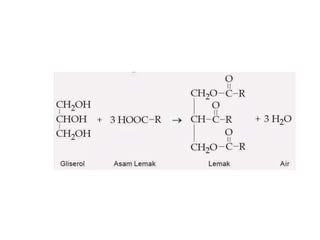
• Acylglycerides, energy source and storage
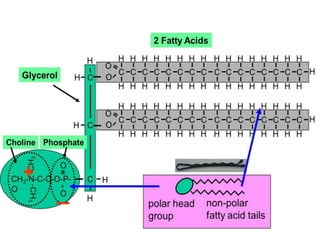
• Complex lipid : Phospholipids, Lipoprotein, Glikolipids,
Aminolipids (active cellular lipids, transport)
• Lipid derivat : Fatty acids, sterols, hormone and bile
acids, eicosanoids (essential metabolite)
• Sources of energy (9 kcal/g)
• Increase palatability
Other functions include:
1. provide means whereby fat-soluble nutrients
(e.g., sterols, vitamins) can be absorbed by the
body
2. structural element of cell, sub cellular
components
3. components of hormones and precursors for
eicosanoids synthesis
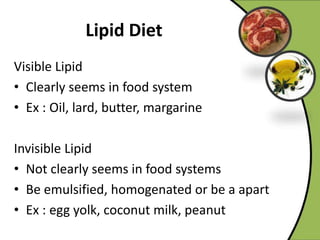
Visible Lipid
• Clearly seems in food system
• Ex : Oil, lard, butter, margarine
Invisible Lipid
• Not clearly seems in food systems
• Be emulsified, homogenated or be a apart
• Ex : egg yolk, coconut milk, peanut
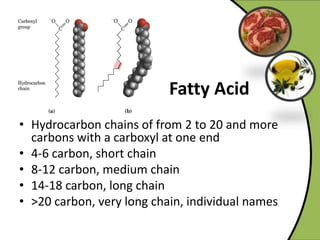
• Hydrocarbon chains of from 2 to 20 and more
carbons with a carboxyl at one end
• 4-6 carbon, short chain
• 8-12 carbon, medium chain
• 14-18 carbon, long chain
• >20 carbon, very long chain, individual names
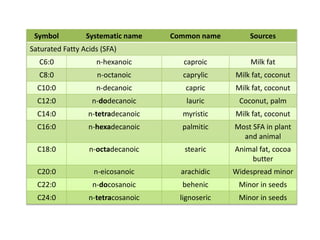
Symbol Systematic name Common name Sources
Saturated Fatty Acids (SFA)
C6:0 n-hexanoic caproic Milk fat
C8:0 n-octanoic caprylic Milk fat, coconut
C10:0 n-decanoic capric Milk fat, coconut
C12:0 n-dodecanoic lauric Coconut, palm
C14:0 n-tetradecanoic myristic Milk fat, coconut
C16:0 n-hexadecanoic palmitic Most SFA in plant
and animal
C18:0 n-octadecanoic stearic Animal fat, cocoa
butter
C20:0 n-eicosanoic arachidic Widespread minor
C22:0 n-docosanoic behenic Minor in seeds
C24:0 n-tetracosanoic lignoseric Minor in seeds
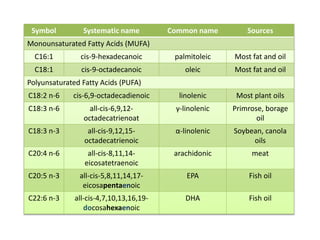
Symbol Systematic name Common name Sources
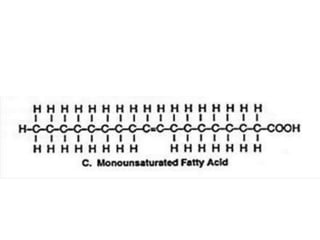
Monounsaturated Fatty Acids (MUFA)
C16:1 cis-9-hexadecanoic palmitoleic Most fat and oil
C18:1 cis-9-octadecanoic oleic Most fat and oil
Polyunsaturated Fatty Acids (PUFA)
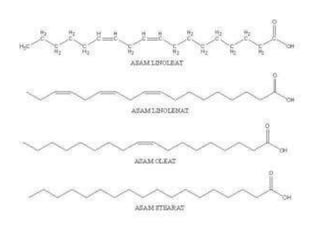
C18:2 n-6 cis-6,9-octadecadienoic linolenic Most plant oils
C18:3 n-6 all-cis-6,9,12-
octadecatrienoat
γ-linolenic Primrose, borage
oil
C18:3 n-3 all-cis-9,12,15-
octadecatrienoic
α-linolenic Soybean, canola
oils
C20:4 n-6 all-cis-8,11,14-
eicosatetraenoic
arachidonic meat
C20:5 n-3 all-cis-5,8,11,14,17-
eicosapentaenoic
EPA Fish oil
C22:6 n-3 all-cis-4,7,10,13,16,19-
docosahexaenoic
DHA Fish oil
Lipid Digestion
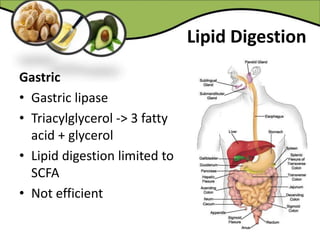
Gastric
• Gastric lipase
• Triacylglycerol -> 3 fatty
acid + glycerol
• Lipid digestion limited to
SCFA
• Not efficient
Lipid Digestion
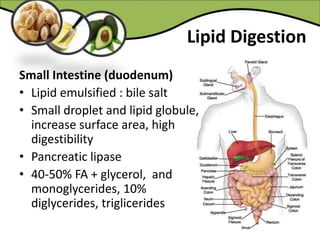
Small Intestine (duodenum)
• Lipid emulsified : bile salt
• Small droplet and lipid globule,
increase surface area, high
digestibility
• Pancreatic lipase
• 40-50% FA + glycerol, and
monoglycerides, 10%
diglycerides, triglicerides
Lipid Absorption
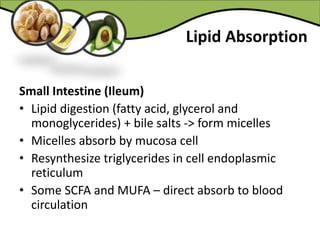
Small Intestine (Ileum)
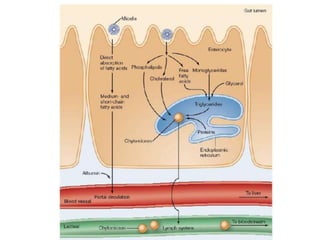
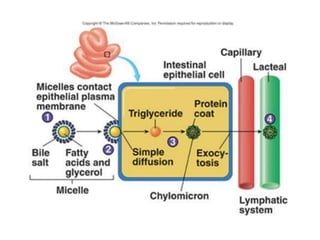
• Lipid digestion (fatty acid, glycerol and
monoglycerides) + bile salts -> form micelles
• Micelles absorb by mucosa cell
• Resynthesize triglycerides in cell endoplasmic
reticulum
• Some SCFA and MUFA – direct absorb to blood
circulation
Lipid Transport
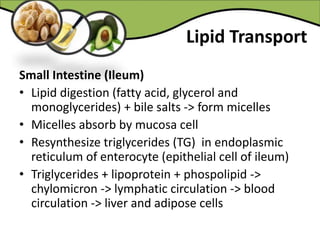
Small Intestine (Ileum)
• Lipid digestion (fatty acid, glycerol and
monoglycerides) + bile salts -> form micelles
• Micelles absorb by mucosa cell
• Resynthesize triglycerides (TG) in endoplasmic
reticulum of enterocyte (epithelial cell of ileum)
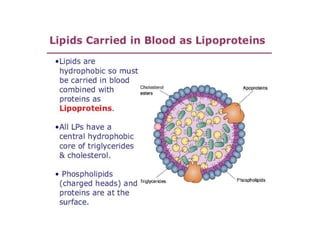
• Triglycerides + lipoprotein + phospolipid ->
chylomicron -> lymphatic circulation -> blood
circulation -> liver and adipose cells
Lipid Metabolism
Liver and Miosit Tissue
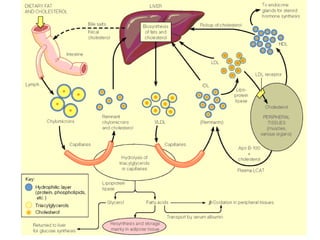
• Chylomicron breakdown (lipoprotein lipase),
TG + cholesterol is transported into adipose
tissue or miosit tissue (muscle)
• Beta oxidation of fatty acid in miosit
(mitochondrion) -> energy
Lipid Deposit
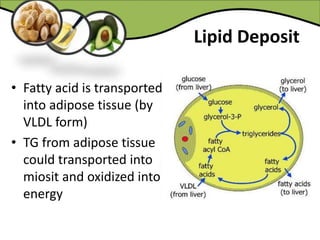
• Fatty acid is transported
into adipose tissue (by
VLDL form)
• TG from adipose tissue
could transported into
miosit and oxidized into
energy
Next..?
Write short review, handwritten, max 1 page
(A4 letter), choose 1 topic only :
• Trans FA metabolism
• Health aspect of Omega-3 FA
• Cholesterol metabolism
• Eicosanoids metabolism
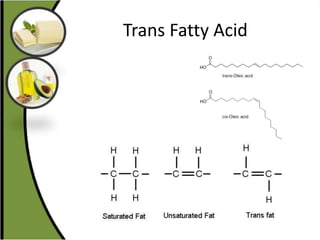
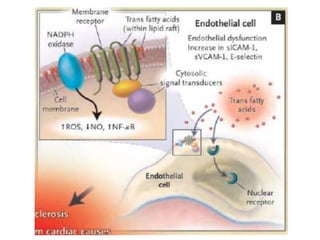
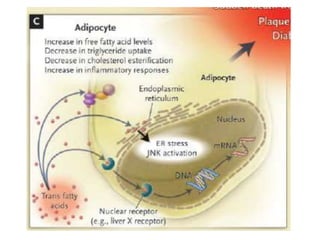
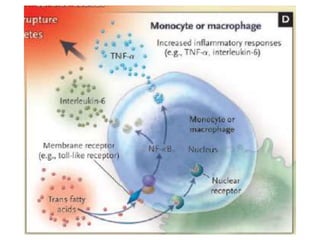
Trans Fatty Acid
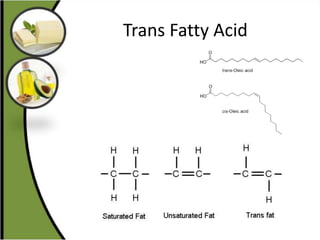
• Unsaturated fatty acids with at least one
double bond in the trans configuration
• Are formed during the partial
hydrogenation of vegetable oils
• Food industry: long shelf life, their
stability during deep-frying, and their
semi solidity, which can be customized
to enhance the palatability of baked
goods and sweets
Trans Fatty Acid
Trans Fatty Acid
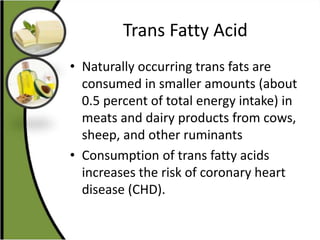
• Naturally occurring trans fats are
consumed in smaller amounts (about
0.5 percent of total energy intake) in
meats and dairy products from cows,
sheep, and other ruminants
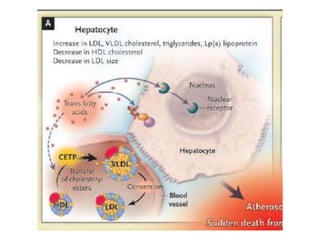
• Consumption of trans fatty acids
increases the risk of coronary heart
disease (CHD).
Trans Fatty Acid
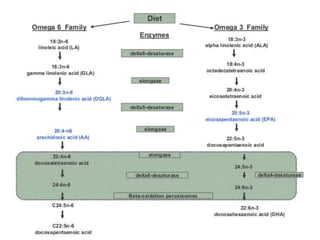
Fatty Acid Metabolism
• MUFA intake from food and
enzymatically synthesis from SFA (9-
desaturase enzyme)
• C16:0  C16:1, C18:0  C18:1
• PUFA (linoleat and linolenat) are
essential FA
• ω3 are synthesized from linolenic acid,
but ω6 form linoleic acid
• Oleic acid  C20:3 ω9 (essential FA
deficiency)
Fatty Acid Metabolism
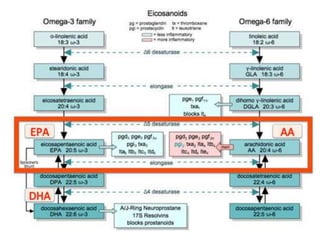
• Delta 6 desaturase: limiting enzyme
(preferred substrate : linoleic)
• Linoleic abundant in food > linolenic
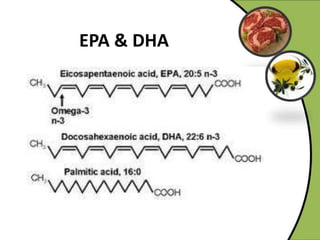
• EPA and DHA : slowly shynthesized
(increased from food intake)
Omega-3 FA vs CVD
• decrease risk for arrhythmias, which can
lead to sudden cardiac death.
• decrease risk for thrombosis, which can
lead to heart attack and stroke.
• decrease triglyceride and remnant
lipoprotein levels.
• decrease rate of growth of the
atherosclerotic plaque.
• improve endothelial function.
• (slightly) lower blood pressure.
• reduce inflammatory responses
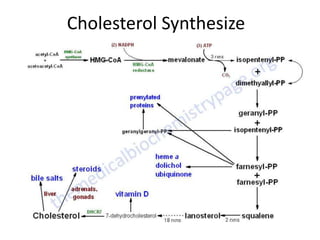
Cholesterol Synthesize
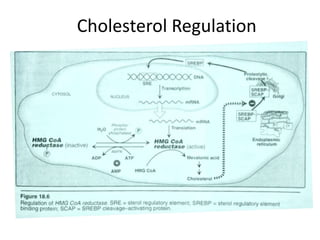
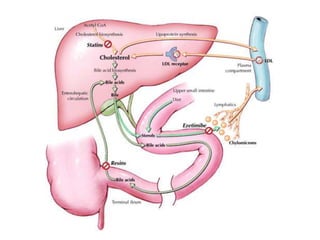
Cholesterol Regulation
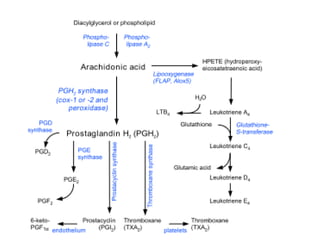
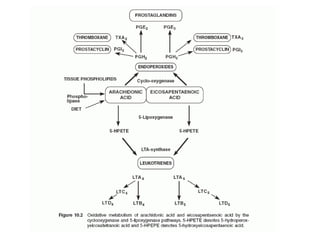
Eicosanoids
• Hormone likes compound
• Short half-life
• C20 FA : precursors of eicosanoids
synthesize (ALA, Arachidonic acid, EPA)
• Prostaglandin, tromboxan,
prostacyclin, leukotriena, lipoxin
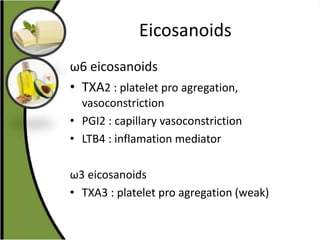
Eicosanoids
ω6 eicosanoids
• TXA2 : platelet pro agregation,
vasoconstriction
• PGI2 : capillary vasoconstriction
• LTB4 : inflamation mediator
ω3 eicosanoids
• TXA3 : platelet pro agregation (weak)
Evaluation of Lipid
• Invitro
rancidity test (peroxides, FFA, TBA test), iod test,
cholesterol content, lipid-trans, fatty acid profile
• Invivo
(hypocholesterolemia, hypotrigliseridemia effect)
blood lipid profile, level of cholesterol, TG, HDL
and LDL level, foam cell analysis, Intima Media
Thickness Level, etc
Lipid evaluation

Lipid evaluation

  • 1.
    Laboratorium Nutrisi Pangandan Hasil Pertanian Program Studi Ilmu dan Teknologi Pangan Jurusan Teknologi Hasil Pertanian FTP - UB 2015
  • 2.
    Lipid • structural componentof all living cell • Integral to membranes, gives form to a cellular components Major classes • Acylglycerides, energy source and storage • Complex lipid : Phospholipids, Lipoprotein, Glikolipids, Aminolipids (active cellular lipids, transport) • Lipid derivat : Fatty acids, sterols, hormone and bile acids, eicosanoids (essential metabolite)
  • 3.
    • Sources ofenergy (9 kcal/g) • Increase palatability Other functions include: 1. provide means whereby fat-soluble nutrients (e.g., sterols, vitamins) can be absorbed by the body 2. structural element of cell, sub cellular components 3. components of hormones and precursors for eicosanoids synthesis
  • 4.
    Visible Lipid • Clearlyseems in food system • Ex : Oil, lard, butter, margarine Invisible Lipid • Not clearly seems in food systems • Be emulsified, homogenated or be a apart • Ex : egg yolk, coconut milk, peanut
  • 7.
    • Hydrocarbon chainsof from 2 to 20 and more carbons with a carboxyl at one end • 4-6 carbon, short chain • 8-12 carbon, medium chain • 14-18 carbon, long chain • >20 carbon, very long chain, individual names
  • 8.
    Symbol Systematic nameCommon name Sources Saturated Fatty Acids (SFA) C6:0 n-hexanoic caproic Milk fat C8:0 n-octanoic caprylic Milk fat, coconut C10:0 n-decanoic capric Milk fat, coconut C12:0 n-dodecanoic lauric Coconut, palm C14:0 n-tetradecanoic myristic Milk fat, coconut C16:0 n-hexadecanoic palmitic Most SFA in plant and animal C18:0 n-octadecanoic stearic Animal fat, cocoa butter C20:0 n-eicosanoic arachidic Widespread minor C22:0 n-docosanoic behenic Minor in seeds C24:0 n-tetracosanoic lignoseric Minor in seeds
  • 9.
    Symbol Systematic nameCommon name Sources Monounsaturated Fatty Acids (MUFA) C16:1 cis-9-hexadecanoic palmitoleic Most fat and oil C18:1 cis-9-octadecanoic oleic Most fat and oil Polyunsaturated Fatty Acids (PUFA) C18:2 n-6 cis-6,9-octadecadienoic linolenic Most plant oils C18:3 n-6 all-cis-6,9,12- octadecatrienoat γ-linolenic Primrose, borage oil C18:3 n-3 all-cis-9,12,15- octadecatrienoic α-linolenic Soybean, canola oils C20:4 n-6 all-cis-8,11,14- eicosatetraenoic arachidonic meat C20:5 n-3 all-cis-5,8,11,14,17- eicosapentaenoic EPA Fish oil C22:6 n-3 all-cis-4,7,10,13,16,19- docosahexaenoic DHA Fish oil
  • 13.
    Lipid Digestion Gastric • Gastriclipase • Triacylglycerol -> 3 fatty acid + glycerol • Lipid digestion limited to SCFA • Not efficient
  • 14.
    Lipid Digestion Small Intestine(duodenum) • Lipid emulsified : bile salt • Small droplet and lipid globule, increase surface area, high digestibility • Pancreatic lipase • 40-50% FA + glycerol, and monoglycerides, 10% diglycerides, triglicerides
  • 15.
    Lipid Absorption Small Intestine(Ileum) • Lipid digestion (fatty acid, glycerol and monoglycerides) + bile salts -> form micelles • Micelles absorb by mucosa cell • Resynthesize triglycerides in cell endoplasmic reticulum • Some SCFA and MUFA – direct absorb to blood circulation
  • 16.
    Lipid Transport Small Intestine(Ileum) • Lipid digestion (fatty acid, glycerol and monoglycerides) + bile salts -> form micelles • Micelles absorb by mucosa cell • Resynthesize triglycerides (TG) in endoplasmic reticulum of enterocyte (epithelial cell of ileum) • Triglycerides + lipoprotein + phospolipid -> chylomicron -> lymphatic circulation -> blood circulation -> liver and adipose cells
  • 21.
    Lipid Metabolism Liver andMiosit Tissue • Chylomicron breakdown (lipoprotein lipase), TG + cholesterol is transported into adipose tissue or miosit tissue (muscle) • Beta oxidation of fatty acid in miosit (mitochondrion) -> energy
  • 22.
    Lipid Deposit • Fattyacid is transported into adipose tissue (by VLDL form) • TG from adipose tissue could transported into miosit and oxidized into energy
  • 23.
    Next..? Write short review,handwritten, max 1 page (A4 letter), choose 1 topic only : • Trans FA metabolism • Health aspect of Omega-3 FA • Cholesterol metabolism • Eicosanoids metabolism
  • 24.
    Trans Fatty Acid •Unsaturated fatty acids with at least one double bond in the trans configuration • Are formed during the partial hydrogenation of vegetable oils • Food industry: long shelf life, their stability during deep-frying, and their semi solidity, which can be customized to enhance the palatability of baked goods and sweets
  • 25.
  • 26.
    Trans Fatty Acid •Naturally occurring trans fats are consumed in smaller amounts (about 0.5 percent of total energy intake) in meats and dairy products from cows, sheep, and other ruminants • Consumption of trans fatty acids increases the risk of coronary heart disease (CHD).
  • 27.
  • 32.
    Fatty Acid Metabolism •MUFA intake from food and enzymatically synthesis from SFA (9- desaturase enzyme) • C16:0  C16:1, C18:0  C18:1 • PUFA (linoleat and linolenat) are essential FA • ω3 are synthesized from linolenic acid, but ω6 form linoleic acid • Oleic acid  C20:3 ω9 (essential FA deficiency)
  • 34.
    Fatty Acid Metabolism •Delta 6 desaturase: limiting enzyme (preferred substrate : linoleic) • Linoleic abundant in food > linolenic • EPA and DHA : slowly shynthesized (increased from food intake)
  • 35.
    Omega-3 FA vsCVD • decrease risk for arrhythmias, which can lead to sudden cardiac death. • decrease risk for thrombosis, which can lead to heart attack and stroke. • decrease triglyceride and remnant lipoprotein levels. • decrease rate of growth of the atherosclerotic plaque. • improve endothelial function. • (slightly) lower blood pressure. • reduce inflammatory responses
  • 36.
  • 37.
  • 39.
    Eicosanoids • Hormone likescompound • Short half-life • C20 FA : precursors of eicosanoids synthesize (ALA, Arachidonic acid, EPA) • Prostaglandin, tromboxan, prostacyclin, leukotriena, lipoxin
  • 43.
    Eicosanoids ω6 eicosanoids • TXA2: platelet pro agregation, vasoconstriction • PGI2 : capillary vasoconstriction • LTB4 : inflamation mediator ω3 eicosanoids • TXA3 : platelet pro agregation (weak)
  • 44.
    Evaluation of Lipid •Invitro rancidity test (peroxides, FFA, TBA test), iod test, cholesterol content, lipid-trans, fatty acid profile • Invivo (hypocholesterolemia, hypotrigliseridemia effect) blood lipid profile, level of cholesterol, TG, HDL and LDL level, foam cell analysis, Intima Media Thickness Level, etc