LIP PRINT
VISHNU RAJ J
CONTENT
Topic one
Topic two
Topic three
Topic four
LIP
PRINTS
2
INTRODUCTION
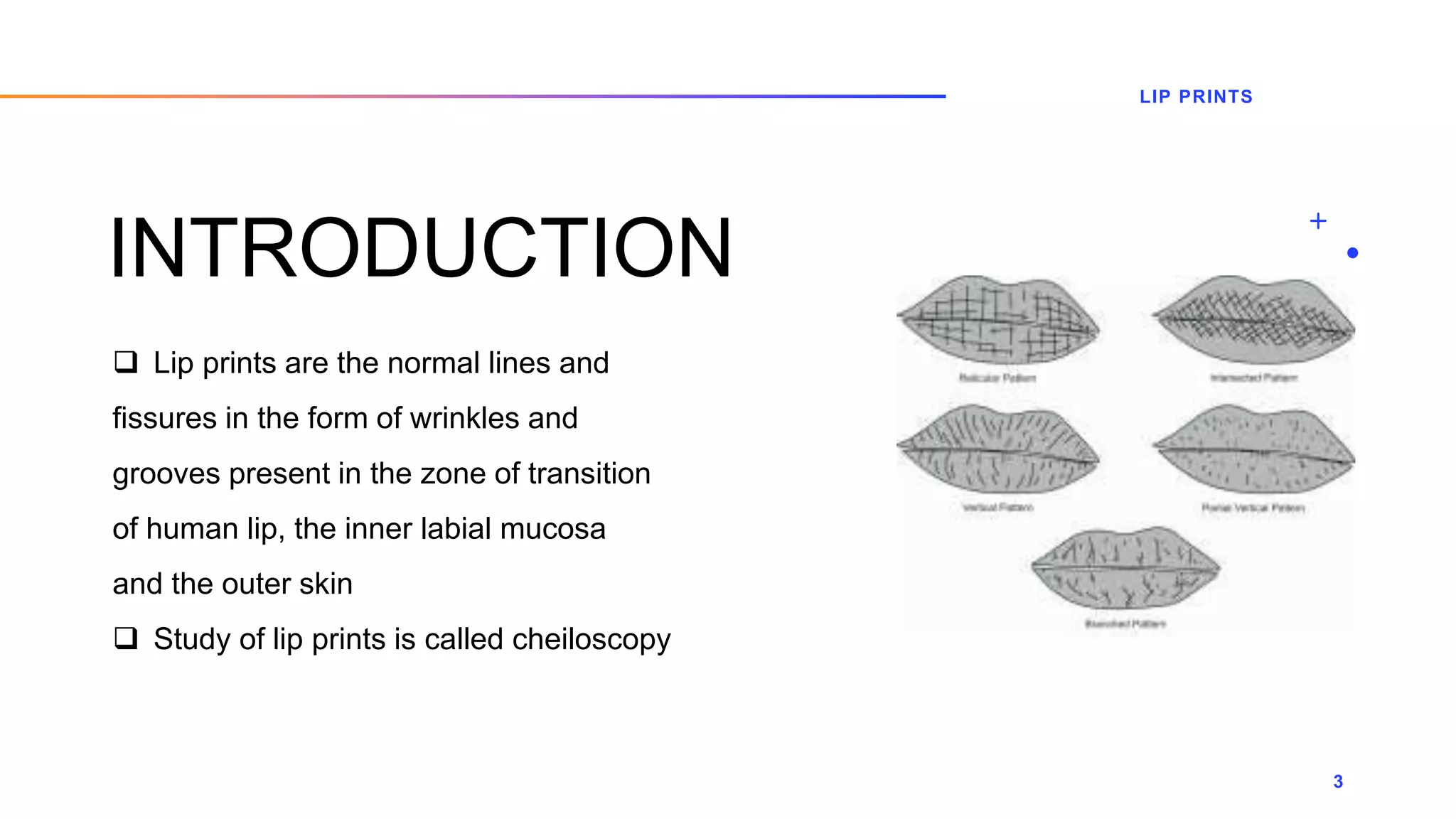
 Lip prints are the normal lines and
fissures in the form of wrinkles and
grooves present in the zone of transition
of human lip, the inner labial mucosa
and the outer skin
 Study of lip prints is called cheiloscopy
LIP PRINTS
3
CLASSIFICATION
Subtitle
Martin santos classification
Suzuki and Tsuchihashi classification
Renaud classification
Afchar – Bayat classification
Jose Maria Dominguez classification
1st proposed by MARTIN SANTOS
SIMPLE WRINKLES
I. Straight line
II. Curved line
III. Angled line
IV. Sine shaped curve
COMPOUND WRINKLES
I. Bifurcated
II. Trifurcated
III. Anomalous
Suzuki and Tsuchihashi’s classification based on grooves (
6 Types)
Type I – clear cut vertical grooves that runs across entire lip
Type I’ – same as Type I , does not cover entire lip.
Type II – Branched grooves
Type III – Intersected grooves
Type IV – Reticular grooves
Type V - Grooves cannot be morphologically differentiated
7
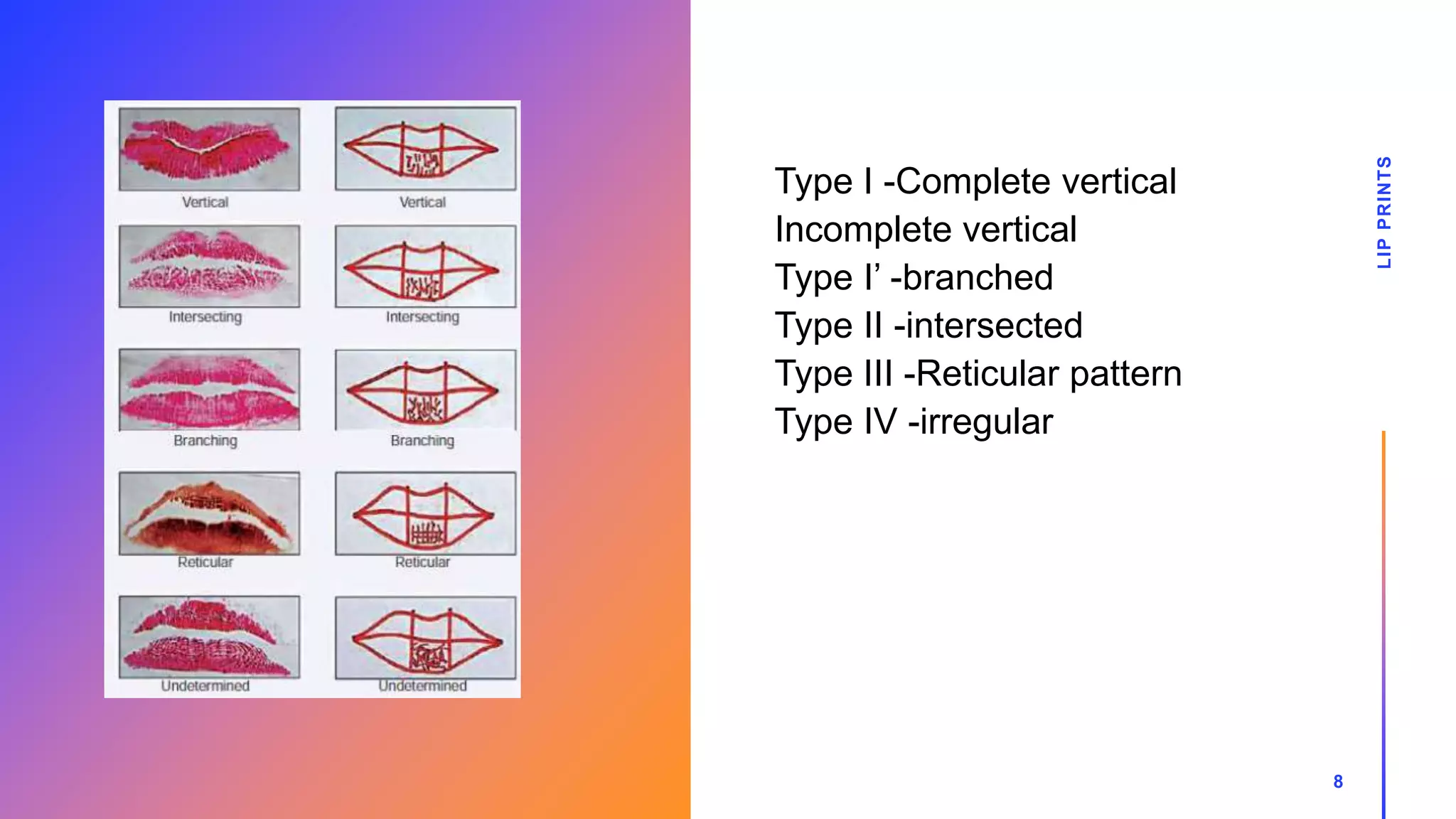
Type I -Complete vertical
Incomplete vertical
Type I’ -branched
Type II -intersected
Type III -Reticular pattern
Type IV -irregular
LIP
PRINTS
8
The study of Chieloscopy has gained much prominence in
recent times, the idea was proposed in 1968 by Yasuo
Tsuchihasi and Kazuo Suzuki at Tokyo University .
They studied the lip prints of people of all ages and concluded
that lip characteristics are unique and stable for a human being.
Much recently, it has been studied that lip prints can also be
used to determine the gender of a human being.
9
The pioneer of Chieloscopy, Professor J.Kasprzak, analyzed 23
unique lip patterns for finding features of human beings.
Such patterns (lines, bifurcations, bridges, pentagones, dots,
lakes, crossings, triangles etc.) are very similar to fingerprint,
iris or palm print patterns.
The statistical characteristics features extracted from the lip
prints also account for unique identification.
10
Michal Choras has re-affirmed the belief in his studies that the
lip can be used as a primary biometric modality for successful
identification purposes.
He has shown that geometrical analysis of the anatomical
parameters of the human lip can be monitored for successful
identification.
Lukasz Smacki has also done significant research studying the
groove patterns in the human lips for personal identification.
11
LIP PRINT AT CRIME SCENE
Lip prints may be left at crime scenes and provide a direct link
to the suspect.
The use of lip sticks was essential to leave behind colored
traces of lip prints.
These marks are characterized by their permanence and
produce ‘persistent’ lip prints that can be recovered days after
being produced.
In recent years, however, lip sticks have been developed that
do not leave any visible trace after contact with surfaces such
as glass, clothing, cutlery or cigarette butts.
12
Although invisible prints can be developed and visualized using
agents like, aluminium powder and magnetic powder.
A combination of these grooves may be found on any set of
lips.
To simplify recording, the lips are divided into quadrants similar
to the dentition- a horizontal line dividing the upper and lower lip
and a vertical line dividing right and left sides.
By noting the type of groove in each quadrant, the individual’s
lip print pattern can be recorded.
13
WAYS OF COLLECTING LIP PRINTS
If located on a non porous surface , lip prints can be photographed and
enlarged .
Using transparent overlap , it is possible to make an overlay tracing
Development of lip prints can be made using several substances , such as
aluminium powder , silver metallic powder etc…
All lip prints contain lipids which make their development possible by using
lysosomes dyes
Sometimes the use of fluorescent reagents , is necessary especially when
the color of developer and color of the surface on which the lip print lies
are the same , or when lip print is an old brand
14
Plumb carbonate is a white powder which can be used as a developer
with a brush , over smooth , polished metallic or plastic surfaces
Its only limitation is its use over white surfaces
Silver nitrate can lead to positive results or non ideal surfaces such as
untreated wood or cardboard
DFO – 1,8 – diazefloren -9- one and ninhydrin are chemical developers
also used as on porous surfaces
In photographs , latent prints can be developed using cyanoacrylate dye
or an iodine spray reagent
15
CONCLUSION
 Identifying live or dead
people is often a time
consuming process.
 Identifying living people is
sometimes difficult because
people do not normally wish
to be identified.
 Therefore in order to
achieve this goal ,people
disguise their presence in
various ways.
LIP
PRINTS
16
17
LIP
PRINT
THANK YOU
VISHNU RAJ

LIP PRINTS

  • 1.
  • 2.
    CONTENT Topic one Topic two Topicthree Topic four LIP PRINTS 2
  • 3.
    INTRODUCTION  Lip printsare the normal lines and fissures in the form of wrinkles and grooves present in the zone of transition of human lip, the inner labial mucosa and the outer skin  Study of lip prints is called cheiloscopy LIP PRINTS 3
  • 4.
  • 5.
    Martin santos classification Suzukiand Tsuchihashi classification Renaud classification Afchar – Bayat classification Jose Maria Dominguez classification
  • 6.
    1st proposed byMARTIN SANTOS SIMPLE WRINKLES I. Straight line II. Curved line III. Angled line IV. Sine shaped curve COMPOUND WRINKLES I. Bifurcated II. Trifurcated III. Anomalous
  • 7.
    Suzuki and Tsuchihashi’sclassification based on grooves ( 6 Types) Type I – clear cut vertical grooves that runs across entire lip Type I’ – same as Type I , does not cover entire lip. Type II – Branched grooves Type III – Intersected grooves Type IV – Reticular grooves Type V - Grooves cannot be morphologically differentiated 7
  • 8.
    Type I -Completevertical Incomplete vertical Type I’ -branched Type II -intersected Type III -Reticular pattern Type IV -irregular LIP PRINTS 8
  • 9.
    The study ofChieloscopy has gained much prominence in recent times, the idea was proposed in 1968 by Yasuo Tsuchihasi and Kazuo Suzuki at Tokyo University . They studied the lip prints of people of all ages and concluded that lip characteristics are unique and stable for a human being. Much recently, it has been studied that lip prints can also be used to determine the gender of a human being. 9
  • 10.
    The pioneer ofChieloscopy, Professor J.Kasprzak, analyzed 23 unique lip patterns for finding features of human beings. Such patterns (lines, bifurcations, bridges, pentagones, dots, lakes, crossings, triangles etc.) are very similar to fingerprint, iris or palm print patterns. The statistical characteristics features extracted from the lip prints also account for unique identification. 10
  • 11.
    Michal Choras hasre-affirmed the belief in his studies that the lip can be used as a primary biometric modality for successful identification purposes. He has shown that geometrical analysis of the anatomical parameters of the human lip can be monitored for successful identification. Lukasz Smacki has also done significant research studying the groove patterns in the human lips for personal identification. 11
  • 12.
    LIP PRINT ATCRIME SCENE Lip prints may be left at crime scenes and provide a direct link to the suspect. The use of lip sticks was essential to leave behind colored traces of lip prints. These marks are characterized by their permanence and produce ‘persistent’ lip prints that can be recovered days after being produced. In recent years, however, lip sticks have been developed that do not leave any visible trace after contact with surfaces such as glass, clothing, cutlery or cigarette butts. 12
  • 13.
    Although invisible printscan be developed and visualized using agents like, aluminium powder and magnetic powder. A combination of these grooves may be found on any set of lips. To simplify recording, the lips are divided into quadrants similar to the dentition- a horizontal line dividing the upper and lower lip and a vertical line dividing right and left sides. By noting the type of groove in each quadrant, the individual’s lip print pattern can be recorded. 13
  • 14.
    WAYS OF COLLECTINGLIP PRINTS If located on a non porous surface , lip prints can be photographed and enlarged . Using transparent overlap , it is possible to make an overlay tracing Development of lip prints can be made using several substances , such as aluminium powder , silver metallic powder etc… All lip prints contain lipids which make their development possible by using lysosomes dyes Sometimes the use of fluorescent reagents , is necessary especially when the color of developer and color of the surface on which the lip print lies are the same , or when lip print is an old brand 14
  • 15.
    Plumb carbonate isa white powder which can be used as a developer with a brush , over smooth , polished metallic or plastic surfaces Its only limitation is its use over white surfaces Silver nitrate can lead to positive results or non ideal surfaces such as untreated wood or cardboard DFO – 1,8 – diazefloren -9- one and ninhydrin are chemical developers also used as on porous surfaces In photographs , latent prints can be developed using cyanoacrylate dye or an iodine spray reagent 15
  • 16.
    CONCLUSION  Identifying liveor dead people is often a time consuming process.  Identifying living people is sometimes difficult because people do not normally wish to be identified.  Therefore in order to achieve this goal ,people disguise their presence in various ways. LIP PRINTS 16
  • 17.