LIP PRINTS CONTENT
 INTRODUCTION
 CHEILOSCOPY
 HISTORY
 CLASSIFICATION
 MATERIALS & METHOD OF COLLECTION
 EXAMINATION
 LATENT LIP PRINT
 MATERIALS & METHOD OF COLLECTION
 RESULT
 ADVANTAGES & DISADVANTAGES
 CASE STUDY & CONCLUSION
WHAT ARE LIP PRINTS?
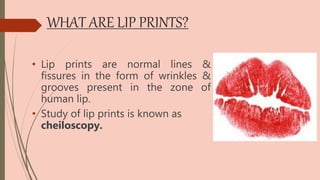
• Lip prints are normal lines &
fissures in the form of wrinkles &
grooves present in the zone of
human lip.
• Study of lip prints is known as
cheiloscopy.
FEATURES
• Lip prints are unique to every individiual just like
finger prints.
• Lip prints are only distinguish factor between two
identical twins.
• lip prints don’t change during entire life.
• Lip prints easily recover after undergoing alteration like
minor trauma and inflammation.
• They are identified as early as 6 week of IUL.
• The lip prints of parent and children and those of siblings
have been shown to have some similarities.
CHEILOSCOPY
• It is the study of lip print which deals with the
forensic investing technique that deals with the
identification of human based lip traces.
• They have to be obtained within 24hr of the time of
death.
• Cheiloscopy technique is equal in value with other
forensic technique like finger prints.
HISTORY
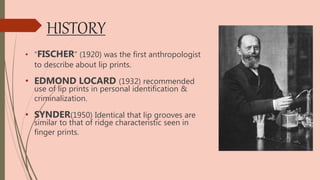
• “FISCHER” (1920) was the first anthropologist
to describe about lip prints.
• EDMOND LOCARD (1932) recommended
use of lip prints in personal identification &
criminalization.
• SYNDER(1950) Identical that lip grooves are
similar to that of ridge characteristic seen in
finger prints.
• Later in 1970 SUZUKI AND TSCUSHIHASHI conducted a
study on 107 japnese families and named the grooves as
LABIORUM RUBRORUM AS SULCI LABIORUM And the lip
print consisting of these grooves as “FIGURA LINEARUM
LABIORUM RUBRORUM”.
• MC DONELL (1972) Identified that lip print were only
distinguish factor between two identical twins.
CLASSIFICATION
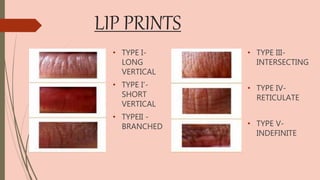
SUZUKI AND TSUCHIHASHI In 1970, devised a
classification method of lip prints, which are as
follows:
1. Type i - a clear-cut vertical grooves that run
across the entire lip.
2. Type i’- similar to type i, but do not cover the
entire lip.
3. Type ii –branched grooves.
4.Type iii – intersected grooves.
5. Type iv- reticular grooves.
6. Type v- grooves that cannot be morphologically
differentiated.
LIP PRINTS
• TYPE I-
LONG
VERTICAL
• TYPE I’-
SHORT
VERTICAL
• TYPEII -
BRANCHED
• TYPE III-
INTERSECTING
• TYPE IV-
RETICULATE
• TYPE V-
INDEFINITE
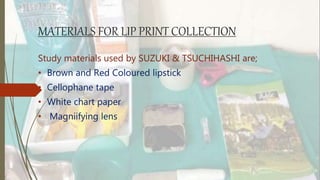
MATERIALS FOR LIP PRINT COLLECTION
Study materials used by SUZUKI & TSUCHIHASHI are;
• Brown and Red Coloured lipstick
• Cellophane tape
• White chart paper
• Magniifying lens
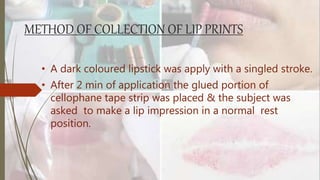
METHOD OF COLLECTION OF LIP PRINTS
• A dark coloured lipstick was apply with a singled stroke.
• After 2 min of application the glued portion of
cellophane tape strip was placed & the subject was
asked to make a lip impression in a normal rest
position.
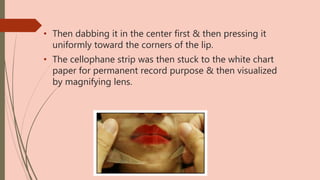
• Then dabbing it in the center first & then pressing it
uniformly toward the corners of the lip.
• The cellophane strip was then stuck to the white chart
paper for permanent record purpose & then visualized
by magnifying lens.
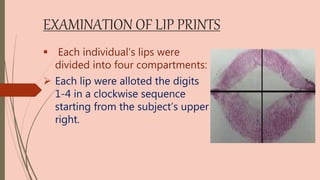
EXAMINATION OF LIP PRINTS
 Each individual’s lips were
divided into four compartments:
 Each lip were alloted the digits
1-4 in a clockwise sequence
starting from the subject’s upper
right.
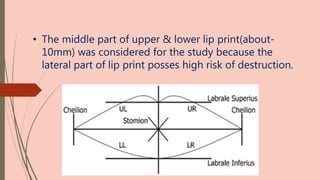
• The middle part of upper & lower lip print(about-
10mm) was considered for the study because the
lateral part of lip print posses high risk of destruction.
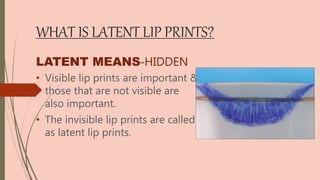
WHAT IS LATENT LIP PRINTS?
LATENT MEANS-HIDDEN
• Visible lip prints are important &
those that are not visible are
also important.
• The invisible lip prints are called
as latent lip prints.
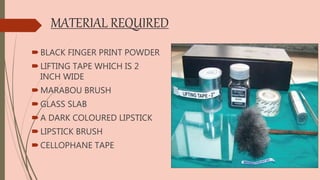
MATERIAL REQUIRED
BLACK FINGER PRINT POWDER
LIFTING TAPE WHICH IS 2
INCH WIDE
MARABOU BRUSH
GLASS SLAB
A DARK COLOURED LIPSTICK
LIPSTICK BRUSH
CELLOPHANE TAPE
METHOD
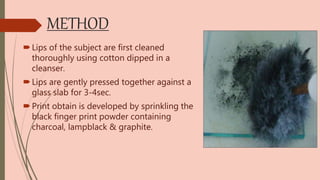
Lips of the subject are first cleaned
thoroughly using cotton dipped in a
cleanser.
Lips are gently pressed together against a
glass slab for 3-4sec.
Print obtain is developed by sprinkling the
black finger print powder containing
charcoal, lampblack & graphite.
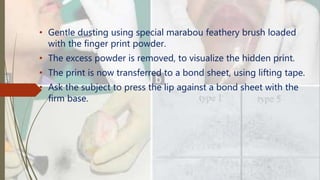
• Gentle dusting using special marabou feathery brush loaded
with the finger print powder.
• The excess powder is removed, to visualize the hidden print.
• The print is now transferred to a bond sheet, using lifting tape.
• Ask the subject to press the lip against a bond sheet with the
firm base.
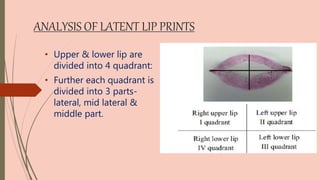
ANALYSIS OF LATENT LIP PRINTS
• Upper & lower lip are
divided into 4 quadrant:
• Further each quadrant is
divided into 3 parts-
lateral, mid lateral &
middle part.
RESULT
A TOTAL OF 100 INDIVIDUALS WERE INCLUDED IN
THE STUDY, COMPRISING OF 50 MALES AND
FEMALES EACH, IN THE AGE GROUP OF 18-30 YEARS.
IN OVERALL STUDY, NO INDIVIDUAL HAD SINGLE
TYPE OF LIP PRINT IN ALL THE FOUR
COMPARTMENTS.
 NO TWO OR MORE INDIVIDUALS HAD SIMILAR TYPE
OF LIP PRINT PATTERN.
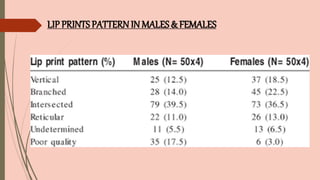
LIP PRINTS PATTERN IN MALES & FEMALES
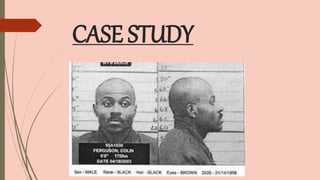
CASE STUDY
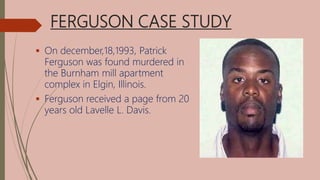
FERGUSON CASE STUDY
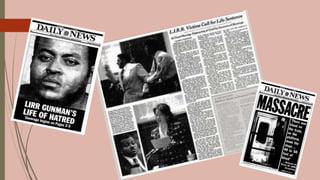
 On december,18,1993, Patrick
Ferguson was found murdered in
the Burnham mill apartment
complex in Elgin, Illinois.
 Ferguson received a page from 20
years old Lavelle L. Davis.
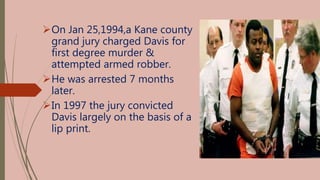
On Jan 25,1994,a Kane county
grand jury charged Davis for
first degree murder &
attempted armed robber.
He was arrested 7 months
later.
In 1997 the jury convicted
Davis largely on the basis of a
lip print.
 The lip print was found on duct tape near the murder
scene.
 It was the only physical evidence which connected Davis to
the crime.
 The prosecution’s forensic witnesses, Lanne Gray(state
police, latent finger print examiner) and Steven Mckasson (
a document examiner) falsely told the jury that lip prints
were an accepted form of identification.
Davis case appears to be the only reported case
in which a lip print has ever been introduced in
evidence.
Later, the witnesses admitted lying to the jury and
were charged.
Davis was released on a bond after 8 years in
prison.
VIRGINIA CASE STUDY
 Detectives caught a suspect red handed, peeping, after identifying
him through lip prints left on a women’s window.
 Officers charged Robert N. Smith, for peeping into a home.
 Without the lip print evidence, smith-accused of spying on women
would absolutely not have been arrested in the case-said by Dave
Dorner(investigating officer).
Then, it was compared with a lip prints that
officers obtained by search warrant from smith.
Scientist used a microscope to check whether the
lip prints matched or not.
“THE LIP PRINT DID MATCH”
Advantages
 In the past decades lip prints studies attracted the attention of many
scientists.
 It acts as a new tool for human identification in both civil & criminal
issues.
 The digital method for analyzing the lip prints images can serve as a
ideal method of permanently storing the data.
 The lip prints being uniform throughout the life, it can be used to verify
the presence or absence of a suspect from crime.
Disadvantages
 Lip prints have to be obtained within 24 hours of the time of
death to prevent postmortem changes of the soft tissues.
 Lip print pattern depend upon whether the mouth is open or
close.
 In close mouth position lip prints exhibit well defined
grooves while in later position, exhibits ill-defined lip print
which may be difficult to interpret.
 Any pathology of lip such as ulceration, Cheilitis,
Granulomatosa (MELKERSON ROSENTHAL SYNDROME)
or tumours may alter the pattern of lip print.
 Post surgical scars can change the lip print patterns.
 Vermilion border of lip has minor salivary glands, and
edges of lips have sebaceous glands & sweat glands.
 Secretion of oil & moisture may lead to the formation of
latent lip prints, which may lead to inaccurate data.
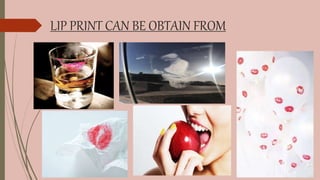
LIP PRINT CAN BE OBTAIN FROM
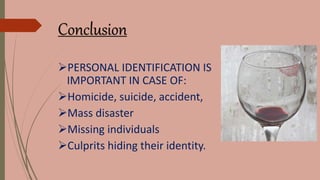
Conclusion
PERSONAL IDENTIFICATION IS
IMPORTANT IN CASE OF:
Homicide, suicide, accident,
Mass disaster
Missing individuals
Culprits hiding their identity.
 Identification is made by comparing the postmortem
record.
 If description of the different parts of the upper and
lower lips are established by detailed study, then this
record can be used for matching the details of lip prints
in postmortem records for personal identification.
 Studies regarding lip prints as evidence in personal
identification and criminal investigation is scanty.
SUZUKI Conducted a study and concluded that
lip prints are dissimilar among different
individuals.
Most common lip print pattern among male &
female -intersected type.
Least common lip print-reticular pattern.
 Detailed analysis of lip prints to an observation that
intersected pattern was most predominant in all the
four compartments:
 In both males and females, branched pattern was
common in compartment 3 and 4.
LIP PRINTS ARE USED AS LAWFUL EVIDENCES ONLY IN SOME
COUNTRIES
GREECE
AUSTRIA
UNITED STATES OF AMERICA
HUNGARY
RUGAE PATTERN C0NTENT
INTRODUCTION
DEVELOPMENT
HISTORY
FEATURES
MATERIALS & METHODS
CLASSIFICATION
CASE HISTORY
CONCLUSION
INTRODUCTION
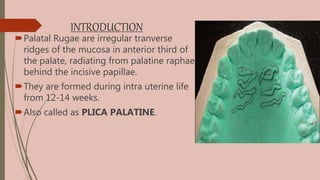
Palatal Rugae are irregular tranverse
ridges of the mucosa in anterior third of
the palate, radiating from palatine raphae
behind the incisive papillae.
They are formed during intra uterine life
from 12-14 weeks.
Also called as PLICA PALATINE.
DEVELOPMENT
It appears towards the 3 month of intra uterine life & it's
growth & development is controlled by epithelial
mesenchymal cells.
The first are distinguished in human embryos of 32mm
next to the incisive papilla.
It does not grow after the age of 10 years.
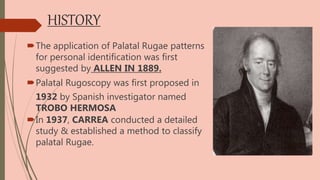
HISTORY
The application of Palatal Rugae patterns
for personal identification was first
suggested by ALLEN IN 1889.
Palatal Rugoscopy was first proposed in
1932 by Spanish investigator named
TROBO HERMOSA
In 1937, CARREA conducted a detailed
study & established a method to classify
palatal Rugae.
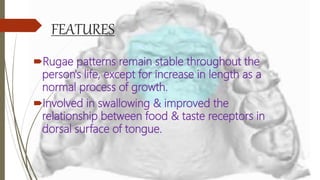
FEATURES
Rugae patterns remain stable throughout the
person's life, except for increase in length as a
normal process of growth.
Involved in swallowing & improved the
relationship between food & taste receptors in
dorsal surface of tongue.
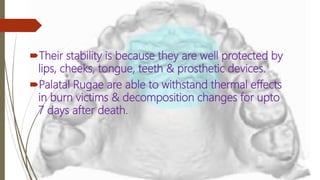
Their stability is because they are well protected by
lips, cheeks, tongue, teeth & prosthetic devices.
Palatal Rugae are able to withstand thermal effects
in burn victims & decomposition changes for upto
7 days after death.
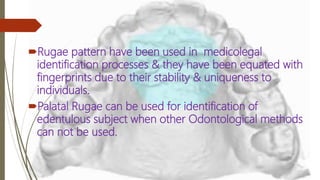
Rugae pattern have been used in medicolegal
identification processes & they have been equated with
fingerprints due to their stability & uniqueness to
individuals.
Palatal Rugae can be used for identification of
edentulous subject when other Odontological methods
can not be used.
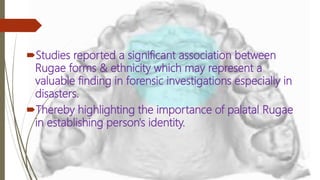
Studies reported a significant association between
Rugae forms & ethnicity which may represent a
valuable finding in forensic investigations especially in
disasters.
Thereby highlighting the importance of palatal Rugae
in establishing person's identity.
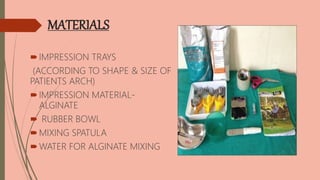
MATERIALS
IMPRESSION TRAYS
(ACCORDING TO SHAPE & SIZE OF
PATIENTS ARCH)
IMPRESSION MATERIAL-
ALGINATE
 RUBBER BOWL
MIXING SPATULA
WATER FOR ALGINATE MIXING
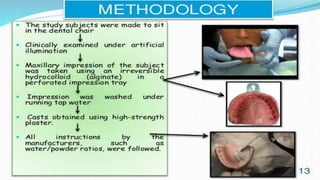
METHODS
CLASSIFICATION
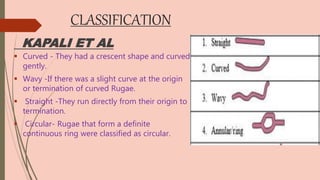
KAPALI ET AL
 Curved - They had a crescent shape and curved
gently.
 Wavy -If there was a slight curve at the origin
or termination of curved Rugae.
 Straight -They run directly from their origin to
termination.
 Circular- Rugae that form a definite
continuous ring were classified as circular.
OTHER CLASSIFICATION
SURVEY
COMPARISON IN DIFFERENT SHAPES OF
RUGAE IN MALES & FEMALES :
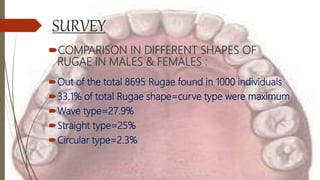
Out of the total 8695 Rugae found in 1000 individuals
33.1% of total Rugae shape=curve type were maximum
Wave type=27.9%
Straight type=25%
Circular type=2.3%
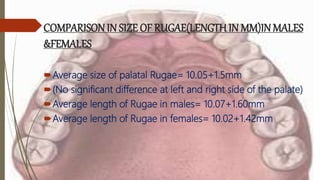
COMPARISON IN SIZE OF RUGAE(LENGTH IN MM)IN MALES
&FEMALES
Average size of palatal Rugae= 10.05+1.5mm
(No significant difference at left and right side of the palate)
Average length of Rugae in males= 10.07+1.60mm
Average length of Rugae in females= 10.02+1.42mm
STATISTICALLY,THERE IS NO
SIGNIFICANT DIFFERENCE IN THE SIZE
OF PALATAL RUGAE BETWEEN THE
TWO GENDERS.
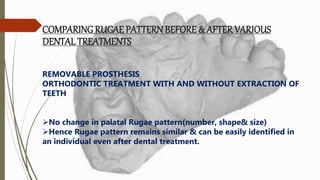
COMPARING RUGAE PATTERN BEFORE & AFTERVARIOUS
DENTAL TREATMENTS
REMOVABLE PROSTHESIS
ORTHODONTIC TREATMENT WITH AND WITHOUT EXTRACTION OF
TEETH
No change in palatal Rugae pattern(number, shape& size)
Hence Rugae pattern remains similar & can be easily identified in
an individual even after dental treatment.
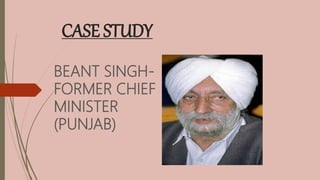
CASE STUDY
BEANT SINGH-
FORMER CHIEF
MINISTER
(PUNJAB)
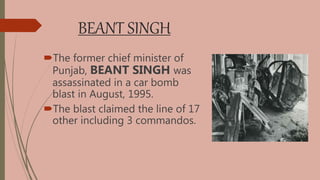
BEANT SINGH
The former chief minister of
Punjab, BEANT SINGH was
assassinated in a car bomb
blast in August, 1995.
The blast claimed the line of 17
other including 3 commandos.
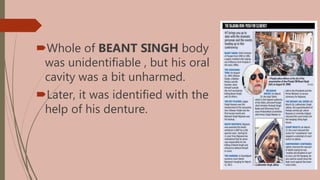
Whole of BEANT SINGH body
was unidentifiable , but his oral
cavity was a bit unharmed.
Later, it was identified with the
help of his denture.
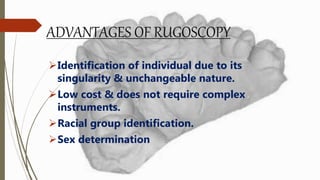
ADVANTAGES OF RUGOSCOPY
Identification of individual due to its
singularity & unchangeable nature.
Low cost & does not require complex
instruments.
Racial group identification.
Sex determination
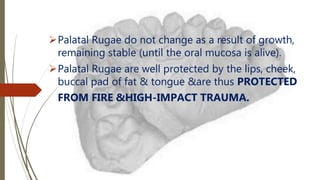
Palatal Rugae do not change as a result of growth,
remaining stable (until the oral mucosa is alive).
Palatal Rugae are well protected by the lips, cheek,
buccal pad of fat & tongue &are thus PROTECTED
FROM FIRE &HIGH-IMPACT TRAUMA.
DISADVANTAGES OF RUGOSCOPY
The changes that occur from orthodontic treatments,
extractions, aging, dentures and extreme finger sucking
in infancy may hamper identification.
It is not useful in Crime Scene Investigation for linking
the suspect with crime scene(no evidence found).
There might be chances of forgery.
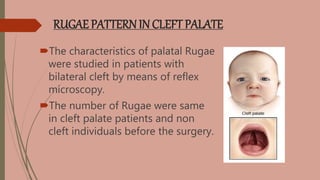
RUGAE PATTERNIN CLEFT PALATE
The characteristics of palatal Rugae
were studied in patients with
bilateral cleft by means of reflex
microscopy.
The number of Rugae were same
in cleft palate patients and non
cleft individuals before the surgery.
Following palatal cleft repair, the rugae count
decreases significantly in patients with
unilateral and bilateral cleft lip and palate.
But the third rugae was never lost after the
surgery.
CONCLUSION
 Palatal Rugae is unique to human beings as fingerprints.
 Thus its use in FORENSIC IDENTIFICATION IS FAIRLY
JUSTIFIED.
 It is a complementary technique for human
identification, providing a significant contribution in
cases of CRIMINAL INVESTIGATION.
Lip print 2018

Lip print 2018

  • 2.
    LIP PRINTS CONTENT INTRODUCTION  CHEILOSCOPY  HISTORY  CLASSIFICATION  MATERIALS & METHOD OF COLLECTION  EXAMINATION  LATENT LIP PRINT  MATERIALS & METHOD OF COLLECTION  RESULT  ADVANTAGES & DISADVANTAGES  CASE STUDY & CONCLUSION
  • 3.
    WHAT ARE LIPPRINTS? • Lip prints are normal lines & fissures in the form of wrinkles & grooves present in the zone of human lip. • Study of lip prints is known as cheiloscopy.
  • 4.
    FEATURES • Lip printsare unique to every individiual just like finger prints. • Lip prints are only distinguish factor between two identical twins. • lip prints don’t change during entire life.
  • 5.
    • Lip printseasily recover after undergoing alteration like minor trauma and inflammation. • They are identified as early as 6 week of IUL. • The lip prints of parent and children and those of siblings have been shown to have some similarities.
  • 6.
    CHEILOSCOPY • It isthe study of lip print which deals with the forensic investing technique that deals with the identification of human based lip traces. • They have to be obtained within 24hr of the time of death. • Cheiloscopy technique is equal in value with other forensic technique like finger prints.
  • 7.
    HISTORY • “FISCHER” (1920)was the first anthropologist to describe about lip prints. • EDMOND LOCARD (1932) recommended use of lip prints in personal identification & criminalization. • SYNDER(1950) Identical that lip grooves are similar to that of ridge characteristic seen in finger prints.
  • 8.
    • Later in1970 SUZUKI AND TSCUSHIHASHI conducted a study on 107 japnese families and named the grooves as LABIORUM RUBRORUM AS SULCI LABIORUM And the lip print consisting of these grooves as “FIGURA LINEARUM LABIORUM RUBRORUM”. • MC DONELL (1972) Identified that lip print were only distinguish factor between two identical twins.
  • 9.
    CLASSIFICATION SUZUKI AND TSUCHIHASHIIn 1970, devised a classification method of lip prints, which are as follows: 1. Type i - a clear-cut vertical grooves that run across the entire lip. 2. Type i’- similar to type i, but do not cover the entire lip. 3. Type ii –branched grooves. 4.Type iii – intersected grooves. 5. Type iv- reticular grooves. 6. Type v- grooves that cannot be morphologically differentiated.
  • 10.
    LIP PRINTS • TYPEI- LONG VERTICAL • TYPE I’- SHORT VERTICAL • TYPEII - BRANCHED • TYPE III- INTERSECTING • TYPE IV- RETICULATE • TYPE V- INDEFINITE
  • 11.
    MATERIALS FOR LIPPRINT COLLECTION Study materials used by SUZUKI & TSUCHIHASHI are; • Brown and Red Coloured lipstick • Cellophane tape • White chart paper • Magniifying lens
  • 12.
    METHOD OF COLLECTIONOF LIP PRINTS • A dark coloured lipstick was apply with a singled stroke. • After 2 min of application the glued portion of cellophane tape strip was placed & the subject was asked to make a lip impression in a normal rest position.
  • 13.
    • Then dabbingit in the center first & then pressing it uniformly toward the corners of the lip. • The cellophane strip was then stuck to the white chart paper for permanent record purpose & then visualized by magnifying lens.
  • 14.
    EXAMINATION OF LIPPRINTS  Each individual’s lips were divided into four compartments:  Each lip were alloted the digits 1-4 in a clockwise sequence starting from the subject’s upper right.
  • 15.
    • The middlepart of upper & lower lip print(about- 10mm) was considered for the study because the lateral part of lip print posses high risk of destruction.
  • 16.
    WHAT IS LATENTLIP PRINTS? LATENT MEANS-HIDDEN • Visible lip prints are important & those that are not visible are also important. • The invisible lip prints are called as latent lip prints.
  • 17.
    MATERIAL REQUIRED BLACK FINGERPRINT POWDER LIFTING TAPE WHICH IS 2 INCH WIDE MARABOU BRUSH GLASS SLAB A DARK COLOURED LIPSTICK LIPSTICK BRUSH CELLOPHANE TAPE
  • 18.
    METHOD Lips of thesubject are first cleaned thoroughly using cotton dipped in a cleanser. Lips are gently pressed together against a glass slab for 3-4sec. Print obtain is developed by sprinkling the black finger print powder containing charcoal, lampblack & graphite.
  • 19.
    • Gentle dustingusing special marabou feathery brush loaded with the finger print powder. • The excess powder is removed, to visualize the hidden print. • The print is now transferred to a bond sheet, using lifting tape. • Ask the subject to press the lip against a bond sheet with the firm base.
  • 20.
    ANALYSIS OF LATENTLIP PRINTS • Upper & lower lip are divided into 4 quadrant: • Further each quadrant is divided into 3 parts- lateral, mid lateral & middle part.
  • 21.
    RESULT A TOTAL OF100 INDIVIDUALS WERE INCLUDED IN THE STUDY, COMPRISING OF 50 MALES AND FEMALES EACH, IN THE AGE GROUP OF 18-30 YEARS. IN OVERALL STUDY, NO INDIVIDUAL HAD SINGLE TYPE OF LIP PRINT IN ALL THE FOUR COMPARTMENTS.  NO TWO OR MORE INDIVIDUALS HAD SIMILAR TYPE OF LIP PRINT PATTERN.
  • 22.
    LIP PRINTS PATTERNIN MALES & FEMALES
  • 23.
  • 24.
    FERGUSON CASE STUDY On december,18,1993, Patrick Ferguson was found murdered in the Burnham mill apartment complex in Elgin, Illinois.  Ferguson received a page from 20 years old Lavelle L. Davis.
  • 25.
    On Jan 25,1994,aKane county grand jury charged Davis for first degree murder & attempted armed robber. He was arrested 7 months later. In 1997 the jury convicted Davis largely on the basis of a lip print.
  • 26.
     The lipprint was found on duct tape near the murder scene.  It was the only physical evidence which connected Davis to the crime.  The prosecution’s forensic witnesses, Lanne Gray(state police, latent finger print examiner) and Steven Mckasson ( a document examiner) falsely told the jury that lip prints were an accepted form of identification.
  • 28.
    Davis case appearsto be the only reported case in which a lip print has ever been introduced in evidence. Later, the witnesses admitted lying to the jury and were charged. Davis was released on a bond after 8 years in prison.
  • 29.
    VIRGINIA CASE STUDY Detectives caught a suspect red handed, peeping, after identifying him through lip prints left on a women’s window.  Officers charged Robert N. Smith, for peeping into a home.  Without the lip print evidence, smith-accused of spying on women would absolutely not have been arrested in the case-said by Dave Dorner(investigating officer).
  • 30.
    Then, it wascompared with a lip prints that officers obtained by search warrant from smith. Scientist used a microscope to check whether the lip prints matched or not. “THE LIP PRINT DID MATCH”
  • 31.
    Advantages  In thepast decades lip prints studies attracted the attention of many scientists.  It acts as a new tool for human identification in both civil & criminal issues.  The digital method for analyzing the lip prints images can serve as a ideal method of permanently storing the data.  The lip prints being uniform throughout the life, it can be used to verify the presence or absence of a suspect from crime.
  • 32.
    Disadvantages  Lip printshave to be obtained within 24 hours of the time of death to prevent postmortem changes of the soft tissues.  Lip print pattern depend upon whether the mouth is open or close.  In close mouth position lip prints exhibit well defined grooves while in later position, exhibits ill-defined lip print which may be difficult to interpret.
  • 33.
     Any pathologyof lip such as ulceration, Cheilitis, Granulomatosa (MELKERSON ROSENTHAL SYNDROME) or tumours may alter the pattern of lip print.  Post surgical scars can change the lip print patterns.  Vermilion border of lip has minor salivary glands, and edges of lips have sebaceous glands & sweat glands.  Secretion of oil & moisture may lead to the formation of latent lip prints, which may lead to inaccurate data.
  • 34.
    LIP PRINT CANBE OBTAIN FROM
  • 35.
    Conclusion PERSONAL IDENTIFICATION IS IMPORTANTIN CASE OF: Homicide, suicide, accident, Mass disaster Missing individuals Culprits hiding their identity.
  • 36.
     Identification ismade by comparing the postmortem record.  If description of the different parts of the upper and lower lips are established by detailed study, then this record can be used for matching the details of lip prints in postmortem records for personal identification.  Studies regarding lip prints as evidence in personal identification and criminal investigation is scanty.
  • 37.
    SUZUKI Conducted astudy and concluded that lip prints are dissimilar among different individuals. Most common lip print pattern among male & female -intersected type. Least common lip print-reticular pattern.
  • 38.
     Detailed analysisof lip prints to an observation that intersected pattern was most predominant in all the four compartments:  In both males and females, branched pattern was common in compartment 3 and 4.
  • 39.
    LIP PRINTS AREUSED AS LAWFUL EVIDENCES ONLY IN SOME COUNTRIES GREECE AUSTRIA UNITED STATES OF AMERICA HUNGARY
  • 40.
  • 41.
    INTRODUCTION Palatal Rugae areirregular tranverse ridges of the mucosa in anterior third of the palate, radiating from palatine raphae behind the incisive papillae. They are formed during intra uterine life from 12-14 weeks. Also called as PLICA PALATINE.
  • 42.
    DEVELOPMENT It appears towardsthe 3 month of intra uterine life & it's growth & development is controlled by epithelial mesenchymal cells. The first are distinguished in human embryos of 32mm next to the incisive papilla. It does not grow after the age of 10 years.
  • 43.
    HISTORY The application ofPalatal Rugae patterns for personal identification was first suggested by ALLEN IN 1889. Palatal Rugoscopy was first proposed in 1932 by Spanish investigator named TROBO HERMOSA In 1937, CARREA conducted a detailed study & established a method to classify palatal Rugae.
  • 44.
    FEATURES Rugae patterns remainstable throughout the person's life, except for increase in length as a normal process of growth. Involved in swallowing & improved the relationship between food & taste receptors in dorsal surface of tongue.
  • 45.
    Their stability isbecause they are well protected by lips, cheeks, tongue, teeth & prosthetic devices. Palatal Rugae are able to withstand thermal effects in burn victims & decomposition changes for upto 7 days after death.
  • 46.
    Rugae pattern havebeen used in medicolegal identification processes & they have been equated with fingerprints due to their stability & uniqueness to individuals. Palatal Rugae can be used for identification of edentulous subject when other Odontological methods can not be used.
  • 47.
    Studies reported asignificant association between Rugae forms & ethnicity which may represent a valuable finding in forensic investigations especially in disasters. Thereby highlighting the importance of palatal Rugae in establishing person's identity.
  • 48.
    MATERIALS IMPRESSION TRAYS (ACCORDING TOSHAPE & SIZE OF PATIENTS ARCH) IMPRESSION MATERIAL- ALGINATE  RUBBER BOWL MIXING SPATULA WATER FOR ALGINATE MIXING
  • 49.
  • 51.
    CLASSIFICATION KAPALI ET AL Curved - They had a crescent shape and curved gently.  Wavy -If there was a slight curve at the origin or termination of curved Rugae.  Straight -They run directly from their origin to termination.  Circular- Rugae that form a definite continuous ring were classified as circular.
  • 52.
  • 53.
    SURVEY COMPARISON IN DIFFERENTSHAPES OF RUGAE IN MALES & FEMALES : Out of the total 8695 Rugae found in 1000 individuals 33.1% of total Rugae shape=curve type were maximum Wave type=27.9% Straight type=25% Circular type=2.3%
  • 54.
    COMPARISON IN SIZEOF RUGAE(LENGTH IN MM)IN MALES &FEMALES Average size of palatal Rugae= 10.05+1.5mm (No significant difference at left and right side of the palate) Average length of Rugae in males= 10.07+1.60mm Average length of Rugae in females= 10.02+1.42mm
  • 55.
    STATISTICALLY,THERE IS NO SIGNIFICANTDIFFERENCE IN THE SIZE OF PALATAL RUGAE BETWEEN THE TWO GENDERS.
  • 56.
    COMPARING RUGAE PATTERNBEFORE & AFTERVARIOUS DENTAL TREATMENTS REMOVABLE PROSTHESIS ORTHODONTIC TREATMENT WITH AND WITHOUT EXTRACTION OF TEETH No change in palatal Rugae pattern(number, shape& size) Hence Rugae pattern remains similar & can be easily identified in an individual even after dental treatment.
  • 57.
    CASE STUDY BEANT SINGH- FORMERCHIEF MINISTER (PUNJAB)
  • 58.
    BEANT SINGH The formerchief minister of Punjab, BEANT SINGH was assassinated in a car bomb blast in August, 1995. The blast claimed the line of 17 other including 3 commandos.
  • 59.
    Whole of BEANTSINGH body was unidentifiable , but his oral cavity was a bit unharmed. Later, it was identified with the help of his denture.
  • 60.
    ADVANTAGES OF RUGOSCOPY Identificationof individual due to its singularity & unchangeable nature. Low cost & does not require complex instruments. Racial group identification. Sex determination
  • 61.
    Palatal Rugae donot change as a result of growth, remaining stable (until the oral mucosa is alive). Palatal Rugae are well protected by the lips, cheek, buccal pad of fat & tongue &are thus PROTECTED FROM FIRE &HIGH-IMPACT TRAUMA.
  • 62.
    DISADVANTAGES OF RUGOSCOPY Thechanges that occur from orthodontic treatments, extractions, aging, dentures and extreme finger sucking in infancy may hamper identification. It is not useful in Crime Scene Investigation for linking the suspect with crime scene(no evidence found). There might be chances of forgery.
  • 63.
    RUGAE PATTERNIN CLEFTPALATE The characteristics of palatal Rugae were studied in patients with bilateral cleft by means of reflex microscopy. The number of Rugae were same in cleft palate patients and non cleft individuals before the surgery.
  • 64.
    Following palatal cleftrepair, the rugae count decreases significantly in patients with unilateral and bilateral cleft lip and palate. But the third rugae was never lost after the surgery.
  • 65.
    CONCLUSION  Palatal Rugaeis unique to human beings as fingerprints.  Thus its use in FORENSIC IDENTIFICATION IS FAIRLY JUSTIFIED.  It is a complementary technique for human identification, providing a significant contribution in cases of CRIMINAL INVESTIGATION.