Project Calico
SECURE NETWORKING FOR THE CLOUD NATIVE ERA
What is SDN?
 Software-Defined Networking (SDN)
 Software-defined networking (SDN) is an architecture purporting to be
dynamic, manageable, cost-effective, and adaptable, seeking to be
suitable for the high-bandwidth, dynamic nature of today's applications.
SDN architectures decouple network control and forwarding functions,
enabling network control to become directly programmable and the
underlying infrastructure to be abstracted from applications and
network services.
 Wikipedia
Why Calico?
 Calico provides secure network connectivity for containers and
virtual machine workloads.
 Calico creates and manages a flat layer 3 network, assigning each
workload a fully routable IP address. Workloads can communicate
without IP encapsulation or network address translation for bare
metal performance, easier troubleshooting, and better
interoperability. In environments that require an overlay, Calico uses
IP-in-IP tunneling or can work with other overlay networking such as
flannel.
Why Calico?
 Simple, remove the complexity, traditional SDNs are complex,
making them hard to deploy and troubleshoot. Calico removes that
complexity, with a simplified networking model designed for the
demands of today's cloud-native applications.
 Calico also provides dynamic enforcement of network security rules.
Using Calico’s simple policy language, you can achieve fine-
grained control over communications between containers, virtual
machine workloads, and bare metal host endpoints.
Why Calico?
 Scalable
 From dev/test to enterprise deployment
 Unlike SDNs that require a central controller, limiting scalability, Calico is
built on a fully distributed, scale-out architecture. So it scales smoothly
from a single developer laptop to large enterprise deployments.
Why Calico?
 Secure
 Policy-based micro-segmentation
 Defining secure network policy used to be reserved for skilled network
engineers. Calico's powerful micro-segmentation capabilities build on a
simple policy language that naturally expresses the developer's intent.
Features
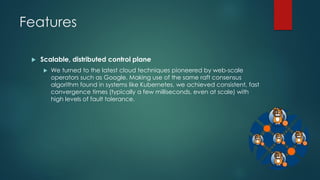
 Scalable, distributed control plane
 We turned to the latest cloud techniques pioneered by web-scale
operators such as Google. Making use of the same raft consensus
algorithm found in systems like Kubernetes, we achieved consistent, fast
convergence times (typically a few milliseconds, even at scale) with
high levels of fault tolerance.
Features
 Policy-driven network security
 Perimeter security (edge firewalls) has been demonstrated time and
again to be insufficient. That's why we built a security layer into Calico
that enables developers and operations staff to easily define with fine
granularity which connections are allowed, and which are not. These
rules implement and extend the Kubernetes Network Policy API – but
also work on all other platforms supported by Calico.
Features
 No overlay required
 Wouldn't it be nice if your virtual networking solution adapted to the
underlying infrastructure, using an overlay only when required? That's
what Calico does. In most environments, Calico simply routes packets
from the workload onto the underlying IP network without any extra
headers. Where an overlay is needed – for example when crossing
availability zone boundaries in public cloud –
Features
 Integrated with all major cloud platforms
 Support for industry standard APIs such as Container Network Interface
(CNI), Neutron, and libnetwork, enables Calico to plug into a wide
variety of cloud orchestrators including:
 Kubernetes
 Mesos
 Docker
 OpenStack
 and various vendor derivatives and distributions
Features
 Widely deployed, and proven at scale
 From a multi-exabyte public storage cloud delivering 99.99999999999%
(that's 13 9's!) durability, to multi-tenant public cloud services powered
by Calico+OpenStack, to the Kubernetes platform that delivers Yahoo!
services to Japan, Calico has established a reputation for enterprise-
grade performance and reliability.
 http://www.virtustream.com/cloud/virtustream-storage-cloud
 http://blog.kubernetes.io/2016/10/kubernetes-and-openstack-at-yahoo-japan.html
Getting Started with Calico?
 Calico with Kubernetes
 Calico with Mesos
 Calico with DC/OS
 Calico with Docker
 Calico with OpenStack
 Calico with rkt
 Host protection
 Proposal date for workshop and which one?
Questions & Contact?
 https://hazzim.io
 Hazzim@Hazzim.io
 Hazzim.Anaya@Gmail.com
 @HazzimAnaya

Project calico - introduction

  • 1.
    Project Calico SECURE NETWORKINGFOR THE CLOUD NATIVE ERA
  • 2.
    What is SDN? Software-Defined Networking (SDN)  Software-defined networking (SDN) is an architecture purporting to be dynamic, manageable, cost-effective, and adaptable, seeking to be suitable for the high-bandwidth, dynamic nature of today's applications. SDN architectures decouple network control and forwarding functions, enabling network control to become directly programmable and the underlying infrastructure to be abstracted from applications and network services.  Wikipedia
  • 3.
    Why Calico?  Calicoprovides secure network connectivity for containers and virtual machine workloads.  Calico creates and manages a flat layer 3 network, assigning each workload a fully routable IP address. Workloads can communicate without IP encapsulation or network address translation for bare metal performance, easier troubleshooting, and better interoperability. In environments that require an overlay, Calico uses IP-in-IP tunneling or can work with other overlay networking such as flannel.
  • 4.
    Why Calico?  Simple,remove the complexity, traditional SDNs are complex, making them hard to deploy and troubleshoot. Calico removes that complexity, with a simplified networking model designed for the demands of today's cloud-native applications.  Calico also provides dynamic enforcement of network security rules. Using Calico’s simple policy language, you can achieve fine- grained control over communications between containers, virtual machine workloads, and bare metal host endpoints.
  • 5.
    Why Calico?  Scalable From dev/test to enterprise deployment  Unlike SDNs that require a central controller, limiting scalability, Calico is built on a fully distributed, scale-out architecture. So it scales smoothly from a single developer laptop to large enterprise deployments.
  • 6.
    Why Calico?  Secure Policy-based micro-segmentation  Defining secure network policy used to be reserved for skilled network engineers. Calico's powerful micro-segmentation capabilities build on a simple policy language that naturally expresses the developer's intent.
  • 7.
    Features  Scalable, distributedcontrol plane  We turned to the latest cloud techniques pioneered by web-scale operators such as Google. Making use of the same raft consensus algorithm found in systems like Kubernetes, we achieved consistent, fast convergence times (typically a few milliseconds, even at scale) with high levels of fault tolerance.
  • 8.
    Features  Policy-driven networksecurity  Perimeter security (edge firewalls) has been demonstrated time and again to be insufficient. That's why we built a security layer into Calico that enables developers and operations staff to easily define with fine granularity which connections are allowed, and which are not. These rules implement and extend the Kubernetes Network Policy API – but also work on all other platforms supported by Calico.
  • 9.
    Features  No overlayrequired  Wouldn't it be nice if your virtual networking solution adapted to the underlying infrastructure, using an overlay only when required? That's what Calico does. In most environments, Calico simply routes packets from the workload onto the underlying IP network without any extra headers. Where an overlay is needed – for example when crossing availability zone boundaries in public cloud –
  • 10.
    Features  Integrated withall major cloud platforms  Support for industry standard APIs such as Container Network Interface (CNI), Neutron, and libnetwork, enables Calico to plug into a wide variety of cloud orchestrators including:  Kubernetes  Mesos  Docker  OpenStack  and various vendor derivatives and distributions
  • 11.
    Features  Widely deployed,and proven at scale  From a multi-exabyte public storage cloud delivering 99.99999999999% (that's 13 9's!) durability, to multi-tenant public cloud services powered by Calico+OpenStack, to the Kubernetes platform that delivers Yahoo! services to Japan, Calico has established a reputation for enterprise- grade performance and reliability.  http://www.virtustream.com/cloud/virtustream-storage-cloud  http://blog.kubernetes.io/2016/10/kubernetes-and-openstack-at-yahoo-japan.html
  • 12.
    Getting Started withCalico?  Calico with Kubernetes  Calico with Mesos  Calico with DC/OS  Calico with Docker  Calico with OpenStack  Calico with rkt  Host protection  Proposal date for workshop and which one?
  • 13.
    Questions & Contact? https://hazzim.io  Hazzim@Hazzim.io  Hazzim.Anaya@Gmail.com  @HazzimAnaya