Comenius University
Faculty of Mathematics, Physics and Informatics
       Department of Computer Science


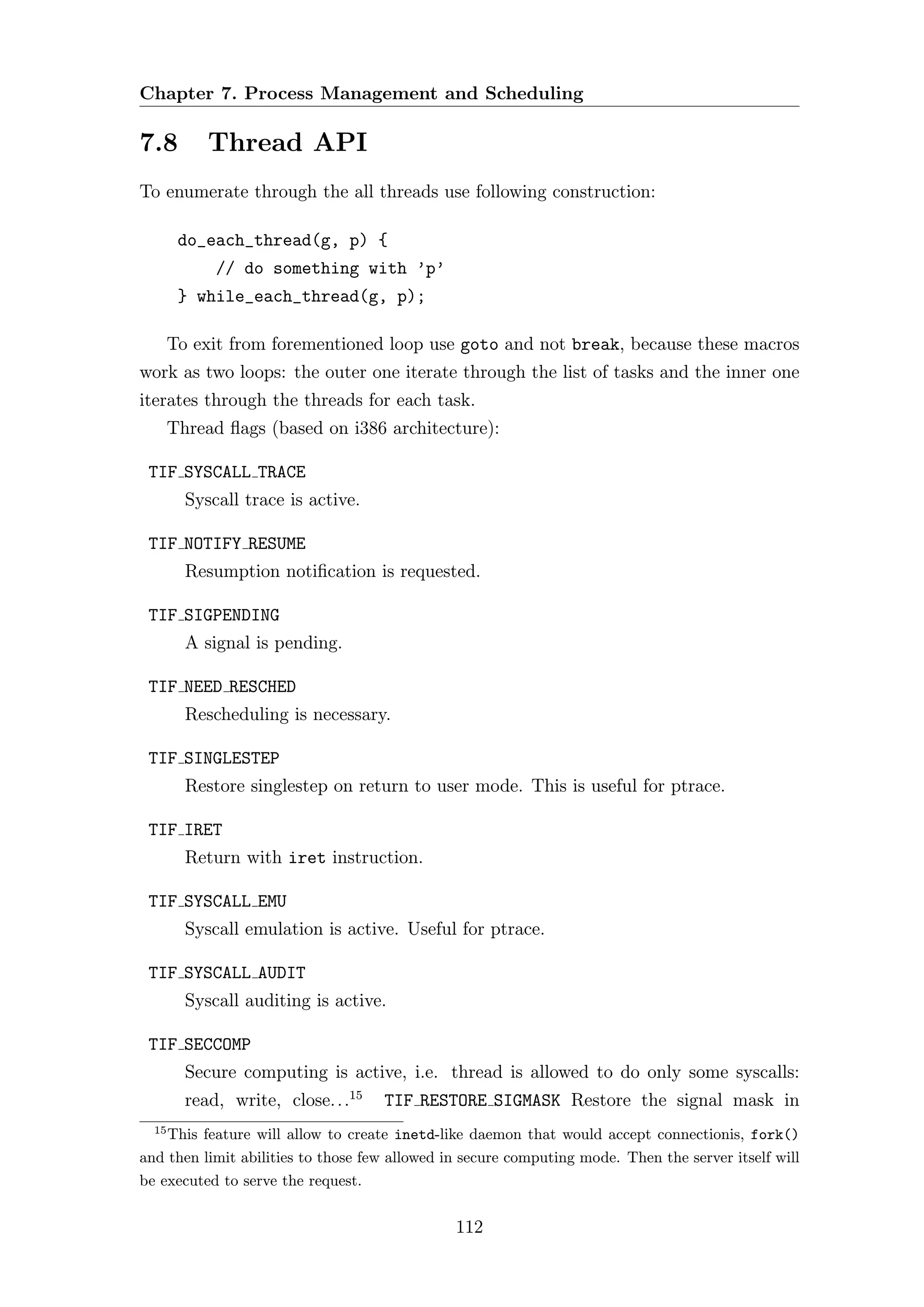
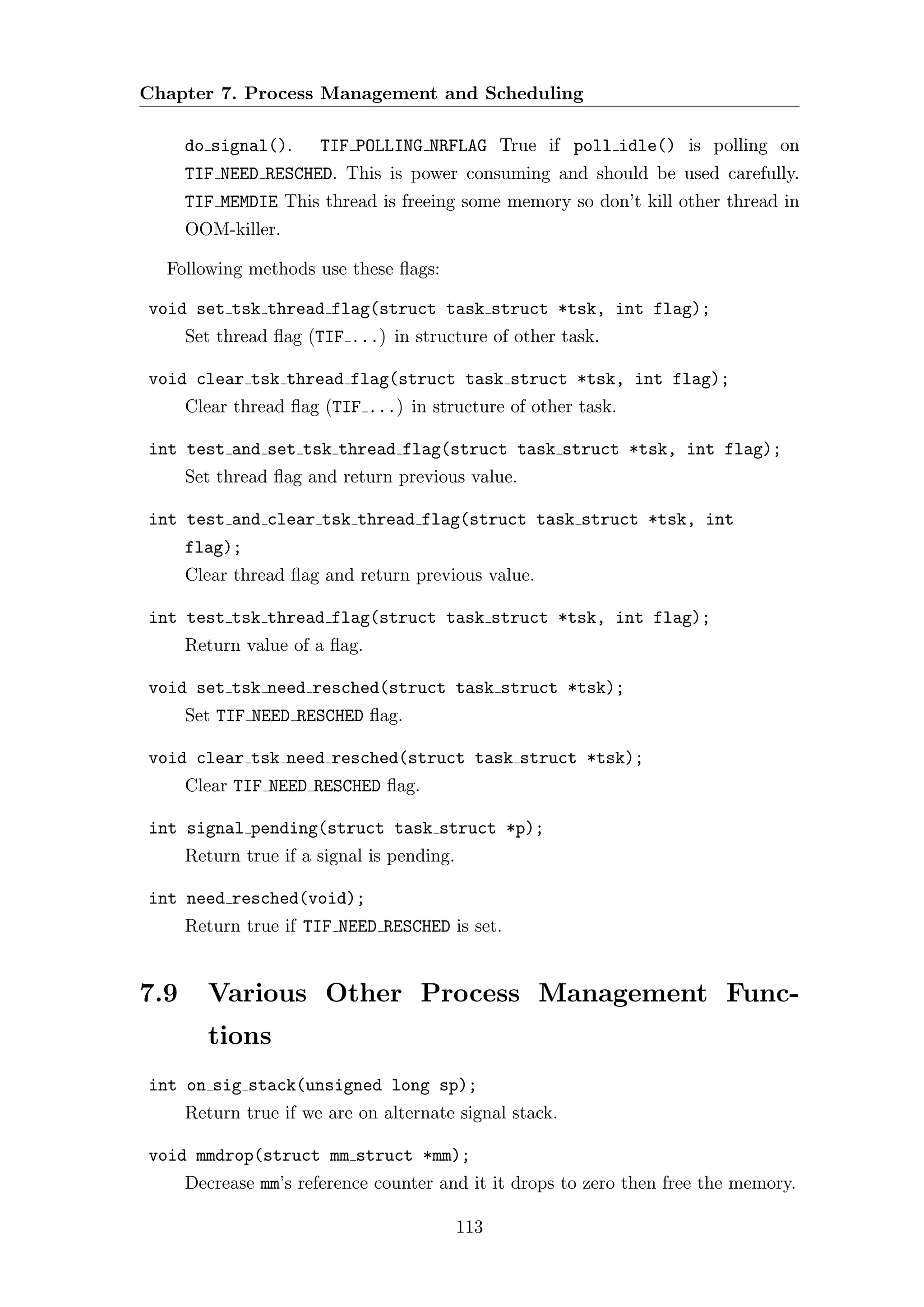
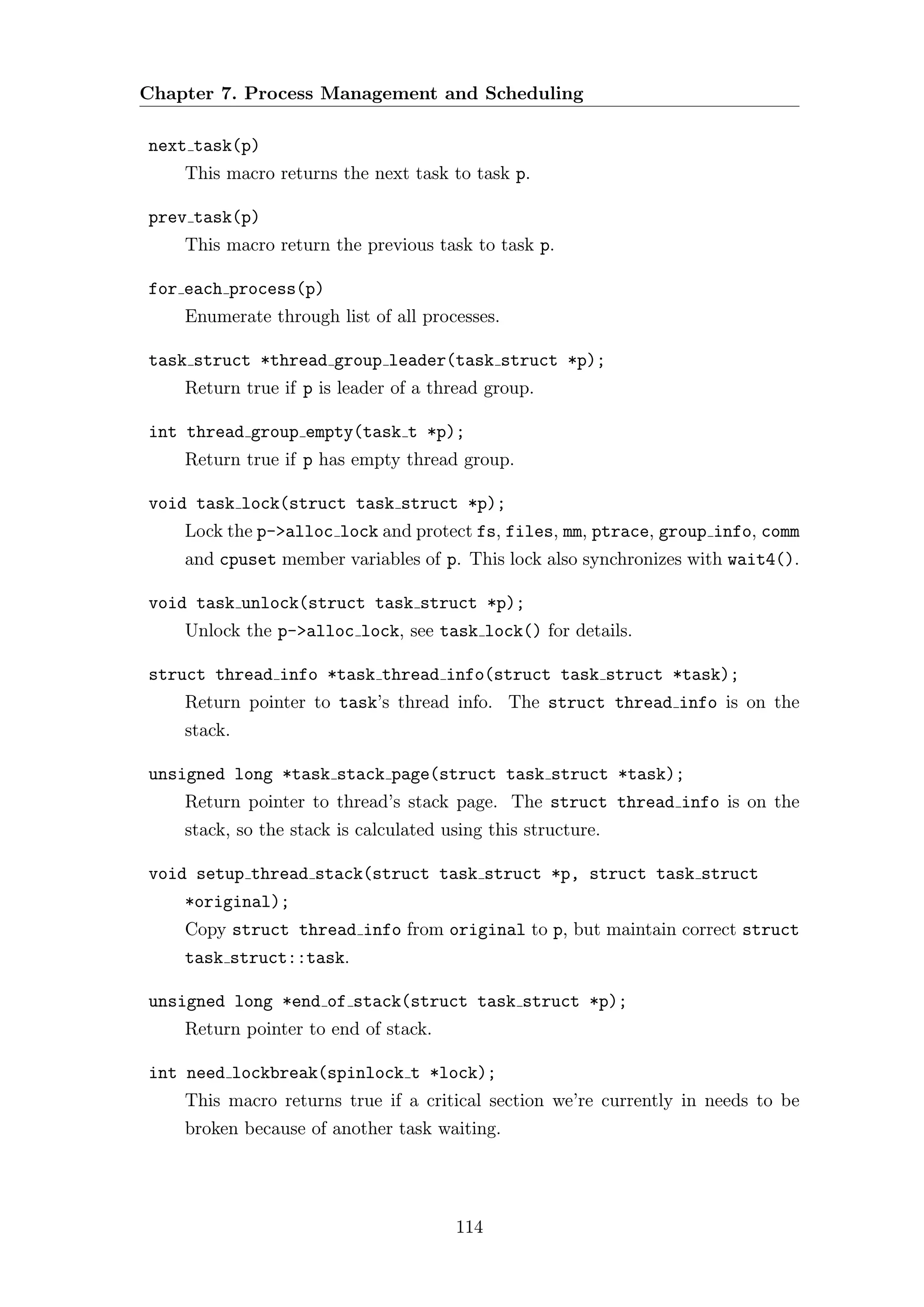
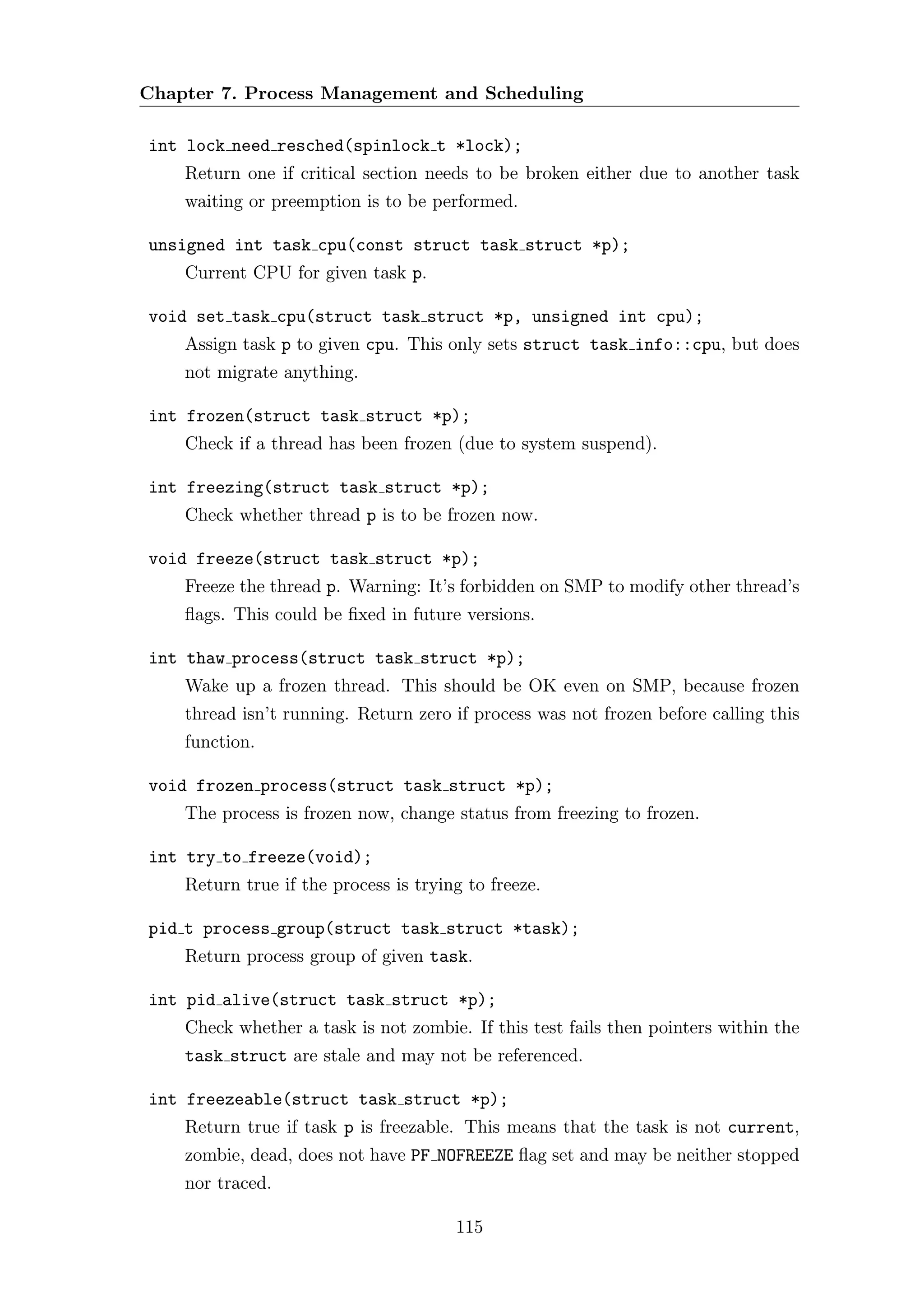
                     Jaroslav Šoltýs


 Linux Kernel 2.6 Documentation

                      Master thesis
          Thesis advisor: RNDr. Jaroslav Janáček


Bratislava                                         2006
By this I declare that I wrote this master thesis by myself, only with the help of
the referenced literature and internet resources, under the supervision of my thesis
advisor.


  Bratislava, 2006                                             Jaroslav Šoltýs
Abstract

This thesis is a study of internal working and interfaces of Linux kernel version 2.6.
It emphasizes differences towards kernel 2.4 and it tries to introduce this problems
to reader knowledgable only in common principles of operating systems.
   The thesis starts with briefing of kernel subsystems and continues with deeper
analysis of important issues like various locking, semaphores and other synchroniza-
tion mechanisms, suitable data structures, interrupt handling, atomic operations,
device driver model and memory allocation.
   Process management and new scheduler with support for multiprocessing and
NUMA architectures and preemption are explored deeply. The core of the work
is concluded with description of loadable kernel module creation together with an
exemplar module.


                                          i
Preface

Fall 2003 brought many testing version of Linux kernel 2.6 and the final 2.6.0 was
released on December 17th 2003. A lot of new interesting features and improved
hardware support were teasing user to try it.
   Linux now scales pretty well on both ends: embedded platforms and large servers
with either SMP or NUMA support. The first has been achieved by merging ucLinux
(branch of Linux for embedded platforms) to main kernel, while the new scheduler
written during 2.5 development branch offers now preemption inside kernel and is
able to take full use of multiple CPUs. This new facts (together with unified driver
model) increase demands on device driver writers’ know-how.
   There was very little documentation to be found concerning this new kernel at
the time I started working on this thesis. I did indeed start before the stable 2.6.0
came out. Also the documentation for older version was incosistent and scattered
throughout the whole web. My task was to study 2.6 kernel (with special attention
to new features in 2.6) and write documentation, that could help kernel beginners.
   Reader is expected to have some preliminary knowledge about operating systems
and some basic understanding of hardware.


Thesis Contents
 Chapter 1: An Informal Introduction to Operating Systems describes the
     basic ideas behind an operating system, shows user the difference between
     monolithic an mikrokernel and mentions Unix traditions. It also contains the
     roughest introduction to Linux kernel and it’s development process.

 Chapter 2: Subsystems Overview lists subsystems and describes each one with
     particular attention to new features introduced in 2.6.

 Chapter 3: Synchronization and Workflow Concurrency takes care about
     locks, semaphores, mutexes and other synchronisation entities. Issues with
     preemption are also mentioned, since existing locking mechanisms has been


                                         ii
improved to cope with these issues. Also one very interesting mechanism
     called read-copy-update is described. The last issues in this chapter are per-
     CPU variables, disabling local interrupts and memory barriers.

 Chapter 4: Linked Lists mentions linked lists, which are intensively used wher-
     ever possible. The complicated variation protected by RCU is also included.

 Chapter 5: Memory Allocation deals with allocating and releasing memory
     using various approches, such as page allocation, slab allocation and virtual
     memory allocation.

 Chapter 6: Handling Interrupts contain all necessary information on how to
     work with hardware interrupts and tasklet interface.

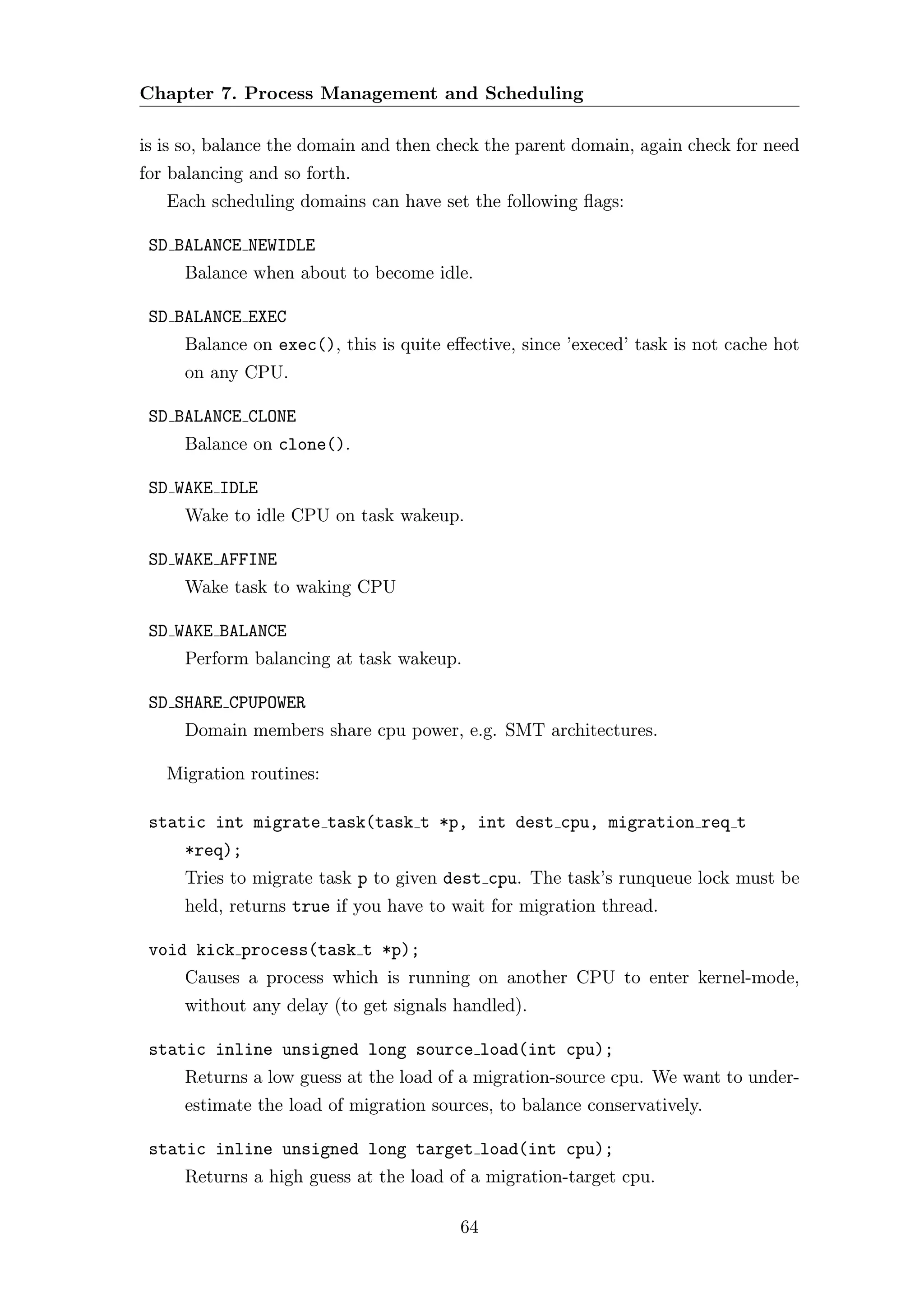
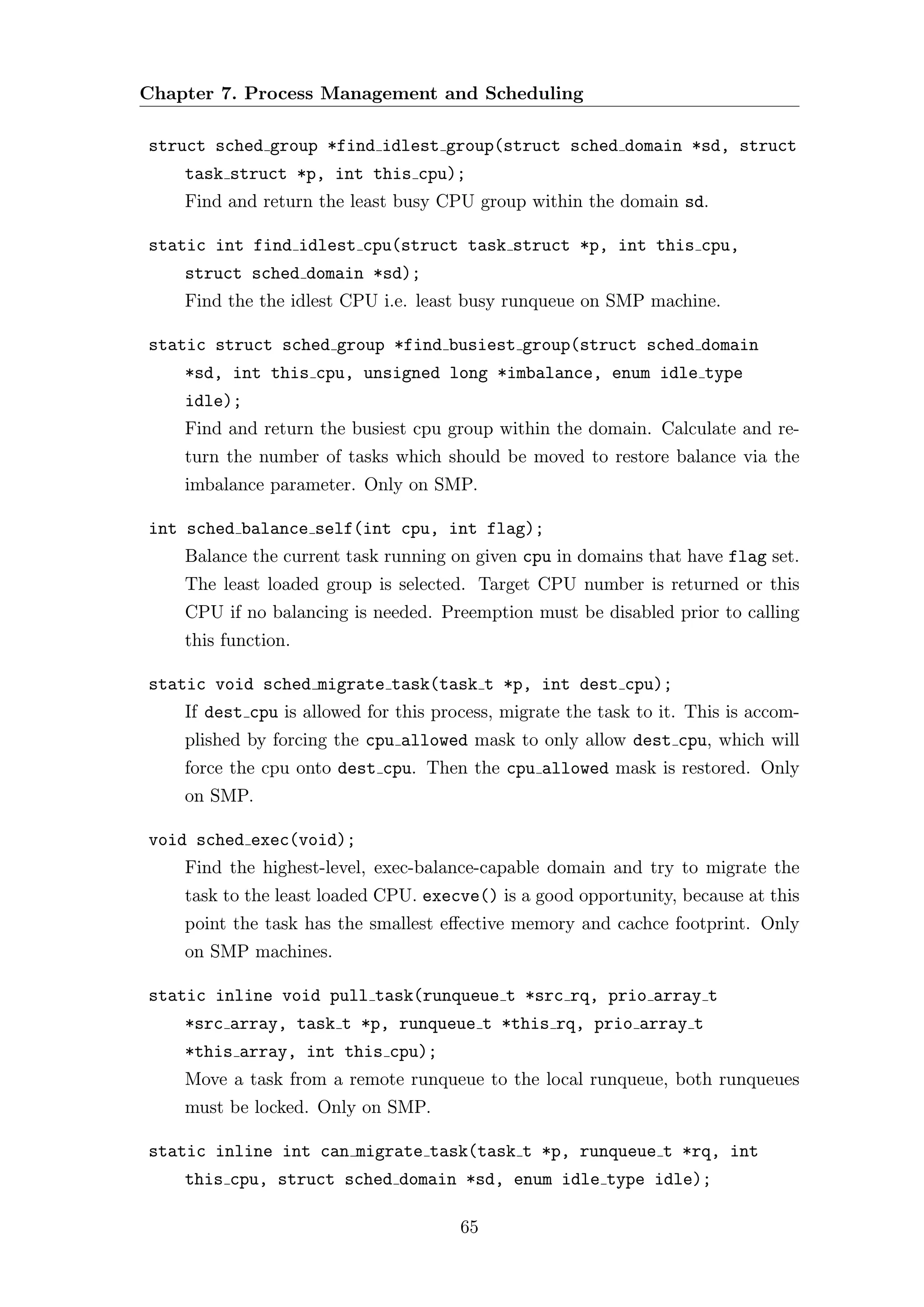
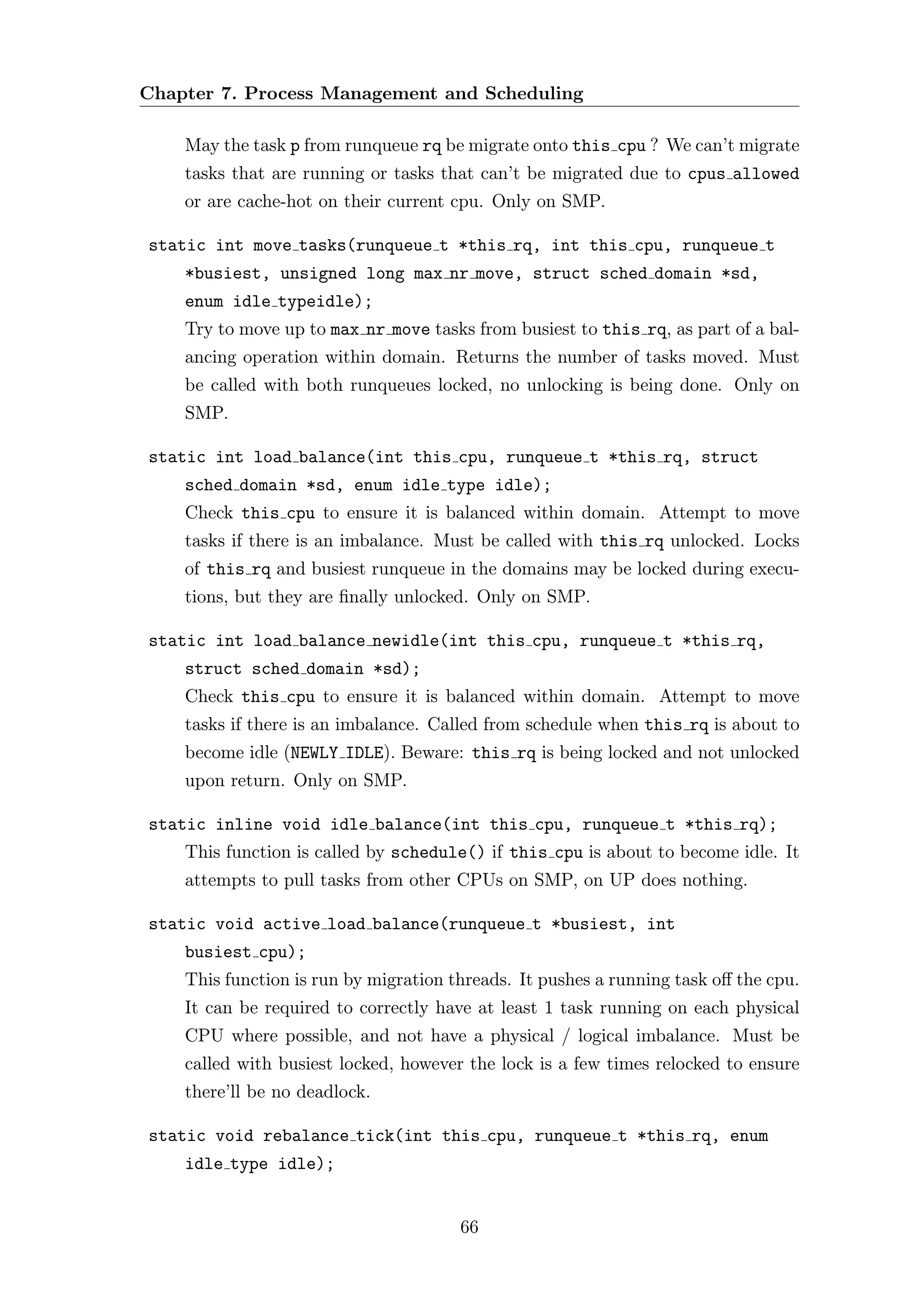
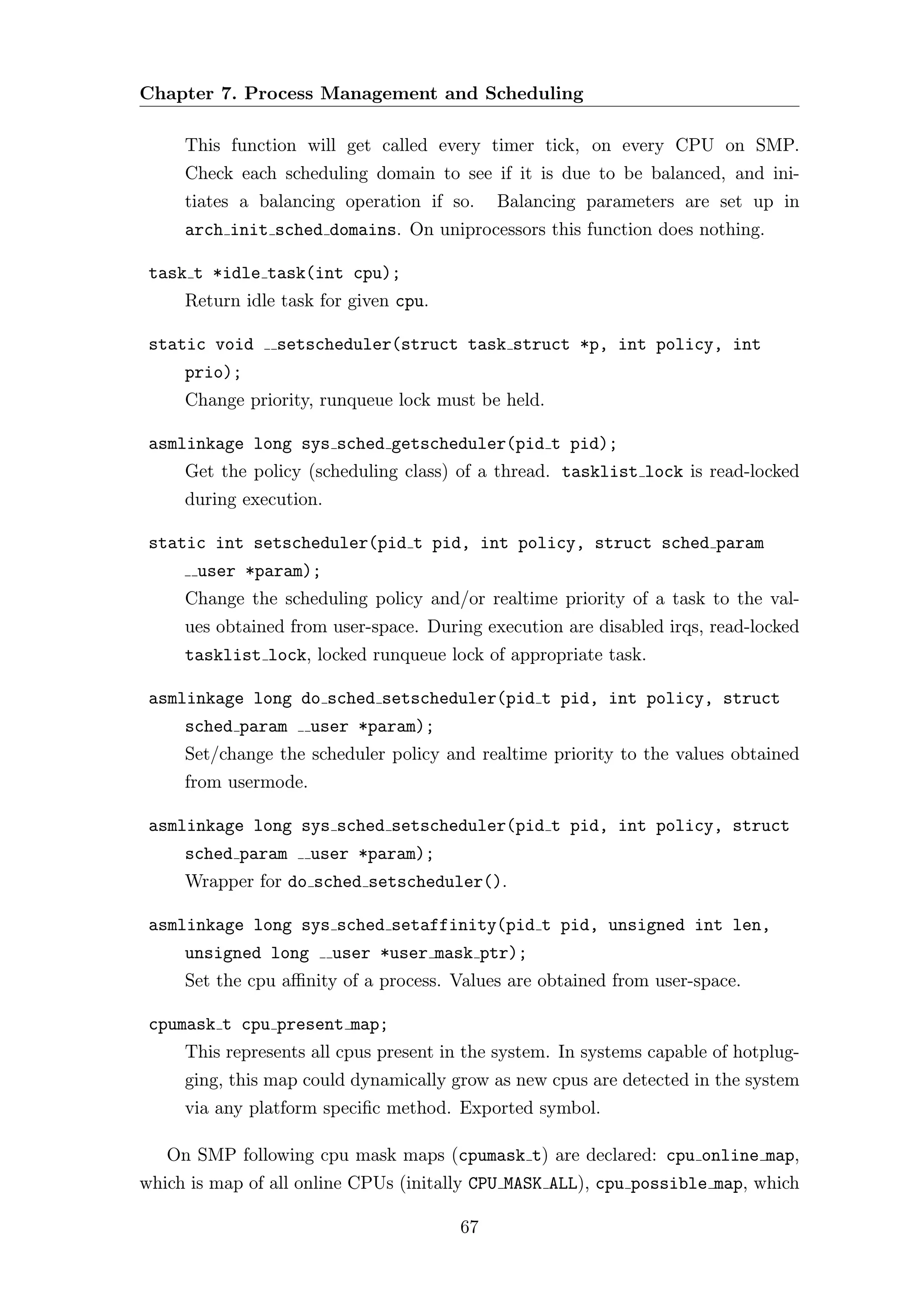
 Chapter 7: Process management and Scheduling concerns in scheduler,
     process life cycle and related issues.

 Chapter 8: New Driver Model in 2.6 describes kernel object architecture and
     sysfs hierarchy, interface for device driver writers and user space event delivery
     mechanism.

 Chapter 9: Common Routines and Helper Macros will introduce various
     macros to access user space memory, manipulate strings and some other com-
     mon routines.

 Chapter 10: Modules contains an exemplary loadable kernel module that ex-
     ports its parameter using sysfs and explains various macros that could help
     with module development.


Typographic Conventions
Typographic conventions used in this thesis are simple and intuitive:
   • Typewriter-like font denotes source code, function() or MACRO definitions
     and related things.

   • Notices are emphasized with slanted font.

   • Warnings and important words are printed in bold.

   • Files and directories like [kernel/sched.c]in Linux kernel source tree are
     enclosed in square brackets.

   • Include files are shown as in ordinary C source code: <linux/list.h>.


                                          iii
Contents

Abstract                                                                                  i

Preface                                                                                  ii
  Thesis Contents . . . . . . . . . . . . . . . . . . . . . . . . . . . . . . . . .       ii
  Typographic Conventions . . . . . . . . . . . . . . . . . . . . . . . . . . .          iii

1 An Informal Introduction to Operating Systems                                          1
  1.1     Monolithic or Micro Kernel? . . . . . . . . . . . . . . . . . . . . . . .       2
  1.2     Concerning Traditional Unix Principles . . . . . . . . . . . . . . . . .        3
  1.3     Overview of the Linux Kernel . . . . . . . . . . . . . . . . . . . . . .        3
  1.4     User Mode and Kernel Mode . . . . . . . . . . . . . . . . . . . . . . .         5
  1.5     About Kernel and Its Development . . . . . . . . . . . . . . . . . . .          5

2 Subsystems Overview                                                                    7
  2.1     System Calls . . . . . . . . . . . . . . . . . . . . . . . . . . . . . . . .    7
  2.2     Process Management and Execution . . . . . . . . . . . . . . . . . . .          8
  2.3     Memory Management . . . . . . . . . . . . . . . . . . . . . . . . . . .         9
  2.4     Interrupts and Exceptions . . . . . . . . . . . . . . . . . . . . . . . . 10
  2.5     Synchronization and Workflow Concurrency . . . . . . . . . . . . . . 10
  2.6     Time and Timers . . . . . . . . . . . . . . . . . . . . . . . . . . . . . 11
  2.7     Signals and Inter-Process Communication . . . . . . . . . . . . . . . 12
  2.8     Virtual File System . . . . . . . . . . . . . . . . . . . . . . . . . . . . 14
  2.9     New Driver Model and Sysfs . . . . . . . . . . . . . . . . . . . . . . . 17
  2.10 Networking . . . . . . . . . . . . . . . . . . . . . . . . . . . . . . . . 17
  2.11 Linked Lists and Their Implementation . . . . . . . . . . . . . . . . . 19

3 Synchronization and Workflow Concurrency                                                20
  3.1     Spinlock . . . . . . . . . . . . . . . . . . . . . . . . . . . . . . . . . . 21
  3.2     Semaphores . . . . . . . . . . . . . . . . . . . . . . . . . . . . . . . . 23
  3.3     Read/Write Semaphores . . . . . . . . . . . . . . . . . . . . . . . . . 24


                                            iv
3.4   Completions . . . . . . . . . . . . . . . . . . . . . . . . . . . . . . . . 25
  3.5   New Mutexes . . . . . . . . . . . . . . . . . . . . . . . . . . . . . . . 27
  3.6 Futexes . . . . . . . . . . . . . . . . . . . . . . . . . . . . . . . . . . 28
  3.7 Preemption . . . . . . . . . . . . . . . . . . . . . . . . . . . . . . . . 29
  3.8 Seqlock and Seqcount . . . . . . . . . . . . . . . . . . . . . . . . . . . 30
  3.9 Atomic Operations . . . . . . . . . . . . . . . . . . . . . . . . . . . . 32
  3.10 Disabling Local IRQs . . . . . . . . . . . . . . . . . . . . . . . . . . . 33
  3.11 Read-copy Update . . . . . . . . . . . . . . . . . . . . . . . . . . . . 34
  3.12 Per-CPU Variables . . . . . . . . . . . . . . . . . . . . . . . . . . . . 36
  3.13 Memory Barriers . . . . . . . . . . . . . . . . . . . . . . . . . . . . . 38

4 Linked lists                                                                        39
  4.1 List API . . . . . . . . . . . . . . . . . . . . . . . . . . . . . . . . . . 39
  4.2 RCU Protected Lists . . . . . . . . . . . . . . . . . . . . . . . . . . . 42

5 Memory Allocation                                                                   44
  5.1 Slab Memory Allocation . . . . . . . . . . . . . . . . . . . . . . . . . 44
  5.2 Virtual Memory Allocation . . . . . . . . . . . . . . . . . . . . . . . . 47
  5.3 Page Allocation . . . . . . . . . . . . . . . . . . . . . . . . . . . . . . 48

6 Handling Interrupts                                                                 50
  6.1 Hardware Interrupts . . . . . . . . . . . . . . . . . . . . . . . . . . . 50
  6.2 Softirqs and Tasklets . . . . . . . . . . . . . . . . . . . . . . . . . . . 52

7 Process Management and Scheduling                                                   56
  7.1 Scheduler . . . . . . . . . . . . . . . . . . . . . . . . . . . . . . . . . 58
        7.1.1   Priority . . . . . . . . . . . . . . . . . . . . . . . . . . . . . . 60
        7.1.2   Runqueues . . . . . . . . . . . . . . . . . . . . . . . . . . . . . 61
        7.1.3   Load Balancing and Migration . . . . . . . . . . . . . . . . . . 63
        7.1.4   Task State Management and Switching . . . . . . . . . . . . . 71
  7.2 Process Forking . . . . . . . . . . . . . . . . . . . . . . . . . . . . . . 79
  7.3 Process Termination . . . . . . . . . . . . . . . . . . . . . . . . . . . 86
  7.4 Waitqueues . . . . . . . . . . . . . . . . . . . . . . . . . . . . . . . . 94
  7.5 Workqueues and Kernel Threads           . . . . . . . . . . . . . . . . . . . . 101
  7.6 PIDs . . . . . . . . . . . . . . . . . . . . . . . . . . . . . . . . . . . . 107
  7.7 Process Accounting for Linux . . . . . . . . . . . . . . . . . . . . . . 109
  7.8 Thread API . . . . . . . . . . . . . . . . . . . . . . . . . . . . . . . . 112
  7.9 Various Other Process Management Functions . . . . . . . . . . . . . 113


                                          v
8 New Driver Model in 2.6                                                           117
  8.1   From Kobject to Sysfs . . . . . . . . . . . . . . . . . . . . . . . . . . 118
        8.1.1   Kref API    . . . . . . . . . . . . . . . . . . . . . . . . . . . . . 118
        8.1.2   Kobject API . . . . . . . . . . . . . . . . . . . . . . . . . . . . 118
        8.1.3   Kset API . . . . . . . . . . . . . . . . . . . . . . . . . . . . . 120
        8.1.4   Subsystem API . . . . . . . . . . . . . . . . . . . . . . . . . . 121
        8.1.5   Kernel to User Space Event Delivery . . . . . . . . . . . . . . 122
  8.2 Bus . . . . . . . . . . . . . . . . . . . . . . . . . . . . . . . . . . . . . 123
  8.3 Drivers . . . . . . . . . . . . . . . . . . . . . . . . . . . . . . . . . . . 126
  8.4 Classes . . . . . . . . . . . . . . . . . . . . . . . . . . . . . . . . . . . 127
  8.5 Class Devices . . . . . . . . . . . . . . . . . . . . . . . . . . . . . . . 129
  8.6 Class Interface . . . . . . . . . . . . . . . . . . . . . . . . . . . . . . . 132
  8.7 Devices     . . . . . . . . . . . . . . . . . . . . . . . . . . . . . . . . . . 133
  8.8 Extended structures       . . . . . . . . . . . . . . . . . . . . . . . . . . . 136

9 Common Routines and Helper Macros                                                 138
  9.1 String Manipulation . . . . . . . . . . . . . . . . . . . . . . . . . . . 138
  9.2 Various Helper Macros . . . . . . . . . . . . . . . . . . . . . . . . . . 140
  9.3 User Space Memory Access . . . . . . . . . . . . . . . . . . . . . . . . 141

10 Modules                                                                          144
  10.1 An Exemplary Module . . . . . . . . . . . . . . . . . . . . . . . . . . 144
  10.2 Kernel Purity . . . . . . . . . . . . . . . . . . . . . . . . . . . . . . . 146
  10.3 Module Properties . . . . . . . . . . . . . . . . . . . . . . . . . . . . 146
  10.4 Module Parameters . . . . . . . . . . . . . . . . . . . . . . . . . . . . 147
  10.5 Building Modules . . . . . . . . . . . . . . . . . . . . . . . . . . . . . 150
  10.6 Exporting Symbols . . . . . . . . . . . . . . . . . . . . . . . . . . . . 151

11 Conclusion                                                                       152

Bibliography                                                                        154

Glossary                                                                            157

Abstract in Slovak Language                                                         160


                                          vi
Chapter 1

An Informal Introduction to
Operating Systems

Kernel of an operating system (OS) usually remains hidden beyond common user
space programs and system utilities (until some serious error occurs). Let’s start
with describing what’s happening inside your computer:


      Your goal is to check for an e-mail. You run your favorite mail user agent and
order to get work done for you.

         Operating system uses notion of a task, in this case your mail user
        agent is a task for him. The word task was often used in past, but users
        of modern Unixes prefer to use word process. OS provides environment
                                                                        1
        for this task/process by using some abstraction or emulation.

      Instead of taking care for every detail, process let kernel to take care of some
details, but he takes care of details of his part of the task. Back to the mail agent:
there’s no need to take care of your video card, your keyboard, your mouse, or details
about how are the files stored on your hard drive.

         Many operating systems exclude graphic routines from the kernel, leav-
        ing implementation to user space programs. Your mail agent runs in
        graphic mode, with colorful icons on buttons. It’s common on Unix-
        like systems to use X server in order to run graphical applications, and
        you’ve probably noticed, that these graphic services are not provided by
        kernel.
  1
      Emulation is scarce in Linux


                                           1
Chapter 1. An Informal Introduction to Operating Systems

Where does the kernel fit in? It provides mechanisms for processes to communicate
and to cooperate with each other. And sometimes also mechanisms to prevent
processes to hurt each other.
      Presume you have video conference running in small window next to your mail
agent and a music player. How is it possible to run so many applications with only
one processor ? Remember the abstraction we mentioned above:

         Each running task is provided environment like it’s the only one running
        and kernel takes care of switching between tasks so quickly that you can’t
        see that there is always only one task running and the others are stopped.

      This was only a small list of kernel’s duties. When you start your computer up,
when you shut it down (except for killing him with power blackout), when you access
your files, it’s always there, watching over resources, time and memory assigned to
each process, handling events from outer world, providing needful trifles, but it is
also judge and police when some of your processes breaks the law.


1.1        Monolithic or Micro Kernel?
Linux was developed by Linus Torvalds in the beginning of 90s, at the time he used
Minix, developed by prof. Andrew Tanenbaum. Minix (providing similar syscall
interface like Unix systems) was internally designed as microkernel, while Linux is
monolithic (with ability to load external modules).
      Microkernels have never gained much success in commercial sphere with probably
one exception: QNX2 . They are more interesting from academic point of view.
      Mikrokernels delegate responsibilities to user space processes instead of doing
everything needed right in the kernel. This leads to simpler and cleaner internal
architecture, modifying one subsystem consists of modifying a user space task and
not the kernel. These tasks (called daemons or servers) don’t run in privileged mode
as kernel does, which should improve stability of the system.
      Monolithic kernels proved to be much faster. Linux, Windows (from NT 3.51
upwards), various BSD branches belong to this family. The problem is that serving
one syscall needs many context switches in microkernel model and modern processors
can gain performance from utilizing cache. This cache is not used efficiently during
context switch.
  2
      QNX is a real time operating system and was intended for use with embedded hardware


                                               2
Chapter 1. An Informal Introduction to Operating Systems

       Microkernel fans often accuse Linux of having dirty internal design. In reality
kernel developers try to clean any mess in unstable branch3 .
       Linux uses kernel threads and loadable kernel modules to increase flexibility.
Kernel threads are meant only for slow things (for example swapping) because of
two more context switches needed.


1.2         Concerning Traditional Unix Principles
Unix was created more than 3 decades ago and it’s often thought of as father of
modern operating systems. Original design offered two running processes, but this
was overcome. Developed in cooperation between university and commercial sector,
it soon included new ideas, such as TCP/IP networking. Its security increased
from nothing to some of the most secure systems available today, including various
security policy enhancements.
       One of the most important Unix concepts is the notion of file. Files are not only
regular files; block and character devices, pipes, named pipes (also called FIFOs),
but symbolic links and TCP streams are also treated like special files. Pipe allow two
programs to cooperate. Unix users sometimes mention the KISS principle: Keep it
simple, small. The vast majority of traditional Unix tools does only one thing, but
they do it perfectly. Instead of accessing directly keyboard and screen, Unix prefers
to provide standard input, output (and error output), which can be redirected and
used to automate user tasks.
       Preemptible multitasking allows tasks to be switched independently on the ’will-
ingness’ of the task, virtual memory provides process more memory that could be
allocated only using physical RAM. Processes don’t need to care about other pro-
cesses in memory4 .
       Many of these ideas seem to be low-level, yet they provide strong instrument to
developer. This is also often criticized, but building operating system on ground
not solid and stable does not enforce good security.


1.3         Overview of the Linux Kernel
Linux started as 386-specific system, but soon developers from other architectures
adopted the source and in time improved it to support 24 architectures. Writing
   3
     Just have a look at the scheduler code in 2.6, all those routines and data structures, one’s
wishing to have an SMP machine to feel it running. . .
   4
     This depends on hardware architecture, some Unixes running on embedded hardware does not
have this feature, because it’s impossible to implement it efficiently without hardware support.


                                               3
Chapter 1. An Informal Introduction to Operating Systems

portable code and running Linux on many platforms helped to find and fix many
bugs. Most of the features are available on all architectures, but some (like address
space protection needs MMU5 ) are not.
       Linux starts with the boot of the kernel, then it starts its most important inter-
nal routines and continues with hardware detection. Since kernel 2.5 (the unstable
branch) Linux has very good support for simultaneous multiprocessing. On architec-
tures supporting CPU hot plug Linux could start and stop CPU anytime is needed
and migrate assigned processes to other CPUs. In case you have multiprocessor
machine, other CPUs are started after boot.
       Devices drivers can be compiled statically into the kernel or dynamically loaded
later. Not all Unix-like kernels support this, for example OpenBSD’s kernel devel-
opers deny loadable kernel modules as bad security practice.
       Device support is very broad. Linux provides good Hardware Abstraction Layer
(HAL), but Hardware Emulation Layer (HEL) is almost non-existent with probably
except for sound support.
       Linux supports many file-systems, and in the time of writing this, Linux started
supporting general user space file system implementation. Mounting remote Web-
DAV, FTP servers, SCP/SFTP or even local archive files and accessing them like
local directories is a feature every desktop user could use. Although this could
be standard feature in microkernel system, not many monolithic system support it
now6 . This problem was traditionally addressed in various user space libraries in
desktop environments, but many Unix tools does not use these libraries.
       It’s important for an operating system to have some file system mounted after
boot and Linux is not staying behind, it’s root file system / could be either real
file system from your hard disk drive, floppy, cdrom, USB key, or only created in
RAM. Mounting NFS as root file system is also possible, therefore Linux is great
for making disk-less network workstations.
       Memory management takes care for virtual memory of all processes and also
the kernel memory. Demand loading is used to load into memory only those pages
which are really needed, paging is used to swap out pages which are supposed to by
not so important and more important ones are loaded instead. Pages can be also
shared to decrease memory footprint of a process and copied for each process only
later, when needed.
       Basic security on Linux is provided by trinity user,group,other while some file
systems allows administrator to use Access Control Lists (ACL). User also has con-
   5
    Memory Management Unit, part of the CPU
   6
    Microsoft Windows supports IFS, which is Installable File System, but the developer fees are
very high and almost nobody is using it


                                               4
Chapter 1. An Informal Introduction to Operating Systems

trol of his processes. Root is by default totally unrestricted7 . Vanilla8 Linux kernels
now include SELinux extension to the default security model, BSD secure levels,
networking security hooks and there are also any others (mostly rule-set based)
extensions like GRSec, PaX, RSBAC or LOMAC available on Internet.


1.4         User Mode and Kernel Mode
The first CPUs allowed all programs to access all memory and I/O ports. At those
times a memory leak in text editor could crash whole system. Later CPUs allowed
to switch between two9 privilege levels, so the OS designers decided to divide OS
into two levels: kernel mode should work with critical data structures and manage
access to the hardware, while user mode should not access to the hardware, only
using calls to kernel. Crash in user mode would not cause crash of the whole system,
it would only kill the crashed application (and perhaps dump the memory of the
application for debugging purposes).
       Switching from user mode to kernel mode could happen in using syscall or when
an interrupt or an exception occurs.


1.5         About Kernel and Its Development
Past Linux version numbering consisted of three dot-separated numbers, the first
one was the major version, the second one was the minor version. Even numbers in
minor version field meant stable kernel, odd ones mean unstable i.e. development
branch. The third field is number of patch. Patches are intended to fix some bug,
they almost never introduce new feature in stable kernel.
       Kernel 2.6.11 used new numbering scheme: development is done in 2.6 branch,
the third number grows as new features are introduced. Patches that do not bring
new features (they should be less than 100 lines in length) increase the fourth num-
ber. If the fourth number is zero, it’s not written: first patch changes 2.6.16 to
2.6.16.1 and the next one to 2.6.16.2 and so on.
       Submitting new patches and drivers became more formal than it was in the past.
[Documentation/SubmittingPatches] contain all necessary information how and
   7
     BSD systems sometimes force root to change permissions of file when he can’t write to it,
Linux root can write immediately
   8
     Vanilla kernel is kernel from [ftp://ftp.kernel.org] without any 3rd party patches
   9
     Some processors such as i386 allowed 4 privilege levels, but usually only 2 are used: 0 as the
kernel mode and 3 as the user mode


                                                5
Chapter 1. An Informal Introduction to Operating Systems

to whom should be the patch sent. A signature scheme exists since the beginning
of the SCO-Linux lawsuit to improve tracking who did what.
   A patch arrives from developer to maintainer and if the maintainer decides not
to dump the patch then he (she) signs it off:

          Signed-off-by:     Random J. Developer rjd@example.org

This sign also means that the developer certifies the patch to be his own work
and he has the right to submit it under open source license, or that the patch was
provided to him (her) by someone who follows the forementioned rules. The list of
maintainers is in file [MAINTAINERS] in the root of the kernel source package.
   The Linux kernel also has its coding style defined in [Document/CodingStyle],
which differs from GNU coding standards.
   Not to be forgotten is the linux-kernel@vger.kernel.org mailing list which
contains kernel development discussion. The patches are also sent there as Cc: so
this mailing list generates much traffic and many e-mails.


                                        6
Chapter 2

Subsystems Overview

Kernel comprises of various subsystems; the code is split into subsystems logically
based on the function provided (i.e. function concerning memory management,
communication, file access. . .). These systems are bound together in monolithic
kernels (such as Linux) and provide interfaces to each other. Imagine each subsystem
as a library, but they sometimes call each other.
   The most important kernel subsystems are process scheduler, memory manager,
virtual file system (VFS) and networking, but many others are also essential to any
functional kernel: system calls, interrupts and exceptions handling, various type of
locks etc.


2.1        System Calls
System call is a way for process running in user space to request some functionality
implemented in kernel. Kernel provides abstractions from hardware, manages shared
resources and perform some of the many network-related functions.
   Syscall is also one of two usual ways of switching between user and kernel mode,
the other one is hardware driven interrupt or exception. Details of system calls are
architecture specific. The interface for system calls is stable on each architecture,
but it varies between CPU architectures. You can run old programs compiled long
ago and they will still run.
   System call (often abbreviated to syscall ) allows user mode to perform privi-
leged operations, if the checks in kernel allow to do it. Not everything in libc
is implemented as syscall, for example memory allocation is solved through map-
ping Copy-On-Write (COW) pages from [/dev/zero] into address space of calling
process.


                                         7
Chapter 2. Subsystems Overview

2.2         Process Management and Execution
Process management is mostly about creating (forking) and terminating pro-
cesses and switching between them. The first process is one of [/sbin/init],
[/etc/init], [/bin/init] or [/bin/sh] (executed in this order). All other pro-
cesses are forked from init or its children. Process management is also maintaining
process states, such as running, sleeping, zombie process.
       Since invention of multitasking (and multithreading) various approaches were
tried. Preemptive multitasking was preferred to cooperative multitasking found in
some systems. Linux support for multithreading can be simply described as creating
more processes with shared virtual memory and some other resources, therefore
terms process and thread are sometimes mixed up in various Linux documents.
       The process scheduler decides which process should run when and how long
should it run. It also allocates CPU for each process on machines with multiple
CPUs. Linux kernel 2.6 uses various techniques to distinguish between processor-
bound1 and I/O-bound processes and gives a slight advantage to the I/0 bound ones,
since they are supposed to be interactive. This should improve desktop responsive-
ness.
       One of the biggest changes (and probably the most popular besides new hardware
drivers) is the new O(1) scheduler written by Ingo Molnar, which will be described
later in section 7.1.
       Preemptible kernel aims to solve latency problem (from desktop user’s point of
view this can for example cause sound to crisp or) by allowing to switch tasks also
inside kernel. Without preemption the code inside kernel runs until it completes its
work (which is source of high latency) or it decides by itself to switch to other
process      (schedule() function switches processes, this is usually done
when kernel decides the thread will sleep until some event occurs. If a
higher priority task becomes runnable, the preemption will make it run. This way
the higher priority task does its work when needed and not later.
       Linux 2.6 also brings better support for symmetric multiprocessing (SMP) and
Non-Uniform Memory Access (NUMA) architectures, which aims to increase perfor-
mance by making multiple CPUs available to computer. One CPU can execute only
one task at a time2 , so kernel must take care of properly assigning tasks to CPUs,
   1
     A processor-bound process is process doing many calculations almost all the time, while I/O-
bound process does very little computations but it’s operations are I/O intensive (e.g. copying a
file can be described as sequence of read/write operations)
   2
     This is not completely true for SMT and multicore CPUs, but we define CPU as virtual CPU,
not the physical one you can buy in a shop.


                                               8
Chapter 2. Subsystems Overview

migrating tasks between CPUs in order to balance the load and achieve maximal
performance. Some architectures also support CPU hot-plugging, where CPUs may
be added or removed and kernel must handle this situations so that no task is lost
with CPU removed.


2.3        Memory Management
Routines used for memory management could be divided into two groups, those
taking care of the memory belonging to process and those managing kernel memory
at the lowest level.
      Basics of the memory management are covered by page management3 . Many
modern CPUs offer segmentation as alternative to paging, but Linux is not using
this feature. Since pages (4 or 8KiB on most architectures) are too big for small
kernel data structures, kernel includes slab allocator. This allows kernel allocate
sub-page memory structures without fragmentation of memory.
      Process memory management is based on pages as each page has its properties
(permissions, read-only flag, present flag. . .). Pages can be shared between processes
and they are the smallest elements that can be used to share or to be swapped out.
Whenever the process switches from user mode to kernel mode, the kernel change
Stack Pointer register to point to kernel stack of the process. This is needed because
the user mode stack can be swapped out. Swapping is technique used to lay aside
pages from process address space, it does not affect kernel pages.
      The very first swapping implementation worked by monitoring amount of free
memory and whenever certain threshold was passed, they put whole address space
of affected process to disk. Pagination brought finer granularity and swapping out
pieces of address space instead increased performance. Which pages can be swapped
out ? Anonymous memory region pages of a process, modified pages (non-modified
are usually mmaped from some file and they can be reclaimed from that file, this
saves write operations to swap and also saves space) and IPC shared memory pages.
      Linux supports multiple swap areas. Each area is divided into slots; whenever
kernel needs to swap out page it tries to find slot in areas with bigger priority first.
If there are more areas with the same priority, kernel uses them cyclically.
      Page replacement has been extended in 2.6 to support one kswapd daemon per
each CPU node. Previous 2.4 version offered only one daemon shared by all nodes,
but Linux wishes to avoid penalty of freeing page on remote node.
  3
    Systems without MMU don’t have this feature, they usually also miss shared memory and
process address space protection.


                                           9
Chapter 2. Subsystems Overview

   IA-32 architecture supports more than just 4 KiB page size, but Linux uses this
pages by default only for mapping the actual kernel image. It is possible to use 4
MiB pages (referred to as huge pages) also for user space processes. The root of
the implementation is a Huge TLB File System hugetlbfs, a pseudo file system
based on ramfs. Any file that exists in that file system is backed by huge pages.
Huge pages can be accessed using shmget() (shared memory) or mmap() (memory
mapped file) on a file opened in this file system.


2.4       Interrupts and Exceptions
Interrupts are used to serve requests, usually from hardware devices (IRQs, inter-
rupt requests), or from CPU itself (these are the exceptions, e.g. page fault, math
coprocessor used and others invoked by various instructions) or syscall (on i386 ar-
chitecture, interrupt 0x80). IRQs are usually called when hardware device needs
to notify kernel about some change, while CPU invoked interrupts (save for syscall,
which has its own section in this chapter) are used to handle faults concerning pro-
cess. Some of these faults can be intentional, e.g. page fault could indicate either
that page is swapped out or that process tried to address the memory not belonging
to him.
   Common exceptions include Page Fault, General Protection Fault, Invalid Op-
code, and various others concerning FPU, memory, debugging or simply division
by zero. Some of these exceptions are used not only to handle errors: FPU stack
contents needs not to be reloaded on each context switch (i.e. task switch from the
OS point of view) so coprocessor exceptions are used to indicate that it’s time to
change the FPU stack content. Page faults are likewise used to bring in swapped
out page.


2.5       Synchronization and Workflow Concurrency
Imagine two threads accessing a shared variable, e.g. counter of opened files. First
thread opens a file and wants to increase the counter. so it retrieves its current value
(for example 5), increases by value of one (the value is now 6) and stores the new
value. A bit later the second thread opens a file and does the same operation. The
final value of our counter is 7.
   What if happens the following situation ? The first thread retrieves the value
(5), then scheduler decides to give opportunity to the second one and it also retrieves
the value and increases it by value of one and stores it back (6). Then the scheduler


                                          10
Chapter 2. Subsystems Overview

resumes the first process, which increases the value it has read before and stores the
new value (6). As we can see, the number of opened files is incorrect.
   This is the problem of mutual exclusion. A common solution is usage of critical
regions: critical region is a region of code and when one is being executed other
threads/processes can’t enter their critical regions. The other solutions is usage of
atomic operations, (i.e. operations that can be executed so quickly that scheduler
can’t interfere). The first solution allows more complex operations to be done, but
is also more difficult to be used correctly.
   Critical regions are protected by locks. Whenever a thead enters the critical
region, it locks the lock and when the other thread tries to enter the region and lock
behind itself it finds out that it must wait for the lock to be unlocked (some locks
prefer word ’sleep’ to word ’wait’).
   The most simple locks used in Linux kernel are spinlocks. When a spinlock is
locked, the other process trying to lock the spinlock enters a busy loop and contin-
ually checks whether the lock did not become unlocked. This behavior condemns
to be used only to protect small critical regions which are supposed to be executed
quickly and without any blocking.
   Kernel developer with need of critical region that could block or will take longer
time to execute should use semaphores (or newer mutexes). A semaphore can be
locked by more than one lock-holders at the same time, this number is set at initial-
ization. In case of being locked, the semaphore provides the advantage of switching
CPU from busy loop to some other (hopefully) more important work. The disad-
vantage is caused by unsuccessful locker falling asleep and then taking some more
time to wake up than spinlock.
   The 2.6 branch of Linux kernel introduced two new notions: preemption and
futexes. Futex stands for fast userspace mutex and preemption is the ability to
switch threads also after they have entered kernel mode. These topics will be more
deeply discussed in chapter 3.


2.6     Time and Timers
Keeping current time and date and executing tasks at given time (or periodically
at some interval) is essential to modern computing. Preemptive process scheduling
wouldn’t work without correct use of timers.
   Linux periodically updates current (system) time, time since system startup
(uptime), it decides for each CPU whether the process running on this CPU has
drained time allocated (scheduling timeslice, or quanta), updates resource usage


                                         11
Chapter 2. Subsystems Overview

statistics (track the system load, profile kernel. . .) and make statistics for BSD
process accounting and checks for elapsed software timers.
      Software timers are based on jiffies, each timer has associated value of how
much ticks in the future (added to jiffies at timer start). The jiffie itself is
constant interval of time, but it’s different on each architecture.


2.7        Signals and Inter-Process Communication
Sometimes processes need to cooperate with each other to achieve a goal, various
mechanisms to solve this problem were introduced.
      Signals are the oldest of all inter-process communication facilities, both user
space processes and kernel are using them to send a short message to process or a
group of processes. This message consists only of its identifier, i.e. integral number.
No arguments are used besides this number.
      Signals are used either to make process aware of events or to force process to deal
with something. Process could specify signal handler which will handle the signal
using sigaction() system call. Signals could be generated by other processes and
sent to target process via system call, or by kernel (for example SIGSEGV sent to
process trying to access beyond its address space). Signals can cause process to
terminate, stop its execution or continue it again. Some signals could be blocked,
SIGKILL and SIGSTOP can’t.
      Another inter-process communication facility common to all Unixes is pipe. Sys-
tem call pipe() returns two file descriptors. One is for reading only and the other
for writing. According to POSIX standard, process must close one of them before
communicating with the other one (half-duplex pipe), but Linux allows to read from
one and write to another.4 Writing and reading from pipe can be blocking call and
cause the process to sleep.
      FIFOs could be best described as extension to pipes; they’re associated with a
filename on the filesystem, therefore any process knowing the name can access this
pipe, which implies the name ’named pipes’. They are created by issuing mknod()
system call with mode S IFIFO.
      IPC in Linux was inspired by SystemV IPC: semaphores, message queues and
shared memory. All these entities are created/joined using key. The same key
used in different processes indicate that they want to share e.g. message queue.
Convenient way to generate keys is the function ftok(). Each mechanism provides
...get() function to acquire an entity and ...ctl() to change permissions and
  4
      Some Unixes support full duplex pipes through both file descriptors.


                                                12
Chapter 2. Subsystems Overview

remove entity (and mechanism specific things).
   Semaphores can be used to synchronize processes, their ’kernel-space relatives’
were described in chapter 3.2. A set of semaphores is allocated by semget(). IPC
Semaphore operations (semop() and semtimedop()) work on semaphore sets, the
advantage is that process is able to (un)lock arbitrary number of semaphores atom-
ically. This could prevent some situations leading to deadlock. Semaphore sets can
by controlled by semctl() function.
   Message Queues can be created (msgget()) in kernel to allow processes to ex-
change messages. Message queue is created by some process, it can overlive its
creator and lives until it’s killed by msgctl(). Messages are appended to the queue
in order in which they’re sent (msgsnd(). Each one has its type set upon sending
(a positive number) and it’s reception (msgrcv()) is based on this type.
   The last of IPC mechanisms described here is shared memory. One process cre-
ates shared memory (using shmget()) and other processes refers to it by its key.
Each process can map this shared memory into specific address inside its VM inde-
pendently on the other processes or let shmat() choose appropriate address. Note
that removing shared memory using shmctl() does not actually removes shared
memory, it only marks it to be removed. The shared memory itself is removed once
the last process detaches using shmdt(). If all processes detach themself without
destroying shared memory, it keeps on existing.
   While System V introduced IPC, the BSD branch of unices has chosen sockets
as their main inter-process communication primitive. They appeared first in BSD
4.2. The API taken from BSD is supported on all unix and also on many non-unix
platforms.
   Socket is end-point for communication, it has some type and one or more asso-
ciated processes. Sockets can send/receive data through streams, using datagrams,
raw packets and sequenced packet. The most interesting protocol/address families
are PF UNIX, PF INET, PF INET6, PF PACKET and PF NETLINK. For example infrared
and bluetooth devices also has their protocol families: PF IRDA and PF BLUETOOTH.
Linux implementation is based on sockfs file system and so some file operations
can be applied to opened sockets.
   A stream socket (SOCK STREAM) can be viewed as network-transparent duplex
pipes, because it connects two distinct end-points, communication is reliable and
sequenced and ensures unduplicated data flow without record boundaries.
   A datagram socket (SOCK DGRAM) does not promises to be reliable, sequenced and
unduplicated, but it allows sending broadcast or multicast packets. Data boundary
are preserved.
   A raw socket (SOCK RAW) provides user access to the underlying protocols which

                                        13
Chapter 2. Subsystems Overview

support socket abstractions. They are usually datagram oriented and non-root user
is not allowed to use these.
      A sequenced packet (SOCK SEQPACET) is like stream packet with the difference
that message boundaries are preserved, but it is based on datagrams.5 .
      socket() call creates socket descriptor for given address/protocol family, socket
type and protocol. This socket is created without any local name and therefore it
is not yet addressable. bind() call binds the socket e.g. to some local path (in case
of PF UNIX) or local address and port (in case of PF INET).
      Next step could differ for SOCK STREAM and SOCK DGRAM, stream oriented sockets
are required to use connect() call to connect to remote endpoint, while datagrams
could either follow their ’stream cousins’ or use sendto() and recvfrom() without
being fixed on one remote endpoint. This is essential for broadcasting and multi-
casting.
      The listening SOCK STREAM side will use listen() to indicate maximum number
of outstanding connections to be queued for processing. These connections are
picked from the queue using accept() call.
      Linux allows the use of ordinary read() and write() calls to operate on sockets
after connect() or accept. Sockets also support their own calls send() and recv(),
which can be used for extended operations.
      Connections are closed using close(), but they can be shut down prior to this
call using shutdown().
      One nice advantage of having socket descriptors acting similarly to file descriptors
is that they can be processed by select() call and related functions and macros.
      SOCK STREAM sockets do support out-of-band data, which is logically independent
transmission channel associated with each pair of stream socket endpoints. Data
inside this channel are delivered independently on data inside normal transmission
channel. Incoming out-of-band data are indicated by SIGURG signal and normal data
are indicated by SIGIO, just as it is with file interface. Sockets can be further tuned
by getsockopt() and setsockopt().


2.8        Virtual File System
Virtual File System (VFS) is layer providing abstraction of one file system, while
there may be many file systems of different types mounted at various places in
directory tree. This allows to access files independently on whether they are stored
on ext2 or umsdos or even on some remote computer. VFS separates applications
  5
      Not implemented by PF INET


                                            14
Chapter 2. Subsystems Overview

from concrete implementation of file system, all data are stored in files separated
into directory tree6 , whose root is marked as /.
       The largest group of file systems can be described as disk based file systems,
its typical representants are ext2/3, reiserfs, xfs, vfat. . . These file systems use
some kind of block device to store information.
       Network file systems smbfs, nfs, coda allow transparent access to files on remote
computers.
       The last group are special file systems, like proc, sysfs. Many of them do
not store any real information, for example procfs offers information about pro-
cesses in the system (usually /proc/<pid>) or various system information. Other
interesting are bdev (block device filesystem), rootfs (used as root during boot-
strap), binfmt misc (miscellaneous binary executable file formats), pipefs (pipes
implementation) and sockfs (sockets implementation).
       Linux kernel supports one really interesting file system since 2.6.14: FUSE, which
is file system in user space. This file system is more interesting for user space
developers than kernel developers.
       How does the VFS work? The idea is based on object oriented programming
techniques: data and operations are encapsulated in objects, but since linux is
coded in plain C, developers used structures with pointers to functions to implement
methods.
       Superblock object stores overall information about a mounted filesystem, inode
stores information about specific files (directory is special file that contains infor-
mation about other files and directories. Each inode has its unique inode number.
struct dentry object stores information about linking of a directory entry with the
corresponging file objects used by user mode processes. Kernel uses dentry cache
to speed up translation of a pathname to the inode. File object keeps information
about file opened by process (this object is only in memory, previous objects can
have their file system dependent representation on disk-based file systems). Linux
also features inode cache for better performance.
       Each file system provides its struct file operations; this object offers meth-
ods such as open(), read(), linux-specific sendfile(), asynchronous aio ...()
operations and many others. When user mode process opens a file, kernel finds
the right file operations depending on the file system and newly created file
structure has pointer to this structure.7
   6
     Hard links can’t link to directories, but symbolic links can, therefore directory structure with
symlinks can create cyclic graph.
   7
     Users complaining that they cannot umount partition with opened files on it should always
think about pointers pointing to non-existing file operations structure. . .


                                                 15
Chapter 2. Subsystems Overview

       User process has its set of struct file opened files and struct fs struct,
because each process has its own root directory and current working directory.
fs struct also contains pointer to mounted filesystem of root directory and pointer
to mounted file system of current working directory.8 Structure fs struct is used
to map file descriptors to struct file objects.
       Modern operating systems use various buffers to improve file system perfor-
mance, linux caches are called page cache and buffer cache. Page cache keeps pages
from memory-mapped files, pages read from block device directly, swapped-out pages
from user space processes, shared pages from IPC etc. The buffer cache saves pro-
cesses from suffering from slow block devices.
       File locking is technique preventing simultaneous access to file. fcntl()-based
file locking (from POSIX) allows to lock whole files and portions of file, but it is just
advisory locking (affected processes must cooperate). Linux inheritance from BSD
brought flock() system call, which allows also mandatory locks (based on the file
system mount flags).
       It’s common to say in unix circles that everything is a file and so are devices.
They’re treated as files and they traditionally had their major/minor numbers, while
udev is new way of managing devices in [/dev]. There are two types of devices:
block devices (they can be accessed randomly) and character devices (they can’t be
accessed randomly, they’re usually processed as streams).
       epoll() is attempt to make select() and poll() system calls in more effective
way. It works by building data structure in kernel first, then each file descriptor is
added to it. This structure is built only once as opposed to forementioned syscalls,
which usually go through the three arrays and check each one and add it to its wait
queue.
       Desktop systems often need to modify user about changes to files in directory
shown in opened window. Kernel developers decided to switch from dnotify mech-
anism to inotify. This new approach allows to watch both files and directories for
changes and does not cause any problems while umounting (inotify also notifies
about part of directory tree being unmounted). Dnotify required to open one file
descriptor per each directory watched and it did not notified about changes to files.
Inotify is not implemented using syscall, it’s based on /dev/inotify.
       While it is sometimes sufficient to wait for an I/O, in some cases the process
would lose performance while sleeping. The situation gets worse with more I/O
requests pending at the same time. Asynchronous I/O (AIO) allows process to do
   8
    Many of these constructions are used to speed up going through many structures, Linux kernel
uses sometimes duplicity of information to gain speed.


                                              16
Chapter 2. Subsystems Overview

some calculations while kernel performs I/O operations in the following manner:
process submits one more I/O requests and uses separate interface to check for
completed I/O operations. AIO works only with O DIRECT files and user space buffer
must be aligned in memory. Although according to POSIX signal can be delivered,
Linux does support neither RT signals for AIO nor listio notification, cancellation
of IO, sockets nor pipes. There are ongoing project aiming to implement complete
POSIX AIO.


2.9      New Driver Model and Sysfs
Past kernel versions included various disparate driver models. The new driver model
unifies them and consolidates set of data and operations into globally accessible data
structures. In this new model all devices are inserted into one global tree. The new
model is bus-centric with orientation towards seamless Plug’n’Play, power manage-
ment and hot plug. Most future buses will support these operations. Operations
common to all devices include probe, init, resume, suspend and remove calls. Two
same devices always use one driver.
   This new tree-based approach evokes a directory tree; indeed sysfs was created
to export this device tree to user space. sysfs is tied closely to kobject infrastruc-
ture. Basic sysfs interface layers are devices, bus drivers and device drivers.
   The kobject infrastructure implements basic functionality for larger data struc-
tures and subsystems: reference counting, maintaining sets of objects, object set
locking and userspace representation. Devices drivers are implemented around this
infrastructure.‘


2.10        Networking
Networking as inter-process communication solution was described in one of previous
sections. But strength of Linux lies also in its routing, firewalling and shaping
possibilities.
   Computer networks are interconnected, this allows users to communicate even if
they aren’t in the same network. The solution to problem how to deliver packages
of data (called packets) to other network is routing. Router is a machine connected
to two networks, which is able to route packets between them. The routing is done
inside the kernel: packet arrives from one network interface adapter and kernel
decides whether it belongs to this computer (e.g. in TCP/IP networks this could
be done by comparing IP address, but there is also exception: network address


                                         17
Chapter 2. Subsystems Overview

translation). If the packet does not belong to this computer, it could be forwarded
(based on the settingsi, e.g. routing can be disabled) to the other network.
   TCP/IP implementation relies on IP routing table, which is maintained from
user mode, but routing is done in kernel. There are also user space deamons for
more dynamic routing, but they’re not interesting from our point of view.
   Opening networks to whole world provides opportunities to share computing
sources, but also enables malevolent forces to take over computers, steal data from
companies. . . The idea of ability to look inside packets being routed to our network
formed the idea of packet filter, which was initiallyr stateless and later became
stateful. Stateful packet filter (from now on abbreviated to PF) is aware of state of
(e.g. TCP) connections.
   Packet filter decides what to do by looking inside the packet and to the known
state of this connection. These decision rules are stored in chains; packet traverses
the chain from beginning til end until it is matched by some rule. Common targets
are ACCEPT, REJECT or DROP, some others will be covered later. If the packet reaches
the end of the chain, default target (policy) for this chain is used.
   PF implementation for Linux is called Netfilter. Netfilter contains four tables:
filter, nat, mangle and raw. The simplest table is filter which has three default
chains. INPUT chain checks the packets destined to local sockets, OUTPUT checks
locally generated packets. FORWARD chain takes care of packets trying to be routed
through this machine.
   Table nat takes care of network address translation (therefore the abbreviation
NAT, which will be used from now). Linux has the possibility to do both source
and destination NAT, which makes Linux popular with ISPs nowadays. The last
two tables are outside of scope of this work.
   The power of netfilter allowed to use connection tracking to create modules, that
allow more complex operation, such as FTP, IRC DCC or PPTP over NAT. This
could not be possible (or at least not so simply) with stateless PF.
   Traffic control (or sometimes call shaping) is a mechanism to alter the traffic
characteristics. Slowing down chosen connections, bandwidth throttling, allowing
short and fast bursts of packets, it all can be done using Linux. Traffic control
inside Linux relies either on classless or classful queueing disciplines (from now on:
qdisc). Classless qdiscs don’t have any internal subdivisions, while classful ones can
compose whole trees of classes, of which some ones can contain further qdics (classful
or not). A packet is examined by classifier and sent to appropriate class and so on.
This approach provides very strong and flexible tool for system administrators.
   Linux also has the ability to tunnel one protocol inside other protocol (or even
the same protocol: IPIP), to bind multiple physical links to aggregate bandwidth or

                                          18
Chapter 2. Subsystems Overview

provide higher availability, to bridge (almost) various network interfaces (and also
filtering bridge is available).


2.11         Linked Lists and Their Implementation
Linked lists are used throughout whole the kernel and it’s necessary for kernel de-
velopers to understand how to use them correctly. The essential file containing all
the list stuff is <linux/list.h>. Their API and implementation is described in
chapter 4.


                                        19
Chapter 3

Synchronization and Workflow
Concurrency

Data structures so complex, that modifying them by multiple writers at once could
break consistency, need to be protected. Solutions of this problems fall into category
of mutual exclusion. Critical region is the region of code which (when executed)
cannot be interrupted/preempted by other process or thread.
   Linux kernel addresses problem of mutual exclusion using many techniques, de-
pending on many factors: how long will run the code in critical region, whether
IRQ handlers can access protected data structures or simply whether the mutual
exclusion wanted is in user mode or kernel mode.
   Technique used to protect bigger pieces of code (and those, which will run for
longer time) is semaphore. Some semaphore implementation uses spinlocks or atomic
operations to access internals of semaphore structure, while the semaphore itself
could cause process to sleep and to schedule() another process to run. This is
unwanted in IRQ handler, in which only spinlocks should be used (and atomic
operations, as will be described later).
   In 2.6.16 new mutexes were introduced, these are similiar to semaphores, but
have better debugging support and therefore should be prefered by developers.
   Atomic operations are simple operations (such as subtract and test) that can
often be performed by one instruction with LOCK prefix, but C compiler could gen-
erate code consisting of more instructions and without LOCK, but that wouldn’t be
atomic. Implementation of atomic operations is always architecture dependent.
   Futex is an abbreviation for Fast Userspace muTEXes. The basic thought is to
make system call only when there is contention between processes/threads access-
ing the same futex. Its implementation is based on some kind of shared memory
(mmap(), shared segments or simply because the threads share VM) and threads are


                                           20
Chapter 3. Synchronization and Workflow Concurrency

using atomic operations on integer. When they find contention, they use system call
to arbitrate this case.
   Special forms of locking are needed for preemptible kernel: both concurrency
and reentrancy could collapse kernel. However preemptive locking is based on SMP
locking mechanisms and we need only few additional functions/macros for this situ-
ations: per-CPU data needs protection (protection between processors is done with
SMP locking) and FPU state was saved only when user space tasks were switched.


3.1      Spinlock
The simplest and basic technique used is spinlock,               to use it include
<linux/spinlock.h>. This mechanism prevents to enter critical section when
the lock is locked by entering busy loop until lock is unlocked. Spinlocks are imple-
mented by set of macros, some prevent concurrency with IRQ handlers while the
other ones not. Spinlock user should always decide which one is most suitable, since
incorrect usage could cause performance loss on SMP machines.
   Spinlocks are suitable to protect small pieces of code which are intended to run
for a very short time. Spinlocks have been extended to support read/write spinlocks
to increase performace in case of many readers and one or very few writers.
   Spinlock macros are in non-preemptible UP kernels evaluated to empty macros
(or some of them to macros just disabling/enabling interrupts). UP kernels with
preemption enabled use spinlocks to disable preemption. For most purposes, pre-
emption can be tought of as SMP equivalent.

     spinlock_t some_lock=SPIN_LOCK_UNLOCKED;


     spin_lock(&lock);
     /* critical section goes here */
     spin_unlock(&lock);

   This example shows us the simplest usage of spinlock.            If the data pro-
tected by this section can be changed in an interrupt handling routine, sim-
ply use spin lock irqsave(lock, flags) and spin lock irqrestore(lock,
flags.      spin lock irqsave() saves the flags and disables IRQs and
spin lock irqrestore() restores the previous state of interrupts, i.e. if they were
disabled they will stay disabled and vice versa. The read... and write... versions
of spinlock are implementation of read/write spinlock, which allows either multiple
readers or one writer to enter the critical section at a time. This type of spinlock is
very suitable when there is a lot of readers and writing is performed scarcely.

                                          21
Chapter 3. Synchronization and Workflow Concurrency

spin lock(lock),
    read lock(lock),
    write lock(lock)
    If the spinlock is unlocked, lock it and enter the critical section. The read/write
    spinlock locked for read does not stop read lock() from entering the critical
    section; the readers counter is increased. Writer may lock r/w spinlock only
    if there is no reader present in the critical section. If the lock is locked, spin
    until it is unlocked (therefore the name spinlock).

spin lock bh(lock),
    read lock bh(lock),
    write lock bh(lock)
    Same as the spin lock and derivates, but prevents execution of softIRQs (bh
    is abbreviation for bottom halves, which is the older name for softIRQs).

spin lock irq(lock),
    read lock irq(lock),
    write lock irq(lock)
    Lock the lock (for details look at spin lock) and in addition disable IRQs.

spin lock irqsave(lock, flags),
    read lock irqsave(lock, flags)
    write lock irqsave(lock, flags)
    Lock the lock same as with spin lock() and friends, but in addition store
    whether IRQs are enabled and disable them.

spin trylock(lock),
    read trylock(lock),
    write trylock(lock),
    spin trylock bh(lock)
    Try to lock the lock (for details see spin lock() and friends), but if it is not
    possible to lock the lock exit with zero return value). Otherwise the return
    value is non-zero.

spin unlock(lock),
    read unlock(lock),
    write unlock(lock)
    Unlock the lock, in case of read lock decrease the readers counter. When this
    counter reaches zero, the writer may enter the critical section.


                                         22
Chapter 3. Synchronization and Workflow Concurrency

 spin unlock bh(lock),
      write unlock bh(lock),
      read unlock bh(lock)
      Unlock the lock locked by spin lock bh() or its appropriate cousin and allow
      softirqs to be processed.

 spin unlock irq(lock),
      read unlock irq(lock),
      write unlock irq(lock)
      Unlock the lock and enable IRQs. ...unlock irqrestore() is more suitable
      in most common cases. read unlock irq() enables IRQs after the last reader
      has left critical section.

 spin unlock irqrestore(lock, flags),
      read unlock irqrestore(lock, flags),
      write unlock irqrestore(lock, flags)
      Unlock the lock and enable IRQs only if they were enabled before locking the
      lock. read unlock irq() enables IRQs after the last reader has left critical
      section.
   Please note that spin lock irqsave() and similar macros should have their
unlocking counterparts in the same funcions, this is caused by limitations of SPARC
architecture. The other good reason is readability. Spinlock may not block, switch
context or enter idle loop.


3.2      Semaphores
This locking entity is deprecated since Linux 2.6.16.
   Semaphore is defined in <asm/semaphore.h> and it’s represented by struc-
ture struct semaphore containing counter count of threads trying to acquire the
semaphore, number of sleepers in the wait queue wait. Semaphore structs can be
initalized using    SEMAPHORE INITIALIZER(name, count) macro, or together with
declaration using    DECLARE SEMAPHORE GENERIC(name, count).
 void sema init(struct semaphore *sem, int val);
      Initialize a semaphore’s counter sem->count to given value val and prepare
      wait queue.

 inline void down(struct semaphore *sem);
      Try to lock the critical section by decreasing sem->count, if there are al-
      ready enough threads inside the critical region, mark the current thread

                                        23
Chapter 3. Synchronization and Workflow Concurrency

      as TASK UNINTERRUPTIBLE and sleep (schedule())until it is woken up by
      some thread exiting the critical section.      Then mark current thread as
      TASK RUNNING and enter the critical section.

 inline int down interruptible(struct semaphore *sem);
      This function does mostly the same operation as down(), but sleeping process
      is marked as TASK INTERRUPTIBLE. If there are any signals pending for the
      current thread, exit before entering sleep state.

 inline int down trylock(struct semaphore *sem);
      Try to acquire semaphore, if it fails return non-zero value, otherwise zero.

 inline void up(struct semaphore *sem);
      Release the semaphore and if there are any tasks sleeping on this semaphore,
      wake them up.

   Special case of semaphores are binary semaphores, also called mutexes. Unlocked
mutex can be declared using DECLARE MUTEX(name) macro and locked one using
DECLARE MUTEX LOCKED(name). There are also two functions with self-explaining
names for initalize mutexes: inline void init MUTEX(struct semaphore *sem)
and inline void init MUTEX LOCKED(struct semaphore *sem). The same op-
erations work on mutexes as they did on semaphores (since mutex is simply a
semaphore with initial count value of 1).
   The schizophrenia of lock names was strengthened with arrival of 2.6.16: a new
Mutex was introduced (while this old one still exists). This new mutex is described
in its own section.


3.3      Read/Write Semaphores
Read/Write semaphores offer the possibility to have either one writer or any number
of readers at a time. struct rw semaphore contains member variable activity,
which indicates current status: any positive number means number of readers, -
1 means one writer and 0 means no activity. RW semaphore also features its
wait queue protected by spinlock. RW semaphore can be initalized either using
DECLARE RWSEM(name), which declares variable struct rw semaphore name; or by
assigning   RWSEM INITIALIZER(name to variable.

 void init rwsem(struct rw semaphore *sem)
      Initialize rw semaphore internals.


                                           24
Chapter 3. Synchronization and Workflow Concurrency

 void down read(struct rw semaphore *rwsem),
      void down write(struct rw semaphore *rwsem)
      Acquire semaphore for reading (up write() for writing). If it’s not possible
      at the moment, sleep until some thread exiting critical section wakes us up.

 int down read trylock(struct rw semaphore *rwsem),
      int down write trylock(struct rw semaphore *rwsem)
      Try to acquire semaphore for reading (up write() for writing).            If the
      semaphore was acquired, return 1, otherwise 0.

 void up read(struct rw semaphore *rwsem),
      void up write(struct rw semaphore *rwsem)
      Release previously acquired lock and wake up waiting threads.

 void downgrade write(struct rw semaphore *rwsem)
      Downgrade previously acquired write lock to read lock (and thus allow other
      readers to enter critical section).


3.4      Completions
Completion is simple synchronization mechanism close to semaphore. Imagine two
cooperating threads: thread A needs to wait for thread B to finish some work. Idle
loop would be inefficient, thread A decides to sleep until thread B wakes him up.
Completion API is accessible through <linux/completion.h>
   A completion is declared using DECLARE COMPLETION(work) macro, which de-
clares a variable of type struct completion:

    struct completion {
          unsigned int done;
          wait_queue_head_t wait;
    };

   Member variable done will be explained later, wait is a waitqueue keeping all
waiters for this completion.

 void init completion(struct completion *x);
      Reinitialize the completion structure: both done and wait member vari-
      ables. This function is used for dynamic initialization. For reinitialization see
      INIT COMPLETION().


                                            25
Chapter 3. Synchronization and Workflow Concurrency

 INIT COMPLETION(x);
      This macro initializes completion: only done member variable. wait is un-
      touched, see init completion(). This macro should be used for fast reini-
      tialization.

 void wait for completion(struct completion *x);
      Wait for completion: the task will become TASK UNINTERRUPTIBLE and will
      sleep until woken up by someone (using complete() or complete all()).

 int wait for completion interruptible(struct completion *x);
      Wait for completion: the task will become TASK INTERRUPTIBLE and will sleep
      until woken up by someone (using complete() or complete all()). The sleep
      may be interrupted (and woken up) by a signal.

 unsigned long wait for completion timeout(struct completion *x,
      unsigned long timeout);
      Wait for completion: the task will become TASK UNINTERRUPTIBLE and will
      sleep until woken up by someone (using complete() or complete all()) or
      timeout expires. Timeout is given in jiffies.

 unsigned long wait for completion interruptible timeout(struct
      completion *x, unsigned long timeout);
      Wait for completion: the task will become TASK INTERRUPTIBLE and will sleep
      until woken up by someone (using complete() or complete all()) or timeout
      expires. Timeout is given in jiffies.

 void complete(struct completion *);
      Wake up one sleeper.

 void complete all(struct completion *);
      Wake up all sleepers.

   Why the reinitialization ? What happens if the complete()-like call is called
before wait for completion()-like is called ? Nothing wrong, because this is the
reason why completion->done exists: when a thread calls wait for completion(),
done is first checked, if it’s true then the second thread has already completed its
part and there’s no need to sleep. If it’s false, the thread goes to sleep.


                                            26
Chapter 3. Synchronization and Workflow Concurrency

3.5      New Mutexes
This new locking entity was introduced in 2.6.16, but the name conflicts a bit with
some macros concerning semaphores (mutexes were implemented as semaphores with
limit of only 1 thread being able to entry critical section). <linux/mutex.h> should
be included instead of deprecated semaphores (<asm/semaphore.h>).
   Only one task may hold the lock and only the owner may unlock the mutex. Mul-
tiple unlocks and recursive locking are not permitted. Mutex must be initialized via
the API. A task may not exist with mutex held and memory areas where held locks
reside must not be freed. Held mutexes must not be reinitalized and finally mutexes
cannot be used in irq contexts. These rules are enforced, when DEBUG MUTEXES is
enabled, which helps tracking down locking bugs. See include/linux/mutex.h for
more details.
   The non-debug version of mutex is simply a struct mutex with three fields:
atomic t count holding one of following values: 1 means unlocked, 0 means locked
and negative: locked, possible waiters. Next field is spinlock t wait lock which
protects struct list head wait list from being inconsitently modified.
   The task waiting for a mutex to be unlocked is represented by struct
mutex waiter control structed, which contains only two self-explaining fields,
list head and struct task struct *task.

 int mutex is locked(struct mutex *lock);
      Return 1 if mutex is locked and 0 otherwise.

 DEFINE MUTEX(name);
      Macro to declare a struct mutex variable.

 mutex init(mutex);
      Initialize the mutex to unlocked state.

 void mutex lock(struct mutex *lock);
      Acquire mutex. Debug version of this function also checks if forementioned
      rules are obeyed.

 int mutex lock interruptible(struct mutex *lock);
      Lock the mutex. If the lock has been acquired, return 0. If a signal arrives
      while waiting for the lock, then this function returns with -EINTR.

 int mutex trylock(struct mutex *lock);
      Try to acquire the lock, if it’s locked then return value is 1 otherwise 0.


                                          27
Chapter 3. Synchronization and Workflow Concurrency

 void mutex unlock(struct mutex *lock);
      Release previously acquired mutex.

   Some                      inconsistency                    is                    in-
troduced by mutex trylock() and mutex lock interruptible(): if the lock is
successfully acquired, one function returns 1 while the other one returns 0.


3.6      Futexes
Futex is abbreviation for Fast user space mutex. Futex was designed to be as
fast as possible. Down and up operations are performed in userspace using atomic
assembler instructions. When there is no contention, there’s no need to use syscall
(and therefore this save expensive context-switches). If one there is contention, one
of the processes calls sys futex(). The API is provided by <linux/futex.h>.
   sys futex(u32      user *uaddr, int op, int val, struct timespec
 user *utime, u32       user *uaddr2, int val3);. uaddr points to 32bit inte-
ger in the user-space, op is the operation to be done with the futex. The meaning
of the rest of the arguments is depends on the operation op specified:

 FUTEX WAIT
      The kernel is asked to suspend the thread, return value is 0 in this case. Before
      the thread is suspended value of *addr is compared to val and if they differ
      the syscall is exited with error code EWOULDBLOCK.
      The utime argument indicates whether the thread will sleep for an unlimited
      time or whether it should be woken up with return code ETIMEDOUT.
      If the thread falls asleep and a signal occurs, the syscall is exited with EINTR.

 FUTEX WAKE
      This operations wakes up val sleeping threads. To wake up all sleepers use
      value of INT MAX. From the user mode point of view the thread waking up the
      others does not know how many sleepers are there and which one will be woken
      up, so usual val values is either 1 or INT MAX. The return value is number of
      threads woken up.

 FUTEX FD
      This operation depends on val value:
      If it is zero, the return value of this syscall is file descriptor, which can be
      used to poll()/epoll()/select(). After the poll the revents are set to
      POLLIN|POLLRDNORM if there are no waiters.

                                          28
Chapter 3. Synchronization and Workflow Concurrency

        If the val is non-zero the kernel associates it as signal with returned file de-
        scriptor so that it is sent when the thread is woken while waiting on the futex.

 FUTEX CMP REQUEUE
        This operation allows to wake up a given number of waiters. Moreover the
        threads that did not woke up are removed from addr futex’s wait queue and
        are added to the wait queue of futex addr2. Pointer to timeout is typecasted
        to int and used to limit the amount of threads to be requeued. Whole this
        operation is started only if val3 equals to *addr, otherwise the syscall will
        end up with return code EAGAIN.

 FUTEX REQUEUE
        This is predecessor to FUTEX CMP REQUEUE, but it’s now considered buggy,
        broken and unstable. Use FUTEX CMP REQUEUE and prevent deadlocks.

 FUTEX WAKE OP
        This is the most complicated of all futex operations: Imagine having more
        than one futex at the same time and a conditional variable implementation,
        where we have to obtain lock before every operation. This would lead to
        heavy context switching and thus performance degradation. The solution is to
        have internal sleep array and waking up the thread only when the condition
        is fulfilled.
        Operators supported are set value, add, and bitwise or, and, and xor. Com-
        parison operators are equivalence, non-equivalence, lesser than, lesser or equal,
        greater than, greater or equal.
        Whether the wakeup actually happens depends on the result of conditional
        expression.


3.7        Preemption
The preemption is the ability to switch the threads also in kernel mode. The
implementation is mostly based on existing SMP-locking infrastructure, but
there are some special cases that need to be taken into account.               Including
<linux/preempt.h> will provide developer macros for disabling/enabling preemp-
tion.
   Preemption opens new locking issues inside the kernel.              Existing locking
primitives are preempt-compatible (for example spinlocks implementation use
preempt disable() and preempt enable()). Problems appear, when thread is


                                            29
Chapter 3. Synchronization and Workflow Concurrency

doing something CPU-dependent, for example modifying per-CPU data structure.
The thread could be preempted and woken up again on another CPU, therefore
modifications to per-CPU structures are not consistent.
   Another case is when CPU state needs to be protected and some other process
preempts current one. FPU state is saved only when switching user space tasks, so
kernel routines using FPU must use kernel fpu begin() and kernel fpu end(),
which use preempt disable() and preempt enable().
   Beginning of critical section is marked with preempt disable(), which de-
creases preempt counter.     preempt enable no resched() increases the counter,
while preempt enable() unrolls forementioned macro and checks whether there
is opportunity to reschedule. This macros also mark end of critical section. The
check for need for rescheduling is performed by preempt check resched() macro.
   Macro preempt count() is used to check preempt-counter, non-zero value means
that preemption is forbidden at this moment, otherwise it is allowed.
   Preemption must be enabled by the same thread that disabled it. The reason
is that preempt count() is defined as current thread info()->preempt count,
which is local to this thread.
   It is possible to prevent a preemption using local irq disable() and
local irq save(), but the danger is when an event occurs that would set
need resched and result int preemption check. There is no need to explicitly dis-
able preemption when holding any locks, but any spin unlock() decreasing the
preemption count to zero might trigger a reschedule (e.g. a simple printk() might
trigger a reschedule. The best practice is to disable preemption explicitly and only
for small areas of atomic code, it is not recommended to call complex functions from
inside these areas.


3.8      Seqlock and Seqcount
Seqlock is defined in <linux/seqlock.h>. Seqlocks are specialized primitive locks,
readers and writers are distinguished. Readers never block and they are willing to
retry if information changes. Writers do not wait for readers. This type of lock
should not be used to protect pointers, because writer could invalidate pointer that
a reader was using.
   The implementation is a struct seqlock t containing spinlock t lock and
unsigned sequence. Seqlock can be initialized using seqlock init() macro, which
initalizes the seqlock to be unlocked. The sequence is always initialized to be 0 and
it is increased with each operation on seqlock.


                                         30
Chapter 3. Synchronization and Workflow Concurrency

   Behavior of writing routines is identical to spinlock (with addition of sequence
increasing each time):

 static inline void write seqlock(seqlock t *sl);
     Acquire the seqlock for writing.

 static inline void write sequnlock(seqlock t *sl);
     Release the seqlock previously acquired for writing.

 static inline void write tryseqlock(seqlock t *sl);
     Try to acquire the seqlock, returning non-zero value on success and zero oth-
     erwise.

   The difference is in behavior for readers, common use is as follows:

    do {
         seq=read_seqbegin(&my_seqlock);
         ...
    } while (read_seqretry(&my_seqlock, seq));

   Following routines are available to readers:

 static inline unsigned read seqbegin(const seqlock t *sl);
     Return sequence number.

 static inline int read seqretry(const seqlock t *sl, unsigned seq);
     Check whether the reader processed consitent/correct information. This check
     first checks whether there was no writer at the time of acquiring the sequence
     (odd seq means there was a writer) and if then check whether the seq and
     sequence equal. Zero return value means that the information processed was
     consistent, non-zero value otherwise.

   The second ’locking’ type introduced in this section is not truly a locking prim-
itive: seqcount t does not uses any lock by itself.
   The behavior from reader’s point of view is the same as it is with seqlock t,
only the routines have changed their names to read seqcount begin() and
read seqcount retry().
   Writers are assumed to use their own locking (probably mutexes, because spin-
lock is implemented in seqlock t). There are two helper routines used to manipu-
late sequence number (sequence should not be changed directly, this routines use
smp wmb() memory barrier).

                                         31
Chapter 3. Synchronization and Workflow Concurrency

 static inline void write seqcount begin(seqcount t *s);
      This routine should be called in the beginning of critical section.

 static inline void write seqcount end(seqcount t *s);
      This routine should be called at the end of critical section.

   The         file       [<seqlock.h>]           also       include         ... irq(),
... irqsave(), ... irqrestore() routines that save/disable and restore IRQs,
... bh() routines that disable and enable tasklets.


3.9        Atomic Operations
Atomic operations are simple operations that are guaranteed to be executed with-
out interruption or being interleaved by other operations. Since C compiler can’t
guarantee us atomicity, their implementation is highly architecture-dependent:
[asm/atomic.h].
   These operations are based around structure atomic t. The initialization is
implemented by macro ATOMIC INIT:

   atomic_t my_atomic_counter = ATOMIC_INIT(0);

   Operations are also implemented as macros (at least on x86) for performance
reasons:

 atomic read(v)
      Atomically read the value of v.

 atomic set(i, v)
      Atomically set the value of v to i.

 atomic add(i, v)
      Atomically add the i to the value of v.

 atomic sub(i, v)
      Atomically subtract the i from the value of v.

 atomic sub and test(i, v)
      Atomically subtract i from v and return true if and only if the result is zero.

 atomic inc(v)
      Atomically increase value of v by 1.


                                            32
Chapter 3. Synchronization and Workflow Concurrency

 atomic dec(v)
     Atomically decrease value of v by 1.

 atomic dec and test(v)
     Atomically decrease value of v by 1 and return true if and only if the result is
     zero.

 atomic inc and test(v)
     Atomically increase value of v by 1 and return true if and only if the result is
     zero.

 atomic add negative(i, v)
     Atomically add i to v and return true if and only if the result is negative.

 atomic add return(i, v)
     Atomically add the i to the value of v and return the result.

 atomic sub return(i, v)
     Atomically subtract the i from the value of v and return the result.

 atomic inc return(v)
     Atomically increase value of v by 1 and return the result.

 atomic dec return(v)
     Atomically decrease value of v by 1 and return the result.


3.10         Disabling Local IRQs
Previous kernel version contained cli() and sti() macros to disable and enable
IRQs. These macros together with save flags(flags), save cli flags(flags)
and restore flags(flags) are now deprecated.
   From now on a better approach is to use spinlocks with spin lock irqsave(),
spin unlock irqrestore(), spin lock irq() and spin unlock irq(). They pro-
vide better readability, spinlock exactly shows the critical section. Spinlocks are
faster than global IRQ disabling.
   Drivers that want to disable local IRQs (i.e. only on current CPU) can use
following macros from <asm/system.h>:

 local irq disable();
     Disable IRQs on current CPU.


                                        33
Chapter 3. Synchronization and Workflow Concurrency

 local irq enable();
       Enable IRQs on current CPU.

 local save flags(flags);
       Save the current IRQ state on local CPU into flags. On most architecture
       the state can be on and off, some ones are using even more bits than one.

 local irq save(flags);
       Save the current IRQ state on local CPU into flags and disable IRQs.

 local irq restore(flags);
       Restore previously saved IRQ flags.


3.11        Read-copy Update
Read-copy update is a synchronization mechanism optimized for mostly-read access.
Reader has to acquire and later to release the lock, but acquiring a lock never blocks.
Writer’s behavior is more complicated: update is split into two phases: removal
and reclamation. The removal phase removes reference to old data (possibly by
replacing them with new data) and can run concurrently with readers. RCU works
under presumption that updates are scarce and reader sometimes retrieves out-dated
information. The old data are freed during reclamation phase. Because this could
disrupt readers, the reclamation phase could not start until readers no longer hold
reference to old data.
   Splitting the code into two phases allows the removal phase to start immediately.
The reclamation phase is deffered. Note that only readers, who were already active
before removal phase should be considered, subsequent readers are working with
new data.
   Reader may not block, switch task context or enter idle loop. This indicates
that preemption is disabled inside the reader’s critical section.
   Following code example declares variable foo var, which will be protected by
RCU:

     struct foo {
          ...
     };
     DEFINE_SPINLOCK(foo_spinlock);


     struct foo *foo_var;


                                          34
Chapter 3. Synchronization and Workflow Concurrency

   The spinlock is used to prevent race condition of multiple writers. Reader’s code:

    rcu_read_lock();
    some_var=rcu_dereference(foo_var);
    rcu_read_unlock();

   And writer’s code:

    struct foo *new, *old;


    // ’new’ points to new data
    spin_lock(&foo_spinlock);


    old=foo_var;
    rcu_assign_pointer(foo_var, new);
    synchronize_rcu();


    spin_unlock(&foo_spinlock);
    kfree(old);

   As can be seen, the reader’s code is very simple. On UP machines without
preemption the macros rcu read lock() and rcu read unlock() are evaluated to
empty strings, thus as fast as possible.
   Include <linux/rcupdate.h> to gain access to following API:

 rcu read lock();
     This macro marks the beginning of RCU protected section and disables pre-
     emption on preemptible kernels.

 rcu read unlock();
     This macro marks the beginning of RCU protected section and enables pre-
     emption on preemptible kernels.

 rcu read lock bh();
     This macro marks the beginning of RCU protected section, disables softIRQs
     and also preemption on preemptible kernels.

 rcu read unlock ();
     This macro marks the beginning of RCU protected section, enables softIRQs
     and also enables preemption on preemptible kernels.


                                           35
Chapter 3. Synchronization and Workflow Concurrency

   Note: RCU-read critical section may be nested.

 rcu dereference(pointer);
     Fetch a pointer protected by RCU. This macro must be used in RCU-read
     critical section. This pointer may be dereferenced after rcu read unlock()
     or equivalent. Memory barrier is used on some architectures.

 rcu assign pointer(pointer, value);
     Assign new value to pointer in the removal phase. Memory barrier is used
     on some architectures.

 codevoid synchronize rcu(); and void synchronize sched(); Wait until all af-
     fected readers (i.e. those that acquired the old pointer) have left the critical
     section. The other way is to use callback function to free old pointer when
     time comes: call rcu() or equivalent.

 void call rcu(struct rcu head *head, void (*func)(struct rcu head
     *head))
     ; Queue an RCU reclamation callback. The callback will be called when all
     affected reader (i.e. those working with the old pointer) have left the critical
     section.

 void call rcu bh(struct rcu head *head, void (*func)(struct rcu head
     *head))
     ; Queue an RCU reclamation callback. The callback will be called when all
     affected reader (i.e. those working with the old pointer) have left the critical
     section. This version assumes that RCU-read critical section ends on comple-
     tion of a softIRQ handler: therefore RCU-read critical sections may not be
     interrupted by softIRQs.

   Note: this mechanism is covered by some patents in U.S.A.


3.12      Per-CPU Variables
Per-CPU variables (<linux/percpu.h>) are extensively used in 2.6 kernel (sched-
uler being nice example). The idea is to hold array of pointers instead variable
of the same type, but this implementation is hidden behind a set of macros and
functions. The good is that there is no synchronisation needed, because each CPU
has its own value. The bad is that that some overhead is needed around critical
section for preemptible kernels. Moreover the per-CPU variable’s single values for

                                        36
Chapter 3. Synchronization and Workflow Concurrency

each CPU are scattered in memory so that cache on SMP CPUs is not invalidated
by other CPUs.

 DEFINE PER CPU(type, name);
      This macro defines the a per-CPU variable name of given type.

 get cpu var(var);
      Mark var per-CPU variable accessible to this CPU. This in fact dis-
      ables preemption on preemptible kernels.      This is the beginning of crit-
      ical section.    Evaluates to l-value of the per-CPU variable, therefore
      get per cpu(socket in use)++; works.

 put cpu var(var);
      Mark the end of critical section for per-CPU variable var, this also enables
      preemption.

   Per-CPU variables can be allocated in the runtime too. The essential data
structure is as follows:

     struct percpu_data {
                 void *ptrs[NR_CPUS];
                 void *blkp;
     };

   Pointer array ptrs holds pointer to each instance of allocated type for each CPU
possibly available in the system. They’re not allocated as one array, if they were
then writing value to one item could invalidate cache on some other CPUs (especially
data types with small memory footprint).

 void *alloc percpu(type);
      Allocate per-CPU variable of given type and zero allocated memory. One
      copy is allocated for each CPU.

 void *free percpu(const void *objp);
      Free a per-CPU variable previously allocated by alloc percpu().

 per cpu ptr(ptr, cpu)
      Access per-CPU variable of other cpu. Use with care and choose additional
      locking.

   If the variable is to be exported to modules, use one of the following macros:

     EXPORT_PER_CPU_SYMBOL(variable);
     EXPORT_PER_CPU_SYMBOL_GPL(variable);

                                        37
Chapter 3. Synchronization and Workflow Concurrency

3.13       Memory Barriers
Designers of modern CPUs try to increase performance by executing instructions
out of order they are in memory. This includes memory loads and stores. The
reordering is not noticable by single thread, but CPUs in SMP machines accessing
the same data at once could find data incosistent (for example one CPU is writing
data out of order and the other is trying to read it in correct order).
   The second part of the problem is compile-time optimization: gcc does the re-
ordering by itself
   Memory barriers are in Linux implemented as architecture-dependent macros
(<asm/system.h>). The most common one are

 barrier();
      Prevent compile-time reordering by inserting optimalization barrier (empty
      code, thus no performance loss).

 mb();
      Prevent read, write and optimalization reordering (SMP and UP).

 rmb();
      Prevent read and optimalization reordering (SMP and UP).

 wmb();
      Prevent write and optimalization reordering (SMP and UP).

 smp mb();
      Prevent read, write and optimalization reordering (SMP only).

 smp rmb();
      Prevent read and optimalization reordering (SMP only).

 smp wmb();
      Prevent write and optimalization reordering (SMP only).

   The reason to implement barriers in so much macros is optimalization, for exam-
ple Intel CPUs does not do write reordering, so wmb(); accts only as optimalization
barrier.


                                         38
Chapter 4

Linked lists

Double-linked lists are provided to kernel developer through <linux/list.h>.
   Double-linked circular list is implemented around struct list head structure.
The list is anchored by one (initial) list head variable. How is it possible to
add other data structures into this list? A structure has to have member of type
list head, which will be part of the list. The next and prev members of struct
list head point to next and previous list heads (i.e. not to the structure contain-
ing struct list head, but to its member of type list head). This complicated
approach provides some flexibility (a structure may contain more members of type
list head and also be part of more than one linked list at one time). Access to
the original data structure (which the developer surely wanted to keep in the list)
is provided by list entry() macro.
   The easiest way to define new list is the LIST HEAD() macro, which unrolls
itself into struct list head name=LIST HEAD INIT(name). As we can see in file
include/linux/list.h, list is a structure containing pointers to next and previous
items in list. The list is double-linked circular, macro LIST HEAD INIT(name) is
defined as { &name, &name }, thus the list is initialized as circle containing one item
pointing to itself in both directions. List can be also initialized after declaration
using INIT LIST HEAD(ptr), which provides the same functionality as described
above.


4.1       List API
Following macros/inline functions are defined to ease developer with list manipula-
tion:

 void list add(struct list head *item, struct list head *head);
        Add the item to the beginning of the list, i.e. right behind the anchoring

                                         39
Chapter 4. Linked lists

    list head.

void list add tail(struct list head *item, struct list head *head);
    Add the item to the end of the list, i.e. insert it between head->prev and
    head.

void list del(struct list head *item);
    Delete item from list it’s contained in. prev and next are set to LIST POISON1
    and LIST POISON2, which marks that the item has been deleted, but also
    prevents list empty(entry) from returning true.

void list del init(struct list head *entry);
    Removes the entry from list (the rest of the list is left untouched) and entry
    is reinitialized as separate list.

void list move(struct list head *source item, struct list head
    *target list);
    Move the source item from its list to the beginning of list target list. It
    is possible to move the source item from either other list to target list or
    just move the source item from inside the list to the beginning.
    void list move tail(struct list head *source item, struct
    list head *target list); Move the source item from its list to the end
    of list target list. See list move().

int list empty(const struct list head *head);
    Checks whether a list is empty. head is the anchoring list head.

int list empty careful(const struct list head *head);
    Test whether the list is empty and check that the list isn’t modified right
    now.    This function is safe only if the only activity that can happen is
    list del init(). If some other CPU is adding items then it’s not safe and
    some synchronization will be needed.

void list splice(struct list head *source list, struct list head
    *target list);
    Move source list to the beginning of target list, so that the last item of
    source list will be just before target list’s first item. The source list’s
    members next and prev are not changed, so it’s unsafe to use source list
    after list splice(). See list splice init().


                                         40
Chapter 4. Linked lists

list splice init(struct list head *source list, struct list head
    *target list);
    Move items in source list to the beginning of target list.                  See
    list splice for details. In addition the source list is reinitialized to empty
    list again.
    list entry(pointer, type, member) This macro returns pointer to struc-
    ture of type, which contains list head as its member variable. The pointer
    argument points this member inside the structure we want to access. See gen-
    eral description of linked lists in the beginning of this section and example in
    list for each().

list for each(iterator, list)
    Iterate over a list using given iterator. Common use of this macro is as
    follows:


             struct list_head *iter;


             list_for_each(iter, init_task) {
                 struct task_struct *task=list_entry(iter,
                    struct task_struct, tasks);


                 /* do something with ’task’ here */
             }


    This code iterates over a task list (init task is the head of list of all pro-
    cess descriptors in Linux) and ’does’ something for each task in the list.
    struct task struct contains member variable struct list head *tasks,
    which keeps it in list of tasks.
    list for each() also does prefetching to speed up list processing.

  list for each(iterator, list);
    Iterate over a list using iterator. see list for each() for details, but this
    macro does not do any prefetching, which makes it suitable only for very short
    lists.

list for each prev(iterator, list);
    Iterates backwards, see list for each() for details.


                                       41
Chapter 4. Linked lists

 list for each safe(iterator, helper, list);
      Iterate over a list like list for each(), but this implementation adds
      helper variable and is safe against removal of list entry.

 list for each entry(type *iterator, list, member);
      Iterate over a list. struct list head is hidden inside the type as member.
      This macro can be viewed as union of list for each() and list entry.
      Example from list for each() can be rewritten:


           struct task_struct *task;


           list_for_each_entry(iter, init_task, tasks) {


                /* do something with ’task’ here */
           }


 list for each entry reverse(type *iterator, list, member);
      The backward version of list for each entry().
      list for each entry safe(type *iterator, type
      *helper, list, member); Iterate over a list of give type. This version
      is safe against removal of list entry.
      list prepare entry(type *position, list, member); Prepare a start
      point for iteration over list. position should be initialized to null pointer.
      This macro checks the value of position and it it isn’t false then the position
      is not initialized to correct pointer for iteration.
      list for each entry continue(type *position, head, member); Iterate
      over a list of given type starting (or continuing) from existing position.


4.2      RCU Protected Lists
Following functions are defined to help developer accessing RCU protected macros:

 void list add rcu(struct list head *item, struct list head *head);
      Add the item to the beginning of the RCU protected list, i.e. right behind
      the anchoring list head. Writer synchronization (e.g. using spinlocks or
      mutexes) is left on developer.


                                           42
Chapter 4. Linked lists

void list add tail rcu(struct list head *item, struct list head
    *head);
    Add the item to the end of the RCU protected list, i.e. insert it between
    head->prev and head. Writer synchronization (e.g. using spinlocks or mu-
    texes) is left on developer.

void list del rcu(struct list head *item);
    Delete item from an RCU protected list it’s contained in. prev and next are
    set to LIST POISON1 and LIST POISON2, which marks that the item has been
    deleted, but also prevents list empty(entry) from returning true. Deleted
    item may not be freed immediately, instead use synchronize kernel() or
    call rcu(). Writer synchronization (e.g. using spinlocks or mutexes) is left
    on developer.

void list replace rcu(struct list head *old, struct list head *new);
    Replace old entry by a new one.         The entry may not be deleted, use
    synchronize kernel() or call rcu(). Writer synchronization (e.g. using
    spinlocks or mutexes) is left on developer.

list for each rcu(iterator, list);
    Iterate over an RCU protected list using iterator. Whole iteration must
    be protected using rcu read lock(), rcu read unlock() or equivalents.

list for each safe rcu(iterator, helper, list);
    Iterate over an RCU protected list like list for each(), but this implemen-
    tation adds helper variable and is safe against removal of list entry. Whole
    iteration must be protected using rcu read lock(), rcu read unlock() or
    equivalents.

list for each entry rcu(type *iterator, list, member);
    Iterate over an RCU protected list. struct list head is hidden inside the
    type as member. This macro can be viewed as union of list for each()
    and list entry. Whole iteration must be protected using rcu read lock(),
    rcu read unlock() or equivalents.

list for each continue rcu(position, list);
    Iterate over an RCU protected list starting (or continuing) from
    position.       Whole iteration must be protected using rcu read lock(),
    rcu read unlock() or equivalents.


                                       43
Chapter 5

Memory Allocation

5.1      Slab Memory Allocation
Linux kernel offers to kernel routines two functions similar to user space malloc()
and free(). These functions are called kmalloc() and kfree() and they’re based
on slabs, therefore suitable only for allocating small buffers.
   Mechanism used to allocate sub-page memory areas is calles slab allocator (SA).
Slab allocator takes care of caching freed memory so that future allocations can be
faster. The memory is allocated from physical contignuous memory and cannot be
swapped out. Slabs are usually smaller than one page.
   This API is defined in <linux/slab.h>:

 void *kmalloc(size t size, int flags);
      Allocate buffer of size. The meaning of flag is as follows:

       GFP KERNEL
           Allocate the physical contignuous memory buffer in kernel space. Func-
           tion may sleep and swap to free memory. This flag is allowed only in user
           context.
       GFP ATOMIC
           This flag forbids the call to sleep, but may fail in case where GFP KERNEL
           would swap to free memory. Function with this flag may be called from
           interrupt context.
       GFP DMA
           Allocate memory in lower 16MB of memory. This is suitable for device
           drivers using ISA bus.

      Return value is the pointer to allocated buffer or NULL if memory allocation
      failed.

                                         44
Chapter 5. Memory Allocation

 void *kzalloc(size t size, int flags);
     Allocate buffer of size using kmalloc(). The arguments are the same, but
     this call also zeroes allocated memory.

 void *kmalloc node(size t size, gfp t flags, int node);
     Allocate a buffer on given node (NUMA-specific call).

 void kfree(const void *buffer);
     Free memory buffer previously allocated by kmalloc().

 void ksize(const void *buffer);
     Return the size of buffer previously allocated by kmalloc.

   The power of slab allocator lies in its cache: the slabs of the same size are not
freed from memory immediatelly, but they are held in cache. Slab cache is therefore
suitable only for allocations of small pieces of memory.

 kmem cache t *kmem cache create(const char *name, size t size, size t
     align, unsigned long flags,
     void (*constructor)(void *, kmem cache t *, unsigned long),
     void (*destructor)(void *, kmem cache t *, unsigned long));
     Create a cache that will allocate, free and hold objects of given size. align
     specifies memory alignment of allocated objects. The cache is identified by its
     name (used in /proc/slabinfo). Possible flags are:

       SLAB POISON
          Poison the slab with pattern 0xa5 to catch references to uninitialized
          memory.
       SLAB RED ZONE
          Insert red zones around allocated memory to check for buffer underruns
          and overruns.
       SLAB NO REAP
          Don’t shrink memory when the system is looking for more available mem-
          ory.
       SLAB HWCACHE ALIGN
          Align the object in this cache to match hardware cacheline.

     The constructor(void *object, kmem cache t *cachep, unsigned long
     flags) and destructor(void *object, kmem cache t *cachep, unsigned


                                         45
Chapter 5. Memory Allocation

     long flags) are optional.       The constructor must be provided if the de-
     structor is also given.   Both callbacks may be implemented by the same
     function as the constructor() is called with flag SLAB CTOR CONTRUCTOR.
     The SLAB CTOR ATOMIC flag indicates that the callback may not sleep,
     SLAB CTOR VERIFY indicates that this call is a verification call. Construc-
     tor is called only for newly allocated objects, objects held in the cache and
     return by allocation call do not gain constructor’s attention. Constructors and
     destructors are very rarely used.
     This function returns pointer to created cache or NULL if creation failed.

 int kmem cache destroy(kmem cache t *cache);
     Destroy a cache. The cache must be empty before calling this function.
     The caller must take care that no allocation attempt will be made during
     kmem cache destroy().

 int kmem cache shrink(kmem cache t *cache);
     Shrink cache, i.e. release as many slabs as possible. Zero return value indicates
     that all slabs were released.

 void *kmem cache alloc(kmem cache t *cache, gfp t flags);
     Allocate an object from cache. For description of flags see kmalloc().

 void *kmem cache alloc node(struct kmem cache t *cachep, gfp t flags,
     int nodeid);
     Allocate an object from cache on given node (NUMA-specific call).

 void kmem cache free(kmem cache t *cache, void *object);
     Release an object. This does not free memory, it only marks object as freed,
     but the memory is kept in cache.

 unsigned int kmem cache size(kmem cache t *cache);
     Return the size of the objects allocated by this cache.

 const char *kmem cache name(kmem cache t *cache);
     Return pointer to the name of the cache.

 kmem cache t *kmem find general cachep(size t size, gfp t gfpflags);
     Find suitable cache from array of general caches. There are in fact two arrays,
     one for DMA memory and the other for normal allocations.

   Many subsystems use of this cache API and create their own caches, the most
common ones are:

                                         46
Chapter 5. Memory Allocation

 kmem cache t *vm area cachep;
      Cache for vm area struct structures.

 kmem cache t *files cachep;
      Cache for files struct (table of open files).

 kmem cache t *filp cachep;
      Cache for struct file objects.

 kmem cache t *fs cachep;
      Cache for fs struct structures.

 kmem cache t *signal cachep;
      Cache for structures (signal struct).

 kmem cache t *sighand cachep;
      Cache for signal handler structures (sighand struct).

 kmem cache t *dentry cachep;
      Cache for directory entries (struct dentry).


5.2     Virtual Memory Allocation
Virtual memory allocation functions (<linux/vmalloc.h>) offer high level API for
allocating swappable memory. This API works with virtually contignuous memory
as opposed to slabs. There is usually no need to use physically contignuous memory
except for hardware devices, which don’t understand paging and virtual memory.
On the other side memory allocated using vmalloc-like functions is accessed through
Translation Look-aside Buffer (TLB) instead of direct access, which can result in
slight overhead when accessing this memory.

 void *vmalloc(unsigned long size);
      Allocate a virtually contignuous memory of given size. The allocated space
      is rounded up to whole pages.

 void *vmalloc exec(unsigned long size);
      Allocate a virtually contignuous executable memory of given size. The allo-
      cated space is rounded up to whole pages.

 void *vmalloc 32(unsigned long size);
      Allocate a virtually contignuous (32bit addressable) memory of given size.
      The allocated space is rounded up to whole pages.

                                        47
Chapter 5. Memory Allocation

 void * vmalloc(unsigned long size, int gfp mask, pgprot t prot);
      Allocate virtually contignuous memory buffer. The allocation takes enough
      pages to cover whole buffer size. gfp mask contains mask of flags for page
      level allocator (see <linux/gfp.h>) and prot contains protection mask for
      allocated pages (see <asm/pgtable/h>).

 void vfree(void *addr);
      Release memory previously allocated by one of vmalloc functions. This func-
      tion may not be called in interrupt context.

 void *vmap(struct page **pages, unsigned int count, unsigned long
      flags, pgprot t prot);
      Map an array of pages into virtually contignuous space. count is the number
      of pages to be allocated, prot contains protection mask. Possible flags:

       VM MAP
           Pages mapped by vmap().
       VM ALLOC
           Pages allocated by one of vmalloc functions.
       VM IOREMAP
           Mapped from hardware device.

 void vunmap(void *addr);
      Release mapping obtained by vmap. May not be called in interrupt context.


5.3     Page Allocation
Page allocation is the most elementar of all allocation methods. It’s hardware depen-
dent, but it’s sometimes the most suitable when writing a hardware device driver.
   Following interface is defined in <linux/gfp.h> and <linux/mm.h>:

 struct page *alloc pages(unsigned int gfp mask, unsigned int order);
      Allocate pages. gfp mask is combination of following:

       GFP USER
           User allocation.
       GFP KERNEL
           Kernel allocation.
       GFP HIGHMEM
           Highmem allocation.

                                         48
Chapter 5. Memory Allocation

       GFP FS
          Don’t call back into a file system. Without this option the allocator may
          swap out some pages to free some more physical memory.
       GFP ATOMIC
          Don’t sleep, this also prohibits swapping out pages.

    order is the power of two of allocation size in pages. Return the pointer to
    the first page’s structure or NULL if allocation fails.

void *page address(struct page *page);
    Return the logical address of the page.

unsigned long       get free pages(unsigned int gfp mask, unsigned int
    order)
    ; Allocate physical pages (see alloc pages()) and return the logical address
    of the first of them.

struct page *alloc page(unsigned int gfp mask);
    Allocate one page and return pointer to it’s page structure.

unsigned long       get free page(unsigned int gfp mask);
    Allocate one page and return it’s logical address.

unsigned long get zereod page(unsigned int gfp mask);
    Allocate one zeroed page and return it’s logical address.

void    free pages(struct page *pages,unsigned int order);
    Free previously allocated pages.

void free pages(unsigned long addr, unsigned int order);
    Free previously allocated pages.

void free page(unsigned long addr);
    Free one page.


                                       49
Chapter 6

Handling Interrupts

Interrupts signalize operating system about events that occured in hardware devices.
CPU knows how to handle each interrupt as it has pointers to interrupt handlers
stored in a table. This handlers are usually invoked with interrupts disabled1
      Interrupt handlers need to be fast, because we don’t want to lose other pending
interrupts. The code is split in linux into two layers, the interrupt handler usually
just queues needed routines as softIRQs or taskqueues (both will be described later)
and quits. Taskqueues will be executed later with interrupts enabled2 and this way
no interrupt should be lost.


6.1        Hardware Interrupts
Hardware devices generate interrupt requests from time to time, the meaning of an
IRQ is to notice software (the kernel in our case) about some event: tick of timer,
arrival of packet from network. . . Understanding how to properly handle IRQs is
essential for device driver developers.
      The kernel offers interrupt handlers to handle IRQs. The handler won’t be
entered by the same interrupt more than once, if the same IRQ is generated, it
is queued or dropped. The handler runs with interrupts disabled (this is done
automatically by CPU on or IRQ controller on some architectures) so it has to run
very fast and may not block. It’s usual to set a software interrupt and exit the
handler.
  1
     Standard PCs have been using Programmable Interrupt Controller for a long time, this con-
troller takes care of (un)masking individual interrupts. MSDOS programmers probably remember
magic sequence, which wrote 0x20 to port 0x20, and thus allowing PIC to report interrupts to
CPU again.
   2
     But taskqueues can disable interrupt while doing something critical.


                                             50
Chapter 6. Handling Interrupts

   General rule: don’t call any blocking function waiting for IRQ handle that could
block while holding a resource that may be used by IRQ handler. Avoid deadlocks.
   Interrupt lines may be shared by devices if all interrupt handlers are marked
with flag SA SHIRQ.
   Include <linux/hardirq.h> to access following function and macros:

 in irq();
     Returns true if called in a hardware IRQ.

 void synchronize irq(unsigned int irq);
     Wait for pending IRQ handler exit for irq. This function may be called with
     care from IRQ context.

 void disable irq nosync(unsigned int irq);
     Disable irq without waiting. Disables and enables are nested. This function
     does not guarantee that any running handlers have exited before returning.
     This function may be called from IRQ context.

 void disable irq(unsigned int irq);
     Disable irq and wait for any handlers to complete. Disables and enables are
     nested. May be called from IRQ context.

 void enable irq(unsigned int irq);
     Enables irq. Enables and disables are nested. May be called from IRQ con-
     text.

 void free irq(unsigned int irq, void *device);
     Remove interrupt handler from irq for given device. If the interrupt line is
     not used by any other driver then the line is blocked. Caller must ensure that
     interrupt is disabled on the device prior to calling this function. The function
     does not wait for completion of any running handlers. It may not be called
     from from IRQ context.

 int request irq(unsigned int irq, irqreturn t (*handler)(int, void
     *, struct pt regs *), unsigned long irqflags, const char
     *devname, void *device);
     Allocate an interrupt line irq with a handler. Flags can be:

        • SA SHIRQ - Interrupt is shared. If there is already any handler bound to
             this IRQ without this flag set, this request irq() will return with error
             code -EBUSY. Otherwise the new interrupt handler is added to the end of
             the interrupt handler chain.

                                            51
Chapter 6. Handling Interrupts

        • SA INTERRUPT - Local interrupts are disabled while processing.
        • SA SAMPLE RANDOM - Interrupt can be used for random entropy.

      Argument devname is the ASCII name for the claiming device and device is a
      cookie passed back to handler. device must be globally unique (e.g. address
      of the device data structure). The interrupt line is enabled after allocation. If
      the interrupt is shared, device must be non-NULL.


6.2      Softirqs and Tasklets
Servicing harware interrupt may not take too much time, so the work is split into
two parts: the minimal servicing is done in the hardware IRQ handler and the rest
is deffered. Previous kernel version used bottom halves (BH) to process the deferred
which didn’t take advantage in using multiple CPUs and developers decided to
switch to softIRQs. Some macros still contain bh substring as a remainder from the
past: local bh enable() and local bh disable(), though they actually disable
end enable softirqs.
   Softirqs are statically created and there are 6 softIRQs defined in kernel 2.6.16:

 HI SOFTIRQ
      high priority tasklets

 TIMER SOFTIRQ
      timer interrupts

 NET TX SOFTIRQ
      network packet transmission

 NET RX SOFTIRQ
      network packet receiving

 SCSI SOFTIRQ
      SCSI-related processing

 TASKLET SOFTIRQ
      tasklets

   Softirqs can be run by multiple CPUs at once, moreover one softirq can be run
by multiple CPUs at once. They’re also reentrant. Synchronization is essential.
   Include <linux/interrupt.h> to access following macros and functions:


                                          52
Chapter 6. Handling Interrupts

 in softirq();
      Return true if in softIRQ. Warning: this macro returns true even if BH lock
      is held.

 in interrupt();
      Return true if in hardware IRQ of softIRQ. Warning: this macro returns true
      even if BH lock is held.

   Tasklets (as opposed to softirqs) can be creating in runtime, so they’ll be of
bigger interest to us. They are executed from softirqs and kernel guarantees not to
execute one tasklet more than once on multiple CPUs. Tasklets of the same type
are serialized, but tasklets of different type may run concurrently. Tasklets are also
preferred way of doing things, they’re sufficient for most operations done by the
drivers.
   The tasklet is built aroung following struct:

     struct tasklet_struct
     {
           struct tasklet_struct *next;
           unsigned long state;
           atomic_t count;
           void (*func)(unsigned long);
           unsigned long data;
     };

   The next field is pointer to next tasklet in the list. func(data) will be called
once the tasklet is to be executed. The state can hold zero (meaning: tasklet not
in list) or combination of the following values:

 TASKLET STATE SCHED
      Tasklet is scheduled for execution. A tasklet without this flag will not start,
      even if it’s in the tasklet list.

 TASKLET STATE RUN
      Tasklet is running (SMP only).

   Tasklet can be easily declared using DECLARE TASKLET(name, func, data),
which declares struct tasklet struct of given name. Disabled tasklet is provided
by DECLARE TASKLET DISABLED(name, func, data).

 void tasklet init(struct tasklet struct *t, void (*func)(unsigned
      long), unsigned long data);

                                          53
Chapter 6. Handling Interrupts

    Initialize a tasklet struct structure. This function is suitable for dynami-
    cally allocated or reinitialized tasklets.

int tasklet trylock(struct tasklet struct *t);
    Try to lock the tasklet: try to set TASKLET STATE RUN to t->state using
    atomic operation. Returns true if the tasklet has been locked before the oper-
    ation.

void tasklet unlock(struct tasklet struct *t);
    Unlock the tasklet using atomic operation.

void tasklet unlock wait(struct tasklet struct *t);
    Wait for tasklet to become unlocked. Warning: busy-loop implementation,
    this function does not sleep.

void tasklet schedule(struct tasklet struct *t);
    Activate the tasklet, i.e. put it into the beginning of tasklet list for current
    CPU.

void tasklet hi schedule(struct tasklet struct *t);
    Activate the tasklet, i.e. put it into the beginning of high priority tasklet list
    for current CPU.

void tasklet disable nosync(struct tasklet struct *t);
    Disable the tasklet, do not wait for termination of tasklet if it’s currently
    running.

void tasklet disable(struct tasklet struct *t);
    Disable the tasklet, but wait for termination of tasklet if it’s currently running.

void tasklet enable(struct tasklet struct *t);
    Enable the disabled, but scheduled tasklet.

void tasklet kill(struct tasklet struct *t);
    Kill a tasklet. This is done by clearing the state’s flag TASKLET STATE SCHED.

void tasklet kill immediate(struct tasklet struct *t, unsigned int
    cpu);
    Kill a tasklet. This is done by clearing the state’s flag TASKLET STATE SCHED.
    Moreover, the tasklet is immediately removed from the list. The cpu must be
    in CPU DEAD state.


                                         54
Chapter 6. Handling Interrupts

   Note that scheduled tasklets are kept in per-CPU arrays (one for normal and
the second one for high priority tasklets).   Before the tasklet is executed its
TASKLET STATE SCHED flag is cleared. If the tasklet wants to be executed in the
future, it’s TASKLET STATE SCHED flag must be set.


                                       55
Chapter 7

Process Management and
Scheduling

Good process management is feature needed by every multitasking OS. This category
contains not only process creation and termination, but also switching between
processes, process state management, in-kernel preemption, kernel threads and many
other things. And everything must be done with maximal efficiency.
   The process (or thread or task) itself may be in one of many states:

 TASK RUNNING
     The task is able to run, i.e. it will run when some CPU has time to run it.

 TASK INTERRUPTIBLE
     This task is sleeping, but it’s possible to wake it up using signals or expiration
     of a timer.

 TASK UNINTERRUPTIBLE
     This task is sleeping, but it can’t be woken up by signals or timers.

 TASK STOPPED
     Task is stopped either due to job control or ptrace().

 TASK TRACED
     This task is being traced.

 TASK NONINTERACTIVE
     This task won’t be given any penalty or priority-boost due to average sleep
     time.

   The tasks may be even frozen, depending on power management state.


                                         56
Chapter 7. Process Management and Scheduling

 set task state(task, state)
      This macro sets the state to given task. The state should not be directly
      assigned, this function uses memory barrier.

 set current state(state)
      This macro sets state to task currently running on local CPU.

   Some structures that are used in many parts of process management are described
here for easier reference later.

 struct task struct;
      This very complicated structure holds all information concerning one process.

 struct sched group;
      Scheduling group, the load balancing algorithm tries to equally divide load
      between groups in a single domain.

 struct sched domain;
      Scheduling domain create a tree. Each CPU is represented by its own domain
      and is a leaf in the domain tree. This approach allows to make very complicated
      load balancing even on NUMA machines.

 struct user struct;
      A structure for each user, which holds number of files opened, processes run-
      ning, pending signals, inotify watches etc. and uid.

 struct thread struct;
      Low level per-architecture defined structure containing copy of some CPU
      registers and similar non-portable things.

 struct fs struct;
      This structure represents a file system, it contains pointer to root, pwd (current
      working directory) directory entries etc.

 struct files struct;
      Per-process structure of opened files.

 struct dentry;
      This structure represents directory entry.

 struct mm struct;
      Memory management information for a process, this may be shared by threads
      in one process.

                                          57
Chapter 7. Process Management and Scheduling

 struct vm area struct;
      A VM area is a part of process virtual memory with a special rule for the
      page-fault handlers. This structure describes one area.

   There is one function that is mentioned fairly often within following sections:
schedule(). This function interrupts execution of current task and switches to
other one.


7.1      Scheduler
The role of the scheduler in multitasking (and multithreading) operating system is
to switch between tasks and to decide when to switch, which task will be woken up
and how long will it run until next task is woken up.
   Scheduler also does load balancing on SMP/NUMA architectures. The goal of
load balancing is to divide computations equally to the CPU nodes.
   NICE TO PRIO(nice) maps nice-value to static priority for internal use,
PRIO TO NICE(prio) maps static priority back to nice-value and TASK NICE(p) re-
turns nice-value of task p. The classic nice-value is converted to user static priority,
which can be easier to use internally in scheduler routines. However dynamic priority
is used when assigning timeslices to tasks.
   The minimum timeslice is MIN TIMESLICE (currently 5 msecs or 1 jiffy, which one
is more), default timeslice is DEF TIMESLICE (100 msecs), maximum timeslice is 800
msecs. Timeslices get refilled after they expire. Tasks are executed in timeslices,
when all tasks run out of their assigned time they get refilled. Dynamic priority is
based on static priority, slightly modified by bonuses/penalties. Interactive tasks
get bonuses (we estimate that task is interactive, if it sleeps sometimes) and batch
tasks (also called cpu hogs) get penalties.
   Each cpu has its own runqueue, which holds lists of tasks being run on this
cpu. There are two priority arrays, one for active tasks and the other for task with
already expired timeslices. When task runs out of its timeslice, we usually put it
to expired array. If a task is interactive, we reinsert it in the active array after its
timeslice has expired. However it wil not continue to run immediately, it will still
roundrobin with other interactive tasks. For each task a sleep avg value is stored,
which is increased by one for each jiffy during sleep and decreased while running.
   SCALE PRIO scales dynamic priority values [ -20 ...          19 ] to time slice val-
ues. The higher a thread’s priority, the bigger timeslices it gets during one round
of execution. But even the lowest priority thread gets MIN TIMESLICE worth of
execution time. int task timeslice(task t *p) is the interface that is used by

                                          58
Chapter 7. Process Management and Scheduling

the scheduler. Dynamic priority can be at most 5 points more or less (depends on
                                        1
interactivity) than static priority.
       The task uses its timeslice in intervals of max TIMESLICE GRANULARITY msecs and
then the scheduler tries to execute other tasks of equal priority from the runqueue2 .
Thus the task uses its timeslice in parts (if the timeslice is long enough) before being
dropped from the active array).
       Priority array contains list queue for each priority. The bitmap array keeps
in mind which list is empty, nr active is number of active tasks. As a lock-
ing rule is used the following: those places that want to lock multiple run-
queues (such as the load balancing or the thread migration code), lock ac-
quire operations must be ordered by ascending &runqueue. To make it simpler,
static void double rq lock(runqueue t *rq1, runqueue t *rq2) and static
void double rq lock(runqueue t *rq1, runqueue t *rq2) are provided.
       Runqueue (runqueue t data type) is the main per-cpu data structure holding
number of running tasks, cpu load (only when compiled with CONFIG SMP, used when
migrating tasks between cpus to determine which cpu is heavily loaded and which
one is almost idle), number of context switches, expired timestamp and the best
expired priority priority (used to determine when is the time to return tasks from
expired array to active array, so that interactive tasks won’t starve non-interactive),
number of uninterruptible tasks, timestamp of last tick, pointers to current and idle
tasks, pointer to previously used mm struct (used when switchig kernel threads to
find out that sometimes there’s no need to switch address space), number processes
waiting for I/O, and the following under the assumption of CONFIG SMP being de-
fined: scheduling domain for this CPU/runqueue, whether balancing is active for this
runqueue (active balance), push cpu, migration thread and migration queue.
       Following macros are being defined for accessing runqueues: cpu rq(cpu) rep-
resentes runqueue of given cpu, this rq() represents runqueue of this processor,
task rq(p) finds runqueue belonging to task p and finally cpu curr(cpu) is cur-
rently executed task on given cpu.
       One of the changes introduced in kernel 2.6 is preemption. Prior to this the task
switching was possible in kernel only when process voluntarily rescheduled. With
   1
      This approach is often criticised, especially the estimating whether a task is interactive.
There are attempts to write better scheduler/patch the existing one (e.g. Con Kolivas’s patches,
http://kerneltrap.org/node/view/780). Too little time for minimal timeslice could cause many con-
text switches and thus decreasing performance as the CPU cache is often reloaded. This approach
is in common better than the one in 2.4 and older kernels.
    2
      This was added because applications like audio players tend to send e.g. 50ms buffer to
soundcard and then sleep, and if other task gains 100ms timeslice this led to audio dropouts


                                               59
Chapter 7. Process Management and Scheduling

preemption it is to switch task at almost any time. Preemptions uses SMP locking
mechanisms to avoid concurrency and reentrancy problems. See ”Locking” chapter
for details about preemption.
   Next problem is protecting CPU state, e.g. FPU state: FPU should be used only
with preemption disabled (the kernel does not save FPU state except for user tasks,
so preemption could change the contents of FPU registers). kernel fpu begin()
and kernel fpu end() should be used around areas that use FPU. Note: some FPU
functions are already preempt-safe.
   Externally visible scheduler statistics are in struct kernel stat kstat;, which
is defined per cpu. Exported symbol.


7.1.1    Priority
 static int effective prio(task t *p);
     Return the effective priority, i.e. the priority based on static priority but
     modified by bonuses/penalties. Bonus/penalty range is +-5 points, thus we
     use 25% of the full priority range. This ensures us that the +19 interactive
     tasks do not preempt 0 nice-value cpu intensive tasks and -20 tasks do not get
     preempted by 0 nice-value tasks.

 static void recalc task prio(task t *p, unsigned long long now);
     Recalculates priority of given task. User tasks that sleep a long time are
     categorised as idle and will get just interactive status to stay active and to
     prevent them suddenly becoming cpu hogs and starving other processes. The
     lower the sleep avg a task has the more rapidly it will rise with sleep time.
     Tasks with low interactive credit are limited to one timeslice worth of
     sleep avg bonus. Tasks with credit less or equal than CREDIT LIMIT waking
     from uninterruptible sleep are limited in their sleep avg rise as they are likely
     to be cpu hogs waiting on I/O. This code gives a bonus to interactive tasks.
     The boost works by updating the ’average sleep time’ value here, based on
     ->timestamp. The more time a task spends sleeping, the higher the average
     gets - and the higher the priority boost gets as well.

 void set user nice(task t *p, long nice);
     Set nice value of task p. Lock of runqueue the task belongs in is locked during
     execution. Exported symbol.

 int can nice(const task t *p, const int nice);
     Check whether task p can reduce its nice value.


                                         60
Chapter 7. Process Management and Scheduling

asmlinkage long sys nice(int increment);
    Add to the priority of the current process increment value. This function is
    available only with   ARCH WANT SYS NICE defined.

int task prio(const task t *p);
    Return the priority of a given task. Realtime tasks are offset by -200, normal
    tasks are arounf 0, value goes from -16 to +15, this is the priority value as
    seen by users in /proc

int task nice(const task t *p);
    Return the nice value of a given task. Exported symbol.

asmlinkage long sys sched setparam(pid t pid, struct sched param
        user *param);
    Set/change the realtime priority of a thread to the values obtained from user-
    space.

asmlinkage long sys sched getparam(pid t pid, struct sched param
        user *param);
    Get the realtime priority of a thread and store it to user-space. tasklist lock
    is read-locked during execution.

asmlinkage long sys sched get priority max(int policy);
    Return maximum realtime priority that can be used by a given scheduling
    class.

asmlinkage long sys sched get priority min(int policy);
    Return minimum realtime priority that can be used by a given scheduling
    class.


7.1.2    Runqueues
static runqueue t *task rq lock(task t *p, unsigned long *flags);
    This function locks the runqueue for a given task and disables interrupts.
    Preemption is not disabled during execution of this function.

static inline void task rq unlock(runqueue t *rq, unsigned long
    *flags);
    This function unlocks the runqueue (possible locked by task rq lock)

static runqueue t *this rq lock(void);
    Lock runqueue, the same case as with task rq lock(): we need to disable

                                       61
Chapter 7. Process Management and Scheduling

    interrupts first and then lock the spinlock (due to SMP and preemption, details
    in [kernel/sched.c])

static inline void rq unlock(runqueue t *rq);
    Unlock the runqueue.

static void dequeue task(struct task struct *p, prio array t *array);
    Remove a task from priority array, i.e. remove it from appropriate list and (if
    needed) set the bit to indicate that list is empty.

static void enqueue task(struct task struct *p, prio array t *array);
    Adds task to end of appropriate list and sets bit to indicate that the list is
    surely not empty.

static inline void enqueue task head(struct task struct *p,
    prio array t *array);
    Adds task to beginning of appropriate list and sets bit to indicate that the list
    is surely not empty. This is used by the migration code (that means migration
    between cpus), we pull tasks from the head of the remote queue so we want
    these tasks to show up at the head of the local queue.

static inline void      activate task(task t *p, runqueue t *rq);
    Move given task to given runqueue.

static inline void      activate idle task(task t *p, runqueue t *rq);
    Move idle task to the front of runqueue.

static void activate task(task t *p, runqueue t *rq, int local);
    Move a task to the runqueue and do priority recalculation, update all the
    scheduling statistics stuff (sleep average calculation, priority modifiers, etc.)

static void deactivate task(struct task struct *p, runqueue t *rq);
    Remove a task from the runqueue.

static void resched task(task t *p);
    need resched flag, on SMP it might also involve a cross-cpu call to triger the
    scheduler on the target cpu. SMP version also does preempt disable in the
    beginning and preempt enable in the end.

static runqueue t *find busiest queue(struct sched group *group);
    Find the busiest runqueue among the CPUs in group. Only on SMP.


                                        62
Chapter 7. Process Management and Scheduling

   Following functions are provided to prevent deadlock while locking runqueues’
spinlocks:

 static void double rq lock(runqueue t *rq1, runqueue t *rq2);
     Safely lock two runqueues. This does not disable interrupts like task rq lock,
     you need to do so manually before calling. This function should be used to
     prevent deadlock when locking two runqueues.

 void double lock balance(runqueue t *this rq, runqueue t *busiest);
     Lock the busiest runqueue, this rq is locked already. During execution it
     may be unlocked and locked again later (to prevent deadlock). Only on SMP.

 static void double rq unlock(runqueue t *rq1, runqueue t *rq2);
     Safely unlock two runqueues, note that this does not restore interrupts.


7.1.3        Load Balancing and Migration
Following functions are intended for migration tasks between CPUs, therefore are
conditionaly compiled only if CONFIG SMP is defined. There are two possible types
of request (request type): REQ MOVE TASK (for migrating between processors) and
REQ SET DOMAIN (for setting scheduling domain)
   Following struct (migration req t) is used to hold migration request details.
type keeps type of request: REQ MOVE TASK or REQ SET DOMAIN, task is the task
that is being moved to the dest cpu. The other case is setting the scheduling
domain sd. Completion mechanism is used for executing migration request.
   Scheduling domains are new approach to SMT/SMP/NUMA scheduling. Each
cpu has its scheduling domain, these domains create a tree-like structure. Domain
has parent pointer, the root domain’s parent is NULL. Scheduling domains are per-
cpu structures as they are locklessly updated. Each domain spans over a set of
CPUs, registered in cpumask t span, these CPUs belong to one or more struct
sched group (pointed to by struct sched group *groups, which are organised as
one-way circular list. The union of CPU masks of these groups must be identical
to CPU mask of the domain and the intersection of any of these groups must be
empty. Groups are (unlike domains) shared between CPUs, they are read-only after
they’ve been set up.
   Load balancing happens between groups. Each group has its load, which is sum
of loads of CPUs that belong into this group. When the load of a group is out of
balance, load balancing between groups occurs. rebalance tick() is the function
that is called by timer tick and checks if there is any need to do load balancing. If


                                         63
Chapter 7. Process Management and Scheduling

is is so, balance the domain and then check the parent domain, again check for need
for balancing and so forth.
   Each scheduling domains can have set the following flags:

 SD BALANCE NEWIDLE
     Balance when about to become idle.

 SD BALANCE EXEC
     Balance on exec(), this is quite effective, since ’execed’ task is not cache hot
     on any CPU.

 SD BALANCE CLONE
     Balance on clone().

 SD WAKE IDLE
     Wake to idle CPU on task wakeup.

 SD WAKE AFFINE
     Wake task to waking CPU

 SD WAKE BALANCE
     Perform balancing at task wakeup.

 SD SHARE CPUPOWER
     Domain members share cpu power, e.g. SMT architectures.

   Migration routines:

 static int migrate task(task t *p, int dest cpu, migration req t
     *req);
     Tries to migrate task p to given dest cpu. The task’s runqueue lock must be
     held, returns true if you have to wait for migration thread.

 void kick process(task t *p);
     Causes a process which is running on another CPU to enter kernel-mode,
     without any delay (to get signals handled).

 static inline unsigned long source load(int cpu);
     Returns a low guess at the load of a migration-source cpu. We want to under-
     estimate the load of migration sources, to balance conservatively.

 static inline unsigned long target load(int cpu);
     Returns a high guess at the load of a migration-target cpu.

                                        64
Chapter 7. Process Management and Scheduling

struct sched group *find idlest group(struct sched domain *sd, struct
    task struct *p, int this cpu);
    Find and return the least busy CPU group within the domain sd.

static int find idlest cpu(struct task struct *p, int this cpu,
    struct sched domain *sd);
    Find the the idlest CPU i.e. least busy runqueue on SMP machine.

static struct sched group *find busiest group(struct sched domain
    *sd, int this cpu, unsigned long *imbalance, enum idle type
    idle);
    Find and return the busiest cpu group within the domain. Calculate and re-
    turn the number of tasks which should be moved to restore balance via the
    imbalance parameter. Only on SMP.

int sched balance self(int cpu, int flag);
    Balance the current task running on given cpu in domains that have flag set.
    The least loaded group is selected. Target CPU number is returned or this
    CPU if no balancing is needed. Preemption must be disabled prior to calling
    this function.

static void sched migrate task(task t *p, int dest cpu);
    If dest cpu is allowed for this process, migrate the task to it. This is accom-
    plished by forcing the cpu allowed mask to only allow dest cpu, which will
    force the cpu onto dest cpu. Then the cpu allowed mask is restored. Only
    on SMP.

void sched exec(void);
    Find the highest-level, exec-balance-capable domain and try to migrate the
    task to the least loaded CPU. execve() is a good opportunity, because at this
    point the task has the smallest effective memory and cachce footprint. Only
    on SMP machines.

static inline void pull task(runqueue t *src rq, prio array t
    *src array, task t *p, runqueue t *this rq, prio array t
    *this array, int this cpu);
    Move a task from a remote runqueue to the local runqueue, both runqueues
    must be locked. Only on SMP.

static inline int can migrate task(task t *p, runqueue t *rq, int
    this cpu, struct sched domain *sd, enum idle type idle);

                                       65
Chapter 7. Process Management and Scheduling

    May the task p from runqueue rq be migrate onto this cpu ? We can’t migrate
    tasks that are running or tasks that can’t be migrated due to cpus allowed
    or are cache-hot on their current cpu. Only on SMP.

static int move tasks(runqueue t *this rq, int this cpu, runqueue t
    *busiest, unsigned long max nr move, struct sched domain *sd,
    enum idle typeidle);
    Try to move up to max nr move tasks from busiest to this rq, as part of a bal-
    ancing operation within domain. Returns the number of tasks moved. Must
    be called with both runqueues locked, no unlocking is being done. Only on
    SMP.

static int load balance(int this cpu, runqueue t *this rq, struct
    sched domain *sd, enum idle type idle);
    Check this cpu to ensure it is balanced within domain. Attempt to move
    tasks if there is an imbalance. Must be called with this rq unlocked. Locks
    of this rq and busiest runqueue in the domains may be locked during execu-
    tions, but they are finally unlocked. Only on SMP.

static int load balance newidle(int this cpu, runqueue t *this rq,
    struct sched domain *sd);
    Check this cpu to ensure it is balanced within domain. Attempt to move
    tasks if there is an imbalance. Called from schedule when this rq is about to
    become idle (NEWLY IDLE). Beware: this rq is being locked and not unlocked
    upon return. Only on SMP.

static inline void idle balance(int this cpu, runqueue t *this rq);
    This function is called by schedule() if this cpu is about to become idle. It
    attempts to pull tasks from other CPUs on SMP, on UP does nothing.

static void active load balance(runqueue t *busiest, int
    busiest cpu);
    This function is run by migration threads. It pushes a running task off the cpu.
    It can be required to correctly have at least 1 task running on each physical
    CPU where possible, and not have a physical / logical imbalance. Must be
    called with busiest locked, however the lock is a few times relocked to ensure
    there’ll be no deadlock.

static void rebalance tick(int this cpu, runqueue t *this rq, enum
    idle type idle);


                                       66
Chapter 7. Process Management and Scheduling

     This function will get called every timer tick, on every CPU on SMP.
     Check each scheduling domain to see if it is due to be balanced, and ini-
     tiates a balancing operation if so.    Balancing parameters are set up in
     arch init sched domains. On uniprocessors this function does nothing.

 task t *idle task(int cpu);
     Return idle task for given cpu.

 static void    setscheduler(struct task struct *p, int policy, int
     prio);
     Change priority, runqueue lock must be held.

 asmlinkage long sys sched getscheduler(pid t pid);
     Get the policy (scheduling class) of a thread. tasklist lock is read-locked
     during execution.

 static int setscheduler(pid t pid, int policy, struct sched param
       user *param);
     Change the scheduling policy and/or realtime priority of a task to the val-
     ues obtained from user-space. During execution are disabled irqs, read-locked
     tasklist lock, locked runqueue lock of appropriate task.

 asmlinkage long do sched setscheduler(pid t pid, int policy, struct
     sched param      user *param);
     Set/change the scheduler policy and realtime priority to the values obtained
     from usermode.

 asmlinkage long sys sched setscheduler(pid t pid, int policy, struct
     sched param      user *param);
     Wrapper for do sched setscheduler().

 asmlinkage long sys sched setaffinity(pid t pid, unsigned int len,
     unsigned long       user *user mask ptr);
     Set the cpu affinity of a process. Values are obtained from user-space.

 cpumask t cpu present map;
     This represents all cpus present in the system. In systems capable of hotplug-
     ging, this map could dynamically grow as new cpus are detected in the system
     via any platform specific method. Exported symbol.

   On SMP following cpu mask maps (cpumask t) are declared: cpu online map,
which is map of all online CPUs (initally CPU MASK ALL), cpu possible map, which

                                       67
Chapter 7. Process Management and Scheduling

is map of all possible CPUs (initially CPU MASK ALL) and nohz cpu mask, which is
map of CPUs with switched-off Hz timer (initally and on systems that do not switch
off the Hz timer CPU MASK NONE)

 long sched getaffinity(pid t pid, cpumask t *mask)
     Get the cpu affinity of a process.           Cpu hotplugging is locked and
     tasklist lock is read-locked.

 asmlinkage long sys sched getaffinity(pid t pid, unsigned int len,
     unsigned long     user *user mask ptr);
     Wrapper for sched getaffinity(). The mask is copied to userspace.

 int set cpus allowed(task t *p, cpumask t new mask);
     Change a given task’s CPU affinity. Migrate the thread to a proper CPU
     (if needed i.e. the current task’s cpu is not enabled in the new mask) and
     schedule it away if the CPU it’s executing on is removed from the allowed
     bitmask. The caller must have a valid reference to the task, the task must not
     exit() & deallocate itself prematurely. The call is not atomic, no spinlocks
     may be held. Task’s runqueue lock is being held during execution and irqs are
     disabled. Exported symbol, SMP only.

 static void    migrate task(struct task struct *p, int src cpu, int
     dest cpu);
     Move (not current) task off this cpu, onto dest cpu. We’re doing this because
     either it can’t run here any more (set cpus allowed() away from this cpu,
     or cpu going down when using hotplug), or because we’re attempting to rebal-
     ance this task on exec (sched balance exec). Both source and destination
     CPUs’ runqueue-locks are held. SMP only.

 static int migration thread(void * data);
     This is a high priority system thread that performs thread migration by bump-
     ing thread off cpu then ’pushing’ onto another runqueue. data runqueue’s lock
     is held during execution. SMP only.

 static void move task off dead cpu(int dead cpu, struct task struct
     *tsk);
     This function moves task tsk from CPU dead cpu that went offline.

 static void migrate nr uninterruptible(runqueue t *rq src);
     Adds nr uninterruptible statistics from (rq src) to any online CPU. Some-
     times nr uninterruptible is not updated for performance reasons and this

                                       68
Chapter 7. Process Management and Scheduling

      way the sum of numbers of TASK UNINTERRUTIBLE tasks on all CPUs is correct.
      IRQs are disabled and runqueues’ locks are locked while updating statistics.

static void migrate live tasks(int src cpu);
      Run through task list on src cpu CPU and migrate tasks from it. IRQs are
      blocked and tasklist lock is being held during this operation.

void sched idle next(void);
      Schedule idle task to be the next runnable task on current CPU. It’s done by
      boosting its priority to highest possible and adding it to the front of runqueue.
      Used by cpu offline code. Current cpu’s runqueue lock is held during execution
      and interrupts are disabled. SMP only.

void idle task exit(void);
      Ensures that the idle task is using init mm right before its cpu goes offline.

static void migrate dead(unsigned int dead cpu, task t *tsk);
      Migrate exiting task from dead CPU. The runqueue lock must be held before
      calling this function and released afterwards. This lock is dropped around
      migration.

static void migrate dead tasks(unsigned int dead cpu);
      Migrate exiting tasks from dead CPU.

int migration call(struct notifier block *nfb, unsigned long action,
      void *hcpu);
      This is a callback that gets triggered when a CPU is added or removed. Mi-
      gration thread for this new CPU is started and stopped here and tasks are
      migrated from dying CPU.

static int migration call(struct notifier block *nfb, unsigned long
      action, void *hcpu);
      Callback that gets triggered when a CPU is added. Here we can start up the
      necessary migration thread for the new CPU. When a new cpu goes up, new
      migration thread is created and bind to that cpu. That cpu’s rq gets locked
      for a while. When a new cpu goes online, wake up migration thread. If cpu’s
      going up was canceled (this could happen only with cpu hotplugging) stop the
      migration thread. When cpu dies, migrate all tasks somewhere else and stop
      migration thread. Dead cpu’s runqueue gets locked for a while. SMP only.

int     init migration init(void);
      Start one migration thread for boot cpu and register cpu migration notifier.

                                          69
Chapter 7. Process Management and Scheduling

      This thread has the highest priority so that task migration migrate all tasks
      happens before everything else.

static int sd degenerate(struct sched domain *sd);
      Return true if scheduling domain is not degenerate. Degenerate domain either
      contains only one CPU, or if it supports internal load balancing and has only
      one group, or if it has set any balacing flag concerning waking processes.

static int sd parent degenerate(struct sched domain *sd, struct
      sched domain *parent);
      Check whether the parent is not degenerated and compare CPU sets of parent
      and sd and flags to find degeneration.

void cpu attach domain(struct sched domain *sd, int cpu);
      Attach the scheduling domain to given cpu as its base domain. CPU hotplug
      gets locked during execution, so does given cpu’s runqueue lock and irqs are
      disabled. Only on SMP.

void init sched build groups(struct sched group groups[], cpumask t
      span, int (*group fn)(int cpu));
      Build a circular linked list of the groups covered by the given span.

int     init migration cost setup(char *str);
      This function sets up a migration cost table:            unsigned long long
      migration cost[MAX DOMAIN DISTANCE]; This table is a function of ’domain
      distance’, i.e. the number of steps (when not implicitly given on command
      line, this table is boot-time calibrated).

int     init setup migration factor(char *str);
      Set migration factor, i.e. retrieve the option given on kernel command line.
      The migration factor is given in percents and measures the cost of migration.

unsigned long domain distance(int cpu1, int cpu2);
      Estimated distance of two CPUs. Return value is the number of domains on
      way between CPUs.

void touch cache(void * cache, unsigned long              size);
      Dirty a big buffer, so that L2 cache will miss and filled with values from this
      buffer.

static unsigned long long measure one(void *cache, unsigned long
      size, int source, int target);
      This function returns the cache-cost of one task migration in nanoseconds.

                                          70
Chapter 7. Process Management and Scheduling

 unsigned long long measure cost(int cpu1, int cpu2, void *cache,
        unsigned int size)
        ; Measure the cache-cost multiple times for different cache sizes using
        measure one() between cpu1 and cpu2. Then measure the cost on each CPU
        itself and the difference is the extra cost that the task migration brings.

 unsigned long long measure migration cost(int cpu1, int cpu2);
        Measure migration cost between two given CPUs.

 void calibrate migration costs(const cpumask t *cpu map);
        This function calibrates migration costs for a set of CPUs.

 int find next best node(int node, unsigned long *used nodes);
        Find the next node to include in a given scheduling domain.

 cpumask t sched domain node span(int node);
        Get a CPU mask for a node’s scheduling domain.

 static void       init arch init sched domains(void);
        Set up domains for each cpu and groups for each node.            Assumptions:
        CONFIG SMP and not ARCH HAS SCHED DOMAIN

   If       ARCH HAS SCHED DOMAIN         is     not     defined       then      struct
sched group sched group cpus[NR CPUS] contains schedule group information for
each cpu and for each CPU is declared struct sched domain cpu domains. Since
these structures are almost never modified but they are fairly often accessed, they’re
copied for each CPU. If CONFIG NUMA defined and ARCH HAS SCHED DOMAIN undefined
then struct sched group sched group nodes[MAX NUMNODES] contains schedule
groups for each node and the struct sched domain contains schedule domains for
each cpu in node domains.


7.1.4       Task State Management and Switching
 unsigned long nr running(void);
        Return number of running processes.

 unsigned long nr uninterruptible(void);
        Return number of uninterruptible processes.

 unsigned long long nr context switches(void);
        Return number of context switches since bootup.


                                           71
Chapter 7. Process Management and Scheduling

unsigned long nr iowait(void);
    Return number of processes waiting for I/O.

void wait task inactive(task t * p);
    Waits for a thread to unschedule. The caller must ensure that the task will
    unschedule sometime soon, else this function might spin for a long time. This
    function can’t be called with interrupts off, or it may introduce deadlock with
    smp call function() if an interprocessor interrupt is sent by the same process
    we are waiting to become inactive.

static int wake idle(int cpu, task t *p);
    This                                                                 function
    (conditonally compiled under assumption ARCH HAS SCHED WAKE IDLE being
    defined) is useful on SMT architectures to wake a task onto an idle sibling if
    we would otherwise if we would otherwise wake it onto a busy sibling inside a
    scheduling domain. Returns the cpu we should wake onto. The other version
    ( ARCH HAS SCHED WAKE IDLE undefined) returns just cpu from argument.

static int try to wake up(task t * p, unsigned int state, int sync);
    Wakes up a process. The arguments are: thread to be woken up (p), the
    mask of task states that can be woken (state) and whether awakening
    should be synchronous (sync). Put it on the run-queue if it’s not already
    there. The current thread is always on the run-queue (except when the ac-
    tual re-schedule is in progress), and as such you’re allowed to do the simpler
    current->state=TASK RUNNING to mark yourself runnable without the over-
    head of this. Returns failure only if the task is already active.

int fastcall wake up process(task t * p);
    Just a wrapper to wake up a process using call to try to wake up() without
    synchronisation, state mask to be woken allows to wake stopped, interruptible
    or uninterruptible processes. This symbol is exported.

int fastcall wake up state(task t *p, unsigned int state);
    Simple wrapper to call try to wake up(p, state, 0);

void fastcall sched fork(task t *p);
    Performs scheduler related setup for a newly forked process p.        Process
    p is forked by current process.       Timeslice of current proces is split in
    two, one half goes to forked process p. The remainder of the first times-
    lice might be recovered by the parent if the child exits early enough.


                                         72
Chapter 7. Process Management and Scheduling

    Local IRQs are being disabled inside this function and in the end en-
    abled, preemption can also be disabled sometimes. This function also locks
    spin lock init(&p->switch lock) but it doesn’t unlock it.

void fastcall wake up new task(task t *p, unsigned long clone flags)
    Put the p task to runqueue, wake it up and do some initial scheduler statis-
    tics housekeeping that must be done for every newly created process. Locks
    task rq lock(current, &flags) and unlocks it in the end.

void fastcall sched exit(task t * p);
    Retrieves timeslices from exiting p’s children back to parent. This way the
    parent does not get penalized for creating too many threads. Disables local
    irqs and locks runqueue of p’s parent during execution.

void prepare task switch(runqueue t *rq, task t *next);
    Prepare to switch tasks from rq runqueue to next: locking and architecture
    specific things. This should be called with runqueue lock held and interrupts
    disabled. When the switch is finished, finish task switch() must be called.

void finish task switch(runqueue t *rq, task t *prev);
    This function must be called after the context switch with runqueue lock
    held and interrupts disabled. Locks locked by prepare task switch() are
    unlocked and architecure specific things are done.

void finish task switch(task t *prev);
    Does some clean-up after task-switch. Argument prev is the thread we just
    switched away from.     We enter this with the runqueue still locked, and
    finish arch switch() (done in this function) will unlock it along with doing
    any other architecture-specific cleanup actions. Note that we may have delayed
    dropping an mm in context switch(). If so, we finish that here outside of
    the runqueue lock by calling mmdrop() (Doing it with the lock held can cause
    deadlocks, see schedule() for details.)

void schedule tail(task t *prev);
    This is the first thing a freshly forked thread must call, the argument prev is
    the thread we just switched away from. Calls finish task switch().

static inline task t *context switch(runqueue t *rq, task t *prev,
    task t *next);
    Switch to the new MM and the new process’s register state. Return previous
    task.

                                      73
Chapter 7. Process Management and Scheduling

static inline int wake priority sleeper(runqueue t *rq);
    If an SMT sibling task has been put to sleep for priority reasons reschedule
    the idle task to see if it can now run.

void update cpu clock(task t *p, runqueue t *rq, unsigned long long
    now);
    Update task’s time since the last tick/switch.

unsigned long long current sched time(const task t *tsk);
    Return time since last tick/switched that wasn’t added to p->sched time.

void account user time(struct task struct *p, cputime t cputime);
    Account user cpu time to a process.

void account system time(struct task struct *p, int hardirq offset,
    cputime t cputime);
    Account system cpu time to a process.

void account steal time(struct task struct *p, cputime t steal);
    Account for involuntary wait time.

void scheduler tick(int user ticks, int sys ticks);
    This function gets called by the timer code, with HZ frequency. We call it
    with interrupts disabled. It also gets called by the fork code, when changing
    the parent’s timeslices. This CPU’s runqueue lock is locked during execution.

void wakeup busy runqueue(runqueue t *rq);
    If an SMT runqueue rq is sleeping due to priority reasons wake it up.

unsigned long smt slice(task t *p, struct sched domain *sd);
    Return number of timeslices lost to process running on multi-thread sibling
    execution unit. (SMT CPU’s threads don’t run always at same speed, e.g.
    shared FPU. . .)

static inline void wake sleeping dependent(int cpu, runqueue t *rq);
    Only on SMT architectures, otherwise dummy function. The function resched-
    ules idle tasks on cpus within domain of given runqueue. If an SMT sibling
    task is sleeping due to priority reasons wake it up now.

static inline int dependent sleeper(int cpu, runqueue t *rq, task t
    *p);
    Only on SMT architectures, otherwise dummy. If a user task with lower static


                                        74
Chapter 7. Process Management and Scheduling

    priority than the running task on the SMT sibling is trying to schedule, delay
    it till there is proportionately less timeslice left of the sibling task to prevent
    a lower priority task from using an unfair proportion of the physical cpu’s
    resources. Reschedule a lower priority task on the SMT sibling, or wake it up
    if it has been put to sleep for priority reasons.

asmlinkage void      sched schedule(void);
    This is the main scheduler function. First we manage here gathering interactive
    credit of task currently being unscheduled, then we check if we’ve not run out
    tasks in our runqueue, if it is so do balance. If all tasks assigned this CPU are in
    expired array then switch expired and active array and set best expired priority
    to hightest (rq->best expired prio = MAX PRIO;) so that high priority tasks
    will be executed first (that also means interactive tasks have some advantage
    due to higher dynamic priority). Note: We must be atomic when calling this
    function, preemption is being disabled inside and this CPU runqueue’s lock is
    held. Exported symbol.

asmlinkage void      sched preempt schedule(void);
    Only with preemptible kernels. This is is the entry point to schedule() from
    preempt enable() if there is need to reschedule. Jump out if irqs are disabled
    or preempt count() is non-zero. Exported symbol.

asmlinkage void      sched preempt schedule irq(void);
    This is improved preempt schedule(), which enables local IRQs before calling
    schedule() and disables them afterwards.

int default wake function(wait queue t *curr, unsigned mode, int
    sync, void *key);
    Try to wake up current task from curr waitqueue. Exported symbol.

void fastcall complete(struct completion *x);
    Wake up task from x->wait and increase x->done. x->wait.lock gets locked
    (and irqs disabled) before and unlocked (and irqs restored) after waking up a
    task. Exported symbol.

void fastcall complete all(struct completion *x);
    Wake up task from x->wait and increase x->done by UINT MAX/2 value.
    x->wait.lock gets locked (and irqs disabled) before and unlocked (and irqs
    restored) after waking up a task. Exported symbol. Exported symbol.


                                         75
Chapter 7. Process Management and Scheduling

void fastcall     sched wait for completion(struct completion *x)
    If completion is not ’done’ then create waitqueue (with WQ FLAG EXCLUSIVE)
    and chain x->wait to the tail of this new waitqueue. Set current task’s state to
    TASK UNINTERRUPTIBLE and call schedule until we’re done. x->wait.lock is
    held inside but unlocked before each schedule() call and locked upon return.
    Also unlocked when exiting function. Exported symbol.

unsigned long fastcall       sched wait for completion timeout(struct
    completion *x, unsigned long timeout);
    Improved     version    of     sched wait for completion()         that    uses
    schedule timeout().

unsigned long fastcall       sched
    wait for completion interruptible(struct completion *x);
    Improved version of    sched wait for completion() that uses interruptible
    sleep.

unsigned long fastcall       sched
    wait for completion interruptible timeout(struct completion *x,
    unsigned long timeout);
    Improved version of    sched wait for completion() that uses interruptible
    sleep and schedule timeout().

void fastcall     sched interruptible sleep on( wait queue head t *q );
    Create new waitqueue, add current task, chain with q, call schedule() and
    remove this new runqueue from q. q’s lock is held while manupulating q.
    Exported symbol.

long fastcall     sched interruptible sleep on timeout(
    wait queue head t *q, long timeout);
    Create new waitqueue, add current task, mark it as TASK INTERRUPTIBLE,
    chain with q, call schedule timeout() and remove this new runqueue from
    q. q’s lock is held while manupulating q. Exported symbol.

void fastcall     sched sleep on(wait queue head t *q);
    Create new waitqueue, add current task, mark it as TASK UNINTERRUPTIBLE,
    chain with q, call schedule() and remove this new runqueue from q. q’s lock
    is held while manupulating q. Exported symbol.

long fastcall     sched sleep on timeout(wait queue head t *q, long
    timeout);

                                       76
Chapter 7. Process Management and Scheduling

      Create new waitqueue, add current task, mark it as TASK UNINTERRUPTIBLE,
      chain with q, call schedule timeout() and remove this new runqueue from
      q. q’s lock is held while manupulating q. Exported symbol.

asmlinkage long sys sched yield(void);
      Yield the current processor to other threads by moving the calling thread to
      the expired array. Realtime tasks will just roundrobin in the active array. If
      there are no other threads running on this CPU then this function will return.
      This CPU’s runqueue spinlock is locked during execution.

void     sched    cond resched(void);
      Sets current task’s state to TASK RUNNIG and calls schedule(). Exported
      symbol.

int cond resched lock(spinlock t *lock);
      If a reschedule is pending, drop the given lock, schedule(), and on return
      reacquire the lock. Exported symbol.

int     sched cond resched softirq(void);
      Conditionally reschedule with SoftIRQs enableed. Exported symbol.

void     sched yield(void);
      Yield the current processor to other threads. It is done via marking thread
      runnable and calls sys sched yield(). Exported symbol.

void     sched io schedule(void);
      Mark this task as sleeping on I/O. Increment rq->nr iowait so that process
      accounting knows that this is a task in I/O wait state. Don’t do that if it is
      a deliberate, throttling IO wait (this task has set its backing dev info: the
      queue against which it should throttle). Exported symbol.

long     sched io schedule timeout(long timeout);
      The same as io schedule but limited with timeout.

asmlinkage long sys sched rr get interval(pid t pid, struct timespec
       user *interval);
      Return the default timeslice od a process into the user-space buffer. A value
      of 0 means infinity. tasklist lock is locked during execution.

static inline struct task struct *eldest child(struct task struct
      *p);
      Return the eldest child of a task.

                                           77
Chapter 7. Process Management and Scheduling

static inline struct task struct *older sibling(struct task struct
    *p);
    Return older sibling of a task.

static inline struct task struct *younger sibling(struct task struct
    *p);
    Return younger sibling of a task.

static void show task(task t * p);
    Print (via printk) some information about given task: pid, parent’s pid, sib-
    lings, eldest child process. . .

void show state(void);
    Calls show task on all threads of all processes. tasklist lock is being held
    during execution.

void   devinit init idle(task t *idle, int cpu);
    Move idle task to given cpu and make it idle (however the task is still marked
    TASK RUNNING). Then the task si rescheduled. Both source and destination
    runqueues are locked and irqs are disabled.

void   might sleep(char *file, int line);
    Helper funtion that writes warning about call to sleeping function from in-
    valid context and dumps stack if IRQs are disabled and preemption disabled
    and kernel not locked. Simple timeout is used to prevent message flooding.
    Exported symbol. Only when CONFIG DEBUG SPINLOCK SLEEP defined.

void   init sched init smp(void);
    Call arch init sched domains() and sched domain debug() on SMP, oth-
    erwise dummy function.

void   init sched init(void);
    Initialize runqueues and the first thread. The boot idle thread does lazy MMU
    switching as well

int in sched functions(unsigned long addr);
    Return true if addr is in memory range belonging to scheduler functions and
    false otherwise.

task t *curr task(int cpu);
    Return the current task for given cpu


                                        78
Chapter 7. Process Management and Scheduling

 void set curr task(int cpu, task t *p);
      Set the current task for a given cpu.

 signed long     sched schedule timeout(signed long timeout);
      Sleep current task until timeout expires.

 signed long     sched schedule timeout interruptible(signed long
      timeout)
      Mark task as TASK INTERRUPTIBLE and sleep with timeout.

 signed long     sched schedule timeout uninterruptible(signed long
      timeout)
      Mark task as TASK UNINTERRUPTIBLE and sleep with timeout.

 int idle cpu(int cpu);
      Is a given cpu idle currently ? Exported symbol.

 inline int task curr(const task t *p);
      Is this task currently being executed on a CPU ?


7.2     Process Forking
Creation of new processes under unix-like operating systems is done by fork()
system call. Linux also supports clone() syscall and since 2.6.16 also unshare()
to unshare some parts of process context shared since clone().
   The simplest operation is fork(), which forks one process into two processes.
Child receives zero return value and parental process receives the PID of the child.
   The clone() syscall offers more options: the processes may share memory, file
descriptors, signal handlers. . . complete list is in <linux/sched.h>.
   Almost everything that can be shared using clone() can be later unshared by
unshare() syscall, but some parts are not yet implemented.
   Memory for task structures is allocated from slab caches: task struct, sig-
nal struct, sighand struct, files struct, fs struct, vm area struct and mm struct to
speed up memory allocations.

 int nr threads;
      Number of threads,       the idle ones do not count.               Protected by
      write lock irq(&tasklist lock).

 int max threads;
      The maximal number of threads. Should be at least 20 (to be safely able to

                                         79
Chapter 7. Process Management and Scheduling

      boot), however the default maximum is so big that the thread structures can
      take up to half of memory.

 unsigned long total forks;
      Total number of forks done since boot.

 unsigned long process counts=0;
      Defined per CPU, holds number of processes for each CPU3 .

 rwlock t tasklist lock;
      Read-write lock protecting access to task list and nr threads. Exported sym-
      bol.

 int nr processes(void);
      Counts total number of processes (the sum of process counts for each CPU).

 void *alloc task struct()
      Allocate memory for task struct. Return value is pointer to allocated mem-
      ory or NULL pointer in case of failure.

 void free task(struct task struct *tsk);
      Free memory allocated by task struct and its thread info.

 void    put task struct cb(struct task struct *tsk);
      This is the RCU callback to free tsk. Warn when task is dead, zombie or
      current.

 void put task struct(struct task struct *t);
      Decrease reference counter and free task if counter has dropped to zero.

 void    init fork init(unsigned long mempages);
      Create a slab on which task structs can be allocated and set maximum
      number of threads so that thread structures can take up to half of memory,
      but at least 20 threads. Set the resource current and maximal resource limit
      to max threads/2

 static struct task struct *dup task struct(struct task struct *orig);
      Duplicate task struct and its thread info. Return NULL if memory alloca-
      tion fails. If needed save FPU state and disable preemption while preparing
      to copy. Increase task struct->usage by 2 (one for us, one for whoever does
      the release task() (usually parent)).
  3
   As far as I found this is not changed when process migrates from between CPUs, for exact
numbers look at the runqueues

                                            80
Chapter 7. Process Management and Scheduling

static inline int dup mmap(struct mm struct *mm, struct mm struct
        *oldmm);
        Write-lock oldmm->mmap sem semaphore, duplicate mm struct and initialize
        some fields and memory region descriptors of a mm struct. Add it to the
        mmlist after the parent (mmlist lock spinlock held). If VM DONTCOPY is set
        then don’t copy anything. Otherwise copy mem policy, page table entries etc4 .
        Locks mm->page table lock and ->vm file->f mapping->i mmap lock. Re-
        turn zero on success. Note: this function is fully implemented only with
        CONFIG MMU, otherwise return 0.

static inline int mm alloc pgd(struct mm struct *mm);
        Allocate page directory structure, fill it with zeroes and if something fails
        return -ENOMEM otherwise zero. Note: this function is fully implemented only
        with CONFIG MMU, otherwise return 0.

static inline void mm free pgd(struct mm struct *mm);
        Free page directory structure. Note: this function is fully implemented only
        with CONFIG MMU, otherwise it is an empty macro.

void *allocate mm();
        Allocate a struct mm struct from slab cache mm cachep.

void free mm(struct mm struct *mm);
        Free previously allocated struct mm struct.

static struct mm struct *mm init(struct mm struct *mm);
        Initialize mm struct: set number of users to one, unlock locks, and try to
        allocate page directory. If the last fails free mm memory (note: this memory is
        not allocated in this function) and return NULL otherwise mm.

struct mm struct *mm alloc(void);
        Allocate, fill with zeros and initialize an mm struct. Return NULL on failure
        and pointer to mm struct on success.

void fastcall           mmdrop(struct mm struct *mm);
        Called when the last reference to the mm is dropped: either by a lazy thread
        or by mmput. Free the page directory and the mm. Warn when mm is init mm,
        i.e. do not try to free the anchor of mmlist list.
  4
      Too complex and too internal to spent more time on this function


                                               81
Chapter 7. Process Management and Scheduling

void mmput(struct mm struct *mm);
    Decrement the use count and release all resources for an mm, exit all asyn-
    chronous I/O operations and release all mmaps. Spinlock mmlist lock is held
    while mm is removed and mmlist nr decreased.

struct mm struct *get task mm(struct task struct *task);
    Return a struct mm struct for given task. This function also increases ref-
    erence counter for return mm struct. NULL value is returned if flags con-
    tain PF BORROWED MM or if the task has no mm. The proper way to release a
    mm struct acquired by this function is mmput(). task->alloc lock is used
    to ensure mutual exclusion inside this function.

void mm release(struct task struct *tsk, struct mm struct *mm);
    This function is called after a mm struct has been removed from the current
    process. Notify parent sleeping on vfork() (i.e. complete tsk->vfork done
    completion, this disables IRQs and locks tsk->vfork done->lock while com-
    pleting).

struct mm struct *dup mm(struct task struct *task);
    Allocate a new mm struct and copy from task’s mm.

static int copy mm(unsigned long clone flags, struct task struct
    *tsk)
    Copy mm struct from current task to task tsk. If flag CLONE VM is set then
    just set pointers tsk->mm and tsk->active mm to current->mm and return 0.
    If CLONE VM si not set, then allocate memory for new mm struct and copy the
    old one to it. Then call mm init() on the new copy, initialize new context and
    call dup mmap(). If anything of these fails, return non-zero value otherwise
    return zero.

static inline struct fs struct * copy fs struct(struct fs struct
    *old)
    Allocate memory for new struct fs struct, increase use count, set lock as
    RW LOCK UNLOCKED and copy umask. The following is done with lock held for
    reading: copy info about root mount point and current working directory.
    If alternate root mount point is set, then copy it else make it NULL. Return
    pointer to newly allocated structure. If allocation failed in the beginning then
    return NULL.

struct fs struct *copy fs struct(struct fs struct *old);
    Just a wrapper to call   copy fs struct(). Exported symbol.

                                       82
Chapter 7. Process Management and Scheduling

static inline int copy fs(unsigned long clone flags, struct
    task struct *tsk);
    Copy struct fs struct from current task to task->fs. If CLONE FS is given
    then just increase usage counter in current->fs->count.

static int count open files(struct files struct *files, int size);
    Counts the number of open files by files struct.

struct files struct *alloc files();
    Allocate a new structure files struct, set it’s reference counter to one and
    initialize some of structure’s members: next file descriptor, maximal count of
    FDs. . . and RCU head.

struct files struct *dup fd(struct files struct *oldf, int *errorp
    Allocate a new files struct and copy contents from oldf.

static int copy files(unsigned long clone flags, struct task struct
    *tsk);
    If clone flags contains CLONE FILES then return with zero.             Other-
    wise allocate memory, set next file descriptor to 0 and spinlock state to
    SPIN LOCK UNLOCKED. Also set maximal number of file descriptors, copy rel-
    evant data fields and increase usage counter for file descriptors. Spinlock
    current->files->lock is held inside while copying.

int unshare files(void);
    This is helper to call copy files(), which isn’t exported. Exported symbol.

void sighand free cb(struct rcu head *rhp);
    This is callback to free struct sighand struct containing given rcu head.

void sighand free(struct sighand struct *sp);
    Free RCU-protected struct sighand struct.

static inline int copy sighand(unsigned long clone flags, struct
    task struct *tsk);
    If flags contain either CLONE SIGHAND or CLONE THREAD increase usage counter
    and return, otherwise allocate memory for sighand struct, initialize spinlock,
    set usage counter to 1 and copy action from current->sighand->action.

static inline int copy signal(unsigned long clone flags, struct
    task struct *tsk);
    If flags contain CLONE THREAD increase usage counter and return, otherwise

                                      83
Chapter 7. Process Management and Scheduling

    allocate memory for struct signal struct and fill initial values, then copy
    process group, tty and session. If the memory allocation fails return -ENOMEM,
    otherwise return zero.

static inline void copy flags(unsigned long clone flags, struct
    task struct *p);
    Clear PF SUPERPRIV and set PF FORKNOEXEC to p->flags. If CLONE PTRACE is
    not set, then set p->ptrace to zero to disable ptrace for p.

long sys set tid address(int        user *tidptr);
    Set pointer to thread ID. This should be called from user space.

struct task struct *copy process(unsigned long clone flags, unsigned
    long stack start, struct pt regs *regs, unsigned long stack size,
    int   user *parent tidptr,int         user *child tidptr);
    This creates a new process as a copy of the old one, but does not actually
    start it yet. It copies the registers, and all the appropriate parts of the pro-
    cess environment (as per the clone flags). The actual kick-off is left to the
    caller. In the beginning check corectness of the flags, such as that thread
    groups must share signals, detached threads can only be started from within
    group, if signal handlers are shared then VM must be implicitly shared too
    etc. Duplicate task struct and then check whether we’re not going to cross
    resource limit (max. number of processes, usually set so that task struct
    take no more than half of memory, but never less than 20). Then increase
    appropriate counters. Mark the process as yet not executed and copy flags.
    If flag CLONE IDLETASK is not set (note: this is only for kernel only threads)
    then allocate a pid, if needed (flag CLONE PARENT SETTID)set tid in the par-
    ent. Initialize list of children and list of siblings and reset timers. Then copy
    mempolicy and afterwards via security task alloc() and audit alloc()
    (system call auditing) check the operation. If it is ok then copy semaphores,
    files, fs, signals, memory structs, namespace and thread information. Set TID
    and whether clear TID on mm release. Child also inherits execution from
    parent process. Now perform scheduler related setup for our newly forked
    process. Lock tasklist lock for writing and check for SIGKILL signal (e.g.
    it is possible here to get SIGKILL from OOM kill). If CLONE PARENT flag is set
    then reuse parent’s parent as our parent. If CLONE THREAD flag is set then lock
    current->sighand->siglock and check for group exit. Copy thread group ID
    from parent and also group leader and unlock current->sighand->siglock.
    Attach PID (if the process is a thread group leader, also attach TGID, PGID

                                        84
Chapter 7. Process Management and Scheduling

    and SID). Increase number of threads running nr threads and finally release
    write-locked tasklist lock. On success return zero, otherwise free what we
    allocated and return corresponding value.

struct pt regs *idle regs(struct pt regs *regs);
    Zero whole structure and return pointer to it.

task t *fork idle(int cpu);
    Clone the process with zeroed registers and no stack start and set it as an idle
    process for given cpu. Then the process is unhashed from list of processes.
    This function is used only during SMP boot.

static inline int fork traceflag(unsigned clone flags);
    Extract trace flags from argument.

long do fork(unsigned long clone flags, unsigned long stack start,
    struct pt regs *regs, unsigned long stack size, int              user
    *parent tidptr, int       user *child tidptr);
    This is the main fork routine. Check the trace flags modify if needed. Copy
    the task, but check the pid for quick exit (OOM kill, etc). If CLONE VFORK is
    set then initialize completion and set vfork done to this completion for the
    new task. If task is traced or stopped, start with immediate SIGSTOP. If task
    is not stopped, check whether it is a thread or a task and wake it up using
    appropriate call. In case of stopped task get CPU (this disables preempt)
    and set its internal state to TASK STOPPED, move to cpu we get and put the
    cpu back (i.e. enable preempt). Increase number of forks done (for statistical
    reasons). If task is traced, notify the tracer. If the fork was initiated by the
    vfork() syscall, wait for completion of task and notify the tracer when the
    task has exited. If it was not vfork() then set thread flag to reschedule. If
    everything went all right, return pid.

void   init proc caches init(void);
    Initialize signal cachep,     sighand cachep,     files cachep,     fs cachep,
    vm area cachep and mm cachep.

void check unshare flags(unsigned long *flags ptr);
    Check constraints on flags passed to unshare() syscall: unsharing a thread
    implies unsharing VM, unsharing VM implies unsharing signal handler. Un-
    sharing signal handlers from task created using CLONE THREAD implies unshar-
    ing a thread. Finally unsharing a namespace implies unsharing filesystem
    information.

                                       85
Chapter 7. Process Management and Scheduling

 int unshare thread(unsigned long unshare flags);
      Return -EINVAL no CLONE THREAD flag and zero otherwise. Unsharing of tasks
      created with CLONE THREAD is not supported yet.

 int unshare fs(unsigned long unshare flags, struct fs struct
      **new fsp);
      If CLONE FS flag is set, unshare file system information (represented by struct
      fs struct).

 int unshare namespace(unsigned long unshare flags, struct namespace
      **new nsp, struct fs struct *new fs);
      Unshare namespace if it’s requested by CLONE NEWNS flag.

 int unshare sighand(unsigned long unshare flags, struct
      sighand struct **new sighp);
      Unshare sighand struct (signal handlers) if CLONE SIGHAND is set.

 int unshare vm(unsigned long unshare flags, struct mm struct
      **new mmp);
      Unshare VM if CLONE VM is set.

 int unshare fd(unsigned long unshare flags, struct files struct
      **new fdp);
      Unshare file descriptors if CLONE FILES is set.

 int unshare semundo(unsigned long unshare flags, struct sem undo list
      **new ulistp);
      This function will unshare System V semaphore once it will be implemented.
      The flag for this operation is CLONE SYSVSEM.

 long sys unshare(unsigned long unshare flags);
      This is implementation of the unshare() syscall, which allows a process to
      ’unshare’ part of its context that was originally shared since clone(). This
      function modifies task struct *current and lock its current->alloc lock.


7.3     Process Termination
Whenever a process calls exit() syscall, multiple things occur: The kernel must
decide what to do with orphaned children processes, whom to inform about death,
whether to something with allocated memory before releasing it etc. All references
to process must be removed from all kernel structures.

                                        86
Chapter 7. Process Management and Scheduling

static void    unhash process(struct task struct *p);
    Detach PID from given task p and decrease number of threads in system. If
    this thread was thread group leader then detach PGID and SID. tasklist lock
    should be held before call to this function.

void release task(struct task struct * p);
    Release entry in /proc, structures for signal handling and unhash process.
    Stop any ptrace. If this thread is the last non-leader member of a thread
    group and the leader is zombie, then notify the group leader’s parent process
    if it wants notification. Locks used: tasklist lock and p->proc lock.

void unhash process(struct task struct *p);
    Only used for SMP init, unhashes proc entry and process and locks
    p->proc lock and tasklist lock (together with disabling IRQs).

int session of pgrp(int pgrp);
    This function checks the process group, but falls back on the PID if no satis-
    factory process group is found. tasklist lock is held for reading.

static int will become orphaned pgrp(int pgrp, task t *ignored task);
    Determine if a process group is orphaned. Orphaned process groups are not
    to be affected by terminal-generated stop signals. Newly orphaned process
    groups are to receive a SIGHUP and a SIGCONT.

int is orphaned pgrp(int pgrp);
    Lock tasklist lock,      check whether process group will become or-
    phaned, unlock the lock and return appropriate value (gotten from
    will become orphaned pgrp()).

static inline int has stopped jobs(int pgrp);
    Return non-zero value if there exists any thread in process group that is not
    TASK STOPPED or it’s being ptraced and its exit code is not one of following:
    SIGSTOP, SIGTSTP, SIGTTIN or SIGTTOU.

void reparent to init(void);
    Reparent the calling kernel thread to the init task (i.e. stop ptracing of this
    process, set parent and real parent to child reaper, which should represent
    init task, set the exit signal to SIGCHLD so we signal init on exit, set nice
    value to 0 (only with SCHED NORMAL), copy resource limit from init task,
    switch uid to INIT USER and increase reference count for this structure.


                                       87
Chapter 7. Process Management and Scheduling

    If a kernel thread is launched as a result of a system call, or if it already exits,
    it should generally reparent itself to init so that it is correctly cleaned up on
    exit. The various task state such as scheduling policy and priority may have
    been inherited from a user process, so we reset them to sane values here.
    Note:      the    reparent to init()        gives   the    caller   full   capabili-
    ties. tasklist lock locked for writing while reparenting, corectness of the
    operation is checked with security task reparent to init().

void   set special pids(pid t session, pid t pgrp);
    If task process’s SID is not session then detach from the old session and
    attach to session. If current task’s process group is not pgrp then detach
    from the old one and attach to pgrp. This function does not acquires any
    locks or tampers with IRQs, see set special pids().

void set special pids(pid t session, pid t pgrp);
    Lock
    tasklist lock for writing with disabling IRQs, call          set special pids()
    and restore IRQs.

int allow signal(int signal);
    Allow given signal: the signal is enabled by exluding from set of blocked sig-
    nals (current->blocked). Kernel threads handle their own signals, so prevent
    dropping this signal or converting it to SIGKILL.
    This operation is protected with current->sighand->siglock spinlock and
    IRQs are disabled. Return value is zero if the sig is a valid signal number,
    -EINVAL is reported otherwise. Exported symbol.

int disallow signal(int sig);
    Disallows a signal by including its number sig into set of blocked signals
    (current->blocked).       Spinlock current->sighand->siglock is held and
    IRQs are disable, protecting the body of the function. Return value is zero
    if the sig is a valid signal number, otherwise -EINVAL is returned. Exported
    symbol.

void daemonize(const char *name, ...);
    Detach thread from userspace. If we were started as result of loading a module,
    close all of the user space pages. We don’t need them, and if we didn’t close
    them they would be locked in memory. Then block and flush all signals.
    Clone fs struct from init, increase it’s usage counter and close all open file


                                         88
Chapter 7. Process Management and Scheduling

      descriptors and steal from init. Finally reparent thread to init(). This puts
      everything required to become a kernel thread without attached user resources
      in one place where it belongs. Locking is done only in calls to subfunctions.
      Exported symbol.

 static inline void close files(struct files struct * files);
      Enumerate through all open files in files and close all of them.

 struct files struct *get files struct(struct task struct *task);
      With task->alloc lock held increase task->files->count reference
      counter. Return task->files.5

 void fastcall put files struct(struct files struct *files);
      Give up using files: atomicaly decrease and test files->count. If the usage
      counter dropped to zero, close all file descriptors, free file descriptor arrays
      and other memory used by this structures. Exported symbol.

 static inline void        exit files(struct task struct *tsk);
      Give up using tsk->files and set it to NULL while holding lock
      task->alloc lock. This function calls put files struct() to decrement
      reference counter and eventually free memory.

 void exit files(struct task struct *task);
      Just a wrapper to call     exit files(task).

 static inline void        put fs struct(struct fs struct *fs);
      Decrement reference counter of fs and eventually free memory structures used
      by it. If we’re the last user and decremented it to zero, we don’t need to lock
      anything.

 void put fs struct(struct fs struct *fs);
      Wrapper to call    put fs struct(fs).

 static inline void        exit fs(struct task struct *task);
      Set task->fs to NULL value, decrease reference counter to it and potentially
      free the memory. task->alloc lock is held while task->fs is being modified.

 void exit fs(struct task struct *task);
      Wrapper to call    exit fs(tsk). Exported symbol.
  5
    This function is not    an   exported   symbol,   but   the   following   void fastcall
put files struct() is.


                                            89
Chapter 7. Process Management and Scheduling

static inline void      exit mm(struct task struct *task);
    Stop using task->mm, set it to NULL. This function serializes with any possi-
    ble pending coredump. mm->mmap sem and task->alloc lock locks are used.
    Reference counter to task->mm is decremented and memory is potentially re-
    leased if we were the last user. Turn us into a lazy TLB process if we aren’t
    already.
    Warning: this function may sleep, it’s implementation uses semaphores.

void exit mm(struct task struct *tsk);
    Wrapper to call   exit mm(tsk). Exported symbol.

static inline void choose new parent(task t *p, task t *reaper,
    task t *child reaper);
    Reparent task p to parent child reaper if p is reaper of reaper is zombie,
    otherwise reparent to reaper.

static inline void reparent thread(task t *p, task t *father, int
    traced);
    Move the child from its dying parent to the new one, modify appropriate struc-
    tures needed for ptracing and if we’ve notified the old parent about this child’s
    death (state == TASK ZOMBIE, thread group empty. . .) then also notify the
    new one. If p is in other process group than father, and it was the only
    connection outside, the p’s process group is now orphaned: if there are any
    stopped jobs, send SIGHUP and SIGCONT to the process group
    Note: this function is called from forget original parent(), which is called
    from exit notify() with tasklist lock write-locked.

static inline void forget original parent(struct task struct *father,
    list head *to release);
    When we die, we re-parent all our children. Try to give them to another thread
    in our thread group, and if no such member exists, give it to the global child
    reaper process (child reaper i.e. init task).

static void exit notify(struct task struct *tsk);
    Make init inherit all the child processes and check to see if any process groups
    have become orphaned as a result of our exiting, and if they have any stopped
    jobs, send them a SIGHUP and then a SIGCONT. If something other than our
    normal parent is ptracing us, then send it a SIGCHLD instead of honoring
    exit signal, which has special meaning only to real parent. Possibly used


                                       90
Chapter 7. Process Management and Scheduling

        locks: tasklist lock and tsk->sighand->siglock, IRQs get enabled in the
        end.

asmlinkage NORET TYPE void do exit(long code);
        This function never returns as its purpose is to exit task. First check and
        warn, if we’re trying to kill interrupt handler, idle task or init. If the task has
        I/O context, release it. Do profiling and process accounting if needed and free
        resources. If we’re session leader then dissociate with current tty. On NUMA
        also free memory policy. As the last thing call schedule(). Exported symbol.

NORET TYPE void complete and exit(struct completion *comp, long
        code);
        Complete completion comp and exit current task using do exit(). Exported
        symbol.

asmlinkage long sys exit(int error code);
        Wrapper to call do exit().

task t fastcall *next thread(const task t *p);
        Return next thread in group. Exported symbol.

NORET TYPE void do group exit(int exit code);
        Take down every thread in the group.                    This is called by fatal sig-
        nals as well as by sys exit group().                 This kills every thread in the
        thread group.        Note that any externally wait4()-ing process will get
        the correct exit code, even if this thread is not the thread group
        leader. If current->signal->group exit is non-zero, the exit code used is
        current->signal->group exit code instead of exit code argument. Used
        locks: tasklist lock, current->sighand->siglock.

asmlinkage void sys exit group(int error code);
        Wrapper to call do group exit().

static int eligible child(pid t pid, int options, task t *p);
        This function is used in sys wait4() to check whether process pid is eligi-
        ble to wait for if given options. We process negative/zero pid according to
        description of sys wait4().
        Wait for all children (clone6 or not) if        WALL is set, otherwise, wait for clone
        children only if     WCLONE is set, otherwise wait for non-clone children only.
  6
      Note: A clone child here is one that reports to its parent using a signal other than SIGCHLD.


                                                 91
Chapter 7. Process Management and Scheduling

int wait noreap copyout(task t *p, pid t pid, uid t uid, int why, int
    status, struct siginfo        user *infop, struct rusage            user
    *rusagep);
    Fill struct siginfo and struct rusage in user space. This is useful for
    wait3(), wait4() and waitid() syscalls. Return zero on success.

static int wait task zombie(task t *p, unsigned int              user
    *stat addr, struct rusage         user *ru);


static int wait task zombie(task t *p, int noreap,struct siginfo
     user *infop, int         user *stat addr, struct rusage         user *ru);
    This function handles sys wait4() work for one task in state TASK ZOMBIE.
    We hold read lock(&tasklist lock) on entry. If we return zero, we still hold
    the lock and this task is uninterestingi and we have filled user space structures.
    If we return nonzero, we have released the lock and the system call should
    return. We try to move the task’s state to TASK DEAD, if we fail this task is
    not interesting to us. Then check whether we’re not in a race with ptraced
    thread dying on another processor, if it is so then jump out. In this phase we
    are sure that this task is interesting, and no other thread can reap it because
    we set its state to TASK DEAD. We can unlock tasklist lock now and check
    the state of resources.
    If p->real parent != p->parent then write lock tasklist lock, unlink
    ptrace for task p and set p’s state to TASK ZOMBIE.
    If this is not detached task, notify the parent. If it’s still not detached after
    that, don’t release it now. Finally unlock the tasklist lock. And done the
    releasing potentially we needed after notifying parent before unlocking.

static int wait task stopped(task t *p, int delayed group leader,
    unsigned int      user *stat addr, struct rusage          user *ru);
    Handle sys wait4() work for one task in state TASK STOPPED. We hold
    read lock(&tasklist lock) on entry.
    If we return zero, we still hold the lock and this task is uninteresting and the
    user space structures have been filled with data.
    If we return nonzero, we have released the lock and the system call should
    return.
    If group stop is in progress and p is the group leader return zero. Now we are
    pretty sure this task is interesting. Make sure it doesn’t get reaped out from

                                        92
Chapter 7. Process Management and Scheduling

       under us while we give up the lock and then examine it below, so increase its
       usage using get task struct(p). We don’t want to keep holding onto the
       tasklist lock while we try to get resource usage and acquire data from user
       space as this could possibly cause page faults. Relock task from read to write
       lock and try to update p’s state with TASK STOPPED.
       If we failed the task resumed and then died, so let the next iteration catch it
       in TASK ZOMBIE7 .
       We check during next step whether exit code is zero, if it’s sok then other
       function got it first or it resumed or it resumed and then died. So unlock
       tasklist lock, decrease p’s usage counter and read-lock tasklist lock and
       return with return value of zero. As the next step we move to end of parent’s
       list to avoid starvation and unlock tasklist lock.

 static int wait task continued(task t *p, int noreap, struct siginfo
        user *infop, int         user *stat addr, struct rusage              user *ru);
       This function handles do wait() work for one task in a live, non-stopped
       state. This function must be called with read lock(&tasklist lock) ac-
       quired. Zero return value indicates that this task is not interesting and lock
       is still acquired.
       Non-zero return value means that the lock has been released and the syscall
       should return to user space (this non-zero return value is the pid).

 int my ptrace child(struct task struct *p);
       Return true if task p is ptraced by someone and the structures are currently
       being modified.

 long do wait(pid t pid, int options, struct siginfo                     user *infop,
       int    user *stat addr, struct rusage              user *ru);
       This suspends execution of the current process until a child as specified by
       the pid argument has exited, or until a signal is delivered whose action is to
       terminate the current process or to call a signal handling function.
       Implementation of this function declares its own waitqueue, which is
       added to current->wait chldexit and change current’s task state to
       TASK INTERRUPTIBLE.
       For each child of current task check if the child is eligible to wait for, if it
       is not so, go on with next child. Based on the state of this child decide to
   7
    exit code might already be zero here if it resumed and did exit(0). The task itself is dead
and it won’t touch exit code again, other processors in this function are locked out.

                                              93
Chapter 7. Process Management and Scheduling

       use either wait task stopped() for TASK STOPPED or wait task zombie()
       for TASK ZOMBIE.
       If the waiting in one of these two functions finished successfully (i.e. return
       value is non-zero), the tasklist lock is unlocked and we can remove our
       waitqueue from the current->wait chldexit and return the PID of the child
       that exited as return value. If we didn’t find any eligible child, we try to look
       for one in list of ptraced children. If we suceeded then unlock tasklist lock
       and based on options decide whether we found the child we were looking for or
       whether we need to restart the whole search, in which case we call schedule()
       before restarting the search.
       Return value is the PID of the process we waited for or -ECHILD to indicate
       that there is no child process we can wait for. -ERESTARTSYS means that this
       syscall woulb block and WNOHANG option has been set.

 asmlinkage long sys waitid(int which, pid t pid, struct siginfo
        user *infop, int options, struct rusage                     user *ru);
       Implementation of waitid() syscall. do wait() is called after a batch of
       checks. See man 2 waitid.

 asmlinkage long sys wait4(pid t pid, int                    user *stat addr, int
       options, struct rusage             user *ru);
       Implementation of waitid() syscall. do wait() is called after a batch of
       checks. See man 2 wait4.

 asmlinkage long sys waitpid(pid t pid, unsigned                        user *stat addr,
       int options);
       Wrapper to call sys waitpid4(). sys waitpid() remains for compatibility.
       waitpid() should be implemented by calling sys wait4() from libc. See
       man 4 wait.


7.4       Waitqueues
Sometimes a task gets into state that forbids later execution until some event hap-
pens. Implementation using busy-loops is not effective8 , so the task is inserted
into structure called wait queue t and delayed for later execution. Developer can
   8
     It’s true that busyloops are used in kernel, e.g see spinlock implementation. However spinlocks
are held only for a short time, delaying task using waitqueue can cause bigger overhead: the need
for context switching, invalidating cpu cache etc.


                                                94
Chapter 7. Process Management and Scheduling

decide whether to use one of the already declared wait queues or define his own
using macro DECLARE WAIT QUEUE(name).          This macro also declares variable of
name name, in case a variable was declared before assign to that variable macro
 WAITQUEUE INITIALIZER(name, tsk).
   The items held in wait queue are represented by structure wait queue head t,
which can be declared using macro DECLARE WAIT QUEUE HEAD(name) or initial-
ized using      WAIT QUEUE HEAD INITIALIZER(name). Another option is to initialize
wait queue head t                               using                          func-
tion static inline void init waitqueue head(wait queue head t *q), func-
tionality is the same.      wait queue t can be initialized with static inline
void init waitqueue entry(wait queue t *q, struct task struct *p), this
will                                                                             use
the default wake function – for alternative wake function use static inline void
init waitqueue func entry(wait queue t *q, wait queue func t func).

 static inline int waitqueue active(wait queue head t *q);
       Check whether task list is empty and if it is so return true, otherwise return
       false.

 void fastcall add wait queue(wait queue head t *q, wait queue t
       *wait);
       Clear exclusive flag (WQ FLAG EXCLUSIVE) from wait and add wait to the wait
       queue q. Spinlock q->lock is held and IRQs disabled while adding to q. Ex-
       ported symbol.

 void fastcall add wait queue exclusive(wait queue head t *q,
       wait queue t *wait);
       Set exclusive flag (WQ FLAG EXCLUSIVE) to wait and add wait to the wait
       queue q. The exclusive flag means that the process will be woken alone and
       no other process will be woken up. Spinlock q->lock is held and IRQs disabled
       while adding q. Exported symbol.

 void fastcall remove wait queue(wait queue head t *q, wait queue t
       *wait);
       Remove wait from wait queue q, q’s lock is held and IRQs disabled while
       removing. Exported symbol.

 static inline void         add wait queue(wait queue head t *head,
       wait queue t *new);


                                          95
Chapter 7. Process Management and Scheduling

    Add new to the wait queue head head, to compare with add wait queue: this
    function does not manipulate flags and does not make us of any spinlock.

static inline void      add wait queue tail(wait queue head t *head,
    wait queue t *new);
    Add new to the tail of head, no locks are used or flags changed. Used for
    wake-one threads.

static inline void      remove wait queue(wait queue head t *head,
    wait queue t *old);
    Remove old from the wait queue head.

int default wake function(wait queue t *curr, unsigned mode, int
    sync, void *key);
    Try to wake up current task from curr wait queue. Exported symbol.

static void     wake up common(wait queue head t *q, unsigned int mode,
    int nr exclusive, int sync, void *key);
    The core wakeup function. Non-exclusive wakeups (nr exclusive == 0) just
    wake everything up. If it’s an exclusive wakeup (nr exclusive == small +
    ve number) then we wake all the non-exclusive tasks and one exclusive task.
    There are circumstances under which we can try to wake a task which has
    already started to run but is not in state TASK RUNNING. try to wake up()
    returns zero in this rare case, and we handle it by continuing to scan the
    queue.

void fastcall     wake up(wait queue head t *q, unsigned int mode, int
    nr exclusive, void *key);
    Wake up threads blocked on a waitqueue q. Lock q->lock is locked and irqs
    distabled during execution. Exported symbol.

void fastcall     wake up locked(wait queue head t *q, unsigned int
    mode);
    Same as   wake up() but called with the spinlock in wait queue head t held.

void fastcall     wake up sync(wait queue head t *q, unsigned int mode,
    int nr exclusive);
    Wake up threads blocked on a waitqueue. The sync wakeup differs that the
    waker knows that it will schedule away soon, so while the target thread will
    be woken up, it will not be migrated to another CPU - ie. the two threads
    are synchronized with each other. This can prevent needless bouncing between

                                      96
Chapter 7. Process Management and Scheduling

        CPUs. On UP it can prevent extra preemption. Lock q->lock is locked during
        execution. Exported symbol.

   Some of the following macros are using previous function for waking up:

 wake up(x)
        Wake up one exclusive TASK UNINTERRUPTIBLE or TASK INTERRUPTIBLE task.

 wake up nr(x, nr)
        Wake
        up nr number of exclusive TASK UNINTERRUPTIBLE or TASK INTERRUPTIBLE
        tasks.

 wake up all(x)
        Wake up all TASK UNINTERRUPTIBLE or TASK INTERRUPTIBLE tasks.

 wake up all sync(x)
        Synchronously wake up all TASK UNINTERRUPTIBLE or TASK INTERRUPTIBLE
        tasks.

 wake up interruptible(x)
        Wake up one exclusive TASK INTERRUPTIBLE task.

 wake up interruptible nr(x, nr)
        Wake up nr number of exclusive TASK INTERRUPTIBLE tasks.

 wake up interruptible all(x)
        Wake up all TASK INTERRUPTIBLE tasks.

 wake up locked(x)
        Wake up one TASK INTERRUPTIBLE or TASK UNINTERRUPTIBLE task with spin-
        lock in x->lock held and IRQs disabled.

 wake up interruptible sync(x)
        Synchronously wake up one TASK INTERRUPTIBLE task.

   These are the new interfaces to sleep waiting for an event, the older ones are
documented later since they’re still in use, but developers should use these new
ones.

 DEFINE WAIT(name)
        This macro declares a wait queue of given name, initializes it and sets its wake
        function to autoremove wake function().

                                           97
Chapter 7. Process Management and Scheduling

init wait(wait);
    This macro initializes wait queue t and sets its wake function to
    autoremove wake function().

  wait event(wq, condition)
    Declare a wait with autoremove function (i.e.       remove task from queue
    if task was successfully finished) and add wq to wait queue marked as
    TASK UNINTERRUPTIBLE and wait for finishing wq while condition is not ac-
    complished.

wait event(wq, condition)
    First check the condition, if it is true then jump out else continue with
     wait event(wq, condition).

  wait event interruptible(wq, condition, ret)
    Declare a wait with autoremove function (i.e.       remove task from queue
    if task was successfully finished) and add wq to wait queue marked as
    TASK UNINTERRUPTIBLE and wait for finishing wq while condition is not ac-
    complished. Right after checking the condition check for any pending signals.
    If there are none try the cycle again otherwise return with -ERESTARTSYS. Note
    that if we have successfuly fulfilled the condition we don’t change the ret
    value, so it should not be -ERESTARTSYS in the beginning.

wait event interruptible(wq, condition)
    Declare int ret = 0; and check condition. If the condition is no true, con-
    tinue with    wait event interruptible(wq, condition,         ret), i.e. this
    misses the possibility of bug -ERESTARTSYS in the beginning mentioned in
    previous macro.

  wait event interruptible timeout(wq, condition, ret)
    Declare a wait with autoremove function (i.e.       remove task from queue
    if task was successfully finished) and add wq to wait queue marked as
    TASK UNINTERRUPTIBLE and wait for finishing wq while condition is not ac-
    complished. Right after checking the condition check for any pending signals.
    If there are none, check the timeout (if we returned after timeout jump out)
    and try the cycle again otherwise return with -ERESTARTSYS. Note that if we
    have successfuly fulfilled the condition we set the ret to timeout value.

wait event interruptible timeout(wq, condition, timeout)
    Declare                                                            int     ret


                                      98
Chapter 7. Process Management and Scheduling

     and initialize it to timeout and check condition. If the condition is not
     true, continue with    wait event interruptible timeout(wq, condition,
       ret), i.e. this misses the possibility of bug -ERESTARTSYS in the beginning
     mentioned in previous macro (the timeout should be a positive value).

  wait event interruptible exclusive(wq, condition, ret)
     Declare an exclusive wait with autoremove function (i.e. remove task from
     queue if task was successfully finished) and add wq to wait queue marked as
     TASK UNINTERRUPTIBLE and wait for finishing wq while condition is not ac-
     complished. Right after checking the conditio check for any pending signals.
     If there are none try the cycle again otherwise return with -ERESTARTSYS.
     Note that if we have successfuly fulfilled the condition we don’t change the
     ret value, so it should not be -ERESTARTSYS in the beginning.

 wait event interruptible exclusive(wq, condition)
     Declare int     ret = 0;     and check condition.         If the condition
     is not true, continue with       wait event interruptible exclusive(wq,
     condition, ret), i.e. this misses the possibility of bug -ERESTARTSYS in
     the beginning mentioned in previous macro.

 static inline void        add wait queue exclusive locked(wait queue head t
     *q, wait queue t *wait);
     Mark wait as exclusive wake and add wait to the tail of q, no locks are used,
     so must be called with the spinlock q->lock held.

 static inline void remove wait queue locked(wait queue head t *q,
     wait queue t *wait);
     Remove wait for wait queue q, must be called with the spinlock q->lock held.

   These are the old interfaces to sleep waiting for an event. I enlisted them just
for simplifying analysis of kernel 2.6. They can cause race condition. DO NOT use
them, use the wait event* interfaces above. It’s rumoured that this interfaces are
planned to be removed during 2.7:

 void fastcall     sched interruptible sleep on( wait queue head t *q);
     Create new waitqueue, add current task, chain with q, call schedule() and
     remove this new runqueue from q. q’s lock is held while manupulating q.
     Exported symbol.

 long fastcall     sched interruptible sleep on timeout(
     wait queue head t *q, long timeout);

                                        99
Chapter 7. Process Management and Scheduling

    Create new waitqueue, add current task, mark it as TASK INTERRUPTIBLE,
    chain with q, call schedule timeout() and remove this new runqueue from
    q. q’s lock is held while manupulating q. Exported symbol.

void fastcall     sched sleep on(wait queue head t *q);
    Create new wait queue, add current task, mark it as TASK UNINTERRUPTIBLE,
    chain with q, call schedule() and remove this new runqueue from q. q’s lock
    is held while manupulating q. Exported symbol.

long fastcall     sched sleep on timeout(wait queue head t *q, long
    timeout);
    Create new wait queue, add current task, mark it as TASK UNINTERRUPTIBLE,
    chain with q, call schedule timeout() and remove this new runqueue from
    q. q’s lock is held while manupulating q. Exported symbol.

  Wait queues which are removed from the waitqueue head at wakeup time:

void fastcall prepare to wait(wait queue head t *q, wait queue t
    *wait, int state);
    Clear exclusive flag and if list wait->task list is empty add it to q and
    set current task’s state to state, everything while holding q lock and IRQs
    disabled. Exported symbol.

void fastcall prepare to wait exclusive(wait queue head t *q,
    wait queue t *wait, int state);
    Set exclusive flag and if list wait->task list is empty add it to q and set
    current task’s state to state, everything while holding q->lock and IRQs
    disabled. Exported symbol.

void fastcall finish wait(wait queue head t *q, wait queue t *wait);
    Set current task’s state to TASK RUNNING, check if list wait->task list is
    empty and if it is not: lock wait queue spinlock and disable IRQs, delete
    head, reinitialize wait as new, unlock wait queue spinlock and restore previous
    IRQ state. Note: Checking for emptiness is done without any locking using
    list empty careful(). Exported symbol.

int autoremove wake function(wait queue t *wait, unsigned mode, int
    sync, void *key);
    Try to wake up wait, if successful then delete head of wait and reinitialize it
    as new. On success return true, otherwise false. Exported symbol.


                                      100
Chapter 7. Process Management and Scheduling

7.5         Workqueues and Kernel Threads
Work queues are generic mechanism for defining kernel helper threads for running
arbitrary tasks in process context. Work queues are based on wait queues, but they
are not as frequently used as wait queues.
      The most basic structure struct work struct represents work to be done with
following attributes: pending is non-zero if work is currently pending, entry,
pointer to function func that will be called with parameter data, pointer to
cpu workqueue struct this work belongs to and timer to be used with delayed
work.
      Another basic structure is cpu workqueue struct. The contents is protected by
its member spinlock lock. The worklist keeps list of work that need to be done.
run depth is used in run workqueue() to check whether recursion is not too deep9
      Workqueues are tied together in structure workqueue struct, which contains
per-CPU cpu workqueue struct cpu wq[NR CPUS], name of the workqueue and
list of all per-CPU workqueues in the system.10
      Reasonable      API     to    these    functions      and    macros   is   provided   by
<linux/workqueue.h> and kthread.h.
      All the per-CPU workqueues on the system are protected by single spinlock
workqueue lock and they’re held in workqueues list. This list is modified on the
fly as the CPUs come and go.
      There
are three functions defined in <linux/workqueue.h>:                   WORK INITIALIZER(n, f,
d), which initializes struct work struct n and sets callback function to f with
argument d. The next is DECLARE WORK(n, f, d), which does the same, but also
declares the variable n. And the last one is PREPARE WORK( work, func, data),
which only sets callback function func and its argument data.

 static inline int is single threaded(struct workqueue struct *wq);
        Returns true if workqueue struct is singlethreaded.

 static void          queue work(struct cpu workqueue struct *cwq, struct
        work struct *work);
        Add work to the tail of queue cwq and save cwq to work->wq data so that we
        can easily find which cpu workqueue struct we belong to. Increase counter of
        ’works’ in queue (the insert sequence), and try to wake up some work from
  9
      The stack available in kernel is limited, 4 or 8 kB on i386
 10
      Note that this list is empty if the workqueues are single-threaded.


                                                 101
Chapter 7. Process Management and Scheduling

    queue. Body of this function is executed with IRQs disabled and cwq->lock
    held. Preemption should be disabled before calling this function.

int fastcall queue work(struct workqueue struct *wq, struct
    work struct *work);
    Queue work on a workqueue wq. Return non-zero if it was successfully added.
    The work is queued to the CPU it was submitted by (except when wq is sin-
    glethreaded), but there is no guarantee that it will be process by that CPU.
    Preemption is disabled during the execution, the work is added if there is
    no work pending on wq. If wq is singlethreaded, add work to the first CPU,
    otherwise to current one. Exported symbol.

static void delayed work timer fn(unsigned long           data);
    Queue work (struct work struct *) data to workqueue belonging to cur-
    rent                       CPU                         ((struct work struct
    *)     data->wq data->cpu wq[smp processor id()]). If the workqueue is
    singlethreaded, add to the first CPU as usual. This is timer callback and
    shouldn’t be called directly.

int fastcall queue delayed work(struct workqueue struct *wq, struct
    work struct *work, unsigned long delay);
    If there is no work/timer pending, store in work->wq data the workqueue we
    want to insert the work into. Then set the timer to expire at jiffies+delay
    time, set the callback to be delayed work timer fn and add timer. This way
    the work will get enqueued in wq as soon as at least delay jiffies pass. Non-zero
    return value means success. Exported symbol.

static inline void run workqueue(struct cpu workqueue struct *cwq);
    Increase run depth in cpu workqueue struct and check whether the recursion
    is not too deep (i.e. more than 3, if it is so bug user and dump stack).
    Otherwise cycle through cwq->worklist, remove work structs one by one,
    clear pending bit and call work struct->func on each. After completing one
    increase the remove sequence counter and wake up work done. Then repeat if
    there is more work to be done. Spinlock cpu workqueue lock is held together
    with IRQs disabled.

static int worker thread(void * cwq);
    Set PF NOFREEZE flag to current process and renice it to -10. Then block and
    flush all signals and set mark state of current thread as TASK INTERRUPTIBLE.


                                      102
Chapter 7. Process Management and Scheduling

        While kthread should stop()11 is false, we stay inside the cycle and try to
        perform work enqueued in current CPU’s runqueue. If the list is empty, we
        call schedule(). While we’re doing some work, current thread is marked as
        TASK RUNNING. In the end (i.e. kthread should stop() is true) mark current
        process as TASK RUNNING. Return value is always zero.

static void flush cpu workqueue(struct cpu workqueue struct *cwq);
        In the first place we check whether the keventd is not trying to flush its own
        queue. If it is so, simply call run workqueue(cwq) to avoid deadlock. In
        the other case lock cwq->lock and disable irqs. Prepare cwq->work done to
        wait and (after unlocking spinlock and restoring IRQs) call schedule() so
        that waiting task could be waken up, after return from schedule() again
        lock the spinlock and disable IRQs. Repeat this cwq->insert sequence -
        cwq->remove sequence times to do all work enqueued here. When done reini-
        tialize the list (cwq->work done) to be empty, unlock spinlock and restore
        IRQs.

void fastcall flush workqueue(struct workqueue struct *wq);
        Ensure that any scheduled work has run to completion: if workqueue is single-
        threaded then continue with flush cpu workqueue() for CPU 0, otherwise
        lock cpu hotplug and for each online CPU call flush cpu workqueue(). When
        done unlock CPU hotplug and return. This function forces execution of the
        workqueue and blocks until completion (typically used in driver shutdown
        handlers). It will sample each workqueue’s current insert sequence number
        and will sleep until the head sequence is greater than or equal to that. This
        means that we sleep until all works which were queued on entry have been
        handled, but we are not livelocked by new incoming ones. Exported symbols.

static struct task struct *create workqueue thread(struct
        workqueue struct *wq, int cpu);
        Create kthread to handle worker thread for given cpu.              Also set
        insert sequence and remove sequence to zeros and init more work and
        work done. Return newly created kthread’s task struct on success (oth-
        erwise NULL).

struct workqueue struct * create workqueue(const char *name, int
        singlethread);
        Create workqueue: allocate memory for workqueue struct, clear it with zeros
 11
      see kthread stop() for details


                                         103
Chapter 7. Process Management and Scheduling

        and set its name (set pointer, no string copying, don’t free the string mem-
        ory too early). Lock the cpu hotplug, we don’t need race condition. In case
        we want single-threaded processing of workqueues we just init list wq->list
        and call create workqueue thread() and wake up newly created kthread.
        In case of multi-thread processing of workqueues we add workqueues to the
        list and for each online CPU create one kthread, bind it to CPU and wake
        it up. When we’re done with all CPUs, we can unlock cpu hotplug. Return
        value on success is the workqueue struct we just created else NULL in the
        other case. Exported symbol. Note: <linux/workqueue.h> defines macro
        create workqueue(name) as             create workqueue((name), 0) and macro
        create singlethread workqueue(name) as                   create workqueue((name),
        1).

static void cleanup workqueue thread(struct workqueue struct *wq, int
        cpu);
        Stop kthread belonging to workqueue of cpu. Locks that workqueue’s spinlock
        and disables IRQs while retrieving pointer to task struct (and setting it to
        NULL)

void destroy workqueue(struct workqueue struct *wq);
        Flush workqueues, lock cpu hotplug and clean workqueue thread for each
        cpu up.       If using multi-threaded processing of workqueues, hold lock
        workqueue lock while deleting wq->list12 . Unlock cpu hotplug and free
        memory used by wq. Exported symbol.

static struct workqueue struct *keventd wq;
        Keventd’s workqueue.

int fastcall schedule work(struct work struct *work);
        Queue work to keventd wq. Exported symbol.

int fastcall schedule delayed work(struct work struct *work, unsigned
        long delay);
        Queue work to keventd wq with delay jiffies delay. Exported symbol.

int fastcall schedule delayed work on(int cpu, struct work struct
        *work, unsigned long delay);
        Queue a work on given cpu with given delay (in jiffies).
 12
      Remember that for single-threaded processing is this list always empty.


                                                104
Chapter 7. Process Management and Scheduling

int schedule on each cpu(void (*func)(void *info), void *info);
    Schedule given function on each cpu.

void flush scheduled work(void);
    Flush keventd wq workqueue. Exported symbol.

void cancel rearming delayed workqueue(struct workqueue struct *wq,
    struct work struct *work);
    Kill work and if it resisted then flush the waitqueue.

void cancel rearming delayed workqueue(struct work struct *work);
    Kill work or flush keventd workqueue.

int keventd up(void);
    Return true if keventd wq is up.

int current is keventd(void);
    Return non-zero if current process on this CPU is keventd.

static void take over work(struct workqueue struct *wq, unsigned int
    cpu);
    Take the work from cpu that went down in hotplug. Lock of workqueue as-
    signed to incriminated is held and IRQs are disabled protecting the body of
    function. Only with CONFIG HOTPLUG CPU

static int    devinit workqueue cpu callback(struct notifier block
    *nfb, unsigned long action, void *hcpu);
    This is callback for handling CPU hotplug events. Prepare workqueue threads
    for CPUs that are preparing to go up, wake thier worker threads when the
    CPU goes online or when going up was canceled bind the kthread to current
    CPU and clean its workqueue up. When a CPU dies, take its work to current
    CPU. Only with CONFIG HOTPLUG CPU

void init workqueues(void);
    Register callback for cpu hotplug events and create keventd’s waitqueue
    (keventd wq) with name events.

static inline int cancel delayed work(struct work struct *work);
    Kill off a pending schedule delayed work(). Note that the work callback
    function may still be running on return from cancel delayed work(). Run
    flush scheduled work() to wait on it. The function returns whether it has
    deactivated a pending timer or not.

                                       105
Chapter 7. Process Management and Scheduling

 struct task struct *kthread create(int (*threadfn)(void *data), void
      *data, const char namefmt[], ...);
      This helper function creates and names a kernel thread. The thread will be
      stopped: use wake up process() to start it. See also kthread run() and
      kthread create on cpu(). When woken, the thread will run threadfn()
      with data as its argument. threadfn can either call do exit() directly if
      it is a standalone thread for which noone will call kthread stop(), or return
      when kthread should stop() is true (which means kthread stop() has been
      called). The return value should be zero or a negative error number: it will
      be passed to kthread stop(). Returns a task struct or ERR PTR(-ENOMEM).
      The namefmt argument contains a printf-style name for the thread. Exported
      symbol.

 define kthread run(threadfn, data, namefmt, ...)
      This macro is wrapper for kthread create() followed by wake up process().
      Returns the kthread’s task struct, or ERR PTR(-ENOMEM). Arguments are
      identical with those of kthread create().

 void kthread bind(struct task struct *k, unsigned int cpu);
      Bind a just-created kthread k to given cpu. This function is equivalent to
      set cpus allowed(), except that cpu doesn’t need to be online, and the
      kthread k must be stopped (ie. just returned from kthread create(). Ex-
      ported symbol.

 int kthread stop(struct task struct *k);
      Stop a kthread k created by kthread create(): set kthread should stop()
      for k to return true, wakes it, and waits for it to exit. The threadfn() must
      not call do exit() itself if you use this function. This can also be called after
      kthread create() instead of calling wake up process(): the thread will exit
      without calling threadfn(). The return value is the result of threadfn(), or
      -EINTR if wake up process() was never called.13 Exported symbol.

 int kthread stop sem(struct task struct *k, struct semaphore *s);
      Stop a thread created by kthread create(). The up operation on semaphore
      s is used to wake up k.

 int kthread should stop(void);
      When someone calls kthread stop() on your kthread, it will be woken and
 13
   Thread stopping is done by setting struct kthread stop info kthread stop info, mutex
kthread stop lock serializes multiple kthread stop() calls.


                                         106
Chapter 7. Process Management and Scheduling

        this will return true. Your kthread should then return, and your return value
        will be passed through to kthread stop(). Exported symbol.

 static void kthread exit files(void);
        Gives up files struct and fs struct and adopt ones from init task.

 static int kthread(void * create);
        Exit files, block and flush all signals and mark as to be allowed to run on any
        CPU by default. Then change the state to TASK INTERRUPTIBLE and wait for
        either stop or wake-up. After rescheduling check if someone stopped us, or if
        the thread has exited on its own without kthread stop() and deal with this
        situation (the return value is zero in this case).

 static void keventd create kthread(void * create);
        Create new kernel thread via arch-specific call kernel thread() and following
        completion, uses kthread().


7.6        PIDs
Processes are identified by PIDs, which are unique numbers. No two processes at
any moment can share PID. On the other side since simple data types are always
able to hold exactly one value from a finite set, PIDs need to be reused. If we
can guarantee that the set is greater than the biggest possible number of running
processes, we can use any free pid at any time.
      There are currently four types of PIDs (from <linux/pid.h>):

 PIDTYPE TGID
        is the process PID as defined in POSIX.1: it’s the ID of whole group of threads
        inside one process. Threads inside one process share this ID.

 PIDTYPE PID
        is the same for standalone processes and for leader threads, it’s different for
        threads, i.e. each of six xmms14 threads has it’s own PID.

 PIDTYPE PGID
        is the process group PID. Process groups are used for distribution of signals,
        e.g. processes joined by pipe on a command line will belong to one process
        group.
 14
      Xmms is media player application


                                            107
Chapter 7. Process Management and Scheduling

PIDTYPE SID
    is the session ID. When a tty is lost all processes belonging to affected session
    receive SIGHUP followed by SIGCONT.

  Following functions are defined in [kernel/pid.c]:

fastcall void free pidmap(int pid);
    Mark bit as free in pidmap table.

int alloc pidmap(void);
    Try to allocate PID from pidmap, on success return new PID value, on failure
    return -1.

fastcall struct pid *find pid(enum pid type type, int nr);
    Find struct pid for given type and number nr of pid.

int fastcall attach pid(task t *task, enum pid type type, int nr);
    Attach task to PID nr of given type. Always return 0.

static inline int      detach pid(task t *task, enum pid type type);
    Detach task from PID it belongs to. Return number of PID.

void fastcall detach pid(task t *task, enum pid type type);
    Detach PID via detach pid() and check if there is any type of PID asociated
    with the number of PID from which we released the task. If there isn’t any
    then free pid via free pidmap().

task t *find task by pid(int nr);
    Return task that belongs to given PID nr. Exported symbol.

void switch exec pids(task t *leader, task t *thread);
    This function switches the PIDs if a non-leader thread calls sys execve().
    This must be done without releasing the PID, which a detach pid() would
    eventually do.

void   init pidhash init(void);
    Initialize pid hash, pidhash shift and pidhash size. The pid hash table is
    scaled according to the amount of memory in the machine. From a minimum
    of 16 slots up to 4096 slots at one gigabyte or more.

void   init pidmap init(void);
    Allocate memory for pidmap array->page and set PID 0 as used (so that the
    first PID used will be 1) and accordingly decrease number of free PIDs. Finally

                                        108
Chapter 7. Process Management and Scheduling

      associate current task with PID 0 (remember that this is done at boot and the
      only thread is the one doing all initializations)

   The        API        (<linux/pid.h>            contains       prototypes         for
attach pid(), detach pid(), find pid(), alloc pidmap(), free pidmap() and
switch exec pids(). Moreover later mentioned macros are declared.
   pid task(pids, type) return pointer to struct task struct if elem is
pids[type]->pid list inside task struct.
   Enumeration through all PIDs of some type can be done using these two
macros:   do each task pid(who, type, task) and while each task pid(who,
type, task). Arguments to these macros should be the same:

     do_each_task_pid(tty->session, PIDTYPE_SID, p) {
          // do something with whole PID session
     } while_each_task_pid(tty->session, PIDTYP_SID, p);

   This code was inspired by [drivers/char/tty io.c], because TTY layer is the
biggest user of PIDs.


7.7       Process Accounting for Linux
Process accounting is a way of keeping (recording) accounting information for pro-
cesses regarding (in version 2) user/group id, real user/group id, control terminal,
process creation time, user time, system time, elapsed time, average memory us-
age, characters transfered, blocks read or written, minor and major pagefaults and
number of swaps, exitcode, command name, elapsed time and various flags. Process
accounting is somewhat different from BSD.
   Possible flags are AFORK (process forked but didn’t exec), ASU (superuser privi-
leges), ACORE (core dumped), AXSIG (killed by signal) and big/little endianness.
   Changes between versions consist mainly of new binary format and parent pro-
cess id was added between version 2 and 3. Later the developers added up to 6
possible logging formats, but without any additions to accounted items.
   Process accounting is controlled by acct() syscall and by amount of free space.
Initially it is suspended whenever there is less then 2% of free space and it is resumed
again when the free space crosses 4%. The check is performed every 30 seconds (these
values are controllable by acct parm).

struct acctglbs {
spinlock_t lock;

                                          109
Chapter 7. Process Management and Scheduling

volatile int active;
volatile int needcheck;
struct file *file;
struct timer_list timer;
};

     Accounting globals are protected by spinlock acct glbs->lock, accounting is
active when acct->active holds nonzero value. The accoung information is being
written to acct->file.

 static void acct timeout(unsigned unused);
       This function is being called whenever timer says to check free space. It’s
       internal function consists of setting acct globals.needcheck to 1, which is
       being checked in following function:

 static int check free space(struct file *file);
       This funcion first checks if free space needs to be checked (see acct timeout)
       and if it is so it performs accordingly. Finally it deletes old timer and regis-
       ters new one using timeout from ACCT TIMEOUT (actually this macro refers to
       acct param[2], which can be changed in runtime).

 void acct file reopen(struct file *file);
       Close the old accounting file, if any open, and open a new one (if file is non-
       NULL). If there is an old file open, it deletes timer and resets the rest of
       acct glbs to initial values. If there is a new file open, it sets it as accounting
       file in acct globals, sets the accounting to active state and starts new timer.
       In the end it does one last accounting and closes old file. acct globals.lock
       must be held on entry and exit, altough it is unlocked before last accounting
       to old file, closing old file and afterwards it is locked again.

 int acct on(char *filename);
       Open a file filename for appending and check whether it’s ok to write to this
       file. Finally call acct file reopen() to close old file and use new one. This
       function returns either 0 if no error occured or -EACCESS if the permissions do
       not allow accounting to write to this file or -EIO in case of any other error.

 asmlinkage long sys acct(const char             user *name);
       This system call starts accounting (or stops in case of NULL parameter).
       If the name argument is not NULL the file is opened in write and append


                                          110
Chapter 7. Process Management and Scheduling

    mode. Then the security acct(file) is used to check permission to ac-
    count. If we don’t have permission to do accounting, the file is closed. Fi-
    nallyacct file reopen(file) is being called with acct globals.lock is be-
    ing held.

void auto close mnt(struct vfsmount *m);
    Turn off accounting if it’s done on m file system.

void acct auto close(struct super block *sb);
    If the accounting is turned on for a file in the filesystem pointed to by sb,
    turn accounting off. The acct globals.lock lock is being held during call to
    acct file reopen((struct file *)NULL).

static comp t encode comp t(unsigned long value);
    Encodes an unsigned longto comp t.

static comp2 t encode comp2 t(u64 value);
    If ACCT VERSION is defined as 1 or 2 then this function encodes unsigned 64-bit
    integer into comp2 t.

static u32 encode float(u64 value);
    If ACCT VERSION is defined as 3 then this function encodes unsigned 64-bit
    integer into 32-bit IEEE float.

static void do acct process(long exitcode, struct file *file);
    This function does the real work. Caller holds the reference to file. It starts
    with checking, whether there’s enough free space to continue the accounting.
    If it is so, fill the structure with the needed values as recorded by the various
    kernel functions. Then the accounting structure is written to file; resource
    limit limiting filesize (FSIZE) is disabled during this operation.

void acct process(long exitcode);
    Handle process accounting for an exiting file. This function is just a wrapper
    for do acct process() with some checks done first.

void acct update integrals(struct task struct *tsk);
    Update tsk->mm integral fields: RSS and VM usage.

void acct clear integrals(struct task struct *tsk);
    Clear the tsk->mm integral fields.


                                        111
Chapter 7. Process Management and Scheduling

7.8         Thread API
To enumerate through the all threads use following construction:

        do_each_thread(g, p) {
             // do something with ’p’
        } while_each_thread(g, p);

       To exit from forementioned loop use goto and not break, because these macros
work as two loops: the outer one iterate through the list of tasks and the inner one
iterates through the threads for each task.
       Thread flags (based on i386 architecture):

 TIF SYSCALL TRACE
         Syscall trace is active.

 TIF NOTIFY RESUME
         Resumption notification is requested.

 TIF SIGPENDING
         A signal is pending.

 TIF NEED RESCHED
         Rescheduling is necessary.

 TIF SINGLESTEP
         Restore singlestep on return to user mode. This is useful for ptrace.

 TIF IRET
         Return with iret instruction.

 TIF SYSCALL EMU
         Syscall emulation is active. Useful for ptrace.

 TIF SYSCALL AUDIT
         Syscall auditing is active.

 TIF SECCOMP
         Secure computing is active, i.e. thread is allowed to do only some syscalls:
         read, write, close. . .15   TIF RESTORE SIGMASK Restore the signal mask in
  15
    This feature will allow to create inetd-like daemon that would accept connectionis, fork()
and then limit abilities to those few allowed in secure computing mode. Then the server itself will
be executed to serve the request.


                                               112
Chapter 7. Process Management and Scheduling

      do signal().     TIF POLLING NRFLAG True if poll idle() is polling on
      TIF NEED RESCHED. This is power consuming and should be used carefully.
      TIF MEMDIE This thread is freeing some memory so don’t kill other thread in
      OOM-killer.

  Following methods use these flags:

void set tsk thread flag(struct task struct *tsk, int flag);
      Set thread flag (TIF ...) in structure of other task.

void clear tsk thread flag(struct task struct *tsk, int flag);
      Clear thread flag (TIF ...) in structure of other task.

int test and set tsk thread flag(struct task struct *tsk, int flag);
      Set thread flag and return previous value.

int test and clear tsk thread flag(struct task struct *tsk, int
      flag);
      Clear thread flag and return previous value.

int test tsk thread flag(struct task struct *tsk, int flag);
      Return value of a flag.

void set tsk need resched(struct task struct *tsk);
      Set TIF NEED RESCHED flag.

void clear tsk need resched(struct task struct *tsk);
      Clear TIF NEED RESCHED flag.

int signal pending(struct task struct *p);
      Return true if a signal is pending.

int need resched(void);
      Return true if TIF NEED RESCHED is set.


7.9     Various Other Process Management Func-
        tions
int on sig stack(unsigned long sp);
      Return true if we are on alternate signal stack.

void mmdrop(struct mm struct *mm);
      Decrease mm’s reference counter and it it drops to zero then free the memory.

                                            113
Chapter 7. Process Management and Scheduling

next task(p)
    This macro returns the next task to task p.

prev task(p)
    This macro return the previous task to task p.

for each process(p)
    Enumerate through list of all processes.

task struct *thread group leader(task struct *p);
    Return true if p is leader of a thread group.

int thread group empty(task t *p);
    Return true if p has empty thread group.

void task lock(struct task struct *p);
    Lock the p->alloc lock and protect fs, files, mm, ptrace, group info, comm
    and cpuset member variables of p. This lock also synchronizes with wait4().

void task unlock(struct task struct *p);
    Unlock the p->alloc lock, see task lock() for details.

struct thread info *task thread info(struct task struct *task);
    Return pointer to task’s thread info. The struct thread info is on the
    stack.

unsigned long *task stack page(struct task struct *task);
    Return pointer to thread’s stack page. The struct thread info is on the
    stack, so the stack is calculated using this structure.

void setup thread stack(struct task struct *p, struct task struct
    *original);
    Copy struct thread info from original to p, but maintain correct struct
    task struct::task.

unsigned long *end of stack(struct task struct *p);
    Return pointer to end of stack.

int need lockbreak(spinlock t *lock);
    This macro returns true if a critical section we’re currently in needs to be
    broken because of another task waiting.


                                       114
Chapter 7. Process Management and Scheduling

int lock need resched(spinlock t *lock);
    Return one if critical section needs to be broken either due to another task
    waiting or preemption is to be performed.

unsigned int task cpu(const struct task struct *p);
    Current CPU for given task p.

void set task cpu(struct task struct *p, unsigned int cpu);
    Assign task p to given cpu. This only sets struct task info::cpu, but does
    not migrate anything.

int frozen(struct task struct *p);
    Check if a thread has been frozen (due to system suspend).

int freezing(struct task struct *p);
    Check whether thread p is to be frozen now.

void freeze(struct task struct *p);
    Freeze the thread p. Warning: It’s forbidden on SMP to modify other thread’s
    flags. This could be fixed in future versions.

int thaw process(struct task struct *p);
    Wake up a frozen thread. This should be OK even on SMP, because frozen
    thread isn’t running. Return zero if process was not frozen before calling this
    function.

void frozen process(struct task struct *p);
    The process is frozen now, change status from freezing to frozen.

int try to freeze(void);
    Return true if the process is trying to freeze.

pid t process group(struct task struct *task);
    Return process group of given task.

int pid alive(struct task struct *p);
    Check whether a task is not zombie. If this test fails then pointers within the
    task struct are stale and may not be referenced.

int freezeable(struct task struct *p);
    Return true if task p is freezable. This means that the task is not current,
    zombie, dead, does not have PF NOFREEZE flag set and may be neither stopped
    nor traced.

                                       115
Chapter 7. Process Management and Scheduling

void refridgerator();
    This function with interesting name freezes current task and enters the fol-
    lowing cycle: set task’s state to TASK UNINTERRUPTIBLE and call schedule().
    This is repeated until task is unfrozen by other task (thaw process()). Ex-
    ported symbol.

int freeze processes(void);
    Iterate through all processes and their threads and try to freeze them. Return
    number of processes we could not freeze.

void thaw processes()
    Thaw frozen processes.


                                      116
Chapter 8

New Driver Model in 2.6

The Linux kernel driver model introduced in 2.6 aims to unite various driver models
used in the past. The idea behind is that devices have something in common: they’re
connected to some type of bus, they often support power management. . . The driver
model adheres to tradition of displaying hardware in tree-like structure.
      This model offers better communication with userspace and management of ob-
ject lifecycles (the implementation hidden behind does reference counting, and it
acts like object oriented).
      Both buses and devices have their common operations and properties: power
management, plug and play, hot-plug support. The common ones were moved from
specific bus/device structures to bus type or struct device.
      The third primitive used by driver mode is class. Let’s explain relations between
these three entities:
      Devices like network card or sound card are usually connected to PCI bus. Most
computers have only one PCI bus1 , so this two devices share a bus. The PCI bus is
able to do power management together with compliant devices.
      Another exemplary bus is USB, with it’s support for plug-and-play, power man-
agement and hot-plugging. When you unload module for your USB optical mouse,
its sensor stops shining and the mouse is without electric power.
      These devices have something in common, but they all belong to different classes:
network, input (mouse), sound, pci bus and usb.
      This hierarchy of hardware devices is represented by new file-system also intro-
duced during 2.5 development cycle: the sysfs. This file-system (usually mounted
at /sys/) is completely virtual and contains at its root directories like [bus/],
[class/], [devices/], which contain other items based on the HW structure of
the system (or logically sorted in class).
  1
      AGP acts like second logical PCI bus with only device connected to it: the graphics adapter


                                               117
Chapter 8. New Driver Model in 2.6

      The graphics adapter connected to AGP would be [class/graphics/], but it
will also appear in somewhere [class/pci bus/...]. There are symbolic links to
the devices deep in the directory [class/].
      The API is defined in <linux/device.h>. A device is controlled by a driver,
that knows how to talk to this particular type of hardware. The device is imple-
mented in struct device, its driver in struct device driver and the class is in
struct class.


8.1        From Kobject to Sysfs
Kobject is the base type for whole driver model, all classes, devices, drivers, ksets
and subsystems are base on kobject. It uses reference counted life cycle management.
Kobjects can create hierarchical structures, or they can be embedded into ksets (and
further into subsystems). This whole hierarchy is represented by directory tree in
sysfs and thus exporting the hierarchy to userspace.


8.1.1       Kref API
Whole kobject infrastructure works thanks to reference counting, implemented in
struct kref. This structure has only one member variable: atomic t refcount,
which is the reference counter itself. The API to manipulate this data type (defined
in <linux/kref.h>) is simple:

 void kref init(struct kref *kref);
        Initialize reference counter.

 void kref get(struct kref *kref);
        Increment reference counter.

 int kref put(struct kref *kref, void (*release)(struct kref *kref));
        Decrement reference counter. Whne the reference counter drops to zero, the
        release() callback is used to clean up object. This function returns 1 if the
        object was released.


8.1.2       Kobject API
A struct kobject defined in <linux/kobject.h> is basic object of driver model.
It’s not used directly, but it’s embedded in larger objects2 .
      The internals of struct kobject are following:
  2
      Recall container of() macro mentioned in Common routines chapter.

                                            118
Chapter 8. New Driver Model in 2.6

const char *k name;
    Name of kobject if longer than KOBJ NAME LEN.

char name[KOBJ NAME LEN];
    Name of kobject if shorter than KOBJ NAME LEN.

struct kref kref;
    Reference counter.

struct kobject *parent;
    The parent of kobject.

struct kset *kset;
    The kset into which does this kobject belong. If there’s no parent for this
    kobject, then the kset is used in sysfs hierarchy.

struct kobj type *ktype;
    The type of the kobject.

struct dentry *dentry;
    sysfs directory entry.

  A kobject basic API is as follows:

void kobject init(struct kobject *kobj);
    Initialize a kobject (reference is set to 1 and initialize some of its internals).

int kobject set name(struct kobject *kobj, const char *fmt, ...);
    Set name for the kobject, the arguments are in printf()-like format.

const char *kobject name(const struct kobject *kobj);
    Get the name of kobject.

struct kobject *kobject get(struct kobject *kobj);
    Increase reference counter.

void kobject put(struct kobject *kobj);
    Decrease reference counter and potentially release the object (if the reference
    counter has falled to 0).

void kobject cleanup(struct kobject *kobj);
    Free object resources.

int kobject add(struct kobject *kobj);
    Add object to the sysfs hierarchy.

                                        119
Chapter 8. New Driver Model in 2.6

 void kobject del(struct kobject *kobj);
        Delete object from the sysfs hierarchy.

 int kobject rename(struct kobject *kobj, const char *new name);
        Change the name of the object.

 int kobject register(struct kobject *kobj);
        Initialize and add an object.

 void kobject unregister(struct kobject *kobj);
        Remove from hierarchy and decrease reference count.

 char *kobject get path(struct kobject *kobject, gfp t gfp mask);
        Return path associated with given kobject. The buffer is allocated using
        gfp mask3 The result must be freed with kfree().

      Each kobject has associated type (represented by struct kobj type with it.
The type take care of sysfs file operations, destructor (when freeing an kobject) and
holds attributes.
      Kobject is represented by subdirectory in sysfs. This directory is a subdirectory
of directory that belongs to parent of this kobject. All kobjects in kernel are exported
to userspace via sysfs. A kobject whose parent member variable has NULL value
is toplevel object in sysfs hierarchy.


8.1.3       Kset API
Kobject can be gathered into sets (named ksets, struct kset). Kset is also a kob-
ject of some and it is able keep kobject of one type. The kset belongs to subsystem
(which is also kset, but with a semaphore, as will be explained later). The kset is
internally protected by spinlock.
      Kobjects are used to simulate hierarchies of objects, either using parent pointer
or ksets. The ksets are further part of the subsystems.

 void kset init(struct kset *k);
        Initialize a kset for use (also the internal spinlock).

 int kset add(struct kset *k);
        Add a kset k to hierarchy.

 int kset register(struct kset *k);
        Initialize and add kset.
  3
      See Memory allocation chapter for gfp t.

                                                 120
Chapter 8. New Driver Model in 2.6

 void kset unregister(struct kset *k);
     Remove from hierarchy and decrease reference counter.

 struct kset *to kset(struct kobject *kobjectj)
     Return pointer to kset in which is the kobject embedded.

 struct kset *kset get(struct kset *k);
     Increate reference counter.

 void kset put(struct kset *k);
     Decrease pointer and potentially release kset.

 struct kobj type *get ktype(struct kobject * k);
     Return the type of the object. If the object is in a set and the set has type
     set, return this one. Otherwiser return kobject’s type.

 struct kobject *kset find obj(struct kset *k, const char *name);
     Find a kobject in kset by its name. Lock internal spinlock and iterate over a
     list of kobjects. If a kobject is found, increase its reference counter and return
     pointer to it. The lock is unlocked before return.

 set kset name(str);
     This macro is an initializer, when name is the only kset’s field to be initialized.


8.1.4    Subsystem API
Subsystem (struct subsystem) contains only two member variables, a kset and rw
semaphore rwsen. Subsystem can contain attribute (struct subsys attribute),
which are controllable from userspace. Each subsys attribute contains two call-
backs: show() to display and store() to store attribute. These attributes are
exposed to user space through sysfs.
   Subsystem operations are mostly wrapped kset ones:

 decl subsys(name, type, uevent ops);
     Declare a subsystem of name subsys name, with given type and uevent ops.

 kobj set kset s(obj, subsystem);
     This macro sets kset for embedded kobject obj to be the same as is set in
     subsystem. obj is pointer to kobject, but subsystem is not a pointer.

 kset set kset s(obj, subsystem);
     This macro sets kset for embedded kset. obj is pointer to kobject, but sub-
     system is not a pointer.

                                         121
Chapter 8. New Driver Model in 2.6

 subsys set kset(obj, subsysten);
     This macro sets kset for subsystem. obj is pointer to kobject, but subsystem
     is not a pointer.

 void subsystem init(struct subsystem *subsys);
     Initialize internal rw semaphore and kset.

 int subsystem register(struct subsystem *subsys);
     Register subsystem, this makes kset point back to subsystem

 void subsystem unregister(struct subsystem *subsys);
     Unregister internal kset.

 struct subsystem *subsys get(struct subsystem *s);
     Increase reference counter.

 void subsys put(struct subsystem *s);
     Decrease reference counter and if reference count drops to zero, release sub-
     system’s kset.

 int subsys create file(struct subsystem *s, struct subsys attribute
     *a);
     Export sysfs attribute file.

 void subsys remove file(struct subsystem *s, struct subsys attribute
     *a);
     Remove sysfs attribute file.


8.1.5     Kernel to User Space Event Delivery
Kobject

 void kobject uevent(struct kobject *kobj, enum kobject action
     action);
     Notify user space by sending an event. The action is one of following:

        KOBJ ADD
            An object has been added (usable exclusively by kobject core).
        KOBJ REMOVE
            An object has been added (usable exclusively by kobject core).
        KOBJ CHANGE
            Device state has changed.

                                        122
Chapter 8. New Driver Model in 2.6

       KOBJ MOUNT
           Mount event for block devices. Comment in 2.6.16 source code says it’s
           broken.
       KOBJ UMOUNT
           Umount event for block devices. Comment in 2.6.16 source code says it’s
           broken.
       KOBJ OFFLINE
           Device is offline.
       KOBJ ONLINE
           Device is online.

      If there is netlink socket opened, the notification is first sent through it. More-
      over if uevent helper is set then it’s executed with subsystem as it’s first
      argument. The environmental variables are set to describe the event.

 int add uevent var(char **envp, int num envp, int *cur index, char
      *buffer, int buffer size, int *cur len, const char *format,
      ...);
      Helper for creating environmental variables. envp is pointer to table of en-
      vironmental variables, num envp is the number of slots available, cur index
      is the pointer to index into envp (i.e. points to the first free slot in envp.
      This index should be initialized to 0 before first call to add uevent var()).
      buffer points to buffer for environmental variables as passed into uevent()
      method. cur len is pointer to current length of space used in buffer. format
      is printf()-like format.


      This helper return 0 if environmental variable was added successfully or
      -ENOMEM if there wasn’t enough space available.


8.2      Bus
The bus API is accessible through <linux/device.h>. The basic type is the
bus type structure, which contains the name of the bus e.g. ”pci”, list of devices
and drivers and attributes, but the most interesting are its operations:

 int (*match)(struct device *dev, struct device driver *drv);
      This callback is called whenever a new device is added to the bus. It is called
      multiple times and each time it compares device (dev) with one driver (drv).

                                         123
Chapter 8. New Driver Model in 2.6

    If they match, i.e. the driver is able to manage the device, this callback should
    return non-zero value.

int (*uevent)(struct device *dev, char **envp, int num envp, char
    *buffer, int buffer size);
    This callback is useful for sending events to user space, for example to load
    some module, configure the device etc. See kobject API.

int (*probe)(struct device *dev);
    Probe for a device.

int (*remove)(struct device *dev);
    Remove device from the bus.

void (*shutdown)(struct device *dev);
    Shutdown the device.

int (*suspend)(struct device *dev, pm message t state);
    Power management: suspend device.

int (*resume)(struct device * dev);
    Resume the device. For example on PCI this first resumes PCI config space,
    then enable the device and finally if the device has been bus master before
    make it bus master again.

  The API concerning bus management is as follows:

int bus register(struct bus type * bus);
    Register a bus with the system.

void bus unregister(struct bus type * bus);
    Unregister the child subsystems and the bus itself.

void bus rescan devices(struct bus type * bus);
    This functions scans the bus for devices without assigned drivers and tries to
    match the devices with existing drivers. If any device/driver pair matches,
    device attach() attaches device to driver.

struct bus type *get bus(struct bus type * bus);
    Increment reference counter for bus object.

void put bus(struct bus type *bus);
    Decrement reference counter for bus object.

                                       124
Chapter 8. New Driver Model in 2.6

 struct bus type *find bus(char *name);
     Find bus by given bus name, return pointer to found bus type or NULL if the
     bus was not found.

 int bus for each dev(struct bus type *bus, struct device *start, void
     *data, int (*fn)(struct device *, void *));
     Iterate over a bus’s list of devices starting from start. fn(device, data)
     callback is called for each device. Return value of fn() is checked after each
     call, non-zero value breaks iteration and this function will return that value.
     Reference counter for device that broke iteration is not incremented, it must
     be done in callback if it’s needed. If the iteration is successfully finished, the
     return value is 0.

 struct device * bus find device(struct bus type *bus, struct device
     *start, void *data, int (*match)(struct device *, void *));
     This function is similar to bus for each(), but it tries to find particular de-
     vice. The match(device, data) callback returns non-zero when the device is
     found and this function exits with return value pointing to struct device of
     found device. If no suitable device was found, return value is NULL.

 int bus for each drv(struct bus type *bus, struct device driver
     *start, void * data, int (*fn)(struct device driver *, void *));
     Iterate over a bus’s driver list. Return value of callback fn(driver, data) is
     checked after each call and if it’s zero the iteration is broken and this return
     value is also return by bus for each drv(). Otherwise the return value is
     zero. If the caller needs to access struct device driver that caused itera-
     tion to fail, its reference counter must be manually increased in callback.

 int bus create file(struct bus type bus*, struct bus attribute
     *attribute);
     Create an attribute file for given attribute of a bus in codesysfs.

 void bus remove file(struct bus type *bus, struct bus attribute
     *attribute);
     Remove attribute file from sysfs.

   An attribute is a struct bus attribute, it’s a mechanism to provide some
interface to user space for setting/getting values. The bus attribute supports two
operations: show() to show value kept inside and store() to store a new value.
New attribute can be declarede using BUS ATTR(name, mode, show, store), which
declares struct bus attribute of name bus attr name .

                                        125
Chapter 8. New Driver Model in 2.6

8.3     Drivers
Driver (represented in our model by struct device driver) has a name and is con-
nected to some particular bus. It keeps pointer to module in which it’s implemented.
The driver has its operations and attributes, which can be (as in other object in this
model) exported to user space. The driver uses struct completion unloaded to
unload itself only if reference count has dropped to zero.
   The device offers following operations for probing, removing, suspending and
resuming devices (see bus type operations):

    int (*probe)(struct device *dev);
    int (*remove)(struct device *dev);
    void (*shutdown)(struct device *dev);
    int (*suspend)(struct device *dev, pm_message_t state);
    int (*resume)(struct device *dev);

   Driver attributes contain reader and writer routines to show() the value to user
space or retrieve a new one using and store() it back to attribute. Driver attribute
can be declared using macro DRIVER ATTR(name, mode, show, store), the vari-
able will be named driver attr name .
   Driver API is following:
 extern int driver register(struct device driver *driver);
      Register a driver with a bus and initialize completion.

 extern void driver unregister(struct device driver * drv);
      Remove driver from the system: the completion will block us until reference
      count drops to zero.

 extern struct device driver * get driver(struct device driver
      *driver);
      Increase reference counter of given driver.

 extern void put driver(struct device driver *drv);
      Decrease reference counter of given driver.

 extern struct device driver *driver find(const char *name, struct
      bus type *bus);
      Find a driver on a bus by its name.

 int driver create file(struct device driver *driver, struct
      driver attribute *attribute);
      Create a file in sysfs for given attribute.

                                         126
Chapter 8. New Driver Model in 2.6

 void driver remove file(struct device driver *driver, struct
      driver attribute *attribute);
      Remove a file from sysfs for given attribute.

 int driver for each device(struct device driver *driver, struct
      device *start, void *data, int (*fn)(struct device *, void *));
      Iterate through devices bound to driver, starting from start device.
      fn(device, data) callback will be called for each device found.

 struct device * driver find device(struct device driver *driver,
      struct device *start, void *data, int (*match)(struct device *,
      void *));
      Iterate   throiugh    devices    bound    to    driver     similarly   as    in
      driver for each device(). The difference is in callback: match(device,
      data) returns zero for device that doesn’t match and non-zero for a matching
      device. The matching device is returned as the return value of this function
      (the first match also cancels iteration). If no device was matched, return NULL.

 void driver attach(struct device driver *drv);
      Walk through the device list of the bus this driver is attached to and try to
      match the driver with each device. If driver probe device() returns 0 and
      device->driver is set, a compatible pair was found and the driver will now
      manage the device.


8.4      Classes
A device class provides higher level view of a device. Classes allow user space
software to work with devices based on ’what they are’ or ’what they do’ rather
than ’which bus are they connected to’. Each class is also a subsystem.
   Basic data type representing class is struct class, which contains:

 const char *name;
      The name of the class.

 struct module *owner;
      Pointer to struct module which owns the class.

 struct subsystem subsys;
      Subsystem for this class.


                                        127
Chapter 8. New Driver Model in 2.6

struct semaphore sem;
    Semaphore that locks both the children and the interface lists.

struct class attribute *class attrs;
    Pointer to array of class attributes. The last attribute must have empty name.

struct class device attribute *class dev attrs;
    Pointer to array of class device attributes. The last attribute must have empty
    name.

int (*uevent)(struct class device *dev, char **envp, int num envp,
    char *buffer, int buffer size);
    This callback is useful for sending events to user space.

void (*release)(struct class device *device);
    This callback is called when a device is going to be released from this device
    class.

void (*class release)(struct class *class);
    This callback will be called on class release.

  The API for device class manipulation is following:

int class register(struct class *class);
    Register a new device class, create attribute files in sysfs and create a sub-
    system for this class.

void class unregister(struct class *class);
    Unregister class and its subsystem and remove corresponding files.

struct class *class create(struct module *owner, char *name);
    Create a struct class with given owner and name. This is used to create a
    class that can be used in calls to class device create(). The newly created
    class is also registered. The release() and class release() callback are
    initialized.
    This structure should be destroyed using class destroy() call.

void class destroy(struct class *class);
    Destroy a class previously created with class create()

struct class *class get(struct class *class);
    Increment reference counter for given class and return pointer to it.

                                       128
Chapter 8. New Driver Model in 2.6

 void class put(struct class *class);
      Decrement reference counter for given class and release it if the counter has
      dropped to zero.

   Each class can have an array of accompanying attributes. Each attribute is
represented by struct class attribute with show() and store() callbacks to
get and set the attribute value:

    ssize_t (*show)(struct class *, char *);
    ssize_t (*store)(struct class*, const char *buf, size_t count);

   Class attribute can be declared using CLASS ATTR(name, mode, show, store)
macro, which declares and initializes variable class attr name .          show() and
store() are attribute access functions as described before.

 int class create file(struct class *class, const struct
      class attribute *attribute);
      Create a file representing given attribute.

 void class remove file(struct class *class, const struct
      class attribute *attribute);
      Remove file for attribute.


8.5      Class Devices
Class devices are devices belonging to particular class. struct class device con-
tain following member variables:

 struct class *class;
      Pointer to the parent class for this class device. Required in all instances.

 struct class device attribute *devt attr;
      For internal use by the driver core only.

 struct class device attribute uevent attr;
      Attribute that represents events for user space.

 struct device *device;
      Points to struct device of this device, this is represented by symlink in
      sysfs hierarchy.


                                         129
Chapter 8. New Driver Model in 2.6

 void *class data;
        Class device specific data, driver developer may use this field for anything.
        Use class get devdata() and class set devdata() to access this field.

 struct class device *parent;
        Parent of this device if there is any. If NULL then this device will show up at
        this class’ root in sysfs hierarchy.

 void(*release)(struct class device *dev);
        This callback is used during release of struct class device. If it’s set, it
        will be called instead of the class specific release() callback. The developer
        should use in cases like releasing nested class device structures.

 int(*uevent)(struct class device *dev, char **envp, int num envp,
        char *buffer, int buffer size);
        This callback is used to send event notifications to user space. If this pointer
        to function is not set, the class-specific uevent() callback will be used.

 char class id[BUS ID SIZE];
        Unique ID for this class.
   The API for struct class device manipulation is similar to other kobject
APIs:

 void *class get devdata(struct class device *dev);
        Return pointer to class specific data.

 void class set devdata(struct class device *dev, void *data);
        Set pointer to class specific data.

 void class device initialize(struct class device *dev);
        Initialize the class device. See class device register() for most cases.

 int class device register(struct class device *dev);
        Initalize the class device and add it to it’s class. (see class device add()).

 void class device unregister(struct class device *dev);
        Unregister the class device and if the reference counter for this structure has
        is zero, release the structure.

 int class device add(struct class device *device);
        Add device to concerned class and configure user space event notification.
        Create files for attributes. At the end an event KOBJ ADD is signalled to user
        space.

                                             130
Chapter 8. New Driver Model in 2.6

 void class device del(struct class device *dev);
      class id, parent class and dev member variables must be set before this
      call is made.

 int class device add(struct class device *device);
      Remove device from parent class, remove symlinks and attribute files and
      issue KOBJ REMOVE event to user space.

 int class device rename(struct class device *dev, char *name);
      Rename the class device.

 struct class device *class device get(struct class device *dev);
      Increment the reference counter for this structure.

 void class device put(struct class device *dev);
      Decrement the reference counter and release the structure when it reaches
      zero.

 struct class device *class device create(struct class *cls, struct
      class device *parent, dev t devt, struct device *device, char
      *fmt, ...);
      Create a class device and register it with sysfs hierarchy. cls is the pointer
      to class that this device should be registered to. parent class device may
      be NULL pointer. dev t devt is for character device to be added, device
      points to struct device associated with this class device. fmt and following
      arguments represent printf-like description of this class device’s name.
      This function can be used by character device classes, struct class device
      will be allocated, initialized an registered inside this function.

 void class device destroy(struct class *cls, dev t devt);
      Remove a class device that was created with class device create(). cls is
      the class to which the class device belongs and devt identifies the device.

   Class device attribute (struct class device attribute) offers the same func-
tionality as other attributes in this driver model: show() and store() operations.
The attribute can be conveniently declared using CLASS DEVICE ATTR(name, mode,
show, store) macro, which declares class device attr name variable and initial-
izes it’s operations to given callbacks.

 int class device create file(struct class device *dev, const struct
      class device attribute *attribute);
      Create a file in sysfs hierarchy representing given attribute.

                                           131
Chapter 8. New Driver Model in 2.6

 void class device remove file(struct class device *dev, const struct
      class device attribute *attribute);
      Remove a file representing an attribute.

 int class device create bin file(struct class device *dev, struct
      bin attribute *attribute);
      Create a file in sysfs hierarchy representing given binary attribure

 void class device remove bin file(struct class device *dev, struct
      bin attribute *attribute);
      Remove a file associated with attribute.

   A binary attribute is similar to forementioned attributes, but it stores binary
data and it’s operations are as follows:

 ssize t (*read)(struct kobject *kobj, char *buffer, loff t offset,
      size t size);
      Read size chars from offset of binary attribute to buffer. kobj is the object
      to which this attribute belongs.

 ssize t (*write)(struct kobject *kobj, char *buffer, loff t offset,
      size t size);
      Write size chars from buffer to binary attribute from given offset and
      size. kobj is the object to which this attribute belongs.

 int (*mmap)(struct kobject *kobj, struct bin attribute *attr, struct
      vm area struct *vma);
      Map binary attribute to user space memory, vma is the VM area to be used,
      attribute is the attribute belonging to kobj object.


8.6     Class Interface
The last structure introduced in class section is struct class interface, which
contains four interesting pointers:

 struct list head node;
      This instance’s entry into list of observers of concerned class.

 struct class *class;
      Points to class to which is this interface bound and on which we monitor
      adding and removing of devices.

                                           132
Chapter 8. New Driver Model in 2.6

 int (*add) (struct class device *dev, struct class interface
      *interface);
      add points to function which will be called when some device is added to
      observed class. dev is the device that is to be added.

 void (*remove) (struct class device *device, struct class interface
      *interface);
      This pointer points to function that will be called upon device removal. dev
      is the device that will be removed.

   This structure represents observer that gets notification about device adding and
removal, the only API for manipulation with observer are functions for registering
an unregistering an interface.

 int class interface register(struct class interface *observer);
      Add an observer to chain of observers. The class which will be observed is
      observer->class.

 void class interface unregister(struct class interface *iface);
      Remove an observer.


8.7     Devices
Let’s describe struct device:

 struct device *parent;
      This is the parent device, i.e. the device to which is this device attached,
      usually a bus. A NULL parent means top-level device.

 struct kobject kobj;
      The kobj keeps this device in the sysfs hierarchy.

 char bus id[BUS ID SIZE];
      Unique string identifying this device on the bus.

 struct device attribute uevent attr;
      Attribute, that has store()

 struct semaphore sem;
      A semaphore to synchronize calls to driver.

 struct bus type *bus;
      The bus this device is connected on.

                                        133
Chapter 8. New Driver Model in 2.6

struct device driver *driver;
    The driver managing this device.

void *driver data;
    Private driver data.

struct dev pm info power;
    Power state of the device.

void (*release)(struct device *dev);
    This method releases the device, when the reference counter drops to zero.

  The common driver API is following:

int device register(struct device *device);
    Register a device with the sysfs hierarchy, first initialize the device and then
    add it to system (i.e. to the bus). This function also sets many internal
    member variables inside struct device.

void device unregister(struct device *device);
    Release the device from all subsystems and then decrement the reference count.
    If it has dropped to zero, the device is released by device release(). Other-
    wise the structure will be hanging around in memory until its reference count
    drops to zero.

void device initialize(struct device *device);
    Initialize struct device and prepare device to be woken up.                See
    device add() and note about device register().

int device add(struct device *device);
    Adds the device to sysfs hierarchy (bus etc). This function is usually preceded
    by device initialize(), which is what device register() exactly does.
    device register() is the preferred way.

void device del(struct device *device);
    Remove the device from lists it’s kept in, notify power management and plat-
    fom dependent functions about removal. This should be called manually only
    if device add() was also called manually, see device unregister().

int device for each child(struct device *parent, void *data, int
    (*fn)(struct device *, void *));
    Iteratate over a list of children of parental device and call fn(child device,


                                       134
Chapter 8. New Driver Model in 2.6

     data) on each one. If the fn() returns non-zero value, break the iteration and
     return this value.

 void device bind driver(struct device *dev);
     Manually attach a driver: dev->driver must be set. This function does not
     manipulate bus semaphore nor reference count. This function must be called
     with dev->sem held for USB drivers.

 void device release driver(struct device *dev);
     Manually release driver from device. This function does not manipulate bus
     semaphore nor reference count. This function must be called with dev->sem
     held for USB drivers.

 int device attach(struct device *dev);
     Walk the list of the drivers attached to bus on which is the device connected
     and call driver probe device() for each one. If a compatible pair is found,
     break iteration and bind the driver to this device. This function returns 1 if
     the driver was bound to this device, 0 if no matching device was found or error
     code otherwise.

 struct device *get device(struct device *dev);
     Increase the reference counter.

 void put device(struct device *dev);
     Decrease the reference counter.

 void device shutdown(void);
     Shut down all devices. System devices are shut down as the last ones. This
     calls shutdown() operation on each device.

 void *dev get drvdata (struct device *dev);
     Get driver specific data for this device.

 void dev set drvdata(struct device *dev, void *data);
     Set driver specific data for this device.

 int device is registered(struct device *dev);
     Return whether a device is registered.

   Each device also has its set of attributes (just like bus, subsystem. . .) for import-
ing an exporting values. Device attribute (struct device attribute) is declared


                                          135
Chapter 8. New Driver Model in 2.6

using DEVICE ATTR(name, mode, show, store) macro, which declares and initial-
izes variable named dev attr name . show() and store() operations are available
for getting/setting values from user space.

 int device create file(struct device *device, struct device attribute
      *entry);
      Create a file in sysfs that will represent given attribure.

 void device remove file(struct device *device, struct
      device attribute *attr);
      Remove file in sysfs that representing given attribure.


8.8      Extended structures
Existing buses have their own bus type variables: pci bus type (<linux/pci.h>),
mca bus type (<linux/mca.h>), ide bus type (<linux/ide.h>), eisa bus type
(<linux/eisa.h>) and usb bus type (<linux/usb.h>).
   A driver is tied tightly to a bus and most of existing buses use extended versions
of struct device driver, e.g. struct usb driver, struct pci driver, struct
mca driver, struct ide driver s (or ide driver t) and struct eisa driver.
   We’ll look more closely on some member variables of struct usb driver:

 const char *name;
      This is the driver name, it should be unique among USB drivers and it also
      should be the same as the module name.

 int (*probe) (struct usb interface *intf, const struct usb device id
      *id);
      This callback is called to check whether the driver is willing to manage a
      particular interface on a device.
      If it is so, zero is returned and dev set drvdata() from the device API to
      associate driver specific data with the interface.
      It the driver is not willing to manage the device, it must return negative error
      value.

 void (*disconnect) (struct usb interface *intf);
      This callback is called when an interface is no longer available: either the
      device has been unplugged or the driver is being unloaded.


                                          136
Chapter 8. New Driver Model in 2.6

 int (*ioctl) (struct usb interface *intf, unsigned int code, void
      *buf);
      Handler for usbfs events, this provides more ways to provide information to
      user space.

 int (*suspend) (struct usb interface *intf, pm message t message);
      Called when the device is going to be suspended (power management).

 int (*resume) (struct usb interface *intf);
      Called when the device is going to be resumed (power management)¿

 struct device driver driver;
      This is the device driver’s structure for driver model.

   Wary reader surely noticed struct usb interface. This structure contains
both struct device and struct class device and some other internals.
   It’s common for <linux/name of a bus.h> files to offer API for that particular
type of a bus, developer should look inside those files as detailed description is behind
scope of this work.


                                          137
Chapter 9

Common Routines and Helper
Macros

9.1     String Manipulation
Following routines accessible through <linux/kernel.h>:

 int printk(const char* format, ...);
      Output the message to console, dmesg and syslog daemon. For formatting
      options see man 3 printf. The output should contain priority, which can be
      added in the following manner:


          printf(KERN_WARNING "%s: module license ’%s’ taints kernel.n",
               mod->name, license);


      These priorities are defined also in [kernel.h]:

       KERN EMERG
          Defined as <0>, means ”system is unusable”.
       KERN ALERT
          Defined as <1>, means ”action must be taken immediately”.
       KERN CRIT
          Defined as <2>, means ”critical conditions”.
       KERN ERR
          Defined as <3>, means ”error conditions”.
       KERN WARNING
          Defined as <4>, means ”warning conditions”.

                                       138
Chapter 9. Common Routines and Helper Macros

      KERN NOTICE
          Defined as <5>, means ”normal but significant condition”.
      KERN INFO
          Defined as <6>, means ”informational”.
      KERN DEBUG
          Defined as <7>, means ”debug-level messages”.

    This function internally calls vprintk, which uses 1024 byte buffer and does
    not check for overruns.

int printk(const char *format, va list args); This is the kernel mode equivalent of
    vprintf, first see man 3 vprintf and then explanation of printk() above.

sprintf(char *buf, const char* format, . . .); The kernel mode equivalent of usual
    user space sprintf().

vsprintf(char *buf, const char* format, va list args); The kernel mode equivalent
    of usual user space vsprintf().

snprintf(char *buf, size t size, const char* format, . . .); The kernel mode equivalent
    of usual user space snprintf().

vsnprintf(char *buf, size t size, const char* format, va list args); The kernel mode
    equivalent of usual user space vsnprintf().

sscanf(const char *buf, const char *format, . . .); The kernel mode equivalent of
    usual user space sscanf().

vsscanf(const char *buf, const char *format, va list args); The kernel mode equiv-
    alent of usual user space vsscanf().

int get option(char **string, int *value);
    Parse an integer value from an option string. A subsequent comma (if any)
    is skipped and string pointer is modified to point behind the parsed int.
    Return 0 if there’s no integer in string, 1 if int was found without comma and
    2 if comma was found too.

char *get options(const char *string, int nints, int *ints);
    Parse a string containing comma-separated list of integers into a list of in-
    tegers. string is the string to be parsed, nints is the size of integer array
    ints. Integers parsed are stored into ints from index 1, ints[0] contains
    the number of integers successfully parsed. Return value is the character in

                                         139
Chapter 9. Common Routines and Helper Macros

      the string which caused end of parsing. If it’s null then the string was parsed
      completely
      char *kstrdup(const char *s, gfp t gfp); Allocate space to hold dupli-
      cate of strin s and copy the string. gfp is the mask of flags used in kmalloc()
      call. Prototype is in <linux/string.h>


9.2     Various Helper Macros
might sleep() This macro works as an annotation for function that can sleep,
      it prints a stack trace if it’s executed in an atomic context (spinlock,
      irq handler. . .). It’s intended for debugging purposes to help find out whether
      the function (which shouldn’t sleep) sleeps.

might sleep if(condition) First evaluate the condition and if it’s true then evaluate
      might sleep macro described above.

min(x,y), max(x,y), min t(type, x,y), max t(type, x,y) Macros that return
      minimal or maximal value of given pair. min() and max() also does strict
      type checking. min t() and max t() allow developer to specify a type, both
      x and y will be type-casted to it.

container of(pointer, type, member)
      If pointer points to member variable inside the structure of given type, return
      the pointer to the structure itself. See list entry() and list implementation
      for an example.

typecheck(type, variable)
      Check at compile time that variable is of given type. Always evaluates to
      value 1.

typecheck fn(type, function)
      Check at compile time that function is of a certain type or a pointer to that
      type. typedef must be used to specify for function type.

BUG()
      This macro (with CONFIG BUG defined) prints message about bug and it’s lo-
      cation and then kernel panics. This macro can be used to check various con-
      ditional branches that shouldn’t be executed.

BUG ON(condition)
      This macro first checks the condition and if it’s true then calls BUG().

                                           140
Chapter 9. Common Routines and Helper Macros

 WARN ON(condition)
      This macro (with CONFIG BUG) prints message about it’s location in file and
      function on which line it’s been placed.

 likely(condition) and unlikely(condition)
      These macros advise compiler which branch is prefered, so the resulting as-
      sembly coded will be optimized for this branch.


9.3     User Space Memory Access
Kernel code sometimes needs to access data in user space memory.          The file
<asm/uaccess.h> provides all necessary inline function, macros or prototypes:

 access ok(type, addr, size)
      Verify whether the memory area specified by addr and size is accessible for
      given type of access: VERIFY READ for reading and VERIFY WRITE for writing.
      Writing is superset of reading. Returns true if the memory is valid. This
      macro is only valid in user context.

 get user(kernel variable, umode ptr)
      Copy a simple variable (char, int. . .)    from user space memory to given
      kernel variable. Returns true on success and -EFAULT on error. This macro
      may sleep and it’s valid only in user context.

 put user(kernel variable, umode ptr)
      Copy a simple variable (char, int. . .) from kernel variable to address at
      given user space memory. Returns true on success and -EFAULT on error. This
      macro may sleep and it’s valid only in user context.

  get user(kernel variable, umode ptr)
      Copy a simple variable (char, int. . .)    from user space memory to given
      kernel variable with less checking. Returns true on success and -EFAULT on
      error. This macro may sleep and it’s valid only in user context.

  put user(kernel variable, umode ptr)
      Copy a simple variable (char, int. . .) from kernel variable to address at
      given user space memory with less checking. Returns true on success and
      -EFAULT on error. This macro may sleep and it’s valid only in user context.

 unsigned long      copy to user inatomic(void         user *to, const void
      *from, unsigned long n);

                                        141
Chapter 9. Common Routines and Helper Macros

    Copy a block of data into user space. to is the destination in user space, from
    is source in kernel space, n is number of bytes to copy. This function is valid
    only in user context. Caller must check the specified block with access ok()
    before calling this function. Returns the number of bytes that cannot be
    copied, i.e. zero on success. This function might sleep.

unsigned long     copy from user inatomic(void *to, const void              user
    *from, unsigned long n);
    Copy a block of data from user space. to is the destination in kernel space,
    from is source in kernel space, n is number of bytes to copy. This func-
    tion is valid only in user context. Caller must check the specified block with
    access ok() before calling this function. Returns the number of bytes that
    cannot be copied, i.e. zero on success. This function might sleep.

unsigned long     copy from user(void *to, const void            user *from,
    unsigned long n);
    Wrapper that calls    copy from user inatomic().

unsigned long copy to user(void          user *to, const void *from,
    unsigned long n);
    Copy data from kernel space to user space. Valid in user context only. This
    function may sleep. Return value is the number of bytes that could not be
    copied, zero on success.

unsigned long copy from user(void *to, const void              user *from,
    unsigned long n);
    Copy data from user space to kernel space. Valid in user context only. This
    function may sleep. Return value is the number of bytes that could not be
    copied, zero on success.

long strncpy from user(char *dst, const char             user *src, long
    count);
    Copy a NULL terminated string from user space to kernel space, destination
    dst must be at least count bytes long. Return value is lenght of the string
    (NULL omitted), otherwise -EFAULT. If count is too small, copy count bytes
    and return count. This function might sleep.

long strnlen user(const char         user *s, long n);
    Get the size of the string s in user space. n is the maximum valid length.
    Return value is the lengh of the string or zero in case of error. If string is too
    long, the return value is n.

                                        142
Chapter 9. Common Routines and Helper Macros

strlen user(str);
    Get the size of the string s in user space.      Return value is the lengh
    of the string or zero in case of error.      This is a macro evaluates to
    strnlen user(str,MAXINT).

unsigned long clear user(void       user *mem, unsigned long len);
    Zero a block in user memory. mem is destination, len is the length of the
    block in bytes. Return the number of bytes that could not be cleared, zero on
    success.


                                     143
Chapter 10

Modules

A module is an object file (but with extension .ko instead of .o), which can be
dynamically inserted to (or removed from) the kernel. The module is dynamically
linked with the rest of the kernel and other modules at the insertion time. This
implies that modules have dependencies between themselves.
    Each module goes through three phases while it’s loaded in kernel: initialization,
normal operation and clean-up. Initialization phase is usually implemented by sim-
ple function which sets up some hooks, which will be used during normal operation.
These hooks are unhooked during clean-up phase.


10.1       An Exemplary Module
Let’s build an exemplary module named mousepad.ko, which will be driver for
mouse pad:

#include <linux/module.h>
#include <linux/kernel.h>


static char mpad_init[] __initdata="initialized";
static char mpad_exit[] __exitdata="exiting";


static int __init mousepad_init()
{
     printk(KERN_INFO "Mouse pad %s.n", mpad_init);
     return 0;
}


static void __exit mousepad_exit()

                                         144
Chapter 10. Modules

{
         printk(KERN_INFO "Mouse pad %s.n", mpad_exit);
}


module_init(mousepad_init);
module_exit(mousepad_exit);


MODULE_LICENSE("Dual BSD/GPL");
MODULE_AUTHOR("Jaroslav Soltys");
MODULE_DESCRIPTION("Mouse Pad driver");
MODULE_SUPPORTED_DEVICE("mousepad");

        This driver contains two functions: mousepad init() is used in the initialization
phase. Our example just prints string "Mouse pad initalized." (probably to
[/var/log/messages]). The module init() macro selects which function is called
during initialization. Remember, if initializing function does not return zero, the
module is unloaded.
        The other function is used before unloading of module from kernel.1 It simply
prints "Mouse pad exiting.". This exit-function is selected by module exit().
        Drivers which made it to official kernel can be either selected to be compiled
as modules or they can be built-in. A driver that is built-in cannot be unloaded,
therefore exit function is never used. To save memory               exit macro was introduced,
which decides at compile time whether to include exit function or not.
        Similar memory-saving is done with init functions:          init macro marks functions
used only during initialization phase and then the memory is freed. This is the cause
for message

Freeing unused kernel memory:                  4486k freed
        during kernel initialization. Once the initialization is completed, the functions
marked with          init and variables marked with            initdata are freed from mem-
ory. This is accomplished by putting               init functions to .init.text section in-
side object file,         initdata to .init.data section,            exit puts the functions to
.exit.data section and            exitdata puts variables used only from within exit con-
text to .exit.data.
    1
        You can think of these init and exit functions as constructors and destructors in OOP.


                                                  145
Chapter 10. Modules

10.2        Kernel Purity
Kernel 2.4 introduced tainted kernels. A tainted kernel is a kernel containing code,
which is neither under GPL license nor under any ’compatible’ free/open software
licenses.
   The license of a module is specified by MODULE LICENSE() macro. Kernel purity
is indicated by following licenses:

 "GPL"
      The module is under General Public license version 2 or later.

 "GPL v2"
      The module is under GPL version 2 license.

 "GPL and additional rights"
      GNU GPL version 2 rights and more.

 "Dual BSD/GPL"
      GNU GPL version 2 or BSD license.

 "Dual MPL/GPL"
      GNU GPL version 2 or Mozilla license code.

   Proprietary modules can either use MODULE LICENSE("Proprietary") or any-
thing other than forementioned GPL strings is considered proprietary. Once a kernel
becomes tainted, it remains tainted until reboot.
   Kernel may be tainted by loading proprietary module, forcing loading or un-
loading of module, using SMP with CPUs not designed for SMP, machine check
experience or bad page. The purity status of a kernel is exported to user space
using procfs. /proc/sys/kernel/tainted returns 1 for tainted kernel.


10.3        Module Properties
Module properties (such as MODULE LICENSE) can be seen using modinfo command.
MODULE AUTHOR declares module’s author, MODULE DESCRIPTION describes what a
module does.
   MODULE SUPPORTED DEVICE("device") is not yet implemented, but it might be
used in the future to say that this module implements [/dev/device]. However
developers should use this macro for documentation purposes.


                                        146
Chapter 10. Modules

10.4      Module Parameters
Modules used to take parameters since time of ISA bus, because earlier versions
of this bus did not support plug and play operation. It was necessary to specify
e.g. port, DMA channel and IRQ for a sound card driver. Modern hardware is
usually able to operate without any parameters, but these interface still provides
the possibility to send parameters to a module.
    Let’s augment our existing code:

#include <linux/module.h>
#include <linux/kernel.h>
#include <linux/init.h>
#include <linux/stat.h>
#include <linux/moduleparam.h>


static char mpad_init[] __initdata="initialized";
static char mpad_exit[] __exitdata="exiting";


static int height=15;
module_param(height, int, S_IRUSR|S_IWUSR);


static int width=20;
module_param(width, int, S_IRUSR|S_IWUSR);


#define COLOR_STR_LEN 80
static char color[COLOR_STR_LEN]="deep blue";
module_param_string(color, color, COLOR_STR_LEN, S_IRUSR|S_IWUSR);


#define VER_LEN 3
static int version[VER_LEN]={-1, -1, -1};
static int ver_len=VER_LEN;
module_param_array(version, int, &ver_len, S_IRUSR|S_IWUSR);


static int __init mousepad_init()
{
     int i;


     printk(KERN_INFO "Mouse pad %s.n",mpad_init);


                                       147
Chapter 10. Modules

     printk(KERN_INFO "The mouse pad is version ");
     for(i=0; i<ver_len; i++)
         printk("%i.", version[i]);
     printk("n" KERN_INFO "It’s size is %ix%i.n", width, height);
     printk(KERN_INFO "Mouse pad colour: %sn", color);


     return 0;
}


static void __exit mousepad_exit()
{
     int i;


     printk(KERN_INFO "The mouse pad is version ");
     for(i=0; i<ver_len; i++)
         printk("%i.", version[i]);
     printk("n" KERN_INFO "It’s size is %ix%i.n", width, height);
     printk(KERN_INFO "Mouse pad colour: %sn", color);


     printk(KERN_INFO "Mouse pad %s.n", mpad_exit);
}


module_init(mousepad_init);
module_exit(mousepad_exit);


MODULE_LICENSE("Dual BSD/GPL");
MODULE_AUTHOR("Jaroslav Soltys");
MODULE_DESCRIPTION("Mouse Pad driver");
MODULE_SUPPORTED_DEVICE("mousepad");


MODULE_PARM_DESC(height, "Mouse pad height");
MODULE_PARM_DESC(width, "Mouse pad width");
MODULE_PARM_DESC(color, "Mouse pad color");
MODULE_PARM_DESC(version, "Version of a mouse pad");

    We introduced parameters height and width to hold size of a mouse pad, color
of the pad and version number that consists of up to three dot-separated numbers.
Each parameter can be set at command line:


                                      148
Chapter 10. Modules

insmod mousepad.ko height=15 width=20
color=red version=1,2,3 mousepad init() writes values of these variables to
/var/log/messages. If there are only two numbers in version=1,2 parameter,
then var len is modified accordingly. Module with parameter version more than
three numbers can’t be loaded into kernel. Similarly color is string with limited
length, if you try to load module with longer string, the module will fail to load.
   Let’s describe the simplest type firstr. int height is declared as ordinary vari-
able, but it’s made accessible as module parameter thanks to module param(name)
macro.
   This macro takes three arguments: name is the first one, it’s the name of the
variable to be used as module parameter and it’s also the name of the parameter.
The second one is type, which can be one of simple types like byte, short, ushort
(unsigned short), int, uint (unsigned int), long, ulong (unsigned long), charp
(char *), bool and invbool (inverted boolean), more complex types will be described
later. The third argument describes file permission in sysfs.
   Sysfs has a directory called /sys/module/mousepad/parameters for our
mousepad.ko module, which offers virtual file for each parameter. These param-
eter may be read or written, all of our parameters are RW for owner (root). cat
version prints version, while echo 4,5 > version sets first and second numbers
of version array and also sets ver len to 2. You must always set at least one
number in array, and you can’t skip any number.
   To      export      an     array      of     simple      types     as     module
parameter, use module param array() macro with four parameters: name, type
of a single item inside an array, array length (this must be pointer to int variable,
as this value can be decreased when shorter array is sent from user space) and again
file permissions.
   The last type described is string color.        The strings are exported using
module param string(), which uses four parameters: name, string, buffer size (to
prevent buffer overrun, kernel won’t allow you to load module with longer param-
eter or write to belonging file more bytes than this limit allows) and finally file
permissions.
   For example echo red > color starts internal kernel mechanism that stores
zero-terminated string "red" into color buffer.
   Each parameter has a description assigned to it, MODULE PARM DESC(version,
"Version of a mouse pad"); says what’s the meaning of a parameter.               Use
/sbin/modinfo to display this information.


                                        149
Chapter 10. Modules

10.5        Building Modules
It’s convenient to include a Makefile with your module’s source code. Kbuild in
2.6 makes building modules using makefiles easier then ever:

obj-m+=mousepad.o
KDIR=/lib/modules/$(shell uname -r)/build


all:
     make -C $(KDIR)        M=$(PWD) modules


clean:
     make -C $(KDIR)        M=$(PWD) clean


install:
     make -C $(KDIR)        M=$(PWD) modules_install

   If you’re not building module for current kernel, change KDIR variable to point
it to relevant kernel source.
   Kbuild offers ready-to-use makefiles, which take following variables (only those
interesting are listed):

 obj-m
       List of modules you want to build ([mousepad.o] in our case).

 modulename -y
       List of object files that will be linked to create the module, if the module is
       split into multiple files.

 obj-y
       List of modules that will be built-in in the kernel. (this is not interesting for
       external modules).

 obj-n
       List of modules that won’t be built.

 INSTALL MOD DIR
       The relative path inside the kernel’s module collection and selects where will
       be the module located. If this variable is not set then [extra/] is used as
       default.

   The most important make targets are:

                                          150
Chapter 10. Modules

 modules
     Build modules.

 clean
     Clean target .ko and temporary files.

 modules install
     Install              the                module                 into
     [/lib/modules/`name -r`
                   u       /extra/]. See INSTALL MOD DIR to place module
     somewhere else than into [extra/] directory.

   See [Documentation/kbuild/] for more in-depth information.


10.6       Exporting Symbols
When a module is loaded into kernel it needs to resolve references to some kernel
functions. These symbols can be exported using one of following macros:

 EXPORT SYMBOL(name)
     This macro exports symbol of given name. This symbol can be used by any
     module. This macro also for documentation purposes marks the symbol as
     external.

 EXPORT SYMBOL GPL(name)
     This macro exports symbol of given name to GPL-complatibly licensed mod-
     ules. This symbol is internal for documentation purposes. Modules under
     proprietary licenses cannot access this module.


                                       151
Chapter 11

Conclusion

My goal was to describe Linux kernel 2.6 internals. There were no books available
and only a few resources describing 2.6 at the time I started working on this thesis.
There was even no stable kernel 2.6 released. Studying Linux kernel is a hard nut
to crack in the beginning, and this thesis aims to fill some of the gaps between
theoretical knowledge of operating systems’ inner working and practical expertise of
Linux kernel.
   Writing about software under heavy development is like shooting at the moving
target. Some of the internal interfaces mentioned here were changed after I described
them for the first time. Some other interfaces became deprecated in favor of other
ones, other ones evolved in some way.
   The assignment proved to be too general, yet I have describe task scheduler and
process management deeper than just the API. Inner working of scheduler can be
of great interest for people studying optimization of parallel algorithms.
   I put strong emphasis on locking issues and therefore I delved deeper into various
techniques provided.
   Description of other subsystems should be sufficient to understand basics of
how the subsystem works and the API needed for module developers to use the
functionality provided by particular subsystem. Interesting and comprehensive is
the description of driver infrastructure.
   This thesis however does not drain every possible information from Linux ker-
nel, there are plenty of opportunities for deeper studies: networking infrastructure,
virtual file system or memory management internals would make a theses by them-
selves.
   I learned many things while I was studying the kernel and I hope that this thesis
will help me to share this knowledge with others. Time spent with kernel source, the
view of changes, new features and performance improvements introduced to kernel


                                            152
Chapter 11. Conclusion

have convicted me that Linux has very bright future.


                                      153
Bibliography

 [1] Daniel P. Bovet and Marco Cesati. Understanding Linux Kernel. O’Reilly
     Media, Inc., 2nd edition edition, December 2002. This book covers kernel 2.4.

 [2] Daniel P. Bovet and Marco Cesati. Understanding Linux Kernel. O’Reilly
     Media, Inc., 3rd edition edition, November 2005. This book covers kernel 2.6.

 [3] Ladislav Lhotka. Server v Internetu. Kopp, 1st edition edition, 2006. Published
     in czech language.

 [4] Dirk Louis, Petr Mejzlík, and Miroslav Virius. Jazyk C a C++ podle normy
     ANSI/ISO. Grada, 1st edition edition, 1999. Published in czech language.

 [5] Michael Lucas. Síťový operační systém FreeBSD. Computer Press, 1st edition
     edition, 2003. Published in czech language.

 [6] Linux Kernel Mailing List <linux-kernel@vger.kernel.org>, archive is accessible
     on http://lkml.org/.

 [7] Linux Mailing List <linux@lists.linux.sk>, Slovak Linux mailing list, archive
     accessible on http://lists.linux.sk/.

 [8] http://wiki.kernelnewbies.org/.

 [9] http://www.kernelnewbies.org/.

[10] http://kerneltrap.org/.

[11] http://kniggit.net/wwol26.html.

[12] http://lse.sf.net/.

[13] http://lwn.net/.

[14] http://lwn.net/Kernel/Index/.

[15] http://lwn.net/Kernel/LDD3/.

                                             154
Bibliography

[16] http://lxr.linux.no/.

[17] http://bugzilla.kernel.org/.

[18] http://ftp.kernel.org/pub/linux/libs/security/linux-privs/kernel-1.4/capfaq-
    0.2.txt.

[19] http://oprofile.sf.net/.

[20] http://people.redhat.com/drepper/futex.pdf.

[21] http://people.redhat.com/drepper/nptl-design.pdf.

[22] http://procps.sf.net/.

[23] http://tech9.net/rml/procps/.

[24] http://thomer.com/linux/migrate-to-2.6.html.

[25] http://www.csn.ul.ie/∼mel/projects/vm/guide/.

[26] http://www.geocities.com/marco corvi/games/lkpe/index.htm.

[27] http://www.gnugeneration.com/mirrors/kernel-api/book1.html.

[28] http://www.hpl.hp.com/research/linux/kernel/o1.php.

[29] http://www.informit.com/articles/article.asp?p=336868.

[30] http://www.kernel.org/pub/linux/kernel/people/bcrl/aio/.

[31] http://www.kernel.org/pub/linux/kernel/people/rusty/kernel-
    locking/index.html.

[32] http://www.linuxjournal.com/article/5755.

[33] http://www.linux.org.uk/∼davej/docs/post-halloween-2.6.txt.

[34] http://www.scs.ch/∼frey/linux/.

[35] http://www.sf.net/projects/linuxquota/.

[36] http://www.skynet.ie/∼mel/projects/vm/guide/html/understand/.

[37] http://www.tldp.org/HOWTO/KernelAnalysis-HOWTO.html.

[38] http://www.tldp.org/LDP/khg/HyperNews/get/khg.html.


                                       155
Bibliography

[39] http://www.tldp.org/LDP/tlk/tlk.html.

[40] http://www-users.cs.umn.edu/∼bentlema/unix/advipc/ipc.html.

[41] http://www.uwsg.indiana.edu/hypermail/linux/kernel/0306.3/1647.html.

[42] http://www.wikipedia.org/.

[43] http://www.xmailserver.org/linux-patches/nio-improve.html.

[44] http://www.kroah.com/log/.

[45] http://www.linux-mm.org/.

[46] http://www.kroah.com/linux/talks/suse 2005 driver model/index.html.

[47] IRC channel #kernelnewbies on server irc.oftc.net.

[48] IRC channel #slackware on server irc.oftc.net.


                                       156
Glossary

 • i386 - Processor architecture compatible with Intel 80386 processor.

 • ACL - Access Control List

 • AIO - Asynchronous Input/Output

 • API - Application Program Interface

 • BSD - Originally Berkeley Software Distribution, this abbreviation refers either
   to one of many BSD derivates of Unix or to BSD license.

 • CPU - Central Processing Unit

 • DCC - Direct Client-to-Client connection used on IRC network either to transfer
   files or to chat directly (i.e. not through the server).

 • FD - File Descriptor

 • FTP - File Transfer Protocol

 • GDT - Global Descriptor Table, i386-specific table used to access segments of
   memory

 • HAL - Hardware Abstraction Layer

 • HEL - Hardware Emulation Layer

 • ICMP - Internet Control Message Protocol

 • IFS - Installable File System, an IFS-kit enables developer to write a new
   filesystem for Windows family of operating systems.

 • I/O - Input/Output

 • IP - Internet Protocol

 • IPIP - IP in IP tunneling

                                      157
Glossary

  • IPX - Internetwork Packet eXchange

  • IRC - Internet Relay Chat

  • IRQ - Interrupt ReQuest

  • ISP - Ineternet Service Provider

  • KISS - Keep It Simple, Small

  • LDT - Local Descriptor Table

  • MMU - Memory Management Unit, a part of processor that takes care of pagi-
    nation and segmentation of memory, access right etc.

  • NAT - Network Address Translation

  • NFS - Network File System

  • NUMA - Non-Uniformed Memory Access - rather specific set of multiprocessing
    machines that has shared memory, but the memory is closer to some processors
    than to other and thus more optimization in scheduler is needed.

  • OOM - Out-Of-Memory killer kills a process if OS runs out of memory. While
    some OSes prefer to stop all processes and panic, others simply crash, Linux
    kills processes using OOM-killer since 2.4.

  • OS - Operating System

  • PF - Packet Filter, an engine that evaluates set of rules on each packet it
    receives and choses either to pass the packet further or to drop or reject it.

  • PGD - Page Global Directory, i.e. the first of three levels of table structures
    used in memory pagination.

  • PIC - Programmable Interrupt Controller

  • PMD - Page Middle Directory

  • POSIX - Portable Operating System Interface. The X signifies the Unix heritage
    of the API.

  • PPTP - Point-to-Point-Tunneling-Protocol used for creating VPNs

  • qdisc - Queueing discipline for Linux network traffic shaping


                                       158
Glossary

  • RAM - Random Access Memory, type of physical memory that can be read from
    and written to.

  • RSS - Resident Set Size - The part of the process’ virtual memory that is
    currently in RAM, i.e. not swapped out.

  • RT - Real Time, computing with dead-line constraints to response

  • RTOS - Real Time Operating System

  • RW - Read/Write

  • SCP - Secure Copy Protocol, substitute for rcp implemented in OpenSSH

  • SFTP - Secure FTP, substitute for ftp implemented in OpenSSH

  • SMP - Symmetric Multi-Processing, i.e. multi-processing in which no memory
    is closer to one processor that to other as in NUMA.

  • SSH - Secure SHell

  • syscall - A way to call certain function implemented in kernel.

  • TCP - Transmission Control Protocol

  • TID - Thread ID

  • UDP - User Datagram Protocol

  • UP - Uniprocessing, architecture or machine with only one processor (one pro-
    cessor core)

  • VFS - Virtual File System

  • VM - Virtual Memory

  • VPN - Virtual Private Network

  • WebDAV - Web-based Distributed Authoring and Versioning, an extended
    HTTP protocol that allows users to collaboratively edit and manage files.

  • x86 - Processor architecure/family compatible with Intel 8086 processor


                                      159
Abstract in Slovak Language

Práca sa zaoberá vnútorným fungovaním jadra operačného systému Linux verzie
2.6. Snaží sa zdôrazniť rozdiely oproti jadru 2.4 a uviesť do problematiky aj človeka
znalého iba všeobecných princípov operačných systémov.
   Popísaný je prehľad subsystémov jadra, hlbšie rozobraté sú dôležité stavebné
kamene jadra ako napr. rôzne zámky, semafory a iné synchronizačné mechanizmy,
vhodné dátové štruktúry, obsluha prerušení, atomické operácie, rozhranie novej ar-
chitektúry ovládačov zariadení a alokácia pamäte.
   Veľmi podrobne preskúmaná je aj správa procesov a nový plánovač s dobrou pod-
porou viacprocesorových a NUMA architektúr a preemptívneho prepínania procesov.
Jadro práce uzatvára popis tvorby jadrových modulov aj s ukážkovým modulom.


                                        160

Linux kernel 2.6 document

  • 1.
    Comenius University Faculty ofMathematics, Physics and Informatics Department of Computer Science Jaroslav Šoltýs Linux Kernel 2.6 Documentation Master thesis Thesis advisor: RNDr. Jaroslav Janáček Bratislava 2006
  • 2.
    By this Ideclare that I wrote this master thesis by myself, only with the help of the referenced literature and internet resources, under the supervision of my thesis advisor. Bratislava, 2006 Jaroslav Šoltýs
  • 3.
    Abstract This thesis isa study of internal working and interfaces of Linux kernel version 2.6. It emphasizes differences towards kernel 2.4 and it tries to introduce this problems to reader knowledgable only in common principles of operating systems. The thesis starts with briefing of kernel subsystems and continues with deeper analysis of important issues like various locking, semaphores and other synchroniza- tion mechanisms, suitable data structures, interrupt handling, atomic operations, device driver model and memory allocation. Process management and new scheduler with support for multiprocessing and NUMA architectures and preemption are explored deeply. The core of the work is concluded with description of loadable kernel module creation together with an exemplar module. i
  • 4.
    Preface Fall 2003 broughtmany testing version of Linux kernel 2.6 and the final 2.6.0 was released on December 17th 2003. A lot of new interesting features and improved hardware support were teasing user to try it. Linux now scales pretty well on both ends: embedded platforms and large servers with either SMP or NUMA support. The first has been achieved by merging ucLinux (branch of Linux for embedded platforms) to main kernel, while the new scheduler written during 2.5 development branch offers now preemption inside kernel and is able to take full use of multiple CPUs. This new facts (together with unified driver model) increase demands on device driver writers’ know-how. There was very little documentation to be found concerning this new kernel at the time I started working on this thesis. I did indeed start before the stable 2.6.0 came out. Also the documentation for older version was incosistent and scattered throughout the whole web. My task was to study 2.6 kernel (with special attention to new features in 2.6) and write documentation, that could help kernel beginners. Reader is expected to have some preliminary knowledge about operating systems and some basic understanding of hardware. Thesis Contents Chapter 1: An Informal Introduction to Operating Systems describes the basic ideas behind an operating system, shows user the difference between monolithic an mikrokernel and mentions Unix traditions. It also contains the roughest introduction to Linux kernel and it’s development process. Chapter 2: Subsystems Overview lists subsystems and describes each one with particular attention to new features introduced in 2.6. Chapter 3: Synchronization and Workflow Concurrency takes care about locks, semaphores, mutexes and other synchronisation entities. Issues with preemption are also mentioned, since existing locking mechanisms has been ii
  • 5.
    improved to copewith these issues. Also one very interesting mechanism called read-copy-update is described. The last issues in this chapter are per- CPU variables, disabling local interrupts and memory barriers. Chapter 4: Linked Lists mentions linked lists, which are intensively used wher- ever possible. The complicated variation protected by RCU is also included. Chapter 5: Memory Allocation deals with allocating and releasing memory using various approches, such as page allocation, slab allocation and virtual memory allocation. Chapter 6: Handling Interrupts contain all necessary information on how to work with hardware interrupts and tasklet interface. Chapter 7: Process management and Scheduling concerns in scheduler, process life cycle and related issues. Chapter 8: New Driver Model in 2.6 describes kernel object architecture and sysfs hierarchy, interface for device driver writers and user space event delivery mechanism. Chapter 9: Common Routines and Helper Macros will introduce various macros to access user space memory, manipulate strings and some other com- mon routines. Chapter 10: Modules contains an exemplary loadable kernel module that ex- ports its parameter using sysfs and explains various macros that could help with module development. Typographic Conventions Typographic conventions used in this thesis are simple and intuitive: • Typewriter-like font denotes source code, function() or MACRO definitions and related things. • Notices are emphasized with slanted font. • Warnings and important words are printed in bold. • Files and directories like [kernel/sched.c]in Linux kernel source tree are enclosed in square brackets. • Include files are shown as in ordinary C source code: <linux/list.h>. iii
  • 6.
    Contents Abstract i Preface ii Thesis Contents . . . . . . . . . . . . . . . . . . . . . . . . . . . . . . . . . ii Typographic Conventions . . . . . . . . . . . . . . . . . . . . . . . . . . . iii 1 An Informal Introduction to Operating Systems 1 1.1 Monolithic or Micro Kernel? . . . . . . . . . . . . . . . . . . . . . . . 2 1.2 Concerning Traditional Unix Principles . . . . . . . . . . . . . . . . . 3 1.3 Overview of the Linux Kernel . . . . . . . . . . . . . . . . . . . . . . 3 1.4 User Mode and Kernel Mode . . . . . . . . . . . . . . . . . . . . . . . 5 1.5 About Kernel and Its Development . . . . . . . . . . . . . . . . . . . 5 2 Subsystems Overview 7 2.1 System Calls . . . . . . . . . . . . . . . . . . . . . . . . . . . . . . . . 7 2.2 Process Management and Execution . . . . . . . . . . . . . . . . . . . 8 2.3 Memory Management . . . . . . . . . . . . . . . . . . . . . . . . . . . 9 2.4 Interrupts and Exceptions . . . . . . . . . . . . . . . . . . . . . . . . 10 2.5 Synchronization and Workflow Concurrency . . . . . . . . . . . . . . 10 2.6 Time and Timers . . . . . . . . . . . . . . . . . . . . . . . . . . . . . 11 2.7 Signals and Inter-Process Communication . . . . . . . . . . . . . . . 12 2.8 Virtual File System . . . . . . . . . . . . . . . . . . . . . . . . . . . . 14 2.9 New Driver Model and Sysfs . . . . . . . . . . . . . . . . . . . . . . . 17 2.10 Networking . . . . . . . . . . . . . . . . . . . . . . . . . . . . . . . . 17 2.11 Linked Lists and Their Implementation . . . . . . . . . . . . . . . . . 19 3 Synchronization and Workflow Concurrency 20 3.1 Spinlock . . . . . . . . . . . . . . . . . . . . . . . . . . . . . . . . . . 21 3.2 Semaphores . . . . . . . . . . . . . . . . . . . . . . . . . . . . . . . . 23 3.3 Read/Write Semaphores . . . . . . . . . . . . . . . . . . . . . . . . . 24 iv
  • 7.
    3.4 Completions . . . . . . . . . . . . . . . . . . . . . . . . . . . . . . . . 25 3.5 New Mutexes . . . . . . . . . . . . . . . . . . . . . . . . . . . . . . . 27 3.6 Futexes . . . . . . . . . . . . . . . . . . . . . . . . . . . . . . . . . . 28 3.7 Preemption . . . . . . . . . . . . . . . . . . . . . . . . . . . . . . . . 29 3.8 Seqlock and Seqcount . . . . . . . . . . . . . . . . . . . . . . . . . . . 30 3.9 Atomic Operations . . . . . . . . . . . . . . . . . . . . . . . . . . . . 32 3.10 Disabling Local IRQs . . . . . . . . . . . . . . . . . . . . . . . . . . . 33 3.11 Read-copy Update . . . . . . . . . . . . . . . . . . . . . . . . . . . . 34 3.12 Per-CPU Variables . . . . . . . . . . . . . . . . . . . . . . . . . . . . 36 3.13 Memory Barriers . . . . . . . . . . . . . . . . . . . . . . . . . . . . . 38 4 Linked lists 39 4.1 List API . . . . . . . . . . . . . . . . . . . . . . . . . . . . . . . . . . 39 4.2 RCU Protected Lists . . . . . . . . . . . . . . . . . . . . . . . . . . . 42 5 Memory Allocation 44 5.1 Slab Memory Allocation . . . . . . . . . . . . . . . . . . . . . . . . . 44 5.2 Virtual Memory Allocation . . . . . . . . . . . . . . . . . . . . . . . . 47 5.3 Page Allocation . . . . . . . . . . . . . . . . . . . . . . . . . . . . . . 48 6 Handling Interrupts 50 6.1 Hardware Interrupts . . . . . . . . . . . . . . . . . . . . . . . . . . . 50 6.2 Softirqs and Tasklets . . . . . . . . . . . . . . . . . . . . . . . . . . . 52 7 Process Management and Scheduling 56 7.1 Scheduler . . . . . . . . . . . . . . . . . . . . . . . . . . . . . . . . . 58 7.1.1 Priority . . . . . . . . . . . . . . . . . . . . . . . . . . . . . . 60 7.1.2 Runqueues . . . . . . . . . . . . . . . . . . . . . . . . . . . . . 61 7.1.3 Load Balancing and Migration . . . . . . . . . . . . . . . . . . 63 7.1.4 Task State Management and Switching . . . . . . . . . . . . . 71 7.2 Process Forking . . . . . . . . . . . . . . . . . . . . . . . . . . . . . . 79 7.3 Process Termination . . . . . . . . . . . . . . . . . . . . . . . . . . . 86 7.4 Waitqueues . . . . . . . . . . . . . . . . . . . . . . . . . . . . . . . . 94 7.5 Workqueues and Kernel Threads . . . . . . . . . . . . . . . . . . . . 101 7.6 PIDs . . . . . . . . . . . . . . . . . . . . . . . . . . . . . . . . . . . . 107 7.7 Process Accounting for Linux . . . . . . . . . . . . . . . . . . . . . . 109 7.8 Thread API . . . . . . . . . . . . . . . . . . . . . . . . . . . . . . . . 112 7.9 Various Other Process Management Functions . . . . . . . . . . . . . 113 v
  • 8.
    8 New DriverModel in 2.6 117 8.1 From Kobject to Sysfs . . . . . . . . . . . . . . . . . . . . . . . . . . 118 8.1.1 Kref API . . . . . . . . . . . . . . . . . . . . . . . . . . . . . 118 8.1.2 Kobject API . . . . . . . . . . . . . . . . . . . . . . . . . . . . 118 8.1.3 Kset API . . . . . . . . . . . . . . . . . . . . . . . . . . . . . 120 8.1.4 Subsystem API . . . . . . . . . . . . . . . . . . . . . . . . . . 121 8.1.5 Kernel to User Space Event Delivery . . . . . . . . . . . . . . 122 8.2 Bus . . . . . . . . . . . . . . . . . . . . . . . . . . . . . . . . . . . . . 123 8.3 Drivers . . . . . . . . . . . . . . . . . . . . . . . . . . . . . . . . . . . 126 8.4 Classes . . . . . . . . . . . . . . . . . . . . . . . . . . . . . . . . . . . 127 8.5 Class Devices . . . . . . . . . . . . . . . . . . . . . . . . . . . . . . . 129 8.6 Class Interface . . . . . . . . . . . . . . . . . . . . . . . . . . . . . . . 132 8.7 Devices . . . . . . . . . . . . . . . . . . . . . . . . . . . . . . . . . . 133 8.8 Extended structures . . . . . . . . . . . . . . . . . . . . . . . . . . . 136 9 Common Routines and Helper Macros 138 9.1 String Manipulation . . . . . . . . . . . . . . . . . . . . . . . . . . . 138 9.2 Various Helper Macros . . . . . . . . . . . . . . . . . . . . . . . . . . 140 9.3 User Space Memory Access . . . . . . . . . . . . . . . . . . . . . . . . 141 10 Modules 144 10.1 An Exemplary Module . . . . . . . . . . . . . . . . . . . . . . . . . . 144 10.2 Kernel Purity . . . . . . . . . . . . . . . . . . . . . . . . . . . . . . . 146 10.3 Module Properties . . . . . . . . . . . . . . . . . . . . . . . . . . . . 146 10.4 Module Parameters . . . . . . . . . . . . . . . . . . . . . . . . . . . . 147 10.5 Building Modules . . . . . . . . . . . . . . . . . . . . . . . . . . . . . 150 10.6 Exporting Symbols . . . . . . . . . . . . . . . . . . . . . . . . . . . . 151 11 Conclusion 152 Bibliography 154 Glossary 157 Abstract in Slovak Language 160 vi
  • 9.
    Chapter 1 An InformalIntroduction to Operating Systems Kernel of an operating system (OS) usually remains hidden beyond common user space programs and system utilities (until some serious error occurs). Let’s start with describing what’s happening inside your computer: Your goal is to check for an e-mail. You run your favorite mail user agent and order to get work done for you. Operating system uses notion of a task, in this case your mail user agent is a task for him. The word task was often used in past, but users of modern Unixes prefer to use word process. OS provides environment 1 for this task/process by using some abstraction or emulation. Instead of taking care for every detail, process let kernel to take care of some details, but he takes care of details of his part of the task. Back to the mail agent: there’s no need to take care of your video card, your keyboard, your mouse, or details about how are the files stored on your hard drive. Many operating systems exclude graphic routines from the kernel, leav- ing implementation to user space programs. Your mail agent runs in graphic mode, with colorful icons on buttons. It’s common on Unix- like systems to use X server in order to run graphical applications, and you’ve probably noticed, that these graphic services are not provided by kernel. 1 Emulation is scarce in Linux 1
  • 10.
    Chapter 1. AnInformal Introduction to Operating Systems Where does the kernel fit in? It provides mechanisms for processes to communicate and to cooperate with each other. And sometimes also mechanisms to prevent processes to hurt each other. Presume you have video conference running in small window next to your mail agent and a music player. How is it possible to run so many applications with only one processor ? Remember the abstraction we mentioned above: Each running task is provided environment like it’s the only one running and kernel takes care of switching between tasks so quickly that you can’t see that there is always only one task running and the others are stopped. This was only a small list of kernel’s duties. When you start your computer up, when you shut it down (except for killing him with power blackout), when you access your files, it’s always there, watching over resources, time and memory assigned to each process, handling events from outer world, providing needful trifles, but it is also judge and police when some of your processes breaks the law. 1.1 Monolithic or Micro Kernel? Linux was developed by Linus Torvalds in the beginning of 90s, at the time he used Minix, developed by prof. Andrew Tanenbaum. Minix (providing similar syscall interface like Unix systems) was internally designed as microkernel, while Linux is monolithic (with ability to load external modules). Microkernels have never gained much success in commercial sphere with probably one exception: QNX2 . They are more interesting from academic point of view. Mikrokernels delegate responsibilities to user space processes instead of doing everything needed right in the kernel. This leads to simpler and cleaner internal architecture, modifying one subsystem consists of modifying a user space task and not the kernel. These tasks (called daemons or servers) don’t run in privileged mode as kernel does, which should improve stability of the system. Monolithic kernels proved to be much faster. Linux, Windows (from NT 3.51 upwards), various BSD branches belong to this family. The problem is that serving one syscall needs many context switches in microkernel model and modern processors can gain performance from utilizing cache. This cache is not used efficiently during context switch. 2 QNX is a real time operating system and was intended for use with embedded hardware 2
  • 11.
    Chapter 1. AnInformal Introduction to Operating Systems Microkernel fans often accuse Linux of having dirty internal design. In reality kernel developers try to clean any mess in unstable branch3 . Linux uses kernel threads and loadable kernel modules to increase flexibility. Kernel threads are meant only for slow things (for example swapping) because of two more context switches needed. 1.2 Concerning Traditional Unix Principles Unix was created more than 3 decades ago and it’s often thought of as father of modern operating systems. Original design offered two running processes, but this was overcome. Developed in cooperation between university and commercial sector, it soon included new ideas, such as TCP/IP networking. Its security increased from nothing to some of the most secure systems available today, including various security policy enhancements. One of the most important Unix concepts is the notion of file. Files are not only regular files; block and character devices, pipes, named pipes (also called FIFOs), but symbolic links and TCP streams are also treated like special files. Pipe allow two programs to cooperate. Unix users sometimes mention the KISS principle: Keep it simple, small. The vast majority of traditional Unix tools does only one thing, but they do it perfectly. Instead of accessing directly keyboard and screen, Unix prefers to provide standard input, output (and error output), which can be redirected and used to automate user tasks. Preemptible multitasking allows tasks to be switched independently on the ’will- ingness’ of the task, virtual memory provides process more memory that could be allocated only using physical RAM. Processes don’t need to care about other pro- cesses in memory4 . Many of these ideas seem to be low-level, yet they provide strong instrument to developer. This is also often criticized, but building operating system on ground not solid and stable does not enforce good security. 1.3 Overview of the Linux Kernel Linux started as 386-specific system, but soon developers from other architectures adopted the source and in time improved it to support 24 architectures. Writing 3 Just have a look at the scheduler code in 2.6, all those routines and data structures, one’s wishing to have an SMP machine to feel it running. . . 4 This depends on hardware architecture, some Unixes running on embedded hardware does not have this feature, because it’s impossible to implement it efficiently without hardware support. 3
  • 12.
    Chapter 1. AnInformal Introduction to Operating Systems portable code and running Linux on many platforms helped to find and fix many bugs. Most of the features are available on all architectures, but some (like address space protection needs MMU5 ) are not. Linux starts with the boot of the kernel, then it starts its most important inter- nal routines and continues with hardware detection. Since kernel 2.5 (the unstable branch) Linux has very good support for simultaneous multiprocessing. On architec- tures supporting CPU hot plug Linux could start and stop CPU anytime is needed and migrate assigned processes to other CPUs. In case you have multiprocessor machine, other CPUs are started after boot. Devices drivers can be compiled statically into the kernel or dynamically loaded later. Not all Unix-like kernels support this, for example OpenBSD’s kernel devel- opers deny loadable kernel modules as bad security practice. Device support is very broad. Linux provides good Hardware Abstraction Layer (HAL), but Hardware Emulation Layer (HEL) is almost non-existent with probably except for sound support. Linux supports many file-systems, and in the time of writing this, Linux started supporting general user space file system implementation. Mounting remote Web- DAV, FTP servers, SCP/SFTP or even local archive files and accessing them like local directories is a feature every desktop user could use. Although this could be standard feature in microkernel system, not many monolithic system support it now6 . This problem was traditionally addressed in various user space libraries in desktop environments, but many Unix tools does not use these libraries. It’s important for an operating system to have some file system mounted after boot and Linux is not staying behind, it’s root file system / could be either real file system from your hard disk drive, floppy, cdrom, USB key, or only created in RAM. Mounting NFS as root file system is also possible, therefore Linux is great for making disk-less network workstations. Memory management takes care for virtual memory of all processes and also the kernel memory. Demand loading is used to load into memory only those pages which are really needed, paging is used to swap out pages which are supposed to by not so important and more important ones are loaded instead. Pages can be also shared to decrease memory footprint of a process and copied for each process only later, when needed. Basic security on Linux is provided by trinity user,group,other while some file systems allows administrator to use Access Control Lists (ACL). User also has con- 5 Memory Management Unit, part of the CPU 6 Microsoft Windows supports IFS, which is Installable File System, but the developer fees are very high and almost nobody is using it 4
  • 13.
    Chapter 1. AnInformal Introduction to Operating Systems trol of his processes. Root is by default totally unrestricted7 . Vanilla8 Linux kernels now include SELinux extension to the default security model, BSD secure levels, networking security hooks and there are also any others (mostly rule-set based) extensions like GRSec, PaX, RSBAC or LOMAC available on Internet. 1.4 User Mode and Kernel Mode The first CPUs allowed all programs to access all memory and I/O ports. At those times a memory leak in text editor could crash whole system. Later CPUs allowed to switch between two9 privilege levels, so the OS designers decided to divide OS into two levels: kernel mode should work with critical data structures and manage access to the hardware, while user mode should not access to the hardware, only using calls to kernel. Crash in user mode would not cause crash of the whole system, it would only kill the crashed application (and perhaps dump the memory of the application for debugging purposes). Switching from user mode to kernel mode could happen in using syscall or when an interrupt or an exception occurs. 1.5 About Kernel and Its Development Past Linux version numbering consisted of three dot-separated numbers, the first one was the major version, the second one was the minor version. Even numbers in minor version field meant stable kernel, odd ones mean unstable i.e. development branch. The third field is number of patch. Patches are intended to fix some bug, they almost never introduce new feature in stable kernel. Kernel 2.6.11 used new numbering scheme: development is done in 2.6 branch, the third number grows as new features are introduced. Patches that do not bring new features (they should be less than 100 lines in length) increase the fourth num- ber. If the fourth number is zero, it’s not written: first patch changes 2.6.16 to 2.6.16.1 and the next one to 2.6.16.2 and so on. Submitting new patches and drivers became more formal than it was in the past. [Documentation/SubmittingPatches] contain all necessary information how and 7 BSD systems sometimes force root to change permissions of file when he can’t write to it, Linux root can write immediately 8 Vanilla kernel is kernel from [ftp://ftp.kernel.org] without any 3rd party patches 9 Some processors such as i386 allowed 4 privilege levels, but usually only 2 are used: 0 as the kernel mode and 3 as the user mode 5
  • 14.
    Chapter 1. AnInformal Introduction to Operating Systems to whom should be the patch sent. A signature scheme exists since the beginning of the SCO-Linux lawsuit to improve tracking who did what. A patch arrives from developer to maintainer and if the maintainer decides not to dump the patch then he (she) signs it off: Signed-off-by: Random J. Developer rjd@example.org This sign also means that the developer certifies the patch to be his own work and he has the right to submit it under open source license, or that the patch was provided to him (her) by someone who follows the forementioned rules. The list of maintainers is in file [MAINTAINERS] in the root of the kernel source package. The Linux kernel also has its coding style defined in [Document/CodingStyle], which differs from GNU coding standards. Not to be forgotten is the linux-kernel@vger.kernel.org mailing list which contains kernel development discussion. The patches are also sent there as Cc: so this mailing list generates much traffic and many e-mails. 6
  • 15.
    Chapter 2 Subsystems Overview Kernelcomprises of various subsystems; the code is split into subsystems logically based on the function provided (i.e. function concerning memory management, communication, file access. . .). These systems are bound together in monolithic kernels (such as Linux) and provide interfaces to each other. Imagine each subsystem as a library, but they sometimes call each other. The most important kernel subsystems are process scheduler, memory manager, virtual file system (VFS) and networking, but many others are also essential to any functional kernel: system calls, interrupts and exceptions handling, various type of locks etc. 2.1 System Calls System call is a way for process running in user space to request some functionality implemented in kernel. Kernel provides abstractions from hardware, manages shared resources and perform some of the many network-related functions. Syscall is also one of two usual ways of switching between user and kernel mode, the other one is hardware driven interrupt or exception. Details of system calls are architecture specific. The interface for system calls is stable on each architecture, but it varies between CPU architectures. You can run old programs compiled long ago and they will still run. System call (often abbreviated to syscall ) allows user mode to perform privi- leged operations, if the checks in kernel allow to do it. Not everything in libc is implemented as syscall, for example memory allocation is solved through map- ping Copy-On-Write (COW) pages from [/dev/zero] into address space of calling process. 7
  • 16.
    Chapter 2. SubsystemsOverview 2.2 Process Management and Execution Process management is mostly about creating (forking) and terminating pro- cesses and switching between them. The first process is one of [/sbin/init], [/etc/init], [/bin/init] or [/bin/sh] (executed in this order). All other pro- cesses are forked from init or its children. Process management is also maintaining process states, such as running, sleeping, zombie process. Since invention of multitasking (and multithreading) various approaches were tried. Preemptive multitasking was preferred to cooperative multitasking found in some systems. Linux support for multithreading can be simply described as creating more processes with shared virtual memory and some other resources, therefore terms process and thread are sometimes mixed up in various Linux documents. The process scheduler decides which process should run when and how long should it run. It also allocates CPU for each process on machines with multiple CPUs. Linux kernel 2.6 uses various techniques to distinguish between processor- bound1 and I/O-bound processes and gives a slight advantage to the I/0 bound ones, since they are supposed to be interactive. This should improve desktop responsive- ness. One of the biggest changes (and probably the most popular besides new hardware drivers) is the new O(1) scheduler written by Ingo Molnar, which will be described later in section 7.1. Preemptible kernel aims to solve latency problem (from desktop user’s point of view this can for example cause sound to crisp or) by allowing to switch tasks also inside kernel. Without preemption the code inside kernel runs until it completes its work (which is source of high latency) or it decides by itself to switch to other process (schedule() function switches processes, this is usually done when kernel decides the thread will sleep until some event occurs. If a higher priority task becomes runnable, the preemption will make it run. This way the higher priority task does its work when needed and not later. Linux 2.6 also brings better support for symmetric multiprocessing (SMP) and Non-Uniform Memory Access (NUMA) architectures, which aims to increase perfor- mance by making multiple CPUs available to computer. One CPU can execute only one task at a time2 , so kernel must take care of properly assigning tasks to CPUs, 1 A processor-bound process is process doing many calculations almost all the time, while I/O- bound process does very little computations but it’s operations are I/O intensive (e.g. copying a file can be described as sequence of read/write operations) 2 This is not completely true for SMT and multicore CPUs, but we define CPU as virtual CPU, not the physical one you can buy in a shop. 8
  • 17.
    Chapter 2. SubsystemsOverview migrating tasks between CPUs in order to balance the load and achieve maximal performance. Some architectures also support CPU hot-plugging, where CPUs may be added or removed and kernel must handle this situations so that no task is lost with CPU removed. 2.3 Memory Management Routines used for memory management could be divided into two groups, those taking care of the memory belonging to process and those managing kernel memory at the lowest level. Basics of the memory management are covered by page management3 . Many modern CPUs offer segmentation as alternative to paging, but Linux is not using this feature. Since pages (4 or 8KiB on most architectures) are too big for small kernel data structures, kernel includes slab allocator. This allows kernel allocate sub-page memory structures without fragmentation of memory. Process memory management is based on pages as each page has its properties (permissions, read-only flag, present flag. . .). Pages can be shared between processes and they are the smallest elements that can be used to share or to be swapped out. Whenever the process switches from user mode to kernel mode, the kernel change Stack Pointer register to point to kernel stack of the process. This is needed because the user mode stack can be swapped out. Swapping is technique used to lay aside pages from process address space, it does not affect kernel pages. The very first swapping implementation worked by monitoring amount of free memory and whenever certain threshold was passed, they put whole address space of affected process to disk. Pagination brought finer granularity and swapping out pieces of address space instead increased performance. Which pages can be swapped out ? Anonymous memory region pages of a process, modified pages (non-modified are usually mmaped from some file and they can be reclaimed from that file, this saves write operations to swap and also saves space) and IPC shared memory pages. Linux supports multiple swap areas. Each area is divided into slots; whenever kernel needs to swap out page it tries to find slot in areas with bigger priority first. If there are more areas with the same priority, kernel uses them cyclically. Page replacement has been extended in 2.6 to support one kswapd daemon per each CPU node. Previous 2.4 version offered only one daemon shared by all nodes, but Linux wishes to avoid penalty of freeing page on remote node. 3 Systems without MMU don’t have this feature, they usually also miss shared memory and process address space protection. 9
  • 18.
    Chapter 2. SubsystemsOverview IA-32 architecture supports more than just 4 KiB page size, but Linux uses this pages by default only for mapping the actual kernel image. It is possible to use 4 MiB pages (referred to as huge pages) also for user space processes. The root of the implementation is a Huge TLB File System hugetlbfs, a pseudo file system based on ramfs. Any file that exists in that file system is backed by huge pages. Huge pages can be accessed using shmget() (shared memory) or mmap() (memory mapped file) on a file opened in this file system. 2.4 Interrupts and Exceptions Interrupts are used to serve requests, usually from hardware devices (IRQs, inter- rupt requests), or from CPU itself (these are the exceptions, e.g. page fault, math coprocessor used and others invoked by various instructions) or syscall (on i386 ar- chitecture, interrupt 0x80). IRQs are usually called when hardware device needs to notify kernel about some change, while CPU invoked interrupts (save for syscall, which has its own section in this chapter) are used to handle faults concerning pro- cess. Some of these faults can be intentional, e.g. page fault could indicate either that page is swapped out or that process tried to address the memory not belonging to him. Common exceptions include Page Fault, General Protection Fault, Invalid Op- code, and various others concerning FPU, memory, debugging or simply division by zero. Some of these exceptions are used not only to handle errors: FPU stack contents needs not to be reloaded on each context switch (i.e. task switch from the OS point of view) so coprocessor exceptions are used to indicate that it’s time to change the FPU stack content. Page faults are likewise used to bring in swapped out page. 2.5 Synchronization and Workflow Concurrency Imagine two threads accessing a shared variable, e.g. counter of opened files. First thread opens a file and wants to increase the counter. so it retrieves its current value (for example 5), increases by value of one (the value is now 6) and stores the new value. A bit later the second thread opens a file and does the same operation. The final value of our counter is 7. What if happens the following situation ? The first thread retrieves the value (5), then scheduler decides to give opportunity to the second one and it also retrieves the value and increases it by value of one and stores it back (6). Then the scheduler 10
  • 19.
    Chapter 2. SubsystemsOverview resumes the first process, which increases the value it has read before and stores the new value (6). As we can see, the number of opened files is incorrect. This is the problem of mutual exclusion. A common solution is usage of critical regions: critical region is a region of code and when one is being executed other threads/processes can’t enter their critical regions. The other solutions is usage of atomic operations, (i.e. operations that can be executed so quickly that scheduler can’t interfere). The first solution allows more complex operations to be done, but is also more difficult to be used correctly. Critical regions are protected by locks. Whenever a thead enters the critical region, it locks the lock and when the other thread tries to enter the region and lock behind itself it finds out that it must wait for the lock to be unlocked (some locks prefer word ’sleep’ to word ’wait’). The most simple locks used in Linux kernel are spinlocks. When a spinlock is locked, the other process trying to lock the spinlock enters a busy loop and contin- ually checks whether the lock did not become unlocked. This behavior condemns to be used only to protect small critical regions which are supposed to be executed quickly and without any blocking. Kernel developer with need of critical region that could block or will take longer time to execute should use semaphores (or newer mutexes). A semaphore can be locked by more than one lock-holders at the same time, this number is set at initial- ization. In case of being locked, the semaphore provides the advantage of switching CPU from busy loop to some other (hopefully) more important work. The disad- vantage is caused by unsuccessful locker falling asleep and then taking some more time to wake up than spinlock. The 2.6 branch of Linux kernel introduced two new notions: preemption and futexes. Futex stands for fast userspace mutex and preemption is the ability to switch threads also after they have entered kernel mode. These topics will be more deeply discussed in chapter 3. 2.6 Time and Timers Keeping current time and date and executing tasks at given time (or periodically at some interval) is essential to modern computing. Preemptive process scheduling wouldn’t work without correct use of timers. Linux periodically updates current (system) time, time since system startup (uptime), it decides for each CPU whether the process running on this CPU has drained time allocated (scheduling timeslice, or quanta), updates resource usage 11
  • 20.
    Chapter 2. SubsystemsOverview statistics (track the system load, profile kernel. . .) and make statistics for BSD process accounting and checks for elapsed software timers. Software timers are based on jiffies, each timer has associated value of how much ticks in the future (added to jiffies at timer start). The jiffie itself is constant interval of time, but it’s different on each architecture. 2.7 Signals and Inter-Process Communication Sometimes processes need to cooperate with each other to achieve a goal, various mechanisms to solve this problem were introduced. Signals are the oldest of all inter-process communication facilities, both user space processes and kernel are using them to send a short message to process or a group of processes. This message consists only of its identifier, i.e. integral number. No arguments are used besides this number. Signals are used either to make process aware of events or to force process to deal with something. Process could specify signal handler which will handle the signal using sigaction() system call. Signals could be generated by other processes and sent to target process via system call, or by kernel (for example SIGSEGV sent to process trying to access beyond its address space). Signals can cause process to terminate, stop its execution or continue it again. Some signals could be blocked, SIGKILL and SIGSTOP can’t. Another inter-process communication facility common to all Unixes is pipe. Sys- tem call pipe() returns two file descriptors. One is for reading only and the other for writing. According to POSIX standard, process must close one of them before communicating with the other one (half-duplex pipe), but Linux allows to read from one and write to another.4 Writing and reading from pipe can be blocking call and cause the process to sleep. FIFOs could be best described as extension to pipes; they’re associated with a filename on the filesystem, therefore any process knowing the name can access this pipe, which implies the name ’named pipes’. They are created by issuing mknod() system call with mode S IFIFO. IPC in Linux was inspired by SystemV IPC: semaphores, message queues and shared memory. All these entities are created/joined using key. The same key used in different processes indicate that they want to share e.g. message queue. Convenient way to generate keys is the function ftok(). Each mechanism provides ...get() function to acquire an entity and ...ctl() to change permissions and 4 Some Unixes support full duplex pipes through both file descriptors. 12
  • 21.
    Chapter 2. SubsystemsOverview remove entity (and mechanism specific things). Semaphores can be used to synchronize processes, their ’kernel-space relatives’ were described in chapter 3.2. A set of semaphores is allocated by semget(). IPC Semaphore operations (semop() and semtimedop()) work on semaphore sets, the advantage is that process is able to (un)lock arbitrary number of semaphores atom- ically. This could prevent some situations leading to deadlock. Semaphore sets can by controlled by semctl() function. Message Queues can be created (msgget()) in kernel to allow processes to ex- change messages. Message queue is created by some process, it can overlive its creator and lives until it’s killed by msgctl(). Messages are appended to the queue in order in which they’re sent (msgsnd(). Each one has its type set upon sending (a positive number) and it’s reception (msgrcv()) is based on this type. The last of IPC mechanisms described here is shared memory. One process cre- ates shared memory (using shmget()) and other processes refers to it by its key. Each process can map this shared memory into specific address inside its VM inde- pendently on the other processes or let shmat() choose appropriate address. Note that removing shared memory using shmctl() does not actually removes shared memory, it only marks it to be removed. The shared memory itself is removed once the last process detaches using shmdt(). If all processes detach themself without destroying shared memory, it keeps on existing. While System V introduced IPC, the BSD branch of unices has chosen sockets as their main inter-process communication primitive. They appeared first in BSD 4.2. The API taken from BSD is supported on all unix and also on many non-unix platforms. Socket is end-point for communication, it has some type and one or more asso- ciated processes. Sockets can send/receive data through streams, using datagrams, raw packets and sequenced packet. The most interesting protocol/address families are PF UNIX, PF INET, PF INET6, PF PACKET and PF NETLINK. For example infrared and bluetooth devices also has their protocol families: PF IRDA and PF BLUETOOTH. Linux implementation is based on sockfs file system and so some file operations can be applied to opened sockets. A stream socket (SOCK STREAM) can be viewed as network-transparent duplex pipes, because it connects two distinct end-points, communication is reliable and sequenced and ensures unduplicated data flow without record boundaries. A datagram socket (SOCK DGRAM) does not promises to be reliable, sequenced and unduplicated, but it allows sending broadcast or multicast packets. Data boundary are preserved. A raw socket (SOCK RAW) provides user access to the underlying protocols which 13
  • 22.
    Chapter 2. SubsystemsOverview support socket abstractions. They are usually datagram oriented and non-root user is not allowed to use these. A sequenced packet (SOCK SEQPACET) is like stream packet with the difference that message boundaries are preserved, but it is based on datagrams.5 . socket() call creates socket descriptor for given address/protocol family, socket type and protocol. This socket is created without any local name and therefore it is not yet addressable. bind() call binds the socket e.g. to some local path (in case of PF UNIX) or local address and port (in case of PF INET). Next step could differ for SOCK STREAM and SOCK DGRAM, stream oriented sockets are required to use connect() call to connect to remote endpoint, while datagrams could either follow their ’stream cousins’ or use sendto() and recvfrom() without being fixed on one remote endpoint. This is essential for broadcasting and multi- casting. The listening SOCK STREAM side will use listen() to indicate maximum number of outstanding connections to be queued for processing. These connections are picked from the queue using accept() call. Linux allows the use of ordinary read() and write() calls to operate on sockets after connect() or accept. Sockets also support their own calls send() and recv(), which can be used for extended operations. Connections are closed using close(), but they can be shut down prior to this call using shutdown(). One nice advantage of having socket descriptors acting similarly to file descriptors is that they can be processed by select() call and related functions and macros. SOCK STREAM sockets do support out-of-band data, which is logically independent transmission channel associated with each pair of stream socket endpoints. Data inside this channel are delivered independently on data inside normal transmission channel. Incoming out-of-band data are indicated by SIGURG signal and normal data are indicated by SIGIO, just as it is with file interface. Sockets can be further tuned by getsockopt() and setsockopt(). 2.8 Virtual File System Virtual File System (VFS) is layer providing abstraction of one file system, while there may be many file systems of different types mounted at various places in directory tree. This allows to access files independently on whether they are stored on ext2 or umsdos or even on some remote computer. VFS separates applications 5 Not implemented by PF INET 14
  • 23.
    Chapter 2. SubsystemsOverview from concrete implementation of file system, all data are stored in files separated into directory tree6 , whose root is marked as /. The largest group of file systems can be described as disk based file systems, its typical representants are ext2/3, reiserfs, xfs, vfat. . . These file systems use some kind of block device to store information. Network file systems smbfs, nfs, coda allow transparent access to files on remote computers. The last group are special file systems, like proc, sysfs. Many of them do not store any real information, for example procfs offers information about pro- cesses in the system (usually /proc/<pid>) or various system information. Other interesting are bdev (block device filesystem), rootfs (used as root during boot- strap), binfmt misc (miscellaneous binary executable file formats), pipefs (pipes implementation) and sockfs (sockets implementation). Linux kernel supports one really interesting file system since 2.6.14: FUSE, which is file system in user space. This file system is more interesting for user space developers than kernel developers. How does the VFS work? The idea is based on object oriented programming techniques: data and operations are encapsulated in objects, but since linux is coded in plain C, developers used structures with pointers to functions to implement methods. Superblock object stores overall information about a mounted filesystem, inode stores information about specific files (directory is special file that contains infor- mation about other files and directories. Each inode has its unique inode number. struct dentry object stores information about linking of a directory entry with the corresponging file objects used by user mode processes. Kernel uses dentry cache to speed up translation of a pathname to the inode. File object keeps information about file opened by process (this object is only in memory, previous objects can have their file system dependent representation on disk-based file systems). Linux also features inode cache for better performance. Each file system provides its struct file operations; this object offers meth- ods such as open(), read(), linux-specific sendfile(), asynchronous aio ...() operations and many others. When user mode process opens a file, kernel finds the right file operations depending on the file system and newly created file structure has pointer to this structure.7 6 Hard links can’t link to directories, but symbolic links can, therefore directory structure with symlinks can create cyclic graph. 7 Users complaining that they cannot umount partition with opened files on it should always think about pointers pointing to non-existing file operations structure. . . 15
  • 24.
    Chapter 2. SubsystemsOverview User process has its set of struct file opened files and struct fs struct, because each process has its own root directory and current working directory. fs struct also contains pointer to mounted filesystem of root directory and pointer to mounted file system of current working directory.8 Structure fs struct is used to map file descriptors to struct file objects. Modern operating systems use various buffers to improve file system perfor- mance, linux caches are called page cache and buffer cache. Page cache keeps pages from memory-mapped files, pages read from block device directly, swapped-out pages from user space processes, shared pages from IPC etc. The buffer cache saves pro- cesses from suffering from slow block devices. File locking is technique preventing simultaneous access to file. fcntl()-based file locking (from POSIX) allows to lock whole files and portions of file, but it is just advisory locking (affected processes must cooperate). Linux inheritance from BSD brought flock() system call, which allows also mandatory locks (based on the file system mount flags). It’s common to say in unix circles that everything is a file and so are devices. They’re treated as files and they traditionally had their major/minor numbers, while udev is new way of managing devices in [/dev]. There are two types of devices: block devices (they can be accessed randomly) and character devices (they can’t be accessed randomly, they’re usually processed as streams). epoll() is attempt to make select() and poll() system calls in more effective way. It works by building data structure in kernel first, then each file descriptor is added to it. This structure is built only once as opposed to forementioned syscalls, which usually go through the three arrays and check each one and add it to its wait queue. Desktop systems often need to modify user about changes to files in directory shown in opened window. Kernel developers decided to switch from dnotify mech- anism to inotify. This new approach allows to watch both files and directories for changes and does not cause any problems while umounting (inotify also notifies about part of directory tree being unmounted). Dnotify required to open one file descriptor per each directory watched and it did not notified about changes to files. Inotify is not implemented using syscall, it’s based on /dev/inotify. While it is sometimes sufficient to wait for an I/O, in some cases the process would lose performance while sleeping. The situation gets worse with more I/O requests pending at the same time. Asynchronous I/O (AIO) allows process to do 8 Many of these constructions are used to speed up going through many structures, Linux kernel uses sometimes duplicity of information to gain speed. 16
  • 25.
    Chapter 2. SubsystemsOverview some calculations while kernel performs I/O operations in the following manner: process submits one more I/O requests and uses separate interface to check for completed I/O operations. AIO works only with O DIRECT files and user space buffer must be aligned in memory. Although according to POSIX signal can be delivered, Linux does support neither RT signals for AIO nor listio notification, cancellation of IO, sockets nor pipes. There are ongoing project aiming to implement complete POSIX AIO. 2.9 New Driver Model and Sysfs Past kernel versions included various disparate driver models. The new driver model unifies them and consolidates set of data and operations into globally accessible data structures. In this new model all devices are inserted into one global tree. The new model is bus-centric with orientation towards seamless Plug’n’Play, power manage- ment and hot plug. Most future buses will support these operations. Operations common to all devices include probe, init, resume, suspend and remove calls. Two same devices always use one driver. This new tree-based approach evokes a directory tree; indeed sysfs was created to export this device tree to user space. sysfs is tied closely to kobject infrastruc- ture. Basic sysfs interface layers are devices, bus drivers and device drivers. The kobject infrastructure implements basic functionality for larger data struc- tures and subsystems: reference counting, maintaining sets of objects, object set locking and userspace representation. Devices drivers are implemented around this infrastructure.‘ 2.10 Networking Networking as inter-process communication solution was described in one of previous sections. But strength of Linux lies also in its routing, firewalling and shaping possibilities. Computer networks are interconnected, this allows users to communicate even if they aren’t in the same network. The solution to problem how to deliver packages of data (called packets) to other network is routing. Router is a machine connected to two networks, which is able to route packets between them. The routing is done inside the kernel: packet arrives from one network interface adapter and kernel decides whether it belongs to this computer (e.g. in TCP/IP networks this could be done by comparing IP address, but there is also exception: network address 17
  • 26.
    Chapter 2. SubsystemsOverview translation). If the packet does not belong to this computer, it could be forwarded (based on the settingsi, e.g. routing can be disabled) to the other network. TCP/IP implementation relies on IP routing table, which is maintained from user mode, but routing is done in kernel. There are also user space deamons for more dynamic routing, but they’re not interesting from our point of view. Opening networks to whole world provides opportunities to share computing sources, but also enables malevolent forces to take over computers, steal data from companies. . . The idea of ability to look inside packets being routed to our network formed the idea of packet filter, which was initiallyr stateless and later became stateful. Stateful packet filter (from now on abbreviated to PF) is aware of state of (e.g. TCP) connections. Packet filter decides what to do by looking inside the packet and to the known state of this connection. These decision rules are stored in chains; packet traverses the chain from beginning til end until it is matched by some rule. Common targets are ACCEPT, REJECT or DROP, some others will be covered later. If the packet reaches the end of the chain, default target (policy) for this chain is used. PF implementation for Linux is called Netfilter. Netfilter contains four tables: filter, nat, mangle and raw. The simplest table is filter which has three default chains. INPUT chain checks the packets destined to local sockets, OUTPUT checks locally generated packets. FORWARD chain takes care of packets trying to be routed through this machine. Table nat takes care of network address translation (therefore the abbreviation NAT, which will be used from now). Linux has the possibility to do both source and destination NAT, which makes Linux popular with ISPs nowadays. The last two tables are outside of scope of this work. The power of netfilter allowed to use connection tracking to create modules, that allow more complex operation, such as FTP, IRC DCC or PPTP over NAT. This could not be possible (or at least not so simply) with stateless PF. Traffic control (or sometimes call shaping) is a mechanism to alter the traffic characteristics. Slowing down chosen connections, bandwidth throttling, allowing short and fast bursts of packets, it all can be done using Linux. Traffic control inside Linux relies either on classless or classful queueing disciplines (from now on: qdisc). Classless qdiscs don’t have any internal subdivisions, while classful ones can compose whole trees of classes, of which some ones can contain further qdics (classful or not). A packet is examined by classifier and sent to appropriate class and so on. This approach provides very strong and flexible tool for system administrators. Linux also has the ability to tunnel one protocol inside other protocol (or even the same protocol: IPIP), to bind multiple physical links to aggregate bandwidth or 18
  • 27.
    Chapter 2. SubsystemsOverview provide higher availability, to bridge (almost) various network interfaces (and also filtering bridge is available). 2.11 Linked Lists and Their Implementation Linked lists are used throughout whole the kernel and it’s necessary for kernel de- velopers to understand how to use them correctly. The essential file containing all the list stuff is <linux/list.h>. Their API and implementation is described in chapter 4. 19
  • 28.
    Chapter 3 Synchronization andWorkflow Concurrency Data structures so complex, that modifying them by multiple writers at once could break consistency, need to be protected. Solutions of this problems fall into category of mutual exclusion. Critical region is the region of code which (when executed) cannot be interrupted/preempted by other process or thread. Linux kernel addresses problem of mutual exclusion using many techniques, de- pending on many factors: how long will run the code in critical region, whether IRQ handlers can access protected data structures or simply whether the mutual exclusion wanted is in user mode or kernel mode. Technique used to protect bigger pieces of code (and those, which will run for longer time) is semaphore. Some semaphore implementation uses spinlocks or atomic operations to access internals of semaphore structure, while the semaphore itself could cause process to sleep and to schedule() another process to run. This is unwanted in IRQ handler, in which only spinlocks should be used (and atomic operations, as will be described later). In 2.6.16 new mutexes were introduced, these are similiar to semaphores, but have better debugging support and therefore should be prefered by developers. Atomic operations are simple operations (such as subtract and test) that can often be performed by one instruction with LOCK prefix, but C compiler could gen- erate code consisting of more instructions and without LOCK, but that wouldn’t be atomic. Implementation of atomic operations is always architecture dependent. Futex is an abbreviation for Fast Userspace muTEXes. The basic thought is to make system call only when there is contention between processes/threads access- ing the same futex. Its implementation is based on some kind of shared memory (mmap(), shared segments or simply because the threads share VM) and threads are 20
  • 29.
    Chapter 3. Synchronizationand Workflow Concurrency using atomic operations on integer. When they find contention, they use system call to arbitrate this case. Special forms of locking are needed for preemptible kernel: both concurrency and reentrancy could collapse kernel. However preemptive locking is based on SMP locking mechanisms and we need only few additional functions/macros for this situ- ations: per-CPU data needs protection (protection between processors is done with SMP locking) and FPU state was saved only when user space tasks were switched. 3.1 Spinlock The simplest and basic technique used is spinlock, to use it include <linux/spinlock.h>. This mechanism prevents to enter critical section when the lock is locked by entering busy loop until lock is unlocked. Spinlocks are imple- mented by set of macros, some prevent concurrency with IRQ handlers while the other ones not. Spinlock user should always decide which one is most suitable, since incorrect usage could cause performance loss on SMP machines. Spinlocks are suitable to protect small pieces of code which are intended to run for a very short time. Spinlocks have been extended to support read/write spinlocks to increase performace in case of many readers and one or very few writers. Spinlock macros are in non-preemptible UP kernels evaluated to empty macros (or some of them to macros just disabling/enabling interrupts). UP kernels with preemption enabled use spinlocks to disable preemption. For most purposes, pre- emption can be tought of as SMP equivalent. spinlock_t some_lock=SPIN_LOCK_UNLOCKED; spin_lock(&lock); /* critical section goes here */ spin_unlock(&lock); This example shows us the simplest usage of spinlock. If the data pro- tected by this section can be changed in an interrupt handling routine, sim- ply use spin lock irqsave(lock, flags) and spin lock irqrestore(lock, flags. spin lock irqsave() saves the flags and disables IRQs and spin lock irqrestore() restores the previous state of interrupts, i.e. if they were disabled they will stay disabled and vice versa. The read... and write... versions of spinlock are implementation of read/write spinlock, which allows either multiple readers or one writer to enter the critical section at a time. This type of spinlock is very suitable when there is a lot of readers and writing is performed scarcely. 21
  • 30.
    Chapter 3. Synchronizationand Workflow Concurrency spin lock(lock), read lock(lock), write lock(lock) If the spinlock is unlocked, lock it and enter the critical section. The read/write spinlock locked for read does not stop read lock() from entering the critical section; the readers counter is increased. Writer may lock r/w spinlock only if there is no reader present in the critical section. If the lock is locked, spin until it is unlocked (therefore the name spinlock). spin lock bh(lock), read lock bh(lock), write lock bh(lock) Same as the spin lock and derivates, but prevents execution of softIRQs (bh is abbreviation for bottom halves, which is the older name for softIRQs). spin lock irq(lock), read lock irq(lock), write lock irq(lock) Lock the lock (for details look at spin lock) and in addition disable IRQs. spin lock irqsave(lock, flags), read lock irqsave(lock, flags) write lock irqsave(lock, flags) Lock the lock same as with spin lock() and friends, but in addition store whether IRQs are enabled and disable them. spin trylock(lock), read trylock(lock), write trylock(lock), spin trylock bh(lock) Try to lock the lock (for details see spin lock() and friends), but if it is not possible to lock the lock exit with zero return value). Otherwise the return value is non-zero. spin unlock(lock), read unlock(lock), write unlock(lock) Unlock the lock, in case of read lock decrease the readers counter. When this counter reaches zero, the writer may enter the critical section. 22
  • 31.
    Chapter 3. Synchronizationand Workflow Concurrency spin unlock bh(lock), write unlock bh(lock), read unlock bh(lock) Unlock the lock locked by spin lock bh() or its appropriate cousin and allow softirqs to be processed. spin unlock irq(lock), read unlock irq(lock), write unlock irq(lock) Unlock the lock and enable IRQs. ...unlock irqrestore() is more suitable in most common cases. read unlock irq() enables IRQs after the last reader has left critical section. spin unlock irqrestore(lock, flags), read unlock irqrestore(lock, flags), write unlock irqrestore(lock, flags) Unlock the lock and enable IRQs only if they were enabled before locking the lock. read unlock irq() enables IRQs after the last reader has left critical section. Please note that spin lock irqsave() and similar macros should have their unlocking counterparts in the same funcions, this is caused by limitations of SPARC architecture. The other good reason is readability. Spinlock may not block, switch context or enter idle loop. 3.2 Semaphores This locking entity is deprecated since Linux 2.6.16. Semaphore is defined in <asm/semaphore.h> and it’s represented by struc- ture struct semaphore containing counter count of threads trying to acquire the semaphore, number of sleepers in the wait queue wait. Semaphore structs can be initalized using SEMAPHORE INITIALIZER(name, count) macro, or together with declaration using DECLARE SEMAPHORE GENERIC(name, count). void sema init(struct semaphore *sem, int val); Initialize a semaphore’s counter sem->count to given value val and prepare wait queue. inline void down(struct semaphore *sem); Try to lock the critical section by decreasing sem->count, if there are al- ready enough threads inside the critical region, mark the current thread 23
  • 32.
    Chapter 3. Synchronizationand Workflow Concurrency as TASK UNINTERRUPTIBLE and sleep (schedule())until it is woken up by some thread exiting the critical section. Then mark current thread as TASK RUNNING and enter the critical section. inline int down interruptible(struct semaphore *sem); This function does mostly the same operation as down(), but sleeping process is marked as TASK INTERRUPTIBLE. If there are any signals pending for the current thread, exit before entering sleep state. inline int down trylock(struct semaphore *sem); Try to acquire semaphore, if it fails return non-zero value, otherwise zero. inline void up(struct semaphore *sem); Release the semaphore and if there are any tasks sleeping on this semaphore, wake them up. Special case of semaphores are binary semaphores, also called mutexes. Unlocked mutex can be declared using DECLARE MUTEX(name) macro and locked one using DECLARE MUTEX LOCKED(name). There are also two functions with self-explaining names for initalize mutexes: inline void init MUTEX(struct semaphore *sem) and inline void init MUTEX LOCKED(struct semaphore *sem). The same op- erations work on mutexes as they did on semaphores (since mutex is simply a semaphore with initial count value of 1). The schizophrenia of lock names was strengthened with arrival of 2.6.16: a new Mutex was introduced (while this old one still exists). This new mutex is described in its own section. 3.3 Read/Write Semaphores Read/Write semaphores offer the possibility to have either one writer or any number of readers at a time. struct rw semaphore contains member variable activity, which indicates current status: any positive number means number of readers, - 1 means one writer and 0 means no activity. RW semaphore also features its wait queue protected by spinlock. RW semaphore can be initalized either using DECLARE RWSEM(name), which declares variable struct rw semaphore name; or by assigning RWSEM INITIALIZER(name to variable. void init rwsem(struct rw semaphore *sem) Initialize rw semaphore internals. 24
  • 33.
    Chapter 3. Synchronizationand Workflow Concurrency void down read(struct rw semaphore *rwsem), void down write(struct rw semaphore *rwsem) Acquire semaphore for reading (up write() for writing). If it’s not possible at the moment, sleep until some thread exiting critical section wakes us up. int down read trylock(struct rw semaphore *rwsem), int down write trylock(struct rw semaphore *rwsem) Try to acquire semaphore for reading (up write() for writing). If the semaphore was acquired, return 1, otherwise 0. void up read(struct rw semaphore *rwsem), void up write(struct rw semaphore *rwsem) Release previously acquired lock and wake up waiting threads. void downgrade write(struct rw semaphore *rwsem) Downgrade previously acquired write lock to read lock (and thus allow other readers to enter critical section). 3.4 Completions Completion is simple synchronization mechanism close to semaphore. Imagine two cooperating threads: thread A needs to wait for thread B to finish some work. Idle loop would be inefficient, thread A decides to sleep until thread B wakes him up. Completion API is accessible through <linux/completion.h> A completion is declared using DECLARE COMPLETION(work) macro, which de- clares a variable of type struct completion: struct completion { unsigned int done; wait_queue_head_t wait; }; Member variable done will be explained later, wait is a waitqueue keeping all waiters for this completion. void init completion(struct completion *x); Reinitialize the completion structure: both done and wait member vari- ables. This function is used for dynamic initialization. For reinitialization see INIT COMPLETION(). 25
  • 34.
    Chapter 3. Synchronizationand Workflow Concurrency INIT COMPLETION(x); This macro initializes completion: only done member variable. wait is un- touched, see init completion(). This macro should be used for fast reini- tialization. void wait for completion(struct completion *x); Wait for completion: the task will become TASK UNINTERRUPTIBLE and will sleep until woken up by someone (using complete() or complete all()). int wait for completion interruptible(struct completion *x); Wait for completion: the task will become TASK INTERRUPTIBLE and will sleep until woken up by someone (using complete() or complete all()). The sleep may be interrupted (and woken up) by a signal. unsigned long wait for completion timeout(struct completion *x, unsigned long timeout); Wait for completion: the task will become TASK UNINTERRUPTIBLE and will sleep until woken up by someone (using complete() or complete all()) or timeout expires. Timeout is given in jiffies. unsigned long wait for completion interruptible timeout(struct completion *x, unsigned long timeout); Wait for completion: the task will become TASK INTERRUPTIBLE and will sleep until woken up by someone (using complete() or complete all()) or timeout expires. Timeout is given in jiffies. void complete(struct completion *); Wake up one sleeper. void complete all(struct completion *); Wake up all sleepers. Why the reinitialization ? What happens if the complete()-like call is called before wait for completion()-like is called ? Nothing wrong, because this is the reason why completion->done exists: when a thread calls wait for completion(), done is first checked, if it’s true then the second thread has already completed its part and there’s no need to sleep. If it’s false, the thread goes to sleep. 26
  • 35.
    Chapter 3. Synchronizationand Workflow Concurrency 3.5 New Mutexes This new locking entity was introduced in 2.6.16, but the name conflicts a bit with some macros concerning semaphores (mutexes were implemented as semaphores with limit of only 1 thread being able to entry critical section). <linux/mutex.h> should be included instead of deprecated semaphores (<asm/semaphore.h>). Only one task may hold the lock and only the owner may unlock the mutex. Mul- tiple unlocks and recursive locking are not permitted. Mutex must be initialized via the API. A task may not exist with mutex held and memory areas where held locks reside must not be freed. Held mutexes must not be reinitalized and finally mutexes cannot be used in irq contexts. These rules are enforced, when DEBUG MUTEXES is enabled, which helps tracking down locking bugs. See include/linux/mutex.h for more details. The non-debug version of mutex is simply a struct mutex with three fields: atomic t count holding one of following values: 1 means unlocked, 0 means locked and negative: locked, possible waiters. Next field is spinlock t wait lock which protects struct list head wait list from being inconsitently modified. The task waiting for a mutex to be unlocked is represented by struct mutex waiter control structed, which contains only two self-explaining fields, list head and struct task struct *task. int mutex is locked(struct mutex *lock); Return 1 if mutex is locked and 0 otherwise. DEFINE MUTEX(name); Macro to declare a struct mutex variable. mutex init(mutex); Initialize the mutex to unlocked state. void mutex lock(struct mutex *lock); Acquire mutex. Debug version of this function also checks if forementioned rules are obeyed. int mutex lock interruptible(struct mutex *lock); Lock the mutex. If the lock has been acquired, return 0. If a signal arrives while waiting for the lock, then this function returns with -EINTR. int mutex trylock(struct mutex *lock); Try to acquire the lock, if it’s locked then return value is 1 otherwise 0. 27
  • 36.
    Chapter 3. Synchronizationand Workflow Concurrency void mutex unlock(struct mutex *lock); Release previously acquired mutex. Some inconsistency is in- troduced by mutex trylock() and mutex lock interruptible(): if the lock is successfully acquired, one function returns 1 while the other one returns 0. 3.6 Futexes Futex is abbreviation for Fast user space mutex. Futex was designed to be as fast as possible. Down and up operations are performed in userspace using atomic assembler instructions. When there is no contention, there’s no need to use syscall (and therefore this save expensive context-switches). If one there is contention, one of the processes calls sys futex(). The API is provided by <linux/futex.h>. sys futex(u32 user *uaddr, int op, int val, struct timespec user *utime, u32 user *uaddr2, int val3);. uaddr points to 32bit inte- ger in the user-space, op is the operation to be done with the futex. The meaning of the rest of the arguments is depends on the operation op specified: FUTEX WAIT The kernel is asked to suspend the thread, return value is 0 in this case. Before the thread is suspended value of *addr is compared to val and if they differ the syscall is exited with error code EWOULDBLOCK. The utime argument indicates whether the thread will sleep for an unlimited time or whether it should be woken up with return code ETIMEDOUT. If the thread falls asleep and a signal occurs, the syscall is exited with EINTR. FUTEX WAKE This operations wakes up val sleeping threads. To wake up all sleepers use value of INT MAX. From the user mode point of view the thread waking up the others does not know how many sleepers are there and which one will be woken up, so usual val values is either 1 or INT MAX. The return value is number of threads woken up. FUTEX FD This operation depends on val value: If it is zero, the return value of this syscall is file descriptor, which can be used to poll()/epoll()/select(). After the poll the revents are set to POLLIN|POLLRDNORM if there are no waiters. 28
  • 37.
    Chapter 3. Synchronizationand Workflow Concurrency If the val is non-zero the kernel associates it as signal with returned file de- scriptor so that it is sent when the thread is woken while waiting on the futex. FUTEX CMP REQUEUE This operation allows to wake up a given number of waiters. Moreover the threads that did not woke up are removed from addr futex’s wait queue and are added to the wait queue of futex addr2. Pointer to timeout is typecasted to int and used to limit the amount of threads to be requeued. Whole this operation is started only if val3 equals to *addr, otherwise the syscall will end up with return code EAGAIN. FUTEX REQUEUE This is predecessor to FUTEX CMP REQUEUE, but it’s now considered buggy, broken and unstable. Use FUTEX CMP REQUEUE and prevent deadlocks. FUTEX WAKE OP This is the most complicated of all futex operations: Imagine having more than one futex at the same time and a conditional variable implementation, where we have to obtain lock before every operation. This would lead to heavy context switching and thus performance degradation. The solution is to have internal sleep array and waking up the thread only when the condition is fulfilled. Operators supported are set value, add, and bitwise or, and, and xor. Com- parison operators are equivalence, non-equivalence, lesser than, lesser or equal, greater than, greater or equal. Whether the wakeup actually happens depends on the result of conditional expression. 3.7 Preemption The preemption is the ability to switch the threads also in kernel mode. The implementation is mostly based on existing SMP-locking infrastructure, but there are some special cases that need to be taken into account. Including <linux/preempt.h> will provide developer macros for disabling/enabling preemp- tion. Preemption opens new locking issues inside the kernel. Existing locking primitives are preempt-compatible (for example spinlocks implementation use preempt disable() and preempt enable()). Problems appear, when thread is 29
  • 38.
    Chapter 3. Synchronizationand Workflow Concurrency doing something CPU-dependent, for example modifying per-CPU data structure. The thread could be preempted and woken up again on another CPU, therefore modifications to per-CPU structures are not consistent. Another case is when CPU state needs to be protected and some other process preempts current one. FPU state is saved only when switching user space tasks, so kernel routines using FPU must use kernel fpu begin() and kernel fpu end(), which use preempt disable() and preempt enable(). Beginning of critical section is marked with preempt disable(), which de- creases preempt counter. preempt enable no resched() increases the counter, while preempt enable() unrolls forementioned macro and checks whether there is opportunity to reschedule. This macros also mark end of critical section. The check for need for rescheduling is performed by preempt check resched() macro. Macro preempt count() is used to check preempt-counter, non-zero value means that preemption is forbidden at this moment, otherwise it is allowed. Preemption must be enabled by the same thread that disabled it. The reason is that preempt count() is defined as current thread info()->preempt count, which is local to this thread. It is possible to prevent a preemption using local irq disable() and local irq save(), but the danger is when an event occurs that would set need resched and result int preemption check. There is no need to explicitly dis- able preemption when holding any locks, but any spin unlock() decreasing the preemption count to zero might trigger a reschedule (e.g. a simple printk() might trigger a reschedule. The best practice is to disable preemption explicitly and only for small areas of atomic code, it is not recommended to call complex functions from inside these areas. 3.8 Seqlock and Seqcount Seqlock is defined in <linux/seqlock.h>. Seqlocks are specialized primitive locks, readers and writers are distinguished. Readers never block and they are willing to retry if information changes. Writers do not wait for readers. This type of lock should not be used to protect pointers, because writer could invalidate pointer that a reader was using. The implementation is a struct seqlock t containing spinlock t lock and unsigned sequence. Seqlock can be initialized using seqlock init() macro, which initalizes the seqlock to be unlocked. The sequence is always initialized to be 0 and it is increased with each operation on seqlock. 30
  • 39.
    Chapter 3. Synchronizationand Workflow Concurrency Behavior of writing routines is identical to spinlock (with addition of sequence increasing each time): static inline void write seqlock(seqlock t *sl); Acquire the seqlock for writing. static inline void write sequnlock(seqlock t *sl); Release the seqlock previously acquired for writing. static inline void write tryseqlock(seqlock t *sl); Try to acquire the seqlock, returning non-zero value on success and zero oth- erwise. The difference is in behavior for readers, common use is as follows: do { seq=read_seqbegin(&my_seqlock); ... } while (read_seqretry(&my_seqlock, seq)); Following routines are available to readers: static inline unsigned read seqbegin(const seqlock t *sl); Return sequence number. static inline int read seqretry(const seqlock t *sl, unsigned seq); Check whether the reader processed consitent/correct information. This check first checks whether there was no writer at the time of acquiring the sequence (odd seq means there was a writer) and if then check whether the seq and sequence equal. Zero return value means that the information processed was consistent, non-zero value otherwise. The second ’locking’ type introduced in this section is not truly a locking prim- itive: seqcount t does not uses any lock by itself. The behavior from reader’s point of view is the same as it is with seqlock t, only the routines have changed their names to read seqcount begin() and read seqcount retry(). Writers are assumed to use their own locking (probably mutexes, because spin- lock is implemented in seqlock t). There are two helper routines used to manipu- late sequence number (sequence should not be changed directly, this routines use smp wmb() memory barrier). 31
  • 40.
    Chapter 3. Synchronizationand Workflow Concurrency static inline void write seqcount begin(seqcount t *s); This routine should be called in the beginning of critical section. static inline void write seqcount end(seqcount t *s); This routine should be called at the end of critical section. The file [<seqlock.h>] also include ... irq(), ... irqsave(), ... irqrestore() routines that save/disable and restore IRQs, ... bh() routines that disable and enable tasklets. 3.9 Atomic Operations Atomic operations are simple operations that are guaranteed to be executed with- out interruption or being interleaved by other operations. Since C compiler can’t guarantee us atomicity, their implementation is highly architecture-dependent: [asm/atomic.h]. These operations are based around structure atomic t. The initialization is implemented by macro ATOMIC INIT: atomic_t my_atomic_counter = ATOMIC_INIT(0); Operations are also implemented as macros (at least on x86) for performance reasons: atomic read(v) Atomically read the value of v. atomic set(i, v) Atomically set the value of v to i. atomic add(i, v) Atomically add the i to the value of v. atomic sub(i, v) Atomically subtract the i from the value of v. atomic sub and test(i, v) Atomically subtract i from v and return true if and only if the result is zero. atomic inc(v) Atomically increase value of v by 1. 32
  • 41.
    Chapter 3. Synchronizationand Workflow Concurrency atomic dec(v) Atomically decrease value of v by 1. atomic dec and test(v) Atomically decrease value of v by 1 and return true if and only if the result is zero. atomic inc and test(v) Atomically increase value of v by 1 and return true if and only if the result is zero. atomic add negative(i, v) Atomically add i to v and return true if and only if the result is negative. atomic add return(i, v) Atomically add the i to the value of v and return the result. atomic sub return(i, v) Atomically subtract the i from the value of v and return the result. atomic inc return(v) Atomically increase value of v by 1 and return the result. atomic dec return(v) Atomically decrease value of v by 1 and return the result. 3.10 Disabling Local IRQs Previous kernel version contained cli() and sti() macros to disable and enable IRQs. These macros together with save flags(flags), save cli flags(flags) and restore flags(flags) are now deprecated. From now on a better approach is to use spinlocks with spin lock irqsave(), spin unlock irqrestore(), spin lock irq() and spin unlock irq(). They pro- vide better readability, spinlock exactly shows the critical section. Spinlocks are faster than global IRQ disabling. Drivers that want to disable local IRQs (i.e. only on current CPU) can use following macros from <asm/system.h>: local irq disable(); Disable IRQs on current CPU. 33
  • 42.
    Chapter 3. Synchronizationand Workflow Concurrency local irq enable(); Enable IRQs on current CPU. local save flags(flags); Save the current IRQ state on local CPU into flags. On most architecture the state can be on and off, some ones are using even more bits than one. local irq save(flags); Save the current IRQ state on local CPU into flags and disable IRQs. local irq restore(flags); Restore previously saved IRQ flags. 3.11 Read-copy Update Read-copy update is a synchronization mechanism optimized for mostly-read access. Reader has to acquire and later to release the lock, but acquiring a lock never blocks. Writer’s behavior is more complicated: update is split into two phases: removal and reclamation. The removal phase removes reference to old data (possibly by replacing them with new data) and can run concurrently with readers. RCU works under presumption that updates are scarce and reader sometimes retrieves out-dated information. The old data are freed during reclamation phase. Because this could disrupt readers, the reclamation phase could not start until readers no longer hold reference to old data. Splitting the code into two phases allows the removal phase to start immediately. The reclamation phase is deffered. Note that only readers, who were already active before removal phase should be considered, subsequent readers are working with new data. Reader may not block, switch task context or enter idle loop. This indicates that preemption is disabled inside the reader’s critical section. Following code example declares variable foo var, which will be protected by RCU: struct foo { ... }; DEFINE_SPINLOCK(foo_spinlock); struct foo *foo_var; 34
  • 43.
    Chapter 3. Synchronizationand Workflow Concurrency The spinlock is used to prevent race condition of multiple writers. Reader’s code: rcu_read_lock(); some_var=rcu_dereference(foo_var); rcu_read_unlock(); And writer’s code: struct foo *new, *old; // ’new’ points to new data spin_lock(&foo_spinlock); old=foo_var; rcu_assign_pointer(foo_var, new); synchronize_rcu(); spin_unlock(&foo_spinlock); kfree(old); As can be seen, the reader’s code is very simple. On UP machines without preemption the macros rcu read lock() and rcu read unlock() are evaluated to empty strings, thus as fast as possible. Include <linux/rcupdate.h> to gain access to following API: rcu read lock(); This macro marks the beginning of RCU protected section and disables pre- emption on preemptible kernels. rcu read unlock(); This macro marks the beginning of RCU protected section and enables pre- emption on preemptible kernels. rcu read lock bh(); This macro marks the beginning of RCU protected section, disables softIRQs and also preemption on preemptible kernels. rcu read unlock (); This macro marks the beginning of RCU protected section, enables softIRQs and also enables preemption on preemptible kernels. 35
  • 44.
    Chapter 3. Synchronizationand Workflow Concurrency Note: RCU-read critical section may be nested. rcu dereference(pointer); Fetch a pointer protected by RCU. This macro must be used in RCU-read critical section. This pointer may be dereferenced after rcu read unlock() or equivalent. Memory barrier is used on some architectures. rcu assign pointer(pointer, value); Assign new value to pointer in the removal phase. Memory barrier is used on some architectures. codevoid synchronize rcu(); and void synchronize sched(); Wait until all af- fected readers (i.e. those that acquired the old pointer) have left the critical section. The other way is to use callback function to free old pointer when time comes: call rcu() or equivalent. void call rcu(struct rcu head *head, void (*func)(struct rcu head *head)) ; Queue an RCU reclamation callback. The callback will be called when all affected reader (i.e. those working with the old pointer) have left the critical section. void call rcu bh(struct rcu head *head, void (*func)(struct rcu head *head)) ; Queue an RCU reclamation callback. The callback will be called when all affected reader (i.e. those working with the old pointer) have left the critical section. This version assumes that RCU-read critical section ends on comple- tion of a softIRQ handler: therefore RCU-read critical sections may not be interrupted by softIRQs. Note: this mechanism is covered by some patents in U.S.A. 3.12 Per-CPU Variables Per-CPU variables (<linux/percpu.h>) are extensively used in 2.6 kernel (sched- uler being nice example). The idea is to hold array of pointers instead variable of the same type, but this implementation is hidden behind a set of macros and functions. The good is that there is no synchronisation needed, because each CPU has its own value. The bad is that that some overhead is needed around critical section for preemptible kernels. Moreover the per-CPU variable’s single values for 36
  • 45.
    Chapter 3. Synchronizationand Workflow Concurrency each CPU are scattered in memory so that cache on SMP CPUs is not invalidated by other CPUs. DEFINE PER CPU(type, name); This macro defines the a per-CPU variable name of given type. get cpu var(var); Mark var per-CPU variable accessible to this CPU. This in fact dis- ables preemption on preemptible kernels. This is the beginning of crit- ical section. Evaluates to l-value of the per-CPU variable, therefore get per cpu(socket in use)++; works. put cpu var(var); Mark the end of critical section for per-CPU variable var, this also enables preemption. Per-CPU variables can be allocated in the runtime too. The essential data structure is as follows: struct percpu_data { void *ptrs[NR_CPUS]; void *blkp; }; Pointer array ptrs holds pointer to each instance of allocated type for each CPU possibly available in the system. They’re not allocated as one array, if they were then writing value to one item could invalidate cache on some other CPUs (especially data types with small memory footprint). void *alloc percpu(type); Allocate per-CPU variable of given type and zero allocated memory. One copy is allocated for each CPU. void *free percpu(const void *objp); Free a per-CPU variable previously allocated by alloc percpu(). per cpu ptr(ptr, cpu) Access per-CPU variable of other cpu. Use with care and choose additional locking. If the variable is to be exported to modules, use one of the following macros: EXPORT_PER_CPU_SYMBOL(variable); EXPORT_PER_CPU_SYMBOL_GPL(variable); 37
  • 46.
    Chapter 3. Synchronizationand Workflow Concurrency 3.13 Memory Barriers Designers of modern CPUs try to increase performance by executing instructions out of order they are in memory. This includes memory loads and stores. The reordering is not noticable by single thread, but CPUs in SMP machines accessing the same data at once could find data incosistent (for example one CPU is writing data out of order and the other is trying to read it in correct order). The second part of the problem is compile-time optimization: gcc does the re- ordering by itself Memory barriers are in Linux implemented as architecture-dependent macros (<asm/system.h>). The most common one are barrier(); Prevent compile-time reordering by inserting optimalization barrier (empty code, thus no performance loss). mb(); Prevent read, write and optimalization reordering (SMP and UP). rmb(); Prevent read and optimalization reordering (SMP and UP). wmb(); Prevent write and optimalization reordering (SMP and UP). smp mb(); Prevent read, write and optimalization reordering (SMP only). smp rmb(); Prevent read and optimalization reordering (SMP only). smp wmb(); Prevent write and optimalization reordering (SMP only). The reason to implement barriers in so much macros is optimalization, for exam- ple Intel CPUs does not do write reordering, so wmb(); accts only as optimalization barrier. 38
  • 47.
    Chapter 4 Linked lists Double-linkedlists are provided to kernel developer through <linux/list.h>. Double-linked circular list is implemented around struct list head structure. The list is anchored by one (initial) list head variable. How is it possible to add other data structures into this list? A structure has to have member of type list head, which will be part of the list. The next and prev members of struct list head point to next and previous list heads (i.e. not to the structure contain- ing struct list head, but to its member of type list head). This complicated approach provides some flexibility (a structure may contain more members of type list head and also be part of more than one linked list at one time). Access to the original data structure (which the developer surely wanted to keep in the list) is provided by list entry() macro. The easiest way to define new list is the LIST HEAD() macro, which unrolls itself into struct list head name=LIST HEAD INIT(name). As we can see in file include/linux/list.h, list is a structure containing pointers to next and previous items in list. The list is double-linked circular, macro LIST HEAD INIT(name) is defined as { &name, &name }, thus the list is initialized as circle containing one item pointing to itself in both directions. List can be also initialized after declaration using INIT LIST HEAD(ptr), which provides the same functionality as described above. 4.1 List API Following macros/inline functions are defined to ease developer with list manipula- tion: void list add(struct list head *item, struct list head *head); Add the item to the beginning of the list, i.e. right behind the anchoring 39
  • 48.
    Chapter 4. Linkedlists list head. void list add tail(struct list head *item, struct list head *head); Add the item to the end of the list, i.e. insert it between head->prev and head. void list del(struct list head *item); Delete item from list it’s contained in. prev and next are set to LIST POISON1 and LIST POISON2, which marks that the item has been deleted, but also prevents list empty(entry) from returning true. void list del init(struct list head *entry); Removes the entry from list (the rest of the list is left untouched) and entry is reinitialized as separate list. void list move(struct list head *source item, struct list head *target list); Move the source item from its list to the beginning of list target list. It is possible to move the source item from either other list to target list or just move the source item from inside the list to the beginning. void list move tail(struct list head *source item, struct list head *target list); Move the source item from its list to the end of list target list. See list move(). int list empty(const struct list head *head); Checks whether a list is empty. head is the anchoring list head. int list empty careful(const struct list head *head); Test whether the list is empty and check that the list isn’t modified right now. This function is safe only if the only activity that can happen is list del init(). If some other CPU is adding items then it’s not safe and some synchronization will be needed. void list splice(struct list head *source list, struct list head *target list); Move source list to the beginning of target list, so that the last item of source list will be just before target list’s first item. The source list’s members next and prev are not changed, so it’s unsafe to use source list after list splice(). See list splice init(). 40
  • 49.
    Chapter 4. Linkedlists list splice init(struct list head *source list, struct list head *target list); Move items in source list to the beginning of target list. See list splice for details. In addition the source list is reinitialized to empty list again. list entry(pointer, type, member) This macro returns pointer to struc- ture of type, which contains list head as its member variable. The pointer argument points this member inside the structure we want to access. See gen- eral description of linked lists in the beginning of this section and example in list for each(). list for each(iterator, list) Iterate over a list using given iterator. Common use of this macro is as follows: struct list_head *iter; list_for_each(iter, init_task) { struct task_struct *task=list_entry(iter, struct task_struct, tasks); /* do something with ’task’ here */ } This code iterates over a task list (init task is the head of list of all pro- cess descriptors in Linux) and ’does’ something for each task in the list. struct task struct contains member variable struct list head *tasks, which keeps it in list of tasks. list for each() also does prefetching to speed up list processing. list for each(iterator, list); Iterate over a list using iterator. see list for each() for details, but this macro does not do any prefetching, which makes it suitable only for very short lists. list for each prev(iterator, list); Iterates backwards, see list for each() for details. 41
  • 50.
    Chapter 4. Linkedlists list for each safe(iterator, helper, list); Iterate over a list like list for each(), but this implementation adds helper variable and is safe against removal of list entry. list for each entry(type *iterator, list, member); Iterate over a list. struct list head is hidden inside the type as member. This macro can be viewed as union of list for each() and list entry. Example from list for each() can be rewritten: struct task_struct *task; list_for_each_entry(iter, init_task, tasks) { /* do something with ’task’ here */ } list for each entry reverse(type *iterator, list, member); The backward version of list for each entry(). list for each entry safe(type *iterator, type *helper, list, member); Iterate over a list of give type. This version is safe against removal of list entry. list prepare entry(type *position, list, member); Prepare a start point for iteration over list. position should be initialized to null pointer. This macro checks the value of position and it it isn’t false then the position is not initialized to correct pointer for iteration. list for each entry continue(type *position, head, member); Iterate over a list of given type starting (or continuing) from existing position. 4.2 RCU Protected Lists Following functions are defined to help developer accessing RCU protected macros: void list add rcu(struct list head *item, struct list head *head); Add the item to the beginning of the RCU protected list, i.e. right behind the anchoring list head. Writer synchronization (e.g. using spinlocks or mutexes) is left on developer. 42
  • 51.
    Chapter 4. Linkedlists void list add tail rcu(struct list head *item, struct list head *head); Add the item to the end of the RCU protected list, i.e. insert it between head->prev and head. Writer synchronization (e.g. using spinlocks or mu- texes) is left on developer. void list del rcu(struct list head *item); Delete item from an RCU protected list it’s contained in. prev and next are set to LIST POISON1 and LIST POISON2, which marks that the item has been deleted, but also prevents list empty(entry) from returning true. Deleted item may not be freed immediately, instead use synchronize kernel() or call rcu(). Writer synchronization (e.g. using spinlocks or mutexes) is left on developer. void list replace rcu(struct list head *old, struct list head *new); Replace old entry by a new one. The entry may not be deleted, use synchronize kernel() or call rcu(). Writer synchronization (e.g. using spinlocks or mutexes) is left on developer. list for each rcu(iterator, list); Iterate over an RCU protected list using iterator. Whole iteration must be protected using rcu read lock(), rcu read unlock() or equivalents. list for each safe rcu(iterator, helper, list); Iterate over an RCU protected list like list for each(), but this implemen- tation adds helper variable and is safe against removal of list entry. Whole iteration must be protected using rcu read lock(), rcu read unlock() or equivalents. list for each entry rcu(type *iterator, list, member); Iterate over an RCU protected list. struct list head is hidden inside the type as member. This macro can be viewed as union of list for each() and list entry. Whole iteration must be protected using rcu read lock(), rcu read unlock() or equivalents. list for each continue rcu(position, list); Iterate over an RCU protected list starting (or continuing) from position. Whole iteration must be protected using rcu read lock(), rcu read unlock() or equivalents. 43
  • 52.
    Chapter 5 Memory Allocation 5.1 Slab Memory Allocation Linux kernel offers to kernel routines two functions similar to user space malloc() and free(). These functions are called kmalloc() and kfree() and they’re based on slabs, therefore suitable only for allocating small buffers. Mechanism used to allocate sub-page memory areas is calles slab allocator (SA). Slab allocator takes care of caching freed memory so that future allocations can be faster. The memory is allocated from physical contignuous memory and cannot be swapped out. Slabs are usually smaller than one page. This API is defined in <linux/slab.h>: void *kmalloc(size t size, int flags); Allocate buffer of size. The meaning of flag is as follows: GFP KERNEL Allocate the physical contignuous memory buffer in kernel space. Func- tion may sleep and swap to free memory. This flag is allowed only in user context. GFP ATOMIC This flag forbids the call to sleep, but may fail in case where GFP KERNEL would swap to free memory. Function with this flag may be called from interrupt context. GFP DMA Allocate memory in lower 16MB of memory. This is suitable for device drivers using ISA bus. Return value is the pointer to allocated buffer or NULL if memory allocation failed. 44
  • 53.
    Chapter 5. MemoryAllocation void *kzalloc(size t size, int flags); Allocate buffer of size using kmalloc(). The arguments are the same, but this call also zeroes allocated memory. void *kmalloc node(size t size, gfp t flags, int node); Allocate a buffer on given node (NUMA-specific call). void kfree(const void *buffer); Free memory buffer previously allocated by kmalloc(). void ksize(const void *buffer); Return the size of buffer previously allocated by kmalloc. The power of slab allocator lies in its cache: the slabs of the same size are not freed from memory immediatelly, but they are held in cache. Slab cache is therefore suitable only for allocations of small pieces of memory. kmem cache t *kmem cache create(const char *name, size t size, size t align, unsigned long flags, void (*constructor)(void *, kmem cache t *, unsigned long), void (*destructor)(void *, kmem cache t *, unsigned long)); Create a cache that will allocate, free and hold objects of given size. align specifies memory alignment of allocated objects. The cache is identified by its name (used in /proc/slabinfo). Possible flags are: SLAB POISON Poison the slab with pattern 0xa5 to catch references to uninitialized memory. SLAB RED ZONE Insert red zones around allocated memory to check for buffer underruns and overruns. SLAB NO REAP Don’t shrink memory when the system is looking for more available mem- ory. SLAB HWCACHE ALIGN Align the object in this cache to match hardware cacheline. The constructor(void *object, kmem cache t *cachep, unsigned long flags) and destructor(void *object, kmem cache t *cachep, unsigned 45
  • 54.
    Chapter 5. MemoryAllocation long flags) are optional. The constructor must be provided if the de- structor is also given. Both callbacks may be implemented by the same function as the constructor() is called with flag SLAB CTOR CONTRUCTOR. The SLAB CTOR ATOMIC flag indicates that the callback may not sleep, SLAB CTOR VERIFY indicates that this call is a verification call. Construc- tor is called only for newly allocated objects, objects held in the cache and return by allocation call do not gain constructor’s attention. Constructors and destructors are very rarely used. This function returns pointer to created cache or NULL if creation failed. int kmem cache destroy(kmem cache t *cache); Destroy a cache. The cache must be empty before calling this function. The caller must take care that no allocation attempt will be made during kmem cache destroy(). int kmem cache shrink(kmem cache t *cache); Shrink cache, i.e. release as many slabs as possible. Zero return value indicates that all slabs were released. void *kmem cache alloc(kmem cache t *cache, gfp t flags); Allocate an object from cache. For description of flags see kmalloc(). void *kmem cache alloc node(struct kmem cache t *cachep, gfp t flags, int nodeid); Allocate an object from cache on given node (NUMA-specific call). void kmem cache free(kmem cache t *cache, void *object); Release an object. This does not free memory, it only marks object as freed, but the memory is kept in cache. unsigned int kmem cache size(kmem cache t *cache); Return the size of the objects allocated by this cache. const char *kmem cache name(kmem cache t *cache); Return pointer to the name of the cache. kmem cache t *kmem find general cachep(size t size, gfp t gfpflags); Find suitable cache from array of general caches. There are in fact two arrays, one for DMA memory and the other for normal allocations. Many subsystems use of this cache API and create their own caches, the most common ones are: 46
  • 55.
    Chapter 5. MemoryAllocation kmem cache t *vm area cachep; Cache for vm area struct structures. kmem cache t *files cachep; Cache for files struct (table of open files). kmem cache t *filp cachep; Cache for struct file objects. kmem cache t *fs cachep; Cache for fs struct structures. kmem cache t *signal cachep; Cache for structures (signal struct). kmem cache t *sighand cachep; Cache for signal handler structures (sighand struct). kmem cache t *dentry cachep; Cache for directory entries (struct dentry). 5.2 Virtual Memory Allocation Virtual memory allocation functions (<linux/vmalloc.h>) offer high level API for allocating swappable memory. This API works with virtually contignuous memory as opposed to slabs. There is usually no need to use physically contignuous memory except for hardware devices, which don’t understand paging and virtual memory. On the other side memory allocated using vmalloc-like functions is accessed through Translation Look-aside Buffer (TLB) instead of direct access, which can result in slight overhead when accessing this memory. void *vmalloc(unsigned long size); Allocate a virtually contignuous memory of given size. The allocated space is rounded up to whole pages. void *vmalloc exec(unsigned long size); Allocate a virtually contignuous executable memory of given size. The allo- cated space is rounded up to whole pages. void *vmalloc 32(unsigned long size); Allocate a virtually contignuous (32bit addressable) memory of given size. The allocated space is rounded up to whole pages. 47
  • 56.
    Chapter 5. MemoryAllocation void * vmalloc(unsigned long size, int gfp mask, pgprot t prot); Allocate virtually contignuous memory buffer. The allocation takes enough pages to cover whole buffer size. gfp mask contains mask of flags for page level allocator (see <linux/gfp.h>) and prot contains protection mask for allocated pages (see <asm/pgtable/h>). void vfree(void *addr); Release memory previously allocated by one of vmalloc functions. This func- tion may not be called in interrupt context. void *vmap(struct page **pages, unsigned int count, unsigned long flags, pgprot t prot); Map an array of pages into virtually contignuous space. count is the number of pages to be allocated, prot contains protection mask. Possible flags: VM MAP Pages mapped by vmap(). VM ALLOC Pages allocated by one of vmalloc functions. VM IOREMAP Mapped from hardware device. void vunmap(void *addr); Release mapping obtained by vmap. May not be called in interrupt context. 5.3 Page Allocation Page allocation is the most elementar of all allocation methods. It’s hardware depen- dent, but it’s sometimes the most suitable when writing a hardware device driver. Following interface is defined in <linux/gfp.h> and <linux/mm.h>: struct page *alloc pages(unsigned int gfp mask, unsigned int order); Allocate pages. gfp mask is combination of following: GFP USER User allocation. GFP KERNEL Kernel allocation. GFP HIGHMEM Highmem allocation. 48
  • 57.
    Chapter 5. MemoryAllocation GFP FS Don’t call back into a file system. Without this option the allocator may swap out some pages to free some more physical memory. GFP ATOMIC Don’t sleep, this also prohibits swapping out pages. order is the power of two of allocation size in pages. Return the pointer to the first page’s structure or NULL if allocation fails. void *page address(struct page *page); Return the logical address of the page. unsigned long get free pages(unsigned int gfp mask, unsigned int order) ; Allocate physical pages (see alloc pages()) and return the logical address of the first of them. struct page *alloc page(unsigned int gfp mask); Allocate one page and return pointer to it’s page structure. unsigned long get free page(unsigned int gfp mask); Allocate one page and return it’s logical address. unsigned long get zereod page(unsigned int gfp mask); Allocate one zeroed page and return it’s logical address. void free pages(struct page *pages,unsigned int order); Free previously allocated pages. void free pages(unsigned long addr, unsigned int order); Free previously allocated pages. void free page(unsigned long addr); Free one page. 49
  • 58.
    Chapter 6 Handling Interrupts Interruptssignalize operating system about events that occured in hardware devices. CPU knows how to handle each interrupt as it has pointers to interrupt handlers stored in a table. This handlers are usually invoked with interrupts disabled1 Interrupt handlers need to be fast, because we don’t want to lose other pending interrupts. The code is split in linux into two layers, the interrupt handler usually just queues needed routines as softIRQs or taskqueues (both will be described later) and quits. Taskqueues will be executed later with interrupts enabled2 and this way no interrupt should be lost. 6.1 Hardware Interrupts Hardware devices generate interrupt requests from time to time, the meaning of an IRQ is to notice software (the kernel in our case) about some event: tick of timer, arrival of packet from network. . . Understanding how to properly handle IRQs is essential for device driver developers. The kernel offers interrupt handlers to handle IRQs. The handler won’t be entered by the same interrupt more than once, if the same IRQ is generated, it is queued or dropped. The handler runs with interrupts disabled (this is done automatically by CPU on or IRQ controller on some architectures) so it has to run very fast and may not block. It’s usual to set a software interrupt and exit the handler. 1 Standard PCs have been using Programmable Interrupt Controller for a long time, this con- troller takes care of (un)masking individual interrupts. MSDOS programmers probably remember magic sequence, which wrote 0x20 to port 0x20, and thus allowing PIC to report interrupts to CPU again. 2 But taskqueues can disable interrupt while doing something critical. 50
  • 59.
    Chapter 6. HandlingInterrupts General rule: don’t call any blocking function waiting for IRQ handle that could block while holding a resource that may be used by IRQ handler. Avoid deadlocks. Interrupt lines may be shared by devices if all interrupt handlers are marked with flag SA SHIRQ. Include <linux/hardirq.h> to access following function and macros: in irq(); Returns true if called in a hardware IRQ. void synchronize irq(unsigned int irq); Wait for pending IRQ handler exit for irq. This function may be called with care from IRQ context. void disable irq nosync(unsigned int irq); Disable irq without waiting. Disables and enables are nested. This function does not guarantee that any running handlers have exited before returning. This function may be called from IRQ context. void disable irq(unsigned int irq); Disable irq and wait for any handlers to complete. Disables and enables are nested. May be called from IRQ context. void enable irq(unsigned int irq); Enables irq. Enables and disables are nested. May be called from IRQ con- text. void free irq(unsigned int irq, void *device); Remove interrupt handler from irq for given device. If the interrupt line is not used by any other driver then the line is blocked. Caller must ensure that interrupt is disabled on the device prior to calling this function. The function does not wait for completion of any running handlers. It may not be called from from IRQ context. int request irq(unsigned int irq, irqreturn t (*handler)(int, void *, struct pt regs *), unsigned long irqflags, const char *devname, void *device); Allocate an interrupt line irq with a handler. Flags can be: • SA SHIRQ - Interrupt is shared. If there is already any handler bound to this IRQ without this flag set, this request irq() will return with error code -EBUSY. Otherwise the new interrupt handler is added to the end of the interrupt handler chain. 51
  • 60.
    Chapter 6. HandlingInterrupts • SA INTERRUPT - Local interrupts are disabled while processing. • SA SAMPLE RANDOM - Interrupt can be used for random entropy. Argument devname is the ASCII name for the claiming device and device is a cookie passed back to handler. device must be globally unique (e.g. address of the device data structure). The interrupt line is enabled after allocation. If the interrupt is shared, device must be non-NULL. 6.2 Softirqs and Tasklets Servicing harware interrupt may not take too much time, so the work is split into two parts: the minimal servicing is done in the hardware IRQ handler and the rest is deffered. Previous kernel version used bottom halves (BH) to process the deferred which didn’t take advantage in using multiple CPUs and developers decided to switch to softIRQs. Some macros still contain bh substring as a remainder from the past: local bh enable() and local bh disable(), though they actually disable end enable softirqs. Softirqs are statically created and there are 6 softIRQs defined in kernel 2.6.16: HI SOFTIRQ high priority tasklets TIMER SOFTIRQ timer interrupts NET TX SOFTIRQ network packet transmission NET RX SOFTIRQ network packet receiving SCSI SOFTIRQ SCSI-related processing TASKLET SOFTIRQ tasklets Softirqs can be run by multiple CPUs at once, moreover one softirq can be run by multiple CPUs at once. They’re also reentrant. Synchronization is essential. Include <linux/interrupt.h> to access following macros and functions: 52
  • 61.
    Chapter 6. HandlingInterrupts in softirq(); Return true if in softIRQ. Warning: this macro returns true even if BH lock is held. in interrupt(); Return true if in hardware IRQ of softIRQ. Warning: this macro returns true even if BH lock is held. Tasklets (as opposed to softirqs) can be creating in runtime, so they’ll be of bigger interest to us. They are executed from softirqs and kernel guarantees not to execute one tasklet more than once on multiple CPUs. Tasklets of the same type are serialized, but tasklets of different type may run concurrently. Tasklets are also preferred way of doing things, they’re sufficient for most operations done by the drivers. The tasklet is built aroung following struct: struct tasklet_struct { struct tasklet_struct *next; unsigned long state; atomic_t count; void (*func)(unsigned long); unsigned long data; }; The next field is pointer to next tasklet in the list. func(data) will be called once the tasklet is to be executed. The state can hold zero (meaning: tasklet not in list) or combination of the following values: TASKLET STATE SCHED Tasklet is scheduled for execution. A tasklet without this flag will not start, even if it’s in the tasklet list. TASKLET STATE RUN Tasklet is running (SMP only). Tasklet can be easily declared using DECLARE TASKLET(name, func, data), which declares struct tasklet struct of given name. Disabled tasklet is provided by DECLARE TASKLET DISABLED(name, func, data). void tasklet init(struct tasklet struct *t, void (*func)(unsigned long), unsigned long data); 53
  • 62.
    Chapter 6. HandlingInterrupts Initialize a tasklet struct structure. This function is suitable for dynami- cally allocated or reinitialized tasklets. int tasklet trylock(struct tasklet struct *t); Try to lock the tasklet: try to set TASKLET STATE RUN to t->state using atomic operation. Returns true if the tasklet has been locked before the oper- ation. void tasklet unlock(struct tasklet struct *t); Unlock the tasklet using atomic operation. void tasklet unlock wait(struct tasklet struct *t); Wait for tasklet to become unlocked. Warning: busy-loop implementation, this function does not sleep. void tasklet schedule(struct tasklet struct *t); Activate the tasklet, i.e. put it into the beginning of tasklet list for current CPU. void tasklet hi schedule(struct tasklet struct *t); Activate the tasklet, i.e. put it into the beginning of high priority tasklet list for current CPU. void tasklet disable nosync(struct tasklet struct *t); Disable the tasklet, do not wait for termination of tasklet if it’s currently running. void tasklet disable(struct tasklet struct *t); Disable the tasklet, but wait for termination of tasklet if it’s currently running. void tasklet enable(struct tasklet struct *t); Enable the disabled, but scheduled tasklet. void tasklet kill(struct tasklet struct *t); Kill a tasklet. This is done by clearing the state’s flag TASKLET STATE SCHED. void tasklet kill immediate(struct tasklet struct *t, unsigned int cpu); Kill a tasklet. This is done by clearing the state’s flag TASKLET STATE SCHED. Moreover, the tasklet is immediately removed from the list. The cpu must be in CPU DEAD state. 54
  • 63.
    Chapter 6. HandlingInterrupts Note that scheduled tasklets are kept in per-CPU arrays (one for normal and the second one for high priority tasklets). Before the tasklet is executed its TASKLET STATE SCHED flag is cleared. If the tasklet wants to be executed in the future, it’s TASKLET STATE SCHED flag must be set. 55
  • 64.
    Chapter 7 Process Managementand Scheduling Good process management is feature needed by every multitasking OS. This category contains not only process creation and termination, but also switching between processes, process state management, in-kernel preemption, kernel threads and many other things. And everything must be done with maximal efficiency. The process (or thread or task) itself may be in one of many states: TASK RUNNING The task is able to run, i.e. it will run when some CPU has time to run it. TASK INTERRUPTIBLE This task is sleeping, but it’s possible to wake it up using signals or expiration of a timer. TASK UNINTERRUPTIBLE This task is sleeping, but it can’t be woken up by signals or timers. TASK STOPPED Task is stopped either due to job control or ptrace(). TASK TRACED This task is being traced. TASK NONINTERACTIVE This task won’t be given any penalty or priority-boost due to average sleep time. The tasks may be even frozen, depending on power management state. 56
  • 65.
    Chapter 7. ProcessManagement and Scheduling set task state(task, state) This macro sets the state to given task. The state should not be directly assigned, this function uses memory barrier. set current state(state) This macro sets state to task currently running on local CPU. Some structures that are used in many parts of process management are described here for easier reference later. struct task struct; This very complicated structure holds all information concerning one process. struct sched group; Scheduling group, the load balancing algorithm tries to equally divide load between groups in a single domain. struct sched domain; Scheduling domain create a tree. Each CPU is represented by its own domain and is a leaf in the domain tree. This approach allows to make very complicated load balancing even on NUMA machines. struct user struct; A structure for each user, which holds number of files opened, processes run- ning, pending signals, inotify watches etc. and uid. struct thread struct; Low level per-architecture defined structure containing copy of some CPU registers and similar non-portable things. struct fs struct; This structure represents a file system, it contains pointer to root, pwd (current working directory) directory entries etc. struct files struct; Per-process structure of opened files. struct dentry; This structure represents directory entry. struct mm struct; Memory management information for a process, this may be shared by threads in one process. 57
  • 66.
    Chapter 7. ProcessManagement and Scheduling struct vm area struct; A VM area is a part of process virtual memory with a special rule for the page-fault handlers. This structure describes one area. There is one function that is mentioned fairly often within following sections: schedule(). This function interrupts execution of current task and switches to other one. 7.1 Scheduler The role of the scheduler in multitasking (and multithreading) operating system is to switch between tasks and to decide when to switch, which task will be woken up and how long will it run until next task is woken up. Scheduler also does load balancing on SMP/NUMA architectures. The goal of load balancing is to divide computations equally to the CPU nodes. NICE TO PRIO(nice) maps nice-value to static priority for internal use, PRIO TO NICE(prio) maps static priority back to nice-value and TASK NICE(p) re- turns nice-value of task p. The classic nice-value is converted to user static priority, which can be easier to use internally in scheduler routines. However dynamic priority is used when assigning timeslices to tasks. The minimum timeslice is MIN TIMESLICE (currently 5 msecs or 1 jiffy, which one is more), default timeslice is DEF TIMESLICE (100 msecs), maximum timeslice is 800 msecs. Timeslices get refilled after they expire. Tasks are executed in timeslices, when all tasks run out of their assigned time they get refilled. Dynamic priority is based on static priority, slightly modified by bonuses/penalties. Interactive tasks get bonuses (we estimate that task is interactive, if it sleeps sometimes) and batch tasks (also called cpu hogs) get penalties. Each cpu has its own runqueue, which holds lists of tasks being run on this cpu. There are two priority arrays, one for active tasks and the other for task with already expired timeslices. When task runs out of its timeslice, we usually put it to expired array. If a task is interactive, we reinsert it in the active array after its timeslice has expired. However it wil not continue to run immediately, it will still roundrobin with other interactive tasks. For each task a sleep avg value is stored, which is increased by one for each jiffy during sleep and decreased while running. SCALE PRIO scales dynamic priority values [ -20 ... 19 ] to time slice val- ues. The higher a thread’s priority, the bigger timeslices it gets during one round of execution. But even the lowest priority thread gets MIN TIMESLICE worth of execution time. int task timeslice(task t *p) is the interface that is used by 58
  • 67.
    Chapter 7. ProcessManagement and Scheduling the scheduler. Dynamic priority can be at most 5 points more or less (depends on 1 interactivity) than static priority. The task uses its timeslice in intervals of max TIMESLICE GRANULARITY msecs and then the scheduler tries to execute other tasks of equal priority from the runqueue2 . Thus the task uses its timeslice in parts (if the timeslice is long enough) before being dropped from the active array). Priority array contains list queue for each priority. The bitmap array keeps in mind which list is empty, nr active is number of active tasks. As a lock- ing rule is used the following: those places that want to lock multiple run- queues (such as the load balancing or the thread migration code), lock ac- quire operations must be ordered by ascending &runqueue. To make it simpler, static void double rq lock(runqueue t *rq1, runqueue t *rq2) and static void double rq lock(runqueue t *rq1, runqueue t *rq2) are provided. Runqueue (runqueue t data type) is the main per-cpu data structure holding number of running tasks, cpu load (only when compiled with CONFIG SMP, used when migrating tasks between cpus to determine which cpu is heavily loaded and which one is almost idle), number of context switches, expired timestamp and the best expired priority priority (used to determine when is the time to return tasks from expired array to active array, so that interactive tasks won’t starve non-interactive), number of uninterruptible tasks, timestamp of last tick, pointers to current and idle tasks, pointer to previously used mm struct (used when switchig kernel threads to find out that sometimes there’s no need to switch address space), number processes waiting for I/O, and the following under the assumption of CONFIG SMP being de- fined: scheduling domain for this CPU/runqueue, whether balancing is active for this runqueue (active balance), push cpu, migration thread and migration queue. Following macros are being defined for accessing runqueues: cpu rq(cpu) rep- resentes runqueue of given cpu, this rq() represents runqueue of this processor, task rq(p) finds runqueue belonging to task p and finally cpu curr(cpu) is cur- rently executed task on given cpu. One of the changes introduced in kernel 2.6 is preemption. Prior to this the task switching was possible in kernel only when process voluntarily rescheduled. With 1 This approach is often criticised, especially the estimating whether a task is interactive. There are attempts to write better scheduler/patch the existing one (e.g. Con Kolivas’s patches, http://kerneltrap.org/node/view/780). Too little time for minimal timeslice could cause many con- text switches and thus decreasing performance as the CPU cache is often reloaded. This approach is in common better than the one in 2.4 and older kernels. 2 This was added because applications like audio players tend to send e.g. 50ms buffer to soundcard and then sleep, and if other task gains 100ms timeslice this led to audio dropouts 59
  • 68.
    Chapter 7. ProcessManagement and Scheduling preemption it is to switch task at almost any time. Preemptions uses SMP locking mechanisms to avoid concurrency and reentrancy problems. See ”Locking” chapter for details about preemption. Next problem is protecting CPU state, e.g. FPU state: FPU should be used only with preemption disabled (the kernel does not save FPU state except for user tasks, so preemption could change the contents of FPU registers). kernel fpu begin() and kernel fpu end() should be used around areas that use FPU. Note: some FPU functions are already preempt-safe. Externally visible scheduler statistics are in struct kernel stat kstat;, which is defined per cpu. Exported symbol. 7.1.1 Priority static int effective prio(task t *p); Return the effective priority, i.e. the priority based on static priority but modified by bonuses/penalties. Bonus/penalty range is +-5 points, thus we use 25% of the full priority range. This ensures us that the +19 interactive tasks do not preempt 0 nice-value cpu intensive tasks and -20 tasks do not get preempted by 0 nice-value tasks. static void recalc task prio(task t *p, unsigned long long now); Recalculates priority of given task. User tasks that sleep a long time are categorised as idle and will get just interactive status to stay active and to prevent them suddenly becoming cpu hogs and starving other processes. The lower the sleep avg a task has the more rapidly it will rise with sleep time. Tasks with low interactive credit are limited to one timeslice worth of sleep avg bonus. Tasks with credit less or equal than CREDIT LIMIT waking from uninterruptible sleep are limited in their sleep avg rise as they are likely to be cpu hogs waiting on I/O. This code gives a bonus to interactive tasks. The boost works by updating the ’average sleep time’ value here, based on ->timestamp. The more time a task spends sleeping, the higher the average gets - and the higher the priority boost gets as well. void set user nice(task t *p, long nice); Set nice value of task p. Lock of runqueue the task belongs in is locked during execution. Exported symbol. int can nice(const task t *p, const int nice); Check whether task p can reduce its nice value. 60
  • 69.
    Chapter 7. ProcessManagement and Scheduling asmlinkage long sys nice(int increment); Add to the priority of the current process increment value. This function is available only with ARCH WANT SYS NICE defined. int task prio(const task t *p); Return the priority of a given task. Realtime tasks are offset by -200, normal tasks are arounf 0, value goes from -16 to +15, this is the priority value as seen by users in /proc int task nice(const task t *p); Return the nice value of a given task. Exported symbol. asmlinkage long sys sched setparam(pid t pid, struct sched param user *param); Set/change the realtime priority of a thread to the values obtained from user- space. asmlinkage long sys sched getparam(pid t pid, struct sched param user *param); Get the realtime priority of a thread and store it to user-space. tasklist lock is read-locked during execution. asmlinkage long sys sched get priority max(int policy); Return maximum realtime priority that can be used by a given scheduling class. asmlinkage long sys sched get priority min(int policy); Return minimum realtime priority that can be used by a given scheduling class. 7.1.2 Runqueues static runqueue t *task rq lock(task t *p, unsigned long *flags); This function locks the runqueue for a given task and disables interrupts. Preemption is not disabled during execution of this function. static inline void task rq unlock(runqueue t *rq, unsigned long *flags); This function unlocks the runqueue (possible locked by task rq lock) static runqueue t *this rq lock(void); Lock runqueue, the same case as with task rq lock(): we need to disable 61
  • 70.
    Chapter 7. ProcessManagement and Scheduling interrupts first and then lock the spinlock (due to SMP and preemption, details in [kernel/sched.c]) static inline void rq unlock(runqueue t *rq); Unlock the runqueue. static void dequeue task(struct task struct *p, prio array t *array); Remove a task from priority array, i.e. remove it from appropriate list and (if needed) set the bit to indicate that list is empty. static void enqueue task(struct task struct *p, prio array t *array); Adds task to end of appropriate list and sets bit to indicate that the list is surely not empty. static inline void enqueue task head(struct task struct *p, prio array t *array); Adds task to beginning of appropriate list and sets bit to indicate that the list is surely not empty. This is used by the migration code (that means migration between cpus), we pull tasks from the head of the remote queue so we want these tasks to show up at the head of the local queue. static inline void activate task(task t *p, runqueue t *rq); Move given task to given runqueue. static inline void activate idle task(task t *p, runqueue t *rq); Move idle task to the front of runqueue. static void activate task(task t *p, runqueue t *rq, int local); Move a task to the runqueue and do priority recalculation, update all the scheduling statistics stuff (sleep average calculation, priority modifiers, etc.) static void deactivate task(struct task struct *p, runqueue t *rq); Remove a task from the runqueue. static void resched task(task t *p); need resched flag, on SMP it might also involve a cross-cpu call to triger the scheduler on the target cpu. SMP version also does preempt disable in the beginning and preempt enable in the end. static runqueue t *find busiest queue(struct sched group *group); Find the busiest runqueue among the CPUs in group. Only on SMP. 62
  • 71.
    Chapter 7. ProcessManagement and Scheduling Following functions are provided to prevent deadlock while locking runqueues’ spinlocks: static void double rq lock(runqueue t *rq1, runqueue t *rq2); Safely lock two runqueues. This does not disable interrupts like task rq lock, you need to do so manually before calling. This function should be used to prevent deadlock when locking two runqueues. void double lock balance(runqueue t *this rq, runqueue t *busiest); Lock the busiest runqueue, this rq is locked already. During execution it may be unlocked and locked again later (to prevent deadlock). Only on SMP. static void double rq unlock(runqueue t *rq1, runqueue t *rq2); Safely unlock two runqueues, note that this does not restore interrupts. 7.1.3 Load Balancing and Migration Following functions are intended for migration tasks between CPUs, therefore are conditionaly compiled only if CONFIG SMP is defined. There are two possible types of request (request type): REQ MOVE TASK (for migrating between processors) and REQ SET DOMAIN (for setting scheduling domain) Following struct (migration req t) is used to hold migration request details. type keeps type of request: REQ MOVE TASK or REQ SET DOMAIN, task is the task that is being moved to the dest cpu. The other case is setting the scheduling domain sd. Completion mechanism is used for executing migration request. Scheduling domains are new approach to SMT/SMP/NUMA scheduling. Each cpu has its scheduling domain, these domains create a tree-like structure. Domain has parent pointer, the root domain’s parent is NULL. Scheduling domains are per- cpu structures as they are locklessly updated. Each domain spans over a set of CPUs, registered in cpumask t span, these CPUs belong to one or more struct sched group (pointed to by struct sched group *groups, which are organised as one-way circular list. The union of CPU masks of these groups must be identical to CPU mask of the domain and the intersection of any of these groups must be empty. Groups are (unlike domains) shared between CPUs, they are read-only after they’ve been set up. Load balancing happens between groups. Each group has its load, which is sum of loads of CPUs that belong into this group. When the load of a group is out of balance, load balancing between groups occurs. rebalance tick() is the function that is called by timer tick and checks if there is any need to do load balancing. If 63
  • 72.
    Chapter 7. ProcessManagement and Scheduling is is so, balance the domain and then check the parent domain, again check for need for balancing and so forth. Each scheduling domains can have set the following flags: SD BALANCE NEWIDLE Balance when about to become idle. SD BALANCE EXEC Balance on exec(), this is quite effective, since ’execed’ task is not cache hot on any CPU. SD BALANCE CLONE Balance on clone(). SD WAKE IDLE Wake to idle CPU on task wakeup. SD WAKE AFFINE Wake task to waking CPU SD WAKE BALANCE Perform balancing at task wakeup. SD SHARE CPUPOWER Domain members share cpu power, e.g. SMT architectures. Migration routines: static int migrate task(task t *p, int dest cpu, migration req t *req); Tries to migrate task p to given dest cpu. The task’s runqueue lock must be held, returns true if you have to wait for migration thread. void kick process(task t *p); Causes a process which is running on another CPU to enter kernel-mode, without any delay (to get signals handled). static inline unsigned long source load(int cpu); Returns a low guess at the load of a migration-source cpu. We want to under- estimate the load of migration sources, to balance conservatively. static inline unsigned long target load(int cpu); Returns a high guess at the load of a migration-target cpu. 64
  • 73.
    Chapter 7. ProcessManagement and Scheduling struct sched group *find idlest group(struct sched domain *sd, struct task struct *p, int this cpu); Find and return the least busy CPU group within the domain sd. static int find idlest cpu(struct task struct *p, int this cpu, struct sched domain *sd); Find the the idlest CPU i.e. least busy runqueue on SMP machine. static struct sched group *find busiest group(struct sched domain *sd, int this cpu, unsigned long *imbalance, enum idle type idle); Find and return the busiest cpu group within the domain. Calculate and re- turn the number of tasks which should be moved to restore balance via the imbalance parameter. Only on SMP. int sched balance self(int cpu, int flag); Balance the current task running on given cpu in domains that have flag set. The least loaded group is selected. Target CPU number is returned or this CPU if no balancing is needed. Preemption must be disabled prior to calling this function. static void sched migrate task(task t *p, int dest cpu); If dest cpu is allowed for this process, migrate the task to it. This is accom- plished by forcing the cpu allowed mask to only allow dest cpu, which will force the cpu onto dest cpu. Then the cpu allowed mask is restored. Only on SMP. void sched exec(void); Find the highest-level, exec-balance-capable domain and try to migrate the task to the least loaded CPU. execve() is a good opportunity, because at this point the task has the smallest effective memory and cachce footprint. Only on SMP machines. static inline void pull task(runqueue t *src rq, prio array t *src array, task t *p, runqueue t *this rq, prio array t *this array, int this cpu); Move a task from a remote runqueue to the local runqueue, both runqueues must be locked. Only on SMP. static inline int can migrate task(task t *p, runqueue t *rq, int this cpu, struct sched domain *sd, enum idle type idle); 65
  • 74.
    Chapter 7. ProcessManagement and Scheduling May the task p from runqueue rq be migrate onto this cpu ? We can’t migrate tasks that are running or tasks that can’t be migrated due to cpus allowed or are cache-hot on their current cpu. Only on SMP. static int move tasks(runqueue t *this rq, int this cpu, runqueue t *busiest, unsigned long max nr move, struct sched domain *sd, enum idle typeidle); Try to move up to max nr move tasks from busiest to this rq, as part of a bal- ancing operation within domain. Returns the number of tasks moved. Must be called with both runqueues locked, no unlocking is being done. Only on SMP. static int load balance(int this cpu, runqueue t *this rq, struct sched domain *sd, enum idle type idle); Check this cpu to ensure it is balanced within domain. Attempt to move tasks if there is an imbalance. Must be called with this rq unlocked. Locks of this rq and busiest runqueue in the domains may be locked during execu- tions, but they are finally unlocked. Only on SMP. static int load balance newidle(int this cpu, runqueue t *this rq, struct sched domain *sd); Check this cpu to ensure it is balanced within domain. Attempt to move tasks if there is an imbalance. Called from schedule when this rq is about to become idle (NEWLY IDLE). Beware: this rq is being locked and not unlocked upon return. Only on SMP. static inline void idle balance(int this cpu, runqueue t *this rq); This function is called by schedule() if this cpu is about to become idle. It attempts to pull tasks from other CPUs on SMP, on UP does nothing. static void active load balance(runqueue t *busiest, int busiest cpu); This function is run by migration threads. It pushes a running task off the cpu. It can be required to correctly have at least 1 task running on each physical CPU where possible, and not have a physical / logical imbalance. Must be called with busiest locked, however the lock is a few times relocked to ensure there’ll be no deadlock. static void rebalance tick(int this cpu, runqueue t *this rq, enum idle type idle); 66
  • 75.
    Chapter 7. ProcessManagement and Scheduling This function will get called every timer tick, on every CPU on SMP. Check each scheduling domain to see if it is due to be balanced, and ini- tiates a balancing operation if so. Balancing parameters are set up in arch init sched domains. On uniprocessors this function does nothing. task t *idle task(int cpu); Return idle task for given cpu. static void setscheduler(struct task struct *p, int policy, int prio); Change priority, runqueue lock must be held. asmlinkage long sys sched getscheduler(pid t pid); Get the policy (scheduling class) of a thread. tasklist lock is read-locked during execution. static int setscheduler(pid t pid, int policy, struct sched param user *param); Change the scheduling policy and/or realtime priority of a task to the val- ues obtained from user-space. During execution are disabled irqs, read-locked tasklist lock, locked runqueue lock of appropriate task. asmlinkage long do sched setscheduler(pid t pid, int policy, struct sched param user *param); Set/change the scheduler policy and realtime priority to the values obtained from usermode. asmlinkage long sys sched setscheduler(pid t pid, int policy, struct sched param user *param); Wrapper for do sched setscheduler(). asmlinkage long sys sched setaffinity(pid t pid, unsigned int len, unsigned long user *user mask ptr); Set the cpu affinity of a process. Values are obtained from user-space. cpumask t cpu present map; This represents all cpus present in the system. In systems capable of hotplug- ging, this map could dynamically grow as new cpus are detected in the system via any platform specific method. Exported symbol. On SMP following cpu mask maps (cpumask t) are declared: cpu online map, which is map of all online CPUs (initally CPU MASK ALL), cpu possible map, which 67
  • 76.
    Chapter 7. ProcessManagement and Scheduling is map of all possible CPUs (initially CPU MASK ALL) and nohz cpu mask, which is map of CPUs with switched-off Hz timer (initally and on systems that do not switch off the Hz timer CPU MASK NONE) long sched getaffinity(pid t pid, cpumask t *mask) Get the cpu affinity of a process. Cpu hotplugging is locked and tasklist lock is read-locked. asmlinkage long sys sched getaffinity(pid t pid, unsigned int len, unsigned long user *user mask ptr); Wrapper for sched getaffinity(). The mask is copied to userspace. int set cpus allowed(task t *p, cpumask t new mask); Change a given task’s CPU affinity. Migrate the thread to a proper CPU (if needed i.e. the current task’s cpu is not enabled in the new mask) and schedule it away if the CPU it’s executing on is removed from the allowed bitmask. The caller must have a valid reference to the task, the task must not exit() & deallocate itself prematurely. The call is not atomic, no spinlocks may be held. Task’s runqueue lock is being held during execution and irqs are disabled. Exported symbol, SMP only. static void migrate task(struct task struct *p, int src cpu, int dest cpu); Move (not current) task off this cpu, onto dest cpu. We’re doing this because either it can’t run here any more (set cpus allowed() away from this cpu, or cpu going down when using hotplug), or because we’re attempting to rebal- ance this task on exec (sched balance exec). Both source and destination CPUs’ runqueue-locks are held. SMP only. static int migration thread(void * data); This is a high priority system thread that performs thread migration by bump- ing thread off cpu then ’pushing’ onto another runqueue. data runqueue’s lock is held during execution. SMP only. static void move task off dead cpu(int dead cpu, struct task struct *tsk); This function moves task tsk from CPU dead cpu that went offline. static void migrate nr uninterruptible(runqueue t *rq src); Adds nr uninterruptible statistics from (rq src) to any online CPU. Some- times nr uninterruptible is not updated for performance reasons and this 68
  • 77.
    Chapter 7. ProcessManagement and Scheduling way the sum of numbers of TASK UNINTERRUTIBLE tasks on all CPUs is correct. IRQs are disabled and runqueues’ locks are locked while updating statistics. static void migrate live tasks(int src cpu); Run through task list on src cpu CPU and migrate tasks from it. IRQs are blocked and tasklist lock is being held during this operation. void sched idle next(void); Schedule idle task to be the next runnable task on current CPU. It’s done by boosting its priority to highest possible and adding it to the front of runqueue. Used by cpu offline code. Current cpu’s runqueue lock is held during execution and interrupts are disabled. SMP only. void idle task exit(void); Ensures that the idle task is using init mm right before its cpu goes offline. static void migrate dead(unsigned int dead cpu, task t *tsk); Migrate exiting task from dead CPU. The runqueue lock must be held before calling this function and released afterwards. This lock is dropped around migration. static void migrate dead tasks(unsigned int dead cpu); Migrate exiting tasks from dead CPU. int migration call(struct notifier block *nfb, unsigned long action, void *hcpu); This is a callback that gets triggered when a CPU is added or removed. Mi- gration thread for this new CPU is started and stopped here and tasks are migrated from dying CPU. static int migration call(struct notifier block *nfb, unsigned long action, void *hcpu); Callback that gets triggered when a CPU is added. Here we can start up the necessary migration thread for the new CPU. When a new cpu goes up, new migration thread is created and bind to that cpu. That cpu’s rq gets locked for a while. When a new cpu goes online, wake up migration thread. If cpu’s going up was canceled (this could happen only with cpu hotplugging) stop the migration thread. When cpu dies, migrate all tasks somewhere else and stop migration thread. Dead cpu’s runqueue gets locked for a while. SMP only. int init migration init(void); Start one migration thread for boot cpu and register cpu migration notifier. 69
  • 78.
    Chapter 7. ProcessManagement and Scheduling This thread has the highest priority so that task migration migrate all tasks happens before everything else. static int sd degenerate(struct sched domain *sd); Return true if scheduling domain is not degenerate. Degenerate domain either contains only one CPU, or if it supports internal load balancing and has only one group, or if it has set any balacing flag concerning waking processes. static int sd parent degenerate(struct sched domain *sd, struct sched domain *parent); Check whether the parent is not degenerated and compare CPU sets of parent and sd and flags to find degeneration. void cpu attach domain(struct sched domain *sd, int cpu); Attach the scheduling domain to given cpu as its base domain. CPU hotplug gets locked during execution, so does given cpu’s runqueue lock and irqs are disabled. Only on SMP. void init sched build groups(struct sched group groups[], cpumask t span, int (*group fn)(int cpu)); Build a circular linked list of the groups covered by the given span. int init migration cost setup(char *str); This function sets up a migration cost table: unsigned long long migration cost[MAX DOMAIN DISTANCE]; This table is a function of ’domain distance’, i.e. the number of steps (when not implicitly given on command line, this table is boot-time calibrated). int init setup migration factor(char *str); Set migration factor, i.e. retrieve the option given on kernel command line. The migration factor is given in percents and measures the cost of migration. unsigned long domain distance(int cpu1, int cpu2); Estimated distance of two CPUs. Return value is the number of domains on way between CPUs. void touch cache(void * cache, unsigned long size); Dirty a big buffer, so that L2 cache will miss and filled with values from this buffer. static unsigned long long measure one(void *cache, unsigned long size, int source, int target); This function returns the cache-cost of one task migration in nanoseconds. 70
  • 79.
    Chapter 7. ProcessManagement and Scheduling unsigned long long measure cost(int cpu1, int cpu2, void *cache, unsigned int size) ; Measure the cache-cost multiple times for different cache sizes using measure one() between cpu1 and cpu2. Then measure the cost on each CPU itself and the difference is the extra cost that the task migration brings. unsigned long long measure migration cost(int cpu1, int cpu2); Measure migration cost between two given CPUs. void calibrate migration costs(const cpumask t *cpu map); This function calibrates migration costs for a set of CPUs. int find next best node(int node, unsigned long *used nodes); Find the next node to include in a given scheduling domain. cpumask t sched domain node span(int node); Get a CPU mask for a node’s scheduling domain. static void init arch init sched domains(void); Set up domains for each cpu and groups for each node. Assumptions: CONFIG SMP and not ARCH HAS SCHED DOMAIN If ARCH HAS SCHED DOMAIN is not defined then struct sched group sched group cpus[NR CPUS] contains schedule group information for each cpu and for each CPU is declared struct sched domain cpu domains. Since these structures are almost never modified but they are fairly often accessed, they’re copied for each CPU. If CONFIG NUMA defined and ARCH HAS SCHED DOMAIN undefined then struct sched group sched group nodes[MAX NUMNODES] contains schedule groups for each node and the struct sched domain contains schedule domains for each cpu in node domains. 7.1.4 Task State Management and Switching unsigned long nr running(void); Return number of running processes. unsigned long nr uninterruptible(void); Return number of uninterruptible processes. unsigned long long nr context switches(void); Return number of context switches since bootup. 71
  • 80.
    Chapter 7. ProcessManagement and Scheduling unsigned long nr iowait(void); Return number of processes waiting for I/O. void wait task inactive(task t * p); Waits for a thread to unschedule. The caller must ensure that the task will unschedule sometime soon, else this function might spin for a long time. This function can’t be called with interrupts off, or it may introduce deadlock with smp call function() if an interprocessor interrupt is sent by the same process we are waiting to become inactive. static int wake idle(int cpu, task t *p); This function (conditonally compiled under assumption ARCH HAS SCHED WAKE IDLE being defined) is useful on SMT architectures to wake a task onto an idle sibling if we would otherwise if we would otherwise wake it onto a busy sibling inside a scheduling domain. Returns the cpu we should wake onto. The other version ( ARCH HAS SCHED WAKE IDLE undefined) returns just cpu from argument. static int try to wake up(task t * p, unsigned int state, int sync); Wakes up a process. The arguments are: thread to be woken up (p), the mask of task states that can be woken (state) and whether awakening should be synchronous (sync). Put it on the run-queue if it’s not already there. The current thread is always on the run-queue (except when the ac- tual re-schedule is in progress), and as such you’re allowed to do the simpler current->state=TASK RUNNING to mark yourself runnable without the over- head of this. Returns failure only if the task is already active. int fastcall wake up process(task t * p); Just a wrapper to wake up a process using call to try to wake up() without synchronisation, state mask to be woken allows to wake stopped, interruptible or uninterruptible processes. This symbol is exported. int fastcall wake up state(task t *p, unsigned int state); Simple wrapper to call try to wake up(p, state, 0); void fastcall sched fork(task t *p); Performs scheduler related setup for a newly forked process p. Process p is forked by current process. Timeslice of current proces is split in two, one half goes to forked process p. The remainder of the first times- lice might be recovered by the parent if the child exits early enough. 72
  • 81.
    Chapter 7. ProcessManagement and Scheduling Local IRQs are being disabled inside this function and in the end en- abled, preemption can also be disabled sometimes. This function also locks spin lock init(&p->switch lock) but it doesn’t unlock it. void fastcall wake up new task(task t *p, unsigned long clone flags) Put the p task to runqueue, wake it up and do some initial scheduler statis- tics housekeeping that must be done for every newly created process. Locks task rq lock(current, &flags) and unlocks it in the end. void fastcall sched exit(task t * p); Retrieves timeslices from exiting p’s children back to parent. This way the parent does not get penalized for creating too many threads. Disables local irqs and locks runqueue of p’s parent during execution. void prepare task switch(runqueue t *rq, task t *next); Prepare to switch tasks from rq runqueue to next: locking and architecture specific things. This should be called with runqueue lock held and interrupts disabled. When the switch is finished, finish task switch() must be called. void finish task switch(runqueue t *rq, task t *prev); This function must be called after the context switch with runqueue lock held and interrupts disabled. Locks locked by prepare task switch() are unlocked and architecure specific things are done. void finish task switch(task t *prev); Does some clean-up after task-switch. Argument prev is the thread we just switched away from. We enter this with the runqueue still locked, and finish arch switch() (done in this function) will unlock it along with doing any other architecture-specific cleanup actions. Note that we may have delayed dropping an mm in context switch(). If so, we finish that here outside of the runqueue lock by calling mmdrop() (Doing it with the lock held can cause deadlocks, see schedule() for details.) void schedule tail(task t *prev); This is the first thing a freshly forked thread must call, the argument prev is the thread we just switched away from. Calls finish task switch(). static inline task t *context switch(runqueue t *rq, task t *prev, task t *next); Switch to the new MM and the new process’s register state. Return previous task. 73
  • 82.
    Chapter 7. ProcessManagement and Scheduling static inline int wake priority sleeper(runqueue t *rq); If an SMT sibling task has been put to sleep for priority reasons reschedule the idle task to see if it can now run. void update cpu clock(task t *p, runqueue t *rq, unsigned long long now); Update task’s time since the last tick/switch. unsigned long long current sched time(const task t *tsk); Return time since last tick/switched that wasn’t added to p->sched time. void account user time(struct task struct *p, cputime t cputime); Account user cpu time to a process. void account system time(struct task struct *p, int hardirq offset, cputime t cputime); Account system cpu time to a process. void account steal time(struct task struct *p, cputime t steal); Account for involuntary wait time. void scheduler tick(int user ticks, int sys ticks); This function gets called by the timer code, with HZ frequency. We call it with interrupts disabled. It also gets called by the fork code, when changing the parent’s timeslices. This CPU’s runqueue lock is locked during execution. void wakeup busy runqueue(runqueue t *rq); If an SMT runqueue rq is sleeping due to priority reasons wake it up. unsigned long smt slice(task t *p, struct sched domain *sd); Return number of timeslices lost to process running on multi-thread sibling execution unit. (SMT CPU’s threads don’t run always at same speed, e.g. shared FPU. . .) static inline void wake sleeping dependent(int cpu, runqueue t *rq); Only on SMT architectures, otherwise dummy function. The function resched- ules idle tasks on cpus within domain of given runqueue. If an SMT sibling task is sleeping due to priority reasons wake it up now. static inline int dependent sleeper(int cpu, runqueue t *rq, task t *p); Only on SMT architectures, otherwise dummy. If a user task with lower static 74
  • 83.
    Chapter 7. ProcessManagement and Scheduling priority than the running task on the SMT sibling is trying to schedule, delay it till there is proportionately less timeslice left of the sibling task to prevent a lower priority task from using an unfair proportion of the physical cpu’s resources. Reschedule a lower priority task on the SMT sibling, or wake it up if it has been put to sleep for priority reasons. asmlinkage void sched schedule(void); This is the main scheduler function. First we manage here gathering interactive credit of task currently being unscheduled, then we check if we’ve not run out tasks in our runqueue, if it is so do balance. If all tasks assigned this CPU are in expired array then switch expired and active array and set best expired priority to hightest (rq->best expired prio = MAX PRIO;) so that high priority tasks will be executed first (that also means interactive tasks have some advantage due to higher dynamic priority). Note: We must be atomic when calling this function, preemption is being disabled inside and this CPU runqueue’s lock is held. Exported symbol. asmlinkage void sched preempt schedule(void); Only with preemptible kernels. This is is the entry point to schedule() from preempt enable() if there is need to reschedule. Jump out if irqs are disabled or preempt count() is non-zero. Exported symbol. asmlinkage void sched preempt schedule irq(void); This is improved preempt schedule(), which enables local IRQs before calling schedule() and disables them afterwards. int default wake function(wait queue t *curr, unsigned mode, int sync, void *key); Try to wake up current task from curr waitqueue. Exported symbol. void fastcall complete(struct completion *x); Wake up task from x->wait and increase x->done. x->wait.lock gets locked (and irqs disabled) before and unlocked (and irqs restored) after waking up a task. Exported symbol. void fastcall complete all(struct completion *x); Wake up task from x->wait and increase x->done by UINT MAX/2 value. x->wait.lock gets locked (and irqs disabled) before and unlocked (and irqs restored) after waking up a task. Exported symbol. Exported symbol. 75
  • 84.
    Chapter 7. ProcessManagement and Scheduling void fastcall sched wait for completion(struct completion *x) If completion is not ’done’ then create waitqueue (with WQ FLAG EXCLUSIVE) and chain x->wait to the tail of this new waitqueue. Set current task’s state to TASK UNINTERRUPTIBLE and call schedule until we’re done. x->wait.lock is held inside but unlocked before each schedule() call and locked upon return. Also unlocked when exiting function. Exported symbol. unsigned long fastcall sched wait for completion timeout(struct completion *x, unsigned long timeout); Improved version of sched wait for completion() that uses schedule timeout(). unsigned long fastcall sched wait for completion interruptible(struct completion *x); Improved version of sched wait for completion() that uses interruptible sleep. unsigned long fastcall sched wait for completion interruptible timeout(struct completion *x, unsigned long timeout); Improved version of sched wait for completion() that uses interruptible sleep and schedule timeout(). void fastcall sched interruptible sleep on( wait queue head t *q ); Create new waitqueue, add current task, chain with q, call schedule() and remove this new runqueue from q. q’s lock is held while manupulating q. Exported symbol. long fastcall sched interruptible sleep on timeout( wait queue head t *q, long timeout); Create new waitqueue, add current task, mark it as TASK INTERRUPTIBLE, chain with q, call schedule timeout() and remove this new runqueue from q. q’s lock is held while manupulating q. Exported symbol. void fastcall sched sleep on(wait queue head t *q); Create new waitqueue, add current task, mark it as TASK UNINTERRUPTIBLE, chain with q, call schedule() and remove this new runqueue from q. q’s lock is held while manupulating q. Exported symbol. long fastcall sched sleep on timeout(wait queue head t *q, long timeout); 76
  • 85.
    Chapter 7. ProcessManagement and Scheduling Create new waitqueue, add current task, mark it as TASK UNINTERRUPTIBLE, chain with q, call schedule timeout() and remove this new runqueue from q. q’s lock is held while manupulating q. Exported symbol. asmlinkage long sys sched yield(void); Yield the current processor to other threads by moving the calling thread to the expired array. Realtime tasks will just roundrobin in the active array. If there are no other threads running on this CPU then this function will return. This CPU’s runqueue spinlock is locked during execution. void sched cond resched(void); Sets current task’s state to TASK RUNNIG and calls schedule(). Exported symbol. int cond resched lock(spinlock t *lock); If a reschedule is pending, drop the given lock, schedule(), and on return reacquire the lock. Exported symbol. int sched cond resched softirq(void); Conditionally reschedule with SoftIRQs enableed. Exported symbol. void sched yield(void); Yield the current processor to other threads. It is done via marking thread runnable and calls sys sched yield(). Exported symbol. void sched io schedule(void); Mark this task as sleeping on I/O. Increment rq->nr iowait so that process accounting knows that this is a task in I/O wait state. Don’t do that if it is a deliberate, throttling IO wait (this task has set its backing dev info: the queue against which it should throttle). Exported symbol. long sched io schedule timeout(long timeout); The same as io schedule but limited with timeout. asmlinkage long sys sched rr get interval(pid t pid, struct timespec user *interval); Return the default timeslice od a process into the user-space buffer. A value of 0 means infinity. tasklist lock is locked during execution. static inline struct task struct *eldest child(struct task struct *p); Return the eldest child of a task. 77
  • 86.
    Chapter 7. ProcessManagement and Scheduling static inline struct task struct *older sibling(struct task struct *p); Return older sibling of a task. static inline struct task struct *younger sibling(struct task struct *p); Return younger sibling of a task. static void show task(task t * p); Print (via printk) some information about given task: pid, parent’s pid, sib- lings, eldest child process. . . void show state(void); Calls show task on all threads of all processes. tasklist lock is being held during execution. void devinit init idle(task t *idle, int cpu); Move idle task to given cpu and make it idle (however the task is still marked TASK RUNNING). Then the task si rescheduled. Both source and destination runqueues are locked and irqs are disabled. void might sleep(char *file, int line); Helper funtion that writes warning about call to sleeping function from in- valid context and dumps stack if IRQs are disabled and preemption disabled and kernel not locked. Simple timeout is used to prevent message flooding. Exported symbol. Only when CONFIG DEBUG SPINLOCK SLEEP defined. void init sched init smp(void); Call arch init sched domains() and sched domain debug() on SMP, oth- erwise dummy function. void init sched init(void); Initialize runqueues and the first thread. The boot idle thread does lazy MMU switching as well int in sched functions(unsigned long addr); Return true if addr is in memory range belonging to scheduler functions and false otherwise. task t *curr task(int cpu); Return the current task for given cpu 78
  • 87.
    Chapter 7. ProcessManagement and Scheduling void set curr task(int cpu, task t *p); Set the current task for a given cpu. signed long sched schedule timeout(signed long timeout); Sleep current task until timeout expires. signed long sched schedule timeout interruptible(signed long timeout) Mark task as TASK INTERRUPTIBLE and sleep with timeout. signed long sched schedule timeout uninterruptible(signed long timeout) Mark task as TASK UNINTERRUPTIBLE and sleep with timeout. int idle cpu(int cpu); Is a given cpu idle currently ? Exported symbol. inline int task curr(const task t *p); Is this task currently being executed on a CPU ? 7.2 Process Forking Creation of new processes under unix-like operating systems is done by fork() system call. Linux also supports clone() syscall and since 2.6.16 also unshare() to unshare some parts of process context shared since clone(). The simplest operation is fork(), which forks one process into two processes. Child receives zero return value and parental process receives the PID of the child. The clone() syscall offers more options: the processes may share memory, file descriptors, signal handlers. . . complete list is in <linux/sched.h>. Almost everything that can be shared using clone() can be later unshared by unshare() syscall, but some parts are not yet implemented. Memory for task structures is allocated from slab caches: task struct, sig- nal struct, sighand struct, files struct, fs struct, vm area struct and mm struct to speed up memory allocations. int nr threads; Number of threads, the idle ones do not count. Protected by write lock irq(&tasklist lock). int max threads; The maximal number of threads. Should be at least 20 (to be safely able to 79
  • 88.
    Chapter 7. ProcessManagement and Scheduling boot), however the default maximum is so big that the thread structures can take up to half of memory. unsigned long total forks; Total number of forks done since boot. unsigned long process counts=0; Defined per CPU, holds number of processes for each CPU3 . rwlock t tasklist lock; Read-write lock protecting access to task list and nr threads. Exported sym- bol. int nr processes(void); Counts total number of processes (the sum of process counts for each CPU). void *alloc task struct() Allocate memory for task struct. Return value is pointer to allocated mem- ory or NULL pointer in case of failure. void free task(struct task struct *tsk); Free memory allocated by task struct and its thread info. void put task struct cb(struct task struct *tsk); This is the RCU callback to free tsk. Warn when task is dead, zombie or current. void put task struct(struct task struct *t); Decrease reference counter and free task if counter has dropped to zero. void init fork init(unsigned long mempages); Create a slab on which task structs can be allocated and set maximum number of threads so that thread structures can take up to half of memory, but at least 20 threads. Set the resource current and maximal resource limit to max threads/2 static struct task struct *dup task struct(struct task struct *orig); Duplicate task struct and its thread info. Return NULL if memory alloca- tion fails. If needed save FPU state and disable preemption while preparing to copy. Increase task struct->usage by 2 (one for us, one for whoever does the release task() (usually parent)). 3 As far as I found this is not changed when process migrates from between CPUs, for exact numbers look at the runqueues 80
  • 89.
    Chapter 7. ProcessManagement and Scheduling static inline int dup mmap(struct mm struct *mm, struct mm struct *oldmm); Write-lock oldmm->mmap sem semaphore, duplicate mm struct and initialize some fields and memory region descriptors of a mm struct. Add it to the mmlist after the parent (mmlist lock spinlock held). If VM DONTCOPY is set then don’t copy anything. Otherwise copy mem policy, page table entries etc4 . Locks mm->page table lock and ->vm file->f mapping->i mmap lock. Re- turn zero on success. Note: this function is fully implemented only with CONFIG MMU, otherwise return 0. static inline int mm alloc pgd(struct mm struct *mm); Allocate page directory structure, fill it with zeroes and if something fails return -ENOMEM otherwise zero. Note: this function is fully implemented only with CONFIG MMU, otherwise return 0. static inline void mm free pgd(struct mm struct *mm); Free page directory structure. Note: this function is fully implemented only with CONFIG MMU, otherwise it is an empty macro. void *allocate mm(); Allocate a struct mm struct from slab cache mm cachep. void free mm(struct mm struct *mm); Free previously allocated struct mm struct. static struct mm struct *mm init(struct mm struct *mm); Initialize mm struct: set number of users to one, unlock locks, and try to allocate page directory. If the last fails free mm memory (note: this memory is not allocated in this function) and return NULL otherwise mm. struct mm struct *mm alloc(void); Allocate, fill with zeros and initialize an mm struct. Return NULL on failure and pointer to mm struct on success. void fastcall mmdrop(struct mm struct *mm); Called when the last reference to the mm is dropped: either by a lazy thread or by mmput. Free the page directory and the mm. Warn when mm is init mm, i.e. do not try to free the anchor of mmlist list. 4 Too complex and too internal to spent more time on this function 81
  • 90.
    Chapter 7. ProcessManagement and Scheduling void mmput(struct mm struct *mm); Decrement the use count and release all resources for an mm, exit all asyn- chronous I/O operations and release all mmaps. Spinlock mmlist lock is held while mm is removed and mmlist nr decreased. struct mm struct *get task mm(struct task struct *task); Return a struct mm struct for given task. This function also increases ref- erence counter for return mm struct. NULL value is returned if flags con- tain PF BORROWED MM or if the task has no mm. The proper way to release a mm struct acquired by this function is mmput(). task->alloc lock is used to ensure mutual exclusion inside this function. void mm release(struct task struct *tsk, struct mm struct *mm); This function is called after a mm struct has been removed from the current process. Notify parent sleeping on vfork() (i.e. complete tsk->vfork done completion, this disables IRQs and locks tsk->vfork done->lock while com- pleting). struct mm struct *dup mm(struct task struct *task); Allocate a new mm struct and copy from task’s mm. static int copy mm(unsigned long clone flags, struct task struct *tsk) Copy mm struct from current task to task tsk. If flag CLONE VM is set then just set pointers tsk->mm and tsk->active mm to current->mm and return 0. If CLONE VM si not set, then allocate memory for new mm struct and copy the old one to it. Then call mm init() on the new copy, initialize new context and call dup mmap(). If anything of these fails, return non-zero value otherwise return zero. static inline struct fs struct * copy fs struct(struct fs struct *old) Allocate memory for new struct fs struct, increase use count, set lock as RW LOCK UNLOCKED and copy umask. The following is done with lock held for reading: copy info about root mount point and current working directory. If alternate root mount point is set, then copy it else make it NULL. Return pointer to newly allocated structure. If allocation failed in the beginning then return NULL. struct fs struct *copy fs struct(struct fs struct *old); Just a wrapper to call copy fs struct(). Exported symbol. 82
  • 91.
    Chapter 7. ProcessManagement and Scheduling static inline int copy fs(unsigned long clone flags, struct task struct *tsk); Copy struct fs struct from current task to task->fs. If CLONE FS is given then just increase usage counter in current->fs->count. static int count open files(struct files struct *files, int size); Counts the number of open files by files struct. struct files struct *alloc files(); Allocate a new structure files struct, set it’s reference counter to one and initialize some of structure’s members: next file descriptor, maximal count of FDs. . . and RCU head. struct files struct *dup fd(struct files struct *oldf, int *errorp Allocate a new files struct and copy contents from oldf. static int copy files(unsigned long clone flags, struct task struct *tsk); If clone flags contains CLONE FILES then return with zero. Other- wise allocate memory, set next file descriptor to 0 and spinlock state to SPIN LOCK UNLOCKED. Also set maximal number of file descriptors, copy rel- evant data fields and increase usage counter for file descriptors. Spinlock current->files->lock is held inside while copying. int unshare files(void); This is helper to call copy files(), which isn’t exported. Exported symbol. void sighand free cb(struct rcu head *rhp); This is callback to free struct sighand struct containing given rcu head. void sighand free(struct sighand struct *sp); Free RCU-protected struct sighand struct. static inline int copy sighand(unsigned long clone flags, struct task struct *tsk); If flags contain either CLONE SIGHAND or CLONE THREAD increase usage counter and return, otherwise allocate memory for sighand struct, initialize spinlock, set usage counter to 1 and copy action from current->sighand->action. static inline int copy signal(unsigned long clone flags, struct task struct *tsk); If flags contain CLONE THREAD increase usage counter and return, otherwise 83
  • 92.
    Chapter 7. ProcessManagement and Scheduling allocate memory for struct signal struct and fill initial values, then copy process group, tty and session. If the memory allocation fails return -ENOMEM, otherwise return zero. static inline void copy flags(unsigned long clone flags, struct task struct *p); Clear PF SUPERPRIV and set PF FORKNOEXEC to p->flags. If CLONE PTRACE is not set, then set p->ptrace to zero to disable ptrace for p. long sys set tid address(int user *tidptr); Set pointer to thread ID. This should be called from user space. struct task struct *copy process(unsigned long clone flags, unsigned long stack start, struct pt regs *regs, unsigned long stack size, int user *parent tidptr,int user *child tidptr); This creates a new process as a copy of the old one, but does not actually start it yet. It copies the registers, and all the appropriate parts of the pro- cess environment (as per the clone flags). The actual kick-off is left to the caller. In the beginning check corectness of the flags, such as that thread groups must share signals, detached threads can only be started from within group, if signal handlers are shared then VM must be implicitly shared too etc. Duplicate task struct and then check whether we’re not going to cross resource limit (max. number of processes, usually set so that task struct take no more than half of memory, but never less than 20). Then increase appropriate counters. Mark the process as yet not executed and copy flags. If flag CLONE IDLETASK is not set (note: this is only for kernel only threads) then allocate a pid, if needed (flag CLONE PARENT SETTID)set tid in the par- ent. Initialize list of children and list of siblings and reset timers. Then copy mempolicy and afterwards via security task alloc() and audit alloc() (system call auditing) check the operation. If it is ok then copy semaphores, files, fs, signals, memory structs, namespace and thread information. Set TID and whether clear TID on mm release. Child also inherits execution from parent process. Now perform scheduler related setup for our newly forked process. Lock tasklist lock for writing and check for SIGKILL signal (e.g. it is possible here to get SIGKILL from OOM kill). If CLONE PARENT flag is set then reuse parent’s parent as our parent. If CLONE THREAD flag is set then lock current->sighand->siglock and check for group exit. Copy thread group ID from parent and also group leader and unlock current->sighand->siglock. Attach PID (if the process is a thread group leader, also attach TGID, PGID 84
  • 93.
    Chapter 7. ProcessManagement and Scheduling and SID). Increase number of threads running nr threads and finally release write-locked tasklist lock. On success return zero, otherwise free what we allocated and return corresponding value. struct pt regs *idle regs(struct pt regs *regs); Zero whole structure and return pointer to it. task t *fork idle(int cpu); Clone the process with zeroed registers and no stack start and set it as an idle process for given cpu. Then the process is unhashed from list of processes. This function is used only during SMP boot. static inline int fork traceflag(unsigned clone flags); Extract trace flags from argument. long do fork(unsigned long clone flags, unsigned long stack start, struct pt regs *regs, unsigned long stack size, int user *parent tidptr, int user *child tidptr); This is the main fork routine. Check the trace flags modify if needed. Copy the task, but check the pid for quick exit (OOM kill, etc). If CLONE VFORK is set then initialize completion and set vfork done to this completion for the new task. If task is traced or stopped, start with immediate SIGSTOP. If task is not stopped, check whether it is a thread or a task and wake it up using appropriate call. In case of stopped task get CPU (this disables preempt) and set its internal state to TASK STOPPED, move to cpu we get and put the cpu back (i.e. enable preempt). Increase number of forks done (for statistical reasons). If task is traced, notify the tracer. If the fork was initiated by the vfork() syscall, wait for completion of task and notify the tracer when the task has exited. If it was not vfork() then set thread flag to reschedule. If everything went all right, return pid. void init proc caches init(void); Initialize signal cachep, sighand cachep, files cachep, fs cachep, vm area cachep and mm cachep. void check unshare flags(unsigned long *flags ptr); Check constraints on flags passed to unshare() syscall: unsharing a thread implies unsharing VM, unsharing VM implies unsharing signal handler. Un- sharing signal handlers from task created using CLONE THREAD implies unshar- ing a thread. Finally unsharing a namespace implies unsharing filesystem information. 85
  • 94.
    Chapter 7. ProcessManagement and Scheduling int unshare thread(unsigned long unshare flags); Return -EINVAL no CLONE THREAD flag and zero otherwise. Unsharing of tasks created with CLONE THREAD is not supported yet. int unshare fs(unsigned long unshare flags, struct fs struct **new fsp); If CLONE FS flag is set, unshare file system information (represented by struct fs struct). int unshare namespace(unsigned long unshare flags, struct namespace **new nsp, struct fs struct *new fs); Unshare namespace if it’s requested by CLONE NEWNS flag. int unshare sighand(unsigned long unshare flags, struct sighand struct **new sighp); Unshare sighand struct (signal handlers) if CLONE SIGHAND is set. int unshare vm(unsigned long unshare flags, struct mm struct **new mmp); Unshare VM if CLONE VM is set. int unshare fd(unsigned long unshare flags, struct files struct **new fdp); Unshare file descriptors if CLONE FILES is set. int unshare semundo(unsigned long unshare flags, struct sem undo list **new ulistp); This function will unshare System V semaphore once it will be implemented. The flag for this operation is CLONE SYSVSEM. long sys unshare(unsigned long unshare flags); This is implementation of the unshare() syscall, which allows a process to ’unshare’ part of its context that was originally shared since clone(). This function modifies task struct *current and lock its current->alloc lock. 7.3 Process Termination Whenever a process calls exit() syscall, multiple things occur: The kernel must decide what to do with orphaned children processes, whom to inform about death, whether to something with allocated memory before releasing it etc. All references to process must be removed from all kernel structures. 86
  • 95.
    Chapter 7. ProcessManagement and Scheduling static void unhash process(struct task struct *p); Detach PID from given task p and decrease number of threads in system. If this thread was thread group leader then detach PGID and SID. tasklist lock should be held before call to this function. void release task(struct task struct * p); Release entry in /proc, structures for signal handling and unhash process. Stop any ptrace. If this thread is the last non-leader member of a thread group and the leader is zombie, then notify the group leader’s parent process if it wants notification. Locks used: tasklist lock and p->proc lock. void unhash process(struct task struct *p); Only used for SMP init, unhashes proc entry and process and locks p->proc lock and tasklist lock (together with disabling IRQs). int session of pgrp(int pgrp); This function checks the process group, but falls back on the PID if no satis- factory process group is found. tasklist lock is held for reading. static int will become orphaned pgrp(int pgrp, task t *ignored task); Determine if a process group is orphaned. Orphaned process groups are not to be affected by terminal-generated stop signals. Newly orphaned process groups are to receive a SIGHUP and a SIGCONT. int is orphaned pgrp(int pgrp); Lock tasklist lock, check whether process group will become or- phaned, unlock the lock and return appropriate value (gotten from will become orphaned pgrp()). static inline int has stopped jobs(int pgrp); Return non-zero value if there exists any thread in process group that is not TASK STOPPED or it’s being ptraced and its exit code is not one of following: SIGSTOP, SIGTSTP, SIGTTIN or SIGTTOU. void reparent to init(void); Reparent the calling kernel thread to the init task (i.e. stop ptracing of this process, set parent and real parent to child reaper, which should represent init task, set the exit signal to SIGCHLD so we signal init on exit, set nice value to 0 (only with SCHED NORMAL), copy resource limit from init task, switch uid to INIT USER and increase reference count for this structure. 87
  • 96.
    Chapter 7. ProcessManagement and Scheduling If a kernel thread is launched as a result of a system call, or if it already exits, it should generally reparent itself to init so that it is correctly cleaned up on exit. The various task state such as scheduling policy and priority may have been inherited from a user process, so we reset them to sane values here. Note: the reparent to init() gives the caller full capabili- ties. tasklist lock locked for writing while reparenting, corectness of the operation is checked with security task reparent to init(). void set special pids(pid t session, pid t pgrp); If task process’s SID is not session then detach from the old session and attach to session. If current task’s process group is not pgrp then detach from the old one and attach to pgrp. This function does not acquires any locks or tampers with IRQs, see set special pids(). void set special pids(pid t session, pid t pgrp); Lock tasklist lock for writing with disabling IRQs, call set special pids() and restore IRQs. int allow signal(int signal); Allow given signal: the signal is enabled by exluding from set of blocked sig- nals (current->blocked). Kernel threads handle their own signals, so prevent dropping this signal or converting it to SIGKILL. This operation is protected with current->sighand->siglock spinlock and IRQs are disabled. Return value is zero if the sig is a valid signal number, -EINVAL is reported otherwise. Exported symbol. int disallow signal(int sig); Disallows a signal by including its number sig into set of blocked signals (current->blocked). Spinlock current->sighand->siglock is held and IRQs are disable, protecting the body of the function. Return value is zero if the sig is a valid signal number, otherwise -EINVAL is returned. Exported symbol. void daemonize(const char *name, ...); Detach thread from userspace. If we were started as result of loading a module, close all of the user space pages. We don’t need them, and if we didn’t close them they would be locked in memory. Then block and flush all signals. Clone fs struct from init, increase it’s usage counter and close all open file 88
  • 97.
    Chapter 7. ProcessManagement and Scheduling descriptors and steal from init. Finally reparent thread to init(). This puts everything required to become a kernel thread without attached user resources in one place where it belongs. Locking is done only in calls to subfunctions. Exported symbol. static inline void close files(struct files struct * files); Enumerate through all open files in files and close all of them. struct files struct *get files struct(struct task struct *task); With task->alloc lock held increase task->files->count reference counter. Return task->files.5 void fastcall put files struct(struct files struct *files); Give up using files: atomicaly decrease and test files->count. If the usage counter dropped to zero, close all file descriptors, free file descriptor arrays and other memory used by this structures. Exported symbol. static inline void exit files(struct task struct *tsk); Give up using tsk->files and set it to NULL while holding lock task->alloc lock. This function calls put files struct() to decrement reference counter and eventually free memory. void exit files(struct task struct *task); Just a wrapper to call exit files(task). static inline void put fs struct(struct fs struct *fs); Decrement reference counter of fs and eventually free memory structures used by it. If we’re the last user and decremented it to zero, we don’t need to lock anything. void put fs struct(struct fs struct *fs); Wrapper to call put fs struct(fs). static inline void exit fs(struct task struct *task); Set task->fs to NULL value, decrease reference counter to it and potentially free the memory. task->alloc lock is held while task->fs is being modified. void exit fs(struct task struct *task); Wrapper to call exit fs(tsk). Exported symbol. 5 This function is not an exported symbol, but the following void fastcall put files struct() is. 89
  • 98.
    Chapter 7. ProcessManagement and Scheduling static inline void exit mm(struct task struct *task); Stop using task->mm, set it to NULL. This function serializes with any possi- ble pending coredump. mm->mmap sem and task->alloc lock locks are used. Reference counter to task->mm is decremented and memory is potentially re- leased if we were the last user. Turn us into a lazy TLB process if we aren’t already. Warning: this function may sleep, it’s implementation uses semaphores. void exit mm(struct task struct *tsk); Wrapper to call exit mm(tsk). Exported symbol. static inline void choose new parent(task t *p, task t *reaper, task t *child reaper); Reparent task p to parent child reaper if p is reaper of reaper is zombie, otherwise reparent to reaper. static inline void reparent thread(task t *p, task t *father, int traced); Move the child from its dying parent to the new one, modify appropriate struc- tures needed for ptracing and if we’ve notified the old parent about this child’s death (state == TASK ZOMBIE, thread group empty. . .) then also notify the new one. If p is in other process group than father, and it was the only connection outside, the p’s process group is now orphaned: if there are any stopped jobs, send SIGHUP and SIGCONT to the process group Note: this function is called from forget original parent(), which is called from exit notify() with tasklist lock write-locked. static inline void forget original parent(struct task struct *father, list head *to release); When we die, we re-parent all our children. Try to give them to another thread in our thread group, and if no such member exists, give it to the global child reaper process (child reaper i.e. init task). static void exit notify(struct task struct *tsk); Make init inherit all the child processes and check to see if any process groups have become orphaned as a result of our exiting, and if they have any stopped jobs, send them a SIGHUP and then a SIGCONT. If something other than our normal parent is ptracing us, then send it a SIGCHLD instead of honoring exit signal, which has special meaning only to real parent. Possibly used 90
  • 99.
    Chapter 7. ProcessManagement and Scheduling locks: tasklist lock and tsk->sighand->siglock, IRQs get enabled in the end. asmlinkage NORET TYPE void do exit(long code); This function never returns as its purpose is to exit task. First check and warn, if we’re trying to kill interrupt handler, idle task or init. If the task has I/O context, release it. Do profiling and process accounting if needed and free resources. If we’re session leader then dissociate with current tty. On NUMA also free memory policy. As the last thing call schedule(). Exported symbol. NORET TYPE void complete and exit(struct completion *comp, long code); Complete completion comp and exit current task using do exit(). Exported symbol. asmlinkage long sys exit(int error code); Wrapper to call do exit(). task t fastcall *next thread(const task t *p); Return next thread in group. Exported symbol. NORET TYPE void do group exit(int exit code); Take down every thread in the group. This is called by fatal sig- nals as well as by sys exit group(). This kills every thread in the thread group. Note that any externally wait4()-ing process will get the correct exit code, even if this thread is not the thread group leader. If current->signal->group exit is non-zero, the exit code used is current->signal->group exit code instead of exit code argument. Used locks: tasklist lock, current->sighand->siglock. asmlinkage void sys exit group(int error code); Wrapper to call do group exit(). static int eligible child(pid t pid, int options, task t *p); This function is used in sys wait4() to check whether process pid is eligi- ble to wait for if given options. We process negative/zero pid according to description of sys wait4(). Wait for all children (clone6 or not) if WALL is set, otherwise, wait for clone children only if WCLONE is set, otherwise wait for non-clone children only. 6 Note: A clone child here is one that reports to its parent using a signal other than SIGCHLD. 91
  • 100.
    Chapter 7. ProcessManagement and Scheduling int wait noreap copyout(task t *p, pid t pid, uid t uid, int why, int status, struct siginfo user *infop, struct rusage user *rusagep); Fill struct siginfo and struct rusage in user space. This is useful for wait3(), wait4() and waitid() syscalls. Return zero on success. static int wait task zombie(task t *p, unsigned int user *stat addr, struct rusage user *ru); static int wait task zombie(task t *p, int noreap,struct siginfo user *infop, int user *stat addr, struct rusage user *ru); This function handles sys wait4() work for one task in state TASK ZOMBIE. We hold read lock(&tasklist lock) on entry. If we return zero, we still hold the lock and this task is uninterestingi and we have filled user space structures. If we return nonzero, we have released the lock and the system call should return. We try to move the task’s state to TASK DEAD, if we fail this task is not interesting to us. Then check whether we’re not in a race with ptraced thread dying on another processor, if it is so then jump out. In this phase we are sure that this task is interesting, and no other thread can reap it because we set its state to TASK DEAD. We can unlock tasklist lock now and check the state of resources. If p->real parent != p->parent then write lock tasklist lock, unlink ptrace for task p and set p’s state to TASK ZOMBIE. If this is not detached task, notify the parent. If it’s still not detached after that, don’t release it now. Finally unlock the tasklist lock. And done the releasing potentially we needed after notifying parent before unlocking. static int wait task stopped(task t *p, int delayed group leader, unsigned int user *stat addr, struct rusage user *ru); Handle sys wait4() work for one task in state TASK STOPPED. We hold read lock(&tasklist lock) on entry. If we return zero, we still hold the lock and this task is uninteresting and the user space structures have been filled with data. If we return nonzero, we have released the lock and the system call should return. If group stop is in progress and p is the group leader return zero. Now we are pretty sure this task is interesting. Make sure it doesn’t get reaped out from 92
  • 101.
    Chapter 7. ProcessManagement and Scheduling under us while we give up the lock and then examine it below, so increase its usage using get task struct(p). We don’t want to keep holding onto the tasklist lock while we try to get resource usage and acquire data from user space as this could possibly cause page faults. Relock task from read to write lock and try to update p’s state with TASK STOPPED. If we failed the task resumed and then died, so let the next iteration catch it in TASK ZOMBIE7 . We check during next step whether exit code is zero, if it’s sok then other function got it first or it resumed or it resumed and then died. So unlock tasklist lock, decrease p’s usage counter and read-lock tasklist lock and return with return value of zero. As the next step we move to end of parent’s list to avoid starvation and unlock tasklist lock. static int wait task continued(task t *p, int noreap, struct siginfo user *infop, int user *stat addr, struct rusage user *ru); This function handles do wait() work for one task in a live, non-stopped state. This function must be called with read lock(&tasklist lock) ac- quired. Zero return value indicates that this task is not interesting and lock is still acquired. Non-zero return value means that the lock has been released and the syscall should return to user space (this non-zero return value is the pid). int my ptrace child(struct task struct *p); Return true if task p is ptraced by someone and the structures are currently being modified. long do wait(pid t pid, int options, struct siginfo user *infop, int user *stat addr, struct rusage user *ru); This suspends execution of the current process until a child as specified by the pid argument has exited, or until a signal is delivered whose action is to terminate the current process or to call a signal handling function. Implementation of this function declares its own waitqueue, which is added to current->wait chldexit and change current’s task state to TASK INTERRUPTIBLE. For each child of current task check if the child is eligible to wait for, if it is not so, go on with next child. Based on the state of this child decide to 7 exit code might already be zero here if it resumed and did exit(0). The task itself is dead and it won’t touch exit code again, other processors in this function are locked out. 93
  • 102.
    Chapter 7. ProcessManagement and Scheduling use either wait task stopped() for TASK STOPPED or wait task zombie() for TASK ZOMBIE. If the waiting in one of these two functions finished successfully (i.e. return value is non-zero), the tasklist lock is unlocked and we can remove our waitqueue from the current->wait chldexit and return the PID of the child that exited as return value. If we didn’t find any eligible child, we try to look for one in list of ptraced children. If we suceeded then unlock tasklist lock and based on options decide whether we found the child we were looking for or whether we need to restart the whole search, in which case we call schedule() before restarting the search. Return value is the PID of the process we waited for or -ECHILD to indicate that there is no child process we can wait for. -ERESTARTSYS means that this syscall woulb block and WNOHANG option has been set. asmlinkage long sys waitid(int which, pid t pid, struct siginfo user *infop, int options, struct rusage user *ru); Implementation of waitid() syscall. do wait() is called after a batch of checks. See man 2 waitid. asmlinkage long sys wait4(pid t pid, int user *stat addr, int options, struct rusage user *ru); Implementation of waitid() syscall. do wait() is called after a batch of checks. See man 2 wait4. asmlinkage long sys waitpid(pid t pid, unsigned user *stat addr, int options); Wrapper to call sys waitpid4(). sys waitpid() remains for compatibility. waitpid() should be implemented by calling sys wait4() from libc. See man 4 wait. 7.4 Waitqueues Sometimes a task gets into state that forbids later execution until some event hap- pens. Implementation using busy-loops is not effective8 , so the task is inserted into structure called wait queue t and delayed for later execution. Developer can 8 It’s true that busyloops are used in kernel, e.g see spinlock implementation. However spinlocks are held only for a short time, delaying task using waitqueue can cause bigger overhead: the need for context switching, invalidating cpu cache etc. 94
  • 103.
    Chapter 7. ProcessManagement and Scheduling decide whether to use one of the already declared wait queues or define his own using macro DECLARE WAIT QUEUE(name). This macro also declares variable of name name, in case a variable was declared before assign to that variable macro WAITQUEUE INITIALIZER(name, tsk). The items held in wait queue are represented by structure wait queue head t, which can be declared using macro DECLARE WAIT QUEUE HEAD(name) or initial- ized using WAIT QUEUE HEAD INITIALIZER(name). Another option is to initialize wait queue head t using func- tion static inline void init waitqueue head(wait queue head t *q), func- tionality is the same. wait queue t can be initialized with static inline void init waitqueue entry(wait queue t *q, struct task struct *p), this will use the default wake function – for alternative wake function use static inline void init waitqueue func entry(wait queue t *q, wait queue func t func). static inline int waitqueue active(wait queue head t *q); Check whether task list is empty and if it is so return true, otherwise return false. void fastcall add wait queue(wait queue head t *q, wait queue t *wait); Clear exclusive flag (WQ FLAG EXCLUSIVE) from wait and add wait to the wait queue q. Spinlock q->lock is held and IRQs disabled while adding to q. Ex- ported symbol. void fastcall add wait queue exclusive(wait queue head t *q, wait queue t *wait); Set exclusive flag (WQ FLAG EXCLUSIVE) to wait and add wait to the wait queue q. The exclusive flag means that the process will be woken alone and no other process will be woken up. Spinlock q->lock is held and IRQs disabled while adding q. Exported symbol. void fastcall remove wait queue(wait queue head t *q, wait queue t *wait); Remove wait from wait queue q, q’s lock is held and IRQs disabled while removing. Exported symbol. static inline void add wait queue(wait queue head t *head, wait queue t *new); 95
  • 104.
    Chapter 7. ProcessManagement and Scheduling Add new to the wait queue head head, to compare with add wait queue: this function does not manipulate flags and does not make us of any spinlock. static inline void add wait queue tail(wait queue head t *head, wait queue t *new); Add new to the tail of head, no locks are used or flags changed. Used for wake-one threads. static inline void remove wait queue(wait queue head t *head, wait queue t *old); Remove old from the wait queue head. int default wake function(wait queue t *curr, unsigned mode, int sync, void *key); Try to wake up current task from curr wait queue. Exported symbol. static void wake up common(wait queue head t *q, unsigned int mode, int nr exclusive, int sync, void *key); The core wakeup function. Non-exclusive wakeups (nr exclusive == 0) just wake everything up. If it’s an exclusive wakeup (nr exclusive == small + ve number) then we wake all the non-exclusive tasks and one exclusive task. There are circumstances under which we can try to wake a task which has already started to run but is not in state TASK RUNNING. try to wake up() returns zero in this rare case, and we handle it by continuing to scan the queue. void fastcall wake up(wait queue head t *q, unsigned int mode, int nr exclusive, void *key); Wake up threads blocked on a waitqueue q. Lock q->lock is locked and irqs distabled during execution. Exported symbol. void fastcall wake up locked(wait queue head t *q, unsigned int mode); Same as wake up() but called with the spinlock in wait queue head t held. void fastcall wake up sync(wait queue head t *q, unsigned int mode, int nr exclusive); Wake up threads blocked on a waitqueue. The sync wakeup differs that the waker knows that it will schedule away soon, so while the target thread will be woken up, it will not be migrated to another CPU - ie. the two threads are synchronized with each other. This can prevent needless bouncing between 96
  • 105.
    Chapter 7. ProcessManagement and Scheduling CPUs. On UP it can prevent extra preemption. Lock q->lock is locked during execution. Exported symbol. Some of the following macros are using previous function for waking up: wake up(x) Wake up one exclusive TASK UNINTERRUPTIBLE or TASK INTERRUPTIBLE task. wake up nr(x, nr) Wake up nr number of exclusive TASK UNINTERRUPTIBLE or TASK INTERRUPTIBLE tasks. wake up all(x) Wake up all TASK UNINTERRUPTIBLE or TASK INTERRUPTIBLE tasks. wake up all sync(x) Synchronously wake up all TASK UNINTERRUPTIBLE or TASK INTERRUPTIBLE tasks. wake up interruptible(x) Wake up one exclusive TASK INTERRUPTIBLE task. wake up interruptible nr(x, nr) Wake up nr number of exclusive TASK INTERRUPTIBLE tasks. wake up interruptible all(x) Wake up all TASK INTERRUPTIBLE tasks. wake up locked(x) Wake up one TASK INTERRUPTIBLE or TASK UNINTERRUPTIBLE task with spin- lock in x->lock held and IRQs disabled. wake up interruptible sync(x) Synchronously wake up one TASK INTERRUPTIBLE task. These are the new interfaces to sleep waiting for an event, the older ones are documented later since they’re still in use, but developers should use these new ones. DEFINE WAIT(name) This macro declares a wait queue of given name, initializes it and sets its wake function to autoremove wake function(). 97
  • 106.
    Chapter 7. ProcessManagement and Scheduling init wait(wait); This macro initializes wait queue t and sets its wake function to autoremove wake function(). wait event(wq, condition) Declare a wait with autoremove function (i.e. remove task from queue if task was successfully finished) and add wq to wait queue marked as TASK UNINTERRUPTIBLE and wait for finishing wq while condition is not ac- complished. wait event(wq, condition) First check the condition, if it is true then jump out else continue with wait event(wq, condition). wait event interruptible(wq, condition, ret) Declare a wait with autoremove function (i.e. remove task from queue if task was successfully finished) and add wq to wait queue marked as TASK UNINTERRUPTIBLE and wait for finishing wq while condition is not ac- complished. Right after checking the condition check for any pending signals. If there are none try the cycle again otherwise return with -ERESTARTSYS. Note that if we have successfuly fulfilled the condition we don’t change the ret value, so it should not be -ERESTARTSYS in the beginning. wait event interruptible(wq, condition) Declare int ret = 0; and check condition. If the condition is no true, con- tinue with wait event interruptible(wq, condition, ret), i.e. this misses the possibility of bug -ERESTARTSYS in the beginning mentioned in previous macro. wait event interruptible timeout(wq, condition, ret) Declare a wait with autoremove function (i.e. remove task from queue if task was successfully finished) and add wq to wait queue marked as TASK UNINTERRUPTIBLE and wait for finishing wq while condition is not ac- complished. Right after checking the condition check for any pending signals. If there are none, check the timeout (if we returned after timeout jump out) and try the cycle again otherwise return with -ERESTARTSYS. Note that if we have successfuly fulfilled the condition we set the ret to timeout value. wait event interruptible timeout(wq, condition, timeout) Declare int ret 98
  • 107.
    Chapter 7. ProcessManagement and Scheduling and initialize it to timeout and check condition. If the condition is not true, continue with wait event interruptible timeout(wq, condition, ret), i.e. this misses the possibility of bug -ERESTARTSYS in the beginning mentioned in previous macro (the timeout should be a positive value). wait event interruptible exclusive(wq, condition, ret) Declare an exclusive wait with autoremove function (i.e. remove task from queue if task was successfully finished) and add wq to wait queue marked as TASK UNINTERRUPTIBLE and wait for finishing wq while condition is not ac- complished. Right after checking the conditio check for any pending signals. If there are none try the cycle again otherwise return with -ERESTARTSYS. Note that if we have successfuly fulfilled the condition we don’t change the ret value, so it should not be -ERESTARTSYS in the beginning. wait event interruptible exclusive(wq, condition) Declare int ret = 0; and check condition. If the condition is not true, continue with wait event interruptible exclusive(wq, condition, ret), i.e. this misses the possibility of bug -ERESTARTSYS in the beginning mentioned in previous macro. static inline void add wait queue exclusive locked(wait queue head t *q, wait queue t *wait); Mark wait as exclusive wake and add wait to the tail of q, no locks are used, so must be called with the spinlock q->lock held. static inline void remove wait queue locked(wait queue head t *q, wait queue t *wait); Remove wait for wait queue q, must be called with the spinlock q->lock held. These are the old interfaces to sleep waiting for an event. I enlisted them just for simplifying analysis of kernel 2.6. They can cause race condition. DO NOT use them, use the wait event* interfaces above. It’s rumoured that this interfaces are planned to be removed during 2.7: void fastcall sched interruptible sleep on( wait queue head t *q); Create new waitqueue, add current task, chain with q, call schedule() and remove this new runqueue from q. q’s lock is held while manupulating q. Exported symbol. long fastcall sched interruptible sleep on timeout( wait queue head t *q, long timeout); 99
  • 108.
    Chapter 7. ProcessManagement and Scheduling Create new waitqueue, add current task, mark it as TASK INTERRUPTIBLE, chain with q, call schedule timeout() and remove this new runqueue from q. q’s lock is held while manupulating q. Exported symbol. void fastcall sched sleep on(wait queue head t *q); Create new wait queue, add current task, mark it as TASK UNINTERRUPTIBLE, chain with q, call schedule() and remove this new runqueue from q. q’s lock is held while manupulating q. Exported symbol. long fastcall sched sleep on timeout(wait queue head t *q, long timeout); Create new wait queue, add current task, mark it as TASK UNINTERRUPTIBLE, chain with q, call schedule timeout() and remove this new runqueue from q. q’s lock is held while manupulating q. Exported symbol. Wait queues which are removed from the waitqueue head at wakeup time: void fastcall prepare to wait(wait queue head t *q, wait queue t *wait, int state); Clear exclusive flag and if list wait->task list is empty add it to q and set current task’s state to state, everything while holding q lock and IRQs disabled. Exported symbol. void fastcall prepare to wait exclusive(wait queue head t *q, wait queue t *wait, int state); Set exclusive flag and if list wait->task list is empty add it to q and set current task’s state to state, everything while holding q->lock and IRQs disabled. Exported symbol. void fastcall finish wait(wait queue head t *q, wait queue t *wait); Set current task’s state to TASK RUNNING, check if list wait->task list is empty and if it is not: lock wait queue spinlock and disable IRQs, delete head, reinitialize wait as new, unlock wait queue spinlock and restore previous IRQ state. Note: Checking for emptiness is done without any locking using list empty careful(). Exported symbol. int autoremove wake function(wait queue t *wait, unsigned mode, int sync, void *key); Try to wake up wait, if successful then delete head of wait and reinitialize it as new. On success return true, otherwise false. Exported symbol. 100
  • 109.
    Chapter 7. ProcessManagement and Scheduling 7.5 Workqueues and Kernel Threads Work queues are generic mechanism for defining kernel helper threads for running arbitrary tasks in process context. Work queues are based on wait queues, but they are not as frequently used as wait queues. The most basic structure struct work struct represents work to be done with following attributes: pending is non-zero if work is currently pending, entry, pointer to function func that will be called with parameter data, pointer to cpu workqueue struct this work belongs to and timer to be used with delayed work. Another basic structure is cpu workqueue struct. The contents is protected by its member spinlock lock. The worklist keeps list of work that need to be done. run depth is used in run workqueue() to check whether recursion is not too deep9 Workqueues are tied together in structure workqueue struct, which contains per-CPU cpu workqueue struct cpu wq[NR CPUS], name of the workqueue and list of all per-CPU workqueues in the system.10 Reasonable API to these functions and macros is provided by <linux/workqueue.h> and kthread.h. All the per-CPU workqueues on the system are protected by single spinlock workqueue lock and they’re held in workqueues list. This list is modified on the fly as the CPUs come and go. There are three functions defined in <linux/workqueue.h>: WORK INITIALIZER(n, f, d), which initializes struct work struct n and sets callback function to f with argument d. The next is DECLARE WORK(n, f, d), which does the same, but also declares the variable n. And the last one is PREPARE WORK( work, func, data), which only sets callback function func and its argument data. static inline int is single threaded(struct workqueue struct *wq); Returns true if workqueue struct is singlethreaded. static void queue work(struct cpu workqueue struct *cwq, struct work struct *work); Add work to the tail of queue cwq and save cwq to work->wq data so that we can easily find which cpu workqueue struct we belong to. Increase counter of ’works’ in queue (the insert sequence), and try to wake up some work from 9 The stack available in kernel is limited, 4 or 8 kB on i386 10 Note that this list is empty if the workqueues are single-threaded. 101
  • 110.
    Chapter 7. ProcessManagement and Scheduling queue. Body of this function is executed with IRQs disabled and cwq->lock held. Preemption should be disabled before calling this function. int fastcall queue work(struct workqueue struct *wq, struct work struct *work); Queue work on a workqueue wq. Return non-zero if it was successfully added. The work is queued to the CPU it was submitted by (except when wq is sin- glethreaded), but there is no guarantee that it will be process by that CPU. Preemption is disabled during the execution, the work is added if there is no work pending on wq. If wq is singlethreaded, add work to the first CPU, otherwise to current one. Exported symbol. static void delayed work timer fn(unsigned long data); Queue work (struct work struct *) data to workqueue belonging to cur- rent CPU ((struct work struct *) data->wq data->cpu wq[smp processor id()]). If the workqueue is singlethreaded, add to the first CPU as usual. This is timer callback and shouldn’t be called directly. int fastcall queue delayed work(struct workqueue struct *wq, struct work struct *work, unsigned long delay); If there is no work/timer pending, store in work->wq data the workqueue we want to insert the work into. Then set the timer to expire at jiffies+delay time, set the callback to be delayed work timer fn and add timer. This way the work will get enqueued in wq as soon as at least delay jiffies pass. Non-zero return value means success. Exported symbol. static inline void run workqueue(struct cpu workqueue struct *cwq); Increase run depth in cpu workqueue struct and check whether the recursion is not too deep (i.e. more than 3, if it is so bug user and dump stack). Otherwise cycle through cwq->worklist, remove work structs one by one, clear pending bit and call work struct->func on each. After completing one increase the remove sequence counter and wake up work done. Then repeat if there is more work to be done. Spinlock cpu workqueue lock is held together with IRQs disabled. static int worker thread(void * cwq); Set PF NOFREEZE flag to current process and renice it to -10. Then block and flush all signals and set mark state of current thread as TASK INTERRUPTIBLE. 102
  • 111.
    Chapter 7. ProcessManagement and Scheduling While kthread should stop()11 is false, we stay inside the cycle and try to perform work enqueued in current CPU’s runqueue. If the list is empty, we call schedule(). While we’re doing some work, current thread is marked as TASK RUNNING. In the end (i.e. kthread should stop() is true) mark current process as TASK RUNNING. Return value is always zero. static void flush cpu workqueue(struct cpu workqueue struct *cwq); In the first place we check whether the keventd is not trying to flush its own queue. If it is so, simply call run workqueue(cwq) to avoid deadlock. In the other case lock cwq->lock and disable irqs. Prepare cwq->work done to wait and (after unlocking spinlock and restoring IRQs) call schedule() so that waiting task could be waken up, after return from schedule() again lock the spinlock and disable IRQs. Repeat this cwq->insert sequence - cwq->remove sequence times to do all work enqueued here. When done reini- tialize the list (cwq->work done) to be empty, unlock spinlock and restore IRQs. void fastcall flush workqueue(struct workqueue struct *wq); Ensure that any scheduled work has run to completion: if workqueue is single- threaded then continue with flush cpu workqueue() for CPU 0, otherwise lock cpu hotplug and for each online CPU call flush cpu workqueue(). When done unlock CPU hotplug and return. This function forces execution of the workqueue and blocks until completion (typically used in driver shutdown handlers). It will sample each workqueue’s current insert sequence number and will sleep until the head sequence is greater than or equal to that. This means that we sleep until all works which were queued on entry have been handled, but we are not livelocked by new incoming ones. Exported symbols. static struct task struct *create workqueue thread(struct workqueue struct *wq, int cpu); Create kthread to handle worker thread for given cpu. Also set insert sequence and remove sequence to zeros and init more work and work done. Return newly created kthread’s task struct on success (oth- erwise NULL). struct workqueue struct * create workqueue(const char *name, int singlethread); Create workqueue: allocate memory for workqueue struct, clear it with zeros 11 see kthread stop() for details 103
  • 112.
    Chapter 7. ProcessManagement and Scheduling and set its name (set pointer, no string copying, don’t free the string mem- ory too early). Lock the cpu hotplug, we don’t need race condition. In case we want single-threaded processing of workqueues we just init list wq->list and call create workqueue thread() and wake up newly created kthread. In case of multi-thread processing of workqueues we add workqueues to the list and for each online CPU create one kthread, bind it to CPU and wake it up. When we’re done with all CPUs, we can unlock cpu hotplug. Return value on success is the workqueue struct we just created else NULL in the other case. Exported symbol. Note: <linux/workqueue.h> defines macro create workqueue(name) as create workqueue((name), 0) and macro create singlethread workqueue(name) as create workqueue((name), 1). static void cleanup workqueue thread(struct workqueue struct *wq, int cpu); Stop kthread belonging to workqueue of cpu. Locks that workqueue’s spinlock and disables IRQs while retrieving pointer to task struct (and setting it to NULL) void destroy workqueue(struct workqueue struct *wq); Flush workqueues, lock cpu hotplug and clean workqueue thread for each cpu up. If using multi-threaded processing of workqueues, hold lock workqueue lock while deleting wq->list12 . Unlock cpu hotplug and free memory used by wq. Exported symbol. static struct workqueue struct *keventd wq; Keventd’s workqueue. int fastcall schedule work(struct work struct *work); Queue work to keventd wq. Exported symbol. int fastcall schedule delayed work(struct work struct *work, unsigned long delay); Queue work to keventd wq with delay jiffies delay. Exported symbol. int fastcall schedule delayed work on(int cpu, struct work struct *work, unsigned long delay); Queue a work on given cpu with given delay (in jiffies). 12 Remember that for single-threaded processing is this list always empty. 104
  • 113.
    Chapter 7. ProcessManagement and Scheduling int schedule on each cpu(void (*func)(void *info), void *info); Schedule given function on each cpu. void flush scheduled work(void); Flush keventd wq workqueue. Exported symbol. void cancel rearming delayed workqueue(struct workqueue struct *wq, struct work struct *work); Kill work and if it resisted then flush the waitqueue. void cancel rearming delayed workqueue(struct work struct *work); Kill work or flush keventd workqueue. int keventd up(void); Return true if keventd wq is up. int current is keventd(void); Return non-zero if current process on this CPU is keventd. static void take over work(struct workqueue struct *wq, unsigned int cpu); Take the work from cpu that went down in hotplug. Lock of workqueue as- signed to incriminated is held and IRQs are disabled protecting the body of function. Only with CONFIG HOTPLUG CPU static int devinit workqueue cpu callback(struct notifier block *nfb, unsigned long action, void *hcpu); This is callback for handling CPU hotplug events. Prepare workqueue threads for CPUs that are preparing to go up, wake thier worker threads when the CPU goes online or when going up was canceled bind the kthread to current CPU and clean its workqueue up. When a CPU dies, take its work to current CPU. Only with CONFIG HOTPLUG CPU void init workqueues(void); Register callback for cpu hotplug events and create keventd’s waitqueue (keventd wq) with name events. static inline int cancel delayed work(struct work struct *work); Kill off a pending schedule delayed work(). Note that the work callback function may still be running on return from cancel delayed work(). Run flush scheduled work() to wait on it. The function returns whether it has deactivated a pending timer or not. 105
  • 114.
    Chapter 7. ProcessManagement and Scheduling struct task struct *kthread create(int (*threadfn)(void *data), void *data, const char namefmt[], ...); This helper function creates and names a kernel thread. The thread will be stopped: use wake up process() to start it. See also kthread run() and kthread create on cpu(). When woken, the thread will run threadfn() with data as its argument. threadfn can either call do exit() directly if it is a standalone thread for which noone will call kthread stop(), or return when kthread should stop() is true (which means kthread stop() has been called). The return value should be zero or a negative error number: it will be passed to kthread stop(). Returns a task struct or ERR PTR(-ENOMEM). The namefmt argument contains a printf-style name for the thread. Exported symbol. define kthread run(threadfn, data, namefmt, ...) This macro is wrapper for kthread create() followed by wake up process(). Returns the kthread’s task struct, or ERR PTR(-ENOMEM). Arguments are identical with those of kthread create(). void kthread bind(struct task struct *k, unsigned int cpu); Bind a just-created kthread k to given cpu. This function is equivalent to set cpus allowed(), except that cpu doesn’t need to be online, and the kthread k must be stopped (ie. just returned from kthread create(). Ex- ported symbol. int kthread stop(struct task struct *k); Stop a kthread k created by kthread create(): set kthread should stop() for k to return true, wakes it, and waits for it to exit. The threadfn() must not call do exit() itself if you use this function. This can also be called after kthread create() instead of calling wake up process(): the thread will exit without calling threadfn(). The return value is the result of threadfn(), or -EINTR if wake up process() was never called.13 Exported symbol. int kthread stop sem(struct task struct *k, struct semaphore *s); Stop a thread created by kthread create(). The up operation on semaphore s is used to wake up k. int kthread should stop(void); When someone calls kthread stop() on your kthread, it will be woken and 13 Thread stopping is done by setting struct kthread stop info kthread stop info, mutex kthread stop lock serializes multiple kthread stop() calls. 106
  • 115.
    Chapter 7. ProcessManagement and Scheduling this will return true. Your kthread should then return, and your return value will be passed through to kthread stop(). Exported symbol. static void kthread exit files(void); Gives up files struct and fs struct and adopt ones from init task. static int kthread(void * create); Exit files, block and flush all signals and mark as to be allowed to run on any CPU by default. Then change the state to TASK INTERRUPTIBLE and wait for either stop or wake-up. After rescheduling check if someone stopped us, or if the thread has exited on its own without kthread stop() and deal with this situation (the return value is zero in this case). static void keventd create kthread(void * create); Create new kernel thread via arch-specific call kernel thread() and following completion, uses kthread(). 7.6 PIDs Processes are identified by PIDs, which are unique numbers. No two processes at any moment can share PID. On the other side since simple data types are always able to hold exactly one value from a finite set, PIDs need to be reused. If we can guarantee that the set is greater than the biggest possible number of running processes, we can use any free pid at any time. There are currently four types of PIDs (from <linux/pid.h>): PIDTYPE TGID is the process PID as defined in POSIX.1: it’s the ID of whole group of threads inside one process. Threads inside one process share this ID. PIDTYPE PID is the same for standalone processes and for leader threads, it’s different for threads, i.e. each of six xmms14 threads has it’s own PID. PIDTYPE PGID is the process group PID. Process groups are used for distribution of signals, e.g. processes joined by pipe on a command line will belong to one process group. 14 Xmms is media player application 107
  • 116.
    Chapter 7. ProcessManagement and Scheduling PIDTYPE SID is the session ID. When a tty is lost all processes belonging to affected session receive SIGHUP followed by SIGCONT. Following functions are defined in [kernel/pid.c]: fastcall void free pidmap(int pid); Mark bit as free in pidmap table. int alloc pidmap(void); Try to allocate PID from pidmap, on success return new PID value, on failure return -1. fastcall struct pid *find pid(enum pid type type, int nr); Find struct pid for given type and number nr of pid. int fastcall attach pid(task t *task, enum pid type type, int nr); Attach task to PID nr of given type. Always return 0. static inline int detach pid(task t *task, enum pid type type); Detach task from PID it belongs to. Return number of PID. void fastcall detach pid(task t *task, enum pid type type); Detach PID via detach pid() and check if there is any type of PID asociated with the number of PID from which we released the task. If there isn’t any then free pid via free pidmap(). task t *find task by pid(int nr); Return task that belongs to given PID nr. Exported symbol. void switch exec pids(task t *leader, task t *thread); This function switches the PIDs if a non-leader thread calls sys execve(). This must be done without releasing the PID, which a detach pid() would eventually do. void init pidhash init(void); Initialize pid hash, pidhash shift and pidhash size. The pid hash table is scaled according to the amount of memory in the machine. From a minimum of 16 slots up to 4096 slots at one gigabyte or more. void init pidmap init(void); Allocate memory for pidmap array->page and set PID 0 as used (so that the first PID used will be 1) and accordingly decrease number of free PIDs. Finally 108
  • 117.
    Chapter 7. ProcessManagement and Scheduling associate current task with PID 0 (remember that this is done at boot and the only thread is the one doing all initializations) The API (<linux/pid.h> contains prototypes for attach pid(), detach pid(), find pid(), alloc pidmap(), free pidmap() and switch exec pids(). Moreover later mentioned macros are declared. pid task(pids, type) return pointer to struct task struct if elem is pids[type]->pid list inside task struct. Enumeration through all PIDs of some type can be done using these two macros: do each task pid(who, type, task) and while each task pid(who, type, task). Arguments to these macros should be the same: do_each_task_pid(tty->session, PIDTYPE_SID, p) { // do something with whole PID session } while_each_task_pid(tty->session, PIDTYP_SID, p); This code was inspired by [drivers/char/tty io.c], because TTY layer is the biggest user of PIDs. 7.7 Process Accounting for Linux Process accounting is a way of keeping (recording) accounting information for pro- cesses regarding (in version 2) user/group id, real user/group id, control terminal, process creation time, user time, system time, elapsed time, average memory us- age, characters transfered, blocks read or written, minor and major pagefaults and number of swaps, exitcode, command name, elapsed time and various flags. Process accounting is somewhat different from BSD. Possible flags are AFORK (process forked but didn’t exec), ASU (superuser privi- leges), ACORE (core dumped), AXSIG (killed by signal) and big/little endianness. Changes between versions consist mainly of new binary format and parent pro- cess id was added between version 2 and 3. Later the developers added up to 6 possible logging formats, but without any additions to accounted items. Process accounting is controlled by acct() syscall and by amount of free space. Initially it is suspended whenever there is less then 2% of free space and it is resumed again when the free space crosses 4%. The check is performed every 30 seconds (these values are controllable by acct parm). struct acctglbs { spinlock_t lock; 109
  • 118.
    Chapter 7. ProcessManagement and Scheduling volatile int active; volatile int needcheck; struct file *file; struct timer_list timer; }; Accounting globals are protected by spinlock acct glbs->lock, accounting is active when acct->active holds nonzero value. The accoung information is being written to acct->file. static void acct timeout(unsigned unused); This function is being called whenever timer says to check free space. It’s internal function consists of setting acct globals.needcheck to 1, which is being checked in following function: static int check free space(struct file *file); This funcion first checks if free space needs to be checked (see acct timeout) and if it is so it performs accordingly. Finally it deletes old timer and regis- ters new one using timeout from ACCT TIMEOUT (actually this macro refers to acct param[2], which can be changed in runtime). void acct file reopen(struct file *file); Close the old accounting file, if any open, and open a new one (if file is non- NULL). If there is an old file open, it deletes timer and resets the rest of acct glbs to initial values. If there is a new file open, it sets it as accounting file in acct globals, sets the accounting to active state and starts new timer. In the end it does one last accounting and closes old file. acct globals.lock must be held on entry and exit, altough it is unlocked before last accounting to old file, closing old file and afterwards it is locked again. int acct on(char *filename); Open a file filename for appending and check whether it’s ok to write to this file. Finally call acct file reopen() to close old file and use new one. This function returns either 0 if no error occured or -EACCESS if the permissions do not allow accounting to write to this file or -EIO in case of any other error. asmlinkage long sys acct(const char user *name); This system call starts accounting (or stops in case of NULL parameter). If the name argument is not NULL the file is opened in write and append 110
  • 119.
    Chapter 7. ProcessManagement and Scheduling mode. Then the security acct(file) is used to check permission to ac- count. If we don’t have permission to do accounting, the file is closed. Fi- nallyacct file reopen(file) is being called with acct globals.lock is be- ing held. void auto close mnt(struct vfsmount *m); Turn off accounting if it’s done on m file system. void acct auto close(struct super block *sb); If the accounting is turned on for a file in the filesystem pointed to by sb, turn accounting off. The acct globals.lock lock is being held during call to acct file reopen((struct file *)NULL). static comp t encode comp t(unsigned long value); Encodes an unsigned longto comp t. static comp2 t encode comp2 t(u64 value); If ACCT VERSION is defined as 1 or 2 then this function encodes unsigned 64-bit integer into comp2 t. static u32 encode float(u64 value); If ACCT VERSION is defined as 3 then this function encodes unsigned 64-bit integer into 32-bit IEEE float. static void do acct process(long exitcode, struct file *file); This function does the real work. Caller holds the reference to file. It starts with checking, whether there’s enough free space to continue the accounting. If it is so, fill the structure with the needed values as recorded by the various kernel functions. Then the accounting structure is written to file; resource limit limiting filesize (FSIZE) is disabled during this operation. void acct process(long exitcode); Handle process accounting for an exiting file. This function is just a wrapper for do acct process() with some checks done first. void acct update integrals(struct task struct *tsk); Update tsk->mm integral fields: RSS and VM usage. void acct clear integrals(struct task struct *tsk); Clear the tsk->mm integral fields. 111
  • 120.
    Chapter 7. ProcessManagement and Scheduling 7.8 Thread API To enumerate through the all threads use following construction: do_each_thread(g, p) { // do something with ’p’ } while_each_thread(g, p); To exit from forementioned loop use goto and not break, because these macros work as two loops: the outer one iterate through the list of tasks and the inner one iterates through the threads for each task. Thread flags (based on i386 architecture): TIF SYSCALL TRACE Syscall trace is active. TIF NOTIFY RESUME Resumption notification is requested. TIF SIGPENDING A signal is pending. TIF NEED RESCHED Rescheduling is necessary. TIF SINGLESTEP Restore singlestep on return to user mode. This is useful for ptrace. TIF IRET Return with iret instruction. TIF SYSCALL EMU Syscall emulation is active. Useful for ptrace. TIF SYSCALL AUDIT Syscall auditing is active. TIF SECCOMP Secure computing is active, i.e. thread is allowed to do only some syscalls: read, write, close. . .15 TIF RESTORE SIGMASK Restore the signal mask in 15 This feature will allow to create inetd-like daemon that would accept connectionis, fork() and then limit abilities to those few allowed in secure computing mode. Then the server itself will be executed to serve the request. 112
  • 121.
    Chapter 7. ProcessManagement and Scheduling do signal(). TIF POLLING NRFLAG True if poll idle() is polling on TIF NEED RESCHED. This is power consuming and should be used carefully. TIF MEMDIE This thread is freeing some memory so don’t kill other thread in OOM-killer. Following methods use these flags: void set tsk thread flag(struct task struct *tsk, int flag); Set thread flag (TIF ...) in structure of other task. void clear tsk thread flag(struct task struct *tsk, int flag); Clear thread flag (TIF ...) in structure of other task. int test and set tsk thread flag(struct task struct *tsk, int flag); Set thread flag and return previous value. int test and clear tsk thread flag(struct task struct *tsk, int flag); Clear thread flag and return previous value. int test tsk thread flag(struct task struct *tsk, int flag); Return value of a flag. void set tsk need resched(struct task struct *tsk); Set TIF NEED RESCHED flag. void clear tsk need resched(struct task struct *tsk); Clear TIF NEED RESCHED flag. int signal pending(struct task struct *p); Return true if a signal is pending. int need resched(void); Return true if TIF NEED RESCHED is set. 7.9 Various Other Process Management Func- tions int on sig stack(unsigned long sp); Return true if we are on alternate signal stack. void mmdrop(struct mm struct *mm); Decrease mm’s reference counter and it it drops to zero then free the memory. 113
  • 122.
    Chapter 7. ProcessManagement and Scheduling next task(p) This macro returns the next task to task p. prev task(p) This macro return the previous task to task p. for each process(p) Enumerate through list of all processes. task struct *thread group leader(task struct *p); Return true if p is leader of a thread group. int thread group empty(task t *p); Return true if p has empty thread group. void task lock(struct task struct *p); Lock the p->alloc lock and protect fs, files, mm, ptrace, group info, comm and cpuset member variables of p. This lock also synchronizes with wait4(). void task unlock(struct task struct *p); Unlock the p->alloc lock, see task lock() for details. struct thread info *task thread info(struct task struct *task); Return pointer to task’s thread info. The struct thread info is on the stack. unsigned long *task stack page(struct task struct *task); Return pointer to thread’s stack page. The struct thread info is on the stack, so the stack is calculated using this structure. void setup thread stack(struct task struct *p, struct task struct *original); Copy struct thread info from original to p, but maintain correct struct task struct::task. unsigned long *end of stack(struct task struct *p); Return pointer to end of stack. int need lockbreak(spinlock t *lock); This macro returns true if a critical section we’re currently in needs to be broken because of another task waiting. 114
  • 123.
    Chapter 7. ProcessManagement and Scheduling int lock need resched(spinlock t *lock); Return one if critical section needs to be broken either due to another task waiting or preemption is to be performed. unsigned int task cpu(const struct task struct *p); Current CPU for given task p. void set task cpu(struct task struct *p, unsigned int cpu); Assign task p to given cpu. This only sets struct task info::cpu, but does not migrate anything. int frozen(struct task struct *p); Check if a thread has been frozen (due to system suspend). int freezing(struct task struct *p); Check whether thread p is to be frozen now. void freeze(struct task struct *p); Freeze the thread p. Warning: It’s forbidden on SMP to modify other thread’s flags. This could be fixed in future versions. int thaw process(struct task struct *p); Wake up a frozen thread. This should be OK even on SMP, because frozen thread isn’t running. Return zero if process was not frozen before calling this function. void frozen process(struct task struct *p); The process is frozen now, change status from freezing to frozen. int try to freeze(void); Return true if the process is trying to freeze. pid t process group(struct task struct *task); Return process group of given task. int pid alive(struct task struct *p); Check whether a task is not zombie. If this test fails then pointers within the task struct are stale and may not be referenced. int freezeable(struct task struct *p); Return true if task p is freezable. This means that the task is not current, zombie, dead, does not have PF NOFREEZE flag set and may be neither stopped nor traced. 115
  • 124.
    Chapter 7. ProcessManagement and Scheduling void refridgerator(); This function with interesting name freezes current task and enters the fol- lowing cycle: set task’s state to TASK UNINTERRUPTIBLE and call schedule(). This is repeated until task is unfrozen by other task (thaw process()). Ex- ported symbol. int freeze processes(void); Iterate through all processes and their threads and try to freeze them. Return number of processes we could not freeze. void thaw processes() Thaw frozen processes. 116
  • 125.
    Chapter 8 New DriverModel in 2.6 The Linux kernel driver model introduced in 2.6 aims to unite various driver models used in the past. The idea behind is that devices have something in common: they’re connected to some type of bus, they often support power management. . . The driver model adheres to tradition of displaying hardware in tree-like structure. This model offers better communication with userspace and management of ob- ject lifecycles (the implementation hidden behind does reference counting, and it acts like object oriented). Both buses and devices have their common operations and properties: power management, plug and play, hot-plug support. The common ones were moved from specific bus/device structures to bus type or struct device. The third primitive used by driver mode is class. Let’s explain relations between these three entities: Devices like network card or sound card are usually connected to PCI bus. Most computers have only one PCI bus1 , so this two devices share a bus. The PCI bus is able to do power management together with compliant devices. Another exemplary bus is USB, with it’s support for plug-and-play, power man- agement and hot-plugging. When you unload module for your USB optical mouse, its sensor stops shining and the mouse is without electric power. These devices have something in common, but they all belong to different classes: network, input (mouse), sound, pci bus and usb. This hierarchy of hardware devices is represented by new file-system also intro- duced during 2.5 development cycle: the sysfs. This file-system (usually mounted at /sys/) is completely virtual and contains at its root directories like [bus/], [class/], [devices/], which contain other items based on the HW structure of the system (or logically sorted in class). 1 AGP acts like second logical PCI bus with only device connected to it: the graphics adapter 117
  • 126.
    Chapter 8. NewDriver Model in 2.6 The graphics adapter connected to AGP would be [class/graphics/], but it will also appear in somewhere [class/pci bus/...]. There are symbolic links to the devices deep in the directory [class/]. The API is defined in <linux/device.h>. A device is controlled by a driver, that knows how to talk to this particular type of hardware. The device is imple- mented in struct device, its driver in struct device driver and the class is in struct class. 8.1 From Kobject to Sysfs Kobject is the base type for whole driver model, all classes, devices, drivers, ksets and subsystems are base on kobject. It uses reference counted life cycle management. Kobjects can create hierarchical structures, or they can be embedded into ksets (and further into subsystems). This whole hierarchy is represented by directory tree in sysfs and thus exporting the hierarchy to userspace. 8.1.1 Kref API Whole kobject infrastructure works thanks to reference counting, implemented in struct kref. This structure has only one member variable: atomic t refcount, which is the reference counter itself. The API to manipulate this data type (defined in <linux/kref.h>) is simple: void kref init(struct kref *kref); Initialize reference counter. void kref get(struct kref *kref); Increment reference counter. int kref put(struct kref *kref, void (*release)(struct kref *kref)); Decrement reference counter. Whne the reference counter drops to zero, the release() callback is used to clean up object. This function returns 1 if the object was released. 8.1.2 Kobject API A struct kobject defined in <linux/kobject.h> is basic object of driver model. It’s not used directly, but it’s embedded in larger objects2 . The internals of struct kobject are following: 2 Recall container of() macro mentioned in Common routines chapter. 118
  • 127.
    Chapter 8. NewDriver Model in 2.6 const char *k name; Name of kobject if longer than KOBJ NAME LEN. char name[KOBJ NAME LEN]; Name of kobject if shorter than KOBJ NAME LEN. struct kref kref; Reference counter. struct kobject *parent; The parent of kobject. struct kset *kset; The kset into which does this kobject belong. If there’s no parent for this kobject, then the kset is used in sysfs hierarchy. struct kobj type *ktype; The type of the kobject. struct dentry *dentry; sysfs directory entry. A kobject basic API is as follows: void kobject init(struct kobject *kobj); Initialize a kobject (reference is set to 1 and initialize some of its internals). int kobject set name(struct kobject *kobj, const char *fmt, ...); Set name for the kobject, the arguments are in printf()-like format. const char *kobject name(const struct kobject *kobj); Get the name of kobject. struct kobject *kobject get(struct kobject *kobj); Increase reference counter. void kobject put(struct kobject *kobj); Decrease reference counter and potentially release the object (if the reference counter has falled to 0). void kobject cleanup(struct kobject *kobj); Free object resources. int kobject add(struct kobject *kobj); Add object to the sysfs hierarchy. 119
  • 128.
    Chapter 8. NewDriver Model in 2.6 void kobject del(struct kobject *kobj); Delete object from the sysfs hierarchy. int kobject rename(struct kobject *kobj, const char *new name); Change the name of the object. int kobject register(struct kobject *kobj); Initialize and add an object. void kobject unregister(struct kobject *kobj); Remove from hierarchy and decrease reference count. char *kobject get path(struct kobject *kobject, gfp t gfp mask); Return path associated with given kobject. The buffer is allocated using gfp mask3 The result must be freed with kfree(). Each kobject has associated type (represented by struct kobj type with it. The type take care of sysfs file operations, destructor (when freeing an kobject) and holds attributes. Kobject is represented by subdirectory in sysfs. This directory is a subdirectory of directory that belongs to parent of this kobject. All kobjects in kernel are exported to userspace via sysfs. A kobject whose parent member variable has NULL value is toplevel object in sysfs hierarchy. 8.1.3 Kset API Kobject can be gathered into sets (named ksets, struct kset). Kset is also a kob- ject of some and it is able keep kobject of one type. The kset belongs to subsystem (which is also kset, but with a semaphore, as will be explained later). The kset is internally protected by spinlock. Kobjects are used to simulate hierarchies of objects, either using parent pointer or ksets. The ksets are further part of the subsystems. void kset init(struct kset *k); Initialize a kset for use (also the internal spinlock). int kset add(struct kset *k); Add a kset k to hierarchy. int kset register(struct kset *k); Initialize and add kset. 3 See Memory allocation chapter for gfp t. 120
  • 129.
    Chapter 8. NewDriver Model in 2.6 void kset unregister(struct kset *k); Remove from hierarchy and decrease reference counter. struct kset *to kset(struct kobject *kobjectj) Return pointer to kset in which is the kobject embedded. struct kset *kset get(struct kset *k); Increate reference counter. void kset put(struct kset *k); Decrease pointer and potentially release kset. struct kobj type *get ktype(struct kobject * k); Return the type of the object. If the object is in a set and the set has type set, return this one. Otherwiser return kobject’s type. struct kobject *kset find obj(struct kset *k, const char *name); Find a kobject in kset by its name. Lock internal spinlock and iterate over a list of kobjects. If a kobject is found, increase its reference counter and return pointer to it. The lock is unlocked before return. set kset name(str); This macro is an initializer, when name is the only kset’s field to be initialized. 8.1.4 Subsystem API Subsystem (struct subsystem) contains only two member variables, a kset and rw semaphore rwsen. Subsystem can contain attribute (struct subsys attribute), which are controllable from userspace. Each subsys attribute contains two call- backs: show() to display and store() to store attribute. These attributes are exposed to user space through sysfs. Subsystem operations are mostly wrapped kset ones: decl subsys(name, type, uevent ops); Declare a subsystem of name subsys name, with given type and uevent ops. kobj set kset s(obj, subsystem); This macro sets kset for embedded kobject obj to be the same as is set in subsystem. obj is pointer to kobject, but subsystem is not a pointer. kset set kset s(obj, subsystem); This macro sets kset for embedded kset. obj is pointer to kobject, but sub- system is not a pointer. 121
  • 130.
    Chapter 8. NewDriver Model in 2.6 subsys set kset(obj, subsysten); This macro sets kset for subsystem. obj is pointer to kobject, but subsystem is not a pointer. void subsystem init(struct subsystem *subsys); Initialize internal rw semaphore and kset. int subsystem register(struct subsystem *subsys); Register subsystem, this makes kset point back to subsystem void subsystem unregister(struct subsystem *subsys); Unregister internal kset. struct subsystem *subsys get(struct subsystem *s); Increase reference counter. void subsys put(struct subsystem *s); Decrease reference counter and if reference count drops to zero, release sub- system’s kset. int subsys create file(struct subsystem *s, struct subsys attribute *a); Export sysfs attribute file. void subsys remove file(struct subsystem *s, struct subsys attribute *a); Remove sysfs attribute file. 8.1.5 Kernel to User Space Event Delivery Kobject void kobject uevent(struct kobject *kobj, enum kobject action action); Notify user space by sending an event. The action is one of following: KOBJ ADD An object has been added (usable exclusively by kobject core). KOBJ REMOVE An object has been added (usable exclusively by kobject core). KOBJ CHANGE Device state has changed. 122
  • 131.
    Chapter 8. NewDriver Model in 2.6 KOBJ MOUNT Mount event for block devices. Comment in 2.6.16 source code says it’s broken. KOBJ UMOUNT Umount event for block devices. Comment in 2.6.16 source code says it’s broken. KOBJ OFFLINE Device is offline. KOBJ ONLINE Device is online. If there is netlink socket opened, the notification is first sent through it. More- over if uevent helper is set then it’s executed with subsystem as it’s first argument. The environmental variables are set to describe the event. int add uevent var(char **envp, int num envp, int *cur index, char *buffer, int buffer size, int *cur len, const char *format, ...); Helper for creating environmental variables. envp is pointer to table of en- vironmental variables, num envp is the number of slots available, cur index is the pointer to index into envp (i.e. points to the first free slot in envp. This index should be initialized to 0 before first call to add uevent var()). buffer points to buffer for environmental variables as passed into uevent() method. cur len is pointer to current length of space used in buffer. format is printf()-like format. This helper return 0 if environmental variable was added successfully or -ENOMEM if there wasn’t enough space available. 8.2 Bus The bus API is accessible through <linux/device.h>. The basic type is the bus type structure, which contains the name of the bus e.g. ”pci”, list of devices and drivers and attributes, but the most interesting are its operations: int (*match)(struct device *dev, struct device driver *drv); This callback is called whenever a new device is added to the bus. It is called multiple times and each time it compares device (dev) with one driver (drv). 123
  • 132.
    Chapter 8. NewDriver Model in 2.6 If they match, i.e. the driver is able to manage the device, this callback should return non-zero value. int (*uevent)(struct device *dev, char **envp, int num envp, char *buffer, int buffer size); This callback is useful for sending events to user space, for example to load some module, configure the device etc. See kobject API. int (*probe)(struct device *dev); Probe for a device. int (*remove)(struct device *dev); Remove device from the bus. void (*shutdown)(struct device *dev); Shutdown the device. int (*suspend)(struct device *dev, pm message t state); Power management: suspend device. int (*resume)(struct device * dev); Resume the device. For example on PCI this first resumes PCI config space, then enable the device and finally if the device has been bus master before make it bus master again. The API concerning bus management is as follows: int bus register(struct bus type * bus); Register a bus with the system. void bus unregister(struct bus type * bus); Unregister the child subsystems and the bus itself. void bus rescan devices(struct bus type * bus); This functions scans the bus for devices without assigned drivers and tries to match the devices with existing drivers. If any device/driver pair matches, device attach() attaches device to driver. struct bus type *get bus(struct bus type * bus); Increment reference counter for bus object. void put bus(struct bus type *bus); Decrement reference counter for bus object. 124
  • 133.
    Chapter 8. NewDriver Model in 2.6 struct bus type *find bus(char *name); Find bus by given bus name, return pointer to found bus type or NULL if the bus was not found. int bus for each dev(struct bus type *bus, struct device *start, void *data, int (*fn)(struct device *, void *)); Iterate over a bus’s list of devices starting from start. fn(device, data) callback is called for each device. Return value of fn() is checked after each call, non-zero value breaks iteration and this function will return that value. Reference counter for device that broke iteration is not incremented, it must be done in callback if it’s needed. If the iteration is successfully finished, the return value is 0. struct device * bus find device(struct bus type *bus, struct device *start, void *data, int (*match)(struct device *, void *)); This function is similar to bus for each(), but it tries to find particular de- vice. The match(device, data) callback returns non-zero when the device is found and this function exits with return value pointing to struct device of found device. If no suitable device was found, return value is NULL. int bus for each drv(struct bus type *bus, struct device driver *start, void * data, int (*fn)(struct device driver *, void *)); Iterate over a bus’s driver list. Return value of callback fn(driver, data) is checked after each call and if it’s zero the iteration is broken and this return value is also return by bus for each drv(). Otherwise the return value is zero. If the caller needs to access struct device driver that caused itera- tion to fail, its reference counter must be manually increased in callback. int bus create file(struct bus type bus*, struct bus attribute *attribute); Create an attribute file for given attribute of a bus in codesysfs. void bus remove file(struct bus type *bus, struct bus attribute *attribute); Remove attribute file from sysfs. An attribute is a struct bus attribute, it’s a mechanism to provide some interface to user space for setting/getting values. The bus attribute supports two operations: show() to show value kept inside and store() to store a new value. New attribute can be declarede using BUS ATTR(name, mode, show, store), which declares struct bus attribute of name bus attr name . 125
  • 134.
    Chapter 8. NewDriver Model in 2.6 8.3 Drivers Driver (represented in our model by struct device driver) has a name and is con- nected to some particular bus. It keeps pointer to module in which it’s implemented. The driver has its operations and attributes, which can be (as in other object in this model) exported to user space. The driver uses struct completion unloaded to unload itself only if reference count has dropped to zero. The device offers following operations for probing, removing, suspending and resuming devices (see bus type operations): int (*probe)(struct device *dev); int (*remove)(struct device *dev); void (*shutdown)(struct device *dev); int (*suspend)(struct device *dev, pm_message_t state); int (*resume)(struct device *dev); Driver attributes contain reader and writer routines to show() the value to user space or retrieve a new one using and store() it back to attribute. Driver attribute can be declared using macro DRIVER ATTR(name, mode, show, store), the vari- able will be named driver attr name . Driver API is following: extern int driver register(struct device driver *driver); Register a driver with a bus and initialize completion. extern void driver unregister(struct device driver * drv); Remove driver from the system: the completion will block us until reference count drops to zero. extern struct device driver * get driver(struct device driver *driver); Increase reference counter of given driver. extern void put driver(struct device driver *drv); Decrease reference counter of given driver. extern struct device driver *driver find(const char *name, struct bus type *bus); Find a driver on a bus by its name. int driver create file(struct device driver *driver, struct driver attribute *attribute); Create a file in sysfs for given attribute. 126
  • 135.
    Chapter 8. NewDriver Model in 2.6 void driver remove file(struct device driver *driver, struct driver attribute *attribute); Remove a file from sysfs for given attribute. int driver for each device(struct device driver *driver, struct device *start, void *data, int (*fn)(struct device *, void *)); Iterate through devices bound to driver, starting from start device. fn(device, data) callback will be called for each device found. struct device * driver find device(struct device driver *driver, struct device *start, void *data, int (*match)(struct device *, void *)); Iterate throiugh devices bound to driver similarly as in driver for each device(). The difference is in callback: match(device, data) returns zero for device that doesn’t match and non-zero for a matching device. The matching device is returned as the return value of this function (the first match also cancels iteration). If no device was matched, return NULL. void driver attach(struct device driver *drv); Walk through the device list of the bus this driver is attached to and try to match the driver with each device. If driver probe device() returns 0 and device->driver is set, a compatible pair was found and the driver will now manage the device. 8.4 Classes A device class provides higher level view of a device. Classes allow user space software to work with devices based on ’what they are’ or ’what they do’ rather than ’which bus are they connected to’. Each class is also a subsystem. Basic data type representing class is struct class, which contains: const char *name; The name of the class. struct module *owner; Pointer to struct module which owns the class. struct subsystem subsys; Subsystem for this class. 127
  • 136.
    Chapter 8. NewDriver Model in 2.6 struct semaphore sem; Semaphore that locks both the children and the interface lists. struct class attribute *class attrs; Pointer to array of class attributes. The last attribute must have empty name. struct class device attribute *class dev attrs; Pointer to array of class device attributes. The last attribute must have empty name. int (*uevent)(struct class device *dev, char **envp, int num envp, char *buffer, int buffer size); This callback is useful for sending events to user space. void (*release)(struct class device *device); This callback is called when a device is going to be released from this device class. void (*class release)(struct class *class); This callback will be called on class release. The API for device class manipulation is following: int class register(struct class *class); Register a new device class, create attribute files in sysfs and create a sub- system for this class. void class unregister(struct class *class); Unregister class and its subsystem and remove corresponding files. struct class *class create(struct module *owner, char *name); Create a struct class with given owner and name. This is used to create a class that can be used in calls to class device create(). The newly created class is also registered. The release() and class release() callback are initialized. This structure should be destroyed using class destroy() call. void class destroy(struct class *class); Destroy a class previously created with class create() struct class *class get(struct class *class); Increment reference counter for given class and return pointer to it. 128
  • 137.
    Chapter 8. NewDriver Model in 2.6 void class put(struct class *class); Decrement reference counter for given class and release it if the counter has dropped to zero. Each class can have an array of accompanying attributes. Each attribute is represented by struct class attribute with show() and store() callbacks to get and set the attribute value: ssize_t (*show)(struct class *, char *); ssize_t (*store)(struct class*, const char *buf, size_t count); Class attribute can be declared using CLASS ATTR(name, mode, show, store) macro, which declares and initializes variable class attr name . show() and store() are attribute access functions as described before. int class create file(struct class *class, const struct class attribute *attribute); Create a file representing given attribute. void class remove file(struct class *class, const struct class attribute *attribute); Remove file for attribute. 8.5 Class Devices Class devices are devices belonging to particular class. struct class device con- tain following member variables: struct class *class; Pointer to the parent class for this class device. Required in all instances. struct class device attribute *devt attr; For internal use by the driver core only. struct class device attribute uevent attr; Attribute that represents events for user space. struct device *device; Points to struct device of this device, this is represented by symlink in sysfs hierarchy. 129
  • 138.
    Chapter 8. NewDriver Model in 2.6 void *class data; Class device specific data, driver developer may use this field for anything. Use class get devdata() and class set devdata() to access this field. struct class device *parent; Parent of this device if there is any. If NULL then this device will show up at this class’ root in sysfs hierarchy. void(*release)(struct class device *dev); This callback is used during release of struct class device. If it’s set, it will be called instead of the class specific release() callback. The developer should use in cases like releasing nested class device structures. int(*uevent)(struct class device *dev, char **envp, int num envp, char *buffer, int buffer size); This callback is used to send event notifications to user space. If this pointer to function is not set, the class-specific uevent() callback will be used. char class id[BUS ID SIZE]; Unique ID for this class. The API for struct class device manipulation is similar to other kobject APIs: void *class get devdata(struct class device *dev); Return pointer to class specific data. void class set devdata(struct class device *dev, void *data); Set pointer to class specific data. void class device initialize(struct class device *dev); Initialize the class device. See class device register() for most cases. int class device register(struct class device *dev); Initalize the class device and add it to it’s class. (see class device add()). void class device unregister(struct class device *dev); Unregister the class device and if the reference counter for this structure has is zero, release the structure. int class device add(struct class device *device); Add device to concerned class and configure user space event notification. Create files for attributes. At the end an event KOBJ ADD is signalled to user space. 130
  • 139.
    Chapter 8. NewDriver Model in 2.6 void class device del(struct class device *dev); class id, parent class and dev member variables must be set before this call is made. int class device add(struct class device *device); Remove device from parent class, remove symlinks and attribute files and issue KOBJ REMOVE event to user space. int class device rename(struct class device *dev, char *name); Rename the class device. struct class device *class device get(struct class device *dev); Increment the reference counter for this structure. void class device put(struct class device *dev); Decrement the reference counter and release the structure when it reaches zero. struct class device *class device create(struct class *cls, struct class device *parent, dev t devt, struct device *device, char *fmt, ...); Create a class device and register it with sysfs hierarchy. cls is the pointer to class that this device should be registered to. parent class device may be NULL pointer. dev t devt is for character device to be added, device points to struct device associated with this class device. fmt and following arguments represent printf-like description of this class device’s name. This function can be used by character device classes, struct class device will be allocated, initialized an registered inside this function. void class device destroy(struct class *cls, dev t devt); Remove a class device that was created with class device create(). cls is the class to which the class device belongs and devt identifies the device. Class device attribute (struct class device attribute) offers the same func- tionality as other attributes in this driver model: show() and store() operations. The attribute can be conveniently declared using CLASS DEVICE ATTR(name, mode, show, store) macro, which declares class device attr name variable and initial- izes it’s operations to given callbacks. int class device create file(struct class device *dev, const struct class device attribute *attribute); Create a file in sysfs hierarchy representing given attribute. 131
  • 140.
    Chapter 8. NewDriver Model in 2.6 void class device remove file(struct class device *dev, const struct class device attribute *attribute); Remove a file representing an attribute. int class device create bin file(struct class device *dev, struct bin attribute *attribute); Create a file in sysfs hierarchy representing given binary attribure void class device remove bin file(struct class device *dev, struct bin attribute *attribute); Remove a file associated with attribute. A binary attribute is similar to forementioned attributes, but it stores binary data and it’s operations are as follows: ssize t (*read)(struct kobject *kobj, char *buffer, loff t offset, size t size); Read size chars from offset of binary attribute to buffer. kobj is the object to which this attribute belongs. ssize t (*write)(struct kobject *kobj, char *buffer, loff t offset, size t size); Write size chars from buffer to binary attribute from given offset and size. kobj is the object to which this attribute belongs. int (*mmap)(struct kobject *kobj, struct bin attribute *attr, struct vm area struct *vma); Map binary attribute to user space memory, vma is the VM area to be used, attribute is the attribute belonging to kobj object. 8.6 Class Interface The last structure introduced in class section is struct class interface, which contains four interesting pointers: struct list head node; This instance’s entry into list of observers of concerned class. struct class *class; Points to class to which is this interface bound and on which we monitor adding and removing of devices. 132
  • 141.
    Chapter 8. NewDriver Model in 2.6 int (*add) (struct class device *dev, struct class interface *interface); add points to function which will be called when some device is added to observed class. dev is the device that is to be added. void (*remove) (struct class device *device, struct class interface *interface); This pointer points to function that will be called upon device removal. dev is the device that will be removed. This structure represents observer that gets notification about device adding and removal, the only API for manipulation with observer are functions for registering an unregistering an interface. int class interface register(struct class interface *observer); Add an observer to chain of observers. The class which will be observed is observer->class. void class interface unregister(struct class interface *iface); Remove an observer. 8.7 Devices Let’s describe struct device: struct device *parent; This is the parent device, i.e. the device to which is this device attached, usually a bus. A NULL parent means top-level device. struct kobject kobj; The kobj keeps this device in the sysfs hierarchy. char bus id[BUS ID SIZE]; Unique string identifying this device on the bus. struct device attribute uevent attr; Attribute, that has store() struct semaphore sem; A semaphore to synchronize calls to driver. struct bus type *bus; The bus this device is connected on. 133
  • 142.
    Chapter 8. NewDriver Model in 2.6 struct device driver *driver; The driver managing this device. void *driver data; Private driver data. struct dev pm info power; Power state of the device. void (*release)(struct device *dev); This method releases the device, when the reference counter drops to zero. The common driver API is following: int device register(struct device *device); Register a device with the sysfs hierarchy, first initialize the device and then add it to system (i.e. to the bus). This function also sets many internal member variables inside struct device. void device unregister(struct device *device); Release the device from all subsystems and then decrement the reference count. If it has dropped to zero, the device is released by device release(). Other- wise the structure will be hanging around in memory until its reference count drops to zero. void device initialize(struct device *device); Initialize struct device and prepare device to be woken up. See device add() and note about device register(). int device add(struct device *device); Adds the device to sysfs hierarchy (bus etc). This function is usually preceded by device initialize(), which is what device register() exactly does. device register() is the preferred way. void device del(struct device *device); Remove the device from lists it’s kept in, notify power management and plat- fom dependent functions about removal. This should be called manually only if device add() was also called manually, see device unregister(). int device for each child(struct device *parent, void *data, int (*fn)(struct device *, void *)); Iteratate over a list of children of parental device and call fn(child device, 134
  • 143.
    Chapter 8. NewDriver Model in 2.6 data) on each one. If the fn() returns non-zero value, break the iteration and return this value. void device bind driver(struct device *dev); Manually attach a driver: dev->driver must be set. This function does not manipulate bus semaphore nor reference count. This function must be called with dev->sem held for USB drivers. void device release driver(struct device *dev); Manually release driver from device. This function does not manipulate bus semaphore nor reference count. This function must be called with dev->sem held for USB drivers. int device attach(struct device *dev); Walk the list of the drivers attached to bus on which is the device connected and call driver probe device() for each one. If a compatible pair is found, break iteration and bind the driver to this device. This function returns 1 if the driver was bound to this device, 0 if no matching device was found or error code otherwise. struct device *get device(struct device *dev); Increase the reference counter. void put device(struct device *dev); Decrease the reference counter. void device shutdown(void); Shut down all devices. System devices are shut down as the last ones. This calls shutdown() operation on each device. void *dev get drvdata (struct device *dev); Get driver specific data for this device. void dev set drvdata(struct device *dev, void *data); Set driver specific data for this device. int device is registered(struct device *dev); Return whether a device is registered. Each device also has its set of attributes (just like bus, subsystem. . .) for import- ing an exporting values. Device attribute (struct device attribute) is declared 135
  • 144.
    Chapter 8. NewDriver Model in 2.6 using DEVICE ATTR(name, mode, show, store) macro, which declares and initial- izes variable named dev attr name . show() and store() operations are available for getting/setting values from user space. int device create file(struct device *device, struct device attribute *entry); Create a file in sysfs that will represent given attribure. void device remove file(struct device *device, struct device attribute *attr); Remove file in sysfs that representing given attribure. 8.8 Extended structures Existing buses have their own bus type variables: pci bus type (<linux/pci.h>), mca bus type (<linux/mca.h>), ide bus type (<linux/ide.h>), eisa bus type (<linux/eisa.h>) and usb bus type (<linux/usb.h>). A driver is tied tightly to a bus and most of existing buses use extended versions of struct device driver, e.g. struct usb driver, struct pci driver, struct mca driver, struct ide driver s (or ide driver t) and struct eisa driver. We’ll look more closely on some member variables of struct usb driver: const char *name; This is the driver name, it should be unique among USB drivers and it also should be the same as the module name. int (*probe) (struct usb interface *intf, const struct usb device id *id); This callback is called to check whether the driver is willing to manage a particular interface on a device. If it is so, zero is returned and dev set drvdata() from the device API to associate driver specific data with the interface. It the driver is not willing to manage the device, it must return negative error value. void (*disconnect) (struct usb interface *intf); This callback is called when an interface is no longer available: either the device has been unplugged or the driver is being unloaded. 136
  • 145.
    Chapter 8. NewDriver Model in 2.6 int (*ioctl) (struct usb interface *intf, unsigned int code, void *buf); Handler for usbfs events, this provides more ways to provide information to user space. int (*suspend) (struct usb interface *intf, pm message t message); Called when the device is going to be suspended (power management). int (*resume) (struct usb interface *intf); Called when the device is going to be resumed (power management)¿ struct device driver driver; This is the device driver’s structure for driver model. Wary reader surely noticed struct usb interface. This structure contains both struct device and struct class device and some other internals. It’s common for <linux/name of a bus.h> files to offer API for that particular type of a bus, developer should look inside those files as detailed description is behind scope of this work. 137
  • 146.
    Chapter 9 Common Routinesand Helper Macros 9.1 String Manipulation Following routines accessible through <linux/kernel.h>: int printk(const char* format, ...); Output the message to console, dmesg and syslog daemon. For formatting options see man 3 printf. The output should contain priority, which can be added in the following manner: printf(KERN_WARNING "%s: module license ’%s’ taints kernel.n", mod->name, license); These priorities are defined also in [kernel.h]: KERN EMERG Defined as <0>, means ”system is unusable”. KERN ALERT Defined as <1>, means ”action must be taken immediately”. KERN CRIT Defined as <2>, means ”critical conditions”. KERN ERR Defined as <3>, means ”error conditions”. KERN WARNING Defined as <4>, means ”warning conditions”. 138
  • 147.
    Chapter 9. CommonRoutines and Helper Macros KERN NOTICE Defined as <5>, means ”normal but significant condition”. KERN INFO Defined as <6>, means ”informational”. KERN DEBUG Defined as <7>, means ”debug-level messages”. This function internally calls vprintk, which uses 1024 byte buffer and does not check for overruns. int printk(const char *format, va list args); This is the kernel mode equivalent of vprintf, first see man 3 vprintf and then explanation of printk() above. sprintf(char *buf, const char* format, . . .); The kernel mode equivalent of usual user space sprintf(). vsprintf(char *buf, const char* format, va list args); The kernel mode equivalent of usual user space vsprintf(). snprintf(char *buf, size t size, const char* format, . . .); The kernel mode equivalent of usual user space snprintf(). vsnprintf(char *buf, size t size, const char* format, va list args); The kernel mode equivalent of usual user space vsnprintf(). sscanf(const char *buf, const char *format, . . .); The kernel mode equivalent of usual user space sscanf(). vsscanf(const char *buf, const char *format, va list args); The kernel mode equiv- alent of usual user space vsscanf(). int get option(char **string, int *value); Parse an integer value from an option string. A subsequent comma (if any) is skipped and string pointer is modified to point behind the parsed int. Return 0 if there’s no integer in string, 1 if int was found without comma and 2 if comma was found too. char *get options(const char *string, int nints, int *ints); Parse a string containing comma-separated list of integers into a list of in- tegers. string is the string to be parsed, nints is the size of integer array ints. Integers parsed are stored into ints from index 1, ints[0] contains the number of integers successfully parsed. Return value is the character in 139
  • 148.
    Chapter 9. CommonRoutines and Helper Macros the string which caused end of parsing. If it’s null then the string was parsed completely char *kstrdup(const char *s, gfp t gfp); Allocate space to hold dupli- cate of strin s and copy the string. gfp is the mask of flags used in kmalloc() call. Prototype is in <linux/string.h> 9.2 Various Helper Macros might sleep() This macro works as an annotation for function that can sleep, it prints a stack trace if it’s executed in an atomic context (spinlock, irq handler. . .). It’s intended for debugging purposes to help find out whether the function (which shouldn’t sleep) sleeps. might sleep if(condition) First evaluate the condition and if it’s true then evaluate might sleep macro described above. min(x,y), max(x,y), min t(type, x,y), max t(type, x,y) Macros that return minimal or maximal value of given pair. min() and max() also does strict type checking. min t() and max t() allow developer to specify a type, both x and y will be type-casted to it. container of(pointer, type, member) If pointer points to member variable inside the structure of given type, return the pointer to the structure itself. See list entry() and list implementation for an example. typecheck(type, variable) Check at compile time that variable is of given type. Always evaluates to value 1. typecheck fn(type, function) Check at compile time that function is of a certain type or a pointer to that type. typedef must be used to specify for function type. BUG() This macro (with CONFIG BUG defined) prints message about bug and it’s lo- cation and then kernel panics. This macro can be used to check various con- ditional branches that shouldn’t be executed. BUG ON(condition) This macro first checks the condition and if it’s true then calls BUG(). 140
  • 149.
    Chapter 9. CommonRoutines and Helper Macros WARN ON(condition) This macro (with CONFIG BUG) prints message about it’s location in file and function on which line it’s been placed. likely(condition) and unlikely(condition) These macros advise compiler which branch is prefered, so the resulting as- sembly coded will be optimized for this branch. 9.3 User Space Memory Access Kernel code sometimes needs to access data in user space memory. The file <asm/uaccess.h> provides all necessary inline function, macros or prototypes: access ok(type, addr, size) Verify whether the memory area specified by addr and size is accessible for given type of access: VERIFY READ for reading and VERIFY WRITE for writing. Writing is superset of reading. Returns true if the memory is valid. This macro is only valid in user context. get user(kernel variable, umode ptr) Copy a simple variable (char, int. . .) from user space memory to given kernel variable. Returns true on success and -EFAULT on error. This macro may sleep and it’s valid only in user context. put user(kernel variable, umode ptr) Copy a simple variable (char, int. . .) from kernel variable to address at given user space memory. Returns true on success and -EFAULT on error. This macro may sleep and it’s valid only in user context. get user(kernel variable, umode ptr) Copy a simple variable (char, int. . .) from user space memory to given kernel variable with less checking. Returns true on success and -EFAULT on error. This macro may sleep and it’s valid only in user context. put user(kernel variable, umode ptr) Copy a simple variable (char, int. . .) from kernel variable to address at given user space memory with less checking. Returns true on success and -EFAULT on error. This macro may sleep and it’s valid only in user context. unsigned long copy to user inatomic(void user *to, const void *from, unsigned long n); 141
  • 150.
    Chapter 9. CommonRoutines and Helper Macros Copy a block of data into user space. to is the destination in user space, from is source in kernel space, n is number of bytes to copy. This function is valid only in user context. Caller must check the specified block with access ok() before calling this function. Returns the number of bytes that cannot be copied, i.e. zero on success. This function might sleep. unsigned long copy from user inatomic(void *to, const void user *from, unsigned long n); Copy a block of data from user space. to is the destination in kernel space, from is source in kernel space, n is number of bytes to copy. This func- tion is valid only in user context. Caller must check the specified block with access ok() before calling this function. Returns the number of bytes that cannot be copied, i.e. zero on success. This function might sleep. unsigned long copy from user(void *to, const void user *from, unsigned long n); Wrapper that calls copy from user inatomic(). unsigned long copy to user(void user *to, const void *from, unsigned long n); Copy data from kernel space to user space. Valid in user context only. This function may sleep. Return value is the number of bytes that could not be copied, zero on success. unsigned long copy from user(void *to, const void user *from, unsigned long n); Copy data from user space to kernel space. Valid in user context only. This function may sleep. Return value is the number of bytes that could not be copied, zero on success. long strncpy from user(char *dst, const char user *src, long count); Copy a NULL terminated string from user space to kernel space, destination dst must be at least count bytes long. Return value is lenght of the string (NULL omitted), otherwise -EFAULT. If count is too small, copy count bytes and return count. This function might sleep. long strnlen user(const char user *s, long n); Get the size of the string s in user space. n is the maximum valid length. Return value is the lengh of the string or zero in case of error. If string is too long, the return value is n. 142
  • 151.
    Chapter 9. CommonRoutines and Helper Macros strlen user(str); Get the size of the string s in user space. Return value is the lengh of the string or zero in case of error. This is a macro evaluates to strnlen user(str,MAXINT). unsigned long clear user(void user *mem, unsigned long len); Zero a block in user memory. mem is destination, len is the length of the block in bytes. Return the number of bytes that could not be cleared, zero on success. 143
  • 152.
    Chapter 10 Modules A moduleis an object file (but with extension .ko instead of .o), which can be dynamically inserted to (or removed from) the kernel. The module is dynamically linked with the rest of the kernel and other modules at the insertion time. This implies that modules have dependencies between themselves. Each module goes through three phases while it’s loaded in kernel: initialization, normal operation and clean-up. Initialization phase is usually implemented by sim- ple function which sets up some hooks, which will be used during normal operation. These hooks are unhooked during clean-up phase. 10.1 An Exemplary Module Let’s build an exemplary module named mousepad.ko, which will be driver for mouse pad: #include <linux/module.h> #include <linux/kernel.h> static char mpad_init[] __initdata="initialized"; static char mpad_exit[] __exitdata="exiting"; static int __init mousepad_init() { printk(KERN_INFO "Mouse pad %s.n", mpad_init); return 0; } static void __exit mousepad_exit() 144
  • 153.
    Chapter 10. Modules { printk(KERN_INFO "Mouse pad %s.n", mpad_exit); } module_init(mousepad_init); module_exit(mousepad_exit); MODULE_LICENSE("Dual BSD/GPL"); MODULE_AUTHOR("Jaroslav Soltys"); MODULE_DESCRIPTION("Mouse Pad driver"); MODULE_SUPPORTED_DEVICE("mousepad"); This driver contains two functions: mousepad init() is used in the initialization phase. Our example just prints string "Mouse pad initalized." (probably to [/var/log/messages]). The module init() macro selects which function is called during initialization. Remember, if initializing function does not return zero, the module is unloaded. The other function is used before unloading of module from kernel.1 It simply prints "Mouse pad exiting.". This exit-function is selected by module exit(). Drivers which made it to official kernel can be either selected to be compiled as modules or they can be built-in. A driver that is built-in cannot be unloaded, therefore exit function is never used. To save memory exit macro was introduced, which decides at compile time whether to include exit function or not. Similar memory-saving is done with init functions: init macro marks functions used only during initialization phase and then the memory is freed. This is the cause for message Freeing unused kernel memory: 4486k freed during kernel initialization. Once the initialization is completed, the functions marked with init and variables marked with initdata are freed from mem- ory. This is accomplished by putting init functions to .init.text section in- side object file, initdata to .init.data section, exit puts the functions to .exit.data section and exitdata puts variables used only from within exit con- text to .exit.data. 1 You can think of these init and exit functions as constructors and destructors in OOP. 145
  • 154.
    Chapter 10. Modules 10.2 Kernel Purity Kernel 2.4 introduced tainted kernels. A tainted kernel is a kernel containing code, which is neither under GPL license nor under any ’compatible’ free/open software licenses. The license of a module is specified by MODULE LICENSE() macro. Kernel purity is indicated by following licenses: "GPL" The module is under General Public license version 2 or later. "GPL v2" The module is under GPL version 2 license. "GPL and additional rights" GNU GPL version 2 rights and more. "Dual BSD/GPL" GNU GPL version 2 or BSD license. "Dual MPL/GPL" GNU GPL version 2 or Mozilla license code. Proprietary modules can either use MODULE LICENSE("Proprietary") or any- thing other than forementioned GPL strings is considered proprietary. Once a kernel becomes tainted, it remains tainted until reboot. Kernel may be tainted by loading proprietary module, forcing loading or un- loading of module, using SMP with CPUs not designed for SMP, machine check experience or bad page. The purity status of a kernel is exported to user space using procfs. /proc/sys/kernel/tainted returns 1 for tainted kernel. 10.3 Module Properties Module properties (such as MODULE LICENSE) can be seen using modinfo command. MODULE AUTHOR declares module’s author, MODULE DESCRIPTION describes what a module does. MODULE SUPPORTED DEVICE("device") is not yet implemented, but it might be used in the future to say that this module implements [/dev/device]. However developers should use this macro for documentation purposes. 146
  • 155.
    Chapter 10. Modules 10.4 Module Parameters Modules used to take parameters since time of ISA bus, because earlier versions of this bus did not support plug and play operation. It was necessary to specify e.g. port, DMA channel and IRQ for a sound card driver. Modern hardware is usually able to operate without any parameters, but these interface still provides the possibility to send parameters to a module. Let’s augment our existing code: #include <linux/module.h> #include <linux/kernel.h> #include <linux/init.h> #include <linux/stat.h> #include <linux/moduleparam.h> static char mpad_init[] __initdata="initialized"; static char mpad_exit[] __exitdata="exiting"; static int height=15; module_param(height, int, S_IRUSR|S_IWUSR); static int width=20; module_param(width, int, S_IRUSR|S_IWUSR); #define COLOR_STR_LEN 80 static char color[COLOR_STR_LEN]="deep blue"; module_param_string(color, color, COLOR_STR_LEN, S_IRUSR|S_IWUSR); #define VER_LEN 3 static int version[VER_LEN]={-1, -1, -1}; static int ver_len=VER_LEN; module_param_array(version, int, &ver_len, S_IRUSR|S_IWUSR); static int __init mousepad_init() { int i; printk(KERN_INFO "Mouse pad %s.n",mpad_init); 147
  • 156.
    Chapter 10. Modules printk(KERN_INFO "The mouse pad is version "); for(i=0; i<ver_len; i++) printk("%i.", version[i]); printk("n" KERN_INFO "It’s size is %ix%i.n", width, height); printk(KERN_INFO "Mouse pad colour: %sn", color); return 0; } static void __exit mousepad_exit() { int i; printk(KERN_INFO "The mouse pad is version "); for(i=0; i<ver_len; i++) printk("%i.", version[i]); printk("n" KERN_INFO "It’s size is %ix%i.n", width, height); printk(KERN_INFO "Mouse pad colour: %sn", color); printk(KERN_INFO "Mouse pad %s.n", mpad_exit); } module_init(mousepad_init); module_exit(mousepad_exit); MODULE_LICENSE("Dual BSD/GPL"); MODULE_AUTHOR("Jaroslav Soltys"); MODULE_DESCRIPTION("Mouse Pad driver"); MODULE_SUPPORTED_DEVICE("mousepad"); MODULE_PARM_DESC(height, "Mouse pad height"); MODULE_PARM_DESC(width, "Mouse pad width"); MODULE_PARM_DESC(color, "Mouse pad color"); MODULE_PARM_DESC(version, "Version of a mouse pad"); We introduced parameters height and width to hold size of a mouse pad, color of the pad and version number that consists of up to three dot-separated numbers. Each parameter can be set at command line: 148
  • 157.
    Chapter 10. Modules insmodmousepad.ko height=15 width=20 color=red version=1,2,3 mousepad init() writes values of these variables to /var/log/messages. If there are only two numbers in version=1,2 parameter, then var len is modified accordingly. Module with parameter version more than three numbers can’t be loaded into kernel. Similarly color is string with limited length, if you try to load module with longer string, the module will fail to load. Let’s describe the simplest type firstr. int height is declared as ordinary vari- able, but it’s made accessible as module parameter thanks to module param(name) macro. This macro takes three arguments: name is the first one, it’s the name of the variable to be used as module parameter and it’s also the name of the parameter. The second one is type, which can be one of simple types like byte, short, ushort (unsigned short), int, uint (unsigned int), long, ulong (unsigned long), charp (char *), bool and invbool (inverted boolean), more complex types will be described later. The third argument describes file permission in sysfs. Sysfs has a directory called /sys/module/mousepad/parameters for our mousepad.ko module, which offers virtual file for each parameter. These param- eter may be read or written, all of our parameters are RW for owner (root). cat version prints version, while echo 4,5 > version sets first and second numbers of version array and also sets ver len to 2. You must always set at least one number in array, and you can’t skip any number. To export an array of simple types as module parameter, use module param array() macro with four parameters: name, type of a single item inside an array, array length (this must be pointer to int variable, as this value can be decreased when shorter array is sent from user space) and again file permissions. The last type described is string color. The strings are exported using module param string(), which uses four parameters: name, string, buffer size (to prevent buffer overrun, kernel won’t allow you to load module with longer param- eter or write to belonging file more bytes than this limit allows) and finally file permissions. For example echo red > color starts internal kernel mechanism that stores zero-terminated string "red" into color buffer. Each parameter has a description assigned to it, MODULE PARM DESC(version, "Version of a mouse pad"); says what’s the meaning of a parameter. Use /sbin/modinfo to display this information. 149
  • 158.
    Chapter 10. Modules 10.5 Building Modules It’s convenient to include a Makefile with your module’s source code. Kbuild in 2.6 makes building modules using makefiles easier then ever: obj-m+=mousepad.o KDIR=/lib/modules/$(shell uname -r)/build all: make -C $(KDIR) M=$(PWD) modules clean: make -C $(KDIR) M=$(PWD) clean install: make -C $(KDIR) M=$(PWD) modules_install If you’re not building module for current kernel, change KDIR variable to point it to relevant kernel source. Kbuild offers ready-to-use makefiles, which take following variables (only those interesting are listed): obj-m List of modules you want to build ([mousepad.o] in our case). modulename -y List of object files that will be linked to create the module, if the module is split into multiple files. obj-y List of modules that will be built-in in the kernel. (this is not interesting for external modules). obj-n List of modules that won’t be built. INSTALL MOD DIR The relative path inside the kernel’s module collection and selects where will be the module located. If this variable is not set then [extra/] is used as default. The most important make targets are: 150
  • 159.
    Chapter 10. Modules modules Build modules. clean Clean target .ko and temporary files. modules install Install the module into [/lib/modules/`name -r` u /extra/]. See INSTALL MOD DIR to place module somewhere else than into [extra/] directory. See [Documentation/kbuild/] for more in-depth information. 10.6 Exporting Symbols When a module is loaded into kernel it needs to resolve references to some kernel functions. These symbols can be exported using one of following macros: EXPORT SYMBOL(name) This macro exports symbol of given name. This symbol can be used by any module. This macro also for documentation purposes marks the symbol as external. EXPORT SYMBOL GPL(name) This macro exports symbol of given name to GPL-complatibly licensed mod- ules. This symbol is internal for documentation purposes. Modules under proprietary licenses cannot access this module. 151
  • 160.
    Chapter 11 Conclusion My goalwas to describe Linux kernel 2.6 internals. There were no books available and only a few resources describing 2.6 at the time I started working on this thesis. There was even no stable kernel 2.6 released. Studying Linux kernel is a hard nut to crack in the beginning, and this thesis aims to fill some of the gaps between theoretical knowledge of operating systems’ inner working and practical expertise of Linux kernel. Writing about software under heavy development is like shooting at the moving target. Some of the internal interfaces mentioned here were changed after I described them for the first time. Some other interfaces became deprecated in favor of other ones, other ones evolved in some way. The assignment proved to be too general, yet I have describe task scheduler and process management deeper than just the API. Inner working of scheduler can be of great interest for people studying optimization of parallel algorithms. I put strong emphasis on locking issues and therefore I delved deeper into various techniques provided. Description of other subsystems should be sufficient to understand basics of how the subsystem works and the API needed for module developers to use the functionality provided by particular subsystem. Interesting and comprehensive is the description of driver infrastructure. This thesis however does not drain every possible information from Linux ker- nel, there are plenty of opportunities for deeper studies: networking infrastructure, virtual file system or memory management internals would make a theses by them- selves. I learned many things while I was studying the kernel and I hope that this thesis will help me to share this knowledge with others. Time spent with kernel source, the view of changes, new features and performance improvements introduced to kernel 152
  • 161.
    Chapter 11. Conclusion haveconvicted me that Linux has very bright future. 153
  • 162.
    Bibliography [1] DanielP. Bovet and Marco Cesati. Understanding Linux Kernel. O’Reilly Media, Inc., 2nd edition edition, December 2002. This book covers kernel 2.4. [2] Daniel P. Bovet and Marco Cesati. Understanding Linux Kernel. O’Reilly Media, Inc., 3rd edition edition, November 2005. This book covers kernel 2.6. [3] Ladislav Lhotka. Server v Internetu. Kopp, 1st edition edition, 2006. Published in czech language. [4] Dirk Louis, Petr Mejzlík, and Miroslav Virius. Jazyk C a C++ podle normy ANSI/ISO. Grada, 1st edition edition, 1999. Published in czech language. [5] Michael Lucas. Síťový operační systém FreeBSD. Computer Press, 1st edition edition, 2003. Published in czech language. [6] Linux Kernel Mailing List <linux-kernel@vger.kernel.org>, archive is accessible on http://lkml.org/. [7] Linux Mailing List <linux@lists.linux.sk>, Slovak Linux mailing list, archive accessible on http://lists.linux.sk/. [8] http://wiki.kernelnewbies.org/. [9] http://www.kernelnewbies.org/. [10] http://kerneltrap.org/. [11] http://kniggit.net/wwol26.html. [12] http://lse.sf.net/. [13] http://lwn.net/. [14] http://lwn.net/Kernel/Index/. [15] http://lwn.net/Kernel/LDD3/. 154
  • 163.
    Bibliography [16] http://lxr.linux.no/. [17] http://bugzilla.kernel.org/. [18]http://ftp.kernel.org/pub/linux/libs/security/linux-privs/kernel-1.4/capfaq- 0.2.txt. [19] http://oprofile.sf.net/. [20] http://people.redhat.com/drepper/futex.pdf. [21] http://people.redhat.com/drepper/nptl-design.pdf. [22] http://procps.sf.net/. [23] http://tech9.net/rml/procps/. [24] http://thomer.com/linux/migrate-to-2.6.html. [25] http://www.csn.ul.ie/∼mel/projects/vm/guide/. [26] http://www.geocities.com/marco corvi/games/lkpe/index.htm. [27] http://www.gnugeneration.com/mirrors/kernel-api/book1.html. [28] http://www.hpl.hp.com/research/linux/kernel/o1.php. [29] http://www.informit.com/articles/article.asp?p=336868. [30] http://www.kernel.org/pub/linux/kernel/people/bcrl/aio/. [31] http://www.kernel.org/pub/linux/kernel/people/rusty/kernel- locking/index.html. [32] http://www.linuxjournal.com/article/5755. [33] http://www.linux.org.uk/∼davej/docs/post-halloween-2.6.txt. [34] http://www.scs.ch/∼frey/linux/. [35] http://www.sf.net/projects/linuxquota/. [36] http://www.skynet.ie/∼mel/projects/vm/guide/html/understand/. [37] http://www.tldp.org/HOWTO/KernelAnalysis-HOWTO.html. [38] http://www.tldp.org/LDP/khg/HyperNews/get/khg.html. 155
  • 164.
    Bibliography [39] http://www.tldp.org/LDP/tlk/tlk.html. [40] http://www-users.cs.umn.edu/∼bentlema/unix/advipc/ipc.html. [41]http://www.uwsg.indiana.edu/hypermail/linux/kernel/0306.3/1647.html. [42] http://www.wikipedia.org/. [43] http://www.xmailserver.org/linux-patches/nio-improve.html. [44] http://www.kroah.com/log/. [45] http://www.linux-mm.org/. [46] http://www.kroah.com/linux/talks/suse 2005 driver model/index.html. [47] IRC channel #kernelnewbies on server irc.oftc.net. [48] IRC channel #slackware on server irc.oftc.net. 156
  • 165.
    Glossary • i386- Processor architecture compatible with Intel 80386 processor. • ACL - Access Control List • AIO - Asynchronous Input/Output • API - Application Program Interface • BSD - Originally Berkeley Software Distribution, this abbreviation refers either to one of many BSD derivates of Unix or to BSD license. • CPU - Central Processing Unit • DCC - Direct Client-to-Client connection used on IRC network either to transfer files or to chat directly (i.e. not through the server). • FD - File Descriptor • FTP - File Transfer Protocol • GDT - Global Descriptor Table, i386-specific table used to access segments of memory • HAL - Hardware Abstraction Layer • HEL - Hardware Emulation Layer • ICMP - Internet Control Message Protocol • IFS - Installable File System, an IFS-kit enables developer to write a new filesystem for Windows family of operating systems. • I/O - Input/Output • IP - Internet Protocol • IPIP - IP in IP tunneling 157
  • 166.
    Glossary •IPX - Internetwork Packet eXchange • IRC - Internet Relay Chat • IRQ - Interrupt ReQuest • ISP - Ineternet Service Provider • KISS - Keep It Simple, Small • LDT - Local Descriptor Table • MMU - Memory Management Unit, a part of processor that takes care of pagi- nation and segmentation of memory, access right etc. • NAT - Network Address Translation • NFS - Network File System • NUMA - Non-Uniformed Memory Access - rather specific set of multiprocessing machines that has shared memory, but the memory is closer to some processors than to other and thus more optimization in scheduler is needed. • OOM - Out-Of-Memory killer kills a process if OS runs out of memory. While some OSes prefer to stop all processes and panic, others simply crash, Linux kills processes using OOM-killer since 2.4. • OS - Operating System • PF - Packet Filter, an engine that evaluates set of rules on each packet it receives and choses either to pass the packet further or to drop or reject it. • PGD - Page Global Directory, i.e. the first of three levels of table structures used in memory pagination. • PIC - Programmable Interrupt Controller • PMD - Page Middle Directory • POSIX - Portable Operating System Interface. The X signifies the Unix heritage of the API. • PPTP - Point-to-Point-Tunneling-Protocol used for creating VPNs • qdisc - Queueing discipline for Linux network traffic shaping 158
  • 167.
    Glossary •RAM - Random Access Memory, type of physical memory that can be read from and written to. • RSS - Resident Set Size - The part of the process’ virtual memory that is currently in RAM, i.e. not swapped out. • RT - Real Time, computing with dead-line constraints to response • RTOS - Real Time Operating System • RW - Read/Write • SCP - Secure Copy Protocol, substitute for rcp implemented in OpenSSH • SFTP - Secure FTP, substitute for ftp implemented in OpenSSH • SMP - Symmetric Multi-Processing, i.e. multi-processing in which no memory is closer to one processor that to other as in NUMA. • SSH - Secure SHell • syscall - A way to call certain function implemented in kernel. • TCP - Transmission Control Protocol • TID - Thread ID • UDP - User Datagram Protocol • UP - Uniprocessing, architecture or machine with only one processor (one pro- cessor core) • VFS - Virtual File System • VM - Virtual Memory • VPN - Virtual Private Network • WebDAV - Web-based Distributed Authoring and Versioning, an extended HTTP protocol that allows users to collaboratively edit and manage files. • x86 - Processor architecure/family compatible with Intel 8086 processor 159
  • 168.
    Abstract in SlovakLanguage Práca sa zaoberá vnútorným fungovaním jadra operačného systému Linux verzie 2.6. Snaží sa zdôrazniť rozdiely oproti jadru 2.4 a uviesť do problematiky aj človeka znalého iba všeobecných princípov operačných systémov. Popísaný je prehľad subsystémov jadra, hlbšie rozobraté sú dôležité stavebné kamene jadra ako napr. rôzne zámky, semafory a iné synchronizačné mechanizmy, vhodné dátové štruktúry, obsluha prerušení, atomické operácie, rozhranie novej ar- chitektúry ovládačov zariadení a alokácia pamäte. Veľmi podrobne preskúmaná je aj správa procesov a nový plánovač s dobrou pod- porou viacprocesorových a NUMA architektúr a preemptívneho prepínania procesov. Jadro práce uzatvára popis tvorby jadrových modulov aj s ukážkovým modulom. 160