SHARING AWARE SCHEDULING ON MULTICORE 
SYSTEMS 
by 
Ali Kamali 
B.Sc., Sharif University of Technology, 2008 
a Thesis submitted in partial fulfillment 
of the requirements for the degree of 
Master of Science 
in the School 
of 
Computing Science 

c Ali Kamali 2010 
SIMON FRASER UNIVERSITY 
Summer 2010 
All rights reserved. This work may not be 
reproduced in whole or in part, by photocopy 
or other means, without the permission of the author.
APPROVAL 
Name: Ali Kamali 
Degree: Master of Science 
Title of Thesis: Sharing Aware Scheduling on Multicore Systems 
Examining Committee: Dr. Ke Wang 
Chair 
Dr. Alexandra Fedorova, Professor, Computing Sci- 
ence 
Simon Fraser University 
Senior Supervisor 
Dr. Greg Mori, Professor, Computing Science 
Simon Fraser University 
Supervisor 
Dr. Hao Zhang, 
Professor, Computing Science 
Simon Fraser University 
Examiner 
Date Approved: 
ii
Abstract 
Multicore processors are becoming more and more widespread, specially in the server market. 
Data centers can harvest the power of multicore systems once proper scheduling methods 
are comprehended. Current operating systems do not consider all characteristics of the ap- 
plications that are being scheduled and therefore cannot make optimal scheduling decisions. 
This will waste the power of multicore systems and increase the costs of a data center. 
The idea explained in this thesis is to solve one of the problems of scheduling on multicore 
systems. Using the methods introduced in this thesis, operating systems can detect data 
sharing between dierent threads of a multithreaded application and make better schedul- 
ing decisions. Sharing aware scheduling can improve the performance of applications by up 
to 42%. The scheduler can detect data sharing dynamically just by monitoring hardware 
performance counters. 
Keywords: Multicore systems, sharing aware, scheduler, CMP, operating system, MESI, 
data sharing, snoop, hardware performance counters 
iii
To my family, Leila, and all my friends in Vancouver 
iv
I can no other answer make, but, thanks, and thanks. 
| William Shakespeare 
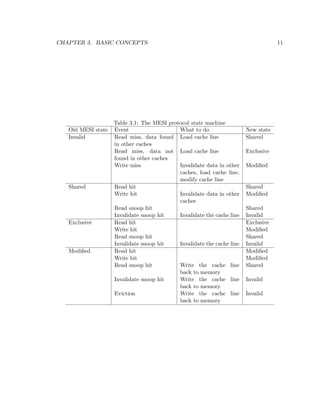
v
Acknowledgments 
I would like to thank my senior supervisor, Sasha Fedorova, who helped me through my 
studies and guided me in the realms of multicore systems! I would also like to thank my 
colleagues at SFU. 
vi
Contents 
Approval ii 
Abstract iii 
Dedication iv 
Quotation v 
Acknowledgments vi 
Contents vii 
List of Tables ix 
List of Figures x 
1 Introduction 1 
2 Related Work 3 
3 Basic concepts 6 
3.1 Multicore Systems . . . . . . . . . . . . . . . . . . . . . . . . . . . . . . . . . 6 
3.1.1 AMD Cache Architecture . . . . . . . . . . . . . . . . . . . . . . . . . 6 
3.1.2 Intel Xeon and Intel Nehalem Cache Architecture . . . . . . . . . . . . 7 
3.2 Types of Cache Misses . . . . . . . . . . . . . . . . . . . . . . . . . . . . . . . 9 
3.2.1 Con
ict Misses . . . . . . . . . . . . . . . . . . . . . . . . . . . . . . . 9 
3.2.2 Capacity Misses . . . . . . . . . . . . . . . . . . . . . . . . . . . . . . 9 
3.2.3 Compulsory Misses . . . . . . . . . . . . . . . . . . . . . . . . . . . . . 9 
vii
3.2.4 Coherency Misses . . . . . . . . . . . . . . . . . . . . . . . . . . . . . . 9 
3.3 The MESI Protocol . . . . . . . . . . . . . . . . . . . . . . . . . . . . . . . . . 10 
3.4 Read and Write Sharing . . . . . . . . . . . . . . . . . . . . . . . . . . . . . . 12 
3.4.1 How does MESI protocol
t here? . . . . . . . . . . . . . . . . . . . . 14 
3.5 Sources of Coherency Misses . . . . . . . . . . . . . . . . . . . . . . . . . . . . 15 
3.6 Why AMD systems do not bene
t from sharing . . . . . . . . . . . . . . . . . 16 
3.7 Summary . . . . . . . . . . . . . . . . . . . . . . . . . . . . . . . . . . . . . . 17 
4 Measuring the Amount of Sharing 18 
4.1 Monitoring Coherency Protocol Events . . . . . . . . . . . . . . . . . . . . . . 18 
4.2 Experimental Setup . . . . . . . . . . . . . . . . . . . . . . . . . . . . . . . . 21 
4.3 Experimental Plan . . . . . . . . . . . . . . . . . . . . . . . . . . . . . . . . . 21 
4.3.1 SwapTest Results . . . . . . . . . . . . . . . . . . . . . . . . . . . . . . 24 
4.3.2 BucketSort Results . . . . . . . . . . . . . . . . . . . . . . . . . . . . . 26 
4.3.3 NetworkTest . . . . . . . . . . . . . . . . . . . . . . . . . . . . . . . . 26 
4.3.4 MySqlTest . . . . . . . . . . . . . . . . . . . . . . . . . . . . . . . . . 27 
4.3.5 Looking at Hardware Performance Counters . . . . . . . . . . . . . . . 27 
4.4 Summary . . . . . . . . . . . . . . . . . . . . . . . . . . . . . . . . . . . . . . 32 
5 Analysis and Implementation 34 
5.1 Model . . . . . . . . . . . . . . . . . . . . . . . . . . . . . . . . . . . . . . . . 34 
5.2 Linear Regression . . . . . . . . . . . . . . . . . . . . . . . . . . . . . . . . . . 36 
5.3 Designing the Scheduler . . . . . . . . . . . . . . . . . . . . . . . . . . . . . . 40 
5.4 Testing the Scheduler . . . . . . . . . . . . . . . . . . . . . . . . . . . . . . . 41 
5.5 Summary . . . . . . . . . . . . . . . . . . . . . . . . . . . . . . . . . . . . . . 43 
6 Conclusion and Future Work 45 
Bibliography 47 
viii
List of Tables 
3.1 The MESI protocol state machine . . . . . . . . . . . . . . . . . . . . . . . . . 11 
4.1 SwapTest running on a shared last level cache versus running on separate 
chips. Lower ratio means a higher bene
t from being placed on a shared cache. 25 
4.2 Execution time of Network test on a shared last level cache versus separate 
caches . . . . . . . . . . . . . . . . . . . . . . . . . . . . . . . . . . . . . . . . 26 
4.3 Execution time of MySqlTest on a shared last level cache versus separate caches 27 
4.4 Snoops and L3 misses for SwapTest . . . . . . . . . . . . . . . . . . . . . . . . 28 
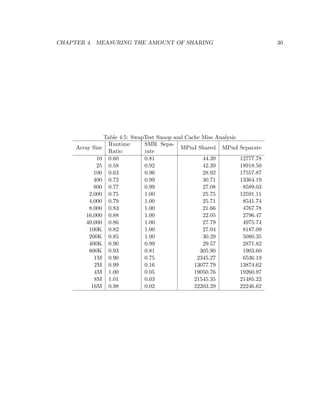
4.5 SwapTest Snoop and Cache Miss Analysis . . . . . . . . . . . . . . . . . . . . 30 
4.6 NetworkTest Snoop and Cache Miss Analysis . . . . . . . . . . . . . . . . . . 32 
4.7 MySqlTest Snoop and Cache Miss Analysis . . . . . . . . . . . . . . . . . . . 32 
4.8 BucketSort Snoop and Cache Miss Analysis . . . . . . . . . . . . . . . . . . . 33 
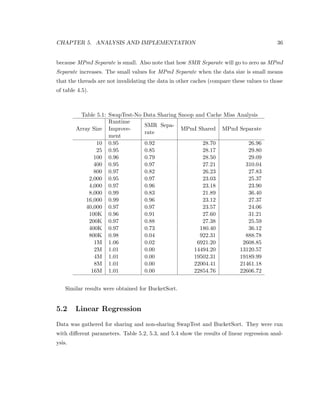
5.1 SwapTest-No Data Sharing Snoop and Cache Miss Analysis . . . . . . . . . . 36 
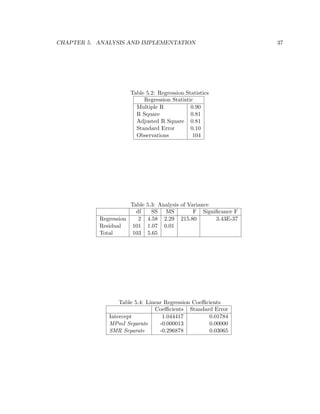
5.2 Regression Statistics . . . . . . . . . . . . . . . . . . . . . . . . . . . . . . . . 37 
5.3 Analysis of Variance . . . . . . . . . . . . . . . . . . . . . . . . . . . . . . . . 37 
5.4 Linear Regression Coecients . . . . . . . . . . . . . . . . . . . . . . . . . . . 37 
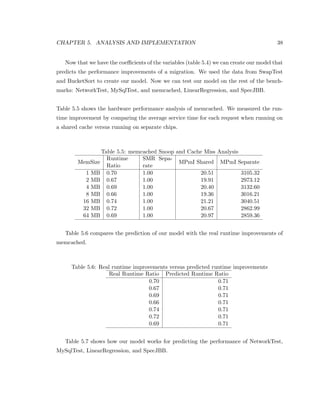
5.5 memcached Snoop and Cache Miss Analysis . . . . . . . . . . . . . . . . . . . 38 
5.6 Real runtime improvements versus predicted runtime improvements . . . . . 38 
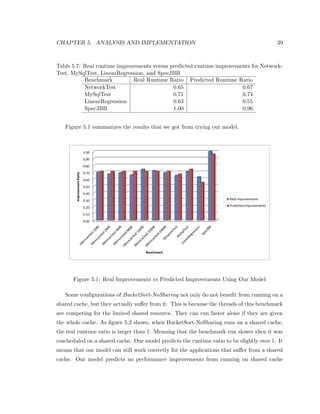
5.7 Real runtime improvements versus predicted runtime improvements for Net- 
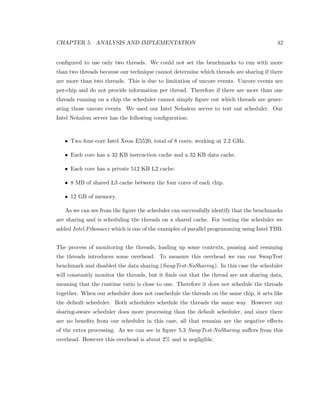
workTest, MySqlTest, LinearRegression, and SpecJBB . . . . . . . . . . . . . 39 
ix
List of Figures 
3.1 AMD Cache Architecture . . . . . . . . . . . . . . . . . . . . . . . . . . . . . 7 
3.2 Shared L2 Cache . . . . . . . . . . . . . . . . . . . . . . . . . . . . . . . . . . 8 
3.3 Intel Nehalem Architecture . . . . . . . . . . . . . . . . . . . . . . . . . . . . 8 
4.1 NUMA - two node example . . . . . . . . . . . . . . . . . . . . . . . . . . . . 20 
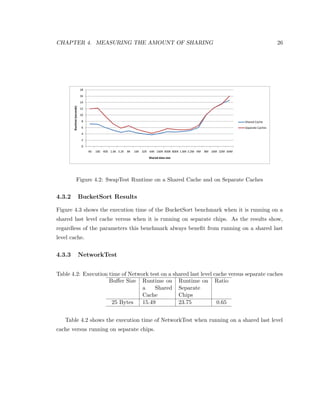
4.2 SwapTest Runtime on a Shared Cache and on Separate Caches . . . . . . . . 26 
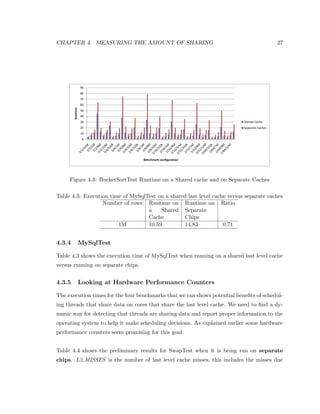
4.3 BucketSortTest Runtime on a Shared cache and on Separate Caches . . . . . 27 
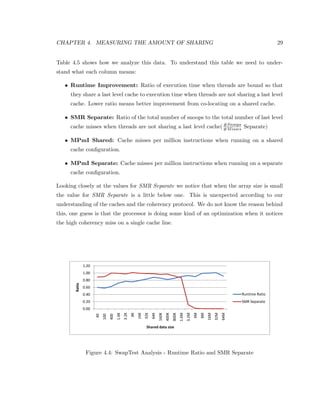
4.4 SwapTest Analysis - Runtime Ratio and SMR Separate . . . . . . . . . . . . 29 
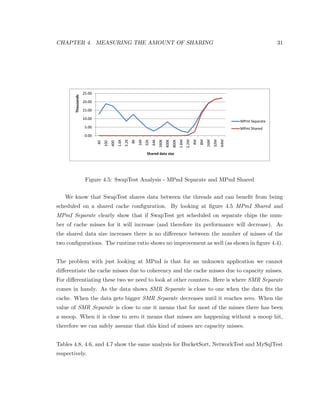
4.5 SwapTest Analysis - MPmI Separate and MPmI Shared . . . . . . . . . . . . 31 
5.1 Real Improvements vs Predicted Improvements Using Our Model . . . . . . . 39 
5.2 Real and Predicted Runtime Ratio for BucketSort-NoSharing . . . . . . . . . 40 
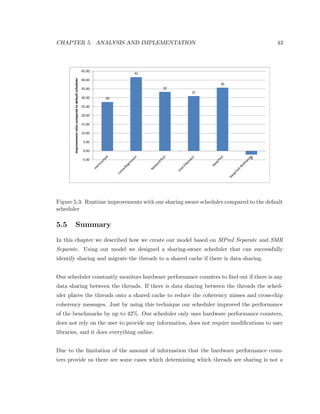
5.3 Runtime improvements with our sharing aware scheduler compared to the 
default scheduler . . . . . . . . . . . . . . . . . . . . . . . . . . . . . . . . . . 42 
x
Chapter 1 
Introduction 
Increasing clock speed of microprocessors is reaching diminishing returns. Newer processors 
are increasing the number of cores per chip and multicore systems are becoming more and 
more widespread. Operating systems however, are not advancing with the same pace. Op- 
timal scheduling on multicore systems is still an open problem. 
In order to understand why scheduling on multicore systems is a challenging task
rst 
we need to understand how multicore systems work. Multicore systems have more than one 
core on each chip and each system can contain one or many chips. These cores need to 
access the main memory which is quite slow compared to the processing power of each chip. 
Cores usually waste a lot of cycles waiting for the data to be fetched from the memory. To 
address this problem multiple level of data and instruction caches were introduced. Each 
core has a private L1 data and instruction cache. Depending on the architecture each core 
can either have a private L2 cache or share it with other cores. Some newer architectures 
have introduced a L3 cache which is always shared among all the cores on each chip. On 
each access to the memory, local caches are searched
rst and if the data is not present in 
those caches a request will be sent to the memory to fetch the data. If the data is actually 
present in any of the caches then there will be no need to send a request to the memory, and 
since delay of accessing caches is much less than the delay of accessing the main memory, 
cores will save some cycles. 
In order to maintain a coherent system cores need to talk to other cores on the same chip 
and the cores on other chips so that all of them access up-to- date data. Each time a core 
1
CHAPTER 1. INTRODUCTION 2 
modi
es some data it needs to notify all other cores that the data was changed. This is done 
via cache coherency protocols such as the MESI protocol. Sending coherency messages cross- 
chips is very expensive and aects the overall performance of the processors[12, 11, 7, 4]. 
Cross-chip coherency messages can be avoided by placing the threads on the same chip so 
that the threads share the last level cache. 
The size of caches on each chip is limited. Cores compete with each other for cache re- 
sources. There is also only one memory controller per chip and cores need to use the 
memory controller each time they access data in the memory. These are the common prob- 
lems that applications that run on multicore systems face. The coherency messages that 
the cores send to each other will also aect the performance of applications [5]. 
An operating system scheduler needs to consider these bottlenecks and make intelligent 
decisions on how to place the threads on dierent cores. The way the scheduler decides to 
place the threads on the cores will impact the overall performance of the system. Dierent 
applications with dierent characteristics will run on the system and the scheduler needs to 
monitor the behavior of these applications and make its decisions based on that. To facili- 
tate this process for schedulers, modern processors provide invaluable information about the 
performance of each core via hardware performance counters. Hardware performance coun- 
ters are special purpose registers put into the processors to re
ect the activities of each core. 
In this thesis we focus on reducing the number of messages due to the coherency proto- 
col. We exploit some of the performance counters to gain knowledge about the amount of 
data sharing among threads. Using this knowledge we design a scheduler that intelligently 
schedules the threads that are sharing data onto a single chip so that the threads share their 
data on the shared last level cache. Hence, they no longer need to send messages across chips 
to maintain their coherency. We call this behavior being sharing-aware, and the placement 
that the scheduler chooses is a sharing-aware placement. Just using this technique we show 
that the runtime of multithreaded applications that share data can be improved by up to 
42%.
Chapter 2 
Related Work 
The work by Tam et al. [8] is the closest to the work that has been done in this thesis. 
In their work, the authors use hardware performance counters to analyze the stall cycles 
of each core. If cross-core communication is among the sources of stalls they monitor all 
threads in the system to gather information about the data regions accessed by the threads 
that caused cross-chip communication. That is done with data sampling capabilities of 
hardware performance counters. Then they cluster the threads that access the same data. 
Their scheduler tries to schedule the threads close to each other based on the cluster groups. 
Although this work showed improvements of up to 7% in some workloads, their method can- 
not be used on Intel processors and does not allow the schedulers to predict the bene
ts 
from sharing-aware placement. 
Bellosa and Steckermeier [1] introduce a new scheduling architecture with the goal of re- 
ducing the number of cache misses. They started by using hardware performance counters 
to identify data sharing between the threads. However due to the limitation of hardware 
performance counters and the delay of acessing them at the time of their work they could 
not obtain good results. Weissman [11] requires users to identify the shared regions. Based 
on the information that the users provide and the cache miss information data gathered by 
hardware performance counters, he designs a portable parallel system that eliminates a lot 
of cache misses. 
Thekkath and Eggers [9] hypothesized that they can reduce cache interference and improve 
3
CHAPTER 2. RELATED WORK 4 
the overall performance by co-locating the threads that share data on the same proces- 
sor. They used a parallel tracing tool called MPtrace to gather information about sharing 
characteristics of their workloads. To test their hypothesis the authors compared a variety 
of thread placement algorithms via simulation. Simulation results showed that compulsory 
and invalidation misses did not decrease with any of the thread placement algorithms. They 
could not show any bene
t from co-locating the threads on the same processor. They con- 
cluded that they could not show any bene
t because of the way their benchmarks were 
accessing the memory and the fact that the data sharing between the threads was insigni
- 
cant. In this thesis we do not use oine analysis, we rely on hardware performance counters 
to obtain online data and we dynamically make our decisions. 
Zhuravlev et al. [13] tried to minimize the number of cache misses by reducing the con- 
tention for accessing the shared resources, such as memory controller and shared caches. 
They designed a new scheduler that uses a heuristic algorithm based on the cache miss 
rate of applications and they showed that the scheduler performs within 2% of the optimal 
scheduler. In their work, however, the authors only studied the applications that suer from 
running on a shared cache. They did not consider the fact that some applications bene
t 
from running on shared caches. Similarly Chandra et al. [2] used stack distance pro
le and 
stack distance competition to predict the eects of sharing a cache between cache intensive 
applications. In this thesis we do not study the eects of contention separately. We intro- 
duce a model that accounts for the eects of cache contention while providing the scheduler 
with the information about data sharing. 
Sridharan et al. [7] proposed that threads must be migrated to lock hot processors. 
They argued that by migrating threads to such processors threads can reuse the critical 
section data that is already in the processor's cache, and therefore synchronization can be 
done faster. To achieve their goal they modi
ed the user level libraries to help them identify 
user level locks. After
nding out which locks are being accessed the most the threads that 
are accessing them will be migrated to the same processor to exploit the shared last level 
cache. That approach requires modi
cations to the application libraries. Our approach 
required no modi
cation to the applications. 
Zhang et al. [12] studied the eects of cache sharing on multicore systems. The authors
CHAPTER 2. RELATED WORK 5 
claim that the placement of threads does not have an impact on the overall performance of 
PARSEC, a recently released benchmark for multicore systems. After analyzing the access 
patterns of the benchmarks, the authors concluded that the benchmarks would not bene-
t from intelligent placement because of three reasons. First, the data sharing is uniform 
among threads, meaning that all threads share the same amount of data with each other, 
and it is dicult (or impossible) to place all threads on the same chip. Second, the amount 
of shared data is insigni
cant since data is partitioned. And third, the working set of the 
benchmarks is usually larger than the cache size. The authors modify some benchmarks 
from PARSEC so that the data sharing is no longer uniform. With the new set of bench- 
marks they showed that a sharing aware scheduler can improve the performance by up to 
36%. 
Torellas el al. [10] analyzed six applications and studied the eects of false sharing on 
the miss rate. The authors proposed changes to the compilers so that they would place the 
data structures with a dierent layout in the caches to prevent false sharing. Eggers and 
Katz [4] studied the eects of sharing on the performance of the bus and on the perfor- 
mance of parallel applications. Their study showed that parallel programs produce more 
cache misses, and better compiler technology and better software development techniques 
can improve the performance of parallel applications by organizing the data dierently in 
the memory. 
Chen et al. [3] evaluated the performance of two greedy schedulers. Parallel Depth First 
(PDF), a scheduler designed for constructive cache sharing, and a traditional scheduler. 
Their study showed that using PDF o-chip trac is reduced and runtime improvements 
of up to 60% can be gained. Jeleel et al. [6] proposed the use of binary instrumentation to 
characterize cache performance. Instead of using trace-driven simulators, the authors used 
Pin (a binary instrumentation tool by Intel) to study the performance of the memory. Their 
simulator, CMP$im, was a parallel memory system simulator that could model any kind of 
cache hierarchy. Using CMP$im the authors could measure the amount of data sharing in 
detail. Their analysis however had to be done oine and therefore their method cannot be 
used in an online scheduler.
Chapter 3 
Basic concepts 
This chapter describes dierent types of systems, and some of the reasons behind choosing 
the correct hardware performance counters. It begins with describing how cores and caches 
are connected, what is a local hit, a local miss, a remote hit, and a remote miss. Then it 
will explain what types of misses there are, and why we are focusing on one particular type 
of miss in this thesis. 
3.1 Multicore Systems 
The architecture of multicore systems has been improved a lot since the introduction of the
rst system in 2001. Dierent vendors follow dierent methodologies. These methodologies 
had a great impact on the performance of the CPU. In this thesis we studies two dierent 
common architectures. 
3.1.1 AMD Cache Architecture 
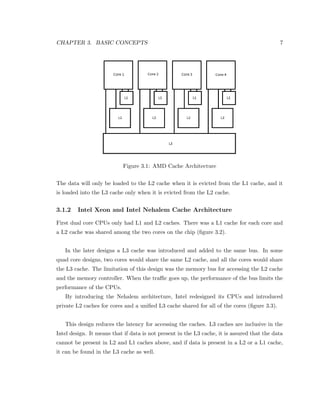
AMD introduced on chip L3 caches and a private L2 cache for each chip (as shown in
gure 
3.1). 
L2 and L3 caches on AMD systems are victim caches (they are not inclusive). Whenever 
there is a cache miss1, the CPU brings the data directly to the L1 cache, skipping the others. 
1A cache miss is when a core tries to access a data, and it cannot
nd the data in its cache. The core 
misses its cache and needs to fetch the data from the main memory. 
6
CHAPTER 3. BASIC CONCEPTS 7 
Figure 3.1: AMD Cache Architecture 
The data will only be loaded to the L2 cache when it is evicted from the L1 cache, and it 
is loaded into the L3 cache only when it is evicted from the L2 cache. 
3.1.2 Intel Xeon and Intel Nehalem Cache Architecture 
First dual core CPUs only had L1 and L2 caches. There was a L1 cache for each core and 
a L2 cache was shared among the two cores on the chip (
gure 3.2). 
In the later designs a L3 cache was introduced and added to the same bus. In some 
quad core designs, two cores would share the same L2 cache, and all the cores would share 
the L3 cache. The limitation of this design was the memory bus for accessing the L2 cache 
and the memory controller. When the trac goes up, the performance of the bus limits the 
performance of the CPUs. 
By introducing the Nehalem architecture, Intel redesigned its CPUs and introduced 
private L2 caches for cores and a uni
ed L3 cache shared for all of the cores (
gure 3.3). 
This design reduces the latency for accessing the caches. L3 caches are inclusive in the 
Intel design. It means that if data is not present in the L3 cache, it is assured that the data 
cannot be present in L2 and L1 caches above, and if data is present in a L2 or a L1 cache, 
it can be found in the L3 cache as well.
CHAPTER 3. BASIC CONCEPTS 8 
Figure 3.2: Shared L2 Cache 
Figure 3.3: Intel Nehalem Architecture
CHAPTER 3. BASIC CONCEPTS 9 
3.2 Types of Cache Misses 
For reducing the number of cache misses we need to
nd out the source of a cache miss: 
3.2.1 Con
ict Misses 
Con
ict misses happen when multiple memory locations get mapped to the same line in 
the cache. This type of cache miss can be resolved by increasing the cache size, and by 
increasing the associativity. 
3.2.2 Capacity Misses 
Capacity misses are due to the size of the cache. The cache is not big enough to hold the 
data while it is being referenced again. This type of cache miss can be resolved by increasing 
the cache size. 
3.2.3 Compulsory Misses 
Compulsory misses happen with the
rst reference to the requested data. The data is simply 
not in the cache and the CPU needs to load it for the
rst time. Prefetching helps to some 
degree. This type of cache miss is not a major problem. 
3.2.4 Coherency Misses 
Coherency misses only happen in multiprocessors and multicore systems. In single core pro- 
cessors when data is loaded into the cache, it will remain the same until that core changes 
it. In multicore processors however, the data can be modi
ed by other cores while it is in 
the cache of a speci
c core. Since the data is modi
ed by other cores, it is no longer valid 
and should not be used by the core that does not have a recent copy of the modi
ed data. 
The data in the old cache is invalidated, therefore the next reference to that data will miss 
the cache. This type of misses are because of coherency messages and are called coherency 
misses. To resolve this problem, whenever a core modi
es a data in its private cache, it 
invalidates the data in all the other caches. On the next reference to that data, the other 
cores will miss in their cache and have to reload it from either the main memory or from 
other caches.
CHAPTER 3. BASIC CONCEPTS 10 
The main focus of this thesis is on reducing the number of coherency misses. To understand 
coherency misses better, we need to understand how the coherency protocol works. The 
most common protocol used in the recent architectures is the MESI protocol. Each vendor 
has made a slight modi
cation to the MESI protocol so that it suits their architecture. 
3.3 The MESI Protocol 
The MESI (modi
ed, exclusive, shared, invalid) cache protocol maintains consistency be- 
tween cache lines of dierent processors. Each cache line is in either modi
ed, exclusive, 
shared, or invalid state. The state of a cache line is updated whenever one of the cores try 
to access that cache line: 
 Invalid: A cache line is in invalid state when the data in that cache line does not 
represent any data in the memory. 
 Exclusive: A cache line will be tagged as exclusive when a core loads the data into 
its cache for the
rst time and the data is not present in the private cache of any other 
core, and is not present in the shared cache of other chips. 
 Shared: When a cache line is in shared state, it means that the cache line represents 
the latest value for that memory location, and the data might be found in the private 
cache of other cores, or might be present in the shared cache of other chips. 
 Modi
ed: A modi
ed cache line is a cache line that was in exclusive mode, but 
the data has been modi

Ali.Kamali-MSc.Thesis-SFU

  • 1.
    SHARING AWARE SCHEDULINGON MULTICORE SYSTEMS by Ali Kamali B.Sc., Sharif University of Technology, 2008 a Thesis submitted in partial fulfillment of the requirements for the degree of Master of Science in the School of Computing Science c Ali Kamali 2010 SIMON FRASER UNIVERSITY Summer 2010 All rights reserved. This work may not be reproduced in whole or in part, by photocopy or other means, without the permission of the author.
  • 2.
    APPROVAL Name: AliKamali Degree: Master of Science Title of Thesis: Sharing Aware Scheduling on Multicore Systems Examining Committee: Dr. Ke Wang Chair Dr. Alexandra Fedorova, Professor, Computing Sci- ence Simon Fraser University Senior Supervisor Dr. Greg Mori, Professor, Computing Science Simon Fraser University Supervisor Dr. Hao Zhang, Professor, Computing Science Simon Fraser University Examiner Date Approved: ii
  • 3.
    Abstract Multicore processorsare becoming more and more widespread, specially in the server market. Data centers can harvest the power of multicore systems once proper scheduling methods are comprehended. Current operating systems do not consider all characteristics of the ap- plications that are being scheduled and therefore cannot make optimal scheduling decisions. This will waste the power of multicore systems and increase the costs of a data center. The idea explained in this thesis is to solve one of the problems of scheduling on multicore systems. Using the methods introduced in this thesis, operating systems can detect data sharing between dierent threads of a multithreaded application and make better schedul- ing decisions. Sharing aware scheduling can improve the performance of applications by up to 42%. The scheduler can detect data sharing dynamically just by monitoring hardware performance counters. Keywords: Multicore systems, sharing aware, scheduler, CMP, operating system, MESI, data sharing, snoop, hardware performance counters iii
  • 4.
    To my family,Leila, and all my friends in Vancouver iv
  • 5.
    I can noother answer make, but, thanks, and thanks. | William Shakespeare v
  • 6.
    Acknowledgments I wouldlike to thank my senior supervisor, Sasha Fedorova, who helped me through my studies and guided me in the realms of multicore systems! I would also like to thank my colleagues at SFU. vi
  • 7.
    Contents Approval ii Abstract iii Dedication iv Quotation v Acknowledgments vi Contents vii List of Tables ix List of Figures x 1 Introduction 1 2 Related Work 3 3 Basic concepts 6 3.1 Multicore Systems . . . . . . . . . . . . . . . . . . . . . . . . . . . . . . . . . 6 3.1.1 AMD Cache Architecture . . . . . . . . . . . . . . . . . . . . . . . . . 6 3.1.2 Intel Xeon and Intel Nehalem Cache Architecture . . . . . . . . . . . . 7 3.2 Types of Cache Misses . . . . . . . . . . . . . . . . . . . . . . . . . . . . . . . 9 3.2.1 Con ict Misses . . . . . . . . . . . . . . . . . . . . . . . . . . . . . . . 9 3.2.2 Capacity Misses . . . . . . . . . . . . . . . . . . . . . . . . . . . . . . 9 3.2.3 Compulsory Misses . . . . . . . . . . . . . . . . . . . . . . . . . . . . . 9 vii
  • 8.
    3.2.4 Coherency Misses. . . . . . . . . . . . . . . . . . . . . . . . . . . . . . 9 3.3 The MESI Protocol . . . . . . . . . . . . . . . . . . . . . . . . . . . . . . . . . 10 3.4 Read and Write Sharing . . . . . . . . . . . . . . . . . . . . . . . . . . . . . . 12 3.4.1 How does MESI protocol
  • 9.
    t here? .. . . . . . . . . . . . . . . . . . . 14 3.5 Sources of Coherency Misses . . . . . . . . . . . . . . . . . . . . . . . . . . . . 15 3.6 Why AMD systems do not bene
  • 10.
    t from sharing. . . . . . . . . . . . . . . . . 16 3.7 Summary . . . . . . . . . . . . . . . . . . . . . . . . . . . . . . . . . . . . . . 17 4 Measuring the Amount of Sharing 18 4.1 Monitoring Coherency Protocol Events . . . . . . . . . . . . . . . . . . . . . . 18 4.2 Experimental Setup . . . . . . . . . . . . . . . . . . . . . . . . . . . . . . . . 21 4.3 Experimental Plan . . . . . . . . . . . . . . . . . . . . . . . . . . . . . . . . . 21 4.3.1 SwapTest Results . . . . . . . . . . . . . . . . . . . . . . . . . . . . . . 24 4.3.2 BucketSort Results . . . . . . . . . . . . . . . . . . . . . . . . . . . . . 26 4.3.3 NetworkTest . . . . . . . . . . . . . . . . . . . . . . . . . . . . . . . . 26 4.3.4 MySqlTest . . . . . . . . . . . . . . . . . . . . . . . . . . . . . . . . . 27 4.3.5 Looking at Hardware Performance Counters . . . . . . . . . . . . . . . 27 4.4 Summary . . . . . . . . . . . . . . . . . . . . . . . . . . . . . . . . . . . . . . 32 5 Analysis and Implementation 34 5.1 Model . . . . . . . . . . . . . . . . . . . . . . . . . . . . . . . . . . . . . . . . 34 5.2 Linear Regression . . . . . . . . . . . . . . . . . . . . . . . . . . . . . . . . . . 36 5.3 Designing the Scheduler . . . . . . . . . . . . . . . . . . . . . . . . . . . . . . 40 5.4 Testing the Scheduler . . . . . . . . . . . . . . . . . . . . . . . . . . . . . . . 41 5.5 Summary . . . . . . . . . . . . . . . . . . . . . . . . . . . . . . . . . . . . . . 43 6 Conclusion and Future Work 45 Bibliography 47 viii
  • 11.
    List of Tables 3.1 The MESI protocol state machine . . . . . . . . . . . . . . . . . . . . . . . . . 11 4.1 SwapTest running on a shared last level cache versus running on separate chips. Lower ratio means a higher bene
  • 12.
    t from beingplaced on a shared cache. 25 4.2 Execution time of Network test on a shared last level cache versus separate caches . . . . . . . . . . . . . . . . . . . . . . . . . . . . . . . . . . . . . . . . 26 4.3 Execution time of MySqlTest on a shared last level cache versus separate caches 27 4.4 Snoops and L3 misses for SwapTest . . . . . . . . . . . . . . . . . . . . . . . . 28 4.5 SwapTest Snoop and Cache Miss Analysis . . . . . . . . . . . . . . . . . . . . 30 4.6 NetworkTest Snoop and Cache Miss Analysis . . . . . . . . . . . . . . . . . . 32 4.7 MySqlTest Snoop and Cache Miss Analysis . . . . . . . . . . . . . . . . . . . 32 4.8 BucketSort Snoop and Cache Miss Analysis . . . . . . . . . . . . . . . . . . . 33 5.1 SwapTest-No Data Sharing Snoop and Cache Miss Analysis . . . . . . . . . . 36 5.2 Regression Statistics . . . . . . . . . . . . . . . . . . . . . . . . . . . . . . . . 37 5.3 Analysis of Variance . . . . . . . . . . . . . . . . . . . . . . . . . . . . . . . . 37 5.4 Linear Regression Coecients . . . . . . . . . . . . . . . . . . . . . . . . . . . 37 5.5 memcached Snoop and Cache Miss Analysis . . . . . . . . . . . . . . . . . . . 38 5.6 Real runtime improvements versus predicted runtime improvements . . . . . 38 5.7 Real runtime improvements versus predicted runtime improvements for Net- workTest, MySqlTest, LinearRegression, and SpecJBB . . . . . . . . . . . . . 39 ix
  • 13.
    List of Figures 3.1 AMD Cache Architecture . . . . . . . . . . . . . . . . . . . . . . . . . . . . . 7 3.2 Shared L2 Cache . . . . . . . . . . . . . . . . . . . . . . . . . . . . . . . . . . 8 3.3 Intel Nehalem Architecture . . . . . . . . . . . . . . . . . . . . . . . . . . . . 8 4.1 NUMA - two node example . . . . . . . . . . . . . . . . . . . . . . . . . . . . 20 4.2 SwapTest Runtime on a Shared Cache and on Separate Caches . . . . . . . . 26 4.3 BucketSortTest Runtime on a Shared cache and on Separate Caches . . . . . 27 4.4 SwapTest Analysis - Runtime Ratio and SMR Separate . . . . . . . . . . . . 29 4.5 SwapTest Analysis - MPmI Separate and MPmI Shared . . . . . . . . . . . . 31 5.1 Real Improvements vs Predicted Improvements Using Our Model . . . . . . . 39 5.2 Real and Predicted Runtime Ratio for BucketSort-NoSharing . . . . . . . . . 40 5.3 Runtime improvements with our sharing aware scheduler compared to the default scheduler . . . . . . . . . . . . . . . . . . . . . . . . . . . . . . . . . . 42 x
  • 14.
    Chapter 1 Introduction Increasing clock speed of microprocessors is reaching diminishing returns. Newer processors are increasing the number of cores per chip and multicore systems are becoming more and more widespread. Operating systems however, are not advancing with the same pace. Op- timal scheduling on multicore systems is still an open problem. In order to understand why scheduling on multicore systems is a challenging task
  • 15.
    rst we needto understand how multicore systems work. Multicore systems have more than one core on each chip and each system can contain one or many chips. These cores need to access the main memory which is quite slow compared to the processing power of each chip. Cores usually waste a lot of cycles waiting for the data to be fetched from the memory. To address this problem multiple level of data and instruction caches were introduced. Each core has a private L1 data and instruction cache. Depending on the architecture each core can either have a private L2 cache or share it with other cores. Some newer architectures have introduced a L3 cache which is always shared among all the cores on each chip. On each access to the memory, local caches are searched
  • 16.
    rst and ifthe data is not present in those caches a request will be sent to the memory to fetch the data. If the data is actually present in any of the caches then there will be no need to send a request to the memory, and since delay of accessing caches is much less than the delay of accessing the main memory, cores will save some cycles. In order to maintain a coherent system cores need to talk to other cores on the same chip and the cores on other chips so that all of them access up-to- date data. Each time a core 1
  • 17.
  • 18.
    es some datait needs to notify all other cores that the data was changed. This is done via cache coherency protocols such as the MESI protocol. Sending coherency messages cross- chips is very expensive and aects the overall performance of the processors[12, 11, 7, 4]. Cross-chip coherency messages can be avoided by placing the threads on the same chip so that the threads share the last level cache. The size of caches on each chip is limited. Cores compete with each other for cache re- sources. There is also only one memory controller per chip and cores need to use the memory controller each time they access data in the memory. These are the common prob- lems that applications that run on multicore systems face. The coherency messages that the cores send to each other will also aect the performance of applications [5]. An operating system scheduler needs to consider these bottlenecks and make intelligent decisions on how to place the threads on dierent cores. The way the scheduler decides to place the threads on the cores will impact the overall performance of the system. Dierent applications with dierent characteristics will run on the system and the scheduler needs to monitor the behavior of these applications and make its decisions based on that. To facili- tate this process for schedulers, modern processors provide invaluable information about the performance of each core via hardware performance counters. Hardware performance coun- ters are special purpose registers put into the processors to re ect the activities of each core. In this thesis we focus on reducing the number of messages due to the coherency proto- col. We exploit some of the performance counters to gain knowledge about the amount of data sharing among threads. Using this knowledge we design a scheduler that intelligently schedules the threads that are sharing data onto a single chip so that the threads share their data on the shared last level cache. Hence, they no longer need to send messages across chips to maintain their coherency. We call this behavior being sharing-aware, and the placement that the scheduler chooses is a sharing-aware placement. Just using this technique we show that the runtime of multithreaded applications that share data can be improved by up to 42%.
  • 19.
    Chapter 2 RelatedWork The work by Tam et al. [8] is the closest to the work that has been done in this thesis. In their work, the authors use hardware performance counters to analyze the stall cycles of each core. If cross-core communication is among the sources of stalls they monitor all threads in the system to gather information about the data regions accessed by the threads that caused cross-chip communication. That is done with data sampling capabilities of hardware performance counters. Then they cluster the threads that access the same data. Their scheduler tries to schedule the threads close to each other based on the cluster groups. Although this work showed improvements of up to 7% in some workloads, their method can- not be used on Intel processors and does not allow the schedulers to predict the bene
  • 20.
    ts from sharing-awareplacement. Bellosa and Steckermeier [1] introduce a new scheduling architecture with the goal of re- ducing the number of cache misses. They started by using hardware performance counters to identify data sharing between the threads. However due to the limitation of hardware performance counters and the delay of acessing them at the time of their work they could not obtain good results. Weissman [11] requires users to identify the shared regions. Based on the information that the users provide and the cache miss information data gathered by hardware performance counters, he designs a portable parallel system that eliminates a lot of cache misses. Thekkath and Eggers [9] hypothesized that they can reduce cache interference and improve 3
  • 21.
    CHAPTER 2. RELATEDWORK 4 the overall performance by co-locating the threads that share data on the same proces- sor. They used a parallel tracing tool called MPtrace to gather information about sharing characteristics of their workloads. To test their hypothesis the authors compared a variety of thread placement algorithms via simulation. Simulation results showed that compulsory and invalidation misses did not decrease with any of the thread placement algorithms. They could not show any bene
  • 22.
    t from co-locatingthe threads on the same processor. They con- cluded that they could not show any bene
  • 23.
    t because ofthe way their benchmarks were accessing the memory and the fact that the data sharing between the threads was insigni
  • 24.
    - cant. Inthis thesis we do not use oine analysis, we rely on hardware performance counters to obtain online data and we dynamically make our decisions. Zhuravlev et al. [13] tried to minimize the number of cache misses by reducing the con- tention for accessing the shared resources, such as memory controller and shared caches. They designed a new scheduler that uses a heuristic algorithm based on the cache miss rate of applications and they showed that the scheduler performs within 2% of the optimal scheduler. In their work, however, the authors only studied the applications that suer from running on a shared cache. They did not consider the fact that some applications bene
  • 25.
    t from runningon shared caches. Similarly Chandra et al. [2] used stack distance pro
  • 26.
    le and stackdistance competition to predict the eects of sharing a cache between cache intensive applications. In this thesis we do not study the eects of contention separately. We intro- duce a model that accounts for the eects of cache contention while providing the scheduler with the information about data sharing. Sridharan et al. [7] proposed that threads must be migrated to lock hot processors. They argued that by migrating threads to such processors threads can reuse the critical section data that is already in the processor's cache, and therefore synchronization can be done faster. To achieve their goal they modi
  • 27.
    ed the userlevel libraries to help them identify user level locks. After
  • 28.
    nding out whichlocks are being accessed the most the threads that are accessing them will be migrated to the same processor to exploit the shared last level cache. That approach requires modi
  • 29.
    cations to theapplication libraries. Our approach required no modi
  • 30.
    cation to theapplications. Zhang et al. [12] studied the eects of cache sharing on multicore systems. The authors
  • 31.
    CHAPTER 2. RELATEDWORK 5 claim that the placement of threads does not have an impact on the overall performance of PARSEC, a recently released benchmark for multicore systems. After analyzing the access patterns of the benchmarks, the authors concluded that the benchmarks would not bene-
  • 32.
    t from intelligentplacement because of three reasons. First, the data sharing is uniform among threads, meaning that all threads share the same amount of data with each other, and it is dicult (or impossible) to place all threads on the same chip. Second, the amount of shared data is insigni
  • 33.
    cant since datais partitioned. And third, the working set of the benchmarks is usually larger than the cache size. The authors modify some benchmarks from PARSEC so that the data sharing is no longer uniform. With the new set of bench- marks they showed that a sharing aware scheduler can improve the performance by up to 36%. Torellas el al. [10] analyzed six applications and studied the eects of false sharing on the miss rate. The authors proposed changes to the compilers so that they would place the data structures with a dierent layout in the caches to prevent false sharing. Eggers and Katz [4] studied the eects of sharing on the performance of the bus and on the perfor- mance of parallel applications. Their study showed that parallel programs produce more cache misses, and better compiler technology and better software development techniques can improve the performance of parallel applications by organizing the data dierently in the memory. Chen et al. [3] evaluated the performance of two greedy schedulers. Parallel Depth First (PDF), a scheduler designed for constructive cache sharing, and a traditional scheduler. Their study showed that using PDF o-chip trac is reduced and runtime improvements of up to 60% can be gained. Jeleel et al. [6] proposed the use of binary instrumentation to characterize cache performance. Instead of using trace-driven simulators, the authors used Pin (a binary instrumentation tool by Intel) to study the performance of the memory. Their simulator, CMP$im, was a parallel memory system simulator that could model any kind of cache hierarchy. Using CMP$im the authors could measure the amount of data sharing in detail. Their analysis however had to be done oine and therefore their method cannot be used in an online scheduler.
  • 34.
    Chapter 3 Basicconcepts This chapter describes dierent types of systems, and some of the reasons behind choosing the correct hardware performance counters. It begins with describing how cores and caches are connected, what is a local hit, a local miss, a remote hit, and a remote miss. Then it will explain what types of misses there are, and why we are focusing on one particular type of miss in this thesis. 3.1 Multicore Systems The architecture of multicore systems has been improved a lot since the introduction of the
  • 35.
    rst system in2001. Dierent vendors follow dierent methodologies. These methodologies had a great impact on the performance of the CPU. In this thesis we studies two dierent common architectures. 3.1.1 AMD Cache Architecture AMD introduced on chip L3 caches and a private L2 cache for each chip (as shown in
  • 36.
    gure 3.1). L2and L3 caches on AMD systems are victim caches (they are not inclusive). Whenever there is a cache miss1, the CPU brings the data directly to the L1 cache, skipping the others. 1A cache miss is when a core tries to access a data, and it cannot
  • 37.
    nd the datain its cache. The core misses its cache and needs to fetch the data from the main memory. 6
  • 38.
    CHAPTER 3. BASICCONCEPTS 7 Figure 3.1: AMD Cache Architecture The data will only be loaded to the L2 cache when it is evicted from the L1 cache, and it is loaded into the L3 cache only when it is evicted from the L2 cache. 3.1.2 Intel Xeon and Intel Nehalem Cache Architecture First dual core CPUs only had L1 and L2 caches. There was a L1 cache for each core and a L2 cache was shared among the two cores on the chip (
  • 39.
    gure 3.2). Inthe later designs a L3 cache was introduced and added to the same bus. In some quad core designs, two cores would share the same L2 cache, and all the cores would share the L3 cache. The limitation of this design was the memory bus for accessing the L2 cache and the memory controller. When the trac goes up, the performance of the bus limits the performance of the CPUs. By introducing the Nehalem architecture, Intel redesigned its CPUs and introduced private L2 caches for cores and a uni
  • 40.
    ed L3 cacheshared for all of the cores (
  • 41.
    gure 3.3). Thisdesign reduces the latency for accessing the caches. L3 caches are inclusive in the Intel design. It means that if data is not present in the L3 cache, it is assured that the data cannot be present in L2 and L1 caches above, and if data is present in a L2 or a L1 cache, it can be found in the L3 cache as well.
  • 42.
    CHAPTER 3. BASICCONCEPTS 8 Figure 3.2: Shared L2 Cache Figure 3.3: Intel Nehalem Architecture
  • 43.
    CHAPTER 3. BASICCONCEPTS 9 3.2 Types of Cache Misses For reducing the number of cache misses we need to
  • 44.
    nd out thesource of a cache miss: 3.2.1 Con ict Misses Con ict misses happen when multiple memory locations get mapped to the same line in the cache. This type of cache miss can be resolved by increasing the cache size, and by increasing the associativity. 3.2.2 Capacity Misses Capacity misses are due to the size of the cache. The cache is not big enough to hold the data while it is being referenced again. This type of cache miss can be resolved by increasing the cache size. 3.2.3 Compulsory Misses Compulsory misses happen with the
  • 45.
    rst reference tothe requested data. The data is simply not in the cache and the CPU needs to load it for the
  • 46.
    rst time. Prefetchinghelps to some degree. This type of cache miss is not a major problem. 3.2.4 Coherency Misses Coherency misses only happen in multiprocessors and multicore systems. In single core pro- cessors when data is loaded into the cache, it will remain the same until that core changes it. In multicore processors however, the data can be modi
  • 47.
    ed by othercores while it is in the cache of a speci
  • 48.
    c core. Sincethe data is modi
  • 49.
    ed by othercores, it is no longer valid and should not be used by the core that does not have a recent copy of the modi
  • 50.
    ed data. Thedata in the old cache is invalidated, therefore the next reference to that data will miss the cache. This type of misses are because of coherency messages and are called coherency misses. To resolve this problem, whenever a core modi
  • 51.
    es a datain its private cache, it invalidates the data in all the other caches. On the next reference to that data, the other cores will miss in their cache and have to reload it from either the main memory or from other caches.
  • 52.
    CHAPTER 3. BASICCONCEPTS 10 The main focus of this thesis is on reducing the number of coherency misses. To understand coherency misses better, we need to understand how the coherency protocol works. The most common protocol used in the recent architectures is the MESI protocol. Each vendor has made a slight modi
  • 53.
    cation to theMESI protocol so that it suits their architecture. 3.3 The MESI Protocol The MESI (modi
  • 54.
    ed, exclusive, shared,invalid) cache protocol maintains consistency be- tween cache lines of dierent processors. Each cache line is in either modi
  • 55.
    ed, exclusive, shared,or invalid state. The state of a cache line is updated whenever one of the cores try to access that cache line: Invalid: A cache line is in invalid state when the data in that cache line does not represent any data in the memory. Exclusive: A cache line will be tagged as exclusive when a core loads the data into its cache for the
  • 56.
    rst time andthe data is not present in the private cache of any other core, and is not present in the shared cache of other chips. Shared: When a cache line is in shared state, it means that the cache line represents the latest value for that memory location, and the data might be found in the private cache of other cores, or might be present in the shared cache of other chips. Modi
  • 57.
  • 58.
    ed cache lineis a cache line that was in exclusive mode, but the data has been modi