INTRODUCTION


Islam Abo Amra
Index
• What is Linux?
• Open Source
• Free Software
• History
• Linux distributions
• Linux Advantages
• Who use Linux?
• Ubuntu installation
What is Linux?

• An OS for your computer
• Like windows “Better”
• Experience total freedom
• Free and Open Source
Owners of Proprietary Software closely guard their
         Source code, and thus cannot be modified by anyone
         except them


 Open           Open Source software means, the source code of
Source          the software is OPEN to general public


           Source Code is made open so that people too can
           contribute to the development of software
Free does not mean Free of Cost, instead it means
           the freedom of source code


 Free               Though Open Source are mostly free of
                    cost but with few Exceptions
Software


             In Open Source Software you have the right to use
             Use, Modify, Copy and Distribute the software with
             or without the changes that you made to the code
History
           In 1970's AT&t Bell labs funded a
           project to create a new Operating
           System and came up with UNIX.

           UNIX finally developed as a powerful
           Operating System and quickly became
           very famous.

           Soon after contribution from various
           Universities AT&T licensed it and made
           it proprietary making it unfit for
           teaching and learning.
History

          GNU Project
History
           Linux is Unix-like Operating
           System.

           The code of UNIX is not
            copied, only the Operating
            System Concepts are
            properly incorporated.

           The development of Linux
            started from scratch and
            thus is just a Unix clone and
            not freely available UNIX
            copy.
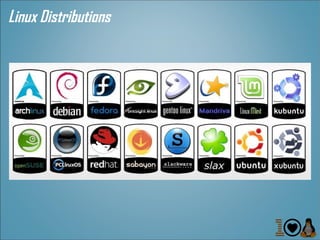
Linux Distributions
                      Operating System


                          Apps

                           GUI


                         Kernel
Linux Distributions
Linux Distributions
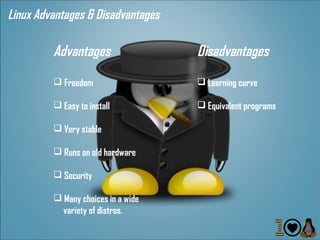
Linux Advantages & Disadvantages

         Advantages                 Disadvantages
          Freedom                   Learning curve

          Easy to install           Equivalent programs

          Very stable

          Runs on old hardware

          Security

          Many choices in a wide
           variety of distros.
? Who use Linux

      The White House
      The United States Department of Defense
      France's national police force
      Germany, 560,000 students in 33 universities
      Russia, all school computers
      The Indian government's tablet for student use Linux as the
       operating system , US$35
      Sony's PlayStation 3
      Novell, 5500 employees
      Amazon.com, in nearly every corner of its business
      Google
      IBM, IBM supports Linux 100%
      Wikipedia
      DreamWorks Animation
      McDonald

                         Who don’t use Linux ?!!
Installing Ubuntu

Linux introduction

  • 1.
  • 2.
    Index • What isLinux? • Open Source • Free Software • History • Linux distributions • Linux Advantages • Who use Linux? • Ubuntu installation
  • 3.
    What is Linux? •An OS for your computer • Like windows “Better” • Experience total freedom • Free and Open Source
  • 4.
    Owners of ProprietarySoftware closely guard their Source code, and thus cannot be modified by anyone except them Open Open Source software means, the source code of Source the software is OPEN to general public Source Code is made open so that people too can contribute to the development of software
  • 5.
    Free does notmean Free of Cost, instead it means the freedom of source code Free Though Open Source are mostly free of cost but with few Exceptions Software In Open Source Software you have the right to use Use, Modify, Copy and Distribute the software with or without the changes that you made to the code
  • 6.
    History  In 1970's AT&t Bell labs funded a project to create a new Operating System and came up with UNIX.  UNIX finally developed as a powerful Operating System and quickly became very famous.  Soon after contribution from various Universities AT&T licensed it and made it proprietary making it unfit for teaching and learning.
  • 7.
    History GNU Project
  • 8.
    History  Linux is Unix-like Operating System.  The code of UNIX is not copied, only the Operating System Concepts are properly incorporated.  The development of Linux started from scratch and thus is just a Unix clone and not freely available UNIX copy.
  • 9.
    Linux Distributions Operating System Apps GUI Kernel
  • 10.
  • 11.
  • 12.
    Linux Advantages &Disadvantages Advantages Disadvantages  Freedom  Learning curve  Easy to install  Equivalent programs  Very stable  Runs on old hardware  Security  Many choices in a wide variety of distros.
  • 13.
    ? Who useLinux  The White House  The United States Department of Defense  France's national police force  Germany, 560,000 students in 33 universities  Russia, all school computers  The Indian government's tablet for student use Linux as the operating system , US$35  Sony's PlayStation 3  Novell, 5500 employees  Amazon.com, in nearly every corner of its business  Google  IBM, IBM supports Linux 100%  Wikipedia  DreamWorks Animation  McDonald Who don’t use Linux ?!!
  • 14.