An Introduction to Linux
               Vivek kurmi
                +91-9008744609
             Kurmi.vivek@gmail.com


             Linux User Group,Manipal


                Install Fest-2012
                 16th october,2012

16-10-2012         Vivek Kurmi LUG Manipal   1
What is Linux?
                 What is Linux?
ā—   Linux is Free and Open Source.
ā—   It is a UNIX like multi-
    user,multitasking operating system
    with the X Windows GUI,which can
    work on multiple hardware platform.
ā—   Since Linux is free and Open
    Source, there are many flavours to
    linux.


    16-10-2012      Vivek Kurmi LUG Manipal   2
Open Source!
                  Open Source!
ā—   Owners of Proprietary Software's closely guard
    their Source code, and thus cannot be modified by
    anyone except them.
ā—   On the contrary Open Source software's means,
    the source code of the software is OPEN to
    general public.
ā—   Programmers can read,redistribute, and modify
    the source for a piece of software.People adapt it,
    improve it and fix bugs.And this can happen at a
    speed that,compared to conventional software
    development, seems astonishing.

    16-10-2012        Vivek Kurmi LUG Manipal     3
Free Software
                 Free Software
ā—   The term Free is in the sense, freedom to
    copy and re-use the software source, rather
    than to the price of the software.
ā—   To understand the concept, one should-
    "think of free as in free speech, not as in
    free beer".
ā—   Though Open Source are mostly free of
    cost there are few exceptions like
    ZendStudio,houdini.
    16-10-2012      Vivek Kurmi LUG Manipal   4
History
             History
                          ā—   Linux is Unix-like Operating
                              System.
                          ā—   The code of UNIX is not
                              copied,only the Operating
                              System Concepts are
                              properly incorporated.
                          ā—   The development of Linux
                              started from scratch and
                              thus is just a Unix clone and
                              not freely available UNIX
                              copy.


16-10-2012   Vivek Kurmi LUG Manipal                5
History-UNIX
                   History-UNIX
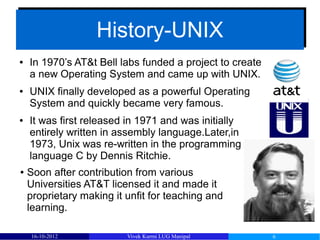
ā—   In 1970’s AT&t Bell labs funded a project to create
    a new Operating System and came up with UNIX.
ā—   UNIX finally developed as a powerful Operating
    System and quickly became very famous.
ā—   It was first released in 1971 and was initially
    entirely written in assembly language.Later,in
    1973, Unix was re-written in the programming
    language C by Dennis Ritchie.
ā—   Soon after contribution from various
    Universities AT&T licensed it and made it
    proprietary making it unfit for teaching and
    learning.

    16-10-2012            Vivek Kurmi LUG Manipal         6
History-GNU
             History-GNU
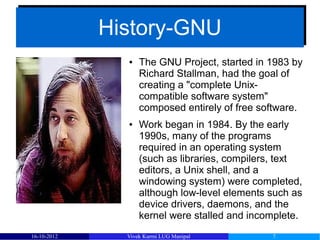
               ā—   The GNU Project, started in 1983 by
                   Richard Stallman, had the goal of
                   creating a "complete Unix-
                   compatible software system"
                   composed entirely of free software.
               ā—   Work began in 1984. By the early
                   1990s, many of the programs
                   required in an operating system
                   (such as libraries, compilers, text
                   editors, a Unix shell, and a
                   windowing system) were completed,
                   although low-level elements such as
                   device drivers, daemons, and the
                   kernel were stalled and incomplete.
16-10-2012     Vivek Kurmi LUG Manipal         7
History-MINIX
                 History-MINIX
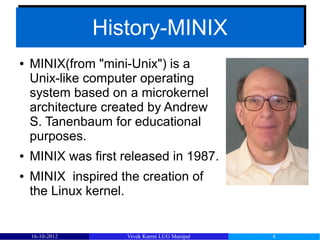
ā—   MINIX(from "mini-Unix") is a
    Unix-like computer operating
    system based on a microkernel
    architecture created by Andrew
    S. Tanenbaum for educational
    purposes.
ā—   MINIX was first released in 1987.
ā—   MINIX inspired the creation of
    the Linux kernel.


    16-10-2012       Vivek Kurmi LUG Manipal   8
History-LINUX
             History-LINUX
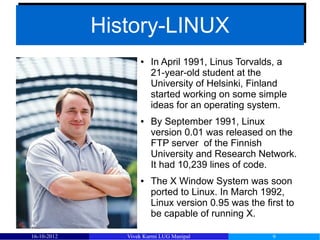
                    ā—   In April 1991, Linus Torvalds, a
                        21-year-old student at the
                        University of Helsinki, Finland
                        started working on some simple
                        ideas for an operating system.
                    ā—   By September 1991, Linux
                        version 0.01 was released on the
                        FTP server of the Finnish
                        University and Research Network.
                        It had 10,239 lines of code.
                    ā—   The X Window System was soon
                        ported to Linux. In March 1992,
                        Linux version 0.95 was the first to
                        be capable of running X.

16-10-2012      Vivek Kurmi LUG Manipal              9
History-LINUX
             History-LINUX
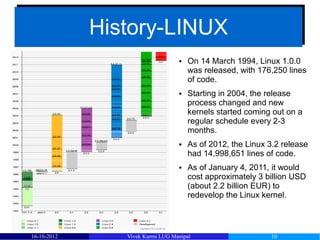
                                  ā—   On 14 March 1994, Linux 1.0.0
                                      was released, with 176,250 lines
                                      of code.
                                  ā—   Starting in 2004, the release
                                      process changed and new
                                      kernels started coming out on a
                                      regular schedule every 2-3
                                      months.
                                  ā—   As of 2012, the Linux 3.2 release
                                      had 14,998,651 lines of code.
                                  ā—   As of January 4, 2011, it would
                                      cost approximately 3 billion USD
                                      (about 2.2 billion EUR) to
                                      redevelop the Linux kernel.


16-10-2012      Vivek Kurmi LUG Manipal                     10
Why so many Linux flavours??
  Why so many Linux flavours??


16-10-2012   Vivek Kurmi LUG Manipal   11
Why so many Linux flavours??
      Why so many Linux flavours??
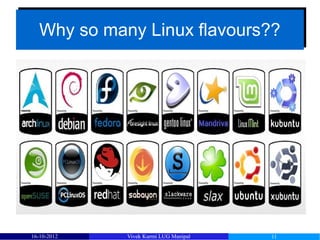
ā—   All Linux flavours are called Distros which are a
    fancy term for distributions.
ā—   Since its Free and Open Source people are
    free to modify and release their own version
    and copies.
ā—   If you dont like you one distro you can freely
    move to any other one which you like for e.g-
    Open Suse, Mandriva, Slackware etc.
ā—   Some popular linux distros are
    Ubuntu,Kubuntu,Fedora,Mint,OpenSuse,
    ArchLinux,RedHat.
    16-10-2012        Vivek Kurmi LUG Manipal   12
Advantages of Linux
                 Advantages of Linux
ā—   Low Cost                       ā—   Compatibility
ā—   Stability                      ā—   Fast and Easy
ā—   Performance                        Installation
ā—   Network Friendliness
                                   ā—   Full use of Hard Disk
ā—   Flexibility
                                   ā—   Multitasking
                                   ā—   Security


    16-10-2012        Vivek Kurmi LUG Manipal           13
Who uses linux??
                 Who uses linux??
ā—   Almost all Hackers rely on linux.
ā—   Almost all Supercomputers runs on Linux.
ā—   Amazon.com online retailer recently switched
    entirely to Linux and saved 17 million Dollars.
ā—   Google, the most popular search engine on the web,
    runs on a cluster of over 1000 Linux servers.
ā—   Wikipedia runs on linux since its birth and has
    shifted to Ubuntu since 2008.
ā—   NYSE runs on linux.
ā—   Life Insurance Corporation of India switched entirely
    to linux.
    16-10-2012          Vivek Kurmi LUG Manipal       14
Linux on multiple hardware platforms
      Linux on multiple hardware platforms

ā—   While not originally designed to be
    portable,Linux is now one of the most widely
    ported operating system kernels, running on a
    diverse range of systems from the ARM
    architecture to the massive mainframe server.
ā—   Some operating systems developed for mobile
    phones use modified versions of the Linux
    kernel, including Google Android, HP webOS,
    and Nokia Maemo.


    16-10-2012      Vivek Kurmi LUG Manipal   15
Thank You!!!


16-10-2012   Vivek Kurmi LUG Manipal    16

Intro to linux

  • 1.
    An Introduction toLinux Vivek kurmi +91-9008744609 Kurmi.vivek@gmail.com Linux User Group,Manipal Install Fest-2012 16th october,2012 16-10-2012 Vivek Kurmi LUG Manipal 1
  • 2.
    What is Linux? What is Linux? ā— Linux is Free and Open Source. ā— It is a UNIX like multi- user,multitasking operating system with the X Windows GUI,which can work on multiple hardware platform. ā— Since Linux is free and Open Source, there are many flavours to linux. 16-10-2012 Vivek Kurmi LUG Manipal 2
  • 3.
    Open Source! Open Source! ā— Owners of Proprietary Software's closely guard their Source code, and thus cannot be modified by anyone except them. ā— On the contrary Open Source software's means, the source code of the software is OPEN to general public. ā— Programmers can read,redistribute, and modify the source for a piece of software.People adapt it, improve it and fix bugs.And this can happen at a speed that,compared to conventional software development, seems astonishing. 16-10-2012 Vivek Kurmi LUG Manipal 3
  • 4.
    Free Software Free Software ā— The term Free is in the sense, freedom to copy and re-use the software source, rather than to the price of the software. ā— To understand the concept, one should- "think of free as in free speech, not as in free beer". ā— Though Open Source are mostly free of cost there are few exceptions like ZendStudio,houdini. 16-10-2012 Vivek Kurmi LUG Manipal 4
  • 5.
    History History ā— Linux is Unix-like Operating System. ā— The code of UNIX is not copied,only the Operating System Concepts are properly incorporated. ā— The development of Linux started from scratch and thus is just a Unix clone and not freely available UNIX copy. 16-10-2012 Vivek Kurmi LUG Manipal 5
  • 6.
    History-UNIX History-UNIX ā— In 1970’s AT&t Bell labs funded a project to create a new Operating System and came up with UNIX. ā— UNIX finally developed as a powerful Operating System and quickly became very famous. ā— It was first released in 1971 and was initially entirely written in assembly language.Later,in 1973, Unix was re-written in the programming language C by Dennis Ritchie. ā— Soon after contribution from various Universities AT&T licensed it and made it proprietary making it unfit for teaching and learning. 16-10-2012 Vivek Kurmi LUG Manipal 6
  • 7.
    History-GNU History-GNU ā— The GNU Project, started in 1983 by Richard Stallman, had the goal of creating a "complete Unix- compatible software system" composed entirely of free software. ā— Work began in 1984. By the early 1990s, many of the programs required in an operating system (such as libraries, compilers, text editors, a Unix shell, and a windowing system) were completed, although low-level elements such as device drivers, daemons, and the kernel were stalled and incomplete. 16-10-2012 Vivek Kurmi LUG Manipal 7
  • 8.
    History-MINIX History-MINIX ā— MINIX(from "mini-Unix") is a Unix-like computer operating system based on a microkernel architecture created by Andrew S. Tanenbaum for educational purposes. ā— MINIX was first released in 1987. ā— MINIX inspired the creation of the Linux kernel. 16-10-2012 Vivek Kurmi LUG Manipal 8
  • 9.
    History-LINUX History-LINUX ā— In April 1991, Linus Torvalds, a 21-year-old student at the University of Helsinki, Finland started working on some simple ideas for an operating system. ā— By September 1991, Linux version 0.01 was released on the FTP server of the Finnish University and Research Network. It had 10,239 lines of code. ā— The X Window System was soon ported to Linux. In March 1992, Linux version 0.95 was the first to be capable of running X. 16-10-2012 Vivek Kurmi LUG Manipal 9
  • 10.
    History-LINUX History-LINUX ā— On 14 March 1994, Linux 1.0.0 was released, with 176,250 lines of code. ā— Starting in 2004, the release process changed and new kernels started coming out on a regular schedule every 2-3 months. ā— As of 2012, the Linux 3.2 release had 14,998,651 lines of code. ā— As of January 4, 2011, it would cost approximately 3 billion USD (about 2.2 billion EUR) to redevelop the Linux kernel. 16-10-2012 Vivek Kurmi LUG Manipal 10
  • 11.
    Why so manyLinux flavours?? Why so many Linux flavours?? 16-10-2012 Vivek Kurmi LUG Manipal 11
  • 12.
    Why so manyLinux flavours?? Why so many Linux flavours?? ā— All Linux flavours are called Distros which are a fancy term for distributions. ā— Since its Free and Open Source people are free to modify and release their own version and copies. ā— If you dont like you one distro you can freely move to any other one which you like for e.g- Open Suse, Mandriva, Slackware etc. ā— Some popular linux distros are Ubuntu,Kubuntu,Fedora,Mint,OpenSuse, ArchLinux,RedHat. 16-10-2012 Vivek Kurmi LUG Manipal 12
  • 13.
    Advantages of Linux Advantages of Linux ā— Low Cost ā— Compatibility ā— Stability ā— Fast and Easy ā— Performance Installation ā— Network Friendliness ā— Full use of Hard Disk ā— Flexibility ā— Multitasking ā— Security 16-10-2012 Vivek Kurmi LUG Manipal 13
  • 14.
    Who uses linux?? Who uses linux?? ā— Almost all Hackers rely on linux. ā— Almost all Supercomputers runs on Linux. ā— Amazon.com online retailer recently switched entirely to Linux and saved 17 million Dollars. ā— Google, the most popular search engine on the web, runs on a cluster of over 1000 Linux servers. ā— Wikipedia runs on linux since its birth and has shifted to Ubuntu since 2008. ā— NYSE runs on linux. ā— Life Insurance Corporation of India switched entirely to linux. 16-10-2012 Vivek Kurmi LUG Manipal 14
  • 15.
    Linux on multiplehardware platforms Linux on multiple hardware platforms ā— While not originally designed to be portable,Linux is now one of the most widely ported operating system kernels, running on a diverse range of systems from the ARM architecture to the massive mainframe server. ā— Some operating systems developed for mobile phones use modified versions of the Linux kernel, including Google Android, HP webOS, and Nokia Maemo. 16-10-2012 Vivek Kurmi LUG Manipal 15
  • 16.
    Thank You!!! 16-10-2012 Vivek Kurmi LUG Manipal 16