Introduction to LINUX
Getting Started
1 Introduction to UNIX
2 LINUX GNU
3 Programming LINUX
• An Introduction to UNIX, Linux, and GNU
What Is UNIX?
The UNIX operating system was originally developed at Bell Laboratories,
once part of the telecommunications giant AT&T. Designed in the 1970s for
Digital Equipment PDP computers, UNIX has become a very popular
multiuser, multitasking operating system for a wide variety of hardware
platforms, from PC workstations to multiprocessor servers and
supercomputers.
UNIX Characteristics
• Simplicity
• Focus
• Reusable Components
• Filters
• Open File Formats
• Flexibility
What Is Linux?
• Linux is a freely distributed implementation of a UNIX-like kernel, the lowlevel core of an
operating system.
• Because Linux takes the UNIX system as its inspiration,
• Linux and UNIX programs are very similar.
• all programs written for UNIX can be compiled and run on Linux
• Linux was developed by Linus Torvalds at the University of Helsinki.
LINUX
Versions of Linux are now available for a wide variety of computer
systems using many different types of CPUs, including PCs based
On 32-bit and 64-bit Intel x86 and compatible processors
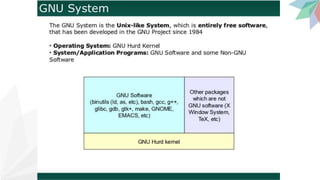
GNU stands for GNU's Not UNIX. It is a UNIX like computer operating
system, but unlike UNIX, it is free software and contains no UNIX code.
LINUX GNU
LINUX GNU
A few major examples of software from the GNU Project distributed under the
GPL follow:
❑ GCC: The GNU Compiler Collection, containing the GNU C compiler
❑ G++: A C++ compiler, included as part of gcc
❑ GDB: A source code–level debugger
❑ GNU make: A version of UNIX make
❑ Bison: A parser generator compatible with UNIX yacc
❑ bash: A command shell
❑ GNU Emacs: A text editor and environment
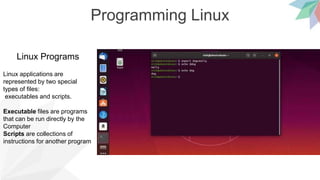
Programming Linux
Linux Programs
Linux applications are
represented by two special
types of files:
executables and scripts.
Executable files are programs
that can be run directly by the
Computer
Scripts are collections of
instructions for another program
❑ /bin: Binaries, programs used in booting the system
❑ /usr/bin: User binaries, standard programs available to users
❑ /usr/local/bin: Local binaries, programs specific to an installation
system administrator and will usually contain some standard places where
system programs are stored. These include:
An administrator’s login, such as root, may use a PATH variable that
includes directories where system administration programs are kept,
such as /sbin and /usr/sbin
Optional operating system components and third-party applications may be
Installed in subdirectories of /opt, and installation programs might add to your
PATH variable by way of user install scripts.
Text Editors
To write and enter the code examples in the book, you’ll need to use an editor.
There are many to choose from on a typical Linux system. The vi editor is popular
with many users.
Both of the authors like Emacs, so we suggest you take the time to learn some of the
features of this powerful editor. Almost all Linux distributions have Emacs as an
optional package you can install
The C Compiler
• On POSIX-compliant systems, the C compiler is called c89.
• The C compiler was simply called cc.
• On Linux systems that do try to implement the standards, you might find
that any or all of the commands c89, cc, and gcc refer to the system C
compiler, usually the GNU C compiler, or gcc
• In this book, we use gcc because it’s provided with Linux distributions
and because it supports the ANSI standard syntax for C
Example Program
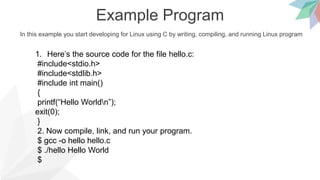
In this example you start developing for Linux using C by writing, compiling, and running Linux program
1. Here’s the source code for the file hello.c:
#include<stdio.h>
#include<stdlib.h>
#include int main()
{
printf(“Hello Worldn”);
exit(0);
}
2. Now compile, link, and run your program.
$ gcc -o hello hello.c
$ ./hello Hello World
$
Thank you

Linux Simple Introduction

  • 1.
  • 2.
    Getting Started 1 Introductionto UNIX 2 LINUX GNU 3 Programming LINUX
  • 3.
    • An Introductionto UNIX, Linux, and GNU What Is UNIX? The UNIX operating system was originally developed at Bell Laboratories, once part of the telecommunications giant AT&T. Designed in the 1970s for Digital Equipment PDP computers, UNIX has become a very popular multiuser, multitasking operating system for a wide variety of hardware platforms, from PC workstations to multiprocessor servers and supercomputers.
  • 4.
    UNIX Characteristics • Simplicity •Focus • Reusable Components • Filters • Open File Formats • Flexibility What Is Linux? • Linux is a freely distributed implementation of a UNIX-like kernel, the lowlevel core of an operating system. • Because Linux takes the UNIX system as its inspiration, • Linux and UNIX programs are very similar. • all programs written for UNIX can be compiled and run on Linux • Linux was developed by Linus Torvalds at the University of Helsinki.
  • 5.
    LINUX Versions of Linuxare now available for a wide variety of computer systems using many different types of CPUs, including PCs based On 32-bit and 64-bit Intel x86 and compatible processors GNU stands for GNU's Not UNIX. It is a UNIX like computer operating system, but unlike UNIX, it is free software and contains no UNIX code. LINUX GNU
  • 7.
    LINUX GNU A fewmajor examples of software from the GNU Project distributed under the GPL follow: ❑ GCC: The GNU Compiler Collection, containing the GNU C compiler ❑ G++: A C++ compiler, included as part of gcc ❑ GDB: A source code–level debugger ❑ GNU make: A version of UNIX make ❑ Bison: A parser generator compatible with UNIX yacc ❑ bash: A command shell ❑ GNU Emacs: A text editor and environment
  • 8.
    Programming Linux Linux Programs Linuxapplications are represented by two special types of files: executables and scripts. Executable files are programs that can be run directly by the Computer Scripts are collections of instructions for another program
  • 9.
    ❑ /bin: Binaries,programs used in booting the system ❑ /usr/bin: User binaries, standard programs available to users ❑ /usr/local/bin: Local binaries, programs specific to an installation system administrator and will usually contain some standard places where system programs are stored. These include: An administrator’s login, such as root, may use a PATH variable that includes directories where system administration programs are kept, such as /sbin and /usr/sbin Optional operating system components and third-party applications may be Installed in subdirectories of /opt, and installation programs might add to your PATH variable by way of user install scripts.
  • 10.
    Text Editors To writeand enter the code examples in the book, you’ll need to use an editor. There are many to choose from on a typical Linux system. The vi editor is popular with many users. Both of the authors like Emacs, so we suggest you take the time to learn some of the features of this powerful editor. Almost all Linux distributions have Emacs as an optional package you can install
  • 11.
    The C Compiler •On POSIX-compliant systems, the C compiler is called c89. • The C compiler was simply called cc. • On Linux systems that do try to implement the standards, you might find that any or all of the commands c89, cc, and gcc refer to the system C compiler, usually the GNU C compiler, or gcc • In this book, we use gcc because it’s provided with Linux distributions and because it supports the ANSI standard syntax for C
  • 12.
    Example Program In thisexample you start developing for Linux using C by writing, compiling, and running Linux program 1. Here’s the source code for the file hello.c: #include<stdio.h> #include<stdlib.h> #include int main() { printf(“Hello Worldn”); exit(0); } 2. Now compile, link, and run your program. $ gcc -o hello hello.c $ ./hello Hello World $
  • 13.