
Linux IO internals
for database administrators
Ilya Kosmodemiansky
ik@postgresql-consulting.com
Why this talk
• Linux is a most common OS for databases
• DBAs often run into IO problems
• Most of the information on topic is written by kernel
developers (for kernel developers) or is checklist-style
• Checklists are useful, but up to certain workload
The main IO problem for databases
• How to maximize page throughput between memory and
disks
• Things involved:
Disks
Memory
CPU
IO Schedulers
Filesystems
Database itself
• IO problems for databases are not always only about disks
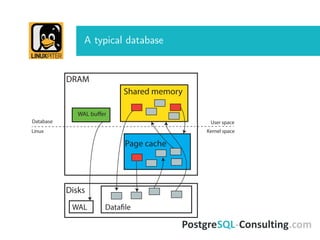
A typical database
DRAM
Disks
Shared memory
Database
Linux
Page cache
User space
Kernel space
WAL buffer
WAL Datafile
Key things about such workload
• Shared memory segment can be very large
• Keeping in-memory pages synchronized with disk generates
huge IO
• WAL should be written fast and safe
• One and every layer of OS IO stack involved
Memory allocation and mapping
CPU L1
MMU TLB
Memory
L2 L3
page
table
Virtual addressing
Translation
Physical addressing
DBAs takeaways:
• Database with huge shared memory segment benefits from
huge pages
• But not from transparent huge pages
Databases operate large continuous shared memory segments
THP defragmentation can lead to severe performance
degradation in such cases
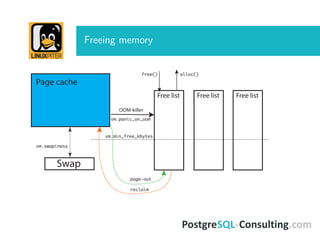
Freeing memory
Page cache
Swap
Free list Free list Free list
alloc()free()
page-out
vm.min_free_kbytes
reclaim
vm.swapiness
OOM-killer
vm.panic_on_oom
Page-out
• Page-out happens if:
someone calls fsync
30 sec timeout exceeded (vm.dirty_expire_centisecs)
Too many dirty pages (vm.dirty_background_ratio and
vm.dirty_ratio)
• It is reasonable to tune vm.dirty_* on rotating disks with
RAID controller, but helps a little on server class SSDs
DBAs takeaways:
• vm.overcommit_memory
0 - heuristic overcommit, reduces swap usage
1 - always overcommit
2 - do not overcommit (vm.overcommit_ratio = 50 by
default)
• vm.min_free_kbytes - reasonably high (can be easy 1000000
on a server with enough memory)
• vm.swappiness = 1
0 - swap disabled
60 - default
100 - swap preffered instead of other reaping mechanisms
• Your database would not like OOM-killer
OOM-killer: plague and cholera
• vm.panic_on_oom effectively disables OOM-killer, but that is
probably not the result you desire
• Or for a certain process: echo -17 > /proc/12465/oom_adj
but again
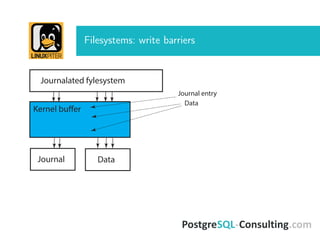
Filesystems: write barriers
Journal
Kernel buffer
Journalated fylesystem
Data
Journal entry
Data
DBAs takeaways:
• ext4 or xfs
• Disable write barrier (only if SSD/controller cache is protected
by capacitor/battery)
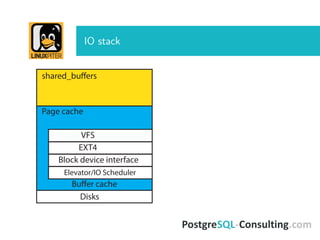
IO stack
shared_buffers
Page cache
VFS
EXT4
Block device interface
Disks
Buffer cache
Elevator/IO Scheduler
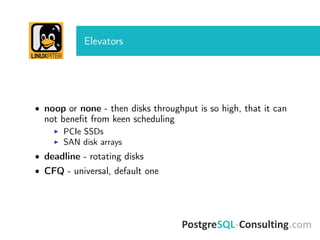
Elevators
• noop or none - then disks throughput is so high, that it can
not benefit from keen scheduling
PCIe SSDs
SAN disk arrays
• deadline - rotating disks
• CFQ - universal, default one
Thanks
to my collegues Alexey Lesovsky and Max Boguk for a lot of
research on this topic
Questions?
ik@postgresql-consulting.com

Linux internals for Database administrators at Linux Piter 2016

  • 1.
    Linux IO internals fordatabase administrators Ilya Kosmodemiansky ik@postgresql-consulting.com
  • 2.
    Why this talk •Linux is a most common OS for databases • DBAs often run into IO problems • Most of the information on topic is written by kernel developers (for kernel developers) or is checklist-style • Checklists are useful, but up to certain workload
  • 3.
    The main IOproblem for databases • How to maximize page throughput between memory and disks • Things involved: Disks Memory CPU IO Schedulers Filesystems Database itself • IO problems for databases are not always only about disks
  • 4.
    A typical database DRAM Disks Sharedmemory Database Linux Page cache User space Kernel space WAL buffer WAL Datafile
  • 5.
    Key things aboutsuch workload • Shared memory segment can be very large • Keeping in-memory pages synchronized with disk generates huge IO • WAL should be written fast and safe • One and every layer of OS IO stack involved
  • 6.
    Memory allocation andmapping CPU L1 MMU TLB Memory L2 L3 page table Virtual addressing Translation Physical addressing
  • 7.
    DBAs takeaways: • Databasewith huge shared memory segment benefits from huge pages • But not from transparent huge pages Databases operate large continuous shared memory segments THP defragmentation can lead to severe performance degradation in such cases
  • 8.
    Freeing memory Page cache Swap Freelist Free list Free list alloc()free() page-out vm.min_free_kbytes reclaim vm.swapiness OOM-killer vm.panic_on_oom
  • 9.
    Page-out • Page-out happensif: someone calls fsync 30 sec timeout exceeded (vm.dirty_expire_centisecs) Too many dirty pages (vm.dirty_background_ratio and vm.dirty_ratio) • It is reasonable to tune vm.dirty_* on rotating disks with RAID controller, but helps a little on server class SSDs
  • 10.
    DBAs takeaways: • vm.overcommit_memory 0- heuristic overcommit, reduces swap usage 1 - always overcommit 2 - do not overcommit (vm.overcommit_ratio = 50 by default) • vm.min_free_kbytes - reasonably high (can be easy 1000000 on a server with enough memory) • vm.swappiness = 1 0 - swap disabled 60 - default 100 - swap preffered instead of other reaping mechanisms • Your database would not like OOM-killer
  • 11.
    OOM-killer: plague andcholera • vm.panic_on_oom effectively disables OOM-killer, but that is probably not the result you desire • Or for a certain process: echo -17 > /proc/12465/oom_adj but again
  • 12.
    Filesystems: write barriers Journal Kernelbuffer Journalated fylesystem Data Journal entry Data
  • 13.
    DBAs takeaways: • ext4or xfs • Disable write barrier (only if SSD/controller cache is protected by capacitor/battery)
  • 14.
    IO stack shared_buffers Page cache VFS EXT4 Blockdevice interface Disks Buffer cache Elevator/IO Scheduler
  • 15.
    Elevators • noop ornone - then disks throughput is so high, that it can not benefit from keen scheduling PCIe SSDs SAN disk arrays • deadline - rotating disks • CFQ - universal, default one
  • 16.
    Thanks to my colleguesAlexey Lesovsky and Max Boguk for a lot of research on this topic
  • 17.