Linux IO internals
for database administrators
Ilya Kosmodemiansky
ik@dataegret.com
1 Why this talk
• Linux is a most common OS for databases
• DBAs often run into IO problems
• Most of the information on topic is written by kernel
developers (for kernel developers) or is checklist-style
• Checklists are useful, but up to certain workload
dataegret.com
Why this talk
• Linux is a most common OS for databases
• DBAs often run into IO problems
• Most of the information on topic is written by kerneldevelopers
(for kernel developers) or is checklist-style
• Checklists are useful, but up to certain workload
dataegret.com
2 The main IO problem for databases
• How to maximize page throughput between memory and
disks
• Things involved:
Disks
Memory
CPU
IO Schedulers
Filesystems
Database itself
• IO problems for databases are not always only about disks
dataegret.com
Why this talk
• Linux is a most common OS for databases
• DBAs often run into IO problems
• Most of the information on topic is written by kerneldevelopers
(for kernel developers) or is checklist-style
• Checklists are useful, but up to certain workload
dataegret.com
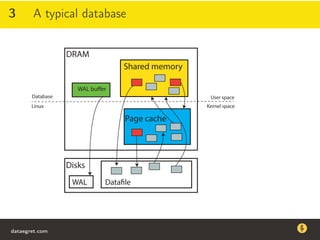
3 A typical database
DRAM
Disks
Shared memory
Database
Linux
Page cache
User space
Kernel space
WAL buffer
WAL Datafile
dataegret.com
Why this talk
• Linux is a most common OS for databases
• DBAs often run into IO problems
• Most of the information on topic is written by kerneldevelopers
(for kernel developers) or is checklist-style
• Checklists are useful, but up to certain workload
dataegret.com
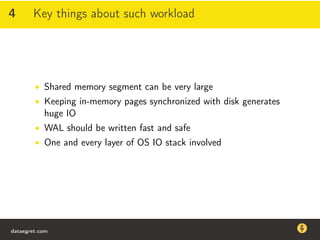
4 Key things about such workload
• Shared memory segment can be very large
• Keeping in-memory pages synchronized with disk generates
huge IO
• WAL should be written fast and safe
• One and every layer of OS IO stack involved
dataegret.com
Why this talk
• Linux is a most common OS for databases
• DBAs often run into IO problems
• Most of the information on topic is written by kerneldevelopers
(for kernel developers) or is checklist-style
• Checklists are useful, but up to certain workload
dataegret.com
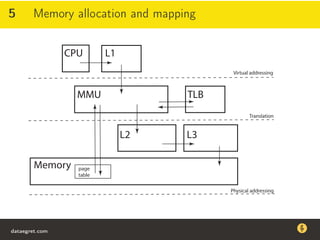
5 Memory allocation and mapping
CPU L1
MMU TLB
Memory
L2 L3
page
table
Virtual addressing
Translation
Physical addressing
dataegret.com
Why this talk
• Linux is a most common OS for databases
• DBAs often run into IO problems
• Most of the information on topic is written by kerneldevelopers
(for kernel developers) or is checklist-style
• Checklists are useful, but up to certain workload
dataegret.com
6 DBAs takeaways:
• Database with huge shared memory segment benefits from
huge pages
• But not from transparent huge pages
Databases operate large continuous shared memory segments
THP defragmentation can lead to severe performance
degradation in such cases
dataegret.com
Why this talk
• Linux is a most common OS for databases
• DBAs often run into IO problems
• Most of the information on topic is written by kerneldevelopers
(for kernel developers) or is checklist-style
• Checklists are useful, but up to certain workload
dataegret.com
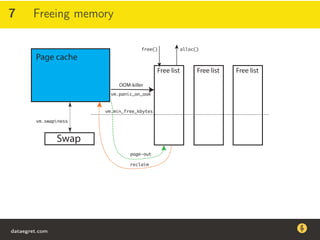
7 Freeing memory
Page cache
Swap
Free list Free list Free list
alloc()free()
page-out
vm.min_free_kbytes
reclaim
vm.swapiness
OOM-killer
vm.panic_on_oom
dataegret.com
Why this talk
• Linux is a most common OS for databases
• DBAs often run into IO problems
• Most of the information on topic is written by kerneldevelopers
(for kernel developers) or is checklist-style
• Checklists are useful, but up to certain workload
dataegret.com
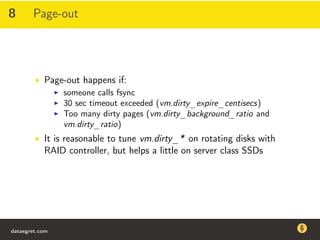
8 Page-out
• Page-out happens if:
someone calls fsync
30 sec timeout exceeded (vm.dirty_expire_centisecs)
Too many dirty pages (vm.dirty_background_ratio and
vm.dirty_ratio)
• It is reasonable to tune vm.dirty_* on rotating disks with
RAID controller, but helps a little on server class SSDs
dataegret.com
Why this talk
• Linux is a most common OS for databases
• DBAs often run into IO problems
• Most of the information on topic is written by kerneldevelopers
(for kernel developers) or is checklist-style
• Checklists are useful, but up to certain workload
dataegret.com
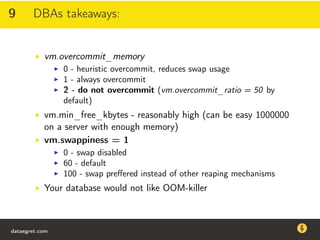
9 DBAs takeaways:
• vm.overcommit_memory
0 - heuristic overcommit, reduces swap usage
1 - always overcommit
2 - do not overcommit (vm.overcommit_ratio = 50 by
default)
• vm.min_free_kbytes - reasonably high (can be easy 1000000
on a server with enough memory)
• vm.swappiness = 1
0 - swap disabled
60 - default
100 - swap preffered instead of other reaping mechanisms
• Your database would not like OOM-killer
dataegret.com
Why this talk
• Linux is a most common OS for databases
• DBAs often run into IO problems
• Most of the information on topic is written by kerneldevelopers
(for kernel developers) or is checklist-style
• Checklists are useful, but up to certain workload
dataegret.com
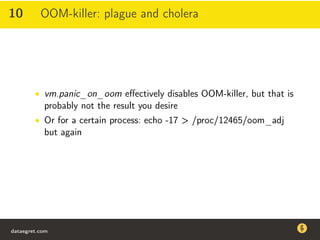
10 OOM-killer: plague and cholera
• vm.panic_on_oom effectively disables OOM-killer, but that is
probably not the result you desire
• Or for a certain process: echo -17 > /proc/12465/oom_adj
but again
dataegret.com
Why this talk
• Linux is a most common OS for databases
• DBAs often run into IO problems
• Most of the information on topic is written by kerneldevelopers
(for kernel developers) or is checklist-style
• Checklists are useful, but up to certain workload
dataegret.com
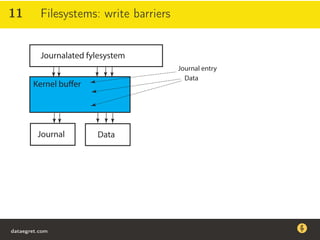
11 Filesystems: write barriers
Journal
Kernel buffer
Journalated fylesystem
Data
Journal entry
Data
dataegret.com
Why this talk
• Linux is a most common OS for databases
• DBAs often run into IO problems
• Most of the information on topic is written by kerneldevelopers
(for kernel developers) or is checklist-style
• Checklists are useful, but up to certain workload
dataegret.com
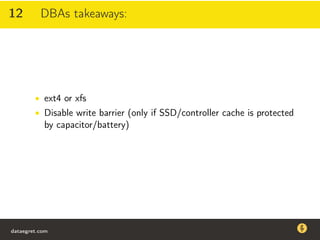
12 DBAs takeaways:
• ext4 or xfs
• Disable write barrier (only if SSD/controller cache is protected
by capacitor/battery)
dataegret.com
Why this talk
• Linux is a most common OS for databases
• DBAs often run into IO problems
• Most of the information on topic is written by kerneldevelopers
(for kernel developers) or is checklist-style
• Checklists are useful, but up to certain workload
dataegret.com
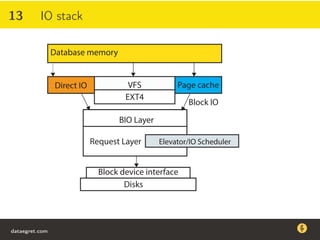
13 IO stack
Database memory
Page cacheVFS
EXT4
Block device interface
Disks
Direct IO
BIO Layer
Block IO
Request Layer Elevator/IO Scheduler
dataegret.com
Why this talk
• Linux is a most common OS for databases
• DBAs often run into IO problems
• Most of the information on topic is written by kerneldevelopers
(for kernel developers) or is checklist-style
• Checklists are useful, but up to certain workload
dataegret.com
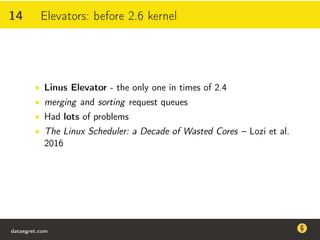
14 Elevators: before 2.6 kernel
• Linus Elevator - the only one in times of 2.4
• merging and sorting request queues
• Had lots of problems
• The Linux Scheduler: a Decade of Wasted Cores – Lozi et al.
2016
dataegret.com
Why this talk
• Linux is a most common OS for databases
• DBAs often run into IO problems
• Most of the information on topic is written by kerneldevelopers
(for kernel developers) or is checklist-style
• Checklists are useful, but up to certain workload
dataegret.com
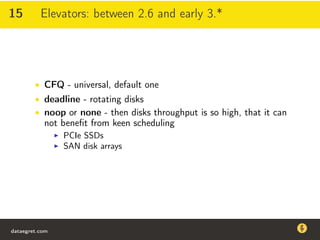
15 Elevators: between 2.6 and early 3.*
• CFQ - universal, default one
• deadline - rotating disks
• noop or none - then disks throughput is so high, that it can
not benefit from keen scheduling
PCIe SSDs
SAN disk arrays
dataegret.com
Why this talk
• Linux is a most common OS for databases
• DBAs often run into IO problems
• Most of the information on topic is written by kerneldevelopers
(for kernel developers) or is checklist-style
• Checklists are useful, but up to certain workload
dataegret.com
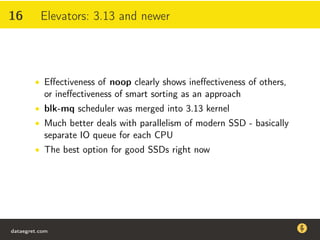
16 Elevators: 3.13 and newer
• Effectiveness of noop clearly shows ineffectiveness of others,
or ineffectiveness of smart sorting as an approach
• blk-mq scheduler was merged into 3.13 kernel
• Much better deals with parallelism of modern SSD - basically
separate IO queue for each CPU
• The best option for good SSDs right now
dataegret.com
Why this talk
• Linux is a most common OS for databases
• DBAs often run into IO problems
• Most of the information on topic is written by kerneldevelopers
(for kernel developers) or is checklist-style
• Checklists are useful, but up to certain workload
dataegret.com
17 Thanks
to my collegues Alexey Lesovsky and Max Boguk for a lot of
research on this topic
dataegret.com
Why this talk
• Linux is a most common OS for databases
• DBAs often run into IO problems
• Most of the information on topic is written by kerneldevelopers
(for kernel developers) or is checklist-style
• Checklists are useful, but up to certain workload
dataegret.com
18 Questions?
ik@dataegret.com
dataegret.com
Why this talk
• Linux is a most common OS for databases
• DBAs often run into IO problems
• Most of the information on topic is written by kerneldevelopers
(for kernel developers) or is checklist-style
• Checklists are useful, but up to certain workload
dataegret.com

Linux IO internals for database administrators (SCaLE 2017 and PGDay Nordic 2017 version)

  • 1.
    Linux IO internals fordatabase administrators Ilya Kosmodemiansky ik@dataegret.com
  • 2.
    1 Why thistalk • Linux is a most common OS for databases • DBAs often run into IO problems • Most of the information on topic is written by kernel developers (for kernel developers) or is checklist-style • Checklists are useful, but up to certain workload dataegret.com Why this talk • Linux is a most common OS for databases • DBAs often run into IO problems • Most of the information on topic is written by kerneldevelopers (for kernel developers) or is checklist-style • Checklists are useful, but up to certain workload dataegret.com
  • 3.
    2 The mainIO problem for databases • How to maximize page throughput between memory and disks • Things involved: Disks Memory CPU IO Schedulers Filesystems Database itself • IO problems for databases are not always only about disks dataegret.com Why this talk • Linux is a most common OS for databases • DBAs often run into IO problems • Most of the information on topic is written by kerneldevelopers (for kernel developers) or is checklist-style • Checklists are useful, but up to certain workload dataegret.com
  • 4.
    3 A typicaldatabase DRAM Disks Shared memory Database Linux Page cache User space Kernel space WAL buffer WAL Datafile dataegret.com Why this talk • Linux is a most common OS for databases • DBAs often run into IO problems • Most of the information on topic is written by kerneldevelopers (for kernel developers) or is checklist-style • Checklists are useful, but up to certain workload dataegret.com
  • 5.
    4 Key thingsabout such workload • Shared memory segment can be very large • Keeping in-memory pages synchronized with disk generates huge IO • WAL should be written fast and safe • One and every layer of OS IO stack involved dataegret.com Why this talk • Linux is a most common OS for databases • DBAs often run into IO problems • Most of the information on topic is written by kerneldevelopers (for kernel developers) or is checklist-style • Checklists are useful, but up to certain workload dataegret.com
  • 6.
    5 Memory allocationand mapping CPU L1 MMU TLB Memory L2 L3 page table Virtual addressing Translation Physical addressing dataegret.com Why this talk • Linux is a most common OS for databases • DBAs often run into IO problems • Most of the information on topic is written by kerneldevelopers (for kernel developers) or is checklist-style • Checklists are useful, but up to certain workload dataegret.com
  • 7.
    6 DBAs takeaways: •Database with huge shared memory segment benefits from huge pages • But not from transparent huge pages Databases operate large continuous shared memory segments THP defragmentation can lead to severe performance degradation in such cases dataegret.com Why this talk • Linux is a most common OS for databases • DBAs often run into IO problems • Most of the information on topic is written by kerneldevelopers (for kernel developers) or is checklist-style • Checklists are useful, but up to certain workload dataegret.com
  • 8.
    7 Freeing memory Pagecache Swap Free list Free list Free list alloc()free() page-out vm.min_free_kbytes reclaim vm.swapiness OOM-killer vm.panic_on_oom dataegret.com Why this talk • Linux is a most common OS for databases • DBAs often run into IO problems • Most of the information on topic is written by kerneldevelopers (for kernel developers) or is checklist-style • Checklists are useful, but up to certain workload dataegret.com
  • 9.
    8 Page-out • Page-outhappens if: someone calls fsync 30 sec timeout exceeded (vm.dirty_expire_centisecs) Too many dirty pages (vm.dirty_background_ratio and vm.dirty_ratio) • It is reasonable to tune vm.dirty_* on rotating disks with RAID controller, but helps a little on server class SSDs dataegret.com Why this talk • Linux is a most common OS for databases • DBAs often run into IO problems • Most of the information on topic is written by kerneldevelopers (for kernel developers) or is checklist-style • Checklists are useful, but up to certain workload dataegret.com
  • 10.
    9 DBAs takeaways: •vm.overcommit_memory 0 - heuristic overcommit, reduces swap usage 1 - always overcommit 2 - do not overcommit (vm.overcommit_ratio = 50 by default) • vm.min_free_kbytes - reasonably high (can be easy 1000000 on a server with enough memory) • vm.swappiness = 1 0 - swap disabled 60 - default 100 - swap preffered instead of other reaping mechanisms • Your database would not like OOM-killer dataegret.com Why this talk • Linux is a most common OS for databases • DBAs often run into IO problems • Most of the information on topic is written by kerneldevelopers (for kernel developers) or is checklist-style • Checklists are useful, but up to certain workload dataegret.com
  • 11.
    10 OOM-killer: plagueand cholera • vm.panic_on_oom effectively disables OOM-killer, but that is probably not the result you desire • Or for a certain process: echo -17 > /proc/12465/oom_adj but again dataegret.com Why this talk • Linux is a most common OS for databases • DBAs often run into IO problems • Most of the information on topic is written by kerneldevelopers (for kernel developers) or is checklist-style • Checklists are useful, but up to certain workload dataegret.com
  • 12.
    11 Filesystems: writebarriers Journal Kernel buffer Journalated fylesystem Data Journal entry Data dataegret.com Why this talk • Linux is a most common OS for databases • DBAs often run into IO problems • Most of the information on topic is written by kerneldevelopers (for kernel developers) or is checklist-style • Checklists are useful, but up to certain workload dataegret.com
  • 13.
    12 DBAs takeaways: •ext4 or xfs • Disable write barrier (only if SSD/controller cache is protected by capacitor/battery) dataegret.com Why this talk • Linux is a most common OS for databases • DBAs often run into IO problems • Most of the information on topic is written by kerneldevelopers (for kernel developers) or is checklist-style • Checklists are useful, but up to certain workload dataegret.com
  • 14.
    13 IO stack Databasememory Page cacheVFS EXT4 Block device interface Disks Direct IO BIO Layer Block IO Request Layer Elevator/IO Scheduler dataegret.com Why this talk • Linux is a most common OS for databases • DBAs often run into IO problems • Most of the information on topic is written by kerneldevelopers (for kernel developers) or is checklist-style • Checklists are useful, but up to certain workload dataegret.com
  • 15.
    14 Elevators: before2.6 kernel • Linus Elevator - the only one in times of 2.4 • merging and sorting request queues • Had lots of problems • The Linux Scheduler: a Decade of Wasted Cores – Lozi et al. 2016 dataegret.com Why this talk • Linux is a most common OS for databases • DBAs often run into IO problems • Most of the information on topic is written by kerneldevelopers (for kernel developers) or is checklist-style • Checklists are useful, but up to certain workload dataegret.com
  • 16.
    15 Elevators: between2.6 and early 3.* • CFQ - universal, default one • deadline - rotating disks • noop or none - then disks throughput is so high, that it can not benefit from keen scheduling PCIe SSDs SAN disk arrays dataegret.com Why this talk • Linux is a most common OS for databases • DBAs often run into IO problems • Most of the information on topic is written by kerneldevelopers (for kernel developers) or is checklist-style • Checklists are useful, but up to certain workload dataegret.com
  • 17.
    16 Elevators: 3.13and newer • Effectiveness of noop clearly shows ineffectiveness of others, or ineffectiveness of smart sorting as an approach • blk-mq scheduler was merged into 3.13 kernel • Much better deals with parallelism of modern SSD - basically separate IO queue for each CPU • The best option for good SSDs right now dataegret.com Why this talk • Linux is a most common OS for databases • DBAs often run into IO problems • Most of the information on topic is written by kerneldevelopers (for kernel developers) or is checklist-style • Checklists are useful, but up to certain workload dataegret.com
  • 18.
    17 Thanks to mycollegues Alexey Lesovsky and Max Boguk for a lot of research on this topic dataegret.com Why this talk • Linux is a most common OS for databases • DBAs often run into IO problems • Most of the information on topic is written by kerneldevelopers (for kernel developers) or is checklist-style • Checklists are useful, but up to certain workload dataegret.com
  • 19.
    18 Questions? ik@dataegret.com dataegret.com Why thistalk • Linux is a most common OS for databases • DBAs often run into IO problems • Most of the information on topic is written by kerneldevelopers (for kernel developers) or is checklist-style • Checklists are useful, but up to certain workload dataegret.com