Date: August 30 2013
By: Patrick Demers
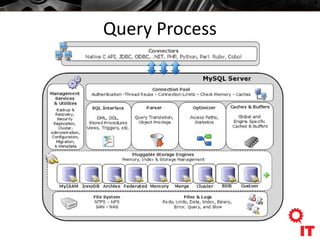
Query Process
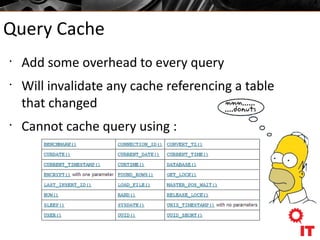
Query Cache
•
Add some overhead to every query
•
Will invalidate any cache referencing a table
that changed
•
Cannot cache query using :
Query Cache
•
Current Setting [ON]
must specify SQL_NO_CACHE to skip cache
•
Will speed up repeating query with the SAME
SYNTAX.
•
Compact with
FLUSH NO_WRITE_TO_BINLOG QUERY CACHE
Example
Variable Type
•
Smaller is usually better
●
less space on disk / memory and CPU cache. Fewer
CPU cycles to process
•
Simple is good
●
Use Integer instead of string (collation / char. set)
•
Avoid Null Column
●
Harder to optimize
●
Use More Space , require special processing.
Variable Type
•
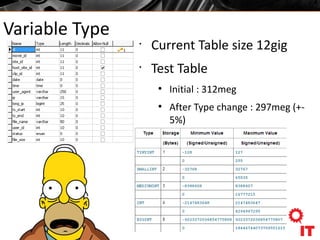
Current Table size 12gig
•
Test Table
●
Initial : 312meg
●
After Type change : 297meg (+-
5%)
Variable Type
•
Size of a Varchar is 65535
•
Why use Text then
●
Stored separately
●
Allow innodb to store more row in a block
●
Use text if not retrieved most of the time
●
Will require an On Disk Temporary table (group by / order
by)
●
Use varchar for columns retrieved in most query
Index
•
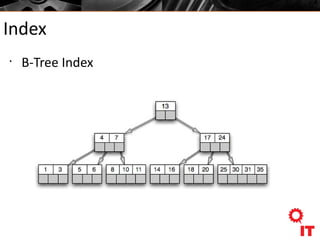
B-Tree Index
Index
•
MySQL will let you index the same column
multiple times
•
Optimizer will check every index available
•
Size of the index depends on Variable Type
•
Indexing a null column requires more
processing
Index
•
Optimize InnoDB Table when there's a lot of
Insert / Delete.
•
Don’t create index only thinking of your
'current query'
•
Test your query often. Adding record in a table
might change an index performance.
•
InnoDB will lock every row it thinks he needs.
No Index will lock the table.
Index
•
Mysql can use part of an index as long as it's
left to right
•
Using a range in a where might prevent the
index to be used fully .
●
where o.date >= '2013-08-01' AND o.date <= '2013-08-30'
•
String can be indexed partially (ex: 10 char on
a 25 char field)
EXPLAIN
•
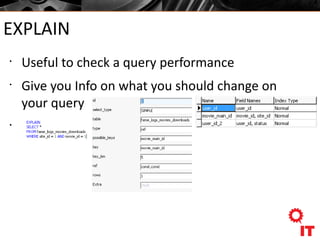
Useful to check a query performance
•
Give you Info on what you should change on
your query
•
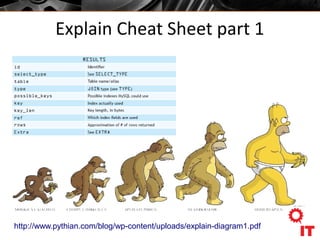
Explain Cheat Sheet part 1
http://www.pythian.com/blog/wp-content/uploads/explain-diagram1.pdf
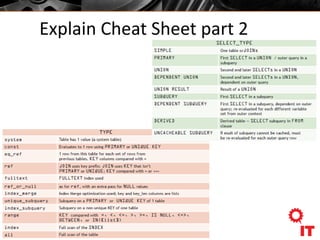
Explain Cheat Sheet part 2
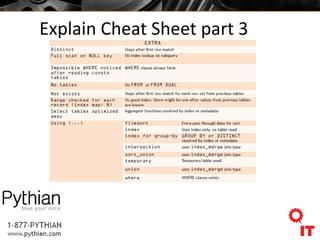
Explain Cheat Sheet part 3
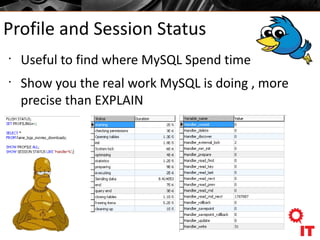
Profile and Session Status
•
Useful to find where MySQL Spend time
•
Show you the real work MySQL is doing , more
precise than EXPLAIN
Example
Other
•
Information_Schema.Columns
●
Useful to search all columns in all databases
●
Sql injection will try to fetch data from there most of the
time.
•
Limit
●
Try not to use big offset. Use a combination of where and
limit when possible
•
Try not to use sub-query
●
The result of a sub-query is copied to a temp. table with
no index, most of the time it should be avoided.
Other
•
See the optimized Query
●
EXPLAIN EXTENDED
●
SHOW WARNINGS
•
Query are not always the problem
•
Test your Doctrine query
Reminder
•
Before Optimizing everything, test what your
doing
•
If you change a Column Type, make sure it will
never get over that value. (skin_id example)
•
(Paysite) If you change a column type for a
client, change it everywhere to stay constant
•
Use new Relic Slow Query Report.
•
Stay Up to date with new feature.
Resource
•
MySQL Performance Blog
•
MySQL Blog
•
Percona Webinar
•
Percona Youtube channel
•
Pythian Varchar vs Text
•
MySQL Group By Optimization
•
MySQL Order By Optimization
•
High Performance MySQL [book]
•
Relational Database Index Design and the Optimizers [book]
Thank You !
Comment , Suggestion and Critics
are
Welcome :)

Tool it Up! - Session #3 - MySQL

  • 1.
    Date: August 302013 By: Patrick Demers
  • 2.
  • 3.
    Query Cache • Add someoverhead to every query • Will invalidate any cache referencing a table that changed • Cannot cache query using :
  • 4.
    Query Cache • Current Setting[ON] must specify SQL_NO_CACHE to skip cache • Will speed up repeating query with the SAME SYNTAX. • Compact with FLUSH NO_WRITE_TO_BINLOG QUERY CACHE
  • 5.
  • 6.
    Variable Type • Smaller isusually better ● less space on disk / memory and CPU cache. Fewer CPU cycles to process • Simple is good ● Use Integer instead of string (collation / char. set) • Avoid Null Column ● Harder to optimize ● Use More Space , require special processing.
  • 7.
    Variable Type • Current Tablesize 12gig • Test Table ● Initial : 312meg ● After Type change : 297meg (+- 5%)
  • 8.
    Variable Type • Size ofa Varchar is 65535 • Why use Text then ● Stored separately ● Allow innodb to store more row in a block ● Use text if not retrieved most of the time ● Will require an On Disk Temporary table (group by / order by) ● Use varchar for columns retrieved in most query
  • 9.
  • 10.
    Index • MySQL will letyou index the same column multiple times • Optimizer will check every index available • Size of the index depends on Variable Type • Indexing a null column requires more processing
  • 11.
    Index • Optimize InnoDB Tablewhen there's a lot of Insert / Delete. • Don’t create index only thinking of your 'current query' • Test your query often. Adding record in a table might change an index performance. • InnoDB will lock every row it thinks he needs. No Index will lock the table.
  • 12.
    Index • Mysql can usepart of an index as long as it's left to right • Using a range in a where might prevent the index to be used fully . ● where o.date >= '2013-08-01' AND o.date <= '2013-08-30' • String can be indexed partially (ex: 10 char on a 25 char field)
  • 13.
    EXPLAIN • Useful to checka query performance • Give you Info on what you should change on your query •
  • 14.
    Explain Cheat Sheetpart 1 http://www.pythian.com/blog/wp-content/uploads/explain-diagram1.pdf
  • 15.
  • 16.
  • 17.
    Profile and SessionStatus • Useful to find where MySQL Spend time • Show you the real work MySQL is doing , more precise than EXPLAIN
  • 18.
  • 19.
    Other • Information_Schema.Columns ● Useful to searchall columns in all databases ● Sql injection will try to fetch data from there most of the time. • Limit ● Try not to use big offset. Use a combination of where and limit when possible • Try not to use sub-query ● The result of a sub-query is copied to a temp. table with no index, most of the time it should be avoided.
  • 20.
    Other • See the optimizedQuery ● EXPLAIN EXTENDED ● SHOW WARNINGS • Query are not always the problem • Test your Doctrine query
  • 21.
    Reminder • Before Optimizing everything,test what your doing • If you change a Column Type, make sure it will never get over that value. (skin_id example) • (Paysite) If you change a column type for a client, change it everywhere to stay constant • Use new Relic Slow Query Report. • Stay Up to date with new feature.
  • 22.
    Resource • MySQL Performance Blog • MySQLBlog • Percona Webinar • Percona Youtube channel • Pythian Varchar vs Text • MySQL Group By Optimization • MySQL Order By Optimization • High Performance MySQL [book] • Relational Database Index Design and the Optimizers [book]
  • 23.
    Thank You ! Comment, Suggestion and Critics are Welcome :)