Discourse Markers
Teacher: Marcelo Lopes
SESI – Conselheiro Saraiva
Discourse Markers
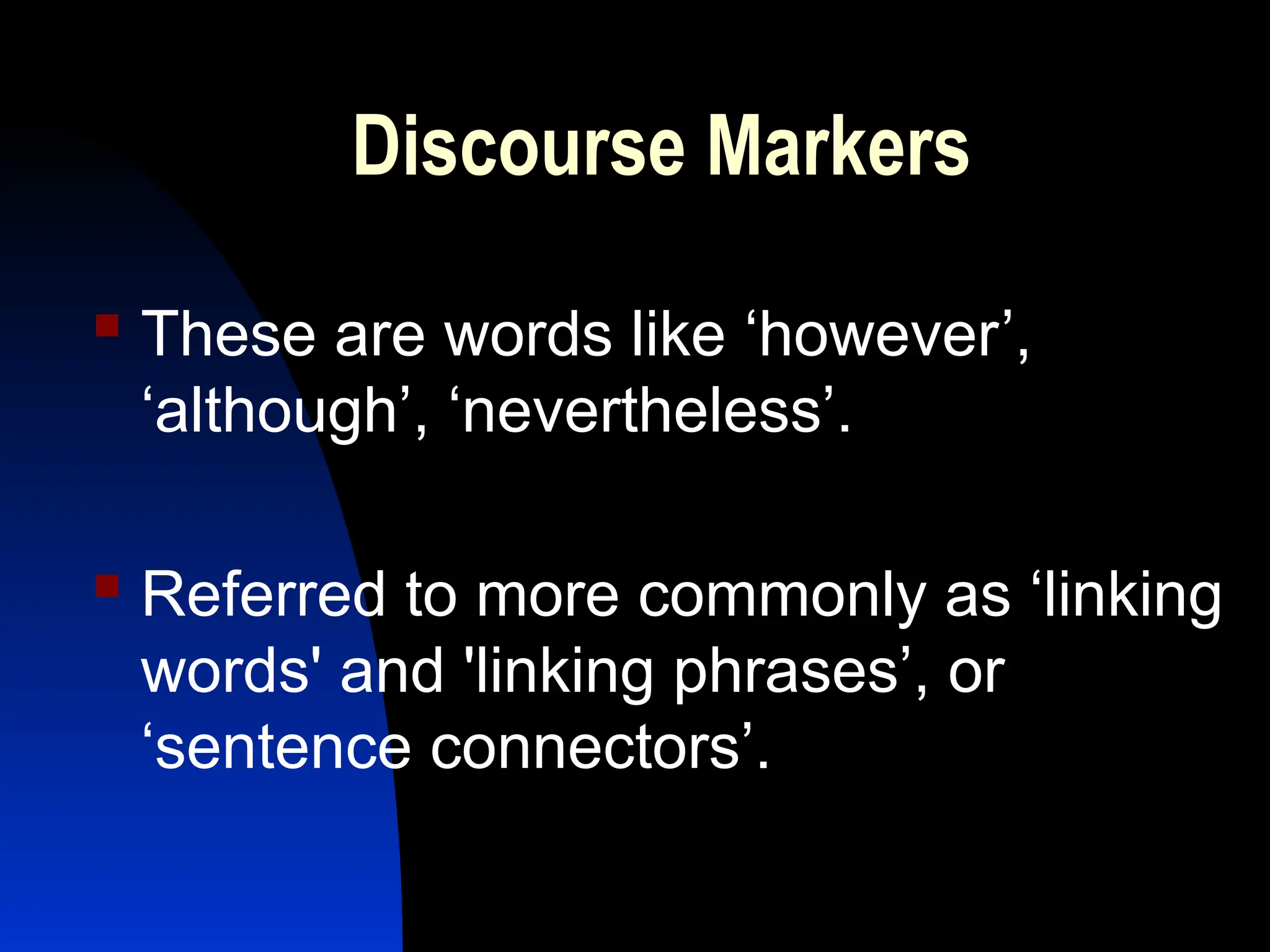
 These are words like ‘however’,
‘although’, ‘nevertheless’.
 Referred to more commonly as ‘linking
words' and 'linking phrases’, or
‘sentence connectors’.
Discourse Markers
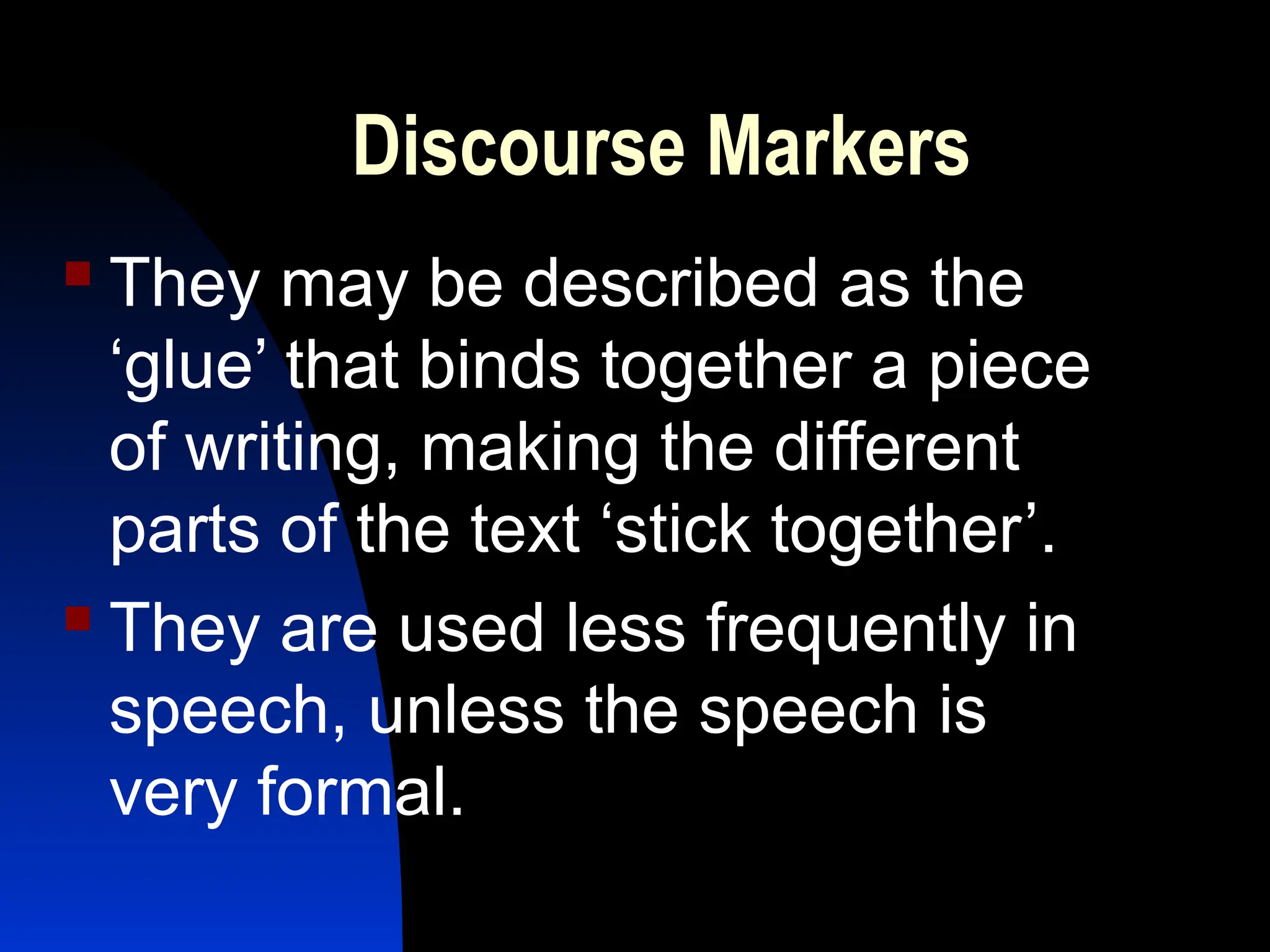
 They may be described as the
‘glue’ that binds together a piece
of writing, making the different
parts of the text ‘stick together’.
 They are used less frequently in
speech, unless the speech is
very formal.
What are the different discourse
markers that can be used?
There are many discourse markers that
express different relationships between
ideas.
The most common types of relationship
between ideas, and the sentence
connectors that are most often used to
express these relationships, are given in
the table below.
Discourse Markers
The discourse markers in the table are
generally used at the start of a phrase or
clause. (a clause is a minimal grammatical
structure that has meaning in its own right,
and consists of a subject and verb, and often
an object too).
Sentence connectors do not always begin a
completely new sentence; they may be
separated from the previous idea with a
semi-colon.
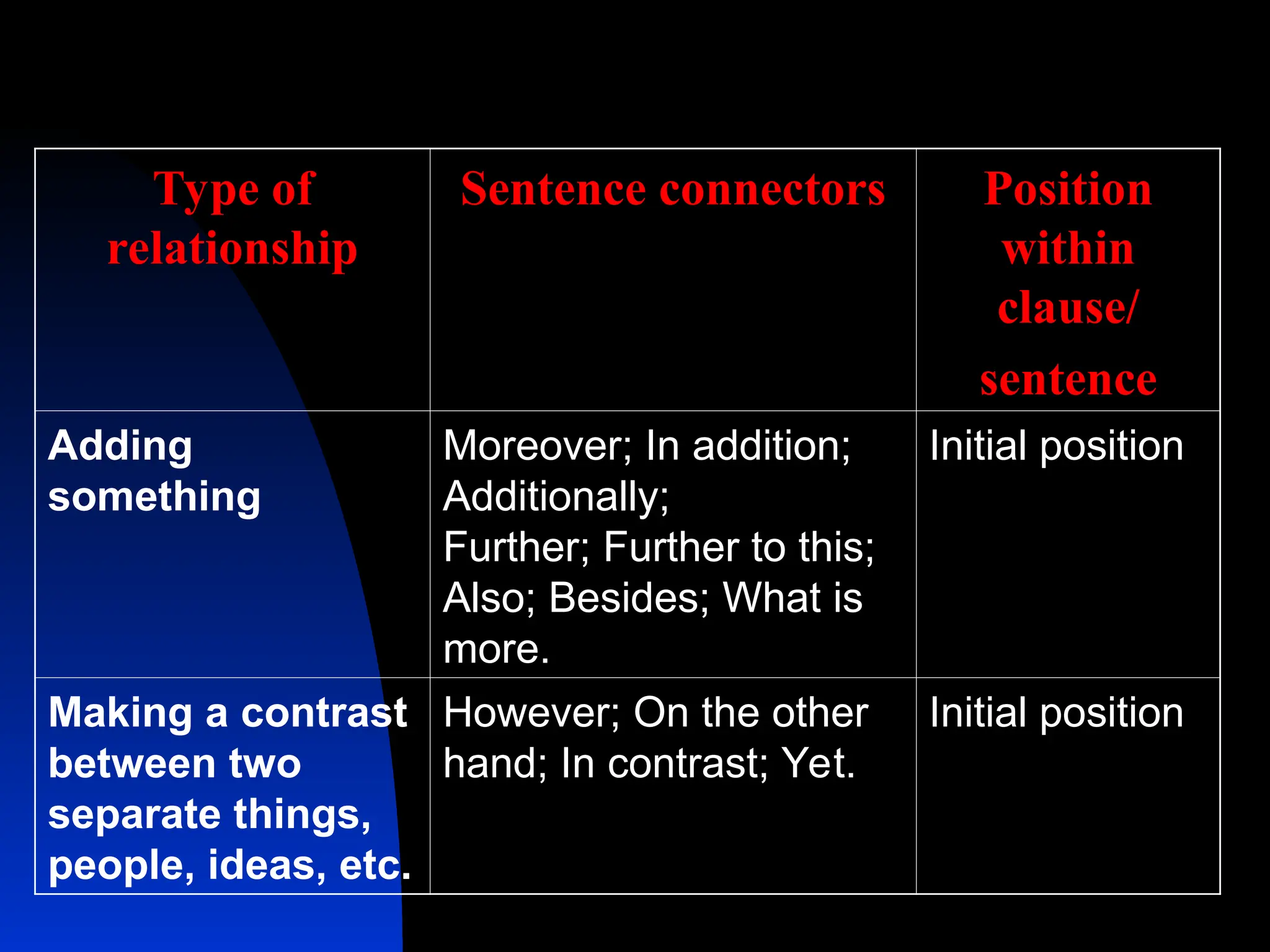
Type of
relationship
Sentence connectors Position
within
clause/
sentence
Adding
something
Moreover; In addition;
Additionally;
Further; Further to this;
Also; Besides; What is
more.
Initial position
Making a contrast
between two
separate things,
people, ideas, etc.
However; On the other
hand; In contrast; Yet.
Initial position
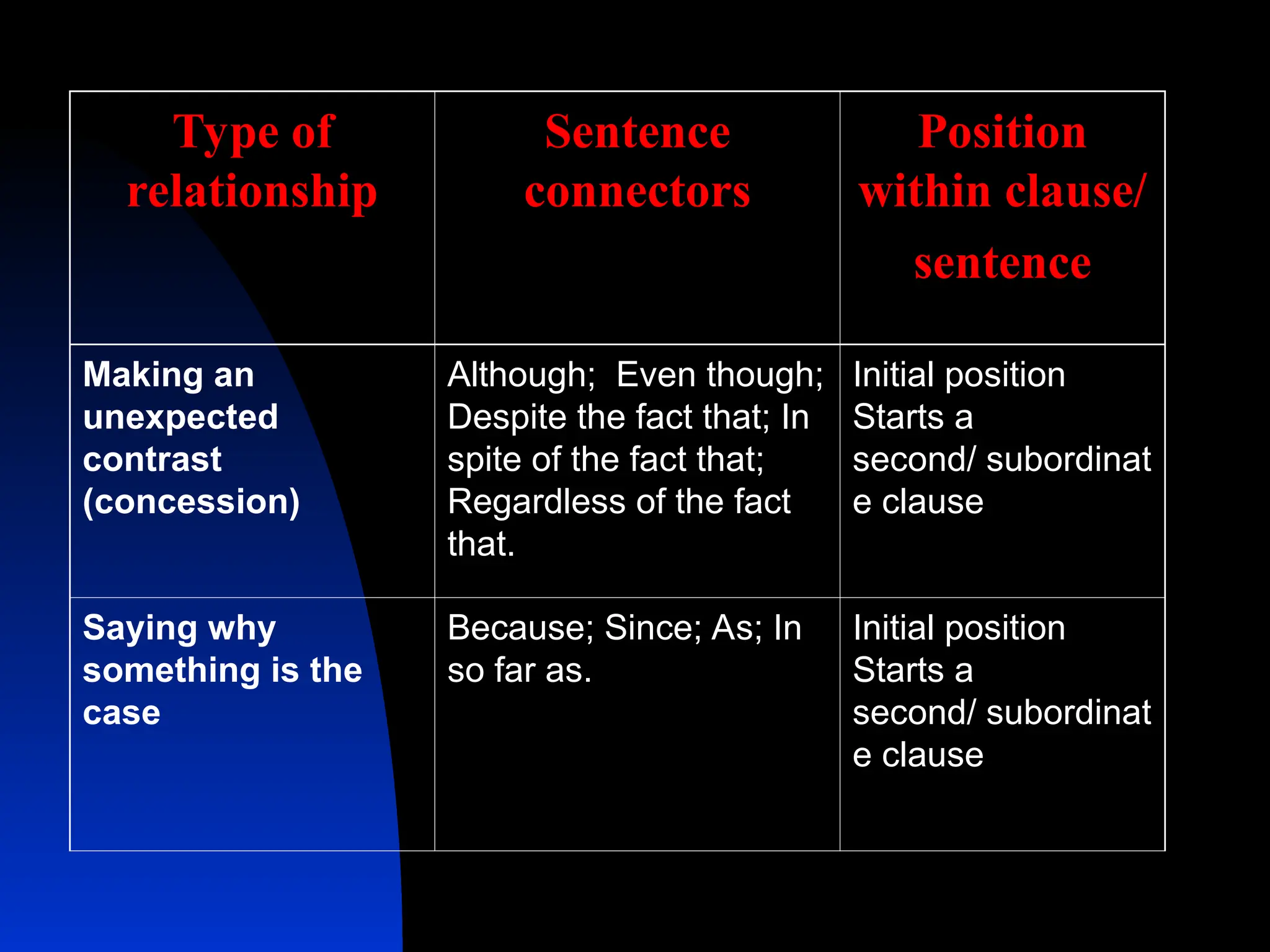
Type of
relationship
Sentence
connectors
Position
within clause/
sentence
Making an
unexpected
contrast
(concession)
Although; Even though;
Despite the fact that; In
spite of the fact that;
Regardless of the fact
that.
Initial position
Starts a
second/ subordinat
e clause
Saying why
something is the
case
Because; Since; As; In
so far as.
Initial position
Starts a
second/ subordinat
e clause
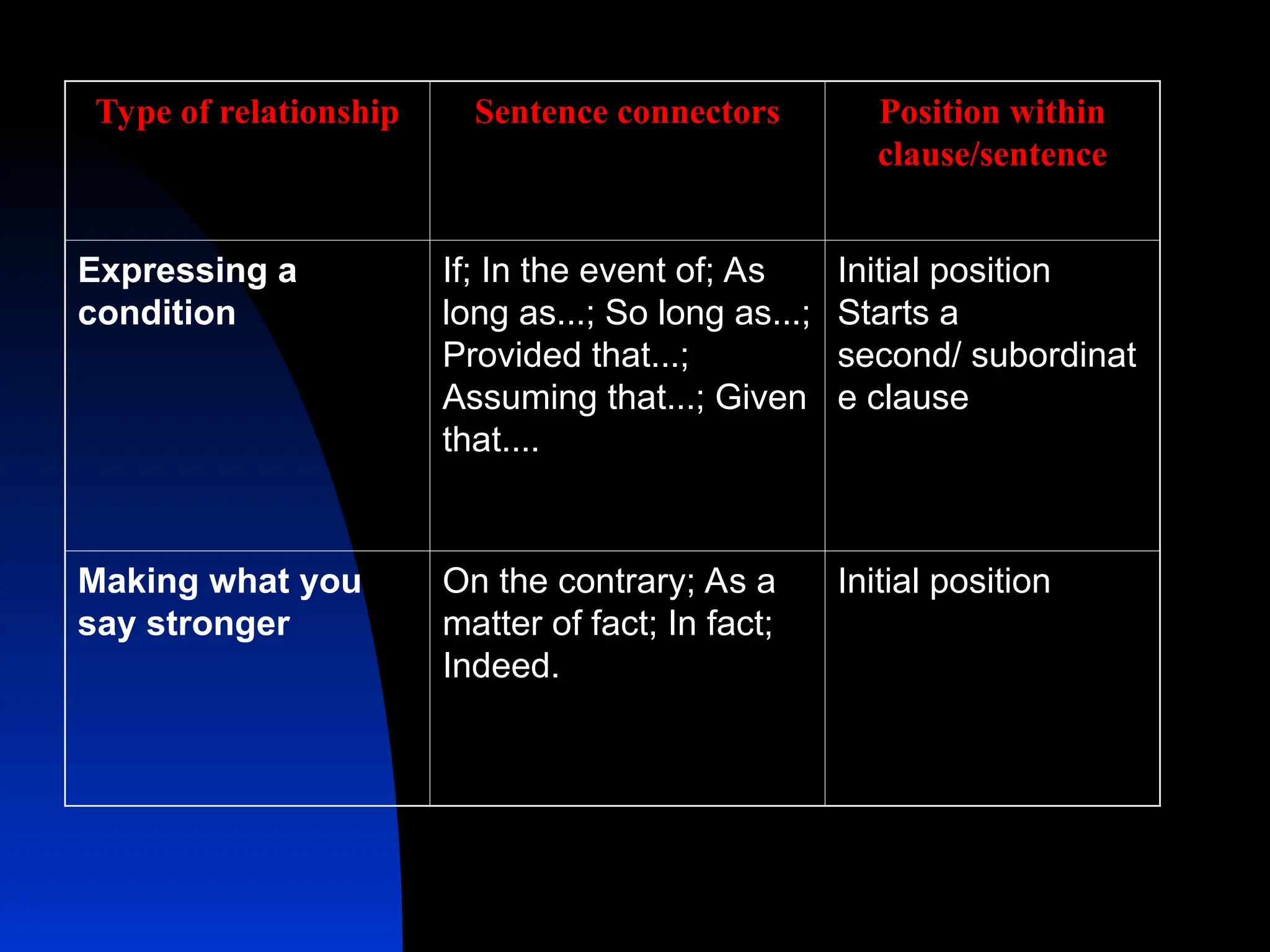
Type of relationship Sentence connectors Position within
clause/sentence
Expressing a
condition
If; In the event of; As
long as...; So long as...;
Provided that...;
Assuming that...; Given
that....
Initial position
Starts a
second/ subordinat
e clause
Making what you
say stronger
On the contrary; As a
matter of fact; In fact;
Indeed.
Initial position
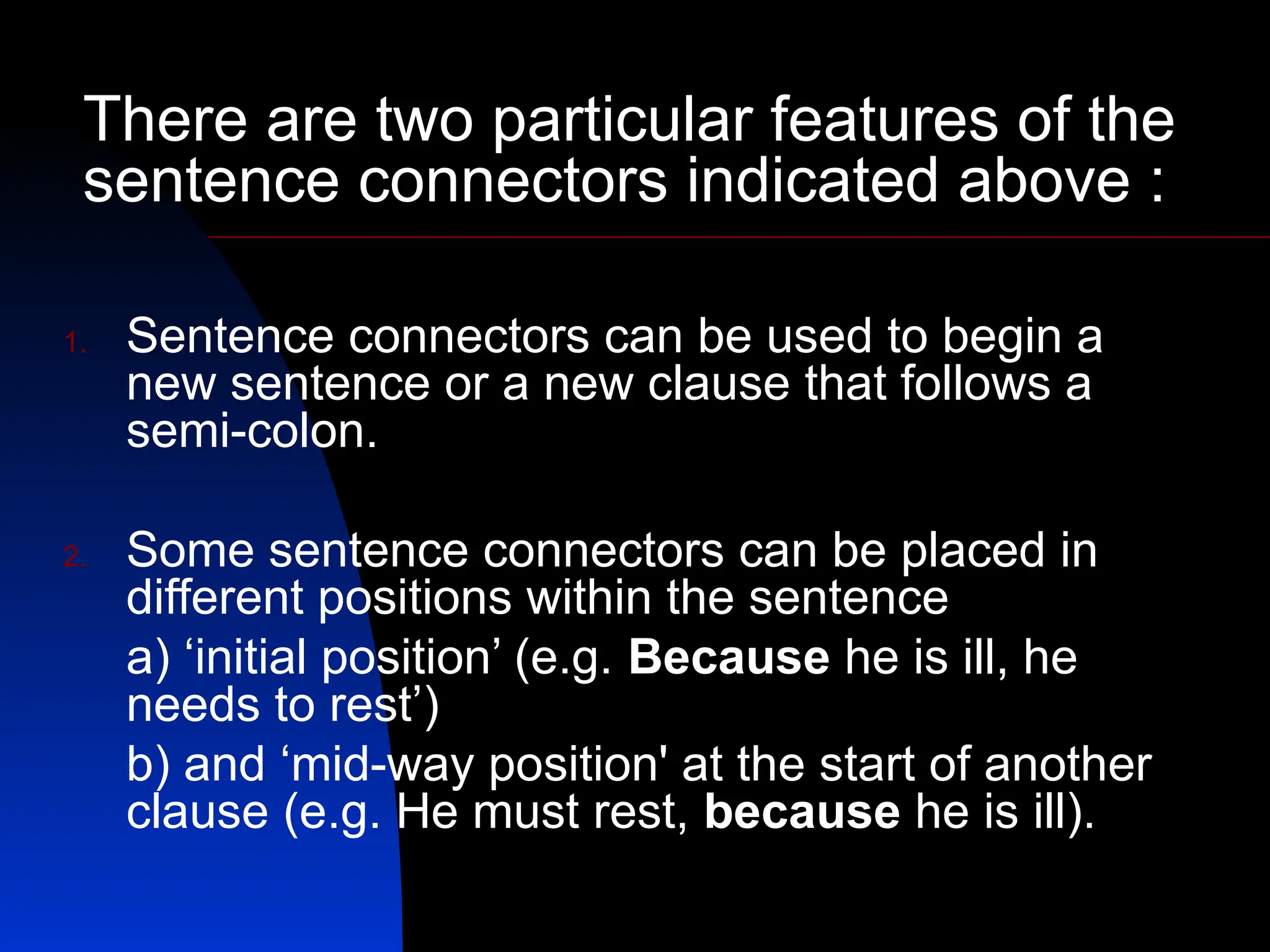
There are two particular features of the
sentence connectors indicated above :
1. Sentence connectors can be used to begin a
new sentence or a new clause that follows a
semi-colon.
2. Some sentence connectors can be placed in
different positions within the sentence
a) ‘initial position’ (e.g. Because he is ill, he
needs to rest’)
b) and ‘mid-way position' at the start of another
clause (e.g. He must rest, because he is ill).
How are paragraphs linked
together?
 In much the same way that ideas
within a paragraph are linked, a
new paragraph must be linked in
some way with the previous one.
This, too, needs the use of
discourse markers.
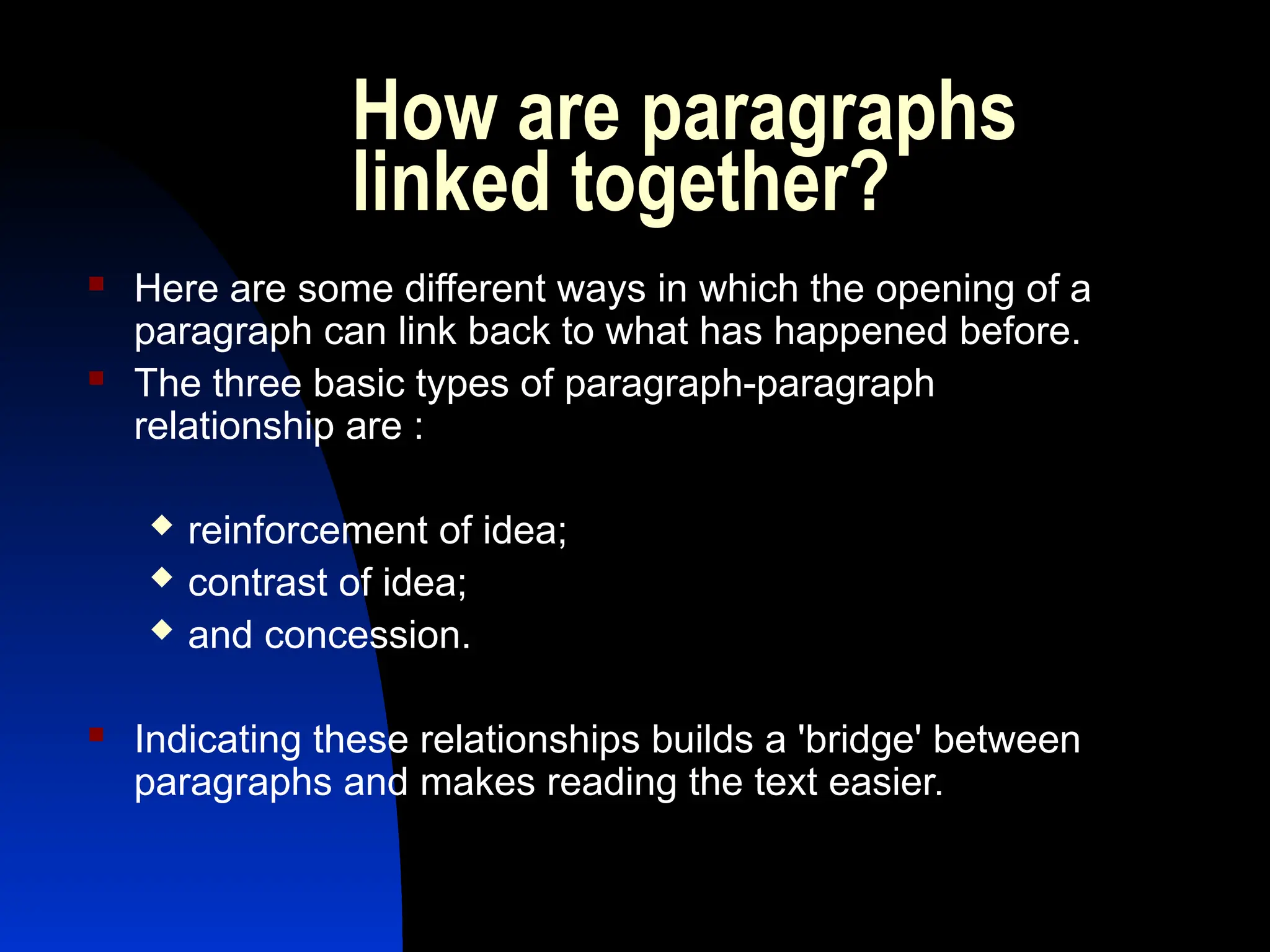
How are paragraphs
linked together?
 Here are some different ways in which the opening of a
paragraph can link back to what has happened before.
 The three basic types of paragraph-paragraph
relationship are :
 reinforcement of idea;
 contrast of idea;
 and concession.
 Indicating these relationships builds a 'bridge' between
paragraphs and makes reading the text easier.
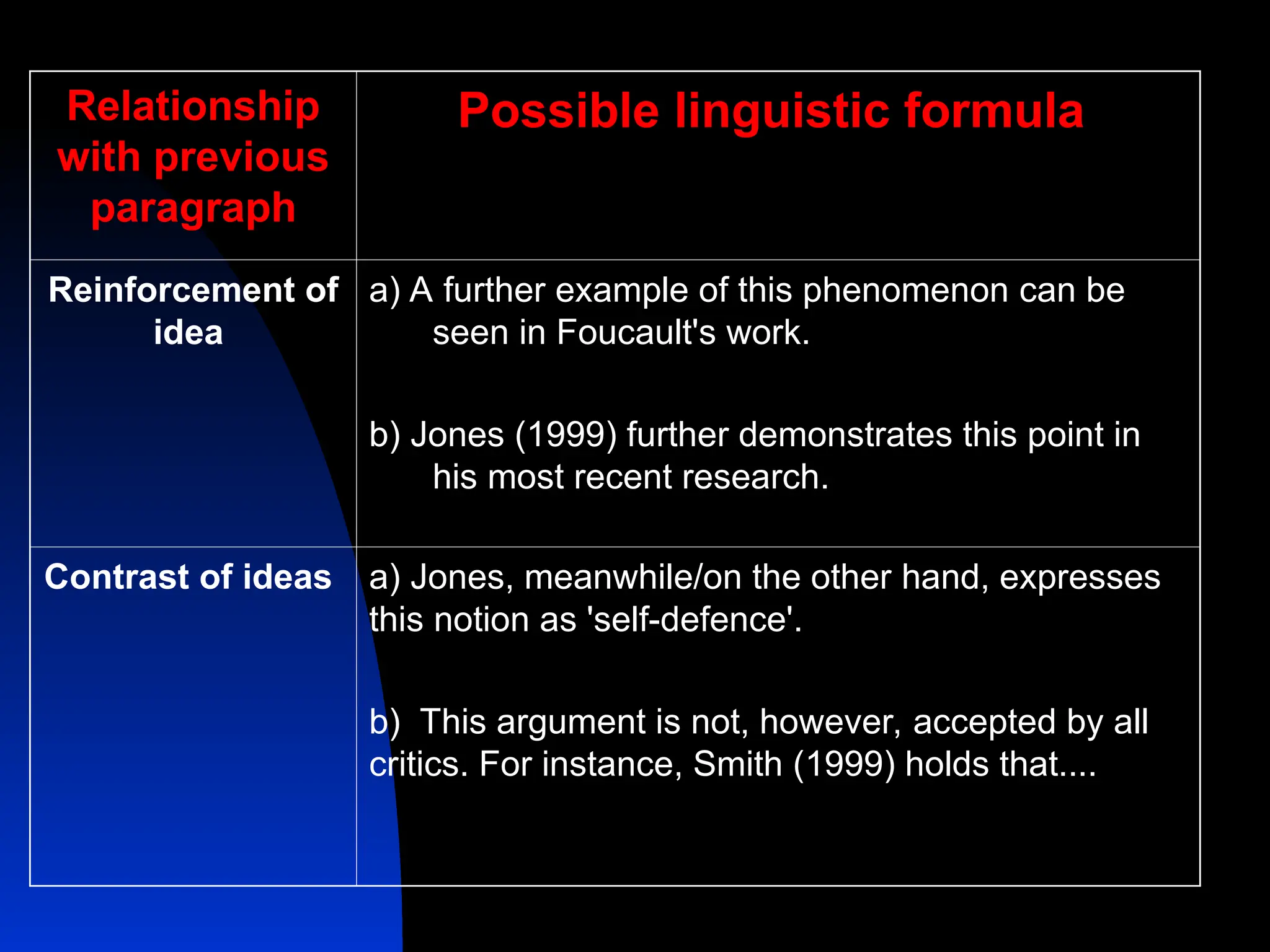
Relationship
with previous
paragraph
Possible linguistic formula
Reinforcement of
idea
a) A further example of this phenomenon can be
seen in Foucault's work.
b) Jones (1999) further demonstrates this point in
his most recent research.
Contrast of ideas a) Jones, meanwhile/on the other hand, expresses
this notion as 'self-defence'.
b) This argument is not, however, accepted by all
critics. For instance, Smith (1999) holds that....
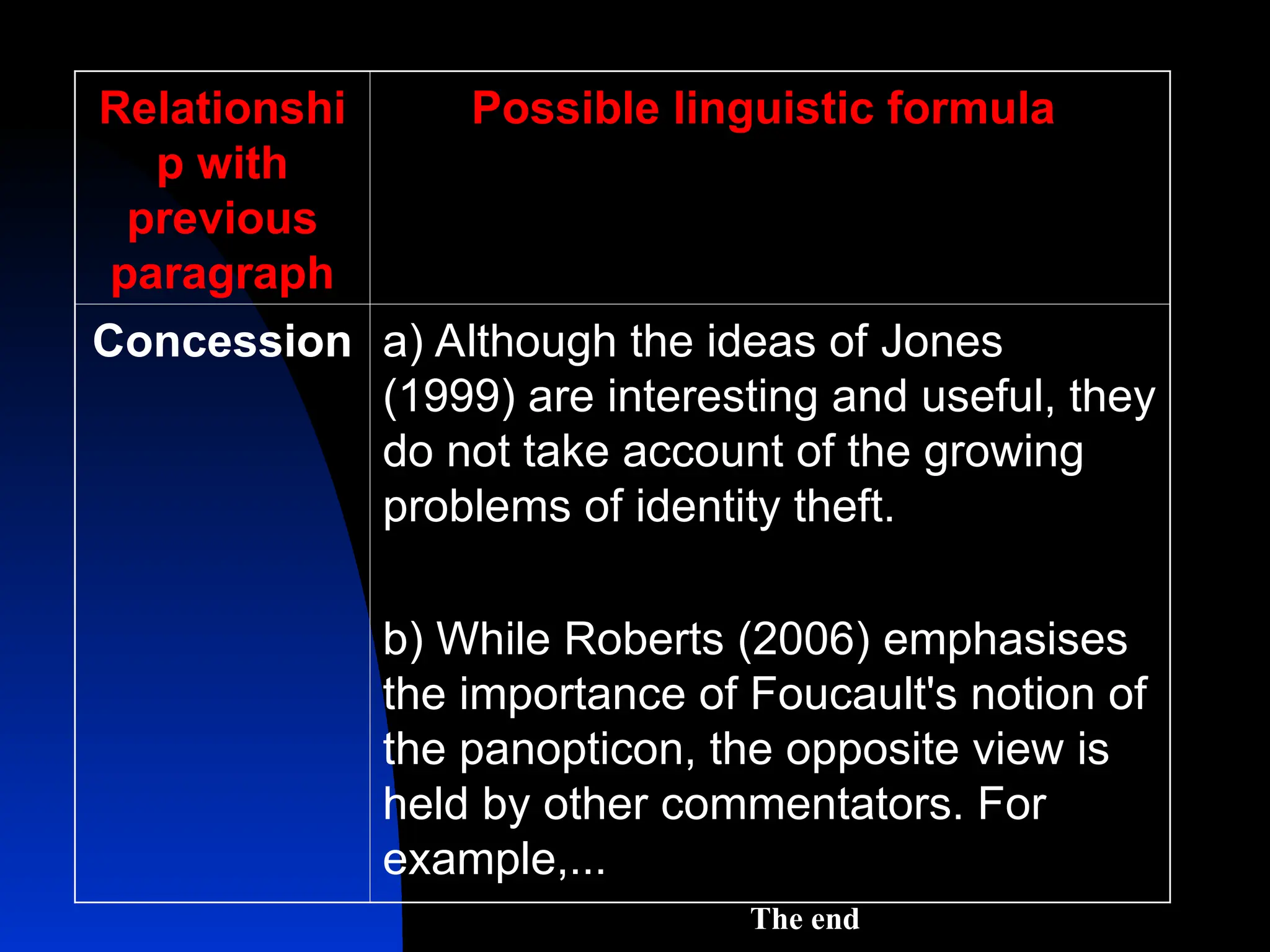
Relationshi
p with
previous
paragraph
Possible linguistic formula
Concession a) Although the ideas of Jones
(1999) are interesting and useful, they
do not take account of the growing
problems of identity theft.
b) While Roberts (2006) emphasises
the importance of Foucault's notion of
the panopticon, the opposite view is
held by other commentators. For
example,...
The end
The end
DISCOURSE MARKERS IN ENGLISH WITH PHRASES.ppt

  • 1.
    Discourse Markers Teacher: MarceloLopes SESI – Conselheiro Saraiva
  • 2.
    Discourse Markers  Theseare words like ‘however’, ‘although’, ‘nevertheless’.  Referred to more commonly as ‘linking words' and 'linking phrases’, or ‘sentence connectors’.
  • 3.
    Discourse Markers  Theymay be described as the ‘glue’ that binds together a piece of writing, making the different parts of the text ‘stick together’.  They are used less frequently in speech, unless the speech is very formal.
  • 4.
    What are thedifferent discourse markers that can be used? There are many discourse markers that express different relationships between ideas. The most common types of relationship between ideas, and the sentence connectors that are most often used to express these relationships, are given in the table below.
  • 5.
    Discourse Markers The discoursemarkers in the table are generally used at the start of a phrase or clause. (a clause is a minimal grammatical structure that has meaning in its own right, and consists of a subject and verb, and often an object too). Sentence connectors do not always begin a completely new sentence; they may be separated from the previous idea with a semi-colon.
  • 6.
    Type of relationship Sentence connectorsPosition within clause/ sentence Adding something Moreover; In addition; Additionally; Further; Further to this; Also; Besides; What is more. Initial position Making a contrast between two separate things, people, ideas, etc. However; On the other hand; In contrast; Yet. Initial position
  • 7.
    Type of relationship Sentence connectors Position within clause/ sentence Makingan unexpected contrast (concession) Although; Even though; Despite the fact that; In spite of the fact that; Regardless of the fact that. Initial position Starts a second/ subordinat e clause Saying why something is the case Because; Since; As; In so far as. Initial position Starts a second/ subordinat e clause
  • 8.
    Type of relationshipSentence connectors Position within clause/sentence Expressing a condition If; In the event of; As long as...; So long as...; Provided that...; Assuming that...; Given that.... Initial position Starts a second/ subordinat e clause Making what you say stronger On the contrary; As a matter of fact; In fact; Indeed. Initial position
  • 9.
    There are twoparticular features of the sentence connectors indicated above : 1. Sentence connectors can be used to begin a new sentence or a new clause that follows a semi-colon. 2. Some sentence connectors can be placed in different positions within the sentence a) ‘initial position’ (e.g. Because he is ill, he needs to rest’) b) and ‘mid-way position' at the start of another clause (e.g. He must rest, because he is ill).
  • 10.
    How are paragraphslinked together?  In much the same way that ideas within a paragraph are linked, a new paragraph must be linked in some way with the previous one. This, too, needs the use of discourse markers.
  • 11.
    How are paragraphs linkedtogether?  Here are some different ways in which the opening of a paragraph can link back to what has happened before.  The three basic types of paragraph-paragraph relationship are :  reinforcement of idea;  contrast of idea;  and concession.  Indicating these relationships builds a 'bridge' between paragraphs and makes reading the text easier.
  • 12.
    Relationship with previous paragraph Possible linguisticformula Reinforcement of idea a) A further example of this phenomenon can be seen in Foucault's work. b) Jones (1999) further demonstrates this point in his most recent research. Contrast of ideas a) Jones, meanwhile/on the other hand, expresses this notion as 'self-defence'. b) This argument is not, however, accepted by all critics. For instance, Smith (1999) holds that....
  • 13.
    Relationshi p with previous paragraph Possible linguisticformula Concession a) Although the ideas of Jones (1999) are interesting and useful, they do not take account of the growing problems of identity theft. b) While Roberts (2006) emphasises the importance of Foucault's notion of the panopticon, the opposite view is held by other commentators. For example,... The end The end