Seeing is believing: We
are all converging
Emily Allbon
Senior Lecturer, City Law School
@lawbore
Big themes around teaching & technology
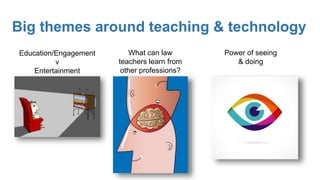
Education/Engagement
v
Entertainment
What can law
teachers learn from
other professions?
Power of seeing
& doing
Challenges for our students (and us)
• Need for instant gratification
• Inability to read deeply
• Difficulties in critical analysis
• Problems keeping up with the volume
of reading
Strategies for
engagement
• Flipping the classroom
• Polling systems
• Incorporation of
multimedia
• Harnessing social
media
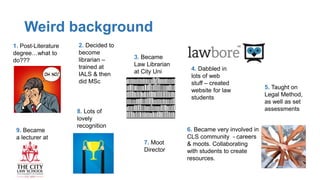
Weird background
1. Post-Literature
degree…what to
do???
2. Decided to
become
librarian –
trained at
IALS & then
did MSc
3. Became
Law Librarian
at City Uni 4. Dabbled in
lots of web
stuff – created
website for law
students
6. Became very involved in
CLS community - careers
& moots. Collaborating
with students to create
resources.
7. Moot
Director
8. Lots of
lovely
recognition
9. Became
a lecturer at
5. Taught on
Legal Method,
as well as set
assessments
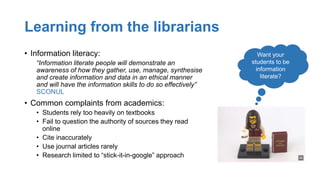
Learning from the librarians
• Information literacy:
“Information literate people will demonstrate an
awareness of how they gather, use, manage, synthesise
and create information and data in an ethical manner
and will have the information skills to do so effectively”
SCONUL
• Common complaints from academics:
• Students rely too heavily on textbooks
• Fail to question the authority of sources they read
online
• Cite inaccurately
• Use journal articles rarely
• Research limited to “stick-it-in-google” approach
Want your
students to be
information
literate?
Not prepared for practice?
• From Paul Maharg interview with senior librarians for
the LETR:
“They [trainees in England and Wales] appeared to be generally
unfamiliar with paper-based resources by comparison with digital
resources. In addition they noted that trainees seemed to
depend on one-hit-only searching: in other words they did not
check thoroughly and contextually around their findings….They
seemed to lack persistence and diligence in searching, as well
as organisation.”
• Librarian role becoming less specialised as institutions
move to economic models based on function
• Much of the teaching by librarians stand-alone in
nature, carried out in induction and not embedded into
other modules
• Students have little respect for course elements which
appear as “add-ons”.
Solutions
• More promotion of the
BIALL Legal Information
Literacy Statement
• Academic-Librarian
partnerships in curriculum
building
• IL teaching to be process
not content-driven
The power of the visual (or at least
non-textual…)
• Students spend much of their day connected
up to devices:
• Watching
• Listening
• Tweeting
• Taking photos/Snapchatting
• Status updating
• Sharing
• Messaging
• Texting
We need to exploit this preference within our teaching
Books
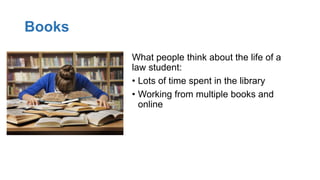
What people think about the life of a
law student:
• Lots of time spent in the library
• Working from multiple books and
online
How far books have come
• E-books only valued for ‘dipping into’ (JISC e-books
observatory -2009)
• 90% of students surveyed said they multitasked while reading
on screen – just 1% did the same when using print (Naomi S.
Baron research - 2015)
• “Pedagogical reboot” – alteration in way millennials ‘read’
• Reflections of reading in print:
“building a physical map in my mind of where things are”
“it takes me longer because I read more carefully”
“it’s easier to follow stories…”
Shift in opinion re visual elements in
books
“Robert Connors points to the
visual design of the fifth edition as
indicating a “lowered evaluation
of its audience’s abilities”
signaled by “wide margins and a
two-color format to open up the
text’s appearance”…[The 1976
edition] goes in deeply for the
“visual observation invention
methods...It is filled with photos,
cartoon illustrations, all meant to
add spice to the text”
Diana George “From Analysis to
Design: Visual Communication in
the Teaching of Writing” Characters from The Insider’s
Guide to Legal Skills (Routledge,
2016)
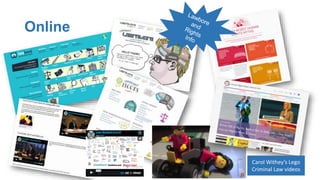
Online
Carol Withey’s Lego
Criminal Law videos
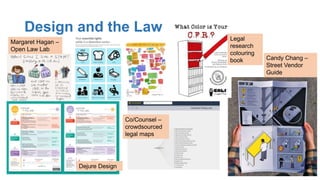
Design and the Law
Margaret Hagan –
Open Law Lab
Candy Chang –
Street Vendor
Guide
Dejure Design
Co/Counsel –
crowdsourced
legal maps
Legal
research
colouring
book
“Visualisation used alongside contract
texts help to piece things together. They
speed up negotiations”
Helen Haapio – researcher in visualisation and
user-centred contract design
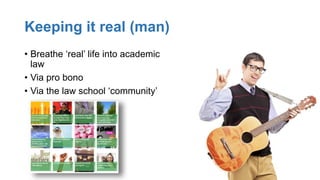
Keeping it real (man)
• Breathe ‘real’ life into academic
law
• Via pro bono
• Via the law school ‘community’
More keeping it real…
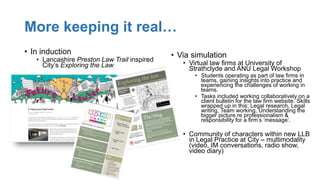
• In induction
• Lancashire Preston Law Trail inspired
City’s Exploring the Law
• Via simulation
• Virtual law firms at University of
Strathclyde and ANU Legal Workshop
• Students operating as part of law firms in
teams, gaining insights into practice and
experiencing the challenges of working in
teams.
• Tasks included working collaboratively on a
client bulletin for the law firm website. Skills
wrapped up in this: Legal research, Legal
writing, Team working, Understanding the
bigger picture re professionalism &
responsibility for a firm’s ‘message’.
• Community of characters within new LLB
in Legal Practice at City – multimodality
(video, IM conversations, radio show,
video diary)
Final thoughts
• Three key areas ripe for change:
• Partnering with librarians to embed information literacy within
law programmes
• Bravely go ‘beyond text’ – thinking more creatively about
exploiting multimodality in our teaching. Using visualisation
techniques to tap into the student learning process
• Focus more on ‘keeping it real’ – whether virtually or via
innovative clinics or pro bono options.
Full article in The Law Teacher (2016) 50(1) The Law Teacher 44
References
• The SCONUL Seven Pillars of Information Literacy Core Model for Higher Education (April 2011)
http://www.sconul.ac.uk/sites/default/files/documents/coremodel.pdf
• Natasha Choolhun and Ruth Bird, “British and Irish Association of Law Librarians (BIALL) Legal
Information Literacy Statement” (2012) 6(2) Journal of Information Literacy 132
• BIALL Information Literacy Statement http://www.biall.org.uk/pages/biall-legal-information-literacy-
statement.html
• Paul Maharg, “Convergence and Fragmentation: Legal Research, Legal Informatics and Legal
Education” (2014) 5(3) European Journal of Law and Technology http://ejlt.org/article/view/372
• Chris Armstrong and Ray Lonsdale, JISC National e-books observatory project “E-Book Use by
Academic Staff and Students in UK Universities: Focus Groups Report” (2009)
• Michael S. Rosenwald, “Why Digital Natives Prefer Reading in Print. Yes, You Read That Right” The
Washington Post, 22 February 2015 https://www.washingtonpost.com/local/why-digital-natives-
prefer-reading-in-print-yes-you-read-that-right/2015/02/22/8596ca86-b871-11e4-9423-
f3d0a1ec335c_story.html
• Diana George, “From Analysis to Design: Visual Communication in the Teaching of Writing” (2002)
54(1) College Composition and Communication 11 noted in Penny Kinnear, “Writing, Visualizing and
Research Reports”, in Tracey Bowen and Carl Whithaus (eds), Multimodal Literacies and Emerging
Genres (Pittsburgh, University of Pittsburgh Press, 2013), p.186
References – Online/Design/Keeping it real
• Lawbore http://lawbore.net/ Learnmore http://learnmore.lawbore.net/ Law Student A-Z
http://learnmore.lawbore.net/index.php/Law_Student_A_to_Z
• Rights Info http://rightsinfo.org/
• Carol Withey, YouTube Criminal Law Lego videos
https://www.youtube.com/channel/UC9jd1aWB_lH9GVCwPM4RdRQ
• Margaret Hagan, Open Law Lab http://www.openlawlab.com/
• Candy Chang, Street Vendor Guide http://candychang.com/streetvendorcrop/
• Nicole Dyszlewski & Raquel Ortiz, What color is your C.F.R?
https://www.cali.org/sites/default/files/ColoringBookFinalAug022016.pdf
• Co/Counsel http://www.cocounsel.co/
• Dejure Design http://dejuredesign.com/
• Helena Haapio, Inline Ruukki Stakeholder Magazine (2011), p.38
• Exploring the Law posts on Future Lawyer blog (Lawbore) http://blog.lawbore.net/tag/exploring-the-law/
• Open Law Map (Preston Law Trail) http://openlawmap.co.uk/
• Margie Rowe, Moira Murray & Fiona Westwood, “Professionalism in Pre-Practice Legal Education: An Insight into
the Universal Nature of Professionalism and the Development of Professional Identity” (2012) 46(2) Law Teacher
120, p.125

Seeing is believing: we are all converging

  • 1.
    Seeing is believing:We are all converging Emily Allbon Senior Lecturer, City Law School @lawbore
  • 2.
    Big themes aroundteaching & technology Education/Engagement v Entertainment What can law teachers learn from other professions? Power of seeing & doing
  • 3.
    Challenges for ourstudents (and us) • Need for instant gratification • Inability to read deeply • Difficulties in critical analysis • Problems keeping up with the volume of reading Strategies for engagement • Flipping the classroom • Polling systems • Incorporation of multimedia • Harnessing social media
  • 4.
    Weird background 1. Post-Literature degree…whatto do??? 2. Decided to become librarian – trained at IALS & then did MSc 3. Became Law Librarian at City Uni 4. Dabbled in lots of web stuff – created website for law students 6. Became very involved in CLS community - careers & moots. Collaborating with students to create resources. 7. Moot Director 8. Lots of lovely recognition 9. Became a lecturer at 5. Taught on Legal Method, as well as set assessments
  • 5.
    Learning from thelibrarians • Information literacy: “Information literate people will demonstrate an awareness of how they gather, use, manage, synthesise and create information and data in an ethical manner and will have the information skills to do so effectively” SCONUL • Common complaints from academics: • Students rely too heavily on textbooks • Fail to question the authority of sources they read online • Cite inaccurately • Use journal articles rarely • Research limited to “stick-it-in-google” approach Want your students to be information literate?
  • 6.
    Not prepared forpractice? • From Paul Maharg interview with senior librarians for the LETR: “They [trainees in England and Wales] appeared to be generally unfamiliar with paper-based resources by comparison with digital resources. In addition they noted that trainees seemed to depend on one-hit-only searching: in other words they did not check thoroughly and contextually around their findings….They seemed to lack persistence and diligence in searching, as well as organisation.” • Librarian role becoming less specialised as institutions move to economic models based on function • Much of the teaching by librarians stand-alone in nature, carried out in induction and not embedded into other modules • Students have little respect for course elements which appear as “add-ons”.
  • 7.
    Solutions • More promotionof the BIALL Legal Information Literacy Statement • Academic-Librarian partnerships in curriculum building • IL teaching to be process not content-driven
  • 8.
    The power ofthe visual (or at least non-textual…) • Students spend much of their day connected up to devices: • Watching • Listening • Tweeting • Taking photos/Snapchatting • Status updating • Sharing • Messaging • Texting We need to exploit this preference within our teaching
  • 9.
    Books What people thinkabout the life of a law student: • Lots of time spent in the library • Working from multiple books and online
  • 10.
    How far bookshave come • E-books only valued for ‘dipping into’ (JISC e-books observatory -2009) • 90% of students surveyed said they multitasked while reading on screen – just 1% did the same when using print (Naomi S. Baron research - 2015) • “Pedagogical reboot” – alteration in way millennials ‘read’ • Reflections of reading in print: “building a physical map in my mind of where things are” “it takes me longer because I read more carefully” “it’s easier to follow stories…”
  • 11.
    Shift in opinionre visual elements in books “Robert Connors points to the visual design of the fifth edition as indicating a “lowered evaluation of its audience’s abilities” signaled by “wide margins and a two-color format to open up the text’s appearance”…[The 1976 edition] goes in deeply for the “visual observation invention methods...It is filled with photos, cartoon illustrations, all meant to add spice to the text” Diana George “From Analysis to Design: Visual Communication in the Teaching of Writing” Characters from The Insider’s Guide to Legal Skills (Routledge, 2016)
  • 12.
  • 13.
    Design and theLaw Margaret Hagan – Open Law Lab Candy Chang – Street Vendor Guide Dejure Design Co/Counsel – crowdsourced legal maps Legal research colouring book
  • 14.
    “Visualisation used alongsidecontract texts help to piece things together. They speed up negotiations” Helen Haapio – researcher in visualisation and user-centred contract design
  • 15.
    Keeping it real(man) • Breathe ‘real’ life into academic law • Via pro bono • Via the law school ‘community’
  • 16.
    More keeping itreal… • In induction • Lancashire Preston Law Trail inspired City’s Exploring the Law • Via simulation • Virtual law firms at University of Strathclyde and ANU Legal Workshop • Students operating as part of law firms in teams, gaining insights into practice and experiencing the challenges of working in teams. • Tasks included working collaboratively on a client bulletin for the law firm website. Skills wrapped up in this: Legal research, Legal writing, Team working, Understanding the bigger picture re professionalism & responsibility for a firm’s ‘message’. • Community of characters within new LLB in Legal Practice at City – multimodality (video, IM conversations, radio show, video diary)
  • 17.
    Final thoughts • Threekey areas ripe for change: • Partnering with librarians to embed information literacy within law programmes • Bravely go ‘beyond text’ – thinking more creatively about exploiting multimodality in our teaching. Using visualisation techniques to tap into the student learning process • Focus more on ‘keeping it real’ – whether virtually or via innovative clinics or pro bono options. Full article in The Law Teacher (2016) 50(1) The Law Teacher 44
  • 18.
    References • The SCONULSeven Pillars of Information Literacy Core Model for Higher Education (April 2011) http://www.sconul.ac.uk/sites/default/files/documents/coremodel.pdf • Natasha Choolhun and Ruth Bird, “British and Irish Association of Law Librarians (BIALL) Legal Information Literacy Statement” (2012) 6(2) Journal of Information Literacy 132 • BIALL Information Literacy Statement http://www.biall.org.uk/pages/biall-legal-information-literacy- statement.html • Paul Maharg, “Convergence and Fragmentation: Legal Research, Legal Informatics and Legal Education” (2014) 5(3) European Journal of Law and Technology http://ejlt.org/article/view/372 • Chris Armstrong and Ray Lonsdale, JISC National e-books observatory project “E-Book Use by Academic Staff and Students in UK Universities: Focus Groups Report” (2009) • Michael S. Rosenwald, “Why Digital Natives Prefer Reading in Print. Yes, You Read That Right” The Washington Post, 22 February 2015 https://www.washingtonpost.com/local/why-digital-natives- prefer-reading-in-print-yes-you-read-that-right/2015/02/22/8596ca86-b871-11e4-9423- f3d0a1ec335c_story.html • Diana George, “From Analysis to Design: Visual Communication in the Teaching of Writing” (2002) 54(1) College Composition and Communication 11 noted in Penny Kinnear, “Writing, Visualizing and Research Reports”, in Tracey Bowen and Carl Whithaus (eds), Multimodal Literacies and Emerging Genres (Pittsburgh, University of Pittsburgh Press, 2013), p.186
  • 19.
    References – Online/Design/Keepingit real • Lawbore http://lawbore.net/ Learnmore http://learnmore.lawbore.net/ Law Student A-Z http://learnmore.lawbore.net/index.php/Law_Student_A_to_Z • Rights Info http://rightsinfo.org/ • Carol Withey, YouTube Criminal Law Lego videos https://www.youtube.com/channel/UC9jd1aWB_lH9GVCwPM4RdRQ • Margaret Hagan, Open Law Lab http://www.openlawlab.com/ • Candy Chang, Street Vendor Guide http://candychang.com/streetvendorcrop/ • Nicole Dyszlewski & Raquel Ortiz, What color is your C.F.R? https://www.cali.org/sites/default/files/ColoringBookFinalAug022016.pdf • Co/Counsel http://www.cocounsel.co/ • Dejure Design http://dejuredesign.com/ • Helena Haapio, Inline Ruukki Stakeholder Magazine (2011), p.38 • Exploring the Law posts on Future Lawyer blog (Lawbore) http://blog.lawbore.net/tag/exploring-the-law/ • Open Law Map (Preston Law Trail) http://openlawmap.co.uk/ • Margie Rowe, Moira Murray & Fiona Westwood, “Professionalism in Pre-Practice Legal Education: An Insight into the Universal Nature of Professionalism and the Development of Professional Identity” (2012) 46(2) Law Teacher 120, p.125