Differential Equation
Name: Ahmad Anwar
Hassan Shah
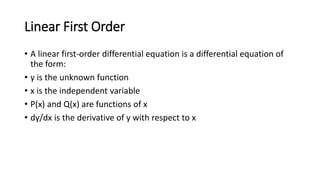
Linear First Order
• A linear first-order differential equation is a differential equation of
the form:
• y is the unknown function
• x is the independent variable
• P(x) and Q(x) are functions of x
• dy/dx is the derivative of y with respect to x
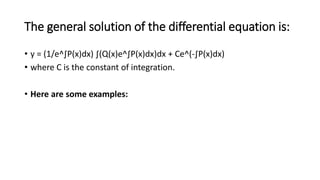
The general solution of the differential equation is:
• y = (1/e^∫P(x)dx) ∫(Q(x)e^∫P(x)dx)dx + Ce^(-∫P(x)dx)
• where C is the constant of integration.
• Here are some examples:
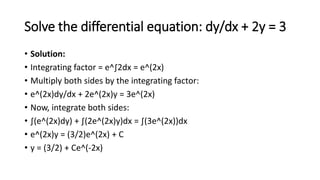
Solve the differential equation: dy/dx + 2y = 3
• Solution:
• Integrating factor = e^∫2dx = e^(2x)
• Multiply both sides by the integrating factor:
• e^(2x)dy/dx + 2e^(2x)y = 3e^(2x)
• Now, integrate both sides:
• ∫(e^(2x)dy) + ∫(2e^(2x)y)dx = ∫(3e^(2x))dx
• e^(2x)y = (3/2)e^(2x) + C
• y = (3/2) + Ce^(-2x)
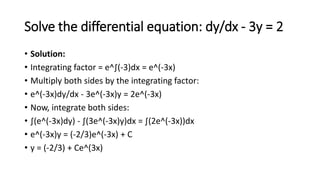
Solve the differential equation: dy/dx - 3y = 2
• Solution:
• Integrating factor = e^∫(-3)dx = e^(-3x)
• Multiply both sides by the integrating factor:
• e^(-3x)dy/dx - 3e^(-3x)y = 2e^(-3x)
• Now, integrate both sides:
• ∫(e^(-3x)dy) - ∫(3e^(-3x)y)dx = ∫(2e^(-3x))dx
• e^(-3x)y = (-2/3)e^(-3x) + C
• y = (-2/3) + Ce^(3x)
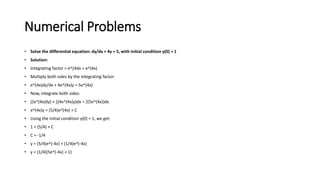
Numerical Problems
• Solve the differential equation: dy/dx + 4y = 5, with initial condition y(0) = 1
• Solution:
• Integrating factor = e^∫4dx = e^(4x)
• Multiply both sides by the integrating factor:
• e^(4x)dy/dx + 4e^(4x)y = 5e^(4x)
• Now, integrate both sides:
• ∫(e^(4x)dy) + ∫(4e^(4x)y)dx = ∫(5e^(4x))dx
• e^(4x)y = (5/4)e^(4x) + C
• Using the initial condition y(0) = 1, we get:
• 1 = (5/4) + C
• C = -1/4
• y = (5/4)e^(-4x) + (1/4)e^(-4x)
• y = (1/4)(5e^(-4x) + 1)
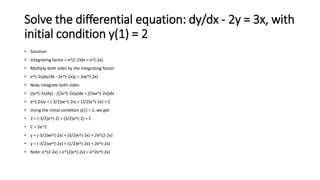
Solve the differential equation: dy/dx - 2y = 3x, with
initial condition y(1) = 2
• Solution:
• Integrating factor = e^∫(-2)dx = e^(-2x)
• Multiply both sides by the integrating factor:
• e^(-2x)dy/dx - 2e^(-2x)y = 3xe^(-2x)
• Now, integrate both sides:
• ∫(e^(-2x)dy) - ∫(2e^(-2x)y)dx = ∫(3xe^(-2x))dx
• e^(-2x)y = (-3/2)xe^(-2x) + (3/2)e^(-2x) + C
• Using the initial condition y(1) = 2, we get:
• 2 = (-3/2)e^(-2) + (3/2)e^(-2) + C
• C = 2e^2
• y = (-3/2)xe^(-2x) + (3/2)e^(-2x) + 2e^(2-2x)
• y = (-3/2)xe^(-2x) + (1/2)e^(-2x) + 2e^(-2x)
• Note: e^(2-2x) = e^(2)e^(-2x) = e^2e^(-2x)

Differential Equation.pptx free download

  • 1.
  • 2.
    Linear First Order •A linear first-order differential equation is a differential equation of the form: • y is the unknown function • x is the independent variable • P(x) and Q(x) are functions of x • dy/dx is the derivative of y with respect to x
  • 3.
    The general solutionof the differential equation is: • y = (1/e^∫P(x)dx) ∫(Q(x)e^∫P(x)dx)dx + Ce^(-∫P(x)dx) • where C is the constant of integration. • Here are some examples:
  • 4.
    Solve the differentialequation: dy/dx + 2y = 3 • Solution: • Integrating factor = e^∫2dx = e^(2x) • Multiply both sides by the integrating factor: • e^(2x)dy/dx + 2e^(2x)y = 3e^(2x) • Now, integrate both sides: • ∫(e^(2x)dy) + ∫(2e^(2x)y)dx = ∫(3e^(2x))dx • e^(2x)y = (3/2)e^(2x) + C • y = (3/2) + Ce^(-2x)
  • 5.
    Solve the differentialequation: dy/dx - 3y = 2 • Solution: • Integrating factor = e^∫(-3)dx = e^(-3x) • Multiply both sides by the integrating factor: • e^(-3x)dy/dx - 3e^(-3x)y = 2e^(-3x) • Now, integrate both sides: • ∫(e^(-3x)dy) - ∫(3e^(-3x)y)dx = ∫(2e^(-3x))dx • e^(-3x)y = (-2/3)e^(-3x) + C • y = (-2/3) + Ce^(3x)
  • 6.
    Numerical Problems • Solvethe differential equation: dy/dx + 4y = 5, with initial condition y(0) = 1 • Solution: • Integrating factor = e^∫4dx = e^(4x) • Multiply both sides by the integrating factor: • e^(4x)dy/dx + 4e^(4x)y = 5e^(4x) • Now, integrate both sides: • ∫(e^(4x)dy) + ∫(4e^(4x)y)dx = ∫(5e^(4x))dx • e^(4x)y = (5/4)e^(4x) + C • Using the initial condition y(0) = 1, we get: • 1 = (5/4) + C • C = -1/4 • y = (5/4)e^(-4x) + (1/4)e^(-4x) • y = (1/4)(5e^(-4x) + 1)
  • 7.
    Solve the differentialequation: dy/dx - 2y = 3x, with initial condition y(1) = 2 • Solution: • Integrating factor = e^∫(-2)dx = e^(-2x) • Multiply both sides by the integrating factor: • e^(-2x)dy/dx - 2e^(-2x)y = 3xe^(-2x) • Now, integrate both sides: • ∫(e^(-2x)dy) - ∫(2e^(-2x)y)dx = ∫(3xe^(-2x))dx • e^(-2x)y = (-3/2)xe^(-2x) + (3/2)e^(-2x) + C • Using the initial condition y(1) = 2, we get: • 2 = (-3/2)e^(-2) + (3/2)e^(-2) + C • C = 2e^2 • y = (-3/2)xe^(-2x) + (3/2)e^(-2x) + 2e^(2-2x) • y = (-3/2)xe^(-2x) + (1/2)e^(-2x) + 2e^(-2x) • Note: e^(2-2x) = e^(2)e^(-2x) = e^2e^(-2x)