Prepared By:
Dr. Chandan Kumar
Assistant Professor, Computer Science & Engineering Department
Invertis University, Bareilly
Introduction
 In computer science, searching play a vital role
 Helpful to find a desired element in a list
 Also helpful to find number of occurrence of a desired
element or a place of an given element in a list
Searching
 An operation or process or technique to find out a desired
element or the place of an element in a list
 It decides whether an element is present or not
 It is the algorithmic method of finding a particular element
in a list
 It can be done on both data structure i.e. internal or
external data structure
 Search is successful if the desired number is found in a list
 Search is unsuccessful if the desired number doesn't found
in a list
Searching Techniques
 To search or find out the desired element in a list or a given
array, there are two ways-
 Linear Search or Sequential Search
 Binary Search or Interval Search
Linear or Sequential Search
 Linear search is also called sequential search
 Simplest method of searching
 In this search technique, the item to be found in the search
is sequentially searched in the list
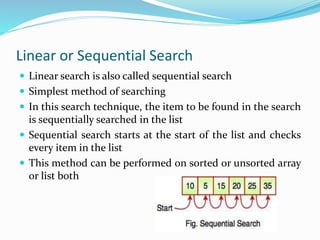
 Sequential search starts at the start of the list and checks
every item in the list
 This method can be performed on sorted or unsorted array
or list both
Linear Search
 We compare each element with the search item until the
list ends or we find it
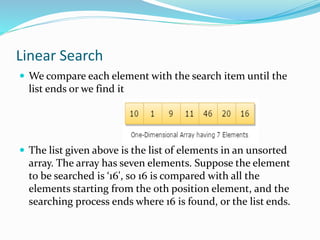
 The list given above is the list of elements in an unsorted
array. The array has seven elements. Suppose the element
to be searched is ‘16', so 16 is compared with all the
elements starting from the 0th position element, and the
searching process ends where 16 is found, or the list ends.
Linear Search
 The desired number 16 has found at 6th position in an
array. so the search is successful
 The performance of the linear search can be measured by
counting the comparisons done to find out an element. The
number of comparisons is O(n) i.e. time complexity of
linear search is O(n).
Steps to implement linear search
 Step 1 - Read the search element from the user.
 Step 2 - Compare the search element with the first element
in the list.
 Step 3 - If both are matched, then display "Given element is
found!!!" and terminate the function
 Step 4 - If both are not matched, then compare search
element with the next element in the list.
 Step 5 - Repeat steps 3 and 4 until search element is
compared with last element in the list.
 Step 6 - If last element in the list also doesn't match, then
display "Element is not found!!!" and terminate the
function.
Algorithm
Linear Search (Array A[n], Number X)
Step 1: set i to 0
Step 2: if i>n then goto step 5
Step 3: if A[i]=X then goto step 6
Step 4: set i to i+1 and goto step 2
Step 5: print element X not found and goto step 7
Step 6: print element X found at index i
Step 7: Exit
Implementation in C
//Linear search
#include <stdio.h>
#include<conio.h>
void main()
{
int array[100], number, i, n, count=0;
clrscr();
printf("Enter number of elements in arrayn");
scanf("%d", &n);
printf("Enter %d elements n", n);
for (i = 0; i < n; i++)
{
scanf("%d", &array[i]);
}
printf("Enter a desired number to searchn");
scanf("%d", &number);
for (i = 0; i < n; i++)
{
if (array[i] == number)
{
count++;
break;
}
}
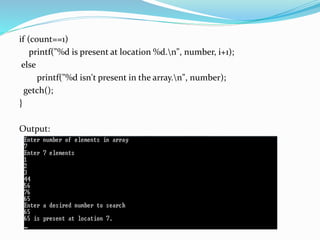
if (count==1)
printf("%d is present at location %d.n", number, i+1);
else
printf("%d isn't present in the array.n", number);
getch();
}
Output:
Binary Search
 Very fast and efficient searching technique
 Used for searching an element in a sorted array only
 If the array isn't sorted, we must sort it using a sorting
technique
 Fast search algorithm with run-time complexity of
O(log n) where n is total number of elements in the
list
 Works on the principle of divide and conquer
Binary Search
 This searching technique looks for a particular
element by comparing the middle most element of the
collection
 Useful when there are large number of elements in an
array
Steps to implement Binary Search
 Step 1 - Read the search element from the user.
 Step 2 - Find the middle element in the sorted list.
 Step 3 - Compare the search element with the middle
element in the sorted list.
 Step 4 - If both are matched, then display "Given
element is found!!!" and terminate the function.
 Step 5 - If both are not matched, then check whether
the search element is smaller or larger than the middle
element.
Steps to implement Binary Search
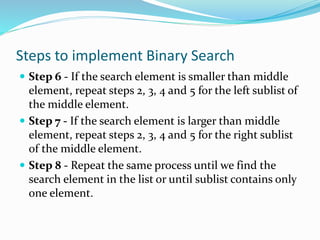
 Step 6 - If the search element is smaller than middle
element, repeat steps 2, 3, 4 and 5 for the left sublist of
the middle element.
 Step 7 - If the search element is larger than middle
element, repeat steps 2, 3, 4 and 5 for the right sublist
of the middle element.
 Step 8 - Repeat the same process until we find the
search element in the list or until sublist contains only
one element.
Steps to implement Binary Search
 Step 9 - If that element also doesn't match with the
search element, then display "Element is not found in
the list!!!" and terminate the function.
Algorithm
Binary Search (List,L_bound, H_bound, D_number)
Step 1: [Input] Input List, D_number
Step 2: [Initialize] set L_bound<- 0, H_bound<- Sizeof(List)-1
Step 3: repeat step 4 and 5 while L_bound<=H_bound
Step 4: set mid<- (L_bound+H_bound)/2
Step 5: if List[mid]=D_number then
return mid; //Desired Number found
else if D_number<List[mid] then
H_bound<- mid -1
else
L_bound<mid+1
Step 6: print "value is not present in the array“
Step 7: Exit
Implementation Binary search
#include<stdio.h>
#include<conio.h>
void main()
{
int first, last, middle, size, i, sElement, list[100];
clrscr();
printf("Enter the size of the list: ");
scanf("%d",&size);
printf("Enter %d integer values in Assending ordern", size);
for (i = 0; i < size; i++)
scanf("%d",&list[i]);
printf("Enter value to be search: ");
scanf("%d", &sElement);
first = 0;
last = size - 1;
middle = (first+last)/2;
while (first <= last)
{
if (list[middle] < sElement)
first = middle + 1;
else if (list[middle] == sElement)
{
printf("Element found at index %d.n",middle);
break;
}
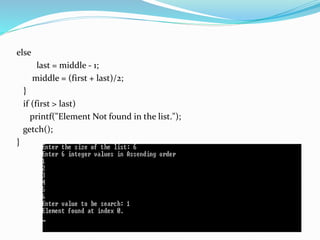
else
last = middle - 1;
middle = (first + last)/2;
}
if (first > last)
printf("Element Not found in the list.");
getch();
}
Searching in c language

Searching in c language

  • 1.
    Prepared By: Dr. ChandanKumar Assistant Professor, Computer Science & Engineering Department Invertis University, Bareilly
  • 2.
    Introduction  In computerscience, searching play a vital role  Helpful to find a desired element in a list  Also helpful to find number of occurrence of a desired element or a place of an given element in a list
  • 3.
    Searching  An operationor process or technique to find out a desired element or the place of an element in a list  It decides whether an element is present or not  It is the algorithmic method of finding a particular element in a list  It can be done on both data structure i.e. internal or external data structure  Search is successful if the desired number is found in a list  Search is unsuccessful if the desired number doesn't found in a list
  • 4.
    Searching Techniques  Tosearch or find out the desired element in a list or a given array, there are two ways-  Linear Search or Sequential Search  Binary Search or Interval Search
  • 5.
    Linear or SequentialSearch  Linear search is also called sequential search  Simplest method of searching  In this search technique, the item to be found in the search is sequentially searched in the list  Sequential search starts at the start of the list and checks every item in the list  This method can be performed on sorted or unsorted array or list both
  • 6.
    Linear Search  Wecompare each element with the search item until the list ends or we find it  The list given above is the list of elements in an unsorted array. The array has seven elements. Suppose the element to be searched is ‘16', so 16 is compared with all the elements starting from the 0th position element, and the searching process ends where 16 is found, or the list ends.
  • 7.
    Linear Search  Thedesired number 16 has found at 6th position in an array. so the search is successful  The performance of the linear search can be measured by counting the comparisons done to find out an element. The number of comparisons is O(n) i.e. time complexity of linear search is O(n).
  • 8.
    Steps to implementlinear search  Step 1 - Read the search element from the user.  Step 2 - Compare the search element with the first element in the list.  Step 3 - If both are matched, then display "Given element is found!!!" and terminate the function  Step 4 - If both are not matched, then compare search element with the next element in the list.  Step 5 - Repeat steps 3 and 4 until search element is compared with last element in the list.  Step 6 - If last element in the list also doesn't match, then display "Element is not found!!!" and terminate the function.
  • 9.
    Algorithm Linear Search (ArrayA[n], Number X) Step 1: set i to 0 Step 2: if i>n then goto step 5 Step 3: if A[i]=X then goto step 6 Step 4: set i to i+1 and goto step 2 Step 5: print element X not found and goto step 7 Step 6: print element X found at index i Step 7: Exit
  • 10.
    Implementation in C //Linearsearch #include <stdio.h> #include<conio.h> void main() { int array[100], number, i, n, count=0; clrscr(); printf("Enter number of elements in arrayn"); scanf("%d", &n); printf("Enter %d elements n", n);
  • 11.
    for (i =0; i < n; i++) { scanf("%d", &array[i]); } printf("Enter a desired number to searchn"); scanf("%d", &number); for (i = 0; i < n; i++) { if (array[i] == number) { count++; break; } }
  • 12.
    if (count==1) printf("%d ispresent at location %d.n", number, i+1); else printf("%d isn't present in the array.n", number); getch(); } Output:
  • 13.
    Binary Search  Veryfast and efficient searching technique  Used for searching an element in a sorted array only  If the array isn't sorted, we must sort it using a sorting technique  Fast search algorithm with run-time complexity of O(log n) where n is total number of elements in the list  Works on the principle of divide and conquer
  • 14.
    Binary Search  Thissearching technique looks for a particular element by comparing the middle most element of the collection  Useful when there are large number of elements in an array
  • 15.
    Steps to implementBinary Search  Step 1 - Read the search element from the user.  Step 2 - Find the middle element in the sorted list.  Step 3 - Compare the search element with the middle element in the sorted list.  Step 4 - If both are matched, then display "Given element is found!!!" and terminate the function.  Step 5 - If both are not matched, then check whether the search element is smaller or larger than the middle element.
  • 16.
    Steps to implementBinary Search  Step 6 - If the search element is smaller than middle element, repeat steps 2, 3, 4 and 5 for the left sublist of the middle element.  Step 7 - If the search element is larger than middle element, repeat steps 2, 3, 4 and 5 for the right sublist of the middle element.  Step 8 - Repeat the same process until we find the search element in the list or until sublist contains only one element.
  • 17.
    Steps to implementBinary Search  Step 9 - If that element also doesn't match with the search element, then display "Element is not found in the list!!!" and terminate the function.
  • 18.
    Algorithm Binary Search (List,L_bound,H_bound, D_number) Step 1: [Input] Input List, D_number Step 2: [Initialize] set L_bound<- 0, H_bound<- Sizeof(List)-1 Step 3: repeat step 4 and 5 while L_bound<=H_bound Step 4: set mid<- (L_bound+H_bound)/2 Step 5: if List[mid]=D_number then return mid; //Desired Number found else if D_number<List[mid] then H_bound<- mid -1 else L_bound<mid+1 Step 6: print "value is not present in the array“ Step 7: Exit
  • 19.
    Implementation Binary search #include<stdio.h> #include<conio.h> voidmain() { int first, last, middle, size, i, sElement, list[100]; clrscr(); printf("Enter the size of the list: "); scanf("%d",&size); printf("Enter %d integer values in Assending ordern", size); for (i = 0; i < size; i++) scanf("%d",&list[i]);
  • 20.
    printf("Enter value tobe search: "); scanf("%d", &sElement); first = 0; last = size - 1; middle = (first+last)/2; while (first <= last) { if (list[middle] < sElement) first = middle + 1; else if (list[middle] == sElement) { printf("Element found at index %d.n",middle); break; }
  • 21.
    else last = middle- 1; middle = (first + last)/2; } if (first > last) printf("Element Not found in the list."); getch(); }