Theory of Computation - Introduction
What do u mean by computation?
calculation, solving, making decision , any kind of operations/task by any machine
(like computer, calculator)
What do u mean by theory?
Simply speaking ….. A theory is a group of ideas intended to explain something.
logically speaking …. A theory is a fact-based framework for describing a phenomenon.
i.e basic principles behind any concept
Purpose of Theory of computation :
Develop formal mathematical models of computation that reflect real-world computers
Definition:
Theory of computation is the branch that deals with how effectively
problems can be solved on a model of computation, using an
algorithm.
Automata Theory:
• Automata is the plural of automaton – means automatic machine
• Is the study of abstract machines and how it could solve the
problems.
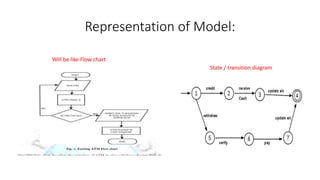
Representation of Model:
Will be like Flow chart
State / transition diagram
Applications of Automata
• Text processing – string search
• Web browsing
• Compiler design
• Operating system
• Game theory (strategy model by decision making)
• NLP
• Artificial intelligence
PREREQUISTIES
• Set theory
• Model theory
• Computability theory
• Proof theory
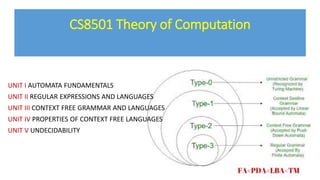
CS8501 Theory of Computation
UNIT I AUTOMATA FUNDAMENTALS
UNIT II REGULAR EXPRESSIONS AND LANGUAGES
UNIT III CONTEXT FREE GRAMMAR AND LANGUAGES
UNIT IV PROPERTIES OF CONTEXT FREE LANGUAGES
UNIT V UNDECIDABILITY
TEXTBOOK FOR REFERENCE
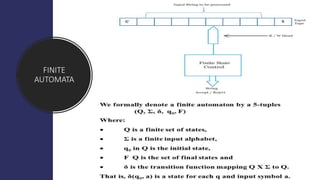
FINITE
AUTOMATA
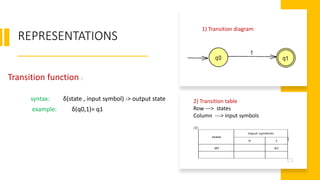
REPRESENTATIONS
Transition function :
syntax: δ(state , input symbol) -> output state
example: δ(q0,1)= q1
2) Transition table
Row ---> states
Column ---> input symbols
1) Transition diagram
TYPES OF FA
1. Deterministic Finite Automata (DFA)
2. Non- Deterministic Finite Automata (NFA)
Both are defined by 5 tuples but there is difference in :
Transition function
DFA: Q x Σ -> [Q] - output is single state
NFA : Q x Σ -> {Q} - output is in many states
NFA
δ(q0,b)= {q0,q1}
NFA
δ(q0,1)= {q0,q2}
δ(q0,0)= {q0,q1}
δ(q2,1)= {q3}
δ(q2,1)= ∅
DFA
δ(q0,b)= [q0]
δ(q0,a)=[ q0,q1]
∅ - no null transitions
Guess the type of FA

Intro to automata theory

  • 1.
    Theory of Computation- Introduction
  • 2.
    What do umean by computation? calculation, solving, making decision , any kind of operations/task by any machine (like computer, calculator) What do u mean by theory? Simply speaking ….. A theory is a group of ideas intended to explain something. logically speaking …. A theory is a fact-based framework for describing a phenomenon. i.e basic principles behind any concept Purpose of Theory of computation : Develop formal mathematical models of computation that reflect real-world computers
  • 3.
    Definition: Theory of computationis the branch that deals with how effectively problems can be solved on a model of computation, using an algorithm. Automata Theory: • Automata is the plural of automaton – means automatic machine • Is the study of abstract machines and how it could solve the problems.
  • 4.
    Representation of Model: Willbe like Flow chart State / transition diagram
  • 5.
    Applications of Automata •Text processing – string search • Web browsing • Compiler design • Operating system • Game theory (strategy model by decision making) • NLP • Artificial intelligence
  • 6.
    PREREQUISTIES • Set theory •Model theory • Computability theory • Proof theory
  • 7.
    CS8501 Theory ofComputation UNIT I AUTOMATA FUNDAMENTALS UNIT II REGULAR EXPRESSIONS AND LANGUAGES UNIT III CONTEXT FREE GRAMMAR AND LANGUAGES UNIT IV PROPERTIES OF CONTEXT FREE LANGUAGES UNIT V UNDECIDABILITY
  • 8.
  • 9.
  • 10.
    REPRESENTATIONS Transition function : syntax:δ(state , input symbol) -> output state example: δ(q0,1)= q1 2) Transition table Row ---> states Column ---> input symbols 1) Transition diagram
  • 11.
    TYPES OF FA 1.Deterministic Finite Automata (DFA) 2. Non- Deterministic Finite Automata (NFA) Both are defined by 5 tuples but there is difference in : Transition function DFA: Q x Σ -> [Q] - output is single state NFA : Q x Σ -> {Q} - output is in many states
  • 12.
    NFA δ(q0,b)= {q0,q1} NFA δ(q0,1)= {q0,q2} δ(q0,0)={q0,q1} δ(q2,1)= {q3} δ(q2,1)= ∅ DFA δ(q0,b)= [q0] δ(q0,a)=[ q0,q1] ∅ - no null transitions Guess the type of FA