Data structure:
A datastructure is a logical representation of data and
operation that can be performed on the data.
Types:
1. Linear data structure.
2. Non linear data structure.
Linear data structure is an order of
data elements.
They are arrays, stacks, queues, and linked lists.
2.
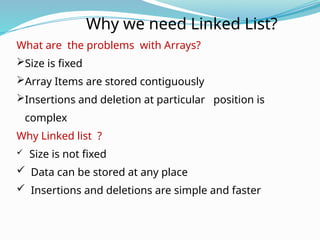
Why we needLinked List?
What are the problems with Arrays?
Size is fixed
Array Items are stored contiguously
Insertions and deletion at particular position is
complex
Why Linked list ?
Size is not fixed
Data can be stored at any place
Insertions and deletions are simple and faster
3.
What is Linkedlist?
Linked list is a linear data structure where
elements are not stored sequentially inside
the computer memory but they are linked with
each other by the help of address.
4.
Linked list:
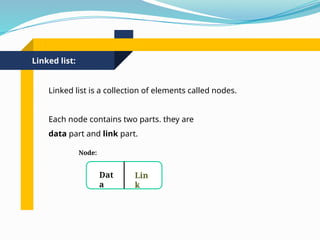
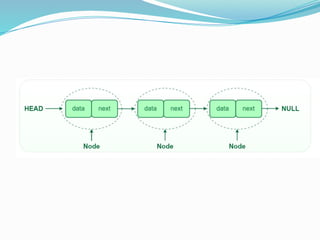
Linked listis a collection of elements called nodes.
Each node contains two parts. they are
data part and link part.
Dat
a
Lin
k
Node:
6.
Linked List Types
Singly Linked list
Doubly linked lists
Circular singly linked list
Circular doubly linked lists
7.
Singly Linked List
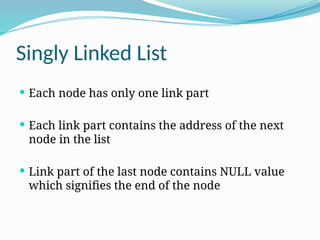
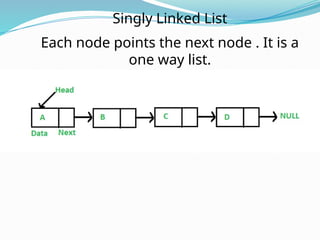
Each node has only one link part
Each link part contains the address of the next
node in the list
Link part of the last node contains NULL value
which signifies the end of the node
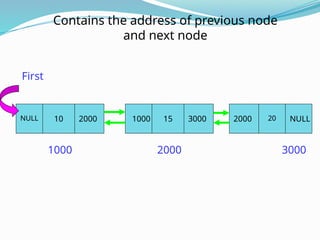
Contains the addressof previous node
and next node
NULL
2000 3000
1000
10 15 20
2000 1000 2000 NULL
3000
First
11.
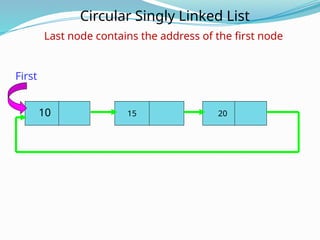
10 15 20
CircularSingly Linked List
Last node contains the address of the first node
First
12.
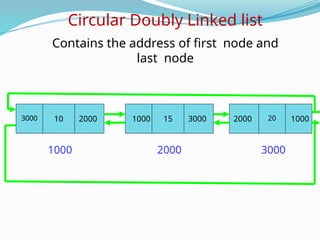
Circular Doubly Linkedlist
Contains the address of first node and
last node
3000
2000 3000
1000
10 15 20
2000 1000 2000 1000
3000
13.
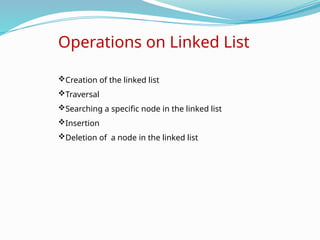
Operations on LinkedList
Creation of the linked list
Traversal
Searching a specific node in the linked list
Insertion
Deletion of a node in the linked list
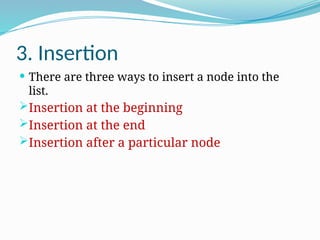
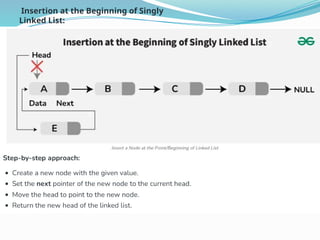
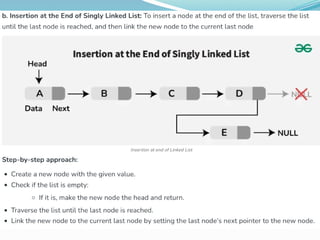
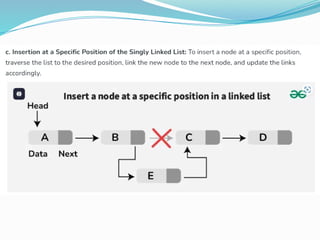
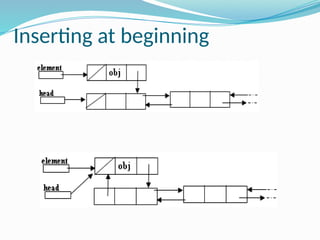
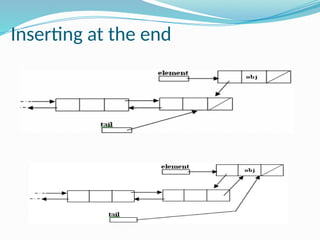
There arethree ways to insert a node into the
list.
Insertion at the beginning
Insertion at the end
Insertion after a particular node
3. Insertion
Deleting a nodein SLL
Here also we have three cases:-
Deleting the first node
Deleting the last node
Deleting the intermediate node
22.
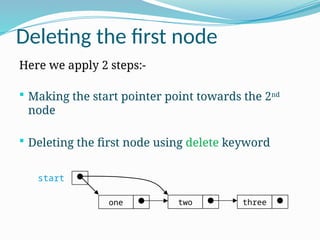
Deleting the firstnode
Here we apply 2 steps:-
Making the start pointer point towards the 2nd
node
Deleting the first node using delete keyword
three
two
one
start
23.
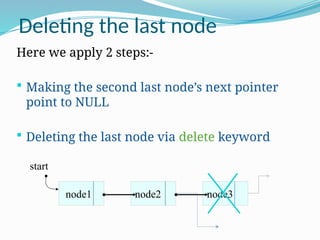
Deleting the lastnode
Here we apply 2 steps:-
Making the second last node’s next pointer
point to NULL
Deleting the last node via delete keyword
node3
node2
node1
start
24.
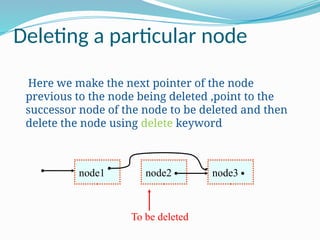
Deleting a particularnode
Here we make the next pointer of the node
previous to the node being deleted ,point to the
successor node of the node to be deleted and then
delete the node using delete keyword
node1 node2 node3
To be deleted
25.
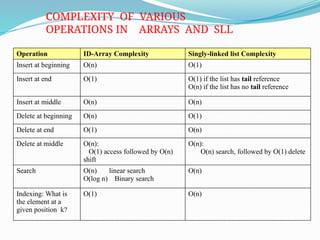
Operation ID-Array ComplexitySingly-linked list Complexity
Insert at beginning O(n) O(1)
Insert at end O(1) O(1) if the list has tail reference
O(n) if the list has no tail reference
Insert at middle O(n) O(n)
Delete at beginning O(n) O(1)
Delete at end O(1) O(n)
Delete at middle O(n):
O(1) access followed by O(n)
shift
O(n):
O(n) search, followed by O(1) delete
Search O(n) linear search
O(log n) Binary search
O(n)
Indexing: What is
the element at a
given position k?
O(1) O(n)
COMPLEXITY OF VARIOUS
OPERATIONS IN ARRAYS AND SLL
26.
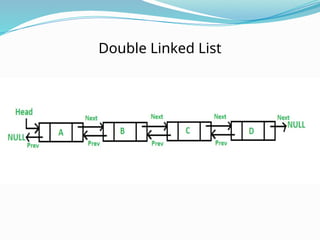
Doubly Linked List
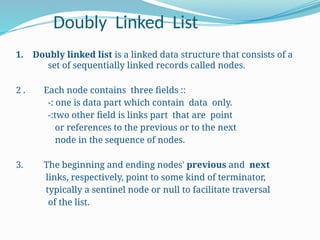
1.Doubly linked list is a linked data structure that consists of a
set of sequentially linked records called nodes.
2 . Each node contains three fields ::
-: one is data part which contain data only.
-:two other field is links part that are point
or references to the previous or to the next
node in the sequence of nodes.
3. The beginning and ending nodes' previous and next
links, respectively, point to some kind of terminator,
typically a sentinel node or null to facilitate traversal
of the list.
27.
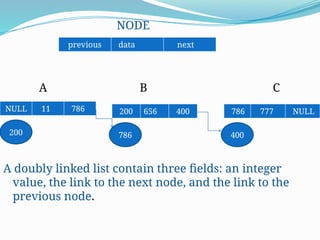
NODE
A B C
Adoubly linked list contain three fields: an integer
value, the link to the next node, and the link to the
previous node.
previous data next
NULL 11 786
786
200 400
200 656 400 786 777 NULL
28.
DLL’s compared toSLL’s
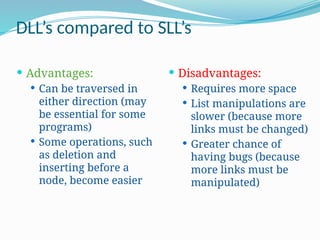
Advantages:
Can be traversed in
either direction (may
be essential for some
programs)
Some operations, such
as deletion and
inserting before a
node, become easier
Disadvantages:
Requires more space
List manipulations are
slower (because more
links must be changed)
Greater chance of
having bugs (because
more links must be
manipulated)
29.
Structure of DLL
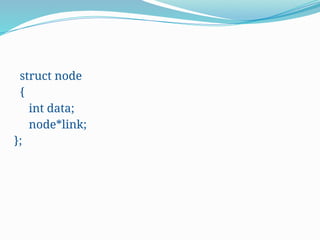
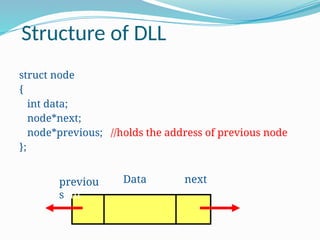
structnode
{
int data;
node*next;
node*previous; //holds the address of previous node
};
.Data .next
previou
s.inf
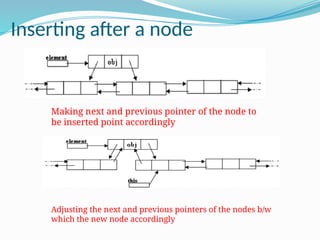
Making next andprevious pointer of the node to
be inserted point accordingly
Adjusting the next and previous pointers of the nodes b/w
which the new node accordingly
Inserting after a node
33.
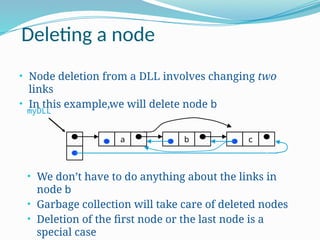
Deleting a node
•Node deletion from a DLL involves changing two
links
• In this example,we will delete node b
myDLL
a b c
• We don’t have to do anything about the links in
node b
• Garbage collection will take care of deleted nodes
• Deletion of the first node or the last node is a
special case
34.
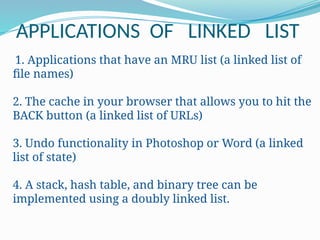
APPLICATIONS OF LINKEDLIST
1. Applications that have an MRU list (a linked list of
file names)
2. The cache in your browser that allows you to hit the
BACK button (a linked list of URLs)
3. Undo functionality in Photoshop or Word (a linked
list of state)
4. A stack, hash table, and binary tree can be
implemented using a doubly linked list.
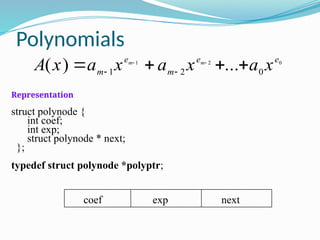
Polynomials
A x ax a x a x
m
e
m
e e
m m
( ) ...
1 2 0
1 2 0
Representation
struct polynode {
int coef;
int exp;
struct polynode * next;
};
typedef struct polynode *polyptr;
coef exp next
37.
• Adding polynomialsusing a Linked list
representation: (storing the result in p3)
To do this, we have to break the process
down to cases:
• Case 1: exponent of p1 > exponent of p2
• Copy node of p1 to end of p3.
[go to next node]
• Case 2: exponent of p1 < exponent of p2
• Copy node of p2 to end of p3.
[go to next node]
38.
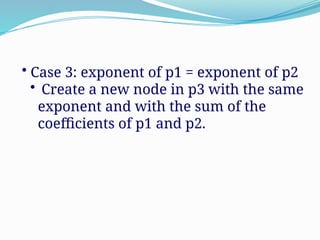
• Case 3:exponent of p1 = exponent of p2
• Create a new node in p3 with the same
exponent and with the sum of the
coefficients of p1 and p2.
39.
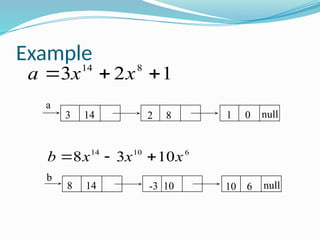
Example
3 14 28 1 0
a
8 14 -3 10 10 6
b
b x x x
8 3 10
14 10 6
null
null
a x x
3 2 1
14 8
40.
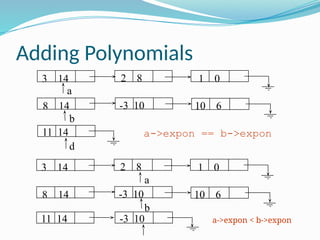
Adding Polynomials
3 142 8 1 0
a
8 14 -3 10 10 6
b
11 14
d
a->expon == b->expon
3 14 2 8 1 0
a
8 14 -3 10 10 6
b
11 14 -3 10 a->expon < b->expon
41.
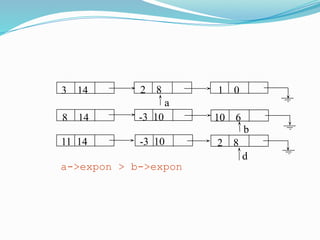
3 14 28 1 0
a
8 14 -3 10 10 6
b
11 14
a->expon > b->expon
-3 10
d
2 8


![• Adding polynomials using a Linked list
representation: (storing the result in p3)
To do this, we have to break the process
down to cases:
• Case 1: exponent of p1 > exponent of p2
• Copy node of p1 to end of p3.
[go to next node]
• Case 2: exponent of p1 < exponent of p2
• Copy node of p2 to end of p3.
[go to next node]](https://image.slidesharecdn.com/linkedlistmodule3-250407082508-526626e0/85/linked-list_MODULE-3-pptx-ppt-on-the-linked-list-37-320.jpg)