Data Communications and Networking 5th Edition Forouzan Solutions Manual
Data Communications and Networking 5th Edition Forouzan Solutions Manual
Data Communications and Networking 5th Edition Forouzan Solutions Manual
Data Communications and Networking 5th Edition Forouzan Solutions Manual
Data Communications and Networking 5th Edition Forouzan Solutions Manual
1.
Data Communications andNetworking 5th Edition
Forouzan Solutions Manual download
https://testbankdeal.com/product/data-communications-and-
networking-5th-edition-forouzan-solutions-manual/
Explore and download more test bank or solution manual
at testbankdeal.com
2.
Here are somerecommended products for you. Click the link to
download, or explore more at testbankdeal.com
Business Data Communications and Networking 13th Edition
FitzGerald Solutions Manual
https://testbankdeal.com/product/business-data-communications-and-
networking-13th-edition-fitzgerald-solutions-manual/
Business Data Communications Infrastructure Networking and
Security 7th Edition Stallings Solutions Manual
https://testbankdeal.com/product/business-data-communications-
infrastructure-networking-and-security-7th-edition-stallings-
solutions-manual/
Business Data Communications and Networking 13th Edition
FitzGerald Test Bank
https://testbankdeal.com/product/business-data-communications-and-
networking-13th-edition-fitzgerald-test-bank/
International Management Managing Across Borders and
Cultures Text and Cases 9th Edition Deresky Solutions
Manual
https://testbankdeal.com/product/international-management-managing-
across-borders-and-cultures-text-and-cases-9th-edition-deresky-
solutions-manual/
3.
Vanders Human PhysiologyThe Mechanisms of Body Function
15th Edition Widmaier Test Bank
https://testbankdeal.com/product/vanders-human-physiology-the-
mechanisms-of-body-function-15th-edition-widmaier-test-bank/
Economy Today 15th Edition Schiller Test Bank
https://testbankdeal.com/product/economy-today-15th-edition-schiller-
test-bank/
Business Communication Process and Product Brief Canadian
Canadian 4th Edition Guffey Solutions Manual
https://testbankdeal.com/product/business-communication-process-and-
product-brief-canadian-canadian-4th-edition-guffey-solutions-manual/
Modern Principles of Economics 3rd Edition Cowen Solutions
Manual
https://testbankdeal.com/product/modern-principles-of-economics-3rd-
edition-cowen-solutions-manual/
Chemistry in Context 9th Edition Amer Solutions Manual
https://testbankdeal.com/product/chemistry-in-context-9th-edition-
amer-solutions-manual/
4.
Natural Disasters 9thEdition Abbott Test Bank
https://testbankdeal.com/product/natural-disasters-9th-edition-abbott-
test-bank/
5.
1
C H AP T E R 9
PRACTICE SET
Questions
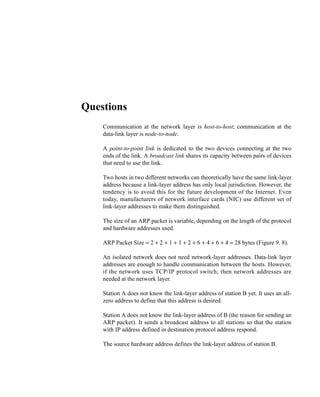
Q9-1. Communication at the network layer is host-to-host; communication at the
data-link layer is node-to-node.
Q9-2. A point-to-point link is dedicated to the two devices connecting at the two
ends of the link. A broadcast link shares its capacity between pairs of devices
that need to use the link.
Q9-3. Two hosts in two different networks can theoretically have the same link-layer
address because a link-layer address has only local jurisdiction. However, the
tendency is to avoid this for the future development of the Internet. Even
today, manufacturers of network interface cards (NIC) use different set of
link-layer addresses to make them distinguished.
Q9-4. The size of an ARP packet is variable, depending on the length of the protocol
and hardware addresses used.
Q9-5. ARP Packet Size = 2 + 2 + 1 + 1 + 2 + 6 + 4 + 6 + 4 = 28 bytes (Figure 9. 8).
Q9-6. An isolated network does not need network-layer addresses. Data-link layer
addresses are enough to handle communication between the hosts. However,
if the network uses TCP/IP protocol switch, then network addresses are
needed at the network layer.
Q9-7. Station A does not know the link-layer address of station B yet. It uses an all-
zero address to define that this address is desired.
Q9-8. Station A does not know the link-layer address of B (the reason for sending an
ARP packet). It sends a broadcast address to all stations so that the station
with IP address defined in destination protocol address respond.
Q9-9. The source hardware address defines the link-layer address of station B.
6.
2
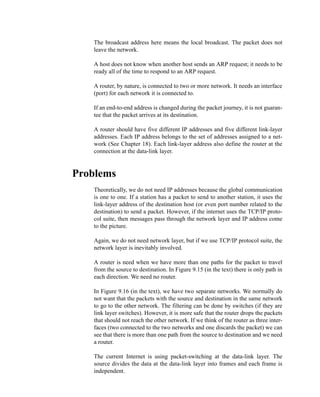
Q9-10. The broadcastaddress here means the local broadcast. The packet does not
leave the network.
Q9-11. A host does not know when another host sends an ARP request; it needs to be
ready all of the time to respond to an ARP request.
Q9-12. A router, by nature, is connected to two or more network. It needs an interface
(port) for each network it is connected to.
Q9-13. If an end-to-end address is changed during the packet journey, it is not guaran-
tee that the packet arrives at its destination.
Q9-14. A router should have five different IP addresses and five different link-layer
addresses. Each IP address belongs to the set of addresses assigned to a net-
work (See Chapter 18). Each link-layer address also define the router at the
connection at the data-link layer.
Problems
P9-1. Theoretically, we do not need IP addresses because the global communication
is one to one. If a station has a packet to send to another station, it uses the
link-layer address of the destination host (or even port number related to the
destination) to send a packet. However, if the internet uses the TCP/IP proto-
col suite, then messages pass through the network layer and IP address come
to the picture.
P9-2. Again, we do not need network layer, but if we use TCP/IP protocol suite, the
network layer is inevitably involved.
P9-3. A router is need when we have more than one paths for the packet to travel
from the source to destination. In Figure 9.15 (in the text) there is only path in
each direction. We need no router.
P9-4. In Figure 9.16 (in the text), we have two separate networks. We normally do
not want that the packets with the source and destination in the same network
to go to the other network. The filtering can be done by switches (if they are
link layer switches). However, it is more safe that the router drops the packets
that should not reach the other network. If we think of the router as three inter-
faces (two connected to the two networks and one discards the packet) we can
see that there is more than one path from the source to destination and we need
a router.
P9-5. The current Internet is using packet-switching at the data-link layer. The
source divides the data at the data-link layer into frames and each frame is
independent.
7.
3
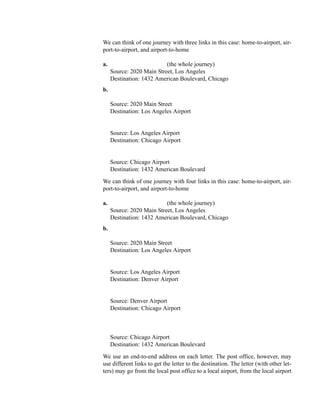
P9-6. We canthink of one journey with three links in this case: home-to-airport, air-
port-to-airport, and airport-to-home
a. End-to-end addresses (the whole journey)
Source: 2020 Main Street, Los Angeles
Destination: 1432 American Boulevard, Chicago
b.
First Link
Source: 2020 Main Street
Destination: Los Angeles Airport
Second Link
Source: Los Angeles Airport
Destination: Chicago Airport
Third Link
Source: Chicago Airport
Destination: 1432 American Boulevard
P9-7. We can think of one journey with four links in this case: home-to-airport, air-
port-to-airport, and airport-to-home
a. End-to-end addresses (the whole journey)
Source: 2020 Main Street, Los Angeles
Destination: 1432 American Boulevard, Chicago
b.
First Link
Source: 2020 Main Street
Destination: Los Angeles Airport
Second Link
Source: Los Angeles Airport
Destination: Denver Airport
Third Link
Source: Denver Airport
Destination: Chicago Airport
Fourth Link
Source: Chicago Airport
Destination: 1432 American Boulevard
P9-8. We use an end-to-end address on each letter. The post office, however, may
use different links to get the letter to the destination. The letter (with other let-
ters) may go from the local post office to a local airport, from the local airport
8.
4
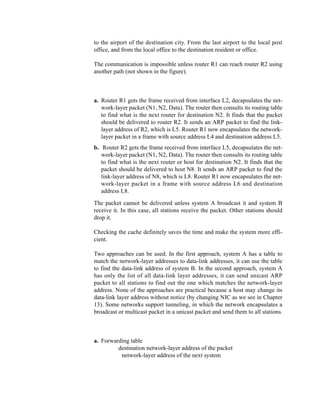
to the airportof the destination city. From the last airport to the local post
office, and from the local office to the destination resident or office.
P9-9. The communication is impossible unless router R1 can reach router R2 using
another path (not shown in the figure).
P9-10.
a. Router R1 gets the frame received from interface L2, decapsulates the net-
work-layer packet (N1, N2, Data). The router then consults its routing table
to find what is the next router for destination N2. It finds that the packet
should be delivered to router R2. It sends an ARP packet to find the link-
layer address of R2, which is L5. Router R1 now encapsulates the network-
layer packet in a frame with source address L4 and destination address L5.
b. Router R2 gets the frame received from interface L5, decapsulates the net-
work-layer packet (N1, N2, Data). The router then consults its routing table
to find what is the next router or host for destination N2. It finds that the
packet should be delivered to host N8. It sends an ARP packet to find the
link-layer address of N8, which is L8. Router R1 now encapsulates the net-
work-layer packet in a frame with source address L6 and destination
address L8.
P9-11. The packet cannot be delivered unless system A broadcast it and system B
receive it. In this case, all stations receive the packet. Other stations should
drop it.
P9-12. Checking the cache definitely saves the time and make the system more effi-
cient.
P9-13. Two approaches can be used. In the first approach, system A has a table to
match the network-layer addresses to data-link addresses, it can use the table
to find the data-link address of system B. In the second approach, system A
has only the list of all data-link layer addresses, it can send unicast ARP
packet to all stations to find out the one which matches the network-layer
address. None of the approaches are practical because a host may change its
data-link layer address without notice (by changing NIC as we see in Chapter
13). Some networks support tunneling, in which the network encapsulates a
broadcast or multicast packet in a unicast packet and send them to all stations.
P9-14.
a. Forwarding table
input: destination network-layer address of the packet
output: network-layer address of the next system
9.
5
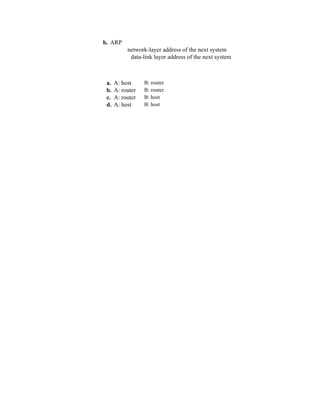
b. ARP
input: network-layeraddress of the next system
output: data-link layer address of the next system
P9-15.
a. A: host B: router
b. A: router B: router
c. A: router B: host
d. A: host B: host
all, their knowledgethat he was on their side so far as it was right to
be, would soon make them as eager to hear as he was to speak:
and finally, they would disperse to their homes with perfect
confidence that they could not do better than to leave their cause in
such hands." Those who seek to restrain the excesses of contending
factions, may always expect rough usage from both sides. Warren
incurred the occasional displeasure of his own party; but he did not
escape insult and outrage from the British. They often called him
rebel, and threatened him with a rebel's doom. One day, on his way
to Roxbury, to see his mother, he passed near several British officers,
standing in the Neck, which joins the peninsula of Boston to the
main land. Not far before him stood a gallows. One of the officers
called out, "Go on, Warren, you will soon come to the gallows:" and
the whole party laughed aloud. Walking directly up to them, he
calmly asked, which of them had thus addressed him? Not one was
bold enough to avow the insolence, and he left them, crest-fallen
and ashamed.
2 We have grouped together here, the events of several years, in the rapidity of our
narrative. The dependence of the judges for their salaries on the Crown, instead of on
the Colonial Legislatures, (whence we date their meriting to be called creatures and
panders,) began in 1772: and the tea was thrown into Boston Harbor, Dec. 16th,
1773.
Distinguished for his eloquence, our young physician was repeatedly
called on to address the people, upon the great and soul-stirring
topics of the times. Far the most interesting of these, was the
Massacre of the Fifth of March. Our authoress has passed too
slightly over this incident. Let us be a little more full.
Insults, recrimination, and outrage, between the soldiers and
citizens, were at length, on the 5th of March, 1770, consummated,
by the former's firing upon the latter in the streets of Boston, and
killing five men—with circumstances shocking to humanity. After one
of the slain (Mr. Gray,) had been shot through the body, and had
fallen on the ground, a bayonet was pushed through his skull, and
12.
his brains fellout upon the pavement. This was the first bloodshed,
consequent on the long festering irritations of the period. The officer
(Capt. Preston) who gave the word "fire!" and six of the soldiers who
had so fatally obeyed it, were in the ensuing October tried before a
Boston jury: and, defended, in spite of obloquy, popular clamor, and
the remonstrances of timid or prudent friends, by John Adams and
Josiah Quincy, Jr., were even by that jury, acquitted. It grieves us
that we cannot pause here, to bestow a merited tribute on the moral
courage of the illustrious counsel who dared defend, on the steady
justice of the tribunal that could acquit, and on the virtue and good
sense of the multitude who, when the first paroxysm of natural
excitement was over, could applaud that defence and approve that
acquittal3—horrible as had been the deed—maddening as had been
the antecedent circumstances. But though the killing happened not
to be murder, (because the people had been the assailants,) still, the
violent destruction of five human lives by an armed soldiery in the
streets of a free and peaceful city, was too impressive an example of
what mischiefs may come of standing armies and lawless
government, to pass unimproved. It was determined to solemnize
each anniversary of that day, by a public exposition of those
mischiefs; by an oration, commemorative of the tragedy, and of
those great principles, the disregard of which had led to its
perpetration. Warren delivered two of these orations.4 His first was
on the 5th of March, 1772. It is not contained in the little book now
before us, but we have seen it elsewhere: and on reading it, no one
need be surprised at its having well nigh urged the people, even at
that early day, to forcible measures. Its masterly argumentation is
equalled by its burning appeals to the passions. All the four first of
these orations had wrought so powerfully upon the public mind, that
the British officers declared there should be no more of them: and
that whoever undertook to deliver another, should do so at the peril
of life. This menace daunted others, but only roused Warren. Not
wailing to be invited, he solicited the task of addressing the people;
and prepared himself accordingly for the fifth anniversary of the
massacre—1775. Meanwhile, the givings out of the officers, and the
rumors among the populace, imported mortal hazard to him if he
13.
should persist. Hepersisted but the more resolutely. Early in the day,
the Old South Meeting House—which, as the scene of these
orations, deserves, better than Faneuil Hall, to be termed the cradle
of liberty—was crowded to its very porch. Many a devoted friend of
Warren's was there, determined to see him safely through, or to fall
in his defence. British officers and soldiers filled the aisles, the pulpit
steps, and even the pulpit. Thinking that if he pushed through them
to his place, a pretext might be seized for some disturbance, which
would take from him and his audience the desirable degree of
calmness, he procured a ladder to be placed outside, and by it,
climbed through the window into the pulpit, just as all were
expecting his entrance at the door. The officers quailed and receded,
at his sudden appearance and dauntless air: while he, far from sure
that his first word would not be answered by a bayonet-thrust or a
pistol-shot, addressed the silent, breathless multitude. His
countenance was lighted up with more than its usual glow of
patriotic enthusiasm: but every other face was pale; every auditor
could distinctly hear the throbbings of his own heart. The speech is
given at length in the appendix to the work under examination; from
the original, as we may conjecture, which, in the orator's own hand
writing, is now in the possession of his nephew, Dr. John C. Warren.
The opening was brief and simple: but in it we discern that curbed
energy, that impassioned moderation—une force contenue, une
rèserve animée—so characteristic of a great mind, concentrating its
powers for some gigantic effort: and as he passes on from the
unaffected humility of his exordium "to the height of his great
argument," we have bodily before our fancy's eye, a nobler
personification of wisdom, courage, eloquence and virtue, than
Homer has displayed in the form of Ulysses.
"MY EVER HONORED FELLOW CITIZENS,
"It is not without the most humiliating conviction of my want of ability, that I now
appear before you; but the sense I have, of the obligation I am under to obey the
calls of my country at all times, together with the animating recollection of your
indulgence, exhibited upon so many occasions, has induced me once more,
14.
undeserving as Iam, to throw myself upon that candor, which looks with kindness
upon the feeblest efforts of an honest mind.
"You will not now expect the elegance, the learning, the fire, the enrapturing strains
of eloquence, which captivated you when a Lovell, a Church, or a Hancock spake: but
you will permit me to say, that with a sincerity equal to theirs, I mourn over my
bleeding country: with them I weep at her distress, and with them, deeply resent the
many injuries she has received from the hands of cruel and unreasonable men."
3 Mr. Adams was, at the time, 35 years old; Mr. Quincy only 26. They were both
threatened with loss of friends, of popularity, and of all prospect of political
preferment. The "Memoirs of Quincy" (by his son Josiah, once a prominent federal
leader in Congress, now President of Harvard University,) contain a letter from his
venerable father, earnestly expostulating upon the step. The young barrister's reply is
also given—a triumphant vindication of the motives, and even of the prudence of his
resolution, to undertake the defence. In the success of that defence, in the universal
approbation which soon followed it, and in the professional and political advancement
of the generous advocates, they found ample rewards for having breasted the storm
of popular feeling, in obedience to the call of duty.
4 The oration of 1771 was delivered by James Lovell; that of 1772 by Joseph Warren;
of 1773, by Dr. Benjamin Church; of 1774, by John Hancock; of 1775, by Joseph
Warren. These, and eight others of succeeding years, down to 1783, we have in Mr.
H. Niles' inestimable collection of "Revolutionary Acts and Speeches."
Having laid down as axioms, the natural right of every man to
personal freedom and to the control of his property, the orator
sketched, with a master's hand, the history of English America: and,
deducing the right of the colonists to the soil from their treaties with
the Indians, and not from the grants of King James or King Charles,
(whose pretended claims of right they undoubtedly despised—whose
patents they probably accepted only "to silence the cavils of their
enemies," and who "might with equal justice have made them a
grant of the planet Jupiter,") he proved by unanswerable reasoning
15.
the rights ofAmerica, and painted in deep and living colors the
usurpations and injustice of England. He traced the progress of
these wrongs: he depicted the halcyon peace, the mutual
benefactions, and the common happiness of the two countries,
marred by successive and heightening aggressions—reaching, at
length, that last aggravation short of civil war—the quartering of an
insolent, hireling soldiery upon the people, to enforce submission to
unjust and unconstitutional laws. The danger of standing armies,
always, to liberty—the incompatibility of martial law with the
government of a well regulated city—the certainty of disputes
between the soldier and the citizen, especially when they are in each
other's eyes, respectively, a rebel, and an instrument of tyranny—all
made it but just to fear the most disagreeable consequences. "Our
fears, we have seen," continued the orator, "were but too well
grounded."
"The many injuries offered to the town, I pass over in silence. I cannot now mark out
the path which led to that unequalled scene of horror, the sad remembrance of which
takes full possession of my soul. The sanguinary theatre again opens itself to view.
The baleful images of terror crowd around me, and discontented ghosts, with hollow
groans, appear to solemnize the anniversary of the FIFTH OF MARCH.
"Approach we then the melancholy walk of death. Hither let me call the gay
companion; here let him drop a farewell tear upon that body, which so late he saw
vigorous and warm with social mirth; hither let me lead the tender mother, to weep
over her beloved son: come, widowed mourner, here satiate thy grief! behold thy
murdered husband gasping on the ground; and, to complete the pompous show of
wretchedness, bring in each hand thy infant children to bewail their father's fate: take
heed, ye orphan babes, lest, while your streaming eyes are fixed upon the ghastly
corpse, your feet slide on the stones bespattered with your father's brains! Enough!
this tragedy need not be heightened by an infant weltering in the blood of him that
gave it birth. Nature, reluctant, shrinks already from the view; and the chilled blood
rolls slowly backward to its fountain. We wildly stare about, and with amazement,
ask, who spread this ruin round us? Has haughty France or cruel Spain, sent forth her
myrmidons? Has the grim savage rushed again from the distant wilderness? Or does
some fiend, fierce from the depth of hell, with all the rancorous malice which the
16.
apostate damned canfeel, twang her destructive bow, and hurl her deadly arrows at
our breast? No, none of these. It is the hand of Britain that inflicts the wound! The
arms of George, our rightful king, have been employed to shed that blood, when
justice, or the honor of his crown, had called his subjects to the field!
"But pity, grief, astonishment, with all the softer movements of the soul, must now
give way to stronger passions. Say, fellow citizens, what dreadful thought now swells
your heaving bosoms? You fly to arms—sharp indignation flashes from each eye—
revenge gnashes her iron teeth—death grins an hideous smile, secure to drench his
jaws in human gore—whilst hovering furies darken all the air! But stop, my bold,
adventurous countrymen; stain not your weapons with the blood of Britons! Attend to
reason's voice. Humanity puts in her claim, and sues to be again admitted to her
wonted seat, the bosom of the brave. Revenge is far beneath the noble mind. Many,
perhaps, compelled to rank among the vile assassins, do, from their inmost souls,
detest the barbarous action. The winged death, shot from your arms, may chance to
pierce some breast, that bleeds already for your injured country.
"The storm subsides: a solemn pause ensues: you spare, upon condition they depart.
They go; they quit your city: they no more shall give offence. Thus closes the
important drama.
"And could it have been conceived that we again should see a British army in our
land, sent to enforce obedience to acts of Parliament destructive to our liberty?... Our
streets are again filled with armed men; our harbor is crowded with ships of war: but
these cannot intimidate us: our liberty must be preserved: it is far dearer than life—
we hold it even dear as our allegiance. We must defend it against the attacks of
friends, as well as enemies: we cannot suffer even Britons to ravish it from us. No
longer could we reflect, with generous pride, on the heroic actions of our American
forefathers; no longer boast our origin from that far famed island, whose warlike sons
have so often drawn their well tried swords to save her from the ravages of tyranny;
—could we, but for a moment, entertain the thought of giving up our liberty. The man
who meanly will submit to wear a shackle, contemns the noblest gift of Heaven; and
impiously affronts the God that made him free."
Highly wrought as these passages may appear, they accorded,
perfectly, with the minds to which they were addressed.
17.
It may bedoubted, if any scene of the kind ever possessed more of
the moral sublime, than that which our young countryman
presented,—daring thus, amidst armed and frowning enemies, to
denounce them and their masters, and to speak forth the startling
truths of justice and freedom, with the naked sword of tyranny
suspended over his head. The rising of Brutus, "refulgent from the
stroke of Cæsar's fate," shaking his crimsoned steel, and hailing
Tully aloud as the "father of his country"—Tully's own denunciations
of Catiline, Verres and Anthony—or the more illustrious Philippics of
Demosthenes—all remote from personal danger—the objects of their
enmity and invective being absent, defenceless, or prostrate—cannot
be compared, for moral sublimity, with the splendid boldness of
Warren. And, whatever classical anathemas await us for it, we are
heretical enough to venture the opinion, that for true eloquence,
blendedly pathetic and argumentative, his oration outstrips any that
we have read of Cicero's, and equals aught that we have seen of
Demosthenes. To the most effective effusions of the latter, indeed, it
bears the closest resemblance—rapid, condensed, inornate,
impassioned: similar, too, in its result, if we consider the difference
of their auditories—the one a mercurial mob, ever liable to be
swayed by whim or convulsed by passion; the other a grave,
reflecting people, who subjected every thing—feeling, imagination,
and even the love of liberty—to REASON. The oratory of Demosthenes
made the Athenians cry out, "Let us march against Philip!" When
Warren ended, a glow of admiration and respect pervaded even the
hostile bosoms around him; but the people of Boston were ready at
once to abjure allegiance to Great Britain. For this, however, affairs
were not yet ripe.
The celebrated Josiah Quincy, Jr. was at this time in England, on a
mission of remonstrance and observation. His interesting letters, and
more interesting journal, (for parts of which we are indebted to the
"Memoirs" before referred to,) shewed his conviction that the
pending disputes must come to the arbitrament of arms. His
countrymen, he said, "must seal their cause with their blood." This,
he was assured by Warren, (one of his warmest and dearest friends)
18.
they were readyto do. "It is the united voice of America" (Warren
wrote him) "to preserve their freedom, or lose their lives in its
defence." Warren was President of the Provincial Congress of
Massachusetts. He writes thus to Quincy concerning it: "Congress
met at Concord at the time appointed. About 260 members were
present. You would have thought yourself in an assembly of
Spartans, or ancient Romans, had you seen the ardor of those who
spoke on the important business they were transacting." Quincy
remained but six months in England, and then embarked for his
home in an advanced stage of consumption: having, as he told the
seaman who attended his sick bed, but one desire—that he might
live long enough to have one more interview with Samuel Adams
and Joseph Warren. His prayer was not granted. He died on ship
board, just entering Cape Anne Harbor, on the 26th of April, 1775,5
eight days after the battle of Lexington; where, unknown to him, his
countrymen had already "sealed their cause with their blood."
5 Love for his country and her liberties, may be safely considered the ruling passion
of this man's pure and splendid and too short life. He displayed it also "strong in
death." His last reported words were in a letter to his family, dictated to his sailor
nurse; in which he breathes a dying wish for his country. And his Will contains the
following clause: "I give to my son, when he shall arrive to the age of 15 years,
Algernon Sidney's Works, John Locke's Works—Lord Bacon's Works—Gordon's Tacitus,
and Cato's Letters. May the spirit of Liberty rest upon him."
Warren (now a brigadier general of the Massachusetts militia) was
not unconcerned in that battle. Scouts of his had notified him on the
18th of April, that a detachment of troops was to march that night
towards Concord: and then, remaining himself upon the watch, he
saw Colonel Smith and 8 or 900 men embark for Charlestown.
Knowing the stores and ammunition at Concord to be their object,
he instantly sent messengers over the surrounding country, to give
the alarm; and himself rode all night—passing so near the enemy, as
to be more than once in great danger of capture. His messenger to
Lexington was Col. Revere; who, on suddenly turning a corner as he
passed through Charlestown, found himself close to a party of the
19.
British. In amoment he put his horse at full speed, dashed through
them, and before they could well ascertain him to be a foe, was
beyond the reach of the balls which they fired after him. It was his
summons, that called forth the company of Lexington militia, upon
whom, about sunrise on the 19th, was begun that bloody drama, of
which the progress was to shake two continents, and the
catastrophe to dissever an empire. Warren, sleepless and in motion
throughout the night, hurried to the scene of action: and, when the
enemy were retreating from Concord, he was among the foremost in
hanging upon their rear, and assailing their flanks. By pressing them
too closely, he once narrowly escaped death. A musket ball took off
a lock of hair, which curled close to his head, in the fashion of that
time.
When his mother first saw him after the battle, and heard of this
escape, she entreated him with tears not again to risk a life so
precious. "Where danger is, dear mother," he answered, "there must
your son be. Now is no time for any of America's children to shrink
from any hazard. I will see her free, or die."
An exchange of prisoners was soon afterwards agreed on, to be
carried into effect at Charlestown. Generals Warren and Putnam with
two select companies of Massachusetts troops, repaired thither for
the purpose. Here was a touching scene. The British and American
officers, on meeting once more as friends after the recent strife had
so rudely sundered their long subsisting ties of hospitality and
mutual kindness, melted with tenderness, and rushed into each
other's arms. The soldiers caught the infection: and mingled tears,
and hands cordially shaken, softened for awhile the rugged front of
war. Putnam and Warren entertained the British as guests, as
sumptuously as the occasion allowed.
A few days afterwards, Warren was appointed Major General of the
Massachusetts forces: but still retained his post as President of the
Provincial Congress. He seems to have combined, with rare felicity,
the qualities of a civil and a military leader. Cool yet brave, gentle yet
20.
decided and firm,he was precisely fitted to teach and enforce order
and discipline. Mingling in the ranks, and talking with individual
soldiers as with brothers, he gained their love, and infused into them
his own ardor and sanguine confidence. He acted with equal talent
in civil council. He spent a part of each day in sharing the
deliberations of the Congress, which sat now at Watertown, ten
miles northwest from Boston. His labors ended there, he would
gallop to the camp at Cambridge. When the American commanders
deliberated upon the seizure and fortification of Dorchester Heights
and Bunker Hill, with a view to strike at the enemy's shipping, or to
anticipate them in a similar movement,—Warren opposed it. Our raw
troops, he thought, were not yet ready to cope with the trained
veterans of England. Putnam, then commander-in-chief at
Cambridge, thought differently. Warren renewed his opposition
before the committee of safety and the council of war: but when
these bodies successively resolved upon the measure, he promptly
gave his whole heart to promote its success; repeating his
determination, to be, himself, ever at the post of greatest danger. On
the 16th of June, when Col. Prescott received his orders, and
marched with his thousand men to fortify Bunker's Hill, the session
at Watertown was so protracted, that Warren could not leave it until
late at night. So soon as he could, he prepared to join Prescott—
despite the dissuasion of his friends. To their assurances, that most
of the detachment, and especially he—daring and conspicuous as he
was—would in all probability be cut off; and that he could not be
spared so soon from the cause; he replied, "I cannot help it: I must
share the fate of my countrymen. I cannot hear the cannon and
remain inactive." Among the most intimate of these friends, was the
afterwards distinguished Elbridge Gerry; with whom he lodged
regularly in the same room, and, on that last night, in the same bed.
To him;—when they parted after midnight, Warren uttered the
sentiment—so truly Roman, and in this instance so prophetic—"dulce
et decorum est, pro patria mori." By day-break, he was at the camp
in Cambridge; where, finding that the British had not shewn
themselves, and sick with an aching head, from mental and bodily
toil, he lay down, to snatch a little repose. But he was soon roused
21.
by tidings, thatthe enemy were in motion: and instantly rising, he
exclaimed, "my headache is gone." Others doubted what the object
of the enemy's threatened movement was. He at once saw it to be,
the unfinished fortification upon Bunker Hill. The committee of safety
(which sat in the house where he was) having resolved immediately
to despatch a reinforcement thither, Warren mounted his horse, and
with sword and musket, hastened to the scene of strife. He arrived
just as the fight began, and seeking out General Putnam, (who was
already there) desired to be posted where the service was to be
most arduous. Putnam expressed his sorrow at seeing him, in a
place so full of peril: "but since you have come," added he, "I will
obey your orders with pleasure." Warren replied, that he came as a
volunteer—to obey and fight; not to command. Putnam then
requested him to take his stand in the redoubt, where Prescott
commanded, and which was considerably in advance of the slighter
defence, behind which Putnam and his men were stationed. On his
entering the redoubt, he was greeted with loud huzzas: and
Prescott, like Putnam, offered him the command. He again refused
it; saying, that he was a mere volunteer, and should be happy to
learn service from so experienced a soldier. We cannot, thrilling as
they are to our recollections, undertake to narrate the well known
particulars of that great day. But we commend the story, as told by
the authoress before us, to the attention of our readers. Our
business is with General Warren. He was constantly active; going
through the ranks, cheering on his comrades, sharing their perils,
and plying his musket against the advancing enemy. When the
British had twice been driven from the height, with a thousand slain;
when the exhaustion of powder and ball, leaving the Americans no
means of resistance but clubbed guns, against fixed bayonets and
fourfold numbers, necessarily made the third onset successful—
Warren was the last to leave his station. The slowest in that slow
and reluctant retreat, he struggled for every foot of ground;
disdaining to quicken his steps, though bullets whizzed and blood
streamed all around him. Major Small, of the British army,
recognized him; and eager to save his life, called upon him for God's
sake to stop, and be protected from destruction. Warren turned and
22.
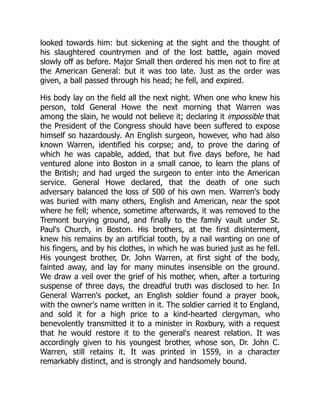
looked towards him:but sickening at the sight and the thought of
his slaughtered countrymen and of the lost battle, again moved
slowly off as before. Major Small then ordered his men not to fire at
the American General: but it was too late. Just as the order was
given, a ball passed through his head; he fell, and expired.
His body lay on the field all the next night. When one who knew his
person, told General Howe the next morning that Warren was
among the slain, he would not believe it; declaring it impossible that
the President of the Congress should have been suffered to expose
himself so hazardously. An English surgeon, however, who had also
known Warren, identified his corpse; and, to prove the daring of
which he was capable, added, that but five days before, he had
ventured alone into Boston in a small canoe, to learn the plans of
the British; and had urged the surgeon to enter into the American
service. General Howe declared, that the death of one such
adversary balanced the loss of 500 of his own men. Warren's body
was buried with many others, English and American, near the spot
where he fell; whence, sometime afterwards, it was removed to the
Tremont burying ground, and finally to the family vault under St.
Paul's Church, in Boston. His brothers, at the first disinterment,
knew his remains by an artificial tooth, by a nail wanting on one of
his fingers, and by his clothes, in which he was buried just as he fell.
His youngest brother, Dr. John Warren, at first sight of the body,
fainted away, and lay for many minutes insensible on the ground.
We draw a veil over the grief of his mother, when, after a torturing
suspense of three days, the dreadful truth was disclosed to her. In
General Warren's pocket, an English soldier found a prayer book,
with the owner's name written in it. The soldier carried it to England,
and sold it for a high price to a kind-hearted clergyman, who
benevolently transmitted it to a minister in Roxbury, with a request
that he would restore it to the general's nearest relation. It was
accordingly given to his youngest brother, whose son, Dr. John C.
Warren, still retains it. It was printed in 1559, in a character
remarkably distinct, and is strongly and handsomely bound.
23.
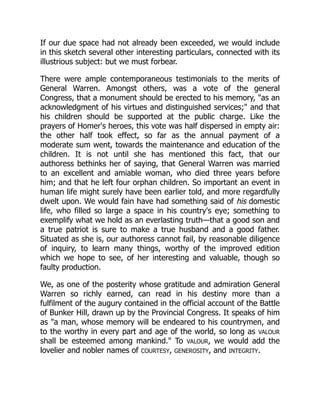
If our duespace had not already been exceeded, we would include
in this sketch several other interesting particulars, connected with its
illustrious subject: but we must forbear.
There were ample contemporaneous testimonials to the merits of
General Warren. Amongst others, was a vote of the general
Congress, that a monument should be erected to his memory, "as an
acknowledgment of his virtues and distinguished services;" and that
his children should be supported at the public charge. Like the
prayers of Homer's heroes, this vote was half dispersed in empty air:
the other half took effect, so far as the annual payment of a
moderate sum went, towards the maintenance and education of the
children. It is not until she has mentioned this fact, that our
authoress bethinks her of saying, that General Warren was married
to an excellent and amiable woman, who died three years before
him; and that he left four orphan children. So important an event in
human life might surely have been earlier told, and more regardfully
dwelt upon. We would fain have had something said of his domestic
life, who filled so large a space in his country's eye; something to
exemplify what we hold as an everlasting truth—that a good son and
a true patriot is sure to make a true husband and a good father.
Situated as she is, our authoress cannot fail, by reasonable diligence
of inquiry, to learn many things, worthy of the improved edition
which we hope to see, of her interesting and valuable, though so
faulty production.
We, as one of the posterity whose gratitude and admiration General
Warren so richly earned, can read in his destiny more than a
fulfilment of the augury contained in the official account of the Battle
of Bunker Hill, drawn up by the Provincial Congress. It speaks of him
as "a man, whose memory will be endeared to his countrymen, and
to the worthy in every part and age of the world, so long as VALOUR
shall be esteemed among mankind." To VALOUR, we would add the
lovelier and nobler names of COURTESY, GENEROSITY, and INTEGRITY.
24.
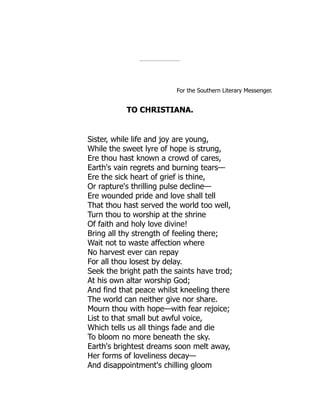
For the SouthernLiterary Messenger.
TO CHRISTIANA.
Sister, while life and joy are young,
While the sweet lyre of hope is strung,
Ere thou hast known a crowd of cares,
Earth's vain regrets and burning tears—
Ere the sick heart of grief is thine,
Or rapture's thrilling pulse decline—
Ere wounded pride and love shall tell
That thou hast served the world too well,
Turn thou to worship at the shrine
Of faith and holy love divine!
Bring all thy strength of feeling there;
Wait not to waste affection where
No harvest ever can repay
For all thou losest by delay.
Seek the bright path the saints have trod;
At his own altar worship God;
And find that peace whilst kneeling there
The world can neither give nor share.
Mourn thou with hope—with fear rejoice;
List to that small but awful voice,
Which tells us all things fade and die
To bloom no more beneath the sky.
Earth's brightest dreams soon melt away,
Her forms of loveliness decay—
And disappointment's chilling gloom
25.
Blights all herflowers of fairest bloom;
But oh, remember, there is bliss
In a far better land than this:
Look thou beyond this world of care,
And hope a fadeless crown to wear.
Then may distress and sorrow come,
Thy soul can ever find a home!
E. A. S.
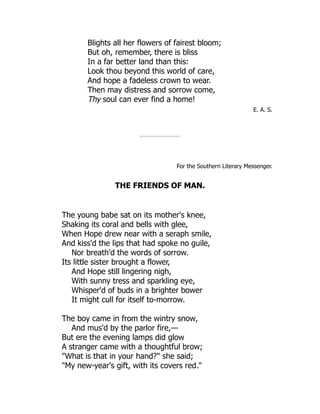
For the Southern Literary Messenger.
THE FRIENDS OF MAN.
The young babe sat on its mother's knee,
Shaking its coral and bells with glee,
When Hope drew near with a seraph smile,
And kiss'd the lips that had spoke no guile,
Nor breath'd the words of sorrow.
Its little sister brought a flower,
And Hope still lingering nigh,
With sunny tress and sparkling eye,
Whisper'd of buds in a brighter bower
It might cull for itself to-morrow.
The boy came in from the wintry snow,
And mus'd by the parlor fire,—
But ere the evening lamps did glow
A stranger came with a thoughtful brow;
"What is that in your hand?" she said;
"My new-year's gift, with its covers red."
26.
"Bring hither thebook, my boy, and see
The magic spell of Memory;—
That page hath gold, and a way I'll find
To lock it safe in your docile mind:
For books have honey, the sages say,
That is sweet to the taste, when the hair is grey."
The youth at midnight sought his bed,
But ere he closed his eyes
Two forms drew near with a gentle tread,
In meek and saintly guise;
One struck a lyre of wondrous power,
With thrilling music fraught,
That chain'd the flying summer hour,
And charm'd the listener's thought—
For still would its tuneful cadence be,
"Follow me! Follow me!
And every morn a smile shall bring
As sweet as the merry lay I sing."
But when she ceas'd, with serious air
The other made reply,
"Shall he not also be my care?
May not I his pleasures share?
Sister! Sister! tell me why?
Need Memory e'er with Hope contend?
Doth not the virtuous soul still find in both a friend?"
The youth beheld the strife,
And earnestly replied,
"Come, each shall be my guide—
Both gild the path of life:"
So he gave to each a trusting kiss,
And laid him down, and his dream was bliss.
The man came forth to run his race,
27.
And ever whenthe morning light
Rous'd him from the trance of night,
When singing from her nest
The lark went up with a dewy breast,
Hope by his pillow stood with angel grace—
And as a mother cheers her son,
She girded his daily harness on.
And when the star of eve from weary care
Bade him to his home repair;
When by the hearth-stone where his joys were born,
The cricket wound its tiny horn,
Sober Memory spread her board,
With knowledge richly stor'd,
And supp'd with him, and like a guardian blest
His nightly rest.
The old man sat in his elbow-chair,
His locks were thin and grey—
Memory, that faithful friend was there,
And he in a querulous tone did say,
"Hast thou not lost with careless key
Something that I have entrusted to thee?"
Her pausing answer was sad and low,
"It may be so! It may be so!
The lock of my casket is worn and weak,
And Time with a plunderer's eye doth seek:
Something I miss, but I cannot say
What it is he hath stolen away—
For it seems that tinsel and trifles spread
Over the alter'd path we tread:
But the gems thou didst give me when life was new,
Look! here they are, all told and true,
Diamonds and rubies of changeless hue."
Thus, while in grave debate,
Mournful and ill at ease they sate,
28.
Finding treasures disarranged,
Blamingthe fickle world, when they themselves were chang'd,
Hope, on a brilliant wing did soar,
Which folded neath her robe she long had wore,
And spread its rainbow plumes with new delight,
And hazarded its strength in a bold heavenward flight.
The dying lay on his couch of pain,
And his soul went forth to the angel train—
Yet when heaven's gate its golden bars undrew,
Memory walked that portal through,
And spread her tablet to the Judge's eye,
Heightening with clear response the welcome of the sky.
But at that threshold high,
Hope faltered with a drooping eye,
And as the expiring rose
Doth in its last adieu its sweetest breath disclose,
Laid down to die.
As a spent harp its symphony doth roll,
Faintly her parting sigh
Greeted a glorious form that stood serenely by:
"Earth's pilgrim I resign;
I cheered him to his grave—I lov'd him—he was mine;
Christ hath redeemed his soul—
Immortal Joy! 'tis thine."
L. H. S.
Hartford, Con. Sept. 1835.
For the Southern Literary Messenger.
29.
THOUGHTS.
Oh Britain! onthy far, far distant shores,
Mid scenes of grandeur, scenes with beauty fraught,
Oft do I wish to stray, when fancy pours
Her rainbow colors in the urn of thought.
Each crumbling tower, and each enchanted wood,
And every haunted glen by Poets sung—
Each mountain, forest, valley, field, or flood,
O'er which romance her magic veil has hung;
Thy "stately homes," the beautiful, the grand—
Each "breezy lawn," and each embowering tree,
In Albion clothed by nature's partial hand
In bloom and verdure—all I seem to see.
I picture to myself thy regal halls,
Where pomp and splendor hold an equal sway;
Thy palaces, within whose time-stained walls
Kings have been born, have lived, and passed away;
That ancient pile,1 where gloom and silence keep
Their vigils o'er the great and honored dead—
Where princes proud, and gifted poets sleep,
Each laid forever in his narrow bed;
The spots that hallowed in thy history stand,
The graves of those whose mem'ries cannot die,
With living gems that still adorn thy land,
All, all appear to fancy's ardent eye.
Parent thou art of many a cherished son,
And many a daughter crowned with wreaths of fame,
30.
Whose talents high,or virtues rare have won
An ever glorious, ever honored name.
A Milton's genius awfully sublime,
A Shakspeare's wit in nature's garments drest,
A Scott whose fame can only end with time,
Sprung from thy soil, and sleep within its breast.
A Campbell's pure and chastened flow of thought,
A Hemans' skill poetic flowers to twine,
A Bulwer's matchless page with interest fraught,
A Landon's love-tuned lyre, all—all are thine!
But oh, between my own blest land and thee
Old Ocean's wide and restless waters spread;
Thy gifted great I may not hope to see,
And on thy shores I know I ne'er shall tread.
Yet the free spirit roves where I would go,
To other climes, the beautiful and bright,
Through fields of air, o'er ocean's trackless flow,
Eager, unchecked and chainless in its flight!
E. A. S.
1 Westminster Abbey.
31.
For the SouthernLiterary Messenger.
KING PEST THE FIRST.
A TALE CONTAINING AN ALLEGORY—BY ——.
The Gods do bear and well allow in kings
The things which they abhor in rascal routes.
Buckhurst's Tragedy of Ferrex and Porrex.
About twelve o'clock, one sultry night, in the month of August, and
during the chivalrous reign of the third Edward, two seamen
belonging to the crew of the "Free and Easy," a trading schooner
plying between Sluys and the Thames, and then at anchor in that
river, were much astonished to find themselves seated in the tap-
room of an ale-house in the parish of St. Andrews, London—which
ale-house bore for sign the portraiture of a "Jolly Tar."
The room, it is needless to say, although ill-contrived, smoke-
blackened, low-pitched, and in every other respect agreeing with the
general character of such places at the period—was, nevertheless, in
the opinion of the grotesque groups scattered here and there within
it, sufficiently well adapted for its purpose.
Of these groups our two seamen formed, I think, the most
interesting, if not the most conspicuous.
The one who appeared to be the elder, and whom his companion
addressed by the characteristic appellation of "Legs," was also much
the most ill-favored, and, at the same time, much the taller of the
two. He might have measured six feet nine inches, and an habitual
32.
stoop in theshoulders seemed to have been the necessary
consequence of an altitude so enormous.
Superfluities in height were, however, more than accounted for by
deficiencies in other respects. He was exceedingly, wofully, awfully
thin; and might, as his associates asserted, have answered, when
sober, for a pennant at the mast-head, or, when stiff with liquor,
have served for a jib-boom. But these jests, and others of a similar
nature, had evidently produced, at no time, any effect upon the
leaden muscles of the tar. With high cheek-bones, a large hawk-
nose, retreating chin, fallen under-jaw, and huge protruding white
eyes, the expression of his countenance, although tinged with a
species of dogged indifference to matters and things in general, was
not the less utterly solemn and serious beyond all attempts at
imitation or description.
The younger seaman was in all outward appearance, the antipodes
of his companion. His stature could not have exceeded four feet. A
pair of stumpy bow-legs supported his squat, unwieldy figure, while
his unusually short and thick arms, with no ordinary fists at their
extremities, swung off, dangling from his sides like the fins of a sea-
turtle. Small eyes, of no particular color, twinkled far back in his
head. His nose remained buried in the mass of flesh which
enveloped his round, full, and purple face; and his thick upper-lip
rested upon the still thicker one beneath with an air of complacent
self-satisfaction, much heightened by the owner's habit of licking
them at intervals. He evidently regarded his tall ship-mate with a
feeling half-wondrous, half-quizzical; and stared up occasionally in
his face as the red setting sun stares up at the crags of Ben Nevis.
Various and eventful, however, had been the peregrinations of the
worthy couple in and about the different tap-houses of the
neighborhood during the earlier hours of the night. Funds even the
most ample, are not always everlasting: and it was with empty
pockets our friends had ventured upon the present hostelrie.
33.
Welcome to ourwebsite – the perfect destination for book lovers and
knowledge seekers. We believe that every book holds a new world,
offering opportunities for learning, discovery, and personal growth.
That’s why we are dedicated to bringing you a diverse collection of
books, ranging from classic literature and specialized publications to
self-development guides and children's books.
More than just a book-buying platform, we strive to be a bridge
connecting you with timeless cultural and intellectual values. With an
elegant, user-friendly interface and a smart search system, you can
quickly find the books that best suit your interests. Additionally,
our special promotions and home delivery services help you save time
and fully enjoy the joy of reading.
Join us on a journey of knowledge exploration, passion nurturing, and
personal growth every day!
testbankdeal.com