
Pre-Raphaelite Online Resource Linda Spurdle Birmingham Museums & Art Gallery
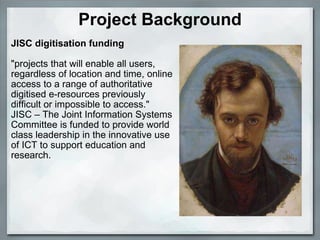
Project Background JISC digitisation funding   "projects that will enable all users, regardless of location and time, online access to a range of authoritative digitised e-resources previously difficult or impossible to access." JISC – The Joint Information Systems Committee is funded to provide world class leadership in the innovative use of ICT to support education and research.    
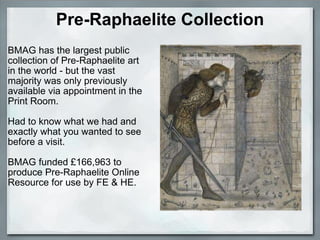
Pre-Raphaelite Collection BMAG has the largest public collection of Pre-Raphaelite art in the world - but the vast majority was only previously available via appointment in the Print Room.    Had to know what we had and exactly what you wanted to see before a visit.  BMAG funded £166,963 to produce Pre-Raphaelite Online Resource for use by FE & HE.  
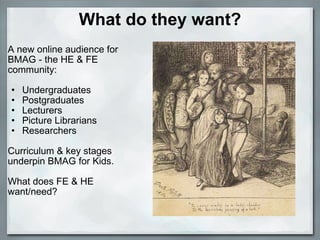
What do they want? A new online audience for BMAG - the HE & FE community: Undergraduates Postgraduates Lecturers Picture Librarians Researchers Curriculum & key stages underpin BMAG for Kids.    What does FE & HE want/need?       
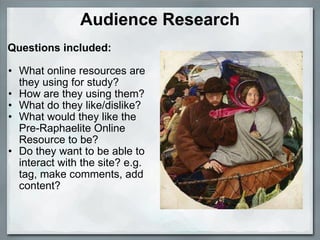
Audience Research   Questions included:   What online resources are they using for study? How are they using them? What do they like/dislike? What would they like the Pre-Raphaelite Online Resource to be? Do they want to be able to interact with the site? e.g. tag, make comments, add content?  
 
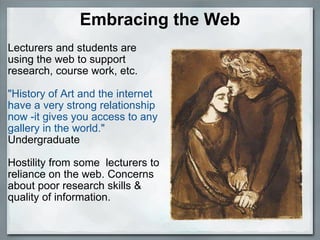
Embracing the Web Lecturers and students are using the web to support research, course work, etc.   "History of Art and the internet have a very strong relationship now -it gives you access to any gallery in the world." Undergraduate  Hostility from some  lecturers to reliance on the web. Concerns about poor research skills & quality of information.   
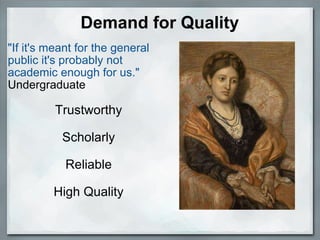
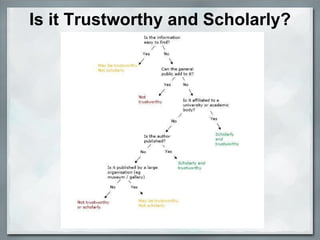
Demand for Quality "If it's meant for the general public it's probably not academic enough for us." Undergraduate Trustworthy   Scholarly   Reliable   High Quality  
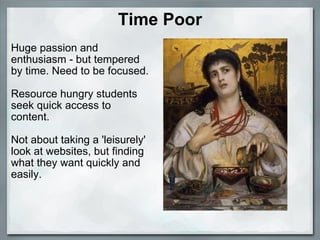
Time Poor Huge passion and enthusiasm - but tempered by time. Need to be focused.   Resource hungry students seek quick access to content.    Not about taking a 'leisurely' look at websites, but finding what they want quickly and easily.        
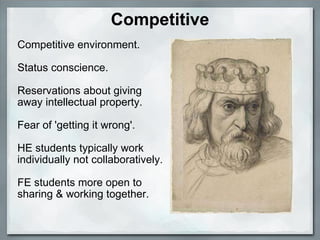
Competitive Competitive environment. Status conscience. Reservations about giving away intellectual property. Fear of 'getting it wrong'. HE students typically work individually not collaboratively. FE students more open to sharing & working together.  
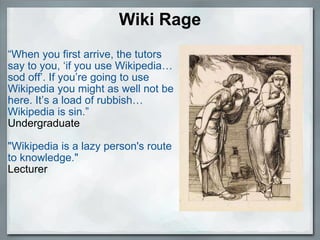
Wiki Rage “ When you first arrive, the tutors say to you, ‘if you use Wikipedia… sod off’. If you’re going to use Wikipedia you might as well not be here. It’s a load of rubbish… Wikipedia is sin.” Undergraduate "Wikipedia is a lazy person's route to knowledge." Lecturer
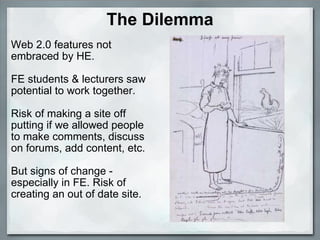
The Dilemma Web 2.0 features not embraced by HE. FE students & lecturers saw potential to work together. Risk of making a site off putting if we allowed people to make comments, discuss on forums, add content, etc. But signs of change - especially in FE. Risk of creating an out of date site.   
Is it Trustworthy and Scholarly?  
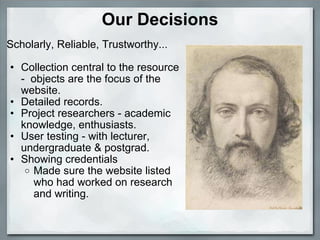
Our Decisions Scholarly, Reliable, Trustworthy...    Collection central to the resource -  objects are the focus of the website. Detailed records. Project researchers - academic knowledge, enthusiasts. User testing - with lecturer, undergraduate & postgrad. Showing credentials Made sure the website listed who had worked on research and writing.   
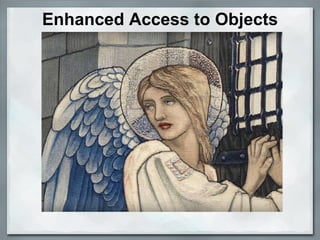
Enhanced Access to Objects Zoom feature  Quest for the Holy Grail link
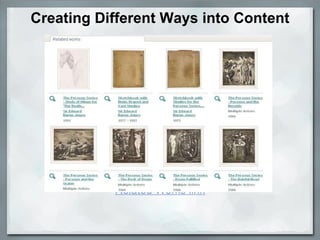
Creating Different Ways into Content Related Works link
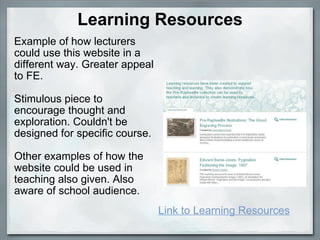
Learning Resources Example of how lecturers could use this website in a different way. Greater appeal to FE.   Stimulous piece to encourage thought and exploration. Couldn't be designed for specific course. Other examples of how the website could be used in teaching also given. Also aware of school audience. Link to Learning Resources
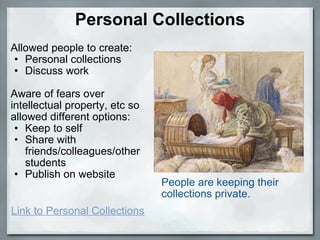
Personal Collections Allowed people to create: Personal collections Discuss work Aware of fears over intellectual property, etc so allowed different options: Keep to self Share with friends/colleagues/other students Publish on website People are keeping their collections private.    Link to Personal Collections
Since July 2009 Launch I can't say too many good things about this remarkable "resource." William Morris Society Blog   Excellent reviews Great Feedback  Winner of Interactive Media Award. Nominated for BIMA & DADI awards  50,000 visitors so far  
http://www.preraphaelites.org Link to Website [email_address] ANY QUESTIONS?

Linda Spurdle Pre Raphaelite Online Resource

  • 1.
    Pre-Raphaelite Online ResourceLinda Spurdle Birmingham Museums & Art Gallery
  • 2.
    Project Background JISCdigitisation funding   "projects that will enable all users, regardless of location and time, online access to a range of authoritative digitised e-resources previously difficult or impossible to access." JISC – The Joint Information Systems Committee is funded to provide world class leadership in the innovative use of ICT to support education and research.    
  • 3.
    Pre-Raphaelite Collection BMAGhas the largest public collection of Pre-Raphaelite art in the world - but the vast majority was only previously available via appointment in the Print Room.    Had to know what we had and exactly what you wanted to see before a visit. BMAG funded £166,963 to produce Pre-Raphaelite Online Resource for use by FE & HE.  
  • 4.
    What do theywant? A new online audience for BMAG - the HE & FE community: Undergraduates Postgraduates Lecturers Picture Librarians Researchers Curriculum & key stages underpin BMAG for Kids.    What does FE & HE want/need?       
  • 5.
    Audience Research  Questions included:   What online resources are they using for study? How are they using them? What do they like/dislike? What would they like the Pre-Raphaelite Online Resource to be? Do they want to be able to interact with the site? e.g. tag, make comments, add content?  
  • 6.
  • 7.
    Embracing the WebLecturers and students are using the web to support research, course work, etc.   "History of Art and the internet have a very strong relationship now -it gives you access to any gallery in the world." Undergraduate Hostility from some  lecturers to reliance on the web. Concerns about poor research skills & quality of information.  
  • 8.
    Demand for Quality"If it's meant for the general public it's probably not academic enough for us." Undergraduate Trustworthy   Scholarly   Reliable   High Quality  
  • 9.
    Time Poor Hugepassion and enthusiasm - but tempered by time. Need to be focused.   Resource hungry students seek quick access to content.    Not about taking a 'leisurely' look at websites, but finding what they want quickly and easily.        
  • 10.
    Competitive Competitive environment.Status conscience. Reservations about giving away intellectual property. Fear of 'getting it wrong'. HE students typically work individually not collaboratively. FE students more open to sharing & working together.  
  • 11.
    Wiki Rage “When you first arrive, the tutors say to you, ‘if you use Wikipedia… sod off’. If you’re going to use Wikipedia you might as well not be here. It’s a load of rubbish… Wikipedia is sin.” Undergraduate "Wikipedia is a lazy person's route to knowledge." Lecturer
  • 12.
    The Dilemma Web2.0 features not embraced by HE. FE students & lecturers saw potential to work together. Risk of making a site off putting if we allowed people to make comments, discuss on forums, add content, etc. But signs of change - especially in FE. Risk of creating an out of date site.  
  • 13.
    Is it Trustworthyand Scholarly?  
  • 14.
    Our Decisions Scholarly,Reliable, Trustworthy...   Collection central to the resource -  objects are the focus of the website. Detailed records. Project researchers - academic knowledge, enthusiasts. User testing - with lecturer, undergraduate & postgrad. Showing credentials Made sure the website listed who had worked on research and writing.   
  • 15.
    Enhanced Access toObjects Zoom feature Quest for the Holy Grail link
  • 16.
    Creating Different Waysinto Content Related Works link
  • 17.
    Learning Resources Exampleof how lecturers could use this website in a different way. Greater appeal to FE.   Stimulous piece to encourage thought and exploration. Couldn't be designed for specific course. Other examples of how the website could be used in teaching also given. Also aware of school audience. Link to Learning Resources
  • 18.
    Personal Collections Allowedpeople to create: Personal collections Discuss work Aware of fears over intellectual property, etc so allowed different options: Keep to self Share with friends/colleagues/other students Publish on website People are keeping their collections private.   Link to Personal Collections
  • 19.
    Since July 2009Launch I can't say too many good things about this remarkable "resource." William Morris Society Blog   Excellent reviews Great Feedback Winner of Interactive Media Award. Nominated for BIMA & DADI awards 50,000 visitors so far  
  • 20.
    http://www.preraphaelites.org Link toWebsite [email_address] ANY QUESTIONS?