Professor & Head, Department of Pharmaceutics
St. Peter’s Institute of Pharmaceutical Sciences,
Hanumakonda, Telangana, India.
Drug development and
Pharmaceutical Research
1. Basic Vs Applied Research and
Drug Development
UGC-sponsored Two -Week Online Refresher Course on
“Drug Discovery and Formulation Development-Interpretation of Research Data”
UGC – MALAVIYA MISSION TEACHER TRAINING CENTRE and JNTU, Hyderabad
INTRODUCTION
1
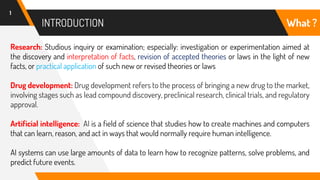
Research: Studious inquiry or examination; especially: investigation or experimentation aimed at
the discovery and interpretation of facts, revision of accepted theories or laws in the light of new
facts, or practical application of such new or revised theories or laws
Drug development: Drug development refers to the process of bringing a new drug to the market,
involving stages such as lead compound discovery, preclinical research, clinical trials, and regulatory
approval.
Artificial intelligence: AI is a field of science that studies how to create machines and computers
that can learn, reason, and act in ways that would normally require human intelligence.
AI systems can use large amounts of data to learn how to recognize patterns, solve problems, and
predict future events.
What ?
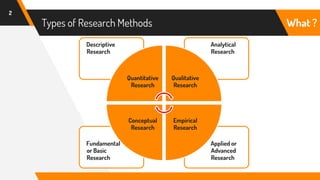
Types of Research Methods
2
Applied or
Advanced
Research
Fundamental
or Basic
Research
Analytical
Research
Descriptive
Research
Quantitative
Research
Qualitative
Research
Empirical
Research
Conceptual
Research
What ?
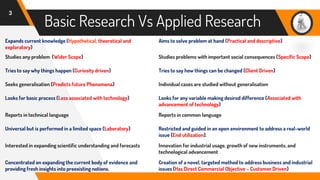
Basic Research Vs Applied Research
3
Expands current knowledge (Hypothetical, theoretical and
exploratory)
Aims to solve problem at hand (Practical and descriptive)
Studies any problem (Wider Scope) Studies problems with important social consequences (Specific Scope)
Tries to say why things happen (Curiosity driven) Tries to say how things can be changed (Client Driven)
Seeks generalisation (Predicts future Phenomena) Individual cases are studied without generalisation
Looks for basic process (Less associated with technology) Looks for any variable making desired difference (Associated with
advancement of technology)
Reports in technical language Reports in common language
Universal but is performed in a limited space (Laboratory) Restricted and guided in an open environment to address a real-world
issue (End utilization).
Interested in expanding scientific understanding and forecasts Innovation for industrial usage, growth of new instruments, and
technological advancement
Concentrated on expanding the current body of evidence and
providing fresh insights into preexisting notions.
Creation of a novel, targeted method to address business and industrial
issues (Has Direct Commercial Objective – Customer Driven)
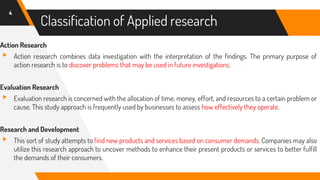
Classification of Applied research
Action Research
▸ Action research combines data investigation with the interpretation of the findings. The primary purpose of
action research is to discover problems that may be used in future investigations.
Evaluation Research
▸ Evaluation research is concerned with the allocation of time, money, effort, and resources to a certain problem or
cause. This study approach is frequently used by businesses to assess how effectively they operate.
Research and Development
▸ This sort of study attempts to find new products and services based on consumer demands. Companies may also
utilize this research approach to uncover methods to enhance their present products or services to better fulfill
the demands of their consumers.
4
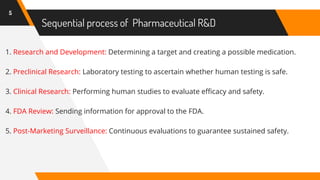
Sequential process of Pharmaceutical R&D
1. Research and Development: Determining a target and creating a possible medication.
2. Preclinical Research: Laboratory testing to ascertain whether human testing is safe.
3. Clinical Research: Performing human studies to evaluate efficacy and safety.
4. FDA Review: Sending information for approval to the FDA.
5. Post-Marketing Surveillance: Continuous evaluations to guarantee sustained safety.
5
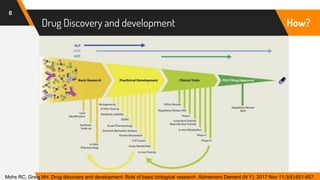
Drug Discovery and development
6
How?
Mohs RC, Greig NH. Drug discovery and development: Role of basic biological research. Alzheimers Dement (N Y). 2017 Nov 11;3(4):651-657.
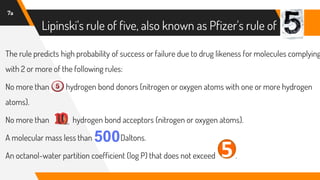
Lipinski's rule of five, also known as Pfizer's rule of
7a
The rule predicts high probability of success or failure due to drug likeness for molecules complying
with 2 or more of the following rules:
No more than hydrogen bond donors (nitrogen or oxygen atoms with one or more hydrogen
atoms).
No more than hydrogen bond acceptors (nitrogen or oxygen atoms).
A molecular mass less than Daltons.
An octanol-water partition coefficient (log P) that does not exceed .
5
Drug likeness
7c
▸ Molecular weight
Drug molecular weight is inversely proportional to drug permeability
▸ Lipophilicity Log P
Drug Lipophilicity is directly proportional to drug permeability
▸ Number of hydrogen bond donors and acceptors
Hydrogen bond donors and acceptors inversely proportional to drug permeability
8a
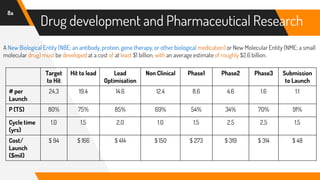
Drug development and Pharmaceutical Research
A New Biological Entity (NBE; an antibody, protein, gene therapy, or other biological medication) or New Molecular Entity (NME; a small
molecular drug) must be developed at a cost of at least $1 billion, with an average estimate of roughly $2.6 billion.
Target
to Hit
Hit to lead Lead
Optimisation
Non Clinical Phase1 Phase2 Phase3 Submission
to Launch
# per
Launch
24.3 19.4 14.6 12.4 8.6 4.6 1.6 1.1
P (TS) 80% 75% 85% 69% 54% 34% 70% 91%
Cycle time
(yrs)
1.0 1.5 2.0 1.0 1.5 2.5 2.5 1.5
Cost/
Launch
($mil)
$ 94 $ 166 $ 414 $ 150 $ 273 $ 319 $ 314 $ 48
R&D Spending
R&D spending in the pharmaceutical industry covers following activities
▸ Invention, or research and discovery of new drugs;
▸ Development, or clinical testing, preparation and submission of applications for FDA
approval, and design of production processes for new drugs;
▸ Incremental innovation, including the development of new dosages and delivery
mechanisms for existing drugs and the testing of those drugs for additional indications;
▸ Product differentiation, or the clinical testing of a new drug against an existing rival drug
to show that the new drug is superior; and
▸ Safety monitoring, or clinical trials (conducted after a drug has reached the market) that
the FDA may require to detect side effects that may not have been observed in shorter
trials when the drug was in development.
8b
Factors Influence Spending for R&D?
▸ Anticipated lifetime global revenues from a new drug,
▸ Expected costs to develop a new drug, and
▸ Policies and programs that influence the supply of and demand for prescription drugs.
8c
9
Drug development and Information to be developed for a
potential clinical candidate molecule
1. Information to be developed for a prospective clinical candidate molecule.
✓ Clarity on target validation in regard to human disease.
✓ Target’s physiology affected by disease
✓ Effective in animal model or disease – What evidence supports relevance to human disease?
2. Reliability of findings – Across multiple essays laboratories doses populations and conditions as
appropriate
3. Specificity of molecule against target
4. Kinetics of molecules
5. Potency of molecules
6. Safety margin in at least two species
Individual laboratory contributions to drug discovery and development
10
Target identification - New receptor, enzyme, pathway, protein etc
Target validation - Data linking target to human disease
Finding new molecule (Chemical or biological)
Screening essays - Cell lines, animal models etc
Data on drug like characteristics pharmacokinetics and toxicology
Developmental tools pharmacodynamic biomarkers including Biochemical essays, PET Ligands (radiotracers used
in positron emission tomography), Electrophysiological measures and others
Efficacy measures - Clinical scales, cognitive tests, functional measures, self reported outcomes, electronic health
recording
Technologies to improve efficiency of trial completion – Recruiting technologies electronic data capture and
tracking, Trial simulation, Safety monitoring etc
Challenges in R&D
1. High Costs and Investment Risks: Pharma R&D is expensive and comes with high financial risks.
2. Regulatory Hurdles: Navigating complex regulatory requirements is a significant challenge.
3. Scientific and Technical Challenges: Overcoming scientific barriers in drug development.
4. Ethical Considerations: Ensuring ethical standards are maintained throughout the R&D process.
5. Time Consumption: The process from discovery to market can take over a decade.
11
Stages in pharmaceutical R&D
12
▸ 1. Discovery and Development: Identifying a target and developing a potential drug.
❖ Researchers utilize techniques like virtual screening and compound screening assays to pinpoint promising
compounds that interact positively with the target molecule.
❖ These initial candidates proceed through a hit discovery process to identify lead compounds with therapeutic
potential.
▸ 2. Preclinical Research: Testing in a lab setting to determine if it’s safe to test lead compounds in humans.
This phase includes:
▸ Animal Testing
▸ In the preclinical phase, selected lead compounds undergo extensive testing in animal models to assess their
safety, efficacy, and therapeutic benefits. This stage is critical for determining the maximum tolerated dose and
establishing a preliminary safety profile. Only a small number of compounds typically advance past this stage
due to the rigorous nature of these tests.
13
3. Clinical Research: Conducting trials in humans to test for new drug safety and
effectiveness.
▸ Phase I Trials
▸ The clinical development phase kicks off with human trials. Phase I trials focus
on evaluating the drug’s pharmacokinetics and pharmacodynamics, as well as
its safety profile in a small group of healthy volunteers.
▸ They determine the basic properties, including absorption, distribution,
metabolism, and excretion. Therefore, this phase is pivotal in determining initial
safety and dosage parameters.
Stages in pharmaceutical R&D Contd……
▸ Phase II Trials
▸ Moving forward, phase II trials assess the drug’s medication effectiveness and further evaluate its safety in
a larger patient population.
▸ These clinical studies help identify the optimal dosing regimen and assess any short-term adverse
effects.
▸ Evidence of Exposure and its relation to dose, frequency of administration, patient characteristics
( Weight, Organ Function, etc)
▸ Evidence of Target engagement and its relationship to drug PK. Done through PET, Biochemical assays
etc (Target binding and mode of action).
▸ Evidence of Target related pharmacodynamic effect and its relationship to dose and drug
pharmacokinetics.
▸ Setting of dose and dosage regimen for phase III trials.
14
Stages in pharmaceutical R&D Contd……
Phase III Trials
▸ Phase III trials involve large-scale testing to gather comprehensive data on
the drug’s efficacy, safety, and overall therapeutic benefit.
▸ This phase typically includes thousands of patients across various
demographics and locations, providing robust data for drug approval and
market authorization.
15
Stages in pharmaceutical R&D Contd……
4. Regulatory Review (FDA Review: Submitting data to the FDA for
approval)
▸ Upon completing phase III clinical trials, a detailed drug application is submitted to regulatory
authorities such as the FDA or EMA for approval. This meticulous review process ensures that the drug
meets stringent safety and efficacy standards before it can be marketed.
FDA Approval
▸ The FDA approval process involves an exhaustive examination of the clinical data to ensure the drug’s safety
and efficacy for its intended use.
Other Regulatory Agencies
▸ In addition to the FDA, other significant regulatory agencies include the European Medicines Agency (EMA),
which oversee the drug approval process in their respective regions, ensuring global compliance and safety
standards.
16
Stages in pharmaceutical R&D Contd……
5. Post-Market Drug Safety Monitoring (Post-Market Surveillance):
Ongoing checks to ensure long-term safety
Phase IV Studies
▸ Post-marketing trials, known as phase IV studies, continue to monitor the long-term safety
and efficacy of approved drugs.
▸ These studies are crucial for identifying rare or long-term adverse effects that may not have
been apparent during earlier trials.
▸ They also help in refining the drug’s usage guidelines and optimizing therapeutic benefits.
17
Stages in pharmaceutical R&D Contd……
▸ "Drug development" is the term used to describe the entire process of introducing a new drug or
technology to the market.
▸ Drug development, chemistry and pharmacology, nonclinical safety testing, manufacturing, clinical
trials, and regulatory submissions are all part of this extensive, multidisciplinary endeavor.
▸ Drug development is a multi-phase, intricate process that turns scientific discoveries into
therapies that can save lives.
▸ From the initial phases of drug research to clinical trials and regulatory approval, each step is
critical to the success of new medications.
▸ This intricate process requires collaboration, stringent testing, and unwavering adherence to
regulatory requirements in order to bring safe and effective pharmaceuticals to market.
18
Conclusion
Drug development and Pharmaceutical Research
2. Artificial Intelligence and Drug Development
UGC-sponsored Two -Week Online Refresher Course on
“Drug Discovery and Formulation Development-Interpretation of Research Data”
Introduction
▸ Artificial intelligence (AI) is utilized in numerous ways to improve drug research and development, such as
Predicting Drug Properties
▸ AI algorithms can anticipate a drug's physicochemical qualities, including solubility, bioavailability, and toxicity. This
allows you to focus on compounds with a better possibility of success, lowering development costs and time.
▸ Personalizing Medicine: AI algorithms can analyse real-world patient data to assist select the best treatment
option for a patient.
▸ AI can help manage clinical data for pharmaceutical products.
▸ Patient engagement with personalized health information, support and education using AI chatbots and virtual
assistants.
19a
History
▸ Alan Turing and John McCarthy. Turing is considered the “father of AI” due in part to his work introducing the
Turing Test in 1950.
▸ Pharmaceutical companies are using AI technology to reduce the drug discovery process from 5-6 years to
one year.
▸ By 2025, AI applications have the potential to generate $350 billion to $410 billion in yearly value for
pharmaceutical businesses.
▸ AI will extract important information from a patient's electronic footprint.
▸ AI-enabled heart devices include electronic stethoscopes and software that uses electrocardiogram data to detect
heart arrhythmias or signs of heart failure are already in use.
19b
Artificial Intelligence and acceleration of drug development
1. Predicting Drug Candidates: AI algorithms (a set of instructions for solving a problem or
accomplishing a task) can predict potential drug candidates faster than traditional methods.
2. Enhancing Precision Medicine: Tailoring treatments to individual genetic profiles.
3. Improving Clinical Trials: Optimizing trial design and patient selection.
4. Data Analysis: Handling vast amounts of research data more efficiently.
5. AI and ML are not just tools but game-changers, making the drug discovery process quicker,
cheaper, and more effective.
20
AI for Drug Discovery
21
Who ?
▸ 1. Target Identification: To find possible therapeutic targets, AI systems can examine a variety of
data types, including genomic, proteomic, and clinical data. AI aids in the development of drugs
that can alter biological processes by identifying targets and molecular pathways linked to
disease.
▸ 2. Virtual Screening: AI makes it possible to effectively screen enormous chemical libraries in
order to find drug candidates that are highly likely to bind to a particular target. AI saves time and
money by helping researchers prioritise and choose compounds for experimental testing by
modelling chemical interactions and forecasting binding affinities.
AI for Drug Discovery
22
Who ?
▸ 3. Structure-Activity Relationship (SAR) Modelling: Artificial intelligence (AI) models are able
to create connections between a compound's chemical makeup and biological activity. This
enables scientists to create compounds with desired properties, such high potency, selectivity,
and advantageous pharmacokinetic profiles, in order to optimize therapeutic prospects.
▸ 4. De Novo Drug Design: AI algorithms can suggest new chemical structures that resemble
drugs by using generative models and reinforcement learning. AI broadens the chemical
universe and helps create novel drug ideas by learning from chemical libraries and experimental
data.
AI for Drug Discovery
23
How ?
▸ 5. Optimization of Drug Candidates: By taking into account a number of variables, such as
pharmacokinetics, safety, and efficacy, AI algorithms are able to evaluate and optimize drug
candidates. This aids scientists in optimising medicinal compounds to increase efficacy while
lowering the possibility of adverse effects.
▸ 6. Drug Repurposing: AI methods can examine vast amounts of biomedical data to find medications
that are already on the market and may be useful in treating various illnesses. AI speeds up and
lowers the cost of drug research by repurposing current medications for new applications.
▸ 7. Toxicity Prediction: By examining a compound's chemical makeup and properties, artificial
intelligence (AI) algorithms are able to forecast a drug's toxicity. Toxicological databases can be used
to train machine learning algorithms that can detect dangerous structural characteristics or predict
negative effects. This aids scientists in prioritizing safer compounds and reducing the possibility of
negative clinical trial reactions.
Popular AI model tools used for drug discovery
24
DeepChem: An open-source library that offers a variety of drug discovery tools and models, such as
deep learning models for generative chemistry, virtual screening, and molecular property prediction.
RDKit: A popular open-source cheminformatics toolkit that provides a number of features for
managing molecules, searching substructures, and calculating descriptors. Drug discovery apps can
incorporate it with machine learning frameworks.
ChemBERTa: A language model created especially for tasks involving drug development. It can produce
molecular structures, forecast characteristics, and aid with lead optimization because it is pre-trained on
a sizable corpus of chemical and biomedical literature and is based on the Transformer architecture.
▸ GraphConv: An architecture for deep learning models that works with molecular graphs. By
using the structural information contained in the graph representation of molecules, it has
proved successful in forecasting molecular characteristics like toxicity and bioactivity.
▸ AutoDock Vina: A well-known docking program that predicts the binding affinity between small
compounds and protein targets using machine learning approaches. It can help with lead
optimisation and virtual screening for drug discovery.
▸ SMILES Transformer: A deep learning model that creates molecular structures from Simplified
Molecular Input Line Entry System (SMILES) strings. Lead optimisation and de novo drug design
are two applications for it.
25
Popular AI model tools used for drug discovery
▸ Schrödinger Suite: An all-inclusive drug discovery software suite that includes a number of AI-
powered capabilities. Predictive modelling, ligand-based and structure-based drug design, virtual
screening, and molecular modelling are among its modules.
▸ IBM RXN for Chemistry : An AI model intended to forecast chemical reactions. It helps with drug
synthesis and the development of new synthetic pathways by generating possible reaction
outcomes using deep learning algorithms and sizable reaction databases.
▸ Scape-db (Extraction of Chemical and Physical Properties from the Literature-DrugBank):
A database which uses machine learning and natural language processing to extract biological
and chemical information from scholarly publications. It offers useful data for studies on
medication discovery.
26
Popular AI model tools used for drug discovery
27
GENTRL (Generative Tensorial Reinforcement Learning): A deep learning model that creates new
molecules with desired characteristics by fusing generative chemistry and reinforcement learning. De
novo drug design and optimization have made use of it.
Popular AI model tools used for drug discovery
28
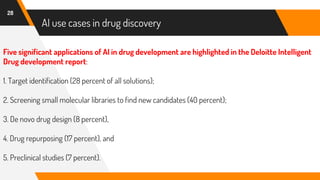
Five significant applications of AI in drug development are highlighted in the Deloitte Intelligent
Drug development report:
1. Target identification (28 percent of all solutions);
2. Screening small molecular libraries to find new candidates (40 percent);
3. De novo drug design (8 percent),
4. Drug repurposing (17 percent), and
5. Preclinical studies (7 percent).
AI use cases in drug discovery
29
Examples of AI drugs: Anastrozole, Letrozole, and Exemestane
Interesting facts
Phase 1 trials for AI-discovered drugs have shown success rates between 80-90%, significantly higher
than the historical industry averages of 40-65%,”
AI Most Common Applications include diagnosing patients, end-to-end drug discovery and
development, improving communication between physician and patient, transcribing medical
documents, such as prescriptions, and remotely treating patients.
De novo drug design: a medicine against fibrosis was generated in just 21 days
Interesting facts contd…
30
How ?
▸ Exscientia is a precision medicine company powered by artificial intelligence that is committed to finding,
developing, and producing the best medications in the most efficient manner.
▸ In order to provide a comprehensive solution for AI-generated methods, virtual screening of vast chemical
spaces, and hit-to-lead discovery and optimization, AIDDISONTM drug discovery software integrates AI,
machine learning, and CADD methodology.
▸ Researchers can explore an unlimited chemical universe and generate concepts for entirely new molecules
with this AI-powered drug development software. Based on anticipated activity, AIDDISONTM can swiftly
identify compounds that show promise as drugs. The program predicts whether a substance may be
produced by chemical synthesis by using a synthetic accessibility score derived from our SYNTHIATM
retrosynthesis software.
CONCLUSION
37
Artificial intelligence (AI) is rapidly changing the drug development process by increasing the speed, accuracy, and efficiency
of the discovery process.
AI tools are used at many levels, such as in the development of new drugs and the enhancement of clinical trial designs.
In addition to accelerating the discovery process, artificial intelligence has the potential to change the economics of
medication development.
Large population data can be analysed using artificial intelligence (AI) algorithms to identify trends and patterns that may
assist forecast how well prospective medication candidates will work for particular patient groups. This makes it possible to
tailor medications to each person's unique needs.
What's Up Next for Pharmaceutical R&D?
In conclusion, pharmaceutical research & development is a significant and ever-evolving sector that is always adapting to
meet the modern health issues. From integrating new technology like AI and Big Data to adhering to legal and ethical
standards, pharmaceutical research and development is at the forefront of medical innovation. Drug research is expected to
become increasingly integrated, patient-centered, and technology-driven in the future, according to trends, funding
patterns, and its global effect. As we turn to the future, the promise of R&D to improve global health remains a beacon of
progress and optimism.
Between 2015 and 2019, the FDA approved almost twice as many new drugs as it had in the previous decade. The proportion
of authorised biologics by the FDA.
31
References
1. DiMasi J.A., Feldman L., Seckler A., Wilson A. Trends in risks associated with new drug development:
success rates for investigational drugs. Clin Pharmacol Ther. 2010;87:272–277. doi:
10.1038/clpt.2009.295.
2. DiMasi J.A., Grabowski H.G., Hansen R.W. Innovation in the pharmaceutical industry: new estimates of
R&D costs. J Health Econ. 2016;47:20–33. doi: 10.1016/j.jhealeco.2016.01.012.
3. Paul S.M., Mytelka D.S., Dunwiddie C.T., Persinger C.C., Munos B.H., Lindborg S.R. How to improve R&D
productivity: the pharmaceutical industry's grand challenge. Nat Rev Drug Discov. 2010;9:203–214. doi:
10.1038/nrd3078.
4. Cummings J., Morstof T., Zhong K. Alzheimer's disease drug development pipeline: few candidates,
frequent failures. Alzheimers Res Ther. 2014;6:37–44. doi: 10.1186/alzrt269.
31
32
THANK You!
Any questions?
You can find me at
yuppieraj@gmail.com &
contact me at +91-9949611237
Dr. Rajasekhar Reddy Poonuru
Professor & Head, Department of Pharmaceutics
St. Peter’s Institute of Pharmaceutical
Sciences, Hanumakonda
“Any unknown in the practice field is a potential research idea”
Drug development and Pharmaceutical Research.pdf

  • 1.
    Professor & Head,Department of Pharmaceutics St. Peter’s Institute of Pharmaceutical Sciences, Hanumakonda, Telangana, India. Drug development and Pharmaceutical Research 1. Basic Vs Applied Research and Drug Development UGC-sponsored Two -Week Online Refresher Course on “Drug Discovery and Formulation Development-Interpretation of Research Data” UGC – MALAVIYA MISSION TEACHER TRAINING CENTRE and JNTU, Hyderabad
  • 2.
    INTRODUCTION 1 Research: Studious inquiryor examination; especially: investigation or experimentation aimed at the discovery and interpretation of facts, revision of accepted theories or laws in the light of new facts, or practical application of such new or revised theories or laws Drug development: Drug development refers to the process of bringing a new drug to the market, involving stages such as lead compound discovery, preclinical research, clinical trials, and regulatory approval. Artificial intelligence: AI is a field of science that studies how to create machines and computers that can learn, reason, and act in ways that would normally require human intelligence. AI systems can use large amounts of data to learn how to recognize patterns, solve problems, and predict future events. What ?
  • 3.
    Types of ResearchMethods 2 Applied or Advanced Research Fundamental or Basic Research Analytical Research Descriptive Research Quantitative Research Qualitative Research Empirical Research Conceptual Research What ?
  • 4.
    Basic Research VsApplied Research 3 Expands current knowledge (Hypothetical, theoretical and exploratory) Aims to solve problem at hand (Practical and descriptive) Studies any problem (Wider Scope) Studies problems with important social consequences (Specific Scope) Tries to say why things happen (Curiosity driven) Tries to say how things can be changed (Client Driven) Seeks generalisation (Predicts future Phenomena) Individual cases are studied without generalisation Looks for basic process (Less associated with technology) Looks for any variable making desired difference (Associated with advancement of technology) Reports in technical language Reports in common language Universal but is performed in a limited space (Laboratory) Restricted and guided in an open environment to address a real-world issue (End utilization). Interested in expanding scientific understanding and forecasts Innovation for industrial usage, growth of new instruments, and technological advancement Concentrated on expanding the current body of evidence and providing fresh insights into preexisting notions. Creation of a novel, targeted method to address business and industrial issues (Has Direct Commercial Objective – Customer Driven)
  • 5.
    Classification of Appliedresearch Action Research ▸ Action research combines data investigation with the interpretation of the findings. The primary purpose of action research is to discover problems that may be used in future investigations. Evaluation Research ▸ Evaluation research is concerned with the allocation of time, money, effort, and resources to a certain problem or cause. This study approach is frequently used by businesses to assess how effectively they operate. Research and Development ▸ This sort of study attempts to find new products and services based on consumer demands. Companies may also utilize this research approach to uncover methods to enhance their present products or services to better fulfill the demands of their consumers. 4
  • 6.
    Sequential process ofPharmaceutical R&D 1. Research and Development: Determining a target and creating a possible medication. 2. Preclinical Research: Laboratory testing to ascertain whether human testing is safe. 3. Clinical Research: Performing human studies to evaluate efficacy and safety. 4. FDA Review: Sending information for approval to the FDA. 5. Post-Marketing Surveillance: Continuous evaluations to guarantee sustained safety. 5
  • 7.
    Drug Discovery anddevelopment 6 How? Mohs RC, Greig NH. Drug discovery and development: Role of basic biological research. Alzheimers Dement (N Y). 2017 Nov 11;3(4):651-657.
  • 8.
    Lipinski's rule offive, also known as Pfizer's rule of 7a The rule predicts high probability of success or failure due to drug likeness for molecules complying with 2 or more of the following rules: No more than hydrogen bond donors (nitrogen or oxygen atoms with one or more hydrogen atoms). No more than hydrogen bond acceptors (nitrogen or oxygen atoms). A molecular mass less than Daltons. An octanol-water partition coefficient (log P) that does not exceed . 5
  • 9.
    Drug likeness 7c ▸ Molecularweight Drug molecular weight is inversely proportional to drug permeability ▸ Lipophilicity Log P Drug Lipophilicity is directly proportional to drug permeability ▸ Number of hydrogen bond donors and acceptors Hydrogen bond donors and acceptors inversely proportional to drug permeability
  • 10.
    8a Drug development andPharmaceutical Research A New Biological Entity (NBE; an antibody, protein, gene therapy, or other biological medication) or New Molecular Entity (NME; a small molecular drug) must be developed at a cost of at least $1 billion, with an average estimate of roughly $2.6 billion. Target to Hit Hit to lead Lead Optimisation Non Clinical Phase1 Phase2 Phase3 Submission to Launch # per Launch 24.3 19.4 14.6 12.4 8.6 4.6 1.6 1.1 P (TS) 80% 75% 85% 69% 54% 34% 70% 91% Cycle time (yrs) 1.0 1.5 2.0 1.0 1.5 2.5 2.5 1.5 Cost/ Launch ($mil) $ 94 $ 166 $ 414 $ 150 $ 273 $ 319 $ 314 $ 48
  • 11.
    R&D Spending R&D spendingin the pharmaceutical industry covers following activities ▸ Invention, or research and discovery of new drugs; ▸ Development, or clinical testing, preparation and submission of applications for FDA approval, and design of production processes for new drugs; ▸ Incremental innovation, including the development of new dosages and delivery mechanisms for existing drugs and the testing of those drugs for additional indications; ▸ Product differentiation, or the clinical testing of a new drug against an existing rival drug to show that the new drug is superior; and ▸ Safety monitoring, or clinical trials (conducted after a drug has reached the market) that the FDA may require to detect side effects that may not have been observed in shorter trials when the drug was in development. 8b
  • 12.
    Factors Influence Spendingfor R&D? ▸ Anticipated lifetime global revenues from a new drug, ▸ Expected costs to develop a new drug, and ▸ Policies and programs that influence the supply of and demand for prescription drugs. 8c
  • 13.
    9 Drug development andInformation to be developed for a potential clinical candidate molecule 1. Information to be developed for a prospective clinical candidate molecule. ✓ Clarity on target validation in regard to human disease. ✓ Target’s physiology affected by disease ✓ Effective in animal model or disease – What evidence supports relevance to human disease? 2. Reliability of findings – Across multiple essays laboratories doses populations and conditions as appropriate 3. Specificity of molecule against target 4. Kinetics of molecules 5. Potency of molecules 6. Safety margin in at least two species
  • 14.
    Individual laboratory contributionsto drug discovery and development 10 Target identification - New receptor, enzyme, pathway, protein etc Target validation - Data linking target to human disease Finding new molecule (Chemical or biological) Screening essays - Cell lines, animal models etc Data on drug like characteristics pharmacokinetics and toxicology Developmental tools pharmacodynamic biomarkers including Biochemical essays, PET Ligands (radiotracers used in positron emission tomography), Electrophysiological measures and others Efficacy measures - Clinical scales, cognitive tests, functional measures, self reported outcomes, electronic health recording Technologies to improve efficiency of trial completion – Recruiting technologies electronic data capture and tracking, Trial simulation, Safety monitoring etc
  • 15.
    Challenges in R&D 1.High Costs and Investment Risks: Pharma R&D is expensive and comes with high financial risks. 2. Regulatory Hurdles: Navigating complex regulatory requirements is a significant challenge. 3. Scientific and Technical Challenges: Overcoming scientific barriers in drug development. 4. Ethical Considerations: Ensuring ethical standards are maintained throughout the R&D process. 5. Time Consumption: The process from discovery to market can take over a decade. 11
  • 16.
    Stages in pharmaceuticalR&D 12 ▸ 1. Discovery and Development: Identifying a target and developing a potential drug. ❖ Researchers utilize techniques like virtual screening and compound screening assays to pinpoint promising compounds that interact positively with the target molecule. ❖ These initial candidates proceed through a hit discovery process to identify lead compounds with therapeutic potential. ▸ 2. Preclinical Research: Testing in a lab setting to determine if it’s safe to test lead compounds in humans. This phase includes: ▸ Animal Testing ▸ In the preclinical phase, selected lead compounds undergo extensive testing in animal models to assess their safety, efficacy, and therapeutic benefits. This stage is critical for determining the maximum tolerated dose and establishing a preliminary safety profile. Only a small number of compounds typically advance past this stage due to the rigorous nature of these tests.
  • 17.
    13 3. Clinical Research:Conducting trials in humans to test for new drug safety and effectiveness. ▸ Phase I Trials ▸ The clinical development phase kicks off with human trials. Phase I trials focus on evaluating the drug’s pharmacokinetics and pharmacodynamics, as well as its safety profile in a small group of healthy volunteers. ▸ They determine the basic properties, including absorption, distribution, metabolism, and excretion. Therefore, this phase is pivotal in determining initial safety and dosage parameters. Stages in pharmaceutical R&D Contd……
  • 18.
    ▸ Phase IITrials ▸ Moving forward, phase II trials assess the drug’s medication effectiveness and further evaluate its safety in a larger patient population. ▸ These clinical studies help identify the optimal dosing regimen and assess any short-term adverse effects. ▸ Evidence of Exposure and its relation to dose, frequency of administration, patient characteristics ( Weight, Organ Function, etc) ▸ Evidence of Target engagement and its relationship to drug PK. Done through PET, Biochemical assays etc (Target binding and mode of action). ▸ Evidence of Target related pharmacodynamic effect and its relationship to dose and drug pharmacokinetics. ▸ Setting of dose and dosage regimen for phase III trials. 14 Stages in pharmaceutical R&D Contd……
  • 19.
    Phase III Trials ▸Phase III trials involve large-scale testing to gather comprehensive data on the drug’s efficacy, safety, and overall therapeutic benefit. ▸ This phase typically includes thousands of patients across various demographics and locations, providing robust data for drug approval and market authorization. 15 Stages in pharmaceutical R&D Contd……
  • 20.
    4. Regulatory Review(FDA Review: Submitting data to the FDA for approval) ▸ Upon completing phase III clinical trials, a detailed drug application is submitted to regulatory authorities such as the FDA or EMA for approval. This meticulous review process ensures that the drug meets stringent safety and efficacy standards before it can be marketed. FDA Approval ▸ The FDA approval process involves an exhaustive examination of the clinical data to ensure the drug’s safety and efficacy for its intended use. Other Regulatory Agencies ▸ In addition to the FDA, other significant regulatory agencies include the European Medicines Agency (EMA), which oversee the drug approval process in their respective regions, ensuring global compliance and safety standards. 16 Stages in pharmaceutical R&D Contd……
  • 21.
    5. Post-Market DrugSafety Monitoring (Post-Market Surveillance): Ongoing checks to ensure long-term safety Phase IV Studies ▸ Post-marketing trials, known as phase IV studies, continue to monitor the long-term safety and efficacy of approved drugs. ▸ These studies are crucial for identifying rare or long-term adverse effects that may not have been apparent during earlier trials. ▸ They also help in refining the drug’s usage guidelines and optimizing therapeutic benefits. 17 Stages in pharmaceutical R&D Contd……
  • 22.
    ▸ "Drug development"is the term used to describe the entire process of introducing a new drug or technology to the market. ▸ Drug development, chemistry and pharmacology, nonclinical safety testing, manufacturing, clinical trials, and regulatory submissions are all part of this extensive, multidisciplinary endeavor. ▸ Drug development is a multi-phase, intricate process that turns scientific discoveries into therapies that can save lives. ▸ From the initial phases of drug research to clinical trials and regulatory approval, each step is critical to the success of new medications. ▸ This intricate process requires collaboration, stringent testing, and unwavering adherence to regulatory requirements in order to bring safe and effective pharmaceuticals to market. 18 Conclusion
  • 23.
    Drug development andPharmaceutical Research 2. Artificial Intelligence and Drug Development UGC-sponsored Two -Week Online Refresher Course on “Drug Discovery and Formulation Development-Interpretation of Research Data”
  • 24.
    Introduction ▸ Artificial intelligence(AI) is utilized in numerous ways to improve drug research and development, such as Predicting Drug Properties ▸ AI algorithms can anticipate a drug's physicochemical qualities, including solubility, bioavailability, and toxicity. This allows you to focus on compounds with a better possibility of success, lowering development costs and time. ▸ Personalizing Medicine: AI algorithms can analyse real-world patient data to assist select the best treatment option for a patient. ▸ AI can help manage clinical data for pharmaceutical products. ▸ Patient engagement with personalized health information, support and education using AI chatbots and virtual assistants. 19a
  • 25.
    History ▸ Alan Turingand John McCarthy. Turing is considered the “father of AI” due in part to his work introducing the Turing Test in 1950. ▸ Pharmaceutical companies are using AI technology to reduce the drug discovery process from 5-6 years to one year. ▸ By 2025, AI applications have the potential to generate $350 billion to $410 billion in yearly value for pharmaceutical businesses. ▸ AI will extract important information from a patient's electronic footprint. ▸ AI-enabled heart devices include electronic stethoscopes and software that uses electrocardiogram data to detect heart arrhythmias or signs of heart failure are already in use. 19b
  • 26.
    Artificial Intelligence andacceleration of drug development 1. Predicting Drug Candidates: AI algorithms (a set of instructions for solving a problem or accomplishing a task) can predict potential drug candidates faster than traditional methods. 2. Enhancing Precision Medicine: Tailoring treatments to individual genetic profiles. 3. Improving Clinical Trials: Optimizing trial design and patient selection. 4. Data Analysis: Handling vast amounts of research data more efficiently. 5. AI and ML are not just tools but game-changers, making the drug discovery process quicker, cheaper, and more effective. 20
  • 27.
    AI for DrugDiscovery 21 Who ? ▸ 1. Target Identification: To find possible therapeutic targets, AI systems can examine a variety of data types, including genomic, proteomic, and clinical data. AI aids in the development of drugs that can alter biological processes by identifying targets and molecular pathways linked to disease. ▸ 2. Virtual Screening: AI makes it possible to effectively screen enormous chemical libraries in order to find drug candidates that are highly likely to bind to a particular target. AI saves time and money by helping researchers prioritise and choose compounds for experimental testing by modelling chemical interactions and forecasting binding affinities.
  • 28.
    AI for DrugDiscovery 22 Who ? ▸ 3. Structure-Activity Relationship (SAR) Modelling: Artificial intelligence (AI) models are able to create connections between a compound's chemical makeup and biological activity. This enables scientists to create compounds with desired properties, such high potency, selectivity, and advantageous pharmacokinetic profiles, in order to optimize therapeutic prospects. ▸ 4. De Novo Drug Design: AI algorithms can suggest new chemical structures that resemble drugs by using generative models and reinforcement learning. AI broadens the chemical universe and helps create novel drug ideas by learning from chemical libraries and experimental data.
  • 29.
    AI for DrugDiscovery 23 How ? ▸ 5. Optimization of Drug Candidates: By taking into account a number of variables, such as pharmacokinetics, safety, and efficacy, AI algorithms are able to evaluate and optimize drug candidates. This aids scientists in optimising medicinal compounds to increase efficacy while lowering the possibility of adverse effects. ▸ 6. Drug Repurposing: AI methods can examine vast amounts of biomedical data to find medications that are already on the market and may be useful in treating various illnesses. AI speeds up and lowers the cost of drug research by repurposing current medications for new applications. ▸ 7. Toxicity Prediction: By examining a compound's chemical makeup and properties, artificial intelligence (AI) algorithms are able to forecast a drug's toxicity. Toxicological databases can be used to train machine learning algorithms that can detect dangerous structural characteristics or predict negative effects. This aids scientists in prioritizing safer compounds and reducing the possibility of negative clinical trial reactions.
  • 30.
    Popular AI modeltools used for drug discovery 24 DeepChem: An open-source library that offers a variety of drug discovery tools and models, such as deep learning models for generative chemistry, virtual screening, and molecular property prediction. RDKit: A popular open-source cheminformatics toolkit that provides a number of features for managing molecules, searching substructures, and calculating descriptors. Drug discovery apps can incorporate it with machine learning frameworks. ChemBERTa: A language model created especially for tasks involving drug development. It can produce molecular structures, forecast characteristics, and aid with lead optimization because it is pre-trained on a sizable corpus of chemical and biomedical literature and is based on the Transformer architecture.
  • 31.
    ▸ GraphConv: Anarchitecture for deep learning models that works with molecular graphs. By using the structural information contained in the graph representation of molecules, it has proved successful in forecasting molecular characteristics like toxicity and bioactivity. ▸ AutoDock Vina: A well-known docking program that predicts the binding affinity between small compounds and protein targets using machine learning approaches. It can help with lead optimisation and virtual screening for drug discovery. ▸ SMILES Transformer: A deep learning model that creates molecular structures from Simplified Molecular Input Line Entry System (SMILES) strings. Lead optimisation and de novo drug design are two applications for it. 25 Popular AI model tools used for drug discovery
  • 32.
    ▸ Schrödinger Suite:An all-inclusive drug discovery software suite that includes a number of AI- powered capabilities. Predictive modelling, ligand-based and structure-based drug design, virtual screening, and molecular modelling are among its modules. ▸ IBM RXN for Chemistry : An AI model intended to forecast chemical reactions. It helps with drug synthesis and the development of new synthetic pathways by generating possible reaction outcomes using deep learning algorithms and sizable reaction databases. ▸ Scape-db (Extraction of Chemical and Physical Properties from the Literature-DrugBank): A database which uses machine learning and natural language processing to extract biological and chemical information from scholarly publications. It offers useful data for studies on medication discovery. 26 Popular AI model tools used for drug discovery
  • 33.
    27 GENTRL (Generative TensorialReinforcement Learning): A deep learning model that creates new molecules with desired characteristics by fusing generative chemistry and reinforcement learning. De novo drug design and optimization have made use of it. Popular AI model tools used for drug discovery
  • 34.
    28 Five significant applicationsof AI in drug development are highlighted in the Deloitte Intelligent Drug development report: 1. Target identification (28 percent of all solutions); 2. Screening small molecular libraries to find new candidates (40 percent); 3. De novo drug design (8 percent), 4. Drug repurposing (17 percent), and 5. Preclinical studies (7 percent). AI use cases in drug discovery
  • 35.
    29 Examples of AIdrugs: Anastrozole, Letrozole, and Exemestane Interesting facts Phase 1 trials for AI-discovered drugs have shown success rates between 80-90%, significantly higher than the historical industry averages of 40-65%,” AI Most Common Applications include diagnosing patients, end-to-end drug discovery and development, improving communication between physician and patient, transcribing medical documents, such as prescriptions, and remotely treating patients. De novo drug design: a medicine against fibrosis was generated in just 21 days
  • 36.
    Interesting facts contd… 30 How? ▸ Exscientia is a precision medicine company powered by artificial intelligence that is committed to finding, developing, and producing the best medications in the most efficient manner. ▸ In order to provide a comprehensive solution for AI-generated methods, virtual screening of vast chemical spaces, and hit-to-lead discovery and optimization, AIDDISONTM drug discovery software integrates AI, machine learning, and CADD methodology. ▸ Researchers can explore an unlimited chemical universe and generate concepts for entirely new molecules with this AI-powered drug development software. Based on anticipated activity, AIDDISONTM can swiftly identify compounds that show promise as drugs. The program predicts whether a substance may be produced by chemical synthesis by using a synthetic accessibility score derived from our SYNTHIATM retrosynthesis software.
  • 37.
    CONCLUSION 37 Artificial intelligence (AI)is rapidly changing the drug development process by increasing the speed, accuracy, and efficiency of the discovery process. AI tools are used at many levels, such as in the development of new drugs and the enhancement of clinical trial designs. In addition to accelerating the discovery process, artificial intelligence has the potential to change the economics of medication development. Large population data can be analysed using artificial intelligence (AI) algorithms to identify trends and patterns that may assist forecast how well prospective medication candidates will work for particular patient groups. This makes it possible to tailor medications to each person's unique needs. What's Up Next for Pharmaceutical R&D? In conclusion, pharmaceutical research & development is a significant and ever-evolving sector that is always adapting to meet the modern health issues. From integrating new technology like AI and Big Data to adhering to legal and ethical standards, pharmaceutical research and development is at the forefront of medical innovation. Drug research is expected to become increasingly integrated, patient-centered, and technology-driven in the future, according to trends, funding patterns, and its global effect. As we turn to the future, the promise of R&D to improve global health remains a beacon of progress and optimism. Between 2015 and 2019, the FDA approved almost twice as many new drugs as it had in the previous decade. The proportion of authorised biologics by the FDA. 31
  • 38.
    References 1. DiMasi J.A.,Feldman L., Seckler A., Wilson A. Trends in risks associated with new drug development: success rates for investigational drugs. Clin Pharmacol Ther. 2010;87:272–277. doi: 10.1038/clpt.2009.295. 2. DiMasi J.A., Grabowski H.G., Hansen R.W. Innovation in the pharmaceutical industry: new estimates of R&D costs. J Health Econ. 2016;47:20–33. doi: 10.1016/j.jhealeco.2016.01.012. 3. Paul S.M., Mytelka D.S., Dunwiddie C.T., Persinger C.C., Munos B.H., Lindborg S.R. How to improve R&D productivity: the pharmaceutical industry's grand challenge. Nat Rev Drug Discov. 2010;9:203–214. doi: 10.1038/nrd3078. 4. Cummings J., Morstof T., Zhong K. Alzheimer's disease drug development pipeline: few candidates, frequent failures. Alzheimers Res Ther. 2014;6:37–44. doi: 10.1186/alzrt269. 31
  • 39.
    32 THANK You! Any questions? Youcan find me at yuppieraj@gmail.com & contact me at +91-9949611237 Dr. Rajasekhar Reddy Poonuru Professor & Head, Department of Pharmaceutics St. Peter’s Institute of Pharmaceutical Sciences, Hanumakonda “Any unknown in the practice field is a potential research idea”