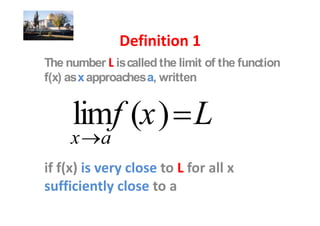
The number Lis called the limit of the function
f(x) as x approaches a, written
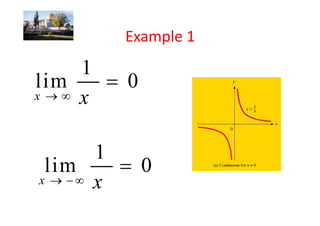
x


x
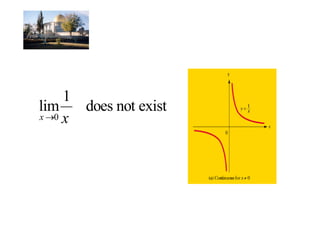
x   0   x
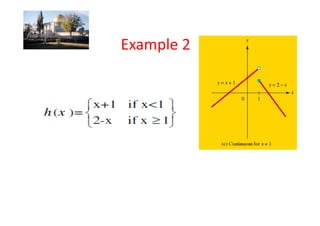
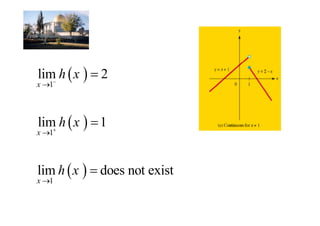
lim h x   2
x   1


lim h x   1
x   1


lim h x   does not exist
x   1
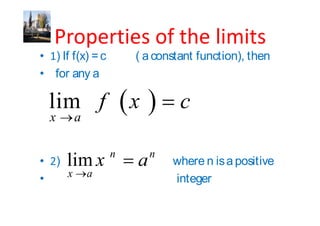
) If f(x) = c           ( a constant function), then
for any a


x           a

                    n     n
    )                          where n is a positive
        x       a
                               integer
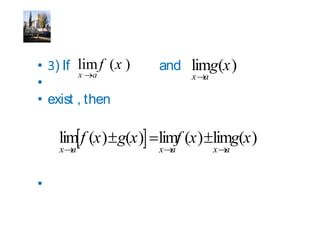
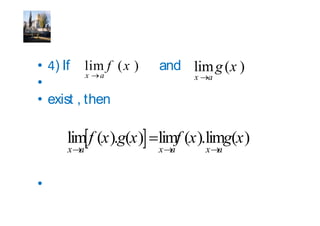
) If           f x   and         gx
        x   a               x a

exist , then


  x a                 x a         x a
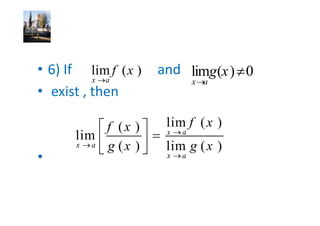
) If     lim f ( x )   and           g x
          x   a               x   a

exist , then


    x a                 x a       x a
- If       lim f ( x )         exists, then for any
           x   a

constant k,

lim k f ( x )]           k lim f ( x )
x      a                   x    a
lim f ( x )                 gx
  x   a                 x a


    f (x )      lim f ( x )
                x   a
lim
x a g (x )      lim g ( x )
                x   a
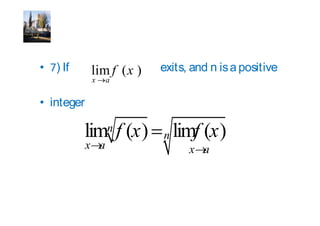
) If     lim f ( x )   exits, and n is a positive
           x    a

integer

                n
                        n
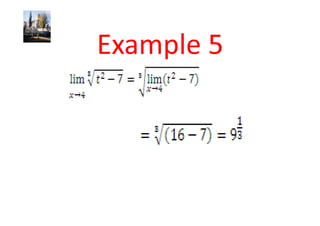
          x a                 x a
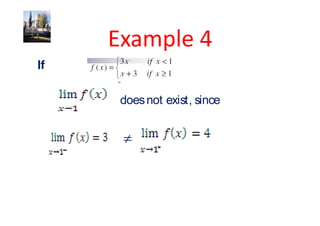
If

     does not exist, since
)      1
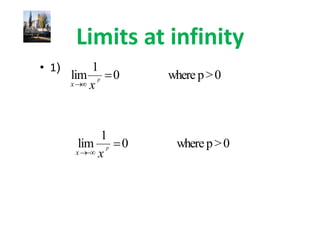
    lim p    0       where p > 0
    x  x


         1
     lim p       0    where p > 0
    x   x
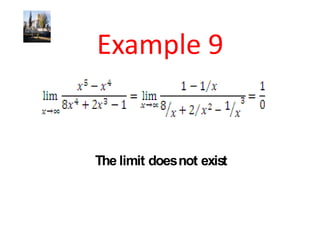
The limit does not exist
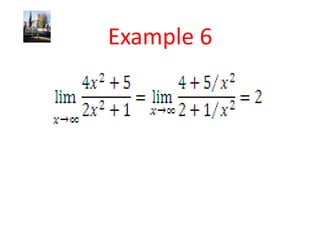
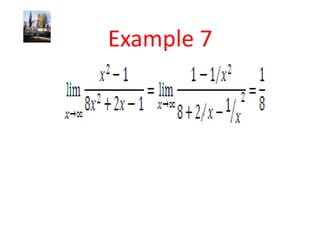
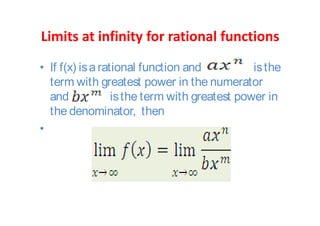
If f(x) is a rational function and           is the
term with greatest power in the numerator
and             is the term with greatest power in
the denominator, then
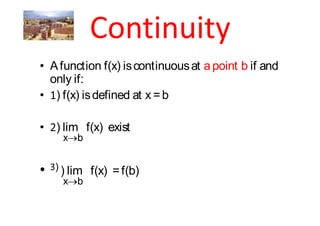
A function f(x) is continuous at a point b if and
only if:
 ) f(x) is defined at x = b

 ) lim f(x) exist
  x b

 ) ) lim   f(x) = f(b)
    x b
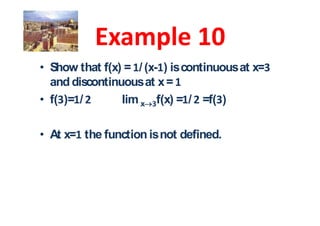
Show that f(x) = / (x- ) is continuous at x=
and discontinuous at x =
f( )= /       lim x f(x) = / =f( )

At x= the function is not defined.
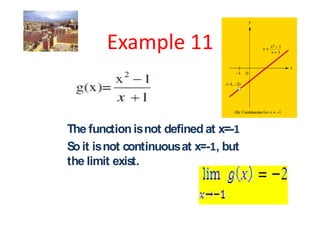
The function is not defined at x=-
So it is not continuous at x=- , but
the limit exist.
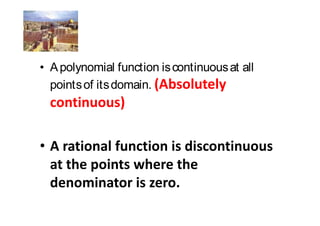
A polynomial function is continuous at all
points of its domain.
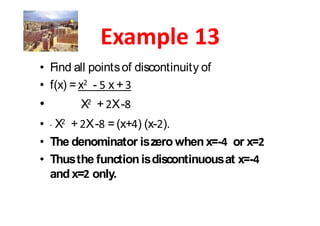
Find all points of discontinuity of
f(x) = x - x +
      X + X-
 X + X - = (x+ ) (x- ).
The denominator is zero when x=- or x=
                               x=-
Thus the function is discontinuous at x=-
and x= only.
Limmits
Limmits
Limmits
Limmits
Limmits
Limmits
Limmits
Limmits
Limmits
Limmits
Limmits
Limmits
Limmits
Limmits
Limmits

Limmits

  • 2.
    The number Liscalled the limit of the function f(x) as x approaches a, written
  • 3.
  • 4.
    x 0 x
  • 6.
    lim h x 2 x 1 lim h x 1 x 1 lim h x does not exist x 1
  • 8.
    ) If f(x)= c ( a constant function), then for any a x a n n ) where n is a positive x a integer
  • 9.
    ) If f x and gx x a x a exist , then x a x a x a
  • 10.
    ) If lim f ( x ) and g x x a x a exist , then x a x a x a
  • 11.
    - If lim f ( x ) exists, then for any x a constant k, lim k f ( x )] k lim f ( x ) x a x a
  • 12.
    lim f (x ) gx x a x a f (x ) lim f ( x ) x a lim x a g (x ) lim g ( x ) x a
  • 13.
    ) If lim f ( x ) exits, and n is a positive x a integer n n x a x a
  • 14.
    If does not exist, since
  • 16.
    ) 1 lim p 0 where p > 0 x x 1 lim p 0 where p > 0 x x
  • 19.
    The limit doesnot exist
  • 20.
    If f(x) isa rational function and is the term with greatest power in the numerator and is the term with greatest power in the denominator, then
  • 23.
    A function f(x)is continuous at a point b if and only if: ) f(x) is defined at x = b ) lim f(x) exist x b ) ) lim f(x) = f(b) x b
  • 24.
    Show that f(x)= / (x- ) is continuous at x= and discontinuous at x = f( )= / lim x f(x) = / =f( ) At x= the function is not defined.
  • 25.
    The function isnot defined at x=- So it is not continuous at x=- , but the limit exist.
  • 27.
    A polynomial functionis continuous at all points of its domain.
  • 28.
    Find all pointsof discontinuity of f(x) = x - x + X + X- X + X - = (x+ ) (x- ). The denominator is zero when x=- or x= x=- Thus the function is discontinuous at x=- and x= only.