 The human eye is one of the most valuable and
sensitive sense organs. It enables us to see the
wonderful world and the colours around us.
 We can identify objects to some extent by their
smell, taste, sound they make or by touch. But we
can’t identify the colours when our eyes are closed.
 The human eye works on the principle of
Refraction Of Light .
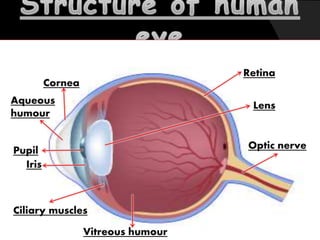
 Main part of human eye are:- Cornea, Iris, Pupil,
Ciliary muscles, Eye lens, Retina and Optic nerve.
 The eyeball is approximately sphericle in shape
with a daimeter of about 2.3cm .
Retina
Cornea
Pupil
Iris
Lens
Optic nerve
Ciliary muscles
Vitreous humour
Aqueous
humour
CORNEA :-It is a thin membrane
through which light enters the eye. It
forms the transparent bulge on the front
surface of the eye.
CORNEA
IRIS
IRIS :- Iris is a dark muscular daiphragm
that controls the size of the pupil.
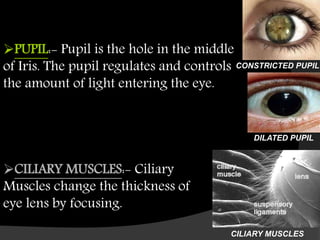
CILIARY MUSCLES:- Ciliary
Muscles change the thickness of
eye lens by focusing.
CILIARY MUSCLES
DILATED PUPIL
CONSTRICTED PUPIL
PUPIL:- Pupil is the hole in the middle
of Iris. The pupil regulates and controls
the amount of light entering the eye.
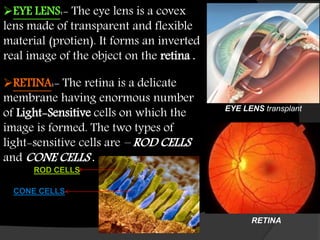
EYE LENS:- The eye lens is a covex
lens made of transparent and flexible
material (protien). It forms an inverted
real image of the object on the retina .
EYE LENS transplant
RETINA:- The retina is a delicate
membrane having enormous number
of Light-Sensitive cells on which the
image is formed. The two types of
light-sensitive cells are – ROD CELLS
and CONE CELLS .
RETINA
ROD CELLS
CONE CELLS
OPTIC NERVE :- Optic Nerve
convey the signal which are
generated by Light-Sensitive cell
to the brain .
OPTIC NERVE
SCLERA :- Sclera is the white
part of the eyeball. It helps in the
attachment. Sclera is a tough
white skin (made of tissue) that
covers all of the eyeball except
the cornea
SCLERA
 The eye lens is composed of fibrous, jelly-like
material.
 Its curvature can be modified to some extent by
the ciliary muscles.
 The change in the curvature of the eye lens can
thus change its Focal lenght.
 The ability of the eye lens to adjust its focal
lenght is called accommodation.
 When the muscles are relaxed, the lens becomes
thin. Thus its focal lenght increases.
 When you are looking at objects closer to the eye,
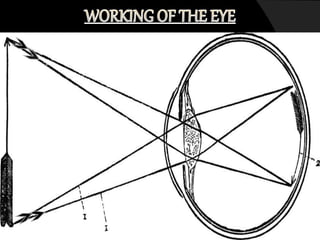
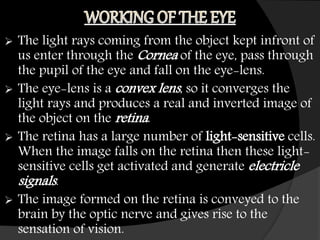
 The light rays coming from the object kept infront of
us enter through the Cornea of the eye, pass through
the pupil of the eye and fall on the eye-lens.
 The eye-lens is a convex lens, so it converges the
light rays and produces a real and inverted image of
the object on the retina.
 The retina has a large number of light-sensitive cells.
When the image falls on the retina then these light-
sensitive cells get activated and generate electricle
signals.
 The image formed on the retina is conveyed to the
brain by the optic nerve and gives rise to the
sensation of vision.
 Sometimes, the eye may gradually lose its power of
accommodation.
 The person cannot see the objects distinctly and
comfortably. The vision becomes blurred due to the
refractive defects of the eye.
 There are mainly three common refractive defects
of vision. These are :-
a) Myopia or near-sightedness.
b) Hypermetropia or far-sightedness.
c) Presbyopia.
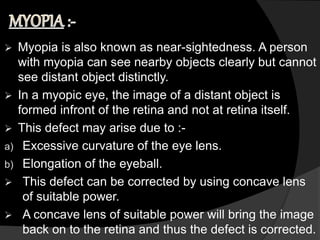
 Myopia is also known as near-sightedness. A person
with myopia can see nearby objects clearly but cannot
see distant object distinctly.
 In a myopic eye, the image of a distant object is
formed infront of the retina and not at retina itself.
 This defect may arise due to :-
a) Excessive curvature of the eye lens.
b) Elongation of the eyeball.
 This defect can be corrected by using concave lens
of suitable power.
 A concave lens of suitable power will bring the image
back on to the retina and thus the defect is corrected.
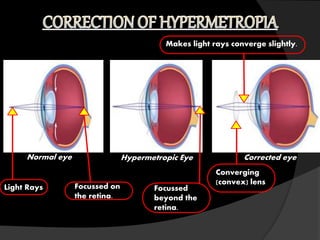
 Hypermetropia is also known as far-sightedness. A person with
hypermetropia can see distant objects clearly but cannot see nearby
objects distinctly.
 The near point, for the person, is farther away from the normal near
point (25 cm).
 As a result, the light rays from a closeby object are focussed at a
point behind the retina.
 This defect arises either because :-
a) the focal lenght of the eye lens is too long.
b) the eyeball has become too small.
 This defect can be corrected by using a convex lens of suitable
power.
 Eye-glasseswith converging lenses provide the additional focussing
power required for forming the image.
Normal eye Hypermetropic Eye
Light Rays Focussed on
the retina.
Focussed
beyond the
retina.
Converging
(convex) lens
Corrected eye
Makes light rays converge slightly.
The power of accommodation of the
eye usually decreases with ageing. For
most people, the near point gradually
recedes away
They find it difficult to see nearby objects comfortably
and distinctly without corrective eye-glasses. This
defect is called Presbyopia.
Presbyopia in simple words is a type of hypermetropia
which occurs in old age.
It arises due to the gradual weakening
of the ciliary muscles and diminishing
flexibilityof the eye lens.
A person may also suffer from both
Myopia and Hypermetropia. Such people
often require bi-focal lenses.
A common type of bi-focal lenses
consists of both concave and convex
lenses. The upper portion consists of a
concave lens. It facilitates distant vision.
The lower part is a convex lens. It
facilitates near vision.
 Humaneyeisoneofthebothvaluable andsensitivesenseorganwhich
workonrefractionoflightandenablesustoseethewonderfulworld.
Thepartsofhumaneye
are:-Cornea,Iris,Pupil,
CiliaryMuscles,Eyelens,
RetinaandOpticnerve.
Theabilityofeyelenstoadjustitsfocallenghtiscalledaccommodation.
LightentersthroughtheCornea,ofeye,passesthroughthe
Pupil,fallsontheEyelenswhichconvergesthelighttoforman
RealandInvertedimageonRetina,whichcontainsthe light
sensitivecells.Thatgenerateselectricalsignalswhicharesentto
thebrainviaopticnerve.
NAME ROLLno.
1. Md.irshad 52
2. Arko probho chattopadhyay 22
3. Dixita sur 24
4. Susmita saha 22
5. Bibhash dey 16
6. Samrat bhattacharjee 53
7. Harshita goswami 14
HUMAN EYE AND ITS DEFECTS

HUMAN EYE AND ITS DEFECTS

  • 2.
     The humaneye is one of the most valuable and sensitive sense organs. It enables us to see the wonderful world and the colours around us.  We can identify objects to some extent by their smell, taste, sound they make or by touch. But we can’t identify the colours when our eyes are closed.  The human eye works on the principle of Refraction Of Light .  Main part of human eye are:- Cornea, Iris, Pupil, Ciliary muscles, Eye lens, Retina and Optic nerve.  The eyeball is approximately sphericle in shape with a daimeter of about 2.3cm .
  • 3.
  • 4.
    CORNEA :-It isa thin membrane through which light enters the eye. It forms the transparent bulge on the front surface of the eye. CORNEA IRIS IRIS :- Iris is a dark muscular daiphragm that controls the size of the pupil.
  • 5.
    CILIARY MUSCLES:- Ciliary Muscleschange the thickness of eye lens by focusing. CILIARY MUSCLES DILATED PUPIL CONSTRICTED PUPIL PUPIL:- Pupil is the hole in the middle of Iris. The pupil regulates and controls the amount of light entering the eye.
  • 6.
    EYE LENS:- Theeye lens is a covex lens made of transparent and flexible material (protien). It forms an inverted real image of the object on the retina . EYE LENS transplant RETINA:- The retina is a delicate membrane having enormous number of Light-Sensitive cells on which the image is formed. The two types of light-sensitive cells are – ROD CELLS and CONE CELLS . RETINA ROD CELLS CONE CELLS
  • 7.
    OPTIC NERVE :-Optic Nerve convey the signal which are generated by Light-Sensitive cell to the brain . OPTIC NERVE SCLERA :- Sclera is the white part of the eyeball. It helps in the attachment. Sclera is a tough white skin (made of tissue) that covers all of the eyeball except the cornea SCLERA
  • 8.
     The eyelens is composed of fibrous, jelly-like material.  Its curvature can be modified to some extent by the ciliary muscles.  The change in the curvature of the eye lens can thus change its Focal lenght.  The ability of the eye lens to adjust its focal lenght is called accommodation.  When the muscles are relaxed, the lens becomes thin. Thus its focal lenght increases.  When you are looking at objects closer to the eye,
  • 11.
     The lightrays coming from the object kept infront of us enter through the Cornea of the eye, pass through the pupil of the eye and fall on the eye-lens.  The eye-lens is a convex lens, so it converges the light rays and produces a real and inverted image of the object on the retina.  The retina has a large number of light-sensitive cells. When the image falls on the retina then these light- sensitive cells get activated and generate electricle signals.  The image formed on the retina is conveyed to the brain by the optic nerve and gives rise to the sensation of vision.
  • 12.
     Sometimes, theeye may gradually lose its power of accommodation.  The person cannot see the objects distinctly and comfortably. The vision becomes blurred due to the refractive defects of the eye.  There are mainly three common refractive defects of vision. These are :- a) Myopia or near-sightedness. b) Hypermetropia or far-sightedness. c) Presbyopia.
  • 13.
     Myopia isalso known as near-sightedness. A person with myopia can see nearby objects clearly but cannot see distant object distinctly.  In a myopic eye, the image of a distant object is formed infront of the retina and not at retina itself.  This defect may arise due to :- a) Excessive curvature of the eye lens. b) Elongation of the eyeball.  This defect can be corrected by using concave lens of suitable power.  A concave lens of suitable power will bring the image back on to the retina and thus the defect is corrected.
  • 15.
     Hypermetropia isalso known as far-sightedness. A person with hypermetropia can see distant objects clearly but cannot see nearby objects distinctly.  The near point, for the person, is farther away from the normal near point (25 cm).  As a result, the light rays from a closeby object are focussed at a point behind the retina.  This defect arises either because :- a) the focal lenght of the eye lens is too long. b) the eyeball has become too small.  This defect can be corrected by using a convex lens of suitable power.  Eye-glasseswith converging lenses provide the additional focussing power required for forming the image.
  • 16.
    Normal eye HypermetropicEye Light Rays Focussed on the retina. Focussed beyond the retina. Converging (convex) lens Corrected eye Makes light rays converge slightly.
  • 17.
    The power ofaccommodation of the eye usually decreases with ageing. For most people, the near point gradually recedes away They find it difficult to see nearby objects comfortably and distinctly without corrective eye-glasses. This defect is called Presbyopia. Presbyopia in simple words is a type of hypermetropia which occurs in old age.
  • 18.
    It arises dueto the gradual weakening of the ciliary muscles and diminishing flexibilityof the eye lens. A person may also suffer from both Myopia and Hypermetropia. Such people often require bi-focal lenses. A common type of bi-focal lenses consists of both concave and convex lenses. The upper portion consists of a concave lens. It facilitates distant vision. The lower part is a convex lens. It facilitates near vision.
  • 19.
  • 20.
  • 21.
    NAME ROLLno. 1. Md.irshad52 2. Arko probho chattopadhyay 22 3. Dixita sur 24 4. Susmita saha 22 5. Bibhash dey 16 6. Samrat bhattacharjee 53 7. Harshita goswami 14