Light, Reflection, and Refraction
Chapters 14 and 15
OPTICS
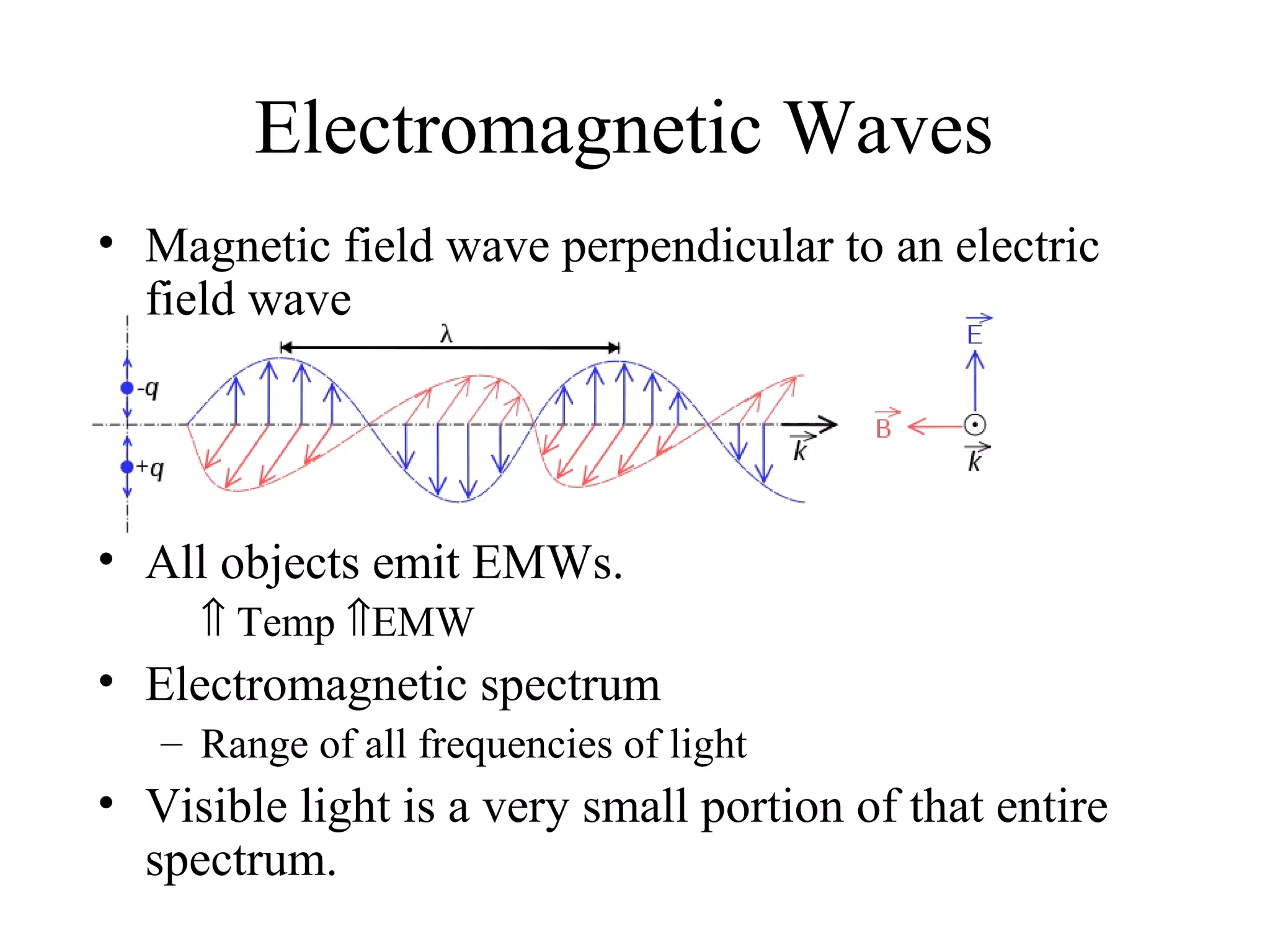
Electromagnetic Waves
• Magnetic field wave perpendicular to an electric
field wave

• All objects emit EMWs.
⇑ Temp ⇑EMW

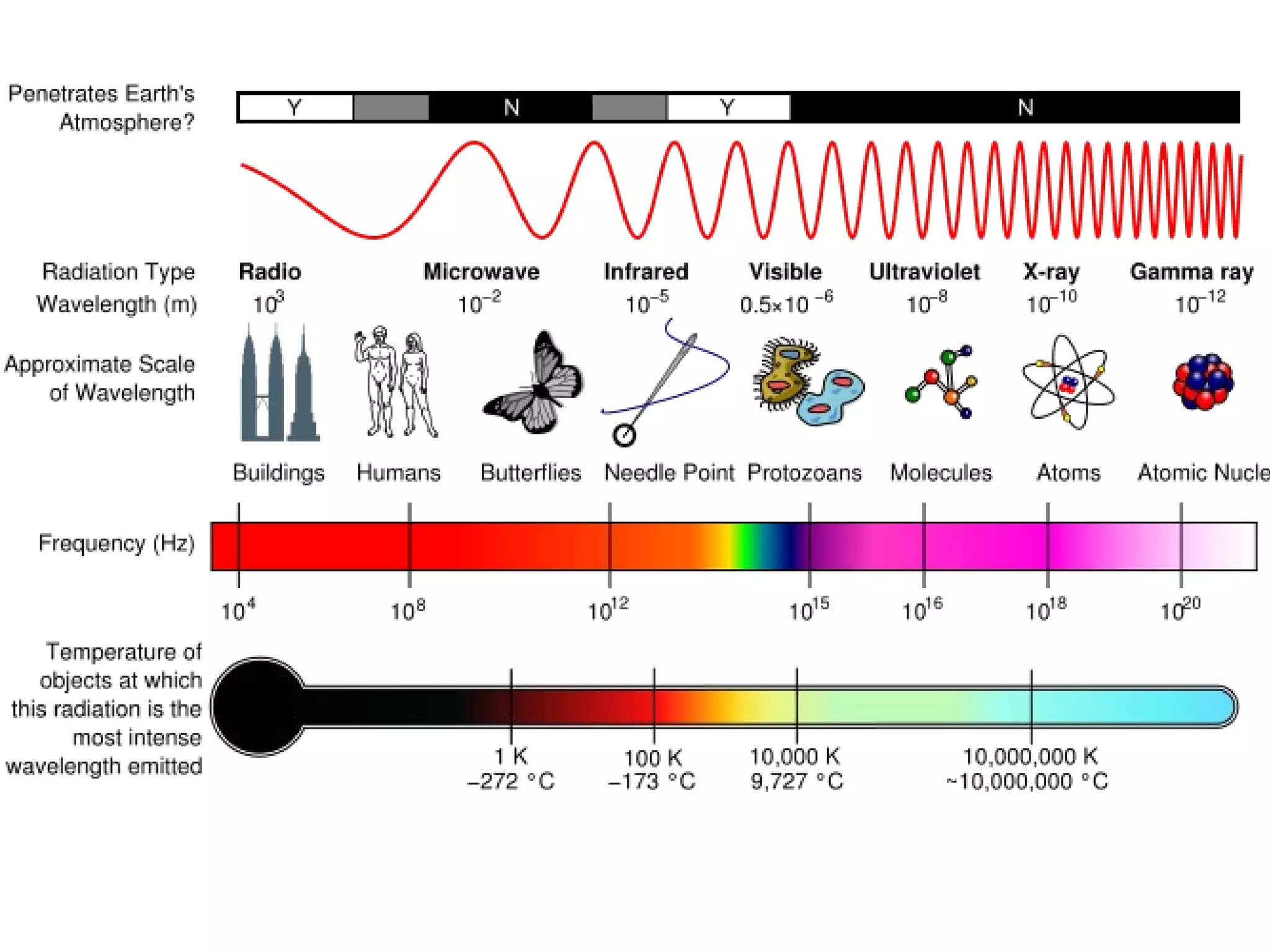
• Electromagnetic spectrum
– Range of all frequencies of light

• Visible light is a very small portion of that entire
spectrum.
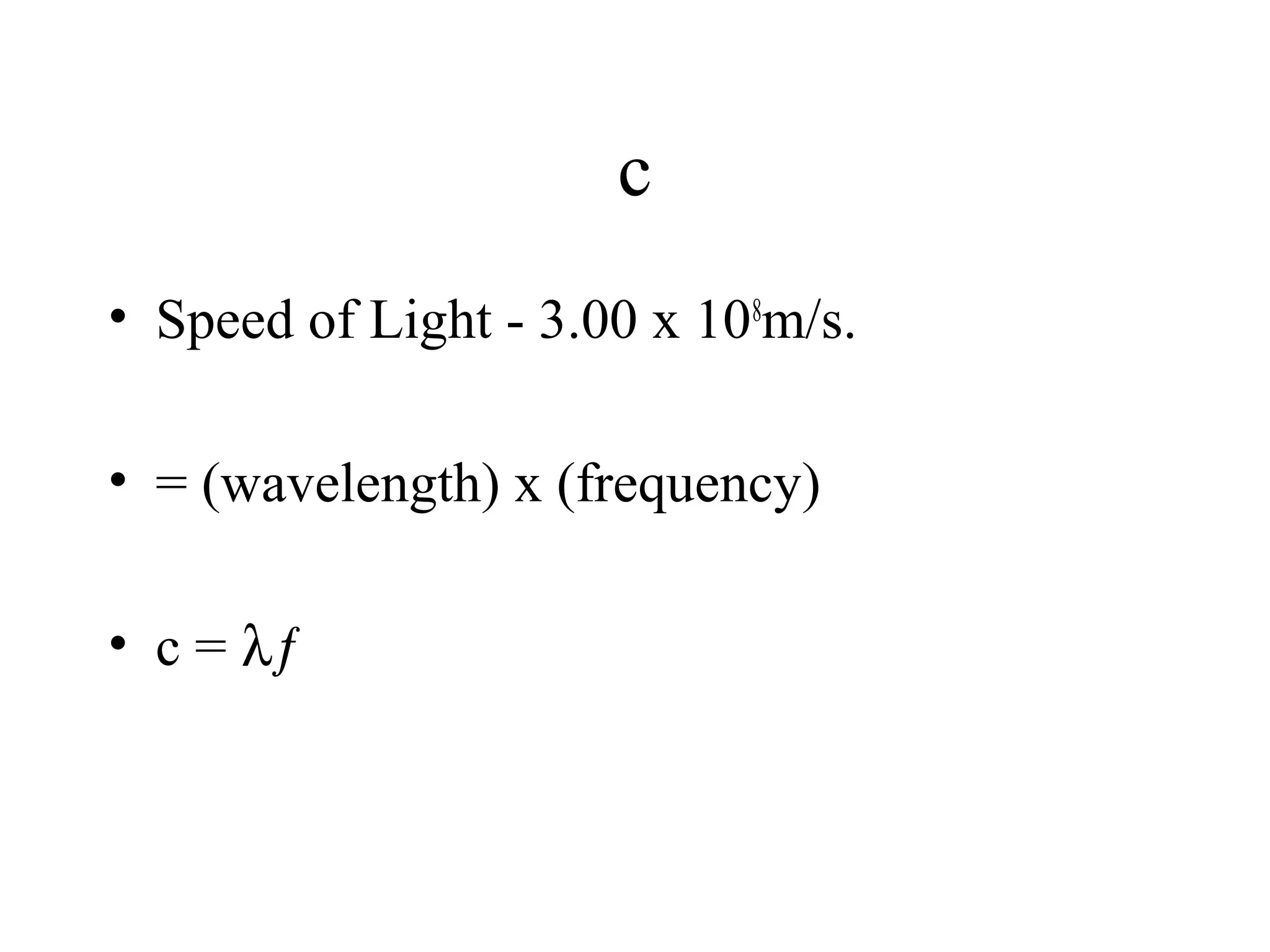
c
• Speed of Light - 3.00 x 10⁸m/s.
• = (wavelength) x (frequency)
• c = λƒ
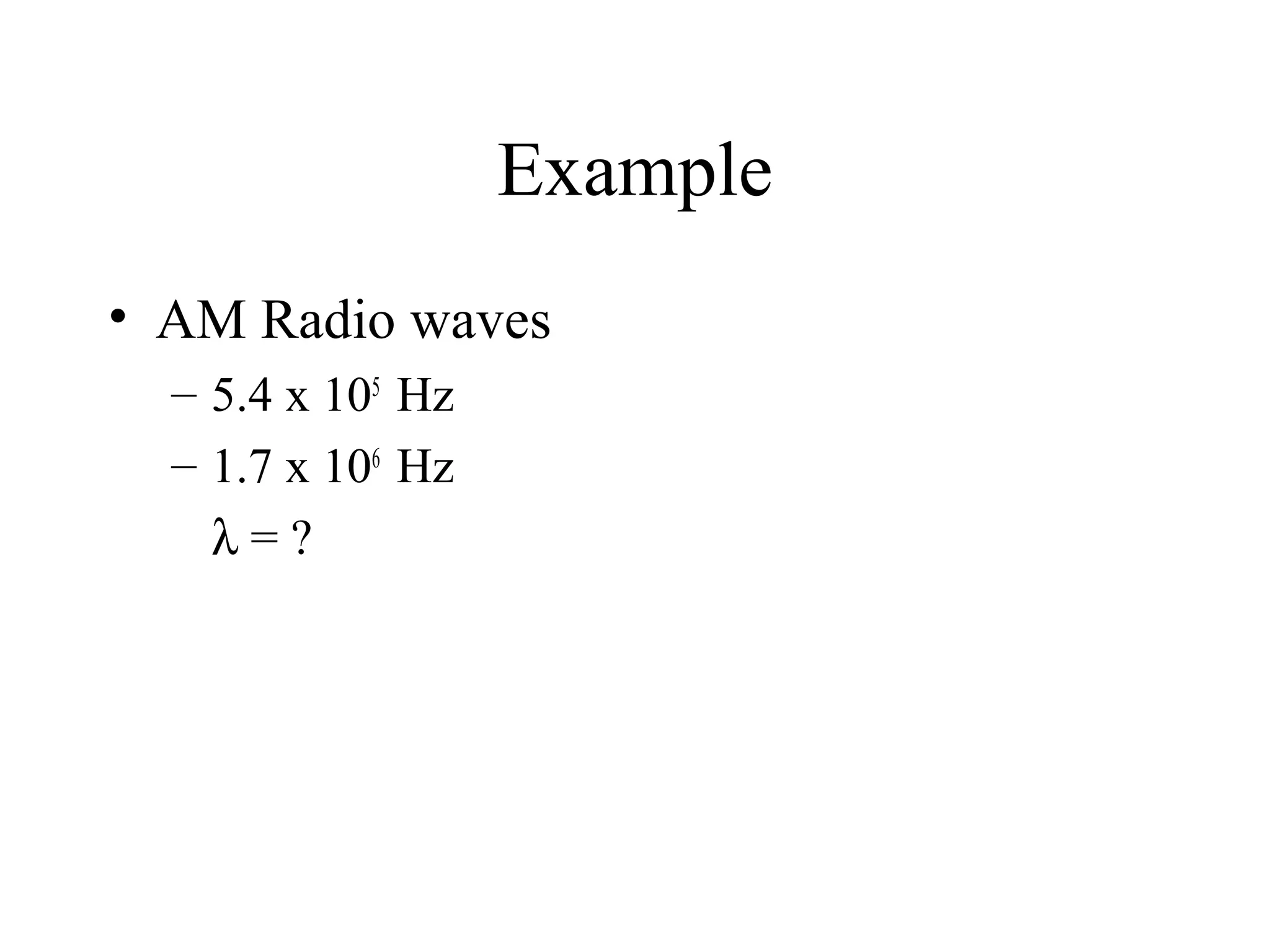
Example
• AM Radio waves
– 5.4 x 10⁵ Hz
– 1.7 x 10⁶ Hz
λ=?
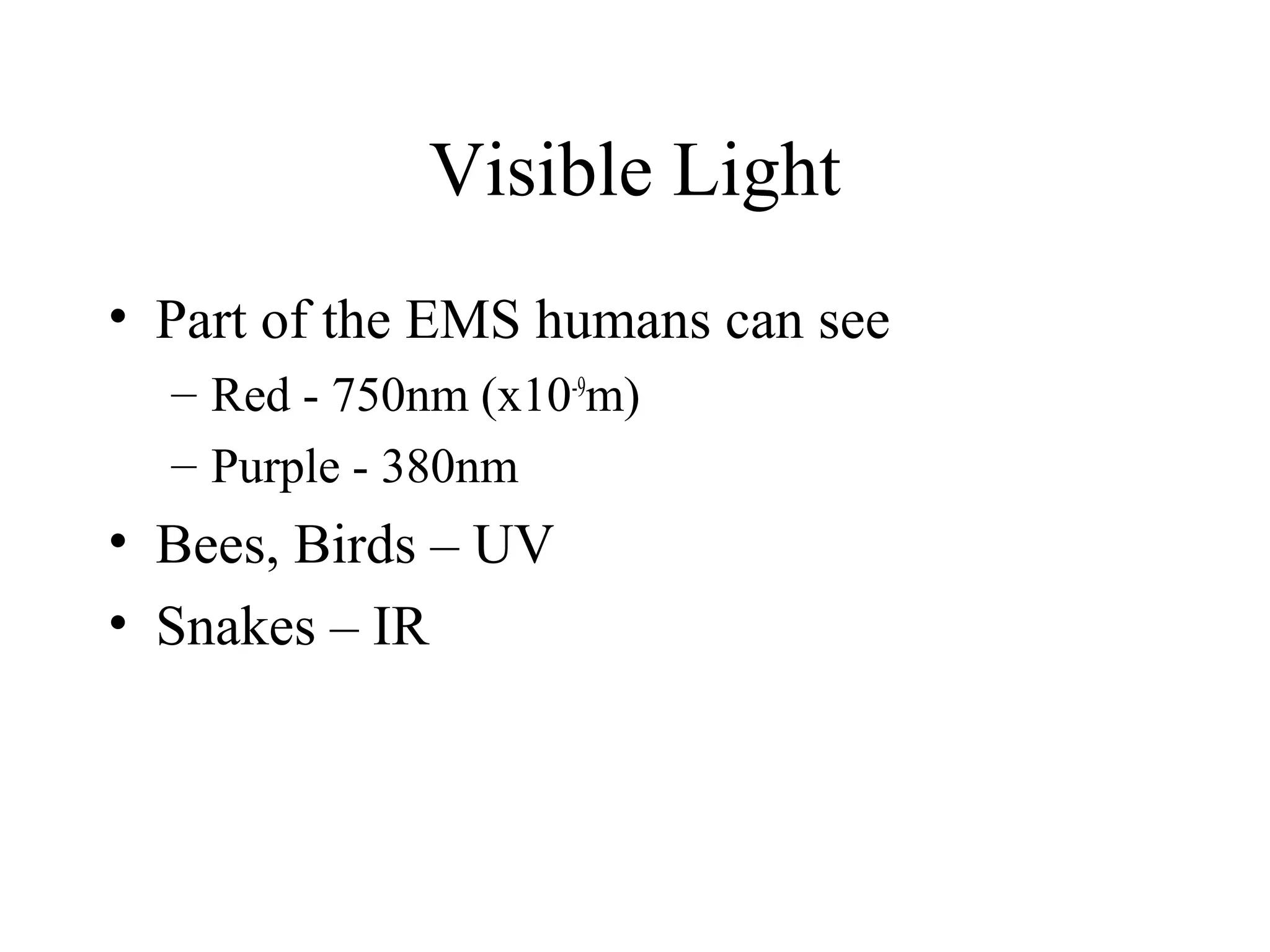
Visible Light
• Part of the EMS humans can see
– Red - 750nm (x10-9m)
– Purple - 380nm

• Bees, Birds – UV
• Snakes – IR
Reflection
• Light waves usually travel in straight paths
• Change in substance changes direction
• Opaque - does not permit light
– some light reflected
– some light absorbed as heat
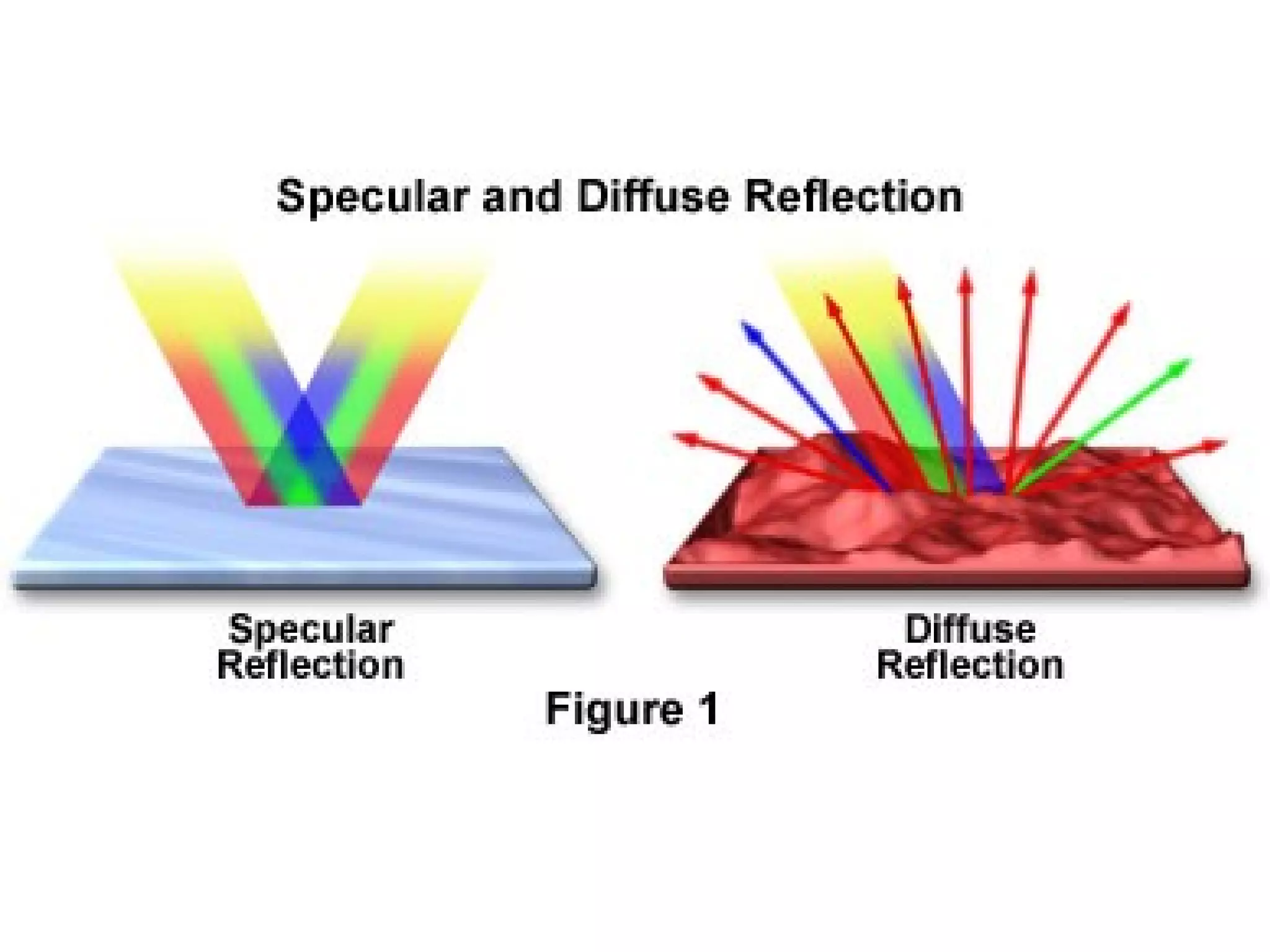
Reflection
• Texture affects reflection
• Diffuse reflection (rough)
– reflects light in many different directions,

• Specular reflection (smooth)
– reflects light in only one direction

• Smooth – variations in surface < λ
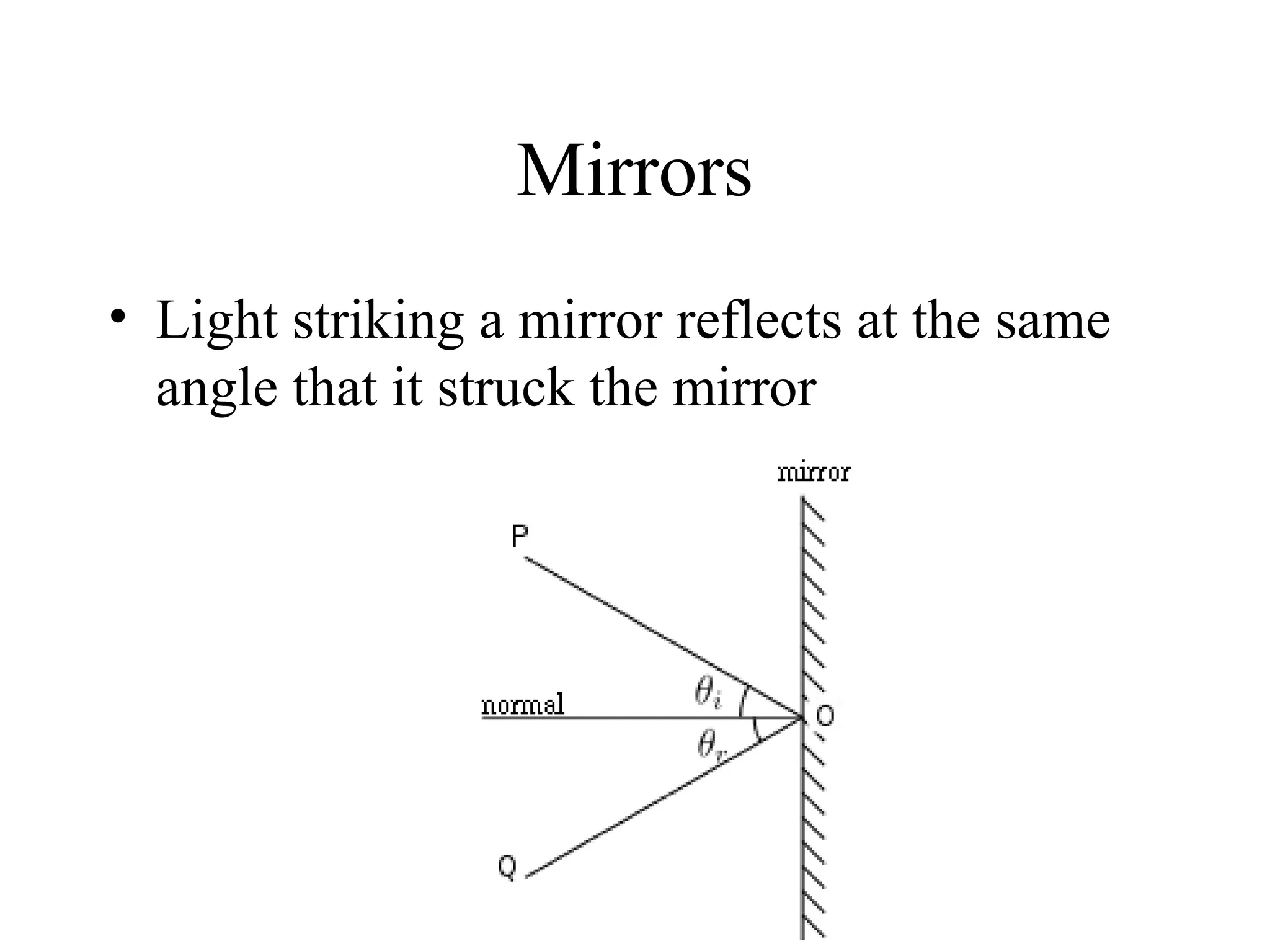
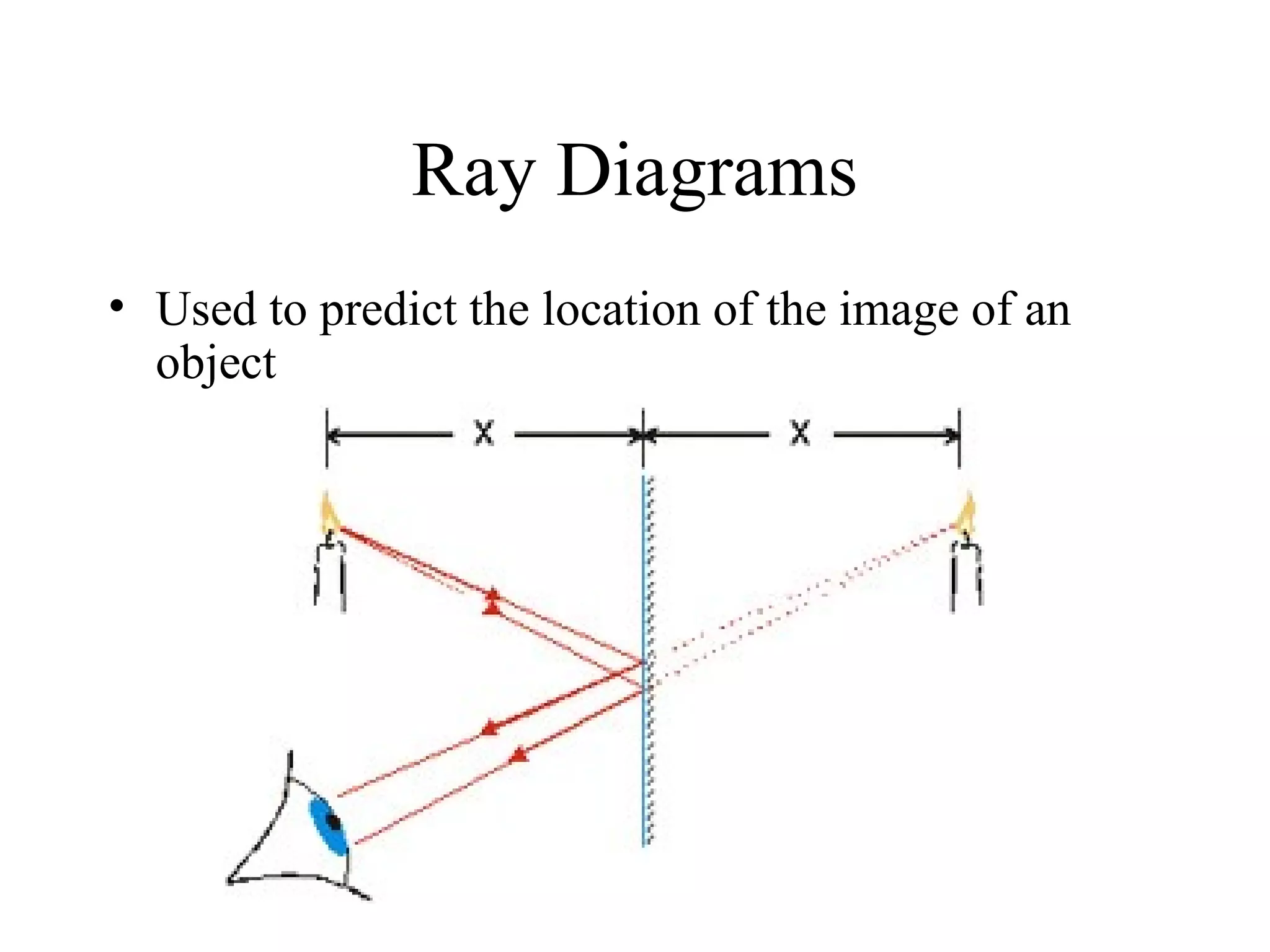
Mirrors
• Light striking a mirror reflects at the same
angle that it struck the mirror
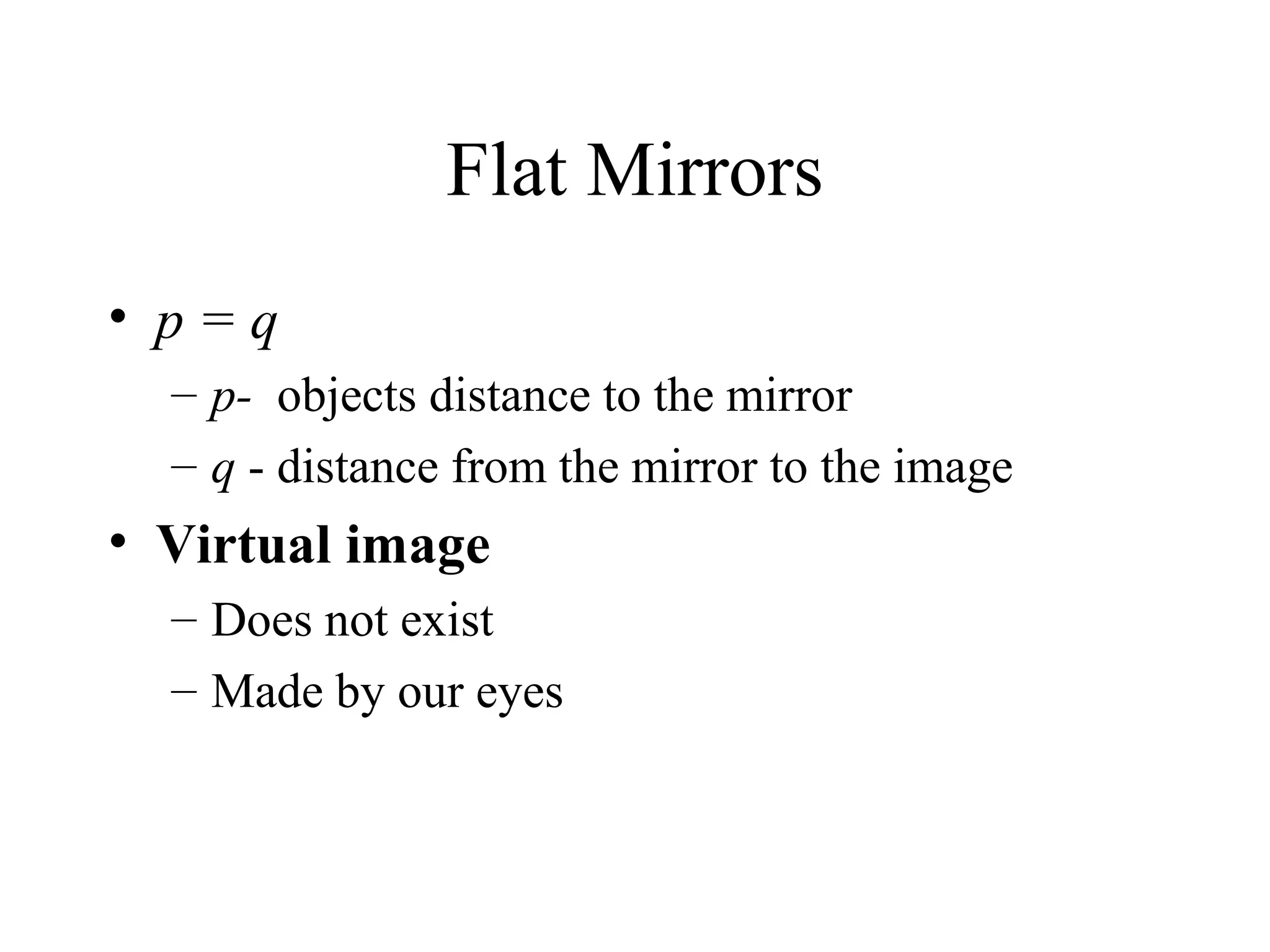
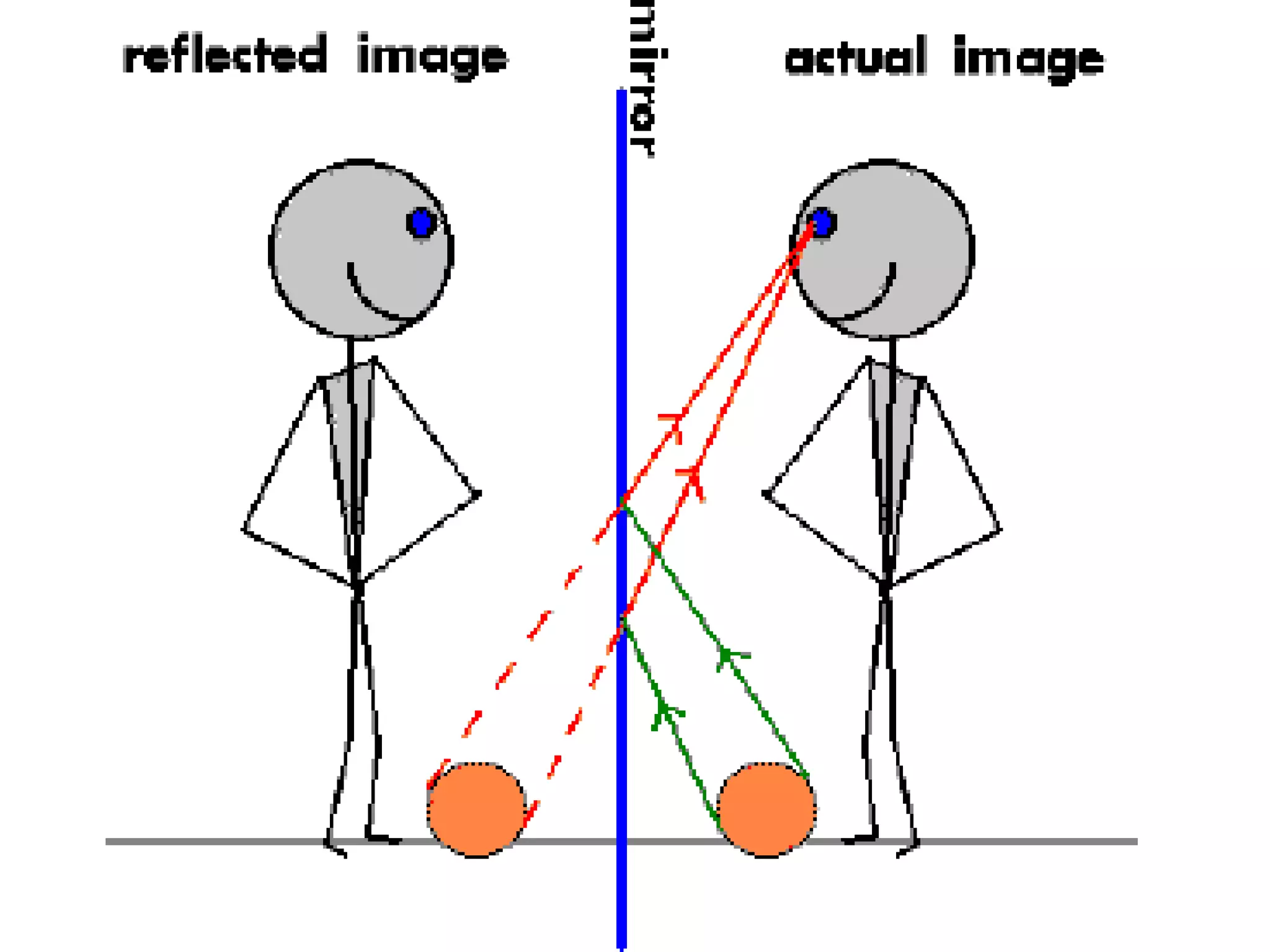
Flat Mirrors
• p=q
– p- objects distance to the mirror
– q - distance from the mirror to the image

• Virtual image
– Does not exist
– Made by our eyes
Ray Diagrams
• Used to predict the location of the image of an
object
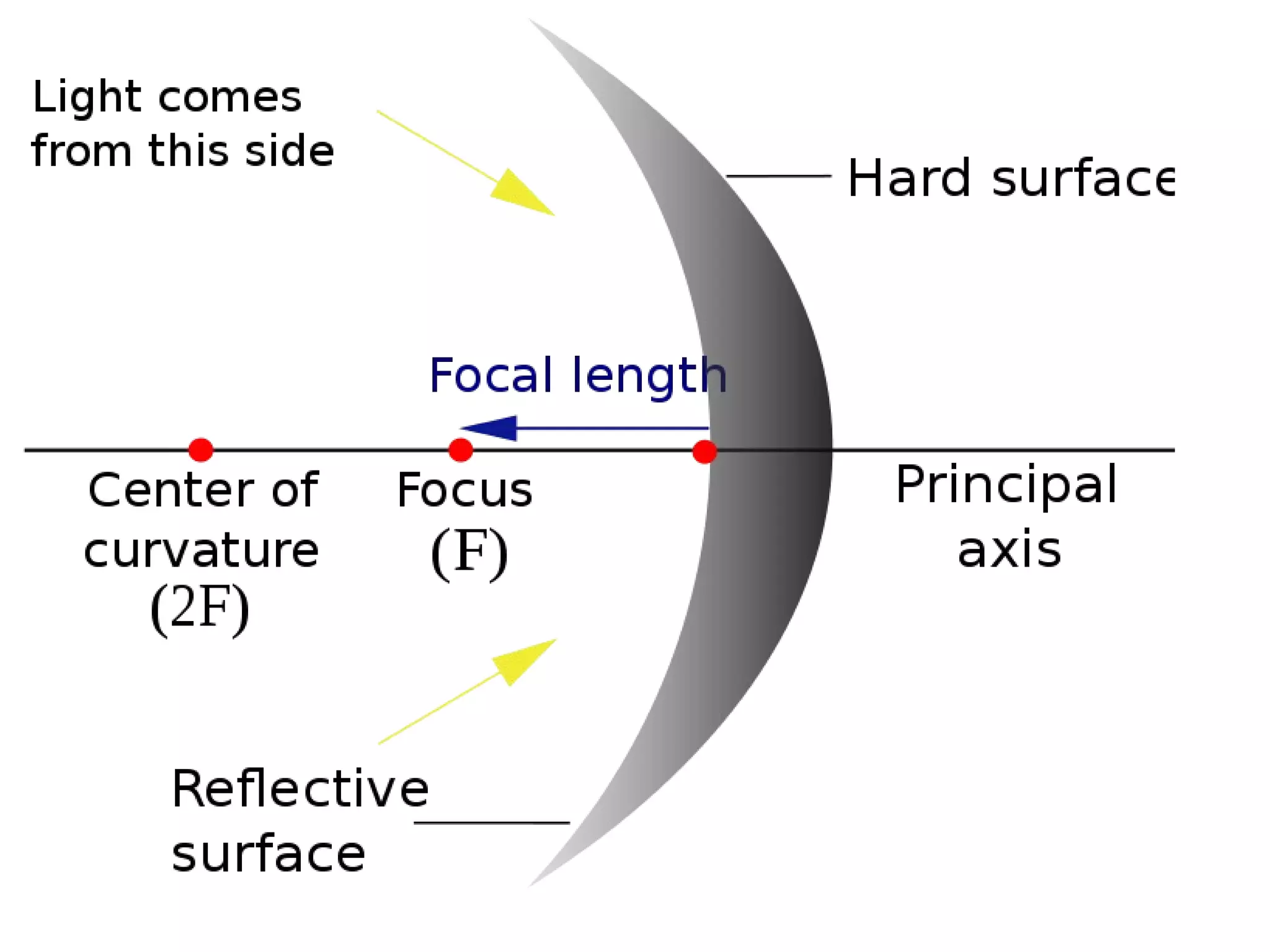
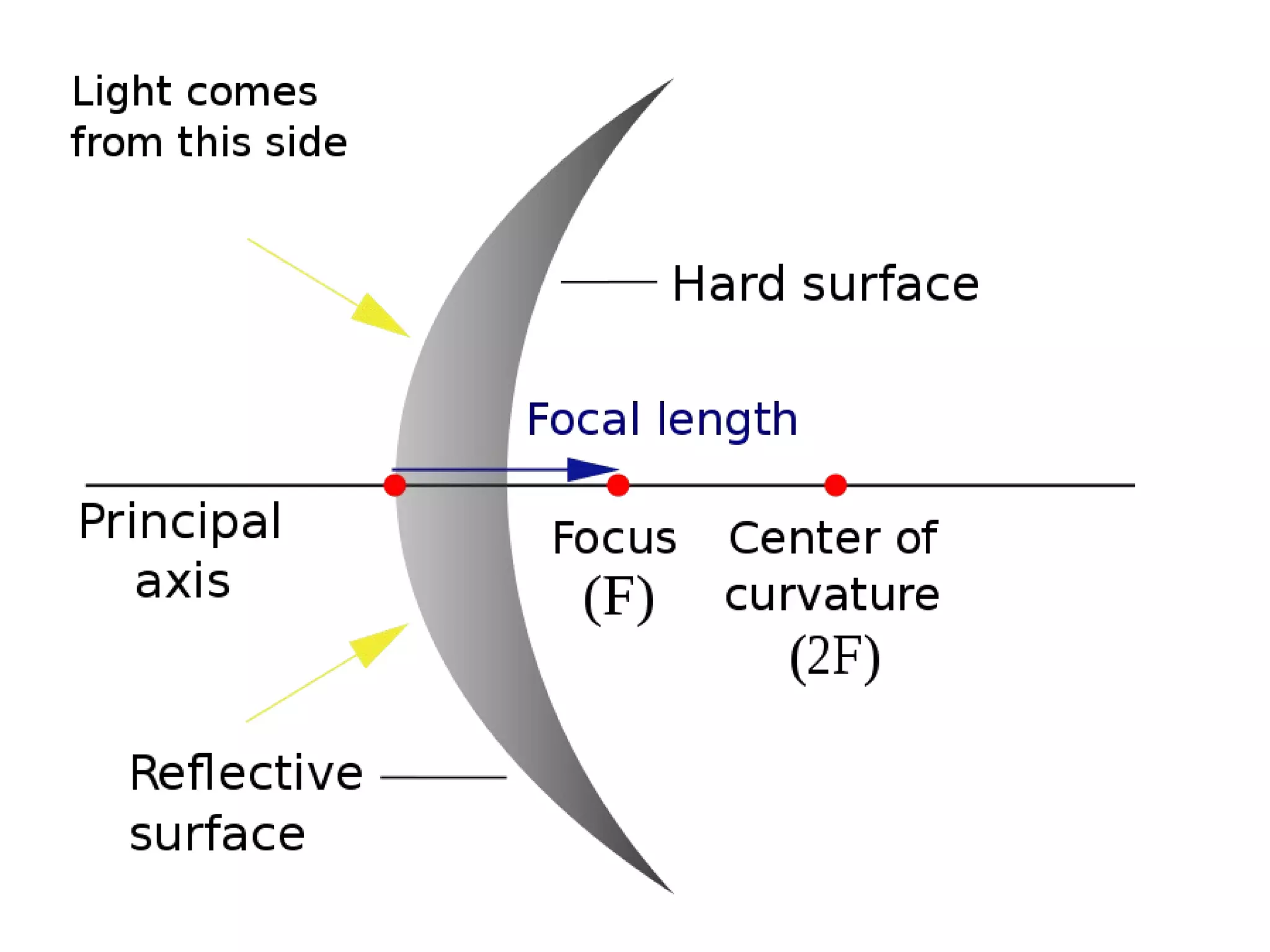
Concave Spherical Mirrors
• Reflective surface is on the interior of a
curved surface
–
–
–
–

C – center of curvature
R – Radius (distance to C)
f – Focal Point (1/2 R)
Principal axis
• any line that passes through C
• usually oriented with an object
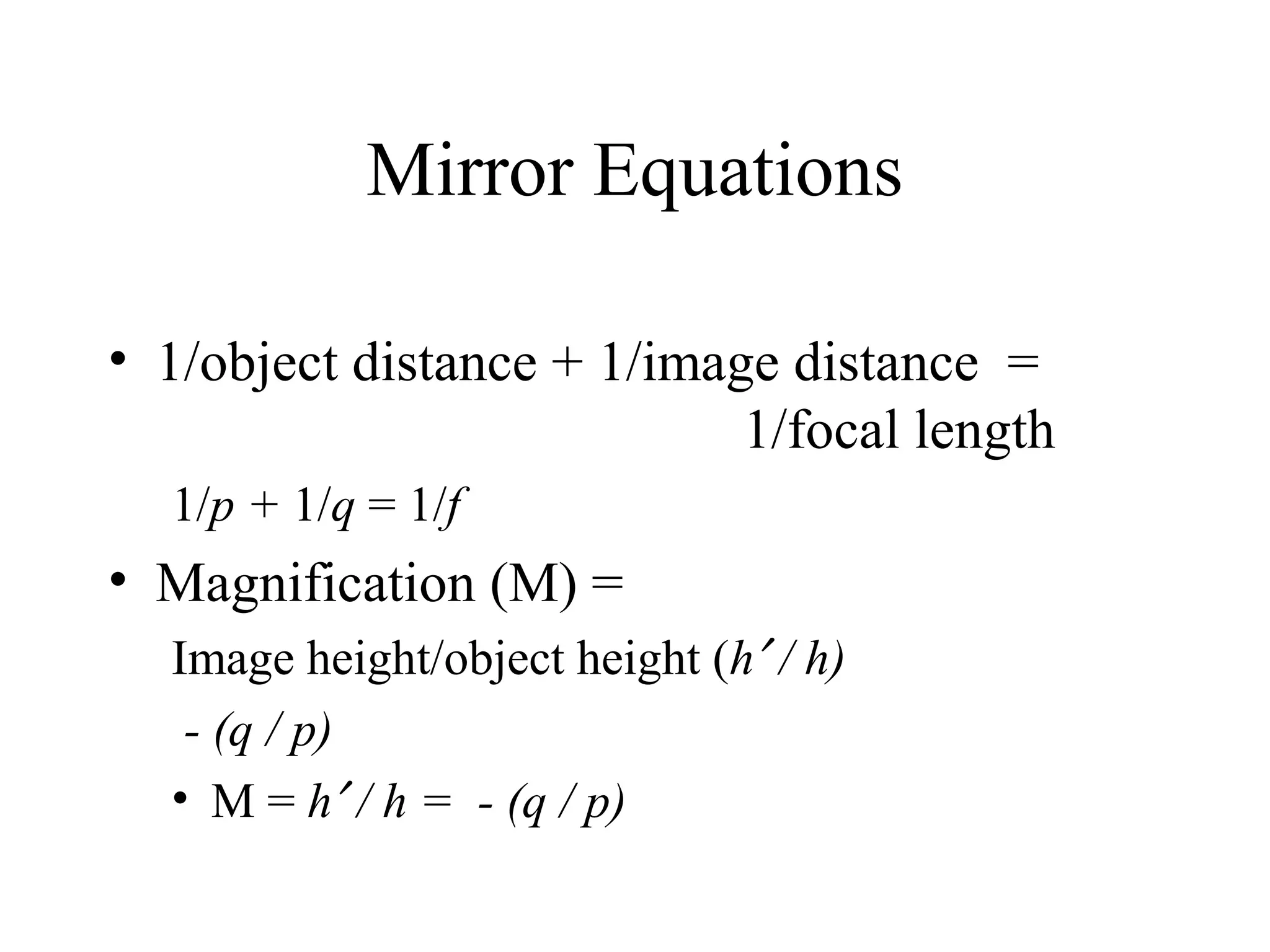
Mirror Equations
• 1/object distance + 1/image distance =
1/focal length
1/p + 1/q = 1/f

• Magnification (M) =
Image height/object height (h′ / h)
- (q / p)
• M = h′ / h = - (q / p)
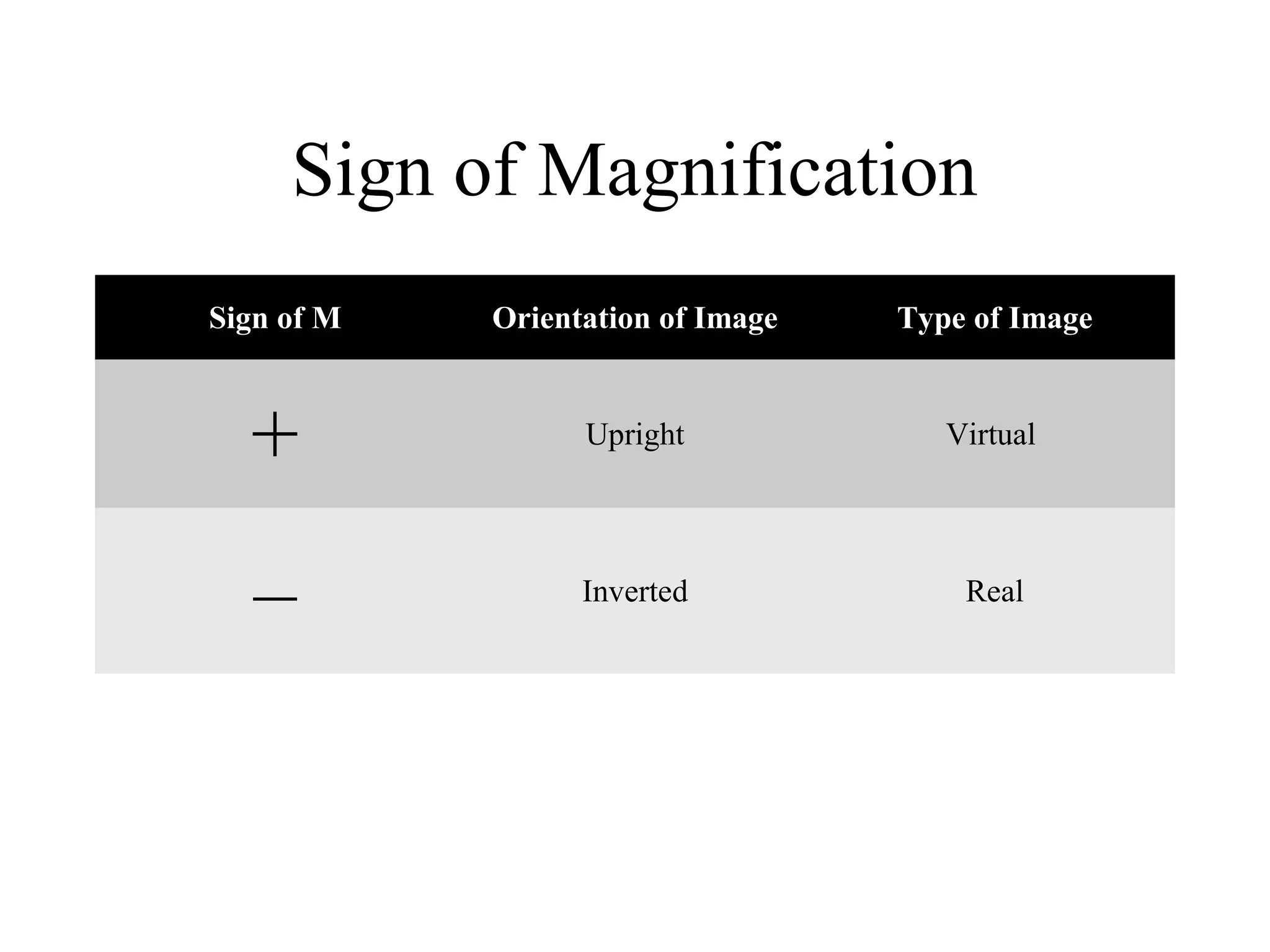
Sign of Magnification
Sign of M

Orientation of Image

Type of Image

+

Upright

Virtual

–

Inverted

Real
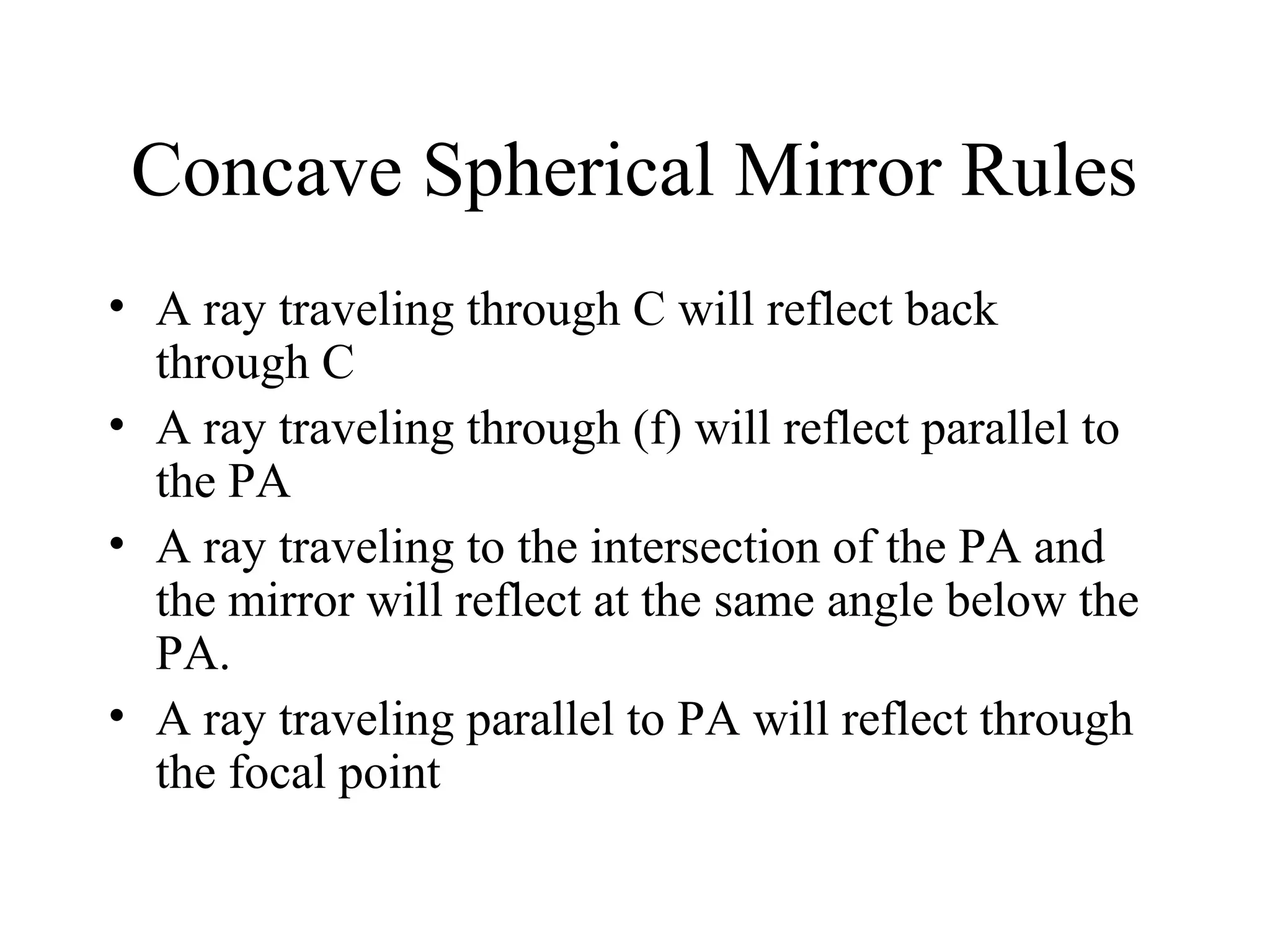
Concave Spherical Mirror Rules
• A ray traveling through C will reflect back
through C
• A ray traveling through (f) will reflect parallel to
the PA
• A ray traveling to the intersection of the PA and
the mirror will reflect at the same angle below the
PA.
• A ray traveling parallel to PA will reflect through
the focal point
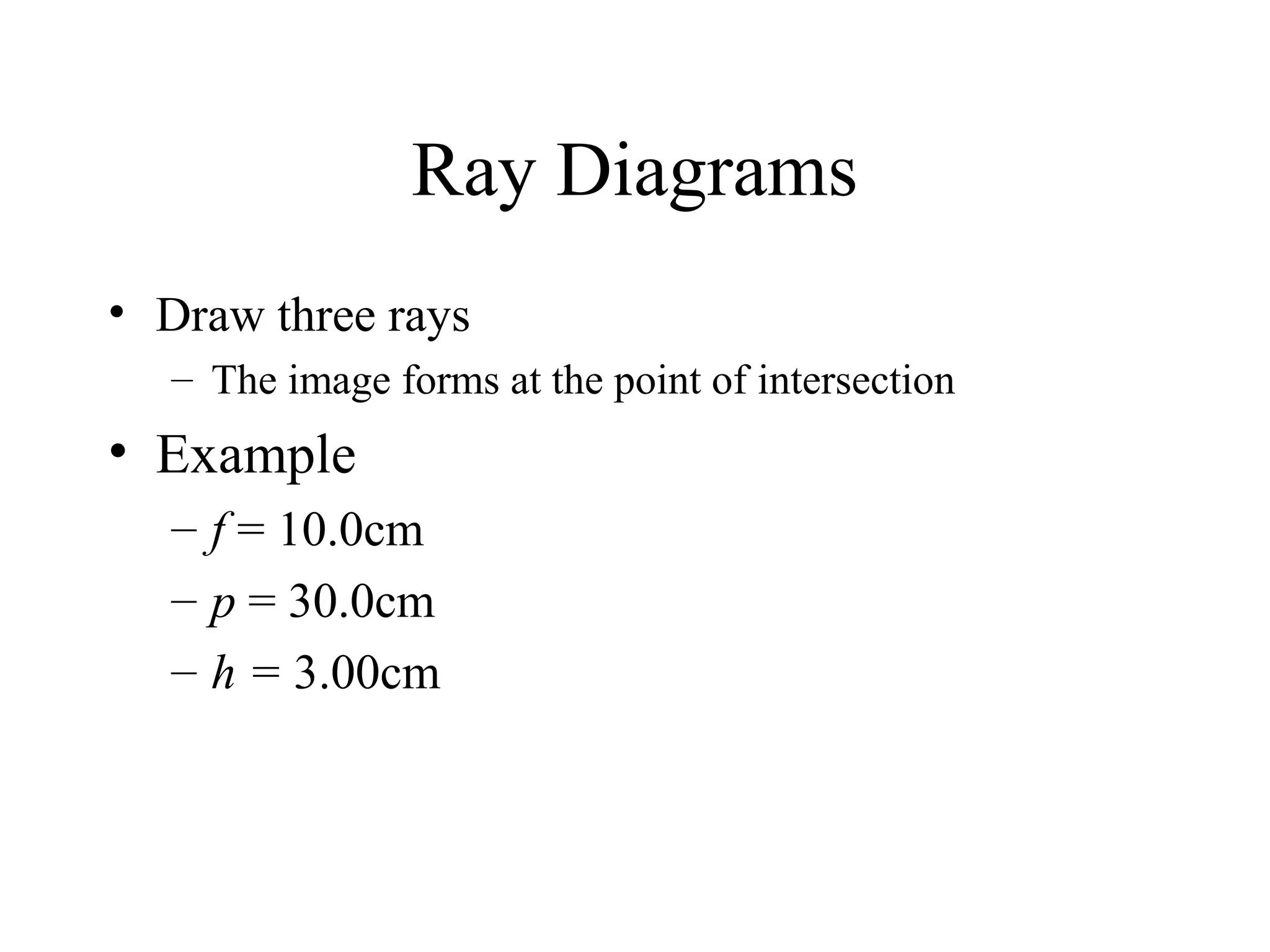
Ray Diagrams
• Draw three rays
– The image forms at the point of intersection

• Example
– f = 10.0cm
– p = 30.0cm
– h = 3.00cm
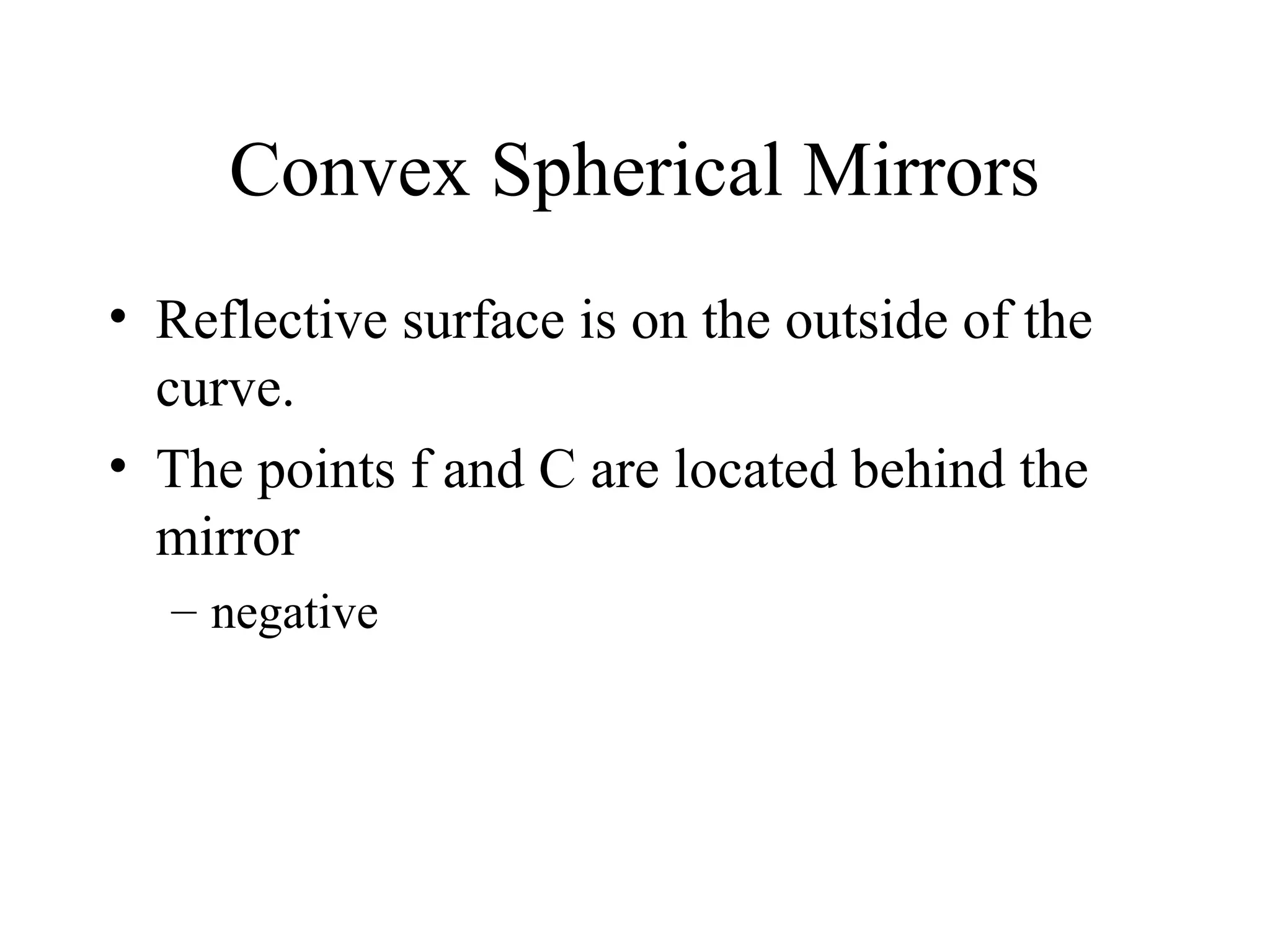
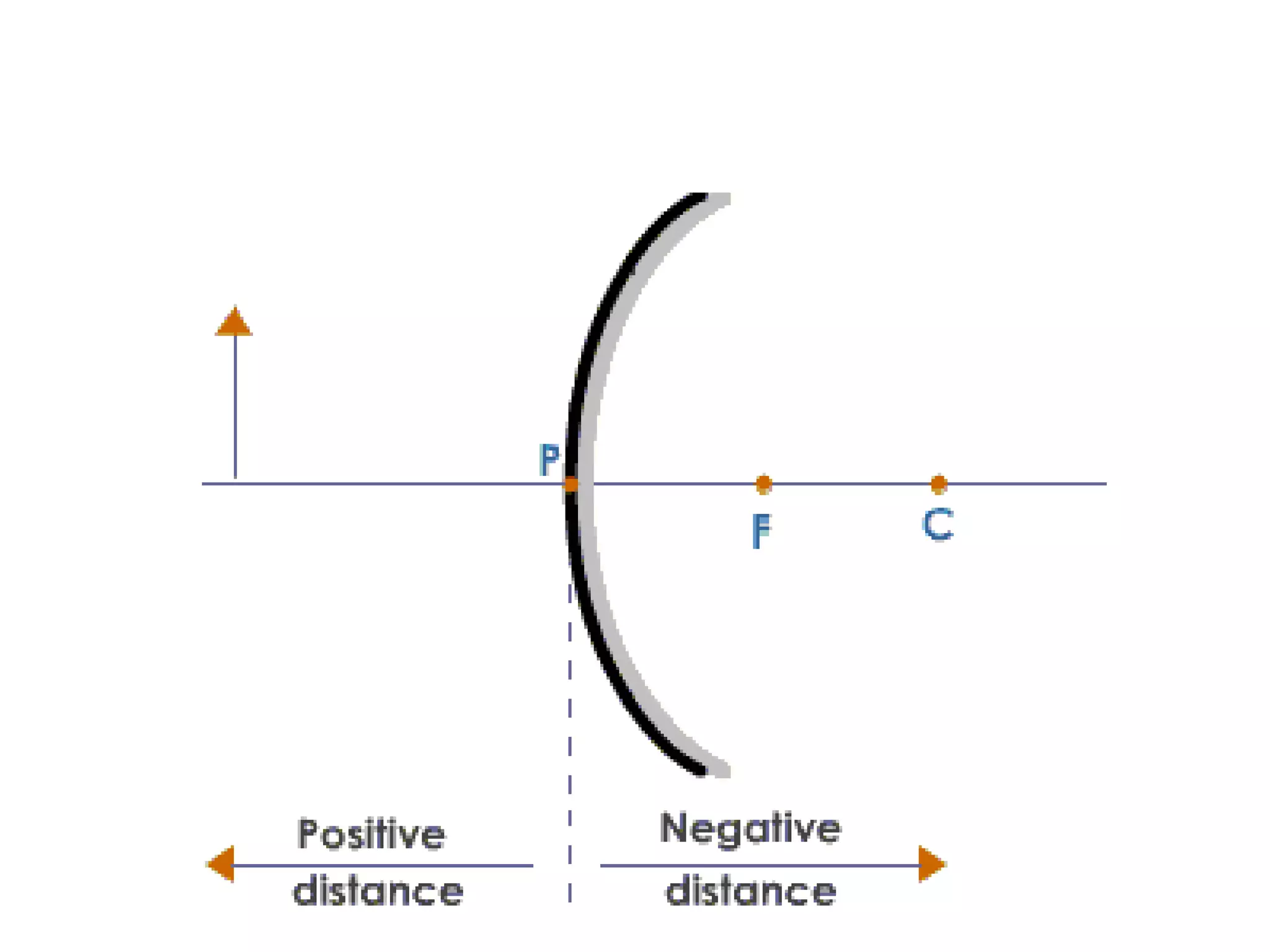
Convex Spherical Mirrors
• Reflective surface is on the outside of the
curve.
• The points f and C are located behind the
mirror
– negative
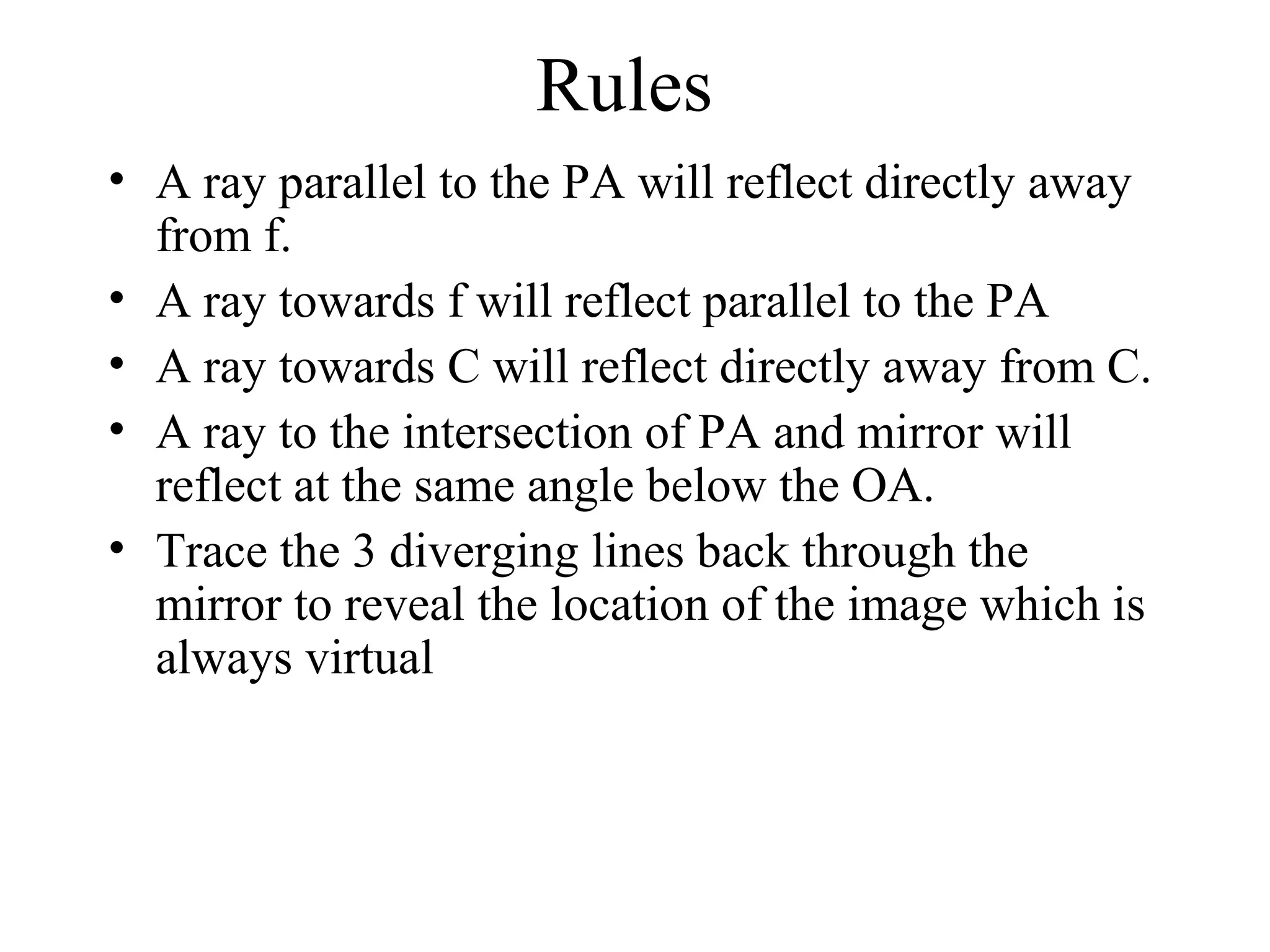
Rules
• A ray parallel to the PA will reflect directly away
from f.
• A ray towards f will reflect parallel to the PA
• A ray towards C will reflect directly away from C.
• A ray to the intersection of PA and mirror will
reflect at the same angle below the OA.
• Trace the 3 diverging lines back through the
mirror to reveal the location of the image which is
always virtual
Example
• f = -8.00cm
• p= 10.0cm
• h = 3cm
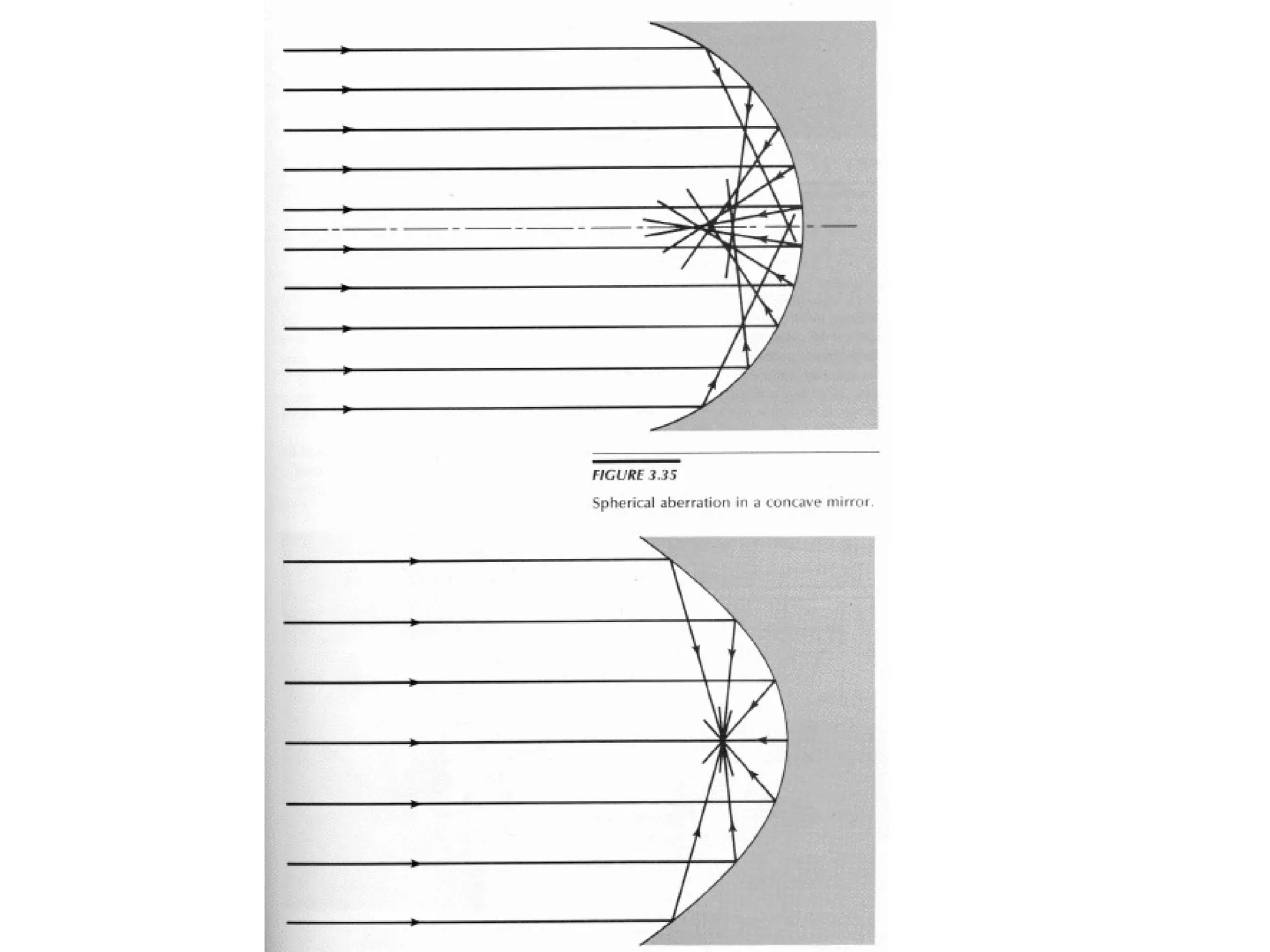
Parabolic Mirrors
• Rays that hit spherical mirrors far away
from the OA often reflect though other
points causing fuzzy images, spherical
aberration.
• Telescopes use parabolic mirrors as they
ALWAYS focus the rays to a single point.
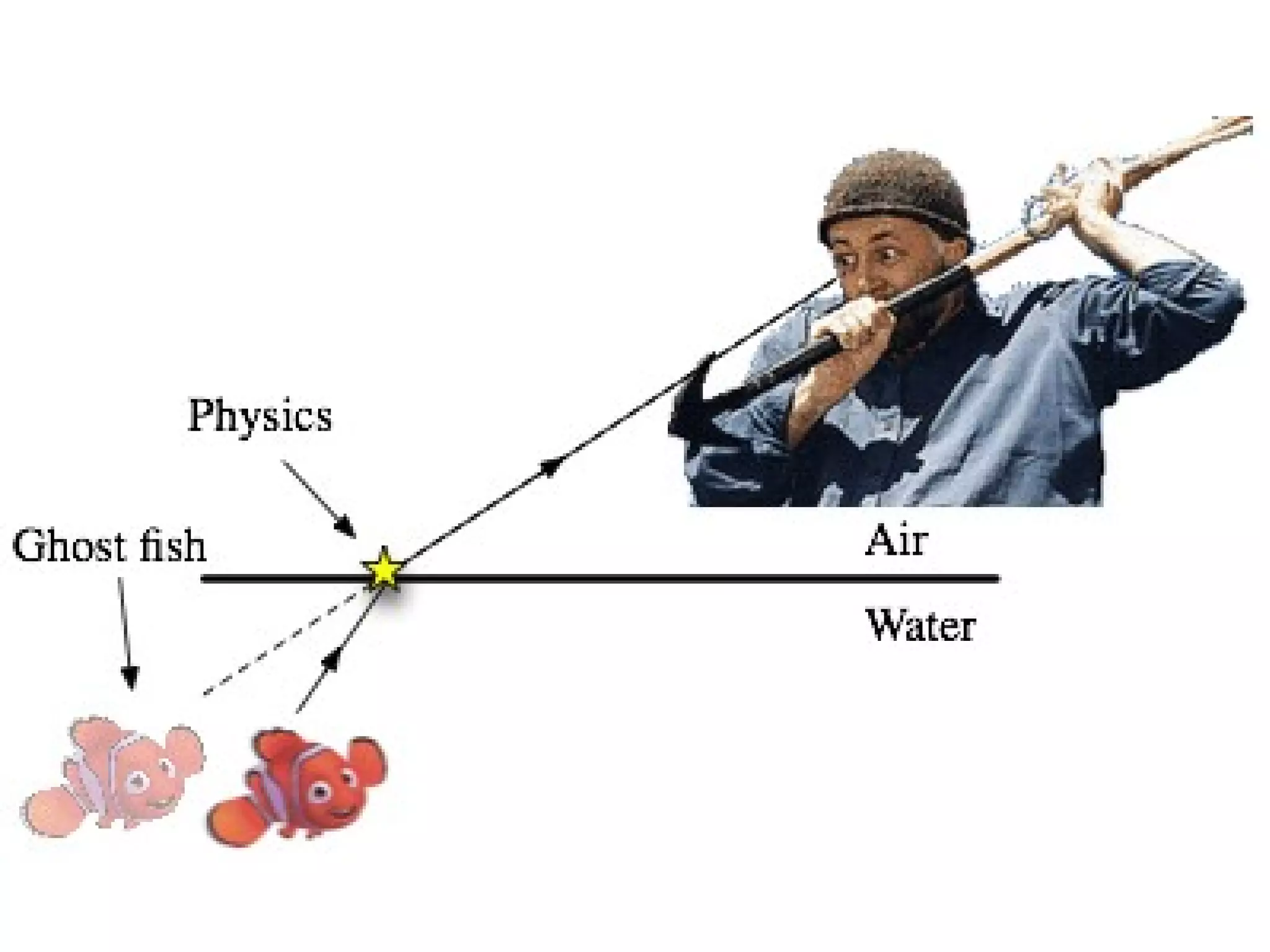
Refraction
• Substances that are transparent or translucent
allow light to pass though them.
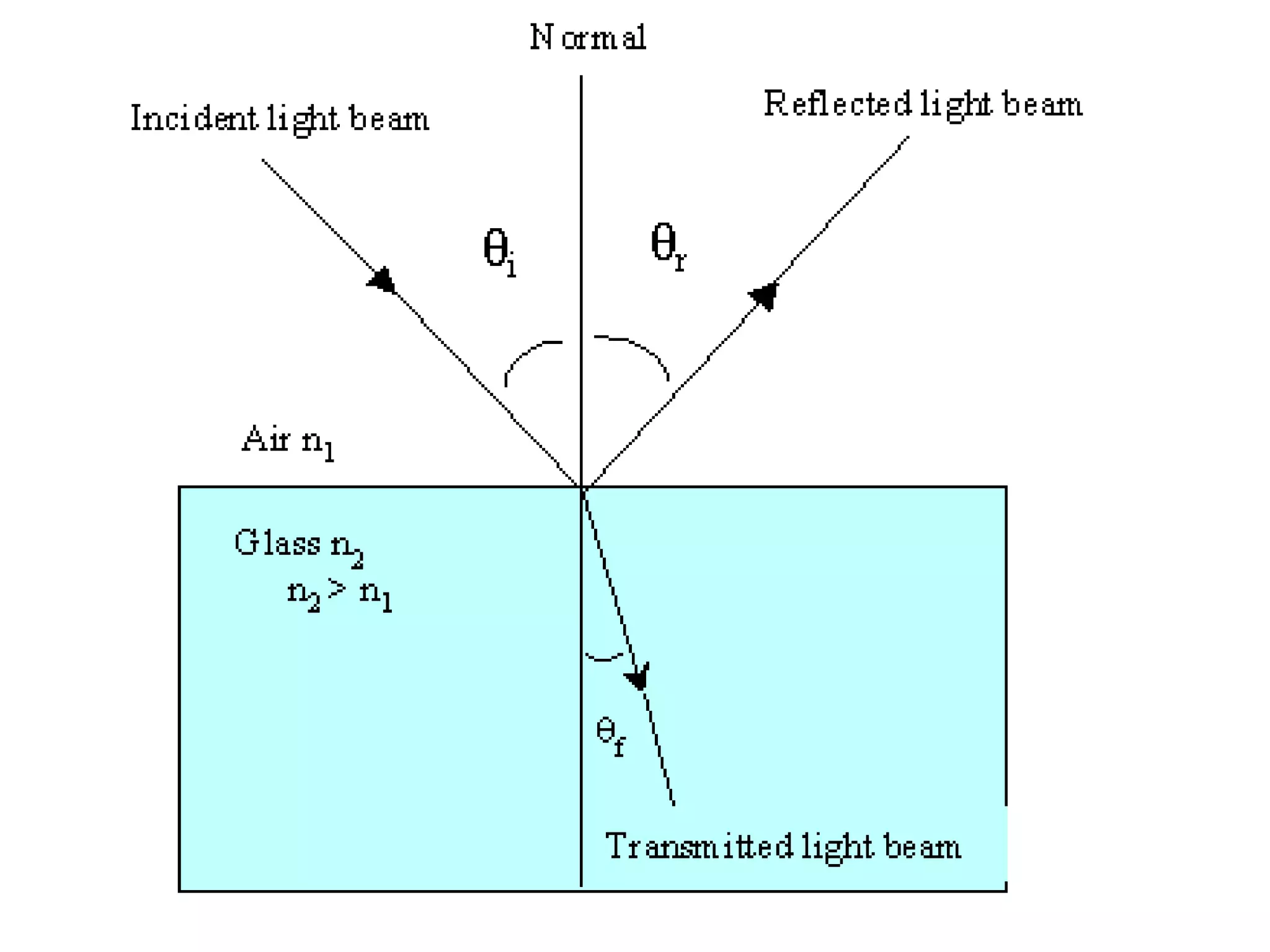
• Changes direction of light
• Due to the differences in speed of light
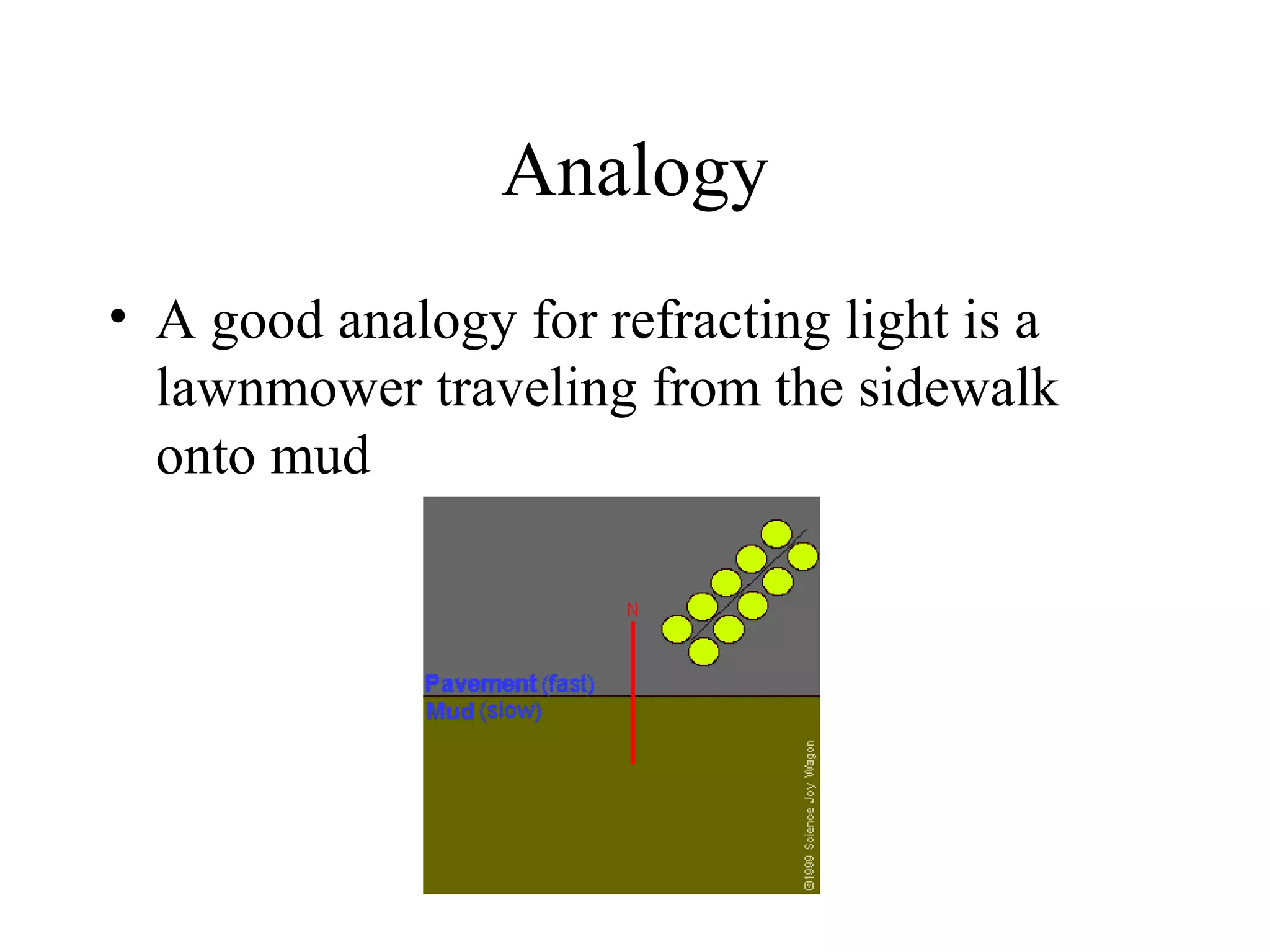
Analogy
• A good analogy for refracting light is a
lawnmower traveling from the sidewalk
onto mud
Index of Refraction (n)
• The ratio of the speed of light in a vacuum
to the speed of light in a medium
∀⇑ n - ⇓ c
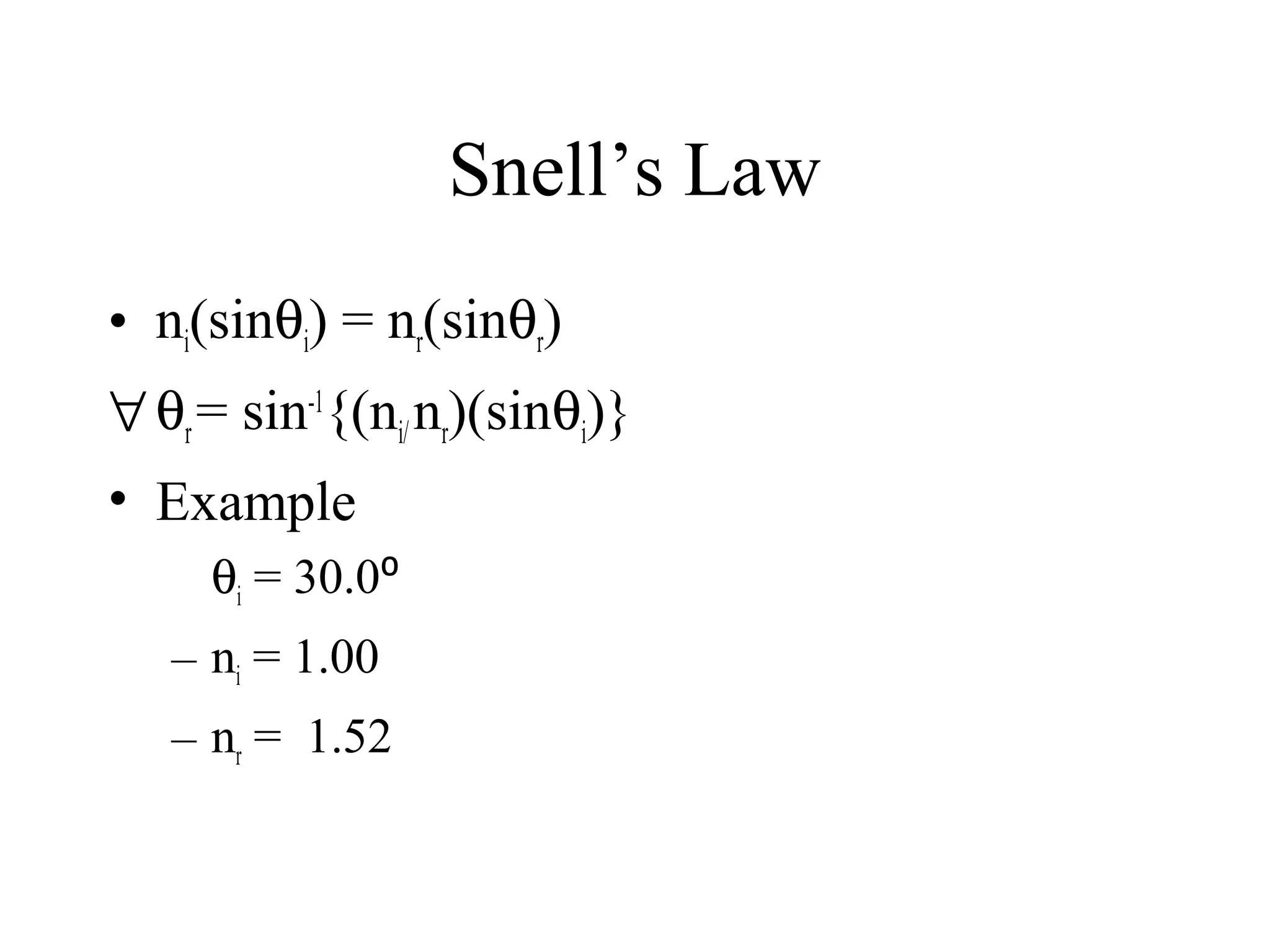
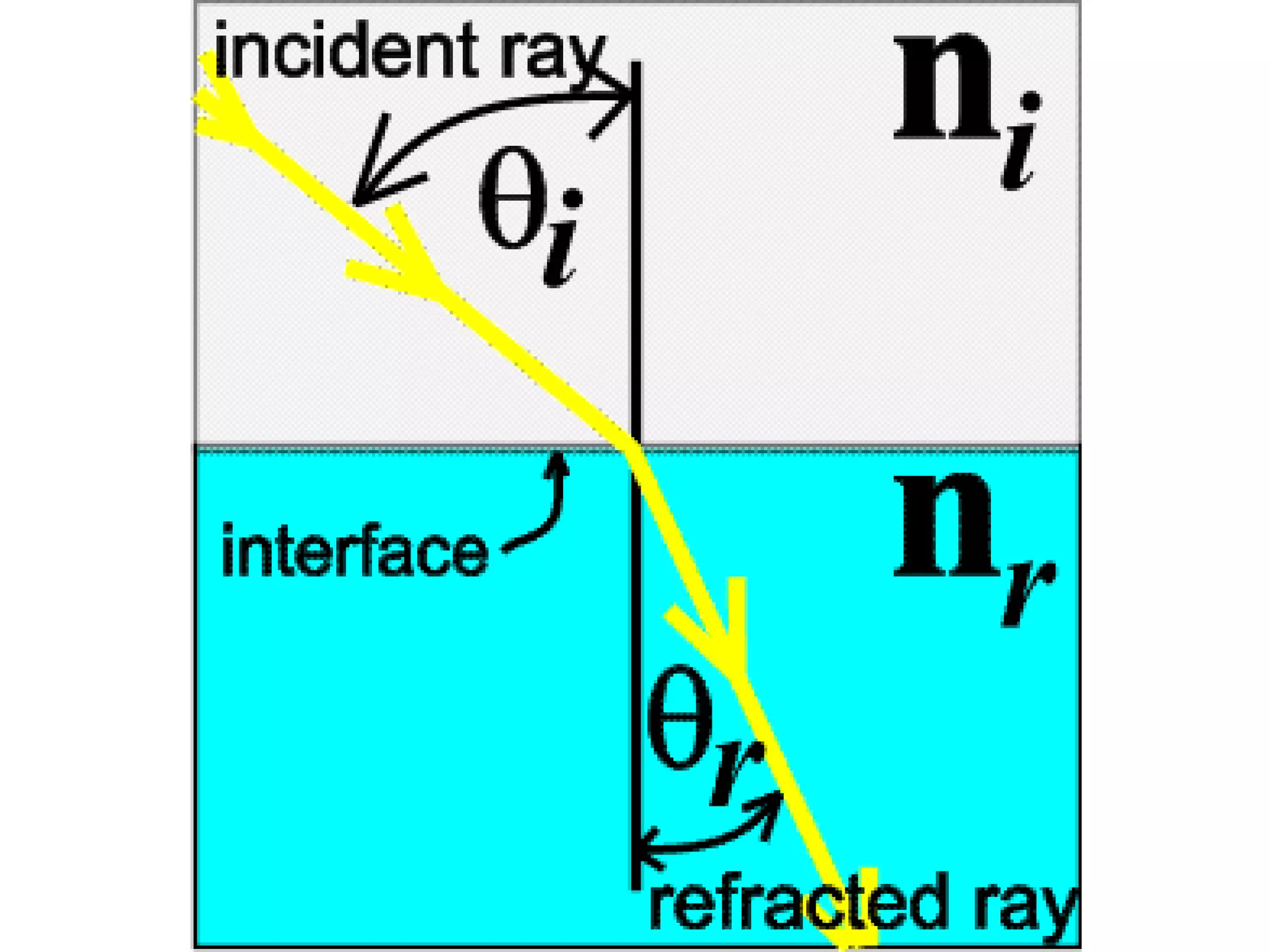
Snell’s Law
• ni(sinθi) = nr(sinθr)
∀ θr = sin-1{(ni/ nr)(sinθi)}
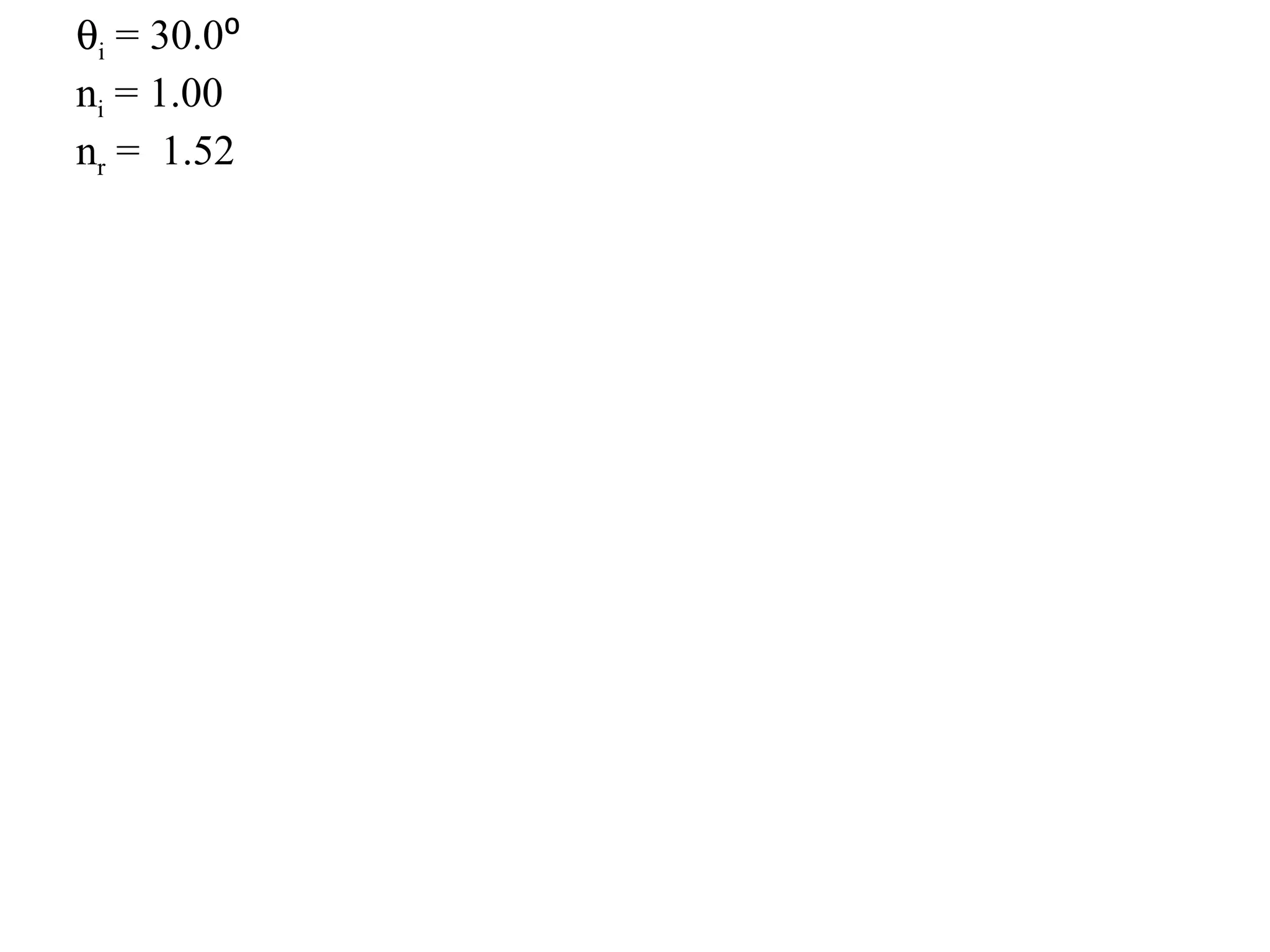
• Example
θi = 30.0⁰
– ni = 1.00
– nr = 1.52
θi = 30.0⁰
ni = 1.00
nr = 1.52
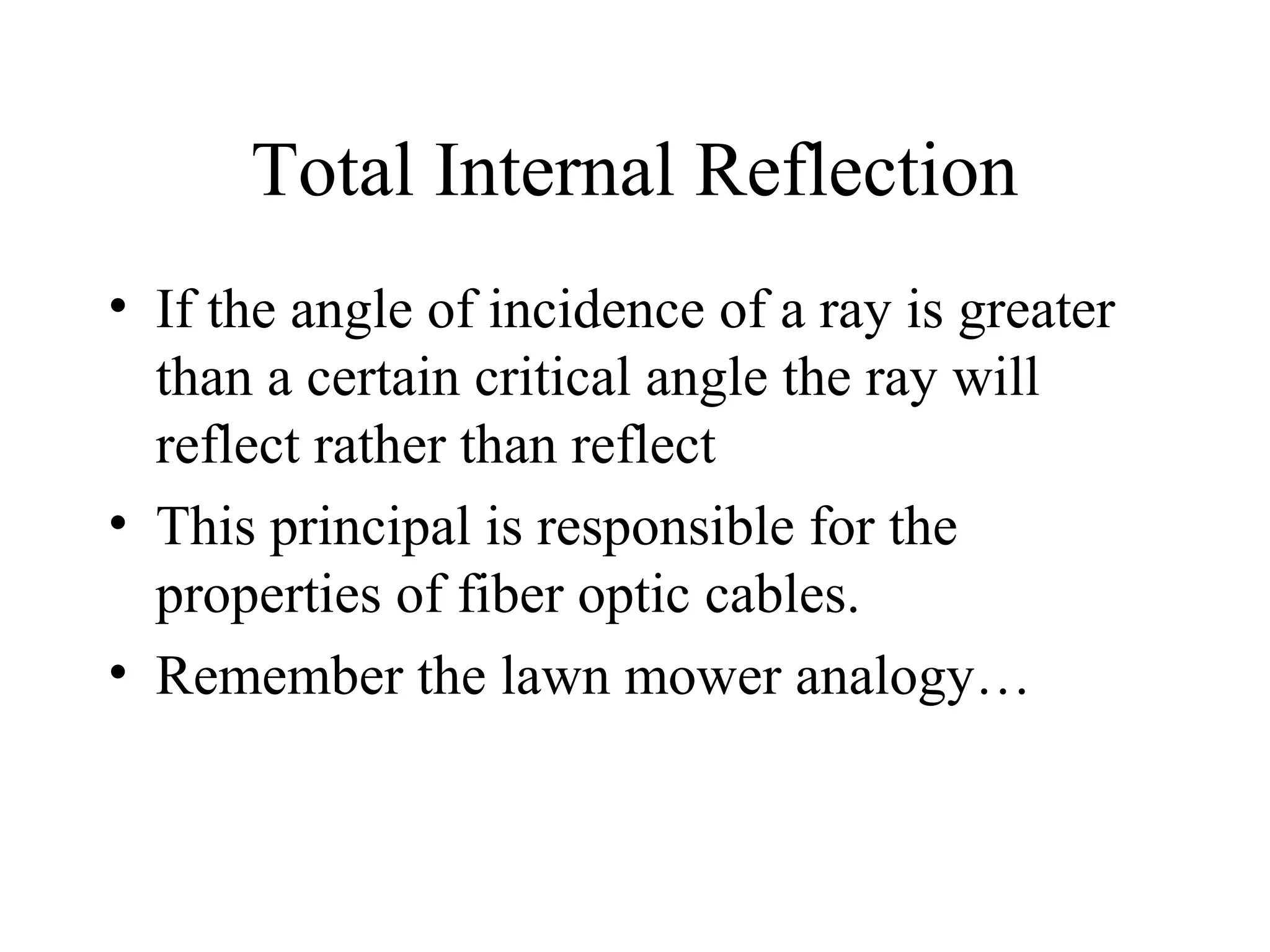
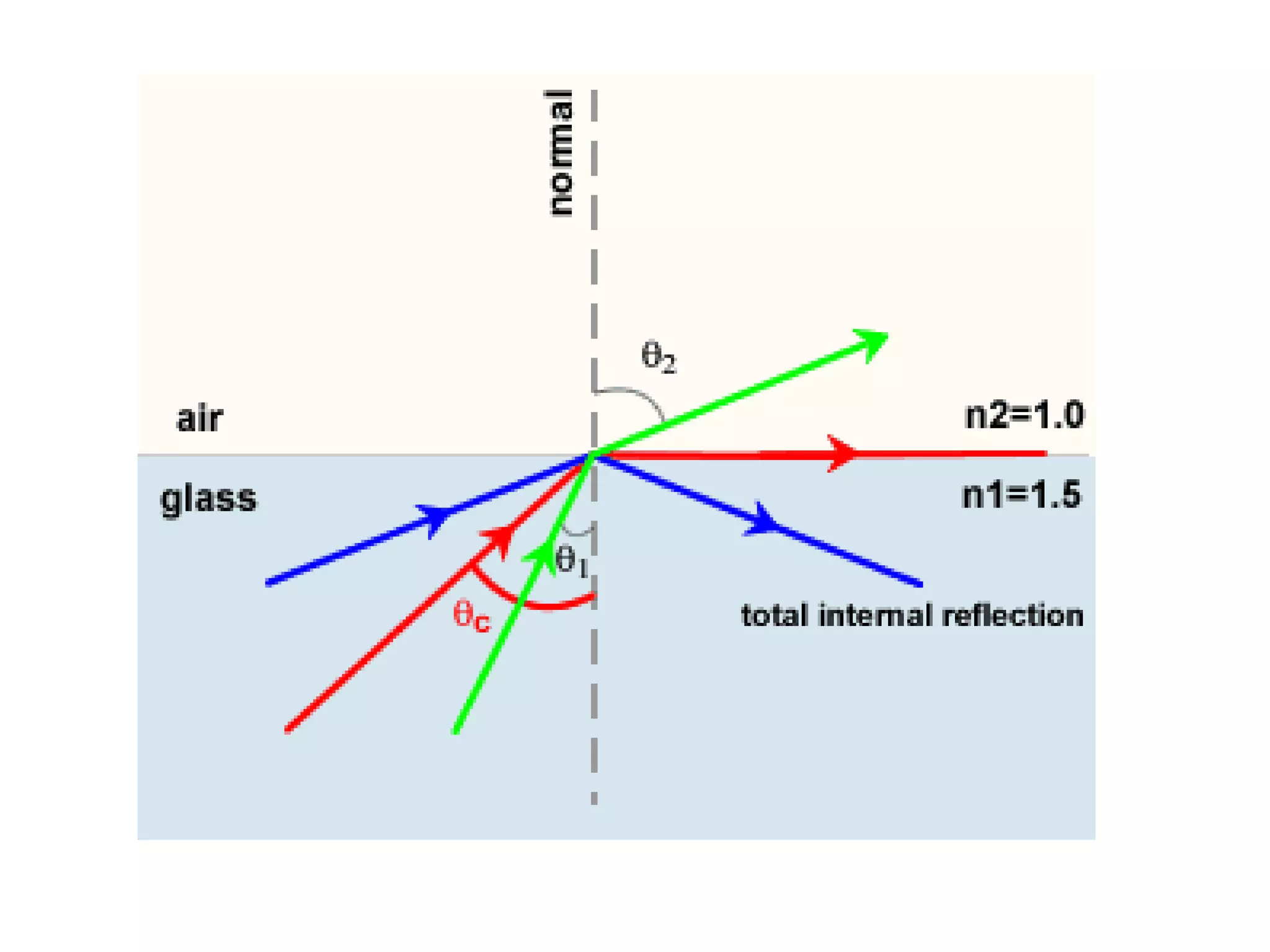
Total Internal Reflection
• If the angle of incidence of a ray is greater
than a certain critical angle the ray will
reflect rather than reflect
• This principal is responsible for the
properties of fiber optic cables.
• Remember the lawn mower analogy…
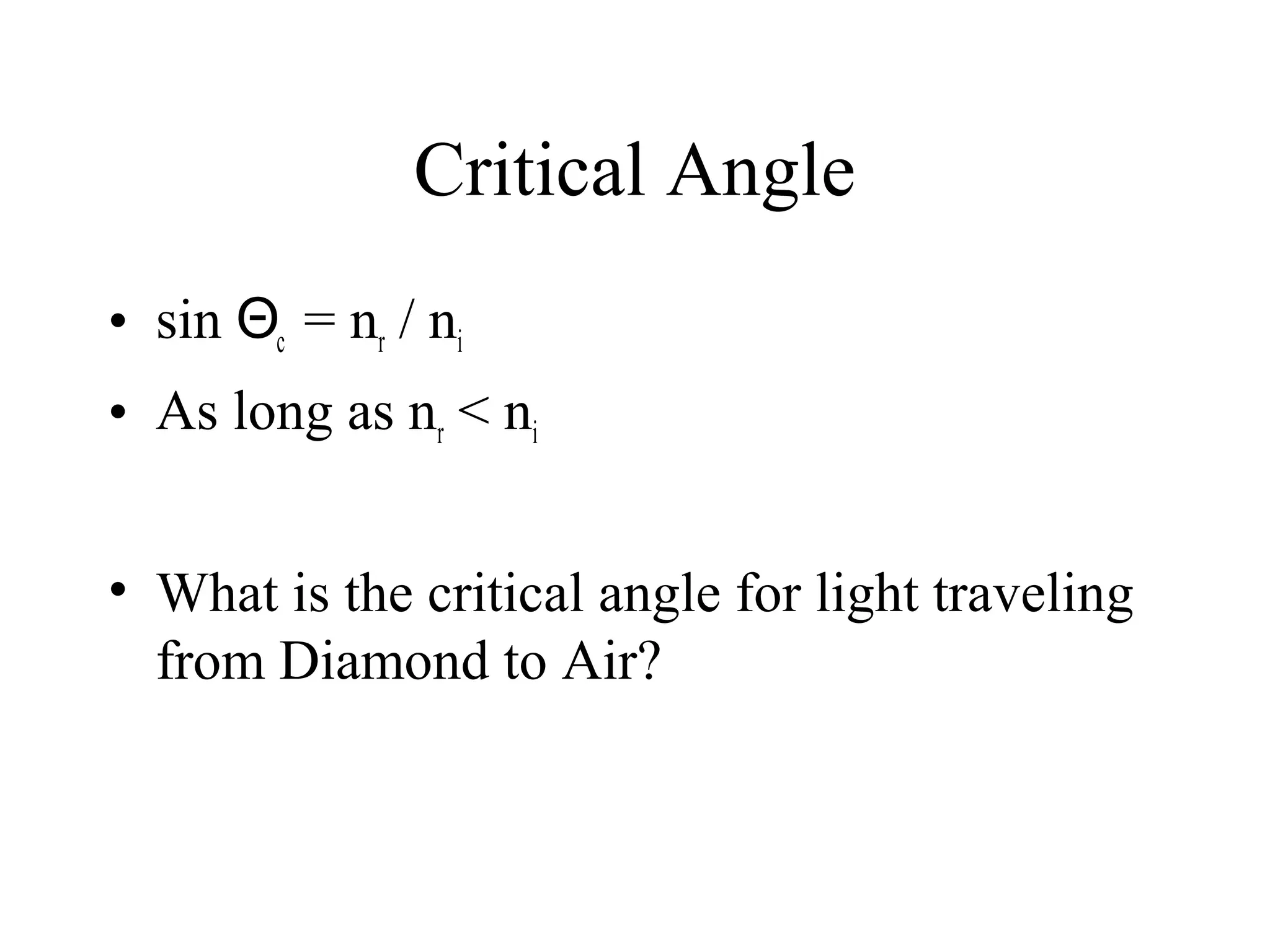
Critical Angle
• sin Θc = nr / ni
• As long as nr < ni
• What is the critical angle for light traveling
from Diamond to Air?
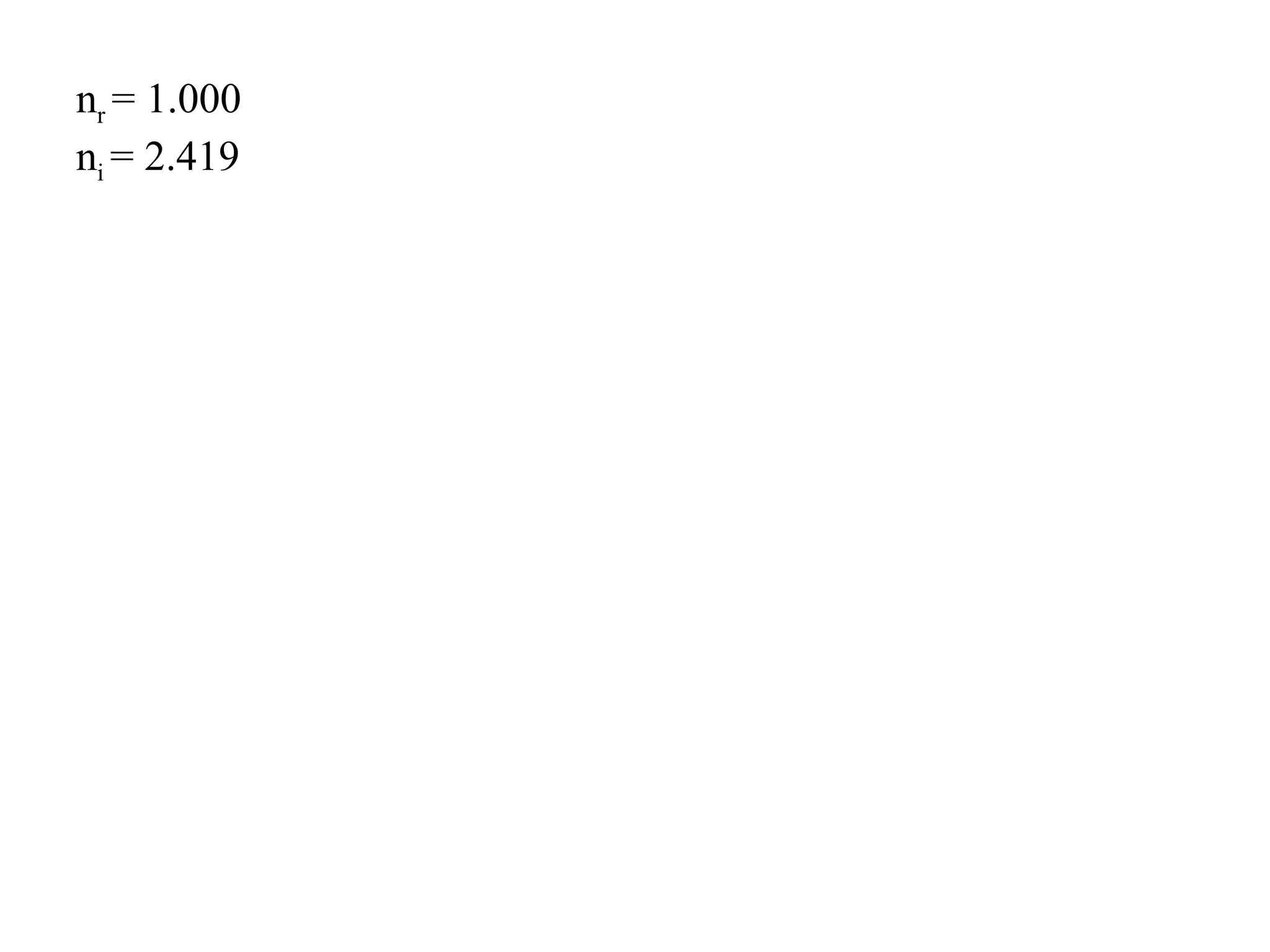
nr = 1.000
ni = 2.419
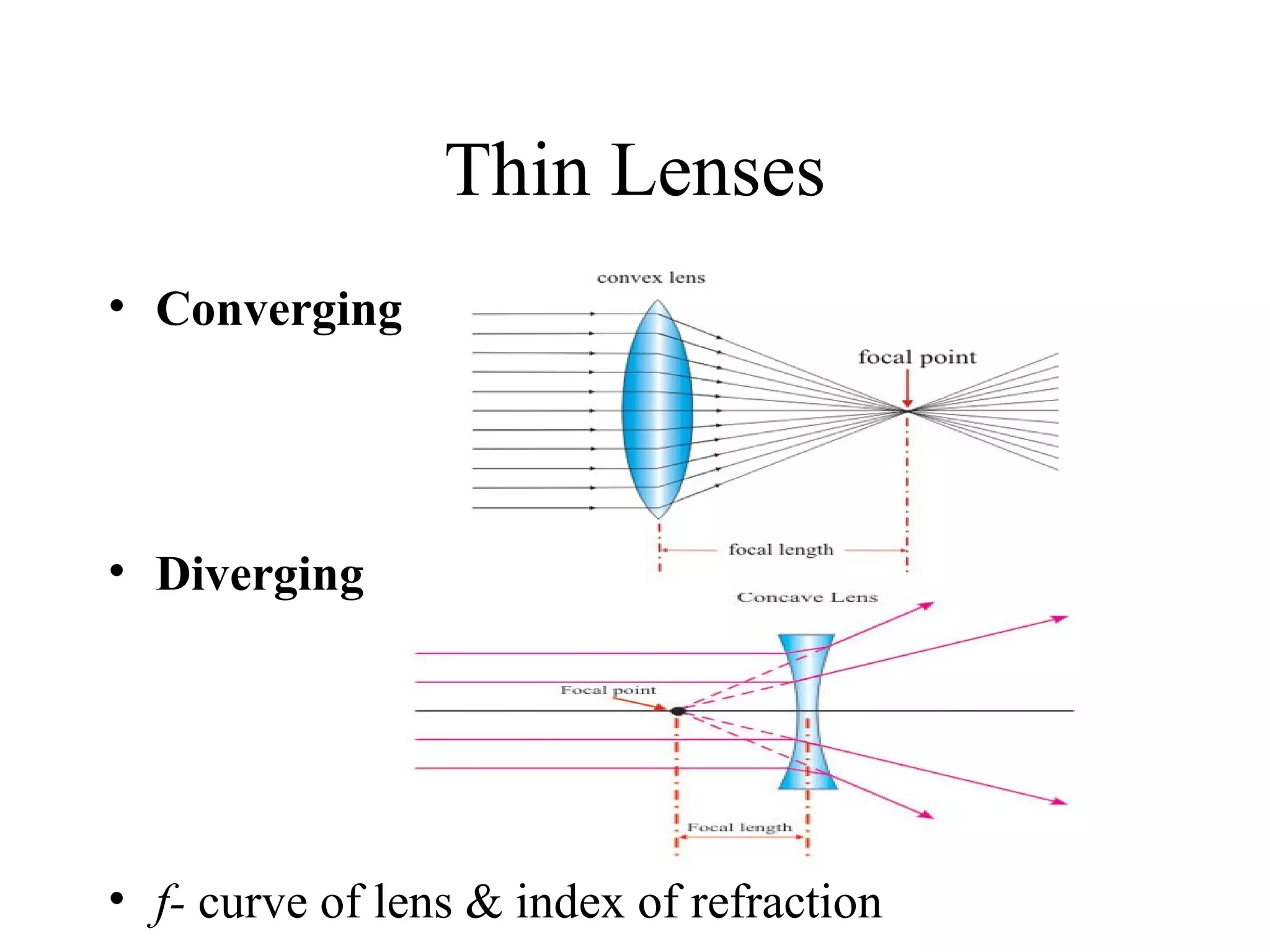
Thin Lenses
• Converging

• Diverging

• f- curve of lens & index of refraction
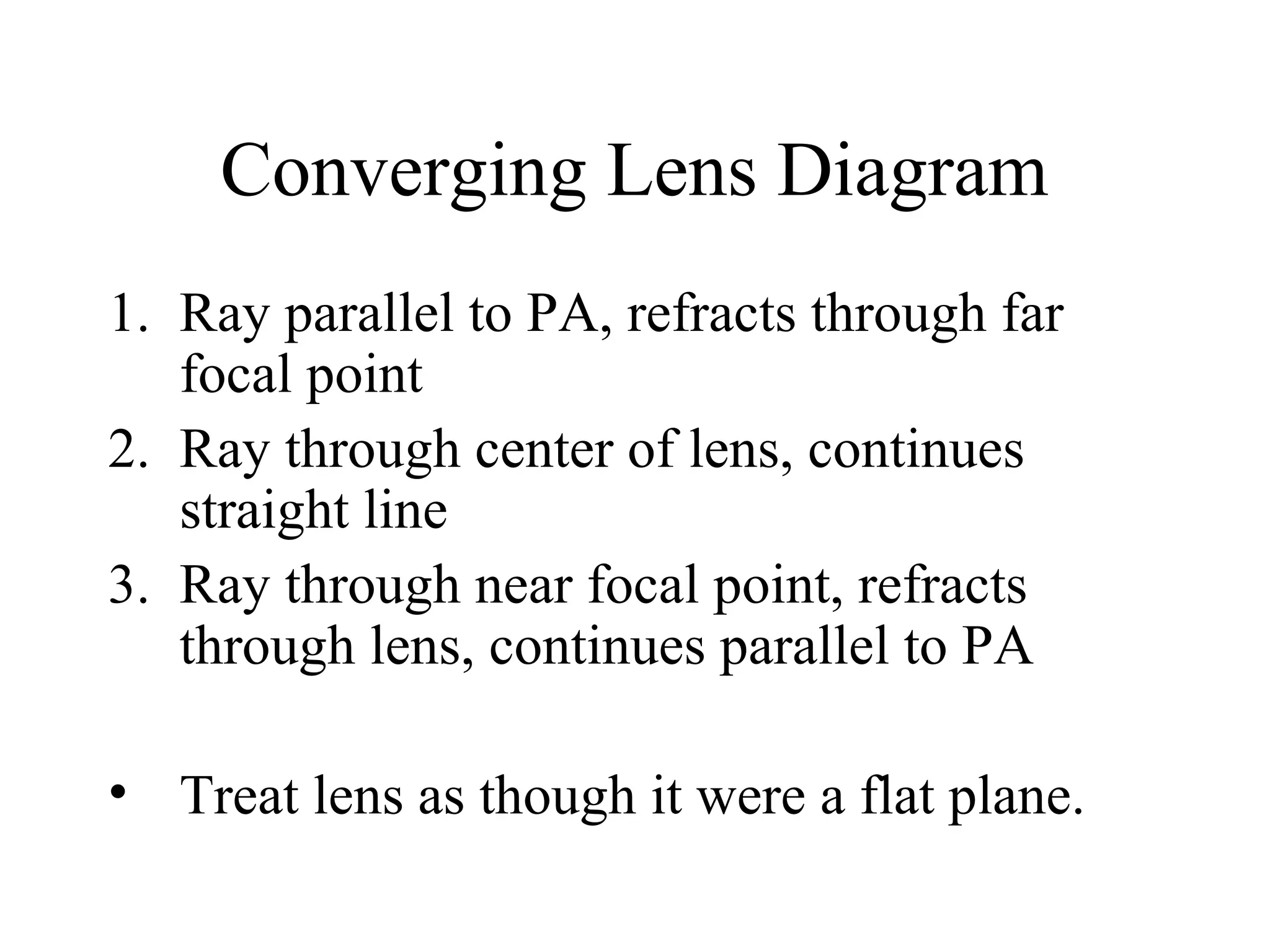
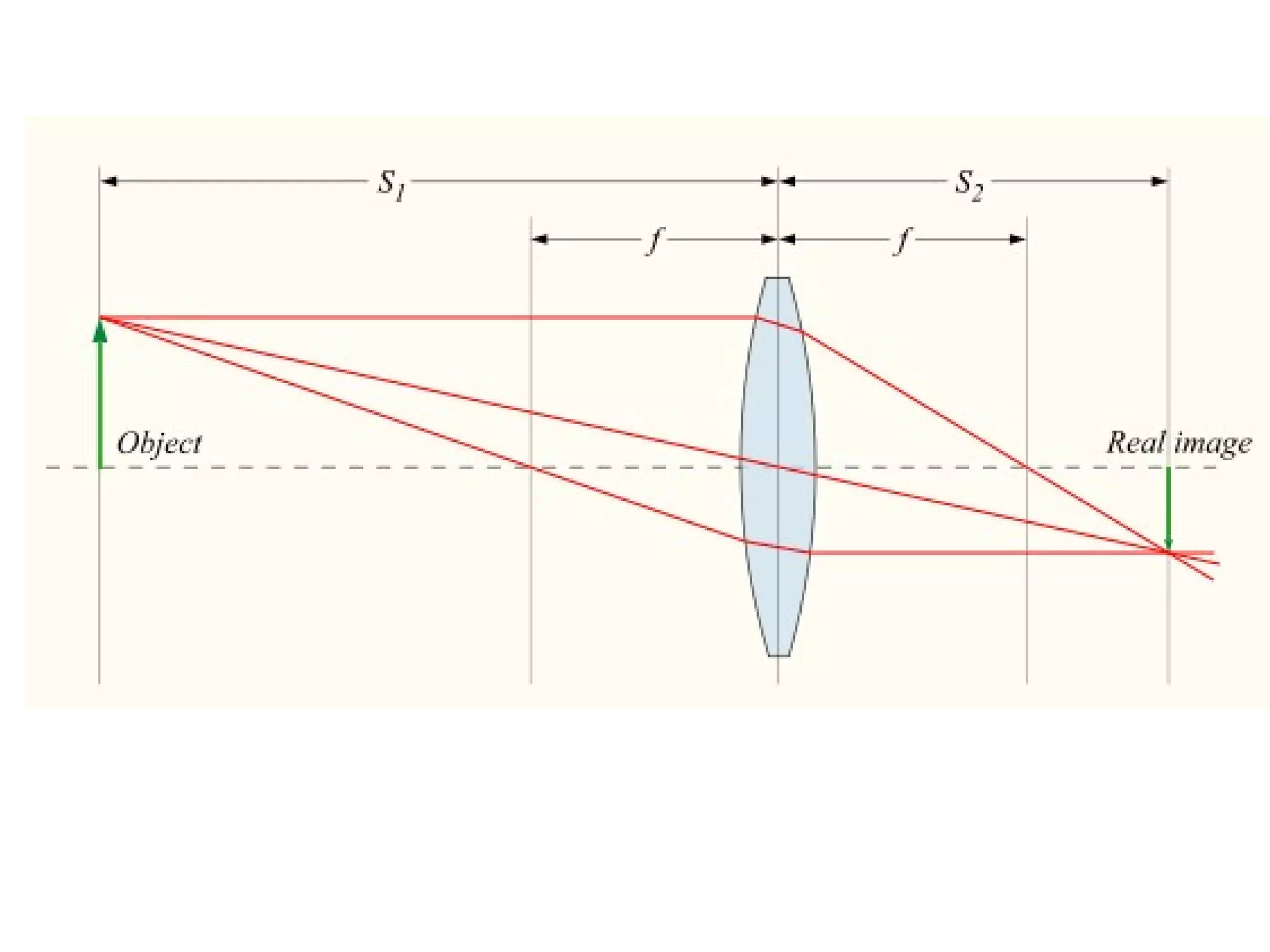
Converging Lens Diagram
1. Ray parallel to PA, refracts through far
focal point
2. Ray through center of lens, continues
straight line
3. Ray through near focal point, refracts
through lens, continues parallel to PA
• Treat lens as though it were a flat plane.
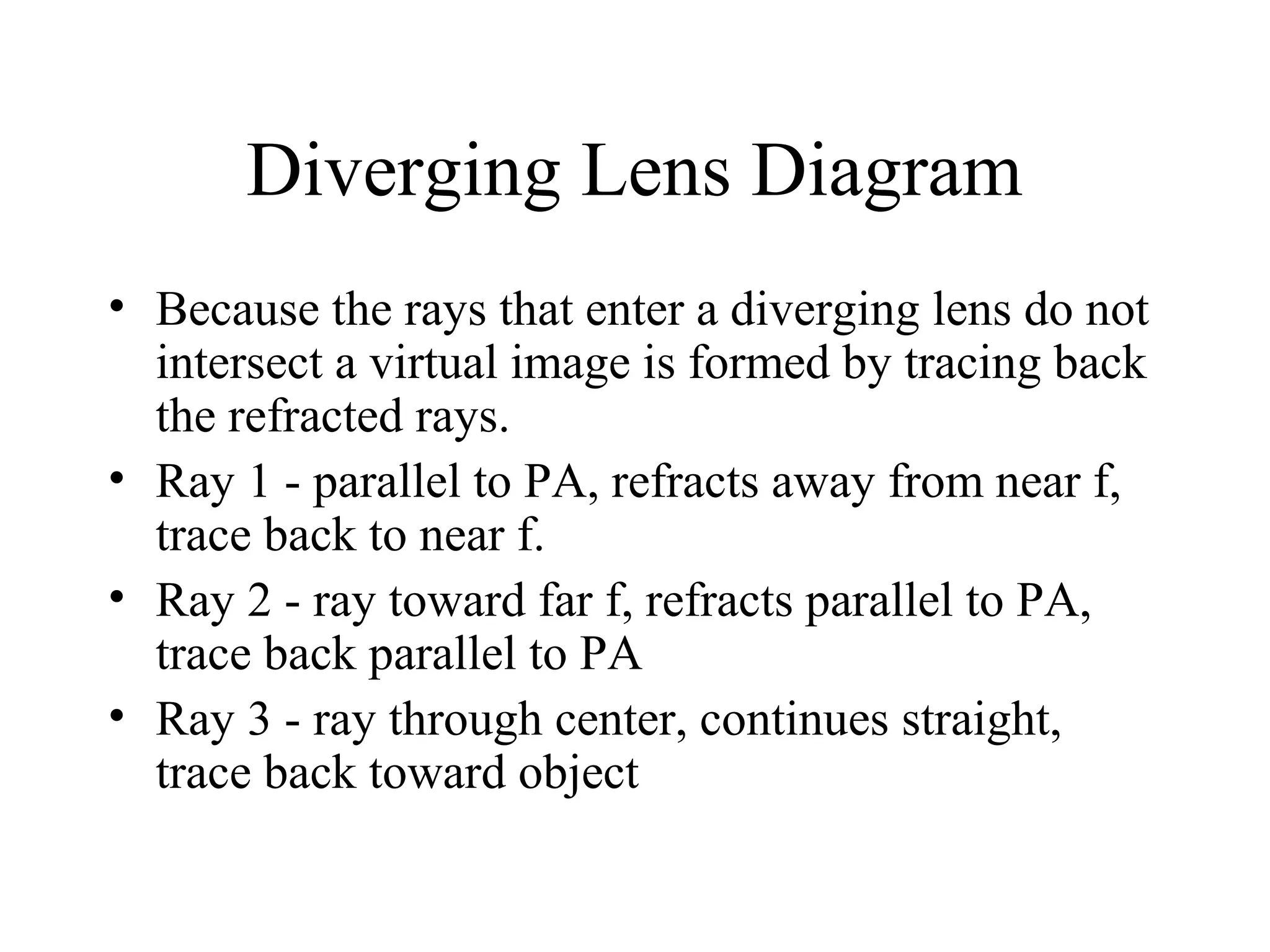
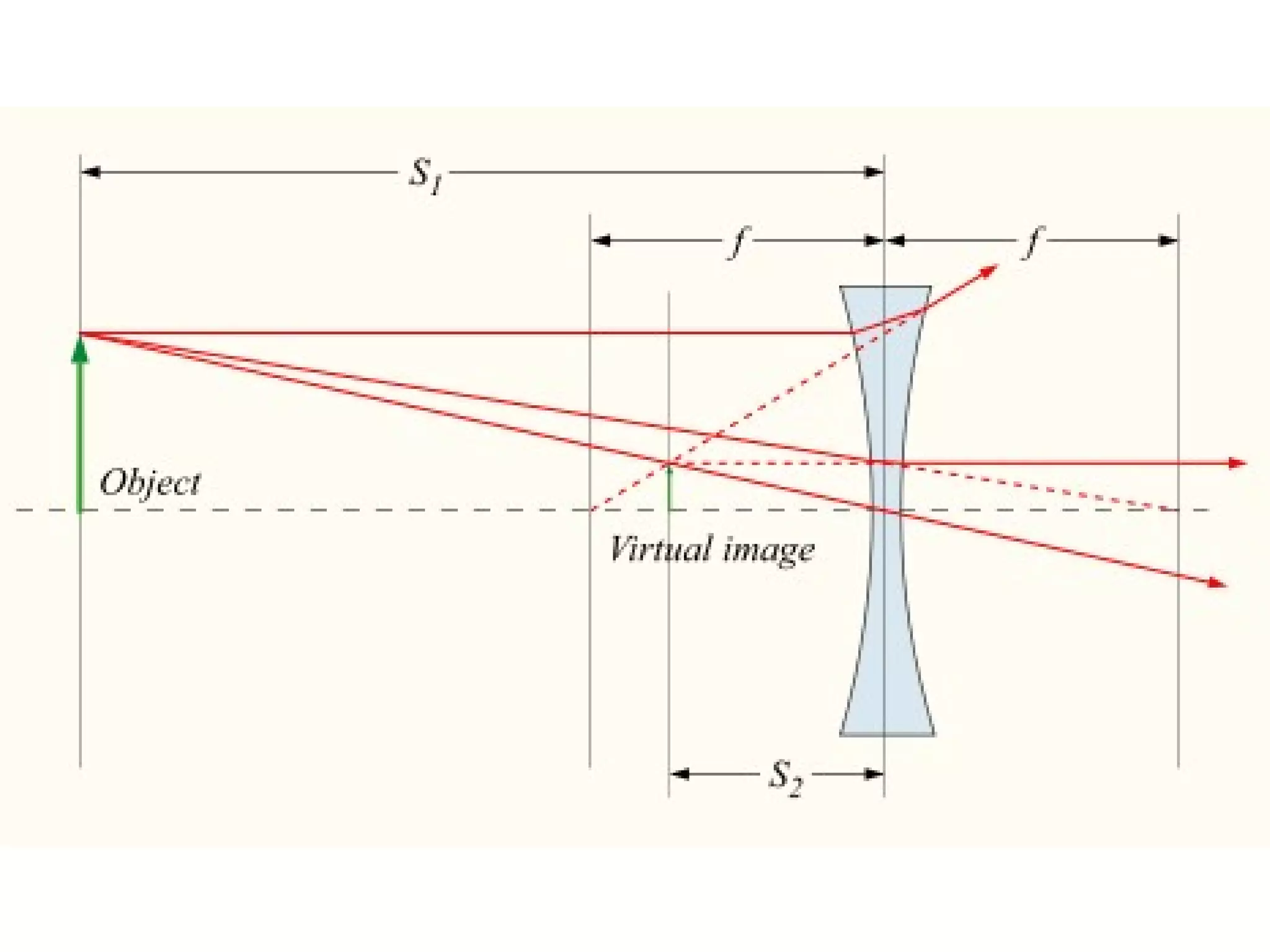
Diverging Lens Diagram
• Because the rays that enter a diverging lens do not
intersect a virtual image is formed by tracing back
the refracted rays.
• Ray 1 - parallel to PA, refracts away from near f,
trace back to near f.
• Ray 2 - ray toward far f, refracts parallel to PA,
trace back parallel to PA
• Ray 3 - ray through center, continues straight,
trace back toward object
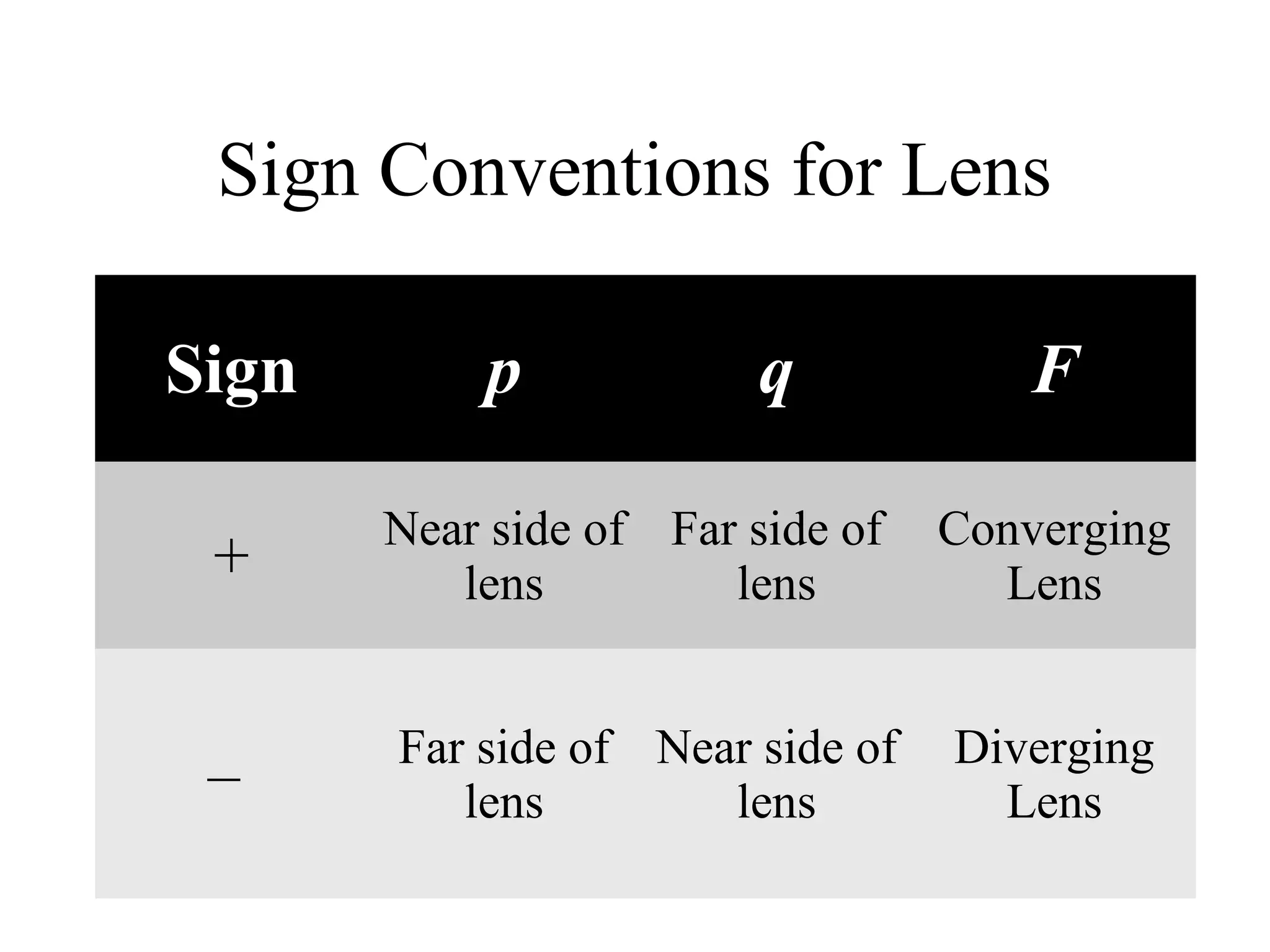
Sign Conventions for Lens
Sign
+

–

p

q

Near side of Far side of
lens
lens
Far side of Near side of
lens
lens

F
Converging
Lens
Diverging
Lens
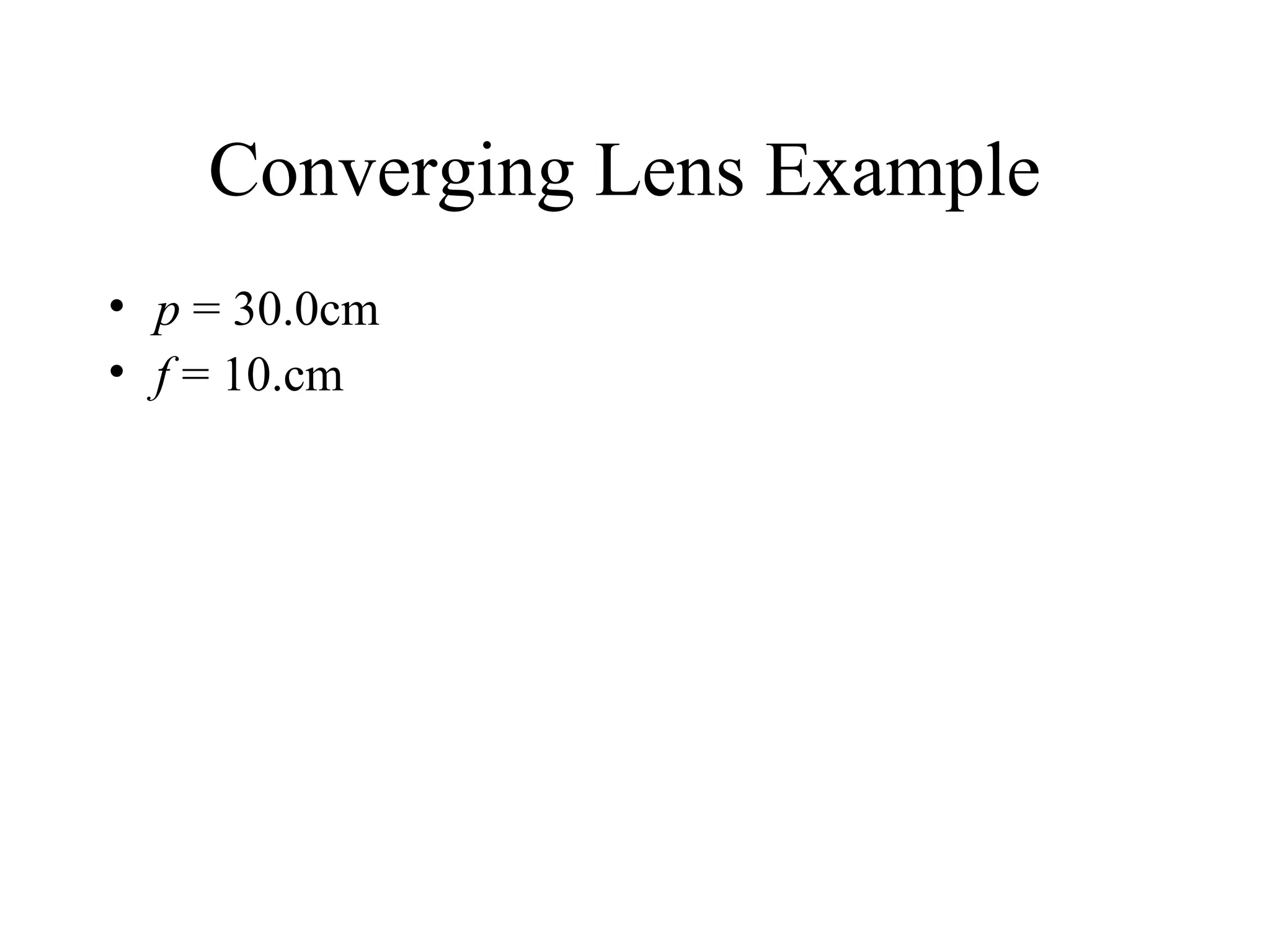
Converging Lens Example
• p = 30.0cm
• f = 10.cm
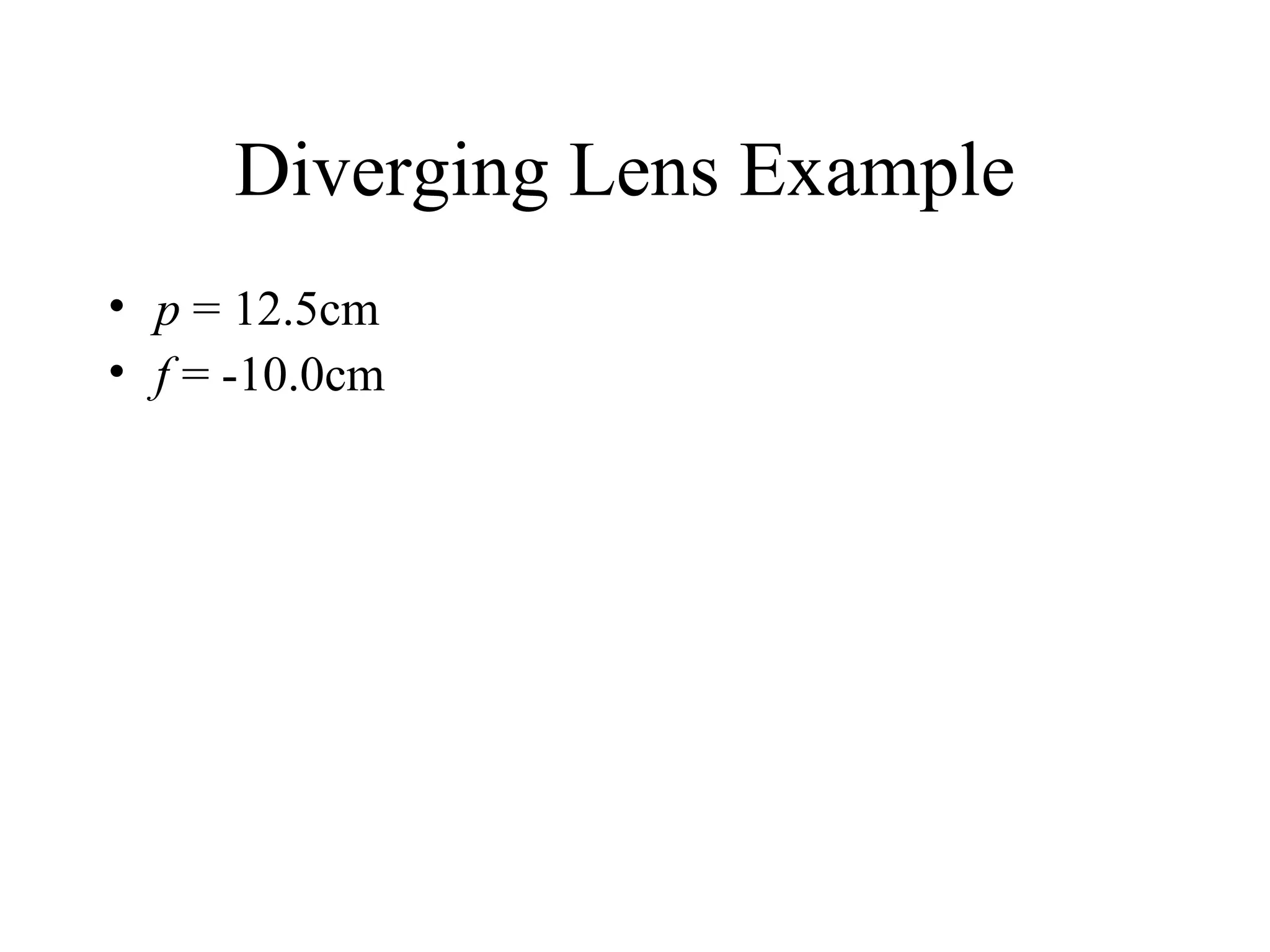
Diverging Lens Example
• p = 12.5cm
• f = -10.0cm

Light (1)

  • 1.
    Light, Reflection, andRefraction Chapters 14 and 15 OPTICS
  • 2.
    Electromagnetic Waves • Magneticfield wave perpendicular to an electric field wave • All objects emit EMWs. ⇑ Temp ⇑EMW • Electromagnetic spectrum – Range of all frequencies of light • Visible light is a very small portion of that entire spectrum.
  • 4.
    c • Speed ofLight - 3.00 x 10⁸m/s. • = (wavelength) x (frequency) • c = λƒ
  • 5.
    Example • AM Radiowaves – 5.4 x 10⁵ Hz – 1.7 x 10⁶ Hz λ=?
  • 6.
    Visible Light • Partof the EMS humans can see – Red - 750nm (x10-9m) – Purple - 380nm • Bees, Birds – UV • Snakes – IR
  • 7.
    Reflection • Light wavesusually travel in straight paths • Change in substance changes direction • Opaque - does not permit light – some light reflected – some light absorbed as heat
  • 8.
    Reflection • Texture affectsreflection • Diffuse reflection (rough) – reflects light in many different directions, • Specular reflection (smooth) – reflects light in only one direction • Smooth – variations in surface < λ
  • 10.
    Mirrors • Light strikinga mirror reflects at the same angle that it struck the mirror
  • 11.
    Flat Mirrors • p=q –p- objects distance to the mirror – q - distance from the mirror to the image • Virtual image – Does not exist – Made by our eyes
  • 13.
    Ray Diagrams • Usedto predict the location of the image of an object
  • 14.
    Concave Spherical Mirrors •Reflective surface is on the interior of a curved surface – – – – C – center of curvature R – Radius (distance to C) f – Focal Point (1/2 R) Principal axis • any line that passes through C • usually oriented with an object
  • 16.
    Mirror Equations • 1/objectdistance + 1/image distance = 1/focal length 1/p + 1/q = 1/f • Magnification (M) = Image height/object height (h′ / h) - (q / p) • M = h′ / h = - (q / p)
  • 17.
    Sign of Magnification Signof M Orientation of Image Type of Image + Upright Virtual – Inverted Real
  • 18.
    Concave Spherical MirrorRules • A ray traveling through C will reflect back through C • A ray traveling through (f) will reflect parallel to the PA • A ray traveling to the intersection of the PA and the mirror will reflect at the same angle below the PA. • A ray traveling parallel to PA will reflect through the focal point
  • 19.
    Ray Diagrams • Drawthree rays – The image forms at the point of intersection • Example – f = 10.0cm – p = 30.0cm – h = 3.00cm
  • 20.
    Convex Spherical Mirrors •Reflective surface is on the outside of the curve. • The points f and C are located behind the mirror – negative
  • 22.
    Rules • A rayparallel to the PA will reflect directly away from f. • A ray towards f will reflect parallel to the PA • A ray towards C will reflect directly away from C. • A ray to the intersection of PA and mirror will reflect at the same angle below the OA. • Trace the 3 diverging lines back through the mirror to reveal the location of the image which is always virtual
  • 24.
    Example • f =-8.00cm • p= 10.0cm • h = 3cm
  • 25.
    Parabolic Mirrors • Raysthat hit spherical mirrors far away from the OA often reflect though other points causing fuzzy images, spherical aberration. • Telescopes use parabolic mirrors as they ALWAYS focus the rays to a single point.
  • 27.
    Refraction • Substances thatare transparent or translucent allow light to pass though them. • Changes direction of light • Due to the differences in speed of light
  • 28.
    Analogy • A goodanalogy for refracting light is a lawnmower traveling from the sidewalk onto mud
  • 29.
    Index of Refraction(n) • The ratio of the speed of light in a vacuum to the speed of light in a medium ∀⇑ n - ⇓ c
  • 32.
    Snell’s Law • ni(sinθi)= nr(sinθr) ∀ θr = sin-1{(ni/ nr)(sinθi)} • Example θi = 30.0⁰ – ni = 1.00 – nr = 1.52
  • 33.
    θi = 30.0⁰ ni= 1.00 nr = 1.52
  • 35.
    Total Internal Reflection •If the angle of incidence of a ray is greater than a certain critical angle the ray will reflect rather than reflect • This principal is responsible for the properties of fiber optic cables. • Remember the lawn mower analogy…
  • 37.
    Critical Angle • sinΘc = nr / ni • As long as nr < ni • What is the critical angle for light traveling from Diamond to Air?
  • 38.
  • 39.
    Thin Lenses • Converging •Diverging • f- curve of lens & index of refraction
  • 40.
    Converging Lens Diagram 1.Ray parallel to PA, refracts through far focal point 2. Ray through center of lens, continues straight line 3. Ray through near focal point, refracts through lens, continues parallel to PA • Treat lens as though it were a flat plane.
  • 42.
    Diverging Lens Diagram •Because the rays that enter a diverging lens do not intersect a virtual image is formed by tracing back the refracted rays. • Ray 1 - parallel to PA, refracts away from near f, trace back to near f. • Ray 2 - ray toward far f, refracts parallel to PA, trace back parallel to PA • Ray 3 - ray through center, continues straight, trace back toward object
  • 44.
    Sign Conventions forLens Sign + – p q Near side of Far side of lens lens Far side of Near side of lens lens F Converging Lens Diverging Lens
  • 45.
    Converging Lens Example •p = 30.0cm • f = 10.cm
  • 46.
    Diverging Lens Example •p = 12.5cm • f = -10.0cm

Editor's Notes