BODY MECHANICS
PRESENTED
MISS JENNIFER OWARE
MPHIL STD UG, BSc NURSING, RGN,
LICENSING EXAMINER.
OVERVIEW
• The co-ordinated efforts and safe
use of the body to produce
motion and maintain proper
balance, posture and body
alignments during activity.
Importance of body mechanics
• It prevent strain on the body
needed in lifting, shifting, pulling,
pushing, bending and transferring
patient
• It enhance efficient use of the
body during nursing activities
Importance of body Mechanics cont’d
• Proper body mechanics avoid the
risk of causing injury to the nurse
and the patient
Principles underlying proper
body mechanics
Three major factors involved are:
• Centre of gravity
• Base of support
• Line of gravity
Centre of Gravity
• Centre of gravity is located in pelvic
area.
• Half of the body weight is distributed
above the pelvic area horizontally
• Half the body weight is to each side
of the body as divided vertically.
Centre of gravity cont’d
To maintain a balance in lifting,
• Keep knees and hips bend
• Back is straightened to allow
weight of body to be distributed
over the feet to give extra
stability.
Base of Support
• Feet provide the base of support.
• The wider the base support, the
more stable the object within limits.
• The feet are spread side wide when
to give side-to-side stability.
• One foot is placed slightly in front of
the other for back-to-front stability.
Base of Support
• Weight distribute evenly between
both feet.
• knees are flexed slightly to absorb
jolts.
• Feet are moved to the object
being moved.
Line of Gravity
• Line of gravity is an imaginary vertical
line through top of head, the centre of
gravity and the base support.
• The line is drawn straight from top to
the base support to ensure highest
efficiency with equal weight on each
side.
Line of Gravity
• The back is straightened
• Head is erect
• Line of gravity passes through
centre of body and proper body
mechanics will be in place
Basic Principles of Body Mechanics
• Pull, push, or roll an object than to
lifting
• Movement should be smooth and
continuous rather than jerky.
• Less energy or force is required to
keep object moving than it is to start
and stop it.
Basic Principles of Body Mechanics
• Works as close as possible to
the object.
• Use strong leg and arm
muscles as much as possible.
• Use back muscles as little as
possible
Basic Principles of Body Mechanics
• Face the direction of the
movement to prevent abdominal
twisting and the spine
LIFTING TECHNIQUES
Lifting Technique
• An art of carrying patient from
one place to another with
minimal effort without injury to
the nurse and vice versa
Forms of lifting
• Sit up in bed
• Sit out of bed i.e. position in and out of
bed
• Bed to stretcher
• Stretcher to bed
• Stretcher to stretcher
• Sitting position on the side of the bed
Basic Rules for Lifting
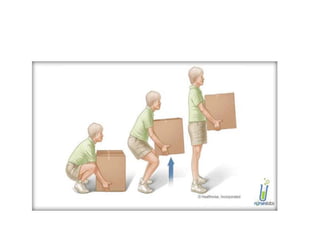
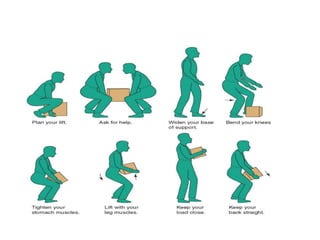
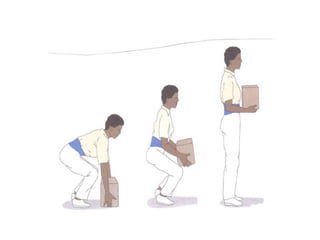
• Keep back straight
• Keep feet separated to provide a
good base of support
• Bend from hips and knees to get
close to the object or patient
Basic Rules for Lifting cont’d
• Hold heavy objects close to the
body
• Use the stronger muscles in lifting
Basic Rules for Lifting cont’d
• Always ask for help if object to be
lifted is too heavy to be moved
• Co-ordinate movements
• Avoid twisting body as you work
• Do not bend for long periods.
Types of Lifting
There are two main types of
lifting and these are:
• Orthodox
• Australian
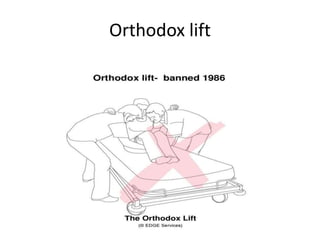
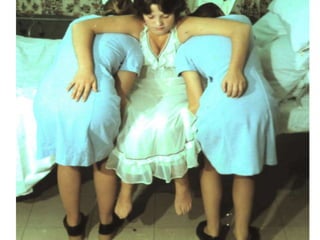
Orthodox lift
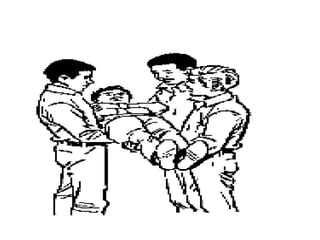
Two nurses are needed
Steps
• Stand close to the bed facing each
other.
• Ask patient to cross arms across the
chest with the head bent forward
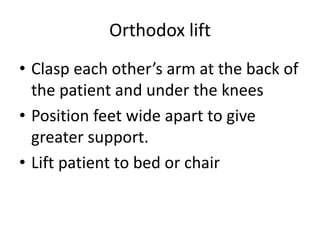
Orthodox lift
• Clasp each other’s arm at the back of
the patient and under the knees
• Position feet wide apart to give
greater support.
• Lift patient to bed or chair
Orthodox lift
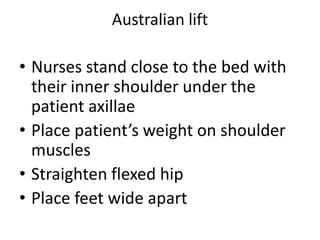
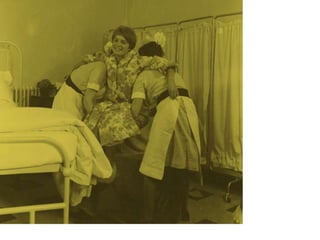
Australian lift
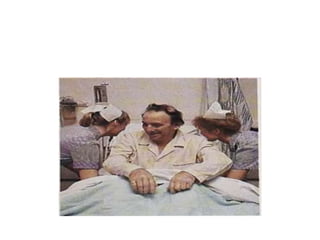
• Nurses stand close to the bed with
their inner shoulder under the
patient axillae
• Place patient’s weight on shoulder
muscles
• Straighten flexed hip
• Place feet wide apart
Australian lift cont’d
• Lift patient
• Outer arms are used to support bed
and adjust pillows.
• Check whether lift was comfortable
for patient
Guidelines for Lifting
• Assess patient and the environment
to establish what aid and help will
be required for the lifting.
• Decide on how patient is to be lifted
• Ensure other nurses are aware of
what they are to do.
• Screen area if necessary
Guidelines for Lifting cont’d
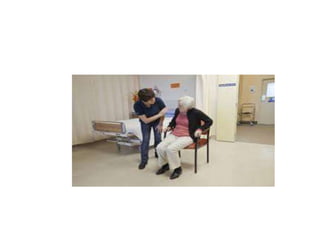
• Adopt suitable stand for the
proposed lift.
• Feet should be wide apart
• Stand as close to patient as possible
• Bend knees and hips to allow a
suitable grasp to be taken.
Guidelines for Lifting cont’d
• Grasp the other lifter’s hand or wrist
firmly avoiding tender and painful areas
• Lift patient into a desired position
• one nurse acting as a leader and
coordinate the movement of lifting
• Check whether lift was comfortable for
the patient.
Forms of lifting
Assisting Patient to Sitting Position
• Place client in a supine position
• Remove all pillows from the bed
• Face the head of the bed
• Place feet apart with the foot nearest
to the bed behind the other foot
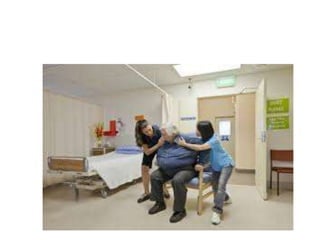
Assisting Patient to Sitting Position
• Place hand further from under the
shoulder of the patient
• Give support to patient head and
vertebrae
• Place other hand on the bed surface
• Raise patient to a sitting position by
shifting weight from front leg to the
back leg.
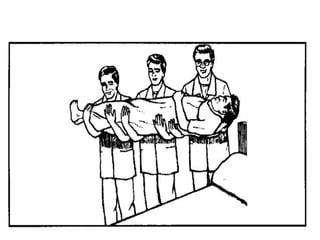
Lifting Unconscious Patient
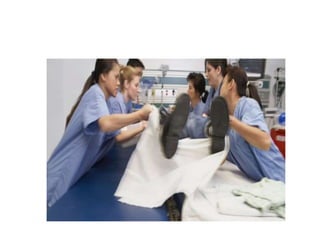
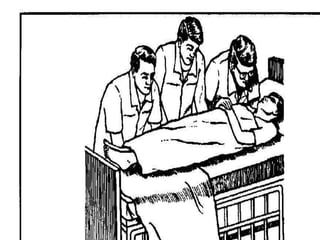
Two or three nurses needed
• Stand at same side of the patient
• Lift patient
• Nurse at patient’s head moves towards
head of bed or stretcher
• Nurse holding trunk and feet move at
the same time
• Patient is moved with sheet
Transferring unconscious patients from
bed to stretcher
Four nurses are needed
• Identify patient and provide privacy
• Lock wheels of bed
• Raise bed to equal height of stretcher
• Lower side rails if any
• Place stretcher parallel against the bed
• Lock wheels of stretcher
Transferring unconscious patients from
bed to stretcher
• Position lifters
• One nurse stands opposite side of the bed
• One stands at the foot of the bed facing head
of bed
• Third nurse stands against the stretcher
• Fourth nurse stands at head of stretcher facing
foot of the stretcher.
Moving an unconscious patient
• Nurse at foot end hold patient’s feet and
legs
• Nurse at side of bed lifts and guides
patient’s body
• Nurse at side of stretcher grasps and
turns sheets with hands, raises and
draws patient on the stretcher
Moving an unconscious patient
• Nurse at the head of stretcher cradles
patient’s head and neck with hand under
shoulders and arms together
• Patient is lifted and placed at centre of
the stretcher
• Secure stretcher restraints
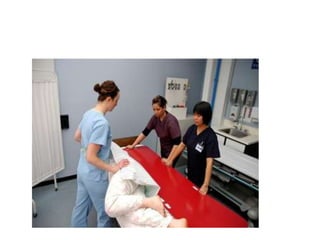
Log rolling of patient on to his side
• Identify patient and provide privacy
• Secure help from other nurses
• Elevate bed to waist high horizontal
position.
• Lock wheels
• Lower side rail on side opposite the
patient will be turned.
Log rolling of patient on to his side
• Stay on the same side of bed
• Lift patient as a unit
• First nurse places hands under
patient’s head and shoulder
• Second nurse places hands under
patient’s hips and legs.
Log rolling of patient on to his side
• Carry on till completion of action
• Place pillow lengthwise between
the patient’s legs and fold the
patient’s arm over chest
• Place additional pillows behind
the patient to maintain position
Body Mechanics of basic nursing and science