Edition 6
Lifting Guide
Lifting operations call for a very high level
of safety. The lifting equipment and the
way it is used are crucial to your safety
on site. For this reason, it is important to
choose a responsible supplier. Gunnebo
Lifting is a leading manufacturer of lifting
equipment. When it comes to quality we
leave nothing to chance. That is something
you can rely on.
Your partner in safe lifting
Edition 6, eng
Warning:
Failure to read, understand and comply with following instructions,
working load limits and specifications in this publication could
result in serious injury or damage to property.
Regular Inspection, Storage .  .  .  .  .  .  .  .  .  . 102-103
Inspection .  .  .  .  .  .  .  .  .  .  .  .  .  .  .  .  .  .  .  .  .  .  .  . 104-106
Chain .  .  .  .  .  .  .  .  .  .  .  .  .  .  .  .  .  .  .  .  .  .  .  .  .  .  .  . 107-111
Steel Wire Rope .  .  .  .  .  .  .  .  .  .  .  .  .  .  .  .  .  .  . 112-113
Components .  .  .  .  .  .  .  .  .  .  .  .  .  .  .  .  .  .  .  .  .  . 114-115
Soft Lifting Equipment .  .  .  .  .  .  .  .  .  .  .  .  .  . 116-117
Keeping a Register .  .  .  .  .  .  .  .  .  .  .  .  .  .  .  .  .  .  .  .  . 118
Inspection Planning .  .  .  .  .  .  .  .  .  .  .  .  .  .  .  .  . 120-121
Contents
Introduction .  .  .  .  .  .  .  .  .  .  .  .  .  .  .  .  .  .  .  .  .  .  .  .  .  .  .  .  . 4
The Ant and the Elephant  .  .  .  .  .  .  .  .  .  .  .  .  .  .  .  .  . 5
Standards, Laws and Regulations .  .  .  .  .  .  .  .  .  .  . 6-7
Expressions and Terms .  .  .  .  .  .  .  .  .  .  .  .  .  .  .  .  .  . 8-9
Safety and Responsibility .  .  .  .  .  .  .  .  .  .  .  .  .  .  . 10-13
Components of Lifting Equipment .  .  .  .  .  .  .  . 14-30
Check List for Safe Lifting  .  .  .  .  .  .  .  .  .  .  .  .  .  .  .  . 31
General .  .  .  .  .  .  .  .  .  .  .  .  .  .  .  .  .  .  .  .  .  .  .  .  .  .  .  . 50-75
Chain .  .  .  .  .  .  .  .  .  .  .  .  .  .  .  .  .  .  .  .  .  .  .  .  .  .  .  .  .  . 76-83
Steel Wire Rope .  .  .  .  .  .  .  .  .  .  .  .  .  .  .  .  .  .  .  .  . 84-93
Soft Lifting Equipment .  .  .  .  .  .  .  .  .  .  .  .  .  .  .  . 94-99
Signal diagram  .  .  .  .  .  .  .  .  .  .  .  .  .  .  .  .  .  .  .  . 100-101
Types of Lifting Equipment  .  .  .  .  .  .  .  .  .  .  .  .  . 32-35
Load Tables .  .  .  .  .  .  .  .  .  .  .  .  .  .  .  .  .  .  .  .  .  .  .  .  .  . 36-49
Lifting Equipment in General Page
Choosing the Right Equipment Page
When Lifting Page
Maintenance Page
4
This manual is your pocket guide to the use
of lifting equipment. It covers equipment
made of synthetic fibre, steel wire rope and
chain with associated master links, hooks and
couplings.
It consists of four colour-coded sections which
can be read individually when required:
Introduction
Gunnebo Lifting does not, however, in any
way claim that this manual covers all kinds of
lifting equipment or all lifting situations.
Maintenance
When Lifting
Choosing Lifting Equipment
Lifting Equipment in General
Lifting Equipment
5
There are many illustrations in this manual.
To make it more comprehensible we have
chosen to depict lifting operations with the
help of two creatures: the Ant, representing
the diligent and orderly working man and the
Elephant, representing the strength needed
when lifting heavy loads.
The two work as a team. Sometimes they show
what you should not do - in red - but more
often they show what you should do - in green.
The Ant and the Elephant
in General
6
Several organisations are involved in the
development of standards, legislation and
inspection procedures in the field of lifting.
We recommend that you obtain relevant
information from your national Health & Safety
Authority.
ISO, International Organization for
Standardization,
develops world-wide standards.
www.iso.org
CEN, Comité Européen de Normalisation,
develops European standards.
www.cenorm.org
ASTM, American Standardisation
Organizations.
www.astm.org
Standards, Laws
and Regulations
Lifting Equipment
7
in General
8
Lifting equipment is everything used to
connect a load to the crane hook, i.e. wire rope
slings, chain slings, roundslings, webbing slings,
lifting beams etc.
WLL (Working Load Limit) is the maximum
mass that the lifting equipment is authorized to
sustain in general lifting service.
BF (Breaking Force) is the maximum force
reached during the static tensile test.
SF (Safety Factor) is the relationship between
breaking force and WLL. Note! The safety
factors for chain, steel wire rope and soft slings
differ.
MPF (Manufacturing Proof Force) is the force
to which lifting equipment or components are
tested prior to delivery, by the manufacturer.
Expressions and Terms
Lifting Equipment
9
Total ultimate elongation is the elongation of
a chain at the moment of breaking, in percent,
of the original length. It is a measure of
toughness and ductility.
Effective Working Length (EWL) is the
length between the load bearing points of an
unloaded lifting sling or chain sling.
Effective length of a one-legged lifting sling with
two components.
Effective Working Length is stated on endless
sling.
in General
10
Be aware of the applicable safety regulations
for lifting in general. Responsibilities also rest
with the supplier/ manufacturer, who must:
• Take responsibility for damage and personal
injury caused by inferior equipment (so-called
product responsibility).
• Provide instructions for safe usage.
• Mark the equipment with the maximum
permitted load and the manufacturer's
designation.
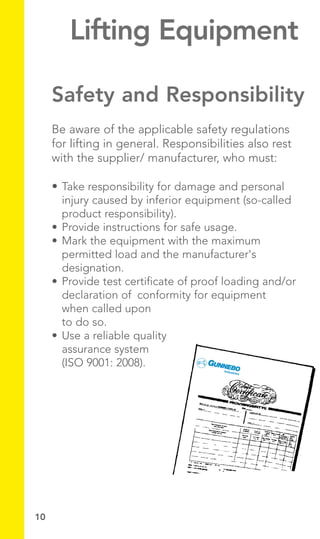
• Provide test certificate of proof loading and/or
declaration of conformity for equipment
when called upon
to do so.
• Use a reliable quality
assurance system
(ISO 9001: 2008).
Safety and Responsibility
Lifting Equipment
11
Product Responsibility
New and more demanding laws on product
responsibility have been adopted in the EU.
If an injured person is able to prove his/her
injury, a defect in the lifting equipment and a
connection between the injury and the defect,
the manufacturer (or importer) will be held
responsible. For this reason, it is important that
the manufacturer/importer is adequately insured.
Marking
Lifting assemblies must be supplied with an
resistant ID-tag including following information:
- W.L.L. and range of angles
- CE marking
- Individual identification mark
- Grade
- Manufacturers name
or symbol.
- Number of legs.
Steel wire rope slings
can be marked on
the ferrules, while soft
lifting slings should
have an ID-label.
in General
12
Safety and Responsibility
Quality Assurance
The demands on suppliers for quality
assurance systems, approved according to
ISO 9001:2008 are growing even stronger.
The ISO 9001 system ensures that the supplier
has documented routines for all activities which
may influence on customer related quality.
A third part auditor continuously assesses the
conformity of the quality system.
Lifting Equipment
13
Environmental responsibility
A manufacturer who is certified according to
ISO 14001 takes the necessary measures to
reduce the effect of their operations on the
environment. Choose a manufacturer that
values environmental responsibility to ensure a
sustainable environment in the future.
Quality Steel Meets International Standards
By close co-operation with our suppliers we
guarantee that the raw material complies with
our high demands.
We work continuously to improve our existing
range of products and develop new innovative
products in order to solve all possible kinds of
lifting situations.
Our Quality Assurance & Environmental
system, accredited to ISO 9001 and ISO 14001,
covers all processes from design to delivered
product, e.g. design, development, marketing,
production and distribution.
in General
14
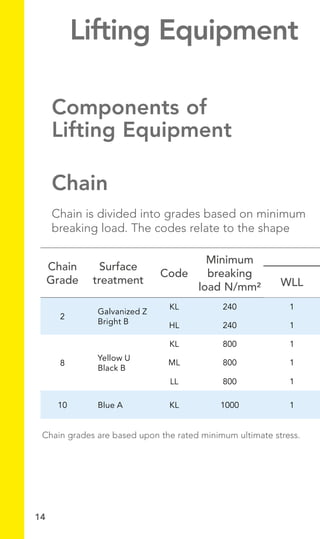
Chain grades are based upon the rated minimum ultimate stress.
Chain is divided into grades based on minimum
breaking load. The codes relate to the shape
Chain
Components of
Lifting Equipment
Lifting Equipment
Chain
Grade
Surface
treatment
Code
Minimum
breaking
load N/mm² WLL
2
Galvanized Z
Bright B
KL 240 1
HL 240 1
8
Yellow U
Black B
KL 800 1
ML 800 1
LL 800 1
10 Blue A KL 1000 1
15
of the link, short link (KL), medium length (HL)
and long link (LL) chain. Chains are also made
in different strength grades. Grade 8 and 10
chain are the most common in lifting
equipment.
Only use short link chain for lifting operations.
in General
Load factors
Typical use
MPF
Breaking
force
2.4 4.5
Farming, mooring, general use
2.4 5.2
2.5 4
General lifting (KL),
Container lashing (LL).
Extra heavy towing (ML), Lashing (KL, LL).
2.5 5
2.5 5
2.5 4 General lifting
Grade 2 and all HL, ML & LL chain must not be used for lifting
applicatons.
16
Lifting Equipment
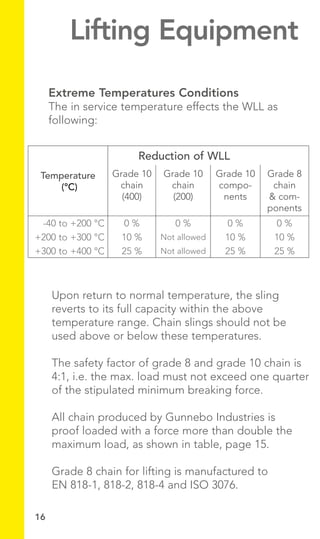
Extreme Temperatures Conditions
The in service temperature effects the WLL as
following:
Upon return to normal temperature, the sling
reverts to its full capacity within the above
temperature range. Chain slings should not be
used above or below these temperatures.
The safety factor of grade 8 and grade 10 chain is
4:1, i.e. the max. load must not exceed one quarter
of the stipulated minimum breaking force.
All chain produced by Gunnebo Industries is
proof loaded with a force more than double the
maximum load, as shown in table, page 15.
Grade 8 chain for lifting is manufactured to
EN 818-1, 818-2, 818-4 and ISO 3076.
Temperature
(°C)
Reduction of WLL
Grade 10
chain
(400)
Grade 10
chain
(200)
Grade 10
compo-
nents
Grade 8
chain
& com-
ponents
-40 to +200 °C 0 % 0 % 0 % 0 %
+200 to +300 °C 10 % Not allowed 10 % 10 %
+300 to +400 °C 25 % Not allowed 25 % 25 %
% of min. breaking force
Min. breaking force
Manufacturing proof force
Working load limit, safety factor 4:1
17
% elongation
Stress/elongation diagram
Chain grade 8, and grade 10 type KL
0 10 20 30 40 50 60
100
110
120
90
80
70
60
50
40
30
0
10
20
25
in General
18
The most common designs of steel wire rope
used in lifting equipment are:
• 114-wire rope (6 x 19+FC) with a fibre core
(diameter: approx. 3 to 8 mm)
• 216-wire rope (6 x 36+FC) with a fibre core
(diameter: approx. 6 to 60 mm)
• 133-wire rope (7 x 19+WSC) with a steel core,
intended for hot environments.
• 265-wire rope (6 x 36+IWRC) with a steel
core, intended for hot environments.
• 144-wire rope (6 x 24+7FC) for use in
shipping and disposable slings.
The nominal breaking strain of individual wires
in ropes must be 1770 N/mm2. The minimum
wire fill-factor of ropes must be 0.40.
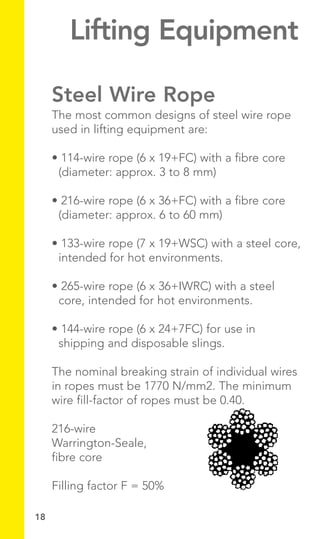
216-wire
Warrington-Seale,
fibre core
Filling factor F = 50%
Steel Wire Rope
Lifting Equipment
19
Steel Wire Rope Slings are manufactured according
to EN13414-1.
The working load limit can be decided either
from standard tables or when the angle to
the vertical and the centre of gravity is known
through trigonometric calculations.
The following formula can be used for calculating
the maximum load in cases where a wire design
can’t be found in the standard tables. The
calculation yields the maximum load on each leg
rounded off to the nearest hundred kgs, when
the lifting angle is 0°
WLL =
			
Where:
Fmin = The minimum breaking load of the rope
in kN
KT = allowed factor for the efficiency of the
termination
ZP = 5 (Safety Factor)
g = 9,81
Fmin x KT
Zp x g
in General
20
Location of the Mechanical
Splices or Ferrules.
The length (h) of the eye on a
steel wire rope must be at least
15 x d.
d = rope diameter
The distance between the two ferrules on
lifting slings must not be less than 20 x d.
For hand spliced lifting slings the minimum
length of plain rope shall be at least 15 x d.
The distance between the ferrules on a endless
sling must not be less than 3 x the length of the
ferrule. (unpressed).
L = Effective length of endless sling
Min 20Xd
Lifting Equipment
Acc. to EN 13411-3
21
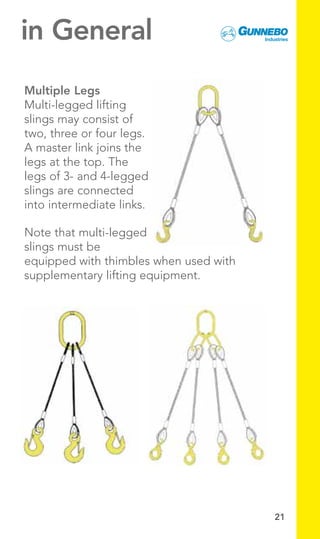
Multiple Legs
Multi-legged lifting
slings may consist of
two, three or four legs.
A master link joins the
legs at the top. The
legs of 3- and 4-legged
slings are connected
into intermediate links.
Note that multi-legged
slings must be
equipped with thimbles when used with
supplementary lifting equipment.
in General
22
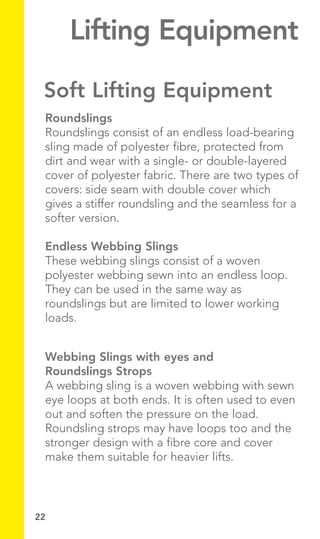
Roundslings
Roundslings consist of an endless load-bearing
sling made of polyester fibre, protected from
dirt and wear with a single- or double-layered
cover of polyester fabric. There are two types of
covers: side seam with double cover which
gives a stiffer roundsling and the seamless for a
softer version.
Endless Webbing Slings
These webbing slings consist of a woven
polyester webbing sewn into an endless loop.
They can be used in the same way as
roundslings but are limited to lower working
loads.
Webbing Slings with eyes and
Roundslings Strops
A webbing sling is a woven webbing with sewn
eye loops at both ends. It is often used to even
out and soften the pressure on the load.
Roundsling strops may have loops too and the
stronger design with a fibre core and cover
make them suitable for heavier lifts.
Soft Lifting Equipment
Lifting Equipment
23
Advice
One single cover heavy duty tube for the
roundsling is actually stronger than a double
cover tube with two thin layers. Our tests
show that the quality of the tube is of utmost
importance for the lifetime of the product.
We refute the argument that when the first
layer on a double cover sling is damaged you
can still use the sling because there is a risk
that sharp objects have entered in between the
layers and may cause hidden damage.
Another advantage with the single cover
roundsling is the protected label which also
makes the sling stiffer, so it can be passed
through narrow spaces.
in General
24
Material Properties
• Polyester is resistant to acids but not to
alkalis, e.g. ammonia and caustic soda.
• The melting point is 260°C, but polyester 		
lifting equipment must not be used with loads
or ambient temperatures above 100°C.
• The strength is not affected by water.
Water absorption is negligible.
• Note that friction and sharp edges can
quickly wear and cut polyester.
• Lifting equipment in polyester has a blue
identification tag.
• Polypropylene is less resistant to wear than 		
Polyester.
• Polypropylene can be damaged by solvents,
tars and paints.
• The melting point is 165°C.
• Polypropylene must not be used with loads
hotter than 80°C.
• Lifting equipment in polypropylene has a
brown identification tag.
Safety Factor
Roundslings and webbing slings = 7:1 according
to EN-standards.
Lifting Equipment
25
Lifting Components
The grade of the lifting components must match
the grade of the chain (usually grade 8 or grade
10). The size designation usually refers to the size
of the chain with the same strength, e.g.: G-10-10
= Coupling link, type G, suitable for
10 mm chain, grade 10 (max. load 4.0 tonnes)
Master links can be drop forged or forged and
welded from round steel. There are two basic
designs:
- Single master link, for one- and two-legged
lifting slings
- Master link, with sub-links for three- and
four-legged lifting slings.
Master Links
Master Link MF
For use with G-link
or CL & CLD
Master Link M
For use with
G-links
Master Link MG
“All-in-one” top link.
Master Link MT
For use with G-link
or CL & CLD
Master Link MGD
“All-in-one” top link
for 2-leg slings.
in General
26
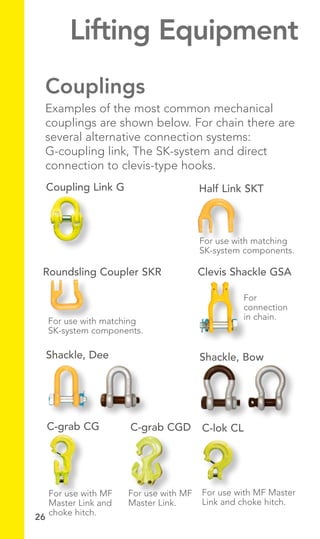
Examples of the most common mechanical
couplings are shown below. For chain there are
several alternative connection systems:
G-coupling link, The SK-system and direct
connection to clevis-type hooks.
Couplings
Clevis Shackle GSA
		
Half Link SKT
For use with matching
SK-system components.
Roundsling Coupler SKR
For use with matching
SK-system components.
Coupling Link G
Shackle, Dee Shackle, Bow
C-grab CG
For use with MF
Master Link and
choke hitch.
C-lok CL
For use with MF Master
Link and choke hitch.
C-grab CGD
For use with MF
Master Link.
Lifting Equipment
For
connection
in chain.
27
Eye hooks for steel wire rope and chain
(GrabiQ CL/CG )(G-coupling link/Berglok BL)
Safety Hook
BK/OBK
Will not open when
under direct load
and prevents the
hook from snagging
when lifting.
Sling Hook EKN
With latch to
help prevent
unintentional
unloading.
Sling Hook EK
Suitable when
latching hooks
cannot be used.
Foundry Hook OKE
With a wide opening to
accept large diameter.
Hooks
Swivel Safety Hook
BKL/LBK
Grab Hook OG
No load derating.
Supporting bridge prevents
chain deformation.
Swivel Latch Hook LKN
With a swivelling eye to
enable rotation.
With a swivelling eye
to enable rotation.
in General
28
Clevis-type hooks for direct connection to chain
Sling Hook
EGKN
Sling Hook
EGK
Safety Hook
GBK/BKG
Roller Bearing
Swivel SKLI
Sling Hook
ESKN/SKN,
ESKH/SKH
Master Link
SKG / SKO
SK-System
Used to insulate the
lifted load to enable safe
welding. Max. 1000 V.
Lubricated, sealed and
fully rotational even at
maximum load.
With latch to
prevent
unintentional
unloading.
Suitable when
latching hooks
can not be used.
Will not open when
under direct load and
prevents the hook from
snagging when lifting.
Lifting Equipment
ESKN/SKN
with latch
ESKH/SKH
without latch
SKG closed
master link
and SKO open
master link.
Rotating Lifting Points
RELP, compact
and robust,
ideal for top-
mounting.
RLP, has an
easily dis-
mountable
D-ring.
DLP
De-centered
Lifting Point
BLP
Ball-bearing
Lifting Point
29
Assembly of Clamps
Before assembly, make sure that the clamps are
cleaned and that bolts and nuts are greased.
The bolts should be tightened gradually and evenly
to the correct torque level. After the first loading the
bolts should be re-tightened. We recommend that
the user will tighten the bolts again after some few
weeks of use. (a few days to 3 weeks depending on
the amount of use)
Steel Rope Components
for Lifting Equipment
Thimble
Clamping Thimble
Steel Rope Clamp
Place the clamps like this:
Min. clamps for max work load.
Type
Wire diam mm
Min. cllamps 3
5-6
N-6 N-8 N-9 N-10 N-12 N-16 N-20 N-25 N-35
7-8 9 10 11-12 13-16 17-20 21-25 26-35
4 5 6 7
Reduce the steel rope capacity by 20%.
in General
30
Many lifting accessories and components are
made for specific load types, e.g.:
• Custom-made lifting beams
• Pallet forks
• Steel plate clamps
• Drum lifters etc.
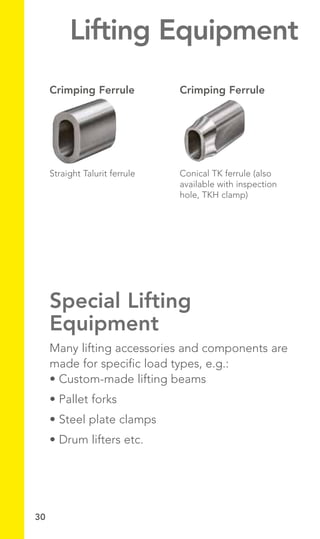
Crimping Ferrule Crimping Ferrule
Straight Talurit ferrule Conical TK ferrule (also
available with inspection
hole, TKH clamp)
Special Lifting
Equipment
Lifting Equipment
31
Checklist for Safe Lifting
• Confirm the weight of the load.
• Choose a safe and suitable lifting method.
• Consider all the angles.
• Choose suitable equipment.
• Attach the load and check:
- the centre of gravity
- if there is a risk of rotation
- if there is a risk of sliding
- that the load will stay together
• Position yourself - keep your back clear.
• Never stand or walk under the suspended
load.
• Test-lift until the load just clears the ground,
then check the load distribution.
• Never drag the load with equipment.
• Take note of the max. load. Never overload.
• Ensure the landing area is strong enough to
support the load.
in General
32
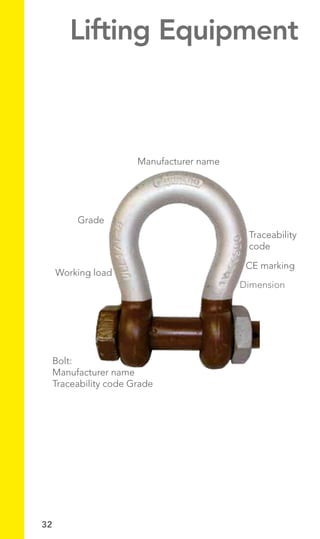
Bolt:
Manufacturer name
Traceability code Grade
Manufacturer name
Traceability
code
CE marking
Dimension
Grade
Working load
Lifting Equipment
33
Manufacturer
identification H32
Component code,
dimension and grade
Traceability code
Manufacturer name
in General
34
Check the list below every time you are facing
a new lifting situation.
Checklist
• Make a good estimate of the lifting and
transportation requirements.
• Find out the weight of the load.
• Choose appropriate lifting equipment.
• Decide the best way to attach the lifting
equipment to the load, considering its
centre of gravity and configuration.
• Choose appropriate lifting equipment with
sufficient capacity. Note that the sling leg
loadings rise as the angle between the sling
legs increases.
Lifting Equipment Differences
The fields of application for the three main
types of lifting equipment (chain, steel wire
rope and soft lifting equipment) overlap.
For this reason, you may often choose the
type you are most familiar with, but there are
differences in properties you should be
aware of:
Types of Lifting
Equipment
Choosing
35
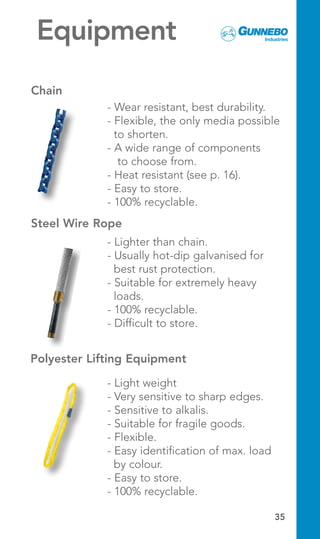
- Light weight
- Very sensitive to sharp edges.
- Sensitive to alkalis.
- Suitable for fragile goods.
- Flexible.
- Easy identification of max. load
by colour.
- Easy to store.
- 100% recyclable.
Chain
- Wear resistant, best durability.
- Flexible, the only media possible
to shorten.
- A wide range of components
to choose from.
- Heat resistant (see p. 16).
- Easy to store.
- 100% recyclable.
Steel Wire Rope
- Lighter than chain.
- Usually hot-dip galvanised for
best rust protection.
- Suitable for extremely heavy
loads.
- 100% recyclable.
- Difficult to store.
Polyester Lifting Equipment
Equipment
36
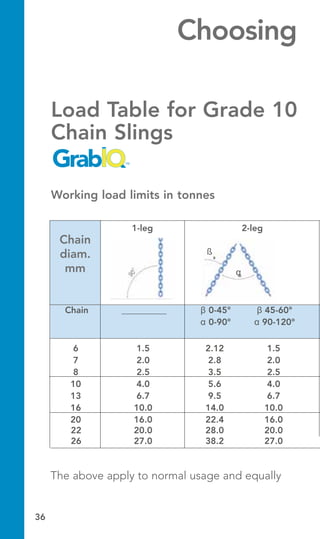
Load Table for Grade 10
Chain Slings
Working load limits in tonnes
The above apply to normal usage and equally 		
1-leg 2-leg
Chain __________ β 0-45° β 45-60°
			 α 0-90° α 90-120°
6 1.5 2.12 1.5
7 2.0 2.8 2.0
8 2.5 3.5 2.5
10 4.0 5.6 4.0
13 6.7 9.5 6.7
16 10.0 14.0 10.0
20 16.0 22.4 16.0
22 20.0 28.0 20.0
26 27.0 38.2 27.0
α
ß
Chain
diam.
mm
Choosing
37
loaded legs.
In the case of asymmetric loading
• 2-legged sling calculated as the corresponding
1-leg sling.
• 3- and 4-legged sling calculated as the
corresponding 1-leg sling (If it is certain that
2-legs are equally carrying the major part of the
load it can be calculated as the corresponding
2-legged sling.
3-leg 4-leg 2-leg choke hitch
β 0-45° β 45-60° β 0-45° β 45-60°
α 0-90° α 90-120° α 0-90° α 90-120°
3.15 2.24 1.6 1.2
4.2 3.0 2.2 1.6
5.2 3.7 2.7 2.0
8.4 6.0 4.4 3.2
14.0 10.0 7.4 5.3
21.0 15.0 11.0 8.0
33.6 24.0 17.6 12.8
42.0 30.0 22.0 16.0
57.3 40.5 29.7 21.6
α α
β β
Equipment
β
α
α
β
38
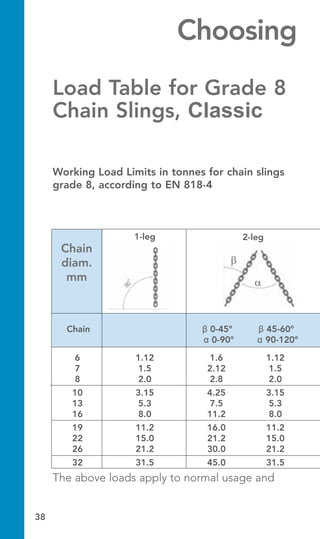
Load Table for Grade 8
Chain Slings, Classic
Working Load Limits in tonnes for chain slings
grade 8, according to EN 818-4
The above loads apply to normal usage and 		
Choosing
1-leg 2-leg
Chain		 β 0-45° β 45-60°
			 α 0-90° α 90-120°
6 1.12 1.6 1.12
7 1.5 2.12 1.5
8 2.0 2.8 2.0
10 3.15 4.25 3.15
13 5.3 7.5 5.3
16 8.0 11.2 8.0
19 11.2 16.0 11.2
22 15.0 21.2 15.0
26 21.2 30.0 21.2
32 31.5 45.0 31.5
Chain
diam.
mm
b
a
39
equally loaded legs.
In the case of asymmetric loading
• 2-legged sling calculated as the corresponding
1-leg sling.
• 3- and 4-legged sling calculated as the
corresponding 1-leg sling (If it is certain
that 2-legs are equally carrying the major part
of the load it can be calculated as the
corresponding 2-legged sling).
Equipment
3-leg 4-leg Choked endless sling
β 0-45° β 45-60°
α 0-90° α 90-120°
2.36 1.7 1.8
3.15 2.24 2.5
4.25 3.0 3.15
6.7 4.75 5.0
11.2 8.0 8.5
17.0 11.8 12.5
23.6 17.0 18.0
31.5 22.4 23.6
45.0 31.5 33.5
67.0 47.5 50.0
b
b
a
a
Ma
Lin Ø
mm
Enkel 2-partig*
Rakt Snarat U-form
α0°-90°
β0°-45°
3 0,09 0,07 0,18 0,12
4 0,15 0,12 0,30 0,21
5 0,25 0,20 0,50 0,35
6 0,35 0,28 0,70 0,50
7 0,50 0,40 1,00 0,70
8 0,75 0,60 1,50 1,10
9 0,90 0,80 1,80 1,26
10 1,20 0,95 2,40 1,70
11 1,40 1,10 2,80 2,00
12 1,70 1,30 3,40 2,40
13 2,00 1,60 4,00 2,80
14 2,30 1,80 4,60 3,20
16 3,00 2,40 6,00 4,20
18 3,80 3,10 7,60 5,30
20 4,70 3,80 9,40 6,60
22 5,70 4,60 11,40 8,00
24 6,80 5,40 13,60 9,50
26 8,00 6,40 16,00 11,20
28 9,30 7,40 18,60 13,00
32 12,00 9,70 24,00 16,80
36 15,00 12,00 30,00 21,00
40 19,00 15,00 38,00 27,00
44 23,00 18,00 46,00 32,00
48 27,00 22,00 54,00 38,00
52 32,00 26,00 64,00 45,00
56 37,00 30,00 74,00 52,00
60 43,00 34,00 86,00 60,00
40
Choosing
Load Table for Steel Wire
Rope with Fibre Core
acc.to EN 13414-1
Nom. diam.
mm
Straight
2-leg
Working Load Limit
Choke hitch Basket hitch
1-leg
ax last i ton
3- & 4-partig* Ändlös
α90°-120°
β45°-60°
α0°-90°
β0°-45°
α90°-120°
β45°-60°
Rakt Snarat U-form
0,09 0,19 0,13 0,18 0,14 0,36
0,15 0,31 0,22 0,30 0,24 0,60
0,25 0,50 0,35 0,50 0,40 1,00
0,35 0,70 0,50 0,70 0,55 1,40
0,50 1,00 0,75 1,00 0,80 2,00
0,75 1,60 1,10 1,40 1,20 3,00
0,90 2,00 1,40 1,80 1,50 3,60
1,20 2,50 1,80 2,40 1,90 4,80
1,40 3,00 2,20 2,80 2,30 5,60
1,70 3,60 2,60 3,40 2,70 6,80
2,00 4,20 3,00 4,00 3,20 8,00
2,30 4,80 3,50 4,60 3,70 9,20
3,00 6,30 4,50 6,00 4,80 12,00
3,80 8,00 5,70 7,60 6,10 15,20
4,70 10,00 7,10 9,40 7,60 18,80
5,70 12,00 8,50 11,40 9,20 23,00
6,80 14,30 10,20 13,60 11,00 27,00
8,00 16,80 12,00 16,00 12,80 32,00
9,30 19,50 14,00 18,60 15,00 37,00
12,00 25,50 18,00 24,00 19,50 48,00
15,00 32,00 23,00 30,00 25,00 60,00
19,00 40,00 28,50 38,00 30,00 76,00
23,00 48,00 34,00 46,00 37,00 92,00
27,00 57,00 41,00 54,00 44,00 108,00
32,00 67,00 48,00 64,00 51,00 128,00
37,00 78,00 56,00 74,00 60,00 148,00
43,00 90,00 64,00 86,00 68,00 172,00
41
Equipment
The table below shows the maximum permitted load for the
most common steel rope slings, tensile grade 1770/1960 N/
mm². (Ø 3-7 mm 114-tr 1770 N/mm², Ø 8-60 mm 216-tr 1960
N/mm²).
in tonnes
3- & 4-leg Endless
Straight Choke hitch Basket hitch
42
Load Table for Steel Wire
Rope with Steel Core
Acc. to EN 13414-1
Choosing
Working Load
Lin Ø
mm
1-leg 2-leg
Straight Choke hitch Basket hitch
α0°-90°
β0°-45°
3 0,10 0,08 0,20 0,14
4 0,17 0,14 0,34 0,24
5 0,27 0,22 0,54 0,38
6 0,38 0,30 0,76 0,53
7 0,53 0,42 1,06 0,74
8 0,80 0,65 1,60 1,15
9 1,05 0,80 2,10 1,45
10 1,30 1,00 2,60 1,80
11 1,50 1,20 3,00 2,20
12 1,80 1,40 3,60 2,60
13 2,20 1,80 4,40 3,00
14 2,50 2 5,00 3,50
16 3,30 2,60 6,60 4,60
18 4,10 3,30 8,20 5,80
20 5,10 4,10 10,20 7,20
22 6,20 5,00 12,40 8,70
24 7,40 5,90 14,80 10,30
26 8,70 7,00 17,40 12,10
28 10,00 8,00 20,00 14,00
32 13,00 10,40 26,00 18,40
36 16,60 13,30 33,00 23,00
40 20,50 16,40 41,00 29,00
44 25,00 20,00 50,00 35,00
48 29,50 23,60 59,00 41,00
52 35,00 28,00 70,00 48,00
56 40,00 32,00 80,00 56,00
60 46,00 37,00 92,00 65,00
43
Equipment
Limit in Tonnes
3- & 4-leg Endless
α90°-120°
β45°-60°
α0°-90°
β0°-45°
α90°-120°
β45°-60°
Straight Choke hitch Basket hitch
0,10 0,21 0,15 0,20 0,16 0,40
0,17 0,36 0,25 0,34 0,27 0,68
0,27 0,56 0,41 0,54 0,43 1,08
0,38 0,80 0,57 0,76 0,61 1,52
0,53 1,10 0,80 1,06 0,85 2,12
0,80 1,70 1,20 1,60 1,30 3,20
1,05 2,20 1,80 2,10 1,70 4,20
1,30 2,70 1,90 2,60 2,00 5,20
1,50 3,30 2,30 3,00 2,50 6,00
1,80 3,90 2,80 3,60 3,00 7,20
2,20 4,50 3,20 4,40 3,50 8,80
2,50 5,30 3,80 5,00 4,00 10,00
3,30 6,90 4,90 6,60 5,20 13,20
4,10 8,70 6,20 8,20 6,60 16,40
5,10 10,70 7,70 10,20 8,20 20,40
6,20 13,00 9,30 12,40 10,00 24,80
7,40 15,50 11,10 14,80 11,80 29,60
8,70 18,20 13,00 17,40 13,80 34,80
10,00 21,00 15,00 20,00 16,00 40,00
13,00 27,50 19,70 26,00 21,00 52,00
16,60 35,00 25,00 33,00 26,50 66,00
20,50 43,00 31,00 41,00 33,00 82,00
25,00 52,00 37,00 50,00 40,00 100,00
29,50 62,00 44,00 59,00 47,00 118,00
35,00 73,00 52,00 70,00 55,00 140,00
40,00 84,00 60,00 80,00 64,00 160,00
46,00 97,00 69,00 92,00 74,00 184,00
The table below shows the maximum permitted load for the
most common steel rope slings, tensile grade 1770/1960 N/
mm². (Ø 3-7 mm 133-tr 1770 N/mm², Ø 8-60 mm 265-tr 1960
N/mm²).
Steel Rope Slings
When planning a lift where technical data on
weight , centre of gravity etc. are known,
trigonometrics may be used for calculating the
maximum load on the lifting equipment. Basis for
the calculation is the column for 1-legged slings,
or the following formula:
WLL =
Where
Fmin = The minimum breaking load of the rope
		 in kN
KT = allowed factor for the efficiency of the
		termination
ZP = 5 (Safety Factor)
g = 9,81
The calculation yields the max. load on each leg
when the lifting angle is 0º, rounded off to the
nearest hundred kgs.
Max. Load for Multi-legged Equipment
If the table is not used, the max. load must be
calculated. The result of the above formula,
representing the max. load on a 1-legged sling,
shall be multiplied by a factor according to the
following table:
44
Fmin x KT
Zp x g
Choosing
45
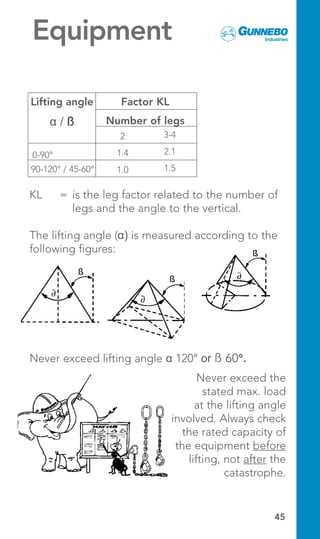
Factor KL
Number of legs
KL = is the leg factor related to the number of
		 legs and the angle to the vertical.
The lifting angle (α) is measured according to the
following figures:
Lifting angle
α / ß
2
1.4
1.0
3-4
2.1
1.5
90-120° / 45-60°
Equipment
Never exceed the
stated max. load
at the lifting angle
involved. Always check
the rated capacity of
the equipment before
lifting, not after the
catastrophe.
Never exceed lifting angle α 120° or ß 60°.
0-90°
Choosing
46
R
e
d
u
c
ti
o
n
o
f
W
L
L
4
%
In
c
re
a
s
e
d
fo
rc
e
w
it
h
4
%
=
5
2
0
k
g
In
c
re
a
s
e
d
fo
rc
e
w
it
h
4
%
=
5
2
0
k
g
6
%
=
5
3
0
k
g
1
0
%
=
5
5
0
k
g
1
6
%
=
5
8
0
k
g
2
2
%
=
6
1
0
k
g
3
0
%
=
6
5
0
k
g
4
2
%
=
7
1
0
k
g
56%
=
780
kg
74%
=
870 kg
100%
= 1000 kg
136% = 1180 kg
192% = 1460 kg
286% = 1930 kg
5
.5
%
9
%
1
4
%
1
8
%
2
3
%
30%
36%
42.5%
50%
57.6%
65.8%
74%
30°
40°
50°
60°
70°
80°
90°
100°
110°
120°
130°
140°
150°
Load: 1000 kg
500
kg
500
kg
R
e
d
u
c
ti
o
n
o
f
W
L
L
4
%
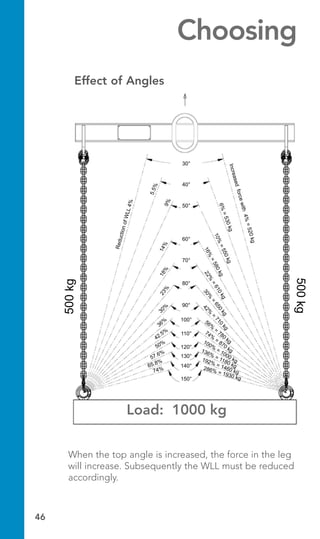
Effect of Angles
When the top angle is increased, the force in the leg
will increase. Subsequently the WLL must be reduced
accordingly.
Equipment
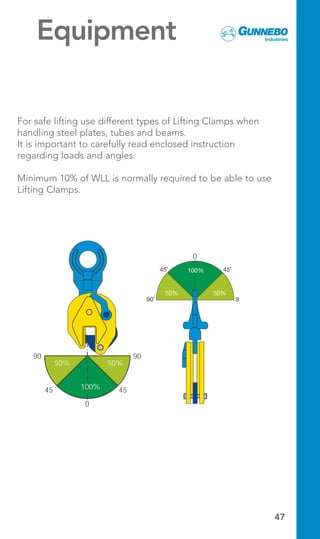
For safe lifting use different types of Lifting Clamps when
handling steel plates, tubes and beams.
It is important to carefully read enclosed instruction
regarding loads and angles.
Minimum 10% of WLL is normally required to be able to use
Lifting Clamps.
47
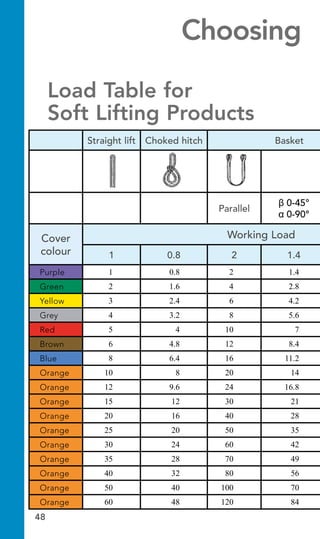
Load Table for
Soft Lifting Products
Choosing
48
Straight lift Choked hitch Basket
Parallel
β 0-45°
α 0-90°
Cover
colour
Working Load
1 0.8 2 1.4
Purple 1 0.8 2 1.4
Green 2 1.6 4 2.8
Yellow 3 2.4 6 4.2
Grey 4 3.2 8 5.6
Red 5 4 10 7
Brown 6 4.8 12 8.4
Blue 8 6.4 16 11.2
Orange 10 8 20 14
Orange 12 9.6 24 16.8
Orange 15 12 30 21
Orange 20 16 40 28
Orange 25 20 50 35
Orange 30 24 60 42
Orange 35 28 70 49
Orange 40 32 80 56
Orange 50 40 100 70
Orange 60 48 120 84
49
Equipment
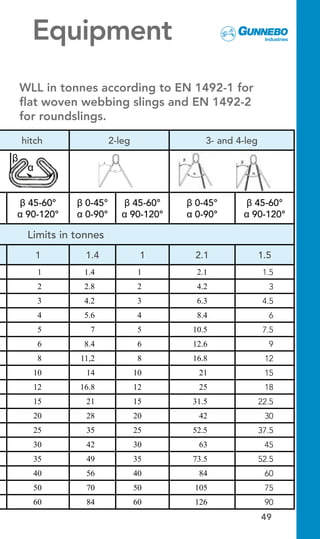
WLL in tonnes according to EN 1492-1 for
flat woven webbing slings and EN 1492-2
for roundslings.
hitch 2-leg 3- and 4-leg
β 45-60°
α 90-120°
β 0-45°
α 0-90°
β 45-60°
α 90-120°
β 0-45°
α 0-90°
β 45-60°
α 90-120°
Limits in tonnes
1 1.4 1 2.1 1.5
1 1.4 1 2.1 1.5
2 2.8 2 4.2 3
3 4.2 3 6.3 4.5
4 5.6 4 8.4 6
5 7 5 10.5 7.5
6 8.4 6 12.6 9
8 11,2 8 16.8 12
10 14 10 21 15
12 16.8 12 25 18
15 21 15 31.5 22.5
20 28 20 42 30
25 35 25 52.5 37.5
30 42 30 63 45
35 49 35 73.5 52.5
40 56 40 84 60
50 70 50 105 75
60 84 60 126 90
β
α
β
α
50
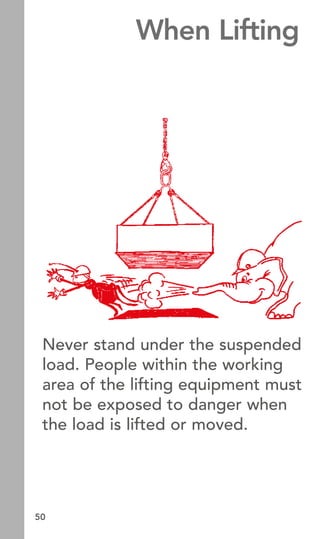
Never stand under the suspended
load. People within the working
area of the lifting equipment must
not be exposed to danger when
the load is lifted or moved.
When Lifting
51
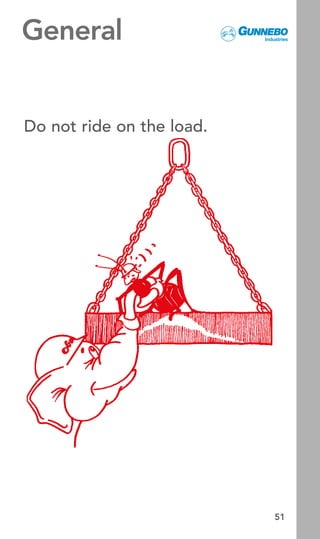
Do not ride on the load.
General
52
Be careful where you stand in
relation to the load when lifting.
The load might slip and cause
injury. Keep your back clear.
When Lifting
53
Lift vertically. Otherwise the load
will swing horizontally when
clearing the ground.
General
54
Avoid snatch loading. Do not
expose the equipment to
unnecessary strain, for example
sudden jerks.
When Lifting
55
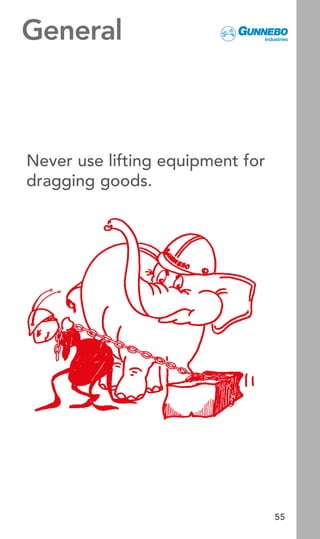
Never use lifting equipment for
dragging goods.
General
56
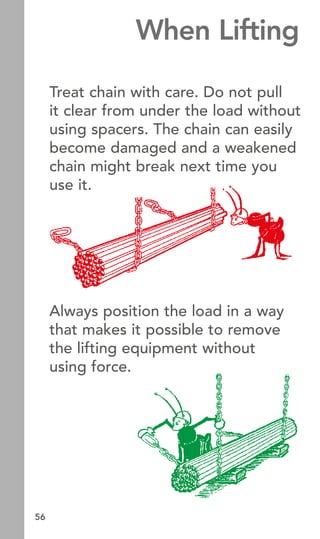
Treat chain with care. Do not pull
it clear from under the load without
using spacers. The chain can easily
become damaged and a weakened
chain might break next time you
use it.
Always position the load in a way
that makes it possible to remove
the lifting equipment without
using force.
When Lifting
57
Avoid choke-hitching, as loads
can tip over.
General
58
Never point load the
hook. Use an eyebolt
with a larger eye or
connect with a
suitable shackle.
When Lifting
59
Never force a
master link on
to a hook. Use
a hook with a
larger opening.
Hooks should
be fitted with
latches, whenever practicable.
General
60
Use sheet-metal clamps when
lifting sheet-metal packs.
Point loading of hooks is not
allowed.
When Lifting
61
Test-lift by carefully lifting the
load just clear of the ground.
Check the load security and
angles before continuing. When
frequently using a sling to its
maximum load, we recommend
increasing the sling size by one
dimension.
General
62
Handle the load with care.
Raise and lower it gently and
avoid snatching.
When Lifting
63
Grip the hook by its sides
with your fingertips only,
never with your entire hand,
otherwise your fingers
might be crushed.
General
64
When connecting to lifting eyes,
make sure that the hooks/eyes
are turned the right way (facing
outwards). A rotating lifting
point (RLP) will automatically
adjust itself to the right position.
When Lifting
65
Do not side load the hook.
General
66
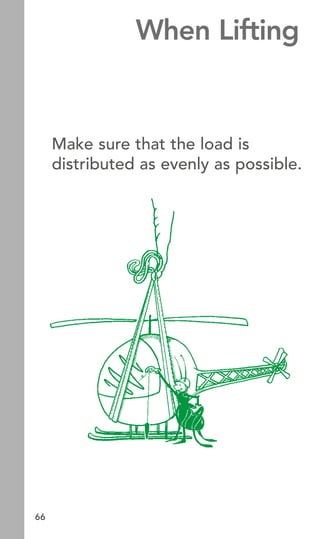
Make sure that the load is
distributed as evenly as possible.
When Lifting
67
Never lift with ropes or bands
intended for wrapping. They are
only intended for keeping the
goods together, not for lifting.
General
68
Note that the pressure increases
as the lifting angle grows. Use
the pressure correctly.
When Lifting
69
Correct usage of pressure.
General
70
Use a spreader beam. When
using basket slings, make an
extra turn around the load to
get a firm hold. This effectively
prevents the load from sliding.
When Lifting
71
Use a steering rope to control
rotation when lifting long loads.
General
72
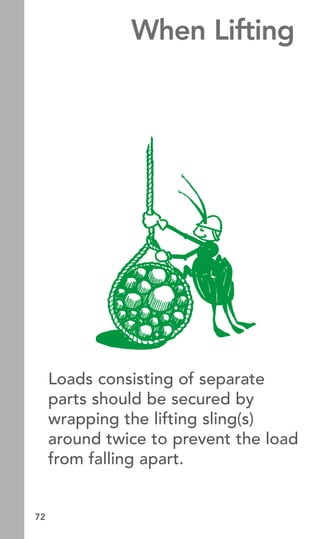
Loads consisting of separate
parts should be secured by
wrapping the lifting sling(s)
around twice to prevent the load
from falling apart.
When Lifting
73
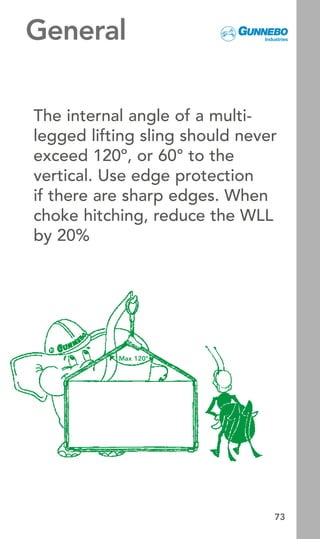
The internal angle of a multi-
legged lifting sling should never
exceed 120º, or 60° to the
vertical. Use edge protection
if there are sharp edges. When
choke hitching, reduce the WLL
by 20%
Max 120°
General
74
When Lifting
Incorrect alignment causes
excessive strain on this shackle
when lifting or pulling.
Correct alignment.
(or use RLP/ERLP)
75
General
Avoid applications which may cause
the shackle pin to rotate.
		Reduction for side loading
Load angle New Working Load (WLL)
0°		 100% of original WLL
45°		 70% of original WLL
90°		 50% of original WLL
Side load should be avoided as the
products are not designed for this
purpose. When side loading is
unavoidable the working load limit
of the shackle must be reduced
76
A chain is never stronger than
its weakest link. Do not repair
broken chains
with wires, bolts
or by welding.
Replace the
entire damaged
chain length.
When Lifting
77
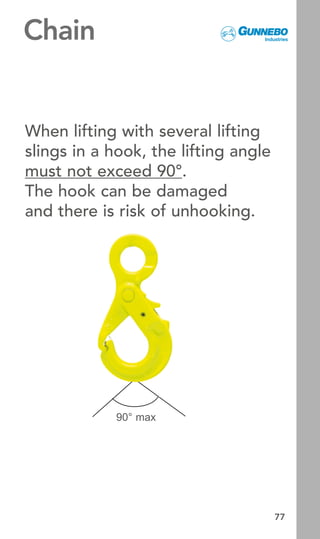
When lifting with several lifting
slings in a hook, the lifting angle
must not exceed 90°.
The hook can be damaged
and there is risk of unhooking.
Chain
90° max
78
When welding or cutting, make
sure that the lifting equipment
is not affected by the heat
involved, as it can damage the
heat treatment of the chain.
When Lifting
79
Do not handle chain violently,
especially when under load.
Chain
80
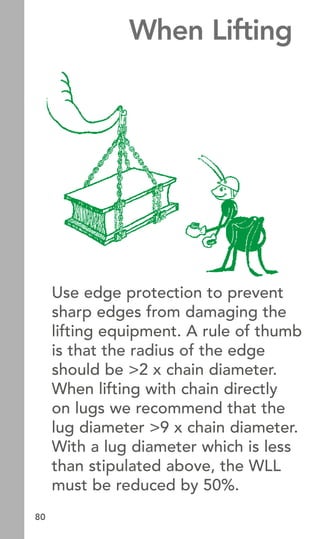
Use edge protection to prevent
sharp edges from damaging the
lifting equipment. A rule of thumb
is that the radius of the edge
should be >2 x chain diameter.
When lifting with chain directly
on lugs we recommend that the
lug diameter >9 x chain diameter.
With a lug diameter which is less
than stipulated above, the WLL
must be reduced by 50%.
When Lifting
81
Use shortening hooks when
lifting asymmetric loads.
Avoid lopsided lifting.
Chain
Use edge protectors to prevent
sharp edges from damaging the
chain. If lifting over sharp edges
reduce the working
load with the
following reduction
factor.
Edge load R > 2 x chain Ø R > chain Ø R < chain Ø
Reduction factor 1.0 0.7 0.5
Hard
material
R
(Radius)
82
Do not connect directly to the
chain by forcing a link on to the
hook. Always use a master link.
When Lifting
83
Never lift with a
twisted chain.
Severe environments
Chain and components
in grade 8 and grade
10 must not be used in
alkaline (> pH10) or
acidic conditions (< pH6).
Comprehensive and regular
examination must be carried out
when used in severe or corrosive
inducing environments, if using in
an uncertain situation, contact the
manufacturer. Remember - The
user is responsible for incorrect
handling or failure to comply with
applicable regulations.
Chain
84
Never join wire rope slings
by knotting, always
use a shackle.
X
X = Recommended
pin diameter 4-8 x wire
diam. for best endurance.
When Lifting Steel
85
6d = 100%
5d = 85%
4d = 80%
3d = 70%
2d = 65%
1d = 50%
The strength of steel wire rope
is reduced by bending.
The de-rating is related to the
diameter of the bend as follows
(d = diameter of the steel rope):
Wire Rope
86
Use protective gloves when
handling steel wire rope.
When Lifting Steel
87
Never shorten steel rope
by knotting.
Wire Rope
88
Do not wind the rope around
a ramshorn hook to prevent
slipping.
The bending
will be too
sharp and
cause damage
to the rope.
When Lifting Steel
89
Use a suitable spacer to prevent
the ropes from sliding. Avoid
sharp bending of the rope. The
load can slip if the lifting points
slide. Sharp bending damages
the rope.
Wire Rope
90
Bending like this will
immediately destroy
the rope. Use lifting
slings with hooks
instead.
When Lifting Steel
91
A two-legged lifting
sling with a single
ferrule fitted like
this can be
lethal. The
tearing force
at the clamp
grows with the
lifting angle.
Wire Rope
92
Do not expose steel wire rope to
excessive heat or cold.
Steel wire rope with fibre core and
aluminium ferrule, max 100°C.
Steel wire rope with steel core and
aluminium ferrule, max 150°C.
Steel wire rope with steel core hand
spliced, max 150°C = 100 % of WLL,
max 200° = 90 % of WLL, max
400°C 60%, of WLL.
Do not use at temperatures below
–40ºC without consulting the
manufacturer.
According to EN 13414-2
When Lifting Steel
93
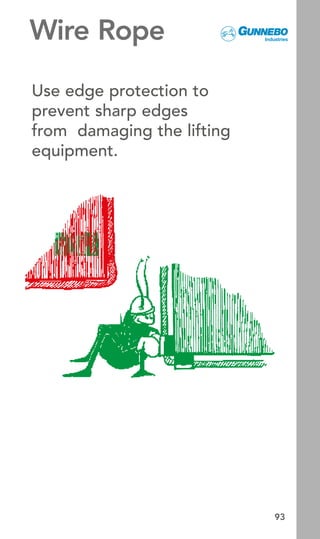
Use edge protection to
prevent sharp edges
from damaging the lifting
equipment.
Wire Rope
94
Tonnes Min. pin Min. free
		 diameter contact width
			
1 23 mm 35 mm
2 32 mm 40 mm
3 35 mm 47 mm
4 38 mm 50 mm
5 42 mm 53 mm
6 46 mm 60 mm
8 50 mm 67 mm
10 56 mm 75 mm
12 58 mm 80 mm
15 70 mm 96 mm
20 78 mm 104 mm
25 84 mm 112 mm
30 90 mm 120 mm
35 96 mm 128 mm
40 102 mm 136 mm
50 120 mm 160 mm
Recommended contact areas
for Polyester roundsling 7:1
Note: If smaller dimensions are used it will
affect the safety because the roundsling
may become damaged. In practice, the WLL
(maximum load) must be reduced.
When Lifting Soft
Use hooks with rounded
edges and an inner
radius not less than the
webbing width.
95
Soft slings are very sensitive
to cutting. Lift vertically and
use protective sleeving and/
or edge protection to keep
the equipment from directly
contacting sharp corners
and edges.
Equipment
96
Polyester lifting strops and slings
are made of synthetic fibre and
must not be used with loads or
ambient conditions exceeding
100°C. Hot materials require the
use of steel wire rope or chain.
When Lifting Soft
97
Keep soft lifting equipment
away from alkalis such as
caustic soda and ammonia.
The colour fades and the
slings disintegrate.
Equipment
98
Do not shorten soft lifting slings
by knotting. They quickly
weaken. Avoid overloading.
When Lifting Soft
99
Note that the maximum load of
roundslings in connection
with choke or basket
hitching assumes
vertical legs
(see table on
p. 48-49).
If the load is placed
inside the roundsling,
the max load should
be calculated as
straight lifting
(see table on
p. 48-49)
Equipment
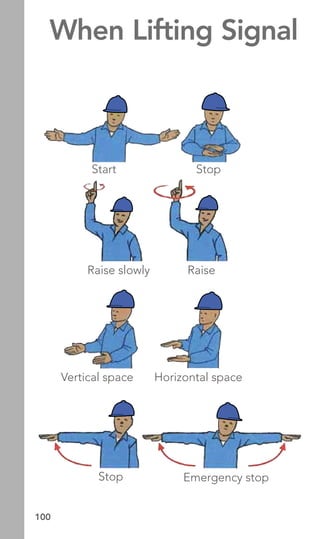
When Lifting Signal
100
Start Stop
Stop
Raise slowly Raise
Vertical space Horizontal space
Emergency stop
Schedule
101
To the left To the right
Move to
Lower slowly Lower
I did not understand
the signal
Alternatively, stop and
emergency stop
102
Lifting equipment must be checked on a
continual basis and be inspected in accordance
with standards and industrial safety legislation.
The responsibility for carrying this out rests with
the site management.
Regular inspection includes functional checks,
as well as the adjustments and maintenance
that may be required from time to time.
Inspections must be carried out by people
possessing sufficient knowledge of design, use
and maintenance of lifting equipment.
Damaged or worn equipment must be reported
to the site management, who in turn, must
arrange for the equipment to be taken out of
use and then be repaired or replaced.
Lifting equipment having been stored for a
period of time must be inspected before being
taken back into use, according to local statutory
requirements.
In addition to regular inspection, which must be
thoroughly recorded, everyone working with
lifting equipment must be on guard and inspect
the equipment before every use.
New equipment should be registered and
controlled before use.
Regular inspection
Maintenance
103
Storage
Dragging or dropping the equipment can
cause
damage and should be avoided.
Arrange for appropriate
storage, preferably at an
even temperature.
Good storage
preserves the
equipment and
helps you find
what you need
faster. Chain and
steel wire rope
stored for long
periods should
be rust protected.
Soft slings and
strops should not
be exposed to
bright sunlight for
any long periods
of time. Choose a
storage location
accordingly.
104
Lifting equipment must be inspected regularly.
Good lighting without shadows is necessary
during inspection.
Check
Check / inspect the equipment regularly.
Make sure that repairs are made when needed.
Inspection
Maintenance
105
When inspecting soft lifting slings or strops: put
the equipment, stretched to its full length, on a
table. Turn eyes on the equipment inside out
and inspect for wear or damage. Inspect
webbing one side at a time. When inspecting
endless slings it is recommended to run them
around a revolving pin, or similar.
106
Before inspecting a chain it must be thoroughly
cleaned of dirt and oil. All cleaning methods
that do not damage the base material are
acceptable. No methods that cause hydrogen
embrittlement or overheating are allowed, nor
methods that remove base material or move
material in a way that might hide cracks or
other visible damage.
In some countries, according to legislation,
when a chain sling is older than 25 years it
should be noted in the register. There is risk
of fatigue, environmental impact etc. Consider
reviewing the history and current use of the
chain sling e.g. How often and how much
you lift, the environment it has been, and is,
currently used in.
Maintenance
107
Chain
The illustration below, showing the distribution
of strain in a link, can be of guidance for
decisions on chain wear and damage.
The stress distribution in the link is very
favourable.
Tensile stresses are the most important to chain
strength. They are concentrated to the most
protected areas of the link: the outside of the
short side and the inside of the long side.
The relatively harmless compressive stresses
are distributed the opposite way around, i.e.
where link wear is at its maximum. Here the link
can wear down significantly without any major
effect on chain strength.
Keeping strain distribution in mind, we shall
take a look at some examples of wear and
damage on the following pages.
Compressive Stress
Tensile Stress
108
Chain showing cracks and gouges must be
discarded. Transverse cracks are the most
serious.
Cracks / Gouges
Maintenance
109
Deformation
When a twisted
chain is overloaded
the resultant
twist becomes
permanent. The
chain must be
replaced.
Chain containing bent links must be replaced.
If the corrosion runs deep, replacement is
recommended.
110
Chain
Inter-link wear, as measured by taking the
diameter indicated (d1) and one at right
angles, (d2) is acceptable until the mean of
these diameters has been reduced to 90%
of the nominal diameter (dn) (see figure)
provided.
The chain must be slackened
and the adjoining links pushed
back to allow inspection of the
contact surfaces of each link.
According to EN 818-6
>0,9dn
d1+d2
2
d
1
d2
A A
A-A
Maintenance
111
Elongation
If the lengths of the legs of a
multi-legged chain sling are
unequal, overload should be
suspected. Use chain gauge
or caliper square to check
the links. If the links are
elongated, discard the
equipment.
Overloaded equipment
must be discarded.
Permanent elongation
is not permitted.
112
Effect of Shock Loading
A load applied or released
quickly (shock) can damage a
steel wire rope as the adjacent
picture shows. Such a rope
must be discarded.
Rust
Remember that
even galvanised
steel wire rope
may rust. Bend
the rope to expose
the inner strands
and core to inspection.
Maintenance
Steel Wire Rope
113
The correct way to
remove a broken
wire is to bend it
back and forth until
it breaks.
Do not use pliers.
Ropes with excessive wear,
broken wires, kinks, crushing
or damaged ferrules must be
removed from service.
Broken Wires
Broken wires weaken the
rope and cause injury.
114
Components
This table indicates the maximum permissible
clearance between hook and latch in horizontal
and vertical direction.
Maintenance
A
A
B
A
Size Maximum A, mm
(clearance without
load the spring)
Maximum B, mm
(only BK-hook)
Grade 8 / 10 Service control Service control
BK/OBK-6 2.2 3.5
BK/OBK-7/8 2.7 4.5
BK/OBK-10 3.0 6.0
BK/OBK-13 3.3 7.0
BK/OBK-16 4.0 9.0
BK/OBK-18/20 5.5 10.0
BK/OBK-22 6.0 11.0
BK-26 6.5 12.0
BK-28 7.0 13.0
BK-32 7.0 13.0
115
• Check the function of hook latches,
locking pins/collars on coupling links etc.
• Check hooks thoroughly for widened
apertures, which indicate abnormal
loading.
• The increase in hook aperture must not
exceed 10%.
• No elongation is permitted for coupling
components, such as G-links, master links
and Berglok links.
• Wear must not exceed 10%.
• Examine all lifting components thoroughly
for transversal cracks, wear and other
damage.
116
Discard the equipment if a load bearing cord
is broken. Repair protective sleeving when
needed. Cut discarded slings and straps
immediately.
Soft Lifting Equipment
The sleeving has been torn
apart by being dragged along
a rough surface. The load
bearing cord is intact. Let
the manufacturer attempt to
repair the sling, or discard it.
A cut as a result of sharp edges
combined with heavy loads
in movement. A load bearing
cord is broken. Discard the
sling.
Roundslings
Maintenance
117
The warp is split as a result of
lopsided loading. The strength
is not affected unless the warp is
broken. The equipment can be
repaired by the manufacturer or
be discarded.
A hardened, shiny surface is a
sign of damage caused by severe
friction. Webbing can easily
slide, causing friction, when the
lifting angle is wide. Folding the
webbing at the damage makes it
easier to see the extent of it.
If the damage is wider than 5% of
the webbing width the equipment
must be discarded.
Webbing Slings and Straps
118
Keeping a Register
Keeping a proper register is important to
safe lifting. The register must describe the
equipment and list its identity markings.
Intervals for inspection and testing should be
determined and entered into the register.
The condition of the equipment and all test
results must be recorded after every
inspection.
The reason for, and a description of, every
repair must also be recorded.
The register is intended as a continuous
description, ensuring that the equipment is
properly inspected, tested and maintained
and that it is currently in a good condition
for use.
Maintenance
119
120
Inspection Planning
Master Links
Material wear must not exceed 10%.
Permanent elongation is not permitted. File
away small, sharp cuts and burrs. Note: In
case of heavy deformation the link must be
discarded.
Coupling Links
Material wear must not exceed 10%.
Permanent elongation is not permitted. File
away small sharp cuts and burrs. Failure to
pivot is a sign of previous overload. Make sure
that the load pin is locked in position and that
the locking pins (CLS / BL) securely lock the
load pin.
Chain
Material wear must not exceed 10%. Wear is
defined as the reduction in average diameter
of the chain material, measured in two
transversal directions. See page 110.
Permanent chain elongation is not permitted.
File away small sharp cuts and burrs.
Hooks
Material wear must not exceed 10%. The
maximum permissible increase in hook
opening due to wear is 10%. File away small
sharp cuts and burrs.
Maintenance
121
Steel Wire Rope Slings
Steel wire rope slings with kinks, excessive
broken wires or damaged ferrules must be
discarded. Concentrated wire breakage on one
strand should not exceed 3 wires. Over a length
of 6 x diameter, maximum 6 broken wires or over
a length of 30 x diameter, maximum 14 randomly
distributed broken wires. Note that steel wire
rope should be opened up to expose the inner
strands and core to inspection. Break off broken
wires by repeated bending or tuck the wire back
into the strand.
Roundslings / Webbing Slings and Straps
Roundslings: When holes in the protective
sleeving expose the loadbearing fibres to
contamination, the sling should be discarded.
If there are holes in the sleeving and broken
load-bearing
cords, the sling
must be discarded.
Roundslings must
also be examined
by hand for lumps,
indicating fibre
breakage. Webbing
slings and strops:
If there is damage
from friction, the
equipment must be
discarded. If eye
sleeving is worn out:
discard or repair.
If edge damage exceeds 5% of the webbing
width, the equipment must be discarded. Check
that the seams are intact.
122
More Information?
Contact us
E-mail: export@gunneboindustries.com
For information such as product
dimensions, 3D-CAD, user instructions,
animations and much more, visit our
web page:
www.gunneboindustries.com
Copyright ©All rights reserved in this publication
by Gunnebo Industerier AB. E&OE
Price: 6 EUR
Edition 6 - March 2016
Art. no: G99064
Gunnebo Industrier AB
www.gunneboindustries.com
Gunnebo Industrier AB
Tel: +46 21 83 82 00
E-mail: export@gunneboindustries.com
Sales Offices
Gunnebo Industries Pty Ltd, Australia
E-mail: general.info@gunneboindustries.com.au
Gunnebo Industries Ltda, South America
E-mail: vendas@gunneboindustries.com.br
Gunnebo Industries Co. Ltd, P.R of China
E-mail: info@gunnebolifting.cn
Gunnebo Industries GmbH, Germany
E-mail : info@gunneboindustries.de
Gunnebo Anja Industrier AS, Norway
E-Mail: sales@gunneboindustrier.no
Gunnebo Industries Sp. z o.o, Poland
E-mail: zawiesia@gunneboindustries.pl
Gunnebo Industries (Pty) Ltd, South Africa
E-mail: info@gunnebolifting.co.za
Gunnebo Industrier AB, Sweden
E-mail: gbg@gunnebolifting.com
Gunnebo Industries Ltd, United Kingdom
E-mail: sales@gunneboindustries.com
Gunnebo Johnson Corporation, North America
E-mail: sales@gjcorp.com

Lifting Guide.pdf

  • 1.
  • 2.
    Lifting operations callfor a very high level of safety. The lifting equipment and the way it is used are crucial to your safety on site. For this reason, it is important to choose a responsible supplier. Gunnebo Lifting is a leading manufacturer of lifting equipment. When it comes to quality we leave nothing to chance. That is something you can rely on. Your partner in safe lifting Edition 6, eng Warning: Failure to read, understand and comply with following instructions, working load limits and specifications in this publication could result in serious injury or damage to property.
  • 3.
    Regular Inspection, Storage. . . . . . . . . . 102-103 Inspection . . . . . . . . . . . . . . . . . . . . . . . . 104-106 Chain . . . . . . . . . . . . . . . . . . . . . . . . . . . . 107-111 Steel Wire Rope . . . . . . . . . . . . . . . . . . . 112-113 Components . . . . . . . . . . . . . . . . . . . . . . 114-115 Soft Lifting Equipment . . . . . . . . . . . . . . 116-117 Keeping a Register . . . . . . . . . . . . . . . . . . . . . 118 Inspection Planning . . . . . . . . . . . . . . . . . 120-121 Contents Introduction . . . . . . . . . . . . . . . . . . . . . . . . . . . . . 4 The Ant and the Elephant . . . . . . . . . . . . . . . . . 5 Standards, Laws and Regulations . . . . . . . . . . . 6-7 Expressions and Terms . . . . . . . . . . . . . . . . . . 8-9 Safety and Responsibility . . . . . . . . . . . . . . . 10-13 Components of Lifting Equipment . . . . . . . . 14-30 Check List for Safe Lifting . . . . . . . . . . . . . . . . 31 General . . . . . . . . . . . . . . . . . . . . . . . . . . . . 50-75 Chain . . . . . . . . . . . . . . . . . . . . . . . . . . . . . . 76-83 Steel Wire Rope . . . . . . . . . . . . . . . . . . . . . 84-93 Soft Lifting Equipment . . . . . . . . . . . . . . . . 94-99 Signal diagram . . . . . . . . . . . . . . . . . . . . 100-101 Types of Lifting Equipment . . . . . . . . . . . . . 32-35 Load Tables . . . . . . . . . . . . . . . . . . . . . . . . . . 36-49 Lifting Equipment in General Page Choosing the Right Equipment Page When Lifting Page Maintenance Page
  • 4.
    4 This manual isyour pocket guide to the use of lifting equipment. It covers equipment made of synthetic fibre, steel wire rope and chain with associated master links, hooks and couplings. It consists of four colour-coded sections which can be read individually when required: Introduction Gunnebo Lifting does not, however, in any way claim that this manual covers all kinds of lifting equipment or all lifting situations. Maintenance When Lifting Choosing Lifting Equipment Lifting Equipment in General Lifting Equipment
  • 5.
    5 There are manyillustrations in this manual. To make it more comprehensible we have chosen to depict lifting operations with the help of two creatures: the Ant, representing the diligent and orderly working man and the Elephant, representing the strength needed when lifting heavy loads. The two work as a team. Sometimes they show what you should not do - in red - but more often they show what you should do - in green. The Ant and the Elephant in General
  • 6.
    6 Several organisations areinvolved in the development of standards, legislation and inspection procedures in the field of lifting. We recommend that you obtain relevant information from your national Health & Safety Authority. ISO, International Organization for Standardization, develops world-wide standards. www.iso.org CEN, Comité Européen de Normalisation, develops European standards. www.cenorm.org ASTM, American Standardisation Organizations. www.astm.org Standards, Laws and Regulations Lifting Equipment
  • 7.
  • 8.
    8 Lifting equipment iseverything used to connect a load to the crane hook, i.e. wire rope slings, chain slings, roundslings, webbing slings, lifting beams etc. WLL (Working Load Limit) is the maximum mass that the lifting equipment is authorized to sustain in general lifting service. BF (Breaking Force) is the maximum force reached during the static tensile test. SF (Safety Factor) is the relationship between breaking force and WLL. Note! The safety factors for chain, steel wire rope and soft slings differ. MPF (Manufacturing Proof Force) is the force to which lifting equipment or components are tested prior to delivery, by the manufacturer. Expressions and Terms Lifting Equipment
  • 9.
    9 Total ultimate elongationis the elongation of a chain at the moment of breaking, in percent, of the original length. It is a measure of toughness and ductility. Effective Working Length (EWL) is the length between the load bearing points of an unloaded lifting sling or chain sling. Effective length of a one-legged lifting sling with two components. Effective Working Length is stated on endless sling. in General
  • 10.
    10 Be aware ofthe applicable safety regulations for lifting in general. Responsibilities also rest with the supplier/ manufacturer, who must: • Take responsibility for damage and personal injury caused by inferior equipment (so-called product responsibility). • Provide instructions for safe usage. • Mark the equipment with the maximum permitted load and the manufacturer's designation. • Provide test certificate of proof loading and/or declaration of conformity for equipment when called upon to do so. • Use a reliable quality assurance system (ISO 9001: 2008). Safety and Responsibility Lifting Equipment
  • 11.
    11 Product Responsibility New andmore demanding laws on product responsibility have been adopted in the EU. If an injured person is able to prove his/her injury, a defect in the lifting equipment and a connection between the injury and the defect, the manufacturer (or importer) will be held responsible. For this reason, it is important that the manufacturer/importer is adequately insured. Marking Lifting assemblies must be supplied with an resistant ID-tag including following information: - W.L.L. and range of angles - CE marking - Individual identification mark - Grade - Manufacturers name or symbol. - Number of legs. Steel wire rope slings can be marked on the ferrules, while soft lifting slings should have an ID-label. in General
  • 12.
    12 Safety and Responsibility QualityAssurance The demands on suppliers for quality assurance systems, approved according to ISO 9001:2008 are growing even stronger. The ISO 9001 system ensures that the supplier has documented routines for all activities which may influence on customer related quality. A third part auditor continuously assesses the conformity of the quality system. Lifting Equipment
  • 13.
    13 Environmental responsibility A manufacturerwho is certified according to ISO 14001 takes the necessary measures to reduce the effect of their operations on the environment. Choose a manufacturer that values environmental responsibility to ensure a sustainable environment in the future. Quality Steel Meets International Standards By close co-operation with our suppliers we guarantee that the raw material complies with our high demands. We work continuously to improve our existing range of products and develop new innovative products in order to solve all possible kinds of lifting situations. Our Quality Assurance & Environmental system, accredited to ISO 9001 and ISO 14001, covers all processes from design to delivered product, e.g. design, development, marketing, production and distribution. in General
  • 14.
    14 Chain grades arebased upon the rated minimum ultimate stress. Chain is divided into grades based on minimum breaking load. The codes relate to the shape Chain Components of Lifting Equipment Lifting Equipment Chain Grade Surface treatment Code Minimum breaking load N/mm² WLL 2 Galvanized Z Bright B KL 240 1 HL 240 1 8 Yellow U Black B KL 800 1 ML 800 1 LL 800 1 10 Blue A KL 1000 1
  • 15.
    15 of the link,short link (KL), medium length (HL) and long link (LL) chain. Chains are also made in different strength grades. Grade 8 and 10 chain are the most common in lifting equipment. Only use short link chain for lifting operations. in General Load factors Typical use MPF Breaking force 2.4 4.5 Farming, mooring, general use 2.4 5.2 2.5 4 General lifting (KL), Container lashing (LL). Extra heavy towing (ML), Lashing (KL, LL). 2.5 5 2.5 5 2.5 4 General lifting Grade 2 and all HL, ML & LL chain must not be used for lifting applicatons.
  • 16.
    16 Lifting Equipment Extreme TemperaturesConditions The in service temperature effects the WLL as following: Upon return to normal temperature, the sling reverts to its full capacity within the above temperature range. Chain slings should not be used above or below these temperatures. The safety factor of grade 8 and grade 10 chain is 4:1, i.e. the max. load must not exceed one quarter of the stipulated minimum breaking force. All chain produced by Gunnebo Industries is proof loaded with a force more than double the maximum load, as shown in table, page 15. Grade 8 chain for lifting is manufactured to EN 818-1, 818-2, 818-4 and ISO 3076. Temperature (°C) Reduction of WLL Grade 10 chain (400) Grade 10 chain (200) Grade 10 compo- nents Grade 8 chain & com- ponents -40 to +200 °C 0 % 0 % 0 % 0 % +200 to +300 °C 10 % Not allowed 10 % 10 % +300 to +400 °C 25 % Not allowed 25 % 25 %
  • 17.
    % of min.breaking force Min. breaking force Manufacturing proof force Working load limit, safety factor 4:1 17 % elongation Stress/elongation diagram Chain grade 8, and grade 10 type KL 0 10 20 30 40 50 60 100 110 120 90 80 70 60 50 40 30 0 10 20 25 in General
  • 18.
    18 The most commondesigns of steel wire rope used in lifting equipment are: • 114-wire rope (6 x 19+FC) with a fibre core (diameter: approx. 3 to 8 mm) • 216-wire rope (6 x 36+FC) with a fibre core (diameter: approx. 6 to 60 mm) • 133-wire rope (7 x 19+WSC) with a steel core, intended for hot environments. • 265-wire rope (6 x 36+IWRC) with a steel core, intended for hot environments. • 144-wire rope (6 x 24+7FC) for use in shipping and disposable slings. The nominal breaking strain of individual wires in ropes must be 1770 N/mm2. The minimum wire fill-factor of ropes must be 0.40. 216-wire Warrington-Seale, fibre core Filling factor F = 50% Steel Wire Rope Lifting Equipment
  • 19.
    19 Steel Wire RopeSlings are manufactured according to EN13414-1. The working load limit can be decided either from standard tables or when the angle to the vertical and the centre of gravity is known through trigonometric calculations. The following formula can be used for calculating the maximum load in cases where a wire design can’t be found in the standard tables. The calculation yields the maximum load on each leg rounded off to the nearest hundred kgs, when the lifting angle is 0° WLL = Where: Fmin = The minimum breaking load of the rope in kN KT = allowed factor for the efficiency of the termination ZP = 5 (Safety Factor) g = 9,81 Fmin x KT Zp x g in General
  • 20.
    20 Location of theMechanical Splices or Ferrules. The length (h) of the eye on a steel wire rope must be at least 15 x d. d = rope diameter The distance between the two ferrules on lifting slings must not be less than 20 x d. For hand spliced lifting slings the minimum length of plain rope shall be at least 15 x d. The distance between the ferrules on a endless sling must not be less than 3 x the length of the ferrule. (unpressed). L = Effective length of endless sling Min 20Xd Lifting Equipment Acc. to EN 13411-3
  • 21.
    21 Multiple Legs Multi-legged lifting slingsmay consist of two, three or four legs. A master link joins the legs at the top. The legs of 3- and 4-legged slings are connected into intermediate links. Note that multi-legged slings must be equipped with thimbles when used with supplementary lifting equipment. in General
  • 22.
    22 Roundslings Roundslings consist ofan endless load-bearing sling made of polyester fibre, protected from dirt and wear with a single- or double-layered cover of polyester fabric. There are two types of covers: side seam with double cover which gives a stiffer roundsling and the seamless for a softer version. Endless Webbing Slings These webbing slings consist of a woven polyester webbing sewn into an endless loop. They can be used in the same way as roundslings but are limited to lower working loads. Webbing Slings with eyes and Roundslings Strops A webbing sling is a woven webbing with sewn eye loops at both ends. It is often used to even out and soften the pressure on the load. Roundsling strops may have loops too and the stronger design with a fibre core and cover make them suitable for heavier lifts. Soft Lifting Equipment Lifting Equipment
  • 23.
    23 Advice One single coverheavy duty tube for the roundsling is actually stronger than a double cover tube with two thin layers. Our tests show that the quality of the tube is of utmost importance for the lifetime of the product. We refute the argument that when the first layer on a double cover sling is damaged you can still use the sling because there is a risk that sharp objects have entered in between the layers and may cause hidden damage. Another advantage with the single cover roundsling is the protected label which also makes the sling stiffer, so it can be passed through narrow spaces. in General
  • 24.
    24 Material Properties • Polyesteris resistant to acids but not to alkalis, e.g. ammonia and caustic soda. • The melting point is 260°C, but polyester lifting equipment must not be used with loads or ambient temperatures above 100°C. • The strength is not affected by water. Water absorption is negligible. • Note that friction and sharp edges can quickly wear and cut polyester. • Lifting equipment in polyester has a blue identification tag. • Polypropylene is less resistant to wear than Polyester. • Polypropylene can be damaged by solvents, tars and paints. • The melting point is 165°C. • Polypropylene must not be used with loads hotter than 80°C. • Lifting equipment in polypropylene has a brown identification tag. Safety Factor Roundslings and webbing slings = 7:1 according to EN-standards. Lifting Equipment
  • 25.
    25 Lifting Components The gradeof the lifting components must match the grade of the chain (usually grade 8 or grade 10). The size designation usually refers to the size of the chain with the same strength, e.g.: G-10-10 = Coupling link, type G, suitable for 10 mm chain, grade 10 (max. load 4.0 tonnes) Master links can be drop forged or forged and welded from round steel. There are two basic designs: - Single master link, for one- and two-legged lifting slings - Master link, with sub-links for three- and four-legged lifting slings. Master Links Master Link MF For use with G-link or CL & CLD Master Link M For use with G-links Master Link MG “All-in-one” top link. Master Link MT For use with G-link or CL & CLD Master Link MGD “All-in-one” top link for 2-leg slings. in General
  • 26.
    26 Examples of themost common mechanical couplings are shown below. For chain there are several alternative connection systems: G-coupling link, The SK-system and direct connection to clevis-type hooks. Couplings Clevis Shackle GSA Half Link SKT For use with matching SK-system components. Roundsling Coupler SKR For use with matching SK-system components. Coupling Link G Shackle, Dee Shackle, Bow C-grab CG For use with MF Master Link and choke hitch. C-lok CL For use with MF Master Link and choke hitch. C-grab CGD For use with MF Master Link. Lifting Equipment For connection in chain.
  • 27.
    27 Eye hooks forsteel wire rope and chain (GrabiQ CL/CG )(G-coupling link/Berglok BL) Safety Hook BK/OBK Will not open when under direct load and prevents the hook from snagging when lifting. Sling Hook EKN With latch to help prevent unintentional unloading. Sling Hook EK Suitable when latching hooks cannot be used. Foundry Hook OKE With a wide opening to accept large diameter. Hooks Swivel Safety Hook BKL/LBK Grab Hook OG No load derating. Supporting bridge prevents chain deformation. Swivel Latch Hook LKN With a swivelling eye to enable rotation. With a swivelling eye to enable rotation. in General
  • 28.
    28 Clevis-type hooks fordirect connection to chain Sling Hook EGKN Sling Hook EGK Safety Hook GBK/BKG Roller Bearing Swivel SKLI Sling Hook ESKN/SKN, ESKH/SKH Master Link SKG / SKO SK-System Used to insulate the lifted load to enable safe welding. Max. 1000 V. Lubricated, sealed and fully rotational even at maximum load. With latch to prevent unintentional unloading. Suitable when latching hooks can not be used. Will not open when under direct load and prevents the hook from snagging when lifting. Lifting Equipment ESKN/SKN with latch ESKH/SKH without latch SKG closed master link and SKO open master link. Rotating Lifting Points RELP, compact and robust, ideal for top- mounting. RLP, has an easily dis- mountable D-ring. DLP De-centered Lifting Point BLP Ball-bearing Lifting Point
  • 29.
    29 Assembly of Clamps Beforeassembly, make sure that the clamps are cleaned and that bolts and nuts are greased. The bolts should be tightened gradually and evenly to the correct torque level. After the first loading the bolts should be re-tightened. We recommend that the user will tighten the bolts again after some few weeks of use. (a few days to 3 weeks depending on the amount of use) Steel Rope Components for Lifting Equipment Thimble Clamping Thimble Steel Rope Clamp Place the clamps like this: Min. clamps for max work load. Type Wire diam mm Min. cllamps 3 5-6 N-6 N-8 N-9 N-10 N-12 N-16 N-20 N-25 N-35 7-8 9 10 11-12 13-16 17-20 21-25 26-35 4 5 6 7 Reduce the steel rope capacity by 20%. in General
  • 30.
    30 Many lifting accessoriesand components are made for specific load types, e.g.: • Custom-made lifting beams • Pallet forks • Steel plate clamps • Drum lifters etc. Crimping Ferrule Crimping Ferrule Straight Talurit ferrule Conical TK ferrule (also available with inspection hole, TKH clamp) Special Lifting Equipment Lifting Equipment
  • 31.
    31 Checklist for SafeLifting • Confirm the weight of the load. • Choose a safe and suitable lifting method. • Consider all the angles. • Choose suitable equipment. • Attach the load and check: - the centre of gravity - if there is a risk of rotation - if there is a risk of sliding - that the load will stay together • Position yourself - keep your back clear. • Never stand or walk under the suspended load. • Test-lift until the load just clears the ground, then check the load distribution. • Never drag the load with equipment. • Take note of the max. load. Never overload. • Ensure the landing area is strong enough to support the load. in General
  • 32.
    32 Bolt: Manufacturer name Traceability codeGrade Manufacturer name Traceability code CE marking Dimension Grade Working load Lifting Equipment
  • 33.
    33 Manufacturer identification H32 Component code, dimensionand grade Traceability code Manufacturer name in General
  • 34.
    34 Check the listbelow every time you are facing a new lifting situation. Checklist • Make a good estimate of the lifting and transportation requirements. • Find out the weight of the load. • Choose appropriate lifting equipment. • Decide the best way to attach the lifting equipment to the load, considering its centre of gravity and configuration. • Choose appropriate lifting equipment with sufficient capacity. Note that the sling leg loadings rise as the angle between the sling legs increases. Lifting Equipment Differences The fields of application for the three main types of lifting equipment (chain, steel wire rope and soft lifting equipment) overlap. For this reason, you may often choose the type you are most familiar with, but there are differences in properties you should be aware of: Types of Lifting Equipment Choosing
  • 35.
    35 - Light weight -Very sensitive to sharp edges. - Sensitive to alkalis. - Suitable for fragile goods. - Flexible. - Easy identification of max. load by colour. - Easy to store. - 100% recyclable. Chain - Wear resistant, best durability. - Flexible, the only media possible to shorten. - A wide range of components to choose from. - Heat resistant (see p. 16). - Easy to store. - 100% recyclable. Steel Wire Rope - Lighter than chain. - Usually hot-dip galvanised for best rust protection. - Suitable for extremely heavy loads. - 100% recyclable. - Difficult to store. Polyester Lifting Equipment Equipment
  • 36.
    36 Load Table forGrade 10 Chain Slings Working load limits in tonnes The above apply to normal usage and equally 1-leg 2-leg Chain __________ β 0-45° β 45-60° α 0-90° α 90-120° 6 1.5 2.12 1.5 7 2.0 2.8 2.0 8 2.5 3.5 2.5 10 4.0 5.6 4.0 13 6.7 9.5 6.7 16 10.0 14.0 10.0 20 16.0 22.4 16.0 22 20.0 28.0 20.0 26 27.0 38.2 27.0 α ß Chain diam. mm Choosing
  • 37.
    37 loaded legs. In thecase of asymmetric loading • 2-legged sling calculated as the corresponding 1-leg sling. • 3- and 4-legged sling calculated as the corresponding 1-leg sling (If it is certain that 2-legs are equally carrying the major part of the load it can be calculated as the corresponding 2-legged sling. 3-leg 4-leg 2-leg choke hitch β 0-45° β 45-60° β 0-45° β 45-60° α 0-90° α 90-120° α 0-90° α 90-120° 3.15 2.24 1.6 1.2 4.2 3.0 2.2 1.6 5.2 3.7 2.7 2.0 8.4 6.0 4.4 3.2 14.0 10.0 7.4 5.3 21.0 15.0 11.0 8.0 33.6 24.0 17.6 12.8 42.0 30.0 22.0 16.0 57.3 40.5 29.7 21.6 α α β β Equipment β α α β
  • 38.
    38 Load Table forGrade 8 Chain Slings, Classic Working Load Limits in tonnes for chain slings grade 8, according to EN 818-4 The above loads apply to normal usage and Choosing 1-leg 2-leg Chain β 0-45° β 45-60° α 0-90° α 90-120° 6 1.12 1.6 1.12 7 1.5 2.12 1.5 8 2.0 2.8 2.0 10 3.15 4.25 3.15 13 5.3 7.5 5.3 16 8.0 11.2 8.0 19 11.2 16.0 11.2 22 15.0 21.2 15.0 26 21.2 30.0 21.2 32 31.5 45.0 31.5 Chain diam. mm b a
  • 39.
    39 equally loaded legs. Inthe case of asymmetric loading • 2-legged sling calculated as the corresponding 1-leg sling. • 3- and 4-legged sling calculated as the corresponding 1-leg sling (If it is certain that 2-legs are equally carrying the major part of the load it can be calculated as the corresponding 2-legged sling). Equipment 3-leg 4-leg Choked endless sling β 0-45° β 45-60° α 0-90° α 90-120° 2.36 1.7 1.8 3.15 2.24 2.5 4.25 3.0 3.15 6.7 4.75 5.0 11.2 8.0 8.5 17.0 11.8 12.5 23.6 17.0 18.0 31.5 22.4 23.6 45.0 31.5 33.5 67.0 47.5 50.0 b b a a
  • 40.
    Ma Lin Ø mm Enkel 2-partig* RaktSnarat U-form α0°-90° β0°-45° 3 0,09 0,07 0,18 0,12 4 0,15 0,12 0,30 0,21 5 0,25 0,20 0,50 0,35 6 0,35 0,28 0,70 0,50 7 0,50 0,40 1,00 0,70 8 0,75 0,60 1,50 1,10 9 0,90 0,80 1,80 1,26 10 1,20 0,95 2,40 1,70 11 1,40 1,10 2,80 2,00 12 1,70 1,30 3,40 2,40 13 2,00 1,60 4,00 2,80 14 2,30 1,80 4,60 3,20 16 3,00 2,40 6,00 4,20 18 3,80 3,10 7,60 5,30 20 4,70 3,80 9,40 6,60 22 5,70 4,60 11,40 8,00 24 6,80 5,40 13,60 9,50 26 8,00 6,40 16,00 11,20 28 9,30 7,40 18,60 13,00 32 12,00 9,70 24,00 16,80 36 15,00 12,00 30,00 21,00 40 19,00 15,00 38,00 27,00 44 23,00 18,00 46,00 32,00 48 27,00 22,00 54,00 38,00 52 32,00 26,00 64,00 45,00 56 37,00 30,00 74,00 52,00 60 43,00 34,00 86,00 60,00 40 Choosing Load Table for Steel Wire Rope with Fibre Core acc.to EN 13414-1 Nom. diam. mm Straight 2-leg Working Load Limit Choke hitch Basket hitch 1-leg
  • 41.
    ax last iton 3- & 4-partig* Ändlös α90°-120° β45°-60° α0°-90° β0°-45° α90°-120° β45°-60° Rakt Snarat U-form 0,09 0,19 0,13 0,18 0,14 0,36 0,15 0,31 0,22 0,30 0,24 0,60 0,25 0,50 0,35 0,50 0,40 1,00 0,35 0,70 0,50 0,70 0,55 1,40 0,50 1,00 0,75 1,00 0,80 2,00 0,75 1,60 1,10 1,40 1,20 3,00 0,90 2,00 1,40 1,80 1,50 3,60 1,20 2,50 1,80 2,40 1,90 4,80 1,40 3,00 2,20 2,80 2,30 5,60 1,70 3,60 2,60 3,40 2,70 6,80 2,00 4,20 3,00 4,00 3,20 8,00 2,30 4,80 3,50 4,60 3,70 9,20 3,00 6,30 4,50 6,00 4,80 12,00 3,80 8,00 5,70 7,60 6,10 15,20 4,70 10,00 7,10 9,40 7,60 18,80 5,70 12,00 8,50 11,40 9,20 23,00 6,80 14,30 10,20 13,60 11,00 27,00 8,00 16,80 12,00 16,00 12,80 32,00 9,30 19,50 14,00 18,60 15,00 37,00 12,00 25,50 18,00 24,00 19,50 48,00 15,00 32,00 23,00 30,00 25,00 60,00 19,00 40,00 28,50 38,00 30,00 76,00 23,00 48,00 34,00 46,00 37,00 92,00 27,00 57,00 41,00 54,00 44,00 108,00 32,00 67,00 48,00 64,00 51,00 128,00 37,00 78,00 56,00 74,00 60,00 148,00 43,00 90,00 64,00 86,00 68,00 172,00 41 Equipment The table below shows the maximum permitted load for the most common steel rope slings, tensile grade 1770/1960 N/ mm². (Ø 3-7 mm 114-tr 1770 N/mm², Ø 8-60 mm 216-tr 1960 N/mm²). in tonnes 3- & 4-leg Endless Straight Choke hitch Basket hitch
  • 42.
    42 Load Table forSteel Wire Rope with Steel Core Acc. to EN 13414-1 Choosing Working Load Lin Ø mm 1-leg 2-leg Straight Choke hitch Basket hitch α0°-90° β0°-45° 3 0,10 0,08 0,20 0,14 4 0,17 0,14 0,34 0,24 5 0,27 0,22 0,54 0,38 6 0,38 0,30 0,76 0,53 7 0,53 0,42 1,06 0,74 8 0,80 0,65 1,60 1,15 9 1,05 0,80 2,10 1,45 10 1,30 1,00 2,60 1,80 11 1,50 1,20 3,00 2,20 12 1,80 1,40 3,60 2,60 13 2,20 1,80 4,40 3,00 14 2,50 2 5,00 3,50 16 3,30 2,60 6,60 4,60 18 4,10 3,30 8,20 5,80 20 5,10 4,10 10,20 7,20 22 6,20 5,00 12,40 8,70 24 7,40 5,90 14,80 10,30 26 8,70 7,00 17,40 12,10 28 10,00 8,00 20,00 14,00 32 13,00 10,40 26,00 18,40 36 16,60 13,30 33,00 23,00 40 20,50 16,40 41,00 29,00 44 25,00 20,00 50,00 35,00 48 29,50 23,60 59,00 41,00 52 35,00 28,00 70,00 48,00 56 40,00 32,00 80,00 56,00 60 46,00 37,00 92,00 65,00
  • 43.
    43 Equipment Limit in Tonnes 3-& 4-leg Endless α90°-120° β45°-60° α0°-90° β0°-45° α90°-120° β45°-60° Straight Choke hitch Basket hitch 0,10 0,21 0,15 0,20 0,16 0,40 0,17 0,36 0,25 0,34 0,27 0,68 0,27 0,56 0,41 0,54 0,43 1,08 0,38 0,80 0,57 0,76 0,61 1,52 0,53 1,10 0,80 1,06 0,85 2,12 0,80 1,70 1,20 1,60 1,30 3,20 1,05 2,20 1,80 2,10 1,70 4,20 1,30 2,70 1,90 2,60 2,00 5,20 1,50 3,30 2,30 3,00 2,50 6,00 1,80 3,90 2,80 3,60 3,00 7,20 2,20 4,50 3,20 4,40 3,50 8,80 2,50 5,30 3,80 5,00 4,00 10,00 3,30 6,90 4,90 6,60 5,20 13,20 4,10 8,70 6,20 8,20 6,60 16,40 5,10 10,70 7,70 10,20 8,20 20,40 6,20 13,00 9,30 12,40 10,00 24,80 7,40 15,50 11,10 14,80 11,80 29,60 8,70 18,20 13,00 17,40 13,80 34,80 10,00 21,00 15,00 20,00 16,00 40,00 13,00 27,50 19,70 26,00 21,00 52,00 16,60 35,00 25,00 33,00 26,50 66,00 20,50 43,00 31,00 41,00 33,00 82,00 25,00 52,00 37,00 50,00 40,00 100,00 29,50 62,00 44,00 59,00 47,00 118,00 35,00 73,00 52,00 70,00 55,00 140,00 40,00 84,00 60,00 80,00 64,00 160,00 46,00 97,00 69,00 92,00 74,00 184,00 The table below shows the maximum permitted load for the most common steel rope slings, tensile grade 1770/1960 N/ mm². (Ø 3-7 mm 133-tr 1770 N/mm², Ø 8-60 mm 265-tr 1960 N/mm²).
  • 44.
    Steel Rope Slings Whenplanning a lift where technical data on weight , centre of gravity etc. are known, trigonometrics may be used for calculating the maximum load on the lifting equipment. Basis for the calculation is the column for 1-legged slings, or the following formula: WLL = Where Fmin = The minimum breaking load of the rope in kN KT = allowed factor for the efficiency of the termination ZP = 5 (Safety Factor) g = 9,81 The calculation yields the max. load on each leg when the lifting angle is 0º, rounded off to the nearest hundred kgs. Max. Load for Multi-legged Equipment If the table is not used, the max. load must be calculated. The result of the above formula, representing the max. load on a 1-legged sling, shall be multiplied by a factor according to the following table: 44 Fmin x KT Zp x g Choosing
  • 45.
    45 Factor KL Number oflegs KL = is the leg factor related to the number of legs and the angle to the vertical. The lifting angle (α) is measured according to the following figures: Lifting angle α / ß 2 1.4 1.0 3-4 2.1 1.5 90-120° / 45-60° Equipment Never exceed the stated max. load at the lifting angle involved. Always check the rated capacity of the equipment before lifting, not after the catastrophe. Never exceed lifting angle α 120° or ß 60°. 0-90°
  • 46.
    Choosing 46 R e d u c ti o n o f W L L 4 % In c re a s e d fo rc e w it h 4 % = 5 2 0 k g In c re a s e d fo rc e w it h 4 % = 5 2 0 k g 6 % = 5 3 0 k g 1 0 % = 5 5 0 k g 1 6 % = 5 8 0 k g 2 2 % = 6 1 0 k g 3 0 % = 6 5 0 k g 4 2 % = 7 1 0 k g 56% = 780 kg 74% = 870 kg 100% = 1000kg 136% = 1180 kg 192% = 1460 kg 286% = 1930 kg 5 .5 % 9 % 1 4 % 1 8 % 2 3 % 30% 36% 42.5% 50% 57.6% 65.8% 74% 30° 40° 50° 60° 70° 80° 90° 100° 110° 120° 130° 140° 150° Load: 1000 kg 500 kg 500 kg R e d u c ti o n o f W L L 4 % Effect of Angles When the top angle is increased, the force in the leg will increase. Subsequently the WLL must be reduced accordingly.
  • 47.
    Equipment For safe liftinguse different types of Lifting Clamps when handling steel plates, tubes and beams. It is important to carefully read enclosed instruction regarding loads and angles. Minimum 10% of WLL is normally required to be able to use Lifting Clamps. 47
  • 48.
    Load Table for SoftLifting Products Choosing 48 Straight lift Choked hitch Basket Parallel β 0-45° α 0-90° Cover colour Working Load 1 0.8 2 1.4 Purple 1 0.8 2 1.4 Green 2 1.6 4 2.8 Yellow 3 2.4 6 4.2 Grey 4 3.2 8 5.6 Red 5 4 10 7 Brown 6 4.8 12 8.4 Blue 8 6.4 16 11.2 Orange 10 8 20 14 Orange 12 9.6 24 16.8 Orange 15 12 30 21 Orange 20 16 40 28 Orange 25 20 50 35 Orange 30 24 60 42 Orange 35 28 70 49 Orange 40 32 80 56 Orange 50 40 100 70 Orange 60 48 120 84
  • 49.
    49 Equipment WLL in tonnesaccording to EN 1492-1 for flat woven webbing slings and EN 1492-2 for roundslings. hitch 2-leg 3- and 4-leg β 45-60° α 90-120° β 0-45° α 0-90° β 45-60° α 90-120° β 0-45° α 0-90° β 45-60° α 90-120° Limits in tonnes 1 1.4 1 2.1 1.5 1 1.4 1 2.1 1.5 2 2.8 2 4.2 3 3 4.2 3 6.3 4.5 4 5.6 4 8.4 6 5 7 5 10.5 7.5 6 8.4 6 12.6 9 8 11,2 8 16.8 12 10 14 10 21 15 12 16.8 12 25 18 15 21 15 31.5 22.5 20 28 20 42 30 25 35 25 52.5 37.5 30 42 30 63 45 35 49 35 73.5 52.5 40 56 40 84 60 50 70 50 105 75 60 84 60 126 90 β α β α
  • 50.
    50 Never stand underthe suspended load. People within the working area of the lifting equipment must not be exposed to danger when the load is lifted or moved. When Lifting
  • 51.
    51 Do not rideon the load. General
  • 52.
    52 Be careful whereyou stand in relation to the load when lifting. The load might slip and cause injury. Keep your back clear. When Lifting
  • 53.
    53 Lift vertically. Otherwisethe load will swing horizontally when clearing the ground. General
  • 54.
    54 Avoid snatch loading.Do not expose the equipment to unnecessary strain, for example sudden jerks. When Lifting
  • 55.
    55 Never use liftingequipment for dragging goods. General
  • 56.
    56 Treat chain withcare. Do not pull it clear from under the load without using spacers. The chain can easily become damaged and a weakened chain might break next time you use it. Always position the load in a way that makes it possible to remove the lifting equipment without using force. When Lifting
  • 57.
    57 Avoid choke-hitching, asloads can tip over. General
  • 58.
    58 Never point loadthe hook. Use an eyebolt with a larger eye or connect with a suitable shackle. When Lifting
  • 59.
    59 Never force a masterlink on to a hook. Use a hook with a larger opening. Hooks should be fitted with latches, whenever practicable. General
  • 60.
    60 Use sheet-metal clampswhen lifting sheet-metal packs. Point loading of hooks is not allowed. When Lifting
  • 61.
    61 Test-lift by carefullylifting the load just clear of the ground. Check the load security and angles before continuing. When frequently using a sling to its maximum load, we recommend increasing the sling size by one dimension. General
  • 62.
    62 Handle the loadwith care. Raise and lower it gently and avoid snatching. When Lifting
  • 63.
    63 Grip the hookby its sides with your fingertips only, never with your entire hand, otherwise your fingers might be crushed. General
  • 64.
    64 When connecting tolifting eyes, make sure that the hooks/eyes are turned the right way (facing outwards). A rotating lifting point (RLP) will automatically adjust itself to the right position. When Lifting
  • 65.
    65 Do not sideload the hook. General
  • 66.
    66 Make sure thatthe load is distributed as evenly as possible. When Lifting
  • 67.
    67 Never lift withropes or bands intended for wrapping. They are only intended for keeping the goods together, not for lifting. General
  • 68.
    68 Note that thepressure increases as the lifting angle grows. Use the pressure correctly. When Lifting
  • 69.
    69 Correct usage ofpressure. General
  • 70.
    70 Use a spreaderbeam. When using basket slings, make an extra turn around the load to get a firm hold. This effectively prevents the load from sliding. When Lifting
  • 71.
    71 Use a steeringrope to control rotation when lifting long loads. General
  • 72.
    72 Loads consisting ofseparate parts should be secured by wrapping the lifting sling(s) around twice to prevent the load from falling apart. When Lifting
  • 73.
    73 The internal angleof a multi- legged lifting sling should never exceed 120º, or 60° to the vertical. Use edge protection if there are sharp edges. When choke hitching, reduce the WLL by 20% Max 120° General
  • 74.
    74 When Lifting Incorrect alignmentcauses excessive strain on this shackle when lifting or pulling. Correct alignment. (or use RLP/ERLP)
  • 75.
    75 General Avoid applications whichmay cause the shackle pin to rotate. Reduction for side loading Load angle New Working Load (WLL) 0° 100% of original WLL 45° 70% of original WLL 90° 50% of original WLL Side load should be avoided as the products are not designed for this purpose. When side loading is unavoidable the working load limit of the shackle must be reduced
  • 76.
    76 A chain isnever stronger than its weakest link. Do not repair broken chains with wires, bolts or by welding. Replace the entire damaged chain length. When Lifting
  • 77.
    77 When lifting withseveral lifting slings in a hook, the lifting angle must not exceed 90°. The hook can be damaged and there is risk of unhooking. Chain 90° max
  • 78.
    78 When welding orcutting, make sure that the lifting equipment is not affected by the heat involved, as it can damage the heat treatment of the chain. When Lifting
  • 79.
    79 Do not handlechain violently, especially when under load. Chain
  • 80.
    80 Use edge protectionto prevent sharp edges from damaging the lifting equipment. A rule of thumb is that the radius of the edge should be >2 x chain diameter. When lifting with chain directly on lugs we recommend that the lug diameter >9 x chain diameter. With a lug diameter which is less than stipulated above, the WLL must be reduced by 50%. When Lifting
  • 81.
    81 Use shortening hookswhen lifting asymmetric loads. Avoid lopsided lifting. Chain Use edge protectors to prevent sharp edges from damaging the chain. If lifting over sharp edges reduce the working load with the following reduction factor. Edge load R > 2 x chain Ø R > chain Ø R < chain Ø Reduction factor 1.0 0.7 0.5 Hard material R (Radius)
  • 82.
    82 Do not connectdirectly to the chain by forcing a link on to the hook. Always use a master link. When Lifting
  • 83.
    83 Never lift witha twisted chain. Severe environments Chain and components in grade 8 and grade 10 must not be used in alkaline (> pH10) or acidic conditions (< pH6). Comprehensive and regular examination must be carried out when used in severe or corrosive inducing environments, if using in an uncertain situation, contact the manufacturer. Remember - The user is responsible for incorrect handling or failure to comply with applicable regulations. Chain
  • 84.
    84 Never join wirerope slings by knotting, always use a shackle. X X = Recommended pin diameter 4-8 x wire diam. for best endurance. When Lifting Steel
  • 85.
    85 6d = 100% 5d= 85% 4d = 80% 3d = 70% 2d = 65% 1d = 50% The strength of steel wire rope is reduced by bending. The de-rating is related to the diameter of the bend as follows (d = diameter of the steel rope): Wire Rope
  • 86.
    86 Use protective gloveswhen handling steel wire rope. When Lifting Steel
  • 87.
    87 Never shorten steelrope by knotting. Wire Rope
  • 88.
    88 Do not windthe rope around a ramshorn hook to prevent slipping. The bending will be too sharp and cause damage to the rope. When Lifting Steel
  • 89.
    89 Use a suitablespacer to prevent the ropes from sliding. Avoid sharp bending of the rope. The load can slip if the lifting points slide. Sharp bending damages the rope. Wire Rope
  • 90.
    90 Bending like thiswill immediately destroy the rope. Use lifting slings with hooks instead. When Lifting Steel
  • 91.
    91 A two-legged lifting slingwith a single ferrule fitted like this can be lethal. The tearing force at the clamp grows with the lifting angle. Wire Rope
  • 92.
    92 Do not exposesteel wire rope to excessive heat or cold. Steel wire rope with fibre core and aluminium ferrule, max 100°C. Steel wire rope with steel core and aluminium ferrule, max 150°C. Steel wire rope with steel core hand spliced, max 150°C = 100 % of WLL, max 200° = 90 % of WLL, max 400°C 60%, of WLL. Do not use at temperatures below –40ºC without consulting the manufacturer. According to EN 13414-2 When Lifting Steel
  • 93.
    93 Use edge protectionto prevent sharp edges from damaging the lifting equipment. Wire Rope
  • 94.
    94 Tonnes Min. pinMin. free diameter contact width 1 23 mm 35 mm 2 32 mm 40 mm 3 35 mm 47 mm 4 38 mm 50 mm 5 42 mm 53 mm 6 46 mm 60 mm 8 50 mm 67 mm 10 56 mm 75 mm 12 58 mm 80 mm 15 70 mm 96 mm 20 78 mm 104 mm 25 84 mm 112 mm 30 90 mm 120 mm 35 96 mm 128 mm 40 102 mm 136 mm 50 120 mm 160 mm Recommended contact areas for Polyester roundsling 7:1 Note: If smaller dimensions are used it will affect the safety because the roundsling may become damaged. In practice, the WLL (maximum load) must be reduced. When Lifting Soft Use hooks with rounded edges and an inner radius not less than the webbing width.
  • 95.
    95 Soft slings arevery sensitive to cutting. Lift vertically and use protective sleeving and/ or edge protection to keep the equipment from directly contacting sharp corners and edges. Equipment
  • 96.
    96 Polyester lifting stropsand slings are made of synthetic fibre and must not be used with loads or ambient conditions exceeding 100°C. Hot materials require the use of steel wire rope or chain. When Lifting Soft
  • 97.
    97 Keep soft liftingequipment away from alkalis such as caustic soda and ammonia. The colour fades and the slings disintegrate. Equipment
  • 98.
    98 Do not shortensoft lifting slings by knotting. They quickly weaken. Avoid overloading. When Lifting Soft
  • 99.
    99 Note that themaximum load of roundslings in connection with choke or basket hitching assumes vertical legs (see table on p. 48-49). If the load is placed inside the roundsling, the max load should be calculated as straight lifting (see table on p. 48-49) Equipment
  • 100.
    When Lifting Signal 100 StartStop Stop Raise slowly Raise Vertical space Horizontal space Emergency stop
  • 101.
    Schedule 101 To the leftTo the right Move to Lower slowly Lower I did not understand the signal Alternatively, stop and emergency stop
  • 102.
    102 Lifting equipment mustbe checked on a continual basis and be inspected in accordance with standards and industrial safety legislation. The responsibility for carrying this out rests with the site management. Regular inspection includes functional checks, as well as the adjustments and maintenance that may be required from time to time. Inspections must be carried out by people possessing sufficient knowledge of design, use and maintenance of lifting equipment. Damaged or worn equipment must be reported to the site management, who in turn, must arrange for the equipment to be taken out of use and then be repaired or replaced. Lifting equipment having been stored for a period of time must be inspected before being taken back into use, according to local statutory requirements. In addition to regular inspection, which must be thoroughly recorded, everyone working with lifting equipment must be on guard and inspect the equipment before every use. New equipment should be registered and controlled before use. Regular inspection Maintenance
  • 103.
    103 Storage Dragging or droppingthe equipment can cause damage and should be avoided. Arrange for appropriate storage, preferably at an even temperature. Good storage preserves the equipment and helps you find what you need faster. Chain and steel wire rope stored for long periods should be rust protected. Soft slings and strops should not be exposed to bright sunlight for any long periods of time. Choose a storage location accordingly.
  • 104.
    104 Lifting equipment mustbe inspected regularly. Good lighting without shadows is necessary during inspection. Check Check / inspect the equipment regularly. Make sure that repairs are made when needed. Inspection Maintenance
  • 105.
    105 When inspecting softlifting slings or strops: put the equipment, stretched to its full length, on a table. Turn eyes on the equipment inside out and inspect for wear or damage. Inspect webbing one side at a time. When inspecting endless slings it is recommended to run them around a revolving pin, or similar.
  • 106.
    106 Before inspecting achain it must be thoroughly cleaned of dirt and oil. All cleaning methods that do not damage the base material are acceptable. No methods that cause hydrogen embrittlement or overheating are allowed, nor methods that remove base material or move material in a way that might hide cracks or other visible damage. In some countries, according to legislation, when a chain sling is older than 25 years it should be noted in the register. There is risk of fatigue, environmental impact etc. Consider reviewing the history and current use of the chain sling e.g. How often and how much you lift, the environment it has been, and is, currently used in. Maintenance
  • 107.
    107 Chain The illustration below,showing the distribution of strain in a link, can be of guidance for decisions on chain wear and damage. The stress distribution in the link is very favourable. Tensile stresses are the most important to chain strength. They are concentrated to the most protected areas of the link: the outside of the short side and the inside of the long side. The relatively harmless compressive stresses are distributed the opposite way around, i.e. where link wear is at its maximum. Here the link can wear down significantly without any major effect on chain strength. Keeping strain distribution in mind, we shall take a look at some examples of wear and damage on the following pages. Compressive Stress Tensile Stress
  • 108.
    108 Chain showing cracksand gouges must be discarded. Transverse cracks are the most serious. Cracks / Gouges Maintenance
  • 109.
    109 Deformation When a twisted chainis overloaded the resultant twist becomes permanent. The chain must be replaced. Chain containing bent links must be replaced. If the corrosion runs deep, replacement is recommended.
  • 110.
    110 Chain Inter-link wear, asmeasured by taking the diameter indicated (d1) and one at right angles, (d2) is acceptable until the mean of these diameters has been reduced to 90% of the nominal diameter (dn) (see figure) provided. The chain must be slackened and the adjoining links pushed back to allow inspection of the contact surfaces of each link. According to EN 818-6 >0,9dn d1+d2 2 d 1 d2 A A A-A Maintenance
  • 111.
    111 Elongation If the lengthsof the legs of a multi-legged chain sling are unequal, overload should be suspected. Use chain gauge or caliper square to check the links. If the links are elongated, discard the equipment. Overloaded equipment must be discarded. Permanent elongation is not permitted.
  • 112.
    112 Effect of ShockLoading A load applied or released quickly (shock) can damage a steel wire rope as the adjacent picture shows. Such a rope must be discarded. Rust Remember that even galvanised steel wire rope may rust. Bend the rope to expose the inner strands and core to inspection. Maintenance Steel Wire Rope
  • 113.
    113 The correct wayto remove a broken wire is to bend it back and forth until it breaks. Do not use pliers. Ropes with excessive wear, broken wires, kinks, crushing or damaged ferrules must be removed from service. Broken Wires Broken wires weaken the rope and cause injury.
  • 114.
    114 Components This table indicatesthe maximum permissible clearance between hook and latch in horizontal and vertical direction. Maintenance A A B A Size Maximum A, mm (clearance without load the spring) Maximum B, mm (only BK-hook) Grade 8 / 10 Service control Service control BK/OBK-6 2.2 3.5 BK/OBK-7/8 2.7 4.5 BK/OBK-10 3.0 6.0 BK/OBK-13 3.3 7.0 BK/OBK-16 4.0 9.0 BK/OBK-18/20 5.5 10.0 BK/OBK-22 6.0 11.0 BK-26 6.5 12.0 BK-28 7.0 13.0 BK-32 7.0 13.0
  • 115.
    115 • Check thefunction of hook latches, locking pins/collars on coupling links etc. • Check hooks thoroughly for widened apertures, which indicate abnormal loading. • The increase in hook aperture must not exceed 10%. • No elongation is permitted for coupling components, such as G-links, master links and Berglok links. • Wear must not exceed 10%. • Examine all lifting components thoroughly for transversal cracks, wear and other damage.
  • 116.
    116 Discard the equipmentif a load bearing cord is broken. Repair protective sleeving when needed. Cut discarded slings and straps immediately. Soft Lifting Equipment The sleeving has been torn apart by being dragged along a rough surface. The load bearing cord is intact. Let the manufacturer attempt to repair the sling, or discard it. A cut as a result of sharp edges combined with heavy loads in movement. A load bearing cord is broken. Discard the sling. Roundslings Maintenance
  • 117.
    117 The warp issplit as a result of lopsided loading. The strength is not affected unless the warp is broken. The equipment can be repaired by the manufacturer or be discarded. A hardened, shiny surface is a sign of damage caused by severe friction. Webbing can easily slide, causing friction, when the lifting angle is wide. Folding the webbing at the damage makes it easier to see the extent of it. If the damage is wider than 5% of the webbing width the equipment must be discarded. Webbing Slings and Straps
  • 118.
    118 Keeping a Register Keepinga proper register is important to safe lifting. The register must describe the equipment and list its identity markings. Intervals for inspection and testing should be determined and entered into the register. The condition of the equipment and all test results must be recorded after every inspection. The reason for, and a description of, every repair must also be recorded. The register is intended as a continuous description, ensuring that the equipment is properly inspected, tested and maintained and that it is currently in a good condition for use. Maintenance
  • 119.
  • 120.
    120 Inspection Planning Master Links Materialwear must not exceed 10%. Permanent elongation is not permitted. File away small, sharp cuts and burrs. Note: In case of heavy deformation the link must be discarded. Coupling Links Material wear must not exceed 10%. Permanent elongation is not permitted. File away small sharp cuts and burrs. Failure to pivot is a sign of previous overload. Make sure that the load pin is locked in position and that the locking pins (CLS / BL) securely lock the load pin. Chain Material wear must not exceed 10%. Wear is defined as the reduction in average diameter of the chain material, measured in two transversal directions. See page 110. Permanent chain elongation is not permitted. File away small sharp cuts and burrs. Hooks Material wear must not exceed 10%. The maximum permissible increase in hook opening due to wear is 10%. File away small sharp cuts and burrs. Maintenance
  • 121.
    121 Steel Wire RopeSlings Steel wire rope slings with kinks, excessive broken wires or damaged ferrules must be discarded. Concentrated wire breakage on one strand should not exceed 3 wires. Over a length of 6 x diameter, maximum 6 broken wires or over a length of 30 x diameter, maximum 14 randomly distributed broken wires. Note that steel wire rope should be opened up to expose the inner strands and core to inspection. Break off broken wires by repeated bending or tuck the wire back into the strand. Roundslings / Webbing Slings and Straps Roundslings: When holes in the protective sleeving expose the loadbearing fibres to contamination, the sling should be discarded. If there are holes in the sleeving and broken load-bearing cords, the sling must be discarded. Roundslings must also be examined by hand for lumps, indicating fibre breakage. Webbing slings and strops: If there is damage from friction, the equipment must be discarded. If eye sleeving is worn out: discard or repair. If edge damage exceeds 5% of the webbing width, the equipment must be discarded. Check that the seams are intact.
  • 122.
  • 123.
    More Information? Contact us E-mail:export@gunneboindustries.com For information such as product dimensions, 3D-CAD, user instructions, animations and much more, visit our web page: www.gunneboindustries.com Copyright ©All rights reserved in this publication by Gunnebo Industerier AB. E&OE
  • 124.
    Price: 6 EUR Edition6 - March 2016 Art. no: G99064 Gunnebo Industrier AB www.gunneboindustries.com Gunnebo Industrier AB Tel: +46 21 83 82 00 E-mail: export@gunneboindustries.com Sales Offices Gunnebo Industries Pty Ltd, Australia E-mail: general.info@gunneboindustries.com.au Gunnebo Industries Ltda, South America E-mail: vendas@gunneboindustries.com.br Gunnebo Industries Co. Ltd, P.R of China E-mail: info@gunnebolifting.cn Gunnebo Industries GmbH, Germany E-mail : info@gunneboindustries.de Gunnebo Anja Industrier AS, Norway E-Mail: sales@gunneboindustrier.no Gunnebo Industries Sp. z o.o, Poland E-mail: zawiesia@gunneboindustries.pl Gunnebo Industries (Pty) Ltd, South Africa E-mail: info@gunnebolifting.co.za Gunnebo Industrier AB, Sweden E-mail: gbg@gunnebolifting.com Gunnebo Industries Ltd, United Kingdom E-mail: sales@gunneboindustries.com Gunnebo Johnson Corporation, North America E-mail: sales@gjcorp.com