Some Useful Guidelines

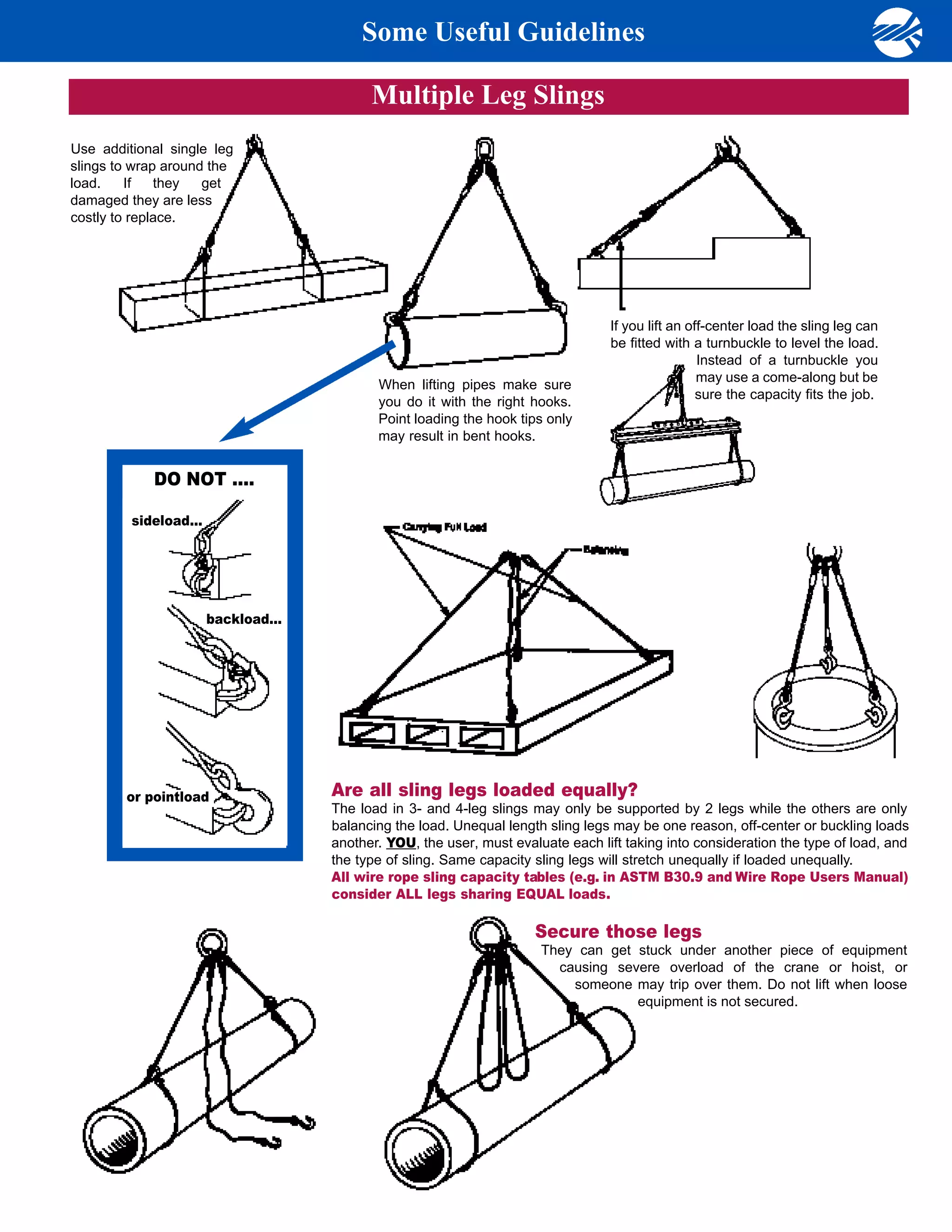
                                           Multiple Leg Slings
Use additional single leg
slings to wrap around the
load.    If   they   get
damaged they are less
costly to replace.


                                                                                  If you lift an off-center load the sling leg can
                                                                                  be fitted with a turnbuckle to level the load.
                                                                                                   Instead of a turnbuckle you
                                                                                                   may use a come-along but be
                                            When lifting pipes make sure
                                                                                                   sure the capacity fits the job.
                                            you do it with the right hooks.
                                            Point loading the hook tips only
                                            may result in bent hooks.


            DO NOT ....

         sideload...


                       backload...


        or pointload                 Are all sling legs loaded equally?
                                     The load in 3- and 4-leg slings may only be supported by 2 legs while the others are only
                                     balancing the load. Unequal length sling legs may be one reason, off-center or buckling loads
                                     another. YOU, the user, must evaluate each lift taking into consideration the type of load, and
                                     the type of sling. Same capacity sling legs will stretch unequally if loaded unequally.
                                     All wire rope sling capacity tables (e.g. in ASTM B30.9 and Wire Rope Users Manual)
                                     consider ALL legs sharing EQUAL loads.

                                                                      Secure those legs
                                                                       They can get stuck under another piece of equipment
                                                                         causing severe overload of the crane or hoist, or
                                                                           someone may trip over them. Do not lift when loose
                                                                                    equipment is not secured.
Some Useful Guidelines

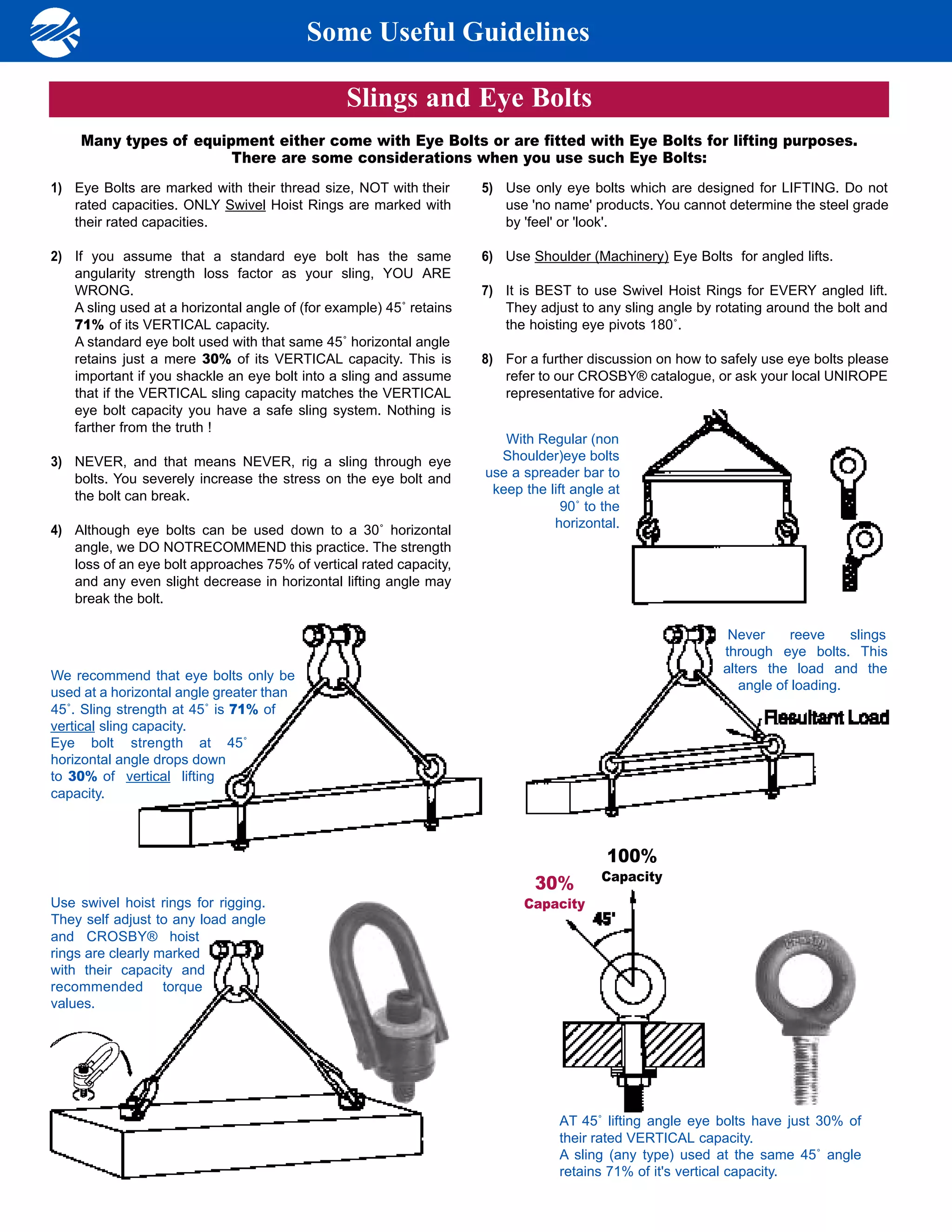
                                                Slings and Eye Bolts
    Many types of equipment either come with Eye Bolts or are fitted with Eye Bolts for lifting purposes.
                       There are some considerations when you use such Eye Bolts:
1) Eye Bolts are marked with their thread size, NOT with their       5) Use only eye bolts which are designed for LIFTING. Do not
   rated capacities. ONLY Swivel Hoist Rings are marked with            use 'no name' products. You cannot determine the steel grade
   their rated capacities.                                              by 'feel' or 'look'.

2) If you assume that a standard eye bolt has the same               6) Use Shoulder (Machinery) Eye Bolts for angled lifts.
   angularity strength loss factor as your sling, YOU ARE
   WRONG.                                                            7) It is BEST to use Swivel Hoist Rings for EVERY angled lift.
   A sling used at a horizontal angle of (for example) 45˚ retains      They adjust to any sling angle by rotating around the bolt and
   71% of its VERTICAL capacity.                                        the hoisting eye pivots 180˚.
   A standard eye bolt used with that same 45˚ horizontal angle
   retains just a mere 30% of its VERTICAL capacity. This is         8) For a further discussion on how to safely use eye bolts please
   important if you shackle an eye bolt into a sling and assume         refer to our CROSBY® catalogue, or ask your local UNIROPE
   that if the VERTICAL sling capacity matches the VERTICAL             representative for advice.
   eye bolt capacity you have a safe sling system. Nothing is
   farther from the truth !
                                                                        With Regular (non
3) NEVER, and that means NEVER, rig a sling through eye                Shoulder)eye bolts
   bolts. You severely increase the stress on the eye bolt and       use a spreader bar to
   the bolt can break.                                                keep the lift angle at
                                                                                  90˚ to the
                                                                                horizontal.
4) Although eye bolts can be used down to a 30˚ horizontal
   angle, we DO NOTRECOMMEND this practice. The strength
   loss of an eye bolt approaches 75% of vertical rated capacity,
   and any even slight decrease in horizontal lifting angle may
   break the bolt.

                                                                                                            Never      reeve    slings
                                                                                                           through eye bolts. This
                                                                                                           alters the load and the
We recommend that eye bolts only be
                                                                                                              angle of loading.
used at a horizontal angle greater than
45˚. Sling strength at 45˚ is 71% of
vertical sling capacity.
Eye bolt strength at 45˚
horizontal angle drops down
to 30% of vertical lifting
capacity.


                                                                                         100%
                                                                                        Capacity
                                                                             30%
Use swivel hoist rings for rigging.                                        Capacity
They self adjust to any load angle
and CROSBY® hoist
rings are clearly marked
with their capacity and
recommended torque
values.


                                                                                 AT 45˚ lifting angle eye bolts have just 30% of
                                                                                 their rated VERTICAL capacity.
                                                                                 A sling (any type) used at the same 45˚ angle
                                                                                 retains 71% of it's vertical capacity.
Some Useful Guidelines

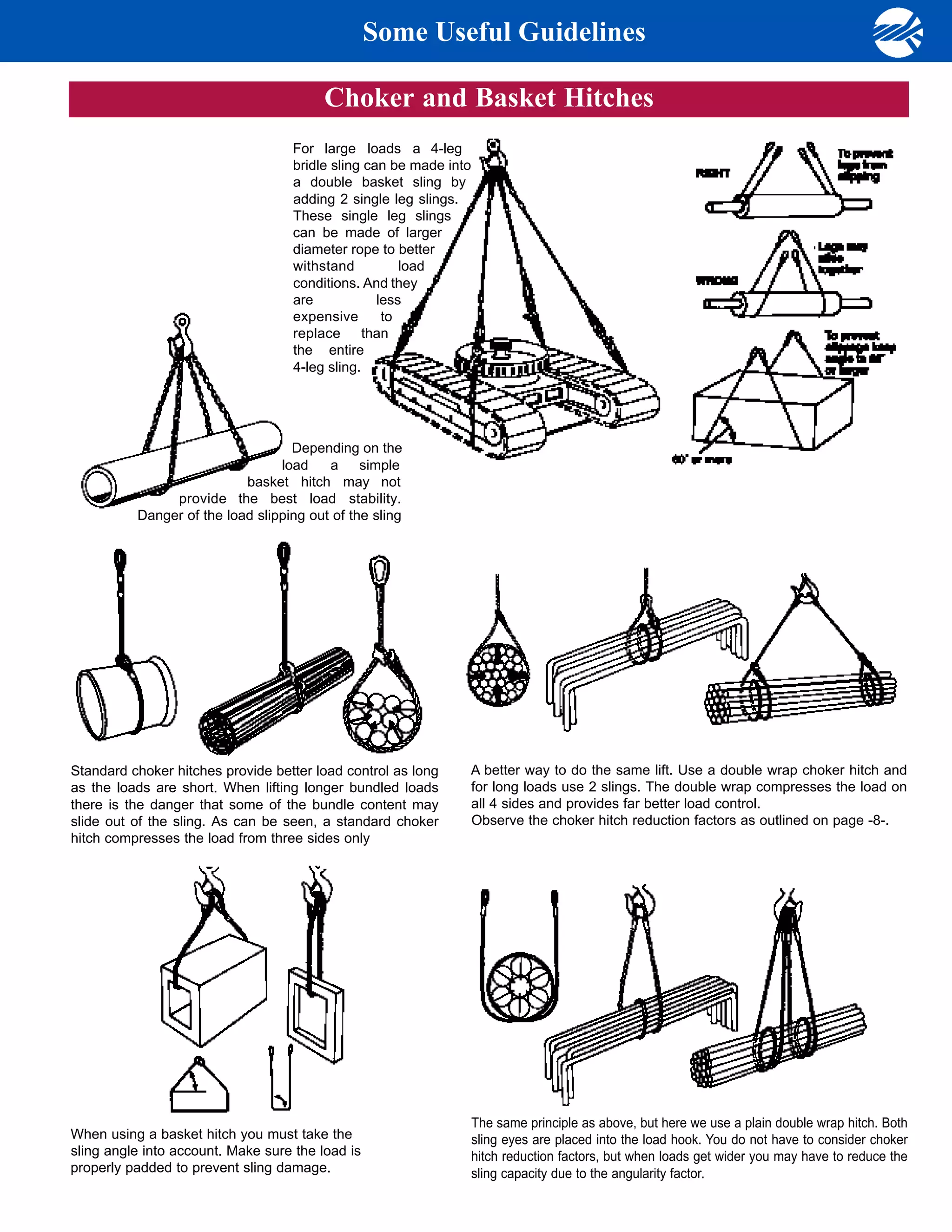
                                         Choker and Basket Hitches
                                   For large loads a 4-leg
                                   bridle sling can be made into
                                   a double basket sling by
                                   adding 2 single leg slings.
                                   These single leg slings
                                   can be made of larger
                                   diameter rope to better
                                   withstand          load
                                   conditions. And they
                                   are            less
                                   expensive       to
                                   replace than
                                   the entire
                                   4-leg sling.


                                   Depending on the
                                 load    a     simple
                           basket hitch may not
               provide the best load stability.
          Danger of the load slipping out of the sling


Standard choker hitches provide better load control as long    A better way to do the same lift. Use a double wrap choker hitch and
as the loads are short. When lifting longer bundled loads      for long loads use 2 slings. The double wrap compresses the load on
there is the danger that some of the bundle content may        all 4 sides and provides far better load control.
slide out of the sling. As can be seen, a standard choker      Observe the choker hitch reduction factors as outlined on page -8-.
hitch compresses the load from three sides only


                                                                   The same principle as above, but here we use a plain double wrap hitch. Both
When using a basket hitch you must take the                        sling eyes are placed into the load hook. You do not have to consider choker
sling angle into account. Make sure the load is                    hitch reduction factors, but when loads get wider you may have to reduce the
properly padded to prevent sling damage.                           sling capacity due to the angularity factor.
Some Useful Guidelines

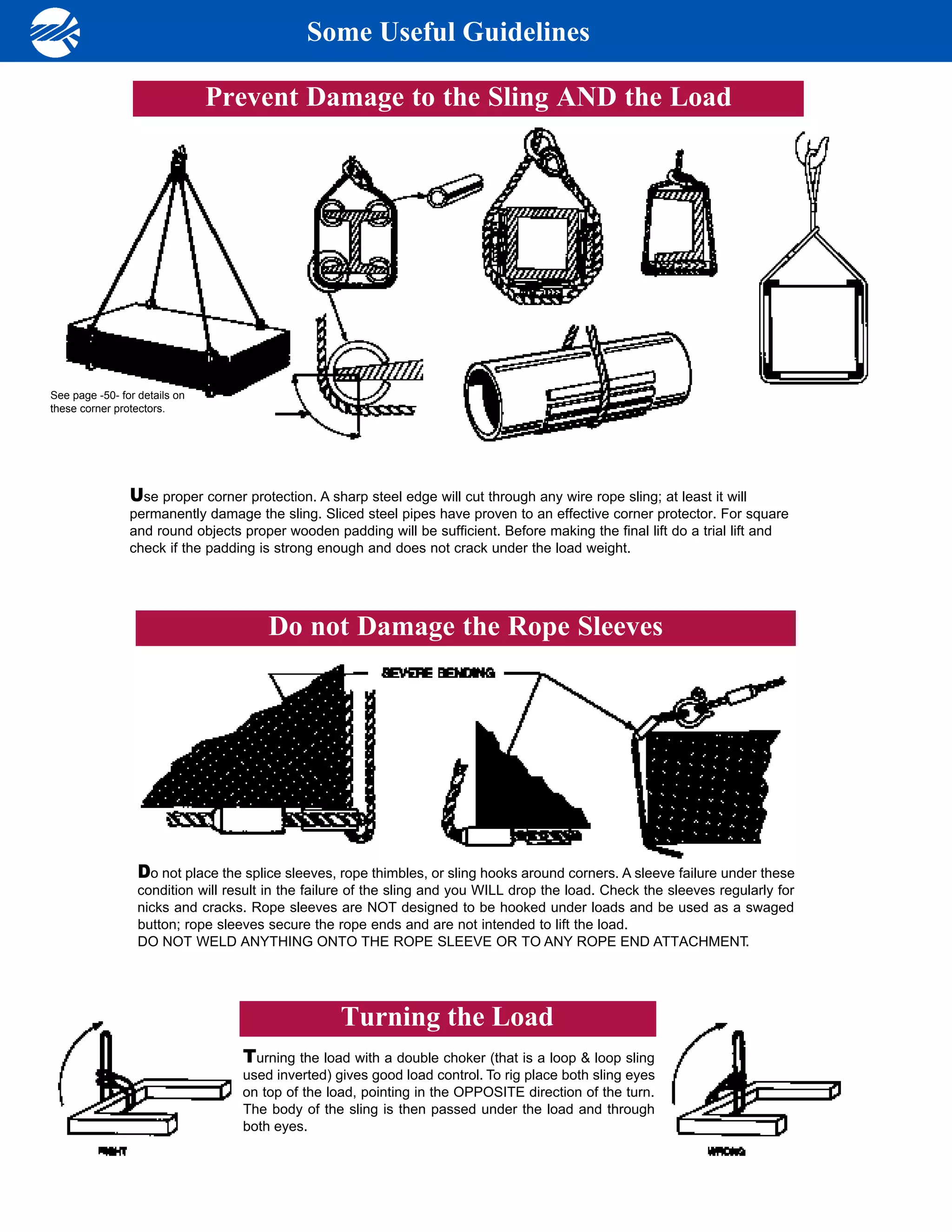
                               Prevent Damage to the Sling AND the Load


See page -50- for details on
these corner protectors.


                Use proper corner protection. A sharp steel edge will cut through any wire rope sling; at least it will
                permanently damage the sling. Sliced steel pipes have proven to an effective corner protector. For square
                and round objects proper wooden padding will be sufficient. Before making the final lift do a trial lift and
                check if the padding is strong enough and does not crack under the load weight.


                                       Do not Damage the Rope Sleeves


                  Do not place the splice sleeves, rope thimbles, or sling hooks around corners. A sleeve failure under these
                  condition will result in the failure of the sling and you WILL drop the load. Check the sleeves regularly for
                  nicks and cracks. Rope sleeves are NOT designed to be hooked under loads and be used as a swaged
                  button; rope sleeves secure the rope ends and are not intended to lift the load.
                  DO NOT WELD ANYTHING ONTO THE ROPE SLEEVE OR TO ANY ROPE END ATTACHMENT.


                                                   Turning the Load
                                   Turning the load with a double choker (that is a loop & loop sling
                                   used inverted) gives good load control. To rig place both sling eyes
                                   on top of the load, pointing in the OPPOSITE direction of the turn.
                                   The body of the sling is then passed under the load and through
                                   both eyes.

Wrs rigging practice

  • 1.
    Some Useful Guidelines Multiple Leg Slings Use additional single leg slings to wrap around the load. If they get damaged they are less costly to replace. If you lift an off-center load the sling leg can be fitted with a turnbuckle to level the load. Instead of a turnbuckle you may use a come-along but be When lifting pipes make sure sure the capacity fits the job. you do it with the right hooks. Point loading the hook tips only may result in bent hooks. DO NOT .... sideload... backload... or pointload Are all sling legs loaded equally? The load in 3- and 4-leg slings may only be supported by 2 legs while the others are only balancing the load. Unequal length sling legs may be one reason, off-center or buckling loads another. YOU, the user, must evaluate each lift taking into consideration the type of load, and the type of sling. Same capacity sling legs will stretch unequally if loaded unequally. All wire rope sling capacity tables (e.g. in ASTM B30.9 and Wire Rope Users Manual) consider ALL legs sharing EQUAL loads. Secure those legs They can get stuck under another piece of equipment causing severe overload of the crane or hoist, or someone may trip over them. Do not lift when loose equipment is not secured.
  • 2.
    Some Useful Guidelines Slings and Eye Bolts Many types of equipment either come with Eye Bolts or are fitted with Eye Bolts for lifting purposes. There are some considerations when you use such Eye Bolts: 1) Eye Bolts are marked with their thread size, NOT with their 5) Use only eye bolts which are designed for LIFTING. Do not rated capacities. ONLY Swivel Hoist Rings are marked with use 'no name' products. You cannot determine the steel grade their rated capacities. by 'feel' or 'look'. 2) If you assume that a standard eye bolt has the same 6) Use Shoulder (Machinery) Eye Bolts for angled lifts. angularity strength loss factor as your sling, YOU ARE WRONG. 7) It is BEST to use Swivel Hoist Rings for EVERY angled lift. A sling used at a horizontal angle of (for example) 45˚ retains They adjust to any sling angle by rotating around the bolt and 71% of its VERTICAL capacity. the hoisting eye pivots 180˚. A standard eye bolt used with that same 45˚ horizontal angle retains just a mere 30% of its VERTICAL capacity. This is 8) For a further discussion on how to safely use eye bolts please important if you shackle an eye bolt into a sling and assume refer to our CROSBY® catalogue, or ask your local UNIROPE that if the VERTICAL sling capacity matches the VERTICAL representative for advice. eye bolt capacity you have a safe sling system. Nothing is farther from the truth ! With Regular (non 3) NEVER, and that means NEVER, rig a sling through eye Shoulder)eye bolts bolts. You severely increase the stress on the eye bolt and use a spreader bar to the bolt can break. keep the lift angle at 90˚ to the horizontal. 4) Although eye bolts can be used down to a 30˚ horizontal angle, we DO NOTRECOMMEND this practice. The strength loss of an eye bolt approaches 75% of vertical rated capacity, and any even slight decrease in horizontal lifting angle may break the bolt. Never reeve slings through eye bolts. This alters the load and the We recommend that eye bolts only be angle of loading. used at a horizontal angle greater than 45˚. Sling strength at 45˚ is 71% of vertical sling capacity. Eye bolt strength at 45˚ horizontal angle drops down to 30% of vertical lifting capacity. 100% Capacity 30% Use swivel hoist rings for rigging. Capacity They self adjust to any load angle and CROSBY® hoist rings are clearly marked with their capacity and recommended torque values. AT 45˚ lifting angle eye bolts have just 30% of their rated VERTICAL capacity. A sling (any type) used at the same 45˚ angle retains 71% of it's vertical capacity.
  • 3.
    Some Useful Guidelines Choker and Basket Hitches For large loads a 4-leg bridle sling can be made into a double basket sling by adding 2 single leg slings. These single leg slings can be made of larger diameter rope to better withstand load conditions. And they are less expensive to replace than the entire 4-leg sling. Depending on the load a simple basket hitch may not provide the best load stability. Danger of the load slipping out of the sling Standard choker hitches provide better load control as long A better way to do the same lift. Use a double wrap choker hitch and as the loads are short. When lifting longer bundled loads for long loads use 2 slings. The double wrap compresses the load on there is the danger that some of the bundle content may all 4 sides and provides far better load control. slide out of the sling. As can be seen, a standard choker Observe the choker hitch reduction factors as outlined on page -8-. hitch compresses the load from three sides only The same principle as above, but here we use a plain double wrap hitch. Both When using a basket hitch you must take the sling eyes are placed into the load hook. You do not have to consider choker sling angle into account. Make sure the load is hitch reduction factors, but when loads get wider you may have to reduce the properly padded to prevent sling damage. sling capacity due to the angularity factor.
  • 4.
    Some Useful Guidelines Prevent Damage to the Sling AND the Load See page -50- for details on these corner protectors. Use proper corner protection. A sharp steel edge will cut through any wire rope sling; at least it will permanently damage the sling. Sliced steel pipes have proven to an effective corner protector. For square and round objects proper wooden padding will be sufficient. Before making the final lift do a trial lift and check if the padding is strong enough and does not crack under the load weight. Do not Damage the Rope Sleeves Do not place the splice sleeves, rope thimbles, or sling hooks around corners. A sleeve failure under these condition will result in the failure of the sling and you WILL drop the load. Check the sleeves regularly for nicks and cracks. Rope sleeves are NOT designed to be hooked under loads and be used as a swaged button; rope sleeves secure the rope ends and are not intended to lift the load. DO NOT WELD ANYTHING ONTO THE ROPE SLEEVE OR TO ANY ROPE END ATTACHMENT. Turning the Load Turning the load with a double choker (that is a loop & loop sling used inverted) gives good load control. To rig place both sling eyes on top of the load, pointing in the OPPOSITE direction of the turn. The body of the sling is then passed under the load and through both eyes.