BASIC FIRE ALARM
TRAINING
• Per	
  the	
  defini+on	
  in	
  NFPA	
  72	
  –	
  	
  
– A	
  system	
  or	
  por+on	
  of	
  a	
  combina+on	
  system	
  that	
  
consists	
  of	
  components	
  and	
  circuits	
  arranged	
  to	
  
monitor	
  and	
  annunciate	
  the	
  status	
  of	
  fire	
  alarm	
  or	
  
supervisory	
  signal-­‐ini+a+ng	
  devices	
  and	
  to	
  ini+ate	
  
the	
  appropriate	
  response	
  to	
  those	
  signals	
  	
  
What	
  is	
  a	
  fire	
  alarm	
  system?	
  
Basic	
  Components	
  of	
  a	
  Fire	
  
Alarm	
  System	
  
Control	
  Panel	
  
Communica+ons	
  
Ini+a+ng	
  Devices	
  
No+fica+on	
  Appliances	
  
Control	
  Panel/Communicator	
  
A	
  component	
  of	
  the	
  fire	
  alarm	
  system	
  that	
  receives	
  signals	
  from	
  ini+a+ng	
  
devices	
  and	
  processes	
  these	
  signals	
  to	
  determine	
  the	
  fire	
  alarm	
  output	
  
func+ons	
  
Communica+ons	
  
DACS	
  –	
  Digital	
  Alarm	
  Communica+ons	
  Systems	
  
POTS	
  –	
  (Plain	
  Old	
  Telephone	
  System)	
  Loop	
  Start	
  with	
  
line	
  seizure	
  from	
  the	
  point	
  of	
  demarca+on	
  prior	
  to	
  
sending	
  it	
  to	
  the	
  home	
  or	
  business.	
  
Cable	
  Company	
  Service	
  –	
  assuming	
  you	
  have	
  no	
  
CODEC,	
  Voice	
  Compression	
  or	
  back	
  up	
  power	
  issues.	
  
One	
  Way/Two	
  Way	
  Radio	
  –	
  Mesh	
  Radio	
  and	
  GSM	
  	
  
IP	
  Communicators	
  with	
  UL	
  lis+ngs	
  
Sole	
  Path	
  Communicators	
  with	
  UL	
  Lis+ngs	
  
2010	
  Edi+on	
  Na+onal	
  Fire	
  Alarm	
  and	
  
Signaling	
  Code	
  
NFPA	
  72-­‐2010	
  Housecleaning	
  Efforts	
  
Recently	
  removed	
  transmission	
  methods	
  
AcBve	
  MulBplex	
  
McCulloh	
  
Directly	
  Connected	
  Non-­‐Coded	
  Systems	
  
Private	
  Microwave	
  Radio	
  Systems	
  
ANNUNCIATOR	
  
Ini+a+ng	
  Devices	
  
A	
  system	
  component	
  that	
  originates	
  
transmission	
  of	
  a	
  change-­‐of-­‐state	
  
condi+on	
  	
  
Examples	
  of	
  Ini+a+on	
  Devices	
  
• Smoke	
  Detector	
  
• Heat	
  Detector	
  
Automa+c	
  Ini+a+ng	
  Devices	
  
Duct	
  Detectors	
  
• Pull	
  Sta+on	
  
Manual	
  Ini+a+ng	
  Devices	
  
Types	
  Of	
  Sprinkler	
  Systems	
  
Wet	
  Pipe:	
  Since	
  water	
  is	
  always	
  present	
  in	
  the	
  pipes	
  supplying	
  the	
  sprinkler	
  
heads,	
  these	
  types	
  of	
  sprinkler	
  system	
  are	
  quick	
  to	
  react	
  upon	
  the	
  opera+on	
  of	
  a	
  
sprinkler	
  head	
  in	
  a	
  fire	
  scenario.	
  These	
  are	
  the	
  most	
  common	
  systems	
  and	
  are	
  
used	
  in	
  buildings	
  where	
  there	
  is	
  no	
  risk	
  of	
  freezing.	
  Wet	
  systems	
  are	
  required	
  for	
  
mul+-­‐storey	
  or	
  high-­‐rise	
  buildings	
  and	
  for	
  life	
  safety	
  systems	
  for	
  UK	
  standards.	
  
Dry	
  pipe:	
  The	
  pipes	
  are	
  filled	
  with	
  air	
  under	
  pressure	
  at	
  all	
  +mes	
  and	
  the	
  water	
  is	
  
held	
  back	
  by	
  the	
  control	
  valve	
  outside	
  of	
  the	
  protected	
  area.	
  Should	
  a	
  sprinkler	
  
head	
  open	
  in	
  a	
  fire	
  scenario,	
  the	
  drop	
  in	
  air	
  pressure	
  opens	
  the	
  valve	
  and	
  water	
  
flows	
  into	
  the	
  pipe	
  work	
  and	
  onto	
  the	
  fire.	
  Dry	
  pipe	
  systems	
  are	
  used	
  where	
  wet	
  
or	
  alternate	
  systems	
  cannot	
  be	
  used.	
  
Alternate:	
  Alternate	
  systems	
  have	
  the	
  pipes	
  full	
  of	
  water	
  for	
  the	
  summer	
  period,	
  
then	
  subsequently	
  drained	
  down	
  and	
  filled	
  with	
  air	
  for	
  the	
  winter.	
  This	
  is	
  typically	
  
for	
  buildings	
  that	
  are	
  not	
  heated,	
  e.g.	
  underground	
  car	
  parks.	
  
• Water	
  Flow	
  
• Valve	
  Tamper	
  
Sprinkler	
  System	
  Devices	
  
Sprinkler	
  Heads	
  
• A	
  fire	
  alarm	
  system	
  component	
  such	
  as	
  a	
  bell,	
  
horn,	
  speaker,	
  light,	
  or	
  text	
  display	
  that	
  
provides	
  audible,	
  tac+le,	
  or	
  visible	
  outputs,	
  or	
  
any	
  combina+on	
  thereof	
  
No+fica+on	
  Appliances	
  
Examples	
  of	
  No+fica+on	
  
Appliances	
  
• Horn/Strobe	
  
• Strobe-­‐Ceiling	
  Mount)	
  
• Speaker	
  
• Bell	
  
Fire	
  Alarm	
  Requirements	
  
• In	
  Pennsylvania,	
  Ohio,	
  and	
  many	
  other	
  states,	
  the	
  
Interna+onal	
  Building	
  Code	
  (IBC)	
  is	
  the	
  model	
  
building	
  code	
  for	
  the	
  state.	
  
• Each	
  building,	
  based	
  on	
  it’s	
  use,	
  is	
  assigned	
  a	
  Use	
  
and	
  Occupancy	
  Code	
  
• The	
  Use	
  and	
  Occupancy	
  Code	
  then	
  determines	
  if	
  
a	
  fire	
  alarm	
  system	
  is	
  required.	
  
• Fire	
  alarm	
  systems	
  may	
  also	
  be	
  required	
  by	
  other	
  
authori+es,	
  such	
  as	
  insurance	
  companies	
  
Interna+onal	
  Building	
  Code	
  
• Once	
  it	
  is	
  determined	
  that	
  a	
  fire	
  alarm	
  system	
  
will	
  be	
  installed,	
  NFPA	
  72	
  then	
  tells	
  us	
  how	
  to	
  
install	
  the	
  system	
  
NFPA	
  72	
  
The	
  Na+onal	
  Fire	
  Alarm	
  Code	
  
• Once	
  it	
  is	
  determined	
  that	
  a	
  fire	
  alarm	
  is	
  
required	
  by	
  the	
  IBC,	
  and	
  has	
  been	
  designed	
  
per	
  NFPA	
  72,	
  the	
  Na+onal	
  Electric	
  Code	
  (NEC)	
  
tells	
  us	
  how	
  to	
  wire	
  the	
  system	
  
NFPA	
  70	
  
The	
  Na+onal	
  Electric	
  Code	
  
Underwriter’s	
  Laboratories	
  (UL)	
  
• UL	
  is	
  a	
  global	
  independent	
  safety	
  science	
  
company	
  with	
  more	
  than	
  a	
  century	
  of	
  
exper+se	
  innova+ng	
  safety	
  solu+ons	
  from	
  the	
  
public	
  adop+on	
  of	
  electricity	
  to	
  new	
  
breakthroughs	
  in	
  sustainability,	
  renewable	
  
energy	
  and	
  nanotechnology.	
  Dedicated	
  to	
  
promo+ng	
  safe	
  living	
  and	
  working	
  
environments,	
  UL	
  helps	
  safeguard	
  people,	
  
products	
  and	
  places	
  in	
  important	
  ways,	
  
facilita+ng	
  trade	
  and	
  providing	
  peace	
  of	
  mind.	
  
What	
  is	
  UL?	
  
• Basically,	
  UL	
  is	
  a	
  company	
  that	
  has	
  developed	
  
standards	
  on	
  how	
  products	
  should	
  operate	
  
safely.	
  Manufacturers	
  send	
  their	
  products	
  to	
  
UL	
  to	
  be	
  tested	
  by	
  UL	
  to	
  UL	
  standards.	
  	
  If	
  the	
  
product	
  passes	
  the	
  tests,	
  the	
  manufacturer	
  
can	
  place	
  the	
  UL	
  mark	
  on	
  the	
  product.	
  
Huh?	
  
• Fire	
  alarm	
  service	
  companies	
  and	
  monitoring	
  
centers	
  apply	
  to	
  UL	
  to	
  become	
  listed	
  
companies	
  
• UL	
  inves+gates	
  the	
  company	
  and	
  ensures	
  the	
  
company	
  understands	
  and	
  can	
  comply	
  with	
  
applicable	
  standards	
  
• UL	
  audits	
  listed	
  companies	
  once	
  per	
  year	
  to	
  
ensure	
  the	
  company	
  is	
  maintaining	
  
compliance	
  	
  
What	
  about	
  fire	
  alarms	
  and	
  UL?	
  
• Authori+es	
  Having	
  Jurisdic+on	
  (AHJ)	
  will	
  
require	
  a	
  UL	
  cer+ficate	
  on	
  a	
  system	
  
• The	
  UL	
  Cer+ficate	
  is	
  the	
  UL	
  mark	
  for	
  fire	
  alarm	
  
systems	
  
• The	
  UL	
  cer+ficate	
  on	
  a	
  fire	
  alarm	
  system	
  
ensures	
  the	
  AHJ	
  that	
  the	
  system	
  was	
  designed,	
  
installed,	
  tested	
  and	
  maintained	
  properly	
  
• One	
  of	
  the	
  main	
  reasons	
  an	
  AHJ	
  will	
  require	
  a	
  
UL	
  cer+ficate	
  is	
  to	
  reduce	
  false	
  alarms	
  
• FM	
  basically	
  provides	
  the	
  same	
  service	
  as	
  UL.	
  	
  
At	
  one	
  +me,	
  when	
  a	
  property	
  was	
  insured	
  by	
  
Factory	
  Mutual	
  insurance,	
  they	
  required	
  the	
  
fire	
  alarm	
  system	
  to	
  be	
  FM	
  approved.	
  
Factory	
  Mutual	
  (FM)	
  
• Fire	
  Alarm	
  system	
  alarm	
  transmissions	
  require	
  
immediate	
  dispatch	
  of	
  the	
  fire	
  department	
  
(unless	
  otherwise	
  required)	
  
Commercial	
  Fire	
  Alarm	
  Monitoring	
  and	
  
Dispatching	
  Requirements	
  
• Runner	
  response	
  is	
  required	
  on	
  all	
  UL	
  Listed/FM	
  Placard	
  fire	
  alarm	
  systems.	
  
• Central	
  Sta+on	
  is	
  responsible	
  for	
  the	
  dispatch	
  of	
  Runners	
  in	
  accordance	
  with	
  
procedures	
  based	
  on	
  NFPA	
  72	
  aaer	
  normal	
  business	
  hours.	
  During	
  normal	
  business	
  
hours,	
  Customer	
  Care/Service	
  is	
  responsible.	
  
• Runner	
  Service	
  is	
  defined	
  as	
  a	
  service	
  performed	
  at	
  the	
  protected	
  premises,	
  
including	
  resebng	
  and	
  silencing	
  of	
  all	
  equipment	
  transmibng	
  fire	
  alarm	
  or	
  
supervisory	
  signals	
  to	
  an	
  off-­‐premises	
  loca+on.	
  	
  
• A	
  UL	
  Runner	
  is	
  a	
  person	
  (other	
  than	
  the	
  required	
  number	
  of	
  operators	
  on	
  duty	
  at	
  
central,	
  supervising,	
  or	
  runner	
  sta+ons)	
  available	
  for	
  prompt	
  dispatching,	
  when	
  
necessary,	
  to	
  the	
  protected	
  premises.	
  	
  
• A	
  Runner	
  shall	
  not	
  be	
  required	
  if	
  there	
  will	
  not	
  be	
  a	
  fire	
  department	
  or	
  customer	
  
representa+ve	
  on-­‐site.	
  
UL	
  Runner	
  Response	
  
• Dispatch	
  runner	
  or	
  technician	
  to	
  the	
  protected	
  premises	
  
within	
  1	
  hour	
  of	
  receipt	
  of	
  a	
  signal	
  if	
  the	
  equipment	
  needs	
  
to	
  be	
  manually	
  reset	
  by	
  the	
  prime	
  contractor.	
  
• A	
  runner/technician	
  response	
  may	
  be	
  waived	
  by	
  the	
  fire	
  
department	
  or	
  other	
  Authority	
  Having	
  Jurisdic+on	
  (AHJ).	
  	
  
The	
  customer	
  may	
  not	
  call	
  off	
  a	
  runner	
  response.	
  
• A	
  runner/technician	
  is	
  not	
  required	
  if	
  the	
  signal	
  results	
  
from	
  a	
  prearranged	
  test.	
  	
  If	
  a	
  runner/technician	
  is	
  required,	
  
they	
  must	
  arrive	
  within	
  1	
  hour	
  of	
  the	
  signal	
  being	
  received.	
  
Fire	
  Alarm	
  Response	
  
• Dispatch	
  a	
  runner	
  or	
  maintenance	
  person	
  to	
  arrive	
  within	
  1	
  hour	
  of	
  the	
  signal	
  
being	
  received	
  to	
  inves+gate.	
  
• Central	
  sta+on	
  must	
  dispatch	
  a	
  runner/maintenance	
  person	
  to	
  the	
  protected	
  
premises	
  if	
  a	
  supervisory	
  signal	
  is	
  received,	
  even	
  if	
  the	
  signal	
  has	
  reset.	
  
• A	
  runner/technician	
  is	
  not	
  required	
  if	
  the	
  signal	
  results	
  from	
  a	
  prearranged	
  test.	


• In	
  addi+on,	
  a	
  runner	
  would	
  not	
  be	
  required	
  if	
  a	
  prearranged	
  procedure	
  is	
  in	
  place	
  
with	
  the	
  subscriber	
  on	
  the	
  handling	
  of	
  supervisory	
  signal	
  and	
  the	
  subscriber	
  is	
  able	
  
to	
  reset	
  the	
  supervisory	
  signal.	


• If	
  the	
  subscriber	
  is	
  unable	
  to	
  reset	
  the	
  supervisory	
  signal,	
  a	
  runner/technician	
  must	
  
s+ll	
  arrive	
  within	
  1	
  hour	
  of	
  receipt	
  of	
  the	
  signal.	
  
• Supervisory	
  alarms	
  are	
  defined	
  as	
  alarms	
  received	
  from	
  sprinkler	
  system	
  
supervisory	
  appliances.	
  	
  These	
  include,	
  but	
  are	
  not	
  limited	
  to,	
  valve	
  tampers	
  
switches,	
  low	
  air	
  pressure/temperature	
  switches,	
  fire	
  pump	
  supervision,	
  tank	
  
level/temperature	
  switches.	
  	
  Addi+onally,	
  when	
  duct	
  detectors	
  are	
  configured	
  not	
  
to	
  provide	
  fire	
  alarm	
  response,	
  they	
  shall	
  be	
  considered	
  a	
  supervisory	
  signal	
  
Supervisory	
  Signal	
  Response	
  
• Dispatch	
  personnel	
  to	
  arrive	
  within	
  4	
  hours	
  to	
  ini+ate	
  maintenance,	
  if	
  necessary.	
  
• This	
  is	
  interpreted	
  to	
  mean	
  the	
  central	
  sta+on	
  must	
  dispatch	
  a	
  technician	
  to	
  the	
  
protected	
  premises	
  if	
  a	
  trouble	
  signal	
  is	
  received.	


• If	
  a	
  reset	
  signal	
  to	
  the	
  trouble	
  signal	
  is	
  received	
  before	
  the	
  technician	
  arrives,	
  the	
  
technician	
  would	
  not	
  have	
  to	
  respond.	


• The	
  customer	
  should	
  be	
  no+fied	
  of	
  the	
  reset	
  signal	
  and	
  asked	
  if	
  they	
  s+ll	
  require	
  
runner	
  response.	
  	
  
• Trouble	
  signals	
  also	
  include	
  such	
  signals	
  as	
  AC	
  power	
  loss,	
  badery	
  trouble,	
  phone	
  
line	
  trouble,	
  failure	
  to	
  test,	
  and	
  other	
  related	
  control	
  panel	
  problem	
  signals.	
  
• If	
  the	
  trouble	
  is	
  due	
  to	
  a	
  known	
  cause	
  that	
  would	
  not	
  be	
  able	
  to	
  be	
  repaired	
  by	
  the	
  
technician,	
  runner	
  response	
  is	
  not	
  required	
  (i.e.	
  AC	
  power	
  to	
  the	
  building	
  is	
  off	
  due	
  
to	
  storm	
  damage).	
  
Trouble	
  Signal	
  Response	
  	
  
• The	
  UL	
  Runner	
  should	
  complete	
  a	
  Select	
  
Security	
  Service	
  Ticket	
  and	
  clearly	
  mark	
  the	
  
+cket	
  as	
  a	
  UL	
  Runner	
  so	
  that	
  the	
  customer	
  is	
  
charged	
  accordingly.	
  This	
  +cket	
  is	
  for	
  the	
  reset	
  
only.	
  
• If	
  addi+onal	
  work	
  or	
  services	
  are	
  required	
  at	
  
the	
  site,	
  the	
  UL	
  Runner	
  should	
  contact	
  the	
  
primary	
  on-­‐call	
  Technician.	
  
AddiBonal	
  Runner	
  	
  Requirements	
  
• No	
  Select	
  Security	
  personnel	
  shall	
  place	
  a	
  fire	
  alarm	
  system	
  or	
  any	
  part	
  of	
  a	
  fire	
  alarm	
  system	
  on	
  
test	
  without	
  first	
  inves+ga+ng	
  the	
  cause	
  of	
  the	
  problem	
  on-­‐site.	
  	
  Select	
  Security	
  personnel	
  may	
  
place	
  a	
  fire	
  alarm	
  system	
  or	
  a	
  part	
  of	
  a	
  fire	
  alarm	
  system	
  on	
  test	
  at	
  the	
  request	
  of	
  the	
  customer.	
  
• If	
  it	
  is	
  determined	
  that	
  a	
  fire	
  alarm	
  system	
  or	
  any	
  part	
  of	
  a	
  fire	
  alarm	
  system	
  will	
  be	
  placed	
  on	
  test,	
  
the	
  reason	
  for	
  the	
  system	
  being	
  on	
  test	
  and	
  the	
  person	
  placing	
  the	
  system	
  on	
  test	
  shall	
  be	
  
documented	
  in	
  the	
  account	
  history	
  on	
  the	
  central	
  sta+on	
  soaware.	
  	
  
• If	
  it	
  is	
  determined	
  that	
  a	
  fire	
  alarm	
  system	
  or	
  any	
  part	
  of	
  a	
  fire	
  alarm	
  system	
  will	
  be	
  placed	
  on	
  test	
  
for	
  a	
  period	
  of	
  more	
  than	
  8	
  hours,	
  the	
  Authority	
  Having	
  Jurisdic+on	
  shall	
  be	
  no+fied.	
  	
  The	
  person	
  
who	
  was	
  no+fied	
  and	
  the	
  person	
  that	
  made	
  the	
  no+fica+on	
  shall	
  be	
  documented	
  in	
  the	
  account	
  
history	
  on	
  the	
  central	
  sta+on	
  soaware.	
  
• No	
  Select	
  Security	
  personnel	
  shall	
  disconnect	
  a	
  device	
  on	
  a	
  fire	
  alarm	
  system	
  for	
  a	
  period	
  of	
  more	
  
than	
  8	
  hours.	
  	
  If	
  a	
  device	
  must	
  be	
  disconnected	
  for	
  a	
  period	
  of	
  more	
  than	
  8	
  hours,	
  the	
  Authority	
  
Having	
  Jurisdic+on	
  shall	
  be	
  no+fied.	
  	
  The	
  person	
  who	
  was	
  no+fied	
  and	
  the	
  person	
  that	
  made	
  the	
  
no+fica+on	
  shall	
  be	
  documented	
  in	
  the	
  account	
  history	
  on	
  the	
  central	
  sta+on	
  soaware.	
  	
  
Addi+onally,	
  an	
  out	
  of	
  service	
  tag	
  shall	
  be	
  placed	
  on	
  any	
  device	
  that	
  is	
  disconnected	
  and	
  at	
  the	
  fire	
  
alarm	
  annunciator.	
  
AddiBonal	
  Fire	
  Alarm	
  Requirements	
  
• Fire	
  alarm	
  inspec+ons	
  shall	
  be	
  conducted	
  per	
  
the	
  requirements	
  of	
  the	
  current	
  version	
  of	
  
NFPA	
  72	
  and	
  contract	
  documents.	
  	
  The	
  fire	
  
alarm	
  inspec+ons	
  will	
  consist	
  of	
  the	
  following:	
  
Fire	
  Alarm	
  Inspec+ons	
  
• 1.	
  	
  The	
  technician	
  shall	
  opera+onally	
  test	
  the	
  fire	
  alarm	
  control	
  panel.	
  	
  The	
  
fire	
  alarm	
  control	
  panel	
  shall	
  be	
  tested	
  to	
  verify	
  correct	
  receipt	
  of	
  alarm,	
  
supervisory	
  and	
  trouble	
  signals,	
  opera+on	
  of	
  no+fica+on	
  appliance	
  and	
  
auxiliary	
  func+on	
  outputs,	
  circuit	
  supervision	
  and	
  AC	
  power	
  loss.	


• 2.	
  	
  Fire	
  alarm	
  panel	
  baderies	
  shall	
  be	
  inspected	
  for	
  corrosion	
  or	
  leakage	
  
and	
  tested	
  under	
  full	
  load	
  with	
  the	
  primary	
  power	
  disconnected.	
  	
  The	
  
badery	
  charging	
  circuit	
  shall	
  be	
  tested	
  to	
  ensure	
  correct	
  voltage	
  output	
  to	
  
the	
  baderies.	


• 3.	
  	
  The	
  digital	
  alarm	
  communicator	
  shall	
  be	
  opera+onally	
  tested	
  to	
  ensure	
  
receipt	
  of	
  the	
  correct	
  signal	
  to	
  the	
  central	
  sta+on	
  within	
  90	
  seconds	
  of	
  
going	
  off-­‐hook.	
  	
  The	
  digital	
  alarm	
  communicator	
  shall	
  be	
  tested	
  to	
  ensure	
  
line	
  seizure,	
  line	
  failure	
  detec+on,	
  and	
  the	
  ability	
  to	
  transmit	
  line	
  failure	
  
within	
  4	
  minutes	
  of	
  detec+ng	
  the	
  line	
  fault.	
  	
  
Quarterly	
  Inspec+ons:	


• 4.	
  	
  The	
  sprinkler	
  alarm	
  and	
  supervisory	
  ini+a+ng	
  devices	
  shall	
  be	
  
func+onally	
  tested	
  per	
  NFPA	
  72	
  standards	
  and	
  manufacturer’s	
  instruc+ons.	
  	
  
Sprinkler	
  alarm	
  and	
  supervisory	
  ini+a+ng	
  devices	
  include	
  but	
  are	
  not	
  
limited	
  to	
  waterflow	
  switches,	
  high/low	
  pressure	
  switches,	
  valve	
  tamper	
  
switches	
  and	
  room	
  temperature	
  switches.	


• 5.	
  	
  Waterflow	
  switches	
  shall	
  be	
  tested	
  by	
  flowing	
  water	
  through	
  the	
  
inspectors	
  test	
  valve.	
  	
  Ini+a+on	
  of	
  the	
  waterflow	
  alarm	
  signal	
  shall	
  occur	
  
within	
  90	
  seconds	
  of	
  opening	
  the	
  inspectors	
  test	
  valve.	


• 6.	
  	
  High/low	
  pressure	
  switches	
  shall	
  be	
  operated	
  and	
  verified	
  that	
  receipt	
  
of	
  the	
  signal	
  occurs	
  when	
  the	
  required	
  pressure	
  is	
  increased	
  or	
  decreased	
  
a	
  maximum	
  of	
  10	
  psi.	


• 7.	
  	
  Valve	
  tamper	
  switches	
  shall	
  be	
  operated	
  and	
  verified	
  that	
  receipt	
  of	
  
signal	
  occurs	
  within	
  the	
  first	
  two	
  revolu+ons	
  of	
  the	
  hand	
  wheel.	


• 8.	
  	
  Room	
  temperature	
  switches	
  shall	
  be	
  operated	
  and	
  verified	
  that	
  receipt	
  
if	
  signal	
  occurs	
  when	
  the	
  room	
  temperature	
  decreases	
  to	
  40°F.	


• 1.	
  	
  The	
  technician	
  shall	
  opera+onally	
  test	
  the	
  fire	
  alarm	
  control	
  panel.	
  	
  The	
  
fire	
  alarm	
  control	
  panel	
  shall	
  be	
  tested	
  to	
  verify	
  correct	
  receipt	
  of	
  alarm,	
  
supervisory	
  and	
  trouble	
  signals,	
  opera+on	
  of	
  no+fica+on	
  appliance	
  and	
  
auxiliary	
  func+on	
  outputs,	
  circuit	
  supervision	
  and	
  AC	
  power	
  loss.	


• 2.	
  	
  Fire	
  alarm	
  panel	
  baderies	
  shall	
  be	
  inspected	
  for	
  corrosion	
  or	
  leakage	
  
and	
  tested	
  under	
  full	
  load	
  with	
  the	
  primary	
  power	
  disconnected.	
  	
  The	
  
badery	
  charging	
  circuit	
  shall	
  be	
  tested	
  to	
  ensure	
  correct	
  voltage	
  output	
  to	
  
the	
  baderies.	


• 3.	
  	
  The	
  digital	
  alarm	
  communicator	
  shall	
  be	
  opera+onally	
  tested	
  to	
  ensure	
  
receipt	
  of	
  the	
  correct	
  signal	
  to	
  the	
  central	
  sta+on	
  within	
  90	
  seconds	
  of	
  
going	
  off-­‐hook.	
  	
  The	
  digital	
  alarm	
  communicator	
  shall	
  be	
  tested	
  to	
  ensure	
  
line	
  seizure,	
  line	
  failure	
  detec+on,	
  and	
  the	
  ability	
  to	
  transmit	
  line	
  failure	
  
within	
  4	
  minutes	
  of	
  detec+ng	
  the	
  line	
  fault.	
  	
  
• 4.	
  	
  Alternate	
  communica+on	
  methods	
  and	
  devices	
  shall	
  be	
  tested	
  per	
  the	
  
current	
  revision	
  of	
  NFPA72	
  and	
  the	
  manufacturer’s	
  instruc+ons	
  
Annual	
  Func+onal	
  Inspec+ons:	
  
• 5.	
  	
  The	
  alarm	
  and	
  supervisory	
  ini+a+ng	
  devices	
  shall	
  be	
  func+onally	
  
tested	
  per	
  NFPA	
  72	
  standards	
  and	
  manufacturer’s	
  instruc+ons.	
  	
  
Alarm	
  and	
  supervisory	
  ini+a+ng	
  devices	
  include	
  but	
  are	
  not	
  limited	
  
to	
  system	
  spot	
  type	
  smoke	
  detectors,	
  heat	
  detectors,	
  duct	
  
detectors,	
  projected	
  beam	
  smoke	
  detectors,	
  manual	
  pull	
  sta+ons,	
  
waterflow	
  switches,	
  high/low	
  pressure	
  switches,	
  valve	
  tamper	
  
switches	
  and	
  room	
  temperature	
  switches.	
  	
  
• 6.	
  	
  System	
  spot	
  type	
  smoke	
  detectors	
  shall	
  be	
  tested	
  in	
  place	
  to	
  
ensure	
  smoke	
  entry	
  into	
  the	
  sensing	
  chamber	
  and	
  an	
  alarm	
  
response.	


• 7.	
  	
  Restorable	
  heat	
  detectors	
  shall	
  be	
  tested	
  with	
  a	
  heat	
  source.	
  	
  
Non-­‐restorable	
  heat	
  detectors	
  shall	
  be	
  tested	
  electrically	
  and	
  
mechanically.	


• 8.	
  	
  Duct	
  detectors	
  shall	
  be	
  tested	
  to	
  ensure	
  that	
  the	
  device	
  will	
  
sample	
  the	
  airstream.	
  	
  
• 9.	
  	
  	
  Projected	
  beam	
  smoke	
  detectors	
  shall	
  be	
  tested	
  per	
  the	
  
manufacturer’s	
  recommenda+ons.	


• 10.	
  	
  Manual	
  pull	
  sta+ons	
  shall	
  be	
  operated.	


• 11.	
  	
  Waterflow	
  switches	
  shall	
  be	
  tested	
  by	
  flowing	
  water	
  through	
  the	
  
inspectors	
  test	
  valve.	
  	
  Ini+a+on	
  of	
  the	
  waterflow	
  alarm	
  signal	
  shall	
  occur	
  
within	
  90	
  seconds	
  of	
  opening	
  the	
  inspectors	
  test	
  valve.	


• 12.	
  	
  High/low	
  pressure	
  switches	
  shall	
  be	
  operated	
  and	
  verified	
  that	
  receipt	
  
of	
  the	
  signal	
  occurs	
  when	
  the	
  required	
  pressure	
  is	
  increased	
  or	
  decreased	
  
a	
  maximum	
  of	
  10	
  psi.	


• 13.	
  	
  Valve	
  tamper	
  switches	
  shall	
  be	
  operated	
  and	
  verified	
  that	
  receipt	
  of	
  
signal	
  occurs	
  within	
  the	
  first	
  two	
  revolu+ons	
  of	
  the	
  hand	
  wheel.	


• 14.	
  	
  Room	
  temperature	
  switches	
  shall	
  be	
  operated	
  and	
  verified	
  that	
  
receipt	
  if	
  signal	
  occurs	
  when	
  the	
  room	
  temperature	
  decreases	
  to	
  40°F.	


• 15.	
  	
  The	
  alarm	
  no+fica+on	
  appliances	
  shall	
  be	
  func+onally	
  tested.	
  	
  
Alarm	
  no+fica+on	
  appliances	
  shall	
  include	
  but	
  are	
  not	
  limited	
  to	
  
bells,	
  horns,	
  horn/strobes,	
  and	
  strobes.	


• 16.	
  	
  Audible	
  no+fica+on	
  appliances	
  shall	
  be	
  tested	
  to	
  ensure	
  proper	
  
sound	
  pressure	
  and	
  verified	
  that	
  the	
  sound	
  is	
  dis+nguishable	
  from	
  
other	
  audible	
  devices.	


• 17.	
  	
  Visual	
  no+fica+on	
  appliances	
  shall	
  be	
  tested	
  to	
  ensure	
  that	
  the	
  
light	
  flashes	
  and	
  has	
  the	
  proper	
  intensity.	
  
• 1.	
  	
  The	
  fire	
  alarm	
  control	
  panel	
  and	
  
annunciators	
  shall	
  be	
  visually	
  inspected	
  to	
  
ensure	
  they	
  are	
  secure	
  and	
  accessible.	


• 2.	
  	
  Fire	
  alarm	
  ini+a+ng	
  devices	
  and	
  no+fica+on	
  
appliances	
  shall	
  be	
  visually	
  inspected	
  to	
  
ensure	
  there	
  are	
  no	
  changes	
  that	
  affect	
  
equipment	
  performance	
  
Semi-­‐Annual	
  Visual	
  Inspec+ons:	
  
What’s	
  required	
  to	
  be	
  red?	
  
• Per	
  NFPA	
  72,	
  the	
  fire	
  alarm	
  disconnec+ng	
  
means	
  (circuit	
  breaker)	
  must	
  be	
  red.	
  	
  Per	
  the	
  
IBC,	
  manual	
  pull	
  sta+ons	
  must	
  be	
  red	
  

Basic Fire Alarm Training.pdf

  • 1.
  • 2.
    • Per  the  defini+on  in  NFPA  72  –     – A  system  or  por+on  of  a  combina+on  system  that   consists  of  components  and  circuits  arranged  to   monitor  and  annunciate  the  status  of  fire  alarm  or   supervisory  signal-­‐ini+a+ng  devices  and  to  ini+ate   the  appropriate  response  to  those  signals     What  is  a  fire  alarm  system?  
  • 3.
    Basic  Components  of  a  Fire   Alarm  System   Control  Panel   Communica+ons   Ini+a+ng  Devices   No+fica+on  Appliances  
  • 4.
    Control  Panel/Communicator   A  component  of  the  fire  alarm  system  that  receives  signals  from  ini+a+ng   devices  and  processes  these  signals  to  determine  the  fire  alarm  output   func+ons  
  • 5.
    Communica+ons   DACS  –  Digital  Alarm  Communica+ons  Systems   POTS  –  (Plain  Old  Telephone  System)  Loop  Start  with   line  seizure  from  the  point  of  demarca+on  prior  to   sending  it  to  the  home  or  business.   Cable  Company  Service  –  assuming  you  have  no   CODEC,  Voice  Compression  or  back  up  power  issues.   One  Way/Two  Way  Radio  –  Mesh  Radio  and  GSM     IP  Communicators  with  UL  lis+ngs   Sole  Path  Communicators  with  UL  Lis+ngs  
  • 6.
    2010  Edi+on  Na+onal  Fire  Alarm  and   Signaling  Code   NFPA  72-­‐2010  Housecleaning  Efforts   Recently  removed  transmission  methods   AcBve  MulBplex   McCulloh   Directly  Connected  Non-­‐Coded  Systems   Private  Microwave  Radio  Systems  
  • 7.
  • 8.
    Ini+a+ng  Devices   A  system  component  that  originates   transmission  of  a  change-­‐of-­‐state   condi+on    
  • 9.
  • 10.
    • Smoke  Detector   • Heat  Detector   Automa+c  Ini+a+ng  Devices  
  • 11.
  • 12.
    • Pull  Sta+on   Manual  Ini+a+ng  Devices  
  • 13.
    Types  Of  Sprinkler  Systems   Wet  Pipe:  Since  water  is  always  present  in  the  pipes  supplying  the  sprinkler   heads,  these  types  of  sprinkler  system  are  quick  to  react  upon  the  opera+on  of  a   sprinkler  head  in  a  fire  scenario.  These  are  the  most  common  systems  and  are   used  in  buildings  where  there  is  no  risk  of  freezing.  Wet  systems  are  required  for   mul+-­‐storey  or  high-­‐rise  buildings  and  for  life  safety  systems  for  UK  standards.   Dry  pipe:  The  pipes  are  filled  with  air  under  pressure  at  all  +mes  and  the  water  is   held  back  by  the  control  valve  outside  of  the  protected  area.  Should  a  sprinkler   head  open  in  a  fire  scenario,  the  drop  in  air  pressure  opens  the  valve  and  water   flows  into  the  pipe  work  and  onto  the  fire.  Dry  pipe  systems  are  used  where  wet   or  alternate  systems  cannot  be  used.   Alternate:  Alternate  systems  have  the  pipes  full  of  water  for  the  summer  period,   then  subsequently  drained  down  and  filled  with  air  for  the  winter.  This  is  typically   for  buildings  that  are  not  heated,  e.g.  underground  car  parks.  
  • 14.
    • Water  Flow   • Valve  Tamper   Sprinkler  System  Devices  
  • 15.
  • 16.
    • A  fire  alarm  system  component  such  as  a  bell,   horn,  speaker,  light,  or  text  display  that   provides  audible,  tac+le,  or  visible  outputs,  or   any  combina+on  thereof   No+fica+on  Appliances  
  • 17.
  • 18.
    • Horn/Strobe   •Strobe-­‐Ceiling  Mount)  
  • 19.
  • 20.
  • 21.
    • In  Pennsylvania,  Ohio,  and  many  other  states,  the   Interna+onal  Building  Code  (IBC)  is  the  model   building  code  for  the  state.   • Each  building,  based  on  it’s  use,  is  assigned  a  Use   and  Occupancy  Code   • The  Use  and  Occupancy  Code  then  determines  if   a  fire  alarm  system  is  required.   • Fire  alarm  systems  may  also  be  required  by  other   authori+es,  such  as  insurance  companies   Interna+onal  Building  Code  
  • 22.
    • Once  it  is  determined  that  a  fire  alarm  system   will  be  installed,  NFPA  72  then  tells  us  how  to   install  the  system   NFPA  72   The  Na+onal  Fire  Alarm  Code  
  • 23.
    • Once  it  is  determined  that  a  fire  alarm  is   required  by  the  IBC,  and  has  been  designed   per  NFPA  72,  the  Na+onal  Electric  Code  (NEC)   tells  us  how  to  wire  the  system   NFPA  70   The  Na+onal  Electric  Code  
  • 24.
  • 25.
    • UL  is  a  global  independent  safety  science   company  with  more  than  a  century  of   exper+se  innova+ng  safety  solu+ons  from  the   public  adop+on  of  electricity  to  new   breakthroughs  in  sustainability,  renewable   energy  and  nanotechnology.  Dedicated  to   promo+ng  safe  living  and  working   environments,  UL  helps  safeguard  people,   products  and  places  in  important  ways,   facilita+ng  trade  and  providing  peace  of  mind.   What  is  UL?  
  • 26.
    • Basically,  UL  is  a  company  that  has  developed   standards  on  how  products  should  operate   safely.  Manufacturers  send  their  products  to   UL  to  be  tested  by  UL  to  UL  standards.    If  the   product  passes  the  tests,  the  manufacturer   can  place  the  UL  mark  on  the  product.   Huh?  
  • 27.
    • Fire  alarm  service  companies  and  monitoring   centers  apply  to  UL  to  become  listed   companies   • UL  inves+gates  the  company  and  ensures  the   company  understands  and  can  comply  with   applicable  standards   • UL  audits  listed  companies  once  per  year  to   ensure  the  company  is  maintaining   compliance     What  about  fire  alarms  and  UL?  
  • 28.
    • Authori+es  Having  Jurisdic+on  (AHJ)  will   require  a  UL  cer+ficate  on  a  system   • The  UL  Cer+ficate  is  the  UL  mark  for  fire  alarm   systems   • The  UL  cer+ficate  on  a  fire  alarm  system   ensures  the  AHJ  that  the  system  was  designed,   installed,  tested  and  maintained  properly   • One  of  the  main  reasons  an  AHJ  will  require  a   UL  cer+ficate  is  to  reduce  false  alarms  
  • 29.
    • FM  basically  provides  the  same  service  as  UL.     At  one  +me,  when  a  property  was  insured  by   Factory  Mutual  insurance,  they  required  the   fire  alarm  system  to  be  FM  approved.   Factory  Mutual  (FM)  
  • 30.
    • Fire  Alarm  system  alarm  transmissions  require   immediate  dispatch  of  the  fire  department   (unless  otherwise  required)   Commercial  Fire  Alarm  Monitoring  and   Dispatching  Requirements  
  • 31.
    • Runner  response  is  required  on  all  UL  Listed/FM  Placard  fire  alarm  systems.   • Central  Sta+on  is  responsible  for  the  dispatch  of  Runners  in  accordance  with   procedures  based  on  NFPA  72  aaer  normal  business  hours.  During  normal  business   hours,  Customer  Care/Service  is  responsible.   • Runner  Service  is  defined  as  a  service  performed  at  the  protected  premises,   including  resebng  and  silencing  of  all  equipment  transmibng  fire  alarm  or   supervisory  signals  to  an  off-­‐premises  loca+on.     • A  UL  Runner  is  a  person  (other  than  the  required  number  of  operators  on  duty  at   central,  supervising,  or  runner  sta+ons)  available  for  prompt  dispatching,  when   necessary,  to  the  protected  premises.     • A  Runner  shall  not  be  required  if  there  will  not  be  a  fire  department  or  customer   representa+ve  on-­‐site.   UL  Runner  Response  
  • 32.
    • Dispatch  runner  or  technician  to  the  protected  premises   within  1  hour  of  receipt  of  a  signal  if  the  equipment  needs   to  be  manually  reset  by  the  prime  contractor.   • A  runner/technician  response  may  be  waived  by  the  fire   department  or  other  Authority  Having  Jurisdic+on  (AHJ).     The  customer  may  not  call  off  a  runner  response.   • A  runner/technician  is  not  required  if  the  signal  results   from  a  prearranged  test.    If  a  runner/technician  is  required,   they  must  arrive  within  1  hour  of  the  signal  being  received.   Fire  Alarm  Response  
  • 33.
    • Dispatch  a  runner  or  maintenance  person  to  arrive  within  1  hour  of  the  signal   being  received  to  inves+gate.   • Central  sta+on  must  dispatch  a  runner/maintenance  person  to  the  protected   premises  if  a  supervisory  signal  is  received,  even  if  the  signal  has  reset.   • A  runner/technician  is  not  required  if  the  signal  results  from  a  prearranged  test.       • In  addi+on,  a  runner  would  not  be  required  if  a  prearranged  procedure  is  in  place   with  the  subscriber  on  the  handling  of  supervisory  signal  and  the  subscriber  is  able   to  reset  the  supervisory  signal.       • If  the  subscriber  is  unable  to  reset  the  supervisory  signal,  a  runner/technician  must   s+ll  arrive  within  1  hour  of  receipt  of  the  signal.   • Supervisory  alarms  are  defined  as  alarms  received  from  sprinkler  system   supervisory  appliances.    These  include,  but  are  not  limited  to,  valve  tampers   switches,  low  air  pressure/temperature  switches,  fire  pump  supervision,  tank   level/temperature  switches.    Addi+onally,  when  duct  detectors  are  configured  not   to  provide  fire  alarm  response,  they  shall  be  considered  a  supervisory  signal   Supervisory  Signal  Response  
  • 34.
    • Dispatch  personnel  to  arrive  within  4  hours  to  ini+ate  maintenance,  if  necessary.   • This  is  interpreted  to  mean  the  central  sta+on  must  dispatch  a  technician  to  the   protected  premises  if  a  trouble  signal  is  received.       • If  a  reset  signal  to  the  trouble  signal  is  received  before  the  technician  arrives,  the   technician  would  not  have  to  respond.       • The  customer  should  be  no+fied  of  the  reset  signal  and  asked  if  they  s+ll  require   runner  response.     • Trouble  signals  also  include  such  signals  as  AC  power  loss,  badery  trouble,  phone   line  trouble,  failure  to  test,  and  other  related  control  panel  problem  signals.   • If  the  trouble  is  due  to  a  known  cause  that  would  not  be  able  to  be  repaired  by  the   technician,  runner  response  is  not  required  (i.e.  AC  power  to  the  building  is  off  due   to  storm  damage).   Trouble  Signal  Response    
  • 35.
    • The  UL  Runner  should  complete  a  Select   Security  Service  Ticket  and  clearly  mark  the   +cket  as  a  UL  Runner  so  that  the  customer  is   charged  accordingly.  This  +cket  is  for  the  reset   only.   • If  addi+onal  work  or  services  are  required  at   the  site,  the  UL  Runner  should  contact  the   primary  on-­‐call  Technician.   AddiBonal  Runner    Requirements  
  • 36.
    • No  Select  Security  personnel  shall  place  a  fire  alarm  system  or  any  part  of  a  fire  alarm  system  on   test  without  first  inves+ga+ng  the  cause  of  the  problem  on-­‐site.    Select  Security  personnel  may   place  a  fire  alarm  system  or  a  part  of  a  fire  alarm  system  on  test  at  the  request  of  the  customer.   • If  it  is  determined  that  a  fire  alarm  system  or  any  part  of  a  fire  alarm  system  will  be  placed  on  test,   the  reason  for  the  system  being  on  test  and  the  person  placing  the  system  on  test  shall  be   documented  in  the  account  history  on  the  central  sta+on  soaware.     • If  it  is  determined  that  a  fire  alarm  system  or  any  part  of  a  fire  alarm  system  will  be  placed  on  test   for  a  period  of  more  than  8  hours,  the  Authority  Having  Jurisdic+on  shall  be  no+fied.    The  person   who  was  no+fied  and  the  person  that  made  the  no+fica+on  shall  be  documented  in  the  account   history  on  the  central  sta+on  soaware.   • No  Select  Security  personnel  shall  disconnect  a  device  on  a  fire  alarm  system  for  a  period  of  more   than  8  hours.    If  a  device  must  be  disconnected  for  a  period  of  more  than  8  hours,  the  Authority   Having  Jurisdic+on  shall  be  no+fied.    The  person  who  was  no+fied  and  the  person  that  made  the   no+fica+on  shall  be  documented  in  the  account  history  on  the  central  sta+on  soaware.     Addi+onally,  an  out  of  service  tag  shall  be  placed  on  any  device  that  is  disconnected  and  at  the  fire   alarm  annunciator.   AddiBonal  Fire  Alarm  Requirements  
  • 37.
    • Fire  alarm  inspec+ons  shall  be  conducted  per   the  requirements  of  the  current  version  of   NFPA  72  and  contract  documents.    The  fire   alarm  inspec+ons  will  consist  of  the  following:   Fire  Alarm  Inspec+ons  
  • 38.
    • 1.    The  technician  shall  opera+onally  test  the  fire  alarm  control  panel.    The   fire  alarm  control  panel  shall  be  tested  to  verify  correct  receipt  of  alarm,   supervisory  and  trouble  signals,  opera+on  of  no+fica+on  appliance  and   auxiliary  func+on  outputs,  circuit  supervision  and  AC  power  loss.           • 2.    Fire  alarm  panel  baderies  shall  be  inspected  for  corrosion  or  leakage   and  tested  under  full  load  with  the  primary  power  disconnected.    The   badery  charging  circuit  shall  be  tested  to  ensure  correct  voltage  output  to   the  baderies.       • 3.    The  digital  alarm  communicator  shall  be  opera+onally  tested  to  ensure   receipt  of  the  correct  signal  to  the  central  sta+on  within  90  seconds  of   going  off-­‐hook.    The  digital  alarm  communicator  shall  be  tested  to  ensure   line  seizure,  line  failure  detec+on,  and  the  ability  to  transmit  line  failure   within  4  minutes  of  detec+ng  the  line  fault.     Quarterly  Inspec+ons:      
  • 39.
    • 4.    The  sprinkler  alarm  and  supervisory  ini+a+ng  devices  shall  be   func+onally  tested  per  NFPA  72  standards  and  manufacturer’s  instruc+ons.     Sprinkler  alarm  and  supervisory  ini+a+ng  devices  include  but  are  not   limited  to  waterflow  switches,  high/low  pressure  switches,  valve  tamper   switches  and  room  temperature  switches.       • 5.    Waterflow  switches  shall  be  tested  by  flowing  water  through  the   inspectors  test  valve.    Ini+a+on  of  the  waterflow  alarm  signal  shall  occur   within  90  seconds  of  opening  the  inspectors  test  valve.       • 6.    High/low  pressure  switches  shall  be  operated  and  verified  that  receipt   of  the  signal  occurs  when  the  required  pressure  is  increased  or  decreased   a  maximum  of  10  psi.       • 7.    Valve  tamper  switches  shall  be  operated  and  verified  that  receipt  of   signal  occurs  within  the  first  two  revolu+ons  of  the  hand  wheel.       • 8.    Room  temperature  switches  shall  be  operated  and  verified  that  receipt   if  signal  occurs  when  the  room  temperature  decreases  to  40°F.      
  • 40.
    • 1.    The  technician  shall  opera+onally  test  the  fire  alarm  control  panel.    The   fire  alarm  control  panel  shall  be  tested  to  verify  correct  receipt  of  alarm,   supervisory  and  trouble  signals,  opera+on  of  no+fica+on  appliance  and   auxiliary  func+on  outputs,  circuit  supervision  and  AC  power  loss.       • 2.    Fire  alarm  panel  baderies  shall  be  inspected  for  corrosion  or  leakage   and  tested  under  full  load  with  the  primary  power  disconnected.    The   badery  charging  circuit  shall  be  tested  to  ensure  correct  voltage  output  to   the  baderies.         • 3.    The  digital  alarm  communicator  shall  be  opera+onally  tested  to  ensure   receipt  of  the  correct  signal  to  the  central  sta+on  within  90  seconds  of   going  off-­‐hook.    The  digital  alarm  communicator  shall  be  tested  to  ensure   line  seizure,  line  failure  detec+on,  and  the  ability  to  transmit  line  failure   within  4  minutes  of  detec+ng  the  line  fault.     • 4.    Alternate  communica+on  methods  and  devices  shall  be  tested  per  the   current  revision  of  NFPA72  and  the  manufacturer’s  instruc+ons   Annual  Func+onal  Inspec+ons:  
  • 41.
    • 5.    The  alarm  and  supervisory  ini+a+ng  devices  shall  be  func+onally   tested  per  NFPA  72  standards  and  manufacturer’s  instruc+ons.     Alarm  and  supervisory  ini+a+ng  devices  include  but  are  not  limited   to  system  spot  type  smoke  detectors,  heat  detectors,  duct   detectors,  projected  beam  smoke  detectors,  manual  pull  sta+ons,   waterflow  switches,  high/low  pressure  switches,  valve  tamper   switches  and  room  temperature  switches.     • 6.    System  spot  type  smoke  detectors  shall  be  tested  in  place  to   ensure  smoke  entry  into  the  sensing  chamber  and  an  alarm   response.       • 7.    Restorable  heat  detectors  shall  be  tested  with  a  heat  source.     Non-­‐restorable  heat  detectors  shall  be  tested  electrically  and   mechanically.       • 8.    Duct  detectors  shall  be  tested  to  ensure  that  the  device  will   sample  the  airstream.    
  • 42.
    • 9.      Projected  beam  smoke  detectors  shall  be  tested  per  the   manufacturer’s  recommenda+ons.       • 10.    Manual  pull  sta+ons  shall  be  operated.       • 11.    Waterflow  switches  shall  be  tested  by  flowing  water  through  the   inspectors  test  valve.    Ini+a+on  of  the  waterflow  alarm  signal  shall  occur   within  90  seconds  of  opening  the  inspectors  test  valve.       • 12.    High/low  pressure  switches  shall  be  operated  and  verified  that  receipt   of  the  signal  occurs  when  the  required  pressure  is  increased  or  decreased   a  maximum  of  10  psi.         • 13.    Valve  tamper  switches  shall  be  operated  and  verified  that  receipt  of   signal  occurs  within  the  first  two  revolu+ons  of  the  hand  wheel.       • 14.    Room  temperature  switches  shall  be  operated  and  verified  that   receipt  if  signal  occurs  when  the  room  temperature  decreases  to  40°F.        
  • 43.
    • 15.    The  alarm  no+fica+on  appliances  shall  be  func+onally  tested.     Alarm  no+fica+on  appliances  shall  include  but  are  not  limited  to   bells,  horns,  horn/strobes,  and  strobes.       • 16.    Audible  no+fica+on  appliances  shall  be  tested  to  ensure  proper   sound  pressure  and  verified  that  the  sound  is  dis+nguishable  from   other  audible  devices.       • 17.    Visual  no+fica+on  appliances  shall  be  tested  to  ensure  that  the   light  flashes  and  has  the  proper  intensity.  
  • 44.
    • 1.    The  fire  alarm  control  panel  and   annunciators  shall  be  visually  inspected  to   ensure  they  are  secure  and  accessible.       • 2.    Fire  alarm  ini+a+ng  devices  and  no+fica+on   appliances  shall  be  visually  inspected  to   ensure  there  are  no  changes  that  affect   equipment  performance   Semi-­‐Annual  Visual  Inspec+ons:  
  • 45.
  • 46.
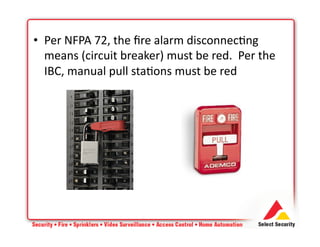
    • Per  NFPA  72,  the  fire  alarm  disconnec+ng   means  (circuit  breaker)  must  be  red.    Per  the   IBC,  manual  pull  sta+ons  must  be  red