Contents
What isLi-Fi
Why is it required??
History.
LI-FI Over WI-FI
Working
Advantages
Disadvantages.
Applications.
Future.
Conclusion.
3.
WHAT IS LI-FI???
•LIFI(light fidelity) is a
bidirectional wireless
system that transmits
data via LED or infrared
light.
• It was first unveiled in
2011 by Harald haas .
• Its frequency is 800thz
4.
History
It allows wirelesscommunication
without the use of radio waves,
which can be dangerous in places
like oil platforms, underwater and
on planes
Li-Fi can be thought of as a
light-based Wi-Fi.
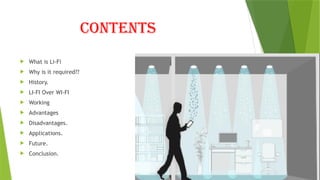
How it’s work?
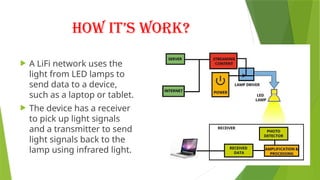
A LiFi network uses the
light from LED lamps to
send data to a device,
such as a laptop or tablet.
The device has a receiver
to pick up light signals
and a transmitter to send
light signals back to the
lamp using infrared light.
8.
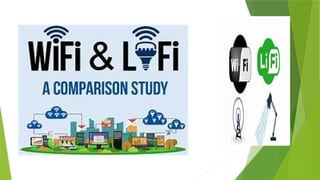
WI-FI VERSUS LI-FI
WI-FI uses radio waves.
WI-FI uses routers and
radio frequency to
transfer and receive data
Not secured (it can be
hacked)
Range is small
costly
LI-FI uses light.
LI-FI uses led bulbs and
light signals to transfer
and receive data
Secured( it cannot be
hacked)
Range is large
cheap
9.
ADVANTAGES
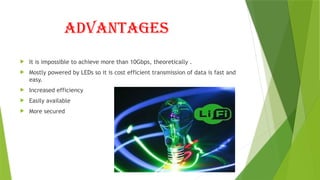
It isimpossible to achieve more than 10Gbps, theoretically .
Mostly powered by LEDs so it is cost efficient transmission of data is fast and
easy.
Increased efficiency
Easily available
More secured
10.
DISADVANTAGES
Light sourcereliance
Limited range
Interference
Presence of light is essential
There should be line of sight
11.
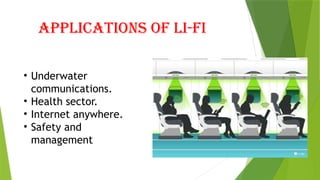
Applications of li-fi
•Underwater
communications.
• Health sector.
• Internet anywhere.
• Safety and
management
12.
Future of li-fi
The future of Li-Fi technology is incredibly exciting.
With its potential to revolutionize the way we
communicate and connect with each other
it could have a significant impact on various industries.
Another industry that could benefit from LiFi technology
is transportation.
13.
CONCLUSION
The possibilitiesare numerous and can be explored
further.
If this technology can be put into practical use, every
bulb can be used something like a WI-FI hotspots to
transmit wireless data.




![Rejuvenation of wireless technology [li fi]](https://cdn.slidesharecdn.com/ss_thumbnails/rejuvenationofwirelesstechnologyli-fi-160407085339-thumbnail.jpg?width=640&height=640&fit=bounds)


