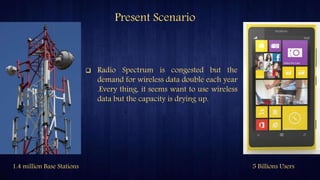
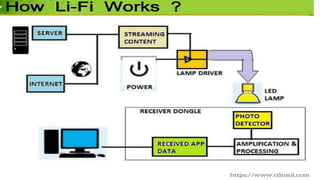
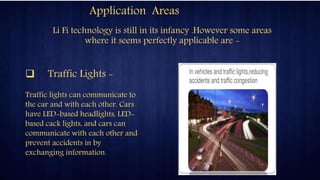
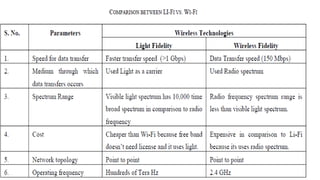
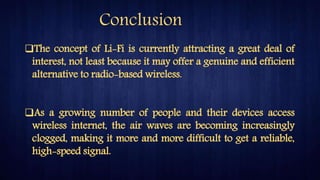
Li-Fi uses light from LED bulbs to transmit data wirelessly. It was pioneered in the 1990s but is now gaining more attention as an alternative to congested radio spectrum networks. Li-Fi works by varying the intensity of LED light faster than the human eye can detect to transmit digital signals. It has applications in traffic lights communicating with cars, hospitals where Wi-Fi can interfere with equipment, airplanes where radio waves don't work well, and under water where Wi-Fi fails. Advantages include higher speeds than Wi-Fi and lower costs since it uses LEDs. It requires line of sight and a light source, whereas Wi-Fi works anywhere. As more devices connect, Li-Fi may provide