LIGHT
FIDELITY
(LI-FI)
BY SAI CHARAN TEJA
• Present Usage of Communication
• Electromagnetic spectrum
• What is Li-Fi?
• History
• Working principle
• Applications
• Limitations
• Conclusion
Contents:
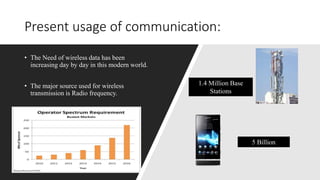
• The Need of wireless data has been
increasing day by day in this modern world.
• The major source used for wireless
transmission is Radio frequency.
Present usage of communication:
1.4 Million Base
Stations
5 Billion
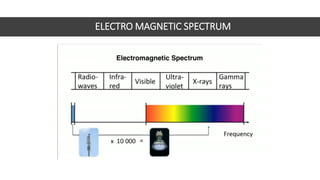
ELECTRO MAGNETIC SPECTRUM
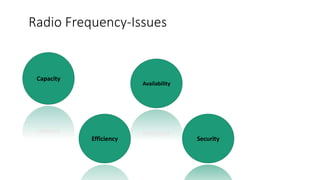
Radio Frequency-Issues
Availability
Security
Capacity
Efficiency
What is Li-Fi?
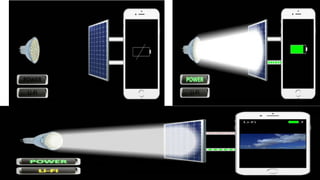
• Li-Fi, or light fidelity, is 5G visible light communication systems
using light from light-emitting diodes(LEDs) as a medium to
deliver networked, mobile, high-speed communication in a
similar manner as Wi-Fi and Optical fiber.
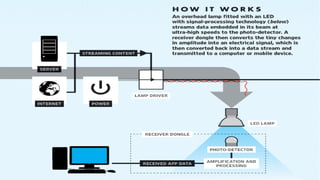
• Visible light communications (VLC) signals work by switching
bulbs on and off within nanoseconds , which is too quick to be
noticed by the human eye.
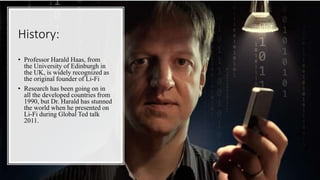
History:
• Professor Harald Haas, from
the University of Edinburgh in
the UK, is widely recognized as
the original founder of Li-Fi
• Research has been going on in
all the developed countries from
1990, but Dr. Harald has stunned
the world when he presented on
Li-Fi during Global Ted talk
2011.
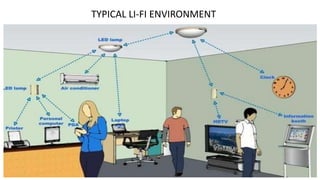
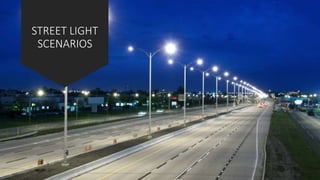
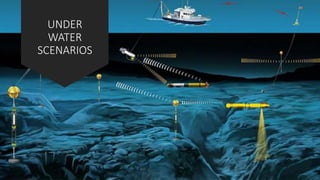
TYPICAL LI-FI ENVIRONMENT
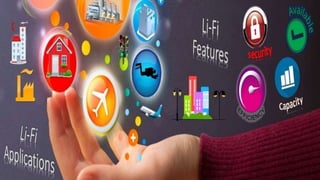
STREET LIGHT
SCENARIOS
UNDER
WATER
SCENARIOS
AEROPLANE
SCENARIOS
In RF
restricted
environments
LIMITATIONS & CHALLENGES
• Interferences from external light sources like sun light, normal
bulbs, and opaque materials in the path of transmission will cause
interruption in the communication.
• Li-Fi requires line of sight.
• High installation cost of the VLC systems.
• A major challenge facing Li-Fi is how the receiving device will
transmit back to transmitter.
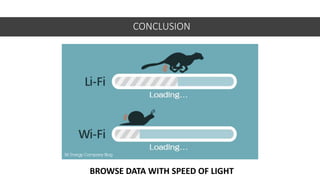
CONCLUSION
BROWSE DATA WITH SPEED OF LIGHT
Light fidelity (li fi) final ppt

Light fidelity (li fi) final ppt