PROFITING FROM SCIENCE
WWW.MATRIX-NI.ORG
LIFE & HEALTH SCIENCES
HORIZON PANEL
PROSPERITY AND HEALTH DELIVERED BY SCIENCE
10.2008
Personalised Medicine -
The opportunity for Northern Ireland
At its most basic, Personalised Medicine
refers to the use of information about a
person’s genetic makeup to tailor strategies
for the detection, treatment, or prevention of
disease.
Personalised Medicine is expected to transform
healthcare over the next several decades.
New diagnostic and prognostic tools will
increase ability to predict the likely outcomes
of drug therapy, while the expanded use of
biomarkers - biological molecules that indicate
a particular disease state - could result in
more focused and targeted drug development.
This will bring benefits to all stakeholders - to
patients (through improved health outcomes
and prevention), to industry (given the more
targeted and hence less costly approach
to R&D and the expansion of new product
pipeline), and to national governments (as it
has the potential to make healthcare more
cost-effective).
Assuming a scenario where Personalised
Medicine will grow to account for a quarter
of total pharmaceutical market value, this
indicates a market potential in excess of
$250 billion. The evolution of the market is,
however, expected to follow a gradual trend.
A personalised approach to medicine has far-
reaching implications, and a re-examination of
current approaches to a wide range of industry
practices and policies (ethical, regulatory,
educational etc) will be required.
The Life and Health Sciences Horizon Panel
has identified an opportunity for Northern
Ireland to carve out a share of this growing
market, by becoming a centre for Integrated
Research & Development in Personalised
Medicine. This would help fuel the development
of Personalised Medicine in Northern Ireland,
and place the local cluster on the international
map in this highly dynamic sector. The
competitive advantage would be conferred by
the integrated nature of the services provided,
harnessing academic scientific expertise,
clinical data and practice and a focus on
commerciable outputs. This will allow the local
cluster to develop in a number of ways:
- Development of existing businesses,
by accessing expertise and knowledge
from the local and international scientific
community;
- Attracting high quality research and FDI to
Northern Ireland; and
- Generating new company spin-outs from
the existing science base.
Realising the Personalised Medicine
opportunity for Northern Ireland will require
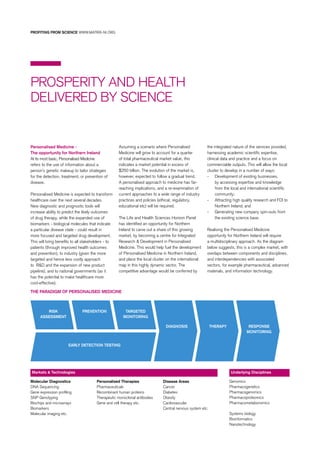
a multidisciplinary approach. As the diagram
below suggests, this is a complex market, with
overlaps between components and disciplines,
and interdependencies with associated
sectors, for example pharmaceutical, advanced
materials, and information technology.
PROSPERITY AND HEALTH
DELIVERED BY SCIENCE
PROFITING FROM SCIENCE WWW.MATRIX-NI.ORG
Molecular Diagnostics
DNA Sequencing
Gene expression profiling
SNP Genotyping
Biochips and microarrays
Biomarkers
Molecular imaging etc.
Personalised Therapies
Pharmaceuticals
Recombinant human proteins
Therapeutic monoclonal antibodies
Gene and cell therapy etc.
Disease Areas
Cancer
Diabetes
Obesity
Cardiovascular
Central nervous system etc.
Markets & Technologies
Genomics
Pharmacogenetics
Pharmacogenomics
Pharmacoproteomics
Pharmacometabonomics
Systems biology
Bioinformatics
Nanotechnology
Underlying Disciplines
RISK
ASSESSMENT
EARLY DETECTION TESTING
PREVENTION TARGETED
MONITORING
DIAGNOSIS THERAPY RESPONSE
MONITORING
THE PARADIGM OF PERSONALISED MEDICINE
Home-based Care
The opportunity for Northern Ireland
Also known as telehealth, or telecare, or
eHealth, Home-based Care refers to the
remote exchange of physiological and
physical data between a patient at home
and a response centre (be it medical staff at
a GP practice or hospital, family, or a third
party service provider) to assist in diagnosis,
progress monitoring and prevention of
various conditions. There is a wide range of
applications for such technologies, and the
Panel has identified immediate opportunities
in two key areas: Management of chronic
disease (e.g. diabetes, cardiovascular etc)
and Enhanced quality of life through extended
independent living for older and disabled
people.
The homecare market is anticipated to show
rapid growth, as installations in the home
move from trials to implementations. The US
is and will remain the largest national market
for telehealth, reaching $4.51 billion in 2010.
The European market may be smaller, but it
will show very rapid growth, with an expected
CAGR of 60% over the period. The UK is
the largest single market at $23 million and
is forecast to grow by 66% CAGR to $286
million in 2010.
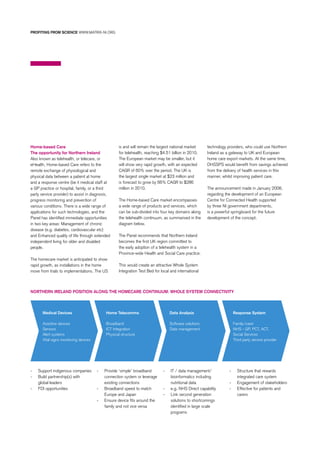
The Home-based Care market encompasses
a wide range of products and services, which
can be sub-divided into four key domains along
the telehealth continuum, as summarised in the
diagram below.
The Panel recommends that Northern Ireland
becomes the first UK region committed to
the early adoption of a telehealth system in a
Province-wide Health and Social Care practice.
This would create an attractive Whole System
Integration Test Bed for local and international
technology providers, who could use Northern
Ireland as a gateway to UK and European
home care export markets. At the same time,
DHSSPS would benefit from savings achieved
from the delivery of health services in this
manner, whilst improving patient care.
The announcement made in January 2008,
regarding the development of an European
Centre for Connected Health supported
by three NI government departments,
is a powerful springboard for the future
development of the concept.
- Support indigenous companies
- Build partnership(s) with
global leaders
- FDI opportunities
- Provide ‘simple’ broadband
connection system or leverage
existing connections
- Broadband speed to match
Europe and Japan
- Ensure device fits around the
family and not vice versa
- IT / data management/
bioinformatics including
nutritional data
- e.g. NHS Direct capability
- Link second generation
solutions to shortcomings
identified in large scale
programs
- Structure that rewards
integrated care system
- Engagement of stakeholders
- Effective for patients and
carers
PROFITING FROM SCIENCE WWW.MATRIX-NI.ORG
NORTHERN IRELAND POSITION ALONG THE HOMECARE CONTINUUM: WHOLE SYSTEM CONNECTIVITY
Home Telecomms
Broadband
ICT Integration
Physical structure
Data Analysis
Software solutions
Data management
Response System
Family/carer
NHS - GP, PCT, ACT,
Social Services
Third party service provider
Medical Devices
Assistive devices
Sensors
Alert systems
Vital signs monitoring devices
NORTHERN IRELAND
SCIENCE INDUSTRY PANEL
INNOVATION POLICY UNIT
DEPARTMENT OF ENTERPRISE,
TRADE AND INVESTMENT
NETHERLEIGH
MASSEY AVENUE
BELFAST BT4 2JP
MATRIX
PROFITING FROM SCIENCE
WWW.MATRIX-NI.ORG

Life & Health Sciences Horizon Panel

  • 1.
    PROFITING FROM SCIENCE WWW.MATRIX-NI.ORG LIFE& HEALTH SCIENCES HORIZON PANEL PROSPERITY AND HEALTH DELIVERED BY SCIENCE 10.2008
  • 2.
    Personalised Medicine - Theopportunity for Northern Ireland At its most basic, Personalised Medicine refers to the use of information about a person’s genetic makeup to tailor strategies for the detection, treatment, or prevention of disease. Personalised Medicine is expected to transform healthcare over the next several decades. New diagnostic and prognostic tools will increase ability to predict the likely outcomes of drug therapy, while the expanded use of biomarkers - biological molecules that indicate a particular disease state - could result in more focused and targeted drug development. This will bring benefits to all stakeholders - to patients (through improved health outcomes and prevention), to industry (given the more targeted and hence less costly approach to R&D and the expansion of new product pipeline), and to national governments (as it has the potential to make healthcare more cost-effective). Assuming a scenario where Personalised Medicine will grow to account for a quarter of total pharmaceutical market value, this indicates a market potential in excess of $250 billion. The evolution of the market is, however, expected to follow a gradual trend. A personalised approach to medicine has far- reaching implications, and a re-examination of current approaches to a wide range of industry practices and policies (ethical, regulatory, educational etc) will be required. The Life and Health Sciences Horizon Panel has identified an opportunity for Northern Ireland to carve out a share of this growing market, by becoming a centre for Integrated Research & Development in Personalised Medicine. This would help fuel the development of Personalised Medicine in Northern Ireland, and place the local cluster on the international map in this highly dynamic sector. The competitive advantage would be conferred by the integrated nature of the services provided, harnessing academic scientific expertise, clinical data and practice and a focus on commerciable outputs. This will allow the local cluster to develop in a number of ways: - Development of existing businesses, by accessing expertise and knowledge from the local and international scientific community; - Attracting high quality research and FDI to Northern Ireland; and - Generating new company spin-outs from the existing science base. Realising the Personalised Medicine opportunity for Northern Ireland will require a multidisciplinary approach. As the diagram below suggests, this is a complex market, with overlaps between components and disciplines, and interdependencies with associated sectors, for example pharmaceutical, advanced materials, and information technology. PROSPERITY AND HEALTH DELIVERED BY SCIENCE PROFITING FROM SCIENCE WWW.MATRIX-NI.ORG Molecular Diagnostics DNA Sequencing Gene expression profiling SNP Genotyping Biochips and microarrays Biomarkers Molecular imaging etc. Personalised Therapies Pharmaceuticals Recombinant human proteins Therapeutic monoclonal antibodies Gene and cell therapy etc. Disease Areas Cancer Diabetes Obesity Cardiovascular Central nervous system etc. Markets & Technologies Genomics Pharmacogenetics Pharmacogenomics Pharmacoproteomics Pharmacometabonomics Systems biology Bioinformatics Nanotechnology Underlying Disciplines RISK ASSESSMENT EARLY DETECTION TESTING PREVENTION TARGETED MONITORING DIAGNOSIS THERAPY RESPONSE MONITORING THE PARADIGM OF PERSONALISED MEDICINE
  • 3.
    Home-based Care The opportunityfor Northern Ireland Also known as telehealth, or telecare, or eHealth, Home-based Care refers to the remote exchange of physiological and physical data between a patient at home and a response centre (be it medical staff at a GP practice or hospital, family, or a third party service provider) to assist in diagnosis, progress monitoring and prevention of various conditions. There is a wide range of applications for such technologies, and the Panel has identified immediate opportunities in two key areas: Management of chronic disease (e.g. diabetes, cardiovascular etc) and Enhanced quality of life through extended independent living for older and disabled people. The homecare market is anticipated to show rapid growth, as installations in the home move from trials to implementations. The US is and will remain the largest national market for telehealth, reaching $4.51 billion in 2010. The European market may be smaller, but it will show very rapid growth, with an expected CAGR of 60% over the period. The UK is the largest single market at $23 million and is forecast to grow by 66% CAGR to $286 million in 2010. The Home-based Care market encompasses a wide range of products and services, which can be sub-divided into four key domains along the telehealth continuum, as summarised in the diagram below. The Panel recommends that Northern Ireland becomes the first UK region committed to the early adoption of a telehealth system in a Province-wide Health and Social Care practice. This would create an attractive Whole System Integration Test Bed for local and international technology providers, who could use Northern Ireland as a gateway to UK and European home care export markets. At the same time, DHSSPS would benefit from savings achieved from the delivery of health services in this manner, whilst improving patient care. The announcement made in January 2008, regarding the development of an European Centre for Connected Health supported by three NI government departments, is a powerful springboard for the future development of the concept. - Support indigenous companies - Build partnership(s) with global leaders - FDI opportunities - Provide ‘simple’ broadband connection system or leverage existing connections - Broadband speed to match Europe and Japan - Ensure device fits around the family and not vice versa - IT / data management/ bioinformatics including nutritional data - e.g. NHS Direct capability - Link second generation solutions to shortcomings identified in large scale programs - Structure that rewards integrated care system - Engagement of stakeholders - Effective for patients and carers PROFITING FROM SCIENCE WWW.MATRIX-NI.ORG NORTHERN IRELAND POSITION ALONG THE HOMECARE CONTINUUM: WHOLE SYSTEM CONNECTIVITY Home Telecomms Broadband ICT Integration Physical structure Data Analysis Software solutions Data management Response System Family/carer NHS - GP, PCT, ACT, Social Services Third party service provider Medical Devices Assistive devices Sensors Alert systems Vital signs monitoring devices
  • 4.
    NORTHERN IRELAND SCIENCE INDUSTRYPANEL INNOVATION POLICY UNIT DEPARTMENT OF ENTERPRISE, TRADE AND INVESTMENT NETHERLEIGH MASSEY AVENUE BELFAST BT4 2JP MATRIX PROFITING FROM SCIENCE WWW.MATRIX-NI.ORG