Feasible Combinatorial Matrix Theory
Ariel G. Fern´andez, Michael Soltys.
fernanag@mcmaster.ca, soltys@mcmaster.ca
Department of Computing and Software
McMaster University
Hamilton, Ontario, Canada
Outline
Introduction
KMM connects max matching with min vertex core
Language to Formalize Min-Max Reasoning
Main Results
LA with ΣB
1 -Ind. proves KMM
LA Equivalence: K¨onig, Menger, Hall, Dilworth
Related Theorems
Menger’s Theorem, Hall’s Theorem, and Dilworh’s Theorem
Future Work
1/12
KMM connects max matching with min vertex core
1
2
3
4
5
1’
2’
3’
4’
V1 V2
2/12
KMM connects max matching with min vertex core
1
2
3
4
5
1’
2’
3’
4’
V1 V2
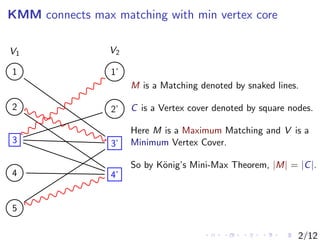
M is a Matching denoted by snaked lines.
C is a Vertex cover denoted by square nodes.
Here M is a Maximum Matching and V is a
Minimum Vertex Cover.
So by K¨onig’s Mini-Max Theorem, |M| = |C|.
2/12
Language to Formalize Min-Max Reasoning
LA is
(Developed by Cook and Soltys.) Part of Cook’s program of
Reverse Mathematics.
Three sorts:
indices
ring elements
matrices
LA formalize linear algebra (Matrix Algebra).
LA over Z (though all matrices are 0-1 matrices.)
Since we want to count the number of 1s in A by ΣA.
3/12
LA with ΣB
1 -Induction
LA (i.e., LA with ΣB
0 -Induction), proves all the ring properties of
matrices (eg.,(AB)C = A(BC)), and LA over Z translates into
TC0
-Frege ([Cook-Soltys’04]).
Bounded Matrix Quantifiers: We let
(∃A ≤ n)α stands for (∃A)[|A| ≤ n ∧ α], and
(∀A ≤ n)α stands for (∀A)[|A| ≤ n → α].
LA with ΣB
1 -Induction correspond to polytime reasoning and proves
standard properties of the determinant, and translate into extended
Frege.
4/12
Main Results
Theorem 1:
LA with ΣB
1 -Induction KMM.
Theorem 2:
LA proves the equivalence of fundamental theorems:
K¨onig Mini-Max
Menger’s Connectivity
Hall’s System of Distinct Representatives
Dilworth’s Decomposition
5/12
LA with ΣB
1 -Ind. proves KMM
Diagonal Property
∗
∗
0
...
00
0
0 . . .1
Either Aii = 1 or (∀j ≥ i)[Aij = 0 ∧ Aji = 0].
Claim Given any matrix A, ∃LA proves that there exist permutation
matrices P, Q such that PAQ has the diagonal property.
6/12
LA Equivalence: K¨onig, Menger, Hall, Dilworth
Theorem :
LA proves the equivalence of fundamental theorems:
K¨onig Mini-Max
Menger’s Connectivity
Hall’s System of Distinct Representatives
Dilworth’s Decomposition
7/12
Menger’s Connectivity Theorem – Example
y
a d
ex b
c f
x y
Menger’s Connectivity Theorem – Example
y
a d
ex b
c f
x y
8/12
Menger’s Connectivity Theorem – Example
y
a d
ex b
c f
x y
8/12
Menger’s Connectivity Theorem – Example
y
a d
ex b
c f
x y
8/12
Menger’s Connectivity Theorem – Example
y
a d
ex b
c f
x y
8/12
Hall’s SDR Theorem - Example
Let X = {1, 2, 3, 4, 5} be the 5-set of integers.
Let S = {S1, S2, S3, S4} be a family of X. For instance,
S1 = {2, 5}, S2 = {2, 5}, S3 = {1, 2, 3, 4}, S4 = {1, 2, 5}.
Then D := (2, 5, 3, 1) is an SDR for (S1, S2, S3, S4).
Now, if we replace S4 by S4 = {2, 5}, then the subsets no
longer have an SDR.
For S1 ∪ S2 ∪ S4 is a 2-set, and three elements are required to
represent S1, S2, S4
9/12
Dilworth’s Decomposition Theorem - Example
{}
{1} {2} {3}
{1, 2} {1, 3} {2, 3}
{1, 2, 3}
Let P = (⊂, 2X
), i.e., all subsets of
X with |X| = n with set inclusion,
x < y ⇐⇒ x ⊂ y.
(A) Suppose that the largest
chain in P has size . Then P can
be partitioned into antichains.
We have 4-antichains [{}] ,
[{1}, {2}, {3}] , [{1, 2}, {1, 3}, {2, 3}] ,
and [{1, 2, 3}] .
(B) Suppose that the largest
antichain in P has size .
Then P can be partitioned into
disjoint chains. We have
[{} ⊂ {1} ⊂ {1, 2} ⊂ {1, 2, 3}] ,
[{2} ⊂ {2, 3}] , and [{3} ⊂ {1, 3}].
10/12
Examples of LA formalization
For example, concepts necessary to state KMM in LLA:
Cover(A, α) :=
∀i, j ≤ r(A)(A(i, j) = 1 → α(1, i) = 1 ∨ α(2, j) = 1)
Select(A, β) :=
∀i, j ≤ r(A)((β(i, j) = 1 → A(i, j) = 1)
∧
∀k ≤ r(A)(β(i, j) = 1 → β(i, k) = 0 ∧ β(k, j) = 0))
11/12
Future Work
Can LA-Theory prove KMM?
What is the relationship between KMM and PHP?
(Eg. LA ∪ PHP KMM?)
Can LA ∪ KMM prove Hard Matrix Identities?
We would like to know whether LA ∪ KMM can prove hard
matrix identities, such as AB = I → BA = I. Of course, we
already know from [TZ11] that (non-uniform) NC2
-Frege is
sufficient to prove AB = I → BA = I, and from [Sol06] we
know that ∃LA can prove them also.
What about ∞-KMM?
12/12

Feasible Combinatorial Matrix Theory - LICS2013 presentation

  • 1.
    Feasible Combinatorial MatrixTheory Ariel G. Fern´andez, Michael Soltys. fernanag@mcmaster.ca, soltys@mcmaster.ca Department of Computing and Software McMaster University Hamilton, Ontario, Canada
  • 2.
    Outline Introduction KMM connects maxmatching with min vertex core Language to Formalize Min-Max Reasoning Main Results LA with ΣB 1 -Ind. proves KMM LA Equivalence: K¨onig, Menger, Hall, Dilworth Related Theorems Menger’s Theorem, Hall’s Theorem, and Dilworh’s Theorem Future Work 1/12
  • 3.
    KMM connects maxmatching with min vertex core 1 2 3 4 5 1’ 2’ 3’ 4’ V1 V2 2/12
  • 4.
    KMM connects maxmatching with min vertex core 1 2 3 4 5 1’ 2’ 3’ 4’ V1 V2 M is a Matching denoted by snaked lines. C is a Vertex cover denoted by square nodes. Here M is a Maximum Matching and V is a Minimum Vertex Cover. So by K¨onig’s Mini-Max Theorem, |M| = |C|. 2/12
  • 5.
    Language to FormalizeMin-Max Reasoning LA is (Developed by Cook and Soltys.) Part of Cook’s program of Reverse Mathematics. Three sorts: indices ring elements matrices LA formalize linear algebra (Matrix Algebra). LA over Z (though all matrices are 0-1 matrices.) Since we want to count the number of 1s in A by ΣA. 3/12
  • 6.
    LA with ΣB 1-Induction LA (i.e., LA with ΣB 0 -Induction), proves all the ring properties of matrices (eg.,(AB)C = A(BC)), and LA over Z translates into TC0 -Frege ([Cook-Soltys’04]). Bounded Matrix Quantifiers: We let (∃A ≤ n)α stands for (∃A)[|A| ≤ n ∧ α], and (∀A ≤ n)α stands for (∀A)[|A| ≤ n → α]. LA with ΣB 1 -Induction correspond to polytime reasoning and proves standard properties of the determinant, and translate into extended Frege. 4/12
  • 7.
    Main Results Theorem 1: LAwith ΣB 1 -Induction KMM. Theorem 2: LA proves the equivalence of fundamental theorems: K¨onig Mini-Max Menger’s Connectivity Hall’s System of Distinct Representatives Dilworth’s Decomposition 5/12
  • 8.
    LA with ΣB 1-Ind. proves KMM Diagonal Property ∗ ∗ 0 ... 00 0 0 . . .1 Either Aii = 1 or (∀j ≥ i)[Aij = 0 ∧ Aji = 0]. Claim Given any matrix A, ∃LA proves that there exist permutation matrices P, Q such that PAQ has the diagonal property. 6/12
  • 9.
    LA Equivalence: K¨onig,Menger, Hall, Dilworth Theorem : LA proves the equivalence of fundamental theorems: K¨onig Mini-Max Menger’s Connectivity Hall’s System of Distinct Representatives Dilworth’s Decomposition 7/12
  • 10.
    Menger’s Connectivity Theorem– Example y a d ex b c f x y
  • 11.
    Menger’s Connectivity Theorem– Example y a d ex b c f x y 8/12
  • 12.
    Menger’s Connectivity Theorem– Example y a d ex b c f x y 8/12
  • 13.
    Menger’s Connectivity Theorem– Example y a d ex b c f x y 8/12
  • 14.
    Menger’s Connectivity Theorem– Example y a d ex b c f x y 8/12
  • 15.
    Hall’s SDR Theorem- Example Let X = {1, 2, 3, 4, 5} be the 5-set of integers. Let S = {S1, S2, S3, S4} be a family of X. For instance, S1 = {2, 5}, S2 = {2, 5}, S3 = {1, 2, 3, 4}, S4 = {1, 2, 5}. Then D := (2, 5, 3, 1) is an SDR for (S1, S2, S3, S4). Now, if we replace S4 by S4 = {2, 5}, then the subsets no longer have an SDR. For S1 ∪ S2 ∪ S4 is a 2-set, and three elements are required to represent S1, S2, S4 9/12
  • 16.
    Dilworth’s Decomposition Theorem- Example {} {1} {2} {3} {1, 2} {1, 3} {2, 3} {1, 2, 3} Let P = (⊂, 2X ), i.e., all subsets of X with |X| = n with set inclusion, x < y ⇐⇒ x ⊂ y. (A) Suppose that the largest chain in P has size . Then P can be partitioned into antichains. We have 4-antichains [{}] , [{1}, {2}, {3}] , [{1, 2}, {1, 3}, {2, 3}] , and [{1, 2, 3}] . (B) Suppose that the largest antichain in P has size . Then P can be partitioned into disjoint chains. We have [{} ⊂ {1} ⊂ {1, 2} ⊂ {1, 2, 3}] , [{2} ⊂ {2, 3}] , and [{3} ⊂ {1, 3}]. 10/12
  • 17.
    Examples of LAformalization For example, concepts necessary to state KMM in LLA: Cover(A, α) := ∀i, j ≤ r(A)(A(i, j) = 1 → α(1, i) = 1 ∨ α(2, j) = 1) Select(A, β) := ∀i, j ≤ r(A)((β(i, j) = 1 → A(i, j) = 1) ∧ ∀k ≤ r(A)(β(i, j) = 1 → β(i, k) = 0 ∧ β(k, j) = 0)) 11/12
  • 18.
    Future Work Can LA-Theoryprove KMM? What is the relationship between KMM and PHP? (Eg. LA ∪ PHP KMM?) Can LA ∪ KMM prove Hard Matrix Identities? We would like to know whether LA ∪ KMM can prove hard matrix identities, such as AB = I → BA = I. Of course, we already know from [TZ11] that (non-uniform) NC2 -Frege is sufficient to prove AB = I → BA = I, and from [Sol06] we know that ∃LA can prove them also. What about ∞-KMM? 12/12