B.V .V .S SANGHA’S
BILURU GURUBASAVA MAHASWAMIJI
INSTITUTE OF TECHNOLOGY, MUDHOL – 587313
Department of AIML Engineering
Presentation On
“LIBRARY MANAGEMENT SYSTEM”
Presented by :-
ABHINAV KORA USN:- 2LB22AI001
AKSHAY VK USN:- 2LB22AI002
ARYAN NIGADE USN:- 2LB22AI003
Under the Guidance of :-
Prof. Aravind Bijaragi
Assist. professor,
Department of AIML,
BGMIT Mudhol.
CONTENTS
INTRODUCTION
1. REQUIREMENT ANALYSIS .
2. E-R DIAGRAM REPRESENTATION.
3. RELATIONAL DATABASE DESIGN.
4. NORMALIZATION.
5. FUTURE SCOPE AND CONCLUSION.
Introduction:-
• The “LIBRARY MANAGEMENT SYSTEM” is a software that uses to maintain the record of the library.
• Library is the collection of different types of books.
• It provides books for large number of readers and to maintain the records is difficult task.
• We need software for managing the library.
• Thus we have proposed library management system software that provides the systematic handilng the
records of books and user
MODULE 1
REQUIREMENT ANALYSIS .
• A library database needs t store information pertaining to its users (or customers), its workers, the
physical locations of its branches, and the media stored in those locations. We have decided to limit the
media to two types: books and videos.
• Customers will provide their name, address, phone number, and date of birth when signing up for a
library card. They will then be assigned a unique user name and ID number, plus a temporary password
that will have to be changed. Checkout operations will require a library card, as will requests to put media
on hold. Each library card will have its own fines, but active fines on any of a customer's cards will
prevent the customer from using the library's services.
• The library will have branches in various physical locations. Branches will be identified by name, and each
branch will have an address and a phone number associated with it. Additionally, a library branch will
store media and have employees.
Requirement analysis for a Library Management System
(LMS) is a comprehensive process that involves several detailed steps to ensure the final system meets the needs
of its users and aligns with the library’s goals. Here is an expanded explanation of this process:
1. Stakeholder Identification
2. Needs Assessment
3. Functional Requirements
4. Non-Functional Requirements
5. Technical Requirements
6. Regulatory and Compliance Requirements
MODULE 2
E-R DIAGRAM REPRESENTATION
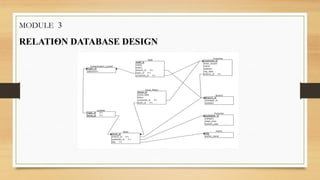
MODULE 3
RELATION DATABASE DESIGN
•
MODULE 5
CONCLUSION
• The evolution of Library Management Systems (LMS) within the framework of Database Management Systems
(DBMS) marks a pivotal advancement in the way libraries operate and serve their patrons. By leveraging cutting-
edge technologies such as AI, machine learning, blockchain, IoT, and cloud computing, LMS can transform
from traditional, manual processes to highly automated, intelligent systems. This shift not only streamlines
administrative tasks but also enhances data security, resource management, and user engagement. Libraries can
provide personalized experiences, improve the accuracy and efficiency of inventory management, and offer
robust data analytics for informed decision-making. The integration of mobile applications and digital platforms
further extends the reach and accessibility of library services, catering to the needs of a tech-savvy user base. As
libraries continue to adopt these innovations, they will remain relevant and indispensable in the digital age,
evolving into dynamic, user-centric hubs of knowledge and learning. The future of LMS in DBMS is promising,
with endless possibilities for enhancing the efficiency, security, and overall user experience, ensuring that libraries
can meet the growing demands of their communities and adapt to the ever-changing technological landscape.
THANK YOU

library management system with dbms using mysql

  • 1.
    B.V .V .SSANGHA’S BILURU GURUBASAVA MAHASWAMIJI INSTITUTE OF TECHNOLOGY, MUDHOL – 587313 Department of AIML Engineering Presentation On “LIBRARY MANAGEMENT SYSTEM” Presented by :- ABHINAV KORA USN:- 2LB22AI001 AKSHAY VK USN:- 2LB22AI002 ARYAN NIGADE USN:- 2LB22AI003 Under the Guidance of :- Prof. Aravind Bijaragi Assist. professor, Department of AIML, BGMIT Mudhol.
  • 2.
    CONTENTS INTRODUCTION 1. REQUIREMENT ANALYSIS. 2. E-R DIAGRAM REPRESENTATION. 3. RELATIONAL DATABASE DESIGN. 4. NORMALIZATION. 5. FUTURE SCOPE AND CONCLUSION.
  • 3.
    Introduction:- • The “LIBRARYMANAGEMENT SYSTEM” is a software that uses to maintain the record of the library. • Library is the collection of different types of books. • It provides books for large number of readers and to maintain the records is difficult task. • We need software for managing the library. • Thus we have proposed library management system software that provides the systematic handilng the records of books and user
  • 4.
    MODULE 1 REQUIREMENT ANALYSIS. • A library database needs t store information pertaining to its users (or customers), its workers, the physical locations of its branches, and the media stored in those locations. We have decided to limit the media to two types: books and videos. • Customers will provide their name, address, phone number, and date of birth when signing up for a library card. They will then be assigned a unique user name and ID number, plus a temporary password that will have to be changed. Checkout operations will require a library card, as will requests to put media on hold. Each library card will have its own fines, but active fines on any of a customer's cards will prevent the customer from using the library's services. • The library will have branches in various physical locations. Branches will be identified by name, and each branch will have an address and a phone number associated with it. Additionally, a library branch will store media and have employees.
  • 5.
    Requirement analysis fora Library Management System (LMS) is a comprehensive process that involves several detailed steps to ensure the final system meets the needs of its users and aligns with the library’s goals. Here is an expanded explanation of this process: 1. Stakeholder Identification 2. Needs Assessment 3. Functional Requirements 4. Non-Functional Requirements 5. Technical Requirements 6. Regulatory and Compliance Requirements
  • 6.
    MODULE 2 E-R DIAGRAMREPRESENTATION
  • 7.
  • 8.
    MODULE 5 CONCLUSION • Theevolution of Library Management Systems (LMS) within the framework of Database Management Systems (DBMS) marks a pivotal advancement in the way libraries operate and serve their patrons. By leveraging cutting- edge technologies such as AI, machine learning, blockchain, IoT, and cloud computing, LMS can transform from traditional, manual processes to highly automated, intelligent systems. This shift not only streamlines administrative tasks but also enhances data security, resource management, and user engagement. Libraries can provide personalized experiences, improve the accuracy and efficiency of inventory management, and offer robust data analytics for informed decision-making. The integration of mobile applications and digital platforms further extends the reach and accessibility of library services, catering to the needs of a tech-savvy user base. As libraries continue to adopt these innovations, they will remain relevant and indispensable in the digital age, evolving into dynamic, user-centric hubs of knowledge and learning. The future of LMS in DBMS is promising, with endless possibilities for enhancing the efficiency, security, and overall user experience, ensuring that libraries can meet the growing demands of their communities and adapt to the ever-changing technological landscape.
  • 9.