A Level Ideologies


  LIBERALISM
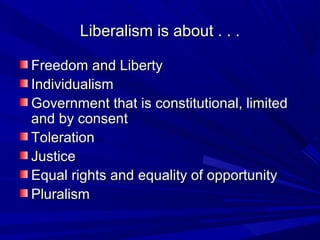
Liberalism is about . . .

Freedom and Liberty
Individualism
Government that is constitutional, limited
and by consent
Toleration
Justice
Equal rights and equality of opportunity
Pluralism
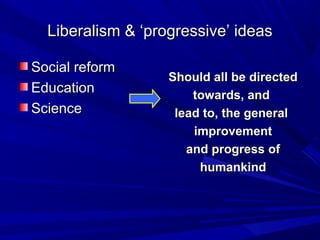
Liberalism & ‘progressive’ ideas

Social reform
                   Should all be directed
Education              towards, and
Science             lead to, the general
                       improvement
                      and progress of
                        humankind
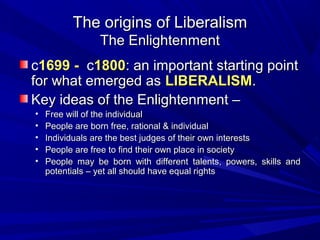
The origins of Liberalism
                 The Enlightenment
c1699 - c1800: an important starting point
for what emerged as LIBERALISM.
Key ideas of the Enlightenment –
•   Free will of the individual
•   People are born free, rational & individual
•   Individuals are the best judges of their own interests
•   People are free to find their own place in society
•   People may be born with different talents, powers, skills and
    potentials – yet all should have equal rights
The origins of Liberalism
  The Enlightenment – Key Thinkers
John Locke (1632-1704)
– ‘Two Treatises on Government’
– Government had to be with the consent of the
  people

Thomas Jefferson (1743-1826)
– One of the ‘Founding Fathers’ of the USA
– Individuals & the ‘pursuit of happiness’
The origins of Liberalism
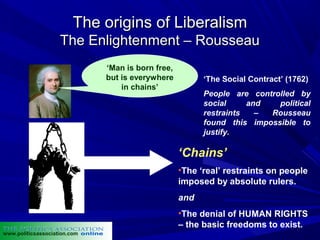
                    The Enlightenment – Rousseau
                              ‘Man is born free,
                              but is everywhere          ‘The Social Contract’ (1762)
                                  in chains’
                                                         People are controlled by
                                                         social     and   political
                                                         restraints   – Rousseau
                                                         found this impossible to
                                                         justify.

                                                   ‘Chains’
                                                   •The ‘real’ restraints on people
                                                   imposed by absolute rulers.
                                                   and
                                                   •The denial of HUMAN RIGHTS
                                                   – the basic freedoms to exist.
www.politicsassociation.com
Freedom and Liberty
 The key element in liberalism.
 Freedom/liberty may be political.
 Freedom/liberty may be about/for the individual.
 Freedom/liberty may be positive – the desire of
 individuals to be in control and not controlled.
 Freedom/liberty may be negative – the absence
 of any kind of restraint.
Individualism
 The individual as the best judge of their
 own interests – Utilitarianism.
 The individual free from constraint.
Constitutional, limited government
 Government must act within clearly defined
 boundaries.
 Government should not interfere with the
 interests of individuals.
 Political power can be substantial – it must
 always be controlled.
 The most effective way of controlling
 government (according to liberals) is to define
 the extent of their power in a constitution.
Toleration
 Original link with religious toleration / freedom.
 Modern liberalism – tolerance of sexuality,
 lifestyle.
Justice
 Social justice – more a feature of modern than
 traditional liberalism. Early liberals felt that social
 justice might require too much intervention by
 the state.
 Legal justice – everyone equal before the law.
Equal rights and equality of
     opportunity
          Equal right of individuals to reach potential – not
          all liberals agree if this is a natural right or not.
          Equality of opportunity – all are entitled to equal
          life chances, this can be promoted initially
          through education.


www.politicsassociation.com
Pluralism
          The liberal belief that a healthy society and
          political system is characterised by the existence
          of, and encouragement towards, group activity.
          Group activity and opportunities help to promote
          the freedom of individuals and limits the power
          of government.


www.politicsassociation.com
Coming soon . . .

                              Liberalism
                               CD ROM


www.politicsassociation.com

Liberalism

  • 1.
  • 2.
    Liberalism is about. . . Freedom and Liberty Individualism Government that is constitutional, limited and by consent Toleration Justice Equal rights and equality of opportunity Pluralism
  • 3.
    Liberalism & ‘progressive’ideas Social reform Should all be directed Education towards, and Science lead to, the general improvement and progress of humankind
  • 4.
    The origins ofLiberalism The Enlightenment c1699 - c1800: an important starting point for what emerged as LIBERALISM. Key ideas of the Enlightenment – • Free will of the individual • People are born free, rational & individual • Individuals are the best judges of their own interests • People are free to find their own place in society • People may be born with different talents, powers, skills and potentials – yet all should have equal rights
  • 5.
    The origins ofLiberalism The Enlightenment – Key Thinkers John Locke (1632-1704) – ‘Two Treatises on Government’ – Government had to be with the consent of the people Thomas Jefferson (1743-1826) – One of the ‘Founding Fathers’ of the USA – Individuals & the ‘pursuit of happiness’
  • 6.
    The origins ofLiberalism The Enlightenment – Rousseau ‘Man is born free, but is everywhere ‘The Social Contract’ (1762) in chains’ People are controlled by social and political restraints – Rousseau found this impossible to justify. ‘Chains’ •The ‘real’ restraints on people imposed by absolute rulers. and •The denial of HUMAN RIGHTS – the basic freedoms to exist. www.politicsassociation.com
  • 7.
    Freedom and Liberty The key element in liberalism. Freedom/liberty may be political. Freedom/liberty may be about/for the individual. Freedom/liberty may be positive – the desire of individuals to be in control and not controlled. Freedom/liberty may be negative – the absence of any kind of restraint.
  • 8.
    Individualism The individualas the best judge of their own interests – Utilitarianism. The individual free from constraint.
  • 9.
    Constitutional, limited government Government must act within clearly defined boundaries. Government should not interfere with the interests of individuals. Political power can be substantial – it must always be controlled. The most effective way of controlling government (according to liberals) is to define the extent of their power in a constitution.
  • 10.
    Toleration Original linkwith religious toleration / freedom. Modern liberalism – tolerance of sexuality, lifestyle.
  • 11.
    Justice Social justice– more a feature of modern than traditional liberalism. Early liberals felt that social justice might require too much intervention by the state. Legal justice – everyone equal before the law.
  • 12.
    Equal rights andequality of opportunity Equal right of individuals to reach potential – not all liberals agree if this is a natural right or not. Equality of opportunity – all are entitled to equal life chances, this can be promoted initially through education. www.politicsassociation.com
  • 13.
    Pluralism The liberal belief that a healthy society and political system is characterised by the existence of, and encouragement towards, group activity. Group activity and opportunities help to promote the freedom of individuals and limits the power of government. www.politicsassociation.com
  • 14.
    Coming soon .. . Liberalism CD ROM www.politicsassociation.com