
Leveraging on Compliance Risk
 Management to Create Value


                          Eneni Oduwole
                           April 10, 2013
Outline

 Introduction

 Risk-based Approach

 Functions of a Compliance Department

 Roles of the Board and Management

 Internal and External Drivers

 Risks and Consequences for Non-Compliance

 Required Measures

 Developing an Effective Programme

 Integrating Compliance with ERM


                                              FITC Compliance Risk Mgt Workshop - April 2013
What is Compliance?

 According to the International Compliance Association, the term Compliance describes the
   ability to act according to an order, set of rules or request. In business, it operates at two
   levels:
      Level 1: Compliance with the external rules that are imposed upon an organisation as a whole
      Level 2: Compliance with internal systems of control that are imposed to achieve compliance with
       the externally imposed rules

 Investorwords.com describes it as “The state of being in accordance with the relevant
   Federal or regional authorities and their requirements.”

 In summary, Compliance describes the act of adhering to a pre-determined set of rules
   whether they are internal policies and procedures or externally driven statutory or
   regulatory guidelines and rules. Compliance also assures that best practices are upheld in
   the organization

 Compliance Risk is defined as the current and prospective risk to earnings or capital arising
   from violations of or non-conformance with set rules and regulations, best practices,
   internal policies, and ethical standards. Compliance Risk also arises where the laws
   governing products or services offered by the organization are vague or untested


                                                                      FITC Compliance Risk Mgt Workshop - April 2013
Risk-based Compliance Approach

 Enables expedient deployment of resources to specific / required areas


 Puts in place steps for identifying and assessing compliance risk exposures


 Ensures the application of appropriate compliance measures for controlling related
  risks

Benefits:
 Tailored compliance strategies for effectively dealing with key compliance risks
 Efficiency gains; improved compliance adherence outcomes
 Reduced financial losses
 Greater business support for compliance – risk management processes by business


                                                           FITC Compliance Risk Mgt Workshop - April 2013
Functions of a Compliance Department

   Identification of Related Risks: recognize regulatory risk exposures in an
    organisation and advise accordingly
   Awareness: Establish and communicate the organization’s compliance policy
    to ensure that it is observed
   Monitoring and Detection: continuously review and report on the
    effectiveness of controls put in place to assure effective Compliance Risk
    Management
   Prevention: ensure design and implementation of controls that would
    protect an organisation from Compliance Risk exposures
   Resolution: have strategies in place to ensure timely management and
    redress of Compliance Risk exposures as they crystallize or are identified
   Consultation: provide advice to the Board and Management of the
    organization on new trends, risks identified and controls required
                                                      FITC Compliance Risk Mgt Workshop - April 2013
Roles and Responsibilities of the Board and Mgt in
                  Regulatory Compliance

The Board                                  Management
 Oversight function over all compliance   • Ensures the execution and adherence
  functions in the Bank                      to the Compliance Policy stipulations

 Reviews Compliance reports               •   Ensures a centrally controlled
  periodically at Board meetings to            Compliance function led by a Chief
  ensure that the organization complies        Compliance Officer exists to manage
  with all regulatory and internal             compliance exposures organization
  procedures
                                               wide

 Ensures that the provisions of the       •   Provides sufficient resources and
  organization’s Compliance policy is          ensures that compliance functions are
  strictly adhered to                          properly carried out, staff are
                                               adequately trained, and the periodic
                                               audit on the compliance function and
                                               framework conducted

                                                       FITC Compliance Risk Mgt Workshop - April 2013
What drives Compliance Exposure Internally and
                      Externally?

Internal Policies
 These ensure that all staff comply with the organization’s internal rules and
   regulations that govern its business model, corporate objectives, ethical
   standards, Code of Corporate Governance and the Code of Professional
   Conduct
 The Chief Compliance Officer should monitor the development and
  implementation of these policies and ensure consistency with regulatory and
  legal stipulations; the Compliance Group in liaison with Management should
  ensure that no regulatory guideline is violated or breached in the
  implementation of its internal policies and procedures
 Corporate Governance should be ensured in the development and
  implementation of internal policies, and all Members of staff should comply
  with all internal policies


                                                      FITC Compliance Risk Mgt Workshop - April 2013
What drives Compliance Exposure Internally and
                  Externally? (cont’d)

Laws and Regulatory Guidelines
 The Compliance function advises and monitors adherence with all legal,
  statutory, regulatory guidelines affecting the organization by ensuring
  transparent practices fashioned along local / international regulatory
  standards, and global best control practices are upheld
 Compliance with the Code of Corporate Governance issued by key local
  regulators (such as the Securities and Exchange Commission , the Central
  Bank of Nigeria) and globally accepted standards such as Sarbanes Oxley
  should be taken into consideration in drafting policies and procedures of the
  organization
 The Compliance function should ensure that all stakeholders are aware and
  adhere to local and international regulatory requirements; it is important
  that policies are drafted in line with relevant local regulations in all
  jurisdictions where the organization is operational
                                                     FITC Compliance Risk Mgt Workshop - April 2013
What drives Compliance Exposure Internally and
                  Externally? (cont’d)

Laws and Regulatory Guidelines (cont’d)
 The guidelines of the key regulators in the home country of the organizations
  must be upheld at all times

 Periodical review and update of all laws, policies and regulations affecting the
  organization should be ensured

 Compliance levels organization-wide should be ascertained, and staff notified
  of new and revised policies and laws


                                                      FITC Compliance Risk Mgt Workshop - April 2013
What drives Compliance Exposure Internally and
                  Externally? (cont’d)

Rendition of Returns
 All regulatory and statutory returns and reports should be rendered to
  regulators and law enforcement agencies as and when due to improve the
  organization’s rating by regulators and minimize sanctions and penalties
  against the organisation

 Maintaining a tracking system that would ensure timely and correct
  rendition of returns is required

 Business areas that breach the stipulated timelines should be appropriately
  sanctioned to ensure that the discipline required is inculcated organization-
  wide


                                                      FITC Compliance Risk Mgt Workshop - April 2013
What drives Compliance Exposure Internally and
                  Externally? (cont’d)

Relationship Management
 The Compliance function ensures timely and satisfactory responses are
  provided to regulatory enquiries in compliance with the laws and regulatory
  requirements

 It liaises with external regulators and law enforcement agencies on its
  compliance responsibilities by maintaining an open, honest and transparent
  relationship with these authorities


                                                      FITC Compliance Risk Mgt Workshop - April 2013
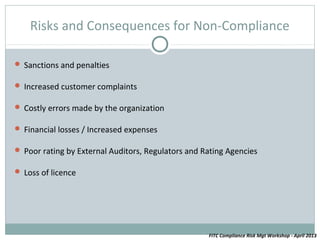
Risks and Consequences for Non-Compliance

 Sanctions and penalties

 Increased customer complaints

 Costly errors made by the organization

 Financial losses / Increased expenses

 Poor rating by External Auditors, Regulators and Rating Agencies

 Loss of licence


                                                    FITC Compliance Risk Mgt Workshop - April 2013
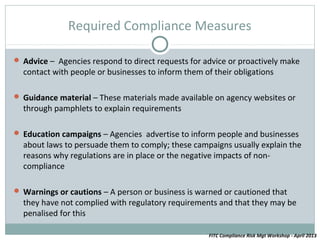
Required Compliance Measures

 Advice – Agencies respond to direct requests for advice or proactively make
  contact with people or businesses to inform them of their obligations

 Guidance material – These materials made available on agency websites or
  through pamphlets to explain requirements

 Education campaigns – Agencies advertise to inform people and businesses
  about laws to persuade them to comply; these campaigns usually explain the
  reasons why regulations are in place or the negative impacts of non-
  compliance

 Warnings or cautions – A person or business is warned or cautioned that
  they have not complied with regulatory requirements and that they may be
  penalised for this

                                                     FITC Compliance Risk Mgt Workshop - April 2013
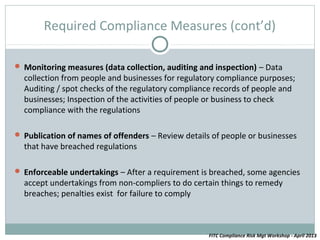
Required Compliance Measures (cont’d)

 Monitoring measures (data collection, auditing and inspection) – Data
  collection from people and businesses for regulatory compliance purposes;
  Auditing / spot checks of the regulatory compliance records of people and
  businesses; Inspection of the activities of people or business to check
  compliance with the regulations

 Publication of names of offenders – Review details of people or businesses
  that have breached regulations

 Enforceable undertakings – After a requirement is breached, some agencies
  accept undertakings from non-compliers to do certain things to remedy
  breaches; penalties exist for failure to comply


                                                    FITC Compliance Risk Mgt Workshop - April 2013
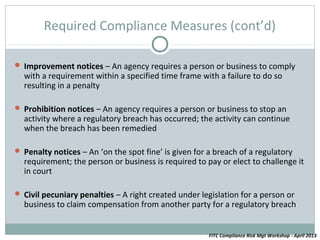
Required Compliance Measures (cont’d)

 Improvement notices – An agency requires a person or business to comply
  with a requirement within a specified time frame with a failure to do so
  resulting in a penalty

 Prohibition notices – An agency requires a person or business to stop an
  activity where a regulatory breach has occurred; the activity can continue
  when the breach has been remedied

 Penalty notices – An ‘on the spot fine’ is given for a breach of a regulatory
  requirement; the person or business is required to pay or elect to challenge it
  in court

 Civil pecuniary penalties – A right created under legislation for a person or
  business to claim compensation from another party for a regulatory breach


                                                       FITC Compliance Risk Mgt Workshop - April 2013
Required Compliance Measures (cont’d)

 Injunctions – A court order that stops a person or business from continuing
  to do a particular thing after a regulatory breach

 Negative licences – The person is restricted from undertaking an activity that
  otherwise requires no authorisation

 Action against licences/accreditation/certification – The authorisation of a
  person or business to undertake an activity is restricted or withdrawn after a
  failure to comply with the conditions of the authorisation

 Criminal prosecution – Legal proceedings are brought by the agency against
  a person or business because the law has been broken; a decision to
  prosecute is made when it is considered to be in the public interest; a range
  of very serious penalties can be given to a person found guilty of a criminal
  offence including large fines and imprisonment

                                                       FITC Compliance Risk Mgt Workshop - April 2013
Developing an Effective Compliance Programme

• Describe the meaning of compliance for your organisation and its response to
  its relevant demands

• Know what drives your compliance exposure both locally and abroad;
  internally and externally

• Identify the risks and consequences of non-compliance on the continued
  existence of your organization

• Appreciate and demonstrate in simple understandable ways, the
  relationship between corporate governance, risk management and
  compliance (GRC)


                                                    FITC Compliance Risk Mgt Workshop - April 2013
Developing an Effective Compliance Programme
                        (cont’d)

• Ensure delineation of the roles and responsibilities of the Board of Directors
  and Management in managing Compliance Risk

• Understand the implications of regulatory guidelines for corporate
  accountability and ethical behaviour

• Develop an effective fit-for-purpose compliance


• Ensure full integration of the organization’s ERM in optimising relevant
  structures and procedures for both compliance and proactive risk
  management


                                                      FITC Compliance Risk Mgt Workshop - April 2013
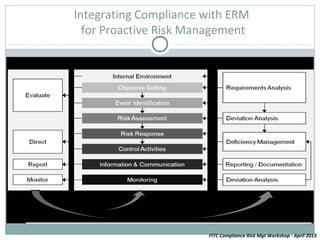
Integrating Compliance with ERM

 Largely driven by IT Compliance strategies

 Ensure that ERM systems have modules for monitoring compliance with
  internal and external policies

 IT Governance strategies should take into consideration procedures that
  drive and monitor Compliance risks organization-wide

 IT should drive the integration of Governance, ERM and Compliance for
  optimal output and value add from these three key elements of business
  management to the success of the organization

 Assures proactive and holistic risk management


                                                   FITC Compliance Risk Mgt Workshop - April 2013
Integrating Compliance with ERM
  for Proactive Risk Management


                       FITC Compliance Risk Mgt Workshop - April 2013
“The fact was that I was not a master of my actions, because
I was not so insane as to attempt to bend events to conform
to my policies. On the contrary, I bent my policies to accord
with the unforeseen shape of events” – Napoleon Bonaparte


       “YOU CANNOT ALLOW ANY OF YOUR PEOPLE TO
       AVOID THE BRUTAL FACTS. IF THEY START LIVING
        IN A DREAM WORLD, IT’S GOING TO BE BAD.” -
            GENERAL JAMES “MAD DOG” MATTISS
References

 www.grc-resource.com
 www.betterregulation.nsw.gov.au


               Thank You...
                            Contact Details
                      eneni.oduwole@gtbank.com
                      enenioduwole@yahoo.co.uk


                                                 FITC Compliance Risk Mgt Workshop - April 2013

Leveraging on Compliance Risk Management to Create Value

  • 1.
    Leveraging on ComplianceRisk Management to Create Value Eneni Oduwole April 10, 2013
  • 2.
    Outline  Introduction  Risk-basedApproach  Functions of a Compliance Department  Roles of the Board and Management  Internal and External Drivers  Risks and Consequences for Non-Compliance  Required Measures  Developing an Effective Programme  Integrating Compliance with ERM FITC Compliance Risk Mgt Workshop - April 2013
  • 3.
    What is Compliance? According to the International Compliance Association, the term Compliance describes the ability to act according to an order, set of rules or request. In business, it operates at two levels:  Level 1: Compliance with the external rules that are imposed upon an organisation as a whole  Level 2: Compliance with internal systems of control that are imposed to achieve compliance with the externally imposed rules  Investorwords.com describes it as “The state of being in accordance with the relevant Federal or regional authorities and their requirements.”  In summary, Compliance describes the act of adhering to a pre-determined set of rules whether they are internal policies and procedures or externally driven statutory or regulatory guidelines and rules. Compliance also assures that best practices are upheld in the organization  Compliance Risk is defined as the current and prospective risk to earnings or capital arising from violations of or non-conformance with set rules and regulations, best practices, internal policies, and ethical standards. Compliance Risk also arises where the laws governing products or services offered by the organization are vague or untested FITC Compliance Risk Mgt Workshop - April 2013
  • 4.
    Risk-based Compliance Approach Enables expedient deployment of resources to specific / required areas  Puts in place steps for identifying and assessing compliance risk exposures  Ensures the application of appropriate compliance measures for controlling related risks Benefits:  Tailored compliance strategies for effectively dealing with key compliance risks  Efficiency gains; improved compliance adherence outcomes  Reduced financial losses  Greater business support for compliance – risk management processes by business FITC Compliance Risk Mgt Workshop - April 2013
  • 5.
    Functions of aCompliance Department  Identification of Related Risks: recognize regulatory risk exposures in an organisation and advise accordingly  Awareness: Establish and communicate the organization’s compliance policy to ensure that it is observed  Monitoring and Detection: continuously review and report on the effectiveness of controls put in place to assure effective Compliance Risk Management  Prevention: ensure design and implementation of controls that would protect an organisation from Compliance Risk exposures  Resolution: have strategies in place to ensure timely management and redress of Compliance Risk exposures as they crystallize or are identified  Consultation: provide advice to the Board and Management of the organization on new trends, risks identified and controls required FITC Compliance Risk Mgt Workshop - April 2013
  • 6.
    Roles and Responsibilitiesof the Board and Mgt in Regulatory Compliance The Board Management  Oversight function over all compliance • Ensures the execution and adherence functions in the Bank to the Compliance Policy stipulations  Reviews Compliance reports • Ensures a centrally controlled periodically at Board meetings to Compliance function led by a Chief ensure that the organization complies Compliance Officer exists to manage with all regulatory and internal compliance exposures organization procedures wide  Ensures that the provisions of the • Provides sufficient resources and organization’s Compliance policy is ensures that compliance functions are strictly adhered to properly carried out, staff are adequately trained, and the periodic audit on the compliance function and framework conducted FITC Compliance Risk Mgt Workshop - April 2013
  • 7.
    What drives ComplianceExposure Internally and Externally? Internal Policies  These ensure that all staff comply with the organization’s internal rules and regulations that govern its business model, corporate objectives, ethical standards, Code of Corporate Governance and the Code of Professional Conduct  The Chief Compliance Officer should monitor the development and implementation of these policies and ensure consistency with regulatory and legal stipulations; the Compliance Group in liaison with Management should ensure that no regulatory guideline is violated or breached in the implementation of its internal policies and procedures  Corporate Governance should be ensured in the development and implementation of internal policies, and all Members of staff should comply with all internal policies FITC Compliance Risk Mgt Workshop - April 2013
  • 8.
    What drives ComplianceExposure Internally and Externally? (cont’d) Laws and Regulatory Guidelines  The Compliance function advises and monitors adherence with all legal, statutory, regulatory guidelines affecting the organization by ensuring transparent practices fashioned along local / international regulatory standards, and global best control practices are upheld  Compliance with the Code of Corporate Governance issued by key local regulators (such as the Securities and Exchange Commission , the Central Bank of Nigeria) and globally accepted standards such as Sarbanes Oxley should be taken into consideration in drafting policies and procedures of the organization  The Compliance function should ensure that all stakeholders are aware and adhere to local and international regulatory requirements; it is important that policies are drafted in line with relevant local regulations in all jurisdictions where the organization is operational FITC Compliance Risk Mgt Workshop - April 2013
  • 9.
    What drives ComplianceExposure Internally and Externally? (cont’d) Laws and Regulatory Guidelines (cont’d)  The guidelines of the key regulators in the home country of the organizations must be upheld at all times  Periodical review and update of all laws, policies and regulations affecting the organization should be ensured  Compliance levels organization-wide should be ascertained, and staff notified of new and revised policies and laws FITC Compliance Risk Mgt Workshop - April 2013
  • 10.
    What drives ComplianceExposure Internally and Externally? (cont’d) Rendition of Returns  All regulatory and statutory returns and reports should be rendered to regulators and law enforcement agencies as and when due to improve the organization’s rating by regulators and minimize sanctions and penalties against the organisation  Maintaining a tracking system that would ensure timely and correct rendition of returns is required  Business areas that breach the stipulated timelines should be appropriately sanctioned to ensure that the discipline required is inculcated organization- wide FITC Compliance Risk Mgt Workshop - April 2013
  • 11.
    What drives ComplianceExposure Internally and Externally? (cont’d) Relationship Management  The Compliance function ensures timely and satisfactory responses are provided to regulatory enquiries in compliance with the laws and regulatory requirements  It liaises with external regulators and law enforcement agencies on its compliance responsibilities by maintaining an open, honest and transparent relationship with these authorities FITC Compliance Risk Mgt Workshop - April 2013
  • 12.
    Risks and Consequencesfor Non-Compliance  Sanctions and penalties  Increased customer complaints  Costly errors made by the organization  Financial losses / Increased expenses  Poor rating by External Auditors, Regulators and Rating Agencies  Loss of licence FITC Compliance Risk Mgt Workshop - April 2013
  • 13.
    Required Compliance Measures Advice – Agencies respond to direct requests for advice or proactively make contact with people or businesses to inform them of their obligations  Guidance material – These materials made available on agency websites or through pamphlets to explain requirements  Education campaigns – Agencies advertise to inform people and businesses about laws to persuade them to comply; these campaigns usually explain the reasons why regulations are in place or the negative impacts of non- compliance  Warnings or cautions – A person or business is warned or cautioned that they have not complied with regulatory requirements and that they may be penalised for this FITC Compliance Risk Mgt Workshop - April 2013
  • 14.
    Required Compliance Measures(cont’d)  Monitoring measures (data collection, auditing and inspection) – Data collection from people and businesses for regulatory compliance purposes; Auditing / spot checks of the regulatory compliance records of people and businesses; Inspection of the activities of people or business to check compliance with the regulations  Publication of names of offenders – Review details of people or businesses that have breached regulations  Enforceable undertakings – After a requirement is breached, some agencies accept undertakings from non-compliers to do certain things to remedy breaches; penalties exist for failure to comply FITC Compliance Risk Mgt Workshop - April 2013
  • 15.
    Required Compliance Measures(cont’d)  Improvement notices – An agency requires a person or business to comply with a requirement within a specified time frame with a failure to do so resulting in a penalty  Prohibition notices – An agency requires a person or business to stop an activity where a regulatory breach has occurred; the activity can continue when the breach has been remedied  Penalty notices – An ‘on the spot fine’ is given for a breach of a regulatory requirement; the person or business is required to pay or elect to challenge it in court  Civil pecuniary penalties – A right created under legislation for a person or business to claim compensation from another party for a regulatory breach FITC Compliance Risk Mgt Workshop - April 2013
  • 16.
    Required Compliance Measures(cont’d)  Injunctions – A court order that stops a person or business from continuing to do a particular thing after a regulatory breach  Negative licences – The person is restricted from undertaking an activity that otherwise requires no authorisation  Action against licences/accreditation/certification – The authorisation of a person or business to undertake an activity is restricted or withdrawn after a failure to comply with the conditions of the authorisation  Criminal prosecution – Legal proceedings are brought by the agency against a person or business because the law has been broken; a decision to prosecute is made when it is considered to be in the public interest; a range of very serious penalties can be given to a person found guilty of a criminal offence including large fines and imprisonment FITC Compliance Risk Mgt Workshop - April 2013
  • 17.
    Developing an EffectiveCompliance Programme • Describe the meaning of compliance for your organisation and its response to its relevant demands • Know what drives your compliance exposure both locally and abroad; internally and externally • Identify the risks and consequences of non-compliance on the continued existence of your organization • Appreciate and demonstrate in simple understandable ways, the relationship between corporate governance, risk management and compliance (GRC) FITC Compliance Risk Mgt Workshop - April 2013
  • 18.
    Developing an EffectiveCompliance Programme (cont’d) • Ensure delineation of the roles and responsibilities of the Board of Directors and Management in managing Compliance Risk • Understand the implications of regulatory guidelines for corporate accountability and ethical behaviour • Develop an effective fit-for-purpose compliance • Ensure full integration of the organization’s ERM in optimising relevant structures and procedures for both compliance and proactive risk management FITC Compliance Risk Mgt Workshop - April 2013
  • 19.
    Integrating Compliance withERM  Largely driven by IT Compliance strategies  Ensure that ERM systems have modules for monitoring compliance with internal and external policies  IT Governance strategies should take into consideration procedures that drive and monitor Compliance risks organization-wide  IT should drive the integration of Governance, ERM and Compliance for optimal output and value add from these three key elements of business management to the success of the organization  Assures proactive and holistic risk management FITC Compliance Risk Mgt Workshop - April 2013
  • 20.
    Integrating Compliance withERM for Proactive Risk Management FITC Compliance Risk Mgt Workshop - April 2013
  • 21.
    “The fact wasthat I was not a master of my actions, because I was not so insane as to attempt to bend events to conform to my policies. On the contrary, I bent my policies to accord with the unforeseen shape of events” – Napoleon Bonaparte “YOU CANNOT ALLOW ANY OF YOUR PEOPLE TO AVOID THE BRUTAL FACTS. IF THEY START LIVING IN A DREAM WORLD, IT’S GOING TO BE BAD.” - GENERAL JAMES “MAD DOG” MATTISS
  • 22.
    References  www.grc-resource.com  www.betterregulation.nsw.gov.au Thank You... Contact Details eneni.oduwole@gtbank.com enenioduwole@yahoo.co.uk FITC Compliance Risk Mgt Workshop - April 2013