Control Self-Assessment (CSA)
Prepared by; Anchalee S.Wanichkul © 2014
Contents
• Why do CSA?
• How to do CSA?
• CSA Format
• CSA Benefits
• Things to concerns
Prepared by; Anchalee S.Wanichkul © 2014
Why do CSA?
• CSA allows managers and work teams directly involved in business units,
functions or processes to participate in assessing the organization’s risk
management and control processes.
• CSA help management to clarify business objectives and to identify and deal
with the risks to achieving those objectives.
• Continuous assurance that the internal controls, regulatory requirements,
policies and procedures are being followed in every corner and at every level
of the business.
• CSA operates by employees (not the auditors) to self-evaluate the controls
or processes. The employees have wealth of information about internal
controls and fraud (if it exists).
• The organization is much bigger than can be reviewed by a single group of
people, even using a risk-based approach. CSA could help cover more areas
with fewer people.
• Etc.
Prepared by; Anchalee S.Wanichkul © 2014
CSA Format
• Risk based;
“Focus on identifying the risks in achieving business objectives, then
identify the controls in place to manage the key risks.”
• Objective based;
“Focus on ways currently used to accomplish a given objective, then
identify the risks that still remain (the residual risks) to achieving the
objective.”
• Control based;
“Focus on how well the controls already in place are working. This format
may use a specific control framework such as COSO to identify the
controls in place.”
• Process based;
“Examine a process from beginning to end and identify the strengths and
weaknesses of each process step.”
• Departmental based;
“Examine the overall situation of dept. and identify the things that help the
dept. function well.”
Prepared by; Anchalee S.Wanichkul © 2014
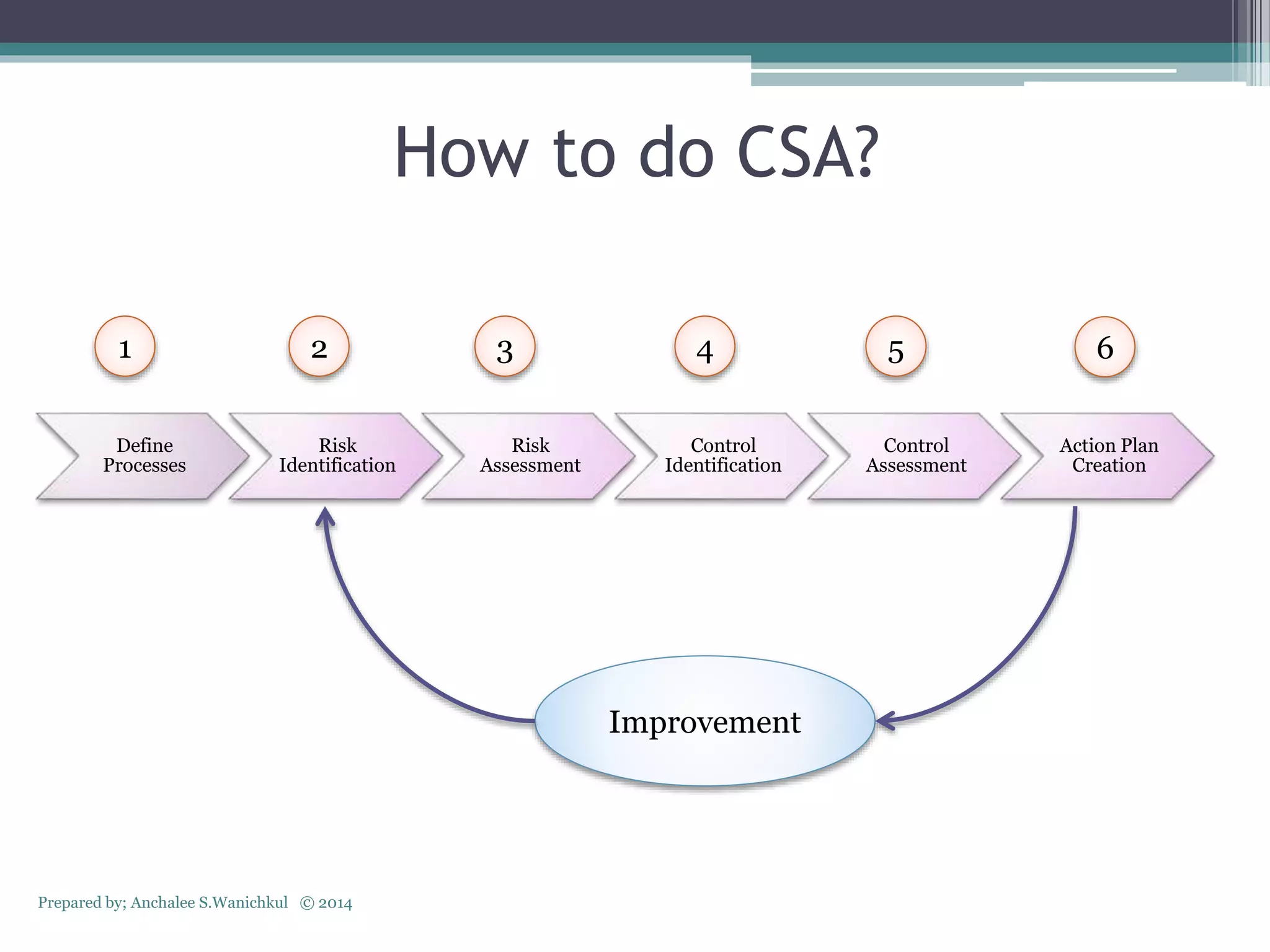
How to do CSA?
Define
Processes
Risk
Identification
Risk
Assessment
Control
Identification
Control
Assessment
Action Plan
Creation
Improvement
1 2 3 4 5 6
Prepared by; Anchalee S.Wanichkul © 2014
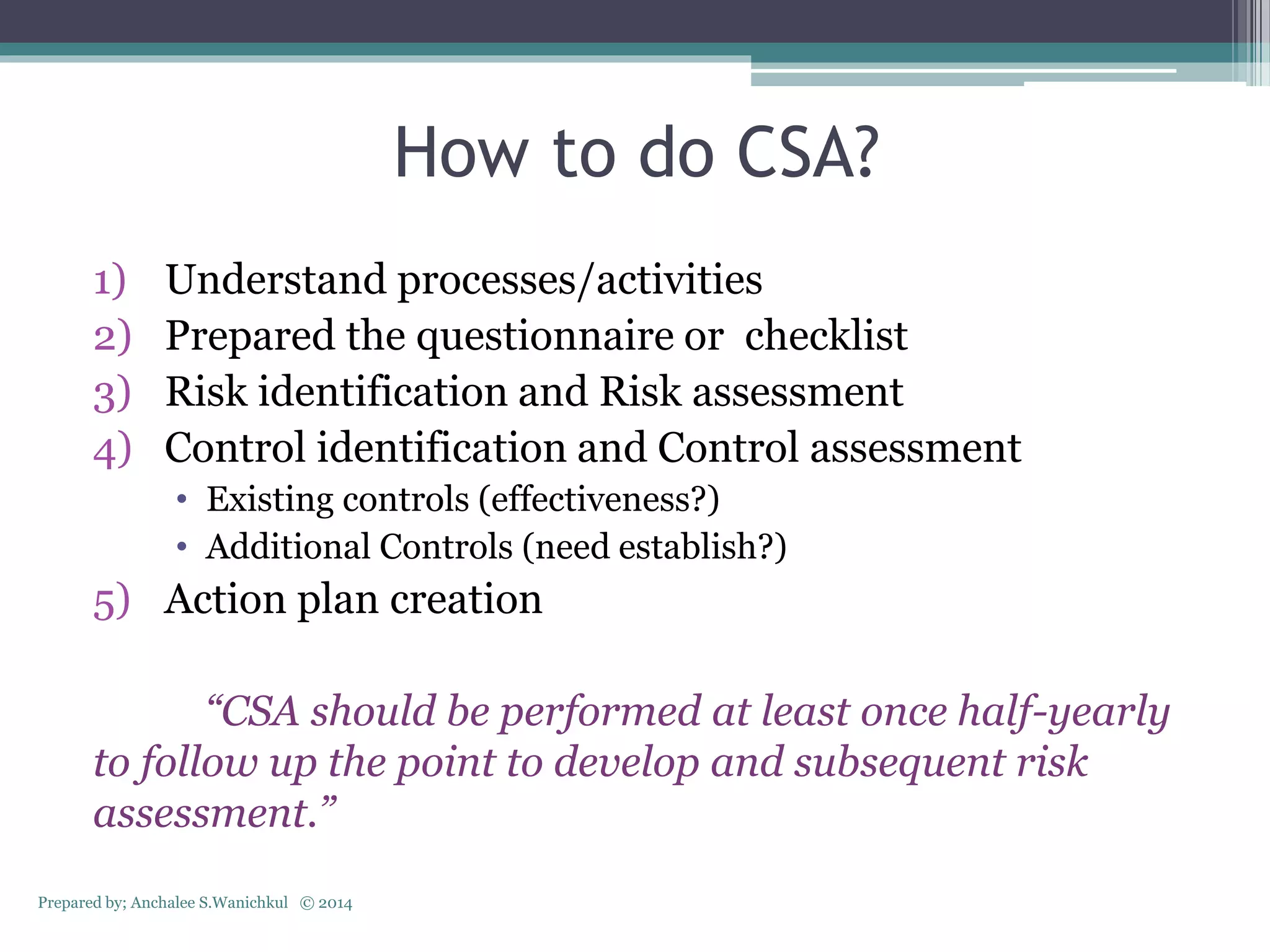
How to do CSA?
1) Understand processes/activities
2) Prepared the questionnaire or checklist
3) Risk identification and Risk assessment
4) Control identification and Control assessment
• Existing controls (effectiveness?)
• Additional Controls (need establish?)
5) Action plan creation
“CSA should be performed at least once half-yearly
to follow up the point to develop and subsequent risk
assessment.”
Prepared by; Anchalee S.Wanichkul © 2014
CSA Benefits
• CSA helps staff all levels to more understand and assume
responsibility for effective control and risk management by
involving them in assessment process.
• Corrective action is more effective because participants “own” the
results.
• Workshops improve communication at all levels, particularly
between managers and work teams.
• CSA increases the awareness and understanding of the
organizational objectives.
• CSA can quickly focus on high-risk issues and concentrate efforts
there.
• CSA can provide an assessment of soft or collaborative controls
which are difficult to assess with traditional auditing.
Prepared by; Anchalee S.Wanichkul © 2014
Things to concerns
• People are generally resistant to change.
• Someone view CSA as simply a shift of work a way for internal audit
to get line employees to do audit’s job.
• The results may not be accurate because the participants were not
knowledgeable, open and honest.
• Facilitators may not be as experienced in the areas of discussion in
CSA workshops.
• Etc.
“CSA is more difficult if work teams will not be opens and candid.”
Prepared by; Anchalee S.Wanichkul © 2014
Reference List
• A Discussion on Control-Self Assessment, KPMG, 15 May 2012
• Control Self-Assessment: Facilitation Skills Participant Guide,
Appendix A, IIA, Inc. Altamonte Springs, FL, 2009
Prepared by; Anchalee S.Wanichkul © 2014

Control self assessment (csa)

  • 1.
    Control Self-Assessment (CSA) Preparedby; Anchalee S.Wanichkul © 2014
  • 2.
    Contents • Why doCSA? • How to do CSA? • CSA Format • CSA Benefits • Things to concerns Prepared by; Anchalee S.Wanichkul © 2014
  • 3.
    Why do CSA? •CSA allows managers and work teams directly involved in business units, functions or processes to participate in assessing the organization’s risk management and control processes. • CSA help management to clarify business objectives and to identify and deal with the risks to achieving those objectives. • Continuous assurance that the internal controls, regulatory requirements, policies and procedures are being followed in every corner and at every level of the business. • CSA operates by employees (not the auditors) to self-evaluate the controls or processes. The employees have wealth of information about internal controls and fraud (if it exists). • The organization is much bigger than can be reviewed by a single group of people, even using a risk-based approach. CSA could help cover more areas with fewer people. • Etc. Prepared by; Anchalee S.Wanichkul © 2014
  • 4.
    CSA Format • Riskbased; “Focus on identifying the risks in achieving business objectives, then identify the controls in place to manage the key risks.” • Objective based; “Focus on ways currently used to accomplish a given objective, then identify the risks that still remain (the residual risks) to achieving the objective.” • Control based; “Focus on how well the controls already in place are working. This format may use a specific control framework such as COSO to identify the controls in place.” • Process based; “Examine a process from beginning to end and identify the strengths and weaknesses of each process step.” • Departmental based; “Examine the overall situation of dept. and identify the things that help the dept. function well.” Prepared by; Anchalee S.Wanichkul © 2014
  • 5.
    How to doCSA? Define Processes Risk Identification Risk Assessment Control Identification Control Assessment Action Plan Creation Improvement 1 2 3 4 5 6 Prepared by; Anchalee S.Wanichkul © 2014
  • 6.
    How to doCSA? 1) Understand processes/activities 2) Prepared the questionnaire or checklist 3) Risk identification and Risk assessment 4) Control identification and Control assessment • Existing controls (effectiveness?) • Additional Controls (need establish?) 5) Action plan creation “CSA should be performed at least once half-yearly to follow up the point to develop and subsequent risk assessment.” Prepared by; Anchalee S.Wanichkul © 2014
  • 7.
    CSA Benefits • CSAhelps staff all levels to more understand and assume responsibility for effective control and risk management by involving them in assessment process. • Corrective action is more effective because participants “own” the results. • Workshops improve communication at all levels, particularly between managers and work teams. • CSA increases the awareness and understanding of the organizational objectives. • CSA can quickly focus on high-risk issues and concentrate efforts there. • CSA can provide an assessment of soft or collaborative controls which are difficult to assess with traditional auditing. Prepared by; Anchalee S.Wanichkul © 2014
  • 8.
    Things to concerns •People are generally resistant to change. • Someone view CSA as simply a shift of work a way for internal audit to get line employees to do audit’s job. • The results may not be accurate because the participants were not knowledgeable, open and honest. • Facilitators may not be as experienced in the areas of discussion in CSA workshops. • Etc. “CSA is more difficult if work teams will not be opens and candid.” Prepared by; Anchalee S.Wanichkul © 2014
  • 9.
    Reference List • ADiscussion on Control-Self Assessment, KPMG, 15 May 2012 • Control Self-Assessment: Facilitation Skills Participant Guide, Appendix A, IIA, Inc. Altamonte Springs, FL, 2009 Prepared by; Anchalee S.Wanichkul © 2014