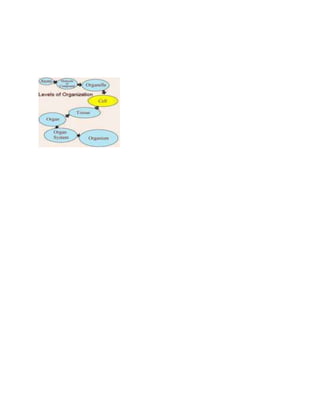
The Levels of Organization is a term used in basic biology, anatomy, and physiology. It is used with five basic concepts, the smallest the cell. Many specialized cells make up a tissue, many tissues an organ, many organs an organ system, and finally, many organ systems an organism. In bizarre cases microorganisms (unicellular) and superorganisms, only one cell or many organisms may occur within a single species.<br />Level I: Cells<br />Cells are the basic building blocks of life and performs vital functions in an organism, stated in Cell Theory.<br />Level II: Tissues<br />Tissue, the second level of organization. It is created by joining cells that have similar function or structure.<br />Level III: Organs<br />An organ is a group of tissues that perform a specific function or groups of functions. This is the third level of organization.<br />Level IV: Organ Systems<br />An organ system is a collection of organs that perform a specific function- the circulatory system or digestive system for example. Several organ systems are present in humans and other creatures have different kinds of systems. Plants have vascular systems and sharks have a kind of \"
electromagnetic system\"
. An organ system cannot live by itself and is dependent on other organ systems to form an organism. Here is a list of human organ systems and the organs they are made up of:<br />Circulatory system: the heart, blood, and blood vessels<br />Digestive system: the salivary glands, esophagus, stomach, liver, gallbladder, pancreas, intestines, rectum, and anus<br />Endocrine system: the hypothalamus, pituitary gland, pineal body, thyroid, parathyroids, and adrenals<br />Integumentary system: the skin, hair, and nails<br />Lymphatic system: the leukocytes, tonsils, adenoids, thymus, and spleen<br />Muscular system: the muscles<br />Nervous system: the nerves, brain, spinal cord, and peripheral nerves<br />Reproductive system: the ovaries, fallopian tubes, uterus, vagina, mammary glands, testes, vas deferens, seminal vesicles, prostate, and penis<br />Respiratory system: the pharynx, larynx, trachea, bronchi, lungs, and diaphragm<br />Skeletal system: the bones, cartilage, ligaments, and tendons<br />Urinary system: the kidneys, ureters, bladder, and urethra<br />Organ systems may be closely intertwined and called things like the musculoskeletal system or neuroendocrine system.<br />
##

##

  • 1.
    The Levels ofOrganization is a term used in basic biology, anatomy, and physiology. It is used with five basic concepts, the smallest the cell. Many specialized cells make up a tissue, many tissues an organ, many organs an organ system, and finally, many organ systems an organism. In bizarre cases microorganisms (unicellular) and superorganisms, only one cell or many organisms may occur within a single species.<br />Level I: Cells<br />Cells are the basic building blocks of life and performs vital functions in an organism, stated in Cell Theory.<br />Level II: Tissues<br />Tissue, the second level of organization. It is created by joining cells that have similar function or structure.<br />Level III: Organs<br />An organ is a group of tissues that perform a specific function or groups of functions. This is the third level of organization.<br />Level IV: Organ Systems<br />An organ system is a collection of organs that perform a specific function- the circulatory system or digestive system for example. Several organ systems are present in humans and other creatures have different kinds of systems. Plants have vascular systems and sharks have a kind of \" electromagnetic system\" . An organ system cannot live by itself and is dependent on other organ systems to form an organism. Here is a list of human organ systems and the organs they are made up of:<br />Circulatory system: the heart, blood, and blood vessels<br />Digestive system: the salivary glands, esophagus, stomach, liver, gallbladder, pancreas, intestines, rectum, and anus<br />Endocrine system: the hypothalamus, pituitary gland, pineal body, thyroid, parathyroids, and adrenals<br />Integumentary system: the skin, hair, and nails<br />Lymphatic system: the leukocytes, tonsils, adenoids, thymus, and spleen<br />Muscular system: the muscles<br />Nervous system: the nerves, brain, spinal cord, and peripheral nerves<br />Reproductive system: the ovaries, fallopian tubes, uterus, vagina, mammary glands, testes, vas deferens, seminal vesicles, prostate, and penis<br />Respiratory system: the pharynx, larynx, trachea, bronchi, lungs, and diaphragm<br />Skeletal system: the bones, cartilage, ligaments, and tendons<br />Urinary system: the kidneys, ureters, bladder, and urethra<br />Organ systems may be closely intertwined and called things like the musculoskeletal system or neuroendocrine system.<br />