Levels of Management
UNIT-1
MANAGEMENT
 Management is the process of planning and organising the
resources and activities of a business to achieve specific goals in
the most effective and efficient manner possible.
 Management is the coordination and administration of tasks to
achieve a goal.
 To be an effective manager, you’ll need to develop a set of skills,
including planning, communication, organization and leadership.
 Management defined as all the activities and tasks undertaken
for archiving goals by continuous activities like; planning,
organizing, leading and controlling.
NATURE/ FEATURES OF
MANAGEMANT
Goal oriented process
Multidimensional in nature
Pervasive
Continuous process
Group activity
Intangible
It is an art as well as science
It is a profession
OBJECTIVES OF MANAGEMENT
1- Organisational objectives
Survival
Profit
Growth
2- Social objectives
Employment opportunities
Less pollution
Safety of employees
Fair trade
3- Personal objectives
Better working conditions
Peer recognition and control
Better salaries
FUNCTIONS OF MANAGEMENT
Planning
Organising
Staffing
Directing
Control and co-ordination
Reporting
Budgeting
PRINCIPLES OF MANAGEMENT
 There are 14 principles of management given by Henry Fayol that
are as follows;
 Division of work
 Authority and Responsibility
 Discipline
 Unity of command
 Unity of direction
 Subordination of personal/individual interests to the general
interest.
 Remuneration
 Centralization
 Scalar chain
 Order
 Equity
 Stability of tenure of personnel
 Initiative
 Esprit de corps
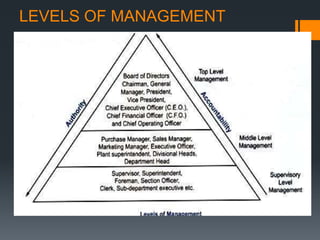
LEVELS OF MANAGEMENT
Top level management
They consist of the senior most executive of the
organisation.
Top level management consist of chairman, Board
of Directors, managing directors, general
managers, president, vice- president, chief
executive officer (CEO), chief financial officers
(CFO) and chief operating officers etc.
It includes group of crucial persons essential for
leading and directing the efforts of other people.
The managers working at this level have maximum
authority.
FUNCTIONS OF TOP LEVEL MANAGEMANT
Determining objectives
Framing plans and policies
Organising activities
Assembling all the resources
Welfare and survival of the organisation
Liaison with out side world
Middle level management
This level of management consist of departmental
heads such as purchase department head, sales
department, finance manager, marketing manager,
plat superintend etc.
People of this group are responsible for executing
the plans and policies made by top level.
They also exercise the functions of top level for
their department as they make plans and policies
for their department, organise an collect the
resources etc.
FUNCTION OF MIDDLE LEVEL
MANAGEMENT
Interpretation of policies to low level
Organising activities of departments
Recruitment and selection of employee's
Motivating people to perform the best
Controlling and instructing employees
Implementing the plans framed by top
management
Budgeting
Supervisor/ operational/ lower level
management
This level consists of supervisor, superintendent,
foreman, sub-department, executives, clerk etc.
Managers of this group actually carry on the work
as perform the activities according to the plans of
top and level management.
Their authority is limited.
The quality and quantity of output depends upon
the efficiency of this level of managers.
They pass on the instruction to workers and report
to the middle level management.
They are also responsible for maintain discipline
among the workers.
FUNCTIONS OF LOWER LEVEL
MANAGEMENT
Representing grievances of workers
Good working condition
Safety of workers
Helping middle level management in recruitment
and selection
Welcoming suggestions of workers
Maintaining quality and standard of products
Boosting the moral of employees and workers

Levels of Management.pptx

  • 1.
  • 2.
    MANAGEMENT  Management isthe process of planning and organising the resources and activities of a business to achieve specific goals in the most effective and efficient manner possible.  Management is the coordination and administration of tasks to achieve a goal.  To be an effective manager, you’ll need to develop a set of skills, including planning, communication, organization and leadership.  Management defined as all the activities and tasks undertaken for archiving goals by continuous activities like; planning, organizing, leading and controlling.
  • 3.
    NATURE/ FEATURES OF MANAGEMANT Goaloriented process Multidimensional in nature Pervasive Continuous process Group activity Intangible It is an art as well as science It is a profession
  • 4.
    OBJECTIVES OF MANAGEMENT 1-Organisational objectives Survival Profit Growth 2- Social objectives Employment opportunities Less pollution Safety of employees Fair trade
  • 5.
    3- Personal objectives Betterworking conditions Peer recognition and control Better salaries
  • 6.
  • 7.
    PRINCIPLES OF MANAGEMENT There are 14 principles of management given by Henry Fayol that are as follows;  Division of work  Authority and Responsibility  Discipline  Unity of command  Unity of direction  Subordination of personal/individual interests to the general interest.  Remuneration  Centralization  Scalar chain  Order  Equity  Stability of tenure of personnel  Initiative  Esprit de corps
  • 8.
  • 9.
    Top level management Theyconsist of the senior most executive of the organisation. Top level management consist of chairman, Board of Directors, managing directors, general managers, president, vice- president, chief executive officer (CEO), chief financial officers (CFO) and chief operating officers etc. It includes group of crucial persons essential for leading and directing the efforts of other people. The managers working at this level have maximum authority.
  • 10.
    FUNCTIONS OF TOPLEVEL MANAGEMANT Determining objectives Framing plans and policies Organising activities Assembling all the resources Welfare and survival of the organisation Liaison with out side world
  • 11.
    Middle level management Thislevel of management consist of departmental heads such as purchase department head, sales department, finance manager, marketing manager, plat superintend etc. People of this group are responsible for executing the plans and policies made by top level. They also exercise the functions of top level for their department as they make plans and policies for their department, organise an collect the resources etc.
  • 12.
    FUNCTION OF MIDDLELEVEL MANAGEMENT Interpretation of policies to low level Organising activities of departments Recruitment and selection of employee's Motivating people to perform the best Controlling and instructing employees Implementing the plans framed by top management Budgeting
  • 13.
    Supervisor/ operational/ lowerlevel management This level consists of supervisor, superintendent, foreman, sub-department, executives, clerk etc. Managers of this group actually carry on the work as perform the activities according to the plans of top and level management. Their authority is limited. The quality and quantity of output depends upon the efficiency of this level of managers. They pass on the instruction to workers and report to the middle level management. They are also responsible for maintain discipline among the workers.
  • 14.
    FUNCTIONS OF LOWERLEVEL MANAGEMENT Representing grievances of workers Good working condition Safety of workers Helping middle level management in recruitment and selection Welcoming suggestions of workers Maintaining quality and standard of products Boosting the moral of employees and workers