2
Principles of Management
CourseOutcomes: On completion of this course the student will
be able to:
1. Understand the basic principles underlying in the
management of organizations.
2. Get exposure in all industrial management functions.
3. Get knowledge to analyse the financial accounts and
ratios.
4. Understand the principles of Economics and IPR
aspects.
3.
3
Module I
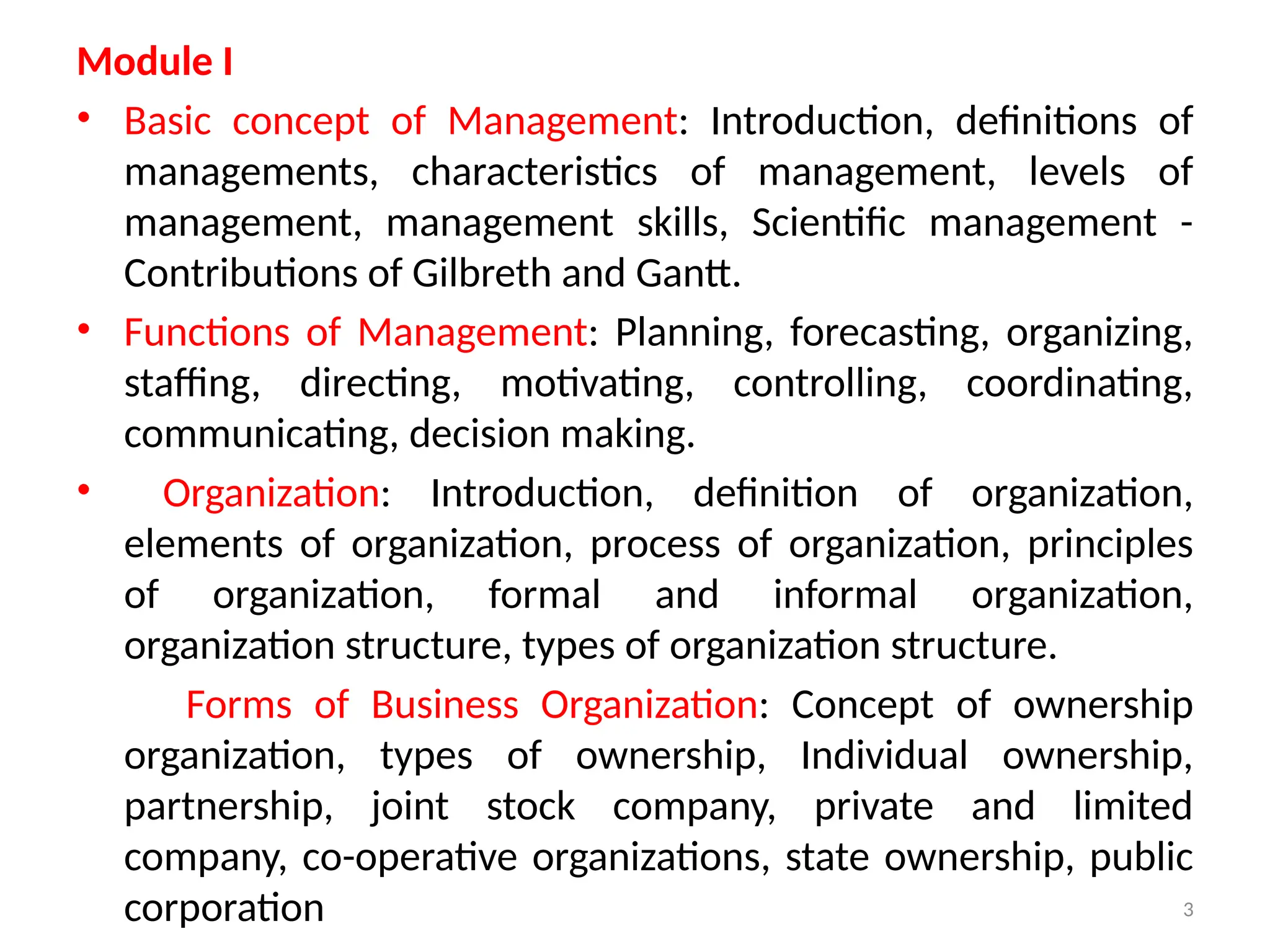
• Basicconcept of Management: Introduction, definitions of
managements, characteristics of management, levels of
management, management skills, Scientific management -
Contributions of Gilbreth and Gantt.
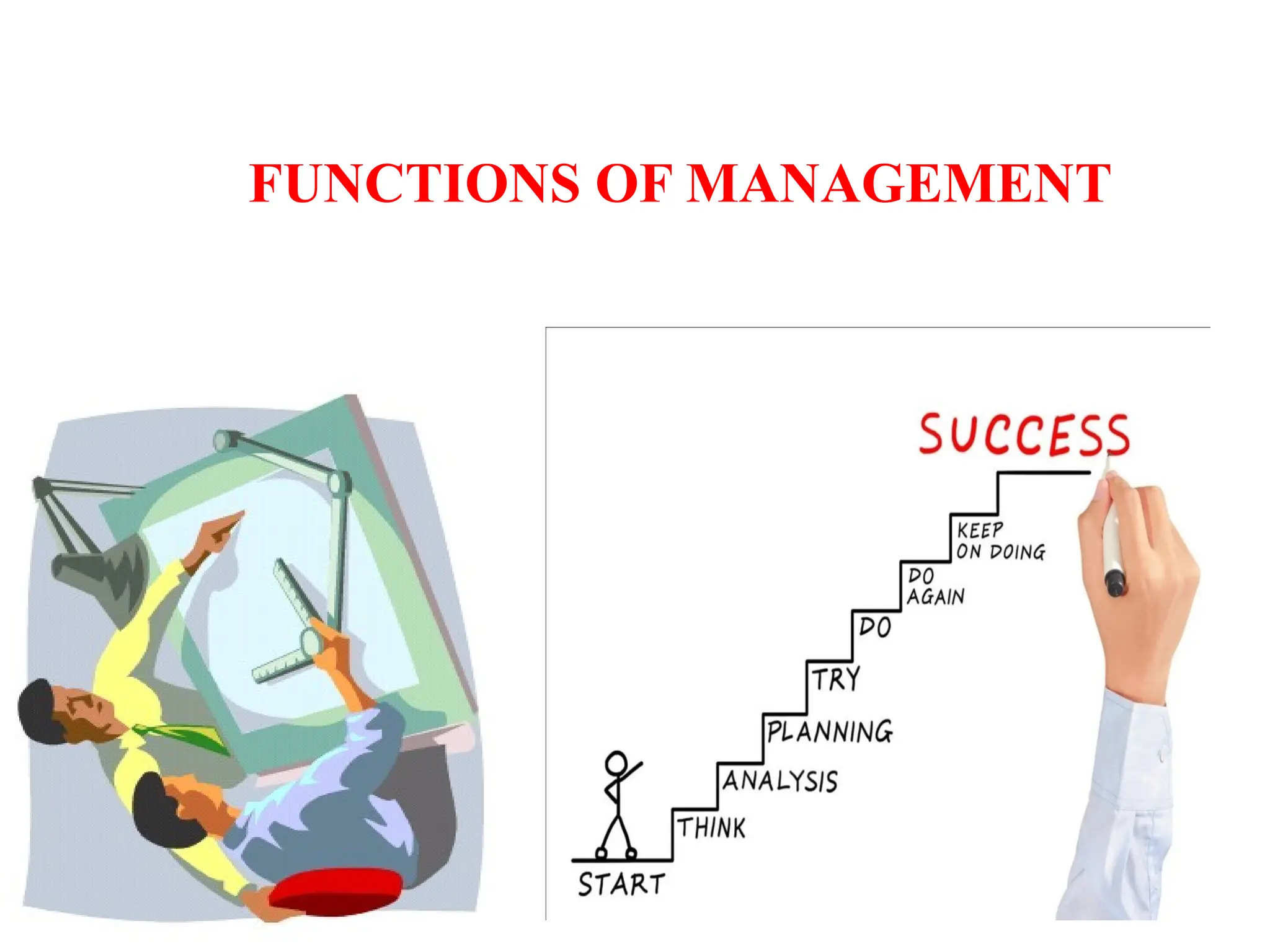
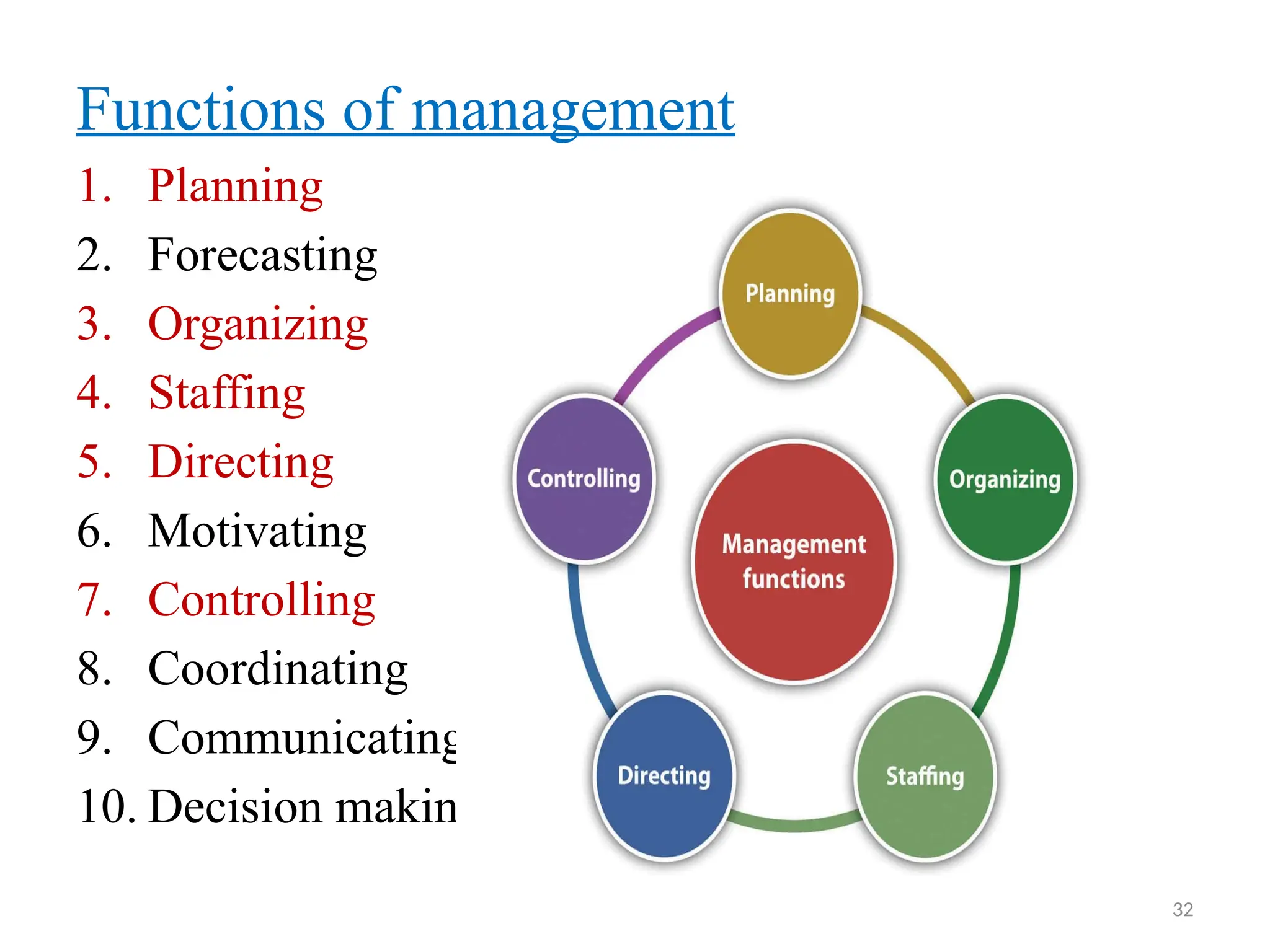
• Functions of Management: Planning, forecasting, organizing,
staffing, directing, motivating, controlling, coordinating,
communicating, decision making.
• Organization: Introduction, definition of organization,
elements of organization, process of organization, principles
of organization, formal and informal organization,
organization structure, types of organization structure.
Forms of Business Organization: Concept of ownership
organization, types of ownership, Individual ownership,
partnership, joint stock company, private and limited
company, co-operative organizations, state ownership, public
corporation
4.
4
• Module II
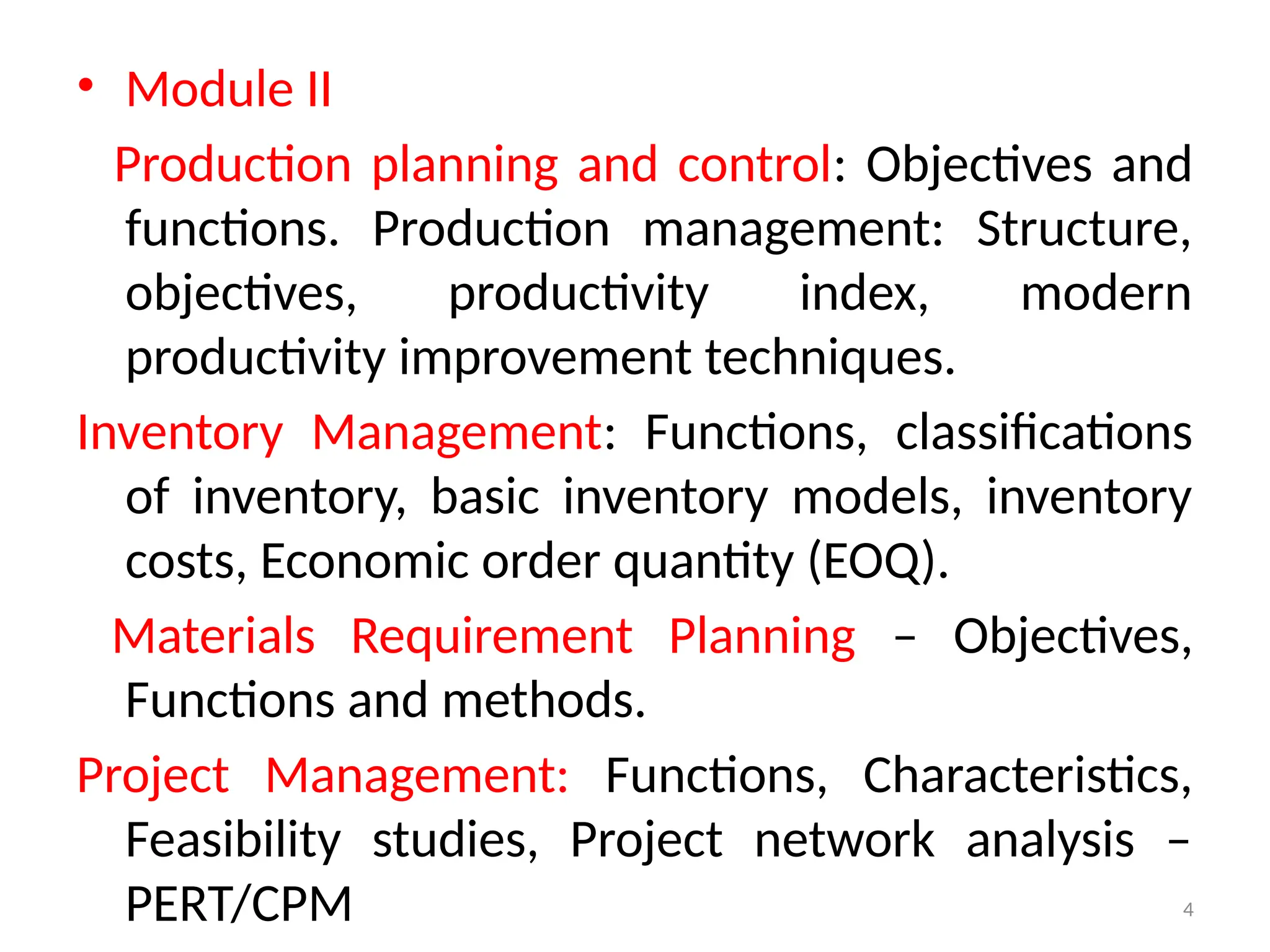
Productionplanning and control: Objectives and
functions. Production management: Structure,
objectives, productivity index, modern
productivity improvement techniques.
Inventory Management: Functions, classifications
of inventory, basic inventory models, inventory
costs, Economic order quantity (EOQ).
Materials Requirement Planning – Objectives,
Functions and methods.
Project Management: Functions, Characteristics,
Feasibility studies, Project network analysis –
PERT/CPM
5.
5
• Module III
HumanResource Management: Introduction, definition,
objectives, characteristics, functions, principles and
organization of HR management, Recruitment,
selection process and training methods, Wages and
incentives, Job evaluation and merit rating, Industrial
accidents-causes and related issues.
Marketing Management: Introduction, Functions and
objectives, Marketing environment and Information,
Market segmentation, Distribution channels,
Consumer and Industrial markets, Consumer
behaviour, Pricing methods, Sales promotion and
Advertisement.
Market research: Objectives and methods.
6.
6
• Module IV
FinancialManagement: Basic functions, Capital-
classifications, Sources of funds, Financial accounts-
types, basic concepts and importance, Financial ratios
and its significance, Types of budgets and budgetary
controls, Overheads, Standard costing, Marginal costing.
Economics: Principles of economics, problem of scarcity,
demand, supply, utility, time value of money, inflation
and deflation, Consumer Demand Curve.
IPR Aspects: General introduction to IPR, eligibility for
patent, patent information and prior art search,
procedure for filing patent application, rights of patent
owner and duration, ownership of patent and
commercialization.
7.
7
Topics (Part 1)
Basic concept of management
Definition
Importance of management
Characteristics of management
Levels of management
Management skills
Scientific management
Contribution of Gilbreth-Gantt
8.
8
What is Management?
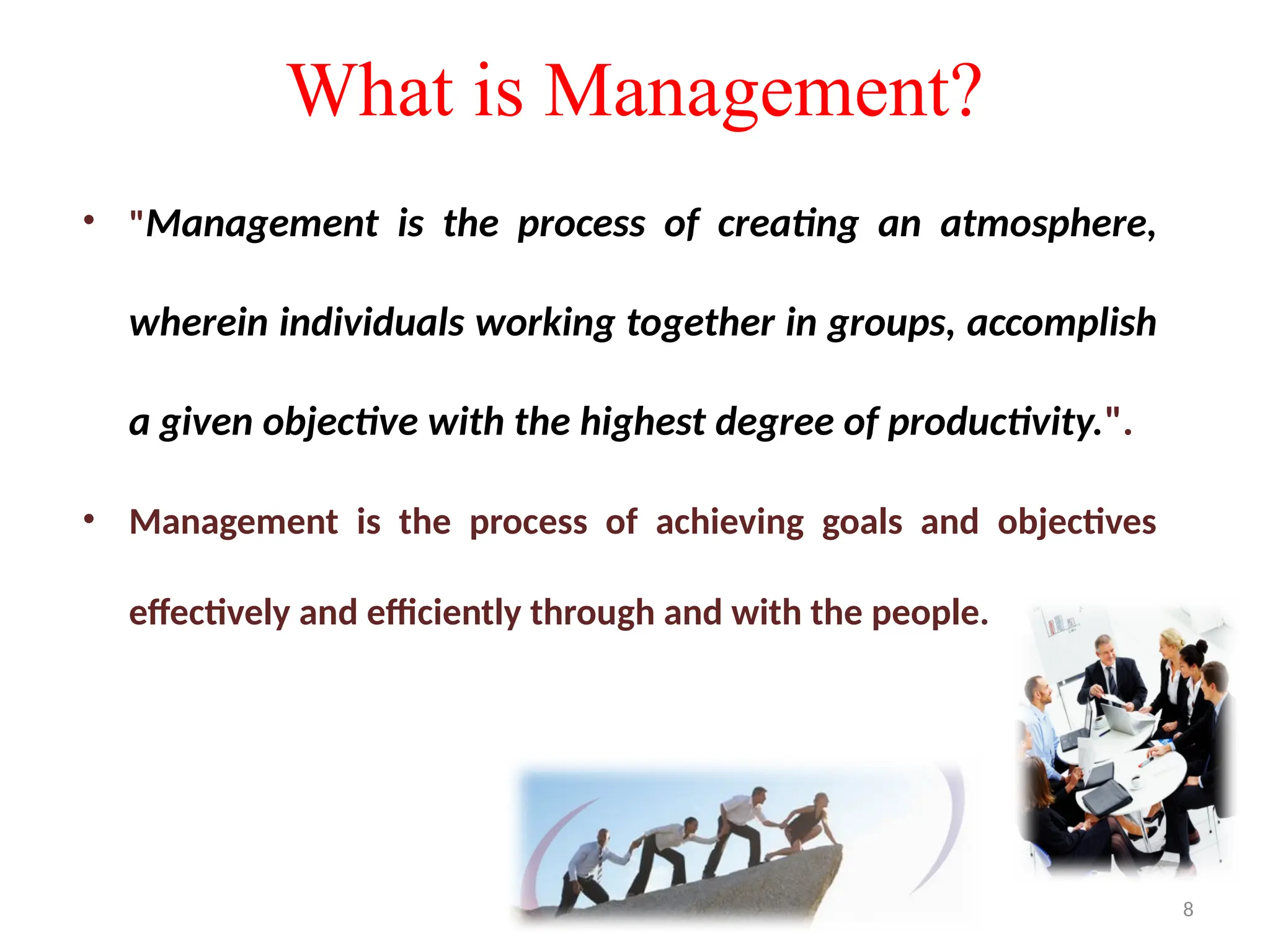
•"Management is the process of creating an atmosphere,
wherein individuals working together in groups, accomplish
a given objective with the highest degree of productivity.".
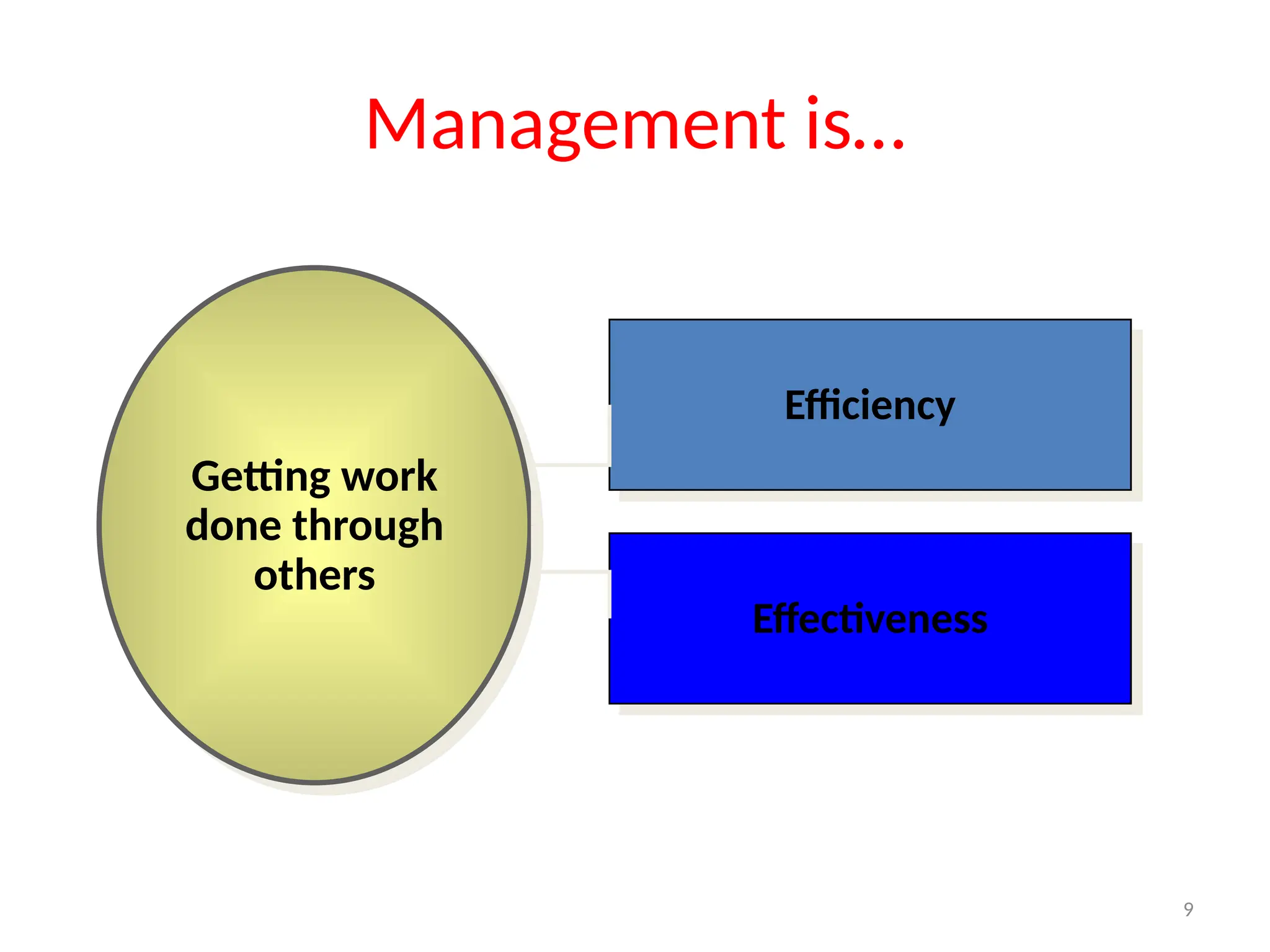
• Management is the process of achieving goals and objectives
effectively and efficiently through and with the people.
10
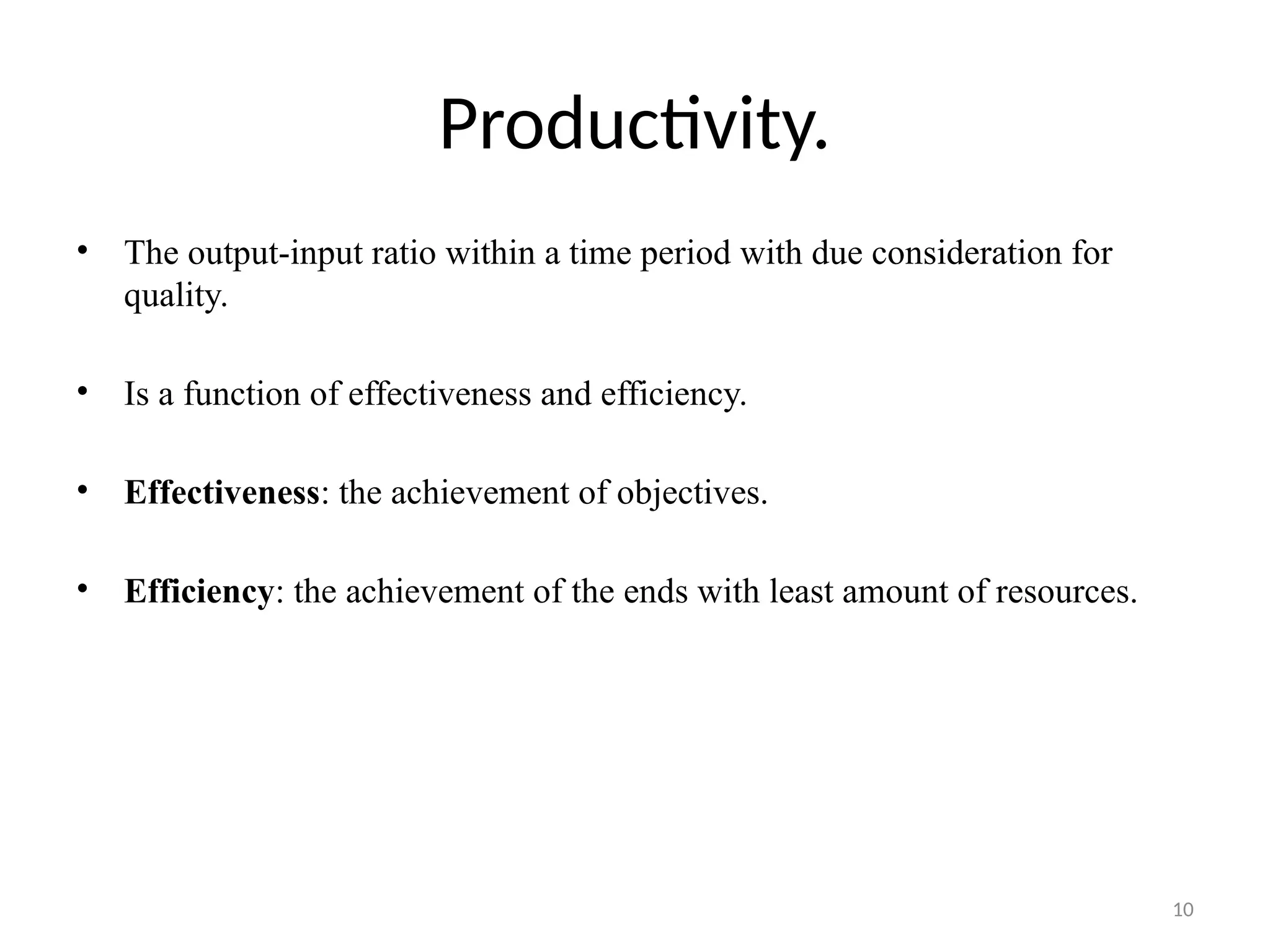
Productivity.
• The output-inputratio within a time period with due consideration for
quality.
• Is a function of effectiveness and efficiency.
• Effectiveness: the achievement of objectives.
• Efficiency: the achievement of the ends with least amount of resources.
11.
11
Definition
• Management isan art of getting the work done
through the efforts of people and by the effective
utilisation of resources.
• For getting the work done, it is necessary to guide,
direct, coordinate and control human efforts for the
fulfillment of the goals of the enterprise.
12.
12
Management defined…
• Managementapplies to managers at all
organizational levels.
• The aim of all managers is the same: to create
a surplus.
• Managing is concerned with productivity,
which implies effectiveness and efficiency.
13.
13
Management defined…
• Asmanagers, people carry out the managerial
functions of planning, organizing, staffing,
leading and controlling.
• Management applies to any kind of organization.
• Organization: a group of people working
together .
– Profit making / business organization
– Nonprofit / service organization
14.
14
Importance of management
Increasing the effectiveness and efficiency
Development of full human potential
Raising the worker morale
Building mutual trust
Developing teamwork
Providing a stable livelihood for all employees
Constantly and forever improving the system of production and
service.
15.
15
Characteristics of Management
Management is a purposeful activity: Objectives differ from
organisation to organisation
Efficient management of economic resources
Management is a distinct process
Management is universal: applicable to all group of activities
Management applies to managers at all organizational levels
The aim of all managers is the same: to be productive.
16.
16
Characteristics of Management
Co-ordination is the soul of management
Management is dynamic
Management attempts to create a desirable future, keeping the
past and present in mind.
Management is decision making
Management is a profession
17.
17
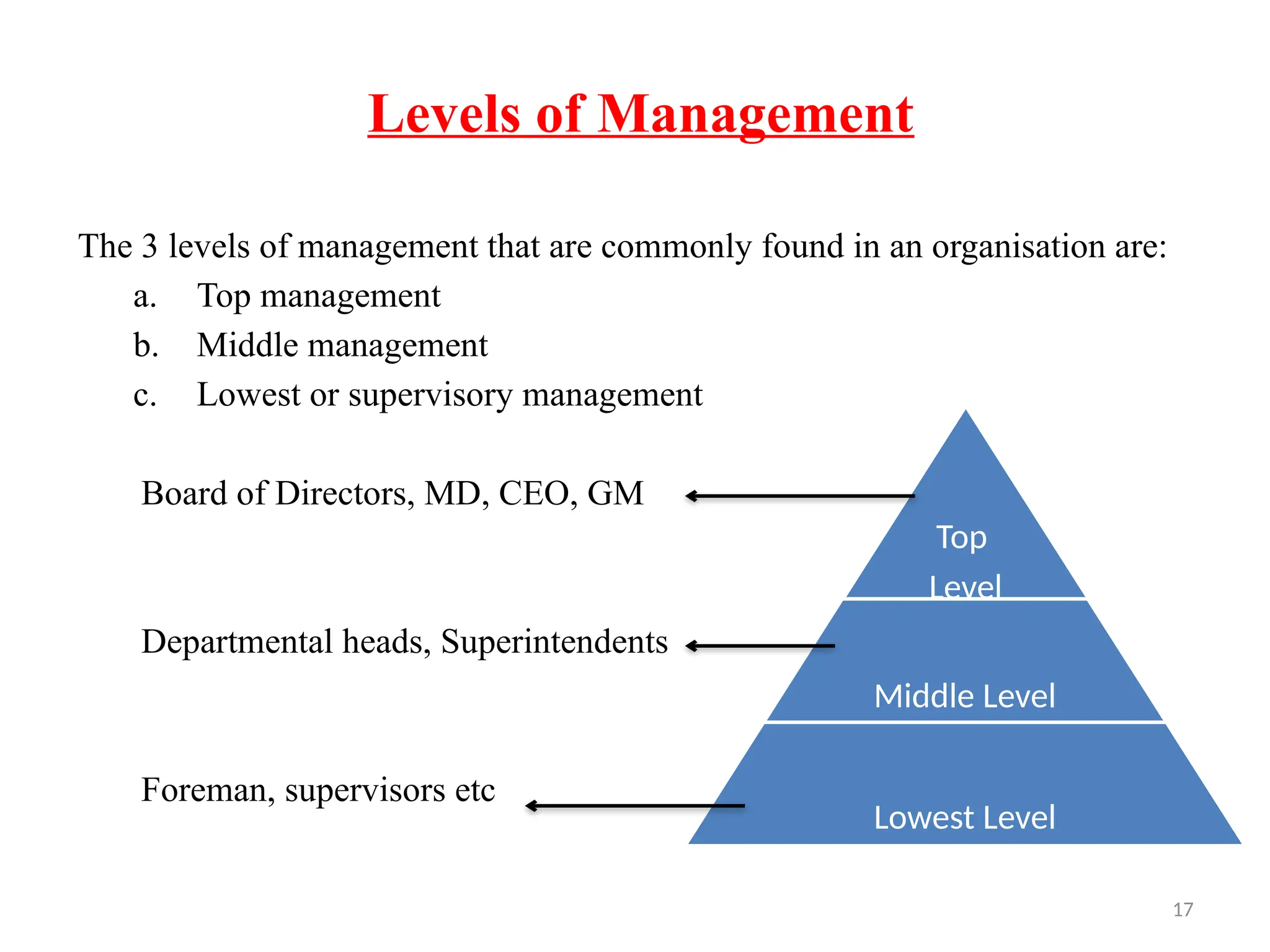
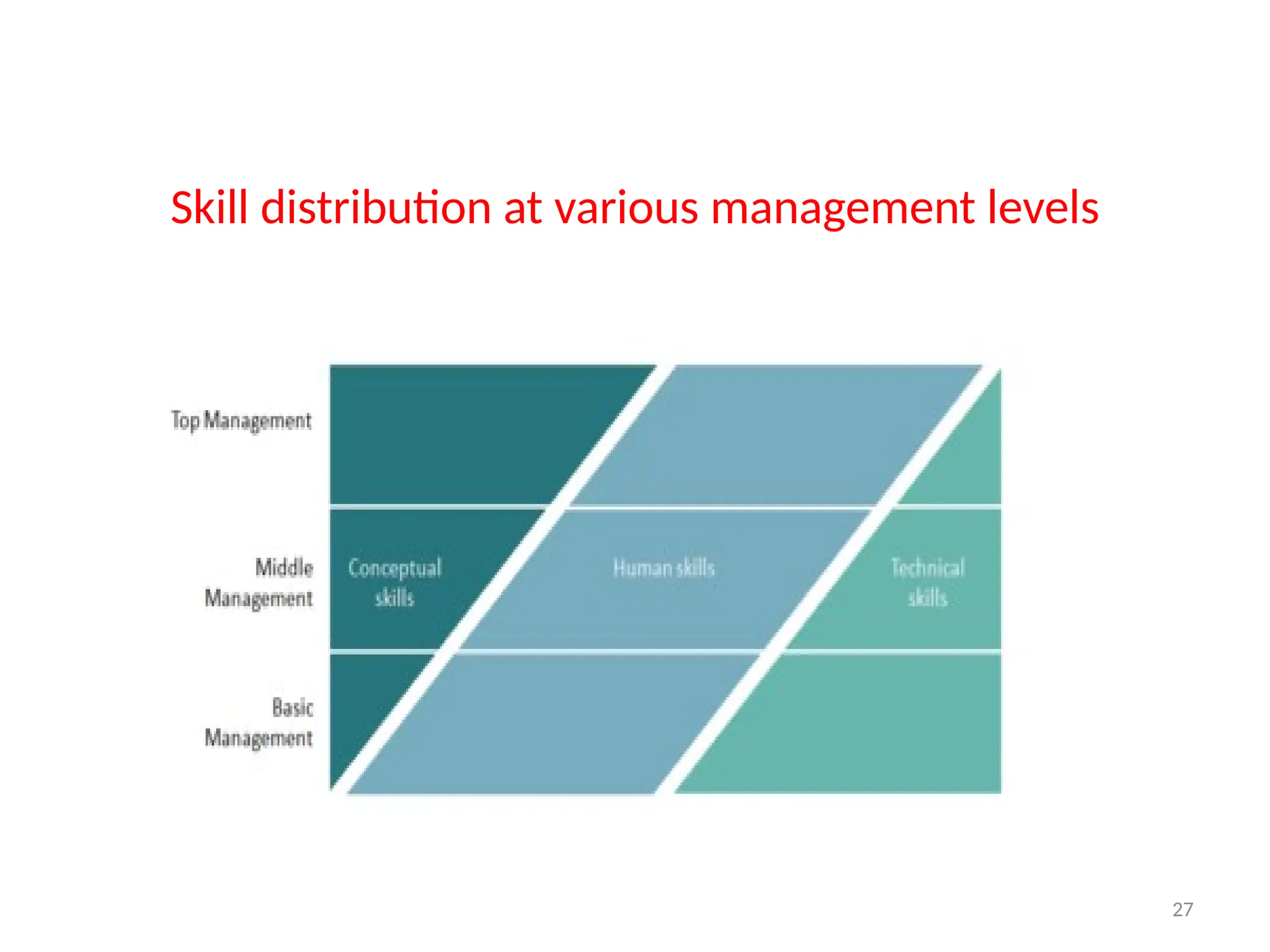
Levels of Management
The3 levels of management that are commonly found in an organisation are:
a. Top management
b. Middle management
c. Lowest or supervisory management
Board of Directors, MD, CEO, GM
Departmental heads, Superintendents
Foreman, supervisors etc
Top
Level
Middle Level
Lowest Level
18.
18
a. Top levelManagement
Top level management is responsible for framing policies of
the organization.
All critical decisions are also made at this level.
Top level management consists of board of directors,
managing director, general manager and senior most
managers.
Top level management is administrative in nature.
19.
19
Functions
Develops long- range plans and strategies
Top management lays down the objectives and broad policies of
the enterprise.
Issues necessary instructions for preparation of department
budgets
Consults subordinate managers on subjects or problems of
general scope
Involved in selection of key personnel
Controls and coordinates the activities of all the departments
Top level Management
20.
20
b. Middle levelManagement
Middle level management is the link between top level and
low level management.
They devote more time to organizational and directional
functions.
These managers supervise, direct and control the activities of
foremen, inspectors and supervisors.
21.
21
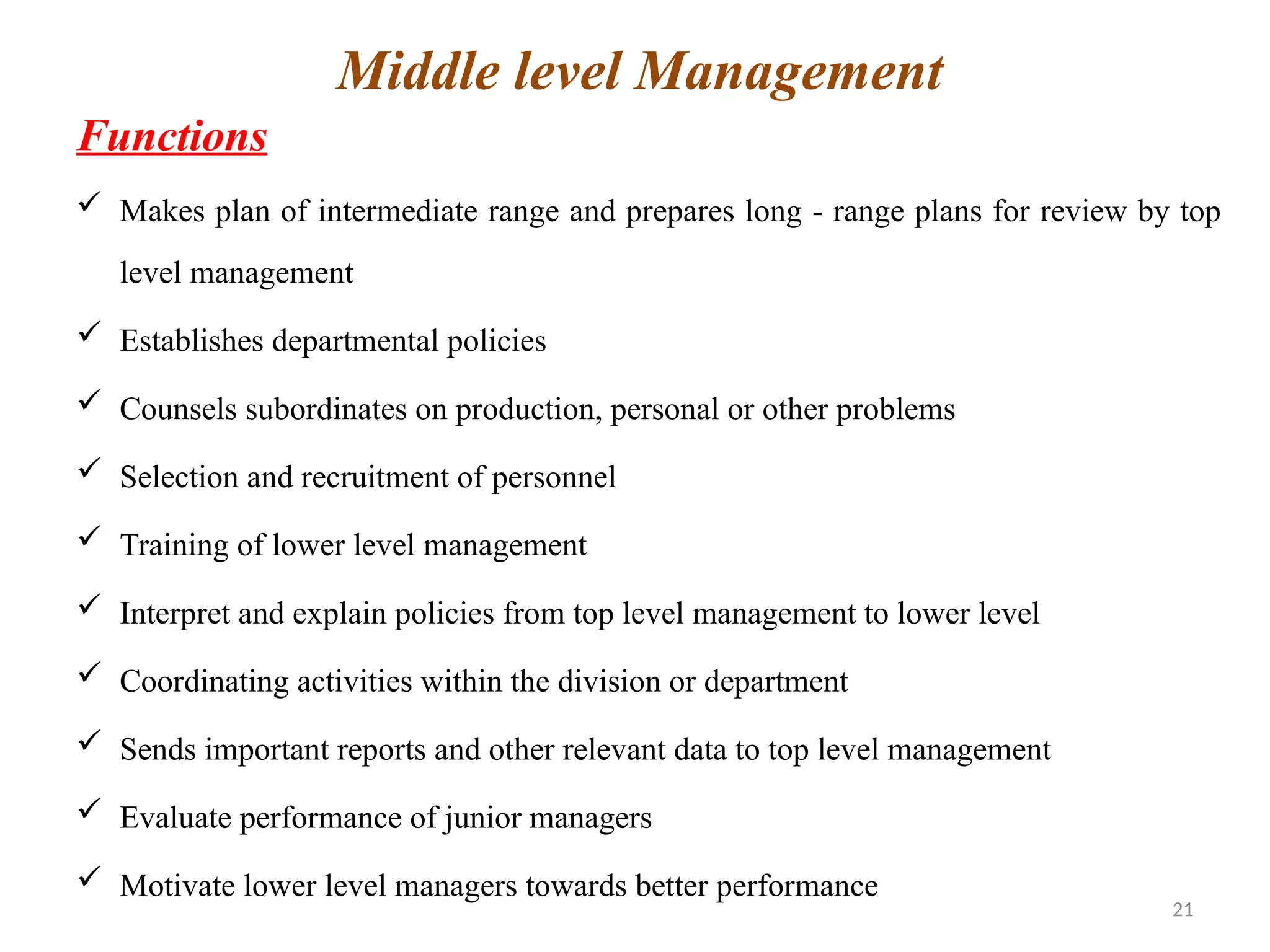
Functions
Makes planof intermediate range and prepares long - range plans for review by top
level management
Establishes departmental policies
Counsels subordinates on production, personal or other problems
Selection and recruitment of personnel
Training of lower level management
Interpret and explain policies from top level management to lower level
Coordinating activities within the division or department
Sends important reports and other relevant data to top level management
Evaluate performance of junior managers
Motivate lower level managers towards better performance
Middle level Management
22.
22
c. Lower levelManagement
Lower level is also known as supervisory / operative level of
management. It consists of foremen, inspectors, supervisors etc.
They will be mainly concerned with direction of operative
employees.
23.
23
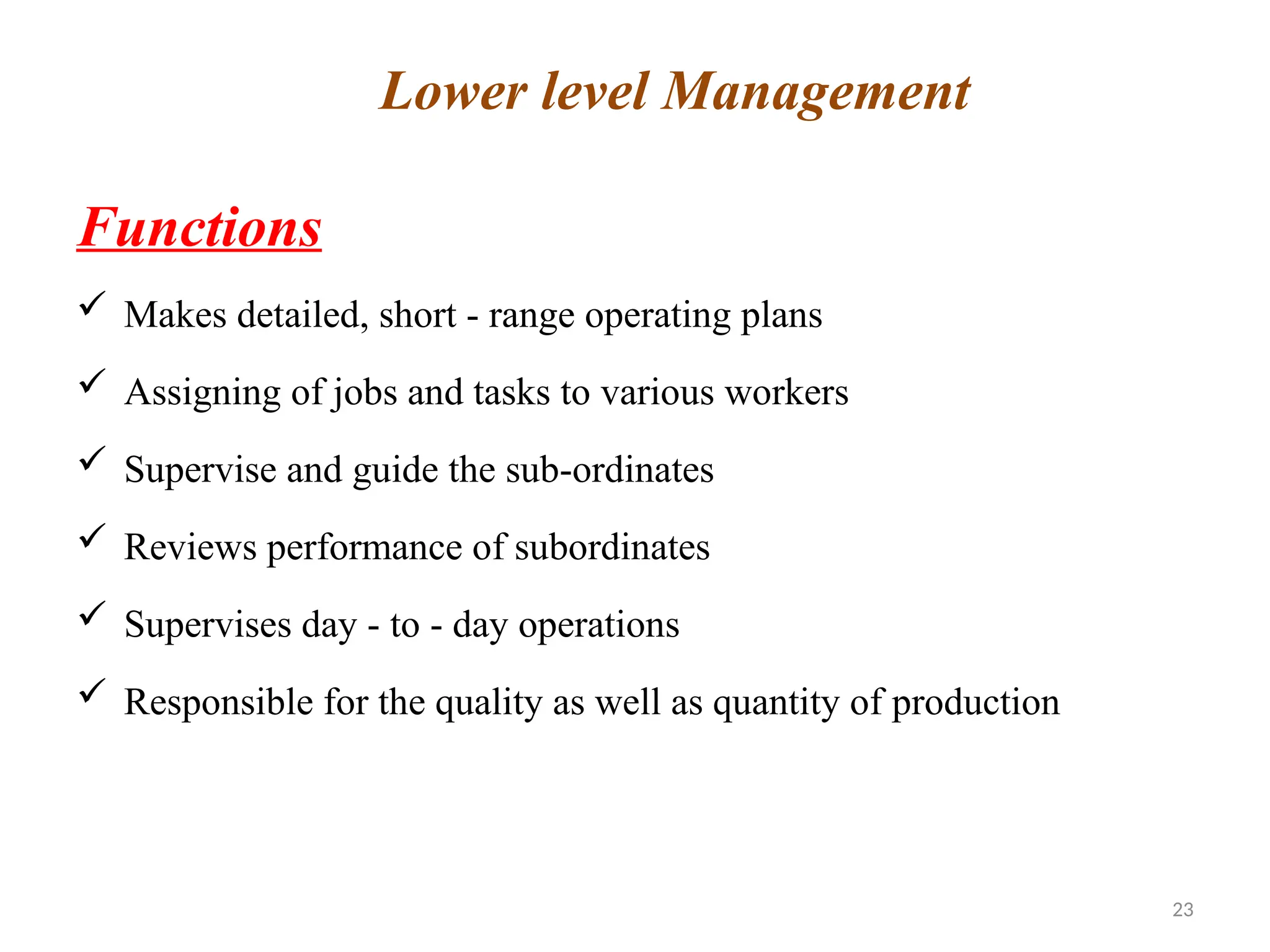
Functions
Makes detailed,short - range operating plans
Assigning of jobs and tasks to various workers
Supervise and guide the sub-ordinates
Reviews performance of subordinates
Supervises day - to - day operations
Responsible for the quality as well as quantity of production
Lower level Management
24.
24
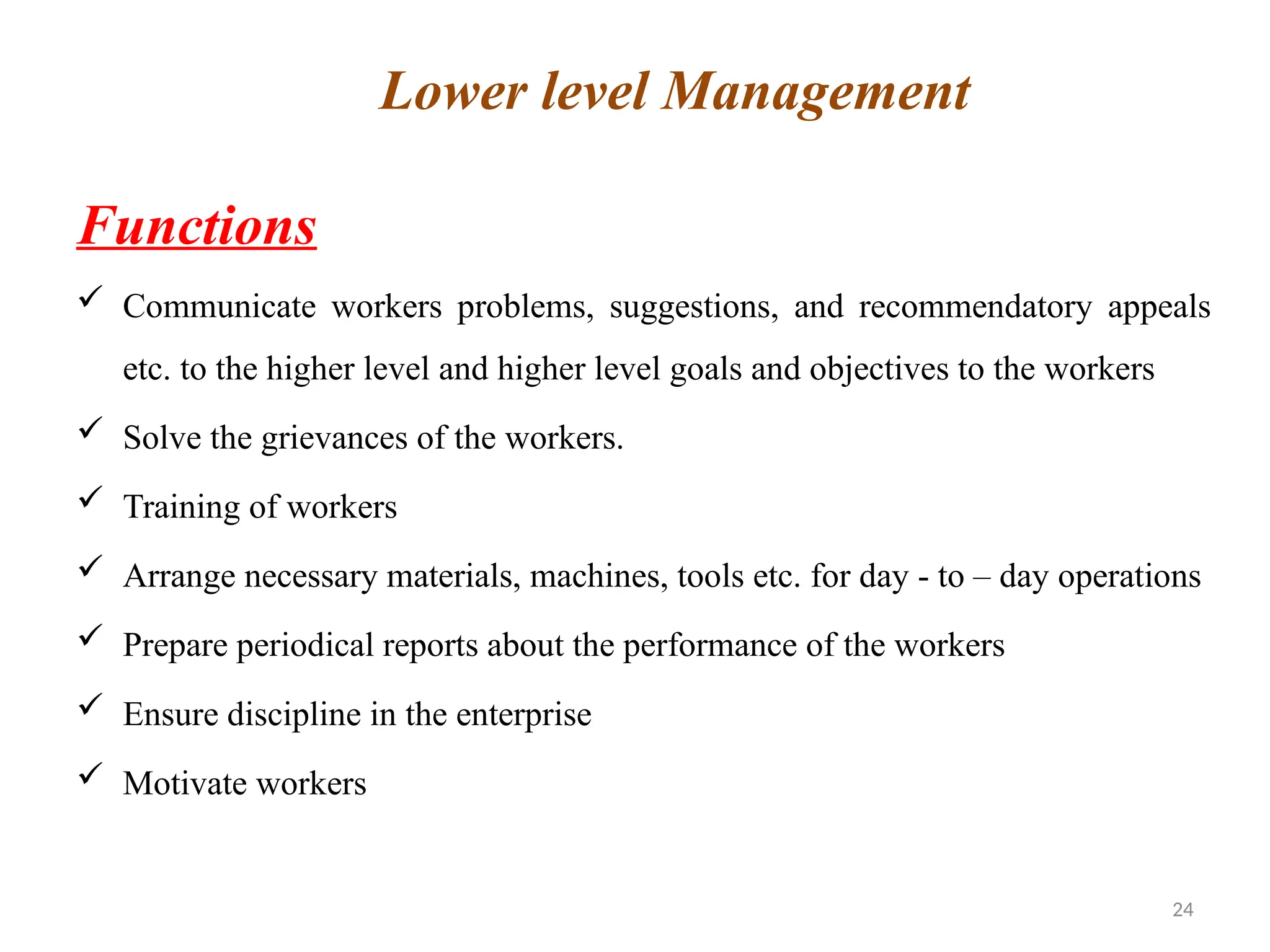
Functions
Communicate workersproblems, suggestions, and recommendatory appeals
etc. to the higher level and higher level goals and objectives to the workers
Solve the grievances of the workers.
Training of workers
Arrange necessary materials, machines, tools etc. for day - to – day operations
Prepare periodical reports about the performance of the workers
Ensure discipline in the enterprise
Motivate workers
Lower level Management
25.
25
Managerial Skills/ ManagementSkills
It’s the ability of a manager to make a smooth functioning team of
people working under him.
It involves obligation to make effective utilization of human and
material resources.
28
1. Technical skills
Technical skill is the ability to perform a manger’s job.
An accountant, doctor, engineer or a musician all have
technical skills in their respective fields of specialization.
A manager must possess technical skill.
It refers to the proficiency in handling methods & techniques
to perform particular tasks.
29.
29
2. Conceptual skills
It is the ability to coordinate and integrate the entire organizational interests and
activities.
a) Decision making skill: ability to make accurate and right
decisions at the right time.
b) Organizational skill: ability to recruit and allocate right person
for the right job.
A manager must have the ability to see the organization as a whole and not
make decisions from his own departmental point of view.
He must be able to see how his department is affected by the decisions of
others.
30.
30
3. Human relationalskills
It is the ability to build cooperative workgroups to achieve
organizational goals.
a) Communication skills: ability to pass on information to others.
b) Motivating skills: ability to encourage the subordinates.
c) Leadership skills: ability to inspire confidence and trust in
subordinates in order to have maximum cooperation from them for
getting work done.
The manager must focus his attention on improving his interpersonal
relations with peers, subordinates, and his own supervisors.
33
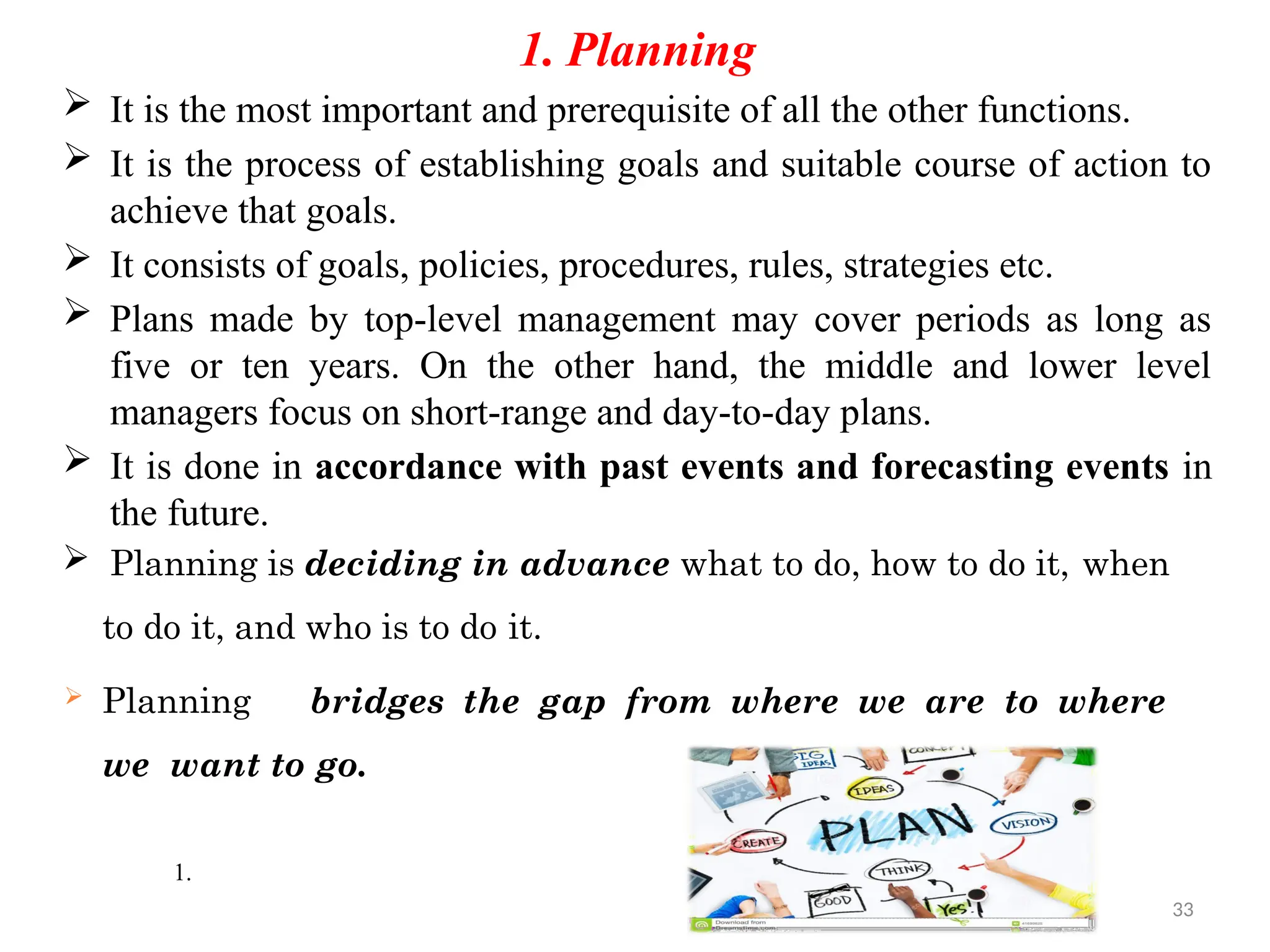
1. Planning
Itis the most important and prerequisite of all the other functions.
It is the process of establishing goals and suitable course of action to
achieve that goals.
It consists of goals, policies, procedures, rules, strategies etc.
Plans made by top-level management may cover periods as long as
five or ten years. On the other hand, the middle and lower level
managers focus on short-range and day-to-day plans.
It is done in accordance with past events and forecasting events in
the future.
Planning is deciding in advance what to do, how to do it, when
to do it, and who is to do it.
Planning bridges the gap from where we are to where
we want to go.
1.
34.
34
The elementsincluded in the planning function are:
1. The policies that will help to achieve
objectives.
2. The programmes that a manager will carry out
3. The time schedules that a manager will have to
meet
4. The budgetary considerations that will be
involved
35.
35
2. Forecasting
Itis defined as an estimate of future events, by
systematically combining past and present data.
It forms the basis of planning of activities of an
organization.
The survival of any manufacturing enterprise depends on its
ability to assess, with reasonable accuracy, the market
trends several years ahead.
Forecasting begins with sales forecast and is followed by
production forecast and forecast for costs, finance,
purchase, profit etc.
36.
36
3. Organizing
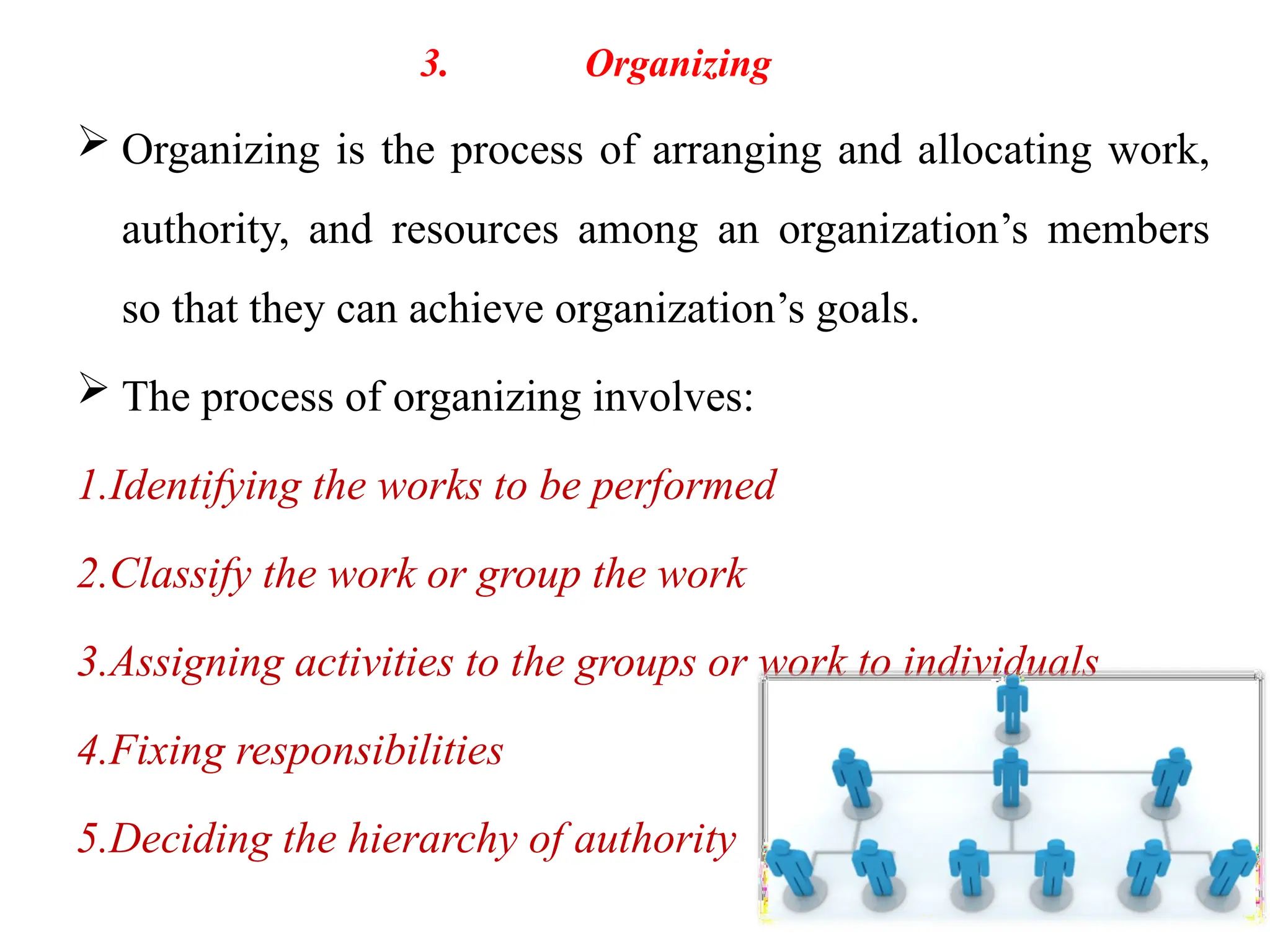
Organizingis the process of arranging and allocating work,
authority, and resources among an organization’s members
so that they can achieve organization’s goals.
The process of organizing involves:
1.Identifying the works to be performed
2.Classify the work or group the work
3.Assigning activities to the groups or work to individuals
4.Fixing responsibilities
5.Deciding the hierarchy of authority
37.
37
4. Staffing
Themain purpose of staffing is to put right man on right
job. It involves manning the positions created by
organization process.
It is a process of filling or keeping filled the various
positions in the organizational structure. It involves:
1. Manpower Planning (estimating man power in terms of
searching, choose the person and giving the right place)
2. Recruitment, selection & placement
3. Training & development.
4. Remuneration
5. Performance appraisal
6. 6.Promotions & transfer
38.
38
5. Directing
Directingis said to be a process in which the managers instruct, guide and
oversee the performance of the workers to achieve predetermined goals.
Directing is said to be the heart of management process. Planning, organizing,
staffing has got no importance if direction does not take place.
Directing initiates action and it is from here actual work starts. Therefore,
Directing is guiding, inspiring, overseeing and instructing people towards
accomplishment of organizational goals.
It includes:
1. Issuing orders that are clear, complete and within the capabilities of
subordinates to accomplish.
2. Suggesting an incessant training activity in which subordinates are given
instructions to enable them to carry out the particular assignment in the
existing situation.
3. Motivating the workers to meet the expectations of the manager
4. Maintaining discipline and rewarding those who perform well
39.
39
6. Motivating
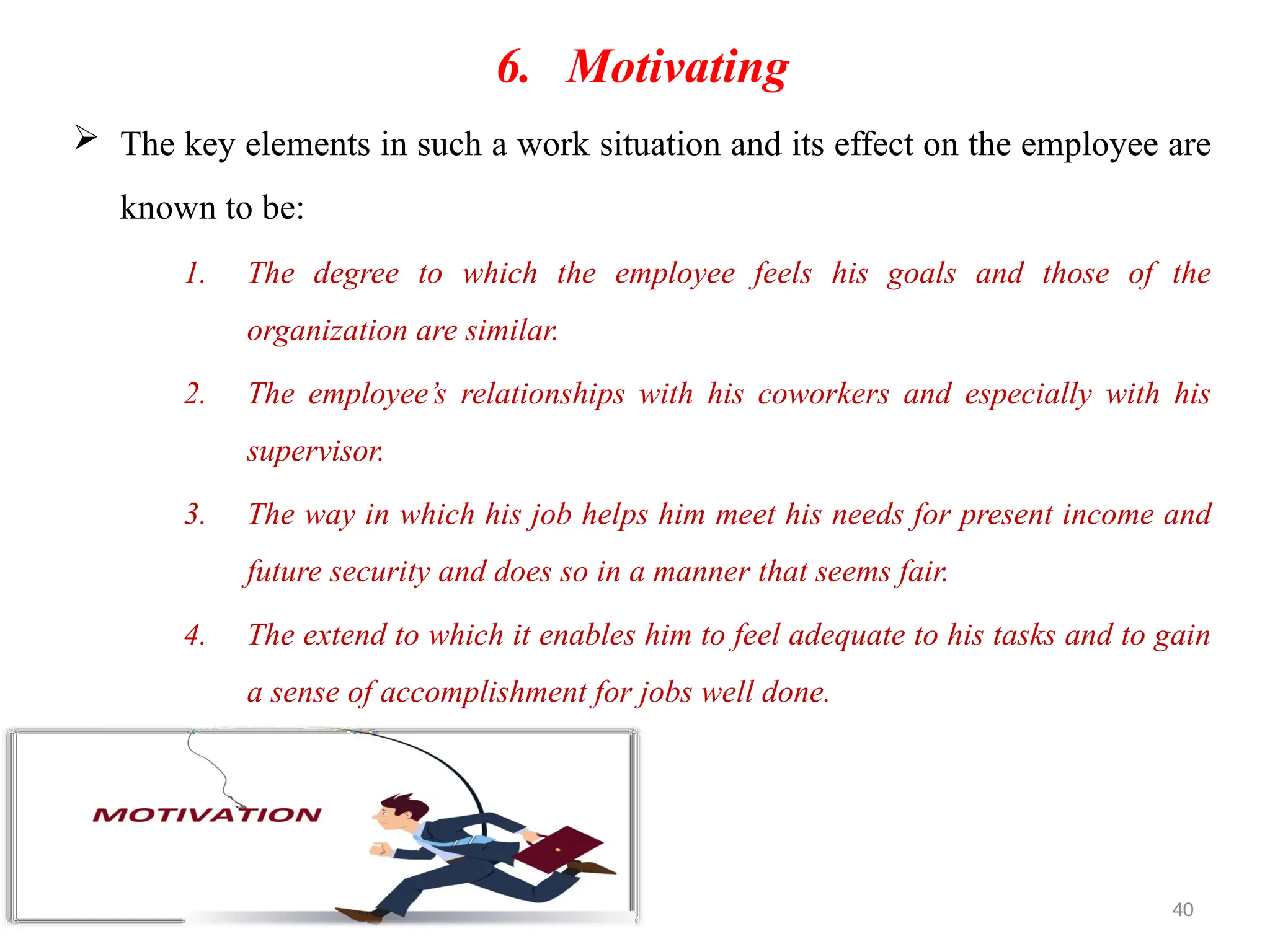
Itmeans inspiring people to intensify their desire and willingness to perform
their duties effectively and co-operate for the achievement of common
objectives of the business.
Motivation is a human psychological characteristic.
It pertains to various drives, desires, needs, wishes and other forces.
Motivation is not easy to achieve and what a manager can try to do is to
create a working climate in which all members may contribute to the limits
of their ability.
Motivational function provides a great deal of challenge to a manager. He
must have the ability to identify the needs of his subordinates and the
methods and techniques to satisfy those needs.
40.
40
6. Motivating
Thekey elements in such a work situation and its effect on the employee are
known to be:
1. The degree to which the employee feels his goals and those of the
organization are similar.
2. The employee’s relationships with his coworkers and especially with his
supervisor.
3. The way in which his job helps him meet his needs for present income and
future security and does so in a manner that seems fair.
4. The extend to which it enables him to feel adequate to his tasks and to gain
a sense of accomplishment for jobs well done.
41.
41
7. Controlling
Controllingis the process of ensuring that actual activities conform to plan
activities. It measures the progress of operations and making sure that things
are proceeding in the right direction as planned
For the control to be effective, a system of communications or reports is
required to inform the manager of the facts on which to base measurements,
comparisons and corrective action.
A great deal of the manager’s time is involved in controlling
It involves:
1. Establishing standards of performance.
2. Measuring actual performance.
3. Comparing actual performance to the established standards.
4. Taking corrective action if deviations are detected.
42.
42
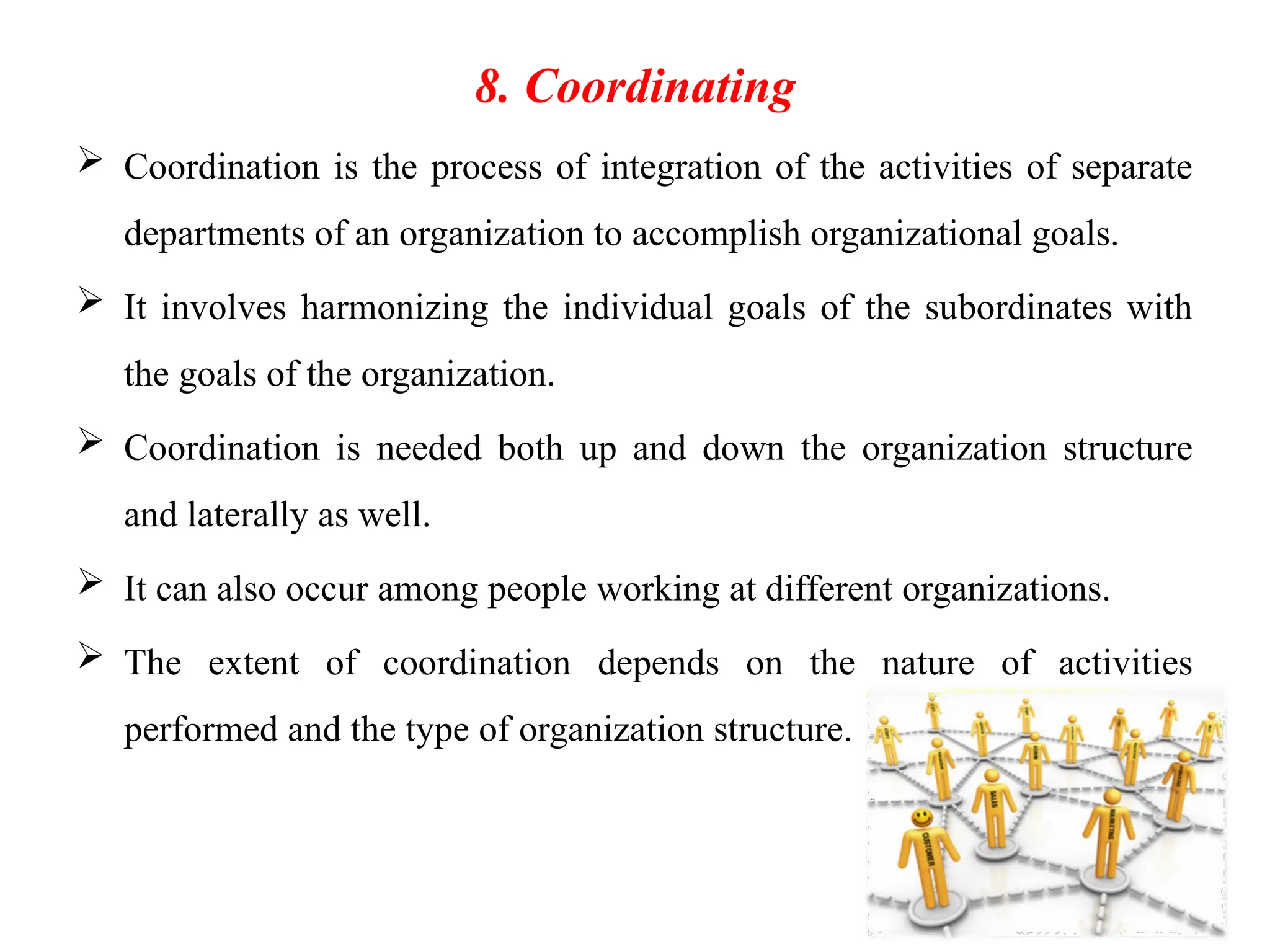
8. Coordinating
Coordinationis the process of integration of the activities of separate
departments of an organization to accomplish organizational goals.
It involves harmonizing the individual goals of the subordinates with
the goals of the organization.
Coordination is needed both up and down the organization structure
and laterally as well.
It can also occur among people working at different organizations.
The extent of coordination depends on the nature of activities
performed and the type of organization structure.
43.
43
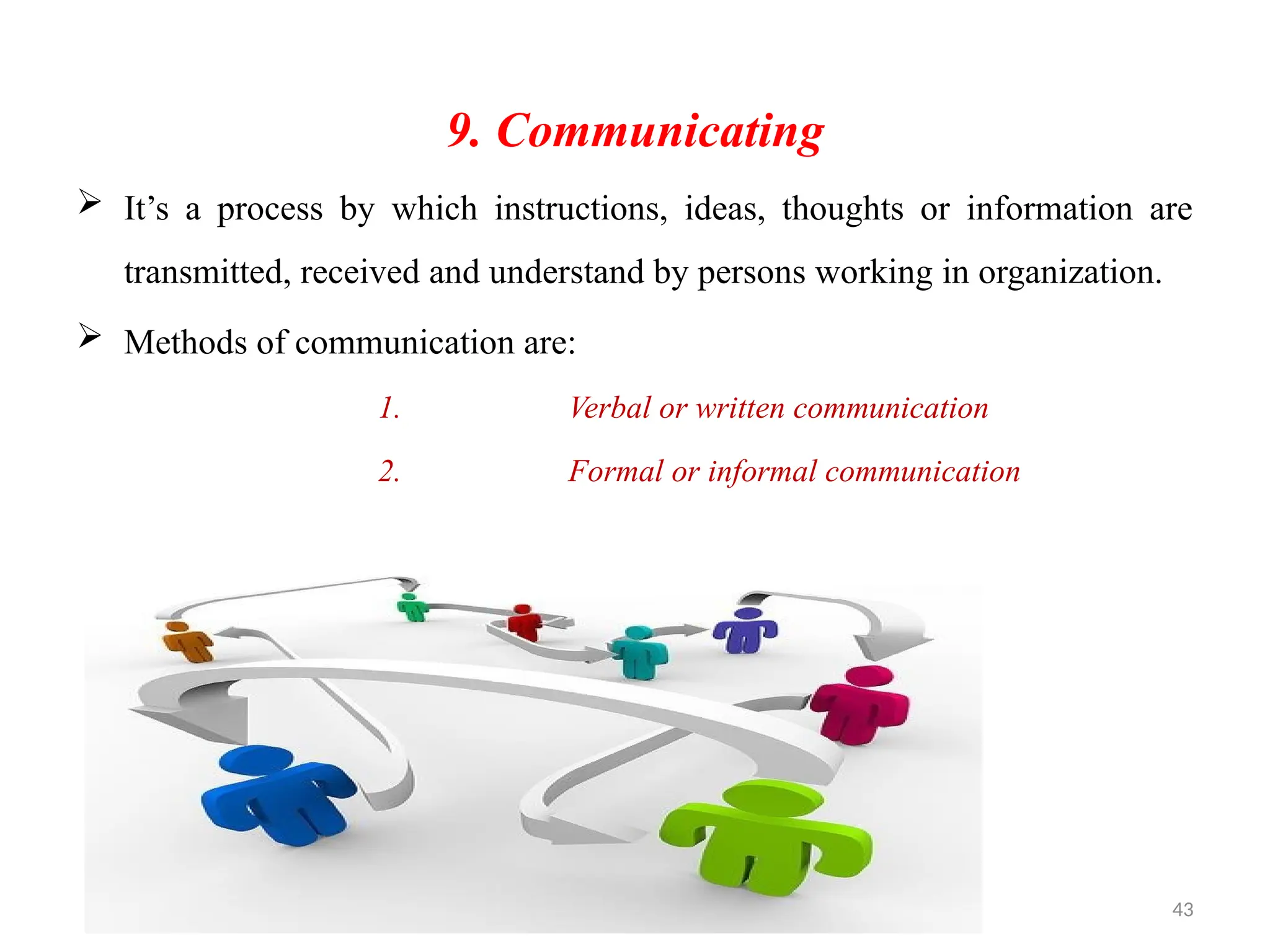
9. Communicating
It’sa process by which instructions, ideas, thoughts or information are
transmitted, received and understand by persons working in organization.
Methods of communication are:
1. Verbal or written communication
2. Formal or informal communication
44.
44
10. Decision making
Decision-making is the process of identifying and selecting a course of
action from among alternatives.
Decision-making is an important part of every manager’s job and it
requires all the skill and judgment a manager accumulates over the years.
The manager constantly seeks to make correct decisions involving the use
of the various types of resources at his disposal to attain the various
objectives.
A manager decides on the utilization of men, materials and machines to
achieve such goals as quality, low cost, quick delivery, safety and so on.
45.
45
Scientific management
• “Artof knowing exactly what is to be done and the best way of doing it”.
• Scientific management is a theory of management that analyzes and
synthesizes workflows, with the objective of improving labor
productivity.
• It’s the result of applying scientific knowledge and the scientific methods
to the various aspects of management and the problems that arise from
them.
• Helps to improve productivity and standardize human efforts.
46.
46
Contributions of F.W.Taylor (1856 – 1915)
The core ideas of the theory were developed by Frederick Winslow Taylor
(1856 – 1915) in the 1880s and 1890s.
Known as father of scientific management.
Scientific management's application is contingent on a high level of
managerial control over employee work practices.
“A complete mental revolution” on the part of management and labour.
Stressed the importance of “time and motion study” to increase efficiency
of men and machines.
Introduced a wage incentive plan known as differential rate system, which
involves payment of higher wages to more efficient workers.
47.
47
Four basic principlesof F.W. Taylor
Develop a science for each element of a man’s work, which replaces the
old rule of thumb method.
Scientifically select and then train, teach, and develop the work man,
where as in the past he chose his own work and trained himself as best as
he could.
Heartily cooperate with the men so as to ensure all of the work being done
is in accordance with the principles of science, which has been developed.
There is an almost equal division of the work and responsibility between
management and workmen. The management takes over all work for
which they are better fitted than the workmen, while in the past almost all
of the work and the greater part of the responsibility were thrown upon the
men.
48.
48
Principles of ScientificManagement (F.W. Taylor)
1. Development of science for each element of work:- analyze the work
scientifically (what, when, who, how.??)
2. Scientific selection, placement and training of workers.
3. Division of Labour
4. Standardization of methods, procedures, tools and equipment.
5. Use of Time and motion study.
6. Differential wage system:- Doesn’t guarantee a min: wage
7. Co-operation between Labour and management.
8. Principle of management by Exception:- Only significant deviations b/w
actual performance and standard performance should be reported to top
managers.
49.
49
Contributions of HenryL Gantt (1861-1919)
Improved Taylor’s differential piece rate system and came up with a
new idea - every worker who finished a day’s assigned workload would
win a 50% bonus.
The supervisor would also earn a bonus for each worker who reached
the daily standard, plus an extra bonus if all the workers reached it.
This would motivate the supervisors to train their workers to do a better
job.
Devised a charting system for production scheduling, now known as
Gantt chart. The Gantt chart is still in use today – basis of the Critical
path Method (CPM) and Program Evaluation and Review Technique
(PERT).
50.
50
Contributions of FrankB and Lillian M Gilbreth (1868-
1924 and 1878-1972)
Did a lot of research in order to improve work methods and thus to discover one best
way of accomplishing a task.
Main field of interest was fatigue and motion studies and focused on ways of promoting
the individual worker’s welfare.
The ultimate aim of scientific management was to help workers reach their full potential
as human beings.
Motion and fatigue were intertwined – every motion that was eliminated reduced
fatigue.
Using motion picture cameras, they tried to find the most economical ways of doing
jobs. They concluded that fatigue could be considerably reduced by lightening the load,
spacing the work and by introducing rest periods.
51.
51
Dr. Lillian Gilbreth
Known as the first lady of management.
Lillian's thesis turned - book, The Psychology of Management, is one of
the earliest contributions to understanding the human side of
management.
Her work illustrated concern for the worker and attempted to show how
scientific management would benefit the individual worker, as well as
the organization.
Lillian wrote about reduction of worker fatigue, how to retool for
disabled veteran workers returning to the workplace, and how to apply
principles of scientific management to the home.
52.
52
Topics (Part 3)
Introduction to Organization
Definition
System approach applied to Organization
Necessity and Elements of Organization
Characteristics of Organization
Process of Organization
Principles of Organization
Formal and Informal Organization
Organization structure
Types of Organization structure
53.
53
Introduction to Organization
Anorganization, or organisation is an entity,
such as a company, an institution, or
an association, comprising one or
more people and having a particular purpose.
54.
54
Definition
Organization isa pattern of relationships among the individuals working
together for a common goal.
It is a system consisting of men, materials, machinery and money working
for a common goal.
It is concerned with building, developing and maintaining of effective
machinery for accomplishing the objectives of the enterprise.
Eg: Banking system
55.
55
System approach appliedto Organization
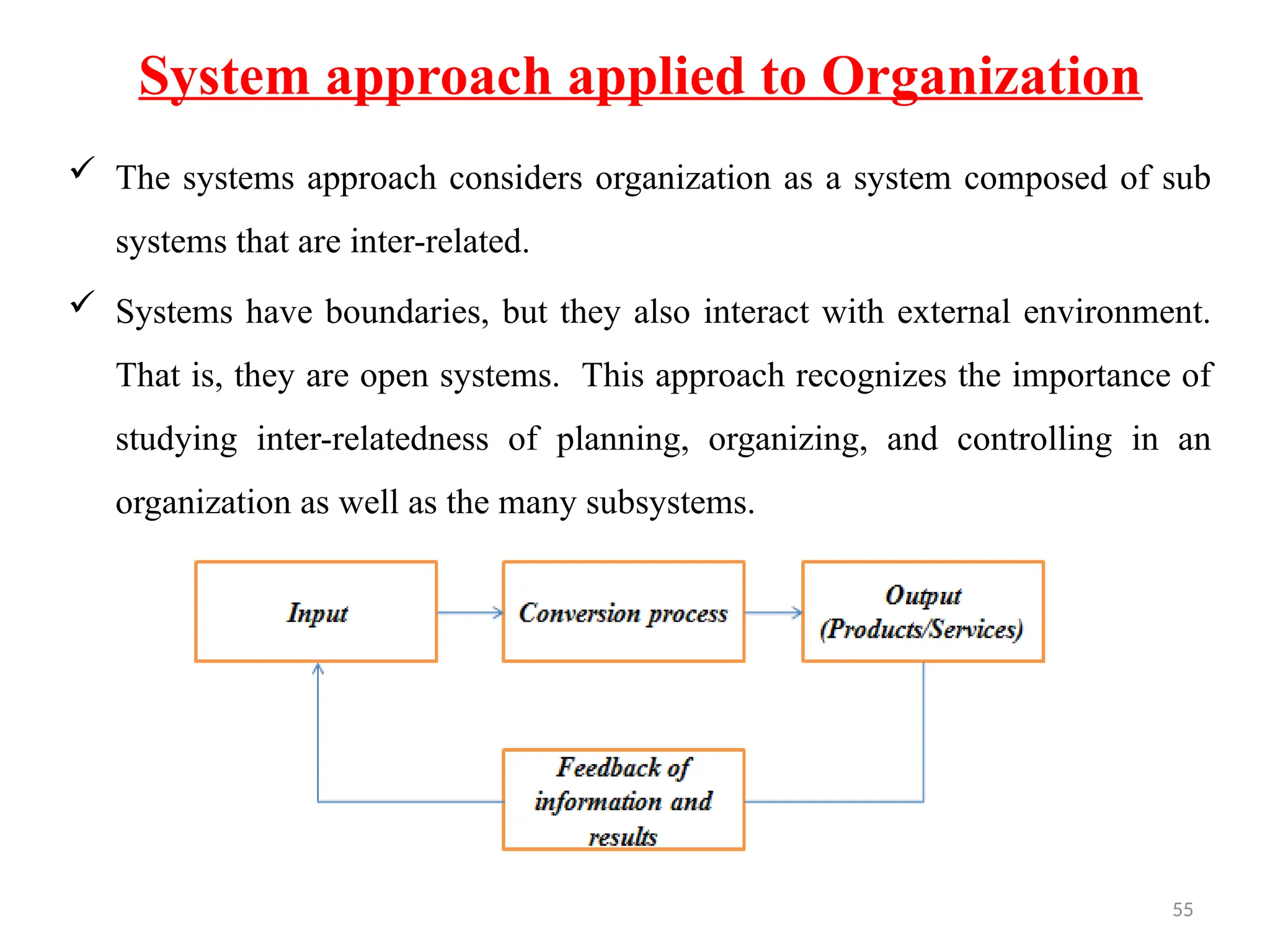
The systems approach considers organization as a system composed of sub
systems that are inter-related.
Systems have boundaries, but they also interact with external environment.
That is, they are open systems. This approach recognizes the importance of
studying inter-relatedness of planning, organizing, and controlling in an
organization as well as the many subsystems.
56.
56
Necessity of Organization
Complexity of Industry
Growing Competition
Optimum utilization of resources
Fixation of authority and responsibility
Reduced labour problems
Co-ordination and directing efforts
Facilitates administration
Stimulates creativity.
57.
57
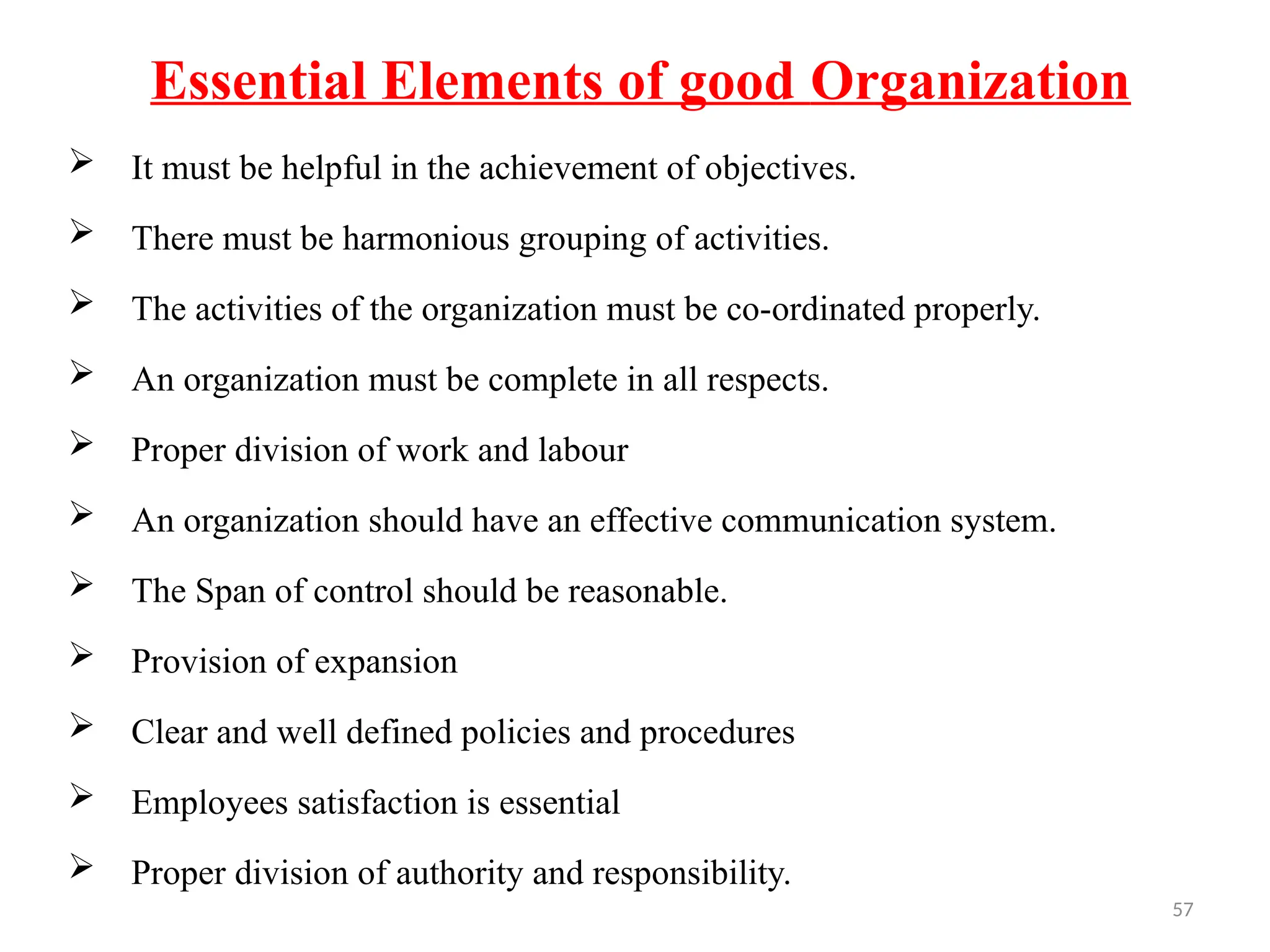
Essential Elements ofgood Organization
It must be helpful in the achievement of objectives.
There must be harmonious grouping of activities.
The activities of the organization must be co-ordinated properly.
An organization must be complete in all respects.
Proper division of work and labour
An organization should have an effective communication system.
The Span of control should be reasonable.
Provision of expansion
Clear and well defined policies and procedures
Employees satisfaction is essential
Proper division of authority and responsibility.
58.
58
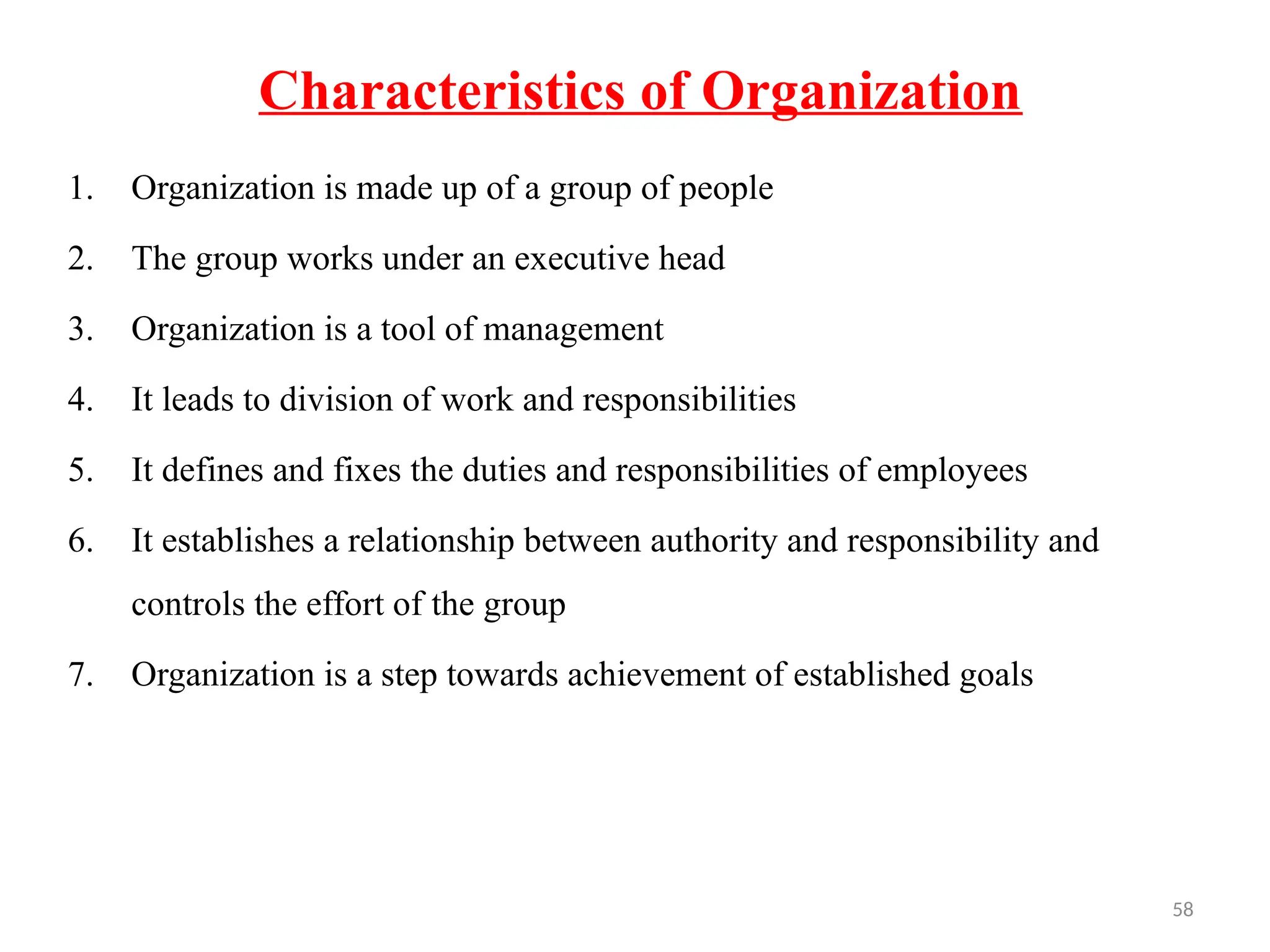
Characteristics of Organization
1.Organization is made up of a group of people
2. The group works under an executive head
3. Organization is a tool of management
4. It leads to division of work and responsibilities
5. It defines and fixes the duties and responsibilities of employees
6. It establishes a relationship between authority and responsibility and
controls the effort of the group
7. Organization is a step towards achievement of established goals
59.
59
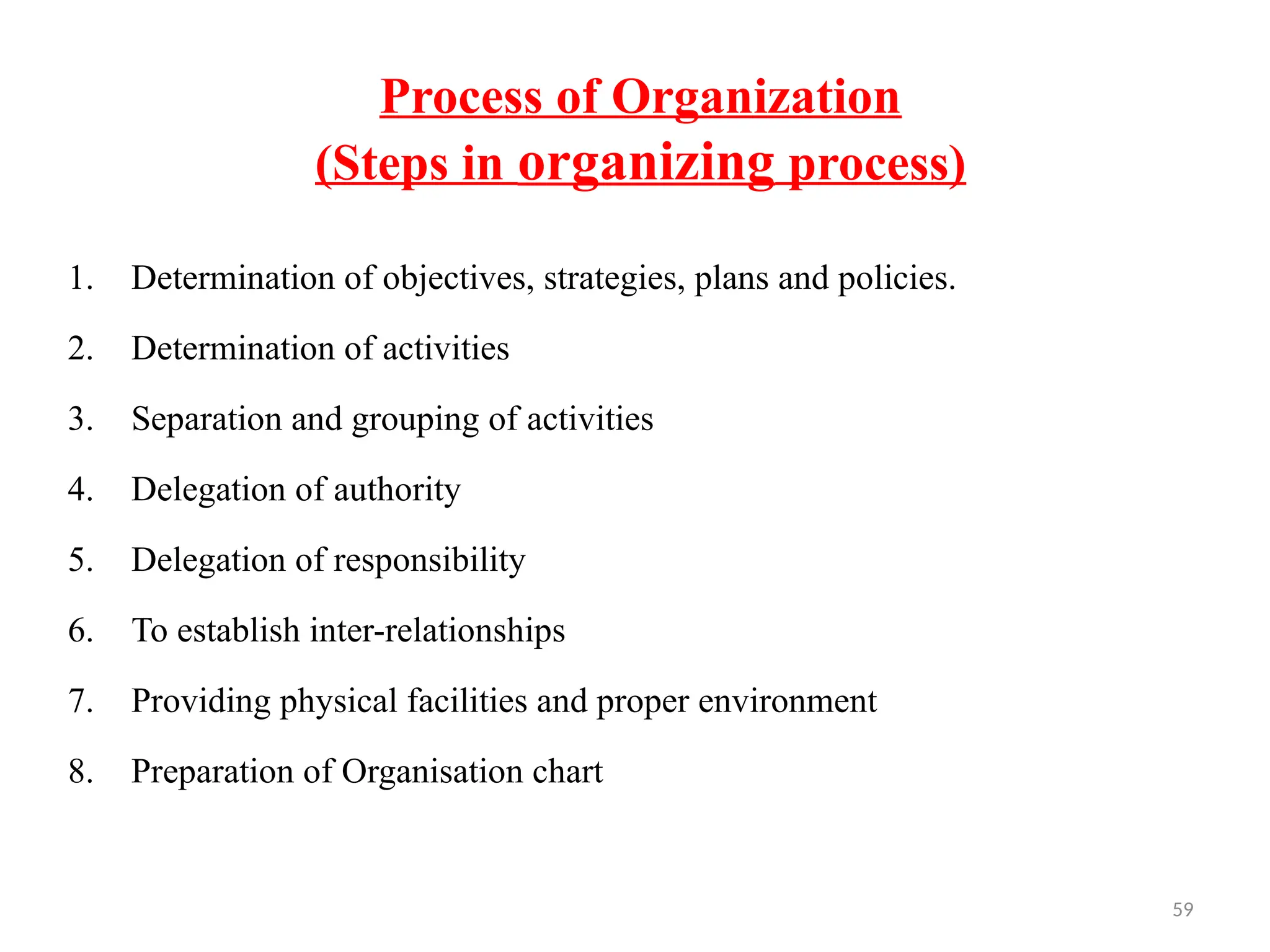
Process of Organization
(Stepsin organizing process)
1. Determination of objectives, strategies, plans and policies.
2. Determination of activities
3. Separation and grouping of activities
4. Delegation of authority
5. Delegation of responsibility
6. To establish inter-relationships
7. Providing physical facilities and proper environment
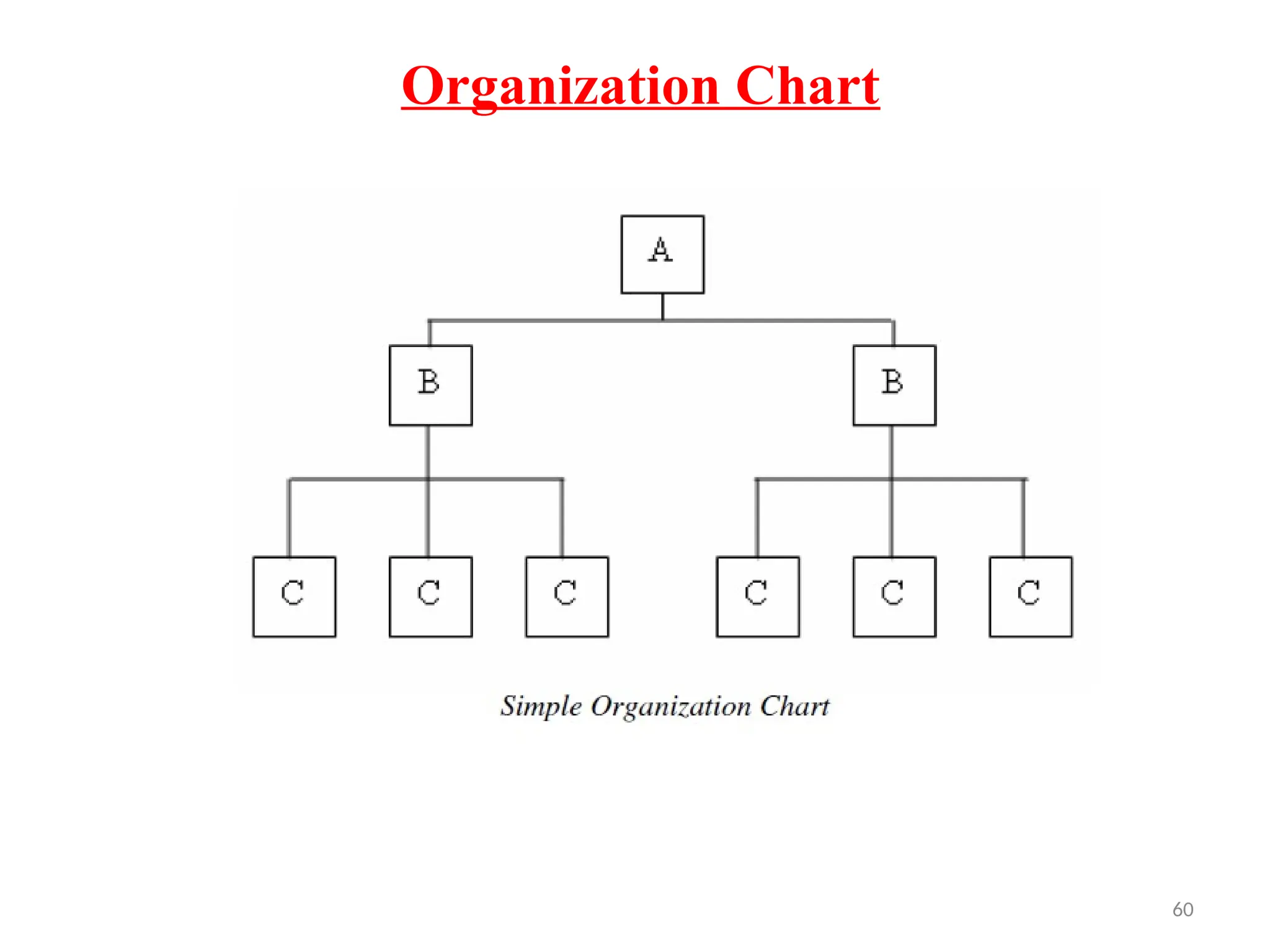
8. Preparation of Organisation chart
61
Principles of Organization
1.Consideration of unity of objectives: the objectives must be clearly
defined for the entire enterprise, for each dept. and even for each position
in the organisation structure.
2. Principle of specialization: Work should be distributed among the
persons very carefully on the basis of their skill, experience and ability to
do that work.
3. Principle of authority: Line of authority should be clearly established in
the structure of organisation in order to avoid overlapping actions,
omission of acts etc.
4. Principle of Co-ordination: Different depts. should have to co-ordinate
with each other to achieve common goals.
5. Principle of unity of command: Each subordinate should have only one
superior and dual subordination should be avoided.
6. Principle of Span of control: The no. of persons who are directly
responsible to the executive is called span of control. In an average firm
SOC range is from 6 to 20.
62.
62
Principles of Organization
7.Principle of exception: Only exceptionally complex matters should be
referred to the executives for their decision and matters of routine nature
should be decided by the sub-ordinate themselves.
8. Principle of flexibility: The organisational structure should be flexible
enough to permit slight alterations and expansions whenever needed, due
to changed circumstances.
9. Principle of simplicity: The organisational structure should be simple
with minimum no. of levels
10. Principle of Responsibility: the superior should be held responsible for
the acts of his subordinates to whom he has delegated authority.
11. Principle of balance: There should be balance between;
- the activities
- authority and responsibility
- standardization of procedures and flexibility
- centralization and decentralization
63.
63
Principles of Organization
12.Principle of continuity: The Organization structure should be in such a way that it
enables to continue its useful existence for a longer period.
13. Scalar principle: The authority originating from the top should flow below without
any interruption.
14. Principle of parity between authority and responsibility: Authority means ability of
the superior to command and responsibility means the obligation of the subordinates
to a superior to perform the assigned task. Both should go hand in hand.
15. Principle of efficiency: Enabling the enterprise to attain objectives with minimum
cost and effort.
16. Principle of Communication: A good communication system is essential for smooth
flow of information.
64.
64
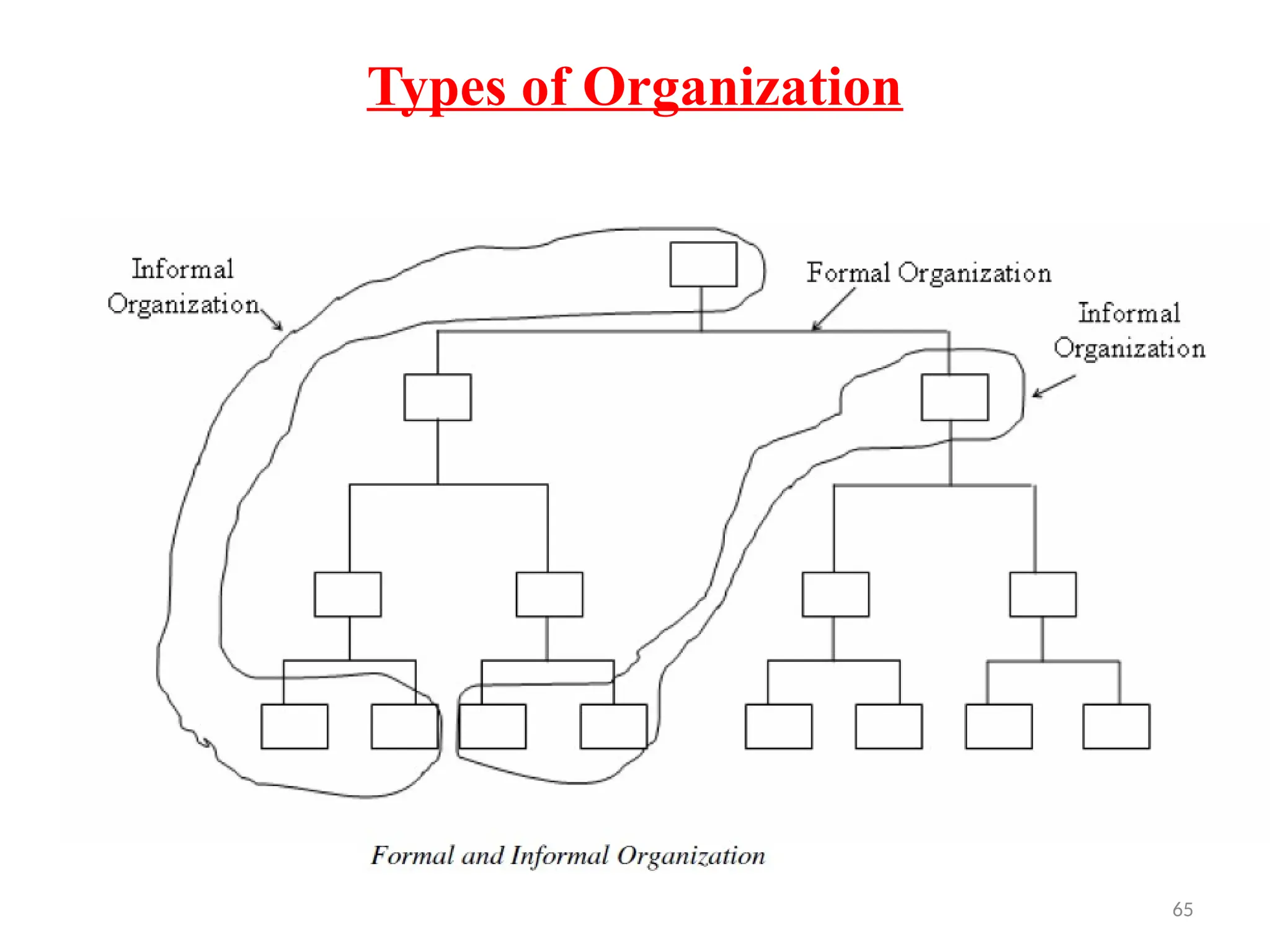
Types of Organization
Formal Organization
– FO are those which have a system of well defined positions,
authority, responsibility, rules, policies, principles etc.
– They are co-ordinated towards a common objectives.
Informal Organization
– Arises from the personal and social relations of the people
which may or may not be work related.
– Arising spontaneously as people associate with one another.
66
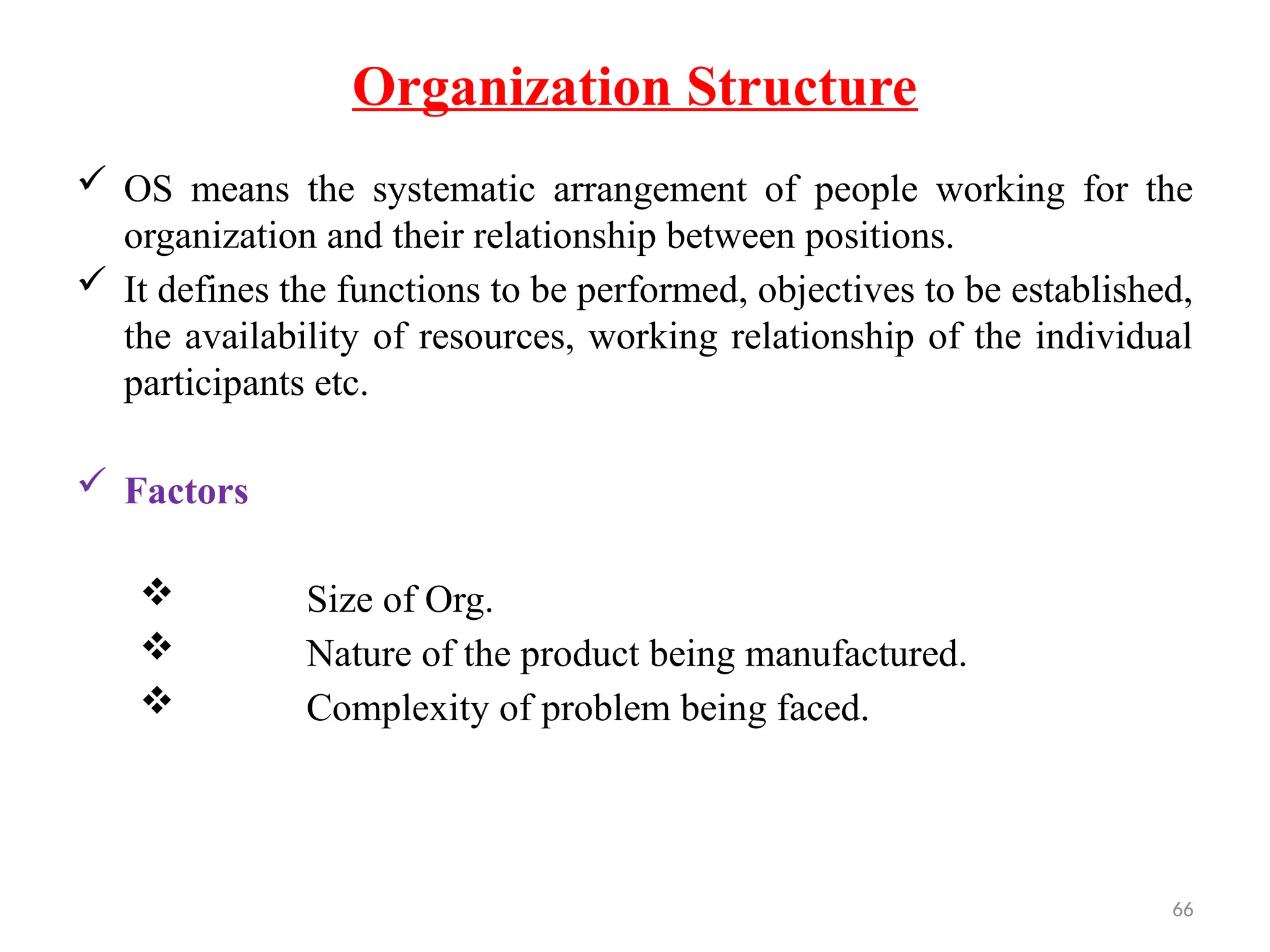
Organization Structure
OSmeans the systematic arrangement of people working for the
organization and their relationship between positions.
It defines the functions to be performed, objectives to be established,
the availability of resources, working relationship of the individual
participants etc.
Factors
Size of Org.
Nature of the product being manufactured.
Complexity of problem being faced.
67.
67
Types of OrganizationStructure
A few commonly known forms of organization structures or types of
organization are:
1) Line organization
2) Line and staff organization
3) Functional Organization
4) Project Organization, and
5) Matrix Organization
68.
68
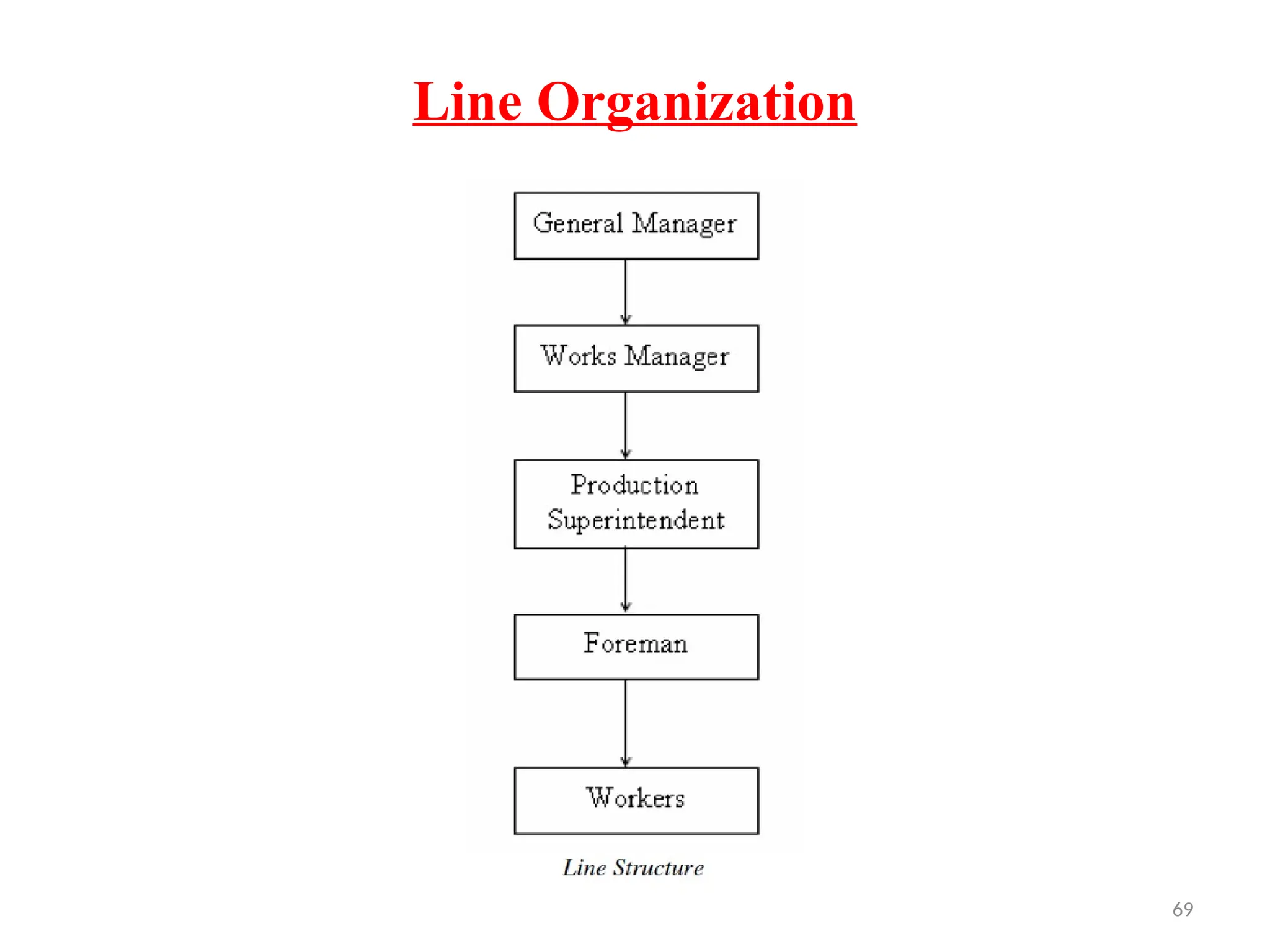
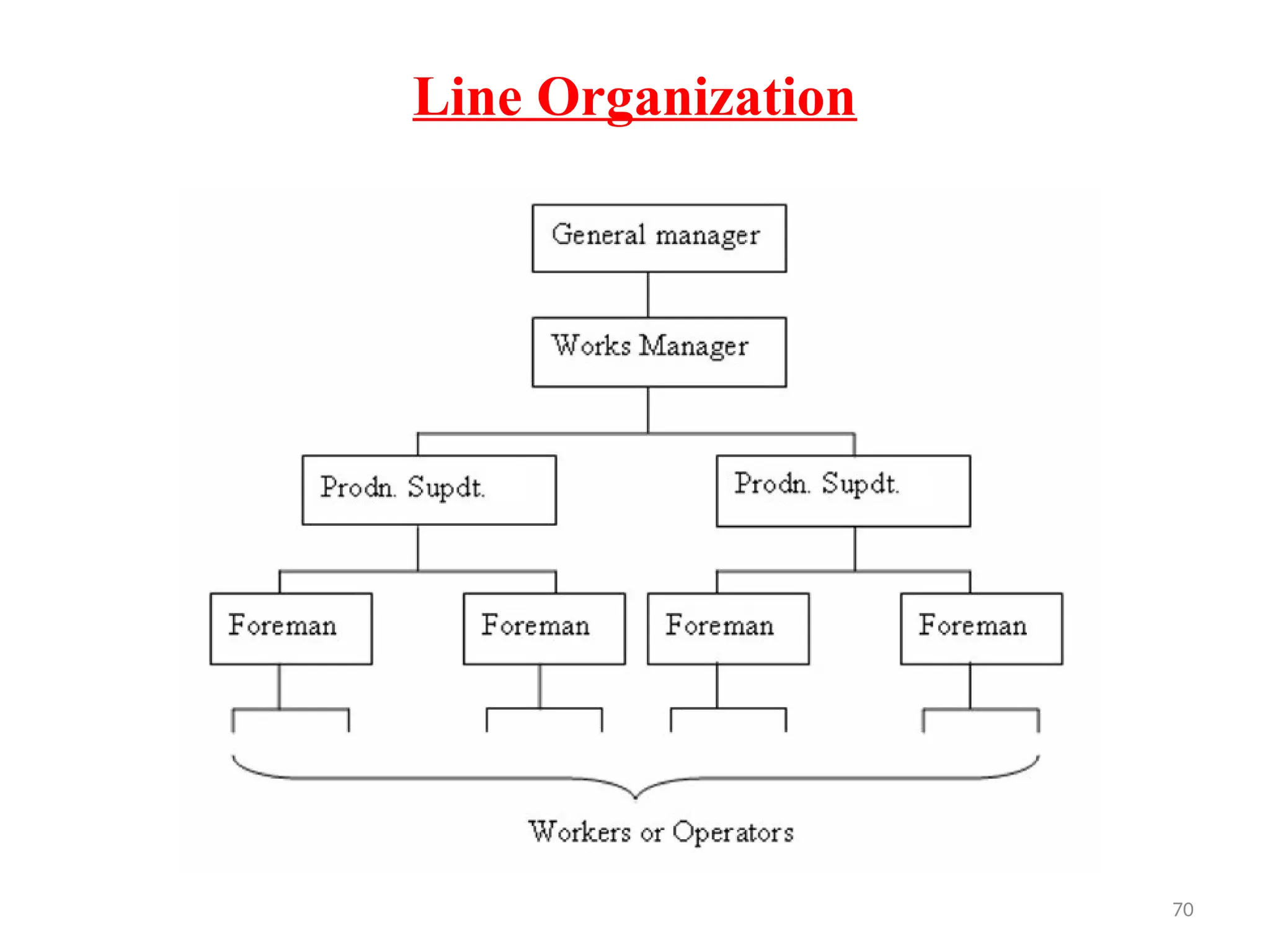
Line Organization
Basedon similarities of activities, different departments are created.
Each department is placed under one department head & he/she has the
full authority all over them.
Authority flows from top to bottom in a vertical line.
Unity of command is maintained.
Superior will be responsible for the performance of sub-ordinate to his
commanding officer.
Line Organization is also called military or scalar organization.
Line organization is suitable for small concerns and for automatic and
continuous process industries such as paper, sugar, cement, textile, etc.
71
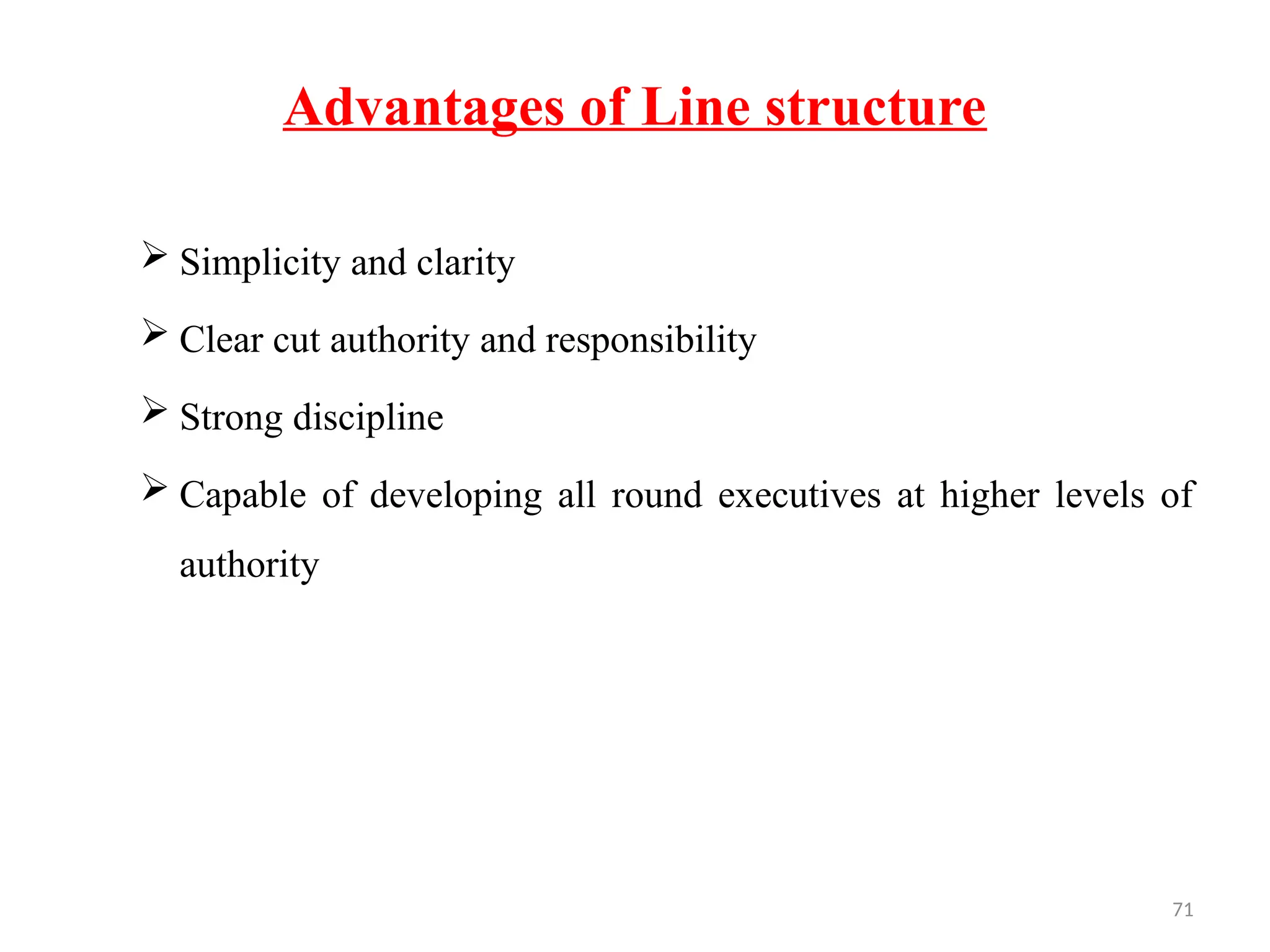
Advantages of Linestructure
Simplicity and clarity
Clear cut authority and responsibility
Strong discipline
Capable of developing all round executives at higher levels of
authority
72.
72
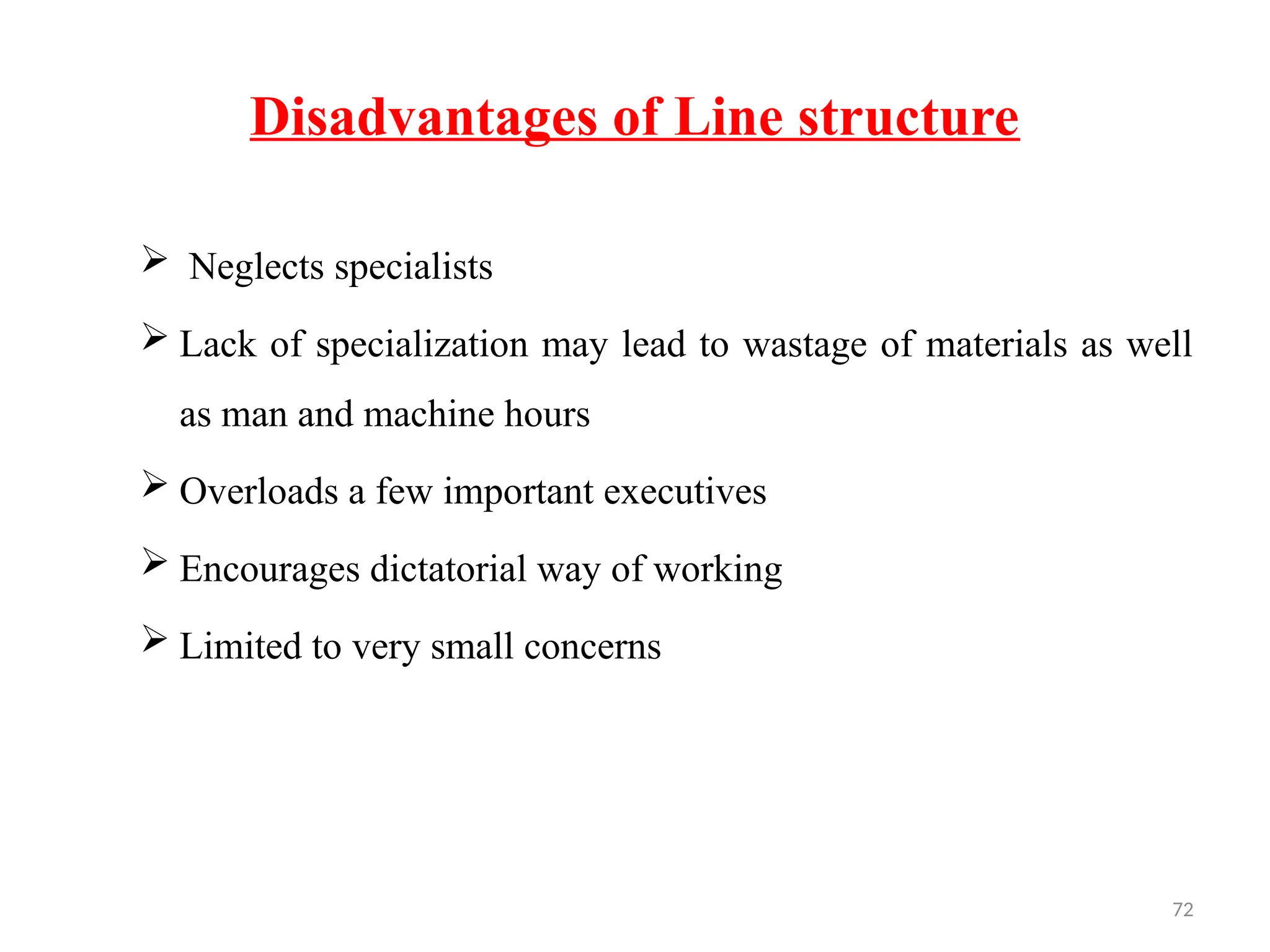
Disadvantages of Linestructure
Neglects specialists
Lack of specialization may lead to wastage of materials as well
as man and machine hours
Overloads a few important executives
Encourages dictatorial way of working
Limited to very small concerns
73.
73
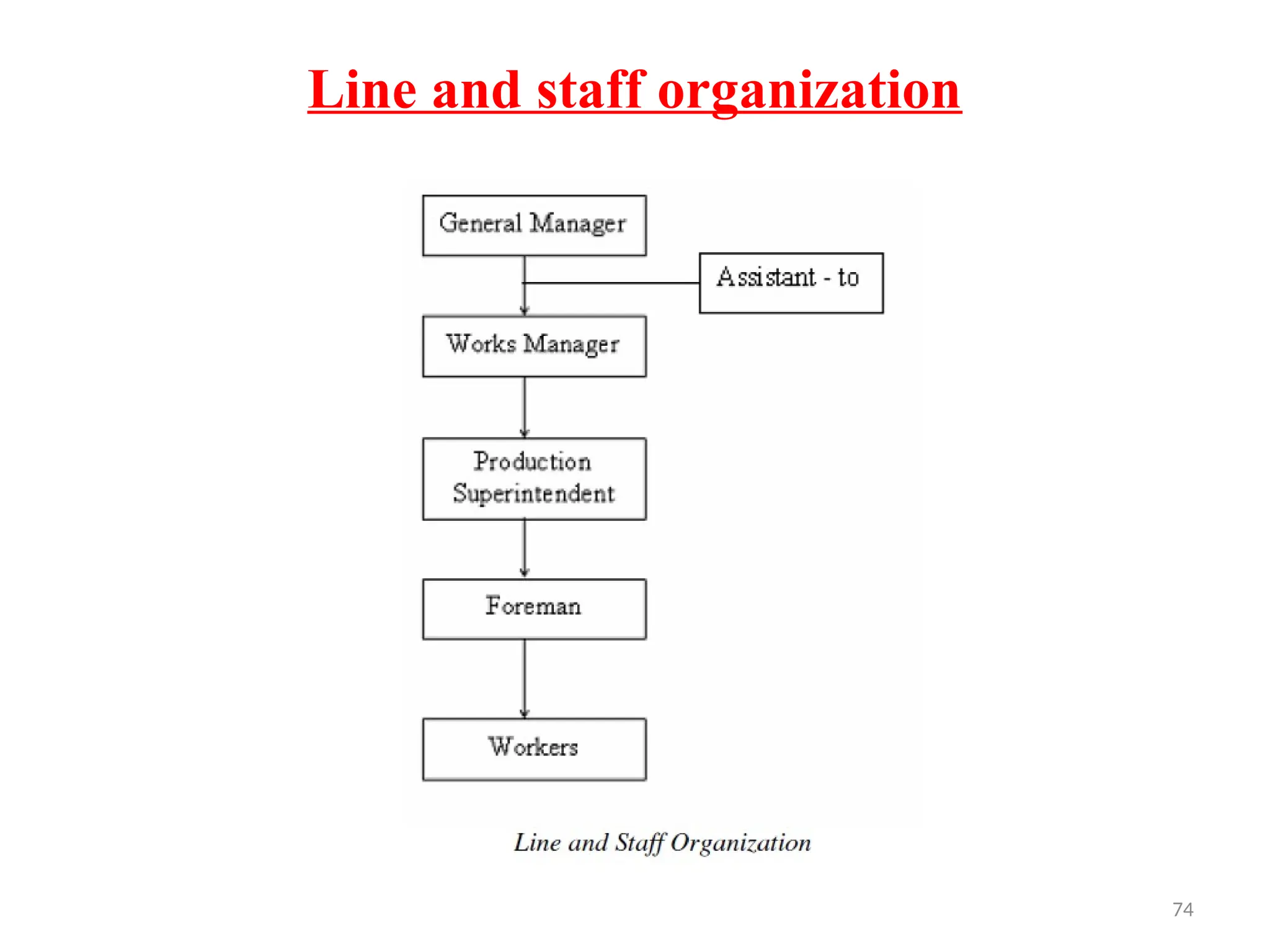
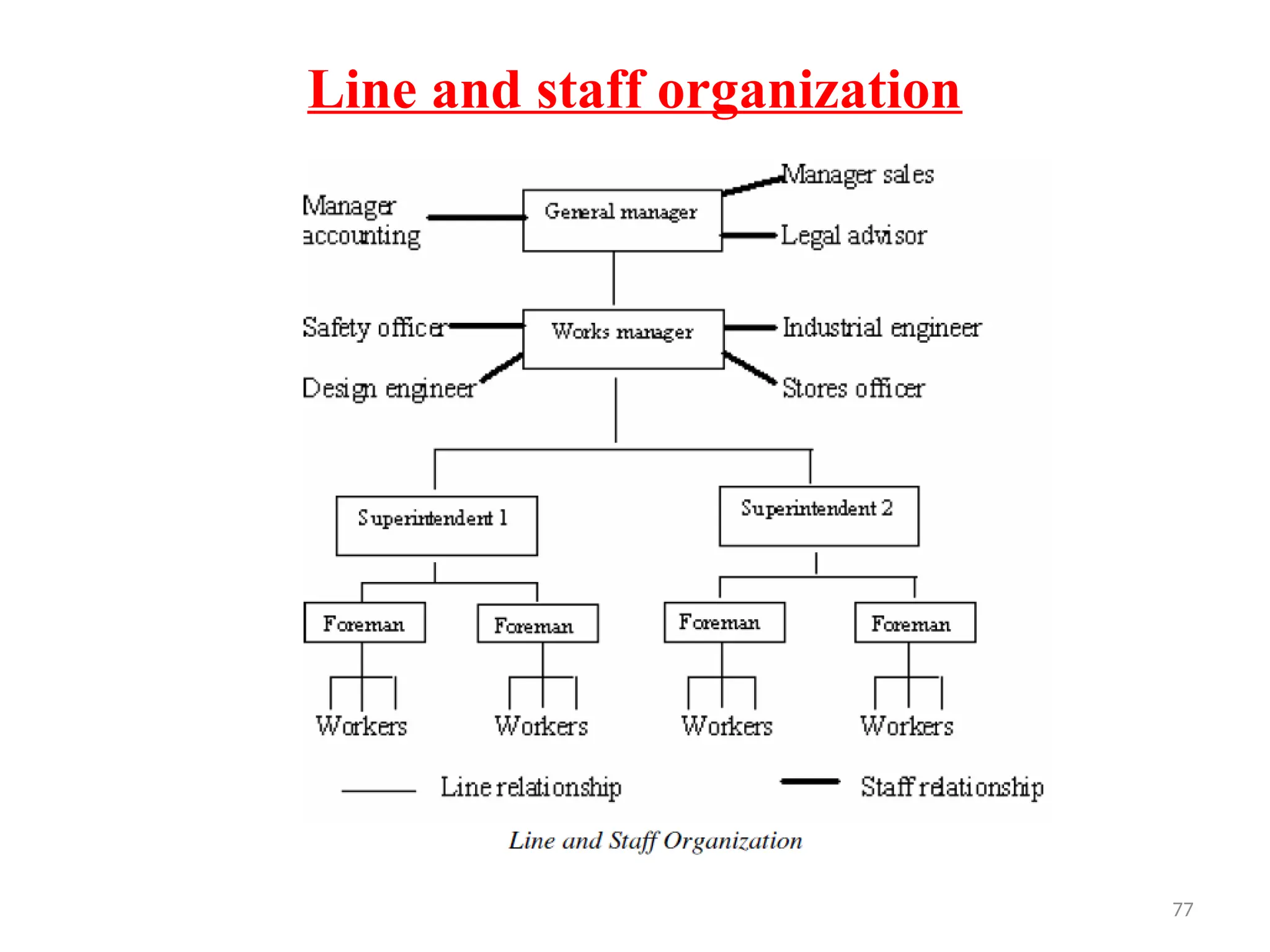
Line and stafforganization
In a big organization manager will have to do a variety of
functions and he may not be expertise in all areas.
Special executives will be employed to assist line executives and
they were known as staff, whom to perform specialized function.
Supervisory authority will be given for line executives and the
staff executives gives advices and expert opinion, have no direct
authority.
75
Advantages of Lineand staff organization
Specialization benefits of staff can be profitably utilized to have
standard operations.
Line executives are relieved of some of their workloads and are
thus able to concentrate on other important matters.
Less wastage of material and labour
Improved product quality
Relatively flexible
76.
76
Disadvantages of Lineand staff organization
Staff – line conflict
Paper work may be increased very much
Staff men may dominate over the lower the lower-level line
managers
Increased product cost because of high salaries of staff
executives
Too much staff activity may complicate a line executive’s job of
leadership and control
78
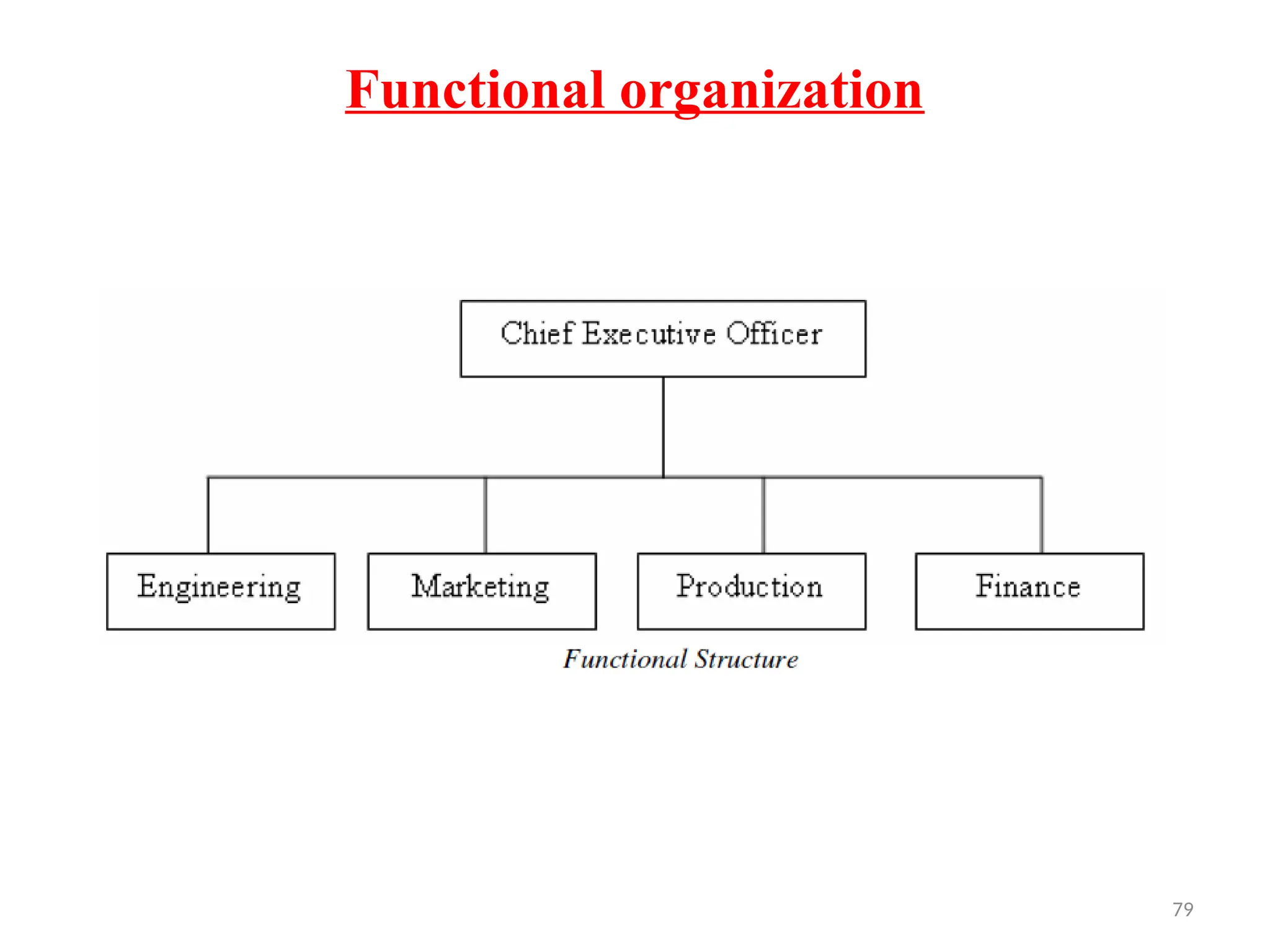
Functional organization
Modifiedform of line organization
Authority rests with functional heads
Staffs are grouped and located by specialty into functional
departments: each headed by a functional manager. Each member of
staff has one clear boss.
Functional manager are specialists in their respective areas and is based
on high degree of specialization.
This specialization leads to greater efficiency and refinement of
particular expertise.
The functional structure helps to focus on those departments that are
critical for the success of the enterprise.
80
Advantages of Functionalorganization
Efficient use of resources
Simplifies training
Promotes professional development
Centralized control of strategic decisions
Improved quality of work
81.
81
Disadvantages of Functionalorganization
Limits development of general managers or all-round executives
Restricted view of company objectives
Difficulty in multifunctional decision making
Promotes narrow specialization
Makes industrial relationships more complex
82.
82
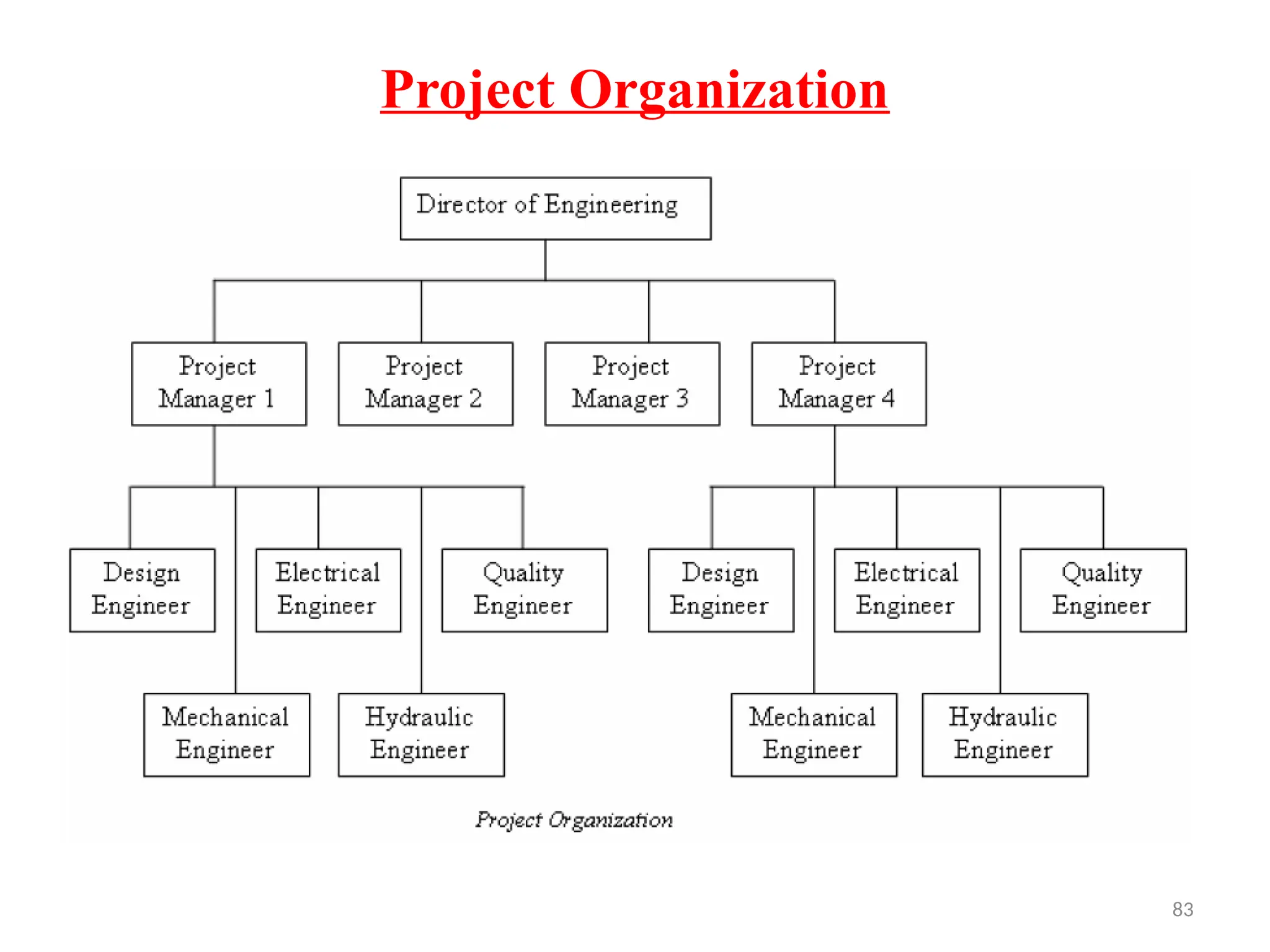
Project Organization
Firmsdealing with multiple products or different projects usually adopt
project organization.
It consist of an autonomous project team, existing independently of the
rest of organization.
The emphasis in project organization is on creation of teams for the
accomplishment of specific objectives.
The project team is assembled for a specific project under the action of
project manager.
The team is thus temporary and will be dispersed when the project is
completed.
84
Advantages of ProjectOrganization
Flexibility
Responsive to changing environment
Encourages team work
85.
85
Disadvantages of ProjectOrganization
Projects can be of short duration leading to frequent change in
organization structure
Professionals prefer to be allied with their professional group
rather than being allied with a project
Trained professionals need not tolerate the insecurity of frequent
organization change
86.
86
Matrix Organization
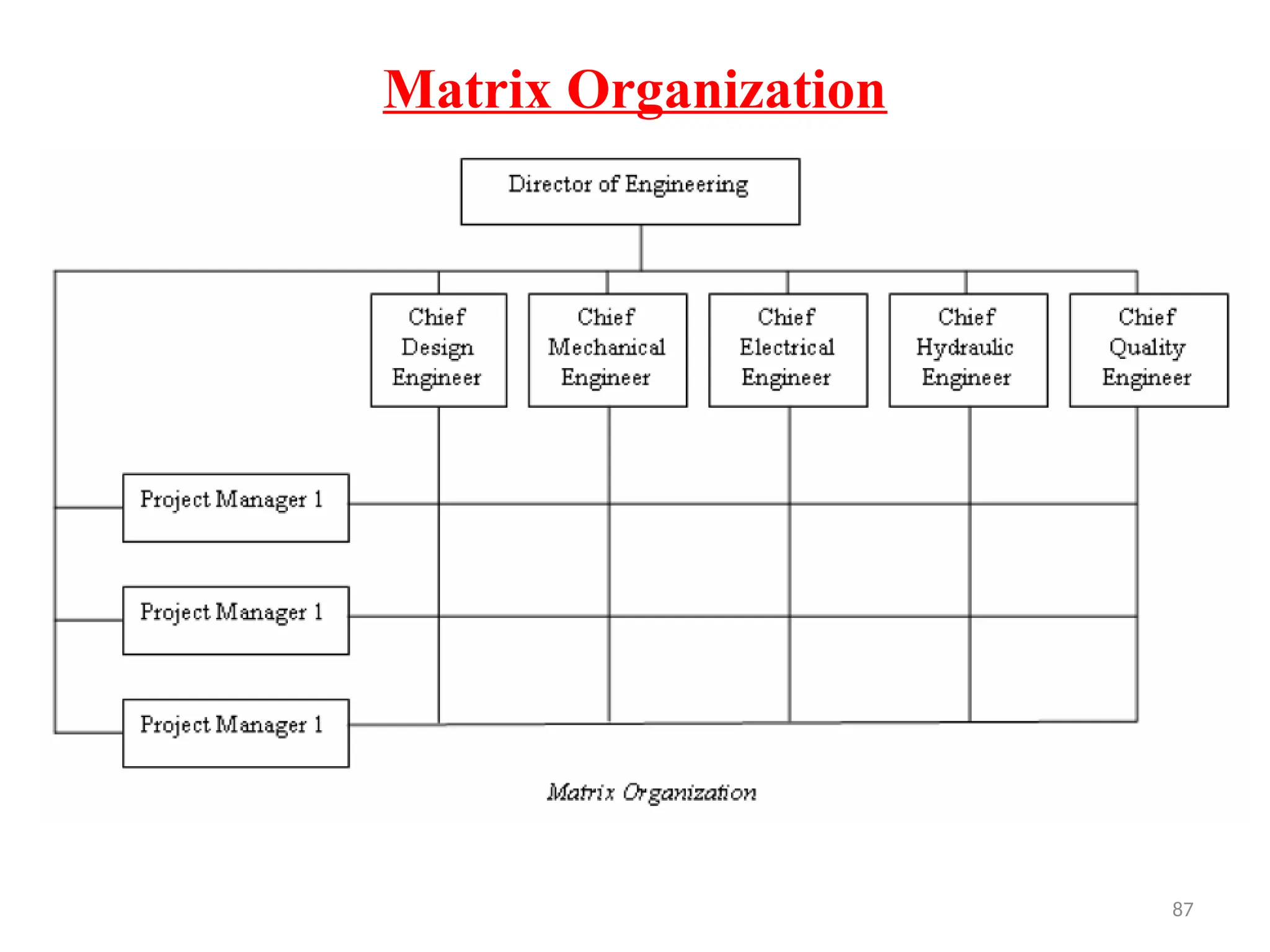
Theyare those that comes between fully functional and fully project
organizational structure.
Staffs are grouped and located by speciality into functional units
headed by a functional manager.
The project manager works with the functional manager for timely
completion of project.
The matrix organization is an organization structure that establishes
two chains of command, one vertical and one horizontal, at the same
time.
It is intended to combine the advantages of functional structure and
project structure.
88
Advantages of MatrixOrganization
Decentralized decision making
Efficient use of functional managers
Capable of adapting to fast environmental changes
Flexibility
89.
89
Disadvantages of MatrixOrganization
Violates the principle of unity of command
High administrative costs
Requires tremendous horizontal and vertical co-ordination
Chances of interpersonal conflicts
90.
90
Topics (Part 4)
FORMSOF BUSINESS ORGANIZATION
Concept of Ownership organization
Types of ownership
1. Individual ownership
2. Partnership
3. Joint stock company
Private and public limited company,
4. Co-operative organizations
5. State ownership
Public corporation
91.
Ownership Organisation
A firmis an Ownership organisation which
combine the factors of production in a plant for the purpose of
producing goods or services and selling them at profit.
• Business
Business may be defined as an activity in which
different persons exchange something of value, whether goods
or service, for mutual gain or profit.
• Factors
Size and nature of organisation
Technical difficulties
Market competition and scope of articles in markets
Capital required
Limitations and restriction put forth by govt.
92.
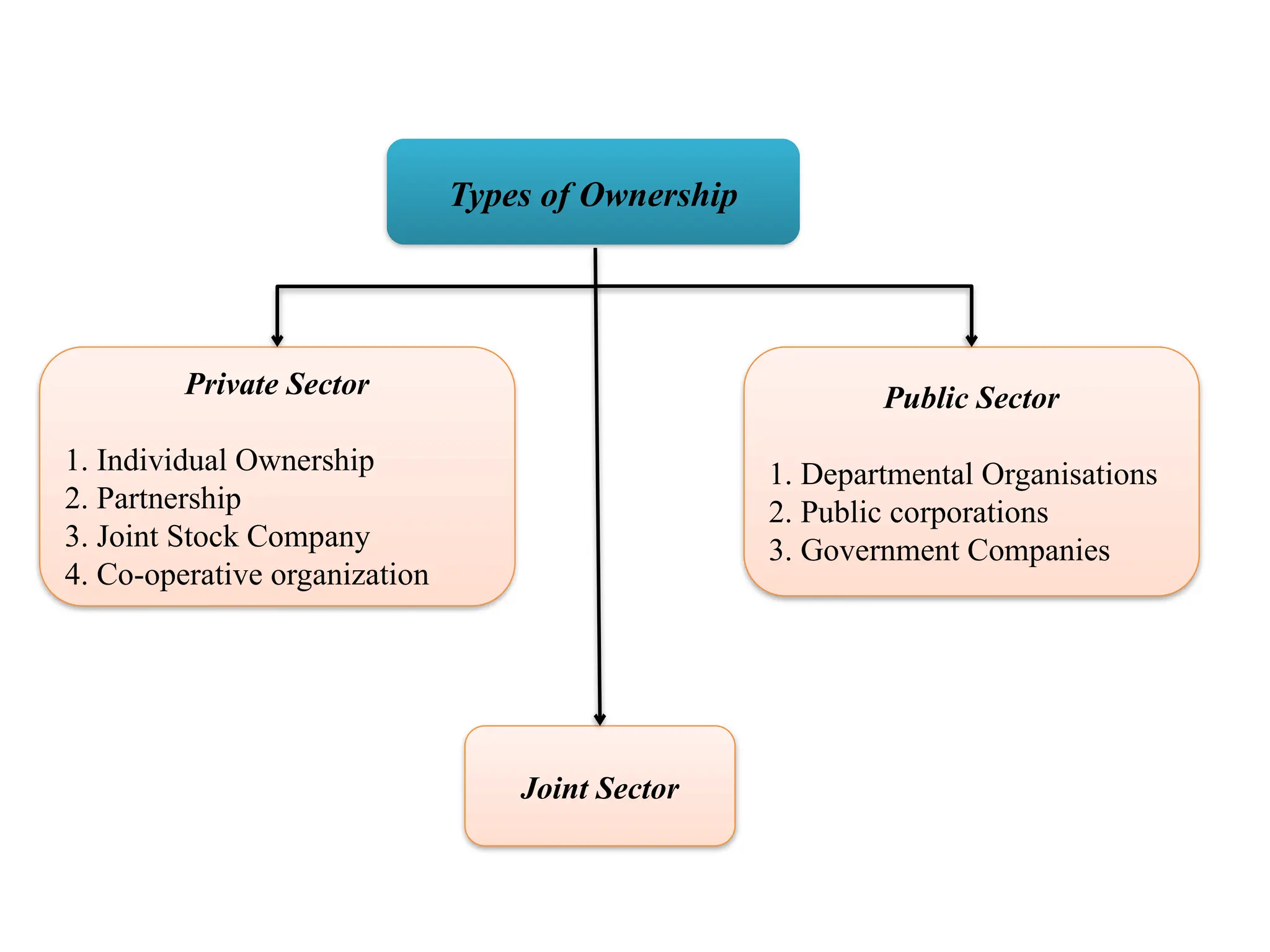
Types of Ownership
PrivateSector
1. Individual Ownership
2. Partnership
3. Joint Stock Company
4. Co-operative organization
Public Sector
1. Departmental Organisations
2. Public corporations
3. Government Companies
Joint Sector
93.
PRIVATE SECTOR
Privatesector organizations, as the name indicates, are exclusively
owned by private individuals.
The efficiency of the private sector organizations is usually very
high compared to organizations from any other sector.
The important forms of the private sector organizations are:
1. Individual/Single ownership
2. Partnership
3. Joint stock companies
4. Cooperative organization
94.
1. Individual/single Ownership
Simplest and oldest form of Organisation.
Individual entrepreneur supplies the entire capital, also known as sole
proprietorship.
Entire Authority & responsibility belongs to him and also the profit and
loss.
An individual introduces his own capital, uses his own skill and
intelligence in the management of its affairs and is solely responsible
for the results of its operation.
In Short it’s a “one man business”, if need he can employ a person to
assist him.
His liabilities will be unlimited.
– Applications.
Small scale industries
Risk covered is not too heavy
Management by one man is possible
95.
Advantages of Individual/singleOwnership
Ease of formation and dissolution.
Direct relationship between effort and reward serves as a powerful
incentive to the proprietor to manage the concern efficiently
Ease of coordination
Promptness in decision-making
Flexibility in management
Secrecy of the affairs of business can be maintained
Freedom from government regulations
96.
Disadvantages of Individual/single
Ownership
The amount of capital that can be invested is limited, therefore,
rendering it unsuitable for modern business
All the qualities required for success in business are rarely found in a
single person
The liability of the sole proprietor will be unlimited
Uncertainty of duration as the firm may cease to exist with the death of
the proprietor
97.
2. Partnership Organization
Owned by 2 or more persons who share the power, responsibilities and
profits according to an agreement reached amongst themselves.
Person may possess exceptional business ability, experience, talent but
no capital, then he can have a financing partner (vice versa).
“Partnership deed” – written agreement
Indian partnership act defines partnership as the relation between
persons who have agreed to share profits of a business carried on by
all or any of them acting for all.
The contribution of the partners in running the business need not be
same.
98.
2. Partnership Organization
The partnership is created by mutual consent and voluntary agreement.
Registration of a business under partnership is essential under shops and
establishment act in order to take legal help in enforcing the terms of
agreement on the partners.
Every partner has an unlimited liability in respect of the firm’s debt and
limitation of the liability through mutual agreement is not possible legally
under partnership.
active partners
sleeping partners
nominal partners
secret partners
minor partners
99.
Advantages of PartnershipOrganization
Ease of formation as there are very little legal formalities
Larger financial resources as compared to single ownership
Balanced judgment as the partners possesses various sorts of talent,
expertise and experience
Adequate credit availability because of unlimited liabilities of the
partners
Flexibility of operation
Secrecy in business
Losses, if any, are shared by the partners
100.
Disadvantages of PartnershipOrganization
Unlimited liabilities of each partner
All partners suffer because of the wrong steps taken by any of the partners
Uncertain life as partnership may dissolve by death or insolvency of a
partner
Lack of public confidence as the affairs of the business are kept secret and
the accounts is not published
Non-transferability or restricted transferability of the partners’ interest in
the business
101.
3. Joint StockCompany
It is a voluntary association of individuals for profit, having a capital divided
into transferable shares of different values.
Persons who purchase shares are called Share Holders and managing body is
known as Board of Directors, whom elected by the Share Holders.
Legal business owned by the shareholders having limited liability and managed
by an elected Board of Directors.
Capital is contributed by large number of persons in the form of shares of
different values.
In this form of organization liability of the shareholder is limited to the amount
of shares held by him and he is free from the responsibility of the debts and
claims of the company beyond the value of shares.
Types:- a) Private Ltd. Company b) Public Ltd Company
102.
a) Private Ltd.Company
Owned and managed by a group of members from family, relatives or
friends.
Formed by 2 or more members & maximum is limited to 50.
Transfer of share is limited to members only and general public cannot
be invited to purchase shares.
A private limited company need not make the prospectus, accounts and
other particulars open to public.
The government also does not interfere on the working of the company.
A private limited company, while conferring the advantage of limited
liability, allows a business to be privately owned and managed.
103.
b) Public Ltdcompany
It is opened to general public
Minimum number of persons are 7 and there is no upper limit.
They are subjected to greater control and supervision of the govt.
This control is necessary to protect the interest of the shareholders and the
members of the public.
The affairs of the public limited company should be made open to public by
publishing in leading newspapers.
Shares are transferable without any prior approval.
The affairs of company are managed by BOD
The public limited companies can advertise to offer its share to general public
through a prospectus and there is no restriction on the transfer of shares
104.
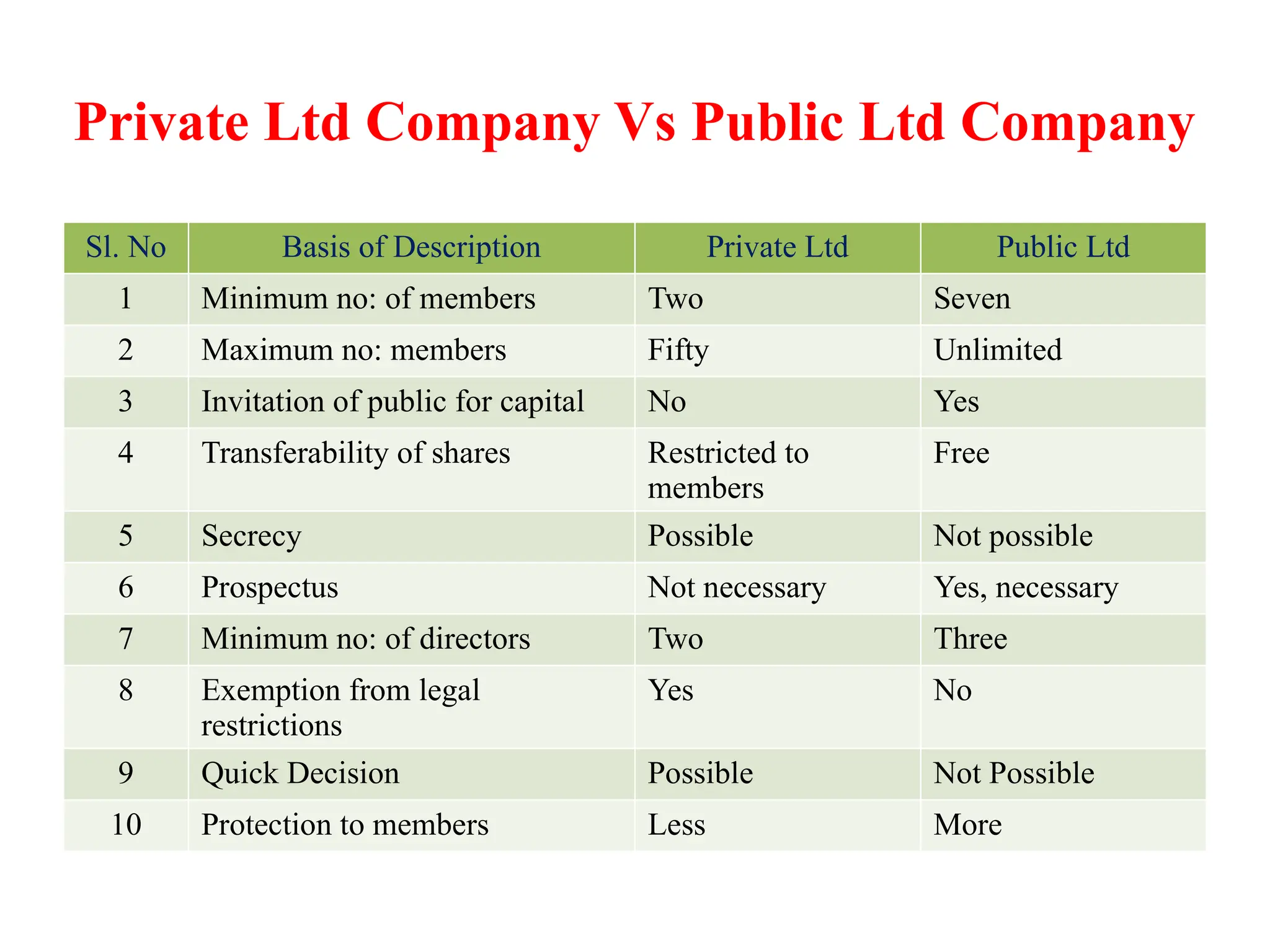
Private Ltd CompanyVs Public Ltd Company
Sl. No Basis of Description Private Ltd Public Ltd
1 Minimum no: of members Two Seven
2 Maximum no: members Fifty Unlimited
3 Invitation of public for capital No Yes
4 Transferability of shares Restricted to
members
Free
5 Secrecy Possible Not possible
6 Prospectus Not necessary Yes, necessary
7 Minimum no: of directors Two Three
8 Exemption from legal
restrictions
Yes No
9 Quick Decision Possible Not Possible
10 Protection to members Less More
105.
Advantages of JointStock Company
Availability of large capital
Limited liability
Not affected by the death or retirement
Risk of loss is divided among the shareholders
Ease of expansion
Services of specialists can be obtained
Cheaper and better production because of large-scale production with
the use of modern technology, which the company can afford
106.
Disadvantages of JointStock Company
Lack of personal interest on the part of the salaried manager can lead to
inefficiency and waste.
Board of directors and managers who have intimate knowledge of the
financial position of the company may purchase or sell the shares
accordingly for their personal profits
Requires a great deal of legal formalities to be observed
Difficult to maintain secrecy
Few shareholders having greater number of shares may secure control
over the company
Slow decision-making
107.
4. Co-operative Organization
Its an Organisation where in persons voluntarily associate as human beings
for the fulfillment of their common economic interests.
Set up with a primary objective of helping its members rather than making
profit.
The primary motive of a cooperative society is to provide maximum
service to its members and not to make profits.
This does not, however, mean that a co-operative does not work for profit
at all.
Whatever is the profit, it will be partly distributed as bonus to its members.
Types
1. Producers Co-operative society
2. Consumers Co-operative society
3. Housing Co-operative society
4. Co-operative Credit society
108.
1. Producer’s Co-operativesociety
They are formed to protect the interest of small producers by making
available items of their need for production (like raw materials, tools
etc)
For buying and selling the products, produced/cultivated by the
members to eliminate middlemen and get better prices.
Eg: handlooms, coir, handicrafts etc.
2. Consumer’s Co-operative society
For the retail trade of household and consumable items.
Eg: Stores in School & Colleges.
109.
3. Housing Co-operativesociety
Formed for the purpose of getting plots or constructing houses for
needy persons by providing loans, reducing cost of construction etc.
4. Co-operative credit Society
It’s objective is to finance the poor cultivators by providing loans at
low Rate of Interest (ROI) for developing land, buying agro
machineries etc.
Formed by persons working in the same organisation to provide
loans to the members in case of financial difficulties etc.
110.
Advantages of Co-operativeOrganization
Democratic management
Limited liability
The life of a cooperative society is not affected by the death or
insolvency of a member
Ease of coordination because of the cooperation among the members
of the society
Monetary help can be secured from government
Helps development of moral character
111.
Disadvantages of Co-operativeOrganization
Limitation of capital
Excessive government regulation
Lack of secrecy
Insufficient motivation
Inefficiency of management as the members generally lacks technical
knowledge and may not be competent enough
112.
PUBLIC SECTOR
Ownedand managed by Central or State government.
Controlled and operated by the govt. or in association with private
enterprises.
Public sector companies are established by the government to produce and
supply goods and services required by the society.
Public sector prevents the economic unbalance in the nation.
It also serves as a means to obstruct the monopolistic tendencies.
Capital is invested by the govt. or govt. controlled financial institutions
like LIC, UTI, Public sector banks etc.
Public Sector Undertaking (PSU) is a term used to refer companies in
which the govt: owned a majority (51% or more) of the company equity.
113.
PUBLIC SECTOR
Theimportant forms of public sector organizations are:
1. Departmental organizations
2. Public corporations
3. Government companies
114.
1. Departmental Organizations
It’s the business organisation which are owned, managed and run by the
govt: or local bodies like municipality, district board etc.
Generally done in the case of water supply, electricity, gas, bus, railways,
navigation etc.
A top executive appointed by the ministry concerned will manage the
organization.
In certain organizations cooperation from several ministries may be required
and in such cases a board or committee of representatives from the
ministries concerned will manage the organization.
Social benefit is of primary importance while profit motive is given as
secondary consideration.
Eg: Railways, Posts and Telegraphs etc.
115.
2. Public Corporations
Owned by the govt-either Central, State or local bodies.
It is managed by the Board of Directors nominated by the government.
It combines the public interest of the govt. body & autonomous
management of the public sector.
Though the total capital is provided by the government, they have separate
entity and enjoy independence in matters related to appointment,
promotions etc.
Public service rather than profit maximization becomes the main aim of
such corporations.
Eg: FCI, ONGC, Financial corporation, Industrial development
corporation etc.
116.
3. Government Companies
A govt. company is any company in which not less than 51% of the share
capital is held by the Central or State govt: or partly by both.
Managed by elected Board of Directors.
Eg: FACT, HAL, HLL, HMT etc.
117.
Advantages of PublicSector
Helps for the betterment of the community and for the welfare of the
people
Facilities like power, transport, credit, and insurance, etc are easily
made available to public sector units
Because of the government control economical and social objectives
can easily be achieved
Provides better working conditions to the employees and cheaper and
better products and services to the customers
Encourages industrial growth of under-developed regions in the
country
Provides employment opportunities to all sections of the people
Prevents monopolistic tendencies and paves the way for equitable
distribution of wealth among different sections of the community
118.
Disadvantages of PublicSector
Because of bureaucratic control generally timely decisions are not
taken
Lack of initiative among workers because promotions are seniority
based rather than merit based
Too much of interference by the political leaders and government in
the internal affairs of public sector units
Misuse of excessive freedom (compared to private concerns) cannot
be ruled out
Inadequate accountability
Government officials prefer to work according to certain rules and
regulations and therefore lesser flexibility
Incompetent persons may occupy high levels
119.
JOINT SECTOR
Theconcept of joint-sector implies the participation of both the
government and the private sector in the share capital and general
management of the business.
It combines the best aspects of both private sector and public sector
organizations and aims at achieving the task of social justice through
efficient use of resources.
Joint sector firms can be a pure Indian firm or an Indian firm with
foreign collaboration
120.
Advantages of JointSector
Helps to foster the industrial development with social justice
Checks business malpractices
Antidote to monopoly and concentration of economic power
Combines the best aspects of both private sector and public sector
organizations.
Makes nationalization unnecessary
121.
Disadvantages of JointSector
Lack of confidence between two sectors
Managerial autonomy making the owners passive in business
Inadequate accountability
Editor's Notes
#9 Management is getting work done through others.
Managers have to be concerned with efficiency and effectiveness in the workplace. Efficiency is getting work done with a minimum of effort, expense, or waste. Effectiveness is accomplishing tasks that help full organizational objectives, such as customer service and satisfaction.