Siddha Raj Bhatta
Email: siddhabhatta@gmail.com
Controlling
Controlling
 Monitoring of organizational
activities so that performance
remains within acceptable limits.
 Objective is to ensure the
achievement of organizational goal.
Steps in Controlling
 Step 1 : Establishing Standards
-Should me measurable
-Should be consistent with goals
-Should identify the performance indicators
 Step 2 : Measuring Performance
-Continuous and ongoing activity
-Quality/quantity
-Sources : personal observation, oral, statistical
and written reports
Steps in Controlling
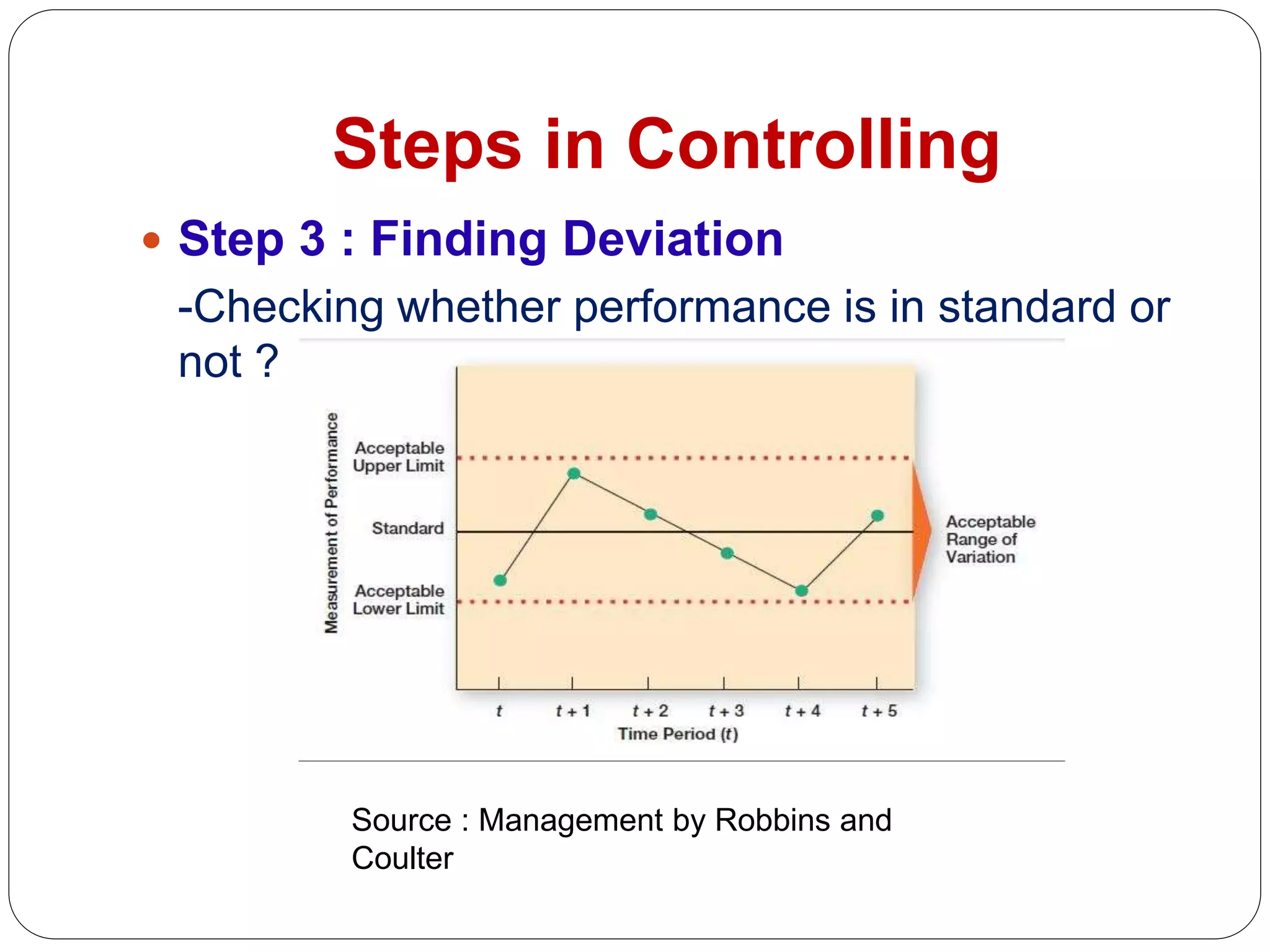
 Step 3 : Finding Deviation
-Checking whether performance is in standard or
not ?
Source : Management by Robbins and
Coulter
Steps in Controlling
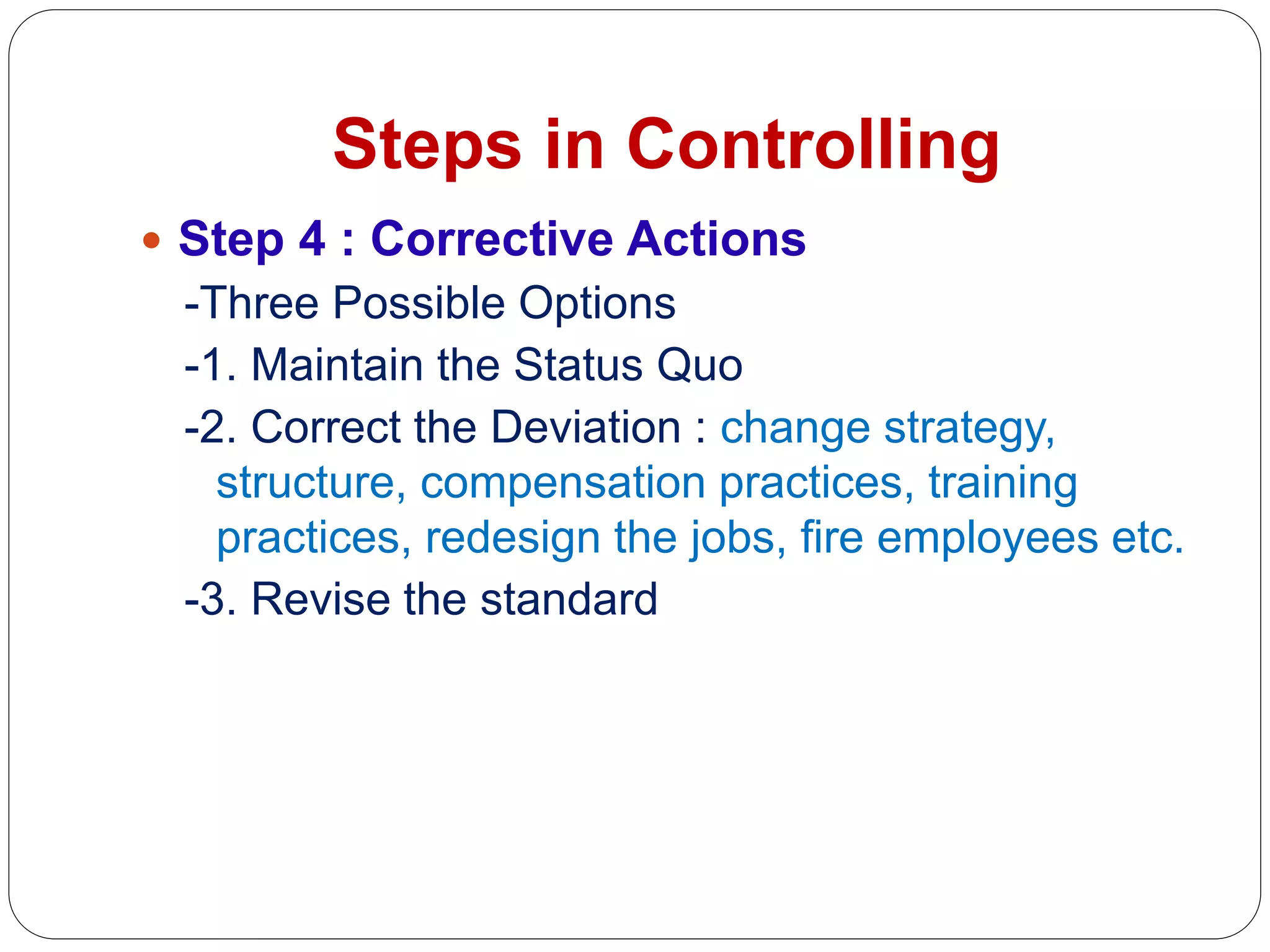
 Step 4 : Corrective Actions
-Three Possible Options
-1. Maintain the Status Quo
-2. Correct the Deviation : change strategy,
structure, compensation practices, training
practices, redesign the jobs, fire employees etc.
-3. Revise the standard
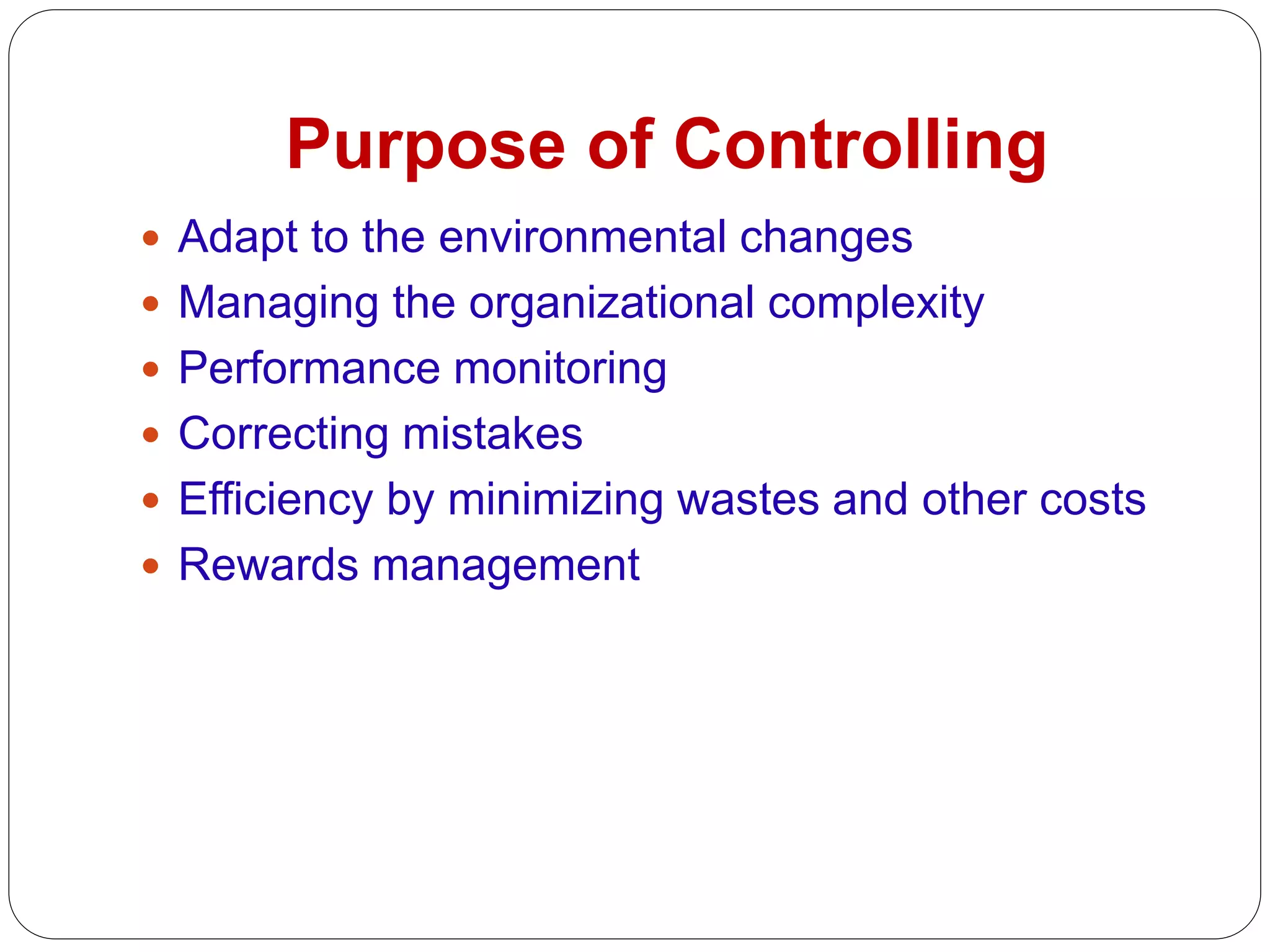
Purpose of Controlling
 Adapt to the environmental changes
 Managing the organizational complexity
 Performance monitoring
 Correcting mistakes
 Efficiency by minimizing wastes and other costs
 Rewards management
Types of Controls
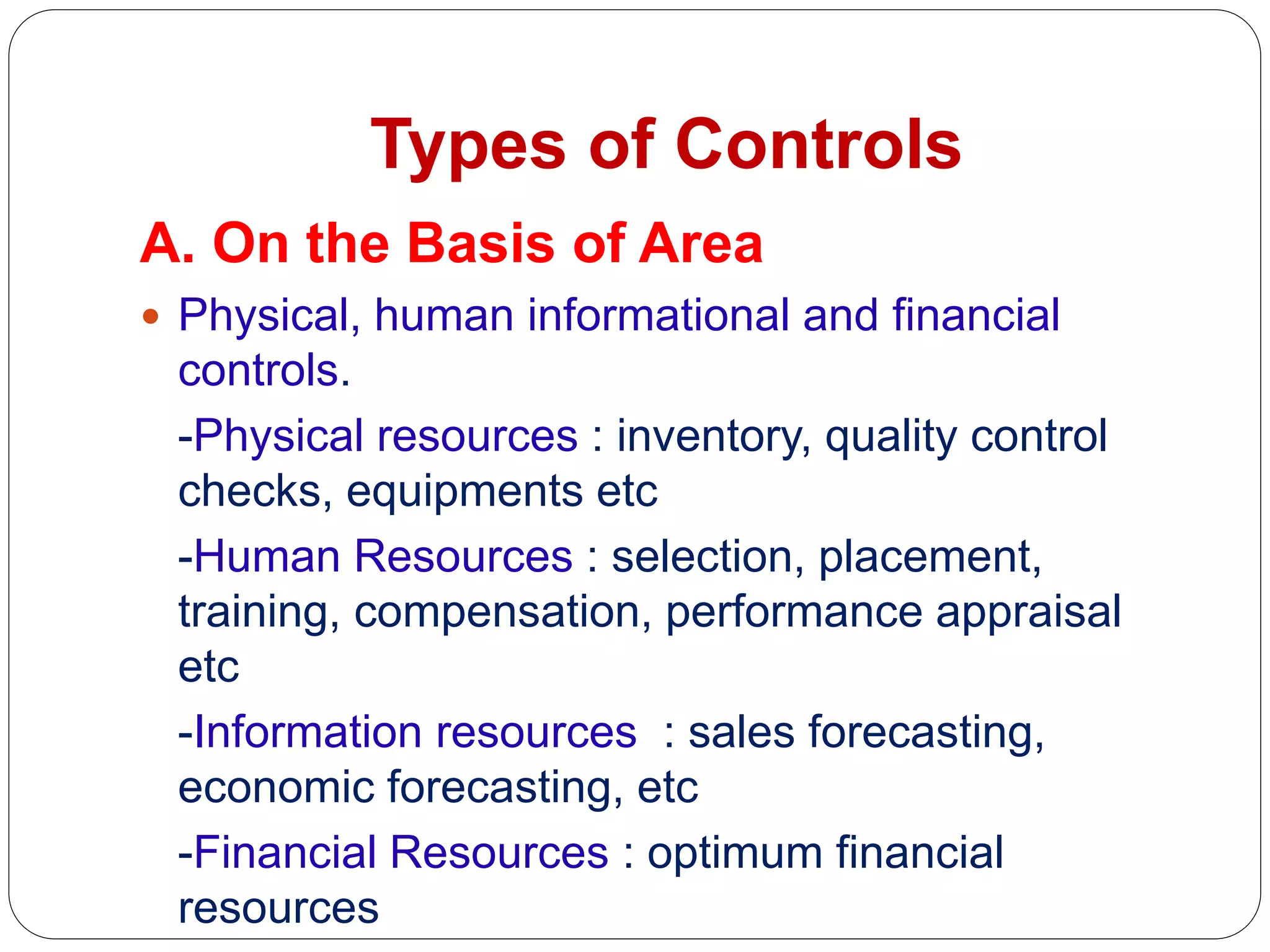
A. On the Basis of Area
 Physical, human informational and financial
controls.
-Physical resources : inventory, quality control
checks, equipments etc
-Human Resources : selection, placement,
training, compensation, performance appraisal
etc
-Information resources : sales forecasting,
economic forecasting, etc
-Financial Resources : optimum financial
resources
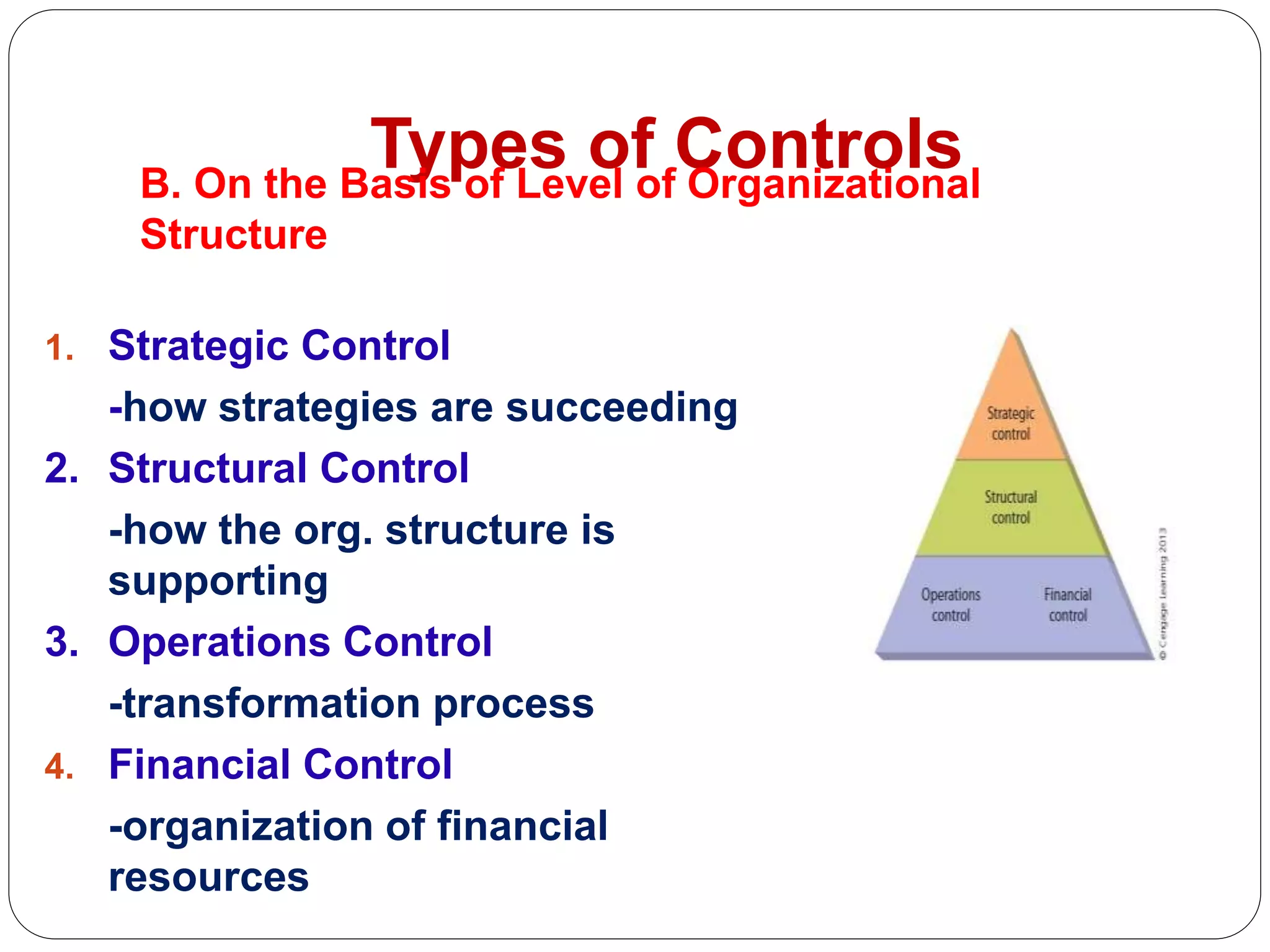
Types of ControlsB. On the Basis of Level of Organizational
Structure
1. Strategic Control
-how strategies are succeeding
2. Structural Control
-how the org. structure is
supporting
3. Operations Control
-transformation process
4. Financial Control
-organization of financial
resources
Types of Controls
A. Strategic Control
 Checks whether the structure of the organization,
its human resources, technology adopted and
others are contributing to the attainment of the
strategic goals or not.
 Focuses on five areas : structure, leadership,
technology, human resources and information
and operational control system.
 If some of the above are obstructing the
attainment of strategic goals, it may be necessary
to alter its structure, replace key leaders, adopt
new technology, modify its human resources, or
Types of Controls
B. Structural Control
 Related to the control by through appropriate org
design.
 Two types : Bureaucratic and Decentralized
Control
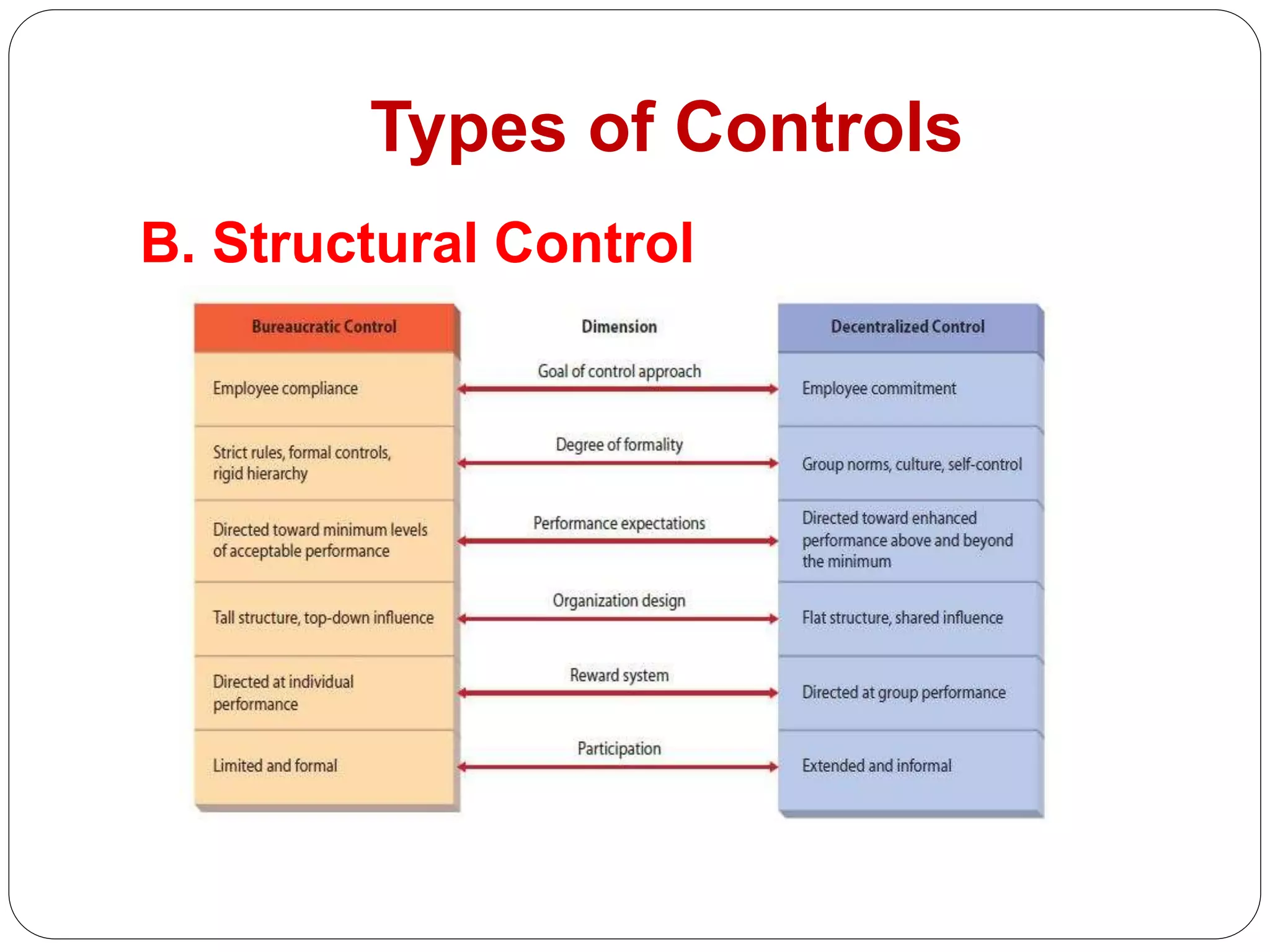
 Bureaucratic control is an approach to
organization design characterized by formal and
mechanistic structural arrangements whereas
Decentralized control has informal and organic
structural arrangements.
Types of Controls
B. Structural Control
Types of Controls
C. Operations Control
 Concerns with the control process of the
transformation of inputs into goods and services
 Three types :
 1. Preliminary Control
 Also called feed forward control or pre control
 Related to the control during the input stage of the
transformation process –input side control
 Focuses on financial, material, human and
information resources
 Examples are quality specification, recruitment and
selection of HR, budgets, etc.
Types of Controls
C. Operations Control
 2. Screening Control
 Also called concurrent control
 Control during the transformation process
 For instance : periodic quality checks
 Effective way to catch problems and minimize
waste
 Direct supervision is the best method of this type.
Types of Controls
C. Operations Control
 3. Post Action Control
 Also called feedback control
 Control after the transformation process is
complete
 Helpful to find the defect rate
 Provides information for further planning
 An effective tool for reward management
Types of Controls
D. Financial Control
 Control related to the financial resources
 Main tools of financial control are :
 Financial Budget : cash budget, capita budget,
operating budget, non-monetary budget, etc.
 Financial Statements : Balance sheet, income
statement and cash flow statement
 Ratio Analysis : liquidity, operation, leverage and
profitability ratios
 Audits : internal audit, external audit and
management audit
Characteristics of Effective
Control System
 1. Integration with Planning
-Should be consistent with the planning
objectives
-Otherwise it cannot ensure the attainment of
goals
 2. Flexibility
-Environment is dynamic and changes occur.
-Control system should be flexible enough to
suit the new situations
Characteristics of Effective
Control System
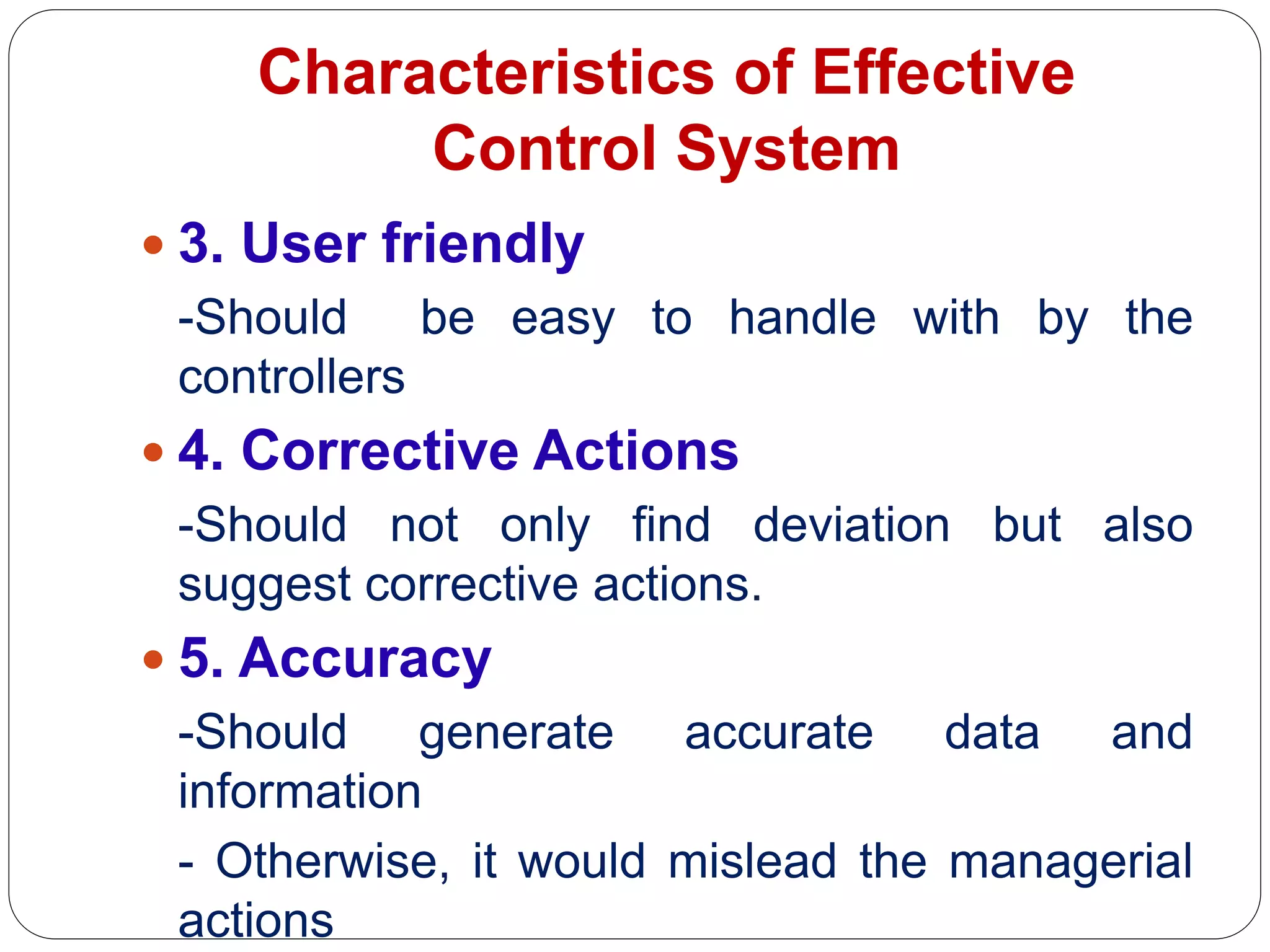
 3. User friendly
-Should be easy to handle with by the
controllers
 4. Corrective Actions
-Should not only find deviation but also
suggest corrective actions.
 5. Accuracy
-Should generate accurate data and
information
- Otherwise, it would mislead the managerial
actions
Characteristics of Effective
Control System
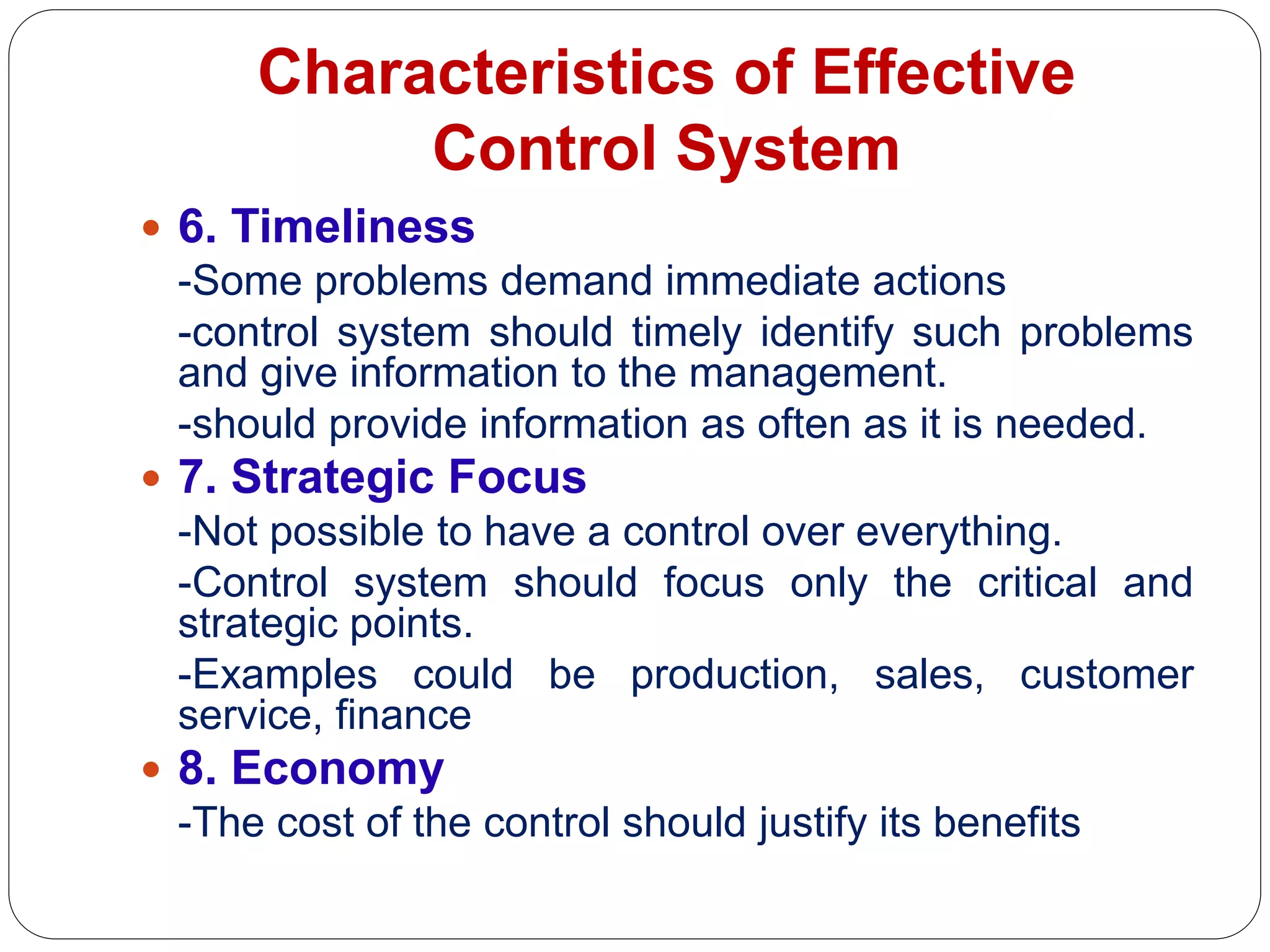
 6. Timeliness
-Some problems demand immediate actions
-control system should timely identify such problems
and give information to the management.
-should provide information as often as it is needed.
 7. Strategic Focus
-Not possible to have a control over everything.
-Control system should focus only the critical and
strategic points.
-Examples could be production, sales, customer
service, finance
 8. Economy
-The cost of the control should justify its benefits
Characteristics of Effective
Control System
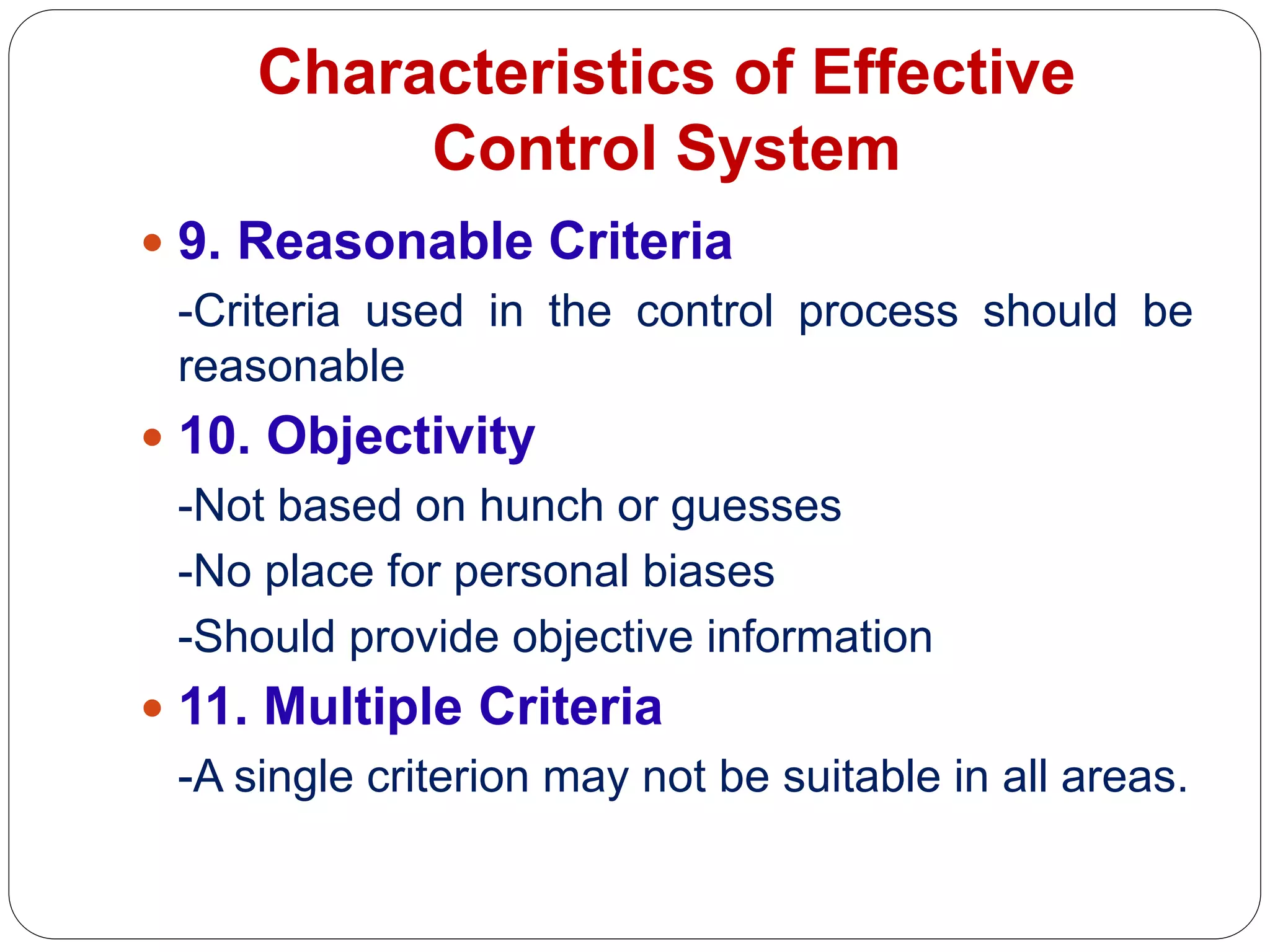
 9. Reasonable Criteria
-Criteria used in the control process should be
reasonable
 10. Objectivity
-Not based on hunch or guesses
-No place for personal biases
-Should provide objective information
 11. Multiple Criteria
-A single criterion may not be suitable in all areas.
2. Resistances to Control
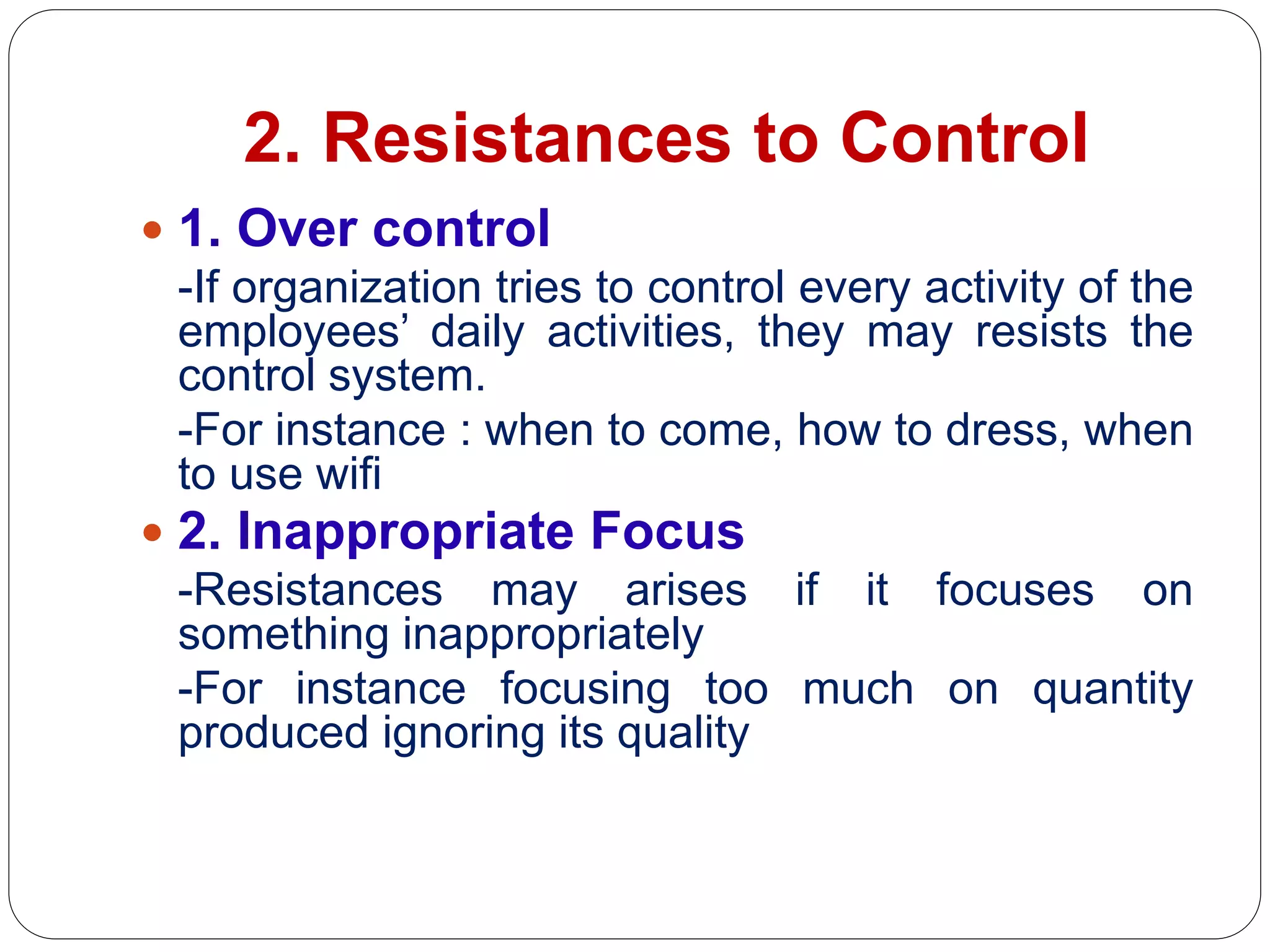
 1. Over control
-If organization tries to control every activity of the
employees’ daily activities, they may resists the
control system.
-For instance : when to come, how to dress, when
to use wifi
 2. Inappropriate Focus
-Resistances may arises if it focuses on
something inappropriately
-For instance focusing too much on quantity
produced ignoring its quality
2. Resistances to Control
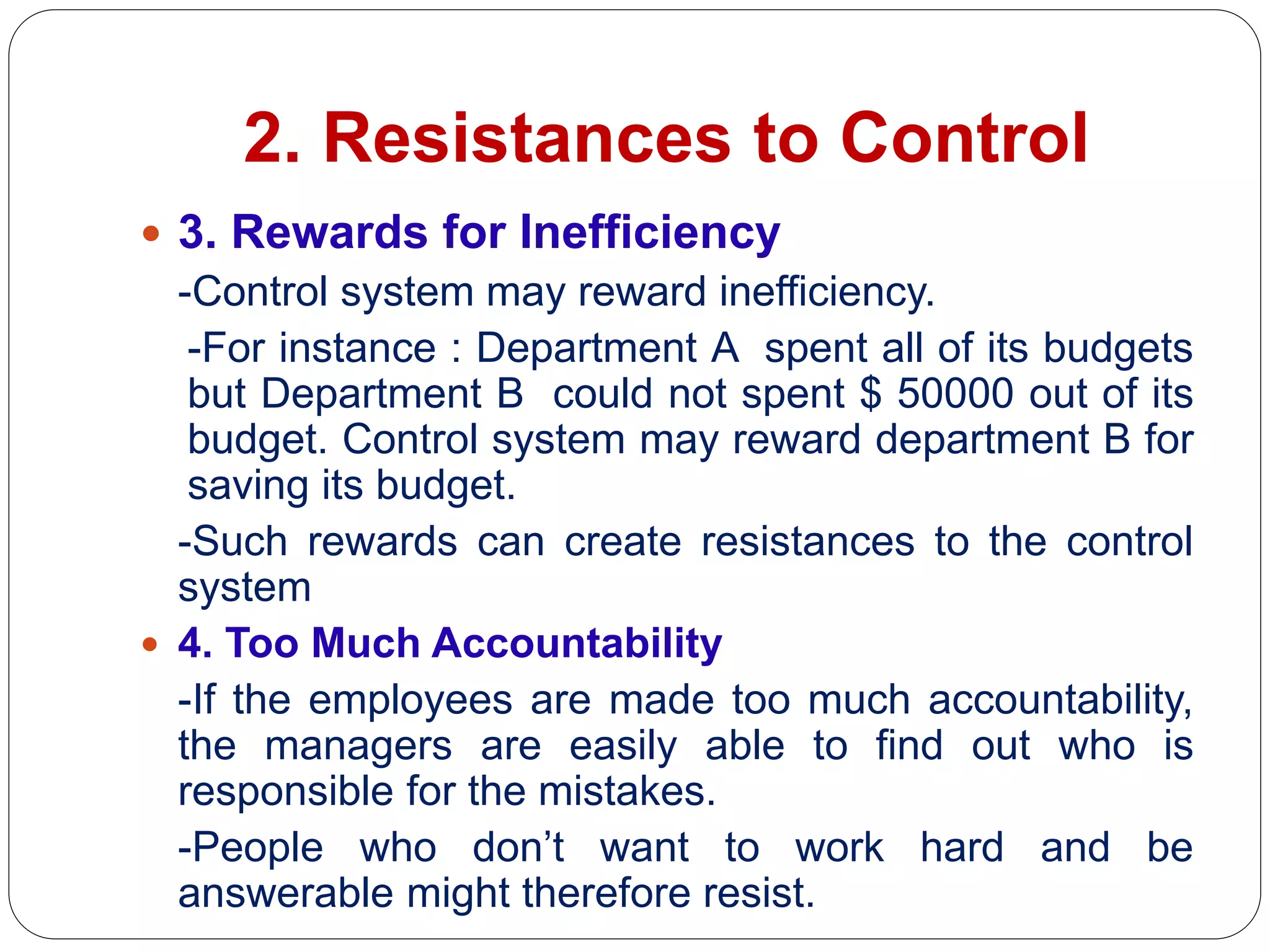
 3. Rewards for Inefficiency
-Control system may reward inefficiency.
-For instance : Department A spent all of its budgets
but Department B could not spent $ 50000 out of its
budget. Control system may reward department B for
saving its budget.
-Such rewards can create resistances to the control
system
 4. Too Much Accountability
-If the employees are made too much accountability,
the managers are easily able to find out who is
responsible for the mistakes.
-People who don’t want to work hard and be
answerable might therefore resist.
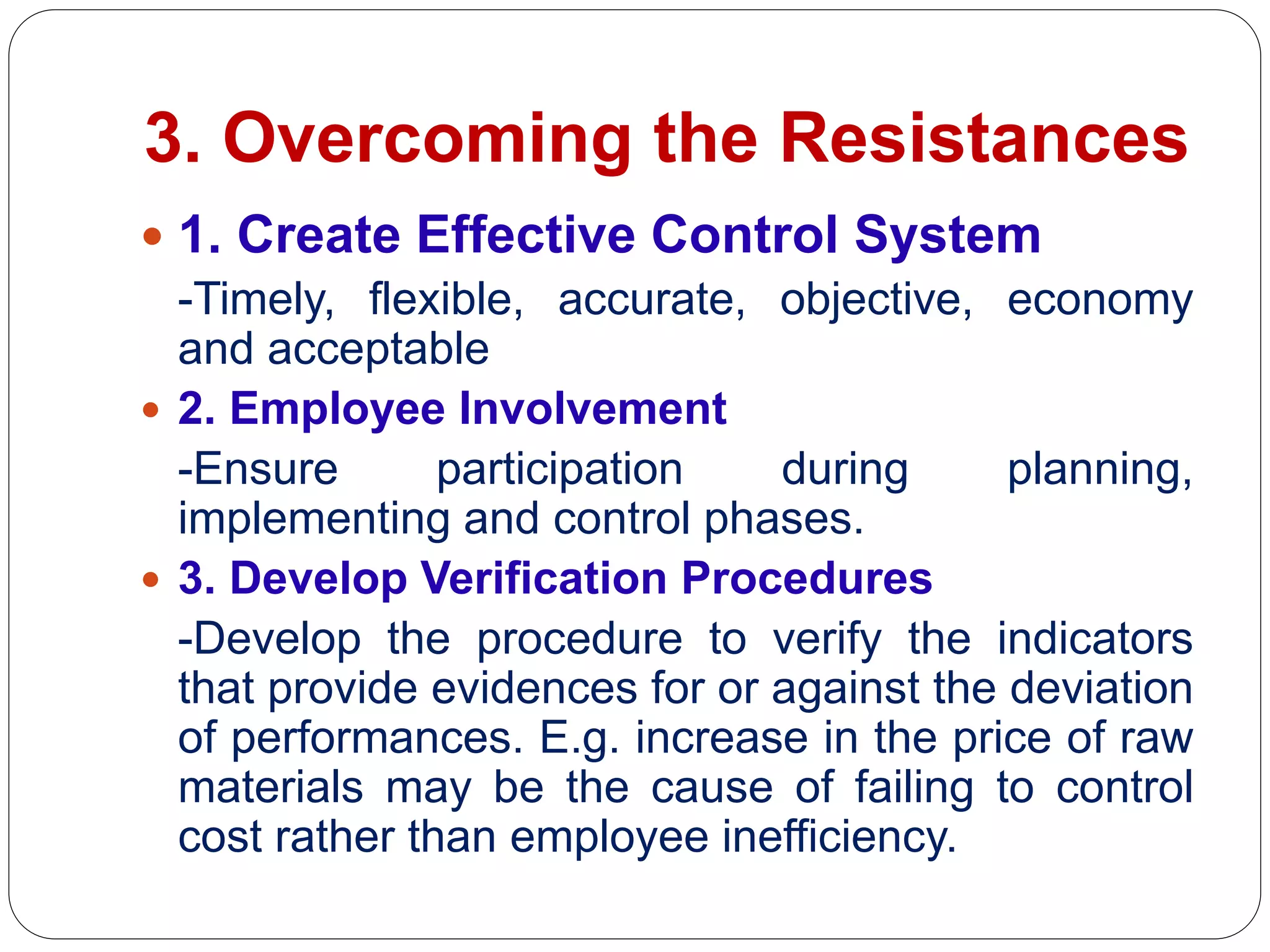
3. Overcoming the Resistances
 1. Create Effective Control System
-Timely, flexible, accurate, objective, economy
and acceptable
 2. Employee Involvement
-Ensure participation during planning,
implementing and control phases.
 3. Develop Verification Procedures
-Develop the procedure to verify the indicators
that provide evidences for or against the deviation
of performances. E.g. increase in the price of raw
materials may be the cause of failing to control
cost rather than employee inefficiency.
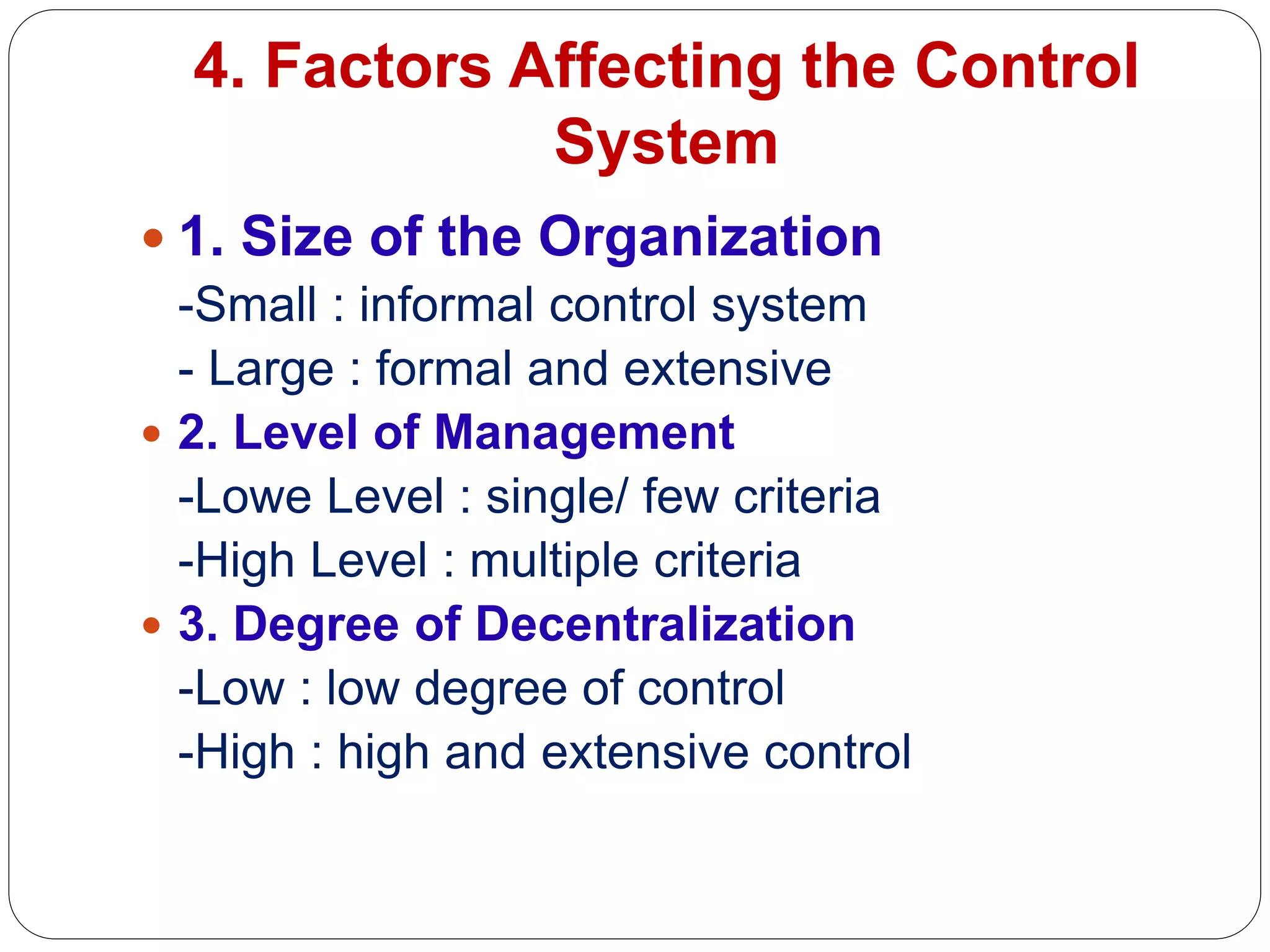
4. Factors Affecting the Control
System
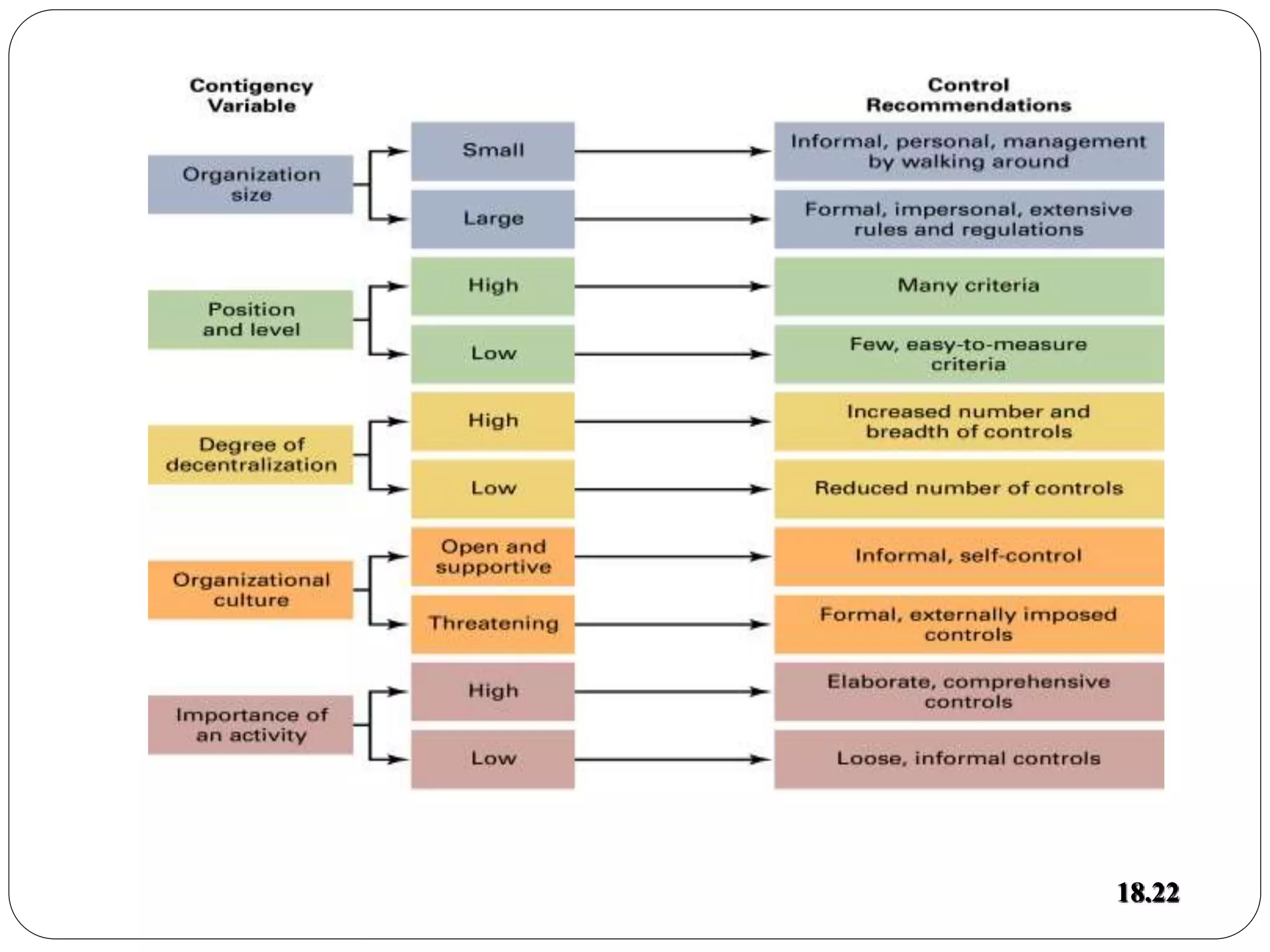
 1. Size of the Organization
-Small : informal control system
- Large : formal and extensive
 2. Level of Management
-Lowe Level : single/ few criteria
-High Level : multiple criteria
 3. Degree of Decentralization
-Low : low degree of control
-High : high and extensive control
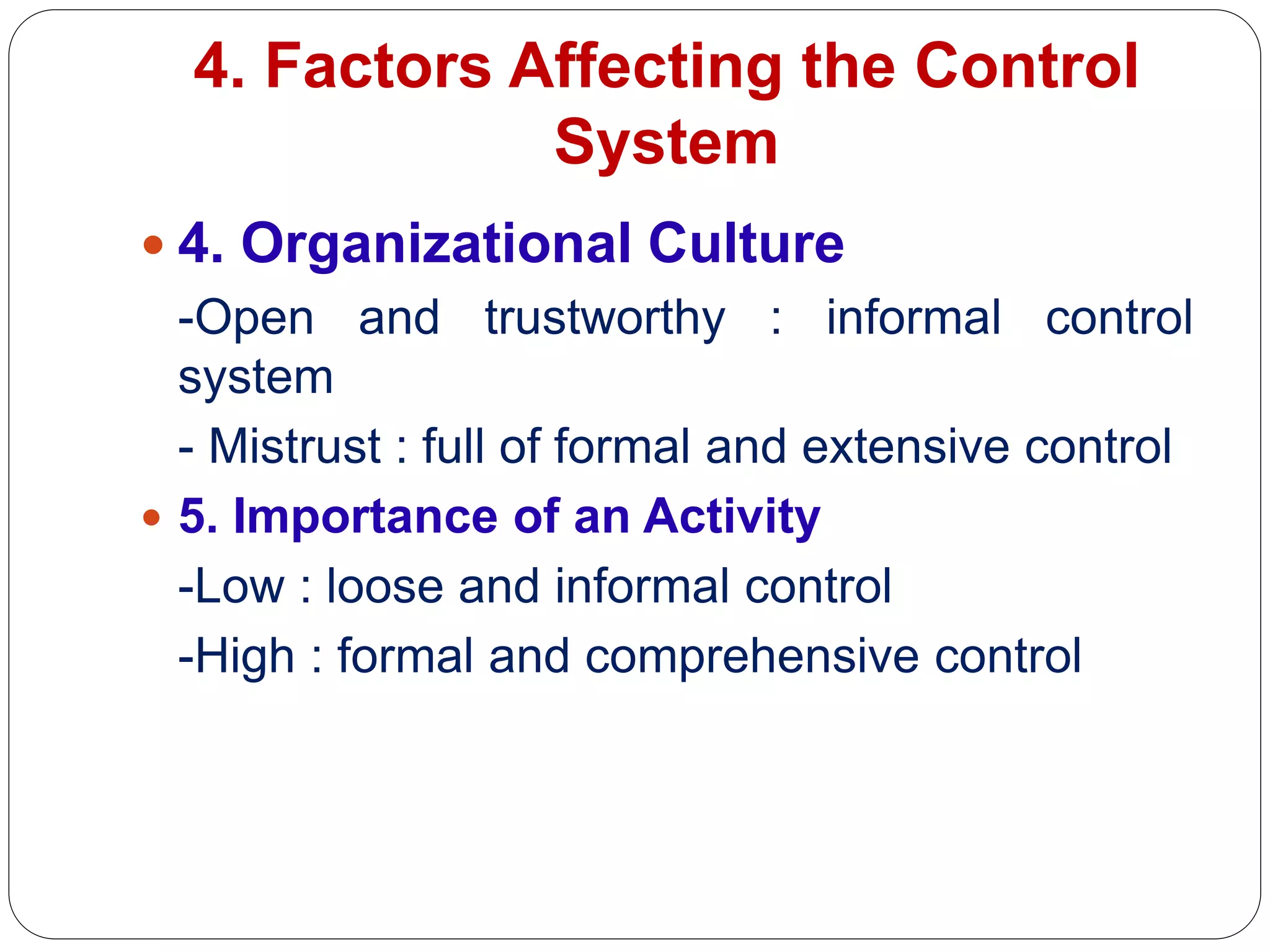
4. Factors Affecting the Control
System
 4. Organizational Culture
-Open and trustworthy : informal control
system
- Mistrust : full of formal and extensive control
 5. Importance of an Activity
-Low : loose and informal control
-High : formal and comprehensive control
18.22
Like and Share the Video
and
Subscribe to my Channel

Controlling Functon in Management

  • 1.
    Siddha Raj Bhatta Email:siddhabhatta@gmail.com Controlling
  • 2.
    Controlling  Monitoring oforganizational activities so that performance remains within acceptable limits.  Objective is to ensure the achievement of organizational goal.
  • 3.
    Steps in Controlling Step 1 : Establishing Standards -Should me measurable -Should be consistent with goals -Should identify the performance indicators  Step 2 : Measuring Performance -Continuous and ongoing activity -Quality/quantity -Sources : personal observation, oral, statistical and written reports
  • 4.
    Steps in Controlling Step 3 : Finding Deviation -Checking whether performance is in standard or not ? Source : Management by Robbins and Coulter
  • 5.
    Steps in Controlling Step 4 : Corrective Actions -Three Possible Options -1. Maintain the Status Quo -2. Correct the Deviation : change strategy, structure, compensation practices, training practices, redesign the jobs, fire employees etc. -3. Revise the standard
  • 6.
    Purpose of Controlling Adapt to the environmental changes  Managing the organizational complexity  Performance monitoring  Correcting mistakes  Efficiency by minimizing wastes and other costs  Rewards management
  • 7.
    Types of Controls A.On the Basis of Area  Physical, human informational and financial controls. -Physical resources : inventory, quality control checks, equipments etc -Human Resources : selection, placement, training, compensation, performance appraisal etc -Information resources : sales forecasting, economic forecasting, etc -Financial Resources : optimum financial resources
  • 8.
    Types of ControlsB.On the Basis of Level of Organizational Structure 1. Strategic Control -how strategies are succeeding 2. Structural Control -how the org. structure is supporting 3. Operations Control -transformation process 4. Financial Control -organization of financial resources
  • 9.
    Types of Controls A.Strategic Control  Checks whether the structure of the organization, its human resources, technology adopted and others are contributing to the attainment of the strategic goals or not.  Focuses on five areas : structure, leadership, technology, human resources and information and operational control system.  If some of the above are obstructing the attainment of strategic goals, it may be necessary to alter its structure, replace key leaders, adopt new technology, modify its human resources, or
  • 10.
    Types of Controls B.Structural Control  Related to the control by through appropriate org design.  Two types : Bureaucratic and Decentralized Control  Bureaucratic control is an approach to organization design characterized by formal and mechanistic structural arrangements whereas Decentralized control has informal and organic structural arrangements.
  • 11.
    Types of Controls B.Structural Control
  • 12.
    Types of Controls C.Operations Control  Concerns with the control process of the transformation of inputs into goods and services  Three types :  1. Preliminary Control  Also called feed forward control or pre control  Related to the control during the input stage of the transformation process –input side control  Focuses on financial, material, human and information resources  Examples are quality specification, recruitment and selection of HR, budgets, etc.
  • 13.
    Types of Controls C.Operations Control  2. Screening Control  Also called concurrent control  Control during the transformation process  For instance : periodic quality checks  Effective way to catch problems and minimize waste  Direct supervision is the best method of this type.
  • 14.
    Types of Controls C.Operations Control  3. Post Action Control  Also called feedback control  Control after the transformation process is complete  Helpful to find the defect rate  Provides information for further planning  An effective tool for reward management
  • 15.
    Types of Controls D.Financial Control  Control related to the financial resources  Main tools of financial control are :  Financial Budget : cash budget, capita budget, operating budget, non-monetary budget, etc.  Financial Statements : Balance sheet, income statement and cash flow statement  Ratio Analysis : liquidity, operation, leverage and profitability ratios  Audits : internal audit, external audit and management audit
  • 16.
    Characteristics of Effective ControlSystem  1. Integration with Planning -Should be consistent with the planning objectives -Otherwise it cannot ensure the attainment of goals  2. Flexibility -Environment is dynamic and changes occur. -Control system should be flexible enough to suit the new situations
  • 17.
    Characteristics of Effective ControlSystem  3. User friendly -Should be easy to handle with by the controllers  4. Corrective Actions -Should not only find deviation but also suggest corrective actions.  5. Accuracy -Should generate accurate data and information - Otherwise, it would mislead the managerial actions
  • 18.
    Characteristics of Effective ControlSystem  6. Timeliness -Some problems demand immediate actions -control system should timely identify such problems and give information to the management. -should provide information as often as it is needed.  7. Strategic Focus -Not possible to have a control over everything. -Control system should focus only the critical and strategic points. -Examples could be production, sales, customer service, finance  8. Economy -The cost of the control should justify its benefits
  • 19.
    Characteristics of Effective ControlSystem  9. Reasonable Criteria -Criteria used in the control process should be reasonable  10. Objectivity -Not based on hunch or guesses -No place for personal biases -Should provide objective information  11. Multiple Criteria -A single criterion may not be suitable in all areas.
  • 20.
    2. Resistances toControl  1. Over control -If organization tries to control every activity of the employees’ daily activities, they may resists the control system. -For instance : when to come, how to dress, when to use wifi  2. Inappropriate Focus -Resistances may arises if it focuses on something inappropriately -For instance focusing too much on quantity produced ignoring its quality
  • 21.
    2. Resistances toControl  3. Rewards for Inefficiency -Control system may reward inefficiency. -For instance : Department A spent all of its budgets but Department B could not spent $ 50000 out of its budget. Control system may reward department B for saving its budget. -Such rewards can create resistances to the control system  4. Too Much Accountability -If the employees are made too much accountability, the managers are easily able to find out who is responsible for the mistakes. -People who don’t want to work hard and be answerable might therefore resist.
  • 22.
    3. Overcoming theResistances  1. Create Effective Control System -Timely, flexible, accurate, objective, economy and acceptable  2. Employee Involvement -Ensure participation during planning, implementing and control phases.  3. Develop Verification Procedures -Develop the procedure to verify the indicators that provide evidences for or against the deviation of performances. E.g. increase in the price of raw materials may be the cause of failing to control cost rather than employee inefficiency.
  • 23.
    4. Factors Affectingthe Control System  1. Size of the Organization -Small : informal control system - Large : formal and extensive  2. Level of Management -Lowe Level : single/ few criteria -High Level : multiple criteria  3. Degree of Decentralization -Low : low degree of control -High : high and extensive control
  • 24.
    4. Factors Affectingthe Control System  4. Organizational Culture -Open and trustworthy : informal control system - Mistrust : full of formal and extensive control  5. Importance of an Activity -Low : loose and informal control -High : formal and comprehensive control
  • 25.
  • 26.
    Like and Sharethe Video and Subscribe to my Channel

Editor's Notes