Sohail Ahmed
 Letter writing is an essential skill. Despite the
prevalence of emails and text messages,
everyone has to write letters at some point.
Letters of complaint, job applications, thank
you letters, letters requesting changes or
making suggestions
 Business letters are sometimes called "snail-
mail" (in contrast to email which is faster).
{Letter Witing} Sohail Ahmed 2
Letter
Memo
Fax
Email
{Letter Witing} Sohail Ahmed 3
 Letters are written from a person/group,
known as the sender to a person/group,
known in business as the recipient.
 Business people also read letters on a daily
basis.
{Letter Witing} Sohail Ahmed 4
 to persuade
 to inform
 to request
 to express thanks
 to remind
 to recommend to
apologize
 to congratulate
 to reject a proposal
or offer
 to introduce a person
or policy
 to invite or welcome
 to follow up
 to formalize decisions
{Letter Witing} Sohail Ahmed 5
 Use A4 paper or letterhead
 Use 2.5 cm or 1 inch margins on all four sides
 Use a simple font such as Times New Roman ,Arial
or Book Antique
 Use 10 to 12 point font
 Use a comma after the salutation (Dear Mr,)
 Lay out the letter so that it fits the paper
appropriately
{Letter Witing} Sohail Ahmed 6
 Single space within paragraphs
 Double space between paragraphs
 Double space between last sentence and closing
(Sincerely, Best wishes)
 Leave three to fives spaces for a handwritten
signature
 cc: (meaning "copies to") comes after the typed name
(if necessary)
 enc: (meaning "enclosure") comes next (if necessary)
 Fold in three (horizontally) before placing in the
envelope
{Letter Witing} Sohail Ahmed 7
Business Letter Formats Cont……..
It is best to type an envelope for a business
letter
{Letter Witing} Sohail Ahmed 8
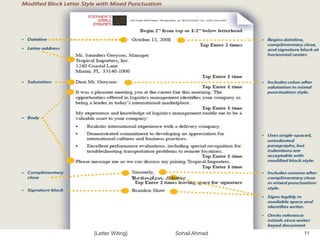
There are two formats of Business Letters
 Full Block Letters
 Semi-Block
{Letter Witing} Sohail Ahmed 9
{Letter Witing} Sohail Ahmed 10
{Letter Witing} Sohail Ahmed 11
A business letter is not a place for chit-chat. A
business letter should be clear and concise. By
taking time to plan your letter, you will save
time in the writing and proofreading stages.
During the planning stage, ask yourself a few
simple questions. Jot down your answers to
create an outline before you start writing.
{Letter Witing} Sohail Ahmed 12
The main reason for the letter should be
understood from the subject line and first few
sentences. You may cover more than one thing
in one business letter, but there will almost
always be a general reason for the letter.
Identify your main goal and what you hope to
accomplish.
{Letter Witing} Sohail Ahmed 13
The term "business letter" makes people
nervous. Many people worry that their writing
is not advanced enough for business writing.
This is not the case. An effective letter in
business uses short, simple sentences and
straightforward vocabulary. The easier a letter
is to read, the better it is.
{Letter Witing} Sohail Ahmed 14
Following, may be the parts of Letters but not all letters have same requirements.
 Letterhead/Return Address
 Date Line
 Reference Line or Block
 Special Notations
 Inside Address
 Salutation
 Subject Line
 Text or Body
 Complimentary Closing
 Signature Block
 Reference Initials
 Enclosure Notation
 Courtesy Copy/ Carbon Copy
 Postscripts
{Letter Witing} Sohail Ahmed 15
 Letterhead/Return Address—
Business letterheads provide the name, address, and
phone number of the organization sending the letter.
The letterhead may also include the company logo and
fax number(s).
 The date line-
The date line is placed two or three lines below the
letterhead (or as many as six lines, if the letter is short).
If no letterhead is used, the date line is directly beneath
the return address.
{Letter Witing} Sohail Ahmed 16
 Reference Line or Block—
Reference lines or blocks are one or two lines below
the date line. Reference lines are usually aligned with
the date. They can begin with RE or Reference.
Sometimes a lead-in is needed to clarify the reference.
 Special Notations—Special notations appear two
lines below the date or reference line. Capital letters
are used to make the note more visible.
{Letter Witing} Sohail Ahmed 17
 Inside Address—The inside address appears below
the date or reference line.(It's the name and address
of the person the letter is sent to, just like the one you
put on the outside of the envelope.)
 Salutation— The salutation appears two spaces
below the inside address and usually begins with
Dear followed by the title and name of the addressee.
In standard style punctuation, a colon (formal letters)
or comma (informal letters) follows the salutation.
{Letter Witing} Sohail Ahmed 18
 Subject Line—Subject lines define the subject of
the letter. They appear two lines below the salutation
and two lines above the first line of the text. Subject
lines are emphasized by using boldface type,
underlining, or all capitals.
 Text or Body- Text is usually single-spaced with
one blank line between paragraphs. (Most of Business
letters written in three Paragraphs but some times it
extends to many pages)
{Letter Witing} Sohail Ahmed 19
 Complimentary Closing—The complimentary
closing appears two lines below the last line of text
and is right of center. (eg: Sincerely, Regards etc….)
 Signature Block—The signature block is four or
five lines below the complimentary closing and is
right of center. The signature block contains the
handwritten signature of the writer, the full typed
name of the writer, and the title of the writer.
{Letter Witing} Sohail Ahmed 20
 Reference Initials—Reference initials (the
writer's initials and the secretary's/typists' initials) are
two lines below the last line of the signature block
and flush with the left margin.
 Enclosure Notation— Enclosure notations
remind readers that one or more enclosures are
included. These notations appear directly under the
reference initials.
{Letter Witing} Sohail Ahmed 21
 Courtesy Copy Notation (CC)— Courtesy
copy notations, which show the distribution of the
letter, are two lines below the enclosure notations and
flush left.(its also known as Carbon Copy)
 Postscripts- Postscripts may be used as additions
to a letter after it has been typed or to emphasize
items, it comes below CC: (Eg: PS or PSS: reply us
as soon as possible)
{Letter Witing} Sohail Ahmed 22
All letters must have following Parts:
1. Salutation
2. Body
 First Paragraph
 Second & Third Paragraph
3. Closing
{Letter Witing} Sohail Ahmed 23
First and foremost, make sure that you spell
the recipient's name correctly. You should also
confirm the gender and proper title. Use Ms.
for women and Mr. for men.
Here are some common ways to address the recipient:
 Dear Mr Ayaan,
 Dear Ms Sara,
 Dear Sir or Madam
 Gentlemen
{Letter Witing} Sohail Ahmed 24
In most types of business letter it is common to use a
friendly greeting in the first sentence of the letter.
Here are some examples:
 Thank you for your kind letter of January 5th.
 I came across an ad for your company in The Dawn.
 It was a pleasure meeting you at the conference this
month.
 I'm writing to enquire about...
 I'm interested in the job opening posted on your
company website.
{Letter Witing} Sohail Ahmed 25
Use a few short paragraphs to go into greater
detail about your main point. If one paragraph
is all you need, don't write an extra paragraph
just to make your letter look longer. If you are
including sensitive material, such as rejecting
an offer or informing an employee of a layoff
period, embed this sentence in the second
paragraph rather than opening with it.
{Letter Witing} Sohail Ahmed 26
Your last paragraph should include requests,
reminders, and notes on enclosures. If necessary,
your contact information should also be in this
paragraph.
Examples:
 Please respond at your earliest convenience.
 I look forward to...
 If you require more information...
 Thank you for taking this into consideration.
 I appreciate any feedback you may have.
 Enclosed you will find...
 Feel free to contact me by phone or email.
{Letter Witing} Sohail Ahmed 27
Here are some common ways to close a
letter.
 Yours truly,
 Yours sincerely,
 Sincerely,
 Sincerely yours
 Thank you,
 Best wishes
 Best of luck
 Warm regards,{Letter Witing} Sohail Ahmed 28
"Proofread" means to read a text carefully to check it
for errors and general tone. You should always
proofread a business letter before sending it.
{Letter Witing} Sohail Ahmed 29
 Classifications of business letters
 Positive
▪ Letters responding favorably to a writer’s request or complaint
▪ Sales letters promoting a product
 Neutral
▪ Letters requesting information about a Something, placing an order,
or responding to some action or question
 Negative
▪ Refusing a request, saying no to an adjustment, etc.
{Letter Witing} Sohail Ahmed 30
 Inquiry Letters: Inquiry letters ask for
information about something.
 Special Request Letters: State who you are and
why you are writing, Indicate clearly your reason for
requesting the information. Make your questions
easy to answer and separate them clearly.
{Letter Witing} Sohail Ahmed 31
 Sales Letters: Identify and limit your
audience ,Use reader psychology.
 Customer Relations Letters:
Deal explicitly with establishing and
maintaining friendly work relations. Send
readers good news or bad news,
acceptances or refusals
{Letter Witing} Sohail Ahmed 32
 Being Direct or Indirect:
 Good news message
 Use the direct approach
 Start your letter with the news the reader wants to hear
▪ Don’t postpone the opportunity to put your reader in the right frame of mind
 Then provide any relevant supporting details, explanations, or
commentary
 Bad news message
 Use the indirect approach
 Start your letter with pleasant, positive words designed to put your
reader in a good frame of mind
 Explain the situation
 End on a positive, upbeat note
{Letter Witing} Sohail Ahmed 33
 Follow-Up Letters: A follow-up letter is a
combination thank you note and Some times Inquiry.
Complaint Letters
 Never send a nasty letter
 Avoid the following
 Name calling Sarcasm
 Insults Threats
 Anger Unflattering clip art
 Intimidating type fonts (e.g., all capital letters)
{Letter Witing} Sohail Ahmed 34
Special thanks to:
Prof: Hina
Stylecard
KCI
{Letter Witing} Sohail Ahmed 35
Good Luck
{Letter Witing} Sohail Ahmed 36

Letterwritingbysohailahmed 140106031731-phpapp01

  • 1.
  • 2.
     Letter writingis an essential skill. Despite the prevalence of emails and text messages, everyone has to write letters at some point. Letters of complaint, job applications, thank you letters, letters requesting changes or making suggestions  Business letters are sometimes called "snail- mail" (in contrast to email which is faster). {Letter Witing} Sohail Ahmed 2
  • 3.
  • 4.
     Letters arewritten from a person/group, known as the sender to a person/group, known in business as the recipient.  Business people also read letters on a daily basis. {Letter Witing} Sohail Ahmed 4
  • 5.
     to persuade to inform  to request  to express thanks  to remind  to recommend to apologize  to congratulate  to reject a proposal or offer  to introduce a person or policy  to invite or welcome  to follow up  to formalize decisions {Letter Witing} Sohail Ahmed 5
  • 6.
     Use A4paper or letterhead  Use 2.5 cm or 1 inch margins on all four sides  Use a simple font such as Times New Roman ,Arial or Book Antique  Use 10 to 12 point font  Use a comma after the salutation (Dear Mr,)  Lay out the letter so that it fits the paper appropriately {Letter Witing} Sohail Ahmed 6
  • 7.
     Single spacewithin paragraphs  Double space between paragraphs  Double space between last sentence and closing (Sincerely, Best wishes)  Leave three to fives spaces for a handwritten signature  cc: (meaning "copies to") comes after the typed name (if necessary)  enc: (meaning "enclosure") comes next (if necessary)  Fold in three (horizontally) before placing in the envelope {Letter Witing} Sohail Ahmed 7 Business Letter Formats Cont……..
  • 8.
    It is bestto type an envelope for a business letter {Letter Witing} Sohail Ahmed 8
  • 9.
    There are twoformats of Business Letters  Full Block Letters  Semi-Block {Letter Witing} Sohail Ahmed 9
  • 10.
  • 11.
  • 12.
    A business letteris not a place for chit-chat. A business letter should be clear and concise. By taking time to plan your letter, you will save time in the writing and proofreading stages. During the planning stage, ask yourself a few simple questions. Jot down your answers to create an outline before you start writing. {Letter Witing} Sohail Ahmed 12
  • 13.
    The main reasonfor the letter should be understood from the subject line and first few sentences. You may cover more than one thing in one business letter, but there will almost always be a general reason for the letter. Identify your main goal and what you hope to accomplish. {Letter Witing} Sohail Ahmed 13
  • 14.
    The term "businessletter" makes people nervous. Many people worry that their writing is not advanced enough for business writing. This is not the case. An effective letter in business uses short, simple sentences and straightforward vocabulary. The easier a letter is to read, the better it is. {Letter Witing} Sohail Ahmed 14
  • 15.
    Following, may bethe parts of Letters but not all letters have same requirements.  Letterhead/Return Address  Date Line  Reference Line or Block  Special Notations  Inside Address  Salutation  Subject Line  Text or Body  Complimentary Closing  Signature Block  Reference Initials  Enclosure Notation  Courtesy Copy/ Carbon Copy  Postscripts {Letter Witing} Sohail Ahmed 15
  • 16.
     Letterhead/Return Address— Businessletterheads provide the name, address, and phone number of the organization sending the letter. The letterhead may also include the company logo and fax number(s).  The date line- The date line is placed two or three lines below the letterhead (or as many as six lines, if the letter is short). If no letterhead is used, the date line is directly beneath the return address. {Letter Witing} Sohail Ahmed 16
  • 17.
     Reference Lineor Block— Reference lines or blocks are one or two lines below the date line. Reference lines are usually aligned with the date. They can begin with RE or Reference. Sometimes a lead-in is needed to clarify the reference.  Special Notations—Special notations appear two lines below the date or reference line. Capital letters are used to make the note more visible. {Letter Witing} Sohail Ahmed 17
  • 18.
     Inside Address—Theinside address appears below the date or reference line.(It's the name and address of the person the letter is sent to, just like the one you put on the outside of the envelope.)  Salutation— The salutation appears two spaces below the inside address and usually begins with Dear followed by the title and name of the addressee. In standard style punctuation, a colon (formal letters) or comma (informal letters) follows the salutation. {Letter Witing} Sohail Ahmed 18
  • 19.
     Subject Line—Subjectlines define the subject of the letter. They appear two lines below the salutation and two lines above the first line of the text. Subject lines are emphasized by using boldface type, underlining, or all capitals.  Text or Body- Text is usually single-spaced with one blank line between paragraphs. (Most of Business letters written in three Paragraphs but some times it extends to many pages) {Letter Witing} Sohail Ahmed 19
  • 20.
     Complimentary Closing—Thecomplimentary closing appears two lines below the last line of text and is right of center. (eg: Sincerely, Regards etc….)  Signature Block—The signature block is four or five lines below the complimentary closing and is right of center. The signature block contains the handwritten signature of the writer, the full typed name of the writer, and the title of the writer. {Letter Witing} Sohail Ahmed 20
  • 21.
     Reference Initials—Referenceinitials (the writer's initials and the secretary's/typists' initials) are two lines below the last line of the signature block and flush with the left margin.  Enclosure Notation— Enclosure notations remind readers that one or more enclosures are included. These notations appear directly under the reference initials. {Letter Witing} Sohail Ahmed 21
  • 22.
     Courtesy CopyNotation (CC)— Courtesy copy notations, which show the distribution of the letter, are two lines below the enclosure notations and flush left.(its also known as Carbon Copy)  Postscripts- Postscripts may be used as additions to a letter after it has been typed or to emphasize items, it comes below CC: (Eg: PS or PSS: reply us as soon as possible) {Letter Witing} Sohail Ahmed 22
  • 23.
    All letters musthave following Parts: 1. Salutation 2. Body  First Paragraph  Second & Third Paragraph 3. Closing {Letter Witing} Sohail Ahmed 23
  • 24.
    First and foremost,make sure that you spell the recipient's name correctly. You should also confirm the gender and proper title. Use Ms. for women and Mr. for men. Here are some common ways to address the recipient:  Dear Mr Ayaan,  Dear Ms Sara,  Dear Sir or Madam  Gentlemen {Letter Witing} Sohail Ahmed 24
  • 25.
    In most typesof business letter it is common to use a friendly greeting in the first sentence of the letter. Here are some examples:  Thank you for your kind letter of January 5th.  I came across an ad for your company in The Dawn.  It was a pleasure meeting you at the conference this month.  I'm writing to enquire about...  I'm interested in the job opening posted on your company website. {Letter Witing} Sohail Ahmed 25
  • 26.
    Use a fewshort paragraphs to go into greater detail about your main point. If one paragraph is all you need, don't write an extra paragraph just to make your letter look longer. If you are including sensitive material, such as rejecting an offer or informing an employee of a layoff period, embed this sentence in the second paragraph rather than opening with it. {Letter Witing} Sohail Ahmed 26
  • 27.
    Your last paragraphshould include requests, reminders, and notes on enclosures. If necessary, your contact information should also be in this paragraph. Examples:  Please respond at your earliest convenience.  I look forward to...  If you require more information...  Thank you for taking this into consideration.  I appreciate any feedback you may have.  Enclosed you will find...  Feel free to contact me by phone or email. {Letter Witing} Sohail Ahmed 27
  • 28.
    Here are somecommon ways to close a letter.  Yours truly,  Yours sincerely,  Sincerely,  Sincerely yours  Thank you,  Best wishes  Best of luck  Warm regards,{Letter Witing} Sohail Ahmed 28
  • 29.
    "Proofread" means toread a text carefully to check it for errors and general tone. You should always proofread a business letter before sending it. {Letter Witing} Sohail Ahmed 29
  • 30.
     Classifications ofbusiness letters  Positive ▪ Letters responding favorably to a writer’s request or complaint ▪ Sales letters promoting a product  Neutral ▪ Letters requesting information about a Something, placing an order, or responding to some action or question  Negative ▪ Refusing a request, saying no to an adjustment, etc. {Letter Witing} Sohail Ahmed 30
  • 31.
     Inquiry Letters:Inquiry letters ask for information about something.  Special Request Letters: State who you are and why you are writing, Indicate clearly your reason for requesting the information. Make your questions easy to answer and separate them clearly. {Letter Witing} Sohail Ahmed 31
  • 32.
     Sales Letters:Identify and limit your audience ,Use reader psychology.  Customer Relations Letters: Deal explicitly with establishing and maintaining friendly work relations. Send readers good news or bad news, acceptances or refusals {Letter Witing} Sohail Ahmed 32
  • 33.
     Being Director Indirect:  Good news message  Use the direct approach  Start your letter with the news the reader wants to hear ▪ Don’t postpone the opportunity to put your reader in the right frame of mind  Then provide any relevant supporting details, explanations, or commentary  Bad news message  Use the indirect approach  Start your letter with pleasant, positive words designed to put your reader in a good frame of mind  Explain the situation  End on a positive, upbeat note {Letter Witing} Sohail Ahmed 33
  • 34.
     Follow-Up Letters:A follow-up letter is a combination thank you note and Some times Inquiry. Complaint Letters  Never send a nasty letter  Avoid the following  Name calling Sarcasm  Insults Threats  Anger Unflattering clip art  Intimidating type fonts (e.g., all capital letters) {Letter Witing} Sohail Ahmed 34
  • 35.
    Special thanks to: Prof:Hina Stylecard KCI {Letter Witing} Sohail Ahmed 35
  • 36.