 Maheen Sohail (073)
 Ali Shahzad(075)
 Ammar Haider(076)
Group Members:
Business Letter:
Definition:
 W. J. Weston said, “Business letter is the process of accomplishing business
transaction in written form.”
 In the words of H. A. Murphy, “The medium used most often for
written messages to persons outside your organization is the
business letter.”
Business Letter:
Purpose :
The purpose of writing business letters are;
 According to Ricks and Gow, “The primary purposes of business letters are to
inform, instruct, request, inquire, remit, order, advice, correct and to
question.”
 The main and basic purpose of any business letter is to convey information
regarding business activities.
 Tips To Write a Good Business Letter:
 Keep the content of the letter relevant and to the point .
 Ensure the letter is well presented .
 Ensure your spelling and grammar are perfect.
 Use simple language .
 Make sure the letter has a good structure (i.e. beginning, middle and finishing
paragraph ).
 Types Of Business Letters:
1. Sales Letter
2. Order Letters
3. Complaint Letters
4. Adjustment Letters
5. Inquiry Letters
6. Follow Up Letters
7. Letters of Recommendation
8. Acknowledgment Letters
9. Cover Letters
10. Letters of Resignation
 Sale Letters:
 Typical sales letters start off with a very strong statement to capture the interest of the
reader.
 The purpose is to get the reader to do something, these letters include strong calls to
action, detail the benefit to the reader of taking the action and include information to
help the reader to act, such as including a telephone number or website link.
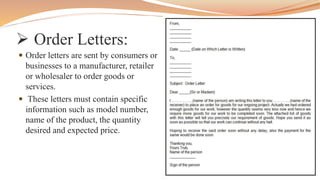
 Order Letters:
 Order letters are sent by consumers or
businesses to a manufacturer, retailer
or wholesaler to order goods or
services.
 These letters must contain specific
information such as model number,
name of the product, the quantity
desired and expected price.
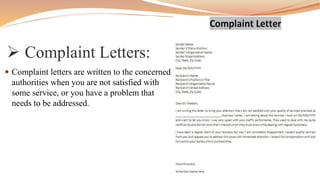
 Complaint Letters:
 Complaint letters are written to the concerned
authorities when you are not satisfied with
some service, or you have a problem that
needs to be addressed.
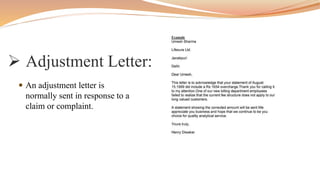
 Adjustment Letter:
 An adjustment letter is
normally sent in response to a
claim or complaint.
 Inquiry Letters:
 Inquiry letters ask a question or elicit information from the
recipient.
 Follow-Up Letters:
 Follow-up letters are usually sent after some type of initial
communication.
 Letters Of Recommendation:
 A letter of recommendation or recommendation letter, also known as a letter of
reference, reference letter or simply reference, is a document in which the
writer assesses the qualities, characteristics, and capabilities of the person
being recommended in terms of that individual's ability to perform a particular
task or function. Letters of recommendation are typically related
to employment
 Cover letters:
 A cover letter is a letter of introduction attached to or
accompanying another document.
 Letters Of Resignation:
 A letter of resignation is written to announce the
author's intent to leave a position currently held, such
as an office, employment or commission
Mechanical Structure Of Business Letter:
 The Structure of letter is the systematic arrangement of
information in a letter in a prescribed format. It also called
layout of the business letter.
 The physical appearance of a letter is very important to grasp
the attention of the receiver. It reveals the character of the writer
and the organization he belongs to.
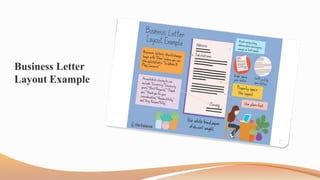
Business Letter
Layout Example
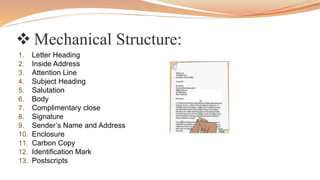
 Mechanical Structure:
1. Letter Heading
2. Inside Address
3. Attention Line
4. Subject Heading
5. Salutation
6. Body
7. Complimentary close
8. Signature
9. Sender’s Name and Address
10. Enclosure
11. Carbon Copy
12. Identification Mark
13. Postscripts
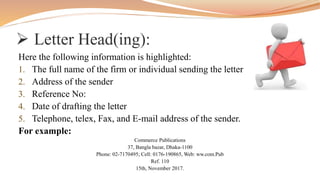
 Letter Head(ing):
Here the following information is highlighted:
1. The full name of the firm or individual sending the letter
2. Address of the sender
3. Reference No:
4. Date of drafting the letter
5. Telephone, telex, Fax, and E-mail address of the sender.
For example:
Commerce Publications
37, Bangla bazar, Dhaka-1100
Phone: 02-7170495; Cell: 0176-190865, Web: ww.com.Pub
Ref. 110
15th, November 2017.
 Inside Address:
 The address of the receiver is given here as would appear on an envelope.
 It helps the outward clerk to write the same address on the cover.
 It also a record on the copy which serves to identify the letter for filling a
purpose.
For example:
RANI BITAN LIBRARY
40, Saddar Road,
Barisal
 Attention Line:
 The person who can take prompt action for the letter, his name and
department are stated here.
For example:
Mr. Ahmed, Sales Manager
Mr. Aslam, Product Manager
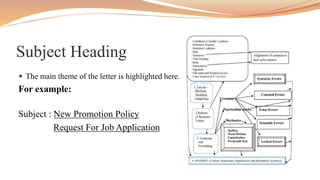
Subject Heading
 The main theme of the letter is highlighted here.
For example:
Subject : New Promotion Policy
Request For Job Application
 Salutation:
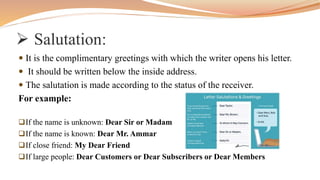
 It is the complimentary greetings with which the writer opens his letter.
 It should be written below the inside address.
 The salutation is made according to the status of the receiver.
For example:
If the name is unknown: Dear Sir or Madam
If the name is known: Dear Mr. Ammar
If close friend: My Dear Friend
If large people: Dear Customers or Dear Subscribers or Dear Members
 Letter Body:
 It is that part of the letter which contains the message or the information
to be communicated and therefore the most important part.
 It must be natural and simple with a logical sequence.
 It should be stated considering “You Attitude”.
Complimentary Close:
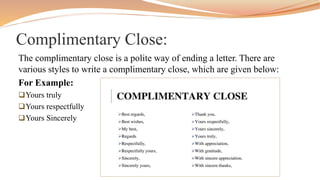
The complimentary close is a polite way of ending a letter. There are
various styles to write a complimentary close, which are given below:
For Example:
Yours truly
Yours respectfully
Yours Sincerely
 Signature:
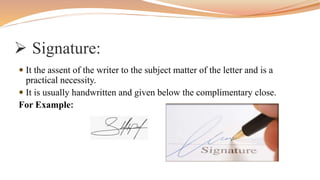
 It the assent of the writer to the subject matter of the letter and is a
practical necessity.
 It is usually handwritten and given below the complimentary close.
For Example:
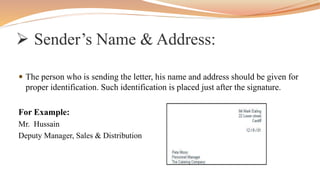
 The person who is sending the letter, his name and address should be given for
proper identification. Such identification is placed just after the signature.
For Example:
Mr. Hussain
Deputy Manager, Sales & Distribution
 Sender’s Name & Address:
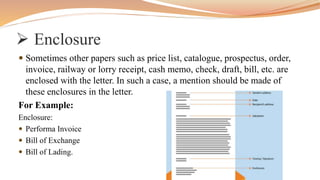
 Enclosure
 Sometimes other papers such as price list, catalogue, prospectus, order,
invoice, railway or lorry receipt, cash memo, check, draft, bill, etc. are
enclosed with the letter. In such a case, a mention should be made of
these enclosures in the letter.
For Example:
Enclosure:
 Performa Invoice
 Bill of Exchange
 Bill of Lading.
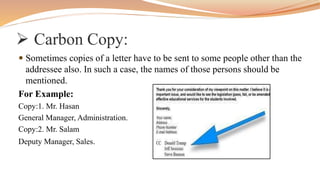
 Carbon Copy:
 Sometimes copies of a letter have to be sent to some people other than the
addressee also. In such a case, the names of those persons should be
mentioned.
For Example:
Copy:1. Mr. Hasan
General Manager, Administration.
Copy:2. Mr. Salam
Deputy Manager, Sales.
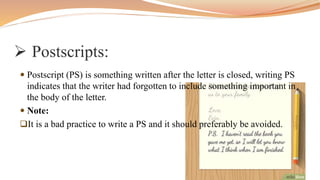
 Postscripts:
 Postscript (PS) is something written after the letter is closed, writing PS
indicates that the writer had forgotten to include something important in
the body of the letter.
 Note:
It is a bad practice to write a PS and it should preferably be avoided.
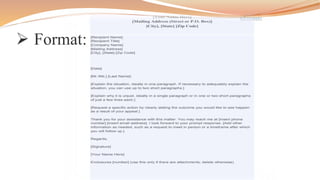
 Format:
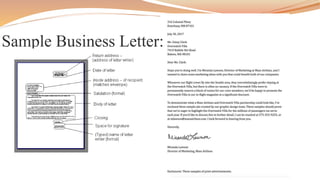
Sample Business Letter:
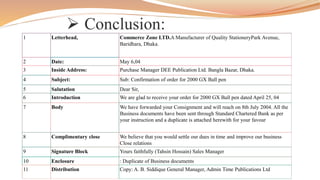
 Conclusion:
1 Letterhead, Commerce Zone LTD.A Manufacturer of Quality StationeryPark Avenue,
Baridhara, Dhaka.
2 Date: May 6,04
3 Inside Address: Purchase Manager DEE Publication Ltd. Bangla Bazar, Dhaka.
4 Subject: Sub: Confirmation of order for 2000 GX Ball pen
5 Salutation Dear Sir,
6 Introduction We are glad to receive your order for 2000 GX Ball pen dated April 25, 04
7 Body We have forwarded your Consignment and will reach on 8th July 2004. All the
Business documents have been sent through Standard Chartered Bank as per
your instruction and a duplicate is attached herewith for your favour
8 Complimentary close We believe that you would settle our dues in time and improve our business
Close relations
9 Signature Block Yours faithfully (Tahsin Hossain) Sales Manager
10 Enclosure : Duplicate of Business documents
11 Distribution Copy: A. B. Siddique General Manager, Admin Time Publications Ltd
Business Letters.pptx

Business Letters.pptx

  • 2.
     Maheen Sohail(073)  Ali Shahzad(075)  Ammar Haider(076) Group Members:
  • 3.
    Business Letter: Definition:  W.J. Weston said, “Business letter is the process of accomplishing business transaction in written form.”  In the words of H. A. Murphy, “The medium used most often for written messages to persons outside your organization is the business letter.”
  • 4.
    Business Letter: Purpose : Thepurpose of writing business letters are;  According to Ricks and Gow, “The primary purposes of business letters are to inform, instruct, request, inquire, remit, order, advice, correct and to question.”  The main and basic purpose of any business letter is to convey information regarding business activities.
  • 5.
     Tips ToWrite a Good Business Letter:  Keep the content of the letter relevant and to the point .  Ensure the letter is well presented .  Ensure your spelling and grammar are perfect.  Use simple language .  Make sure the letter has a good structure (i.e. beginning, middle and finishing paragraph ).
  • 6.
     Types OfBusiness Letters: 1. Sales Letter 2. Order Letters 3. Complaint Letters 4. Adjustment Letters 5. Inquiry Letters 6. Follow Up Letters 7. Letters of Recommendation 8. Acknowledgment Letters 9. Cover Letters 10. Letters of Resignation
  • 7.
     Sale Letters: Typical sales letters start off with a very strong statement to capture the interest of the reader.  The purpose is to get the reader to do something, these letters include strong calls to action, detail the benefit to the reader of taking the action and include information to help the reader to act, such as including a telephone number or website link.
  • 8.
     Order Letters: Order letters are sent by consumers or businesses to a manufacturer, retailer or wholesaler to order goods or services.  These letters must contain specific information such as model number, name of the product, the quantity desired and expected price.
  • 9.
     Complaint Letters: Complaint letters are written to the concerned authorities when you are not satisfied with some service, or you have a problem that needs to be addressed.
  • 10.
     Adjustment Letter: An adjustment letter is normally sent in response to a claim or complaint.
  • 11.
     Inquiry Letters: Inquiry letters ask a question or elicit information from the recipient.  Follow-Up Letters:  Follow-up letters are usually sent after some type of initial communication.
  • 12.
     Letters OfRecommendation:  A letter of recommendation or recommendation letter, also known as a letter of reference, reference letter or simply reference, is a document in which the writer assesses the qualities, characteristics, and capabilities of the person being recommended in terms of that individual's ability to perform a particular task or function. Letters of recommendation are typically related to employment
  • 13.
     Cover letters: A cover letter is a letter of introduction attached to or accompanying another document.  Letters Of Resignation:  A letter of resignation is written to announce the author's intent to leave a position currently held, such as an office, employment or commission
  • 14.
    Mechanical Structure OfBusiness Letter:  The Structure of letter is the systematic arrangement of information in a letter in a prescribed format. It also called layout of the business letter.  The physical appearance of a letter is very important to grasp the attention of the receiver. It reveals the character of the writer and the organization he belongs to.
  • 15.
  • 16.
     Mechanical Structure: 1.Letter Heading 2. Inside Address 3. Attention Line 4. Subject Heading 5. Salutation 6. Body 7. Complimentary close 8. Signature 9. Sender’s Name and Address 10. Enclosure 11. Carbon Copy 12. Identification Mark 13. Postscripts
  • 17.
     Letter Head(ing): Herethe following information is highlighted: 1. The full name of the firm or individual sending the letter 2. Address of the sender 3. Reference No: 4. Date of drafting the letter 5. Telephone, telex, Fax, and E-mail address of the sender. For example: Commerce Publications 37, Bangla bazar, Dhaka-1100 Phone: 02-7170495; Cell: 0176-190865, Web: ww.com.Pub Ref. 110 15th, November 2017.
  • 18.
     Inside Address: The address of the receiver is given here as would appear on an envelope.  It helps the outward clerk to write the same address on the cover.  It also a record on the copy which serves to identify the letter for filling a purpose. For example: RANI BITAN LIBRARY 40, Saddar Road, Barisal
  • 19.
     Attention Line: The person who can take prompt action for the letter, his name and department are stated here. For example: Mr. Ahmed, Sales Manager Mr. Aslam, Product Manager
  • 20.
    Subject Heading  Themain theme of the letter is highlighted here. For example: Subject : New Promotion Policy Request For Job Application
  • 21.
     Salutation:  Itis the complimentary greetings with which the writer opens his letter.  It should be written below the inside address.  The salutation is made according to the status of the receiver. For example: If the name is unknown: Dear Sir or Madam If the name is known: Dear Mr. Ammar If close friend: My Dear Friend If large people: Dear Customers or Dear Subscribers or Dear Members
  • 22.
     Letter Body: It is that part of the letter which contains the message or the information to be communicated and therefore the most important part.  It must be natural and simple with a logical sequence.  It should be stated considering “You Attitude”.
  • 23.
    Complimentary Close: The complimentaryclose is a polite way of ending a letter. There are various styles to write a complimentary close, which are given below: For Example: Yours truly Yours respectfully Yours Sincerely
  • 24.
     Signature:  Itthe assent of the writer to the subject matter of the letter and is a practical necessity.  It is usually handwritten and given below the complimentary close. For Example:
  • 25.
     The personwho is sending the letter, his name and address should be given for proper identification. Such identification is placed just after the signature. For Example: Mr. Hussain Deputy Manager, Sales & Distribution  Sender’s Name & Address:
  • 26.
     Enclosure  Sometimesother papers such as price list, catalogue, prospectus, order, invoice, railway or lorry receipt, cash memo, check, draft, bill, etc. are enclosed with the letter. In such a case, a mention should be made of these enclosures in the letter. For Example: Enclosure:  Performa Invoice  Bill of Exchange  Bill of Lading.
  • 27.
     Carbon Copy: Sometimes copies of a letter have to be sent to some people other than the addressee also. In such a case, the names of those persons should be mentioned. For Example: Copy:1. Mr. Hasan General Manager, Administration. Copy:2. Mr. Salam Deputy Manager, Sales.
  • 28.
     Postscripts:  Postscript(PS) is something written after the letter is closed, writing PS indicates that the writer had forgotten to include something important in the body of the letter.  Note: It is a bad practice to write a PS and it should preferably be avoided.
  • 29.
  • 30.
  • 31.
     Conclusion: 1 Letterhead,Commerce Zone LTD.A Manufacturer of Quality StationeryPark Avenue, Baridhara, Dhaka. 2 Date: May 6,04 3 Inside Address: Purchase Manager DEE Publication Ltd. Bangla Bazar, Dhaka. 4 Subject: Sub: Confirmation of order for 2000 GX Ball pen 5 Salutation Dear Sir, 6 Introduction We are glad to receive your order for 2000 GX Ball pen dated April 25, 04 7 Body We have forwarded your Consignment and will reach on 8th July 2004. All the Business documents have been sent through Standard Chartered Bank as per your instruction and a duplicate is attached herewith for your favour 8 Complimentary close We believe that you would settle our dues in time and improve our business Close relations 9 Signature Block Yours faithfully (Tahsin Hossain) Sales Manager 10 Enclosure : Duplicate of Business documents 11 Distribution Copy: A. B. Siddique General Manager, Admin Time Publications Ltd