Writing a Business Letter
Presented by:
Prof.B.Manchanda
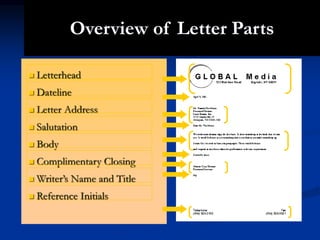
Overview of Letter Parts
 Letterhead
 Dateline
 Letter Address
 Salutation
 Body
 Complimentary Closing
 Writer’s Name and Title
 Reference Initials
Letterhead
 The letter head is the heading at the
top of a letter.
 It usually consists of the name, address,
telephone number and fax number of
the company.
 The letterhead can be typed out but it
is usually printed on the company’s
stationery
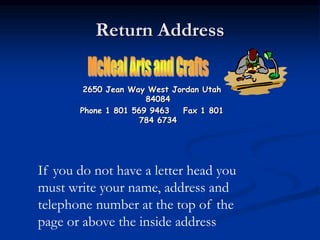
Return Address
2650 Jean Way West Jordan Utah
84084
Phone 1 801 569 9463 Fax 1 801
784 6734
If you do not have a letter head you
must write your name, address and
telephone number at the top of the
page or above the inside address
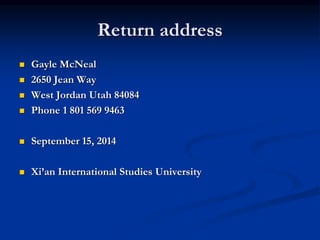
Return address
 Gayle McNeal
 2650 Jean Way
 West Jordan Utah 84084
 Phone 1 801 569 9463
 September 15, 2014
 Xi’an International Studies University
Date Line
 The date line is used to indicate the date
the letter was written.
 If your letter is completed over a number
of days, use the date it was finished and
mailed.
Date Line Cont.
 If you are writing use the day/month/ year
 Depending which format you are using for
your letter, either left justify the date or center
it horizontally.
 Write out the date two inches from the top of
the page.
Inside Address
 The inside address is the recipient’s address.
 It is always best to write to a specific
individual at the firm to which you are
writing.
 If you do not have the person’s name, do
some research by calling the company or
speaking with employees from the company
INSIDE ADDRESS Cont.
 Follow a woman’s preference in being
addressed as:
 Miss, Mrs., or Ms.
 If you are unsure of a woman’s preference in
being addressed, use Ms.
INSIDE ADDRESS Cont
 If there is a possibility that the person
to whom you are writing is a Dr. or
has some other title, use that title.
 Usually, people will not mind being
addressed by a higher title than they
actually possess.
INSIDE ADDRESS Cont
 For international addresses, type the name
of the country in all-capital letters on the last
line.
 The inside address begins two lines below
the date.
 It should be left justified, no matter which
format you are using.
Salutation
 Use the same name as the inside
address, including the personal title.
 If you know the person and typically
address them by their first name, it is
acceptable to use only the first name in
the salutation (i.e., Dear Arun).
 In all other cases, however, use the
personal title and full name followed by
a colon.
 Leave one line blank after the
salutation.
Salutation Cont.
 If you don’t know a reader’s gender,
use a nonsexist salutation, such as "To
Whom it May Concern."
 It is also acceptable to use the full
name in a salutation if you cannot
determine gender.
 For example, you might write Dear
Mohan Kapoor:
Examples or Salutations
 Dear Personnel Director,
 Dear Sir or Madam (use if you don't know
who you are writing to)
 Dear Mr., Mrs., Miss or Ms (use if you
know who you are writing to.
 VERY IMPORTANT use Ms for women
unless asked to use Mrs. or Miss)
 Dear Rahul (use if the person is a close
business contact or friend)
Body
 For block and modified block formats,
single space and left justify each paragraph
within the body of the letter.
 Leave a blank line between each paragraph.
 When writing a business letter, be careful to
remember that conciseness is very important.
Body (Cont.)
 In the first paragraph, consider a friendly opening
and then a statement of the main point.
 The next paragraph should begin justifying the
importance of the main point.
 In the next few paragraphs, continue justification
with background information and supporting
details.
 The closing paragraph should restate the purpose
of the letter and, in some cases, request some type
of action.
The Reference
Give a reference for the reason you are writing
 With reference to your advertisement in
the Times of India,
 your letter of 23rd. March,
 your phone call today,
 Thank you for your letter of March 5 th
The Reason for Writing
 I am writing to enquire about
 I am writing to apologize for
 I am writing to confirm
Requesting
 Could you possibly?
 I would be grateful if you could
Agreeing to Requests
•I would be delighted to
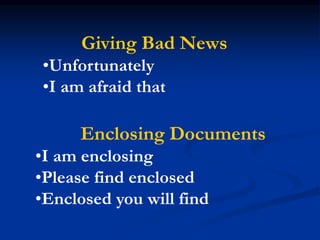
Giving Bad News
•Unfortunately
•I am afraid that
Enclosing Documents
•I am enclosing
•Please find enclosed
•Enclosed you will find
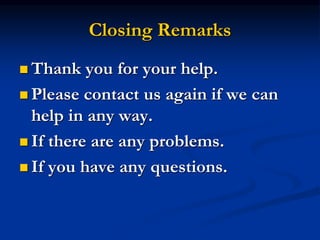
Closing Remarks
 Thank you for your help.
 Please contact us again if we can
help in any way.
 If there are any problems.
 If you have any questions.
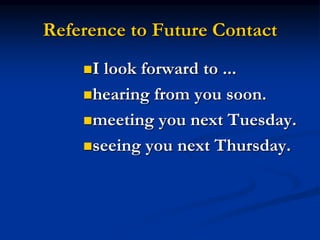
Reference to Future Contact
I look forward to ...
hearing from you soon.
meeting you next Tuesday.
seeing you next Thursday.
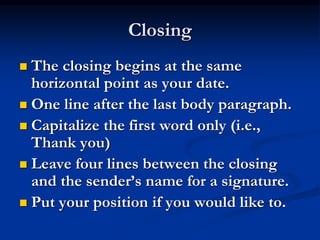
Closing
 The closing begins at the same
horizontal point as your date.
 One line after the last body paragraph.
 Capitalize the first word only (i.e.,
Thank you)
 Leave four lines between the closing
and the sender’s name for a signature.
 Put your position if you would like to.
Closing (Cont.)
 If a colon follows the salutation, a
comma should follow the closing
 otherwise, there is no punctuation
after the closing.
Finish The
 Yours faithfully, (If you don't know the
name of the person you're writing to)
 Yours sincerely, (If you know the name
of the person you're writing to)
 Best wishes,
 Best regards, (If the person is a close
business contact or friend)
Enclosures Notation
 If you have enclosed any documents along with the
letter, such as a resume, you indicate this simply
by typing Enclosures one line below the closing.
 As an option, you may list the name of each
document you are including in the envelope.
 For instance, if you have included many
documents and need to insure that the recipient is
aware of each document, it may be a good idea to
list the names.
Copy Notation
 If you are sending a copy of the letter to
another person or company, include
that information at the bottom of the
page.
 It should have the letters Cc in front of
the information.
Postscript
 The postscript is used to add an
afterthought.
 In sales letters, it is used mainly as added
punch.
 Use the initials PS before the message.
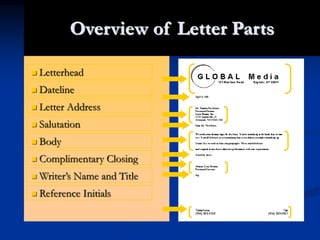
Overview of Letter Parts
 Letterhead
 Dateline
 Letter Address
 Salutation
 Body
 Complimentary Closing
 Writer’s Name and Title
 Reference Initials
Format
 When writing business letters, you
must pay special attention to the format
and font used.
 The most common layout of a business
letter is known as block format.
 Using this format, the entire letter is
left justified and single spaced except
for a double space between paragraphs.
Format Cont.
 Another widely utilized format is
known as modified block format.
 the body of the letter is left
justified and single-spaced.
 the date and closing are in
alignment in the center of the
page.
The final, and least used, style is
semi-block.
It is much like the modified block
style except that each paragraph is
indented instead of left justified.
Format Cont.
PAGE SETUP
 Leave a good margin on both sides (2-
5cm) and on top and bottom (3-5cm)
 Use quality paper for both your letter
and envelope
 Use a good printer, preferably a laser
printer, to achieve the best possible
effect
 Eliminate spelling and grammar errors
Group Activity
 In a group you will write a letter.
 You will turn the letter in at the end of class
 Use all the parts of a letter
 The return address
 Date line
 Inside address
 Salutation
 Body of the letter three paragraphs
 Complimentary closing
 Signature
Class Assignment 1
 Write a letter to Arun Kumar, General Manager
of XYZ Corporation. He will be visiting your city
next week. In the letter invite him to dinner on
Thursday night. (Be sure to specify the time and
place of the dinner.)
 Decide on a date, inside address, and salutation
 Write the body of the letter
 Use a complimentary close and sign the letter.
Class Assignment 1 cont.
 In the first paragraph, consider a friendly
opening and then a statement of the main
point.
 The next paragraph should begin justifying
the importance of the main point.
 The closing paragraph should restate the
purpose of the letter and, in some cases,
request some type of action.
Class Assignment 2
 You are Arun Kumar. Respond to the Letter
you wrote in class earlier. You will be
accepting or declining the invitation.
 Complete the letter with all of the parts we
discussed earlier.
 The letter must be written very neatly.
Grade
 You will be graded on how well you use
the information from my lecture.
 Any late Class assignments will not
receive a grade.
Remember:
 All papers must contain the following
information:
 Student Name & Roll number
 Date
 Assignment Name
Business Letter Writing.ppt

Business Letter Writing.ppt

  • 1.
    Writing a BusinessLetter Presented by: Prof.B.Manchanda
  • 2.
    Overview of LetterParts  Letterhead  Dateline  Letter Address  Salutation  Body  Complimentary Closing  Writer’s Name and Title  Reference Initials
  • 3.
    Letterhead  The letterhead is the heading at the top of a letter.  It usually consists of the name, address, telephone number and fax number of the company.  The letterhead can be typed out but it is usually printed on the company’s stationery
  • 4.
    Return Address 2650 JeanWay West Jordan Utah 84084 Phone 1 801 569 9463 Fax 1 801 784 6734 If you do not have a letter head you must write your name, address and telephone number at the top of the page or above the inside address
  • 5.
    Return address  GayleMcNeal  2650 Jean Way  West Jordan Utah 84084  Phone 1 801 569 9463  September 15, 2014  Xi’an International Studies University
  • 6.
    Date Line  Thedate line is used to indicate the date the letter was written.  If your letter is completed over a number of days, use the date it was finished and mailed.
  • 7.
    Date Line Cont. If you are writing use the day/month/ year  Depending which format you are using for your letter, either left justify the date or center it horizontally.  Write out the date two inches from the top of the page.
  • 8.
    Inside Address  Theinside address is the recipient’s address.  It is always best to write to a specific individual at the firm to which you are writing.  If you do not have the person’s name, do some research by calling the company or speaking with employees from the company
  • 9.
    INSIDE ADDRESS Cont. Follow a woman’s preference in being addressed as:  Miss, Mrs., or Ms.  If you are unsure of a woman’s preference in being addressed, use Ms.
  • 10.
    INSIDE ADDRESS Cont If there is a possibility that the person to whom you are writing is a Dr. or has some other title, use that title.  Usually, people will not mind being addressed by a higher title than they actually possess.
  • 11.
    INSIDE ADDRESS Cont For international addresses, type the name of the country in all-capital letters on the last line.  The inside address begins two lines below the date.  It should be left justified, no matter which format you are using.
  • 12.
    Salutation  Use thesame name as the inside address, including the personal title.  If you know the person and typically address them by their first name, it is acceptable to use only the first name in the salutation (i.e., Dear Arun).  In all other cases, however, use the personal title and full name followed by a colon.  Leave one line blank after the salutation.
  • 13.
    Salutation Cont.  Ifyou don’t know a reader’s gender, use a nonsexist salutation, such as "To Whom it May Concern."  It is also acceptable to use the full name in a salutation if you cannot determine gender.  For example, you might write Dear Mohan Kapoor:
  • 14.
    Examples or Salutations Dear Personnel Director,  Dear Sir or Madam (use if you don't know who you are writing to)  Dear Mr., Mrs., Miss or Ms (use if you know who you are writing to.  VERY IMPORTANT use Ms for women unless asked to use Mrs. or Miss)  Dear Rahul (use if the person is a close business contact or friend)
  • 15.
    Body  For blockand modified block formats, single space and left justify each paragraph within the body of the letter.  Leave a blank line between each paragraph.  When writing a business letter, be careful to remember that conciseness is very important.
  • 16.
    Body (Cont.)  Inthe first paragraph, consider a friendly opening and then a statement of the main point.  The next paragraph should begin justifying the importance of the main point.  In the next few paragraphs, continue justification with background information and supporting details.  The closing paragraph should restate the purpose of the letter and, in some cases, request some type of action.
  • 17.
    The Reference Give areference for the reason you are writing  With reference to your advertisement in the Times of India,  your letter of 23rd. March,  your phone call today,  Thank you for your letter of March 5 th
  • 18.
    The Reason forWriting  I am writing to enquire about  I am writing to apologize for  I am writing to confirm
  • 19.
    Requesting  Could youpossibly?  I would be grateful if you could Agreeing to Requests •I would be delighted to
  • 20.
    Giving Bad News •Unfortunately •Iam afraid that Enclosing Documents •I am enclosing •Please find enclosed •Enclosed you will find
  • 21.
    Closing Remarks  Thankyou for your help.  Please contact us again if we can help in any way.  If there are any problems.  If you have any questions.
  • 22.
    Reference to FutureContact I look forward to ... hearing from you soon. meeting you next Tuesday. seeing you next Thursday.
  • 23.
    Closing  The closingbegins at the same horizontal point as your date.  One line after the last body paragraph.  Capitalize the first word only (i.e., Thank you)  Leave four lines between the closing and the sender’s name for a signature.  Put your position if you would like to.
  • 24.
    Closing (Cont.)  Ifa colon follows the salutation, a comma should follow the closing  otherwise, there is no punctuation after the closing.
  • 25.
    Finish The  Yoursfaithfully, (If you don't know the name of the person you're writing to)  Yours sincerely, (If you know the name of the person you're writing to)  Best wishes,  Best regards, (If the person is a close business contact or friend)
  • 26.
    Enclosures Notation  Ifyou have enclosed any documents along with the letter, such as a resume, you indicate this simply by typing Enclosures one line below the closing.  As an option, you may list the name of each document you are including in the envelope.  For instance, if you have included many documents and need to insure that the recipient is aware of each document, it may be a good idea to list the names.
  • 27.
    Copy Notation  Ifyou are sending a copy of the letter to another person or company, include that information at the bottom of the page.  It should have the letters Cc in front of the information.
  • 28.
    Postscript  The postscriptis used to add an afterthought.  In sales letters, it is used mainly as added punch.  Use the initials PS before the message.
  • 29.
    Overview of LetterParts  Letterhead  Dateline  Letter Address  Salutation  Body  Complimentary Closing  Writer’s Name and Title  Reference Initials
  • 30.
    Format  When writingbusiness letters, you must pay special attention to the format and font used.  The most common layout of a business letter is known as block format.  Using this format, the entire letter is left justified and single spaced except for a double space between paragraphs.
  • 31.
    Format Cont.  Anotherwidely utilized format is known as modified block format.  the body of the letter is left justified and single-spaced.  the date and closing are in alignment in the center of the page.
  • 32.
    The final, andleast used, style is semi-block. It is much like the modified block style except that each paragraph is indented instead of left justified. Format Cont.
  • 33.
    PAGE SETUP  Leavea good margin on both sides (2- 5cm) and on top and bottom (3-5cm)  Use quality paper for both your letter and envelope  Use a good printer, preferably a laser printer, to achieve the best possible effect  Eliminate spelling and grammar errors
  • 34.
    Group Activity  Ina group you will write a letter.  You will turn the letter in at the end of class  Use all the parts of a letter  The return address  Date line  Inside address  Salutation  Body of the letter three paragraphs  Complimentary closing  Signature
  • 35.
    Class Assignment 1 Write a letter to Arun Kumar, General Manager of XYZ Corporation. He will be visiting your city next week. In the letter invite him to dinner on Thursday night. (Be sure to specify the time and place of the dinner.)  Decide on a date, inside address, and salutation  Write the body of the letter  Use a complimentary close and sign the letter.
  • 36.
    Class Assignment 1cont.  In the first paragraph, consider a friendly opening and then a statement of the main point.  The next paragraph should begin justifying the importance of the main point.  The closing paragraph should restate the purpose of the letter and, in some cases, request some type of action.
  • 37.
    Class Assignment 2 You are Arun Kumar. Respond to the Letter you wrote in class earlier. You will be accepting or declining the invitation.  Complete the letter with all of the parts we discussed earlier.  The letter must be written very neatly.
  • 38.
    Grade  You willbe graded on how well you use the information from my lecture.  Any late Class assignments will not receive a grade.
  • 39.
    Remember:  All papersmust contain the following information:  Student Name & Roll number  Date  Assignment Name