BUSINESS LETTERS
BUSINESS LETTERS
 Any business will have to correspond in writing with its
customers, branches, suppliers, bankers, and others with
whom it has or would like to have a lasting relationship
 Business letters serve as a means to reach out to people
not only within the locality and neighbourhood but also
in other cities and nations
 They represent you when you conduct transactions in
writing
 They have become such an integral part of every day
business that one cannot think of running a business
without the related correspondence.
2
BUSINESS LETTERS
 Though there are many modern communication methods
available these days, the traditional business letters still
retain their importance in the business world for the
following reasons:
 Just as your personal letters help you keep your personal
relationship with your friends and relatives alive, business letters
assist you in sustaining your business relationships with other
businesses and customers.
 They are the appropriate form of communication when the
information you wish to convey is complex.
 They serve as permanent records and are a valuable repository
of information, which you can refer to in future.
 They help you reach a large and geographically diverse
audience thereby enabling you to save money on telephone calls.
3
BUSINESS LETTERS
 Purpose
 The ultimate purpose of writing any business letter is to
sustain the existing business relationships or to create
and establish a new business relationship.
 But each individual letter will have a unique purpose.
For example, when you apply for a job, you aim at
offering your services to your prospective employer.
 Similarly, as the purchase manager of a company when
you write a letter complaining about the damaged
consignment, your aim is not only to bring the flaw to
the notice of the recipient but also to request for a
corrective action.
4
BUSINESS LETTERS
 Business letters therefore are written for varied purposes as
mentioned below;
 to inform
 to congratulate
 to enquire
 to order
 to request
 to collect dues
 to complain
 to make an adjustment
 to sell a product, service, or scheme
 to apply for a job
5
BUSINESS LETTERS
 Structure
 Business letters are different from personal letters as
they have a distinct structure and layout.
 Although there are different types of letters, each
relevant in a specific context, they share a common
structure comprising various elements or parts.
 You need to be familiar with not only these different
elements but also their positioning in the letter and the
purpose for which they are included in the letter.
 Several of these elements appear in every letter; others
appear only when desirable or appropriate.
6
BUSINESS LETTERS
 Standard Elements
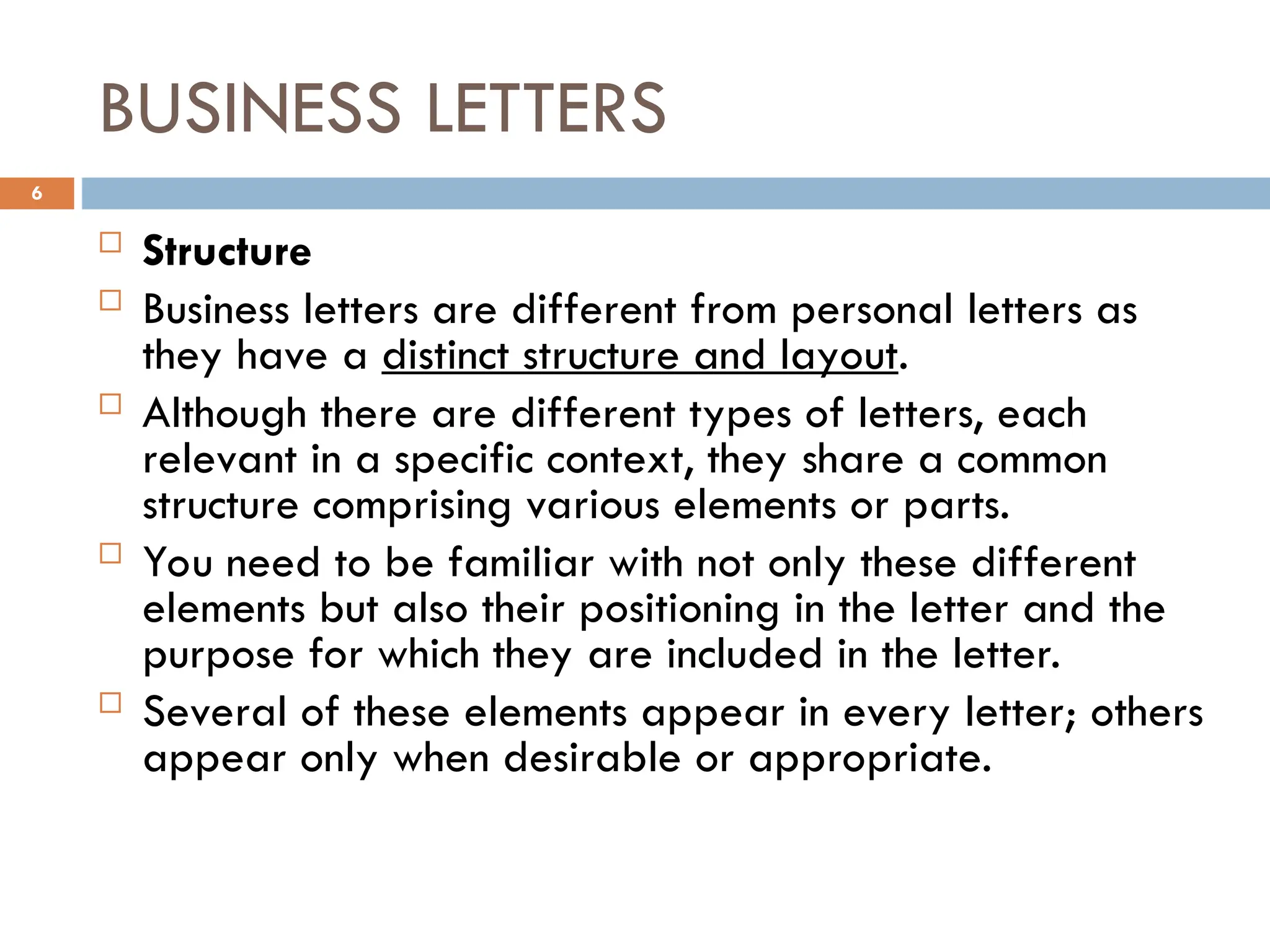
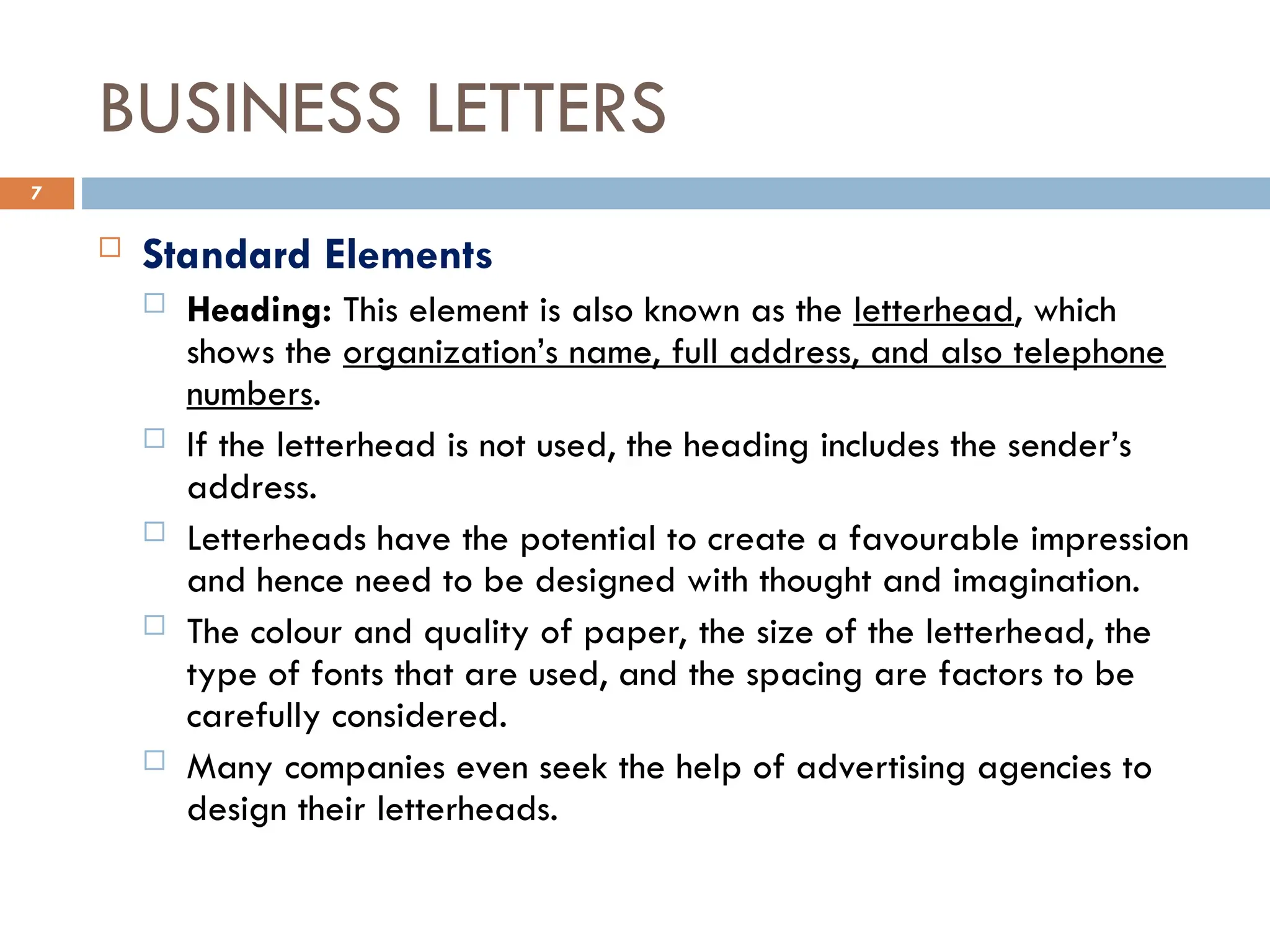
 Heading: This element is also known as the letterhead, which
shows the organization’s name, full address, and also telephone
numbers.
 If the letterhead is not used, the heading includes the sender’s
address.
 Letterheads have the potential to create a favourable impression
and hence need to be designed with thought and imagination.
 The colour and quality of paper, the size of the letterhead, the
type of fonts that are used, and the spacing are factors to be
carefully considered.
 Many companies even seek the help of advertising agencies to
design their letterheads.
7
BUSINESS LETTERS
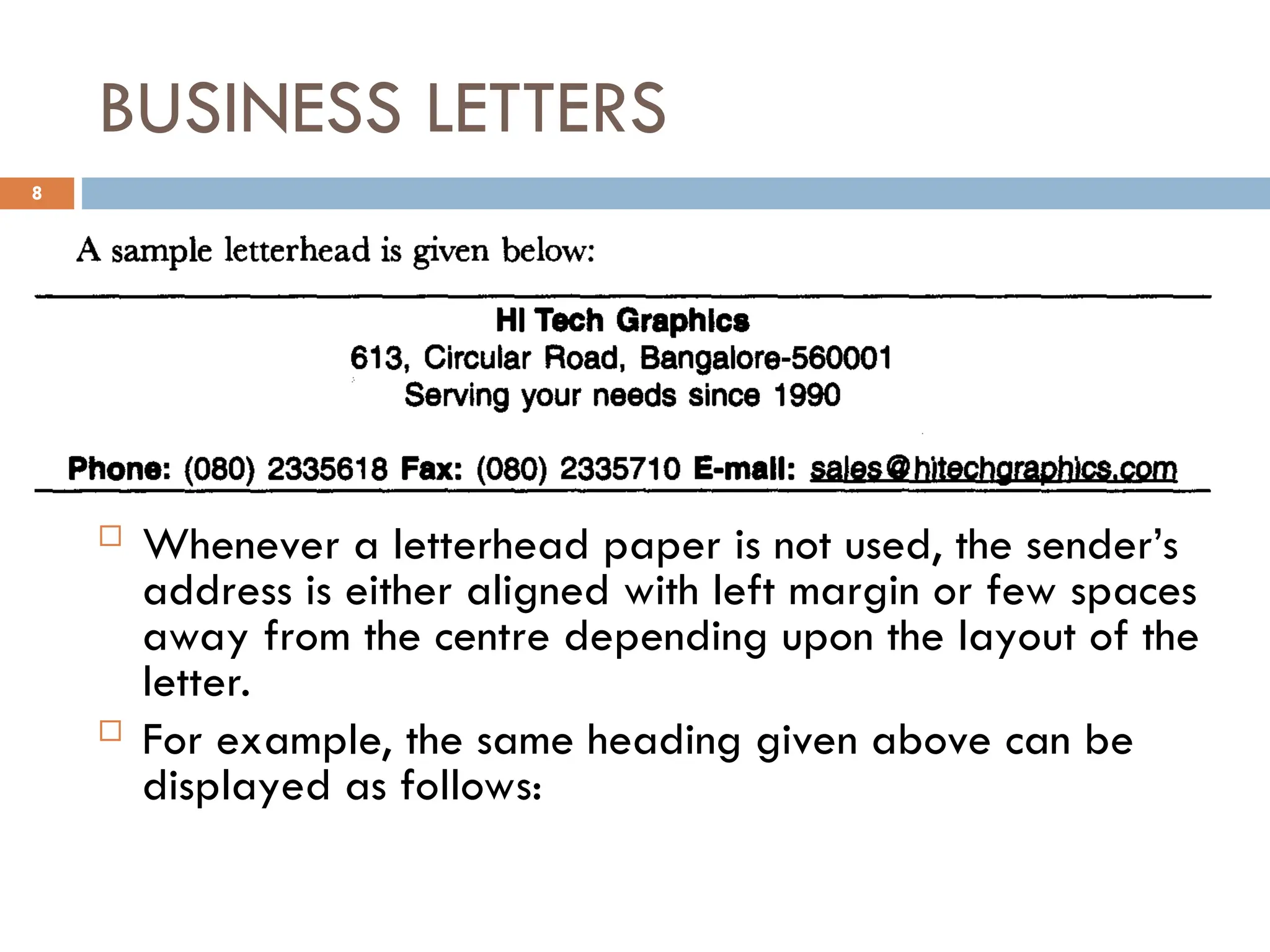
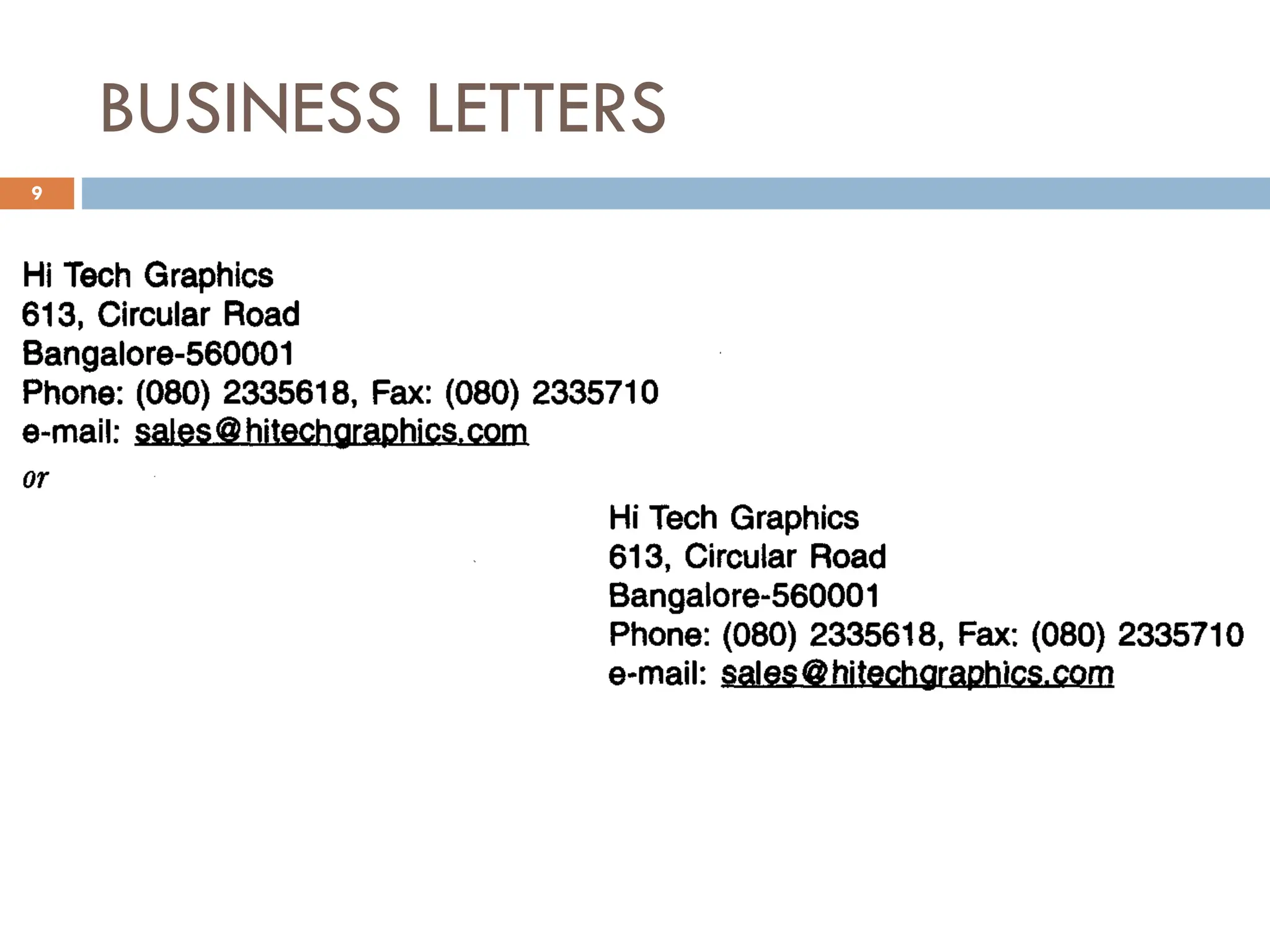
 Whenever a letterhead paper is not used, the sender’s
address is either aligned with left margin or few spaces
away from the centre depending upon the layout of the
letter.
 For example, the same heading given above can be
displayed as follows:
8
BUSINESS LETTERS
9
BUSINESS LETTERS
 Standard Elements
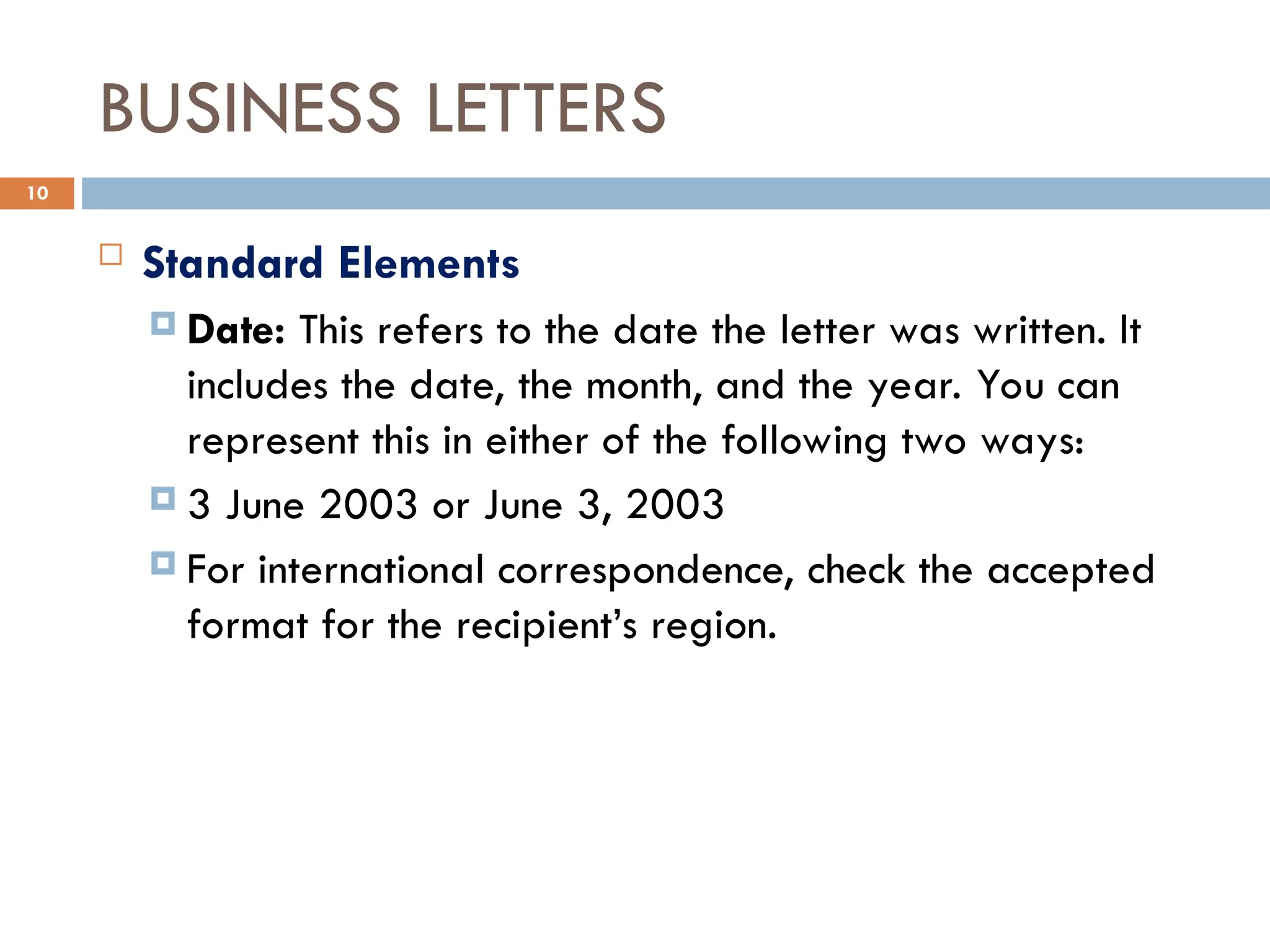
 Date: This refers to the date the letter was written. It
includes the date, the month, and the year. You can
represent this in either of the following two ways:
 3 June 2003 or June 3, 2003
 For international correspondence, check the accepted
format for the recipient’s region.
10
BUSINESS LETTERS
 Standard Elements
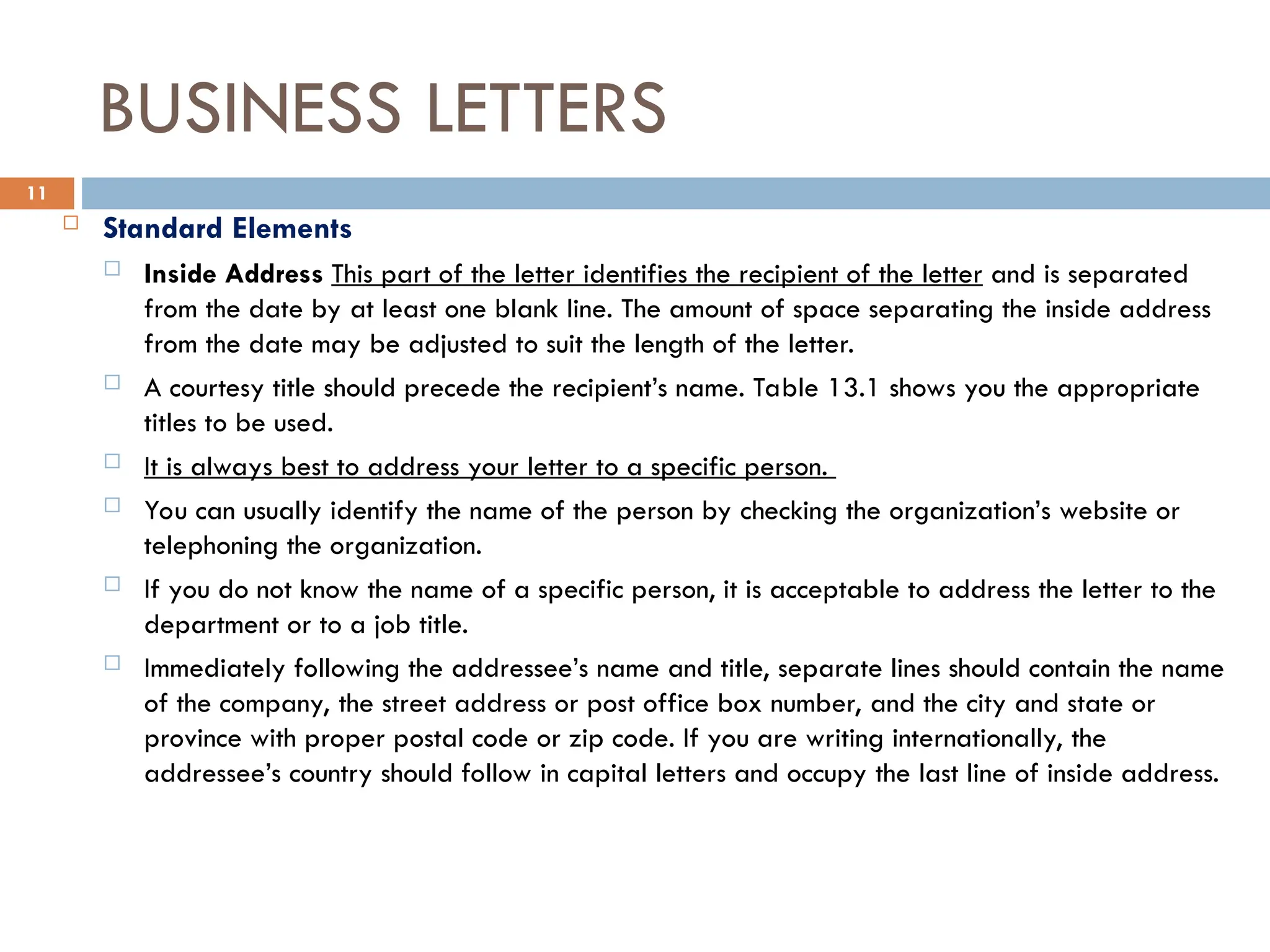
 Inside Address This part of the letter identifies the recipient of the letter and is separated
from the date by at least one blank line. The amount of space separating the inside address
from the date may be adjusted to suit the length of the letter.
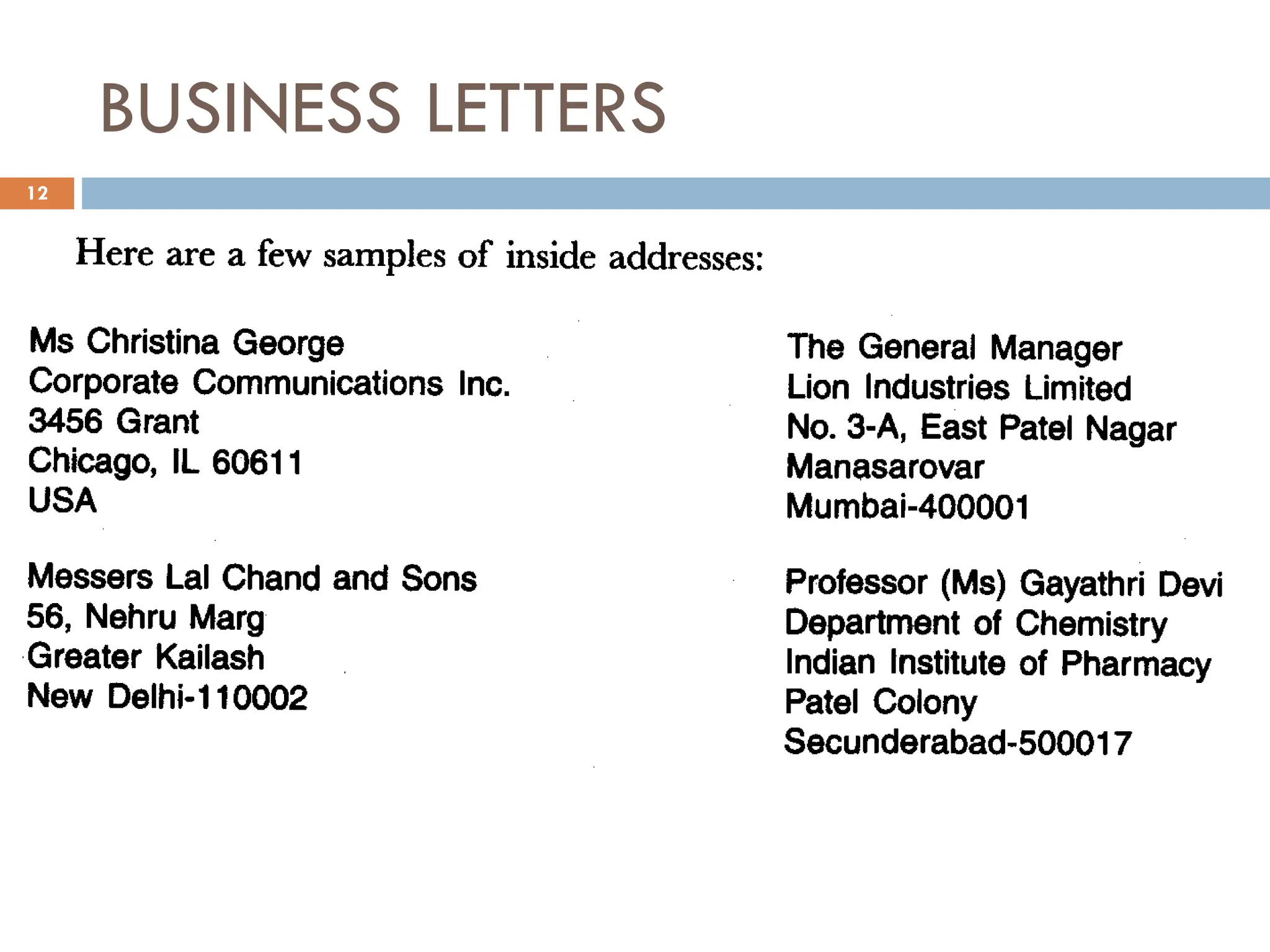
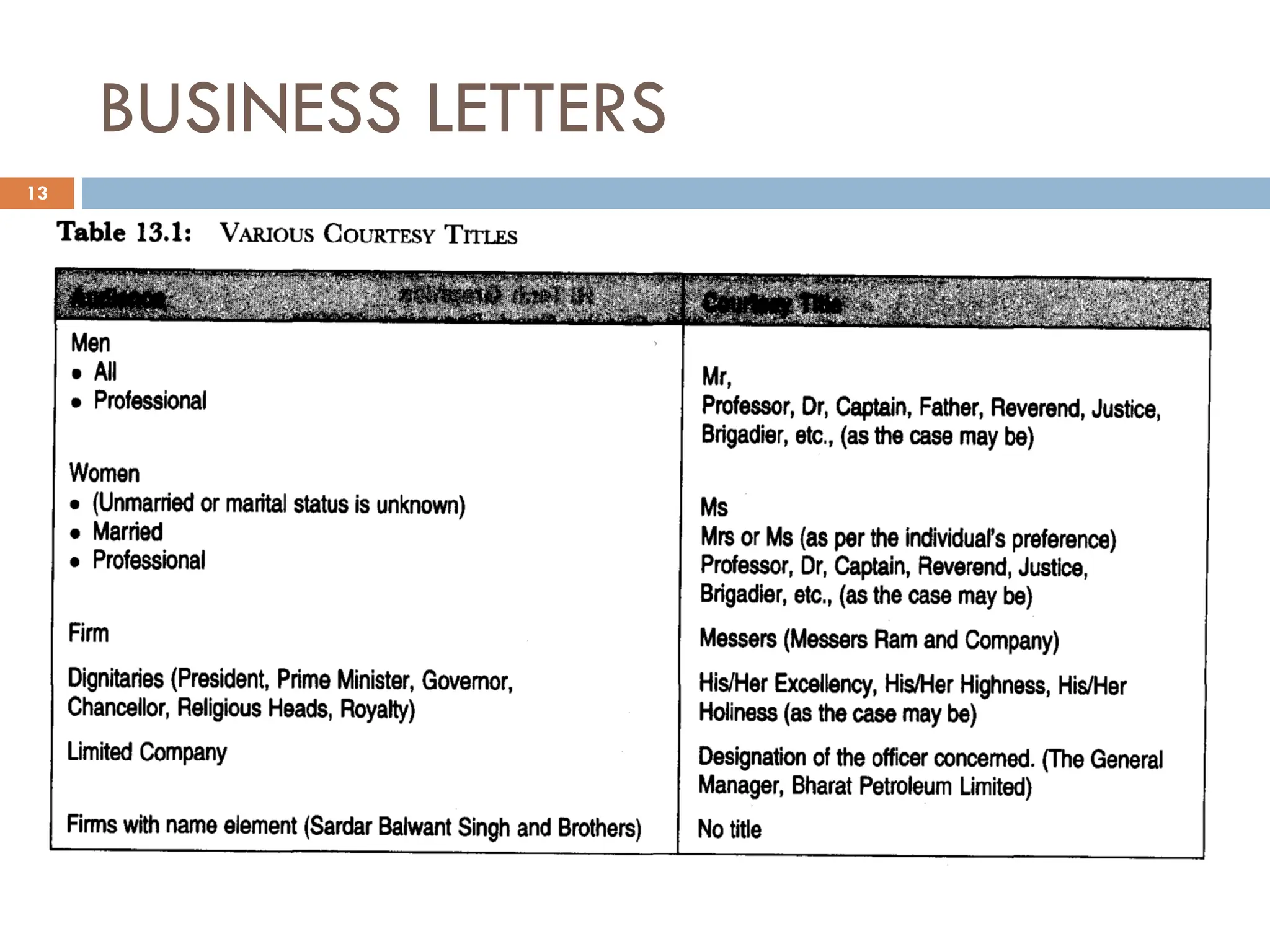
 A courtesy title should precede the recipient’s name. Table 13.1 shows you the appropriate
titles to be used.
 It is always best to address your letter to a specific person.
 You can usually identify the name of the person by checking the organization’s website or
telephoning the organization.
 If you do not know the name of a specific person, it is acceptable to address the letter to the
department or to a job title.
 Immediately following the addressee’s name and title, separate lines should contain the name
of the company, the street address or post office box number, and the city and state or
province with proper postal code or zip code. If you are writing internationally, the
addressee’s country should follow in capital letters and occupy the last line of inside address.
11
BUSINESS LETTERS
12
BUSINESS LETTERS
13
BUSINESS LETTERS
 Standard Elements
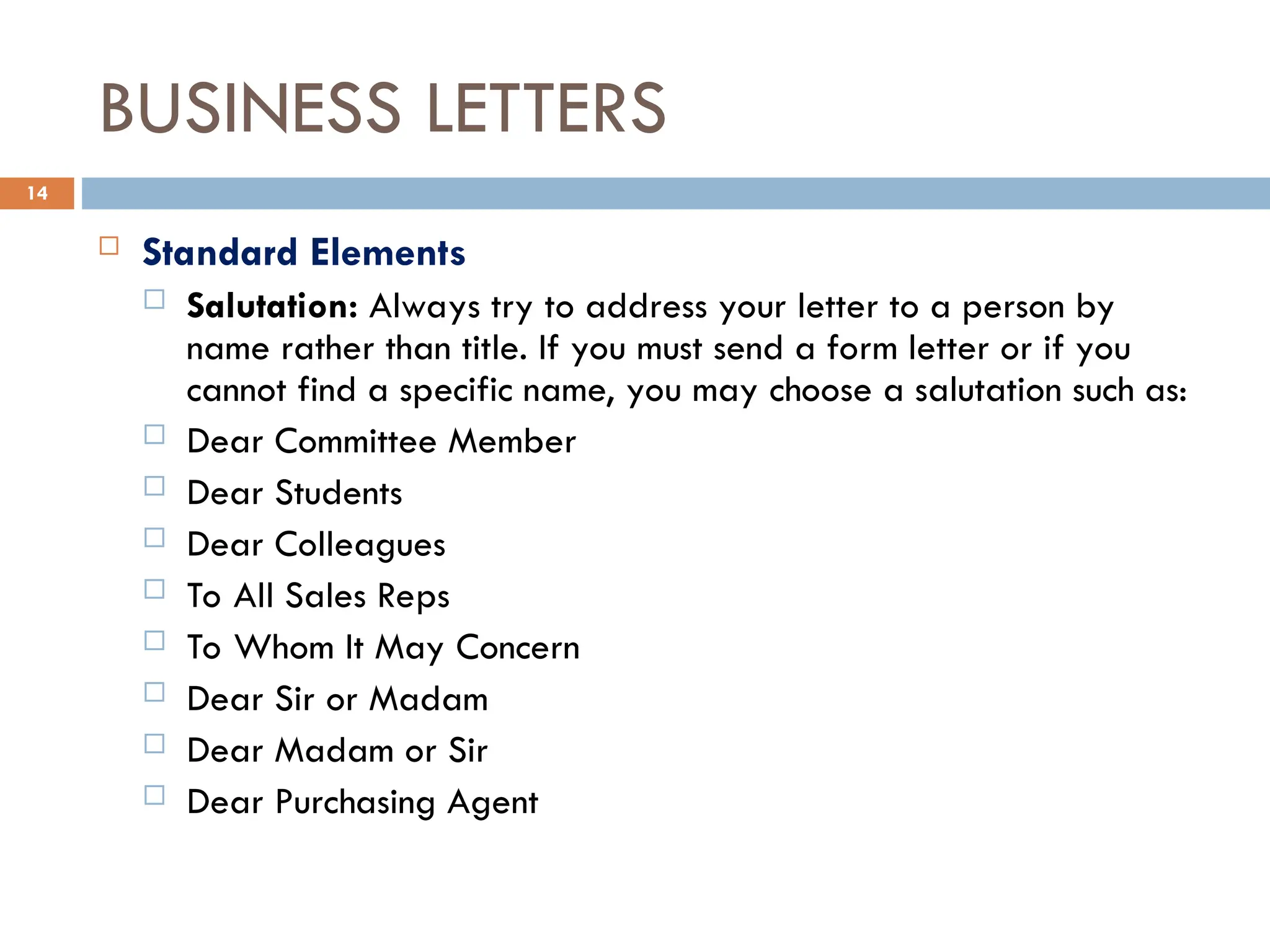
 Salutation: Always try to address your letter to a person by
name rather than title. If you must send a form letter or if you
cannot find a specific name, you may choose a salutation such as:
 Dear Committee Member
 Dear Students
 Dear Colleagues
 To All Sales Reps
 To Whom It May Concern
 Dear Sir or Madam
 Dear Madam or Sir
 Dear Purchasing Agent
14
BUSINESS LETTERS
15
BUSINESS LETTERS
 Standard Elements
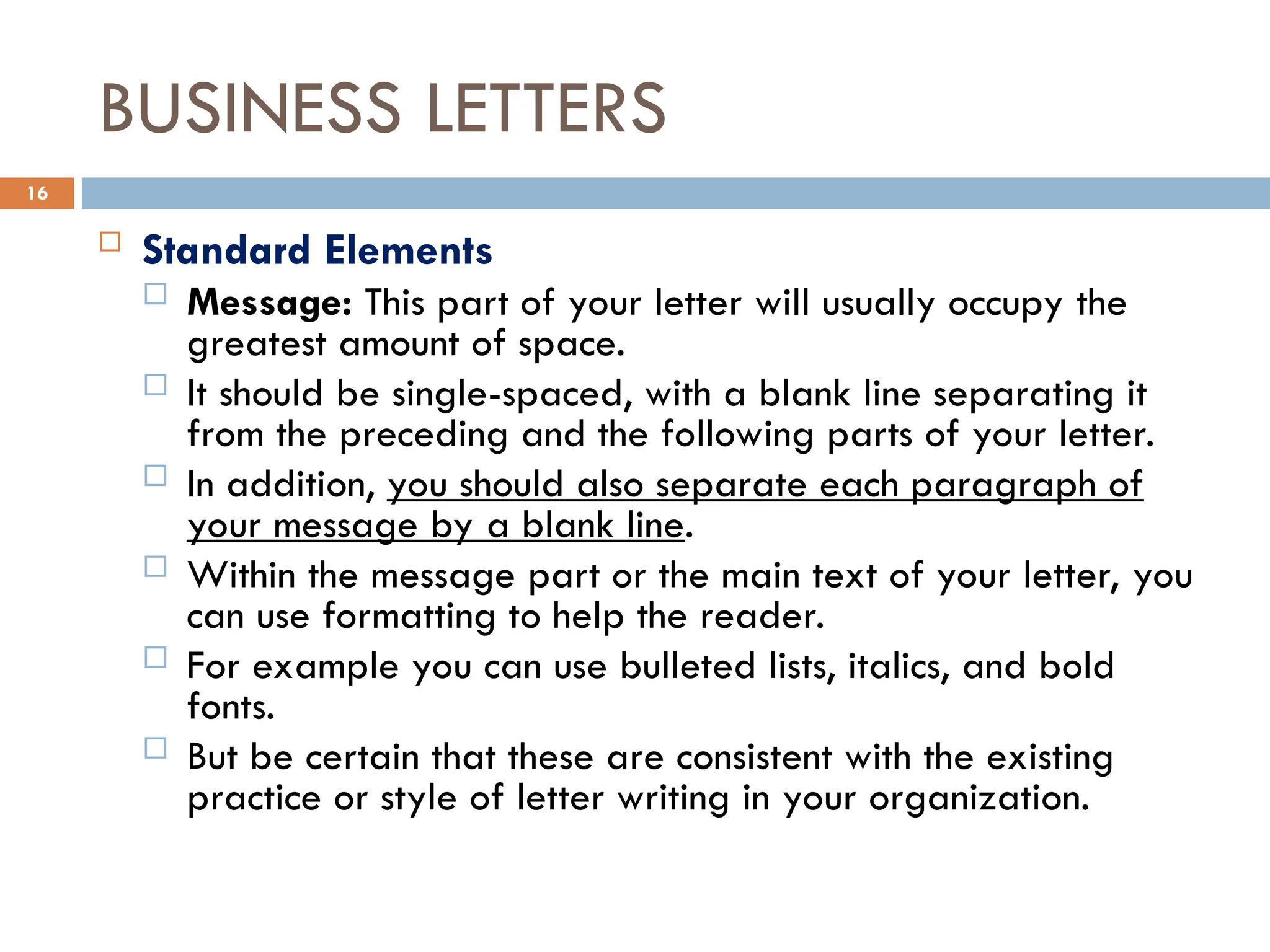
 Message: This part of your letter will usually occupy the
greatest amount of space.
 It should be single-spaced, with a blank line separating it
from the preceding and the following parts of your letter.
 In addition, you should also separate each paragraph of
your message by a blank line.
 Within the message part or the main text of your letter, you
can use formatting to help the reader.
 For example you can use bulleted lists, italics, and bold
fonts.
 But be certain that these are consistent with the existing
practice or style of letter writing in your organization.
16
BUSINESS LETTERS
 Standard Elements
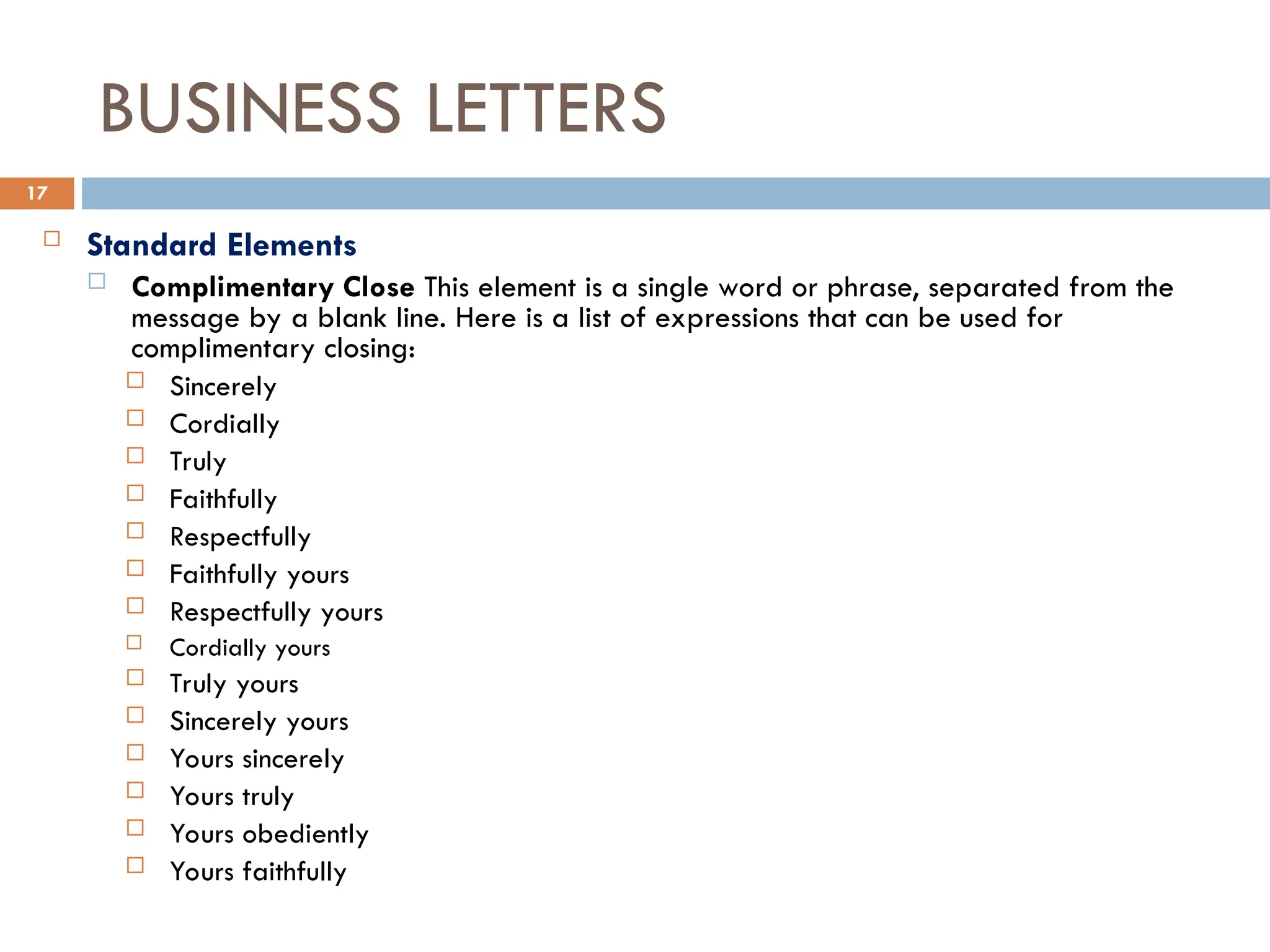
 Complimentary Close This element is a single word or phrase, separated from the
message by a blank line. Here is a list of expressions that can be used for
complimentary closing:
 Sincerely
 Cordially
 Truly
 Faithfully
 Respectfully
 Faithfully yours
 Respectfully yours
 Cordially yours
 Truly yours
 Sincerely yours
 Yours sincerely
 Yours truly
 Yours obediently
 Yours faithfully
17
BUSINESS LETTERS
 Standard Elements
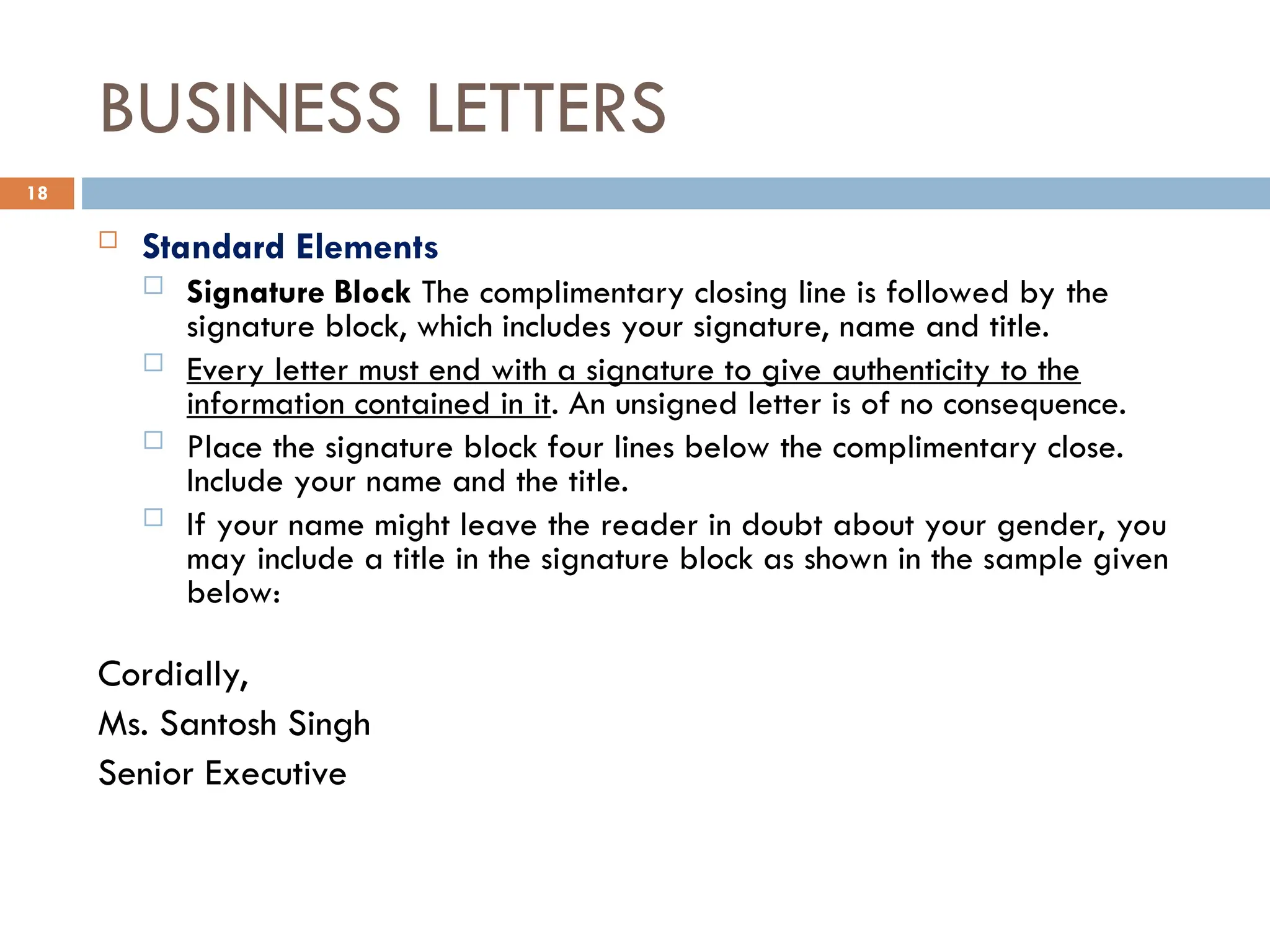
 Signature Block The complimentary closing line is followed by the
signature block, which includes your signature, name and title.
 Every letter must end with a signature to give authenticity to the
information contained in it. An unsigned letter is of no consequence.
 Place the signature block four lines below the complimentary close.
Include your name and the title.
 If your name might leave the reader in doubt about your gender, you
may include a title in the signature block as shown in the sample given
below:
Cordially,
Ms. Santosh Singh
Senior Executive
18
BUSINESS LETTERS
 Standard Elements
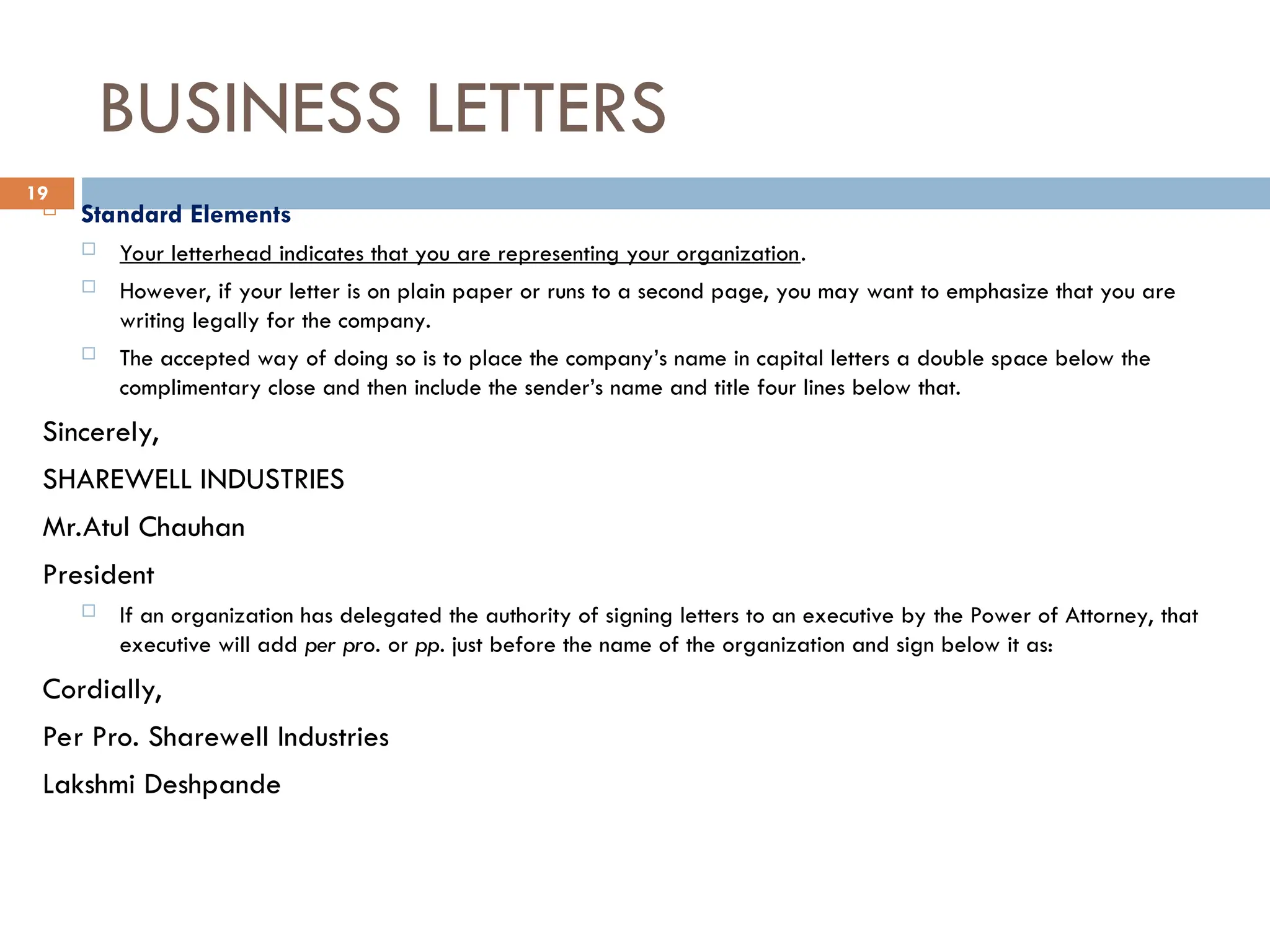
 Your letterhead indicates that you are representing your organization.
 However, if your letter is on plain paper or runs to a second page, you may want to emphasize that you are
writing legally for the company.
 The accepted way of doing so is to place the company’s name in capital letters a double space below the
complimentary close and then include the sender’s name and title four lines below that.
Sincerely,
SHAREWELL INDUSTRIES
Mr.Atul Chauhan
President
 If an organization has delegated the authority of signing letters to an executive by the Power of Attorney, that
executive will add per pro. or pp. just before the name of the organization and sign below it as:
Cordially,
Per Pro. Sharewell Industries
Lakshmi Deshpande
19
BUSINESS LETTERS
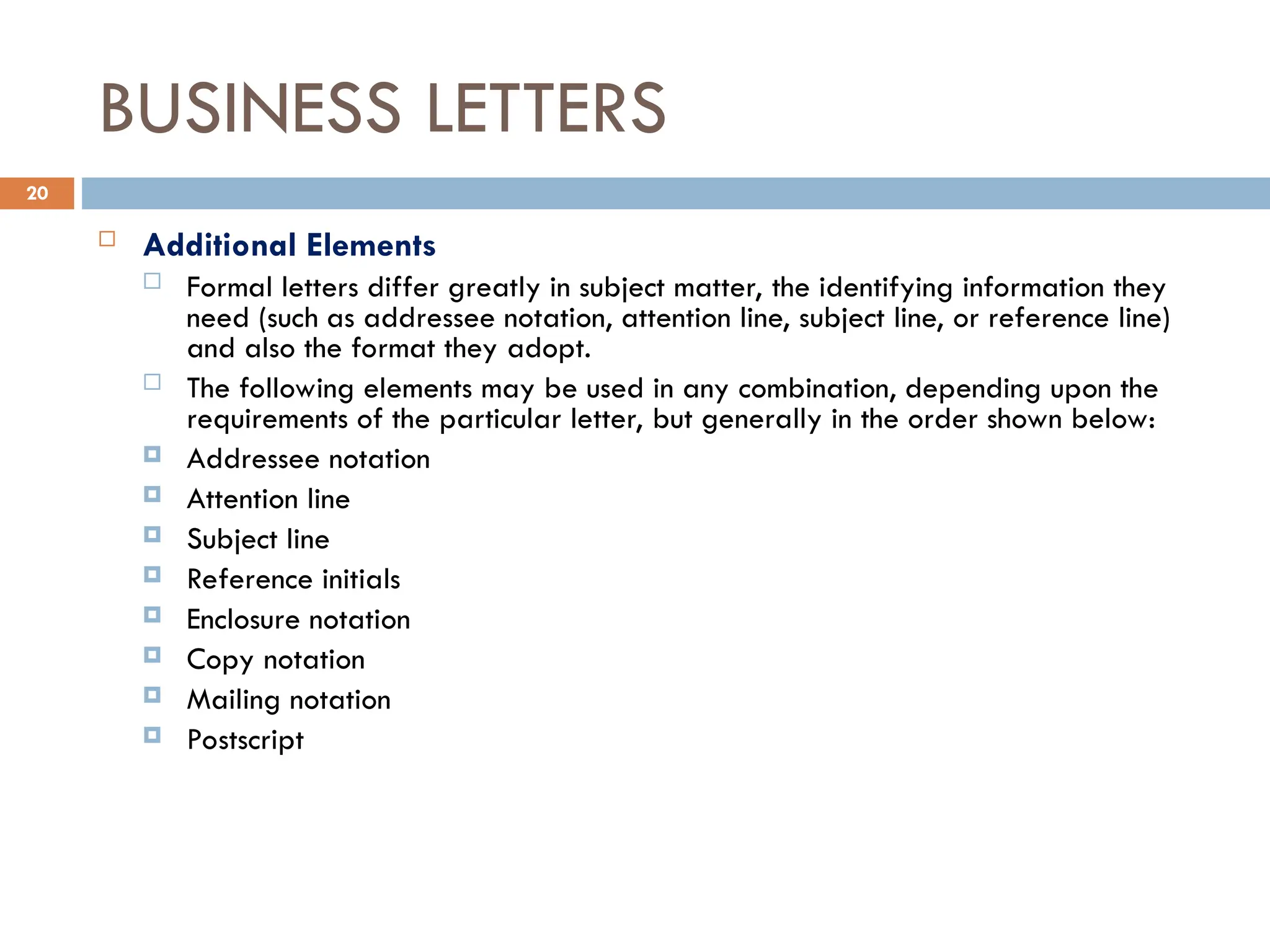
 Additional Elements
 Formal letters differ greatly in subject matter, the identifying information they
need (such as addressee notation, attention line, subject line, or reference line)
and also the format they adopt.
 The following elements may be used in any combination, depending upon the
requirements of the particular letter, but generally in the order shown below:
 Addressee notation
 Attention line
 Subject line
 Reference initials
 Enclosure notation
 Copy notation
 Mailing notation
 Postscript
20
BUSINESS LETTERS
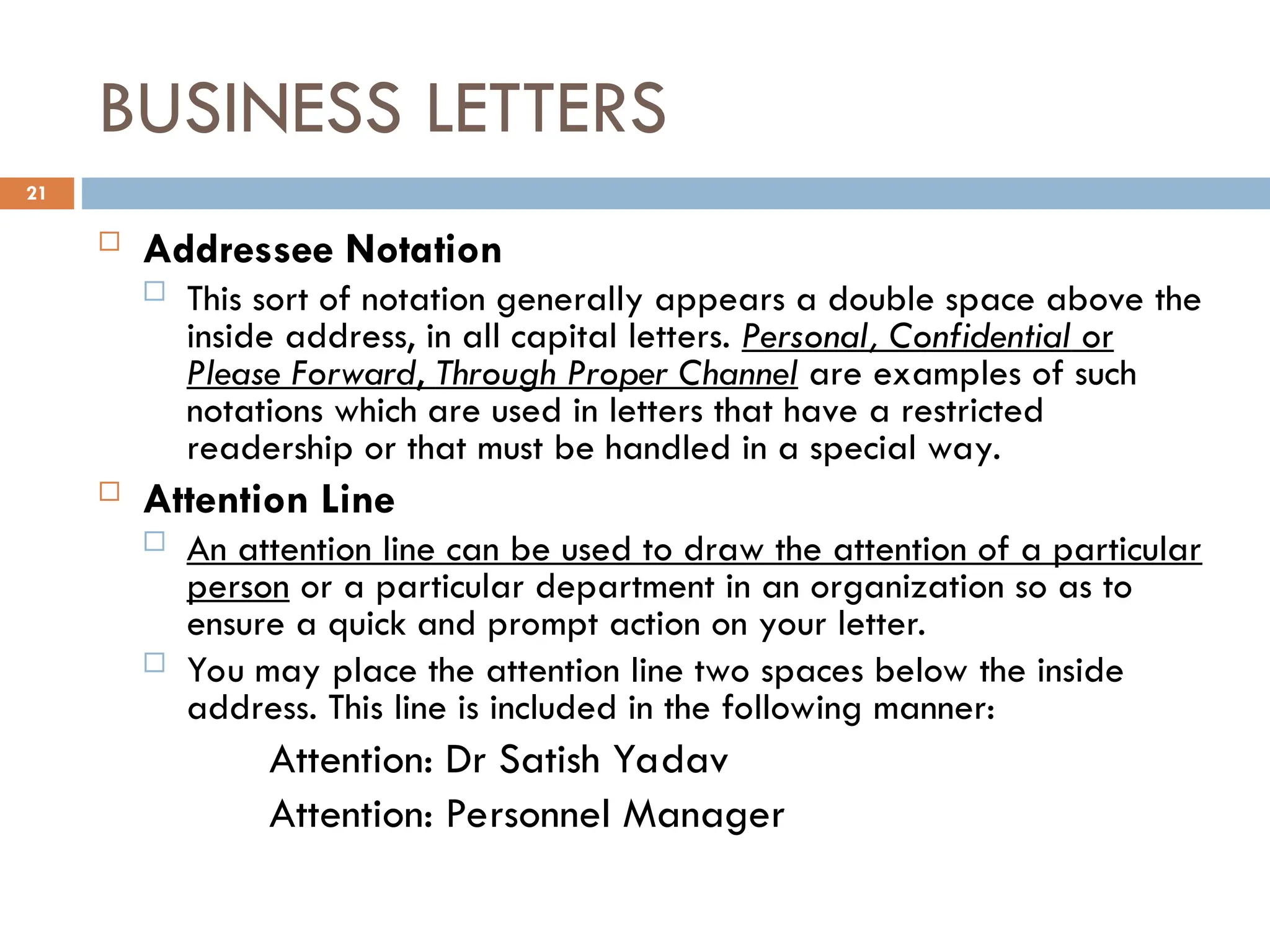
 Addressee Notation
 This sort of notation generally appears a double space above the
inside address, in all capital letters. Personal, Confidential or
Please Forward, Through Proper Channel are examples of such
notations which are used in letters that have a restricted
readership or that must be handled in a special way.
 Attention Line
 An attention line can be used to draw the attention of a particular
person or a particular department in an organization so as to
ensure a quick and prompt action on your letter.
 You may place the attention line two spaces below the inside
address. This line is included in the following manner:
Attention: Dr Satish Yadav
Attention: Personnel Manager
21
BUSINESS LETTERS
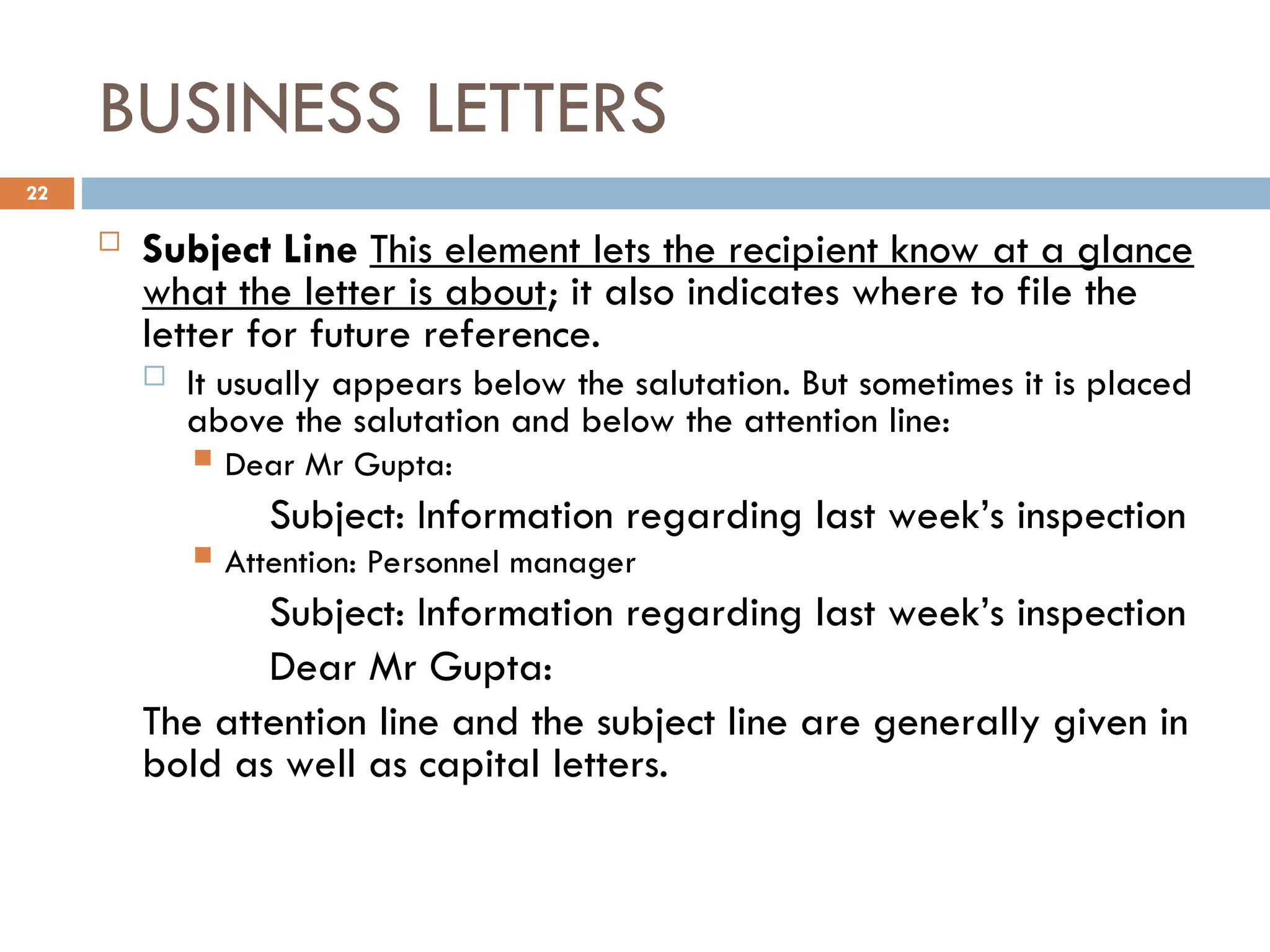
 Subject Line This element lets the recipient know at a glance
what the letter is about; it also indicates where to file the
letter for future reference.
 It usually appears below the salutation. But sometimes it is placed
above the salutation and below the attention line:
 Dear Mr Gupta:
Subject: Information regarding last week’s inspection
 Attention: Personnel manager
Subject: Information regarding last week’s inspection
Dear Mr Gupta:
The attention line and the subject line are generally given in
bold as well as capital letters.
22
BUSINESS LETTERS
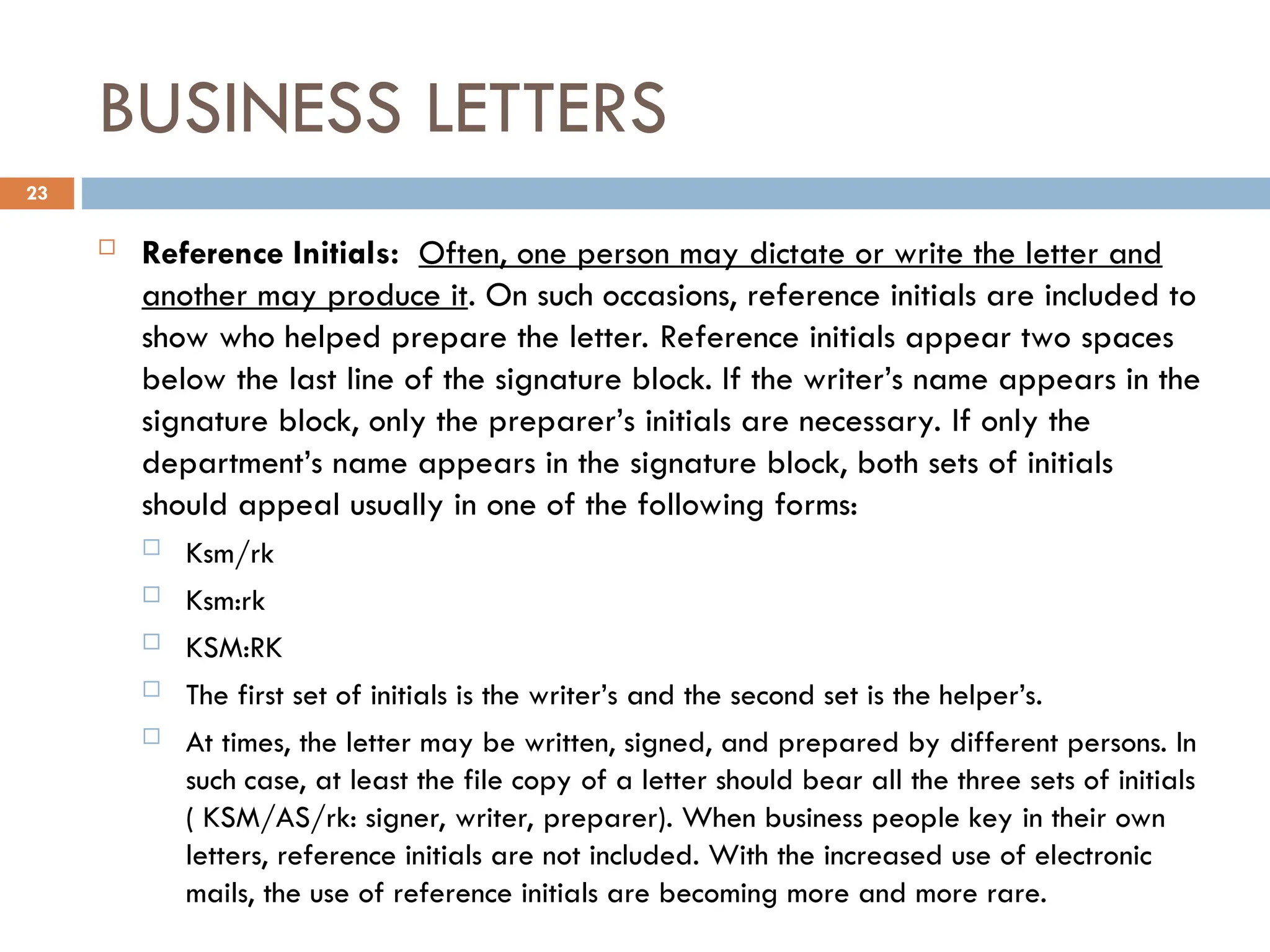
 Reference Initials: Often, one person may dictate or write the letter and
another may produce it. On such occasions, reference initials are included to
show who helped prepare the letter. Reference initials appear two spaces
below the last line of the signature block. If the writer’s name appears in the
signature block, only the preparer’s initials are necessary. If only the
department’s name appears in the signature block, both sets of initials
should appeal usually in one of the following forms:
 Ksm/rk
 Ksm:rk
 KSM:RK
 The first set of initials is the writer’s and the second set is the helper’s.
 At times, the letter may be written, signed, and prepared by different persons. In
such case, at least the file copy of a letter should bear all the three sets of initials
( KSM/AS/rk: signer, writer, preparer). When business people key in their own
letters, reference initials are not included. With the increased use of electronic
mails, the use of reference initials are becoming more and more rare.
23
BUSINESS LETTERS
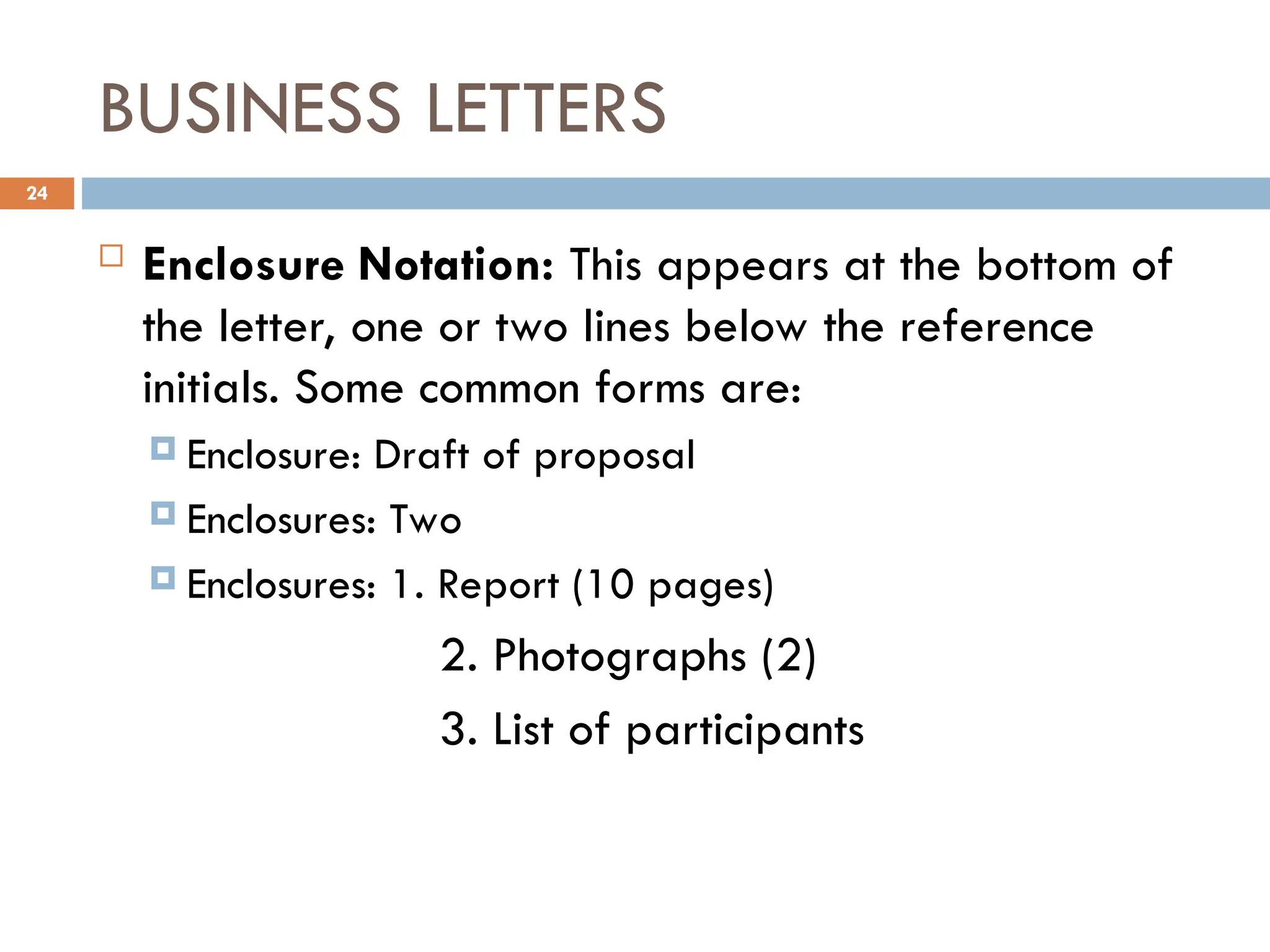
 Enclosure Notation: This appears at the bottom of
the letter, one or two lines below the reference
initials. Some common forms are:
 Enclosure: Draft of proposal
 Enclosures: Two
 Enclosures: 1. Report (10 pages)
2. Photographs (2)
3. List of participants
24
BUSINESS LETTERS
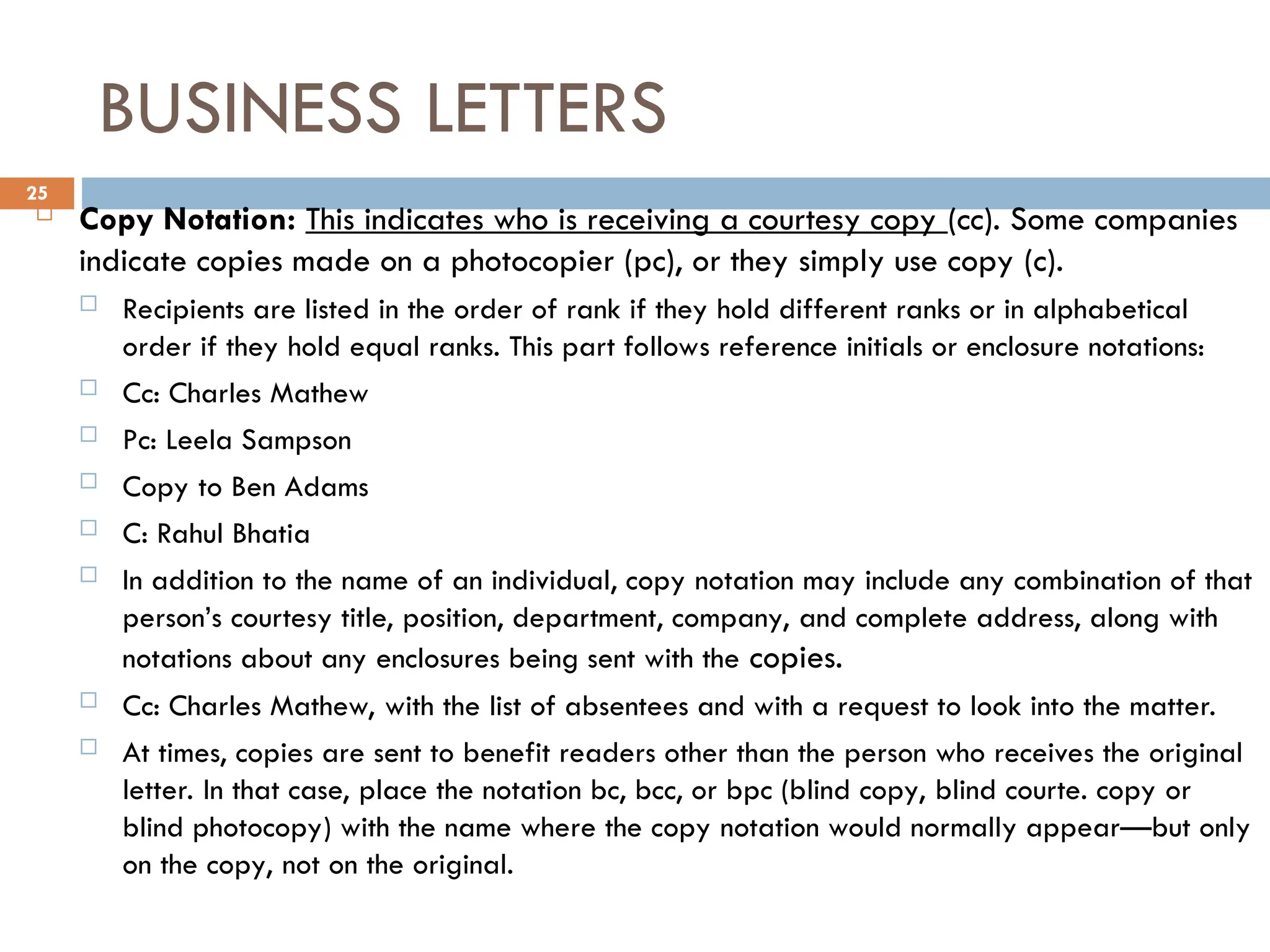
 Copy Notation: This indicates who is receiving a courtesy copy (cc). Some companies
indicate copies made on a photocopier (pc), or they simply use copy (c).
 Recipients are listed in the order of rank if they hold different ranks or in alphabetical
order if they hold equal ranks. This part follows reference initials or enclosure notations:
 Cc: Charles Mathew
 Pc: Leela Sampson
 Copy to Ben Adams
 C: Rahul Bhatia
 In addition to the name of an individual, copy notation may include any combination of that
person’s courtesy title, position, department, company, and complete address, along with
notations about any enclosures being sent with the copies.
 Cc: Charles Mathew, with the list of absentees and with a request to look into the matter.
 At times, copies are sent to benefit readers other than the person who receives the original
letter. In that case, place the notation bc, bcc, or bpc (blind copy, blind courte. copy or
blind photocopy) with the name where the copy notation would normally appear—but only
on the copy, not on the original.
25
BUSINESS LETTERS
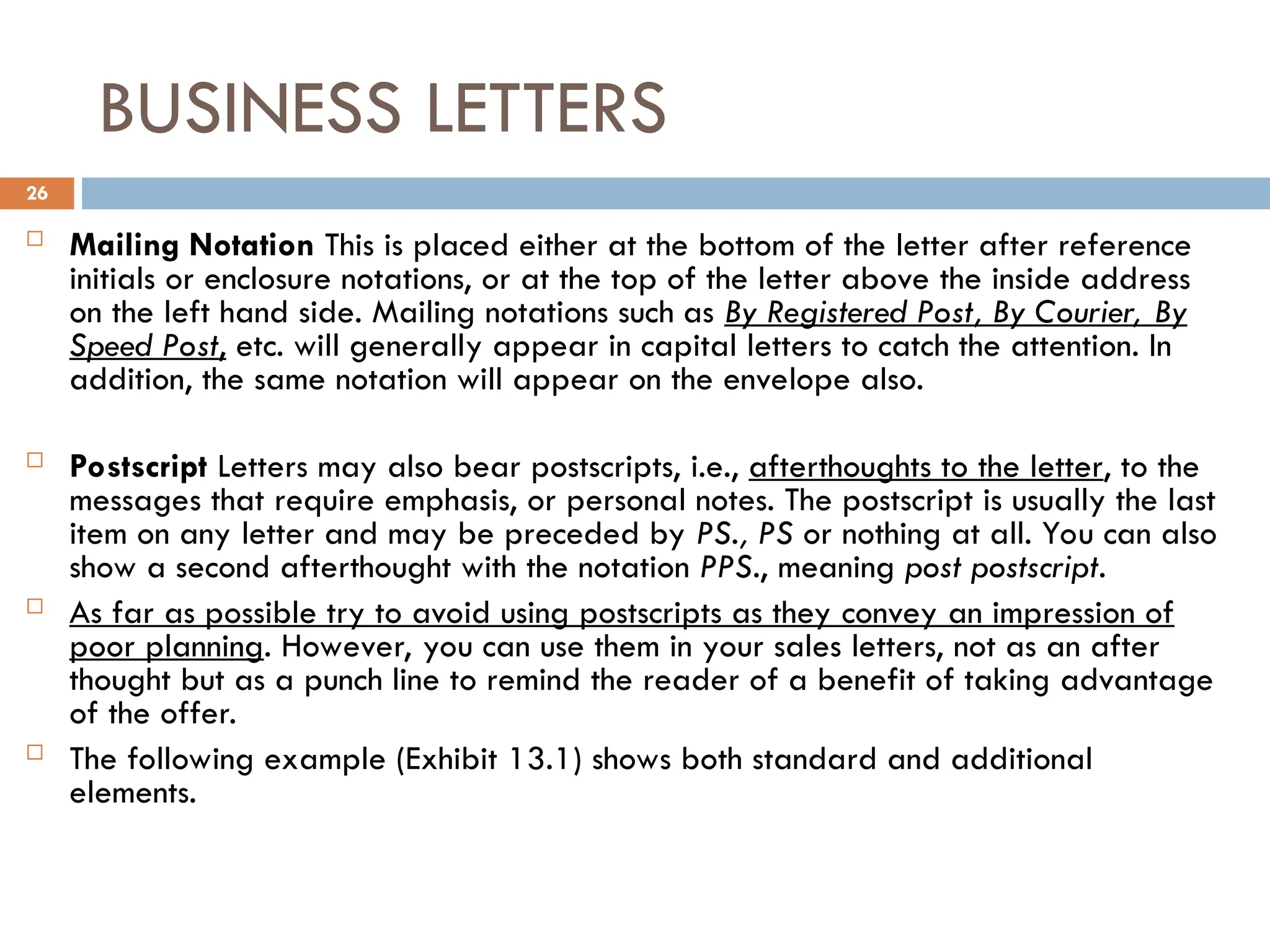
 Mailing Notation This is placed either at the bottom of the letter after reference
initials or enclosure notations, or at the top of the letter above the inside address
on the left hand side. Mailing notations such as By Registered Post, By Courier, By
Speed Post, etc. will generally appear in capital letters to catch the attention. In
addition, the same notation will appear on the envelope also.
 Postscript Letters may also bear postscripts, i.e., afterthoughts to the letter, to the
messages that require emphasis, or personal notes. The postscript is usually the last
item on any letter and may be preceded by PS., PS or nothing at all. You can also
show a second afterthought with the notation PPS., meaning post postscript.
 As far as possible try to avoid using postscripts as they convey an impression of
poor planning. However, you can use them in your sales letters, not as an after
thought but as a punch line to remind the reader of a benefit of taking advantage
of the offer.
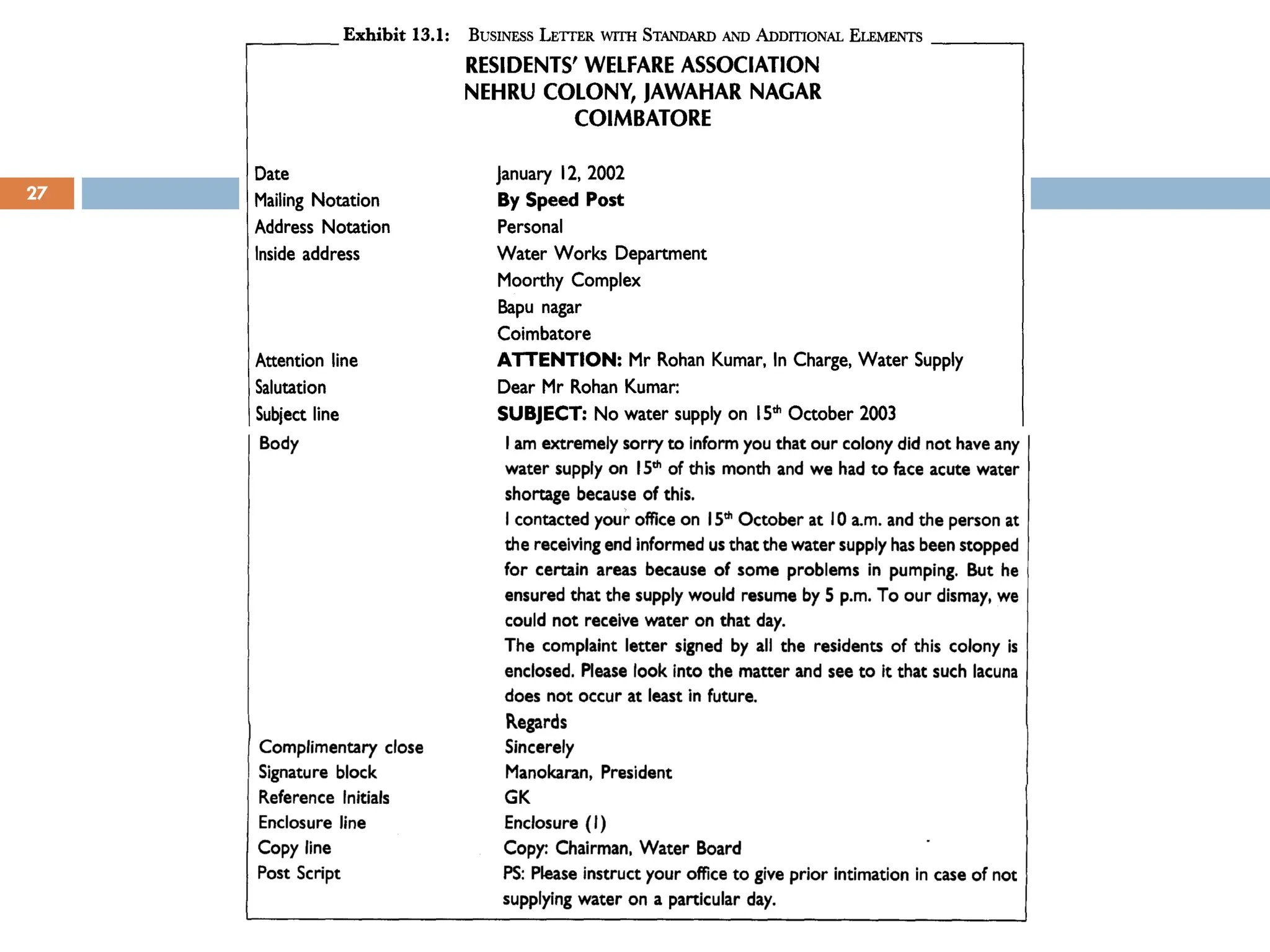
 The following example (Exhibit 13.1) shows both standard and additional
elements.
26
27
BUSINESS LETTERS
 Layout
 Suitable and correct layout enhances the overall effectiveness of any letter. The
layout helps to arrange all the elements of a business letter in an organized
manner.
 Although the basic parts of a business letter have remained the same for centuries,
the layouts do change. Sometimes a company adopts a certain format as its policy;
sometimes the individual letter writer is allowed to choose the format most
appropriate for a given letter or to settle on a personal performance, but in
general, four major letter layouts are commonly used.
 Block layout
 Modified block layout
 Semi-block layout
 Simplified layout
28
BUSINESS LETTERS
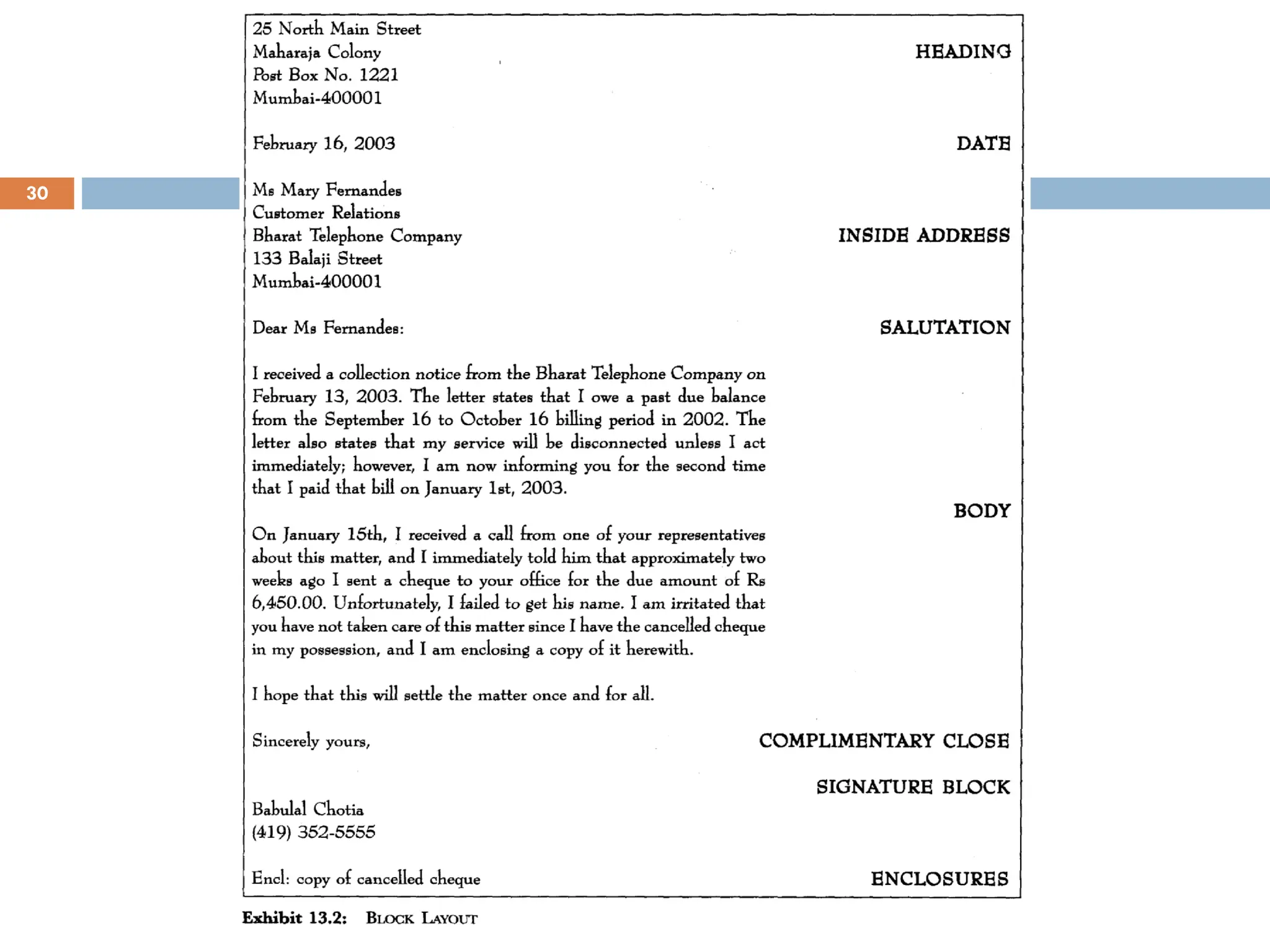
 Block Layout
 This form (Exhibit 13.2) is extremely popular as it
makes the letter look attractive, elegant, and
efficient. It has the following characteristics:
 All elements except the letterhead heading are
aligned to the left margin.
 It follows open punctuation. In other words the end
punctuation marks are omitted in each element except
the salutation, complimentary close, and message.
29
30
BUSINESS LETTERS
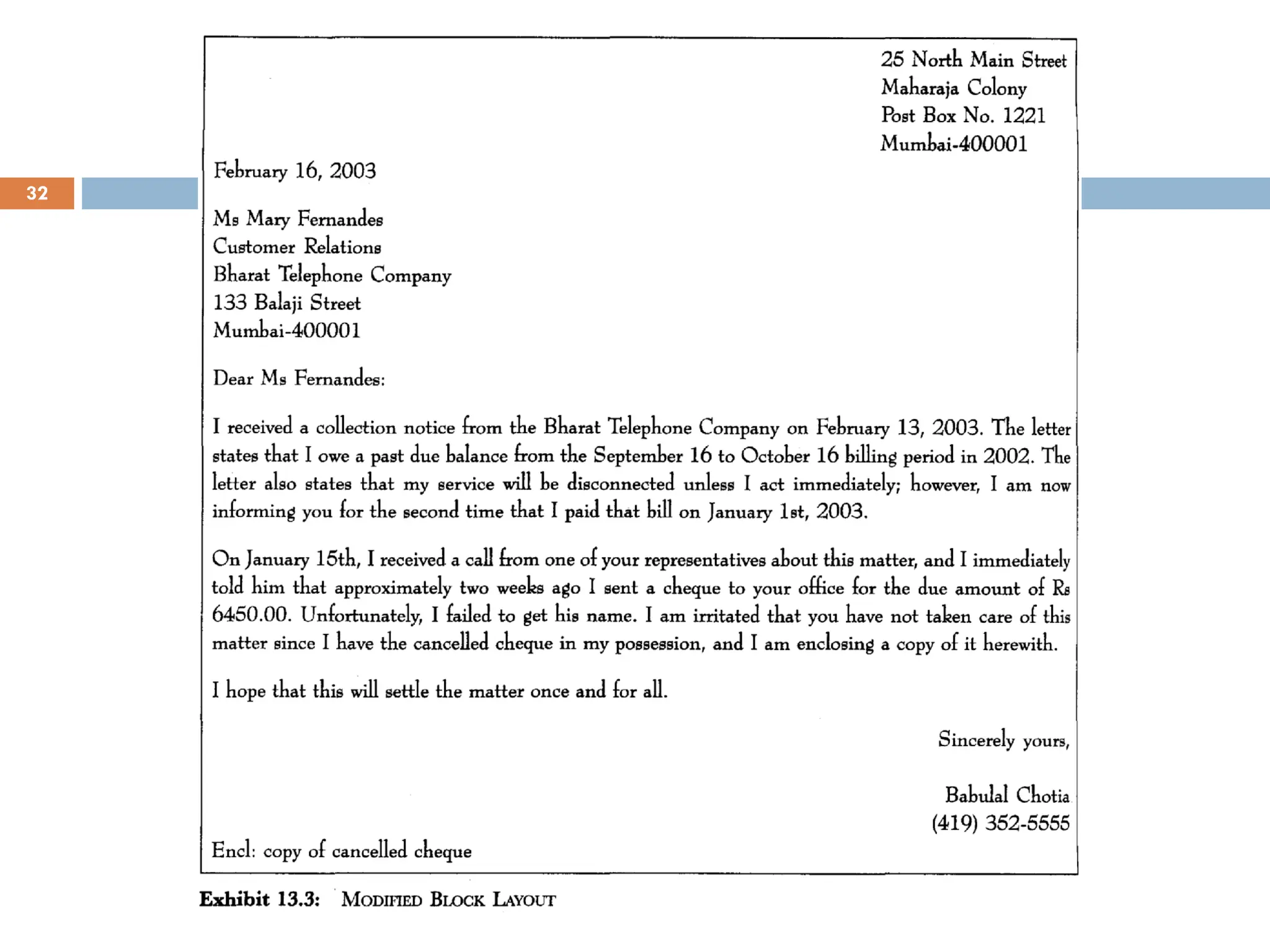
 Modified Block Layout
 Modified block format (Exhibit 13.3) differs from
block format in the positioning of certain elements:
 Heading, complimentary close, and signature block
are aligned vertically with the right margin.
 Although businesses seem to prefer full block
format, modified block is acceptable.
 Many people consider the modified block’s
appearance more balanced and traditional.
31
32
BUSINESS LETTERS
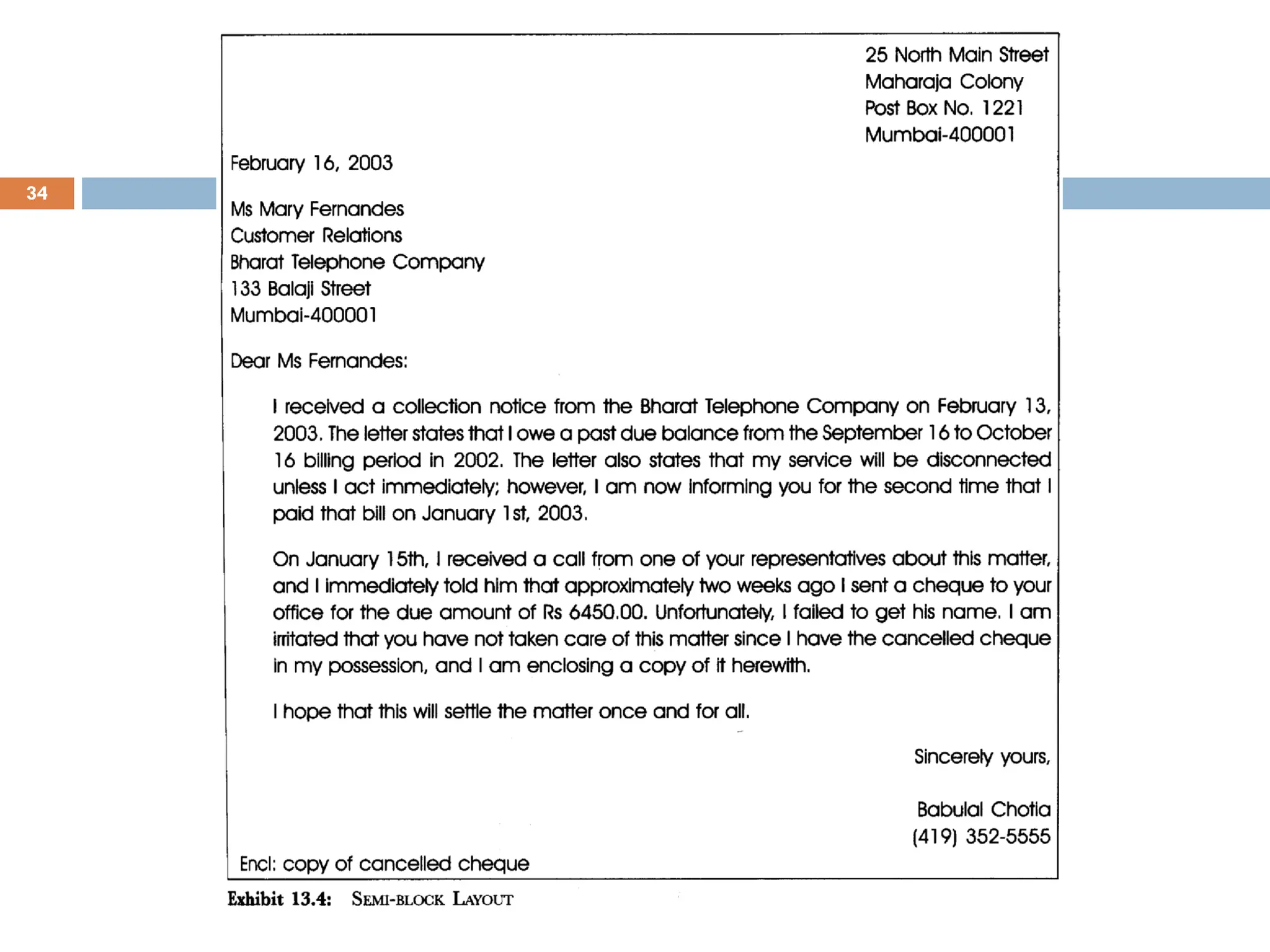
 Semi-block Layout
 This resembles modified block style except that the
start of each paragraph is indented, i.e., each
paragraph of the message starts a few spaces
away from the margin.
 This form makes the letter somewhat clumsy and has
gone out of style (Exhibit13.4).
33
34
BUSINESS LETTERS
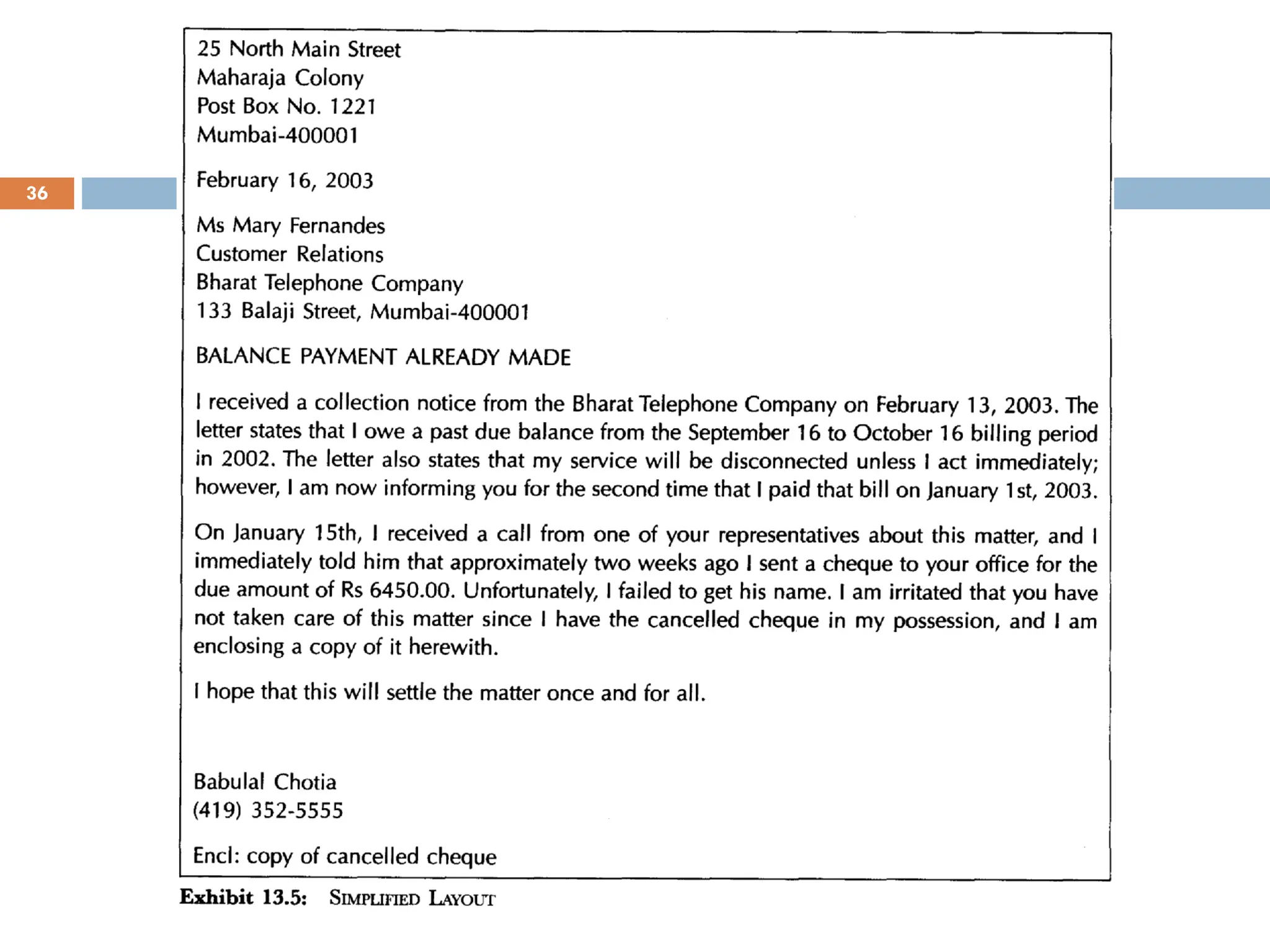
 Simplified Layout
 Though this format (Exhibit 13.5) resembles block format, it is
characterized by the following features:
 Omits salutation
 Often includes a subject line in capital letters
 Omits complimentary close
 This format is convenient when you do not know your recipient’s name.
 However, some people object to this format because it seems
mechanical and impersonal.
 Nevertheless, this drawback may be overcome with a warm writing
style.
35
36
BUSINESS LETTERS
 Principles
 Read the following message contained in a business letter.
Dear Sir
I am writing to complain that you haven’t paid any attention while sending the goods to us.
While we had ordered for 15 air conditioners, you sent 50 air coolers instead. This is
simply wasting my time and is most annoying. What is the reason for this nonsense?
Have you any problems? Are you understaffed? Is the volume of work too much for you
to manage? Or is it simply due to sheer carelessness? Whatever the reason, if this kind
of mistake occurs again, we shall stop our orders. Look into the matter carefully and do
the needful immediately.
Yours sincerely
Pradeep Bhatti
Purchase Manager
37
BUSINESS LETTERS
 How do you find this letter?
 If you are the recipient of this letter, how would you receive
it?
 Will you react positively to the complaint? Most probably
you may not feel like responding. You will only respond to
the complaint but also may decide to end your relationship
with this customer
 The Chinese proverb ‘In the midst of joy do not promise to
give a man anything, in the midst of great anger do not
answer man’s letter’ holds true in business letter writing.
38
BUSINESS LETTERS
 As already said, business letters are written mainly to create, establish,
or sustain your business relationship with others. A good relationship is
based on respect and courtesy.
 So, when trying to establish good relationships in your business
messages, remember to follow the principles of business letter writing
mentioned
 below:
 Use the you attitude
 Be clear and concise
 Be correct and complete
 Emphasize the positive
 Be courteous and considerate
39
BUSINESS LETTERS
 ‘You’ Attitude
 Focus on the recipient’s needs, purposes, or interests instead of your own. Even if
you must talk about yourself in a business letter a great deal, do so in a way
that relates your concerns to those of the recipient.
 This recipient-oriented style is often called the ‘you’ attitude. It does not mean
using more yours but making the recipient the main focus of the letter.
Remember that all letters are not propaganda material.
 Even an unpleasant situation can be changed by using the ‘you’ attitude.
 At the simplest level, you can adopt the ‘you’ attitude by replacing the terms
that refer to yourself and your company with terms that refer to your audience.
 In other words, use more of you and yours instead of I, me, mine, we, us, our,
and ours:
40
BUSINESS LETTERS
41
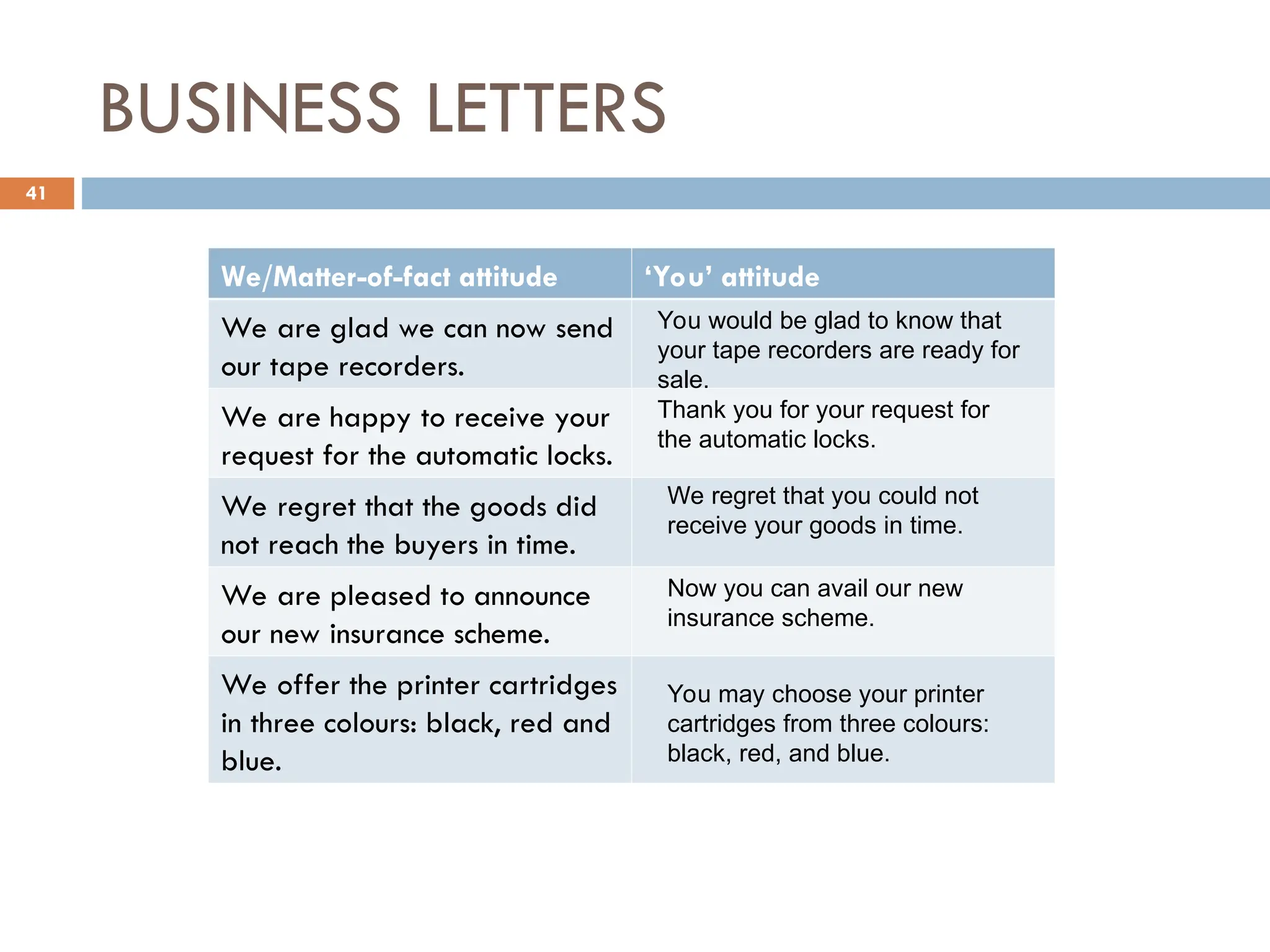
We/Matter-of-fact attitude ‘You’ attitude
We are glad we can now send
our tape recorders.
We are happy to receive your
request for the automatic locks.
We regret that the goods did
not reach the buyers in time.
We are pleased to announce
our new insurance scheme.
We offer the printer cartridges
in three colours: black, red and
blue.
You would be glad to know that
your tape recorders are ready for
sale.
Thank you for your request for
the automatic locks.
We regret that you could not
receive your goods in time.
Now you can avail our new
insurance scheme.
You may choose your printer
cartridges from three colours:
black, red, and blue.
BUSINESS LETTERS
 Remember that the ‘you’ attitude is not intended to be manipulative or
insincere.
 In fact it is an extension of the audience-centered approach.
 Also, this attitude is not just a matter of using one pronoun rather than
another; it is a matter of genuine empathy.
 Despite using you 20 times in a single letter you may be ignoring your
recipient’s concerns.
 Hence, it is the thought and sincerity that count and not the pronoun you.
 If you are writing to a manufacturer, think like a manufacturer; if you
are dealing with a retailer, put yourself in that position. The core of
‘you’ attitude is your attitude toward recipients and your appreciation
of their position or situation.
42
BUSINESS LETTERS
 But as you know, there are always exceptions to rules. The
‘you’ attitude may not help at times.
 On some occasions you will do better if you avoid using you.
For instance, when someone makes a mistake, you may want to
minimize ill feeling by referring to the mistake impersonally
rather than pointing out directly.
 You might say, ‘we have a problem’ instead of ‘you caused a
problem’.
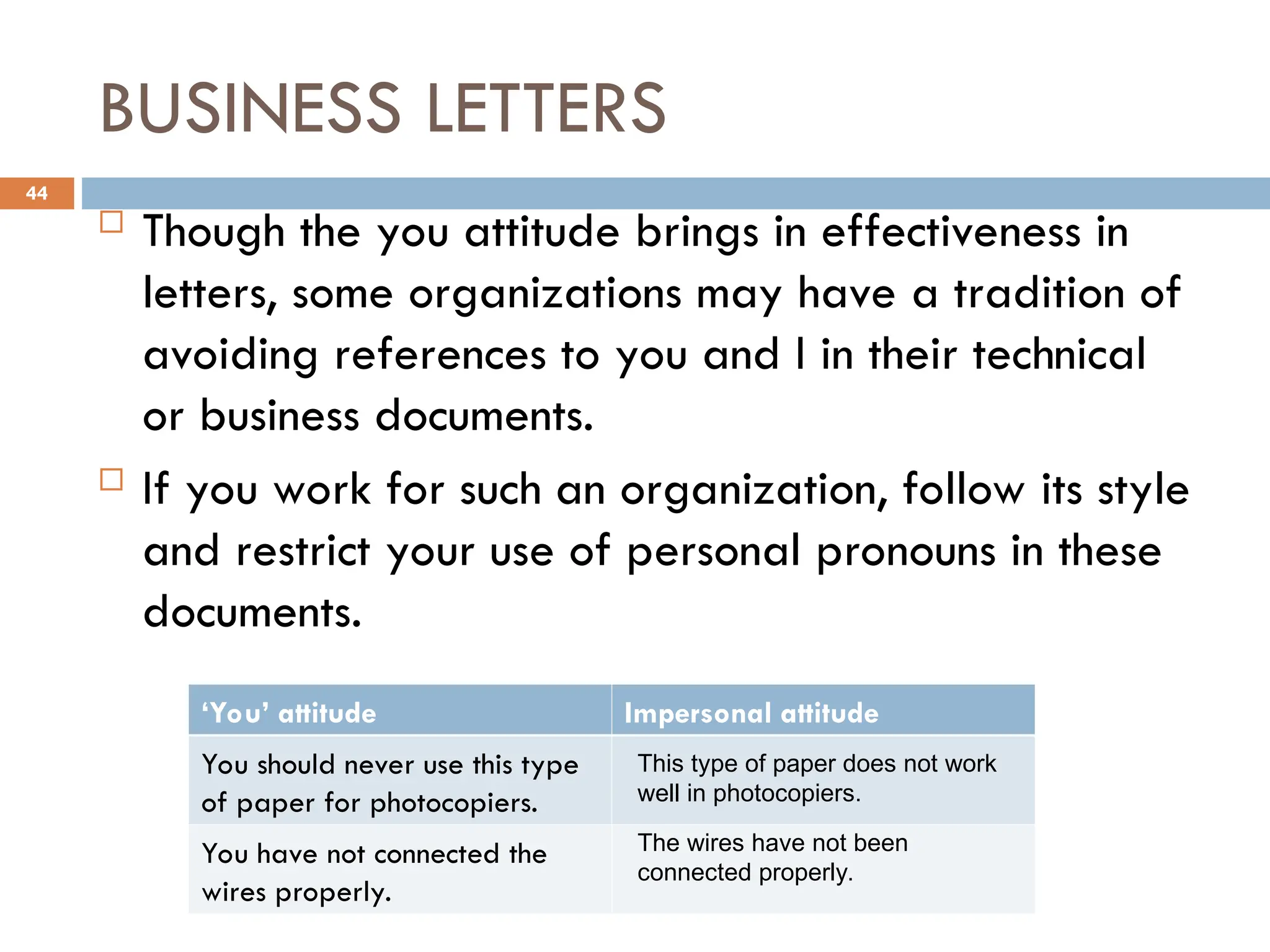
 Look at these examples. The more impersonal, matter-of-fact
tone shows greater sensitivity and avoids creating unnecessary
hard feelings in the recipient.
43
BUSINESS LETTERS
 Though the you attitude brings in effectiveness in
letters, some organizations may have a tradition of
avoiding references to you and I in their technical
or business documents.
 If you work for such an organization, follow its style
and restrict your use of personal pronouns in these
documents.
44
‘You’ attitude Impersonal attitude
You should never use this type
of paper for photocopiers.
You have not connected the
wires properly.
This type of paper does not work
well in photocopiers.
The wires have not been
connected properly.
BUSINESS LETTERS
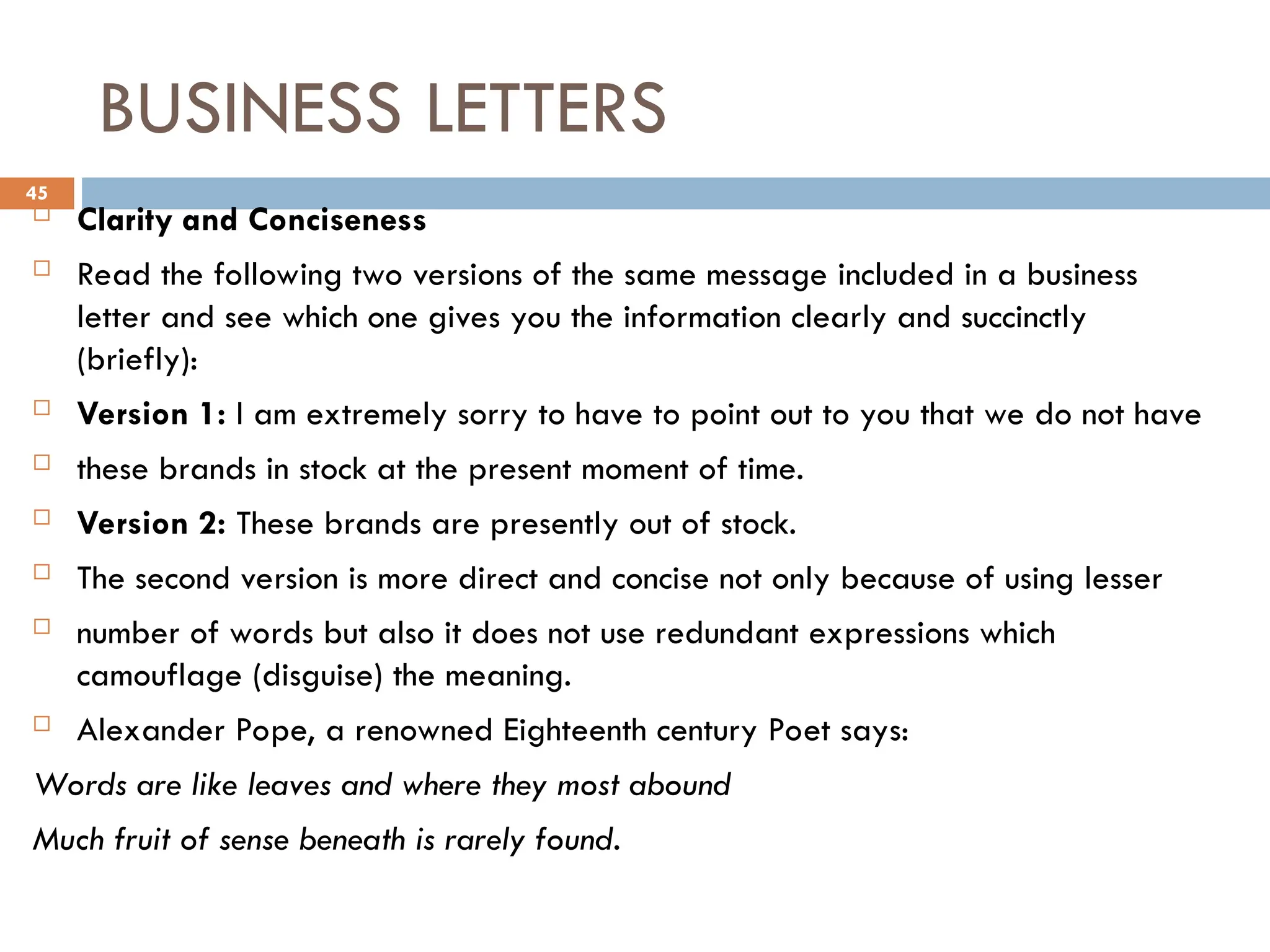
 Clarity and Conciseness
 Read the following two versions of the same message included in a business
letter and see which one gives you the information clearly and succinctly
(briefly):
 Version 1: I am extremely sorry to have to point out to you that we do not have
 these brands in stock at the present moment of time.
 Version 2: These brands are presently out of stock.
 The second version is more direct and concise not only because of using lesser
 number of words but also it does not use redundant expressions which
camouflage (disguise) the meaning.
 Alexander Pope, a renowned Eighteenth century Poet says:
Words are like leaves and where they most abound
Much fruit of sense beneath is rarely found.
45
BUSINESS LETTERS
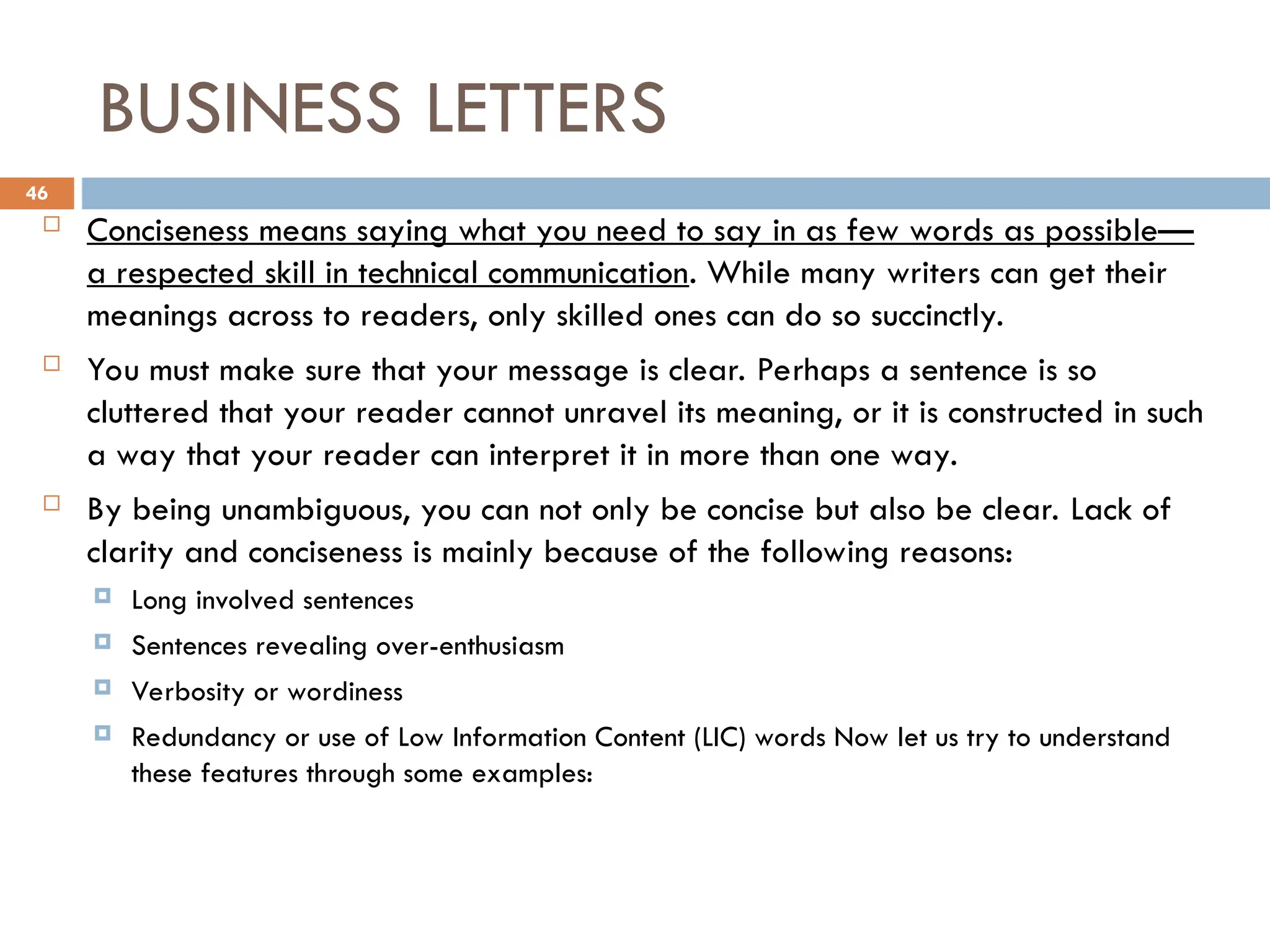
 Conciseness means saying what you need to say in as few words as possible—
a respected skill in technical communication. While many writers can get their
meanings across to readers, only skilled ones can do so succinctly.
 You must make sure that your message is clear. Perhaps a sentence is so
cluttered that your reader cannot unravel its meaning, or it is constructed in such
a way that your reader can interpret it in more than one way.
 By being unambiguous, you can not only be concise but also be clear. Lack of
clarity and conciseness is mainly because of the following reasons:
 Long involved sentences
 Sentences revealing over-enthusiasm
 Verbosity or wordiness
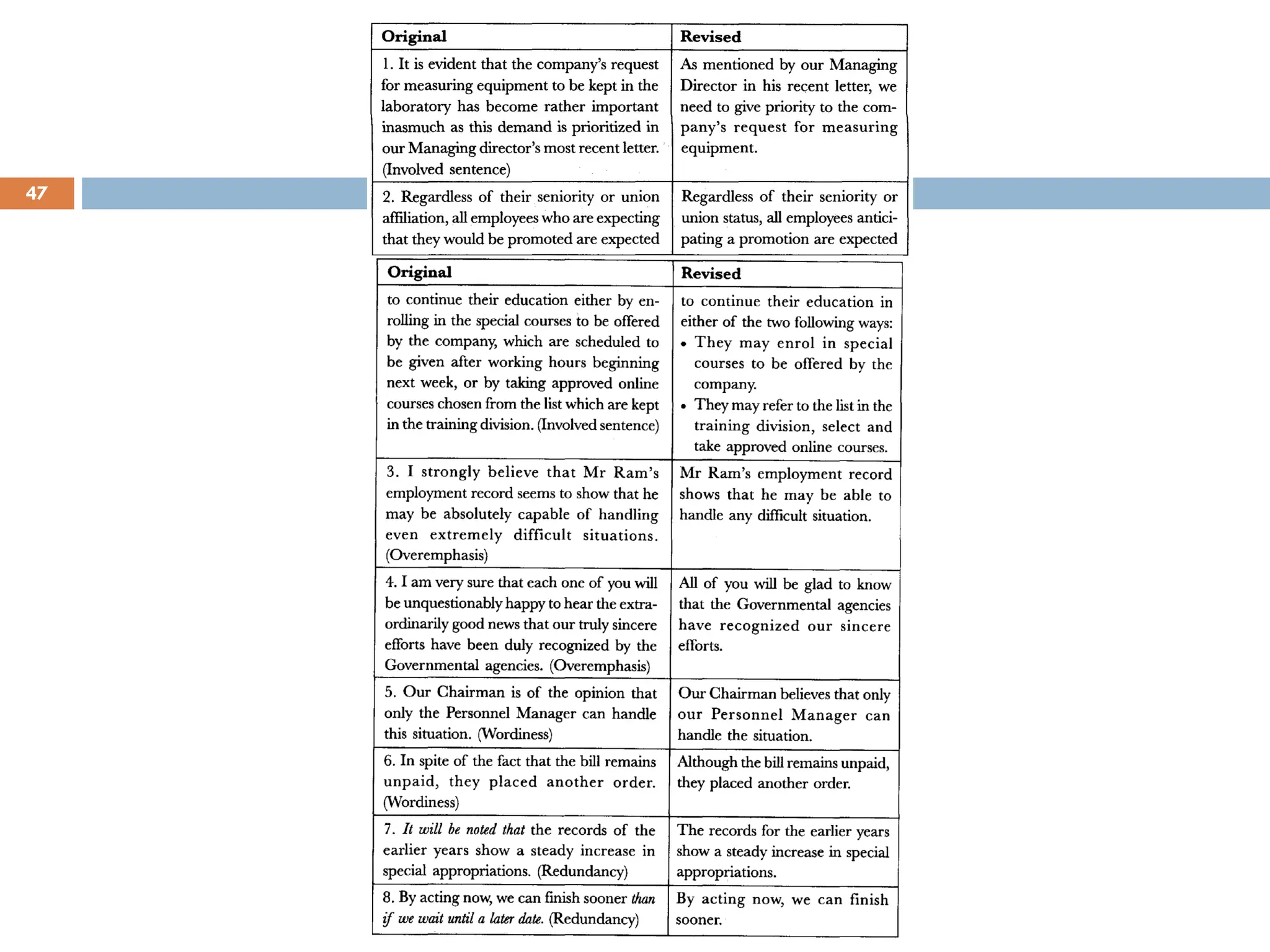
 Redundancy or use of Low Information Content (LIC) words Now let us try to understand
these features through some examples:
46
47
BUSINESS LETTERS
 The italicized phrases in examples 7 and 8 are
redundant. They serve no purpose and contain little
information.
 If you develop the practice of removing such
phrases from your business or technical writing, your
writing style will turn out to be more effective.
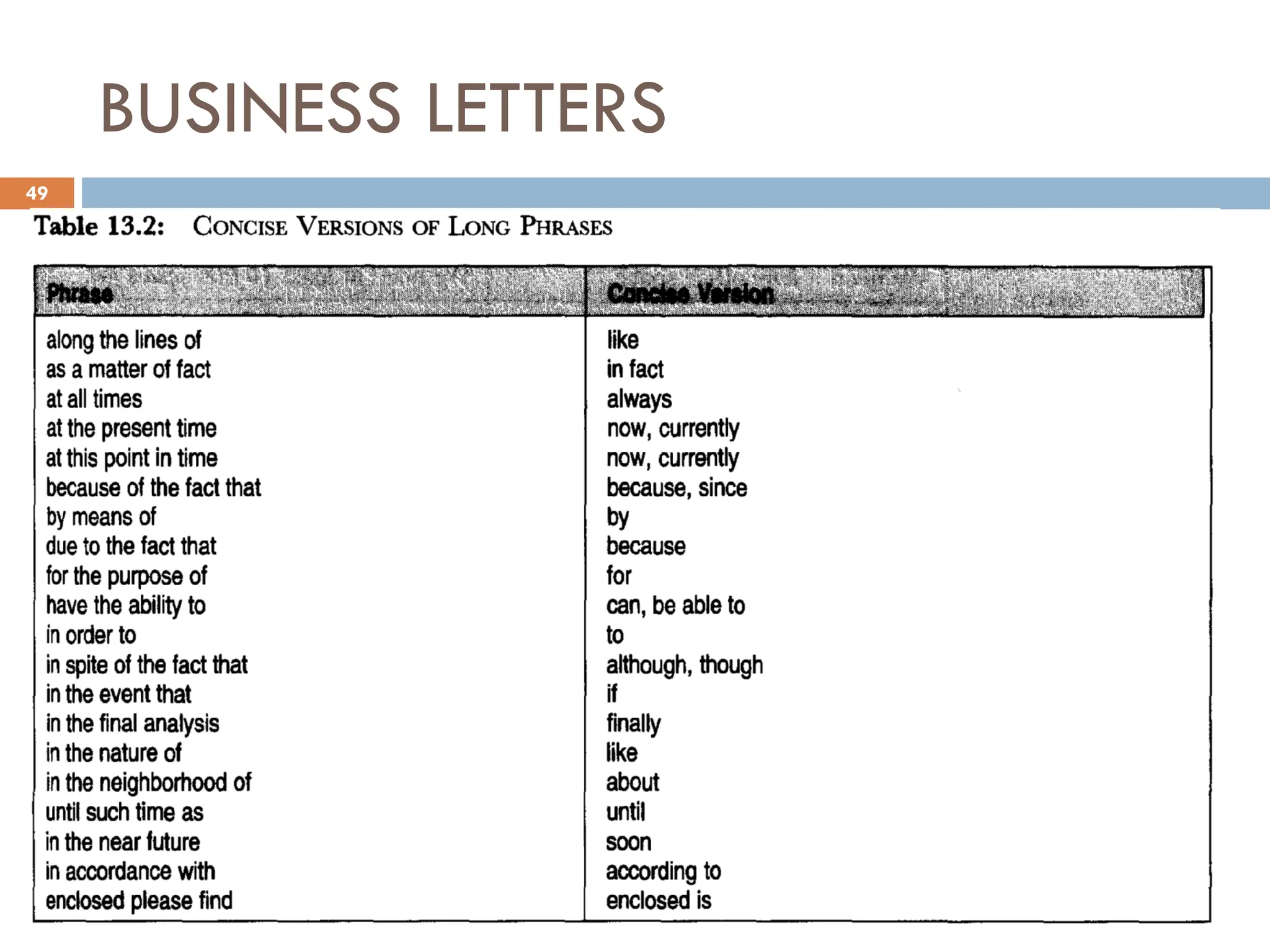
 Examples of some common phrases that can easily
be replaced with short, more concise words or
descriptions are given in Table 13.2.
48
BUSINESS LETTERS
49
BUSINESS LETTERS
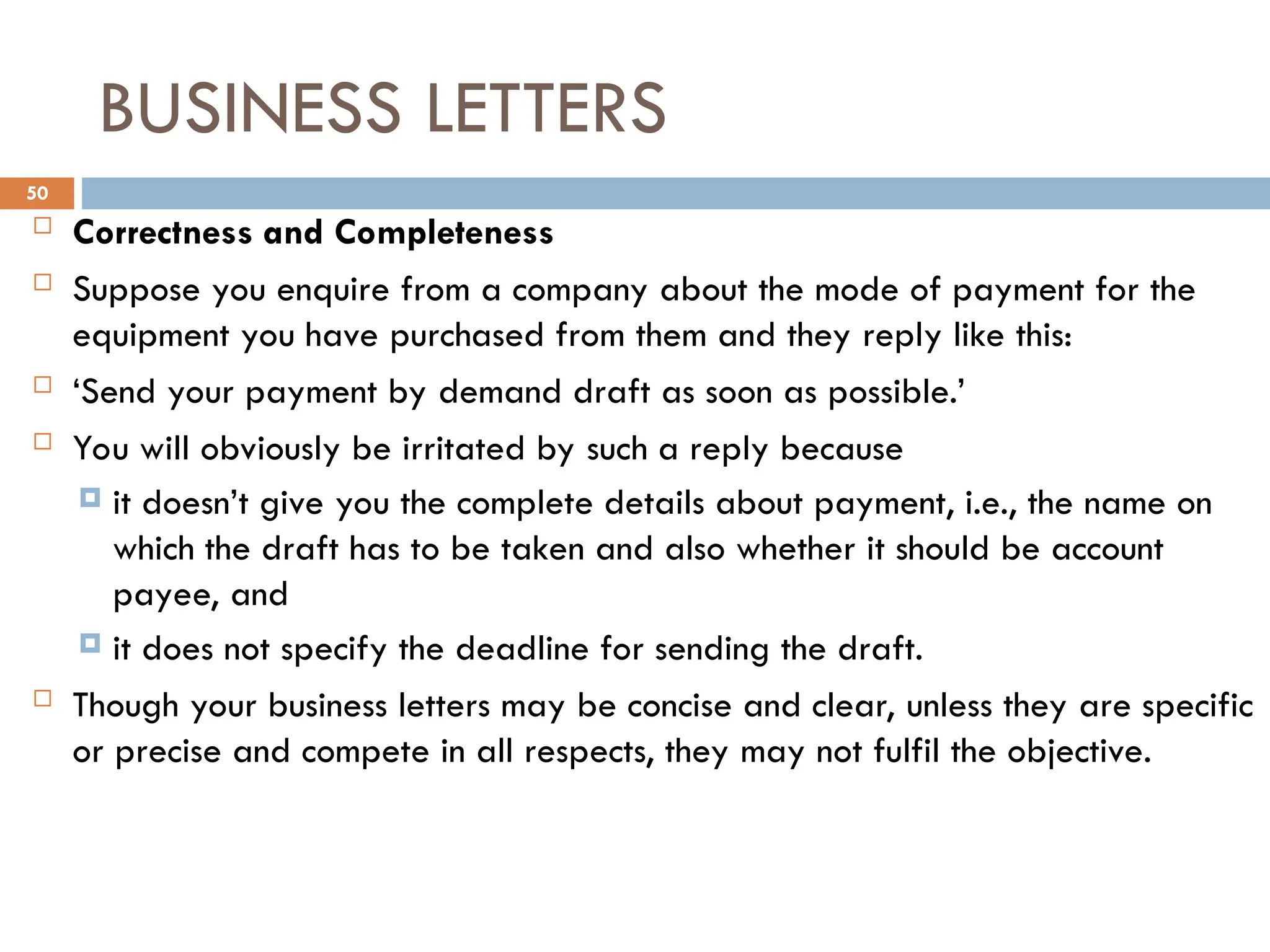
 Correctness and Completeness
 Suppose you enquire from a company about the mode of payment for the
equipment you have purchased from them and they reply like this:
 ‘Send your payment by demand draft as soon as possible.’
 You will obviously be irritated by such a reply because
 it doesn’t give you the complete details about payment, i.e., the name on
which the draft has to be taken and also whether it should be account
payee, and
 it does not specify the deadline for sending the draft.
 Though your business letters may be concise and clear, unless they are specific
or precise and compete in all respects, they may not fulfil the objective.
50
BUSINESS LETTERS
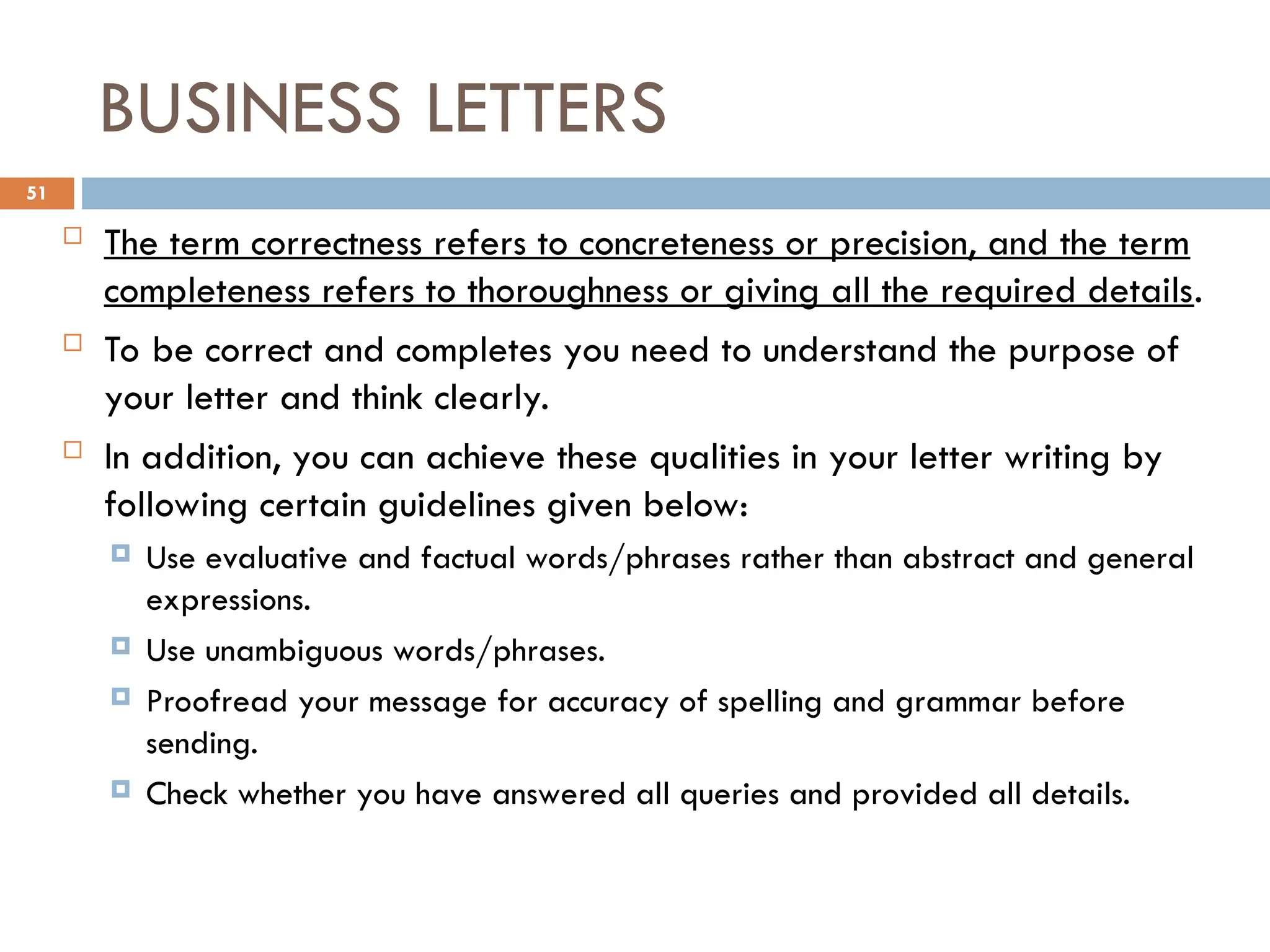
 The term correctness refers to concreteness or precision, and the term
completeness refers to thoroughness or giving all the required details.
 To be correct and completes you need to understand the purpose of
your letter and think clearly.
 In addition, you can achieve these qualities in your letter writing by
following certain guidelines given below:
 Use evaluative and factual words/phrases rather than abstract and general
expressions.
 Use unambiguous words/phrases.
 Proofread your message for accuracy of spelling and grammar before
sending.
 Check whether you have answered all queries and provided all details.
51
BUSINESS LETTERS
52
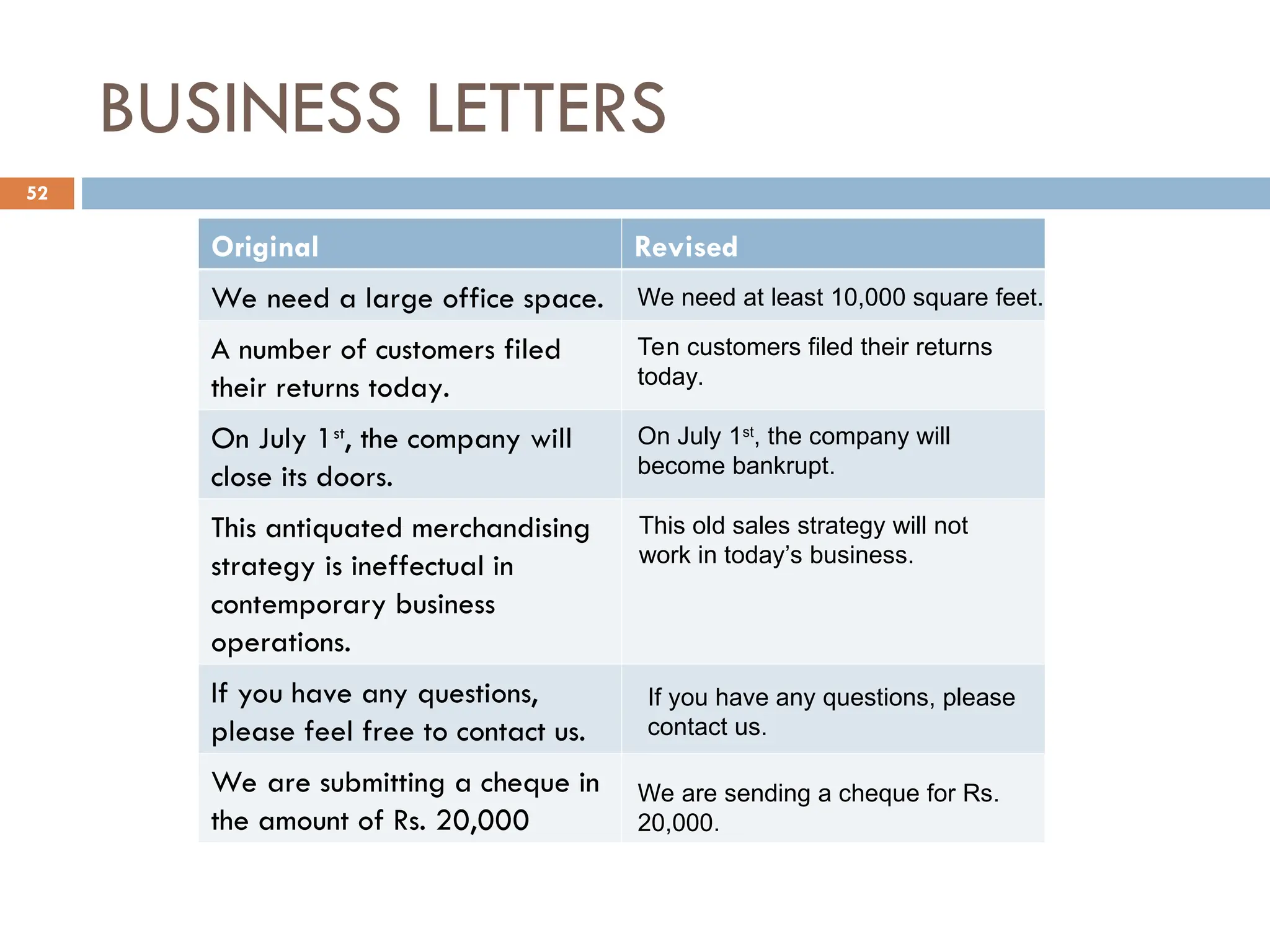
Original Revised
We need a large office space.
A number of customers filed
their returns today.
On July 1st
, the company will
close its doors.
This antiquated merchandising
strategy is ineffectual in
contemporary business
operations.
If you have any questions,
please feel free to contact us.
We are submitting a cheque in
the amount of Rs. 20,000
We need at least 10,000 square feet.
Ten customers filed their returns
today.
On July 1st
, the company will
become bankrupt.
This old sales strategy will not
work in today’s business.
If you have any questions, please
contact us.
We are sending a cheque for Rs.
20,000.
BUSINESS LETTERS
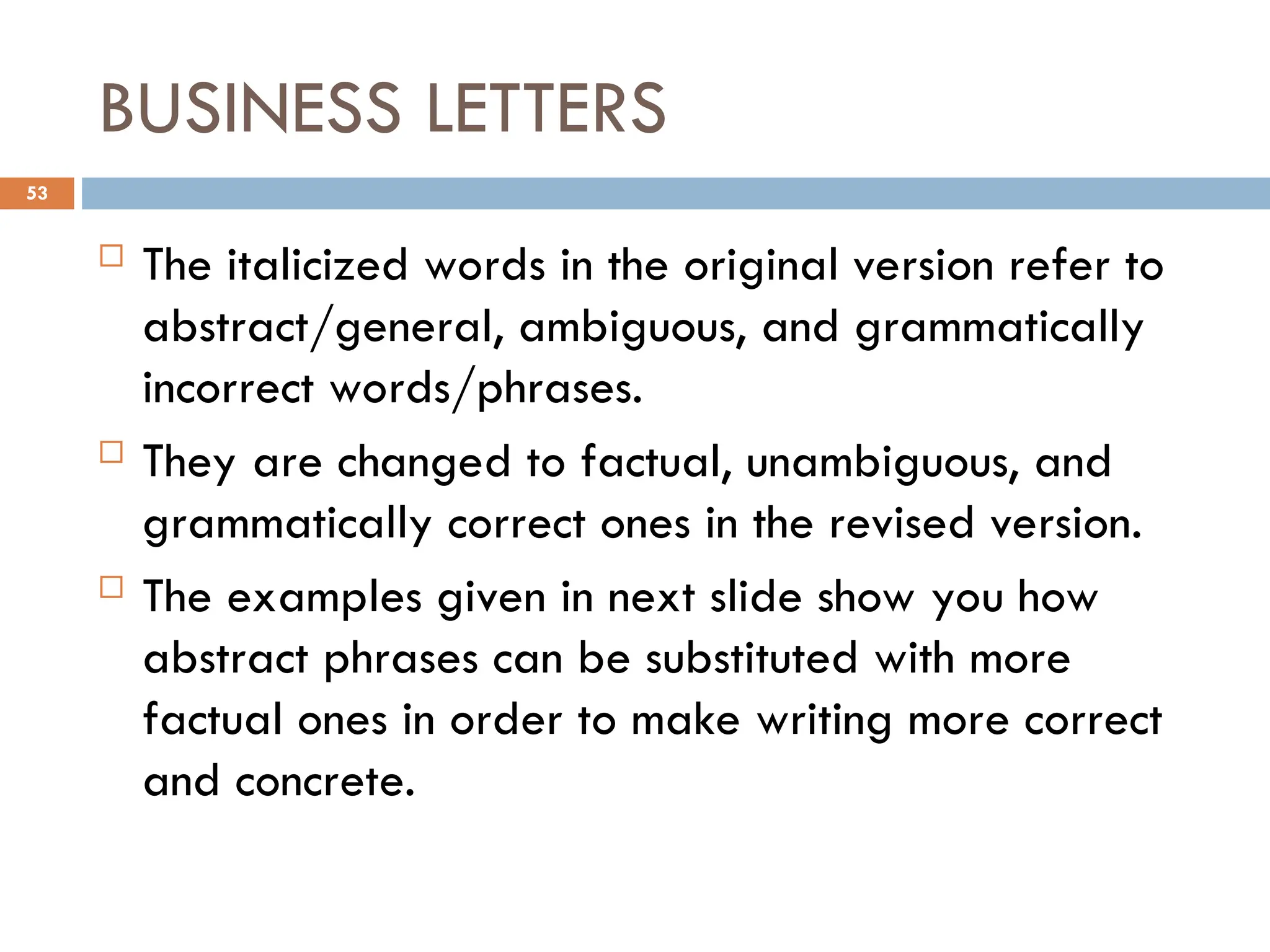
 The italicized words in the original version refer to
abstract/general, ambiguous, and grammatically
incorrect words/phrases.
 They are changed to factual, unambiguous, and
grammatically correct ones in the revised version.
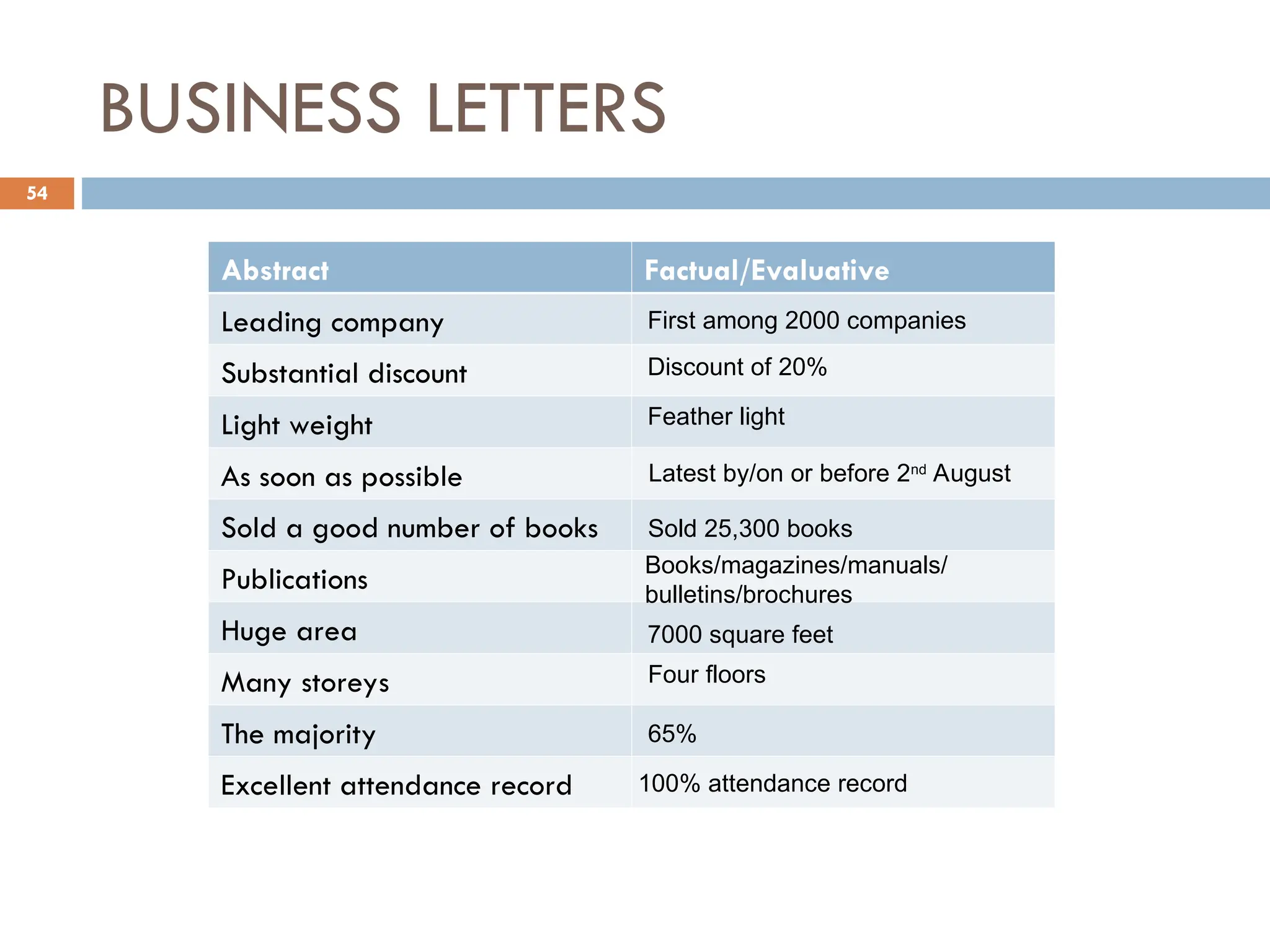
 The examples given in next slide show you how
abstract phrases can be substituted with more
factual ones in order to make writing more correct
and concrete.
53
BUSINESS LETTERS
54
Abstract Factual/Evaluative
Leading company
Substantial discount
Light weight
As soon as possible
Sold a good number of books
Publications
Huge area
Many storeys
The majority
Excellent attendance record
First among 2000 companies
Discount of 20%
Feather light
Latest by/on or before 2nd
August
Sold 25,300 books
Books/magazines/manuals/
bulletins/brochures
7000 square feet
Four floors
65%
100% attendance record
BUSINESS LETTERS
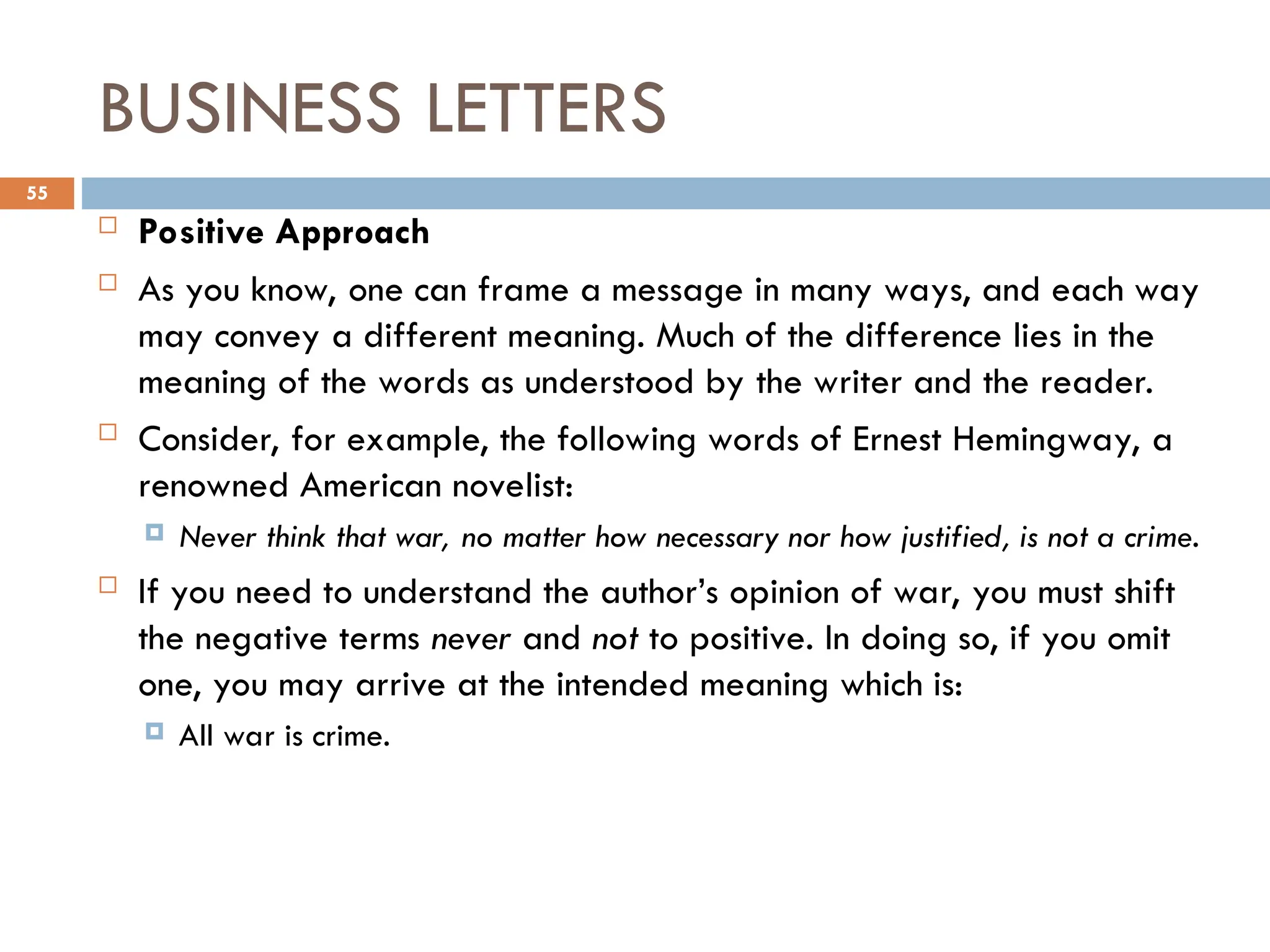
 Positive Approach
 As you know, one can frame a message in many ways, and each way
may convey a different meaning. Much of the difference lies in the
meaning of the words as understood by the writer and the reader.
 Consider, for example, the following words of Ernest Hemingway, a
renowned American novelist:
 Never think that war, no matter how necessary nor how justified, is not a crime.
 If you need to understand the author’s opinion of war, you must shift
the negative terms never and not to positive. In doing so, if you omit
one, you may arrive at the intended meaning which is:
 All war is crime.
55
BUSINESS LETTERS
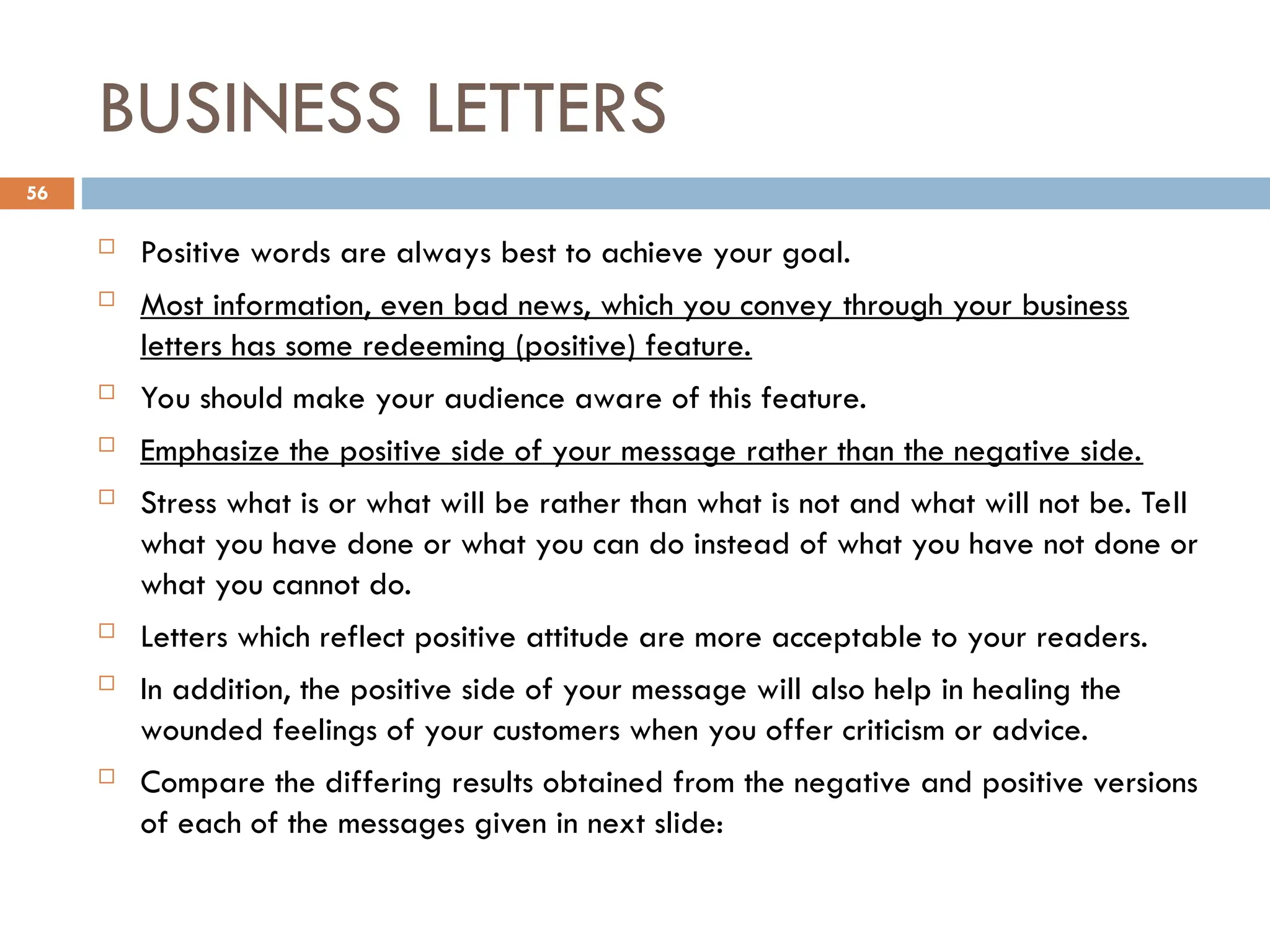
 Positive words are always best to achieve your goal.
 Most information, even bad news, which you convey through your business
letters has some redeeming (positive) feature.
 You should make your audience aware of this feature.
 Emphasize the positive side of your message rather than the negative side.
 Stress what is or what will be rather than what is not and what will not be. Tell
what you have done or what you can do instead of what you have not done or
what you cannot do.
 Letters which reflect positive attitude are more acceptable to your readers.
 In addition, the positive side of your message will also help in healing the
wounded feelings of your customers when you offer criticism or advice.
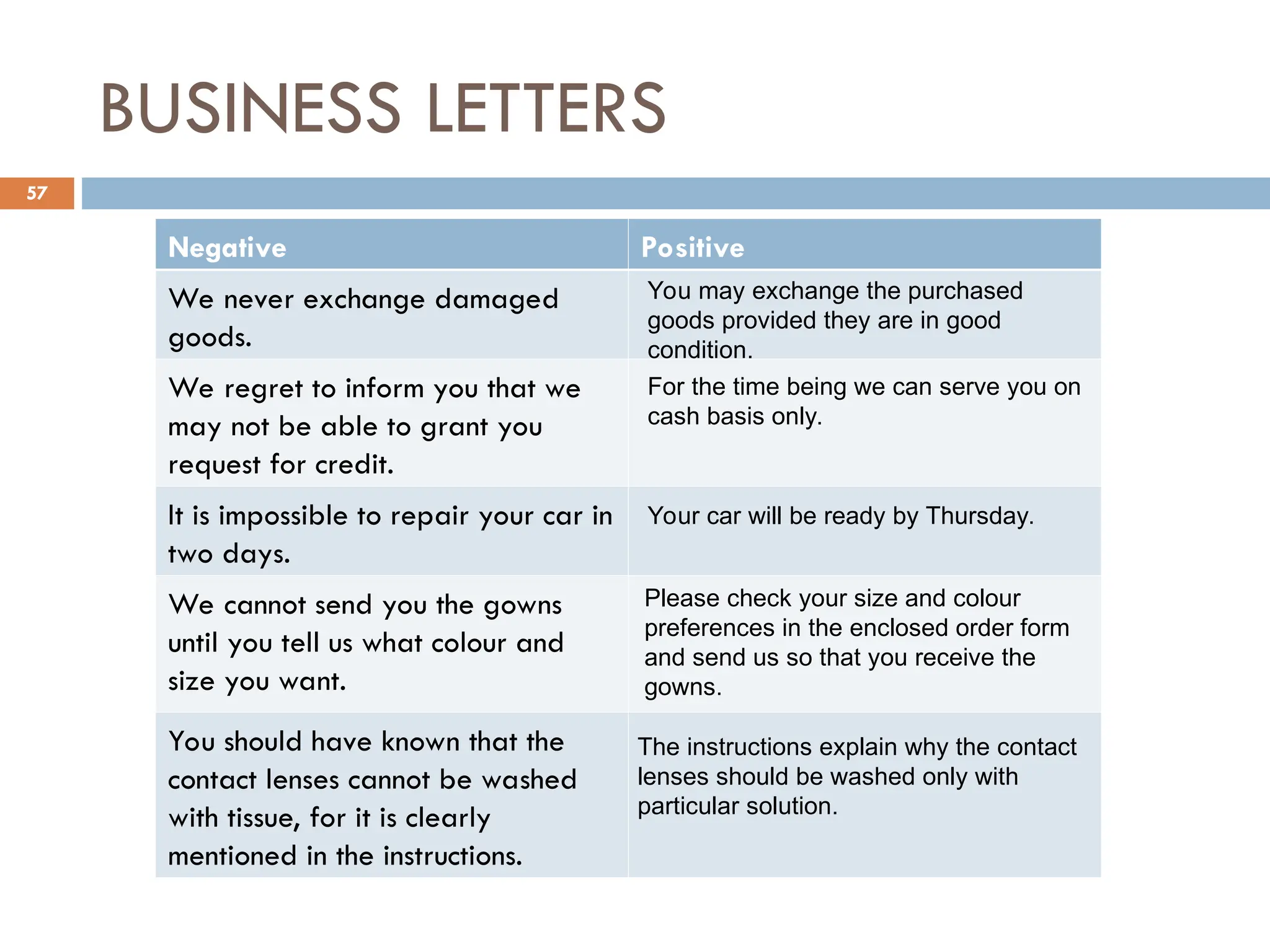
 Compare the differing results obtained from the negative and positive versions
of each of the messages given in next slide:
56
BUSINESS LETTERS
Negative Positive
We never exchange damaged
goods.
We regret to inform you that we
may not be able to grant you
request for credit.
It is impossible to repair your car in
two days.
We cannot send you the gowns
until you tell us what colour and
size you want.
You should have known that the
contact lenses cannot be washed
with tissue, for it is clearly
mentioned in the instructions.
57
You may exchange the purchased
goods provided they are in good
condition.
For the time being we can serve you on
cash basis only.
Your car will be ready by Thursday.
Please check your size and colour
preferences in the enclosed order form
and send us so that you receive the
gowns.
The instructions explain why the contact
lenses should be washed only with
particular solution.
BUSINESS LETTERS
 Also avoid words with negative connotations
(suggestion). In other words, try to frame your
message with words which will not offend or hurt
your readers. Replace words with the unpleasant
connotations with mild terms
58
BUSINESS LETTERS
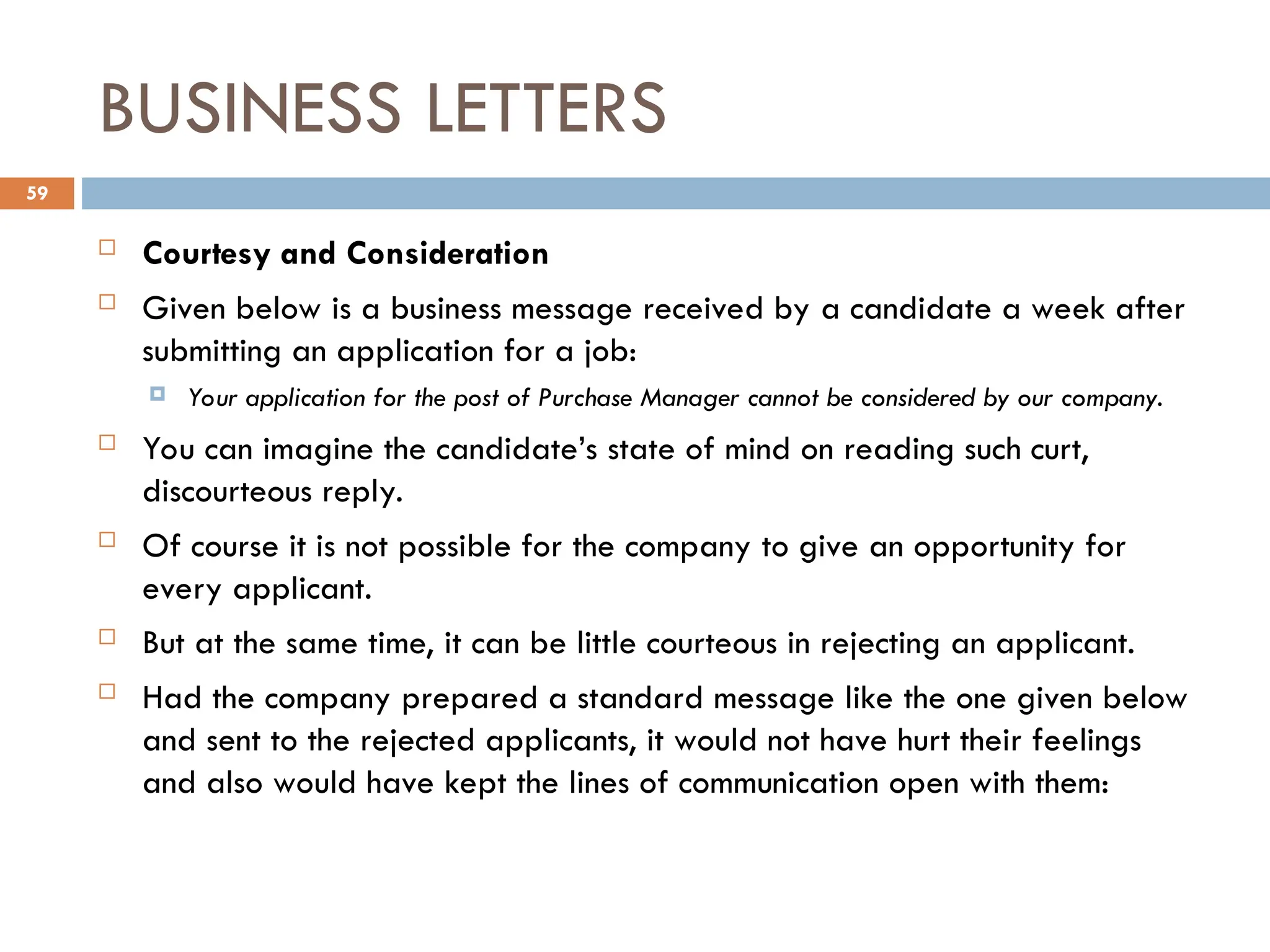
 Courtesy and Consideration
 Given below is a business message received by a candidate a week after
submitting an application for a job:
 Your application for the post of Purchase Manager cannot be considered by our company.
 You can imagine the candidate’s state of mind on reading such curt,
discourteous reply.
 Of course it is not possible for the company to give an opportunity for
every applicant.
 But at the same time, it can be little courteous in rejecting an applicant.
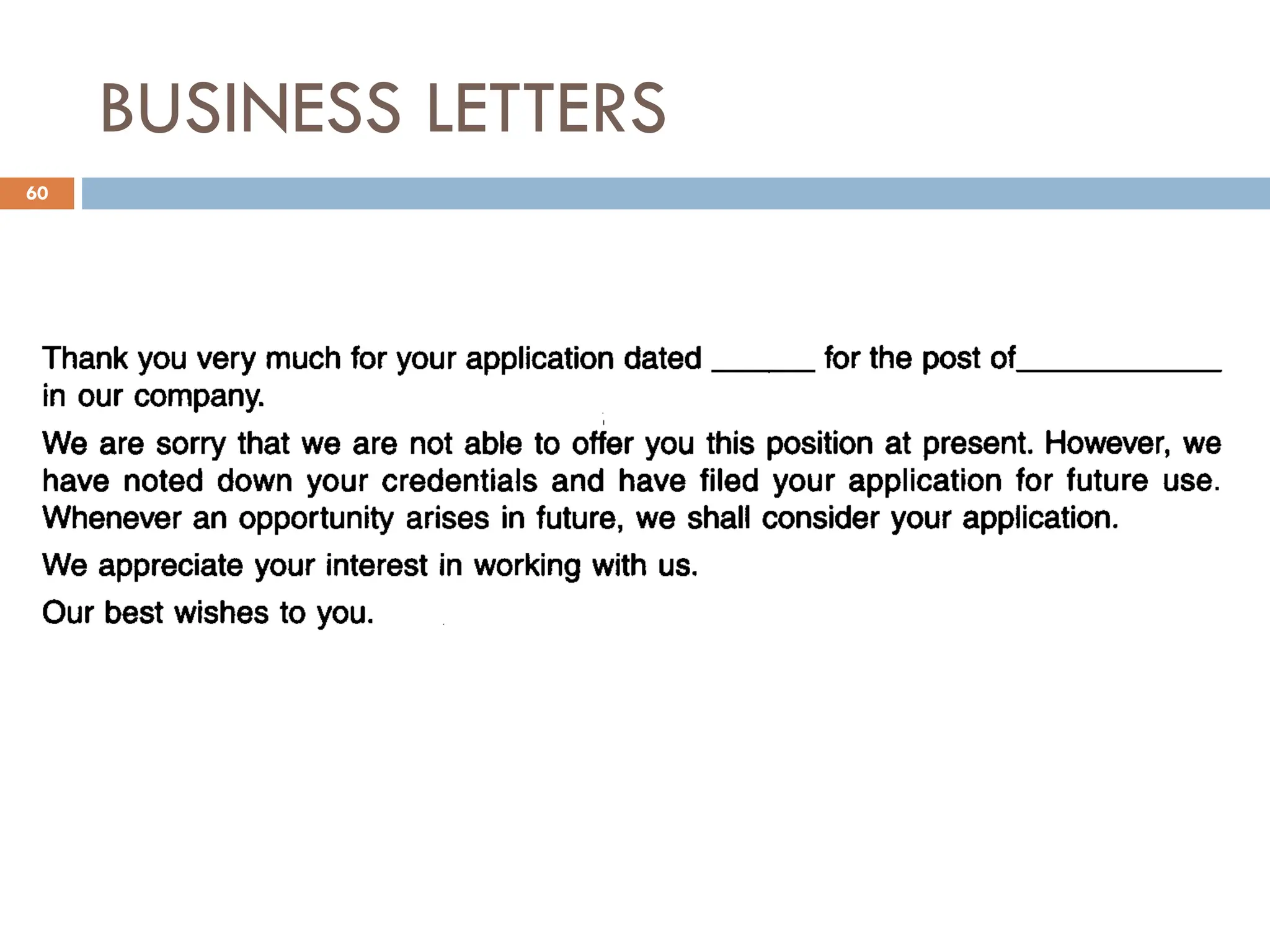
 Had the company prepared a standard message like the one given below
and sent to the rejected applicants, it would not have hurt their feelings
and also would have kept the lines of communication open with them:
59
BUSINESS LETTERS
60
BUSINESS LETTERS
 Courtesy is oil; it reduces friction.
 Being polite to your readers is another way of earning their respect and sustaining
your relationship with them.
 Not only do you show consideration for their needs and feelings but also you treat
them with friendly concern when you are courteous in your business letters. The
resultant climate will facilitate both you and your readers to forge stronger bonds.
 When you meet somebody face to face, you can express your courtesy and
consideration through non-verbal means and by speaking appropriate words.
 Similarly when you wish to be courteous and considerate to your recipients of your
letters, you need to:
 use a conversational tone (be natural)
 avoid dogmatism (do not preach)
 avoid anger (be patient)
61
BUSINESS LETTERS
 The following examples will give you an idea of how
courtesy and consideration bring in a positive a
desirable change in the style of your business letters.
 You may also notice that when you express courtesy,
you may have to explain something extra and in this
process you may end up with more words.
 But never mind. Cutting down on words is not your
objective in writing letters:
62
BUSINESS LETTERS
63
BUSINESS LETTERS
 Here are certain phrases which may help you in
expressing courtesy and consideration:
 Many thanks for your letter dated...
 Kindly respond to our request for...
 Please refer to our order dated...
 You are correct Ms Varma in saying that...
 You will be pleased to know that...
 Please do not forget to send us the original as.
 We appreciate your prompt response to our...
 We are sorry that we may not be able to grant you
64
BUSINESS LETTERS
 But remember to avoid the artificial and angry
expressions as the ones given below:
 Please permit me to say that...
 Please be advised that...
 It has come to my attention that...
 We beg to state that...
 Never has there been, nor there will be, a customer as good as you...
 We have no intention of allowing this state of affairs to continue.
 I simply cannot understand your negligence.
65
BUSINESS LETTERS
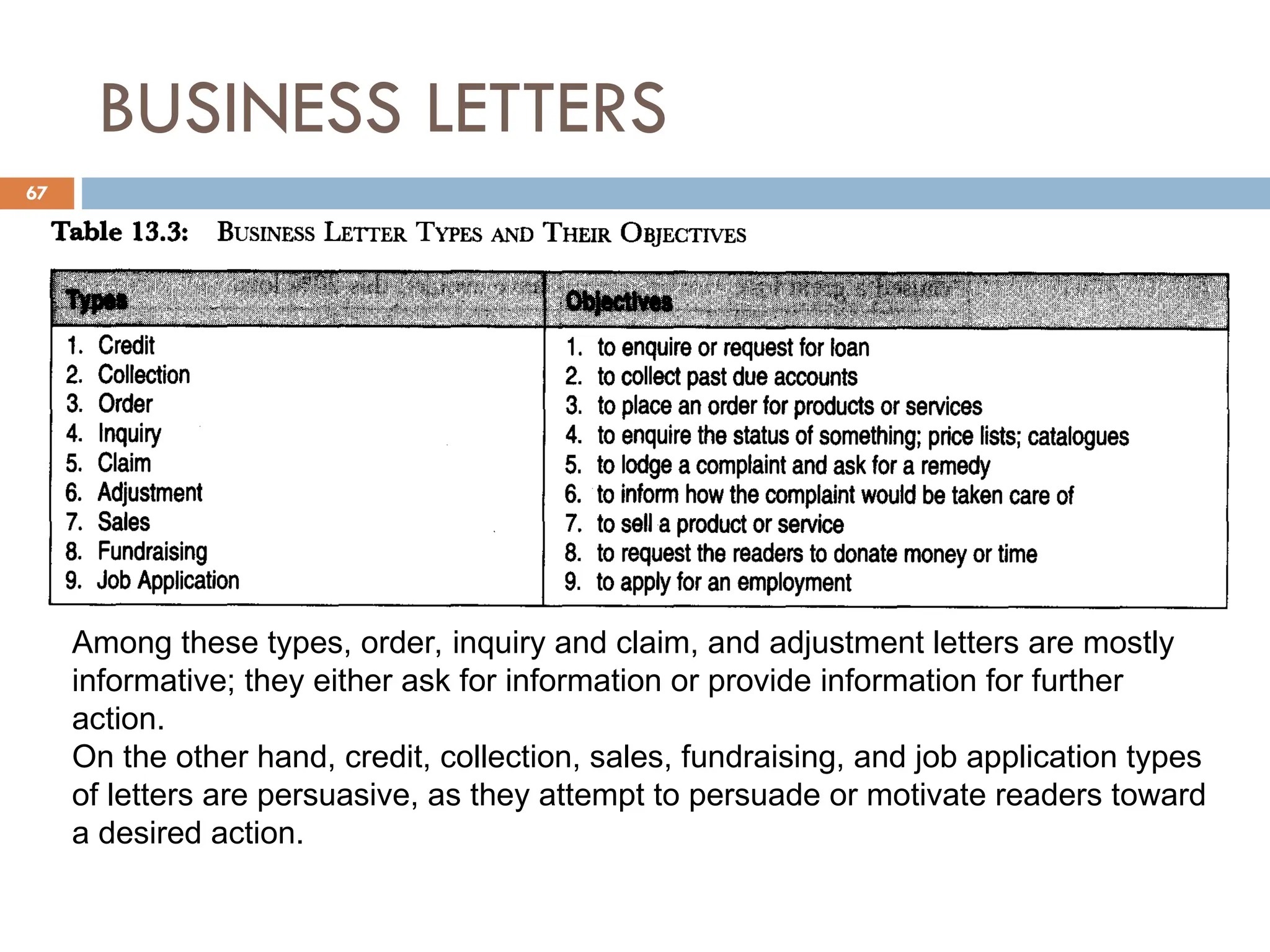
 Types and Samples
 Depending on their purpose, business letters can be
classified into various types, as shown in Table
13.3.
 Credit and collection letters
 Order and enquiry letters
 Claim and adjustment letters
 Sales and fund-raising letters
 Job application letters
66
BUSINESS LETTERS
Among these types, order, inquiry and claim, and adjustment letters are mostly
informative; they either ask for information or provide information for further
action.
On the other hand, credit, collection, sales, fundraising, and job application types
of letters are persuasive, as they attempt to persuade or motivate readers toward
a desired action.
67

12_Business_Letters_ppt.ppt ppt on business letters

  • 1.
  • 2.
    BUSINESS LETTERS  Anybusiness will have to correspond in writing with its customers, branches, suppliers, bankers, and others with whom it has or would like to have a lasting relationship  Business letters serve as a means to reach out to people not only within the locality and neighbourhood but also in other cities and nations  They represent you when you conduct transactions in writing  They have become such an integral part of every day business that one cannot think of running a business without the related correspondence. 2
  • 3.
    BUSINESS LETTERS  Thoughthere are many modern communication methods available these days, the traditional business letters still retain their importance in the business world for the following reasons:  Just as your personal letters help you keep your personal relationship with your friends and relatives alive, business letters assist you in sustaining your business relationships with other businesses and customers.  They are the appropriate form of communication when the information you wish to convey is complex.  They serve as permanent records and are a valuable repository of information, which you can refer to in future.  They help you reach a large and geographically diverse audience thereby enabling you to save money on telephone calls. 3
  • 4.
    BUSINESS LETTERS  Purpose The ultimate purpose of writing any business letter is to sustain the existing business relationships or to create and establish a new business relationship.  But each individual letter will have a unique purpose. For example, when you apply for a job, you aim at offering your services to your prospective employer.  Similarly, as the purchase manager of a company when you write a letter complaining about the damaged consignment, your aim is not only to bring the flaw to the notice of the recipient but also to request for a corrective action. 4
  • 5.
    BUSINESS LETTERS  Businessletters therefore are written for varied purposes as mentioned below;  to inform  to congratulate  to enquire  to order  to request  to collect dues  to complain  to make an adjustment  to sell a product, service, or scheme  to apply for a job 5
  • 6.
    BUSINESS LETTERS  Structure Business letters are different from personal letters as they have a distinct structure and layout.  Although there are different types of letters, each relevant in a specific context, they share a common structure comprising various elements or parts.  You need to be familiar with not only these different elements but also their positioning in the letter and the purpose for which they are included in the letter.  Several of these elements appear in every letter; others appear only when desirable or appropriate. 6
  • 7.
    BUSINESS LETTERS  StandardElements  Heading: This element is also known as the letterhead, which shows the organization’s name, full address, and also telephone numbers.  If the letterhead is not used, the heading includes the sender’s address.  Letterheads have the potential to create a favourable impression and hence need to be designed with thought and imagination.  The colour and quality of paper, the size of the letterhead, the type of fonts that are used, and the spacing are factors to be carefully considered.  Many companies even seek the help of advertising agencies to design their letterheads. 7
  • 8.
    BUSINESS LETTERS  Whenevera letterhead paper is not used, the sender’s address is either aligned with left margin or few spaces away from the centre depending upon the layout of the letter.  For example, the same heading given above can be displayed as follows: 8
  • 9.
  • 10.
    BUSINESS LETTERS  StandardElements  Date: This refers to the date the letter was written. It includes the date, the month, and the year. You can represent this in either of the following two ways:  3 June 2003 or June 3, 2003  For international correspondence, check the accepted format for the recipient’s region. 10
  • 11.
    BUSINESS LETTERS  StandardElements  Inside Address This part of the letter identifies the recipient of the letter and is separated from the date by at least one blank line. The amount of space separating the inside address from the date may be adjusted to suit the length of the letter.  A courtesy title should precede the recipient’s name. Table 13.1 shows you the appropriate titles to be used.  It is always best to address your letter to a specific person.  You can usually identify the name of the person by checking the organization’s website or telephoning the organization.  If you do not know the name of a specific person, it is acceptable to address the letter to the department or to a job title.  Immediately following the addressee’s name and title, separate lines should contain the name of the company, the street address or post office box number, and the city and state or province with proper postal code or zip code. If you are writing internationally, the addressee’s country should follow in capital letters and occupy the last line of inside address. 11
  • 12.
  • 13.
  • 14.
    BUSINESS LETTERS  StandardElements  Salutation: Always try to address your letter to a person by name rather than title. If you must send a form letter or if you cannot find a specific name, you may choose a salutation such as:  Dear Committee Member  Dear Students  Dear Colleagues  To All Sales Reps  To Whom It May Concern  Dear Sir or Madam  Dear Madam or Sir  Dear Purchasing Agent 14
  • 15.
  • 16.
    BUSINESS LETTERS  StandardElements  Message: This part of your letter will usually occupy the greatest amount of space.  It should be single-spaced, with a blank line separating it from the preceding and the following parts of your letter.  In addition, you should also separate each paragraph of your message by a blank line.  Within the message part or the main text of your letter, you can use formatting to help the reader.  For example you can use bulleted lists, italics, and bold fonts.  But be certain that these are consistent with the existing practice or style of letter writing in your organization. 16
  • 17.
    BUSINESS LETTERS  StandardElements  Complimentary Close This element is a single word or phrase, separated from the message by a blank line. Here is a list of expressions that can be used for complimentary closing:  Sincerely  Cordially  Truly  Faithfully  Respectfully  Faithfully yours  Respectfully yours  Cordially yours  Truly yours  Sincerely yours  Yours sincerely  Yours truly  Yours obediently  Yours faithfully 17
  • 18.
    BUSINESS LETTERS  StandardElements  Signature Block The complimentary closing line is followed by the signature block, which includes your signature, name and title.  Every letter must end with a signature to give authenticity to the information contained in it. An unsigned letter is of no consequence.  Place the signature block four lines below the complimentary close. Include your name and the title.  If your name might leave the reader in doubt about your gender, you may include a title in the signature block as shown in the sample given below: Cordially, Ms. Santosh Singh Senior Executive 18
  • 19.
    BUSINESS LETTERS  StandardElements  Your letterhead indicates that you are representing your organization.  However, if your letter is on plain paper or runs to a second page, you may want to emphasize that you are writing legally for the company.  The accepted way of doing so is to place the company’s name in capital letters a double space below the complimentary close and then include the sender’s name and title four lines below that. Sincerely, SHAREWELL INDUSTRIES Mr.Atul Chauhan President  If an organization has delegated the authority of signing letters to an executive by the Power of Attorney, that executive will add per pro. or pp. just before the name of the organization and sign below it as: Cordially, Per Pro. Sharewell Industries Lakshmi Deshpande 19
  • 20.
    BUSINESS LETTERS  AdditionalElements  Formal letters differ greatly in subject matter, the identifying information they need (such as addressee notation, attention line, subject line, or reference line) and also the format they adopt.  The following elements may be used in any combination, depending upon the requirements of the particular letter, but generally in the order shown below:  Addressee notation  Attention line  Subject line  Reference initials  Enclosure notation  Copy notation  Mailing notation  Postscript 20
  • 21.
    BUSINESS LETTERS  AddresseeNotation  This sort of notation generally appears a double space above the inside address, in all capital letters. Personal, Confidential or Please Forward, Through Proper Channel are examples of such notations which are used in letters that have a restricted readership or that must be handled in a special way.  Attention Line  An attention line can be used to draw the attention of a particular person or a particular department in an organization so as to ensure a quick and prompt action on your letter.  You may place the attention line two spaces below the inside address. This line is included in the following manner: Attention: Dr Satish Yadav Attention: Personnel Manager 21
  • 22.
    BUSINESS LETTERS  SubjectLine This element lets the recipient know at a glance what the letter is about; it also indicates where to file the letter for future reference.  It usually appears below the salutation. But sometimes it is placed above the salutation and below the attention line:  Dear Mr Gupta: Subject: Information regarding last week’s inspection  Attention: Personnel manager Subject: Information regarding last week’s inspection Dear Mr Gupta: The attention line and the subject line are generally given in bold as well as capital letters. 22
  • 23.
    BUSINESS LETTERS  ReferenceInitials: Often, one person may dictate or write the letter and another may produce it. On such occasions, reference initials are included to show who helped prepare the letter. Reference initials appear two spaces below the last line of the signature block. If the writer’s name appears in the signature block, only the preparer’s initials are necessary. If only the department’s name appears in the signature block, both sets of initials should appeal usually in one of the following forms:  Ksm/rk  Ksm:rk  KSM:RK  The first set of initials is the writer’s and the second set is the helper’s.  At times, the letter may be written, signed, and prepared by different persons. In such case, at least the file copy of a letter should bear all the three sets of initials ( KSM/AS/rk: signer, writer, preparer). When business people key in their own letters, reference initials are not included. With the increased use of electronic mails, the use of reference initials are becoming more and more rare. 23
  • 24.
    BUSINESS LETTERS  EnclosureNotation: This appears at the bottom of the letter, one or two lines below the reference initials. Some common forms are:  Enclosure: Draft of proposal  Enclosures: Two  Enclosures: 1. Report (10 pages) 2. Photographs (2) 3. List of participants 24
  • 25.
    BUSINESS LETTERS  CopyNotation: This indicates who is receiving a courtesy copy (cc). Some companies indicate copies made on a photocopier (pc), or they simply use copy (c).  Recipients are listed in the order of rank if they hold different ranks or in alphabetical order if they hold equal ranks. This part follows reference initials or enclosure notations:  Cc: Charles Mathew  Pc: Leela Sampson  Copy to Ben Adams  C: Rahul Bhatia  In addition to the name of an individual, copy notation may include any combination of that person’s courtesy title, position, department, company, and complete address, along with notations about any enclosures being sent with the copies.  Cc: Charles Mathew, with the list of absentees and with a request to look into the matter.  At times, copies are sent to benefit readers other than the person who receives the original letter. In that case, place the notation bc, bcc, or bpc (blind copy, blind courte. copy or blind photocopy) with the name where the copy notation would normally appear—but only on the copy, not on the original. 25
  • 26.
    BUSINESS LETTERS  MailingNotation This is placed either at the bottom of the letter after reference initials or enclosure notations, or at the top of the letter above the inside address on the left hand side. Mailing notations such as By Registered Post, By Courier, By Speed Post, etc. will generally appear in capital letters to catch the attention. In addition, the same notation will appear on the envelope also.  Postscript Letters may also bear postscripts, i.e., afterthoughts to the letter, to the messages that require emphasis, or personal notes. The postscript is usually the last item on any letter and may be preceded by PS., PS or nothing at all. You can also show a second afterthought with the notation PPS., meaning post postscript.  As far as possible try to avoid using postscripts as they convey an impression of poor planning. However, you can use them in your sales letters, not as an after thought but as a punch line to remind the reader of a benefit of taking advantage of the offer.  The following example (Exhibit 13.1) shows both standard and additional elements. 26
  • 27.
  • 28.
    BUSINESS LETTERS  Layout Suitable and correct layout enhances the overall effectiveness of any letter. The layout helps to arrange all the elements of a business letter in an organized manner.  Although the basic parts of a business letter have remained the same for centuries, the layouts do change. Sometimes a company adopts a certain format as its policy; sometimes the individual letter writer is allowed to choose the format most appropriate for a given letter or to settle on a personal performance, but in general, four major letter layouts are commonly used.  Block layout  Modified block layout  Semi-block layout  Simplified layout 28
  • 29.
    BUSINESS LETTERS  BlockLayout  This form (Exhibit 13.2) is extremely popular as it makes the letter look attractive, elegant, and efficient. It has the following characteristics:  All elements except the letterhead heading are aligned to the left margin.  It follows open punctuation. In other words the end punctuation marks are omitted in each element except the salutation, complimentary close, and message. 29
  • 30.
  • 31.
    BUSINESS LETTERS  ModifiedBlock Layout  Modified block format (Exhibit 13.3) differs from block format in the positioning of certain elements:  Heading, complimentary close, and signature block are aligned vertically with the right margin.  Although businesses seem to prefer full block format, modified block is acceptable.  Many people consider the modified block’s appearance more balanced and traditional. 31
  • 32.
  • 33.
    BUSINESS LETTERS  Semi-blockLayout  This resembles modified block style except that the start of each paragraph is indented, i.e., each paragraph of the message starts a few spaces away from the margin.  This form makes the letter somewhat clumsy and has gone out of style (Exhibit13.4). 33
  • 34.
  • 35.
    BUSINESS LETTERS  SimplifiedLayout  Though this format (Exhibit 13.5) resembles block format, it is characterized by the following features:  Omits salutation  Often includes a subject line in capital letters  Omits complimentary close  This format is convenient when you do not know your recipient’s name.  However, some people object to this format because it seems mechanical and impersonal.  Nevertheless, this drawback may be overcome with a warm writing style. 35
  • 36.
  • 37.
    BUSINESS LETTERS  Principles Read the following message contained in a business letter. Dear Sir I am writing to complain that you haven’t paid any attention while sending the goods to us. While we had ordered for 15 air conditioners, you sent 50 air coolers instead. This is simply wasting my time and is most annoying. What is the reason for this nonsense? Have you any problems? Are you understaffed? Is the volume of work too much for you to manage? Or is it simply due to sheer carelessness? Whatever the reason, if this kind of mistake occurs again, we shall stop our orders. Look into the matter carefully and do the needful immediately. Yours sincerely Pradeep Bhatti Purchase Manager 37
  • 38.
    BUSINESS LETTERS  Howdo you find this letter?  If you are the recipient of this letter, how would you receive it?  Will you react positively to the complaint? Most probably you may not feel like responding. You will only respond to the complaint but also may decide to end your relationship with this customer  The Chinese proverb ‘In the midst of joy do not promise to give a man anything, in the midst of great anger do not answer man’s letter’ holds true in business letter writing. 38
  • 39.
    BUSINESS LETTERS  Asalready said, business letters are written mainly to create, establish, or sustain your business relationship with others. A good relationship is based on respect and courtesy.  So, when trying to establish good relationships in your business messages, remember to follow the principles of business letter writing mentioned  below:  Use the you attitude  Be clear and concise  Be correct and complete  Emphasize the positive  Be courteous and considerate 39
  • 40.
    BUSINESS LETTERS  ‘You’Attitude  Focus on the recipient’s needs, purposes, or interests instead of your own. Even if you must talk about yourself in a business letter a great deal, do so in a way that relates your concerns to those of the recipient.  This recipient-oriented style is often called the ‘you’ attitude. It does not mean using more yours but making the recipient the main focus of the letter. Remember that all letters are not propaganda material.  Even an unpleasant situation can be changed by using the ‘you’ attitude.  At the simplest level, you can adopt the ‘you’ attitude by replacing the terms that refer to yourself and your company with terms that refer to your audience.  In other words, use more of you and yours instead of I, me, mine, we, us, our, and ours: 40
  • 41.
    BUSINESS LETTERS 41 We/Matter-of-fact attitude‘You’ attitude We are glad we can now send our tape recorders. We are happy to receive your request for the automatic locks. We regret that the goods did not reach the buyers in time. We are pleased to announce our new insurance scheme. We offer the printer cartridges in three colours: black, red and blue. You would be glad to know that your tape recorders are ready for sale. Thank you for your request for the automatic locks. We regret that you could not receive your goods in time. Now you can avail our new insurance scheme. You may choose your printer cartridges from three colours: black, red, and blue.
  • 42.
    BUSINESS LETTERS  Rememberthat the ‘you’ attitude is not intended to be manipulative or insincere.  In fact it is an extension of the audience-centered approach.  Also, this attitude is not just a matter of using one pronoun rather than another; it is a matter of genuine empathy.  Despite using you 20 times in a single letter you may be ignoring your recipient’s concerns.  Hence, it is the thought and sincerity that count and not the pronoun you.  If you are writing to a manufacturer, think like a manufacturer; if you are dealing with a retailer, put yourself in that position. The core of ‘you’ attitude is your attitude toward recipients and your appreciation of their position or situation. 42
  • 43.
    BUSINESS LETTERS  Butas you know, there are always exceptions to rules. The ‘you’ attitude may not help at times.  On some occasions you will do better if you avoid using you. For instance, when someone makes a mistake, you may want to minimize ill feeling by referring to the mistake impersonally rather than pointing out directly.  You might say, ‘we have a problem’ instead of ‘you caused a problem’.  Look at these examples. The more impersonal, matter-of-fact tone shows greater sensitivity and avoids creating unnecessary hard feelings in the recipient. 43
  • 44.
    BUSINESS LETTERS  Thoughthe you attitude brings in effectiveness in letters, some organizations may have a tradition of avoiding references to you and I in their technical or business documents.  If you work for such an organization, follow its style and restrict your use of personal pronouns in these documents. 44 ‘You’ attitude Impersonal attitude You should never use this type of paper for photocopiers. You have not connected the wires properly. This type of paper does not work well in photocopiers. The wires have not been connected properly.
  • 45.
    BUSINESS LETTERS  Clarityand Conciseness  Read the following two versions of the same message included in a business letter and see which one gives you the information clearly and succinctly (briefly):  Version 1: I am extremely sorry to have to point out to you that we do not have  these brands in stock at the present moment of time.  Version 2: These brands are presently out of stock.  The second version is more direct and concise not only because of using lesser  number of words but also it does not use redundant expressions which camouflage (disguise) the meaning.  Alexander Pope, a renowned Eighteenth century Poet says: Words are like leaves and where they most abound Much fruit of sense beneath is rarely found. 45
  • 46.
    BUSINESS LETTERS  Concisenessmeans saying what you need to say in as few words as possible— a respected skill in technical communication. While many writers can get their meanings across to readers, only skilled ones can do so succinctly.  You must make sure that your message is clear. Perhaps a sentence is so cluttered that your reader cannot unravel its meaning, or it is constructed in such a way that your reader can interpret it in more than one way.  By being unambiguous, you can not only be concise but also be clear. Lack of clarity and conciseness is mainly because of the following reasons:  Long involved sentences  Sentences revealing over-enthusiasm  Verbosity or wordiness  Redundancy or use of Low Information Content (LIC) words Now let us try to understand these features through some examples: 46
  • 47.
  • 48.
    BUSINESS LETTERS  Theitalicized phrases in examples 7 and 8 are redundant. They serve no purpose and contain little information.  If you develop the practice of removing such phrases from your business or technical writing, your writing style will turn out to be more effective.  Examples of some common phrases that can easily be replaced with short, more concise words or descriptions are given in Table 13.2. 48
  • 49.
  • 50.
    BUSINESS LETTERS  Correctnessand Completeness  Suppose you enquire from a company about the mode of payment for the equipment you have purchased from them and they reply like this:  ‘Send your payment by demand draft as soon as possible.’  You will obviously be irritated by such a reply because  it doesn’t give you the complete details about payment, i.e., the name on which the draft has to be taken and also whether it should be account payee, and  it does not specify the deadline for sending the draft.  Though your business letters may be concise and clear, unless they are specific or precise and compete in all respects, they may not fulfil the objective. 50
  • 51.
    BUSINESS LETTERS  Theterm correctness refers to concreteness or precision, and the term completeness refers to thoroughness or giving all the required details.  To be correct and completes you need to understand the purpose of your letter and think clearly.  In addition, you can achieve these qualities in your letter writing by following certain guidelines given below:  Use evaluative and factual words/phrases rather than abstract and general expressions.  Use unambiguous words/phrases.  Proofread your message for accuracy of spelling and grammar before sending.  Check whether you have answered all queries and provided all details. 51
  • 52.
    BUSINESS LETTERS 52 Original Revised Weneed a large office space. A number of customers filed their returns today. On July 1st , the company will close its doors. This antiquated merchandising strategy is ineffectual in contemporary business operations. If you have any questions, please feel free to contact us. We are submitting a cheque in the amount of Rs. 20,000 We need at least 10,000 square feet. Ten customers filed their returns today. On July 1st , the company will become bankrupt. This old sales strategy will not work in today’s business. If you have any questions, please contact us. We are sending a cheque for Rs. 20,000.
  • 53.
    BUSINESS LETTERS  Theitalicized words in the original version refer to abstract/general, ambiguous, and grammatically incorrect words/phrases.  They are changed to factual, unambiguous, and grammatically correct ones in the revised version.  The examples given in next slide show you how abstract phrases can be substituted with more factual ones in order to make writing more correct and concrete. 53
  • 54.
    BUSINESS LETTERS 54 Abstract Factual/Evaluative Leadingcompany Substantial discount Light weight As soon as possible Sold a good number of books Publications Huge area Many storeys The majority Excellent attendance record First among 2000 companies Discount of 20% Feather light Latest by/on or before 2nd August Sold 25,300 books Books/magazines/manuals/ bulletins/brochures 7000 square feet Four floors 65% 100% attendance record
  • 55.
    BUSINESS LETTERS  PositiveApproach  As you know, one can frame a message in many ways, and each way may convey a different meaning. Much of the difference lies in the meaning of the words as understood by the writer and the reader.  Consider, for example, the following words of Ernest Hemingway, a renowned American novelist:  Never think that war, no matter how necessary nor how justified, is not a crime.  If you need to understand the author’s opinion of war, you must shift the negative terms never and not to positive. In doing so, if you omit one, you may arrive at the intended meaning which is:  All war is crime. 55
  • 56.
    BUSINESS LETTERS  Positivewords are always best to achieve your goal.  Most information, even bad news, which you convey through your business letters has some redeeming (positive) feature.  You should make your audience aware of this feature.  Emphasize the positive side of your message rather than the negative side.  Stress what is or what will be rather than what is not and what will not be. Tell what you have done or what you can do instead of what you have not done or what you cannot do.  Letters which reflect positive attitude are more acceptable to your readers.  In addition, the positive side of your message will also help in healing the wounded feelings of your customers when you offer criticism or advice.  Compare the differing results obtained from the negative and positive versions of each of the messages given in next slide: 56
  • 57.
    BUSINESS LETTERS Negative Positive Wenever exchange damaged goods. We regret to inform you that we may not be able to grant you request for credit. It is impossible to repair your car in two days. We cannot send you the gowns until you tell us what colour and size you want. You should have known that the contact lenses cannot be washed with tissue, for it is clearly mentioned in the instructions. 57 You may exchange the purchased goods provided they are in good condition. For the time being we can serve you on cash basis only. Your car will be ready by Thursday. Please check your size and colour preferences in the enclosed order form and send us so that you receive the gowns. The instructions explain why the contact lenses should be washed only with particular solution.
  • 58.
    BUSINESS LETTERS  Alsoavoid words with negative connotations (suggestion). In other words, try to frame your message with words which will not offend or hurt your readers. Replace words with the unpleasant connotations with mild terms 58
  • 59.
    BUSINESS LETTERS  Courtesyand Consideration  Given below is a business message received by a candidate a week after submitting an application for a job:  Your application for the post of Purchase Manager cannot be considered by our company.  You can imagine the candidate’s state of mind on reading such curt, discourteous reply.  Of course it is not possible for the company to give an opportunity for every applicant.  But at the same time, it can be little courteous in rejecting an applicant.  Had the company prepared a standard message like the one given below and sent to the rejected applicants, it would not have hurt their feelings and also would have kept the lines of communication open with them: 59
  • 60.
  • 61.
    BUSINESS LETTERS  Courtesyis oil; it reduces friction.  Being polite to your readers is another way of earning their respect and sustaining your relationship with them.  Not only do you show consideration for their needs and feelings but also you treat them with friendly concern when you are courteous in your business letters. The resultant climate will facilitate both you and your readers to forge stronger bonds.  When you meet somebody face to face, you can express your courtesy and consideration through non-verbal means and by speaking appropriate words.  Similarly when you wish to be courteous and considerate to your recipients of your letters, you need to:  use a conversational tone (be natural)  avoid dogmatism (do not preach)  avoid anger (be patient) 61
  • 62.
    BUSINESS LETTERS  Thefollowing examples will give you an idea of how courtesy and consideration bring in a positive a desirable change in the style of your business letters.  You may also notice that when you express courtesy, you may have to explain something extra and in this process you may end up with more words.  But never mind. Cutting down on words is not your objective in writing letters: 62
  • 63.
  • 64.
    BUSINESS LETTERS  Hereare certain phrases which may help you in expressing courtesy and consideration:  Many thanks for your letter dated...  Kindly respond to our request for...  Please refer to our order dated...  You are correct Ms Varma in saying that...  You will be pleased to know that...  Please do not forget to send us the original as.  We appreciate your prompt response to our...  We are sorry that we may not be able to grant you 64
  • 65.
    BUSINESS LETTERS  Butremember to avoid the artificial and angry expressions as the ones given below:  Please permit me to say that...  Please be advised that...  It has come to my attention that...  We beg to state that...  Never has there been, nor there will be, a customer as good as you...  We have no intention of allowing this state of affairs to continue.  I simply cannot understand your negligence. 65
  • 66.
    BUSINESS LETTERS  Typesand Samples  Depending on their purpose, business letters can be classified into various types, as shown in Table 13.3.  Credit and collection letters  Order and enquiry letters  Claim and adjustment letters  Sales and fund-raising letters  Job application letters 66
  • 67.
    BUSINESS LETTERS Among thesetypes, order, inquiry and claim, and adjustment letters are mostly informative; they either ask for information or provide information for further action. On the other hand, credit, collection, sales, fundraising, and job application types of letters are persuasive, as they attempt to persuade or motivate readers toward a desired action. 67