Business Letters
   Business letters are formal paper communications
    between, to or from businesses
   Business letters includes:
       · Letter
       · Memo
       · Fax
       · Email
   Letters are written from a person/group, known
    as the sender to a person/group, known in business as
    the recipient.

   Some examples of senders and recipients:
      · business «» business
      · business «» consumer
      · job applicant «» company
      · citizen «» government official
      · employee «» employee
      · staff member «» staff member
· To persuade
· To inform
· To request
· To express thanks
· To remind
· To recommend
· To apologize
· To congratulate
· To reject a proposal or offer
· To introduce a person or policy
· To invite or welcome
   Body - The content of the letter; between the salutation and
    signature.
   Enclosure - Extra document or image included with a letter.
   Inside address - Recipient's mailing information.
   Logo - Symbol or image that identifies a specific organization.
   Memorandum (memo) - Document sent within a company
    (internal), presented in short form.
   Punctuation - Marks used within or after sentences and
    phrases (e.g. periods, commas).
   Salutation - Greeting in a letter (e.g. "Dear Mr. Abhay").
   Tone - The feeling of the language (e.g. serious, enthusiastic)
   Standards for formatting a business letter.
   Some basic guidelines:
     Use a comma after the salutation (Dear Mr. Abhay,)
     Single space within paragraphs
     Double space between paragraphs
     Double space between last sentence and closing
      (Sincerely, Best wishes)
     Leave three to fives spaces for a handwritten signature
     Everything begins from left margin.
   Block format is the most common format used in
    business today.

   In Block format, nothing is centered.

   The sender's address, the recipient's address, the date
    and all new paragraphs begin at the left margin
ABC Co. Ltd            << Sender’s Address>>
 22 Saket Nagar, Juhi   << may be printed
 Kanpur - 208014           Company Logo and
                           Address


21st August, 2007       << Date

CDE Co. Ltd
15/91 Civil Lines,
                        << Recipient’s Address>>
Kanpur - 208001
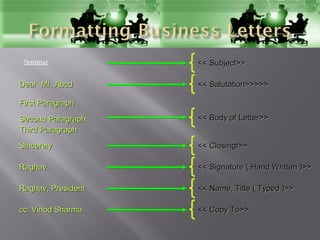
Seminar            << Subject>>

Dear Mr. Abcd       << Salutation>>>>>

First Paragraph

Second Paragraph    << Body of Letter>>
Third Paragraph

Sincerely           << Closingt>>

Raghav              << Signature ( Hand Written )>>

Raghav, President   << Name, Title ( Typed )>>

cc: Vinod Sharma    << Copy To>>
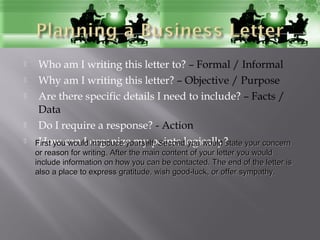
    Who am I writing this letter to? – Formal / Informal
    Why am I writing this letter? – Objective / Purpose
    Are there specific details I need to include? – Facts /
     Data
    Do I require a response? - Action
   First youcan I organize my points logically?
     How would introduce yourself. Second you would state your concern
    or reason for writing. After the main content of your letter you would
    include information on how you can be contacted. The end of the letter is
    also a place to express gratitude, wish good-luck, or offer sympathy.
   An effective letter in business uses short, simple
    sentences and straightforward vocabulary.

   The easier a letter is to read, the better. You will need to
    use smooth transitions so that your sentences do not
    appear too choppy.
   First and foremost, make sure that you spell the
    recipient's name correctly.
   You should also confirm the gender and proper title.
    Use Ms. for women and Mr. for men. Use Mrs. if you
    are 100% sure that a woman is married.
   Under less formal circumstances, or after a long period
    of correspondence it may be acceptable to address a
    person by his or her first name.
   When you don't know the name of a person and cannot
    find this information out you may write, "To Whom It
    May Concern".
   It is standard to use a comma after the salutation.
   Some common ways to address the recipient:
      Dear Mr. Powell,
      Dear Ms. Mackenzie,
      Dear Frederick Hanson:
      Dear Editor-in-Chief:
      Dear Valued Customer
      Dear Sir or Madam:
      Dear Madam
      Dear Sir,
      Dear Sirs
      Gentlemen:
   In most types of business letter it is common to use a
    friendly greeting in the first sentence of the letter. Here
    are some examples:
       I hope you are enjoying a fine summer.
       Thank you for your kind letter of January 5th.
       I came across an ad for your company in The Star today.
       It was a pleasure meeting you at the conference this month.
       I appreciate your patience in waiting for a response.

        After your short opening, state the main point of
        your letter in one or two sentences:
         I'm writing to enquire about...
         I'm interested in the job opening posted on your company
          website
   Use a few short paragraphs to go into greater detail
    about your main point. If one paragraph is all you need,
    don't write an extra paragraph just to make your letter
    look longer.

   If you are including sensitive material, such as rejecting
    an offer or informing an employee of a layoff period,
    embed this sentence in the second paragraph rather
    than opening with it.

   Here are some common ways to express unpleasant
    facts:
       We regret to inform you...
       It is with great sadness that we...
       After careful consideration we have decided...
   Your last paragraph should include requests, reminders, and
    notes on enclosures. If necessary, your contact information should
    also be in this paragraph.

   Here are some common phrases used when closing a business
    letter:
       I look forward to...
       Please respond at your earliest convenience.
       I should also remind you that the next board meeting is on February
        5th.
       For further details...
       If you require more information...
       Thank you for taking this into consideration.
       I appreciate any feedback you may have.
       Enclosed you will find...
       Feel free to contact me by phone or email
   Here are some common ways to close a letter. Use a
    comma between the closing and your handwritten name
    (or typed in an email).

   If you do not use a comma or colon in your salutation,
    leave out the comma after the closing phrase:
       Yours truly,
       Yours sincerely,
       Sincerely,
       Sincerely yours
       Thank you,
       Best wishes
       All the best,
       Best of luck
       Warm regards,
   Use a conversational tone.
   Ask direct questions.
   Double-check gender and spelling of names.
   Use active voice whenever possible.
   Use polite modals (would in favour of will).
   Always refer to yourself as "I".
   Don't use "we" unless it is clear exactly who the pronoun
    refers to.
   Rewrite any sentence or request that sounds vague.
   Don't forget to include the date. Day-Month-Year is
    conventional, however, to avoid confusion, write out the
    month instead of using
   numbers (e.g. July 5th, 2007)
"Proof read" means to read a text carefully to
    check it for errors and general tone.

You should always proofread a business letter
             before sending it.
Bussiness letter

Bussiness letter

  • 1.
  • 2.
    Business letters are formal paper communications between, to or from businesses  Business letters includes: · Letter · Memo · Fax · Email
  • 3.
    Letters are written from a person/group, known as the sender to a person/group, known in business as the recipient.  Some examples of senders and recipients: · business «» business · business «» consumer · job applicant «» company · citizen «» government official · employee «» employee · staff member «» staff member
  • 4.
    · To persuade ·To inform · To request · To express thanks · To remind · To recommend · To apologize · To congratulate · To reject a proposal or offer · To introduce a person or policy · To invite or welcome
  • 5.
    Body - The content of the letter; between the salutation and signature.  Enclosure - Extra document or image included with a letter.  Inside address - Recipient's mailing information.  Logo - Symbol or image that identifies a specific organization.  Memorandum (memo) - Document sent within a company (internal), presented in short form.  Punctuation - Marks used within or after sentences and phrases (e.g. periods, commas).  Salutation - Greeting in a letter (e.g. "Dear Mr. Abhay").  Tone - The feeling of the language (e.g. serious, enthusiastic)
  • 6.
    Standards for formatting a business letter.  Some basic guidelines:  Use a comma after the salutation (Dear Mr. Abhay,)  Single space within paragraphs  Double space between paragraphs  Double space between last sentence and closing (Sincerely, Best wishes)  Leave three to fives spaces for a handwritten signature  Everything begins from left margin.
  • 7.
    Block format is the most common format used in business today.  In Block format, nothing is centered.  The sender's address, the recipient's address, the date and all new paragraphs begin at the left margin
  • 8.
    ABC Co. Ltd << Sender’s Address>> 22 Saket Nagar, Juhi << may be printed Kanpur - 208014 Company Logo and Address 21st August, 2007 << Date CDE Co. Ltd 15/91 Civil Lines, << Recipient’s Address>> Kanpur - 208001
  • 9.
    Seminar << Subject>> Dear Mr. Abcd << Salutation>>>>> First Paragraph Second Paragraph << Body of Letter>> Third Paragraph Sincerely << Closingt>> Raghav << Signature ( Hand Written )>> Raghav, President << Name, Title ( Typed )>> cc: Vinod Sharma << Copy To>>
  • 10.
    Who am I writing this letter to? – Formal / Informal  Why am I writing this letter? – Objective / Purpose  Are there specific details I need to include? – Facts / Data  Do I require a response? - Action  First youcan I organize my points logically? How would introduce yourself. Second you would state your concern or reason for writing. After the main content of your letter you would include information on how you can be contacted. The end of the letter is also a place to express gratitude, wish good-luck, or offer sympathy.
  • 11.
    An effective letter in business uses short, simple sentences and straightforward vocabulary.  The easier a letter is to read, the better. You will need to use smooth transitions so that your sentences do not appear too choppy.
  • 12.
    First and foremost, make sure that you spell the recipient's name correctly.  You should also confirm the gender and proper title. Use Ms. for women and Mr. for men. Use Mrs. if you are 100% sure that a woman is married.  Under less formal circumstances, or after a long period of correspondence it may be acceptable to address a person by his or her first name.  When you don't know the name of a person and cannot find this information out you may write, "To Whom It May Concern".  It is standard to use a comma after the salutation.
  • 13.
    Some common ways to address the recipient: Dear Mr. Powell, Dear Ms. Mackenzie, Dear Frederick Hanson: Dear Editor-in-Chief: Dear Valued Customer Dear Sir or Madam: Dear Madam Dear Sir, Dear Sirs Gentlemen:
  • 14.
    In most types of business letter it is common to use a friendly greeting in the first sentence of the letter. Here are some examples:  I hope you are enjoying a fine summer.  Thank you for your kind letter of January 5th.  I came across an ad for your company in The Star today.  It was a pleasure meeting you at the conference this month.  I appreciate your patience in waiting for a response. After your short opening, state the main point of your letter in one or two sentences:  I'm writing to enquire about...  I'm interested in the job opening posted on your company website
  • 15.
    Use a few short paragraphs to go into greater detail about your main point. If one paragraph is all you need, don't write an extra paragraph just to make your letter look longer.  If you are including sensitive material, such as rejecting an offer or informing an employee of a layoff period, embed this sentence in the second paragraph rather than opening with it.  Here are some common ways to express unpleasant facts:  We regret to inform you...  It is with great sadness that we...  After careful consideration we have decided...
  • 16.
    Your last paragraph should include requests, reminders, and notes on enclosures. If necessary, your contact information should also be in this paragraph.  Here are some common phrases used when closing a business letter:  I look forward to...  Please respond at your earliest convenience.  I should also remind you that the next board meeting is on February 5th.  For further details...  If you require more information...  Thank you for taking this into consideration.  I appreciate any feedback you may have.  Enclosed you will find...  Feel free to contact me by phone or email
  • 17.
    Here are some common ways to close a letter. Use a comma between the closing and your handwritten name (or typed in an email).  If you do not use a comma or colon in your salutation, leave out the comma after the closing phrase:  Yours truly,  Yours sincerely,  Sincerely,  Sincerely yours  Thank you,  Best wishes  All the best,  Best of luck  Warm regards,
  • 18.
    Use a conversational tone.  Ask direct questions.  Double-check gender and spelling of names.  Use active voice whenever possible.  Use polite modals (would in favour of will).  Always refer to yourself as "I".  Don't use "we" unless it is clear exactly who the pronoun refers to.  Rewrite any sentence or request that sounds vague.  Don't forget to include the date. Day-Month-Year is conventional, however, to avoid confusion, write out the month instead of using  numbers (e.g. July 5th, 2007)
  • 19.
    "Proof read" meansto read a text carefully to check it for errors and general tone. You should always proofread a business letter before sending it.