NAME- RAJ VIPULBHAI SEVAK
ID NO.- 15BEAEM014
ENR. NO.- 150410101046
COMMUNICATION SKILLS
BUSINESS LETTER
PERPOSE
ELEMENT
LAYOUT
PURPOSE
• The ultimate purpose of writing any business letter is to sustain the existing business relationships or
to create and establish a new business relationship. But each individual letter will have a unique
purpose.
• For example, when you apply for a job, you aim at offering your services to your prospective
employer, similarly, as the purchase manager of company when you write a letter complaining about
the damaged consignment, your aim is not only to bring the flow to the notice of the recipient but also
to request for a corrective action.
To inform
To collect dues
To complain
To make an adjustment
To sell a product, service and scheme
To congratulate
To apply for a job
To order
To inquire
To request
Business letter therefore are written for varied purpose as follows:
[SENDER'S COMPANY NAME]
[SENDER'S ADDRESS*]
[SENDER'S PHONE]
[THE SENDER'S E-MAIL]
[DATE]
[RECIPIENT W/O PREFIX]
[RECIPIENT'S COMPANY]
[RECIPIENT'S ADDRESS]
(Optional) Attention [DEPARTMENT/PERSON]
Dear [RECIPIENT W/ PREFIX]
[First Salutation then Subject in Business letters]
[CONTENT]
[CONTENT]
[COMPLIMENTARY CLOSING (Sincerely, Respectfully, Regards, etc.)]
[SENDER]
[SENDER'S TITLE]
[SENDER'S ADDRESS (optional if placed on top**)]
Enclosures ([NUMBER OF ENCLOSURES])
The following is the general format, excluding indentation used in various formats:
• - Sender's Address may be placed after Sender's Title below the Complimentary Closing.
• * - Sender's Address may be placed on top before Recipient's Address in a more conservative style.
ELEMENT
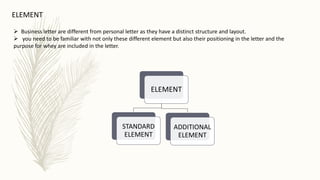
 Business letter are different from personal letter as they have a distinct structure and layout.
 you need to be familiar with not only these different element but also their positioning in the letter and the
purpose for whey are included in the letter.
ELEMENT
STANDARD
ELEMENT
ADDITIONAL
ELEMENT
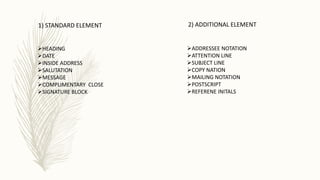
1) STANDARD ELEMENT 2) ADDITIONAL ELEMENT
HEADING
DATE
INSIDE ADDRESS
SALUTATION
MESSAGE
COMPLIMENTARY CLOSE
SIGNATURE BLOCK
ADDRESSEE NOTATION
ATTENTION LINE
SUBJECT LINE
COPY NATION
MAILING NOTATION
POSTSCRIPT
REFERENE INITALS
 HEADING
 This element is also known as the letterhead.
 This element shows the organization’s name, full address, and also telephone numbers.
 If the letterhead is not used, the heading includes the sender’s address.
 Letterheads have the potential to create a favourable impression and hence need to be designed with thought
and imagination.
 Whenever a letterhead paper is not used, the sender’s address is either aligned with left margin or few spaces
away from the centre depending upon the layout of the letter.
 DATE
 This refers to the date the letter was written.
 it includes the date, the month, and the year.
 You can represent this in either of the following two ways:
3 June 2015 or June 3, 2015
STANDARD ELEMENT
 INSIDE ADDRESS
 This part of the letter identifies the recipient of the letter and is separated from the date by at least one blank
line.
 The amount of space separating the inside address from the date may be adjusted to suit the length of the letter.
 It is always best to address your letter to a specific person.
 You can usually identify the name of the person by checking the organization’s website or telephoning the
organization.
 Immediately following the addressee’s name and title, separate lines should contain the name of the company,
the street address or post office box number, and the city and state or province with proper postal code or zip code.
 SALUTATION
 Always try to address your letter to a personal byname rather then title.
 If you send a from letter or if you cannot find a specific name, you may choose solution such as:
Dear student or To all sales reps or Dear Madam or Sir
If your letter is addressed to company , the proper salutation is:
Gentlemen or ladies
If your letter is addressed to an organization of only women or only men, use:
Dear Sir , Dear ladies , Dear Mesdames
Formal- Dear Mr. Gupta
Informal- raj, ashok
 Begin the body of a business letter two spaces below the salutation or attention-getting device. Each paragraph
should be single-spaced and justified to the left margin of the page with a double space separating each paragraph.
 It is acceptable to double space the text of a letter when the body is very short. This is done purely for cosmetic
reasons, giving the letter a more visually balanced appearance on the page. In such instances it is appropriate to indent
the first line of each paragraph.
 THE BODY / MESSAGE
 The complimentary close is placed two spaces below the last line of a letter's body.
 Customary expressions used to close a formal business letter include Thank you, Sincerely, Sincerely yours, and Yours
truly. Less formal expressions such as Regards, Best regards, and Best wishes should be used only when the writer is
addressing a business associate that is also a friend.
 When the expression contains two words, such as Thank you, only the first word receives an initial upper case letter
 A comma follows all forms of a complimentary close.
 Allow four spaces between the complimentary close and the typed version of the writer's full name. The space
between is reserved for a handwritten signature. The writer's job position or title should appear directly below his or
her name.
 The writer's signature should be identical to the printed version except in those situations where the recipient is also
a friend, in which case a first name only is fine.
 THE COMPLIMENTARY CLOSE
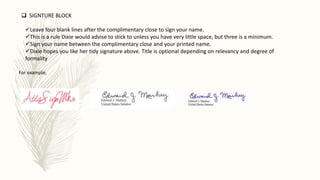
Leave four blank lines after the complimentary close to sign your name.
This is a rule Dixie would advise to stick to unless you have very little space, but three is a minimum.
Sign your name between the complimentary close and your printed name.
Dixie hopes you like her tidy signature above. Title is optional depending on relevancy and degree of
formality
 SIGNTURE BLOCK
For example,
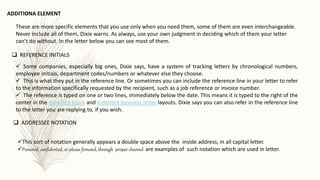
These are more specific elements that you use only when you need them, some of them are even interchangeable.
Never include all of them, Dixie warns. As always, use your own judgment in deciding which of them your letter
can’t do without. In the letter below you can see most of them.
ADDITIONA ELEMENT
 Some companies, especially big ones, Dixie says, have a system of tracking letters by chronological numbers,
employee initials, department codes/numbers or whatever else they choose.
 This is what they put in the reference line. Or sometimes you can include the reference line in your letter to refer
to the information specifically requested by the recipient, such as a job reference or invoice number.
 The reference is typed on one or two lines, immediately below the date. This means it is typed to the right of the
center in the modified block and indented business letter layouts. Dixie says you can also refer in the reference line
to the letter you are replying to, if you wish.
 REFERENCE INITIALS
 ADDRESSEE NOTATION
This sort of notation generally appears a double space above the inside address, in all capital letter.
Personal, confidential, or please forward, through proper channel are examples of such notation which are used in letter.
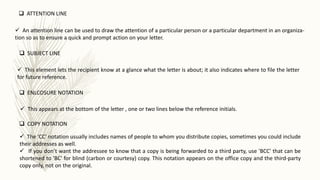
 ATTENTION LINE
 An attention line can be used to draw the attention of a particular person or a particular department in an organiza-
tion so as to ensure a quick and prompt action on your letter.
 SUBJECT LINE
 This element lets the recipient know at a glance what the letter is about; it also indicates where to file the letter
for future reference.
 ENLCOSURE NOTATION
 This appears at the bottom of the letter , one or two lines below the reference initials.
 COPY NOTATION
 The 'CC' notation usually includes names of people to whom you distribute copies, sometimes you could include
their addresses as well.
 If you don’t want the addressee to know that a copy is being forwarded to a third party, use 'BCC' that can be
shortened to 'BC' for blind (carbon or courtesy) copy. This notation appears on the office copy and the third-party
copy only, not on the original.
 The manuals on business correspondence recommend to type special mailing notations in all uppercase
characters before the inside address if you consider them necessary in your letter. But you might prefer to have them
less visible, your choice. Examples from the book:
SPECIAL DELIVERY
CERTIFIED MAIL
 MAILING NOTATION
 POSTSCRIPT
 Letter may also bear postscripts, i.e., afterthoughts to the letter, to the message that require emphasis, or personal
notes.
 Postscripts are not needed any more for including a forgotten piece of information as the whole letter can be easily
edited for that purpose.
 They still can be used to add a more informal, personalized touch to a formal communication. Contemporary sales
letters use them as a common tactic, implying that the writer has an additional reason for the customer to buy the
product.
 Postscripts are also common in medical letters.
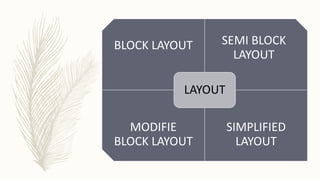
BLOCK LAYOUT SEMI BLOCK
LAYOUT
MODIFIE
BLOCK LAYOUT
SIMPLIFIED
LAYOUT
LAYOUT
Date ........................
Inside Address ..........
...................................
...................................
Attention Line ..........
Salutation..................
Subject Line...............
Body of the Letter .................................................................................
..........................................................................................................
..........................................................................................................
..........................................................................................................
..........................................................................................................
..........................................................................................................
Complimentary Close..........
..............................................
signature...............................
Full Name.............................
Position.................................
Identification Initials
Enclosure Reference
Letter Head
(Company's Name & Address)
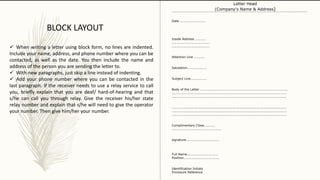
BLOCK LAYOUT
 When writing a letter using block form, no lines are indented.
Include your name, address, and phone number where you can be
contacted, as well as the date. You then include the name and
address of the person you are sending the letter to.
 With new paragraphs, just skip a line instead of indenting.
 Add your phone number where you can be contacted in the
last paragraph. If the receiver needs to use a relay service to call
you, briefly explain that you are deaf/ hard-of-hearing and that
s/he can call you through relay. Give the receiver his/her state
relay number and explain that s/he will need to give the operator
your number. Then give him/her your number.
Date : .................
Inside Address ..........
...................................
...................................
Attention Line ............................
Salutation....................
Subject Line................................
Body of the Letter ....................................................................................
..............................................................................................................
..............................................................................................................
..............................................................................................................
..............................................................................................................
..............................................................................................................
Complimentary Close
signature..............
Full Name
Position
Identification Initials
Enclosure Reference
Letter Head
(Company's Name & Address)
MODIFIE BLOCK LAYOUT
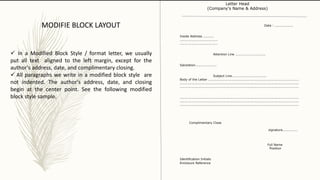
 In a Modified Block Style / format letter, we usually
put all text aligned to the left margin, except for the
author's address, date, and complimentary closing.
 All paragraphs we write in a modified block style are
not indented. The author's address, date, and closing
begin at the center point. See the following modified
block style sample.
Date:.......................
Inside Address ..........
...................................
...................................
Attention Line ....................
Salutation..................
Subject Line.......................
Body of The Letter...............................................................................................................
.........................................................................................................................................
.........................................................................................................................................
....................................................................................................................................
.........................................................................................................................................
.........................................................................................................................................
Complimentary Close
signature..............
Full Name
Position
Identification Initials
Enclosure Reference
Letter Head
(Company's Name & Address)
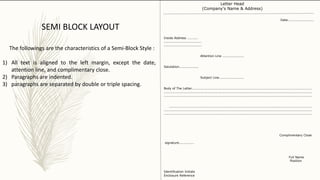
SEMI BLOCK LAYOUT
The followings are the characteristics of a Semi-Block Style :
1) All text is aligned to the left margin, except the date,
attention line, and complimentary close.
2) Paragraphs are indented.
3) paragraphs are separated by double or triple spacing.
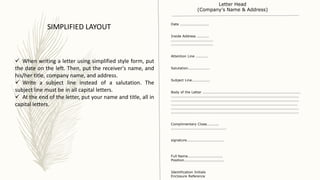
 When writing a letter using simplified style form, put
the date on the left. Then, put the receiver's name, and
his/her title, company name, and address.
 Write a subject line instead of a salutation. The
subject line must be in all capital letters.
 At the end of the letter, put your name and title, all in
capital letters.
SIMPLIFIED LAYOUT Date ........................
Inside Address ..........
...................................
...................................
Attention Line ..........
Salutation..................
Subject Line...............
Body of the Letter .................................................................................
..........................................................................................................
..........................................................................................................
.........................................................................................................
..........................................................................................................
..........................................................................................................
Complimentary Close..........
..............................................
signature...............................
Full Name.............................
Position.................................
Identification Initials
Enclosure Reference
Letter Head
(Company's Name & Address)
THANK YOU…

business letter

  • 1.
    NAME- RAJ VIPULBHAISEVAK ID NO.- 15BEAEM014 ENR. NO.- 150410101046 COMMUNICATION SKILLS BUSINESS LETTER PERPOSE ELEMENT LAYOUT
  • 2.
    PURPOSE • The ultimatepurpose of writing any business letter is to sustain the existing business relationships or to create and establish a new business relationship. But each individual letter will have a unique purpose. • For example, when you apply for a job, you aim at offering your services to your prospective employer, similarly, as the purchase manager of company when you write a letter complaining about the damaged consignment, your aim is not only to bring the flow to the notice of the recipient but also to request for a corrective action. To inform To collect dues To complain To make an adjustment To sell a product, service and scheme To congratulate To apply for a job To order To inquire To request Business letter therefore are written for varied purpose as follows:
  • 3.
    [SENDER'S COMPANY NAME] [SENDER'SADDRESS*] [SENDER'S PHONE] [THE SENDER'S E-MAIL] [DATE] [RECIPIENT W/O PREFIX] [RECIPIENT'S COMPANY] [RECIPIENT'S ADDRESS] (Optional) Attention [DEPARTMENT/PERSON] Dear [RECIPIENT W/ PREFIX] [First Salutation then Subject in Business letters] [CONTENT] [CONTENT] [COMPLIMENTARY CLOSING (Sincerely, Respectfully, Regards, etc.)] [SENDER] [SENDER'S TITLE] [SENDER'S ADDRESS (optional if placed on top**)] Enclosures ([NUMBER OF ENCLOSURES]) The following is the general format, excluding indentation used in various formats: • - Sender's Address may be placed after Sender's Title below the Complimentary Closing. • * - Sender's Address may be placed on top before Recipient's Address in a more conservative style.
  • 4.
    ELEMENT  Business letterare different from personal letter as they have a distinct structure and layout.  you need to be familiar with not only these different element but also their positioning in the letter and the purpose for whey are included in the letter. ELEMENT STANDARD ELEMENT ADDITIONAL ELEMENT
  • 5.
    1) STANDARD ELEMENT2) ADDITIONAL ELEMENT HEADING DATE INSIDE ADDRESS SALUTATION MESSAGE COMPLIMENTARY CLOSE SIGNATURE BLOCK ADDRESSEE NOTATION ATTENTION LINE SUBJECT LINE COPY NATION MAILING NOTATION POSTSCRIPT REFERENE INITALS
  • 6.
     HEADING  Thiselement is also known as the letterhead.  This element shows the organization’s name, full address, and also telephone numbers.  If the letterhead is not used, the heading includes the sender’s address.  Letterheads have the potential to create a favourable impression and hence need to be designed with thought and imagination.  Whenever a letterhead paper is not used, the sender’s address is either aligned with left margin or few spaces away from the centre depending upon the layout of the letter.  DATE  This refers to the date the letter was written.  it includes the date, the month, and the year.  You can represent this in either of the following two ways: 3 June 2015 or June 3, 2015 STANDARD ELEMENT
  • 7.
     INSIDE ADDRESS This part of the letter identifies the recipient of the letter and is separated from the date by at least one blank line.  The amount of space separating the inside address from the date may be adjusted to suit the length of the letter.  It is always best to address your letter to a specific person.  You can usually identify the name of the person by checking the organization’s website or telephoning the organization.  Immediately following the addressee’s name and title, separate lines should contain the name of the company, the street address or post office box number, and the city and state or province with proper postal code or zip code.  SALUTATION  Always try to address your letter to a personal byname rather then title.  If you send a from letter or if you cannot find a specific name, you may choose solution such as: Dear student or To all sales reps or Dear Madam or Sir If your letter is addressed to company , the proper salutation is: Gentlemen or ladies If your letter is addressed to an organization of only women or only men, use: Dear Sir , Dear ladies , Dear Mesdames Formal- Dear Mr. Gupta Informal- raj, ashok
  • 8.
     Begin thebody of a business letter two spaces below the salutation or attention-getting device. Each paragraph should be single-spaced and justified to the left margin of the page with a double space separating each paragraph.  It is acceptable to double space the text of a letter when the body is very short. This is done purely for cosmetic reasons, giving the letter a more visually balanced appearance on the page. In such instances it is appropriate to indent the first line of each paragraph.  THE BODY / MESSAGE  The complimentary close is placed two spaces below the last line of a letter's body.  Customary expressions used to close a formal business letter include Thank you, Sincerely, Sincerely yours, and Yours truly. Less formal expressions such as Regards, Best regards, and Best wishes should be used only when the writer is addressing a business associate that is also a friend.  When the expression contains two words, such as Thank you, only the first word receives an initial upper case letter  A comma follows all forms of a complimentary close.  Allow four spaces between the complimentary close and the typed version of the writer's full name. The space between is reserved for a handwritten signature. The writer's job position or title should appear directly below his or her name.  The writer's signature should be identical to the printed version except in those situations where the recipient is also a friend, in which case a first name only is fine.  THE COMPLIMENTARY CLOSE
  • 9.
    Leave four blanklines after the complimentary close to sign your name. This is a rule Dixie would advise to stick to unless you have very little space, but three is a minimum. Sign your name between the complimentary close and your printed name. Dixie hopes you like her tidy signature above. Title is optional depending on relevancy and degree of formality  SIGNTURE BLOCK For example,
  • 10.
    These are morespecific elements that you use only when you need them, some of them are even interchangeable. Never include all of them, Dixie warns. As always, use your own judgment in deciding which of them your letter can’t do without. In the letter below you can see most of them. ADDITIONA ELEMENT  Some companies, especially big ones, Dixie says, have a system of tracking letters by chronological numbers, employee initials, department codes/numbers or whatever else they choose.  This is what they put in the reference line. Or sometimes you can include the reference line in your letter to refer to the information specifically requested by the recipient, such as a job reference or invoice number.  The reference is typed on one or two lines, immediately below the date. This means it is typed to the right of the center in the modified block and indented business letter layouts. Dixie says you can also refer in the reference line to the letter you are replying to, if you wish.  REFERENCE INITIALS  ADDRESSEE NOTATION This sort of notation generally appears a double space above the inside address, in all capital letter. Personal, confidential, or please forward, through proper channel are examples of such notation which are used in letter.
  • 11.
     ATTENTION LINE An attention line can be used to draw the attention of a particular person or a particular department in an organiza- tion so as to ensure a quick and prompt action on your letter.  SUBJECT LINE  This element lets the recipient know at a glance what the letter is about; it also indicates where to file the letter for future reference.  ENLCOSURE NOTATION  This appears at the bottom of the letter , one or two lines below the reference initials.  COPY NOTATION  The 'CC' notation usually includes names of people to whom you distribute copies, sometimes you could include their addresses as well.  If you don’t want the addressee to know that a copy is being forwarded to a third party, use 'BCC' that can be shortened to 'BC' for blind (carbon or courtesy) copy. This notation appears on the office copy and the third-party copy only, not on the original.
  • 12.
     The manualson business correspondence recommend to type special mailing notations in all uppercase characters before the inside address if you consider them necessary in your letter. But you might prefer to have them less visible, your choice. Examples from the book: SPECIAL DELIVERY CERTIFIED MAIL  MAILING NOTATION  POSTSCRIPT  Letter may also bear postscripts, i.e., afterthoughts to the letter, to the message that require emphasis, or personal notes.  Postscripts are not needed any more for including a forgotten piece of information as the whole letter can be easily edited for that purpose.  They still can be used to add a more informal, personalized touch to a formal communication. Contemporary sales letters use them as a common tactic, implying that the writer has an additional reason for the customer to buy the product.  Postscripts are also common in medical letters.
  • 13.
    BLOCK LAYOUT SEMIBLOCK LAYOUT MODIFIE BLOCK LAYOUT SIMPLIFIED LAYOUT LAYOUT
  • 14.
    Date ........................ Inside Address.......... ................................... ................................... Attention Line .......... Salutation.................. Subject Line............... Body of the Letter ................................................................................. .......................................................................................................... .......................................................................................................... .......................................................................................................... .......................................................................................................... .......................................................................................................... Complimentary Close.......... .............................................. signature............................... Full Name............................. Position................................. Identification Initials Enclosure Reference Letter Head (Company's Name & Address) BLOCK LAYOUT  When writing a letter using block form, no lines are indented. Include your name, address, and phone number where you can be contacted, as well as the date. You then include the name and address of the person you are sending the letter to.  With new paragraphs, just skip a line instead of indenting.  Add your phone number where you can be contacted in the last paragraph. If the receiver needs to use a relay service to call you, briefly explain that you are deaf/ hard-of-hearing and that s/he can call you through relay. Give the receiver his/her state relay number and explain that s/he will need to give the operator your number. Then give him/her your number.
  • 15.
    Date : ................. InsideAddress .......... ................................... ................................... Attention Line ............................ Salutation.................... Subject Line................................ Body of the Letter .................................................................................... .............................................................................................................. .............................................................................................................. .............................................................................................................. .............................................................................................................. .............................................................................................................. Complimentary Close signature.............. Full Name Position Identification Initials Enclosure Reference Letter Head (Company's Name & Address) MODIFIE BLOCK LAYOUT  In a Modified Block Style / format letter, we usually put all text aligned to the left margin, except for the author's address, date, and complimentary closing.  All paragraphs we write in a modified block style are not indented. The author's address, date, and closing begin at the center point. See the following modified block style sample.
  • 16.
    Date:....................... Inside Address .......... ................................... ................................... AttentionLine .................... Salutation.................. Subject Line....................... Body of The Letter............................................................................................................... ......................................................................................................................................... ......................................................................................................................................... .................................................................................................................................... ......................................................................................................................................... ......................................................................................................................................... Complimentary Close signature.............. Full Name Position Identification Initials Enclosure Reference Letter Head (Company's Name & Address) SEMI BLOCK LAYOUT The followings are the characteristics of a Semi-Block Style : 1) All text is aligned to the left margin, except the date, attention line, and complimentary close. 2) Paragraphs are indented. 3) paragraphs are separated by double or triple spacing.
  • 17.
     When writinga letter using simplified style form, put the date on the left. Then, put the receiver's name, and his/her title, company name, and address.  Write a subject line instead of a salutation. The subject line must be in all capital letters.  At the end of the letter, put your name and title, all in capital letters. SIMPLIFIED LAYOUT Date ........................ Inside Address .......... ................................... ................................... Attention Line .......... Salutation.................. Subject Line............... Body of the Letter ................................................................................. .......................................................................................................... .......................................................................................................... ......................................................................................................... .......................................................................................................... .......................................................................................................... Complimentary Close.......... .............................................. signature............................... Full Name............................. Position................................. Identification Initials Enclosure Reference Letter Head (Company's Name & Address)
  • 18.