



BUSINESSBUSINESS
LETTERSLETTERS
BY- RISHIRAJ SINGHBY- RISHIRAJ SINGH
RAVIKANTRAVIKANT
SHARMASHARMA
 It is a letter written in formal language, used when writing from one 
business organization to another, or for correspondence between such
organizations and their customers, clients and other external parties.
 They are used for different purposes; like placing orders, making
inquiries’, making credit request, requesting claims and adjustment, to
apologize for a wrong or simply to convey goodwill. etc.
 Even today, they are very useful because it produces a permanent record, 
they are confidential, formal and delivers persuasive, well-considered
messages.
 Style of letter depends on the relationship between the parties
concerned.
APPEARANCE OF A
BUSINESS LETTER
 Stationery : Must be of good quality.
 Typing : Must be neat, without cancellations.
 Paragraphing : Is necessary for breaking up a composition into readable,
logical and progressive units.
 Folding : Of the letter must be neat. it makes a poor impression if it is badly
folded.
 Address : On the envelope is typed halfway down and one third in from the
left.
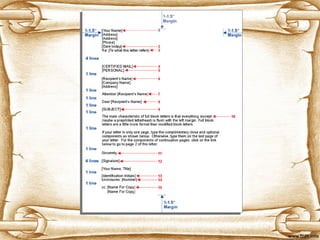
Format ofFormat of
BUSINESS LETTERSBUSINESS LETTERS
11. The Letter Head / The. The Letter Head / The
sender’s Addresssender’s Address
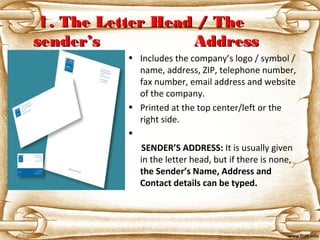
• Includes the company’s logo / symbol /
name, address, ZIP, telephone number,
fax number, email address and website
of the company.
• Printed at the top center/left or the
right side.
•
      SENDER’S ADDRESS: It is usually given
in the letter head, but if there is none,
the Sender’s Name, Address and 
Contact details can be typed.
2.Reference2.Reference
Include a reference line to identify a file or case
number, invoice number or any other internal
identifying information, if your company requires one.
Some companies have specific reference codes that
they place either in a reference line below the date, or
at the very bottom of the letter.
REF.HMT/25/2005/114
3.Date3.Date
• Date consists of the date, name of the month and the year. 
• If the letter sheet includes a letterhead, type the date from 2 to 3
lines under the letterhead, else type it under the return address.
• Never send a letter without a date.
• The date is written in two styles.
1. The British Method (ordinal numbers) : 4th
 July, 2012
2. The American Method (cardinal numbers) : July 4, 2012
• Never write like 7-2-12 or 7/2/12 because it shows that the writer
is careless or in a great hurry.
4.The Inside Address4.The Inside Address
• Includes the name and address of the firm or the individual to
whom the letter is written.
• Written on the left side, beside the margin, two spaces below the
date- line.
• Use Courtesy titles before names of the receiver such as Mr., Mrs.,
Shri, Smt., Miss, Ms, Messrs, Dr, Prof., Capt., Maj., Col., Gen. etc.
• The address can also begin with a job title or a department (if you
don’t know the name). For e.g. : The Sales Manager, The Accounts
Department etc.
5.Subject and receivers5.Subject and receivers
reference numberreference number
• Subject is use so that the reader immediately knows what your
letter is about.
• Use “Subject” or “Re”.
• Subject usually comes between Salutation and body.
• The receiver's references i.e. the receiver’s pervious letter number
is mentioned under the heading reference.
• This will enable the receiver to easily take out a copy of his own
letter from his files and understand the matter in the reply.
• e.g. Your Reference :MBM/SD/285/05 DATED 5th
oct.2005
6.Salutation6.Salutation
• It is a compliment or greeting.
• Written beside the left hand margin, two spaces below the Inside
address and two lines above the body of the letter.
• It is followed by a comma (,) or a colon (:).
• Salutation depends on the gender, type, number or the social
status of the person addressed.
Ex: Dear Sir,
Dear Madam,
Dear Amit Das,
Dear Mr. John,
Dear Nancy,
7.Body
• Begins two spaces below the salutation.
• Contains the message or the information to be communicated.
• Most important, lengthiest, prominent part- written in correct,
appealing and impressive style.
• Divided normally into 3 parts:
1) Introductory paragraph
2) Middle paragraph
3) Closing paragraph
• Double space between paragraphs.
• If letter exceeds one page, repeat the recipient's name, date,
reference/subject line and put page number.
• Continue your letter three lines below the heading.
8.Complimentary Close8.Complimentary Close
• It is written two spaces below the last line of the body.
• It is a polite way of saying “ Good bye”.
• It depends on the tone and degree of formality.
Formal: Respectfully yours, Sincerely, Yours faithfully
Informal: Cordially yours, Warm Regards, Best wishes
9. The Signature and
designation
• Written double space below the complimentary close.
• First comes Signature (pen written). Sign your first and last name.
• Second line - type written name.
• Third line - business title.
• The signature acts as proof.
10. Enclosures10. Enclosures
• This line tells the reader to look in the envelope for more.
• Write Enc./Encl./Enclosure below the signature block.
e.g. : Enclosure
Enclosures: 3
Enclosures : Check #231 for $500
• If you don't enclose anything, skip it.
11. REFERENCE INITIALS
• If someone else has composed typed the letter for you, it is
common for them to indicate so with initials.
• Typically it is your initials in upper case followed by the other
initials in lower case.
 SWA/KA - (composer/typist)
 SWA:KA
12. Copy notation
• When other people are to receive a copy of the same letter,
their names are noted either by their ranks or by alphabetically.
• Written just below the reference initials or the enclosure whichever
is last.
• Type “cc” before the names if sending a “carbon copy(to)” and “pc”
for photocopy (to).
CC: Jim Blue, Jennifer Louis
LAYOUT OF
BUSINESS LETTER
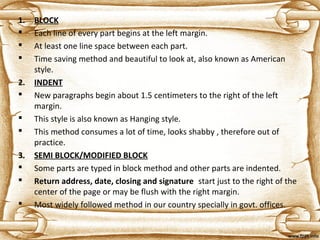
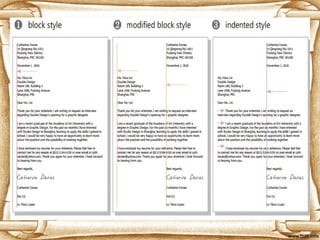
1. BLOCK
 Each line of every part begins at the left margin.
 At least one line space between each part.
 Time saving method and beautiful to look at, also known as American
style.
2. INDENT
 New paragraphs begin about 1.5 centimeters to the right of the left
margin.
 This style is also known as Hanging style.
 This method consumes a lot of time, looks shabby , therefore out of
practice.
3. SEMI BLOCK/MODIFIED BLOCK
 Some parts are typed in block method and other parts are indented.
 Return address, date, closing and signature start just to the right of the
center of the page or may be flush with the right margin.
 Most widely followed method in our country specially in govt. offices.
Types ofTypes of
BUSINESS LETTERSBUSINESS LETTERS
• Inquiry
• Order
• Refusal
• Acceptance
• Quotation
• Follow up or Cancelation
• Compliance
• Complaints, Claims, Adjustments
• Settlement
• Collection
• Agency
• Sales letters
GOOD / NEUTRAL NEWSGOOD / NEUTRAL NEWS
LETTERSLETTERS
 OPENING
 Mention the Best news or summarise the main idea.
 MIDDLE
 Explanations, details, reader benefits, background.
 END
 Use goodwill ending.
 Positive friendly, clear statement of action desired, motivation to
action, willingness to help further, appreciation.
 Examples of Bad/ Negative News letters
 Refusing Credit.
 Refusing adjustments on Claims and Complaints.
 Answering Non-Sales related inquiries.
 Declining invitations and requests for favours.
 Announcing a bad news about prices or services.
 Rejection Letters.
APPLYAPPLY “seven C’S”“seven C’S”
OF COMMUNICATIONOF COMMUNICATION
1. COMPLETENESS: Letter should not lacks its purpose. Provide all
necessary information. E.g. Order should not only mention quantity
but also size, price, packaging, delivery, transportation charges,
discount rates, payment item and condition etc
2. CONCISENESS: Be to the point, avoid unnecessary repetitions and
include only relevant material.
3. CONSIDERATION: Focus on “you” instead on “I” or “We”, Show
reader benefits and emphasize positive pleasant facts.
4. CONCRETENESS: Use specific facts and figures, put action in verbs
and choose image building words.
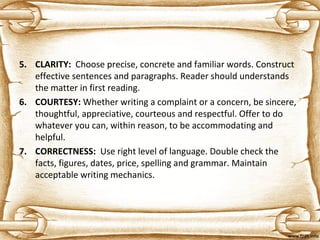
5. CLARITY: Choose precise, concrete and familiar words. Construct
effective sentences and paragraphs. Reader should understands
the matter in first reading.
6. COURTESY: Whether writing a complaint or a concern, be sincere,
thoughtful, appreciative, courteous and respectful. Offer to do
whatever you can, within reason, to be accommodating and
helpful.
7. CORRECTNESS: Use right level of language. Double check the
facts, figures, dates, price, spelling and grammar. Maintain
acceptable writing mechanics.
Points to Rememebr
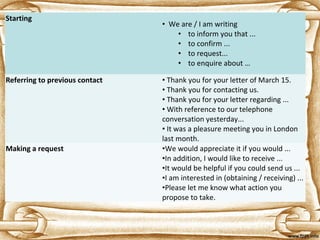
Starting
• We are / I am writing
• to inform you that ...
• to confirm ...
• to request...
• to enquire about …
Referring to previous contact • Thank you for your letter of March 15.
• Thank you for contacting us.
• Thank you for your letter regarding ...
• With reference to our telephone
conversation yesterday...
• It was a pleasure meeting you in London
last month.
Making a request •We would appreciate it if you would ...
•In addition, I would like to receive ...
•It would be helpful if you could send us ...
•I am interested in (obtaining / receiving) ...
•Please let me know what action you
propose to take.
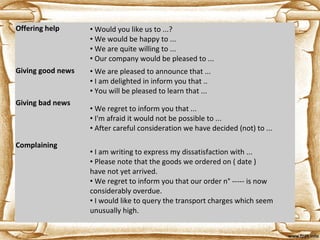
Offering help • Would you like us to ...?
• We would be happy to ...
• We are quite willing to ...
• Our company would be pleased to ...
Giving good news • We are pleased to announce that ...
• I am delighted in inform you that ..
• You will be pleased to learn that ...
Giving bad news
• We regret to inform you that ...
• I'm afraid it would not be possible to ...
• After careful consideration we have decided (not) to ...
Complaining
• I am writing to express my dissatisfaction with ...
• Please note that the goods we ordered on ( date )
have not yet arrived.
• We regret to inform you that our order n° ----- is now
considerably overdue.
• I would like to query the transport charges which seem
unusually high.
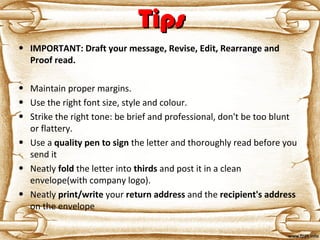
TipsTips
• IMPORTANT: Draft your message, Revise, Edit, Rearrange and
Proof read.
• Maintain proper margins.
• Use the right font size, style and colour.
• Strike the right tone: be brief and professional, don't be too blunt
or flattery.
• Use a quality pen to sign the letter and thoroughly read before you
send it
• Neatly fold the letter into thirds and post it in a clean
envelope(with company logo).
• Neatly print/write your return address and the recipient's address
on the envelope
THANKSTHANKS

Business letters

  • 1.
    BUSINESSBUSINESS LETTERSLETTERS BY- RISHIRAJ SINGHBY-RISHIRAJ SINGH RAVIKANTRAVIKANT SHARMASHARMA
  • 2.
     It isa letter written in formal language, used when writing from one  business organization to another, or for correspondence between such organizations and their customers, clients and other external parties.  They are used for different purposes; like placing orders, making inquiries’, making credit request, requesting claims and adjustment, to apologize for a wrong or simply to convey goodwill. etc.  Even today, they are very useful because it produces a permanent record,  they are confidential, formal and delivers persuasive, well-considered messages.  Style of letter depends on the relationship between the parties concerned.
  • 3.
    APPEARANCE OF A BUSINESSLETTER  Stationery : Must be of good quality.  Typing : Must be neat, without cancellations.  Paragraphing : Is necessary for breaking up a composition into readable, logical and progressive units.  Folding : Of the letter must be neat. it makes a poor impression if it is badly folded.  Address : On the envelope is typed halfway down and one third in from the left.
  • 4.
    Format ofFormat of BUSINESSLETTERSBUSINESS LETTERS
  • 6.
    11. The LetterHead / The. The Letter Head / The sender’s Addresssender’s Address • Includes the company’s logo / symbol / name, address, ZIP, telephone number, fax number, email address and website of the company. • Printed at the top center/left or the right side. •       SENDER’S ADDRESS: It is usually given in the letter head, but if there is none, the Sender’s Name, Address and  Contact details can be typed.
  • 7.
    2.Reference2.Reference Include a referenceline to identify a file or case number, invoice number or any other internal identifying information, if your company requires one. Some companies have specific reference codes that they place either in a reference line below the date, or at the very bottom of the letter. REF.HMT/25/2005/114
  • 8.
    3.Date3.Date • Date consistsof the date, name of the month and the year.  • If the letter sheet includes a letterhead, type the date from 2 to 3 lines under the letterhead, else type it under the return address. • Never send a letter without a date. • The date is written in two styles. 1. The British Method (ordinal numbers) : 4th  July, 2012 2. The American Method (cardinal numbers) : July 4, 2012 • Never write like 7-2-12 or 7/2/12 because it shows that the writer is careless or in a great hurry.
  • 9.
    4.The Inside Address4.TheInside Address • Includes the name and address of the firm or the individual to whom the letter is written. • Written on the left side, beside the margin, two spaces below the date- line. • Use Courtesy titles before names of the receiver such as Mr., Mrs., Shri, Smt., Miss, Ms, Messrs, Dr, Prof., Capt., Maj., Col., Gen. etc. • The address can also begin with a job title or a department (if you don’t know the name). For e.g. : The Sales Manager, The Accounts Department etc.
  • 10.
    5.Subject and receivers5.Subjectand receivers reference numberreference number • Subject is use so that the reader immediately knows what your letter is about. • Use “Subject” or “Re”. • Subject usually comes between Salutation and body. • The receiver's references i.e. the receiver’s pervious letter number is mentioned under the heading reference. • This will enable the receiver to easily take out a copy of his own letter from his files and understand the matter in the reply. • e.g. Your Reference :MBM/SD/285/05 DATED 5th oct.2005
  • 11.
    6.Salutation6.Salutation • It isa compliment or greeting. • Written beside the left hand margin, two spaces below the Inside address and two lines above the body of the letter. • It is followed by a comma (,) or a colon (:). • Salutation depends on the gender, type, number or the social status of the person addressed. Ex: Dear Sir, Dear Madam, Dear Amit Das, Dear Mr. John, Dear Nancy,
  • 12.
    7.Body • Begins twospaces below the salutation. • Contains the message or the information to be communicated. • Most important, lengthiest, prominent part- written in correct, appealing and impressive style. • Divided normally into 3 parts: 1) Introductory paragraph 2) Middle paragraph 3) Closing paragraph • Double space between paragraphs. • If letter exceeds one page, repeat the recipient's name, date, reference/subject line and put page number. • Continue your letter three lines below the heading.
  • 13.
    8.Complimentary Close8.Complimentary Close •It is written two spaces below the last line of the body. • It is a polite way of saying “ Good bye”. • It depends on the tone and degree of formality. Formal: Respectfully yours, Sincerely, Yours faithfully Informal: Cordially yours, Warm Regards, Best wishes
  • 14.
    9. The Signatureand designation • Written double space below the complimentary close. • First comes Signature (pen written). Sign your first and last name. • Second line - type written name. • Third line - business title. • The signature acts as proof.
  • 15.
    10. Enclosures10. Enclosures •This line tells the reader to look in the envelope for more. • Write Enc./Encl./Enclosure below the signature block. e.g. : Enclosure Enclosures: 3 Enclosures : Check #231 for $500 • If you don't enclose anything, skip it.
  • 16.
    11. REFERENCE INITIALS •If someone else has composed typed the letter for you, it is common for them to indicate so with initials. • Typically it is your initials in upper case followed by the other initials in lower case.  SWA/KA - (composer/typist)  SWA:KA
  • 17.
    12. Copy notation •When other people are to receive a copy of the same letter, their names are noted either by their ranks or by alphabetically. • Written just below the reference initials or the enclosure whichever is last. • Type “cc” before the names if sending a “carbon copy(to)” and “pc” for photocopy (to). CC: Jim Blue, Jennifer Louis
  • 18.
  • 19.
    1. BLOCK  Eachline of every part begins at the left margin.  At least one line space between each part.  Time saving method and beautiful to look at, also known as American style. 2. INDENT  New paragraphs begin about 1.5 centimeters to the right of the left margin.  This style is also known as Hanging style.  This method consumes a lot of time, looks shabby , therefore out of practice. 3. SEMI BLOCK/MODIFIED BLOCK  Some parts are typed in block method and other parts are indented.  Return address, date, closing and signature start just to the right of the center of the page or may be flush with the right margin.  Most widely followed method in our country specially in govt. offices.
  • 21.
    Types ofTypes of BUSINESSLETTERSBUSINESS LETTERS
  • 22.
    • Inquiry • Order •Refusal • Acceptance • Quotation • Follow up or Cancelation • Compliance • Complaints, Claims, Adjustments • Settlement • Collection • Agency • Sales letters
  • 23.
    GOOD / NEUTRALNEWSGOOD / NEUTRAL NEWS LETTERSLETTERS  OPENING  Mention the Best news or summarise the main idea.  MIDDLE  Explanations, details, reader benefits, background.  END  Use goodwill ending.  Positive friendly, clear statement of action desired, motivation to action, willingness to help further, appreciation.
  • 24.
     Examples ofBad/ Negative News letters  Refusing Credit.  Refusing adjustments on Claims and Complaints.  Answering Non-Sales related inquiries.  Declining invitations and requests for favours.  Announcing a bad news about prices or services.  Rejection Letters.
  • 25.
    APPLYAPPLY “seven C’S”“sevenC’S” OF COMMUNICATIONOF COMMUNICATION
  • 26.
    1. COMPLETENESS: Lettershould not lacks its purpose. Provide all necessary information. E.g. Order should not only mention quantity but also size, price, packaging, delivery, transportation charges, discount rates, payment item and condition etc 2. CONCISENESS: Be to the point, avoid unnecessary repetitions and include only relevant material. 3. CONSIDERATION: Focus on “you” instead on “I” or “We”, Show reader benefits and emphasize positive pleasant facts. 4. CONCRETENESS: Use specific facts and figures, put action in verbs and choose image building words.
  • 27.
    5. CLARITY: Chooseprecise, concrete and familiar words. Construct effective sentences and paragraphs. Reader should understands the matter in first reading. 6. COURTESY: Whether writing a complaint or a concern, be sincere, thoughtful, appreciative, courteous and respectful. Offer to do whatever you can, within reason, to be accommodating and helpful. 7. CORRECTNESS: Use right level of language. Double check the facts, figures, dates, price, spelling and grammar. Maintain acceptable writing mechanics.
  • 28.
  • 29.
    Starting • We are/ I am writing • to inform you that ... • to confirm ... • to request... • to enquire about … Referring to previous contact • Thank you for your letter of March 15. • Thank you for contacting us. • Thank you for your letter regarding ... • With reference to our telephone conversation yesterday... • It was a pleasure meeting you in London last month. Making a request •We would appreciate it if you would ... •In addition, I would like to receive ... •It would be helpful if you could send us ... •I am interested in (obtaining / receiving) ... •Please let me know what action you propose to take.
  • 30.
    Offering help •Would you like us to ...? • We would be happy to ... • We are quite willing to ... • Our company would be pleased to ... Giving good news • We are pleased to announce that ... • I am delighted in inform you that .. • You will be pleased to learn that ... Giving bad news • We regret to inform you that ... • I'm afraid it would not be possible to ... • After careful consideration we have decided (not) to ... Complaining • I am writing to express my dissatisfaction with ... • Please note that the goods we ordered on ( date ) have not yet arrived. • We regret to inform you that our order n° ----- is now considerably overdue. • I would like to query the transport charges which seem unusually high.
  • 31.
    TipsTips • IMPORTANT: Draftyour message, Revise, Edit, Rearrange and Proof read. • Maintain proper margins. • Use the right font size, style and colour. • Strike the right tone: be brief and professional, don't be too blunt or flattery. • Use a quality pen to sign the letter and thoroughly read before you send it • Neatly fold the letter into thirds and post it in a clean envelope(with company logo). • Neatly print/write your return address and the recipient's address on the envelope
  • 32.