2022/2023
 Business Letters
 Business letters are used in many
different professional contexts—
business, health care, government,
nonprofit organization, etc.—for
official communication with individuals
or a small group of individuals outside
of the writer’s organization.
 While they are more formal and more
structured than personal letters (or business
memos or emails), they are still a form of
personal communication. Letters address
their readers as individuals, show awareness
of the relationship writers have with their
readers, and maintain a professional yet
personable tone.
 The “You Attitude”
 To establish the appropriate tone, letters
should be reader-centered.They should
employ a “you attitude,” meaning the focus
of the letter remains on the reader and his or
her concerns rather than on the writer, and
shows the reader courtesy and respect.
 These guidelines can help you achieve a
“you attitude”:
 Avoid using first person pronouns (I,We)
when possible. Address readers directly as
“you.”
 Think of and focus on readers’ interests
and needs.
 Be courteous and tactful; avoid being
abrupt, terse, or accusatory. Respect
readers’ intelligence.
 Be clear and specific; avoid making
readers guess what you mean with
unclear or general expressions.
 Use simple English. Avoid using
highly technical language or stilted
“letterese” (e.g., “as per request,”
“contingent upon,” “proceed
forthwith”)
 Letter Parts and Format
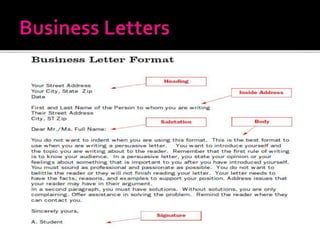
 Letters include these standard elements, in this order:
 Outside address (yours). If you are using paper with a
letterhead, you do not need a separate outside
address.
 Date
 Inside address (readers)
 Salutation (Dear….)
 Body (one or more paragraphs)
 Complimentary closing (Sincerely,YoursTruly,
Respectfully, BestWishes, Cordially, etc.)
 Signature
 If you are enclosing any materials
with your letter, type “Enclosure” or
“Enc.” two spaces below your
signature; identify the number of
enclosures if there is more than one
(e.g., “Enc. 3).
 If you are sending copies of the
letter to other reciepients, type
“cc:” followed by their names two
spaces below the enclosure notice
OR under your signature if you
have no enclosures. If more than
one other reader is receiving
copies, list their names vertically.
 Letters commonly use block or modified
block format. In block format, all letter
elements are placed against the left
margin. In modified block format, the
writer’s (inside) address, closing, and
signature are placed against the right
margin.
 Professional letters are single spaced, and
paragraphs are not indented.
 Start out right
 Letters often follow up on other
communication: in person meetings, other
letters, phone calls, etc. If your letter does so,
refer to that previous contact. E.g., “It was a
pleasure visiting you in your Atlanta office…”
or “We were sorry to learn of the problems
you had with your power saw.”
 Like other forms of business correspondence,
letters should make their purpose clear
immediately and if possible, deliver their
main point at the beginning of the letter. If
the letter is giving bad news to the reader,
deliver that news in a second paragraph
AFTER acknowledging earlier communication
and the issue you are addressing, and
expressing sympathy.
Thank you

Technical English.pptx

  • 1.
  • 2.
     Business Letters Business letters are used in many different professional contexts— business, health care, government, nonprofit organization, etc.—for official communication with individuals or a small group of individuals outside of the writer’s organization.
  • 3.
     While theyare more formal and more structured than personal letters (or business memos or emails), they are still a form of personal communication. Letters address their readers as individuals, show awareness of the relationship writers have with their readers, and maintain a professional yet personable tone.
  • 4.
     The “YouAttitude”  To establish the appropriate tone, letters should be reader-centered.They should employ a “you attitude,” meaning the focus of the letter remains on the reader and his or her concerns rather than on the writer, and shows the reader courtesy and respect.
  • 6.
     These guidelinescan help you achieve a “you attitude”:  Avoid using first person pronouns (I,We) when possible. Address readers directly as “you.”  Think of and focus on readers’ interests and needs.  Be courteous and tactful; avoid being abrupt, terse, or accusatory. Respect readers’ intelligence.
  • 7.
     Be clearand specific; avoid making readers guess what you mean with unclear or general expressions.  Use simple English. Avoid using highly technical language or stilted “letterese” (e.g., “as per request,” “contingent upon,” “proceed forthwith”)
  • 8.
     Letter Partsand Format  Letters include these standard elements, in this order:  Outside address (yours). If you are using paper with a letterhead, you do not need a separate outside address.  Date  Inside address (readers)  Salutation (Dear….)  Body (one or more paragraphs)  Complimentary closing (Sincerely,YoursTruly, Respectfully, BestWishes, Cordially, etc.)  Signature
  • 9.
     If youare enclosing any materials with your letter, type “Enclosure” or “Enc.” two spaces below your signature; identify the number of enclosures if there is more than one (e.g., “Enc. 3).
  • 10.
     If youare sending copies of the letter to other reciepients, type “cc:” followed by their names two spaces below the enclosure notice OR under your signature if you have no enclosures. If more than one other reader is receiving copies, list their names vertically.
  • 11.
     Letters commonlyuse block or modified block format. In block format, all letter elements are placed against the left margin. In modified block format, the writer’s (inside) address, closing, and signature are placed against the right margin.  Professional letters are single spaced, and paragraphs are not indented.
  • 12.
     Start outright  Letters often follow up on other communication: in person meetings, other letters, phone calls, etc. If your letter does so, refer to that previous contact. E.g., “It was a pleasure visiting you in your Atlanta office…” or “We were sorry to learn of the problems you had with your power saw.”
  • 13.
     Like otherforms of business correspondence, letters should make their purpose clear immediately and if possible, deliver their main point at the beginning of the letter. If the letter is giving bad news to the reader, deliver that news in a second paragraph AFTER acknowledging earlier communication and the issue you are addressing, and expressing sympathy.
  • 15.