Services Offered & Approach Used


                                   1
Caplan Therapy Centre
         Tom Caplan, MSW
        Phone: 514-737-7208
         Fax: 514-737-0497
    eMail: tcaplan@sympatico.ca
    Web: www.tomcaplanmsw.com
      Web: www.needs-abc.com
        5845 Cote des Neiges
             Suite 440
           Montreal, QC
              H3S 1Z4
                                   2
Present Clinical Work
    Adjunct Professor at McGill S.W. School
    McGill Domestic Violence Clinic
    Research
    Papers
    Books
    Designated DV Expert in the Quebec Court System
    Private Practice
    Approved AAMFT Clinical Supervisor
    Caplan Therapy Centre
       Montreal Anger Management Centre

       McGill Domestic Violence Clinic

    Clinical Training on Behaviour Management and the
     Needs ABC Model
                                                         3
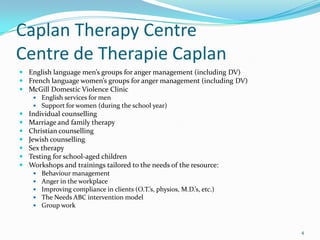
Caplan Therapy Centre
Centre de Therapie Caplan
 English language men’s groups for anger management (including DV)
 French language women’s groups for anger management (including DV)
 McGill Domestic Violence Clinic
     English services for men
     Support for women (during the school year)
 Individual counselling
 Marriage and family therapy
 Christian counselling
 Jewish counselling
 Sex therapy
 Testing for school-aged children
 Workshops and trainings tailored to the needs of the resource:
     Behaviour management
     Anger in the workplace
     Improving compliance in clients (O.T.’s, physios, M.D.’s, etc.)
     The Needs ABC intervention model
     Group work


                                                                        4
Professional Status of CTC
 All clinicians have a minimum of a Master’s level
  degree
 All are members of a professional order
 All are trained in the Needs ABC Model as well as
  other accredited intervention models

Note: We are the only resource for Anger Management
whose clinicians all are accredited by a professional
order.

                                                        5
6
Quest for the
“Holy Grail” of Relational Therapy
 Looking for a better and more effective way of helping clients – individuals, couples and
  families – to move forward with an improved quality of life together.
 This quest exists despite the brilliant approaches created by – but not limited to:

       Jacobson
       Gottman                             Have any of you presented?
       Greenberg
       Johnson                             So – How am “I“ feeling
       White
       Miller
                                            today?
       Rollnick
       Teyber                              What do I need to feel
       De Shazer                           better?
       Ellis
       Glasser
       And others


                                                                                              7
What I Have Learned
 All models have merit and can succeed or fail
  depending upon the therapists style and/or
  personality
 The best way to work on a problem is NOT to work on
  the problem
 Individual client needs and feelings in relationships
  need to be defined and clarified


                                                          8
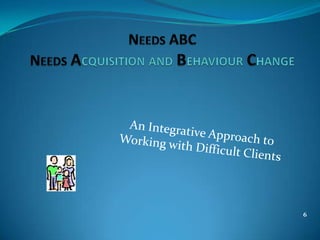
Model
[Needs ABC]
 This model is presently being used with problems such
  as:
    Substance abuse
    Anger management - DV
    Gambling
 There are two parts to the model:
    1. Determining a clients relational needs
    2. Collaborating on strategies to get needs met
     productively with an eye on emotion


                                                          9
10
 10
Behaviour Management
 Treatment Goals?
    The immediate cessation of all forms of inappropriate behaviour
     within and without the family or contextual setting.
    Effective case management: if several professionals are involved in
     treating the client (s)
    Creating and Maintaining Hope


 Stages of Treatment
    Stage 1: Creating a Context for Change
    Stage 2: Creatively Challenging Old Patterns and Expanding New
     Alternatives
    Stage 3: Consolidation of New More Productive Behaviours
         Restoration of Positive Behaviours versus Retribution

                                                                           11
Needs ABC Approach
 Does all 3:
   Creating a Context for Change (safety)
   Supportively Challenges Old Patterns and Promotes
    New Alternatives to Problem-Solving through:
       Consolidation of New More Productive Behaviours
       Restoration of Positive Behaviours versus Retribution


                                                                12
The Most Difficult Journey
The most difficult journey of all is the distance between
 two people.
Author unknown – Perhaps a take off on the Victor Borge quote: “Laughter is the shortest
   distance between two people.”


                                                                                           13
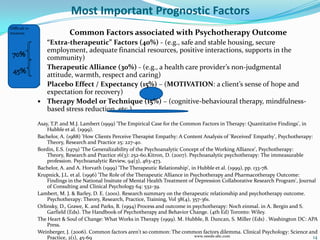
Most Important Prognostic Factors
Difficult to
measure                     Common Factors associated with Psychotherapy Outcome
                “Extra-therapeutic” Factors (40%) - (e.g., safe and stable housing, secure
                 employment, adequate financial resources, positive interactions, supports in the
                 community)
                Therapeutic Alliance (30%) - (e.g., a health care provider’s non-judgmental
                 attitude, warmth, respect and caring)
                Placebo Effect / Expectancy (15%) – (MOTIVATION: a client’s sense of hope and
                 expectation for recovery)
                Therapy Model or Technique (15%) – (cognitive-behavioural therapy, mindfulness-
                 based stress reduction, etc.)

               Asay, T.P. and M.J. Lambert (1999) 'The Empirical Case for the Common Factors in Therapy: Quantitative Findings', in
                   Hubble et al. (1999).
               Bachelor, A. (1988) 'How Clients Perceive Therapist Empathy: A Content Analysis of 'Received' Empathy', Psychotherapy:
                   Theory, Research and Practice 25: 227-40.
               Bordin, E.S. (1979) 'The Generalizability of the Psychoanalytic Concept of the Working Alliance', Psychotherapy:
                   Theory, Research and Practice 16(3): 252-60.Kitron, D. (2007). Psychoanalytic psychotherapy: The immeasurable
                   profession. Psychoanalytic Review, 94(3), 463-473.
               Bachelor, A. and A. Horvath (1999) 'The Therapeutic Relationship', in Hubble et al. (1999), pp. 133-78.
               Krupnick, J.L. et al. (1996) 'The Role of the Therapeutic Alliance in Psychotherapy and Pharmacotherapy Outcome:
                   Findings in the National Insitute of Mental Health Treatment of Depression Collaborative Research Program', Journal
                   of Consulting and Clinical Psychology 64: 532-39.
               Lambert, M. J. & Barley, D. E. (2001). Research summary on the therapeutic relationship and psychotherapy outcome.
                   Psychotherapy: Theory, Research, Practice, Training, Vol 38(4), 357-361.
               Orlinsky, D., Grawe, K. and Parks, B. (1994) Process and outcome in psychotherapy: Noch einmal. in A. Bergin and S.
                   Garfield (Eds). The Handbook of Psychotherapy and Behavior Change. (4th Ed) Toronto: Wiley.
               The Heart & Soul of Change: What Works in Therapy (1999). M. Hubble, B. Duncan, S. Miller (Eds) . Washington DC: APA
                   Press.
               Weinberger, J. (2006). Common factors aren't so common: The common factors dilemma. Clinical Psychology: Science and
                   Practice, 2(1), 45-69                                               www.needs-abc.com                              14
Therefore: Strengths of Model

 The model helps clients to take responsibility by
  focusing on THEIR needs (not on others such as the
  partner, the employer , the system, etc.)

 This model helps clients to feel understood and
  supported (joining)


                                                    15
Needs Acquisition and Behaviour Change Model
An Integrated, Relational, Client-Focused Approach
to Therapy – using concepts also described in:
 Cognitive-Behavioural / Motivational
    (Ellis 1997, Jacobsen 1995, Miller & Rollnick 1991)
 Narrative
    (White 1990, Jenkins 1990, Avis-Myers 2004)
 Solution Focused
    (De Shazer 1991, I.K. Berg 1993)
 Emotion Focused
    (Greenberg & Johnson 1988, Greenberg & Pavio 1997)
 Process-Oriented
    (Shulman 1992, Teyber, 2000, Caplan, 2005)


                                                           16
Basic Assumption of the Model

   It is the NEED (as described in the theme of a
    client’s narrative) that DRIVES the EMOTIONS.

   It is EMOTION that DRIVES the BEHAVIOURS.

   MEETING THE NEED – through appropriate
    behaviour – will result in EXTINGUISHING the
    inappropriate BEHAVIOUR.


                                                   17
The Needs ABC Model’s Focus:
 On Relational needs – NOT on client behaviours!
 (defensiveness - shame!)

 On the emotions they predict when unmet


                                                    18
The Needs ABC Model’s strategy:
   Illuminate a client’s missing relational
    needs
   Highlight emotions that are more
    relationally productive
   Help clients to
      communicate these needs productively;
       and/or
      Acquire these needs more functionally


                                               19
Benefits of Using Model
 It is a way of listening
    You can continue to use your own style and strategies, etc.
    You can integrate it with the model you are using.

 It gives clients “answers” – something tangible to work with.
    You can “label” the client’s struggle
    Relational triggers are demystified

 It helps to lead clients away from a “power struggle” and towards
  collaborative problem-solving.

 The model transcends sexual, racial and cultural issues.

 The model can also reduce anxiety for clients with Mental Health
  Issues.


                                                                      20
Interesting Quote
 They may forget what you said, but they will never
 forget how you made them feel.
        Carl Buchner


                                                       21
Needs ABC Emotion Concepts

  “Emotion Focus” Helping the client to
  understand their emotional possibilities.

  “Emotion Conscious” Helping the client
  to understand which emotions are more
  useful in problem-solving.


                                              22
Needs ABC Emotion Focus
 Less “Useful” [productive] emotions tend to
  drive problematic behaviours and, as a result,
  tend not to get our needs met.

 More “Useful” [productive] emotions tend to
  expose more appropriate options for satisfying
  unmet needs.

Note: A “useful emotion” is one that will facilitate problem-
resolution at that time.

                                                            23
Questions
                         Trainings
                         Available

 Tom Caplan, MSW

  (514) 737-7208
 tcaplan@sympatico.ca

  www.needs-abc.com
 www.tomcaplanmsw.com


                                     24
Questions
            Trainings Available


                                  25

Ctc General Pr

  • 1.
    Services Offered &Approach Used 1
  • 2.
    Caplan Therapy Centre  Tom Caplan, MSW  Phone: 514-737-7208  Fax: 514-737-0497  eMail: tcaplan@sympatico.ca  Web: www.tomcaplanmsw.com  Web: www.needs-abc.com  5845 Cote des Neiges  Suite 440  Montreal, QC  H3S 1Z4 2
  • 3.
    Present Clinical Work  Adjunct Professor at McGill S.W. School  McGill Domestic Violence Clinic  Research  Papers  Books  Designated DV Expert in the Quebec Court System  Private Practice  Approved AAMFT Clinical Supervisor  Caplan Therapy Centre  Montreal Anger Management Centre  McGill Domestic Violence Clinic  Clinical Training on Behaviour Management and the Needs ABC Model 3
  • 4.
    Caplan Therapy Centre Centrede Therapie Caplan  English language men’s groups for anger management (including DV)  French language women’s groups for anger management (including DV)  McGill Domestic Violence Clinic  English services for men  Support for women (during the school year)  Individual counselling  Marriage and family therapy  Christian counselling  Jewish counselling  Sex therapy  Testing for school-aged children  Workshops and trainings tailored to the needs of the resource:  Behaviour management  Anger in the workplace  Improving compliance in clients (O.T.’s, physios, M.D.’s, etc.)  The Needs ABC intervention model  Group work 4
  • 5.
    Professional Status ofCTC  All clinicians have a minimum of a Master’s level degree  All are members of a professional order  All are trained in the Needs ABC Model as well as other accredited intervention models Note: We are the only resource for Anger Management whose clinicians all are accredited by a professional order. 5
  • 6.
  • 7.
    Quest for the “HolyGrail” of Relational Therapy  Looking for a better and more effective way of helping clients – individuals, couples and families – to move forward with an improved quality of life together.  This quest exists despite the brilliant approaches created by – but not limited to:  Jacobson  Gottman Have any of you presented?  Greenberg  Johnson So – How am “I“ feeling  White  Miller today?  Rollnick  Teyber What do I need to feel  De Shazer better?  Ellis  Glasser  And others 7
  • 8.
    What I HaveLearned  All models have merit and can succeed or fail depending upon the therapists style and/or personality  The best way to work on a problem is NOT to work on the problem  Individual client needs and feelings in relationships need to be defined and clarified 8
  • 9.
    Model [Needs ABC]  Thismodel is presently being used with problems such as:  Substance abuse  Anger management - DV  Gambling  There are two parts to the model:  1. Determining a clients relational needs  2. Collaborating on strategies to get needs met productively with an eye on emotion 9
  • 10.
  • 11.
    Behaviour Management  TreatmentGoals?  The immediate cessation of all forms of inappropriate behaviour within and without the family or contextual setting.  Effective case management: if several professionals are involved in treating the client (s)  Creating and Maintaining Hope  Stages of Treatment  Stage 1: Creating a Context for Change  Stage 2: Creatively Challenging Old Patterns and Expanding New Alternatives  Stage 3: Consolidation of New More Productive Behaviours  Restoration of Positive Behaviours versus Retribution 11
  • 12.
    Needs ABC Approach Does all 3:  Creating a Context for Change (safety)  Supportively Challenges Old Patterns and Promotes New Alternatives to Problem-Solving through:  Consolidation of New More Productive Behaviours  Restoration of Positive Behaviours versus Retribution 12
  • 13.
    The Most DifficultJourney The most difficult journey of all is the distance between two people. Author unknown – Perhaps a take off on the Victor Borge quote: “Laughter is the shortest distance between two people.” 13
  • 14.
    Most Important PrognosticFactors Difficult to measure Common Factors associated with Psychotherapy Outcome  “Extra-therapeutic” Factors (40%) - (e.g., safe and stable housing, secure employment, adequate financial resources, positive interactions, supports in the community)  Therapeutic Alliance (30%) - (e.g., a health care provider’s non-judgmental attitude, warmth, respect and caring)  Placebo Effect / Expectancy (15%) – (MOTIVATION: a client’s sense of hope and expectation for recovery)  Therapy Model or Technique (15%) – (cognitive-behavioural therapy, mindfulness- based stress reduction, etc.) Asay, T.P. and M.J. Lambert (1999) 'The Empirical Case for the Common Factors in Therapy: Quantitative Findings', in Hubble et al. (1999). Bachelor, A. (1988) 'How Clients Perceive Therapist Empathy: A Content Analysis of 'Received' Empathy', Psychotherapy: Theory, Research and Practice 25: 227-40. Bordin, E.S. (1979) 'The Generalizability of the Psychoanalytic Concept of the Working Alliance', Psychotherapy: Theory, Research and Practice 16(3): 252-60.Kitron, D. (2007). Psychoanalytic psychotherapy: The immeasurable profession. Psychoanalytic Review, 94(3), 463-473. Bachelor, A. and A. Horvath (1999) 'The Therapeutic Relationship', in Hubble et al. (1999), pp. 133-78. Krupnick, J.L. et al. (1996) 'The Role of the Therapeutic Alliance in Psychotherapy and Pharmacotherapy Outcome: Findings in the National Insitute of Mental Health Treatment of Depression Collaborative Research Program', Journal of Consulting and Clinical Psychology 64: 532-39. Lambert, M. J. & Barley, D. E. (2001). Research summary on the therapeutic relationship and psychotherapy outcome. Psychotherapy: Theory, Research, Practice, Training, Vol 38(4), 357-361. Orlinsky, D., Grawe, K. and Parks, B. (1994) Process and outcome in psychotherapy: Noch einmal. in A. Bergin and S. Garfield (Eds). The Handbook of Psychotherapy and Behavior Change. (4th Ed) Toronto: Wiley. The Heart & Soul of Change: What Works in Therapy (1999). M. Hubble, B. Duncan, S. Miller (Eds) . Washington DC: APA Press. Weinberger, J. (2006). Common factors aren't so common: The common factors dilemma. Clinical Psychology: Science and Practice, 2(1), 45-69 www.needs-abc.com 14
  • 15.
    Therefore: Strengths ofModel  The model helps clients to take responsibility by focusing on THEIR needs (not on others such as the partner, the employer , the system, etc.)  This model helps clients to feel understood and supported (joining) 15
  • 16.
    Needs Acquisition andBehaviour Change Model An Integrated, Relational, Client-Focused Approach to Therapy – using concepts also described in:  Cognitive-Behavioural / Motivational  (Ellis 1997, Jacobsen 1995, Miller & Rollnick 1991)  Narrative  (White 1990, Jenkins 1990, Avis-Myers 2004)  Solution Focused  (De Shazer 1991, I.K. Berg 1993)  Emotion Focused  (Greenberg & Johnson 1988, Greenberg & Pavio 1997)  Process-Oriented  (Shulman 1992, Teyber, 2000, Caplan, 2005) 16
  • 17.
    Basic Assumption ofthe Model  It is the NEED (as described in the theme of a client’s narrative) that DRIVES the EMOTIONS.  It is EMOTION that DRIVES the BEHAVIOURS.  MEETING THE NEED – through appropriate behaviour – will result in EXTINGUISHING the inappropriate BEHAVIOUR. 17
  • 18.
    The Needs ABCModel’s Focus:  On Relational needs – NOT on client behaviours! (defensiveness - shame!)  On the emotions they predict when unmet 18
  • 19.
    The Needs ABCModel’s strategy:  Illuminate a client’s missing relational needs  Highlight emotions that are more relationally productive  Help clients to  communicate these needs productively; and/or  Acquire these needs more functionally 19
  • 20.
    Benefits of UsingModel  It is a way of listening  You can continue to use your own style and strategies, etc.  You can integrate it with the model you are using.  It gives clients “answers” – something tangible to work with.  You can “label” the client’s struggle  Relational triggers are demystified  It helps to lead clients away from a “power struggle” and towards collaborative problem-solving.  The model transcends sexual, racial and cultural issues.  The model can also reduce anxiety for clients with Mental Health Issues. 20
  • 21.
    Interesting Quote  Theymay forget what you said, but they will never forget how you made them feel. Carl Buchner 21
  • 22.
    Needs ABC EmotionConcepts  “Emotion Focus” Helping the client to understand their emotional possibilities.  “Emotion Conscious” Helping the client to understand which emotions are more useful in problem-solving. 22
  • 23.
    Needs ABC EmotionFocus  Less “Useful” [productive] emotions tend to drive problematic behaviours and, as a result, tend not to get our needs met.  More “Useful” [productive] emotions tend to expose more appropriate options for satisfying unmet needs. Note: A “useful emotion” is one that will facilitate problem- resolution at that time. 23
  • 24.
    Questions Trainings Available  Tom Caplan, MSW (514) 737-7208  tcaplan@sympatico.ca  www.needs-abc.com  www.tomcaplanmsw.com 24
  • 25.
    Questions Trainings Available 25